PRACTICES AND CHALLENGES OF SCHOOL BASED CONTINUOUS PROFESSIONAL
DEVELOPMENT IN SECONDARY SCHOOLS OF KEMASHI ZONE
BY:
ASHEBIR MEKONNEN
INSTITUTE OF EDUCATION AND PROFESSIONAL DEVELOPMENT STUDIES
DEPARTMENT OF EDUCATIONAL PLANNING AND MANAGEMENT
MARCH, 2014
JIMMA UNIVERSITY, ETHIOPIA
PRACTICES AND CHALLENGES OF SCHOOL BASED CONTINUOUS PROFESSIONA
DEVELOPMENT IN SECONDARY SCHOOLS OF KEMASHI ZONE
BY:
ASHEBIR MEKONNEN
ADVISORS:
MAIN ADVISOR: Mitiku Bekele (Ph.D)
CO-ADVISOR: Abunu Arega (Ph.D Candidate)
A THESIS SUBMITTED TO DEPARTMENT OF EDUCATIONAL PLANNING AND
MANAGEMENT IN PARTIAL FULFILLMENT FOR THE REQUIREMENTS OF DEGREE OF
MASTER OF ARTS IN EDUCATIONAL LEADERSHIP
DECLARATION
I, the undersigned, declared that this thesis is my original work and has not been presented for a degree in any other university, and that all source of materials used for the thesis have been duly acknowledged.
Name __________________________ Sign.________________________ Date_____________________________
This thesis has been submitted for examination with my approval as university advisor Main advisor- Name _______________________________
Sign ________________________________ Date _________________________________ Co-advisor- Name _________________________________
Sign _________________________________ Date __________________________________ Place: Jimma University
Institute of Education and Professional Development Studies Department of Educational Planning and Management Date of submission ____________________
I
Acknowledgements
First of all I extend my deepest gratitude and appreciation to my thesis advisors, Dr. Mitiku Bekele and Mr. Abunu Arega for their unreserved professional advice and guidance by giving constructive comments and useful suggestions. Indeed, without their great dedication, the development and completion of this study would have been impossible.
Moreover, I wish to express my thanks to all my friends, in Kemashi Zone Sample Secondary School principals, cluster supervisors, teachers, Woreda and Zone education office experts for their cooperation in giving necessary information, by filling me questionnaire, giving interview and providing me documents as well as the lecturers at Jimma University who cooperative in responding to my request in the process of writing this thesis.
In addition, my thanks go to Bello Djiganfoy Woreda education office for giving me the chance of following MA program in educational leadership at Jimma Universty. In addition I would like to thank Bello Djiganfoy Administrative Office, as well as the education office in providing moral and material support.
I would like to express my profound gratitude to my beloved wife, Mamene Kejela who shared all life burdens during my stay in the graduate studies.
I have deepest sense of gratitude and humble thanks to my loving Children‟s, parents, brothers and sisters who always helped me without any reward. I am also indebted to Ato Aregawi G/Medihin and AtoTegabu Tekele students of MA in Jimma University for their moral support. I want to extend my sincere gratitude to pensioned Ato Tesfa Gebere, Lakachew Yerdaw and Kes Zeleke Tiruneh who‟s looked after my family in all humanly possible ways.
I would also like to express my appreciation to my friends Ato Berhanu Meles, Mesert Getaneh and Tsedal Mengistu for their moral support and printing and duplicating questionnaires for data collection.
II TABLE OF CONTENTS Contents page Acknowledgements………..…I Table of contents……….II List of tables………...III List of figures……….VI Acronyms and abbreviations………VII Abstract………...VIII
CHAPTER ONE
1. Introduction……… ……… ..1
1.1 Background of the Study………...1
1.2 Statement of the Problem………..4
1.3 Objectives of the Study………... …...7
1.3.1 General Objective of the Study………....7
1.3.2 Specific Objectives of the Study………7
1.4 Significance of the Study………. 8
1.5 Scope of the Study………...9
1.6.Limitations of the Study……… ………...9
1.7 Organization of the Study……… ……….9
1.8 Operational Definition of Terms……… ……….10
CHAPTER TWO 2. Review of the Related Literature……… ….11
2.1The Concept of CPD………...11 2.1.1.Historical Development of CPD………... …14 2.1.2 The Benifits of CPD………... ……….……15 2.1.3 Principles of CPD……….... …...18 2.1.4 Features of Effective CPD……… …. ...19 2.1.5 The CPD Cycle……….22
2.2 The Major Activities of CPD………. ...23
2.2.1 Induction……… . ………. 23
III
2.2.3 Mentoring………. ………....26
2.2.4 Action Research……….. ……….28
2.2.5 Class Room Practice of CPD……… ………...29
2.3 Porfolios of Teacher Professional Development……… . ………..30
2.4 Continuous Professional Development in Ethiopia……… ...32
2.5 Functions and Responsibilities of the Concerned Bodies on CPD………… ...34
2.5.1 Functions and Responsibilities of Teachers……… …...34
2.5.2 Functions and Responsibilities of Principals……… ………...36
2.5.3 Functions and Responsibilities of CPD Facilitators……… ………..; 39
2.5.4 Functions and Responsibilities of Supervisors……… ……….. 40
2.5.5 Functions and Responsibilities of Woreda Education Offices…… ……….42
2.5.6 Functions and Responsibilities of Zone Education Department Office …..……….…42
2.6 The Challenges of CPD Implementation………. ….…..43
CHAPTER THREE 3. The Research Design and Methodology……….46
3.1 The Research Design……… ………...46
3.2 The Research Methodology……… ………. ….46
3.3 Sources of Data………...46
3.4 The Study Area and Population……… ………...47
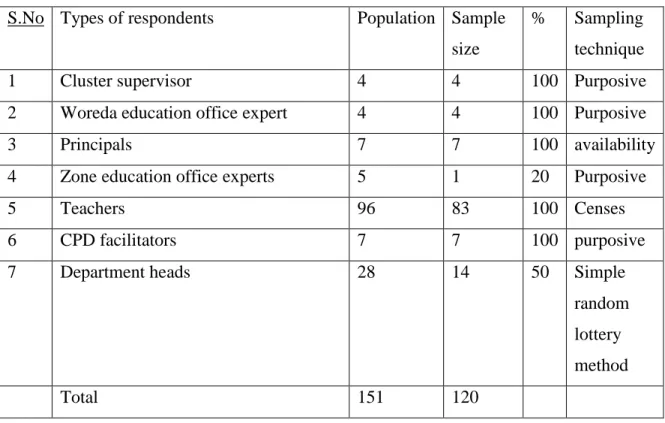
3.5 Sample Size and Sampling Technique……… ………48
3.6 Data Gathering Tools………. ………...50
3.6.1 Questionnaires……… ………..50
3.6.2 Interview……… ...51
3.6.3 Document Analysis……… ……….51
3.7 Data Collection Procedures……… ...52
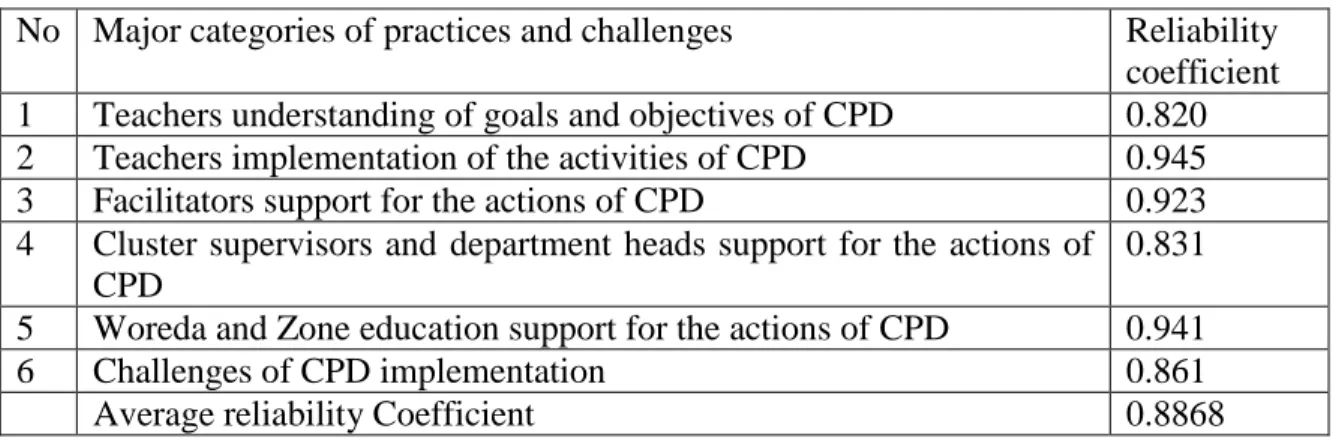
3.8 Validity and Reliabilty of the Study……… …….…...53
3.9 Methods of Data Analysis……… ……. ….54
3.9.1 Quantitative Data………. ……… …….54
3.9.2 Qualitative Data……… …..54
3.10 Ethical Considerations………. …54
IV
CHAPTER FOUR
4.1 Presentation, Analysis and Interpretation of Data………...………...56
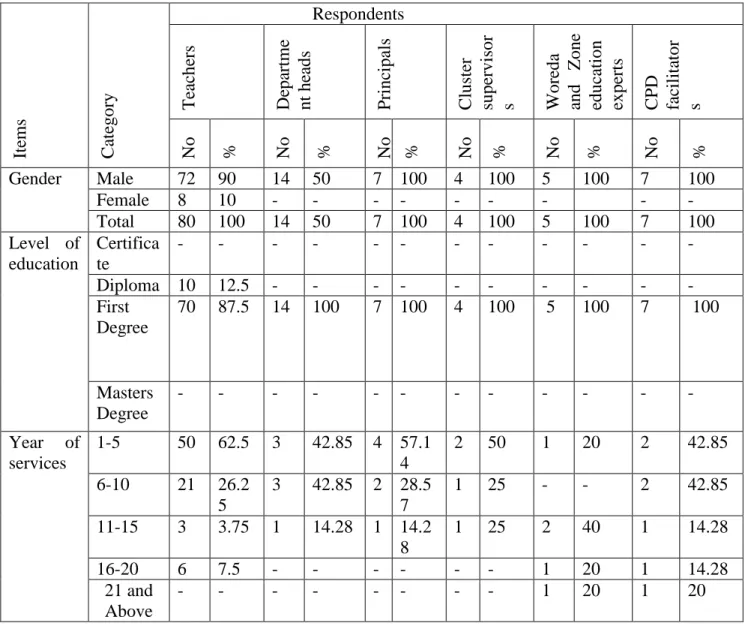
4.2 Characteristics of the Respondents……….……….57
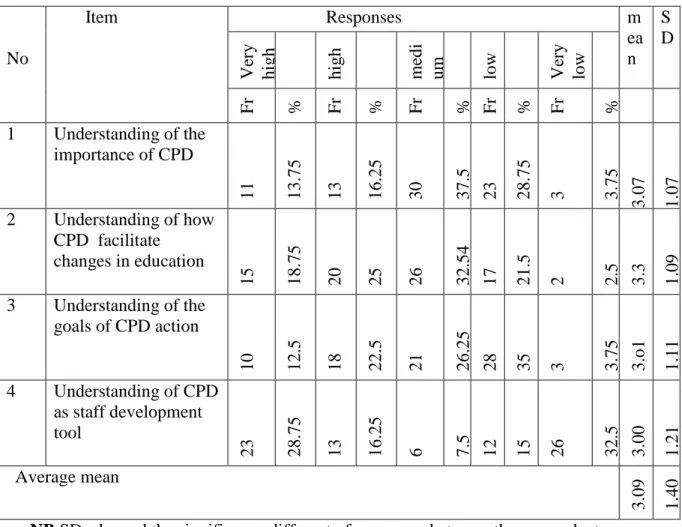
4.3 The Contribution of CPD to Achieve Teachers Competency……..………...…...60
4.4 The Importance of CPD Activities to Improve the Quality of Education……….………….62
4.5 The Implementation of CPD Practices………...…………...66
4.6 The Support of CPD for the Improvement of Teachers‟ Effectiveness in their Profession..70
4.7 The Support of School Principals on CPD Practices………..…...72
4.8The Support of CPD Facilitators in Enhancing the Practice of CPD………..… ..77
4.9 The Support of Cluster Supervisors for the Implementation of CPD……….……..79
4.10 Support from Woreda Education Office on the Practices of CPD……….… ...82
4.11 Support provided by Zone Education Office Experts to Implement CPD………….…….85
4.12 The Challenges of School Based CPD……….88
CHAPTER FIVE 5. Summary, Conclusion ad Recommendations………....95
5.1. Summary of Findings………...95
5.2 Conclusion……….97
5.3 Recommendations……….99
References……… …. ...102
V
LIST OF TABLES
List
Page
Table 1: Summary of Population,and Sample Size in each selected secondary schools ……….50
Table 2: Reliability Coefficient of the practices and challenges of school based CPD…………53
Table 3: Gender, Qualification and year of services of Respondents…………...……….58
Table 4: Teachers understanding of the Contribution of CPD to Achieve School Objective…...60
Table 5:Data Results of the Importance of CPD to Improve the Quality of Education ………..63
Table 6: Data Results of the Implementation of CPD Practices………...……67
Table 7: The support of CPD for Teachers Effectiveness in their Profession………...….70
Table 8: The support of School Principals in Enhancing the Practices of CPD………..73
Table 9: The support of CPD Facilitators in Enhancing the Practices of CPD ... 78
Table 10: Data Results from the Support of Cluster Supervisors……….…… ... 80
Table 11: Data Results from the Support of Woreda Education Office Experts……… 83
Table 12: Support provided by Zone Education Office Experts to Implement CPD………..…86
VI
List of Figures
Figure Page Figure1: The administrative map of Benishangul-Gumuz Regional State ………..48
VII
LIST OF ABBREVIATIONS ANDACRONYMS AREB- Amhara Region Education Bureau
BGRS- Benishangul- Gumuz Regional State
CPD- Continuous Professional Development
E.C-Ethiopian Calendar
ETP- Education and Training Policy
ESDP-Education Sector for Development Programs
TESO-Teacher Education System Overhaul
FDRE-Federal Democratic Republic of Ethiopia
GEQIP-General Education and Quality Improvement Program
MOE-Ministry of Education
OECD-Organization for Economic Co-Operation and Development
REB- Region Education Bureau
SPSS-Statistical Package for Social Sciences
TTA-Teacher Training Agency
USAID-United States Agency for International Development
VIII
ABSTRACT
The purpose of this study is to investigate the practices and challenges of school based teachers‟ continuous professional development in secondary schools of Kemashi Zone, Benishangul- Gumuz Regional State. The study is used four basic research questions. The research employed in the study was descriptive survey method, which is supplemented by qualitative data. The sampling techniques used included purposive, availability and simple random sampling. The sample size was 83 teachers, 14 department heads, seven principals, seven schools „continuous professional development facilitators, four woreda education office experts, four cluster supervisors and one zone education office expert with the total of 120 participants out of 151 study populations. The data gathering tools employed were questionnaire, interview as well as document analysis.The participants of interview were principals, department heads, Continuous Proffessional Development facilitators, cluster supervisors, woreda and zone education office experts. Questionnaire was administered to 83 teachers of which 80 of them were properly filled and returned. Then, the information gathered through closed-ended questionnaire was analyzed using percentage, frequency, standard deviation, and mean score while the data gathered through interview and open-ended questions were narrated qualitatively. Results of the document analysis were also described. The findings indicated that the extent to which teachers engagement in professional development activities such as mentoring, portfolio development, conducting action research, facilitating group discussions and peer observations, and evaluating the overall successes and failures of the implementation processes were inadequately implemented. The school principals, professional development facilitators, senior teachers, woreda and zone education office experts were providing insufficient support for the teachers. The major challenges identified were, lack of training, lack of action research, lack of fulfilling Continuous Professional Development materials, lack of trained facilitators, insufficiency of supports provided for teachers growth, insufficient allocation of budget, lack of peer coaching and peer evaluation, and absence of induction program, were identified by this research as the serious challenges of Continuous Professional Development realization in secondary schools of Kemashi Zone. To overcome the challenges encountered, recommendations
IX
have been forwarded. These include: orienting teachers in advance with the overall contents of the professional growth, motivating teachers to willingly take more responsibilities in the implementation process, employing trained facilitators, and allocation of sufficient resources to effectively achieve the intended goals. Moreover, Woreda education office has to allocate the necessary school budget.
1
CHAPTER ONE INTRODUCTION 1.1BACKGOUND OF THE STUDY
Education is believed to be one of the major forces that speed up economic, social and political advancements in society. It plays a major role in establishing suitable conditions for development process by producing skilled manpower and raising the human capital for national development and it helps to foster changes in technology (MoE, 1994 E.C). The World is in the constant change in all aspects of life. Changes in the education system of a nation and global requirements demanded staff development in respective professions. Haileselasse (2004) in this regard states that, while the world is evolving rapidly today, teachers like most other professional groups, must know the fact that their initial training will not fit them throughout the rest of their lives; they need to up-date and improve their own knowledge and techniques throughout their lifetime. As a result there has been an increase in focus on Continuing Professional Development for teachers worldwide. This is because CPD is continuously viewed as a means of improving learner performance and the production of required skills (Coolahan, 2002).
Continuous professional development is, therefore, vital for quality education and, teacher development is a never ending cycle of teacher learning that begins with initial teacher training and continuous for as long as a teacher remains in the profession. Hence teaching is a valued profession and it helps teachers to improve students‟ learning (Lange, 1990; 250).
The term CPD implies all the activities in which teachers involve during the course of a career which are designed to enhance their work (Day and Saches, 2004; 3).Such activities are intended to result in ongoing teacher learning, a process by which teachers move towards expertise (Kelly, 2006).In education Continuous Professional Development is increasingly becoming a priority in most countries throughout the world. It is widely viewed as the most effective approach to prepare teachers adequately, and
2
improve their instructional and intervention practices, for when they enter the work force (Fraser et al, 2007). In support of this,
Teachers are encouraged to embrace the concept of lifelong learning for their own benefit, for the benefit of the peoples they teach, the communities in which they live and the country at large.
Other researchers like, Kenneedy, and McKinney (2007), and Schwill and Dembele (2007) attributes CPD to the recognition to the wider policy agenda of lifelong learning as well as to the view of CPD as means of improving learner performance and development of required skills. Continuous professional development embraces the idea that individuals aim for the improvement of their professional skills and acquisition of knowledge beyond the basic training initially required to carry out the job (Gray, 2005). Guskey, (2002) describes professional development programs as systematic efforts to bring change in the classroom practices of teachers, in their attitudes and beliefs, and in the learning outcome of the students. This is also supported by Clarke and Hollings (2002) who argued that the most immediate and significant outcome of any successful CPD for teachers is a positive impact in changing teachers knowledge and practice. This in turn results in improved learner performance.
Furthermore, the school management bodies, such as principals, vice principals, and department heads, are the main motivators in creating shared vision for the curriculum in the school and in providing inspirational curriculum leadership. The instructional activity of leaders determines the success of the school and provision of quality education. The school management bodies should take the initiative in working together with teachers in designing and implementing developmental programs including the determination of training needs, approaches to satisfy the needs and follow up activities (spark, 2002) Additionally, Boalm (2000) and Hargreaves (1994) also recognize CPD to have a positive impact on the curriculum and pedagogy as well as teacher‟s effectiveness and their relationship with students. Hence, CPD is very important for teachers to become effective and competent in their profession throughout the world as well as in Ethiopia.
3
According to the national strategy of the ministry of education (MoE, 2009) CPD program is intended to all school teachers, leaders and supervisors in all regions of Ethiopia so as to participate in high quality and effective CPD which impacts classroom practices to ensure improved learning. It allows all teachers to improve their knowledge, skill and attitudes in order that they became more effective classroom practitioners and contribute positively to community development.
Therefore, within the frame work of the education and training policy (TGE, 1994) the education sector development program (ESDP) is launched as a twenty-year education sector plan with quality improvement at all levels of educational system. Continuous professional development is put into practice to enable teachers update themselves with new outlooks, approaches and policy directions. Moreover, CPD makes quality learning by increasing teachers‟ skills and knowledge in teaching –learning activities.
There are various efforts that are being made to implement CPD in Benishan gul-Gumuz Regional Education Bureau (BGREB) since 2007.Quality student learning is a burning issue of today in Ethiopia as well as in BGRS, especially in Kemash Zone. To ensure the quality of education, and improve the students result the professional development of teachers is the most important. Thus, one of the components of teachers‟ professional development is CPD and it helps to improve the classroom activities of teachers as well as students academic achievement.
Hence, teachers tried to practice CPD program in Kemashi Zone Secondary Schools, Benishangul-Gumuz Regional State. Regardless of the attempts, the genuine implementation of CPD program is far short from being fully realized and it does not practically improve the students‟ academic performance.
Therefore, one of the possible reasons could be problem with effective implementation of CPD, a gap giving support for the real implementation of CPD from supervisors, facilitators, and other concerned bodies. It is, therefore, important to fill the gap and it needs a scientific study so as to discover the condition of the practices and the challenges
4
that are being encountered in the process of CPD implementation in Kemashi Zone Secondary Schools to make the program doing well.
1.2 STATEMENT OF THE PROBELEM
Teachers are expected to continuously develop and improve their skills, techniques, and knowledge in order to best utilize new curricula and support continuous education reform initiatives. Continuous professional development can be provided in various ways such as: Pre-service training and orientation for new staff, in-service training provided by programs to current staff, Training seminars and resource provided by external organizations, mentoring programs, and discussion (sparks, and Hirish, 1997).
MoE, (2003) having stressed the importance of CPD, decided to provide as on the job training programs such as workshops, symposiums or seminars shall be extensively given as part of CPD to improve the quality of teachers. To improve their effectiveness, the Education and Training Policy (ETP) set high standards for teachers and described a new approach to education. At the spirit of this new approach was to the promotion of more active learning, problem solving and student centered teaching methods by implementing CPD.
Research surveys study, by Desalgne (2010) reveals that due to the expansion of education and large class sizes, teachers still relied largely on teacher centered methods and CPD activities are very poor. Continuous professional development helps teachers to improve their teaching activities and also students‟ academic performance. Because of this susceptible issue the policy clearly indicated that emphasis should be given to up grading and updating both in pre- service and in-service teachers to achieve pupils result (MoE, 2009).
As a result, schools must improve their basic functions of teaching and learning process aiming at helping students to raise the outcomes through instructional improvement. To achieve the expected out comes, there must be motivated and competent teachers, improved instructional situation and well designed curriculum.
5
In line with this, Mohanty (1990) states that in education system there are different kinds of variables that have their own contributions for development. Of all, the most important is the teacher who needs effective professional developments in all activities. The relevant and Quality Education can be provided for the pupils by involving well qualified teachers at all levels of education (MoE, 2009). Continuous professional development plays an important role in helping teachers to manage current demands of an-ongoing changes to enhance the quality of learning and teaching (Fullan, 2006) and (Hopkins and Harris, 2000).
In order to develop the quality of education and improve the professional skill of teachers, the school management bodies have the responsibility of practicing CPD within their schools by arranging workshops, meetings, regular observation of teachers and giving feedback.
The frame work document of MoE (2009:5) indicates that there are some problems with CPD practice in schools, such as “ time constraint ,lack of shared vision ,lack of common understanding of partners on CPD ,lack of collaboration in monitoring and evaluation system ,lack of adequate awareness among teachers, absence of clearly defined objectives ,turnover of CPD facilitators ,lack of qualified leadership, the absence of link between CPD, and teachers career structure” are identified problems in the CPD implementation process by secondary school teachers.
The General Education Quality Improvement Program (GEQIP) document of the Ministry of Education also shows that the on- going CPD program is still in pain from the lack of the need assessment of teachers training and lack of standardized training program (MoE ,2008).
According to Gizaw (2006) CPD has little effect on teachers‟ classroom practice, utilization of participatory approach of teaching, improved professional knowledge and skills. Moreover, another research study made by Berry (2008:30) in Ethiopia, conducted in three regions namely, Tigray, Afar and Amhara Regional States argued that although the policy is to upgrade all teachers to diploma level there is no difference in the teaching
6
quality of certificate and diploma holders; the practice of teachers in classroom remains a challenge.
Another research survey conducted by Belay (2012) in Benishangul-Gumuz Regional State in Metekel Zone Secondary Schools States that, teachers did not understand why CPD is offers, lower commitment of teachers and principals are the major problems in the study area. Moreover, my study focuses on to investigate deeply the presence or absence of the above listed problems and to propose solutions and to make further investigation of the implementation of CPD in Kemashi Zone Secondary Schools.
Additionally, from the sixteen years of personal experience of the researcher as a teacher and a principal many of Kemashi Zone Secondary School teachers and management bodies spend most of their time in teaching and learning activities and other administrative issues rather than effectively implementing CPD activities.
Therefore, there is a gap in planning CPD lessons together by teachers and other concerned bodies of the school stakeholders, lack of observation of CPD lessons, absence of team teaching, and lack of curriculum meetings in Secondary Schools of Kemashi Zone. Because the students‟ national examination results in grade ten and grade twelve very low in Kemashi Zone Secondary Schools in each year (BGREB,2002-2004E.C). As well as, unmotivated teachers, weak participation in CPD, and low student performance are the common problems in Kemashi Zone Secondary Schools.
Thus, this study would emphasize the assessments of the practices and challenges of CPD during the implementation process. As far as the present knowledge of the researcher is concerned, no any systematic study was reported on the practices and challenges of CPD in any of the Schools in Kemashi Zone and lack of quality education and low academic achievement of students is the serious issue in Kemashi Zone Secondary Schools (BGREB,2002-2004E.C). Therefore, low academic achievement of the students in Kemashi Zone Secondary Schools motivated me to do scientific research on this area. The investigation would conduct with the focus on in school CPD implementation.
7
In light of the above pressing and sensitive issues ,the researcher initiated to fill the gap and conduct in depth exploration of the problem with reference to Secondary Schools in Kemashi Zone ,Benishangul-Gumuz Regional State. Thus, to assess the extent of CPD implementation and to address the existing challenges the following basic research Questions were formulated.
1. To what extent CPD enhanced teachers‟ professional competence?
2. To what extent have school leaders and supervisors discharged the responsibility of implementing CPD?
3. To what extent do Woreda and Zone education office experts provide professional support to teachers?
4. What are the challenges of CPD implementation in Secondary Schools of Kemashi Zone?
1.3 OBJECTIVES OF THE STUDY
1.3.1 General Objectives
The main objective of this study was to assess the practices and challenges of CPD implementation in the Secondary Schools of Kemashi Zone, Benishangul- Gumuz Regional State.
1.3.2 Specific Objectives
To examine the current status of CPD practice in Secondary Schools of Kemashi Zone.
To explore the efforts of responsible school partners‟ at different levels in supporting the implementation of school CPD activities.
To investigate the contribution of principals and cluster supervisors in CPD implementation in the Secondary Schools of Kamashi Zone. To identify the challenges faced in the implementation of CPD.
8
1.4 SIGNIFICANCE OF THE STUDY
Continuous professional development is very important to improve the performance of teachers in the classroom in order to raise students‟ achievement. It is a career long process of improving knowledge, skills and attitudes centered, especially in the classroom, (MoE,2009).Continuous professional development (CPD) is being introduced to improve the quality of education. Therefore, reliable information about the way CPD is implemented by the stakeholders, the challenges facing the program, and the strategies to solve the problems is vital for teachers in the process of regulating and initiating new changes within the program. Moreover, the aim of any research is to get changes and propose solutions for the existing problems.
In light of this, the study would have the following benefits:
It may provide information for educational officials at Regional, Zonal, and Woreda level on the current practice and activities of CPD and help them discharge their responsibilities in Secondary Schools of Kemash Zone.
It may help principals, supervisors and teachers know the status of CPD implementation and discover challenges working against the success of CPD program.
It may provide information to policy designers that will help further development of educational actions.
The study will add to the existing literature pertaining to the experiences of educators in terms of CPD.
It is also hoped the study results would be contribute to the improvement of quality education by encouraging concerned bodies in school improvement program which ultimately ends with pupils‟ achievement.
9
1.5 SCOPE OF THE STUDY
In order to make the study more manageable, geographically the study was delimited to the seven Secondary Schools in Kemashi Zone, Benishangul Gumuz Regional State. The Zone is selected as the student researcher worked in the Zone as teacher and principal for the last sixteen years. This helped the researcher to easily obtain relevant information in the assessment of school based CPD to supplement the study. The study was also delimited to the assessment of the practices and challenges of the school based CPD program, the support given by school leaders and supervisors and the challenges encountered in the process of implementing school based CPD.
1.6. LIMITATIONS OF THE STUDY
It is obvious that research work could not be free from limitation, that matter this study was also constrained with some limitations. One of the limitations was that most of the Teachers, Principals, CPD facilitators, Department heads, Cluster supervisors, Woreda and Zone Education Office Experts were burdened by routine office and teaching activities and they were not devoted to fill the questionnaires and interviews on time.
1.7 ORGANIZATION OF THE STUDY
This study has five chapters. The first chapter deals with background of the study, statement of the problem, objectives of the study, significance of the study, the scope of the Study, Limitations of the Study, organization of the study, and operational definition of terms. The second chapter Reviews Literature related to the concepts of the problem area. Chapter three deals with Research design and methodology including the sources of data ,the study population, sample size and sampling technique ,procedures of data collection, data gathering tools, methodology of data analysis. Chapter four would include presentation of data analysis and interpretation of the findings. Chapter five would incorporate the summary, conclusion and recommendations of the study.
10
1.8 OPERATIONAL DEFINITION OF KEY TERMS
Continuous Professional development: - renewal of teachers‟ knowledge and
skills in their teaching and learning process.
School based Continuous Professional Development (SB-CPD): CPD programs practiced at school level by school leaders and teachers
CPD activities: planned of school based CPD actions to be performed.
Challenges of CPD- problems that school based CPD stake holders, especially teachers face in the implementation of CPD activities.
Mentoring: a continuous staff development activity usually done by an experienced teacher in school who trains and counsels new teachers.
Secondary School: Structure of educational system that includes general secondary education (9-10) and preparatory education (11-12).
11
CHAPTER TWO
REVIEW OF RELATED LIRATURE
The second part of the research presents relevant literatures related to the general concepts of the implementation of school based CPD program and the prevailing challenges. Published books, journals, policy documents and research reports are reviewed and briefly presented
2.1 The Concept of the Continuous Professional Development
The concept of continuous professional development emanates from the understanding that reflection on self-practices and collaboration are essential to improve competence and bring quality in education. Teachers and schools are responsible for student learning. Knowledge does not transfer from outsiders; it is to develop through collaborative discussions, application and reflection in accordance with local realities (Sparks and Hirsh, 1997). Therefore the commitment of teachers is very important to work together, to solve local problems, to increase the competency of teachers and to improve the students‟ academic performance.
Different scholars define CPD in different ways. But, they express similar ideas. The term continuing professional development refers to “all the activities in which teachers hold during the course of a career which are designed to enhance their work (Day & Sachs, 2004:3)‟‟.
Continuous professional development refers to any professional development activities involved in with a view to enhancing their knowledge and skills that will enable them to consider their attitudes and approaches to the education of children with a view to improve their quality of teaching and learning(Bubb & Early,2004 in Bolam,2003;Day and Saches,2004). Bubb and Early (2004) further explain that CPD is an ongoing process building upon initial teacher training and induction, including development and training chances throughout career.
In the frame Work document of MoE, (2009), CDP is defined as anything that makes me a better teacher, targeting at the improvement of teachers performance. According to
12
Gray (2005), CPD embraces the idea that individuals aim for continuous improvement in their professional skills and knowledge beyond the basic training initially required to carry out the job. In line with Gray‟s idea, Mohammed (2006) says that Continuing Professional Development may be regarded as all forms of „in service‟, „continuing education‟, „on-the-job-training‟, „workshop‟, „post qualification courses‟ etc. whether formal or informal, structured or unstructured, teacher initiated or system-initiated. And also we can define CPD as the pillar of teachers‟ teaching- Learning activities that helps the social and economic development of the society.
Continuing Professional Development is widely acknowledged to be of great importance in the life of schools, contributing to professional and personal development for staff and to improvement in teaching and learning. CPD is defined as: “Professional development consists of all natural learning experiences and those aware and planned activities which are intended to be of direct or indirect benefit to the individual, group or school, which constitute, through these, to the quality of education in the classroom (Day, 1999b)
In addition, Taylor (1995) initially identified two aspects of the professional development of teachers, namely: staff development and further professional study. Staff development was regarded as rooted in the needs of the institution. Further professional study referred to being orientated to the needs of individual teachers. Therefore, CPD can improve the activities of the organization, as well as the professional qualification of teachers.
According to Desimone (2009) concurs with Gray (2005) and Mohammed (2006) describes that Teachers experience is a vast range of activities and interactions that may increase their knowledge and skills and improve their teaching practice, as well as contribute to their personal, social, and emotional growth as teachers. These experiences can range from formal, structured topics specific seminars given on in-service days, to everyday, informal “entry” discussions with other teachers about instruction techniques, fixed in teachers‟ everyday work live. Hence experienced teachers can accomplish the CPD actions better than the newly appointed teachers.
13
Further, Desimone, Porter, Kwang Suk Yoon & Birman (2002) correspond with Guskey (2002) in looking at Professional development as an essential mechanism for deepening teachers' content knowledge and developing their teaching content knowledge and developing their teaching practices.
In addition, Fraser et al. (2007), list a number of competing claims for professional development that are evident in the literature of professional associations such as: Lifelong learning for professionals; a means of personal development; a means of assuring a doubtful public that professionals are indeed up-to date, given the rapid pace of technological advancement; a means for employers to gather a competent, adaptable workforce, a Means whereby professional associations can confirm that the standards of their Professions are being upheld.
Similarly, Steyn, and Vanniekerk, (2002) states that CPD is a continuing development program that focuses on the whole range of knowledge, and skill and required to educate learners effectively .It refers to the participation of teachers or management bodies in development activities in order to be better equipped as teachers and school management bodies.
Continuing Professional Development is important to teachers‟ personal lives and career development. Much emphasis has to be put on the nature of CPD as a „continuing‟ process for improvement in the knowledge and skills gained. As an ongoing process of any kind of education, training, learning and support activities engaged in by teachers alone or with others (Bolam, 1993).Continuous professional development enhances their knowledge and skills and enables them to consider their attitudes and approaches to the education of children, and to improve the quality of learning and teaching. In short, CPD focuses on fostering individual competence to enhance, practice and facilitate dynamic changes in education (Blandford, 2000).
Moreover, the recent meaning of CPD states that CPD means any activity that increases the skills, knowledge and understanding of teachers, and their effectiveness in schools
14
(Dajer, 2001). The central point to the success of the plan is the need for staff to work in schools with collaborative cultures. Continuous professional development( CPD) is a continuing process of education, learning, training, and supporting activities to achieve valued teaching and learning culture of teachers so that they can educate their students effectively and creating an agreed balance between individual, school and national needs (Bolam, 2002).
As a result, in today's rapidly changing work environment, keeping pace with changes and Developments in practice and to satisfy professional development requirements; it is mandatory to up-date professional qualities for school achievement. The response to this challenge is embracing the concept of professional training, in order to adapt with learning new skills through CPD.
For that reason, continuous professional growth is the process by which a teacher maintains the quality and relevance of the professional services that he or she delivers. Thus, CPD is the purposeful improvement of knowledge necessary for the professional and technical duties throughout the practitioner's working life (Robert, 1987).
Continuous professional development prepares teachers to manage their future responsibility because it is a future oriented process. It is considered in this research as one of the most important pedagogical activities that is used to improve teachers‟ effectiveness and enhance School improvement with all its constitute parts.
Totally, teaching as an occupation requires standards of trainings and constant rebirth. Continuous professional development is a sustainable progress of teachers‟ knowledge and skills in the process of teaching and learning.
2.1.1 HISTORICAL DEVELOPMENT OF CPD
In the 19th century teachers usually were poorly equipped professional attributes and usually not given attention of advancing their own profession .During that period teacher training was aimed at correcting mistake in teachers‟ academic background. But, teaching was professionalized at the turn of the century and schools appeared for the specific idea of training teachers and in-service education reform (Grant, Peggy and young, 2008).
15
In America, as noted by Abdal-Haqq (1998) the coming of rival countries to lead in scientific and economic competitions, such as the launching of the spuntnik satellite by the Soviet Union and the issue of socialist justice and pragmatism were the factors that initiated the needs of CPD.
Continuous professional development program is demanded because of increasing quality education and the demand to improve teachers‟ skills.
As a result government involvement in the professional development has increased over time and the program is now more prepared and became part of government policies and targets (Baldford, 2000). According to Nicollas, (2001) CPD was formerly known as in-service education and training. He also explained that CPD was first developed in 1960s in Great Britain. The reasons that gave for its appearance were problem identified on the issue of the quality of teaching.
Therefore, continuous professional development is the systematic progress of teachers‟ knowledge and skills and the improvement of learning throughout an individual working life. The programs include activities such as on the job training, conferences, seminars, workshops, and being a coach or mentor (Gust, 2004).
2.1.2 The Benefits of CPD
Continuous professional development program for teachers should aim at forming a better and more effective teacher capable of adapting to different school or classroom situations. At the same time, the end result of the change should be improved learning outcomes for the learners. Clarke and Hollingsworth (2002) stress that the most immediate and significant outcome of any successful CPD is a positive impact in changing teachers‟ knowledge and practice, which in turn should lead to improved learner performance.
In a research study on professional development of teachers reported by Guskey (2002), it was revealed that most teachers engage in CPD activities because they want to become
16
better teachers. These teachers see professional development program as among the most promising and most readily available route to growth on the job. It is also important to note that, for the vast majority of teachers, becoming a better teacher means enhancing student learning outcomes.
Scholars such as, Fullan & Hargreaves (1996); and Fullan (1999) also report similar findings that, teachers are attracted to professional development because they believe that it will expand their knowledge and skills, contribute to their growth, and enhance their effectiveness with students. Any development program therefore, that fail to address these needs, are doubtful to succeed (Fullan & Miles, 1992).
Additionally, Craft (1996), has identified the following for responsibility CPD for teachers: to improve the job performance skills of whole staff and individuals; to develop the professional knowledge and understanding of an individual teacher; to extend the personal or general education of an individual; to make staff feel respected, to promote job satisfaction among staff; to prepare teachers for change.
Moreover, Eraut (1995) emphasizes that in-service education raises the cultural and professional standard of the teaching force as a whole. Therefore, in-service education is also an indicator of the health of an education system as it contributes to a better teaching force and improved learner outcomes as noted earlier. The changes in classroom practices demanded by the educational reforms ultimately rely on teachers (Fullan and Miles, 1992; Spillane, 1999).Continuous professional development plays an important role in helping teachers to manage current demands of the on-going and dynamic changes for enhancing the quality of learning and teaching (Fullan, 1995; 2006; Hopkins and Harris, 2000)
.
As „the core of any innovation is the ongoing and constant process of change‟ (Curtis and Cheng, 2001:139), such an „ongoing‟ change process requires a great deal of learning on the part of teachers, and support and guidance are required for facilitating such learning of teachers (Putman and Borko, 1997; Ball and Cohen, 1999; Wilson and Berne,
17
1999). This learning of teachers should thus be regarded as ongoing and the importance of CPD should not be minimized (Blandford, 2000).
Teachers‟ CPD is generally viewed as a way for the improvement of learning and teaching. Bolam (1993) defines CPD as „any professional development activities engaged in by teachers which enhance their knowledge and skills and enable them to consider their attitudes and approaches to the education of children, with a view to improve the quality of the teaching and learning process‟.
Gordon (2004) has similar views about the purposes of CPD. He also outlines three core purposes of CPD, which are: Improvement of teaching and learning, in terms of curriculum development, restructuring, and instructional development, Improvement of school-parent collaboration and improvement of student assessment.
Hence, the overall purpose of the CPD program is to raise and improve teachers‟ subject matter knowledge based on the content of the curriculum and the teaching approaches which require teachers to involve students in the development of higher order thinking skills by developing more positive attitudes to their work at the school level, and strengthen professional identity. It also promotes teachers to recognize their work as a professional by providing new chance for growth, exploration, learning and development (villegasRiemers, 2003).
Moreover, the contribution of CPD for improved pre-service and in service training and professional support is pointed out in the educational sector review (ESDP IV) of the federal ministry of education (MoE, 2010).
Finally, the purpose of school based CPD is to authorize teachers of their capability in order to improve students‟ learning atmosphere.
18
2.1.3 Principles of CPD
The dynamic evolution of science, technology, culture and school system itself makes it necessary for the basic training of teachers to be complemented by the further training. According to West (1989), the principles of staff development are the following: Staff must see themselves as owners of the program, it must go well with all staffs, it must be rooted in the organizations‟ culture and it should be based on need assessment.
The principles are the basic rules developed to satisfy for the achievement of objectives. At present CPD is not mandatory in most countries of the world. But, governments are introduced legislation concerning CPD and linking it to carrier structure and evaluation of teachers. The legislation contains various principles and conditions of services (Schwill,Leu, e- tal, 2005).
According to the work of Leu and, Gray (2005) the major principles of CPD are the content of professional development focuses on what students are to learn and how to address the different problems students may have in learning the material. And also, Professional development should be based on analyses of the differences between (a) actual student performance and (b) goals and standards for student learning. Professional development should involve teachers in identifying what they need to learn and in developing the learning experiences in which they will be involved.
Moreover, professional development should be primarily school-based and built into the day-to-day work of teaching. Most professional development should be organized around collaborative problem solving. Professional development should be continuous and ongoing, involving follow-up and support for further learning – including support from sources external to the school that can provide necessary resources and new perspectives. Professional development should incorporate evaluation by multiple sources of information on (a) outcomes for students and (b) the instruction and other processes involved in implementing lessons learned through professional development (Leu and, Gray, 2005).
19
Generally, the principles of CPD help to show the features of professional teachers and are based on the societal requirements and cultural development of the society. MOE (1994) noted that professional requirements focuses on creativity, knowledge and skills, collaboration and cooperation between colleagues and its positive attitude towards the needs of the society.
According to MoE (2003) principles outlined in the Ethiopian context; there should be an initial CPD program phase for all teachers to follow. CPD should focus on areas of identified needs that are common across the system; Staff development program will be more effective if all on-going activities are registered or documented. One key element of CPD will be the provision of courses related to the levels and status of teachers, the renewal of a professional teaching license will require the completion of equivalent of stated minimum number of semester hours of CPD credits over the period concerned.
To sum up, the principles are the most important and help to realize the goals of the organizations. Teachers became professionals, and it built the daily work of teaching.
2.1.4 Features of Effective CPD
The most effective forms of professional development seem to be those that focus on clearly articulated priorities, providing on-going school based support to classroom teachers, deal with subject matter content as well as suitable instructional strategies and classroom management techniques and create opportunities for teachers to observe, experience and try out new teaching methods (OECD, 2005:128).
According to Sparks and Louck (1990) features of effective continuous professional development include: Program conducted in school settings and linked to school wide efforts, teachers participating as helpers to each other and as planners, with administrators, of in-service activities. And also, it focuses on self-instruction and with differentiated training opportunities, teachers in active roles, choosing goals and activities for themselves, emphasis on demonstration, supervised trials and feedback, training that
20
is concrete and on-going over time, and ongoing assistance and support available upon request are the major features of effective CPD.
According to WestEd (2002) an effective continuous professional development program as one that focuses on teachers as central to student learning, individual, collegial, and organizational improvement, respects and nurtures the intellectual and leadership capacity of teachers, principals, and others in the school community. Moreover, it reflects best available research and practice in teaching, learning, and leadership, enables teachers to develop further expertise in subject content, teaching strategies. And also, it uses of technologies, and other essential elements in teaching to high standards, Promotes the continuous inquiry and improvement embedded in the daily life of schools.
Furthermore, an effective CPD planned collaboratively by those who will participate in and facilitate development, Collaborative planning ensures ownership of the program, is driven by a coheret long-term plan. Change is a gradual process, hence, it needs to be given more time during which the teachers are monitored and given necessity evaluated ultimately on the basis of its impact on teacher effectiveness and student learning; and this assessment guides subsequent professional progress efforts. Teacher change and consequent improvements in learner performance are the ultimate goals of any CPD program for teachers (WestEd, 2002).
Another scholar, Lee (2002) conducted a study in Taiwan to examine the characteristics of effective CPD. In his study, effective staff development is described as for Treat every colleague as a potentially valuable contributor as: Teach other teachers, Share, discuss, and critique in public forums, Turn ownership of learning over to the learners, Situate learning in practice and relationships, Provide multiple access points into learning communities, Reflect on teaching by reflecting on learning, Share leadership, change professional characteristics and link it to the professional community.
Moreover, other researchers like Lieberman and Wood (2002) examine the features of good practice in CPD, in which „opportunities for sharing of ideas/strategies and current
21
developments with other teachers‟ is the most recognized feature of good practice in CPD. The other most recognized feature of good practice in CPD was „relevant content‟; whilst opportunities for „hands-on‟, practical experience was identified the vital advantage of CPD.
According to Desalgne (2010), effective CPD is directed towards providing teachers with the skills to teach and assess for deep understanding and to develop students‟ cognitive skill. It enhances teachers understanding of the content they teach and makes use of expert teachers and attractive classroom practitioners with the active participation of the stakeholders in improving, collaboration and planning of CPD practices.
The other common characteristics of effective CPD are situated learning and professional learning communities. CPD is effective when teacher learning occurred in authentic way through teachers‟ active involvement and participation. This authentic way of learning fundamentally situated in the context of the practice leading to the betterment of teaching and learning. Teachers put what they have learnt in to practice and new learning through social construction and negotiation of meanings by means of sharing, collegiality and reflection. In this learning process, collaboration is significance in shaping effective CPD. It is the basic to create professional learning communities. In collaboration can create teachers professional confidence and allow for interactions amongst teachers (Harris, 2003).
There has been a growing consensus that the most effective CPD is focused on teachers‟ classroom practice and in collaborative in nature. It claims that an increasing body of professional work demonstrates the value of moving collegial learning from the margins of professional practice to the heart of it in which classroom teachers not only as classroom expert in a single school but also as members of the boarder education community.
In addition, the features of effective school based CPD focuses on classroom practices and collaborative work, improving the teachers performance in the classroom, team
22
teaching and doing action research together, planning lessons in a group, observing each other and teachers work together (MoE,2009) .
And finally, the features of effective CPD are the support of the achievement of the students result as well as the professional development of teachers. Hence, to practice and implement CPD program helps to achieve success.
2.1.5 The CPD Cycle
The CPD Cycle is a carefully planned response to identified development needs” At each level - individual, group, institution, woreda, zone, and region, national - the CPD cycle is similar, (MoE, 2009). The major activities in CPD cycles are analysis of the existing situation, planning, doing, and evaluation. Then CPD analysis is related with the activity to select the learning needs of an individual, a group and an institution.
This activity includes: self assessment, peer review and selection of school CPD priorities, Curriculum meetings, Demonstration lessons, Planning lessons together, Peer observation, Observation of lessons and feedback, Observation of students in lessons,
talking to students, Assessment of students work before and after the CPD activity, Marking of students work. Additionally, giving feedback and advice for development,
Shadowing a teacher, Action research, Professional reading and research, Visiting schools and teachers to see examples of good practice, Sharing/showing good practice within a School, Maintaining a professional portfolio, Team teaching, Workshops, Visiting experts, Mentoring and Discussion meetings are the major activities of the CPD analysis, MoE (2009b).
Planning is part of the CPD cycle which is developed annually by every educational institution preceded by prioritizing the issue identified by the analysis process. The CPD plan can be prepared individually or institutionally with details of events and timings within the CPD module (MoE, 2009).
Doing is concerned with practical methodologies to realize the CPD needs in improving and updating the teacher performance. Such activities include curriculum reforms
23
planning, peer observation, action research, communicating students, sharing professional experiences, workshops, mentoring, discussion, and meetings. Evaluation is reviewing and to judge the effectiveness of the desired outcomes of the CPD action plans (MoE, 2009).
Generally, analysis the existing situation, planning, doing and evaluation are the major actions and variables of the CPD cycle.
2.2 THE MAJOR ACTIVITIES IN CPD 2.2.1 Induction
Induction is a systematic organizational effort to assist personnel to adjust to new assignment (Castetter, 1992). It could be argued that induction is an intended activity to help beginners and/or new staff so as to properly perform their duties. This is because the first year of teaching has always been difficult as almost any serving teaching will testify. Newly hired teachers need to understand how the system is functioning and how they fit into it.
Induction is a form of well organized professional assistance provided for beginner teachers and new staff to contribute for the proper accomplishment of their job. Newly deployed teachers need to understand how the school system is functioning and how to suit to it. Induction is provided for new teachers as transitional CPD in order to adapt or transform to the lifelong process (Gray, 2005).
More specifically, newly hired teachers face difficulties in understanding their responsibilities due to lack of information about the school‟s mission and its goals. It can be crucial for new staff to have job description and knowledge of the formal structure of the school (Craft, 2004). According to David (2006), unless teachers get sufficient information about their roles, responsibilities and other related issues, they will frustrate and may leave their profession.
24
Schools should avoid placing newly qualified teachers to perform complex tasks. They should establish guidance and provide assistance to ensure that they can demonstrate their proficiency in their teaching. To this effect, induction programs should be made to order based on analysis of individual needs to support new teachers from widely diverse backgrounds and experiences. The importance of teachers‟ induction both for the beginner teachers and the schools is that it contributes to avoid unnecessary tension and future fault.
According to Steyn and VanNiekerk(2002:232) new staff members are assisted through induction to adjust effectively to their work environment with the minimum trouble and as quickly as possible. Induction is therefore, familiarization process of all staff who is taking up a post in a new school or a new responsibility in the same school. Furthermore, Widen and Andrews (1987:142) point out that a well designed induction program is an excellent staff development model. The institutionalized induction program should be captured in the induction policy of the school. Schools that have an induction policy can assist in every one knowing about procedures, rights and responsibilities (Bubb and Earely, 2007:133).
Furthermore, a school induction policy should serve to insure that a planned induction program is followed, individuals involved in induction are aware of their roles and responsibilities.
The researchers such as, wideen and Andrews(1987;145) states that a strong induction program is characterized by experienced and beginning teachers participating in the planning, problem solving, decision making and implementation of the induction activities. The induction activities should be tailed into the CPD plan of the school. The induction, therefore, would serve the purpose of building a firm foundation for the future professional and career development of individual teachers (Bubb and Earely, 2007:128).
Therefore, an induction program can help teachers to tackle the problems they face and to cope with reality-shock they experience. Specially, an induction program is useful for new qualified teachers. Hence, the school management bodies need to give an induction
25
program for teachers and follow its practice and solve the problems that create difficulty in their work. More importantly, teachers‟ induction program is vital for both the beginner teachers and the schools and it contributes to keep away from unnecessary anxiety and future fault.
2.2.2 Peer Coaching
Coaching is the process where a person with expertise in the field assists colleagues through structured discussions and activities on how to solve their problems and perform their tasks better than they would do it without this assistance (TTA, 1998). The main purpose of coaching is improving practical skills. It takes place at workplace when workers seek advice, explanations or demonstrations. Major coaching opportunities are research, participation in study groups, problem-solving teams, observation on performance of their colleagues, writing journals, participating in improvement activities (Kalinauckas, 1995).
Peer coaching occurs when two or more peers, usually sharing the same grade, subject or learning area visit each other as they teach and discuss how to help learners (Heysteketal, 2008:186).Furthermore, (Heysteketal, 2008:186) quote Peixottoand Fagar(1998) when they state that peer coaching is particularly effective where teachers have undergone the same training and use chance to compare how they implement their newly gained skills. Hpkins, Ainscow and pointer West(1994:120) provide an important pointer when they write that the primary purpose of peer coaching is to support and not evaluation, thus peers are more appropriate partners‟ than administrators in this professional growth system.
In general coaching requires human interpersonal relationships, collegial atmosphere and collaboration. Skillful, knowledgeable and committed teachers are required to play coaching role. Selecting appropriate coaches is essential. If this process is successfully implemented in schools, the education system will benefit a lot.
26
2.2.3Mentoring
According to Bladford (2000), mentoring can be defined as process assistance offered by experienced staff to other practitioner who needs to acquire professional skill. The experienced practitioner is appointed as a mentor to assist beginning or inexperienced teacher to adapt to the load of a complex job of teaching.
Mentoring in schools is used when a beginner teacher is assigned to an experienced one. During mentoring, knowledge and skills are transferred by the more experienced teacher to less experienced teacher. The experienced teacher coaches the newly appointed teacher, eventually ensuring that he or she acquires the necessary knowledge and skills.
Mundry (2005:10) mentions that beginner teachers who wish to improve their teaching are assigned to an accomplished teacher mentor who teaches the same subject matter. Mentoring enhances the self image of mentors as they see themselves as competent, helpful and having personal exchange (Murrphy, 1996 as quoted in Ehrich and Hansford, 1997:1).
A mentor provides a new comer with support, problem solving, guidance and network of staff who shares resources, insight, practices and materials. Mentors are also expected to establish a supportive supervisory relationship and apply effective counseling skills (Bleach, 1999).
Moreover, induction tutors, in their day to day work with newly qualified teachers are expected to respect, encourage, motivate and understand them to take increasing responsibility for their own development.
In mentoring the school leaders and concerned officials need to plan appropriate mentoring programs and facilitate its implementation in order to get feedback and solve the challenges that can be faced through the process based on the feedback (Anderson and Shannon, 1995).
According to Rhodes (2004) mentoring is an essentially supportive process it can be used to support teachers through a combination of coaching and counseling. It is a powerful
27
personal development and empowerment tool. It is an effective way of helping people to progress in their careers and is becoming increasing popular as its potential is realized. It is partnership between two people normally working in a similar field.
For mentoring to be successful, it should be free from compulsion and external pressures. Mentees are free to choose their mentors. Mentoring activities are fruitful if they help newly qualified teachers to develop; if relationships are cohesive and efforts are collaborative.
Generally, mentoring is to support and encourage people to manage their own learning in order that they may maximize their potential, develop their skills, improve their performance and become the person they want to be.
Mentoring is a powerful personal development and empowerment tool. It is an effective way of helping people to progress in their careers and is becoming increasing popular as its potential is realized. It is a partnership between two people (mentor and mentee) normally working in a similar field or sharing similar experiences. It is a helpful relationship based upon mutual trust and respect.
A mentor is a guide who can help the mentee to find the right direction and who can help them to develop solutions to career issues. Mentors rely upon having had similar experiences to gain an empathy with the mentee and an understanding of their issues. Mentoring provides the mentee with an opportunity to think about career options and progress.
A mentor should help the mentee to believe in herself and boost her confidence. A mentor should ask questions and challenge, while providing guidance and encouragement. Mentoring allows the mentee to explore new ideas in confidence. It is a chance to look more closely at yourself, your issues, opportunities and what you want in life. Mentoring is about becoming more self aware, taking responsibility for your life and directing your life in the direction you decide, rather than leaving it to chance.