1
Corporate Social Responsibility in Supply Chains of Small and
Medium-Sized Enterprises
Hee-Yong Lee Yeungnam University
280 Daehak-Ro, Gyeongsan, Gyeongbuk South Korea, 712-749
E-mail: [email protected]
Dong-Wook Kwak Coventry University Priory Street, Coventry United Kingdom, CV1 5FB E-mail: [email protected]
Jeong-Yang Park (corresponding author) The University of Nottingham
Wollaton Road, Nottingham United Kingdom, NG8 1BB
E-mail: [email protected]
This is a pre-print (non-publisher’s document). Please cite this article as below:
Lee, H-Y., Kwak, D-W., and Park, J-Y. (2017) Corporate social responsibility in supply
2
Corporate Social Responsibility in Supply Chains of Small and
Medium-Sized Enterprises
ABSTRACT
Research has shown that implementation of corporate social responsibility (CSR) practice
represents a considerable challenge for small and medium-sized enterprises (SMEs). This
research conceptualises the dimensions and contingencies of CSR in SMEs’ supply chains.
Drawing on institutional theory and stakeholder theory, we investigates the degree of
importance and implementation of CSR practices in SMEs. A large-scale questionnaire
survey with SMEs in manufacturing sectors and panel discussions were conducted in South
Korea. The findings indicate that SMEs tend to focus on explicit CSR practices that can be
easily identified by their customers. Consistent with this, stakeholder and institutional
pressures were valid in the performance of CSR practices, but largely biased to customers,
government and regulatory pressures. Based on institutional theory and stakeholder theory as
overarching theoretical lenses, this research contributes to offer a fuller understanding of
dimensions of CSR practices in the supply chains from a SME perspective.
.
Keywords: corporate social responsibility, institutional theory, small and medium-sized
3
Corporate Social Responsibility in Supply Chains of Small and
Medium-Sized Enterprises
Introduction
In line with the increasingly shared consensus that organizations should implement corporate
social responsibility (CSR) practices, the form and concept of CSR has become prevalent in
business research which led to various conceptualisations by scholars. To date, developing a
widely-accepted conceptualisation of CSR is highly contested in the literature (Heikkurinen
and Ketola, 2012; McWilliams et al., 2006; Mohr et al., 2001; Welford et al., 2007). Given the complexity of the CSR concept, it is viewed mainly from four perspectives: as a social
obligation, as a stakeholder obligation, as an ethics-driven process and as a strategic
managerial process (Maignan and Ferrell, 2004; Oberseder et al., 2013). Within these CSR perspectives, CSR research and practice lies on a paradox between a notion of voluntary basis
or behaviour of social concerns in companies’ operations (Vilanova et al., 2008) and an opposing notion of social responsibilities that is typically mandated by law (Campbell et al., 2012). In any cases, the awareness of corporate social responsibility by the public has been
increasing, which led firms to implementing CSR practices across their supply chains.
The integration of CSR into supply chains has drawn much attention both from
practitioners and researchers with the current emphases on the triple bottom line of economic,
environmental and social concerns of business operations. However, sustainable supply chain
management (SSCM) research is largely biased to economic and environmental aspects (Hall
and Matos, 2010), which highlights the importance of CSR research focusing on both
4
CSR practices in supply chain management (SCM) is rather limited but it is becoming a field
of increasing interest, with research particularly concentrating on the CSR practices and
activities of large companies in their supply chains. Within CSR in SCM research, the
implementation of environmental and social standards along the supply chains (e.g. Seuring
and Muller, 2008) and the risks and challenges related to implementing and complying with
these environmental and social standards (e.g. Lim and Philips, 2008) have been studied.
Implementing CSR practices into the supply chain can be challenging and yet, despite the
increasing awareness of implementing CSR into supply chains, many firms, specifically
small and medium-sized enterprises (SMEs), struggle to see the real value of CSR practices
in terms of competitive advantages across the supply chains (Welford and Frost, 2006).
Due to the fact that the distribution of CSR complements the supply chains by linking
buyers and suppliers, the focus should integrate responsibilities of and for those parties into a
company’s role to implement the socially responsible businesses. In addition, the scope is
limited to large companies and public authorities, neglecting SMEs in the sustainability
debates (Achabou et al., 2015; Johnson, 2015). With CSR becoming increasingly critical to the today’s organizations whether small or large, there is need to fully understand the CSR
debates of SMEs as they tend to struggle to implement CSR practices. Indeed, SMEs are in a
weak position in supply chains and possess less resources, scope of operations and visibility
compared to large firms, which often leads to SMEs’ passive reactions to CSR practices and
implementations. Given the research gaps, this research aims to conceptualise the dimensions
of CSR in supply chains and investigate the degree of implementation of these CSR practices
from an SME perspective. It also explores the drivers of CSR which initiate and motivate
5
We believe that having a multidisciplinary perspective contribute to advancement of
research on CSR in supply chains. Under this notion, we provide a consolidated dimensions
to investigate CSR and SCM relationships and advance the theoretical understanding of CSR
in SME’s supply chains. The objectives of this paper are three-fold. The first is to
conceptualise the dimensions of CSR in supply chains, highlighting which CSR dimensions
are prioritised in the practice. The second is to demonstrate to what degree SMEs implement
CSR practices. The third is to explore the drivers of SMEs’ CSR practices based on
institutional theory and stakeholder theory. We employ the empirical findings of SMEs’
supply chains to illustrate this theoretical development. In order to address the objectives, we
investigated South Korean SMEs in the manufacturing industries who are involved in global
supply chains. We conducted a large scale questionnaires with manufacturing SMEs in
Gyeongbuk province in South Korea.
The remainder of this paper is structured as follows. In the next section, we review the
extant research that shed light on the dimensions and drivers of CSR in supply chains. Then,
the methodological approach of the empirical study is explained and then the findings are
presented and discussed. Finally, conclusions are drawn including theoretical and practical
implications for SME management with limitations of the study.
Literature Review
CSR in SMEs’ Supply Chains
For the purpose of this paper, we take the view of CSR as a concept whereby companies go
beyond and extend to the grounding CSR on a voluntary basis and integrate the greater notion
of socially binding responsibilities in their business operation and in their interface with their
6
117) where they define CSR as ‘actions that appear to further some social good, beyond the
interests of the firm and that which is required by law’. This interpretation of CSR suggests
the potential dimensions of CSR practices of business operations where CSR is firmly
connected to institutions of stakeholder or government involvement (Brunton et al., 2015; Heikkurinen and Ketola, 2012). Engaging with stakeholders, CSR can be viewed as an
imperative organisational task for firms in order to address ethical, social, environmental and
economic demands (Park and Ghauri, 2015).
Extending the notion of CSR to not only being socially responsible within the
organisation internally, CSR encompasses the idea of being responsible socially and
environmentally throughout its supply chain (Pedersen and Andersen, 2006). Research on
how to integrate CSR in SCM is rather limited but it is becoming a field of increasing interest,
with research particularly concentrating on the CSR practices and activities of large
corporations in their supply chains. Within CSR in supply chains, the implementation of
environmental and social standards along the supply chains (e.g. Seuring and Muller, 2008)
and the risks and challenges related to implementing and complying with these environmental
and social standards (e.g. Lim and Philips, 2008) have been researched.
Implementing CSR practices into the supply chains can be challenging and yet, despite
the increasing awareness of implementing CSR into supply chains, many firms struggle to see
the real value of CSR practices in terms of business profits and performance. In particular,
traditional concepts of CSR cannot fully capture the social responsibilities of supply chains
beyond a company. Due to the fact that the distribution of CSR complements the supply
chains by linking buyers and suppliers, it is highly required to take buyers and suppliers into
account for implementing sustainability with supply chains. For this reason, Carbone et al.
7
while incorporating both social and environmental dimensions for both levels. However,
there are just a few studies which consider the uniqueness of supply chain level
responsibilities, thus conceptualisation of these aspects is not common in the literature.
With respect to the organisational size in CSR-related activities and practices, the
literature tends to focus commonly on large corporations such as multinational enterprises
(MNEs) in developed countries (Jackson et al., 2008) and neglects SMEs in the current sustainability and sustainable development debates (Bos-Brouwers, 2010; Cassells and Lewis,
2011; Lee et al., 2016.). There is a clear knowledge gap in the link between CSR-SMEs (Perez-Sanchez et al., 2003; Russo and Perrini, 2010) although SMEs make up over 90 percent of the global population of corporations and offer more than half of employment in
both developed and developing economies (Jamali et al., 2009; Udayasankar, 2008). Consequently, SMEs produce major contributions in social and economic related activities
(Udayasankar, 2008). Given their importance, this gap needs to be addressed by focusing on
CSR putting emphasis specifically on SMEs. Towards a more holistic approach in CSR, there
is a need for more research into CSR in SCM specifically from a SME perspective (Ayuso et al., 2013; Pedersen, 2009). Typically, SMEs often seem to possess intrinsic differences when compared with large corporations. These differences come in the form of legal structures,
policies, sector, strategic orientation toward profit and institutional forms (Perrini, 2006).
Within SMEs environment, extant CSR theories and instruments suited for MNEs may
not be applicable for SMEs (Bos-Brouwers, 2010). In particular, SMEs typically possess
passive reactions towards CSR and sustainability partly due to insufficient financial resources
and competencies as well as informal management systems compared with large corporations
which put them in the weak position implementing CSR-related organisational practice (Park
8
SMEs’ management system is often seen as a hindering factor to adopt and implement CSR
practices (Baumann-Pauly et al., 2013). For SMEs, the commitment to CSR tends to be implicitly reflected in their internal structures and procedures with no formalised system to
promote CSR practices and processes (Baumann-Pauly et al., 2013). In this vein, Baumann-Pauly et al. (2013) indicate that large organisations seem to be better equipped at organising and implementing CSR explicitly in their formal organisational practices and procedures
which allow them to interact efficiently with stakeholders when compared to SMEs. In both
cases for SMEs and large organisations, the collaboration with external society plays a key
driver in promoting and implementing the CSR practice (Baumann-Pauly et al., 2013; Reyes-Rodriguez et al., 2016; Winsor, 2006). Knowledge about these enabling and inhibiting aspects could provide the CSR implementation practice in SMEs and under this premise, this
research incorporates a comprehensive stakeholder and institutional based framework to
understand CSR in SMEs, to which we now turn.
The Dimensions of CSR from Stakeholder Theory and Institutional Theory
In principle, both stakeholder theory and institutional theory are interlinked and contribute to
CSR on various levels which provide a guide to the drivers that initiate and motivate SMEs to
adopt CSR as well as the enablers that facilitate SMEs in achieving CSR activities in their
business practices. Accordingly, we can suggest possible avenues to illustrate the dimensions
of CSR in supply chains and demonstrate the degree of implementation of these CSR
practices from SMEs’ perspectives integrating stakeholder theory and institutional theory.
Stakeholder theory specifies the extent to which corporations interact with their stakeholders
appropriately (Laczniak and Murphy, 2006). It also illustrates the dimensionality of CSR
9
evaluation of CSR into business operations (Mishra and Suar, 2010).
In the conceptualisation of CSR, the centrality of stakeholders has been emphasised by
Campbell (2007). The primary stakeholders can include any individual, group, organisation,
institution, community and the environment (Spiller, 2000) as well as internal managers and
employees, customers, investors, government and suppliers (Panapanaan et al., 2003). They can even include any groups that may be required for long-term business survival and
management (Mitchell et al., 1997). Over the last twenty years, several SSCM literatures discuss wide-ranging forms of stakeholders which affect pressures to adopt sustainable
thinking, practices or activities (Gonzalez-Benito and Gonzalez-Benito, 2006; Wolf, 2013).
More precisely, current research on CSR from stakeholder perspectives fails to include
discussion of all or wider stakeholder mandates (Obersede et al., 2013). The omission of all or wider stakeholders is partly due to poor and different conceptualisation of CSR in the
literature and practice which affects directly or indirectly the identification of accurate
boundaries for whom corporations are responsible (Donaldson and Preston, 1995; Jones,
1995). The tensions between business-driven and stakeholder-driven systems and issues of
CSR are closely inter-related. Within the stakeholder perspective, there are various ways in
which stakeholders determine significant parts in supply chains as facilitators as well as
hinderers. Thus, SMEs are required to take in all stakeholders ‘who can affect, or are affected
by, the achievement of an organization’s mission’ (Freeman, 1984, p. 54). Consequently,
developing CSR for SMEs is complex and involves strategic decisions to formulate how they
encounter CSR activities or sustainability goals into their operations at a corporate level
(Polonsky and Jevons, 2009; Schneider and Wallenburg, 2012). More importantly,
Baumann-Pauly and Scherer (2012) highlight the importance of interacting and engaging with relevant
10
organisational structures in order to ensure the embeddedness of CSR related practices.
While the role of stakeholders has been widely researched, the role of institutions has
been relatively ignored in CSR research (Brammer et al., 2012). Institutional theory determines companies are socially embedded within a set of formal institutions such as
government regulation and informal institutions such as norms, conventions and shared
beliefs (North, 1990). In this vein, it facilitates to identify the different boundaries between
business associations and society. Within the dominant stands in institutional theory, there are
two aspects of CSR: the diversity and the dynamics of CSR (Tempel and Walgenbach, 2007).
Scott (1995) illustrates several social and cultural pressures that SMEs may face and be
required to fulfil within their specific institutional environments and networks for social
norms and rules. Given that the stakeholders’ demands are linked to the institutional pressures
(Reimann et al., 2012; Yang and Rivers, 2009), in complying with these institutional pressures, SMEs in supply chains may require adaptations of their values, processes,
structures and business practices. In the course of institutionalisation, CSR takes a wider
boundary of the market and government regulations. Thus, an institutional theory views CSR
practices beyond the territory of voluntary action.
This paper critically examines the contributions of stakeholder theory and institutional
theory to understanding the CSR practices in SCM and to investigating CSR-SME
relationships. Underpinned by these two theoretical foundations, this research conceptualise
the key dimensions of organising and implementing CSR in practices specifically from a
SME perspectives.
Research Methodology
11
explore their relative importance and implementation from SMEs’ perspectives. Also, it
sought to investigate the drivers of CSR implementation based on institution theory and
stakeholder theory. The empirical data for this study are from a large-scale questionnaire
survey with South Korean SMEs in manufacturing sectors and panel discussions, to which we
turn next.
Survey Data Collection
To investigate the CSR in supply chains, a large-scale questionnaire survey was conducted
with SMEs in South Korea. The survey sample was constrained to the manufacturing firms
which directly or indirectly involved in global supply chains so that supply chain contexts can
be fully integrated into the survey responses. South Korea is a rapidly developing economy
which has recently increased awareness of the CSR issues in its global SCM. For this
research, Gyeongbuk province in South Korea was selected for its long tradition of strong
focus on manufacturing sectors. A total of 200 questionnaires were distributed via email to
SMEs based in the province from February to March 2015. The list of these SMEs for this
survey was obtained from a government organisation, Gyeongbuk Pride Product Support Centre which supports the internationalisation and marketing of SMEs in the region since 2009. South Korean government defines a SME as a firm which employ fewer than 300
employees in the manufacturing sector.
The questionnaire consists of four parts. Following the first part which asked general
information about participating firms and respondents, the second part was designed to
measure the relative priority of CSR dimensions and CSR practices by pair-wise comparisons.
12
in their organisations. The last part covered the evaluation of contingencies that may affect
the level of CSR implementation based on institutional theory and stakeholder theory, namely
regulatory impact, normative impact, cognitive impact (institutional theory) and customers,
government, suppliers, competitors, local community and non-governmental organisations
(NGOs) (stakeholder theory). The third and fourth parts were measured by 7-point scales.
Before commencing the large-scale survey, this questionnaire was reviewed by CSR experts
and then by a pilot study to examine the applicability and validity of measurement items.
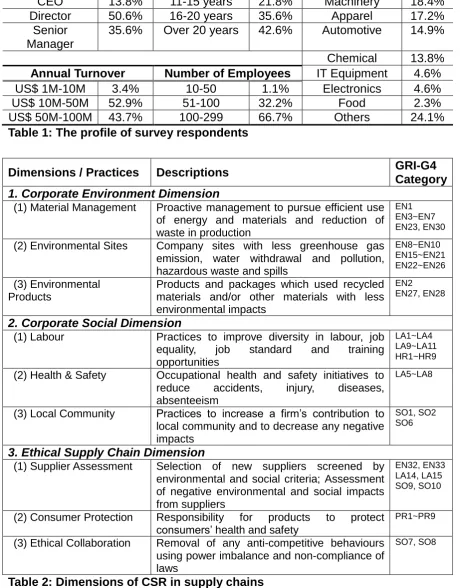
<< Insert Table 1 here >>
A total of 87 questionnaires were collected from top and middle managers, showing the
response rate of 43.5% which is a relatively moderate response rate compared to that of other
SCM research. In CSR research, this response rate may be lower than some previous surveys
(i.e. Sangle 2010; Strachan 1999), but still higher than other surveys (i.e. Beske et al., 2008; Holt 2004). We acknowledge the limited sample size of this research. No missing data and
non-response biases were detected, thus all responses were used for the analysis. The profile
of respondents is shown in Table 1.
Data Analysis
Research Procedure
For this paper, step-wise analysis using analytic hierarchy process, importance-performance
matrix and ANOVA were used. In the following sections, we outline six step-wise processes
13 Step 1 - Define CSR dimensions in supply chains
Step 1 generates a vital theoretical framework to comprehensively understand the dimensions
of CSR applicable both to corporate level and supply chain levels. In particular, it focused on
the social responsibility of supply chains and its operational definitions. A thorough review of
extant CSR-SCM literature was conducted to construct the framework of multi-faceted CSR
dimensions which are holistic yet parsimonious. This framework reviewed by a panel
discussion of five industry experts in CSR and modified according to their feedbacks to
ensure their validity. Based on the framework, a survey questionnaire was designed to capture
(1) pairwise comparisons between CSR dimensions, (2) the implementation level of each
dimension and (3) the impacts of institutional factors and stakeholders on CSR.
Step 2 – Evaluate the relative importance of CSR dimensions
Step 2 aims to understand which dimension is perceived the most important in SMEs’ CSR in
the supply chain context. In particular, the importance of a supply chain social responsibility
dimension can be numerically evaluated in comparison of established CSR dimensions.
Analytic hierarchy process (AHP) is a technique for multiple criteria decision making (Saaty,
1977) which can produce the relative importance of each criterion by pairwise comparisons
between criteria. The application of AHP in this research can provide specific priorities
among CSR dimensions. In the large-scale questionnaire survey, the respondents are asked
the pairwise comparisons between three main CSR dimensions (corporate environment
dimension, corporate social dimension and ethical supply chain dimension) and between
sub-dimensions of each CSR dimension. On the 9-point scale to each end, the respondents
evaluate the extent to which they think one dimension is more important than the other. The
14
responses will be summarised as a representative perception using geometric means.
Step 3 – Demonstrate the average implementation level of CSR dimensions
At Step 3, the implementation level of CSR dimensions will be captured by the mean of
7-point-scale measurement from the large-scale questionnaire survey.
Step 4 – Analyse the importance and performance by a 2X2 matrix
With the results from Step 2 (relative importance) and Step 3 (performance), a
performance-importance matrix can be generated with mean-centred values. ‘Relative’ performance-importance will be
used for this matrix which is the main difference from the normal performance-importance
matrix. Further discussion is made from this matrix to evaluate the CSR practice of SMEs in
supply chains.
Step 5 – Generate three groups by Overall Weighted Index
With AHP results being used as a weight of each dimension of CSR in supply chains, the
Overall Weight Index (OWI) of CSR implementation of respondent firms can be derived
(Jharkharia and Shankar, 2007). The OWI can be calculated by the following formulae:
OWI = ∑(𝑊𝑒𝑖𝑔ℎ𝑡)𝑖
𝑖
× (𝑃𝑒𝑟𝑓𝑜𝑟𝑚𝑎𝑛𝑐𝑒)𝑖
(i = a sub-dimension of CSR)
Based on the OWI, respondents can be grouped into upper, medium and lower groups in
terms of CSR implementation.
15
The impacts of various drivers on CSR practices from institutional theory and stakeholder
theory can be validated by comparing the perception of these drivers between the upper and
lower groups. If the drivers are effective, the mean values of the upper group should be
significantly higher than those of the lower group. If there exists a statistically significant
mean difference in driver A, its impact on CSR implementation can be confirmed. Analysis of
Variance (ANOVA), a statistical tool to test as to whether the mean of two or more groups is
equal or not, will be used and the statistical significance will be tested with the 5%
significance level.
Results
Following step-wise research process, the results are presented in five sections: dimensions of
CSR in supply chains; relative importance of CSR dimensions; the level of CSR
implementation; performance-importance matrix of CSR dimensions; and the impacts of CSR
drivers.
(1) Dimensions of CSR in Supply Chains
In general, CSR consists of the environmental dimension and the social dimension. But most
CSR literature dedicates its focus to the social dimension, dividing it into several
sub-dimensions, such as labour, health and safety, human rights, community, society and etc. The
environmental dimension, on the contrary, tend to be captured by just one dimension
although green logistics and/or SSCM literature described this dimension with details,
including but not limited to material handling, waste management and packaging and
16
the CSR dimension applicable to the supply chain level. Therefore, it is pre-requisite to find
appropriate CSR dimensions in supply chains.
<< Insert Table 2 here >>
For this purpose, the review of existing literature on CSR, green logistics and SCM was
conducted. In particular, Global Reporting Initiative (GRI) (2013)’s Sustainability Reporting
Guidelines (GRI-G4) was useful because they suggested comprehensive criteria to be applied
to a firm’s CSR. At the supply chain level, only a few SCM research focused on how to
implement CSR across the supply chain, and suggested supplier assessment, ethical
collaboration (Gimenez and Tachizawa 2012), awareness building and training (Ciliberti et al., 2008) and evolution of governance (Alvarez et al., 2010). In particular, Carbone et al.
(2008) explicitly distinguished CSR from supply chain social responsibility by considering
measurement items for both environmental and social aspects of supply chains.
One critical difference of this research is the creation of an ‘ethical supply chain’
dimension to address CSR issues in supply chains. The extant studies on CSR focused social
and environmental dimensions, which are in line with GRI-G4 applicable to the report of ‘a
company’. However, when supply chains with various entities are considered, it is necessary
to have another viewpoint which can incorporate the social responsibilities from suppliers to
end customers. In this circumstance, this research has used the same practices and indicators
discussed by literature and GRI-G4, but aligned them with corporate environment, cooperate
social as well as ethical supply chain dimensions.
A set of CSR dimensions and their practices were identified based on GRI-G4 and
17
practices for a parsimonious model, which led to a debate as to whether the supply chain
dimension should take the same hierarchy as the environmental and social dimensions. Some
of them suggested four dimensions taking the model of Carbone et al. (2008) consisting of corporate-social, corporate-environmental, SC-social and SC-environmental dimensions into
account. Eventually they agreed that at least one supply chain dimension should be needed to
capture the unique contributions of sustainable supply chain management to CSR. As a result,
the framework of CSR dimensions in supply chains can be drawn as can be seen in Table 2.
(2) Relative importance of CSR dimensions
Based on the CSR consolidated dimensions, the relative importance of each dimensions and
their practices were calculated by AHP. Four analysis were conducted using SuperDecisions
software package to identify the relative weights among three CSR dimensions and among
practices within a dimension. All the analyses showed the consistency indices less than the
threshold value of 0.1, which means the responses were logically consistent. The results are
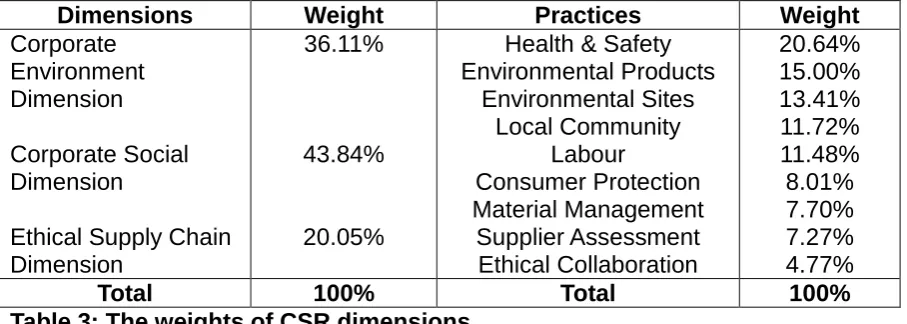
demonstrated in Table 3 in a descending order of relative weights. Two established
dimensions, Corporate Society and Corporate Environment, accounted for 80% of the
importance with similar levels of weights between the two. The Ethical Supply Chain
dimension, on the other hand, was perceived less important than the other two. However, it
also accounted for 20% of the total importance, showing the potential to be an independent
dimension that can effectively illustrate CSR in supply chains.
<< Insert Table 3 here >>
18
100%). This will be attributed to the fact that SMEs have less number of employees who are
exposed to dangerous working conditions. Other two social practices, local community and
labour, have drawn attentions of SMEs to significant extents (11.72% and 11.48%). Two
environmental practices, environment products (15.00%) and environmental sites (11.72%),
were ranked highly whilst material management was perceived relatively low. Three practices
in the ethical supply chain dimension placed at the bottom, which is mainly because the
dimension itself was less important than other two established dimensions. The relative
weights of CSR practices will be further discussed in Step 4 along with their performance
levels.
(3) The level of CSR implementation
The level of CSR implementation was measured by the mean. The results show that
consumer protection (5.3 out of 7) is the most implemented practice, which is followed by
environmental products (5.01) and environmental sites (4.86). While local community (4.6),
supplier assessment (4.6), health & safety (4.53) and ethical collaboration (4.52) are located
in the middle of the table, labour (4.47) and material management (4.37) were selected as the
least implemented practices. This finding is in line with empirical findings of Achabou et al. (2015) and Carbone et al. (2012), which showed the implementation of customer-related as well as environment-related practices was higher than that of society-related practices.
(4) Performance-Importance Matrix of CSR dimensions
To analyse the implementation level in combination with the relative importance of each CSR
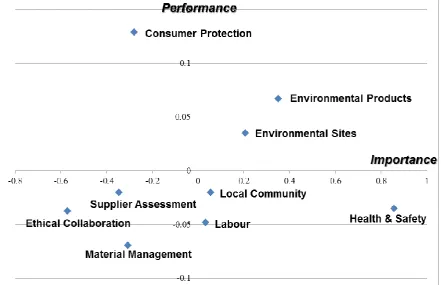
sub-dimension, a 2X2 matrix was generated as shown in Figure 1. All values were modified
19
recognised by SMEs, and at the same time, were embedded in their CSR practices well.
Consumer protection, on the other hand, was heavily implemented in the practice, but its
importance was relatively low. These practices are, in common, explicit to customers, which
can easily build up relatively good social reputation.
Figure 1 illustrates the importance of practices in the corporate social dimension which
was highly regarded but the implementation level was less than expected. In particular, health
and safety was not appropriately addressed by SMEs despite its highest importance. This can
be explained by cost issues because these practices will require immediate spending which
cannot be easily implemented by SMEs given their financial constraints. If SMEs seek their
competitiveness from cost advantages, emphasis on practices for the society can be just
rhetoric. On the contrary, two major environmental practices including environmental
products and environmental sites, were rated highly both in terms of importance and
performance. This results reflect the fact that environmental aspects have been regarded as
established drivers of a firm’s competitive advantage by SMEs.
<< Insert Figure 1 here >>
In terms of the operational aspects, they are often implicit to customers which were not
highly considered by SMEs. These include supplier assessment, ethical collaboration and
material management, which commonly require a certain level of strategic decisions to
implement into the operations. In particular, these operational practices are one of the prolific
research agenda in the SCM disciplines which have suggested many innovative ideas, but
SMEs tend to be less focused on these practices. In addition, this can be explained by power
20
prioritise and initiate supplier assessment, ethical collaboration as well as material
management. With regards to the material management practice, SMEs have to use enough
energy and best materials, regardless of their environmental impacts, to meet the
requirements of powerful customers.
(5) The impacts of CSR drivers
Given the relative weights of CSR practices and the performance of participating companies,
the overall CSR level of each SME can be calculated. The highest and lowest CSR levels
were 5.8 and 3.15 out of 7, which indicated that there are clear discrepancies in CSR
implementation across the SMEs. Also, it meant that there should be some contingencies
which create this difference. This research thus further tested the impacts of contingencies
from stakeholder theory and institutional theory on SMEs’ CSR level by comparing the
means of the better group and the worse group. From stakeholder theory, we identified six
factors (customers, government, suppliers, competitors, NGOs and local community) and
three factors (regulatory, normative and cognitive pressures) were drawn from institutional
theory as shown in Table 4.
<< Insert Table 4 here >>
The ANOVA results showed that there are significant differences in CSR implementation
level given all these contingencies. This implies that the theories are effective even in the
SMEs and the supply chain contexts. When the overall mean values are considered, drivers of
customers and government from stakeholder theory and regulatory pressures from
21
which have explored the relationships between stakeholder/institutional pressures and CSR
implementations (see Kim et al., 2013; Meixell and Luoma, 2015). Park and Ghauri (2015) have found that consumer, competitors and NGOs are the primary determinants of CSR
practices of SMEs, but this study showed that all stakeholder pressures can generate
significant changes in the practice. Interestingly, when the overall mean values are considered,
customers and government from the stakeholder theory showed the highest mean values,
which is quite consistent with Park and Ghauri (2015). When it comes to the institutional
theory, regulatory pressures showed the highest mean values compared to those of normative
and cognitive pressures. This finding can demonstrate that, if SMEs are under scrutiny of
various stakeholders or regulations, their participation in the CSR practices will be general
high (Udayasankar, 2008).
Conclusions and Implications
CSR has become a centre of attention for scholars and practitioners because of its
well-recognised importance to developing sustainable practices. This research explores the
dimensions of CSR in SMEs’ supply chains, and examined how SMEs considered CSR
practices by analysing their importance and performance. This paper provides an essential
insight specifically in the context of South Korea. Based on stakeholder theory and
institutional theory, this research also investigated the impacts of various contingencies on the
level of CSR implementation. Given the complexity of CSR implementation process,it can
be concluded that SMEs tend to focus on explicit CSR practices that can be easily identified
by their customers. On the contrary, operational issues hidden to their customers are not
considered in SMEs’ CSR practices. Such characteristics of SMEs being as resource
22
strategies and lack of supply chain innovation may explain this trait in SMEs’ CSR.
From the above discussion,ANOVA analysis empirically shows that stakeholder and
institutional pressures are valid in the performance of CSR practices for SMEs. However, the
level of pressures was largely biased to external pressures (Darnall et al., 2008) such as customers, government and regulatory pressures, which mean that SMEs tend to be more
reactive rather than proactive to implement CSR practices. This can imply that SMEs
recognise CSR issues as risk sources that generate stakeholder’s reaction and in turn lead to
damage to their firms (Hofmann et al., 2014). In this regard, this research has its value in investigating CSR practices within supply chains specifically taking the SME perspective,
which have not been fully explored in the SCM discipline on its own merits.
Interpreting our findings of this study yields several theoretical, practical and policy
implications. The study empirically analysed the practices and contingencies of CSR
implementation using survey data and various statistical techniques including AHP,
importance-performance matrix and ANOVA, which effectively demonstrated the strong and
weak areas of SMEs’ CSR activities. It is applicable to other industry sectors for comparative
analysis but individual environments will differ significantly. The impacts of contributing
factors from institutional theory and stakeholder theory have been validated even in the
SMEs’ contexts. These theoretical values can be also applicable to managerial implications.
The CSR dimensions and practices can be used as a check list for firms to achieve balanced
CSR implementation. In addition, to evaluate the degree of CSR implementation our
theoretical framework can be used as an index to compare the CSR level of the SMEs.
In highlighting the dimensions of CSR in the SME context, this study holds
implications for public policy. SMEs make up over 90 % of the global population of
23
significant contributions in social and economic related activities (Jamali et al., 2009; Naeem and Welford, 2009. Udayasankar, 2008). Given their importance, governments should
develop specific policies on CSR for SMEs as typically SMEs have intrinsic differences
when compared with large organisation which come in the form of legal structure, policies,
strategic orientation toward profit and institutional forms (Perrini, 2006).
Due to the fact that typically SMEs display passive reactions towards CSR because of
their financial constraint and limited systems which often place SMEs in the weak position
implementing CSR practices, governments should raise CSR awareness and practices through
soft policies on SME and offer consultation more widely. Government organisations could
also introduce incentive system or partial financial assistant to SMEs in supporting the CSR
practices (McWilliams and Siegel, 2001). In this way SMEs’ commitment to CSR could be
better reflected in their internal structures and procedures explicitly which allow them to also
engage with stakeholders (Baumann-Pauly et al., 2013). The collaboration with external society including stakeholder engagement plays an important dimension in motivating and
implementing CSR practices (Winsor, 2006).
Despite the fact that our research is based on CSR in SMEs’ supply chains, we believe
that our discussions and findings are instructive for considering the development of larger
organisational CSR capabilities taken as a whole. Therefore, this paper is of high relevance to
practitioners and policy makers looking to implement and manage CSR practices for
organisations. Overall, this paper offers a useful insight by highlighting consolidated
dimensions in CSR supply chains in manufacturing SMEs in South Korea which could
24 Limitations and Future Research
As with all research, this research has several limitations which offers indications of the
potential avenues for future research. In conducting the survey with SMEs in a single
developing country context in the manufacturing sectors with a focus on SMEs, it limits the
degree of likely generalizability of the findings of this research. Further research could
explore a comparative analysis with larger firms in other environmental contexts such as
service industries which may highlight the distinctive features of SMEs’ CSR practices in
supply chains for replications. In this paper, we collected a total of 87 out of 200
questionnaires and the relatively low response rate (43.5%) might be due to the fact that CSR
might be a sensitive issue for some of manufacturing SMEs in South Korea. The relatively
small sample size of firms limits the generalizability. Another limitation is related to the
self-perception issues when conceptualising the CSR dimensions as well as interpretations of our
findings which requires some caution when interpreting our empirical results.
Further, other limitations include the single response, cross-sectional nature of this
research which may not offer an overall picture of the dimensions of CSR implementation
process over time. Further research can employ longitudinal approach to offer fuller
understanding of CSR implementation in order to extend or conform our results. Building on
these limitations, further research could replicate the research methodology to other
developing countries and industries and it could be complemented with qualitative research
which may strengthen our findings. This study, however, provides insights into understanding
25 Acknowledgement
The authors would like to thank the editor and two anonymous reviewers of this journal for
their constructive suggestions and guidance.
References
Achabou MA, Dekhili S, Hamdoun M. 2015. Environmental upgrading of developing
country firms in global value chains. Business Strategy and the Environment26: 224-238.
Alvarez IG, Lorenzo JMP, Dominguez LR, Sanchez IMG. 2010. Are social and
environmental practices a marketing tool? Empirical evidence for the biggest
European companies. Management Decision 48(10): 1440–1455.
Ayuso S, Roca M, Colome R. 2013. SMEs as “transmitters” of CSR requirements in the
supply chain. Supply Chain Management: An International Journal18(5): 497-508. Baumann-Pauly D, Scherer AG. 2012. The organisational implementation of corporate
citizenship: An assessment tool and its application at UN Global Compact participants.
Journal of Business Ethics117(1): 1-17.
Baumann-Pauly D, Wickert C, Spence LJ, Scherer AG. 2013. Organizing corporate social
responsibility in small and large firms: Size matters. Journal of Business Ethics 115: 693-705.
Beske P. Koplin J, Seuring S. 2008. The use of environmental and social standards by
German first-tier suppliers of the Volkswagen AG. Corporate Social Responsibility and Environmental Management15(2): 63-75.
Bos-Brouwers HEJ. 2010. Corporate sustainability and innovation in SMEs: Evidence of
themes and activities in practice. Business Strategy and the Environment 19: 417-435. Brunton M, Eweje G, Taskin N. 2015. Communicating corporate social responsibility to
internal stakeholders: Walking the walk or just talking the talk. Business Strategy and the Environment26(1): 31-48.
26
institutional theory of corporate social responsibility. Academy of Management Review 32(3): 946-967.
Campbell JT, Eden L, Miller, SR. 2012. Multinationals and corporate social Responsibility in
host countries: Does distance matter. Journal of International Business Studies 43(1): 84–106.
Carbone V, Moatti V, Vinzi VE. 2012. Mapping corporate responsibility and sustainable
supply chains: an exploratory perspective. Business Strategy and the Environment21: 475-494.
Cassells S, Lewis K. 2011. SMEs and environmental responsibility: Do actions reflect
attitudes? Corporate Social Responsibility and Environmental Management 18: 186-199.
Darnall N, Jolley J, Handfield RB. 2008. Environmental management systems and green
supply chain management. Business Strategy and the Environment18: 30-45. Donaldson T, Preston LE. 1995. The stakeholder theory of the corporation: Concepts
evidence, and implications. Academy of Management Journal20: 65-91. Freeman RE. 1984. Strategic Management: A Stakeholder Approach, Boston: Pitman.
Gimenez C, Tachizawa EM. 2012. Extending sustainability to suppliers: a systematic
literature review. Supply Chain Management: An International Journal 17(5): 531-543.
Hall J, Matos S. (2010) Incorporating impoverished communities in sustainable supply chains.
International Journal of Physical Distribution & Logistics Management, 40(1/2): 124-147.
Heikkurinen P, Ketola T. 2012. Corporate responsibility and identity: from a stakeholder to an
awareness approach. Business Strategy and the Environment21: 326-337.
Hofmann H, Busse C, Bode C, Henke M. 2014. Sustainability-related supply chain risks:
conceptualization and management. Business Strategy and the Environment 23: 160-172.
Holt D. 2004. Managing the interface between suppliers and organizations for environmental
27
Responsibility and Environmental Management11(2): 71-84.
Jackson T, Amaeshi K, Yavuz S. 2008. Untangling African indigenous management: Multiple
influences on the success of SMEs in Kenya. Journal of World Business 43(4): 400-416.
Jamali D, Zanhour M, Keshishian T. 2009. Peculiar strengths and relational attributes of
SMEs in the context of CSR. Journal of Business Ethics87: 355-377.
Jenkins H. 2004. A critique of conventional CSR theory: An SME perspective. Journal of General Management 29: 55-75.
Johnson MP. 2015. Sustainability management and small and medium-sized enterprises:
Managers’ awareness and implementation of innovative tools. Corporate Social Responsibility and Environmental Management 22: 271-285.
Kim CH, Amaeshi K, Harris S, Suh C-J. 2013. CSR and the national institutional context: the
case of South Korea. Journal of Business Research66: 2581-2591.
Laczniak GR, Murphy PE. 2006. Normative perspectives for ethical and socially responsible
marketing. Journal of Macromarketing26: 154-177.
Lee K-H, Herold DM, Yu A-L. 2016. Small and medium enterprises and corporate social
responsibility practice: A Swedish perspective. Corporate Social Responsibility and Environmental Management 23: 88-99.
Maignan I, Ferrell OC. 2004. Corporate social responsibility and marketing: an integrative
framework. The Journal of the Academy of Marketing Science32(1): 3-19.
McWilliams A, Siegel D. 2001. Corporate social responsibility: A theory of the firm
perspective. Academy of Management Review26: 117-127.
Mitchell RK, Agle BR, Wood DJ. 1997. Toward a theory of stakeholder identification and
salience: defining the principle of who and what really counts. The Academy of Management22(4): 853-886.
Naeem MA, Welford R. 2009. A comparative study of corporate social responsibility in
Bangladesh and Pakistan. Corporate Social Responsibility and Environmental Management 16: 108-122.
28
perceptions. Journal of Business Research66(10): 1839-1851.
Park BI, Ghauri PN. 2015. Determinants influencing CSR practices in small and medium
sized MNE subsidiaries: A stakeholder perspective. Journal of World Business 50: 192-204.
Pedersen E. 2009. The many and the few: rounding up the SMEs that manage CSR in the
supply chain. Supply Chain Management14(2): 109-116.
Perez-Sanchez D, Barton JR, Bower D. 2003. Implementing environmental management in
SMEs. Corporate Social Responsibility and Environmental Management 10: 67-77. Polonsky M, Jevons C. 2009. Global branding and strategic CSR: An overview of three types
of complexity. International Marketing Review26(3): 327–347.
Reyes-Rodriguez JF, Ulhoi JP, Madsen H. 2016. Corporate environmental sustainability in
Danish SMEs: A longitudinal study of motivators, initiatives, and strategic effects.
Corporate Social Responsibility and Environmental Management 23: 193-212. Saaty TL. 1980. The Analytic Hierarchy Process, New York: McGraw Hill.
Sangle S. 2010. Critical success factors for corporate social responsibility: a public sector
perspective, Corporate Social Responsibility and Environmental Management 17(4): 205-214.
Schneider L, Wallenburg CM. 2012. Implementing sustainable sourcing—does purchasing
need to change? Journal of Purchasing and Supply Management18: 243–257. Scott RW. 1995. Institutions and organisation, Thousand Oaks, CA: Sage.
Strachan PA. 1999. Is the Eco-Management and Audit Scheme (EMAS) Regulation an
effective strategic marketing tool for implementing industrial organisations?
Corporate Social Responsibility and Environmental Management6: 42-51.
Tempel A, Walgenbach P. 2007. Global standardization of organizational forms and
management practices? What new institutionalism and the business-systems approach
can learn from each other. Journal of Management Studies44(1): 1-24.
Russo AF. Perrini. 2010. Investigating Stakeholder Theory and Social Capital: CSR in Large
29
Udayasankar K. 2008. Corporate social responsibility and firm size. Journal of Business Ethics83(2): 167-175.
Vilanova M, Lozano JM. Arenas D. 2008. Exploring the nature of the relationship between
CSR and competitiveness. Journal of Business Ethics87: 57–69.
Welford R, Chan C, Man M. 2007. Priorities for corporate social responsibility: a survey of
businesses and their stakeholders. Corporate Social responsibility and Environmental Management 15:52-62.
Welford R, Frost S. 2006. Corporate social responsibility in Asian supply chains. Corporate Social responsibility and Environmental Management 13: 166-176.
Winsor D, 2006. Corporate social responsibility: Three key approaches. Journal of Management Studies 43: 93-114.
Yang X, Rivers C. 2009. Antecedents of CSR Practices in MNCs’ Subsidiaries: A stakeholder
and institutional perspective. Journal of Business Ethics86(2): 155–169.
Zhu Q, Sarkis J, Lai K-H, Geng Y. 2008. The role of organizational size in the adoption of
30 Tables
Position Industry Experience Industry
CEO 13.8% 11-15 years 21.8% Machinery 18.4%
Director 50.6% 16-20 years 35.6% Apparel 17.2%
Senior Manager
35.6% Over 20 years 42.6% Automotive 14.9%
Chemical 13.8%
Annual Turnover Number of Employees IT Equipment 4.6%
US$ 1M-10M 3.4% 10-50 1.1% Electronics 4.6%
US$ 10M-50M 52.9% 51-100 32.2% Food 2.3%
US$ 50M-100M 43.7% 100-299 66.7% Others 24.1%
Table 1: The profile of survey respondents
Dimensions / Practices Descriptions GRI-G4
Category 1. Corporate Environment Dimension
(1) Material Management Proactive management to pursue efficient use
of energy and materials and reduction of waste in production
EN1 EN3~EN7 EN23, EN30
(2) Environmental Sites Company sites with less greenhouse gas
emission, water withdrawal and pollution, hazardous waste and spills
EN8~EN10 EN15~EN21 EN22~EN26
(3) Environmental Products
Products and packages which used recycled materials and/or other materials with less environmental impacts
EN2 EN27, EN28
2. Corporate Social Dimension
(1) Labour Practices to improve diversity in labour, job
equality, job standard and training
opportunities
LA1~LA4 LA9~LA11 HR1~HR9
(2) Health & Safety Occupational health and safety initiatives to
reduce accidents, injury, diseases,
absenteeism
LA5~LA8
(3) Local Community Practices to increase a firm’s contribution to local community and to decrease any negative impacts
SO1, SO2 SO6
3. Ethical Supply Chain Dimension
(1) Supplier Assessment Selection of new suppliers screened by
environmental and social criteria; Assessment of negative environmental and social impacts from suppliers
EN32, EN33 LA14, LA15 SO9, SO10
(2) Consumer Protection Responsibility for products to protect
consumers’ health and safety
PR1~PR9
(3) Ethical Collaboration Removal of any anti-competitive behaviours using power imbalance and non-compliance of laws
[image:30.595.64.525.140.729.2]SO7, SO8
31
Dimensions Weight Practices Weight
Corporate Environment Dimension
Corporate Social Dimension
Ethical Supply Chain Dimension
36.11%
43.84%
20.05%
Health & Safety Environmental Products Environmental Sites Local Community Labour Consumer Protection Material Management Supplier Assessment Ethical Collaboration 20.64% 15.00% 13.41% 11.72% 11.48% 8.01% 7.70% 7.27% 4.77%
Total 100% Total 100%
Table 3: The weights of CSR dimensions
Drivers Mean Upper Group Lower Group F-value Sig.
Mean S.D Mean S.D
Stakeholder Theory
Customers 5.38 5.85 0.65 4.86 0.75 41.446 *** Government 4.8 5.34 0.73 4.36 0.73 37.987 *** Suppliers 4.51 4.78 0.57 4.29 0.71 12.245 ** Competitors 4.51 4.80 0.68 4.07 0.60 27.209 ***
NGOs 4.46 4.98 0.79 4.00 0.54 43.259 ***
Local Community 4.29 4.68 0.61 3.93 0.46 40.412 ***
Institutional Theory
Regulatory
Pressures 4.74 5.20 0.71 4.36 0.49 39.228 *** Normative
Pressures 4.39 4.83 0.77 4.00 0.54 32.277 *** Cognitive
[image:31.595.67.521.85.247.2]Pressures 4.32 4.54 0.74 4.14 0.65 6.622 *
32 Figure