P
ENSIONS AND
C
HILDREN
1. IntroductionThe crisis of the pensions system in Europe is primar-ily a demographic crisis, resulting from falling fertility and increasing longevity. Fertility rates fell from 2.1 children per female in the 1970s to 1.7 children per female in the 1990s, and they are not expected to pick up again in the future. The problem is compounded by increasing longevity. The ratio of people above 65 to people between 15 and 65 (one way to measure the so-called dependency ratio) in most European countries is expected to more than double, on average, in the EU countries between now and 2050. In per-centage terms, such a ratio is expected to rise by at least 60 percent in the case of the UK, up to 125 per-cent in the case of Italy. In 2050 the dependency ratio is projected to be around 70 percent in Italy and Spain; between 45 and 50 percent in Germany and France; and just below 40 percent in the UK. Changes in the dependency ratio are expected to be even more dramatic for the newly acceded countries – currently featuring relatively young populations, but expected to follow the same demographic pattern as the rest of Europe at a very fast pace.
The magnitude of the demographic crisis is strikingly similar across countries. But its impact on pension systems differs depending on the structure and gen-erosity of these systems. In some countries, the issue is amplified by other sources of macroeconomic fragili-ty, namely, fiscal problems. A proper assessment of public pension liabilities needs to account for contin-gent implicit debt that derives from implicit guaran-tees of the welfare of pensioners (minimum pension, bailouts of bankrupt private funds and so forth).
From a fiscal perspective, addressing the pension cri-sis requires reforms of the public social security sys-tems in light of demographic dynamics that were not foreseen at the time when the systems were intro-duced.1 In many countries, demographic develop-ments have been irresponsibly ignored for at least three decades in most countries. The extent of
required reforms varies across countries, but in most cases radical steps are needed in reconsidering the coverage of the public systems, the degree of redistri-bution and fairness within the system, and the average level of benefits. It is also necessary to reduce or pre-vent altogether the abuse of social security as an improper instrument of industrial or redistributive policy.
It is important to note that balancing the public pen-sion system from an accounting perspective does not automatically imply that the system is optimal, nor moving towards optimality. Therefore, it is important to focus the debate on what the desirable characteris-tics of a pension system should be.
From a macroeconomic perspective, fewer workers relative to non-active people means that, for a given productivity, domestic output is on average lower than it would be if there was a younger population. Even if the government takes the necessary steps to ensure fiscal sustainability, it would still be true that citizens will face the challenge to maintain and raise their average standard of living. There is a trade-off between consumption and leisure: either people should work longer and/or save more to accumulate more human and physical capital, or living standards should fall relative to the economy’s productivity trend.
In light of these considerations, addressing the pen-sion crisis entails much more than quantitative fiscal policy: it also requires the design of policies that cre-ate incentives (or remove disincentives) to innovcre-ate and finance innovations, to participate in the labour force, etc. In designing fiscal measures, microeco-nomic and incentive-related issues play a dominant role.
When addressing social security issues, distribution and efficiency are strictly interconnected: any propos-al of reforms will involve some trade-offs between dif-ferent objectives, shifting the incidence and magni-tude of distortions in different areas of the economy,
including the labour and financial markets, but also fertility choice. An analysis of the principles that should guide reforms needs to focus on the relevant trade-offs, rather than addressing each distortion on its own.
In this chapter, we reconsider the root of the current crisis in the social security systems in Europe, stress-ing its macroeconomic dimensions. We then consider different proposals to reform the system.2
2. The demographic challenge to pension systems Table 4.1 and the Appendix convey the striking dimension of the demographic challenge to social security in an immediate way. In 2050, the lowest old-age dependency ratio (ratio of people above 65 to peo-ple between 15 and 65) is projected to climb just above 30 percent for the US and the UK. Currently, the highest dependency ratio – recorded for Italy – is below that figure.3For the EU-15, the average depen-dency ratio is currently 21 percent. It will more than
double, to about 50 percent in 2050. Strikingly, these averages are essentially identical for the newly acced-ed countries as a group.
Even within Europe, individual countries differ in the extent of the demographic change. Due to very low fertility rates, the situation is extremely alarming for Italy and Spain, which are expected to achieve the highest dependency ratios – close to Japan. On the other side of the spectrum, there are Denmark, Ireland, the Netherlands, and the UK, which are quite far from those levels. Yet with dependency ratios around 40 percent, the situation is critical enough.
It should be noted that a somewhat different picture evolves when one looks at completed fertility rates,
calculated using the number of children during a woman’s reproductive lifetime. Completed fertility rate is sometimes around or above two. This means that part of the observed low fertility rates in many European countries is a transitory phenomenon, due to the fact that women currently in their reproductive lifetime tend to have children at a later stage relative Box 4.1
Why a social security system?
Why not leave retirement saving decisions to individuals rather than organising mandatory public systems or private systems strictly regulated by law? There are four main arguments.
Historically, the argument was to avoid undesirable behaviour within a family. Either rotten children refuse to take care of their parents – an argument invoked by Bismarck – or parents may free ride on the altruism of their children, and consume too much, without taking any measures to sustain their lives as retired people. Free riding on the altruism of others may also have a collective dimension if people expect help from the community in case of need in their old age. This is nothing but a well-understood moral hazard issue in setting up the welfare state.
A different and most powerful argument stresses myopia in savings behaviour. A wealth of empirical evidence suggests that people start to save for their retirement at a quite advanced age – raising an issue as of whether this would lead to irrational under-saving. A mandatory pension system would therefore be a paternalistic measure to force myopic workers to protect themselves, and save enough for their own good.
A recent view stresses that people do not make life-time plans or revise their plans at different stages of their life in an inconsistent way. In particular, people seem to use a higher discount rate for the near future than for the far future. As a consequence, although they care about their retirement, they end up postponing the beginning of a serious savings plan. It is interesting to note that, while this view is shared by many economists and policy analysts, projection models set up to calculate welfare improvements from pension reform almost never account for individuals with such characteristics; see Angeletos et al. (2001) and Choi et al. (2002). However, one could note that what this argument really calls for – instead of a public pension system – is the existence of illiquid assets which would allow people to commit not to dissave. A third set of arguments refers to inefficiency and limitations of financial markets. An efficient market for annuities – where people can convert their pension funds accumulated throughout their working life into a stream of monthly payments up to their death – is an essential element of saving for retirement. It is well known that such markets may not work well because of adverse selection problems and because the size of the financial intermediary that would provide annuities would be too large, thus granting monopoly power. However, the adverse selection argument may be overstated, as characteristics that affect life expectancy are well observable. Moreover, the performance of a private market for annuities should be assessed against the yield of public pension systems.
A fourth argument is that a pay-as-you-go pension system insures people against not having children. In principle people could be sustained in their old age by their children. However, some people cannot have children either for biological reasons or because they do not find an appropriate partner. The public pension system can be seen as a device to protect these people against low income in old age. This argument is particularly strong when capital markets are inadequately developed so that only children are a realistic means to ensure sufficient resources in old age. However, the argument would hold through even with perfect capital markets insofar as education offers infra-marginal returns above the market rate of interest – implying families with children are better off. Note that this view presupposes a commitment by children to sustain their parents, to which they may not agree. With a pay-as-you-go pension system, a similar duty is extended to the society as a whole. In any case, it is necessary for a society to produce enough members of future generations so as to sustain the needs of its members.
2A useful glossary of pension terms and a taxonomy can be found
at http://www.oecd.org/dataoecd/5/4/2496718.pdf and http://www.oecd.org/dataoecd/34/23/2488707.pdf, respectively
3The same picture emerges if one looks at the dependency ratio
including young people of a non-working age (0–15), although the deterioration of this indicator appears less dramatic.
to previous generations. So the low fertility rates in the data reflect the coexistence of older cohorts who have already completed their fertility, with younger cohorts who have not yet reached their peak rates, which is expected to occur at a higher age than for older cohorts. This point is well illustrated by means of simulations for a “typical” European country. As a benchmark, we consider the case in which the fertility rate is 2.1 with a peak in fertility for women between 20 and 30 years old: in our simulations for this case, dependency ratios in the long run would equal 33.9 percent, i.e. they would be barely affected. They would be somewhat higher than current dependency ratios only because of lower mortality rates among pensioners. Against the above scenario, suppose that the fertility rate were to fall to 1.3, leaving the peak of fertility for women between 20 and 30 years old: dependency ratios would then go up to 54 percent in the long run – and population would shrink by 1.3 percent a year. Finally, suppose the fertility rate were to remain at 2.1 but women experienced a peak in fertility between 28 and 38: in this case the long-run dependency ratio would be 34.0 percent, remaining virtually unchanged relative to the benchmark above.4
Yet the current demographic indicators would record a temporary deterioration.
However, one should not count too much on a recov-ery of fertility. While it is true that in some countries completed fertility is around 2 (the UK, Norway, and France) for the latest available cohorts, that is, those born in 1960, it is only equal to 1.6 in Germany, 1.7 in Italy, and 1.5 in Greece.5Furthermore, it is likely that cohorts born after 1960 will have even fewer children. Otherwise, it would be very difficult to explain the observed age pyramids, with cohort size steadily going down with the date of birth. Because the most numer-ous cohorts are those between 30 and 40 years of age, if these cohorts had their maximum fertility in these ages, we should currently observe much higher birth rates. In principle, one could explain the currently low birth rate if these cohorts had their fertility peaks below 30 years of age, while younger cohorts of women ones have later peaks. But if this were the case, birth rates should have been much higher than observed ten years ago.
Table 4.1
Dependency ratios in selected countries
Age groups Age groups Age groups Age groups
((0-15)+ (65-100))/ (15-64) (65-100)/ (15-64) ((0-15)+ (65-100))/ (15-64) (65-100)/ (15-64) ((0-15)+ (65-100))/ (15-64) (65-100)/ (15-64) ((0-15)+ (65-100))/ (15-64) (65-100)/ (15-64) 1950 2004 2025 2050 Austria 0.5 0.16 0.47 0.24 0.56 0.36 0.79 0.55 Belgium 0.47 0.16 0.53 0.27 0.62 0.37 0.74 0.47 Cyprus 0.68 0.1 0.5 0.18 0.58 0.29 0.66 0.39 Czech Republic 0.48 0.12 0.41 0.2 0.55 0.35 0.84 0.59 Denmark 0.55 0.14 0.51 0.23 0.6 0.35 0.68 0.42 Estonia 0.57 0.17 0.46 0.24 0.56 0.33 0.84 0.57 Finland 0.58 0.11 0.5 0.23 0.67 0.41 0.72 0.46 France 0.52 0.17 0.53 0.25 0.63 0.36 0.73 0.46 Germany 0.49 0.14 0.49 0.27 0.6 0.38 0.76 0.49 Greece 0.55 0.11 0.5 0.28 0.57 0.38 0.88 0.62 Hungary 0.48 0.11 0.44 0.22 0.53 0.32 0.75 0.5 Ireland 0.65 0.18 0.47 0.17 0.54 0.25 0.69 0.41 Italy 0.53 0.13 0.5 0.29 0.59 0.4 0.9 0.65 Latvia 0.57 0.18 0.46 0.24 0.54 0.33 0.82 0.56 Lithuania 0.58 0.15 0.49 0.22 0.55 0.3 0.74 0.43 Luxembourg 0.42 0.14 0.49 0.21 0.5 0.25 0.62 0.35 Malta 0.69 0.1 0.47 0.19 0.63 0.36 0.73 0.46 Netherlands 0.59 0.12 0..48 0.21 0.58 0.33 0.68 0.42 Poland 0.53 0.08 0.42 0.18 0.53 0.31 0.75 0.5 Portugal 0.57 0.11 0.49 0.24 0.53 0.32 0.79 0.53 Slovakia 0.55 0.1 0.41 0.16 0.5 0.27 0.73 0.47 Slovenia 0.53 0.11 0.42 0.21 0.56 0.38 0.89 0.64 Spain 0.52 0.11 0.45 0.25 0.53 0.35 0.93 0.68 Sweden 0.51 0.15 0.54 0.27 0.67 0.4 0.73 0.47 UK 0.49 0.16 0.52 0.24 0.56 0.31 0.65 0.38 Japan 0.68 0.08 0.5 0.29 0.7 0.5 0.98 0.72 US 0.54 0.13 0.51 0.18 0.6 0.28 0.31 0.32
Source: United Nations; Population Division, 2004; EEAG.
4If the completed fertility rate is, say, 1.7 instead of 2.1, then
post-ponement of child-bearing actually slightly reduces dependency ratios in the long run, from 0.435 to 0.42.
5Source: Eurostat,
3. Some unpleasant growth arithmetic
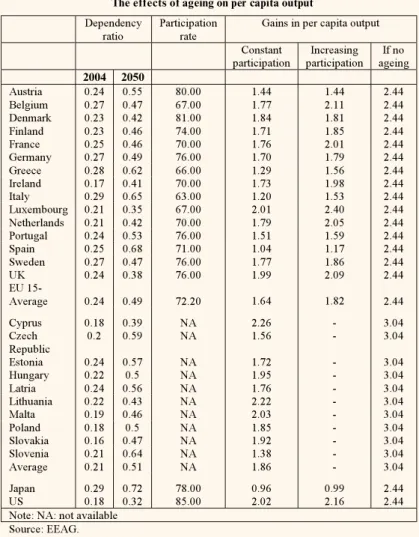
To convey the implications of adverse demographic developments in an immediate way, it is useful to build a simple numerical example showing the implications of ageing for a country’s productive capacity. In partic-ular, assume that workers’ productivity growth is two percent per year in EU-15 as well as in Japan and the US, while it is 2.5 percent in the new EU states. Assume also that the participation rate in the labor force is either constant at the current rate, or increases from the current rate up to 80 percent in 2050: for European countries this implies eight percentage points average rise in participation. Based on this assumption, we cal-culate the change in per capita output for the popula-tion above the age of 15. This measure of per capita output is a rough measure of output available for workers and retired people. Needless to say, the results are very sensitive to the parameters assumed in the exercise. Results are shown in Table 4.2.
As our benchmark, consider a hypothetical situation with no ageing. For the EU-15, other things equal, a
two percent productivity growth per year would raise average output per adult by a factor of 2.44 between 2004 and 2005. Accounting for population ageing, however, the same average output only grows by a fac-tor of 1.63. This figure is raised to 1.82 if substantial gains in the participation rate are achieved (that is, more people of working age actually do work). Note that, relative to the scenario with no adverse demo-graphic development, these average figures are equiv-alent to a productivity slowdown (for a given popula-tion structure) from 2 to 1.1 or 1.3 percent per year.
The outlook is particularly grim in Italy, Spain and Greece. In the case of Spain, for instance, a two per-cent productivity growth barely compensates for the projected population ageing, implying a quasi-stagna-tion of output per capita. Even when extreme gains in participation rates are assumed, income gains are only of the order of 50 percent over the 45-year period.
Table 4.2 shows that raising participation rates does make a difference. If the gain in participation rate is achieved via a delay in retirement age, this result is just a way to reiterate that the impact of longevity on the pension sys-tem can be mitigated by adjusting the retirement age. Figure 4.1, taken from the OECD, shows a wide dispersion in the average effective retirement age for male workers across countries in 2000, which varies between 56 and 62.6
There are two main lessons from our numerical example. First, in the next few decades, when the impact of demographic changes on pension systems will be at its peak, raising retirees’ living stan-dard in line with productivity will only be possible if the economy as a whole consumes its wealth, i.e. consumes its stock of domestic and foreign capital. The numerical Table 4.2
The effects of ageing on per capita output Dependency
ratio
Participation rate
Gains in per capita output Constant participation Increasing participation If no ageing 2004 2050 Austria 0.24 0.55 80.00 1.44 1.44 2.44 Belgium 0.27 0.47 67.00 1.77 2.11 2.44 Denmark 0.23 0.42 81.00 1.84 1.81 2.44 Finland 0.23 0.46 74.00 1.71 1.85 2.44 France 0.25 0.46 70.00 1.76 2.01 2.44 Germany 0.27 0.49 76.00 1.70 1.79 2.44 Greece 0.28 0.62 66.00 1.29 1.56 2.44 Ireland 0.17 0.41 70.00 1.73 1.98 2.44 Italy 0.29 0.65 63.00 1.20 1.53 2.44 Luxembourg 0.21 0.35 67.00 2.01 2.40 2.44 Netherlands 0.21 0.42 70.00 1.79 2.05 2.44 Portugal 0.24 0.53 76.00 1.51 1.59 2.44 Spain 0.25 0.68 71.00 1.04 1.17 2.44 Sweden 0.27 0.47 76.00 1.77 1.86 2.44 UK 0.24 0.38 76.00 1.99 2.09 2.44 EU 15-Average 0.24 0.49 72.20 1.64 1.82 2.44 Cyprus 0.18 0.39 NA 2.26 - 3.04 Czech Republic 0.2 0.59 NA 1.56 - 3.04 Estonia 0.24 0.57 NA 1.72 - 3.04 Hungary 0.22 0.5 NA 1.95 - 3.04 Latria 0.24 0.56 NA 1.76 - 3.04 Lithuania 0.22 0.43 NA 2.22 - 3.04 Malta 0.19 0.46 NA 2.03 - 3.04 Poland 0.18 0.5 NA 1.85 - 3.04 Slovakia 0.16 0.47 NA 1.92 - 3.04 Slovenia 0.21 0.64 NA 1.38 - 3.04 Average 0.21 0.51 NA 1.86 - 3.04 Japan 0.29 0.72 78.00 0.96 0.99 2.44 US 0.18 0.32 85.00 2.02 2.16 2.44
Note: NA: not available Source: EEAG.
6 The new EU members states suffer
markedly from the rapid deterioration of the demographic outlook. In some of our examples, average income per adult is 50 per cent of what it could be for a stable population structure. For Japan, our exer-cise suggests quasi stagnation: annual productivity growth of two per cent is not enough to compensate for population ageing in terms of average resources, although the level of income in this coun-try is high in absolute terms to start with. A relatively better demography explains the relatively good outlook for the US.
example clearly shows the large extent to which the decline in working-age population offsets output gains from productivity growth. The transition to a new sta-ble population is likely to coincide with large decumula-tion of aggregate wealth stocks, especially starting in the 2030s, when the baby boomers born in the mid-1960s will receive their pensions.7 Making sure that our economies arrive at that time with a sufficiently large endowment of domestic and foreign capital is a neces-sary condition to prevent a crisis and manage economic and social issues that could possibly arise in the process.
Second, while running down the stock of national wealth will help smooth consumption during the tran-sition to a new stable population structure, consuming capital stock cannot, however, be a permanent solu-tion to the pension crisis. A higher stock of capital (human and physical) per worker is instead required in the long run when the population structure stabilis-es, reflecting lower fertility and increasing longevity. A higher capital per worker raises productivity levels and sustains living standards.
4. Issues facing the design of a pension system We now discuss major issues that, in our view, should be policy priorities in dealing with pension reform. These issues are often overlooked or misunderstood, and they inform the current debate on social security systems vir-tually in all European countries, despite the differences
across national systems. In Europe, there is a wide variety of pension institutions, ranging from purely redistributive pay-as-you-go sys-tems, to systems with an important funded component. Many coun-tries are undertaking pension reforms that develop social securi-ties in different directions, not only because there are differences in existing pension institutions and macroeconomic conditions but also because reforms may be inspired by alternative principles. In what follows, we will focus on a few general dimensions of pension reforms and then analyze possible solutions to the issues raised.8
4.1 Fairness
“Equity” is a central concern of redistributive poli-cies. Yet in many dimensions, equity concerns are ignored in designing these policies and reforming them. As far as pensions are concerned, there are inequities between individuals of the same generation as well as inequities between generations.
Intragenerational inequities come from not taking individual preferences and characteristics into account. Those who systematically have a lower life expectancy, for example, because of their occupation, gender, or other observable characteristics, do not earn a higher pension per period.9If their pensions were managed by a private insurance company, it would offer them a higher return on their pension wealth than to other agents, because it is known that this return would have to be paid only for a shorter period of time. As people who die earlier are “worse-off ” than people who die later, market discrimination, in this case, tends to make outcomes fairer, while non-discrimination by the state makes outcomes less fair.10
7A country can turn the stock of national wealth into consumption
(consume its stock of capital) by selling domestic and foreign assets to non-residents (including the stock of housing) as well as by letting capital depreciate in line with a falling population.
8Diamond (2004) and Diamond and Orzag (2004) propose a related
exercise, with a somewhat different emphasis relative to our text. See also Casey et al. (2003) among the publications from “ageing soci-ety” at the OECD (www.oecd.org).
9There are some exceptions in the form of specific retirement ages
for some occupations; yet these exceptions often reflect the recipi-ent’s ability to bargain collectively rather than anything else, and are seldom adjusted for evolutions in working conditions.
10An important issue that receives little attention is the treatment of
surviving (non-working) spouses. There are vast differences across systems and within systems (as in many cases somebody who becomes a widow when his/her partner is one day away from retire-ment may receive a much better treatretire-ment than somebody who becomes a widow one day after his/her partner has retired). Reformers may be tempted to “save money” to the system by undu-ly reducing the pension income accruing to surviving spouses – just because these are not a politically well-defined and vocal group in the national political arena.
A related issue in pension reform that is recently sub-ject to widespread debate is that, in many social secu-rity systems, people who want to work longer typical-ly lose the extra pension wealth they accumulate, while people who want to retire earlier often lose a greater share of their pension wealth than the one cor-responding to their foregone contributions. The issue is how to make sure that the system can accommodate individual preferences about retirement age, without either penalising or favouring those who want to devi-ate from the legal retirement age.
A more general problem is due to intergenerational inequities coming from differences in cohort size. Generations who work and retire in periods when the old-age dependency ratio is low are typically better off than generations who work and retire in periods with a high dependency ratio. Clearly, a low old-age depen-dency ratio reduces the workers’ contributions that are needed to sustain a given pension level; alterna-tively, it increases the pension level that can be sus-tained at a given contribution rate. To our knowledge, none of the existing pay-as-you-go systems embodies an explicit mechanism to correct for these inequalities – requiring substantial smoothing of consumption across generations. This could be achieved if “luckier” generations accumulate buffer stocks of pension wealth to be eaten up by less lucky generations, according to a principle of intergenerational insur-ance (see, for instinsur-ance, Allen and Gale (2000) chapter 6). Another aspect of intergenerational equity is rela-ted to economic growth, which tends to make younger (and future) generations better off relative to older (and current) generations.
We think these considerations should be taken into account when implementing the needed reform of the system, as financial considerations alone may lead to an unfair distribution of the burden of adjustment between generations.
4.2 Funded vs. pay-as-you-go systems
An important element of the debate concerns the choice between funded and unfunded pension sys-tems. In an unfunded system, the contributions by the young are directly paid to the old. In a funded system, the contributions are invested in assets and the princi-pal and return to these assets are used to pay for future pensions. Thus, under a funded system, the young are paying “for themselves” whereas under an unfunded system, they are paying “for the old”. As shown below, while an unfunded system is an
inter-generational redistribution device that forces all gen-erations to make gifts to previous gengen-erations, a fund-ed system involves no such rfund-edistribution.
The “returns” in an unfunded system are determined by the ratio between active contributors and retired beneficiaries. The higher that ratio, the greater the amount that can be paid per unit of contribution, and the greater the financial returns from one euro “invested” in the social security system. The returns in a funded system, by contrast, are simply determined by the rate of returns on financial assets.
Does that mean that if the economy had been under a funded system from the start, one would not have to worry about an increased old-age dependency ratio? Not quite! While under an unfunded system, ageing of the society reduces the returns on contributions directly through the ratio between contributors and recipients, under a funded system it reduces the rate of return on capital, as the size of savings in search of productive investment opportunities goes up relative to the workforce. In fact, one can show that the dynamic response of the economy to an increase in the old-age dependency ratio is qualitatively similar under a funded system and an unfunded system. Thus, ageing of society would also be a matter of worry for retirees if pensions had been funded from the start. There are reasons to believe, however, that the implied reduction in pensions would be much lower under funding: for instance, a fraction of pen-sion wealth can be consumed every year, in addition to the return on pension assets.11
Moreover, a fully-funded pension system can be insu-lated by the effects of domestic population changes on the returns on capital to the extent that capital markets are integrated, and pensions contributions are invested in foreign assets – provided the rest of the world does not have an ageing problem. With inte-grated capital markets, arbitrage links the domestic rate of returns to the international rate (note that this is true even when the two rates are not equalized). International diversification reduces the exposure of
11To assess the qualitative effect of variations in the population size
on the rate of return to capital, consider the textbook example of a closed economy where the real rate of returns on capital (and finan-cial assets) is four per cent. Assume returns to scale in production are constant, with capital and labour as production factors; the capital share in GDP is 30 percent and the elasticity of substitution between the two factors is 0.7. Under the assumption of a constant contribu-tion rate and retirement age, a 10 per cent unexpected decline in the size of the working population will cut the pay-as-you-go pension by 10 per cent, but it will cut the return to capital only by a small frac-tion (10 per cent) of four per cent. While both systems are affected by the population shock, the funded system is obviously much less vulnerable to adverse demographic developments.
pension fund holders to domestic risk – including demographic risk.
A funded system also yields a larger level of wealth and capital than an unfunded one. That is because social security contributions raise saving and there-fore net investment in productive assets. Therethere-fore, the economy is “richer” in the long run than under an unfunded system, meaning that it has accumulated more productive assets, implying higher wages and higher living standards.
Furthermore, without a social security system, a ratio-nal worker would save for his retirement and invest in a well-diversified portfolio of financial and real assets earning the market rate. In an actuarial pay-as-you-go system, legal arrangements force him/her to save into an “asset” yielding a lower rate of return. This implies a constraint on portfolio investment, such that a com-ponent of the worker savings has to be put into what financial researchers call a “dominated asset”, that is, an asset whose returns are systematically below other assets available in the market.
Do the considerations above imply that funded systems are uniformly superior to pay-as-you-go ones? The answer is, surprisingly, no. While all current and future generations are better off if the economy accumulates more productive assets (because they get higher wages during their work life), asset accumulation must be paid for by foregone consumption of previous generations. To understand this, assume the economy has had no pension system until now. If an unfunded system is introduced, it is possible to pay pensions to the existing old immediately. On the other hand, if the system is funded, one will have to wait until the proceeds of the investments are realised to start paying pensions, and one is unable to pay pensions to the existing generation of old. In other words, when one starts a pension sys-tem, initial tax proceeds are consumed by the old under an unfunded system, while they are invested under a funded system. Thus, the initial generation of old prefers the unfunded system, while all subsequent gen-erations prefer the funded system. The argument also applies when the system is initially unfunded and one contemplates moving to a funded one: some generations have to invest instead of consuming, and it is impossible to make everybody better off. If for example one stops paying pensions and invests contributions in productive assets instead, retirees obviously lose. If on the other hand, one increases contributions to finance existing pension claims, while at the same investing in a funded system to pay for future pensions, current generations of
workers lose, relative to the status quo, as they have to pay twice: once for the old, once for themselves.
In fact, the pay-as-you-go pension system can be interpreted as an intergenerational redistribution device: the gifts to the first generation of retirees (receiving a pension without having contributed to the system) are fully matched by losses of later genera-tions – who receive a rate of return below the market rate of interest.12The difference between the market rate of return, and the lower return granted by the social security system can be interpreted as an implic-it tax that all future generations have to pay. The pre-sent value of this implicit tax is equal to the gains of the first generation (see Box 4.2).13
In general, at each point in time the implicit pension debt in terms of the then-existing pension claims is equal to the present value of implicit taxes yet to be paid by future generations of participants. This has important fiscal implications when an economy chooses to move from an unfunded to a funded sys-tem without negating the existing pension claims: such a reform requires an immediate redemption of the implicit debt by levying an explicit tax, and/or issuing explicit debt. If the choice is to finance the transition with a tax, the revenue from such a tax is equal, in present value terms, to the current and future revenues from the tax previously implicit in the pay-as-you security system. Then, the move just con-centrates the time path of implicit taxes on the transi-tion generatransi-tion without changing the size of the tax burden in present value terms.14
So, while in the long-run the funded system yields more wealth and capital accumulation, transition
12As is well known, intergenerational redistribution is an advantage
if the economy is “dynamically inefficient”, i.e. it has over-accumu-lated capital. In this case, it has been shown that the pay-as-you-go system can increase consumption of all generations, by making the currently old generation “eat” the capital stock (the same could be achieved by granting transfers to the current generation, financed with the accumulation of public debt). Note that the implicit (or explicit) accumulation of public debt would not correspond to an increase in the debt to GDP ratio, as long as the interest rate is lower than the growth rate: in such a situation the rate of debt accumula-tion is slower than growth. A situaaccumula-tion of dynamic inefficiency is more likely, the greater the population growth rate and the lower its productivity.
13While the pay-as-you-go system obviously is not inherently
inferi-or to a funded system when it offers a rate of return below the mar-ket rate of interest, there may be periods in which the growth rate is above the market rate of interest. The 1960s may have been such a period. However, economists tend to be quite sceptical about the idea that a negative difference between the rate of interest and the rate of growth could last forever. If this were the case, one may argue that the price of assets whose returns tend to match aggregate growth rate (for instance, land) would be infinite (or indeterminate). People would feel so rich that no one would think it necessary to save: thus the over-accumulation of capital would disappear, driving the return to capital above the rate of growth.
14See Sinn (2000) for the general proofs. See also Fenge and Werding
Box 4.2
Shifting to a fully funded system cannot improve everybody’s welfare: an example
It is sometimes heard that the transition to a fully funded system would pay for itself, because the contributions enjoy a greater rate of return than under an unfunded system. As discussed in the text, this argument is incorrect, as one generation must necessarily lose. A simple example will make this very clear, following Sinn (2000). In a pay-as-you-go system, a worker’s contributions to the system earn an ‘internal’ rate of return that can be easily calculated as the rate that equates the value of contributionsCto the future pension benefitsP
where i denotes the “internal rate of return” of the pay-as-you-go system, referred to the entire lifespan of an individual, rather than to a single year. Since future pensions are paid with the contributions of future workers, the internal rate of return is just the rate of growth of total contributions from one generation of workers to another – proportional to the rate of growth of the economy. In the last decades, the yearly average of this rate has been of the order of two per cent, with some fluctuations depending on the growth rate of the economy (and also some disparity across individuals in the same generation).
Now, if the worker could invest his/her retirement savingsSin the financial markets, these would gain the market rater. Thus, we can calculate the amount of saving invested in the market that would yield the same pension wealthPas follows:
An estimate of the average yearly market rate is of the order of four per cent, twice as much as the internal rate of return of social security. Obviously, with these rates it will take much less resources to guarantee a pensionPwith the fully funded system. Roughly: for a working life of 35–40 years, if the yearly return is four per cent forrand two per cent for i, then S is about one half of C. The alleged efficiency of the fully funded system stems from this simple consideration.
But let us think of a fundamental difference between the two systems. In a fully-funded system, every generation accumulates its pension assets. In a pay-as-you-go system, the first generation of old people that receive their pension financed by active workers receive a “gift.” Thus, the contributionCpaid by a worker to the social security system is the sum of an implicit taxTused to finance the initial “gift” when the system was set up, plus savings for retirement,S. Such a tax component is just the difference between the contribution to the pay-as-you-go system and the amount of savingS which would yield a pension as high asPat market rates
T = C – S
whose size is directly related to the difference betweeniandr. It is not difficult to see that the sum of the tax payments T over all generations contributing to the system is equal, in present discounted value, to the initial gift to the first generation of pensioners in the system. Denote byP0the pension received by the first generation of retired people when the pay-as-you-go system is introduced, financed by the contributionClby the first generation of workers in the system
P0=Cl
Assume that, after that, the pensionPpaid to each generation of retired people is also equal to the contribution paid by the current young people, although pensions are no longer a gift: each worker contributes into the system expecting to be rewarded in the future. So the first generation of workers who pays social security contributions equal toClexpects pensions as high asPl=C2, where the subscript 2 indicates the second generation of workers in the system. Hence we can write
Since this is true also for the second generation of workers and so on we can write
Because the growth rate of contributions (= pensions) in a pay-as-you-go system is linked to the economy’s growth rate, and is therefore lower than the market rate of return, the last term vanishes when we consider a long horizonn. Hence the initial net transfer when the system was created is exactly equal, in present value terms, to the cash flow that can be attributed to the tax component of the social security contribution; that is,T = Sx (r–i).
Obviously, a pay-as-you-go system is an intergenerational redistribution device with a strict present value equivalence between all gains and all losses. This is bad news for those who believe in a low cost and easy transition from a pay-as-you-go to a funded system on the basis of superior efficiency of the latter. It can be shown that, at each point in time, the implicit pension debt in terms of the then-existing pension claims, is equal to the present value of all future implicit taxes. Suppose that a country decides to move from a pay-as-you-go to a fully funded system, financing the current pension payments by issuing public debt. This would make the implicit debt an explicit one. Government solvency requires explicit tax revenue to increase against the explicit public debt. The present value of the explicit taxes necessary to service the explicit debt is exactly equal in present value terms to the implicit taxes in an ongoing pay-as-you-go pension system. Thus nothing can be gained in present value terms by moving from one system to the other. It would even be possible with an appropriate borrowing strategy to choose a time path of the explicit tax fully in line with the implicit pay-as-you-go taxes. This is just another aspect of the equivalence between pay-as-you-go pensions and debt discussed in the text.
C . (l+i) = P
S = P
from one system to the other involves trade-offs: mov-ing from one system to another implicitly, and inevitably, redistributes welfare among generations.
4.3 Fiscal budget process and pension reforms
An important caveat in assessing the difference between pension systems is that one has a truly fund-ed system only if contributions ultimately finance productive assets. One can show that an unfunded system is equivalent to public debt. That is not sur-prising: public debt is held by current generations, who buy it (the equivalent of their contributions), and it is paid back, with interest, by future generations who pay taxes (thus these taxes are equivalent to future generations’ contributions, while repayments are equivalent to pensions). Thus there is no differ-ence between issuing public debt to give money to the existing retirees, and setting up a pay-as-you go sys-tem. Consequently, if one has a funded system where contributions are invested in newly issued public debt (i.e., correspond to a fiscal deficit), it is in fact not dif-ferent from an unfunded system. The counterpart of contributions is in the form of government expendi-tures rather than productive capital, and it is the taxes paid for by future generations, rather than the return to the investment, that provide the basis of future pensions. The problem would be slightly less severe if pension contributions matched new public capital (rather than public consumption), but this is unlikely to be a plausible scenario, given the limited role played by public expenditures on public capital in a typical fiscal budget.
To sum up: a funded system whose counterpart is public debt is indeed not funded at all, in the sense that the consumption possibilities of future genera-tions will be no different from what an equivalent pay-as-you-go system would have yielded. It follows that the goal of promoting capital accumulation could be pursued, instead of moving to a funded system, by reducing public debt. A fiscal consolidation would have the same effect on capital. In this sense, the trade-off between pay-as-you go and funded systems is not particularly important from a macroeconomic perspective, as there are alternative fiscal strategies to pursue similar macroeconomic goals. However, the two systems have quite different properties from a political and distributional viewpoint. The pay-as-you-go system typically leaves less room for individual choice (if workers were allowed to decide to con-tribute less, the system could not meet the claims of the old), and is therefore more politicised. It
automat-ically encounters financing problems when the popu-lation becomes older and there is a political conflict between generations over how to fix the pension sys-tem’s budget. Each generation wants taxes to be increased immediately after it has retired. Under a funded system, that conflict can be solved by market forces alone, as equilibrium between supply and demand determines the change in pension levels – that is rates of return adjust downwards for investment opportunities to absorb the increase in savings brought about by ageing. If people can freely deter-mine how much they contribute and when they retire, these variables will adjust as well; for example, if rates of return fall, people will decide to work a little bit longer to offset the adverse effects on their pensions.
A funded system does away with collective decision-making and relies on individual decisions and market mechanisms to absorb demographic shocks. While the political conflict is avoided, it is not clear that the resulting allocation of the burden between genera-tions is “fair”. Small cohorts, for example, will benefit from both higher wages (because they will work with the capital accumulated by previous, more numerous generations) and a higher return on capital (because their savings will be invested in productive assets that will be operated by the more numerous, subsequent generations), so they will be disproportionately better off relative to other generations. Under a pay-as-you-go system, they will command less political influence, and have to pay the pensions of the larger previous generation. Therefore, they will have to contribute more when active (for both reasons) and perhaps even get lower pensions when old (because of reduced political influence). These effects run against the mar-ket effect of higher wages and higher return to capital, and may contribute to even out the distribution of the gains and losses from demographic fluctuations across generations.
4.4. Where to invest contributions to pension funds
Another important issue, when one considers moving to a funded system, is the assets in which the contri-butions should be invested. What should the compo-sition of the pension funds portfolios be? Given that people contribute during their working time, the returns to that portfolio should be negatively correlat-ed with the labour market risk of contributors. So it is not a very good idea to have an employer-based pen-sion scheme where a large fraction of the wealth is invested in the firm’s own shares. Such employee stock ownership may perhaps provide good work incentives
– as a good performance of the firms would raise its workers pension wealth (although there are free-rid-ing issues to take into account). But it has very poor insurance properties, since it exposes workers to the risk of experiencing both job loss and a capital loss on their pension wealth should their employer encounter trouble. Ideally, pension wealth should be invested in assets whose return goes up when business conditions deteriorate in the contributor’s industry or occupa-tion. Unfortunately, as business conditions tend to move together in all sectors, it is not easy to find such assets.
In principle, one should also relate the optimal port-folio composition to a worker’s age, skills, occupation and industry, using standard finance tools. At a mini-mum, a well-diversified portfolio with little or no assets in the industry where the person is working is advisable; the portfolio should be readjusted when the person’s job or labour market status changes.
An important but tricky question is whether wealth should be invested in equities or bonds. It is often argued that investment in equities yields a much high-er return than bonds. Howevhigh-er, they are much more volatile, and can yield a lower return for long periods if there is a persistent bear market. The following table compares the performance of two pension funds: one (fund A) is fully invested in a portfolio indexed on the Dow Jones Industrial Average; the
other (fund B) is invested in a safe asset yielding an annual real return of two percent. Table 4.3 reports the ratio of real total pension wealth between fund A and fund B, at the age of retirement, for an individual who invests 20 percent of his yearly income during 40 years.15While fund A would have left cohorts retir-ing in 2004 and 1999 much richer than fund B, it bare-ly makes a difference for those retiring in 1989 (who lose a bit relative to fund B) and 1994 (who gain a bit), while those retiring in 1985 are much worse off than if they had invested in bonds. A key reason is that they suffered a lot from the bear market of 1971–73, dur-ing which the Dow-Jones lost almost half its value. Another lesson from the exercise is that fund A gen-erates huge inequalities among cohorts: the pension wealth of workers retiring in 1999 is more than twice the pension wealth of workers retiring in 1994.
Table 4.3
The relative performance of a pension fund invested in stocks, relative to a pension fund
invested in bonds
Year of retirement Ration, fund A/fund B
1985 0.68 1989 0.97 1994 1.02 1999 2.43 2004 1.83 Source: EEAG. Box 4.3
Pensions reforms as a way to circumvent inefficiencies coming from taxes and regulations
By adopting a fully funded system, an economy can raise its savings rate, therefore building a higher capital stock. One may argue that, in a closed economy, a higher capital stock is a potential source of net gains for the economy as a whole because the marginal return on (real) capital is typically higher than the market rate of return, earned on individual savings. Thus, when one uses the latter to calculate the present discounted value of current and future output flows, adopting a fully funded system clearly raises domestic wealth that is it drives up the current value of current and future output.
The problem with this argument is that it ignores the reason for the wedge between the marginal return on capital and the market rate. If this is due to different tax rates on individuals and corporations, there is a simpler and more direct way to achieve an equivalent increase in domestic welfare consisting of a tax reform that eliminates the source of inefficiency.
It should be noted here that the difference in rates of return in the above argument should not be confused with compensation differences in risk properties of different assets. Clearly, there is no room for welfare improvement following from these price differences. Appropriately adjusting the discount factor to calculate the present value of output makes clear that no gain in domestic wealth can be reaped by exploiting them.
A different efficiency-related argument stresses that the social security contribution in a pay-as-you-go system introduces a wedge between net wages and labour costs, thus creating distortions in the labor market. The above argument would of course apply in full force if social security contributions were totally de-linked from benefits. If pensions were universally granted to old people, independently of past contributions, any payment into the social security system would indeed be a tax distorting the labour/leisure choice. Most importantly, the incentive to evade would be very strong: systems with these features are a powerful reason for a thriving informal sector in the economy. It should be noted that a fully funded system may not be immune to the problem if it is run on a collective basis with redistribution goals that weaken the link between retirement saving and pension payments at the individual level. In practice, however, most systems link between benefits and contributions. Clearly, the stricter the link is, the lower the distortionary effects of social security payments are. This is because a strict link would induce workers and employers to correctly consider social security as part of the compensation of labour – although deferred in time. Some tax distortions are inherent in social security systems: first, people are forced to save rather than spend their income as they wish, which reduces the value of working; second, the rate of return on social security contributions in pay-as-you-go systems is below the market rate. Yet the magnitude of such distortions should not be exaggerated, as if pensions were not linked to contributions at all. We return on this issue in Box 4.4 below.
15We have assumed that this income grows at a real rate of two per
From this exercise we draw three conclusions. First, it is unwise to use realised stock returns over, say, the last ten years, to evaluate the performance of a fund-ed system in the future. This argument is reinforcfund-ed if one further notes that funded systems are likely to generate a massive supply of savings to the market, and thus depress rates of return. Second, one should therefore make sure that a significant fraction of pen-sion portfolios is invested in safe assets; otherwise, there is the risk of massive social unrest should the market turn “bearish” for a number of years. Third, one should consider stimulating the development of a market for corporate bonds to absorb the demand for safe, productive assets that would result from the rise of private, funded pension schemes.16
5. Possible solutions
We now discuss a number of solutions that are typi-cally proposed to fix the pension problem. A pension reform should not only make the system viable in the long-run by correcting financial imbalances but also aim at designing it in the most efficient way. That is, a system may be inefficient even if it is not in financial trouble, and the financial crisis is an opportunity to deal with such inefficiencies.
5.1 Raising contributions
The most straightforward solution, from a pure finan-cial perspective, is an increase in the level of contribu-tions, computed to maintain the pensioners’ living standards unchanged, relative to GDP. This possibili-ty raises a number of questions.
First, is it fair? Raising contributions puts the burden of adjustment on some generations but not on oth-ers: current generations of retirees will not partici-pate at all in the adjustment effort. The generations of workers who will have to provide for the baby-boomers’ pensions will suffer the larger loss. Subsequent generations who will provide for cohorts of retirees less numerous than the baby-boomers will suffer a smaller loss, but still contribute more than current retirees. In short, this option may imply an
arbitrary distribution of the adjustment burden across generations.
Second, an increase in contributions would take place in the context of already high tax rates that discour-age employment, investment and innovation. Increasing payroll taxes further may have severe dis-tortionary effects on the economy. In fact, some stud-ies (Laroque 2004) find that for some categorstud-ies of workers, one is close to the top of the “Laffer Curve”, meaning that taxing these workers further would actually reduce tax receipts. But, as discussed in the box, the severity of this problem crucially depends on the design of actuarial pay-as-you-go-system. Distor-tions can be reduced by designing systems in which contributions are effectively deferred wage payments, accumulated at an internal rate of return that is not too far from the market rate of return.
A possible argument in favour of raising contribu-tions is that the cost for workers associated with an increasing old-age dependency ratio may be partly offset by the fact that fewer children may mean a lower burden related to caring and education, i.e. by a lower youth dependency ratio. However, the extent to which the cost of raising children falls with the lower number of children is unclear, because of raising schooling levels and education costs. Moreover, the above ignores differences between those who have children and those who do not, an issue we will dis-cuss extensively below.
To summarise: we believe that there is some room for increasing contributions. The adverse distortionary effects of higher contribution rates in the labour and financial markets can be contained by making social security systems more actuarially fair. But in light of our previous consideration about the fiscal dimension of pension reform, governments should be prevented from undoing the beneficial effects of such a policy by raising fiscal deficits: increases in contributions should be matched by equivalent savings in public budgets.
5.2 Lowering pension benefits
An alternative route is to lower pension benefits, which has the merit of not increasing fiscal distor-tions. Again, if done blindly, holding contribution rates constant, cutting pension benefits of present and future retirees has controversial distributional conse-quences: it is fairer than increasing contributions, as the burden is spread among all current and future 16We have argued above that investing pension contributions in
newly issued non-productive assets backed by future domestic tax liabilities makes a funded system equivalent to a pay-as-you-go sys-tem. We should stress here that this is not an argument against investment in government bonds by pension funds. Provided that the government does not issue new debt (i.e. does not run a budget deficit), a pension fund that invests part of new pension contribu-tions in government bonds “frees” private financial resources that can be redirected towards the accumulation of domestic capital and foreign wealth.
generations; however, it also imposes an excess burden on abnormally large cohorts – as opposed to increas-ing contributions that impose an excess burden on abnormally small cohorts. Also, in order to gauge the desirability of such an option, one must look at the living standards of retirees. In the EU as a whole, the retirees’ median income is about 83 percent of the median income of people aged less than 65. One may consider that as a rather high number: while retirees spend more on health care, they typically do not bear all the costs of a family (childrearing, housing, etc.). Furthermore, from a “fairness” point of view, retirees do not bear the disutility of work.
One argument in favour of reducing pension benefits is that declining fertility rates were not appropriately accounted for in the original design of the systems. To the extent that a lower fertility rate can be interpreted as insufficient investment in human capital, current generations who have not borne the costs of raising children, on average, should be entitled to a lower return on their social security saving. But by the same token there is no reason to penalize individuals in these generations who do have enough children – an argument that underlies the proposal to differentiate pensions by the number of children discussed below.
Overall, we think that there is some room for manoeu-vre in reducing pension benefits, especially in light of the fact that the required reduction in the purchasing power of pensions is only relative: their absolute pur-chasing power can still grow.
5.3 Raising the retirement age
Another natural option is to raise the retirement age. This option has been largely neglected until the most recent reforms. Average retirement age has actually been falling rather than rising. Yet, from an arith-metical point of view, such a reform makes a lot of sense. Average life expectancy at 65 was about 12 years in 1960 (for men) and should be about 20 years in 2040. Thus if the average length of time spent in retirement were held constant, the retirement age should increase to 73 in 2040. If one targets the share of a lifetime (from age 20) spent in retirement rather than its absolute length, one still reaches the conclusion that the age of retirement should increase to 711/2. Therefore, if one had indexed the retirement age on life expectancy one way or another, the “pen-sion problem” would simply be non-existent. A recent British report calculates that from a balanced budget
perspective (using again men as a benchmark), one should increase the age of retirement to 69 by 2050.17
Instead of increasing, the actual retirement age has fallen below 60 in many countries, because of gener-ous pre-retirement policies. For example, the employ-ment rate of the 55–64 age group does not exceed 50 percent in most European countries, being as low as 25–28 percent in Austria and Belgium and 34–38 percent in France and Germany.
Therefore, as far as the arithmetic is concerned, increasing longevity is not necessarily a problem for pension systems to the extent that the retirement age correspondingly rises. But this does not imply that a substantial rise in retirement age is necessarily desir-able, or that it is the only policy that should be pur-sued. The extent to which this margin should be used clearly depends on whether people are willing and/or able to work the required extra years. It may be that, faced with a choice, people would prefer lower con-sumption when retired and/or during their work life rather than working longer. After all, the secular trend of reduced working time in Europe – engineered by public policies such as pre-retirement and the reduced workweek – must have to do with the prefer-ences of the political majority. It remains to be seen, though, whether these preferences reflect a genuine taste for more leisure rather than misperception of its costs. Moreover, incentive for shorter working time may also be explained by high tax wedges, rather than preferences for leisure, as discussed in Chapter 3.
As far as feasibility is concerned, one may ask whether people are in good enough condition, say between 60 and 70, to perform jobs. Here the answer is probably yes. First, most jobs are less physically demanding than 50 years ago; second, the increase in life expectancy has been associated with a reduction in morbidity rates: one is in better health at 68 now than 50 years ago. Finally, since societies have chosen to adapt the workplace to make it more adequate for the disabled, there is no reason why similar steps – likely to be less costly than for the disabled – could not be taken for older workers as well.
That being said, by how much the retirement age should increase is less clear, as it depends on prefer-ences. In particular, people are impatient and prefer to enjoy leisure earlier rather than later. This puts limits on the desirability of increasing the retirement age. As
preferences and individual situations in that respect are heterogeneous, we advocate pension systems where people can trade later retirement ages for high-er pensions at an actuarially fair rate, making people free to choose their retirement age according to their individual preferences.
Nonetheless, given that the pension finance problem comes from a longer lifetime, increasing the age of retirement should naturally be part of any solution. More generally, a higher rate of participation in the workforce would clearly help. As is well known, labour force participation is lower in Europe than in other advanced regions.18 Reducing distortions in labour markets, which may include making pension rights actuarially linked to contributions as we rec-ommend in this report, would therefore be an impor-tant step in tackling the pension finance problem.
5.4 Growth
The crisis of pension systems due to a rising old-age dependency ratio is particularly apparent if one wants pensions to grow in line with other incomes. This is apparent when pension benefits are indexed to wages: improvements in the quality of the workforce that raise wages also raise pension claims. This is why reducing or eliminating wage indexation of pensions may ease transitional problems: to the extent that pen-sions of a given generation of retirees are indexed to their own past wages, raising the human capital of the young will raise the tax base but not the claims of these retirees (only the future claims of these young workers increase). While welfare across cohorts of retirees will rise with the standard of living and there-fore the productivity of individuals during their own working lifetime, increasing growth will tend to reduce the pension burden relative to GDP.
Observe that in principle a pension system could be designed to guarantee only a constant pension in real terms – perhaps according to an “assistance” philoso-phy. In this case, productivity growth will induce a downward trend in the value of pensions relative to GDP, making it quite easy to cope with the increasing number of retirees. However, such an option has not been seriously debated, mainly because it would entail a widening inequality between pensioners and work-ers, with adverse social and political consequences despite the fact that the pensioner’s living standards would not fall over time.
To the extent that policies that promote growth increase the amount of resources available for redis-tribution, they will also help alleviate the pension problem. Thus one may consider investing in a bet-ter educated, high-skilled workforce – endowed with a higher level and better quality of physical capital – so that higher productivity would com-pensate for the loss in the size of the workforce. However, these policies are no free lunch and involve a reduction in consumption for current gen-erations, just like any other increase in savings to provide for future retirement.
5.5 Immigration
A policy that is often advocated in the context of debates about pension crisis is to open up immigra-tion, to make up for demographic and financial deficits with new workers contributing to the system. We have a number of reservations about this solution. First, it is strange to increase migration for the sole purpose of financing pensions: one could in principle pursue the same goal by enrolling foreign workers into national pay-as-you go schemes without them actual-ly living in the country. In fact, as argued above, this would not be different from selling the national debt to foreigners. Of course, one may want to have a younger population and/or a stronger production basis for other reasons. But as far as financing pen-sions is concerned, the geographical origin of contri-butions is irrelevant. Given the social strains created by excess immigration and the controversies it gener-ates, the pension finance argument does not seem very appealing.
Second, immigration is likely to have only transitory benefits: as immigrants age and adjust their fertility behaviour to that of natives, a pension finance prob-lem pops up again. Only if immigrants systematically die earlier or make more children than natives would immigration permanently solve the pension problem, and each of these hypotheses would mean that they fail to integrate into society, which creates problems of its own.
Finally, whether the immigrants’ contribution to pub-lic finances is positive overall is unclear and depends on their skill level. While the inflow of young legal immigrants raises overall contributions to the pen-sions system, to the extent that they are unskilled they may also be net recipients from other welfare pro-grammes such as unemployment or child benefit. The 18Nevertheless, the corresponding contraction of non-market
net effect depends on the skill composition of immi-gration and on the structure of the welfare state.
To be sure, taking in skilled immigrants would clearly be a positive contribution to public finance. However, one does not select the skill level of migrants by decree. It depends on the incentives that they face when choosing a destination, incentives that reflect the levels of taxation and social protection, as well as immigration policy. Countries with a high level of redistribution in favour of the unskilled are more like-ly to attract unskilled immigrants.
To conclude, immigration is an important dimension of policy which should be discussed on its own merits, rather than being advocated as a mere fix for the pen-sion system’s financial problems.
5.6 Increasing the margin of individual choice
There are some good reasons to have a state-spon-sored pension system, most prominently the fact that a fraction of the population does not save adequately. However, this argument does not justify uniform pen-sion systems. Therefore, one of our key recommenda-tions is to increase the margins of individual choices. Pensions should be linked to contributions in an actu-arially fair way. This recommendation has a number of implications: People should be allowed to retire at the age they wish, provided they get correspondingly higher or lower pensions, at an actuarially fair rate. Similarly, they may choose to
contribute more or less, provided they contribute more than a pre-defined floor. Making pensions more actuarial also reduces the distortions induced by the pen-sion system on the labour supply, as illustrated in Box 4.4 The example of Sweden and Italy, moving towards notionally defined contributions, can be interpreted as a step in this direc-tion: any payment to the social security system over a worker’s life would be contributing to determine his/her pension, reduc-ing the incentive to evade. An actuarial system would of course limit the role of social security in redistributing resources within the same generation. But this is not necessarily bad news, in light
of the evidence on current systems. In systems that are not actuarially fair it is often the case that the within-cohort redistribution is highly regressive. For instance, when pension benefits are calculated based only on the wage income in the last few years of employment (or based on the best wage over a few years), social security systems tend to favour high-wage workers who usually have steeper age profiles of wage income than low-wage workers.
Allowing for this margin of manoeuvre may in princi-ple generate problems for the pay-as-you-go system if individual decisions do not square with the system’s overall commitments. To analyse these problems, we need to take into account the fact that one euro invest-ed in the pay-as-you-go system does not yield the same return as one euro invested in capital markets. Suppose that an individual decides to retire early, hence contributing less to the pay-as-you-go system. If his/her pension benefits are reduced calculating the current market value of his/her missing contributions, there is no negative financial implication on social security. In fact, the government can make up for the shortfalls in revenues by borrowing from financial markets a sum that, in present value terms, is identical to the reduction in individual pension benefits. In other words, the value of incremental future interest payments on the additional debt is exactly equal to the reduction in the individual’s pension claims. By the same token, the financial balance of a well-designed pension system would not be affected if indi-viduals who choose to postpone their retirement
Box 4.4
An actuarial system reduces the tax wedge
To what extent are social security contributions as distortionary as a tax on labor income? To provide an intuition, consider the extreme example of a hypothetical reform from a system with no link between contributions and pension, to a system of individual accounts such as the German system set up by Adenauer in 1957 or the new Swedish one. Keeping the average contribution rate fixed at 20 percent of the wage, we can easily calculate the difference between tax wedges in the two systems. Consumption (including bequests) during retirement will be equal to the pension benefits plus any private saving accumulated over the lifespan, and capitalised at the market rate r.
In an extreme non-actuarial system, pension payments are independent of contributions. Hence pension contributions drive a tax wedge distorting the labour/leisure choice as high as 20 percent. In an actuarial system, pension benefits are linked to contributions via the internal rate. The contribution is perceived as deferred wage income, capitalized at a rate of return that is, however, lower than the market interest rate. Hence the tax wedge in pension contributions is less than 20 percent: it is proportional to the difference between the market rate of return and the internal rate of return of the social security system. For instance, if the market rate is four percent, and the internal rate of return is two, the tax wedge would only be two percent of the contribution rate. Clearly pension reforms strengthening the link between benefits and contributions in a credible way can lead to a marked reduction in labour market distortions. This could result in higher working hours and a higher participation rate (depending on the strength of the substitution effect from higher wages). As a note of caution, we should point out however that the overall effect of a reform should be assessed by considering the entire structure of taxation.