1877–0428 © 2011 Published by Elsevier Ltd. doi:10.1016/j.sbspro.2011.05.057
Procedia Social and Behavioral Sciences 18 (2011) 394–399
Kongres Pengajaran dan Pembelajaran UKM, 2010
Problem-Based Learning: With or Without Facilitator?
Tham Yi Chuan
a, Nadiah Binti Rosly
a, Mohd Zaid Bin Zolkipli
a, Ng Wei Wei
a, Mohd
Azlan Bin Basheer Ahamed
a, Nur Afney Binti Mustapha
a, Abdus Salam
b,Zaiton
Zakaria
a,baFaculty of Medicine, Universiti Kebangsaan Malaysia Medical Centre, Jalan Raja Muda Abdul Aziz, Kuala Lumpur, 50300 Malaysia. bFaculty of Medicine, Universiti Kebangsaan Malaysia Medical Centre, Cheras Kuala Lumpur 56000 Malaysia
Received date here; revised date here; accepted date here
Abstract
Problem-based learning (PBL) which was introduced in 1983 in the Faculty of Medicine, Universiti Kebangsaan Malaysia (UKM), has become one of the main teaching learning methodologies in 2005 as part of the integrated system-based curriculum. During the PBL sessions, facilitators are always present to guide the students to achieve the learning outcomes. To determine whether the students are able to acquire knowledge independently, communicate better and work as a team even without a facilitator, a randomised controlled study was performed to compare the outcome of PBL class in UKM with and without facilitator. Second year medical students of UKM were recruited in this study. Ten PBL groups consisting of 11 students each group were randomly selected to conduct the PBL without facilitators while another ten groups (control group) continue the PBL as usual. Two PBL topics in the neuroscience module in the second semester were chosen. In order to compare within the observed groups, only one topic is conducted without facilitator. Basic science knowledge, critical thinking skills, motivation and group dynamics were tested in the study. Comparison was made between the control groups and the observed groups and within the observed groups in PBL without facilitator and with facilitator. Comparison of basic science knowledge between the control groups with mean and SD (2.33 +1.08) and observed groups (2.45 + 1.13) was not significant. Even within the observed groups there is no significant difference in their basic science knowledge when they had facilitator or without facilitator. Overall this study showed there were no significant differences in the parameters tested between PBL groups with facilitators and without facilitators.
Keywords: problem-based learning; facilitators;
1. Introduction
Problem–based learning (PBL) was first introduced at McMaster University in Canada in the mid 1960’s. PBL is an active learning method based on the use of ill-structured problems as a stimulus for learning (Barrows 1986). In most medical schools, the PBL sessions are guided by facilitators so that the students can obtain the learning outcomes. However PBL without facilitator has been established in some medical school such as UCLA School of
Corresponding author. Tel: +6-03-92897577; fax: +6-03-26939687 E-mail address: [email protected]
Open access under CC BY-NC-ND license. © 2011 Published by Elsevier Ltd.
Selection and/or peer-review under responsibility of Kongres Pengajaran & Pembelajaran UKM, 2010 Open access under CC BY-NC-ND license.
Medicine where the main intention is to reduce demand on the faculty time. In these instances, students received significant training in small group process, similar to what facilitators get in tutored small group process. At Helsinki University of Technology, PBL without facilitator was also conducted. The students of the university are later interviewed and they revealed that facilitator act as a safety net against incorrect knowledge and reasoning. They felt that if they were stuck in the middle of a discussion or even if they have gone astray from the topic, a facilitator serve to bring them back to the right direction. Apart from that, facilitator will also give them more pressure in doing research for the particular topic. Students who underwent PBL without tutor also stated that at times they are frustrated because of their uncertainty whether their presentation and discussion are correct or not. Other than that, there are also conflicts among the students as not all of them are equally involved in the discussion and some of them tend to take their tasks lightly as they are not being evaluated by a higher authority. Nuutila et al. (2005) also agreed that it is more difficult to establish common work goals and standards among students in group without facilitator while Neville (1999) found that groups without facilitator identified fewer learning issues compared with groups with facilitator. McMaster University has had experience with both tutored and PBL without facilitator small groups (Woods et al. 1996). Their conclusions were that there were very different problems encountered and priorities set in tutored versus groups without facilitator. In groups without facilitator, it is important to train and empower the students to solve processing problems, just as tutors are trained to do this in tutored groups. The difference between facilitated and groups not facilitated is in who learns and applies the procedures.
In the early 1980s, the Faculty of Medicine, Universiti Kebangsaan Malaysia (UKM) introduced Problem Based Learning (PBL) into the traditional discipline-based curriculum. The format of PBL in UKM was further improvised in the year 2005 as part of the Integrated System-based Curriculum and has become one of the main teaching-learning methodologies in the curriculum. Currently in the Year 1 and Year 2 of Faculty of Medicine, there were 20 PBL groups in each semester with around 10-11 students per group. Each year there are 8 modules and for each module, there was a minimum of 2 PBL topics and each topic usually had 2 sessions per week lasting for 2 hours. Each PBL group was guided by a faculty-assigned lecturer during every session. Although studies on PBL without facilitator have been carried out in other medical schools, this is the first study conducted to determine the effectiveness of PBL session in terms of self-directed learning, motivation and critical thinking skills in UKM. 1.Methodology
The target populations for this study were the whole second year medical students with a total of 204 students at the UKMMC during the 2009/2010 academic year. The study was done on the second year medical students because they were familiar with the PBL process after going through it in year 1. There were 20 PBL groups, assigned by the faculty, each consisting of 10-11 students. A randomize control study was performed to compare the outcome of PBL class in the medical faculty between PBL group with facilitator (control group) and PBL group without facilitator (observed group). Two PBL topics, entitled “Blissful Headache” and “Everything is Blur” were selected during the neuroscience module in the second semester. There were 2 sessions for each PBL topic. Ten groups of PBL were chosen randomly in this study as the PBL group without facilitator. The other 10 PBL groups continued their PBL session with facilitators as usual. For the observed group, the 1st PBL topic (Blissful Headache) was
conducted with facilitator as usual while the 2nd PBL topic (Everything is Blur) was done without facilitator.
However in this study, facilitators were still there to observe and assess the students’ performances (as part of the continuous assessment) though they were not involved in the facilitation of the second PBL topic. During the sessions of PBL without facilitator, one of the students acted as a chairperson. The chairperson played the same role as other students in the group except he/she held the PBL triggers and patients’ information sheets (without looking at the information beforehand) and distributed them as the discussion progressed. To determine the basic science knowledge, a total of 10 objective questions (one best answer) based on PBL topics of both PBL sessions were used to test the students’ basic science knowledge. Test questions were prepared with reference to the learning outcomes of the PBL cases. It was developed by the research group with the guidance of the supervisor. The test was given out at the end of 2nd PBL session The three components critical thinking skills, motivation, group dynamics were assessed by 12-item questionnaires, 4 for critical thinking skills, 3 for motivation status and 5 for group dynamics. They were prepared and modified in accordance to the assessment of UKM. The questionnaires were based on the five-point Likert Scale. The students evaluated themselves for each component based on their experiences and
perceptions of the PBL process after completed both the PBL sessions. For the critical thinking skills questions, they included evaluation for self ability to generate the PBL hypothesis, to ask for patient’s information/history, identify the learning issues and understand the discussion among the group members. On the other hand, motivation status was assessed based on punctuality in attending PBL class, motivation to complete the given task and participation in group discussion. For group dynamics, it was evaluated based on encouraging peers to communicate, paying attention to others and domination in the group discussion, comfortable during the PBL session and whether the group works well together.
2.Analysis
Data was analysed by using SPSS version 13.0.U. Mann-Whitney test was used to identify the differences in the outcomes of the PBL group with facilitator (control group) and PBL group without facilitator (observed group) based on the perceptions of the students. The analysis included the two independent variables (observed vs. control group) and four dependent variables: (1) basic science knowledge, (2) critical thinking skills, (3) motivation status, (4) group dynamics. The analysis was aimed to determine whether there were any significant differences between the dependent variables and the PBL group (observed vs. control).
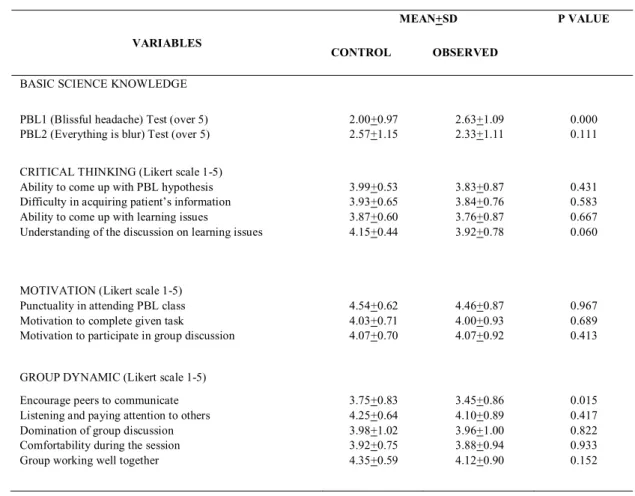
Table 1. The summary of means, standard deviations, and p value of the dependent variables for observed and control PBL groups
3.Results
The questionnaires response rate for this study was 99% out of 204 2nd year medical students (n= 191). The
questionnaires that were answered completely in the analysis was included in the data analysis. Results obtained
VARIABLES
MEAN+SD P VALUE
CONTROL OBSERVED
BASIC SCIENCE KNOWLEDGE PBL1 (Blissful headache) Test (over 5) PBL2 (Everything is blur) Test (over 5)
2.00+0.97 2.57+1.15 2.63+1.09 2.33+1.11 0.000 0.111
CRITICAL THINKING (Likert scale 1-5) Ability to come up with PBL hypothesis Difficulty in acquiring patient’s information Ability to come up with learning issues
Understanding of the discussion on learning issues
3.99+0.53 3.93+0.65 3.87+0.60 4.15+0.44 3.83+0.87 3.84+0.76 3.76+0.87 3.92+0.78 0.431 0.583 0.667 0.060
MOTIVATION (Likert scale 1-5) Punctuality in attending PBL class Motivation to complete given task
Motivation to participate in group discussion
4.54+0.62 4.03+0.71 4.07+0.70 4.46+0.87 4.00+0.93 4.07+0.92 0.967 0.689 0.413
GROUP DYNAMIC (Likert scale 1-5) Encourage peers to communicate Listening and paying attention to others Domination of group discussion Comfortability during the session Group working well together
3.75+0.83 4.25+0.64 3.98+1.02 3.92+0.75 4.35+0.59 3.45+0.86 4.10+0.89 3.96+1.00 3.88+0.94 4.12+0.90 0.015 0.417 0.822 0.933 0.152
showed no significant difference in basic science knowledge between PBL with facilitator and PBL without facilitator. For the other parameters, results also revealed no significant difference in overall components of critical thinking skills and motivation. However, one component of group dynamics which is the encouragement of peers to communicate shows that the control groups is better than the observed group, and the difference is significant (P = 0.015) while the other components were not significant (Table 1).
4.Discussion
In this study, the observed group performed significantly better in the test of the first PBL topic compared to the control group. This result could probably due to the fact that the observed group paid more attention during the PBL session. However there is no significant difference in the test of the second PBL topic. A report showed that in two out of three learning blocks, first-year health science students’ performance was at par on knowledge-based examinations when they were in PBL groups led by fourth-year students as they did when in groups facilitated by faculty (DeVolder et al, 1985). There was however one block where this was not the case, it occurred early in the year. This led DeVolder and his co-authors to suggest that faculty guidance could be essential in the budding stages of learning before students acquired a foundation upon which to base subsequent study and learning. It is also possible that a certain amount of time is needed for students to acclimatise to PBL. Thus a facilitator’s role should be facilitating knowledge acquisition besides assisting students in adapting roles in a PBL environment (Schmidt, 1994). In this study, the students were the second year medical students in their last semester and they had a year worth of experience before entering this study.
In critical thinking, motivation and group dynamic aspect there were no significant difference between the control and observed group except for the peer encouragement part. There is a significant decreased mean on encouraging peer to communicate in PBL group without facilitator which is usually the role of facilitators. In this study, students were noted to be able to carry out their discussion smoothly and identified the learning issues. Some group members participated minimally while others dominated during discussion. The results of the study are in accordance with other studies that there is no difference on knowledge, critical thinking and motivation in PBL group with or without facilitator. PBL topic is most advantageous when learners have little prior knowledge of a domain or when the learning activity is not `highly' structured (Schmidt, 1994). Highly structured learning activities are those that provide clues and guidance about what is important to study. When they lacked prior knowledge of a domain, Schmidt found that students participating in PBL groups led by content experts performed better in examinations than students in groups that were facilitated either by fellow students or by facilitator lacking content expertise. On the other hand, under `low structure' conditions, student performance is enhanced by being in groups led either by content experts or by students. The advantage of content expertise in low structure cases lies in the expert's ability to stimulate thinking and learning by posing appropriate questions and by recognizing student errors. Simultaneously, Schmidt speculates that in low structure conditions student facilitators are able to communicate more effectively with their fellows, identify points of confusion and achieve mutually understandable explanations and understandings. He describes this as a situation of `role congruence' and of `cognitive congruence'. In another study comparing effectiveness of PBL between PBL with facilitator and PBL without facilitator, students claimed that they were able to utilize their time more efficiently by not paying more time in generating “fruitless” hypothesis and discussion when they had the learning objectives from the PBL session (Steele et al. 2000). For this group of students, the answers and not the learning process were of paramount importance. Besides, they also found out that there were groups of students making claims that without the guidance of a facilitator, they might not know when they were making errors in judgment or interpretation of a given subject. However, the study showed that there was no difference in students’ performance.
In faculty of medicine UKM, having a “true” PBL session without facilitator is limited as the facilitators were required to be present to assess the student’s involvement in the PBL session. Ideally a one-way mirror or a video-taping would be the best tool for the situation. However, the facilitators did not participate in the discussion as required. In the PBL session without facilitator, students were noted to be able to carry out their discussion more smoothly and identified the learning issues. This was most probably because they were thoroughly conversant of the PBL process. On the contrary, there were some members of the group that participated minimally throughout the discussion while discussion was dominated by certain students. Students in these groups felt that there should be a
was similar, students progressed from generation of hypothesis to learning issues upon given a new trigger, the flow of the discussion was smooth. Despite that, some students were concern about their directions of the discussion as they were not sure of any mistake or judgment they made. But there were students who prefer PBL without facilitator, they claimed that PBL with facilitator will be good if they were expert in the topic discussed; otherwise facilitator’s role will be only to guide them through the focus discussion and ascertain that objectives were reached. Students also stated that the session without facilitator was more relaxing. All these findings were consistent with Steele et al. (2000).
At the same time, this study considered the value of PBL in training a more matured medical students. The qualities considered in this context included critical thinking skills, motivation and group dynamics. These are part of the objectives of PBL and simultaneously affect the outcomes of learning. It was not uncommon for students to come up with conflicting information and had to reconcile the differences in group discussion (Donner and Bickley, 1993). Thus this led to a realization that there may be more than one answer to a question and served to inculcate the habit of critical thinking. The amount of knowledge acquired during PBL sessions also largely depend on each student way of learning (Woods, 1996). Some may prefer to only memorize and be led by a facilitator or any dominant person which is called the breadth of learning, while on the other hand, there are students who are learning in depth by understanding and reasoning each problem. In this study, students had the opportunity to seek and discussed the learning issues of the PBL topic outside the allocated time slot of their PBL session. This is probably the reason that one of the attributes of a student trained from a PBL curriculum is to become an independent learner.
Steele and colleagues stated that PBL without facilitator felt anxious in receiving information as they were worried in receiving false information. Feedbacks from facilitators observing the PBL without facilitator shared the same concern. Students appeared hesitant in sharing the information they gathered compared to the PBL with facilitator. While, it was apparent that the discussion was able to proceed at the pace of the group without a facilitator, objectives of the PBL topic could not be fully reached. Furthermore, the students were oblivious of the depth and breadth of a particular issue that they should be discussing. This was reflected by the students as well. In PBL without facilitator, students have the freedom to develop social relationship in order to develop dynamic process that serves as a momentum in conducting a PBL. Apart from that, the PBL group may have adopted a model of working with other group members of different gender, characters and personalities.
PBL sessions also involve character building as well as students’ personal and professional development. This is crucial in preparing students for future clinical experience. If the PBL session were to be conducted truly without facilitator, the students should be properly trained in the proper conduct of the PBL process. However, issues like students’ attendance, accountability in sharing information, critical reasoning, dominance and passiveness need to be addressed. Having a PBL with facilitator may solve the above mentioned issues. Facilitator plays a major role in probing information when there is lack of depth in learning.
PBL without facilitator opens up opportunity for better management of human resource. Concurrently, it could nurture students with a better quality of critical thinking when they are subjected to the unknowns. Decision making skills and a more dynamic group works could also be cultivated. There is however a need to divide and share the workload of the group equally among the members. Allowing each member to present their information and clarify the source of the information is crucial in validating the facts. At the same time, this would pose as an opportunity to shape students character in terms of becoming an independent learner who is capable of working with other individuals.
5.Conclusion
This study showed that there was no significant difference between PBL without facilitator and PBL with facilitator in terms of knowledge, critical thinking skills, motivation and group dynamic.
Acknowledgement
We would like to acknowledged Universiti Kebangsaan Malaysia for their support and financial assistance throughout the study. We would also like to thank all facilitators and second year students who participated in this study.
References
Barrows H.S. (1986). A taxonomy of problem-based learning methods. Medical Education. Vol 20, Issue 6, November 481-486.
DeVolder ML, DeGrave WS., & Gijselaers W. (1985). Peer teaching: academic achievement of teacher-led versus student-led discussion groups.
High Educ. 14:643-50.
Donner R S & Bickley H. (1993). Problem-based learning in American medical education: an overview. Bulletin of the Medical Library Association. July; 81(3): 294–298.
Neville, A.J. (1999). The problem-based learning tutor: Teacher? Facilitator? Evaluator?, Medical Teacher 21(4), pp. 393–401.
Nuutila, E., Törmä, S. & Malmi, L. (2005). PBL and Computer Programming – The Seven Steps Method with Adaptations. Computer Science Education, 15(2), 123–142.
Schmidt HG. (1994). Resolving inconsistencies in tutor expertise research: does lack of structure cause students to seek tutor guidance? Acad Med; 69:656-62.
Steele D. J., Medder J. D & Turner P. (2000). A comparison of learning outcomes and attitudes in student- versus faculty-led problem-based learning: an experimental study. Medical Education. 34:23-29.
Woods, D. R., Hall, F. L., Eyles, C.H. & Hrymak, A. N. (1996). "Tutored vs. tutorless groups in problem-based learning," American Journal of Pharmaceutical Education, 60(3), 231-238.