1
Investigating the Impact of an Intervention Programme in a Grade 11
Mathematics Class: A Case Study
by
Xabiso Priceless Mnqwazi Student No: 2864687
A Thesis submitted in Partial Fulfilment of the Degree Master of Education
in Mathematics
In the
School of Science and Mathematics Education Faculty of Education
at the
UNIVERSITY OF THE WESTERN CAPE
Supervisor: Prof. Cyril Julie Co-Supervisor: Prof Monde Mbekwa
2 Declaration
I, Xabiso Priceless Mnqwazi, declare that the contents of this thesis represent my own unaided work and that the thesis has not previously been submitted for academic examination towards any qualification. Furthermore, it represents my own opinions and not necessarily those of participants. Signed: --- Date ---
3 Acknowledgements and dedication
I express my deepest appreciation to the following people who contributed towards the completion of this academic project:
My Supervisor, Professor Cyril Julie for guidance in achieving the end goal. Thank you for demonstrating the search of knowledge and for becoming a father and friend to me;
My Co-Supervisor, Professor Monde Mbekwa for supervision and patient guidance during the course of this project. Thank you for supporting me to carry out this study;
Doctor Neetha Ravjee I say thank you for the academic and material support.
Students of School of Mathematics and Science for helping me in my research work, real friends in the battle for knowledge;
Mr Daniel Angaama and Ms Loide Shifula for their great contribution to this work.
Thank you Mr Tyanai Masiya for making invaluable contributions to enable me to get through with this research.
Mrs Zwane for going out of her way in order to assist me. Pastor Xhaso for being such an inspiration and eye opener.
My Masters colleagues, your encouragements to carry on are greatly appreciated. Interview Participants, l would have not made it without your participation. I thank you; I would like to thank the almighty God for bringing brilliant people in my way to do this work.
Finally, I would like to thank the National Research Foundation (NRF) for financially supporting me towards this project.
To my sons (Lisolenkosi, Onako, Cebo) and my loving wife (Zukiswa).
To the almighty God
4
Table of Contents
Acknowledgements and dedication ... 3
Key Words: ... 7
1 Introduction ... 9
1.1 Background of the Study... 9
1.2 Rationale of the Study ... 14
1.3 Research Questions ... 15
1.4 Significance of the study ... 16
1.5 Contribution of the Research ... 16
1.6 Delineation of Research ... 16
1.7 Structure of the Thesis ... 17
1.8 Conclusion to Chapter 1 ... 17
2.1 Introduction ... 18
2.2 Tutoring Programmes ... 18
2.2.1 Essence of Tutorials ... 18
2.3 Tutoring Studies ... 20
2.3.1 Impact of a Tutorial Programme at Stellenbosch University ... 20
2.3.2 Integration of Tutorials into Numeracy Courses at the University of Cape Town ... 21
2.3.3 Effect of the Peer-Tutorship Model ... 22
2.3.4 Evaluation of Computer-Based Tutorial Programmes ... 23
2.4 Theoretical Framework ... 25 2.5 Conclusion ... 26 3.1 Introduction ... 27 3.2 Qualitative Approach ... 27 3.3 Action Research ... 28 3.4 Sample Context ... 29
3.5 Data Collection Methods ... 29
3.5.1 In-depth interviews ... 30 3.5.2 Focus Groups ... 30 3.5.3 Observation ... 31 3.5.4 Documentary Evidence ... 32 3.6 Ethical Considerations ... 32
5
3.6.1 Ethics Statement ... 32
3.7 Conclusion ... 33
4.1 Introduction ... 34
4.2 Khayelitsha School Pre-Test Results ... 34
4.2.1 About the Pre-Test Results ... 37
4.2.2 Khayelitsha School Post-Test Results ... 38
4.3 Qualitative Presentation of Findings ... 40
4.4 Consolidation of Tests 1 to 5 ... 44
4.5 The Tutorial Process ... 44
4.5.1 Perceptions of tutorials from students and teachers ... 45
4.6 Challenges During the Tutorial Programme ... 46
4.7 The Langa School ... 47
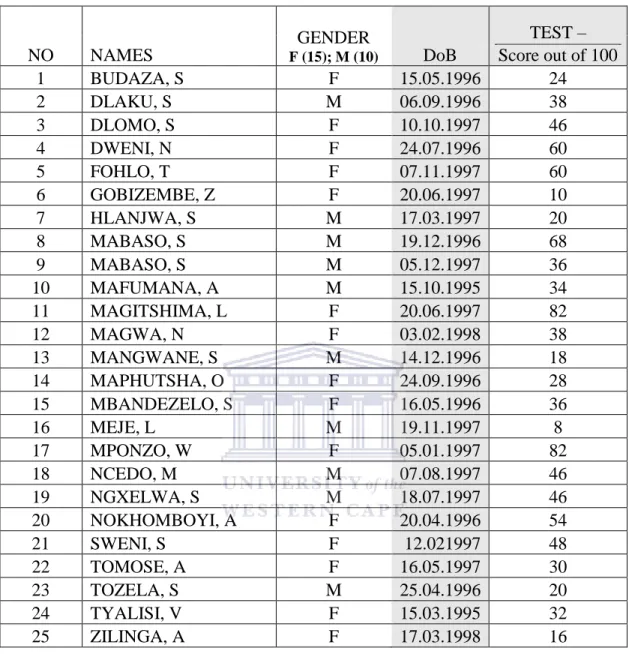
4.7.1 Test Scores ... 49
4.8 Conclusion ... 51
5.1 Introduction ... 52
5.2 Summary of the Thesis ... 52
5.3 Conclusion ... 54
5.3.1 Limitations of the Study ... 55
5.4 Recommendations ... 55
5.5 Considerations for Future Research ... 56
6 References ... 57
7 Appendices ... 62
Appendix 1: Example of Questionnaires for Teachers ... 63
Appendix 2: Example of Questionnaires for Learners ... 65
Appendix 3: Example of Research Consent Form/Statement ... 67
Appendix 4: Example of Test Assessment Tool ... 68
6 List of Tables
Table 1: Grade 12 Mathematics Pass rate at a Khayelitsha School ... 12
Table 2: Pre-Test 1, Pre-Test 2 Results ... 36
Table 3: Pre-Test Mean Score Aggregates ... 37
Table 4: Pre & Post-Test Mean Score Aggregates ... 39
Table 5: Khayelitsha School - Grade 11 ... 43
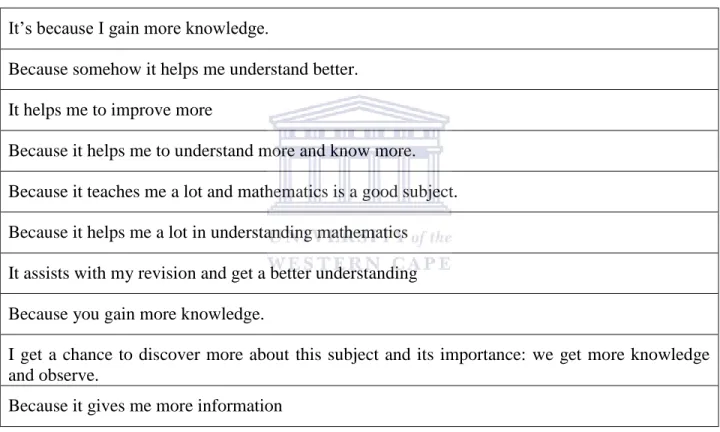
Table 6: Reasons why learners attended the tutorials ... 45
Table 7: Langa Test Results ... 50
7 Abstract
The general performance of learners in mathematics in most secondary schools in South Africa is not encouraging. Statistics reveal that there is a general poor performance in mathematics and related science subjects especially in those schools located in previously disadvantaged communities. There is just a need for appropriate interventions of the significance of mathematics in present society which is now characterised by high information and technology thrust.
The objective of the study was to investigate the impact of the tutorial intervention programme on the performance of a grade eleven mathematics class with a view to improving the mathematics performance of these grade 11 learners. The selection of the action research based method was premised on the idea that it would help the researcher to improve his tutoring practice as well as contributing to better learner performance. Data was collected through the use of qualitative research methods. These involved observation, the utilisation of focus group discussions of learners, and in-depth interviews with randomly selected learners and other mathematics colleagues. A careful mix of learners of different learning abilities was made so that high performers would assist those whose performance was lower. In each group of five at least two high performers were included.
Findings of the study point to the effectiveness of the tutorial process, justifying its adoption on a long term basis. In general, it can be concluded that the tutoring strategies used by the researcher had a positive effect on the knowledge retention of the learners. This conclusion was arrived at from an observation of improved test results over time, the learners‟ views in the questionnaires as well as those of peer observers.
Key Words: Action Research, Achievement, Focus Groups, Grade 11, Learner Performance, Matric
Examinations, National learner attainment strategy, School Mathematics, Teaching Method, Tutorial.
8
List of Abbreviations
UWC - University of the Western Cape
CDE - The Centre for Development and Enterprise CDC - Centre for Disease Control
AIMS - African Institute for Mathematical Science SU - Stellenbosch University
HED - Higher Education Development UCT - University of Cape Town MM - Master Maths
CBT System - Computer Based Teaching System HSRC - Human Sciences Research Council USA - United States of America
WCED - Western Cape Education Department SAT Monitor - South African Transformation Monitor NSC - National Senior Certificate
9
CHAPTER 1: INTRODUCTION
1 Introduction
This chapter introduces the thesis. It presents the background of the study, the rationale of the study, research questions, the significance of the study and its contribution to the research.
Within the background section (section 1.1), the chapter introduces the context of the study, including the challenges affecting learning and related outcomes in mathematics and science in the historically disadvantaged schools in black townships. This is followed by a rationale in section 1.2, an outline of research question/s in section 1.3, the significance of the study in section 1.4, the anticipated contribution of the study in section 1.5, delineation of the study in section 1.6 and the structure of the thesis in section 1.7. A conclusion (which precedes chapter two) in section 1.7, is the final section of the chapter.
1.1 Background of the Study
The new demands of the 21st century require citizenry which is mathematically literate. Swanepoel (in Bhudal, 1993) argues that mathematics is important in present day society as most fields of knowledge are dependent upon it. Furthermore, South African development policy is oriented towards transforming the economy from one which is primarily resource-based to one which is increasingly technology-based. A technology-based economy is dependent on reasonable knowledge of mathematics. Thus sound mathematics education is necessary especially in South Africa to advance the subject. Technology is based upon the sciences, and the sciences are firmly based upon mathematics. Mathematics is compulsory for further studies in a number of fields which are very important to the economy and the further development of the country.
In view of the importance of mathematics, it is critical that mathematics teachers develop effective strategies of enhancing the performance of learners in the subject. The clearest mandate that the teacher has is to teach learners properly in a way which will enhance their understanding of the subject matter. Hence teachers are always looking for the best strategies to promote knowledge acquisition. In this regard, this researcher sets out to engage in tutorial interventions
10
at a Khayelitsha and Langa school with the aim of helping learners perform better in mathematics.
Khayelitsha Township lies some 30 km of south-east of Cape Town in the Western Cape. The name is of Xhosa origin and means „new home‟. Khayelitsha Township was established during apartheid in 1983 to accommodate informal settlement dwellers on the Cape Flats. It was built under the principle of racial segregation executed by the government and today it is the second biggest Black township in South Africa after Soweto in Johannesburg. A Langa school was added in the second cycle of the action research to incorporate the some insights gained in the first cycle. Langa is a suburb found in Cape Town. It was established in 1927 in terms of the 1923 Urban Areas Act as one of the many areas in South Africa that were designated for Black Africans before the apartheid era. It is the oldest of such suburbs in Cape Town. Although Langa literally means "sun" in Xhosa, the name of the township is derived from the name of Langalibalele - a chief and renowned rainmaker who in 1873 was imprisoned on Robben Island for rebelling against the Natal government
South Africa is a country that continues to face significant difficulties in improving access to quality education and improved performances for learners. This challenge is much greater in previously disadvantaged communities due to limited resources and an environment that provides inadequate learning outside the class room context. Mathematics is the most affected subject in secondary schools.
A study by Makgato & Mji (2006) states that numerous researchers paint a gloomy picture of mathematics teaching in South African high schools. The state of mathematical and scientific literacy is generally poor in the entire schooling system. The numbers of learners taking mathematics is also dramatically affected by the low pass rates. In particular, most grade 12 graduates from previously disadvantaged communities do not come out with results that qualify them to take up degree studies in the sciences. The Centre for Development and Enterprise (CDE) report (2004) concludes that the number of learners who completed grade 12 with mathematics and science in secondary school level is very low in South Africa to the extent that there is a continued dearth of skilled workers to build the economy. South Africa still significantly relies on importing foreign scientific and technological expertise.
11
A strong appreciation of mathematics is thus required among learners today because it equips them with knowledge, skills and habits of mind that are essential for successful and rewarding participation in society.
Therefore mathematics is
“Identified as a core subject, math is deemed as the “bedrock of our modern world” and it is of crucial importance that students are successfully taught to understand the concepts that lie within math, as the skills involved are an integral part of our society” (Roman, 2004, p.16).
Beyond everyday life, mathematics is an integral part of science (Rutherford, & Ahlgren, 1990). The sciences (physical sciences, chemistry, astronomy, and so on) require proficiency in mathematics, and the background knowledge associated with the sciences can be used for everyday problem solving. The thesis is an exploration of the effectiveness of tutorials to build a strong mathematical proficiency.
Tutorials are imperative for huge investments to be directed towards the promotion of mathematics in schools and universities in South Africa. Figures reveal that there is not only a general poor performance in mathematics and other science related subjects but also a tendency by learners to avoid taking the subject. Dating as far back as 2011, where 45% of grade 12 learners wrote the mathematics examination in the country, fewer than half of the candidates passed the subject with at least 30% (Parker, 2012), and only 18,51% of students who wrote Mathematics achieved a 50% pass at this time (Thandulwazi Maths and Science Academy, n.d.). Of great concern in this statistics is that one in six learners got less than 10% (Pauw, Dommisse, & van der Merwe, 2012). Even worst is that was no notable sense of improvement in the years 2010, 2011 and 2012 - from poor status of the previous years of 2006, 2007, 2008, 2009 and 2010. In 2006 for example, learners who passed with at least 30% mark were 33,80% of the total that wrote the subject at Matric level. The figures according to the South African Transformation Monitor (SAT Monitor, n.d), was 41,41% in 2007, then 42,58% in 2008 and 45, 97% in 2009. The sad reality is that statistics suggest a state of deterioration. For example, of those who passed mathematics in 2010, only 31% obtained a mark of 40% or above (South African Catholic Bishops Conference, 2011). However, the Department of Education considers a 30% score as a pass, which appears to be somewhat a low pass bench mark. Before a reflection on the situation in subsequent (recent) years as analysed in this study, it is clearly in the historical statistics that
12
under-achievement in mathematics remains a problem that confronts many secondary schools, especially those situated in disadvantaged communities. The schools under-study are some examples of such schools. Results for mathematics of the school used in the first cycle of this study reflected pass rates highlighted below (Table 1);
Table 1: Grade 12 Mathematics Pass rate at a Khayelitsha School
Year 2007 2008 2009 2010 2011
Percentage 21% 19,5% 18% 22% 24%
For the learners to perform better and learn mathematics in a way that will serve them well throughout their lives, they need classroom experiences which help them develop mathematical understanding, learn important facts, skills, and procedures, develop the ability to apply the processes of mathematics, and acquire a positive attitude towards mathematics. One such classroom experience is the introduction of tutorials. A tutorial is an extended version of instruction where learners are given individual practical attention by the teacher (the tutor in this respect), through detail guidance that include a question and answer process as well as learning by practical experimentation whilst corrected at the same time. A group format is frequently used to incorporate the collaborative learning component in the tutorial model used in this study. These have been found to improve the educational outcomes for learners who are at risk of academic failure (Hock, Pulvers, Donald & Schumaker, 2001).
Overall the researcher has eighteen years of teaching experience. Despite having over ten years of experience teaching at the grade twelve levels, the researcher was teaching in the tutorial programme for only the second time in 2011 and realised the anomaly (a diversion from the anticipated normal trend) of the existing intervention approach. It was therefore a very positive exercise to propose an alternative tutorial intervention approach and to determine the impact of this intervention. Using normal teaching strategies to teach mathematics does not yield any improvement. Tutorial interventions are therefore a critical tool to improve performance. A study by Baker, Gerston, & Lee (2002) found that the use of tutors to provide feedback and support improves the performance of low achievers. Thurston (1995) states that, in order to achieve in-depth mathematical understanding, effective communication of mathematics ideas is the key. Learners tend to be freer and more relaxed when they are left to share ideas among themselves
13
rather than with a teacher. Students tend to be more comfortable in situations where the teacher is just being around to guide them in doing their work. Such an atmosphere prevails in a tutorial set up.
The schools under consideration introduced tutorials for the mathematics classes for grade twelve in 2009. The national learner attainment strategy was presented in 2007. This introduction of tutorials is part of the government‟s National Learner Attainment Strategy that seeks to boost pass rates in poorly performing schools. The introduction of the tutorials at the school is supported by the Western Cape Education Department. The Department employs tutors for mathematics to assist in the teaching of learners in previously disadvantaged communities who seem to have difficulties in learning mathematics.
Prior to this research, the intervention involved the Western Cape Education Department appointed tutor to offer one and half hour lessons to the whole class once a week and occasionally checking solutions provided by the learners around the class. There was no close interaction among learners or between the learners and the tutor to reinforce learning. As a result there did not seem to be improvement in the performance of learners. Further, since the tutorials began, no impact studies of the intervention had ever been carried out by either the school or this researcher. Wenmoth (2007, p.8) points out that:
“taking the time to reflect critically on the things we are doing in our classrooms is perhaps the most effective thing we can do to ensure that what we are doing is having the desired outcomes and is changing our practice in the ways we want it to”.
This study thus focused on an alternative tutorial approach.
14
1.2 Rationale of the Study
This study was motivated by academically struggling grade twelve learners in the two secondary schools who were experiencing problems in mastering key mathematics concepts that will enable them to pass their grade 12 examinations in the subject. Existing extra classes conducted between 15:00 and 16:30 once a week had not contributed to improvement in the performance of learners in relation to their mathematics results in the past years. The goal of this research was to investigate the impact of an alternative intervention programme (tutorials) in the performance of a grade 11 class.
Key research questions raised in this regard include:
Was the intervention proposed in this research workable?
What was the impact of intervention program on the researcher?
How can the researcher develop his teaching in order to be relevant to learners at the disadvantaged schools?
Corey (1953, p. 6) asserts that: “schools cannot keep up with the life they are supposed to sustain and improve, unless teachers, pupils, supervisors, administrators and school patrons continuously examine what they are doing”. Scrutinizing teaching and learning is important for obtaining positive results (Corey, 1953). Research is directed towards the solution of a problem. This research was designed to improve tutoring practice and performance of mathematics learners in the school.
In this research work, the researcher used grade eleven as a barometer to gauge school performance following an intervention. The study is done in grade 11 because the learners who did not pass grade 11 Mathematics were likely to fail in grade 12. The researcher is mindful of the fact that grade twelve is a critical grade in the academic journey of any South African secondary school learner. It is at this stage that academic work done at previous grades can be tested with relative effectiveness and efficiency through the National Senior Certificate examinations (NSC). When one talks of grade twelve being a stage where academic work done at previous grades can be tested with relative efficiency and effectiveness, one is referring to the use of external examiners. It is only at grade twelve that external examiners get to mark students‟ scripts at the level of secondary education in South Africa. Grade 12 is the exit grade of secondary schooling in South Africa.
15
In the lower grades students can be promoted to higher grades without external examinations. Examinations are internal i.e. assessment is made by the teacher who teach their classes.
The researcher felt a need to develop special tutorial methods to improve mathematics performance in the target schools because he saw in tutorials an effective and efficient way to engage students in the learning process. One reason for this is that it is very difficult for some learners to study at home because of overcrowding.
The crisis faced by the majority of students centres around homework not being done because they spend limited time in school and the home environment makes the academic endeavour an arduous task for these students because of space constraints. It is important for this aspect of the student‟s life to be compensated with new productive tutorial methods. It was hoped that emphasis on the tutorial methods would give learners who run short of academic working space at home the option of concentrating their academic working efforts at school. The emphasis in this study was on tutors playing a minimal role in the tutorials and a maximum involvement by the learners. Tutors could play a minimal role by allowing students to lead group sessions or by working out answers and explaining to the group how they would have arrived at the answers. The researcher believes in the pedagogical principle that learners should learn by doing. They should be placed in situations that lead them to solve mathematical problems by themselves and find possible solutions in order to learn. The standard of tutorial questions should also allow students a wide range of mathematical problems from those with easy solutions to the more complex ones.
The researcher hoped that doing academic work at school would certainly yield fruit because it would be more conducive for learners since they would be interacting with their peers during tutorial sessions. The researcher felt that those who were good at mathematics would become better and those who were weak would be positively influenced by the better performing students. Once the students were motivated, they would be engaged in their work and the results would certainly improve.
1.3 Research Questions
1.3.1 What is the impact of the tutorial intervention programme on the performance of grade 11 learners?
16
1.3.2 Is the intervention proposed in this research workable?
1.3.3 What is the impact of intervention program on the researcher?
1.3.4 How can the researcher develop his teaching in order to be relevant to learners at the Khayelitsha and Langa schools?
1.4 Significance of the study
This study is significant for a number of reasons. It attempts to provide an understanding of the relationships that existed between tutorial interventions and learners‟ performance levels. The study showed the appropriateness of the tutorial intervention programme to grade eleven class.
The results of this research should be beneficial to previously disadvantaged schools especially those that have adopted the tutorial intervention programme as it has highlighted the contribution of the tutorial intervention programme to learners‟ performance in the mathematics subject. This research is an important additional commentary on the role of tutorial programmes in improving learner performance in mathematics.
This research provides the foundation for further research into the relevance of the tutorial intervention programme in South African schools.
The research was an important capacity building exercise for the researcher with regards to conducting tutorials in a mathematics class.
1.5 Contribution of the Research
The aim of this study was to offer insight towards improved teaching, learning and hopefully, learning outcomes in high school mathematics. In particular, to help devise a practical tutorial tool to help learners own the learning process and advance their mathematical problem solving skills.
1.6 Delineation of Research
The study only focuses on the subject of mathematics in high schools of Khayelitsha and Langa townships in the Western Cape.
17
1.7 Structure of the Thesis
This thesis is divided into five chapters. Each chapter is composed of introduction, sub sections and conclusion. Roadmap to the content of the chapters is also presented in subsequent sections below.
Chapter 1 – Chapter one is the introduction which highlights the aim and rationale of the study, as well as the research questions.
Chapter 2 – Following the introductory chapter (Chapter 1), chapter 2 reviews related literature in the field.
Chapter 3 – The third chapter outlines the methodology, sampling and data collection methods that the researcher used to conduct this research. The chapter further discusses the sampling method and the units if analysis for this thesis. Reasons for selecting specific units of analysis are justified in this section. The manner in which data was analysed is part of discussion in this chapter.
Chapter 4 - Chapter four mainly focuses on the findings.
Chapter 5 - The final chapter (Chapter 5) concludes the study. It summarises the thesis, offers a conclusion, recommendations and suggestions for further studies.
1.8 Conclusion to Chapter 1
The aim of this chapter was to introduce the subject of study, to outline the rationale of the project, research questions and ultimately, the structure of the thesis. Subsequently, a review of the literature to support the investigation is presented in the next chapter, chapter 2.
18
CHAPTER 2: LITERATURE REVIEW
2.1 Introduction
Subsequent to the introduction of the study in chapter 1, this section describes the context of the tutorial programme as the subject of analysis in this thesis. It draws on existing literature to define the tutorial concept, and to describe the significance or essence of tutorials in education.
To frame the context, the chapter draws on examples in the University of Stellenbosch (US), followed by a reflection of tutorial programmes in numeracy courses at the University of Cape Town (UCT) in South Africa. A peer-tutorial model as well as a brief overview of computer based tutorial options are then used to clarify the significance of learner participation in constructivist learning, all presented in section 2.2. A discussion of the tutorial programme is followed by a tutoring studies in section 2.3, theoretical framework in section 2.4 and finally, a conclusion of the chapter in section 2.5
2.2 Tutoring Programmes
2.2.1 Essence of Tutorials
A tutorial is an exercise whereby a tutor gives intensive instruction in some subject to an individual learner or small group of learners to help them improve learning strategies in order to promote independence and empowerment (Horn and Jansen, 2009). The authors consider a tutorial to be a small number of students (as few as four but sometimes rising to 20) discussing a subject with a tutor. Cook, et al. (2005) observe that introduction of tutorial groups improves performance. They posit that there is no dispute that tutorials are effective in improving the relationship between staff and learners, in encouraging a collaborative approach to learning and in modelling the teamwork common in the workplace.
Tutoring also helps learners help themselves and assists them to become independent learners. In this way a tutor is mainly a helper. The objective of tutorials particularly for underperforming learners is to help them achieve higher test grades (Hock, Pulvers, Donald, & Schumaker, 2001).
Further, Horn & Jansen (2009) argue that tutorial attendance contributes to improved academic performance. However, in reviewing related literature, Horn & Jansen (2009, pp180-182)
19
concluded that there was a dearth of literature on the role of tutorial programmes in influencing student performance. This study makes a contribution in that regard.
Improving the educational outcomes of learners is an important issue for educators. Hock, Pulvers, Donald & Schumaker (2001) observe that before-and-after-school tutoring programmes have the potential to turn poor performance into academic success. They argue that tutoring programmes can help at-risk students and students with learning disabilities who were falling behind in classes to earn average or better grades on quizzes and tests if they had the support of trained tutors, or through tutoring programs.
According to Powell (1997), researchers on tutoring have found it to be moderately effective as a strategy for improving learner performance. Powell (1997) also reports that in a 1982 meta-analysis of 65 tutoring studies in the United States of America (USA), it was found that learners on tutorial programmes performed better than those who were not on the programme in examinations. It was found that they expressed more positive attitudes toward the subjects in which they were tutored. More importantly, in the South African context, Powell (1997) found tutoring to be particularly beneficial among children from disadvantaged socio-economic backgrounds, with learners showing greater than average gains in reading and mathematics achievement and less absenteeism than non-participating counterparts.
Sanderson (2003) also contends that after school tutoring complements the regular learning times in that it adds intensive hours of instruction. The additional hours are particularly relevant to the South African context in that most learners, if dismissed from school early, do not have available learning alternative environment at their homes. Specifically, Robinson, Schofield & Steers-Wentzell (2005) state that tutoring has a positive impact on a variety of mathematics proficiencies, including arithmetic computation, conceptual understanding, and problem solving skills.
Improved performances arising from tutoring are a result of the fact that the programme is uniquely tailored for the purpose. Karan (1996), points out that tutoring is structured in such a way that it focuses on how to undertake a task rather than on what to do. This indicates that learners know how to tackle rather than embark on it. Moreover, in Euclidean geometry, a learner can start by looking at the diagram and identify theorems which apply before answering the question. In this regard, the student learns to help herself or himself by not only knowing the
20
problem but to solve the problem step by step. Tutoring also involves personalised instruction with specific emphasis on the utilisation of a student‟s unique abilities and experiences to develop the most effective learning strategies for himself or herself. Focusing on an individual learner provides the opportunities for him or her to personally discover answers and thereby gaining the ability and necessary self-confidence to learn independently of the tutor. Such a learning process provides intensive practice for learners and encourages higher levels of thinking.
Furthermore, the tutoring setting enables learners to be fully engaged in the learning process and the bond they can form with their tutor can provide a warm, supportive relationship within which instruction occurs best. However, it is important in the context of this study to note that the impact of tutor learning can also have an effect on tutors. Tutors seem able to learn through tutoring, no matter what subject they are teaching. Studies have shown that not only do tutees benefit from tutoring programs, but the tutors of the program gain from it as well (Cohen, Kulik & Kulik, 1982). Studies have also shown that in this regard, mathematics is among the subjects that may exhibit stronger gains than any other programs (Roscoe & Chi, 2007).
2.3 Tutoring Studies
2.3.1 Impact of a Tutorial Programme at Stellenbosch University
Horn & Jansen (2009) analysed the impact of a tutorial programme at Stellenbosch University (SU) in South Africa. Their study investigated the tutorial programme for first-year economics students. In the programme, tutorial classes were conducted weekly and commenced 2 weeks after the formal academic programme had started. Attending tutorial classes was voluntary, although some students were encouraged to attend regularly. Tutors were appointed from a pool of postgraduate and undergraduate students who took economics as one of their majors in their final year of study. The students who applied to be considered for tutoring positions were interviewed, and selected based on their academic achievement, communication skills and enthusiasm. Tutors were required to attend compulsory training offered by SU‟s Centre for Teaching and Learning.
The training covered areas such as how to approach tutorial classes for the first time, how to work in groups, and maintaining discipline within classes. Mock tutorials, where tutors receive
21
comments and feedback on their presentation skills, were part of the training programme. Compulsory meetings throughout the academic year were used to address problems and issues pertaining to the programme. During their (Horn & Jansen, 2009) academic semester of study, a total of 23 tutorials were held. There were 27 tutorial groups, comprising 15 Afrikaans groups and 12 English groups. Tutors were assigned to each group. The tutors were expected to assist learners by way of addressing key challenges in mathematics.
The study by Horn & Jansen (2009) concluded that a formal tutorial programme as implemented at SU, makes a positive contribution to the academic performance of students. They conclude that for both first time registered students and repeaters, tutorial attendance contributed positively to the performance of economics students.
2.3.2 Integration of Tutorials into Numeracy Courses at the University of Cape Town Research studies suggest that tutorial can be effectively integrated into numeracy courses, with commendable learning outcomes. In effect, Frith, Jaftha, & Prince (2005) studied the integration of interactive Excel Tutorials into a Bridging (Pre-Calculus) Course in the Faculty of Higher Education Development at the University of Cape Town.
The study focused on the use of computer tutorials in a course titled “Effective Numeracy” at the University of Cape Town. The Effective Numeracy Course is designed to increase first year students‟ appreciation of quantitative literacy. The course targeted those students coming from previously disadvantaged communities. It sought to ensure that these students are adequately prepared for mathematics courses and other subjects in later years of their study at the university.
Frith et al (2005) point out that integration of tutorials into the Effective Numeracy course was by way of a 2 hour session in the computer laboratory every week coupled by two 2 hour periods in the workshop-lecture environment. As such in this course, there was a particular emphasis on linking laboratory work to classroom teaching by ensuring that the tutors raise the same issues dealt with in the laboratories during the lecture in the same week. This is noted as critical to ensure assessment and promotion of student learning. Because of the critical relationship between assessment practices and the nature of student learning, the computer tutorial system is also designed in such a way that assessment is continuous. The system records the students‟ responses to questions in the tutorials and the assessment can be recorded automatically to a
22
database where they can be processed to produce feedback to individual students about their misconceptions and to the tutors about the class‟s performance in general. The system can also be used for auto marking.
However every third week students wrote a computer assignment whose mark contributed to their final class record. As regards to testing, a third of the final examination is also made up of computer laboratory work.
This study identified various responses pertaining to the usefulness of the Efficiency Numeracy course from eleven randomly selected students. Seventy percent of the responses that were given by the students indicated that students found a complementary relationship between computer laboratory work and classroom teaching. What students would not understand in class for example, would be easier to understand when they get to the laboratory because laboratory work is very visual and has clear graphic illustrations as compared to the classroom. For the students, the lab also offered opportunity to explore many examples with ample feedback.
Frith, et al (2005) conclude that with regards to the effect of tutorials on students‟ attitudes to learning mathematics, the study showed that there was a general improvement in students‟ feelings of confidence in doing mathematics (and in using computers). This is regardless of the sequence of delivery of computer tutorials and class workshops.
The study observed that the use of computer tutorials adds value to students‟ understanding of mathematics courses. This is because graphical abilities of the Excel computer programme enable the students to practice more using examples and using realistic values. In addition, the Excel environment facilitates the understanding and representation of functions in the four different ways that the course emphasizes: with a formula, with a table of values, graphically and verbally. The computer not only provides immediate feedback on tutorial exercises but also makes it possible to illustrate certain concepts and processes graphically in a dynamic manner.
Furthermore, in the final analysis, 70% of the interviewed students felt strongly that the computer tutorials had helped them to understand the mathematics content of the course.
2.3.3 Effect of the Peer-Tutorship Model
Sample (2010) in her thesis studied the effect of tutoring program on the performance of grade 9 and 10 pupils in mathematics in the United States of America. In her study, a typical afternoon of
23
mathematics tutoring consisted of 9th and 10th grade tutees, as well as 11th and 12th graders who served as peer tutors, gathering in the cafeteria. For Sample, the study was important because the results of this study could be used to interpret the effect that this program may have on learner over time. Also, the results of the study could be used as evidence to support the implementation of tutoring programs as a resource for learner success in mathematics.
Participating students completed identical pre- and post- Likert-scaled surveys, which included statements about mathematics tutoring. Additionally, students were administered a pre-assessment and a corresponding post-pre-assessment that tested their level of performance in mathematics. The study concluded that there was a noticeable positive change between the pre-vs post-survey and assessment findings. Surveys were used in this study based on the research-supported statement “more attention should be directed to the attitudes of students themselves” (Walker, 2006, p. 44). According to the pre- and post-surveys, a substantial change occurred where there was a positive change in the attitude of the students toward mathematics in general, as well as towards mathematics tutoring.
2.3.4 Evaluation of Computer-Based Tutorial Programmes
Reddy, Berkowitz & Mji (2006) of the Human Sciences Research Council studied a computer based tutorial program called MasterMaths (MM) at Phakama Secondary school in the Western Cape. MM is a computer based teaching system (CBT system) that combines voice and animated graphics in the teaching of mathematics. MM was designed for the use as supplementary tuition where a learner works through a module of work and then solves problems. A tutor is at hand to assist the learner if she has difficulties. In addition to the supplementary, out-of-school tuition format, MM has been selected as the mathematics-teaching software for a Western Cape schools project, which utilises computers as part of in-school teaching. The size of centres varies from place-to-place. Some places had as few as 2 or 3 computer workstations and others as many as 40 workstations. Subject to computer terminal availability, effectively managed capacity of a MM centre is in the order of a maximum of one facilitator to eight learners at any one time.
The investigation into the in-school application of MM was based on a visit to a school that participated in the Khanya programme – an initiative which is linked to the Western Cape Education Department. They visited the computer centre of Phakama Secondary School in Philippi-East, which is about 20km from Cape Town. Almost all learners are English second
24
language-speakers. The school‟s computer centre manager is also a fulltime teacher at the school. Learners typically spend two hours a week at the centre engaged in MM modules. As final exams approach, learners may attend sessions lasting up to three hours at a time. Facilitators also set homework, with parents and students advised to spend 10 minutes a day on such activities. This time is to revise theory and work through 1 or 2 practice examples (from MM grade notes) and also go back over previous modules to revise older material.
Evaluation by the Human Sciences Research Council found that the computer based lesson component generally repeated previous lessons taught, with the result that the entire curriculum was not covered in the lessons, there was hardly any interaction with students, and the trend was for students to work alone on the computers for most of the time. Furthermore, the report documents that teachers found it difficult to construct a coherent, appropriately paced sequence of lessons that took into account the need to move between computers in the laboratory and the classroom according to a pre-arranged schedule. On this aspect, teachers were unhappy with the training they had received, which on average was 2 hours (as opposed to the far lengthier and intensive training required of MM franchisees). Teachers were unfamiliar with MM modules. In addition, the tests on MM modules were used, but were not a substantial feature of teachers‟ formal assessment practices and therefore not used for diagnostic purposes. Overall the authors found that teachers had mainly relinquished their mediation role in the computer laboratory.
Interestingly enough, from interviews with both teachers and learners, attitudes towards the software were generally positive. Both groups saw the software as an invaluable resource in assisting them fill knowledge gaps. However, use of the system is inadequately exploited because of limited access to computer laboratories. Learners could only use computers to revise, fill in gaps, and get extra practice in their own time. All learners said that the computer had improved their performance in mathematics.
The program reverses the traditional learner-teacher dynamic in two ways. Firstly, in MM learners are the active members. Instead of standing up and teaching the lesson, instructors facilitate learners‟ contact with the material. In addition, interactions between facilitator and learner are relaxed and informal.
The study reported here at a Khayelitsha school uniquely positions itself differently from all the above tutorials in that it utilizes the same teacher who takes the learners in the earlier class. The
25
learners are familiar with the teacher who this time, to a large extent, plays a role of a facilitator and heavily relies on focus groups and build capacity and comprehension among learners. The researcher is not utilising the peer facilitators. The disadvantage of using peers at the Khayelitsha school is that generally they are also facing critical difficulties with mathematics. Further to this, computer facilities cannot be used because of limited technology resources.
2.4 Theoretical Framework
There are a number of theories underlying tutoring. These include the role model, behaviourist, socio-linguistic and Gestalt theories. This study discusses the behaviourist and the Gestalt theories as they are most relevant to the impact assessment under review. The focus on tutor – learner roles in a tutorial programme helped to determine the ideal programme implementation process and attendant outcomes. The two theories however are not mutually exclusive but simply suggest different priorities and types of activities which differentially address the needs of the learner or the tutor (Powell, 1997, p.7). McLead (in Skinner‟s operant condition 2007) propounds a behavioural theory related to classroom learning based on what he calls „Operant condition‟. Skinner describes this by means of the life of an organism which operates in the environment. In this process it (organism), encounters a stimulus, called a „reinforcing stimulus‟, which increases the operant that is, the behaviour occurring just before the reinforcing stimulus. This is operant conditioning that produces an outcome and the nature of the outcome modifies the organisms tendency to repeat the behaviour in the future. This means therefore that what the tutor produces (which is the environment of the learner) results in behavioural change or change in understanding by the learner.
Explaining the behaviourist theory, Powell (1997) notes that effective learning takes place when every correct answer is rewarded. Tutoring programs that are based on the behaviourist theory are highly structured. The tutor presents materials in a given order. In the process, both the learner and the tutor experience success. The learner is rewarded by the tutor‟s positive acknowledgment for learning the material presented while the tutor experiences success when the learner accomplishes greater proficiency with the material. Thus emphasis is on giving learners individual instruction and more teaching. This theory is thus useful to understanding how tutorial sessions should be structured for the grade eleven mathematics class. In particular, it helps the researcher think about those processes that empower the learner during tutorials.
26
Further, Powell (1997, p.7-8) explains the Gestalt theory developed by Fritz Perls as asserting that learning occurs when the learner can “locate” an item in an intellectual structure or field, or relate an idea to a larger context. This theory contends that tutors will be the principal beneficiaries of the tutoring experience because they have to struggle to make the material meaningful to the learner through reflecting on their own learning process. This opportunity will increase the researcher‟s awareness of the patterns of learning and consequently helps to develop the ability to see problems in new and different ways.
2.5 Conclusion
A tutorial is an exercise serves as an additional intervention to the tradition mode of instruction. It entails a tutor giving an additional intensive instruction of the subject content to an individual or small group of learners to promote independence in learning, and empower the learner in improving their learning outcomes (Mlitwa, 2011). Various studies considered in this section conclude that there is value in pursuing tutorials programmes. These have been seen to facilitate improved performance by learners. In this study, the researcher sets out to engage in tutorial interventions at a Khayelitsha school with the aim of helping learners perform better in their mathematics subject by employing different methods in the tutorial. The study at a Khayelitsha school made use of the same teacher who took the learners into focus groups, thereby building capacity and comprehension among learners. The teacher largely plays a facilitating role.
27 CHAPTER 3 RESEARCH DESIGN
3.1 Introduction
This chapter explains the research methodology used in this study. Since a mixed methods approach was followed in this work, consisting of both the qualitative and quantitative methods with their relevant techniques, the chapter describes how data sources were identified, how data were collected, validated, analysed and ultimately – interpreted in this thesis.
Within the context of action research, a description is offered on how the qualitative methods as well as the statistical analysis were utilised. To this effect, the chapter is structured into 8 sections, starting with an outline of the qualitative approach in section 3.2 check what was written about the numbering of sections above., followed by action research in section 3.3, sample context in section 3.4, data collection techniques in section 3.5, ethical considerations in section 3.6, and a conclusion of the chapter in section 3.7
3.2 Qualitative Approach
Qualitative research captures opinions, experiences and feelings of individuals. It describes a social phenomenon as it occurs naturally. That is, no attempt is made to manipulate the situation under study as is the case with experimental quantitative research. Furthermore, data is collected through direct encounters with learners and peers, through one to one interviews; group interviews; focus group discussions or observations.
The major advantage of the qualitative approach in this research is that it enabled flexibility of interaction between the researcher and the learners, as well as among the learners themselves. For example, in the course of the interviews, it enabled the researcher to ask open-ended questions, thereby giving the participants the freedom to respond in their own words, and this tended to give rich responses rather than simply “yes” or “no” answers. In addition, the qualitative approach provided an environment where the relationship between the researcher and the participant was less formal. Again this ensured that participants had opportunity to respond more elaborately and in greater detail than would be the case with quantitative methods. In this way the researcher also had the privilege to respond immediately to what participants said by tailoring subsequent questions to information the participant had provided.
28
3.3 Action Research
Action research is widely used in education, especially by teachers who use it to improve their teaching. This researcher selected action research because it is an approach that promotes effective intervention (McNiff, Lomax, Whitehead, 1996). It does this through assessing the methods that are used in teacher intervention approaches, the consequences of such interventions and their results and suggesting areas that can be improved. Action research was found to be appropriate for this research as it is one means by which teachers can improve their teaching strategies (Sagor, 2004). For a teacher, action research can also be used for professional development purposes as the classroom can be used to test new teaching strategies, assess new curricula or to assess an existing teaching method. Existing research indicate that action research promotes positive change. It improves performance of the teacher, self-reflection, and overall learning that enhances classroom practices (Ferrance, 2000). In short, through action research one can identify a map that helps teachers to better understand why, when, and how students become better learners (Miller, 2007).
According Bassey (1998) action research is carried out in order to understand classroom difficulties, to evaluate the extent of these and then to change, in order to improve educational practice. Mills (2003, p. 4) states that,
“action research is any systematic inquiry conducted by teacher researchers to gather information about the ways that their particular school operates, how they teach, and how well their students learn. The information is gathered with the goals of gaining insight, developing reflective practice, effecting positive changes in the school environment and on educational practices in general, and improving student outcomes”.
In this regard, action research is most suitable for teachers because in the teaching profession, the very act of teaching involve collection information to help in improving teaching so that all teachers always purposively or reflexively plan new strategies, watch how students respond to them, and then think about how to make further improvements.
This action research study utilised a qualitative research approach. According to Abhiyan (n.d), qualitative research methodology encompasses describing situations, events, people, interactions, and observed behaviours in detail. In education qualitative research is used to gather qualitative
29
data. Such data in particular, describe experiences of learners, tutors, teachers and other related actors in depth and detail.
This research study utilised the tutorial delivery approach based on facilitating and administering periodic tests. It involved the tutor dividing learners into focus groups of 5 members each and distributing previous examination paper questions to the learners to solve the problems individually and then discuss solutions among the small groups themselves. A careful mix of learners of different learning abilities was made so that higher performers could assist those whose performance was lower. That is, each group was deliberately created to consist of high performing learners, average performers and poor performing learners. Members of the focus group were asked to discuss their solutions with each other. A member of the group was randomly selected to demonstrate the solution of a problem. In the event that the member failed, another group member was given the opportunity to try, and where all members of the group failed, the tutor then intervened and explained the solution process. The tutorials were conducted three times a week (Monday, Wednesday and Friday), with each tutorial being one and half hours long (from 15:00pm to 16:30pm) after school. A fortnightly test was given to the learners over a period of three months to determine the pattern of learner performance to observe any improvement in performance.
3.4 Sample Context
The study was conducted at two secondary schools located in Khayelitsha and Langa, Cape Town. The schools have historically experienced poor mathematics Matric (Grade 12) results, hence this research is one of the efforts to try and improve teaching strategies and performance of learners. A grade eleven mathematics class was selected for a tutorial programme in each school. Learners were divided into groups of 5 for purposes of focus group discussions. Tutorials were conducted between 15:00pm and 16:30pm three times a week.
3.5 Data Collection Methods
Data collection methods refer to the procedures used in conducting research. Accordingly, the selected methods, and the way in which these were configured in the research project, made them the most effective in producing the answers to the research question. Principally the focus was getting feedback to support the improvement of teaching by the researcher as well as
30
learning by learners. The following were the data collection methods which were employed in this study.
3.5.1 In-depth interviews
The researcher used in-depth interviews to solicit responses to the way in which the tutorials were conducted and respondents‟ perceptions of the usefulness of these tutorials. In-depth interviewing is a qualitative research technique that involves conducting intensive individual interviews with respondents in order to achieve a holistic understanding of the interviewee‟s point of view or situation (Berry, 1999).Thus the in-depth interview is a technique designed to elicit a vivid picture of the participant‟s perspective on the research topic. In-depth interviews enabled the researcher to engage with participants by posing questions in a neutral manner, listening attentively to participants‟ responses, and asking follow-up questions and probes based on those responses.
Five teachers were selected to observe the tutoring in the afternoons. These were later interviewed. Ten learners were also randomly selected and interviewed out of a class of 34 learners. The in-depth interviews provided a basis for a dialogue between the researcher and participants. The in-depth interviews were effective in this regard as they elicited rich, detailed material which could be meaningfully analyzed. The interviews supported provision of detailed responses that brought out detailed perceptions of respondents with regards to the tutorial programme.
However, the researcher notes that the four in-depth interviews carried out were quite few and generalising the results could be affected by the small sample (see Boyce and Neale, 2006). The in-depth interviews were also time consuming because of the time it took from the carrying out of interviews to analysing the results. However, in this study care was taken to ensure that sufficient time is given to data transcription and data analysis.
3.5.2 Focus Groups
Thirty four learners in Khayelitsha were divided into 6 groups of five and the last group was having four learners for purposes of focus group discussions. In Langa, the total of twenty five learners were divided into five groups. Schurink, Schurink & Poggenpoel (1998) define focus groups as a “purposive discussion of a topic or related topics taking place between nine to twelve
31
people with similar background and common interests” (p. 2). The focus groups supported both interviewing and participant observation (see Patton, 1990). Focus groups also helped the researcher to capitalise on group dynamics provided by the learners‟ group interaction. Further, focus groups helped to bring out data and insights that are uniquely associated with group interactions rather than face to face interviews (Gibbs, 1997). Thus the technique provided an understanding of group interactions, conversations, and gave clear understanding of learners‟ actions, attitudes, and language. According to Schurink, Schurink & Poggenpoel (1998:2-5), other advantages of focus group interview include that it is cost and time effective as respondents and researchers can be in the same place at the same time. The researcher took advantage of this fact. Further, focus groups allowed respondents to interact with the researcher in terms of the information and the subject under investigation. Tutorials utilise group dynamics and therefore the choice of focus group discussions was more appropriate for this study. The researcher notes the limitations of focus group however. In particular, given that some learners tend to dominate discussions, utilization of focus groups may produce views that are not representative of the majority of the group members. The researcher attempted to involve all participants by asking all learners to make contributions.
3.5.3 Observation
Observation enables an individual to gather primary data on phenomenon being studied (Sidhu, 2010). In this study, participant observation was used as a supplementary instrument to support the gathering of the kind of data that ordinarily participants may not share by word of mouth but use certain expressions or actions. The researcher noted cases of interest, excitement or disquiet among learners with regards to certain topics during discussions. Sidhu also argues that observation enables the collection of data on a wide range of behaviours, interactions, as well as exploring the research topic. Center for Disease Control USA (2008), points out to the importance of observation as lying in its ability to gather data by watching behaviour, events and noting physical characteristics in their natural setting. Observation can either be overt or covert. Covert observation enables collection of data from participants who are likely to behave as they will not be aware that they are being observed. However, overt observations are more preferable because of ethical problems related to a researcher concealing his observation. Observations can also be either direct or indirect. Direct observation is when one watches interactions, processes,
32
or behaviours as they occur; for example, observing a teacher teaching a lesson from a written curriculum to determine whether they are delivering it with fidelity. Indirect observations are when one watches the results of interactions, processes, or behaviours; for example, measuring the amount of plate waste left by students in a school cafeteria if a new type of food is introduced to determine whether it is acceptable to them.
However observation as a research method is prone to perceptual errors (Waltz, Strickland, and Lenz, 2010), that is, it relies on the researcher‟s personal opinion to reach conclusions about the meaning of any observed phenomenon. As such the researcher used triangulation with other methods as well as using his own opinion to reach conclusions about the strategies employed in the tutoring process.
3.5.4 Documentary Evidence
Documentary evidence from tutorials was used to determine the consequences of the tutorial. The researcher used such documents from learners that provided a rich source of data relevant to the research purpose.
3.6 Ethical Considerations
Ethics are an important part of research. Given the age group of the majority of learners in particular, all names of respondents were anonymised (or fictionalised). The same was done to names of colleagues serve for where their use was negotiated and agreed. Therefore in general, during the course of this research the principle of confidentiality underlined all research transactions. Further, the researcher ensured that he did not mislead the interviewees or exercise any form of dishonesty. Further to this, the research was only conducted after clearance had been granted by both university authorities as a well as the school where the research was conducted.
3.6.1 Ethics Statement
This study was conducted once the University approved the proposal and the researcher adhered to all ethical rules of confidentiality, anonymity and informed consent. Observing all ethical rules protects the integrity of all interviewees; and protects careers of those in positions of authority. An application was first made to the University seeking ethical clearance to conduct the research. Letters were sent to the Department of education and the principals of the
33
concerned schools seeking clearance to pursue the research. Finally consent forms were designed and signed for by the individual students or their parents for all participants in the tutorial programme.
3.7 Conclusion
This chapter explained the research methodology used in this study. Action research was used to help develop effective teaching strategies through a tutorial programme to improve learner performance in a grade eleven class at a Khayelitsha school. Tutorials were conducted based on past examination question papers (matric). In-depth interviews, focus group discussions, observations and documentary evidence were used to collect the appropriate data. Constant comparison technique was used to analyse the data that the researcher gathered.
34
CHAPTER 4
RESULTS OF THE STUDY
4.1 Introduction
This chapter presents the results of the study. In this process, the chapter presents a detailed outline of the findings on the tutorial experiment in the Khayelitsha secondary school, as well as the findings on the comparative case of the Langa school. Using means and test percentages, the Pre-Test data is presented and compared with the Post-Test data, with interpretations and analysis drawn to deduce the outcome and ultimately, conclusions. The section opens with a presentation of the Pre-Test data in section 4.2, followed by the post-test data outline in section 4.3 and ultimately, a comparative discussion of the difference in the findings in section 4.4, and finally, a conclusion in section 4.5.
4.2 Khayelitsha School Pre-Test Results
In the Khayelitsha case, two pre-tests were conducted, before embarking on the tutorial sessions and the five subsequent tests to gauge the performance levels of the learners. The two post-tests which can be referred to as “control” marks were conducted in a classroom environment in a regular assessment format. In other words, the intention was not to address a specific research question, but rather, to assess the performance of learners in solving mathematical problems based on the content they had already been taught. These 2 initial tests were meant to cover a broader scope of different mathematical problems that students had already covered in regular class. The aim was to determine the students‟ knowledge of the topics they had covered, so as to use this insight to compare the performance of the learners after being exposed to the tutorial later in the study.
Given the common challenge of poor performance in Mathematics assessments, the known abilities of participating learners from regular assessment in the class groups, and the amount of work covered during the formal tuition, a regular performance average of at least 50% was anticipated at this stage. The performance outcomes in the two Pre-Tests are presented as mean aggregates in Table 1 below. In effect, the means are useful in predicting future results when
35
collecting information or data. For example, the mean is the sum of all values divided by their number: Pre – test 1
The means model was even more useful in the context of gauging the effect of tutorials in a grade 11 mathematics class at Khayelitsha. The researcher was interested in gathering the data about the performance of learners before the implementation of tutorials, and to compare such findings with post-test results after the tutorials are applied in order to identify the influence of tutorials.