TRANSFER LEARNING FOR ENDOSCOPY DISEASE DETECTION AND SEGMENTATION
WITH MASK-RCNN BENCHMARK ARCHITECTURE
Shahadate Rezvy
1,4, Tahmina Zebin
2, Barbara Braden
3, Wei Pang
4, Stephen Taylor
5, Xiaohong W Gao
1 1School of Science and Technology, Middlesex University London, UK
2
School of Computing Sciences, University of East Anglia, UK
3
Translational Gastroenterology Unit, John Radcliffe Hospital, University of Oxford, UK
4School of Mathematical & Computer Sciences, Heriot-Watt University, UK
5MRC Weatherall Institute of Molecular Medicine, University of Oxford, UK
ABSTRACT
We proposed and implemented a disease detection and se-mantic segmentation pipeline using a modified mask-RCNN infrastructure model on the EDD2020 dataset1. On the im-ages provided for the phase-I test dataset, for ’BE’, we achieved an average precision of 51.14%, for ’HGD’ and ’polyp’ it is 50%. However, the detection score for ’suspi-cious’ and ’cancer’ were low. For phase-I, we achieved a dice coefficient of 0.4562 and an F2 score of 0.4508. We noticed the missed and mis-classification was due to the imbalance between classes. Hence, we applied a selective and balanced augmentation stage in our architecture to provide more accu-rate detection and segmentation. We observed an increase in detection score to 0.29 on phase -II images after balancing the dataset from our phase-I detection score of 0.24. We achieved an improved semantic segmentation score of 0.62 from our phase-I score of 0.52.
1. INTRODUCTION
Endoscopy is an extensively used clinical procedure for the early detection of cancers in various organs such as esopha-gus, stomach, colon, and bladder [1]. In recent years, deep learning methods were used in various endoscopic imag-ing tasks includimag-ing esophago-gastro-duodenoscopy (EGD), colonoscopy, and capsule endoscopy (CE) [2]. Most of these were inspired by artificial neural network-based solutions for accurate and consistent localization and segmentation of diseased region-of-interests enable precise quantification and mapping of lesions from clinical endoscopy videos. This en-ables critical and useful detection techniques for monitoring and surgical planning.
For oesophageal cancer detection, Mendelet al.[3] pro-posed an automatic approach for early detection of
adenocar-1https://edd2020.grand-challenge.org
Copyright c2020 for this paper by its authors. Use permitted under Creative Commons License Attribution 4.0 International (CC BY 4.0).
cinoma in the esophagus by using high-definition endoscopic images (50 cancer, 50 Barrett). They adapted and fed the data set to a deep Convolutional Neural Network (CNN) using a transfer learning approach. The model was evaluated to leave one patient out cross-validation. With sensitivity and speci-ficity of 0.94 and 0.88, respectively. Horieet al.[4] reported AI diagnoses of esophageal cancer including squamous cell carcinoma (ESCC) and adenocarcinoma (EAC) using CNNs. The CNN correctly detected esophageal cancer cases with a sensitivity of 98%. CNN could detect all small cancer lesions less than 10 mm in size. It has reportedly distinguished super-ficial esophageal cancer from advanced cancer with an accu-racy of 98%. Very recently, Gaoet al.[5] investigated the fea-sibility of mask-RCNN (Region-based convolutional neural network) and YOLOv3 architectures to detect various stages of squamous cell carcinoma (SCC) cancer in real-time to de-tect subtle appearance changes. For the dede-tection of SCC, the reported average accuracy for classification and detection was 85% and 74% respectively.
For colonoscopy, deep neural networks based solutions were implemented to detect and classify colorectal polyps in research presented by the authors in reference [6, 7, 8]. For gastric cancer, Wu et al.[9] identified EGC from non-malignancy with an accuracy of 92.5%, a sensitivity of 94.0%, a specificity of 91.0%, a positive predictive value of 91.3%, and a negative predictive value of 93.8%, outper-forming all levels of endoscopists. In real-time unprocessed EGD videos, the DCNN achieved automated performance for detecting EGC and monitoring blind spots. Moriet al.[10] and Minet al.[2] provided a comprehensive review of some recent literature in this field.
For Endoscopy Disease Detection and Segmentation Grand Challenge, we proposed and implemented a disease detection and semantic segmentation pipeline using a mod-ified mask-RCNN architecture. The rest of the paper is organized as follows. Section 2 introduces the dataset for the task. Section 3 presents our proposed architecture with various settings and procedural stages, with results presented
Table 1. Class-wise object distribution [1] Disease Category (Class name) Objects Non-dysplastic Barrett’s oesophagus (BE) 160 Subtle pre-cancerous lesion (Suspicious) 88 Suspected Dysplasia (HGD) 74 Adenocarcinoma (Cancer) 53
Polyp 127
and discussed in Section 4. Finally, conclusions are drawn in Section 5.
2. DATASET DESCRIPTION AND IMAGE AUGMENTATION
The annotated dataset provided for the competition contained 388 frames from 5 different international centers and 3 organs (colon, esophagus, and stomach) targeting multiple popula-tions and varied endoscopy video modalities associated with pre-malignant and diseased regions. The dataset is labeled by medical experts and experienced post-doctoral researchers. It came with object-wise binary masks and bounding box an-notation. The class-wise object distribution in the dataset is shown in Table 1. A detailed description of the dataset can be found at [1].
We separated a small subset from the original training set with various class labels as our external validation set. This subset had 25 images, and was programmatically chosen to have similar size and resolution as the images in phase-I test dataset of 24 images. This set with ground truth labels served as a checkpoint for us to the trained model’s performance.
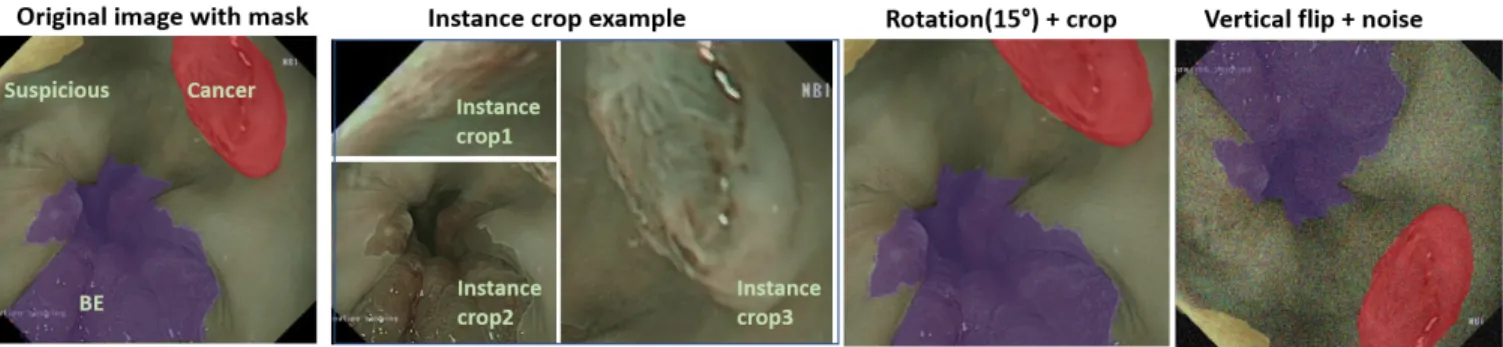
We applied image augmentation techniques [11] on the rest of the images with their associated masks. Our obser-vation of the dataset revealed a co-location of ’BE’ regions with ’suspicious, cancer and HGD’ area. We also noticed an imbalance between classes and images coming from various organs. Hence, we opted for an instance cropping stage in our pipeline that produced multiple images from these co-located images, each with one target object and other objects are re-moved by a selective cropping mechanism (example shown on Figure 1). We kept 10% padding around the ground truth bounding box provided for the instance. This isolated the in-stances of ’cancer’, ’suspicious’ and ’HGD’ regions from co-localized ’BE’ regions. We applied transformations such as rotation, flip and crop on the individual classes and instances to increase our training data. We then used the ’WeightedRan-domSampler’ from the PyTorch data loader to form the fi-nal balanced training set of almost equal class representation. This set included 1670 instances in total. Figure 1 illustrates some of the augmentation methods we applied in our pipeline.
3. METHODS
We implemented the Endoscopic disease detection and se-mantic segmentation pipeline for the EDD2020 challenge us-ing a modified mask-RCNN [12] architecture trained in the feature-representation transfer learning mode. Mask-RCNN was proposed as an extension of Faster R-CNN and the ar-chitecture has reportedly outperformed all the previous state-of-the-art models used for the instance segmentation task on various image datasets. We used PyTorch, torchvision, im-gaug, pycoco-creator, maskrcnn-benchmark [13], apex, and OpenCV libraries in python for generating various functions of the pipeline.
3.1. Ptrained model backbone and network head re-moval
We removed the network head or the final layers of the pre-trained model with a Resnet-101 backbone [12] that was ini-tially trained on the COCO dataset. This stage is crucial as the pre-trained model was trained for a different classification task. The removal of network head removed weights and bias associated to class score, bounding box predictor and mask predictor layers. It is then replaced with new untrained layers with desired number of classes for the new data. We adjusted a six-class network head for the EDD2020 dataset (five as-signed classes+ Background). We fed the augmented dataset and and the associated masks into the mask-RCNN model ar-chitecture as illustrated in figure 2.
3.2. Transfer learning stages
At the initial stage, we froze the weights of the earlier layers of the pre-trained ResNet-101 backbone to help us extract the generic low-level descriptors or patterns from the endoscopy image data. Later layers of the CNN become progressively more specific to the details of the output classes of the new data-set. Then a newly added network head is trained for adapting the weights according to the patterns and distribu-tion of the new dataset. The network head is updated and fine tuned during model training. The training of the model has been done offline on an Ubuntu machine with Intel(R) Core i9-9900X CPU @ 3.50GHz, 62GB memory and a GeForce RTX 2060 GPU. The final model was fine- tuned with an Adam optimizer with a learning rate of 0.0001 and a categor-ical cross-entropy for 50000 epochs. To be noted, the dataset after augmentation is still quite small, so we employed a five-fold cross-validation during training to avoid the over-fitting of the model.
4. RESULTS AND EVALUATION SCORE
Equations (1) to (3) in this section summarises the detection and segmentation matrices we are using to evaluate the per-formance of a model trained on this dataset [1]. The metric,
Fig. 1. Augmentation methods applied on the images including transformation such as rotation, flip and instance cropping.
Fig. 2. Illustration of the mask-RCNN architecture adapted for transfer learning on the EDD dataset
mean average precision (mAP) measures the ability of an ob-ject detector to accurately retrieve all instances of the ground truth bounding boxes. The higher the mAP the better the per-formance. In Equation (1), N = 5 andAPiindicates Average
precision of individual disease classifor this dataset.
mAP = 1
N
X
i
APi (1)
scored= 0.6×mAPd+ 0.4×IoUd (2)
scores= 0.25∗X
i
precision+recall+F1+F2 (3)
For the detection task, the competition uses a a final mean score (scored), which is a weighted score of mAP and IoU and formula is presented in Equation (2). Here, IoU - inter-section over union measures the overlap between the ground truth and predicted bounding boxes. For scoring of the se-mantic segmentation task, an average measure (scores) is cal-culated as per Equation (3), which is the average score ofF1
-score (Dice Coefficient), F2-score, precision and recall. A
detail description of these matrices can be found in [1].
Table 2. Validation set bounding-box detection and segmen-tation score before and after fine-tuning
Fine-tuning Task mAP AP(50), AP(75) AP(m), AP(l) No bbox 0.291 0.361; 0.319 0.450; 0.328 No segment 0.254 0.347; 0.252 0.250; 0.292 Yes bbox 0.479 0.689; 0.600 0.675; 0.493 Yes segment 0.513 0.683; 0.549 0.563; 0.566
Table 3. Out-of-sample detection and segmentation score Training Dataset (Test data) scored scores
Original+ Flip, rotate, crop
(Phase-I) 0.2460 0.5243
Original+Instance-crop+class-balance
(Phase-II) 0.2906 0.6264
4.1. Results on validation dataset
Table 2 summarises average precision performances on the isolated validation dataset (25 images with ground-truth masks) to get an estimate of the test set performance. Class-wise precision values were presented for two IoU thresholds. For AP(50), only candidates over 50% region comparing ground truth were counted and we achieved about 36.1% average precision for bounding box detection and 34.7% av-erage precision for pixel-to-pixel segmentation. ForAP(75), only the candidates over 75% IoU value are counted. Av-erage precision values were counted for large (AP(l)) and medium-sized (AP(m)) objects in the images and the accu-racy ranged from 32.27% to 45% respectively. To be noted, we omittedAP(s)for small object (area<32pixel2) due to the absence of such small objects in the test dataset. However, such low values are indicative of the model being overfit and we applied parameter-tuning to the fully connected network layers along with realistic and balanced augmentation. This significantly improved themAP for for both bounding box and segmentation mask to 47.9% and 51.3% respectively (shown in row 3 and 4 on Table 2).
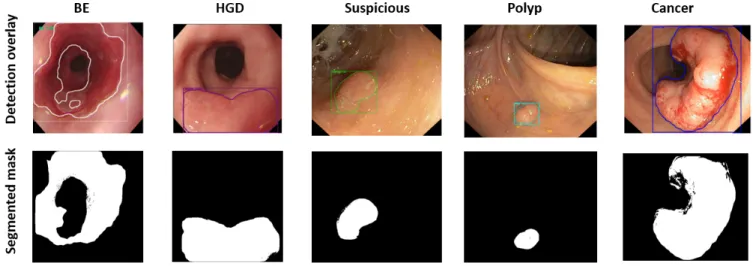
Fig. 3. Semantic segmentation results on some of the images from the test dataset
4.2. Results on the test dataset: Phase-I and Phase-II
For phase-I, we received 24 images and Figure 3 shows detec-tion and segmentadetec-tion output from some of the images from this test set. From the scores available on the leaderboard, for ’BE’, we achieved average precision value of 51.14%, for ’HGD’ and ’polyp’ it is 50%. However, the score for ’suspi-cious’ and ’cancer’ areas were very low. We attained a dice coefficient of 0.4562 and an F2 score of 0.4508. We noticed the missed and mis-classification was due to the imbalance between classes. Hence, before phase-II submission, we retrained the model after applying a ’WeightedRandomSam-pler’ for selective and balanced sampling of the augmented dataset. During phase-II, we received 43 images and we retrained the model with a balanced augmentation dataset. From the leader-board scores available at this stage, the fi-nal detection scorescored and semantic segmentation score
scores is listed in Table 3. In the table, we observed an in-crease in detection score to 0.29 when a class balancing and instance cropping is applied on the training dataset. We had a score of 0.24 on phase-I which we obtained with generic augmentation techniques applied on the data. We achieved an improved semantic segmentation score of 0.62 as well from our phase-I score 0f 0.52. The final model had an standard deviation of 0.082 in themAPdvalue and deviation was 0.33
in the semantic score.
5. DISCUSSION & CONCLUSION
As balanced augmentation has improved both detection and segmentation score in this task, application of generative ad-versarial network-based augmentation techniques in future can contribute to a more generalised and robust model. Ad-ditionally, we assumed that the detected object was spread uniformly across a detected region as the patch was classi-fied as a specific disease type (cancer, polyp) depending on the patch-specific feature. However, the idea of one uniform
region of cancer or polyp or BE is not always the case in practice. Very often, multifocal patches of cancer, low-grade and high-grade dysplasia are scattered across the surface of the lesion. Further improvements are required to deal with bubble, saturation, instrument and other visible artefacts in the dataset [14, 15]. This will improve the model’s perfor-mance by avoiding false detection in these regions and will provide more accurate and realistic solution for endoscopic disease detection cases.
6. REFERENCES
[1] Sharib Ali, Noha Ghatwary, Barbara Braden, Do-minique Lamarque, Adam Bailey, Stefano Realdon, Re-nato Cannizzaro, Jens Rittscher, Christian Daul, and James East. Endoscopy disease detection challenge 2020.arXiv preprint arXiv:2003.03376, 2020.
[2] Jun Ki Min, Min Seob Kwak, and Jae Myung Cha. Overview of deep learning in gastrointestinal en-doscopy. Gut and liver, 13(4):388, 2019.
[3] Robert Mendel, Alanna Ebigbo, Andreas Probst, et al. Barretts esophagus analysis using convolutional neu-ral networks. InImage Processing for Medicine 2017, pages 80–85. Springer, 2017.
[4] Yoshimasa Horie, Toshiyuki Yoshio, Kazuharu Aoyama, Yoshimizu, et al. Diagnostic outcomes of esophageal cancer by artificial intelligence using convo-lutional neural networks. Gastrointestinal endoscopy, 89(1):25–32, 2019.
[5] Xiaohong W Gao, Barbara Braden, Stephen Taylor, and Wei Pang. Towards real-time detection of squamous pre-cancers from oesophageal endoscopic videos. In
2019 18th IEEE International Conference On Machine Learning And Applications (ICMLA), pages 1606–1612, Dec 2019.
[6] Yoriaki Komeda, Hisashi Handa, et al. Computer-aided diagnosis based on convolutional neural network system for colorectal polyp classification: preliminary experi-ence.Oncology, 93:30–34, 2017.
[7] Teng Zhou, Guoqiang Han, Bing Nan Li, et al. Quan-titative analysis of patients with celiac disease by video capsule endoscopy: A deep learning method. Comput-ers in biology and medicine, 85:1–6, 2017.
[8] Lequan Yu, Hao Chen, Qi Dou, Jing Qin, and Pheng Ann Heng. Integrating online and offline three-dimensional deep learning for automated polyp detec-tion in colonoscopy videos.IEEE journal of biomedical and health informatics, 21(1):65–75, 2016.
[9] Lianlian Wu, Wei Zhou, Xinyue Wan, Jun Zhang, et al. A deep neural network improves endoscopic detection of early gastric cancer without blind spots. Endoscopy, 51(06):522–531, 2019.
[10] Yuichi Mori, Tyler M Berzin, and Shin-ei Kudo. Ar-tificial intelligence for early gastric cancer: early promise and the path ahead.Gastrointestinal endoscopy, 89(4):816–817, 2019.
[11] Connor Shorten and Taghi M Khoshgoftaar. A survey on image data augmentation for deep learning. Journal of Big Data, 6(1):60, 2019.
[12] Kaiming He, Georgia Gkioxari, Piotr Doll´ar, and Ross Girshick. Mask r-cnn. InProceedings of the IEEE in-ternational conference on computer vision, pages 2961– 2969, 2017.
[13] Francisco Massa and Ross Girshick. maskrcnn-benchmark: Fast, modular reference im-plementation of Instance Segmentation and Object Detection algorithms in PyTorch. https://github.com/facebookresearch/maskrcnn-benchmark, 2018.
[14] Sharib Ali, Felix Zhou, Christian Daul, Barbara Braden, Adam Bailey, Stefano Realdon, James East, Georges Wagnieres, Victor Loschenov, Enrico Grisan, et al. En-doscopy artifact detection (ead 2019) challenge dataset.
arXiv preprint arXiv:1905.03209, 2019.
[15] Sharib Ali, Felix Zhou, Barbara Braden, Adam Bai-ley, Suhui Yang, Guanju Cheng, Pengyi Zhang, Xiao-qiong Li, Maxime Kayser, Roger D. Soberanis-Mukul, Shadi Albarqouni, Xiaokang Wang, Chunqing Wang, Seiryo Watanabe, Ilkay Oksuz, Qingtian Ning, Shu-fan Yang, Mohammad Azam Khan, Xiaohong W. Gao, Stefano Realdon, Maxim Loshchenov, Julia A. Schn-abel, James E. East, Geroges Wagnieres, Victor B.
Loschenov, Enrico Grisan, Christian Daul, Walter Blon-del, and Jens Rittscher. An objective comparison of de-tection and segmentation algorithms for artefacts in clin-ical endoscopy.Scientific Reports, 10, 2020.
![Table 1. Class-wise object distribution [1]](https://thumb-us.123doks.com/thumbv2/123dok_us/36730.2505162/2.918.83.448.135.261/table-class-wise-object-distribution.webp)