An improved modified LEACH-C algorithm for
energy efficient routing in Wireless Sensor
Networks
Amit Parmar, and Ankit Thakkar,
Member, IEEE
Abstract—Wireless Sensor Network (WSN) is mainly charac-terized by its limited power supply. Hence, protocols designed for WSNs should be energy efficient. Cluster based routing helps to improve the network lifetime. Centralized Low-Energy Adaptive Clustering Hierarchy (LEACH-C) is an energy efficient cluster based routing protocol that has shown improvement over Low Energy Adaptive Clustering Heirarchy (LEACH) protocol. A modified LEACH-C (LEACH-CM) protocol is proposed in this paper that considers the distance between the selected cluster head (CH) and a member node; and the distance between the member node and Base Station (BS) to transmit data by a member node to CH or BS. The proposed approach selects number of CHs on the basis of alive nodes in the network, rather than considering total nodes in the network. Simulation results show that LEACH-CM outperforms to LEACH-C, and improves the network lifetime.
Index Terms—Wireless Sensor Network (WSN), Energy effi-cient clustering, Centralized LEACH (LEACH-C), LEACH-CM
I. INTRODUCTION
W
IRELESS Sensor Network (WSN) consists of a large number of sensor nodes, wherein each node has a limited processing capability, a small amount of memory, a transceiver for wireless communication and a power source to provide required energy to various components of a sensor node for their proper functioning. Numerous difficulties have been acquainted to implement protocol stack for WSNs as each WSN node has size, energy, computational and storage constraints. WSN should function properly for a longer du-ration to provide required services as per the need of the underlying application, and for that the protocol designed for WSN should be energy efficient because it is difficult to replace or recharge batteries of a WSN node [1]. Many techniques are developed to enhance the network lifetime of WSN such as sleep scheduling, MAC protocols, routing protocols, etc.[2].This paper focuses on cluster based routing schemes as it helps to enhance the lifetime of WSNs. In this technique, nodes are elected as CHs from a subset of nodes which are eligible to become CH. The remaining nodes act as member nodes for the elected CHs. Each member node selects nearest A. Parmar is with the Information Technology Department, Chandubhai S. Patel Institute of Technology, Charusat University, Changa, Gujarat, India.
e-mail: [email protected].
A. Thakkar is with the Computer Science & Engineering Department, Institute of Technology, Nirma University, Ahmedabad - 382 481, Gujarat, India. e-mail: [email protected].
CH to save own’s energy, and transmits its data to the selected CH. CH performs data aggregation on the data received from its member nodes. This method of data transmission is energy efficient as the energy required for communication is high compared to the energy required for computation [3], [4], [5]. The role of CH should be on rotational basis to avoid premature death of CHs. This is required because many activities are performed by each CH, including cluster head announcement, an announcement of data transmission schedule to the member nodes, reception of data from member nodes, data aggregation, transmission of aggregated data to BS etc.
Each clustering protocol can be classified as distributed protocol, semi-centralized protocol or centralized protocol. This classification is based on the cluster head election method used by a particular protocol. There are different techniques to classify routing protocols, and detail discussion of such techniques can be found in [6], [7], [8].
Low Energy Adaptive Clustering Hierarchy (LEACH) [9] is pioneer protocol for cluster based routing technique. It is dis-tributed energy efficient clustered routing protocol. However, due to stochastic nature, it fails to maintain the desired number of CHs during each round. It is likely possible that during a particular round more than one CH may sit nearby [10], which lowers the improvement in the network lifetime. CVLEACH [10] overcomes the problem of LEACH by creating non-overlapping cluster regions as far as possible. However, due to stochastic nature of both protocols, LEACH and CVLEACH, strong candidates may not be selected as CHs during each round. This can be overcome by using centralized clustering scheme, and it is discussed in section II.
The rest of the paper is organized as follows: Central-ized clustering schemes are discussed in section II; Modified LEACH-C (LEACH-CM) is described in section III; Simula-tion parameters and result discussions are given in secSimula-tion IV; and concluding remarks are given in section V.
II. RELATEDWORK
LEACH-Centralized (LEACH-C) [11] is a centralized clus-tering algorithm. In this protocol, each node sends its energy information after every round. After getting energy informa-tion from all nodes, BS calculates the average energy of the network. A node works as a member node if its energy is lower than the average energy of the network. BS finds the desired number of CHs using simulated annealing algorithm
from the set of nodes whose energy is higher than the average energy of the network. BS announces CHs for the current round. Each recipient node compares its node ID with the node IDs received from BS, and works as a CH for the current round if a match is found, otherwise works as a member node. Base Station Controlled Dynamic Clustering Protocol (BCDCP) [12] is a centralized clustering technique that im-proves the network lifetime by balancing load on the CHs i.e., each CH serves approximately equal number of mem-ber nodes. Authors have proposed partition-based LEACH (pLEACH) in [13]. Like LEACH-C, it is a centralized clus-tering scheme, in which BS partitions entire network into the required number of sectors, and the highest energy node from each sector is elected as CH. A centralized cluster formation and distributed CH selection based algorithm is proposed in [14] that divides network into energy balanced clusters and selects optimal number of CHs to enhance the network lifetime.
A genetic algorithm based LEACH-C routing protocol is proposed in [15], wherein a method is proposed for repre-sentation of chromosomes. In this protocol, fitness function is derived using features, which is based on energy information of nodes. Low Energy Adaptive Clustering Hierarchy protocol with K-means and MTE (LEACH-CKM) [16] is an exten-sion of LEACH-C protocol. It uses K-means classification algorithm for grouping nodes into clusters and Minimum Transmission Energy (MTE) algorithm to transmit data from remote nodes. Authors in [17] have proposed an algorithm to estimate energy of the nodes to reduce overhead of transmis-sion of nodes’ energy level to BS during each round, and thus improves the network lifetime. All these protocols have shown network lifetime improvement over LEACH-C. However, the modifications proposed in the paper by extending LEACH-C protocol, which is termed as LEACH-CM, is yet not proposed by any one till date to the best of our knowledge.
III. MODIFIEDLEACH-C ALGORITHM(LEACH-CM) In LEACH-C, each node sends its coordinate values and energy information to the BS. The BS uses this information to calculate the average energy of the network. A set of nodes having higher energy than the average energy of the network, is eligible to become CH for the current round. LEACH-C finds the desired number of CHs from the set of eligible nodes using simulated annealing algorithm.
In the proposed approach, LEACH-CM, the CH selection and cluster formation methods are same as LEACH-C with two modifications, discussed later in this section. The BS collects information about the coordinates and energy information from all nodes, and calculates the average energy of the network. The set of nodes having energy higher than the average network energy are eligible to become CHs for the current round. The desired number of CHs are identified by BS using simulated annealing algorithm. In the proposed approach, each sensor node calculates Euclidean distance between itself and BS while sending its coordinate values and the current energy information to the BS. This information is saved in the sensor node’s memory asBSdist.
The first modification in the proposed approach, LEACH-CM is as follows: Once the CHs are identified by BS, each CH announces that it is a CH for the current round to the other nodes in the network which are in communication range of the CHs. A set of recipient nodes which are non-CH nodes for the current round, i.e. member nodes for the current round calculate their Euclidean distances from the CH(s) from which they have received CH announcement message(s). This distance is called as CHdist. A member node transmits its
data to the BS ifBSdist is less than theCHdist, otherwise it
transmits its data to the selected CH. It is possible in topology, where BS is located in the center of the node deployment area, and during a particular round a node is nearer to the BS compared to CH. The same is also possible even if BS is outside and closer to the node deployment area. This proposed modification is an extension of LEACH-C protocol, and it is also used in LEACH [9].
The second modification which is proposed in LEACH-CM is as follows: LEACH-C gives optimal performance when the desired percentage of CHs (p) is set to 5% of the total nodes (N). In LEACH-C, BS always selects 5% of the total nodes as CHs during each round. However, nodes die over a period of time. Hence, LEACH-CM selects5%of alive nodes (AN =N−Dead) as CH. Also, LEACH-CM takes the ceil value of the total number of CHs (CHn =AN∗p) ifCHn
is less than one, otherwise it takes the floor value of CHn.
Apart from these two modifications, LEACH-CM follows the same assumptions that of LEACH-C [11].
IV. SIMULATION PARAMETERS AND RESULT DISCUSSIONS A. Simulation parameters
Simulations are carried out using Network Simulator [18]. To test the performance of the proposed approach LEACH-CM against LEACH-C, a network is created with a random node deployment of varying node density between 50to200 nodes. These nodes are deployed in an area of100m x100m. Each node has 2J of initial energy. CH re-selection interval is set to 20 seconds. Each simulation is carried out for 3600 seconds. Simulation parameters are given in Table I.
TABLE I
PARAMETERS USED FORSIMULATIONRUNS
Parameter Name Value
Node Deployment Area 100m X 100m Number of Nodes (Excluding BS) 1) 50
2)100 3)200 Initial Energy/Node 2J
Round duration 20seconds Simulation Stopping Criteria 3600seconds
Packet Size 4000 bits Percentage of Cluster Heads 5% [11] Proposed Approach Compared with LEACH-C [11]
B. Simulation metrics and result discussions
• Network Lifetime: Network lifetime is measured using three metrics: First Node Dies (FND), Half of the Nodes Alive (HNA) or Half of the Nodes Die (HND) and Last
Node Dies (LND) [19], [20]. FND is also referred as stable period [21]. The result for FND, HND and LND is shown in the Figures 1–3 respectively. It can be seen from the figures that the proposed approach improves the network lifetime, including stability period. Alive nodes
Fig. 1. First Node Dies (FND)
Fig. 2. Half of the Nodes Die (HND)
Fig. 3. Last Node Dies (LND)
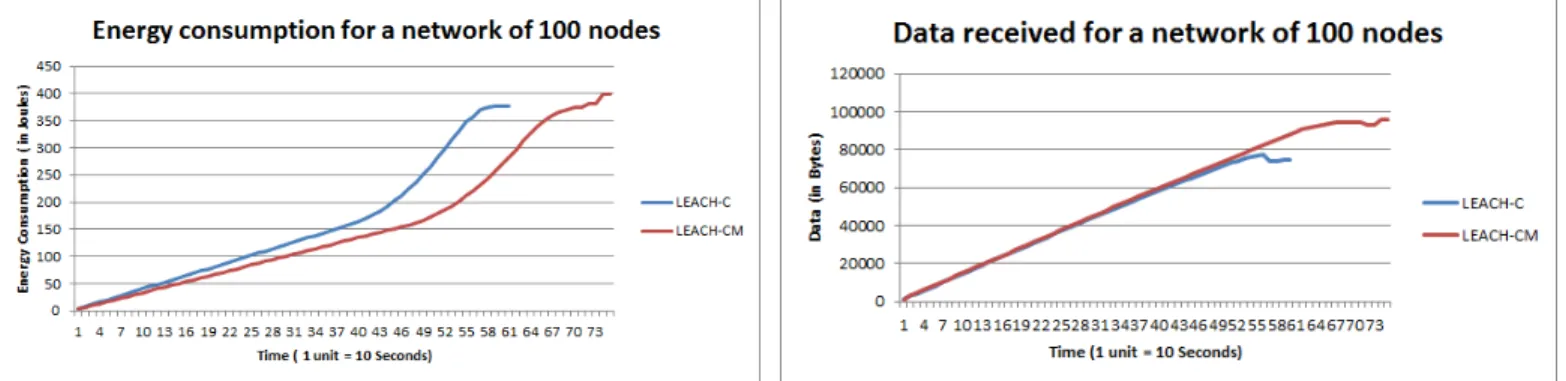
over a period of time for a network with different node densities is shown in the Figures 4–6. These figures con-firm that the proposed approach LEACH-CM outperforms to C protocol, and at any point of time LEACH-CM has higher number of alive nodes as compared to LEACH-C. Energy consumption over a period of time for a network with different node densities is shown in the Figures 7–9. These figures confirm that at any point of time, the proposed approach LEACH-CM has lower energy consumption as compared to LEACH-C.
Fig. 4. Alive nodes over a period of time for a network of 50 nodes
Fig. 5. Alive nodes over a period of time for a network of 100 nodes
Fig. 6. Alive nodes over a period of time for a network of 200 nodes
Fig. 8. Energy consumption over a period of time for a network of 100 nodes
Fig. 9. Energy consumption over a period of time for a network of 200 nodes
• Number of Packets: It indicates number of packets received by BS from the network. Number of packets received by the BS from the network is shown in the Figures 10–12. It confirms that higher number of packets are received by the BS for LEACH-CM protocol as com-pared to LEACH-C protocol for varying node densities. Higher the number of packets received indicate lower die rate of the nodes and consumption of energy [22]. Hence, Figures 10–12 are inline with the Figures 4–6.
Fig. 10. Data received by BS over a period of time for a network of 50 nodes
• Average energy consumption/node: It indicates the average energy consumption per node. Lower the value of average energy consumption per node, better is the net-work lifetime. It is a very important parameter to prolong the network lifetime [23]. Average energy consumption per node is shown in the Figure 13. It can be concluded from the figure that the proposed approach LEACH-CM
Fig. 11. Data received by BS over a period of time for a network of 100 nodes
Fig. 12. Data received by BS over a period of time for a network of 200 nodes
helps to minimize the average energy consumption per node as compared to LEACH-C, and thus improves the network lifetime.
Fig. 13. Average energy consumption/Node
V. CONCLUDINGREMARKS
LEACH-CM protocol is proposed in the paper by extending LEACH-C protocol with two modifications. The first modifica-tion is that non-CH nodes decide to transmit their data directly to BS or through CH whichever is energy efficient, and the second one is to select number of CHs on the basis of alive nodes in the network, rather than considering total nodes in the network. The first approach allows individual member node to save its energy by transmitting to either BS or CH whichever is nearest to it. The second approach reduces the number of CHs
over a period of time as dead nodes increase in the network. Both of these approaches help to reduce the energy expenditure of a network. It concludes that the proposed approach LEACH-CM is energy efficient and improves the network lifetime, including stability period. The effectiveness of the proposed approach has been verified through simulations. LEACH-CM also delivers higher number of packets to BS compared to LEACH-C.
REFERENCES
[1] A. Thakkar and K. Kotecha, “Cluster head election for energy and delay constraint applications of wireless sensor network,” Sensors Journal, IEEE, vol. 14, no. 8, pp. 2658–2664, 2014.
[2] W. Li, M. Bandai, and T. Watanabe, “Tradeoffs among delay, energy and accuracy of partial data aggregation in wireless sensor networks,” in Advanced Information Networking and Applications (AINA), 2010 24th IEEE International Conference on. IEEE, 2010, pp. 917–924. [3] A. Mohanoor,Data gathering techniques on wireless sensor networks.
ProQuest, 2008.
[4] A. Thakkar and K. Kotecha, “WALEACH: Weight based energy effi-cient Advanced LEACH algorithm,”Computer Science & Information Technology (CS & IT), vol. 2, no. 4, 2012.
[5] M. A. Razzaque and S. Dobson, “Energy-efficient sensing in wireless sensor networks using compressed sensing,”Sensors, vol. 14, no. 2, pp. 2822–2859, 2014.
[6] A. A. Abbasi and M. Younis, “A survey on clustering algorithms for wireless sensor networks,”Computer communications, vol. 30, no. 14, pp. 2826–2841, 2007.
[7] M. Patil and R. C. Biradar, “A survey on routing protocols in wireless sensor networks,” inNetworks (ICON), 2012 18th IEEE International Conference on. IEEE, 2012, pp. 86–91.
[8] C. Wei, J. Yang, Y. Gao, and Z. Zhang, “Cluster-based routing protocols in wireless sensor networks: a survey,” inComputer Science and Network Technology (ICCSNT), 2011 International Conference on, vol. 3. IEEE, 2011, pp. 1659–1663.
[9] W. R. Heinzelman, A. Chandrakasan, and H. Balakrishnan, “Energy-efficient communication protocol for wireless microsensor networks,” in System sciences, 2000. Proceedings of the 33rd annual Hawaii international conference on. IEEE, 2000, pp. 10–pp.
[10] A. Thakkar and K. Kotecha, “CVLEACH: Coverage based energy efficient LEACH Algorithm,”International Journal of Computer Science and Network (IJCSN) Volume, vol. 1, 2012.
[11] W. B. Heinzelman, A. P. Chandrakasan, and H. Balakrishnan, “An application-specific protocol architecture for wireless microsensor net-works,”Wireless Communications, IEEE Transactions on, vol. 1, no. 4, pp. 660–670, 2002.
[12] S. D. Muruganathan, D. C. Ma, R. Bhasin, A. O. Fapojuwo et al., “A centralized energy-efficient routing protocol for wireless sensor networks,”Communications Magazine, IEEE, vol. 43, no. 3, pp. S8– 13, 2005.
[13] H. Gou and Y. Yoo, “An energy balancing leach algorithm for wireless sensor networks,” inInformation Technology: New Generations (ITNG), 2010 Seventh International Conference on. IEEE, 2010, pp. 822–827. [14] A. Khamiss, C. Senchun, Z. Baihai, and C. Lingguo, “Combined metrics-clustering algorithm based on LEACH-C,” inControl and Deci-sion Conference (CCDC), 2015 27th Chinese. IEEE, 2015, pp. 5252– 5257.
[15] A. Rahmanian, H. Omranpour, M. Akbari, and K. Raahemifar, “A novel genetic algorithm in LEACH-C routing protocol for sensor networks,” inElectrical and Computer Engineering (CCECE), 2011 24th Canadian Conference on. IEEE, 2011, pp. 001 096–001 100.
[16] D. Mechta, S. Harous, I. Alem, and D. Khebbab, “LEACH-CKM: Low Energy Adaptive Clustering Hierarchy protocol with K-means and MTE,” inInnovations in Information Technology (INNOVATIONS), 2014 10th International Conference on. IEEE, 2014, pp. 99–103. [17] J.-M. Kim, H.-K. Joo, S.-S. Hong, W.-H. Ahn, and H.-B. Ryou, “An
efficient clustering scheme through estimate in centralized hierarchical routing protocol,” inHybrid Information Technology, 2006. ICHIT’06. International Conference on, vol. 2. IEEE, 2006, pp. 145–152. [18] “The network simulator - ns2,” http://www.isi.edu/nsnam/ns/, Last
Ac-cessed: 29-07-2015.
[19] A. Thakkar and K. Kotecha, “Alive nodes based improved low energy adaptive clustering hierarchy for wireless sensor network,” inAdvanced Computing, Networking and Informatics-Volume 2. Springer, 2014, pp. 51–58.
[20] ——, “A new bollinger band based energy efficient routing for clustered wireless sensor network,”Applied Soft Computing, vol. 32, pp. 144–153, 2015.
[21] G. Smaragdakis, I. Matta, A. Bestavroset al., “SEP: A stable election protocol for clustered heterogeneous wireless sensor networks,” in
Second international workshop on sensor and actor network protocols and applications (SANPA 2004), 2004, pp. 1–11.
[22] A. Wang, D. Yang, and D. Sun, “A clustering algorithm based on energy information and cluster heads expectation for wireless sensor networks,”
Computers & Electrical Engineering, vol. 38, no. 3, pp. 662–671, 2012. [23] A. Thakkar and K. Kotecha, “Bio-inspired based optimized algorithm for cluster head election using RSSI and LQI,”International Journal of Computer Science, vol. 1, no. 02, pp. 19–29, 2011.
Amit Parmaris working as an Assistant Professor, Information Technology Department, Chandubhai S. Patel Institute of Technology, Charusat University, Changa. He received the M. Tech. degree in Com-puter Science & Engineering, Institute of Technol-ogy, Nirma University, Ahmedabad. His research interest include data structure and algorithims, op-erating systems and wireless sensor networks.
Ankit Thakkar is working as an Associate Pro-fessor in Computer Science & Engineering Depart-ment, Institute of Technology, Nirma University. He received the B.E. degree in Computer Engineering from North Gujarat University, and the M.Tech. and the Ph.D. degree in Computer Science and Engineering from Nirma University, Ahmedabad, in 2002, 2009 and 2014, respectively. His research interests include wireless sensor networks, image processing, and embedded and real-time systems. He is serving as Associate Editor for the Swarm and Evolutionary Computation Journal of Elsevier. He has been a reviewer for many international journals and conferences, including the Ad Hoc Networks and the Swarm & Evolutionary Computation journals of Elsevier, IEEE Communications Letters, IEEE Sensors Journal, IET Wireless Sensor Systems, the Telecommunication Systems journal of Springer, and International Journal of Distributed Sensor Networks of Hindawi Publication. He has authored several papers in international journals and conferences. He received a Gold Medal for securing the highest CPI among all graduating 2007 to 2009 batch M.Tech. students of Computer Science and Engineering Branch, Institute of Technology, Nirma University. He is a recognized Ph.D. guide for Computer Science & Engineering under Faculty of Technology & Engineering, Nirma University. He is a Life Member of ISTE. He is a member of IEEE and IEEE Sensors Council. He is serving as the Coordinator of IDEA Lab, Institute of Technology, Nirma University.