F
aculty and students increasingly want to integrate technology into teaching and learning, using it for more than just taking notes.1 Computer-based examination of student learning is one such use. Implementing computer exams requires a secure testing envi-ronment—one that prevents students from seeking answers by scanning their computer hard drives, instant messag-ing or e-mailmessag-ing friends, or browsmessag-ing the Internet. While campuses can establish a relatively secure testing environment in many ways, the challenge lies infinding a long-term security solution acceptable to both faculty and students. Any such solution must not consume an inordinate amount of resources nor impose too cumbersome a process on participants.
The College of Business and Econom-ics at the University of Idaho conducted a pilot study that used commercially available encryption software called Securexam to deliver computer-based examinations.2 A multi-step implemen-tation procedure was developed, imple-mented, and then evaluated on the basis
Helping Students Adapt
to Computer-Based
Faculty can
promote student
acceptance of
computer-based
exams through
training and
encouragement
By Lori Baker-Eveleth,
Daniel M. Eveleth,
Michele O’Neill, and
Robert W. Stone
Encrypted
Examinations
of what students viewed as valuable. Two key aspects in this procedure raised some concern. First, the faculty team conducting the study (the authors of this article) preferred that the encryp-tion software itself not negatively affect students (for example, their score on an examination or their individual psycho-logical response). Second, we wanted to provide meaningful support in the form of help with the technology for students to facilitate their use of the encryption software while not biasing their exam scores.
We based the conceptual links between faculty support activities and the students’ examination performance and psychological attributes on the Technology Acceptance Model (TAM; described later).3 The purpose of this research was not to empirically test the model but to provide the conceptual linkages between practical methods fac-ulty can employ and outcomes associ-ated with students’ use of examination encryption software.
The results of this study show that giving students the opportunity to practice using encryption soft-ware before taking an examination reduces their anxiety, improves their attitudes toward the software, and improves their perceptions of their performance on the examination.
Faculty encouragement in using the encryption software also positively affected student attitudes toward the software. Furthermore, none of the faculty activities influenced student grades on the examination, implying that these faculty activities do not bias performance on the exam despite their positive effects on student attitudes.
The Research
Using commercially available encryp-tion software, we administered an examination at a common time for two sections of a core business course. Participants were 98 undergraduate, mostly junior-level, business students representing seven majors: account-ing, economics, finance, information systems, management and human resources, marketing, and production and operations management.
Using their laptops in class, the stu-dents downloaded the encrypted exam from a network server using the encryp-tion software and a password. They then decrypted the exam to display it as a word-processing document and a spreadsheet. Once the examination was decrypted, the software allowed stu-dents to input answers only into the word-processing document and spread-sheet. In other words, the encryption software prevented students from
exit-ing the specific documents to access hard drives, the Internet, e-mail, or any other software or files.
Five days after the examination, before students received their exam scores, a questionnaire was adminis-tered in class. The questionnaire con-tained items developed from previous research on the Theory of Reasoned Action4 and the TAM.
The Theory of Reasoned Action has proved to be a useful framework for pre-dicting and explaining human inten-tions and acinten-tions. Davis5 and Davis, Bagozzi, and Warshaw6 developed the TAM by applying the Theory of Rea-soned Action to the specific instance of technology acceptance. The TAM is therefore useful for understanding what factors affect the beliefs and atti-tudes of people who use technology as well as their intentions to use technol-ogy in the future.7 The TAM was an appropriate framework for this study in particular because the goals were to (1) identify faculty activities that would support the use of the exami-nation encryption software and (2) understand how these activities affect important student outcomes such as student anxiety, attitude, perceived performance, and grade.
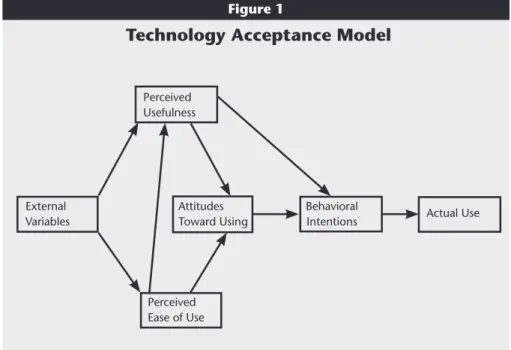
Figure 1 shows the original TAM. As mentioned earlier, the focus of this research was the practical class-room application of faculty activities conducted to positively influence students’ perceptions of using exami-nation encryption software. These faculty activities are represented as the external variables. The groups of these faculty activities were defined as instruction, technology support, prac-tice, faculty encouragement, and envi-ronment. The relationships studied are between these external variables and students’ perceived usefulness of the encryption software as represented by their perceived examination perfor-mance and grade.
The other relationships of interest are between these external variables and student attitudes toward using the soft-ware as represented by their anxiety and expressed attitudes. Due to the practical focus of this research, we ignored the Figure 1
Technology Acceptance Model
Perceived Usefulness External Variables Attitudes Toward Using Behavioral
Intentions Actual Use
Perceived Ease of Use
intervening variable of perceived useful-ness between the external variables and attitudes toward using the software.
Measures
We measured the constructs in the model using a series of questionnaire items. We developed the perceived performance items using the outcome expectancy measure of Stone and Henry,8 while the perceived usefulness items are those developed by Davis.9 The items measuring attitude used the attitude measure of Agarwal and Prasad,10 and we developed additional items in the same spirit. The anxiety items were based on the work of Culpan.11 Modifications to the items used made them appropriate for the context of our study.
A questionnaire created using these items also included items representing each of the five categories of faculty activities (instruction, technology sup-port, practice, faculty encouragement, and environment) and three of the four outcomes (anxiety, attitude, and perceived performance). Actual perfor-mance on the examination was mea-sured by students’ examination scores. All of the items asked students the extent to which they agreed or disagreed with a statement, using a five-point Likert-type scale of strongly disagree, disagree, neutral, agree, or strongly agree.
The questionnaire was pre-tested by 11 undergraduate students already familiar with the examination software. The pre-test resulted in the modification of four items and the elimination of four others. The final set of questionnaire items appears in Table 1.
Results
Sixty students from both sections completed the questionnaire, produc-ing a 61 percent response rate. As with any research based on a survey, non-response bias was a concern. However, when we compared the characteristics of the sample to the same characteristics for the student population in the busi-ness college, we found that the sam-ple is qualitatively and quantitatively similar to the college population. The only statistically significant difference is that the average age of the sample is
Table 1
Questionnaire Items and Measures
Variable Item
Anxiety
Overall, I find the encryption software useful in my exam taking. I often become confused when using the encryption software. (reverse coded)
I make errors frequently when using the encryption software. (reverse coded)
Attitude
I enjoy completing an exam using the encryption software. I prefer to complete my exam using the encryption software. I would like to use the encryption software for all my exams. I hate using the encryption software. (reverse coded)
I wish all my classes would use the encryption software exams.
Perceived Performance
Using the encryption software…
gives me greater control over my exam performance. improves my exam performance.
enhances my effectiveness on the exam. improves the quality of the work I do. increases my productivity.
Instruction
The following factor helped your use of the encryption software: Projecting instructions on the classroom screen for exam loading, opening, closing, and posting
Printing instructions on the cover sheet for exam loading, opening, closing, and posting
Technology Support
Indicate the extent to which you agree or disagree that it helped your use of Securexam:
Having technical support staff available during the exam Having extra power cords available
Having extra Ethernet cables available
Practice
The following helped your use of the encryption software: Going through a short practice exercise with the encryption software during class
Going through a sample exam with the encryption software during class
Going through the entire process of directions, exam loading, taking the exam, and posting the exam during class
Faculty Encouragement
Indicate the extent to which you agree or disagree that it helped your use of Securexam:
Faculty explaining the advantages of the encryption software
Faculty explaining laptop-based exams and related software are inevitable
Environment
Indicate the extent to which you agree or disagree that it helped your use of Securexam:
Having one empty seat on either side of me Having a faculty member present in the room
to simulate the actual examination experience.
Encouragement
Faculty encouragement significantly affected students’ attitudes and their perceived performance on the exami-nation. These encouraging results indi-cate that faculty activities can influence students’ attitudes and perceptions of performance without biasing actual per-formance as measured by grades. A dis-appointing result was that these activi-ties did not mitigate students’ anxiety regarding the encryption software.
Two types of faculty-encouragement activities took place during the prac-tice sessions. In one, faculty emphasized the advantages of the encryption soft-ware over traditional paper-and-pencil examinations, pointing out the benefits of using word-processing tools (gram-mar- and spell-checker, copy and paste, highlight and delete) while avoiding “writer’s cramp” during a two-hour essay examination. Faculty also pointed out that students use their laptops in class daily, so using laptops in an examina-tion setting would be familiar.
Another tactic to encourage students to accept the encryption software was to explain its similarities to ubiquitous technology such as calculators and cell phones and suggest that laptop-based examinations would become the norm in the next few years. The significant results for this category ensure that the faculty will continue this set of actions in the future.
Instruction Activities
The remaining faculty activities (instruction, technology support, and environment) had no meaning-ful impacts on the dependent variables of interest. The instruction activities included displaying instructions on using the encryption software, both in front of the classroom and on the examination cover sheet. The detailed instructions described how to load, open, close, and post the completed examination. Additionally, a hard-copy examination was provided for students to use as scratch paper.
For several reasons, faculty thought Table 2
Regression Results
Anxiety Attitude PerformancePerceived Grade
Intercept 0.14 (3.77) −2.55 (6.99) −1.67 (6.81) 56.11*** (14.60) Instruction −0.06 (0.33) −0.37 (0.62) −0.18 (0.60) 1.49 (1.29) Technology Support −0.16 (0.16) −0.25 (0.29) 0.25 (0.29) −0.61 (0.61) Practice 0.73 (0.25)*** 1.09 (0.46)** 0.87 (0.45)* 0.36 (0.96) Faculty Encouragement 0.07 (0.19) 1.05 (0.35)*** 0.68 (0.35)* 0.36 (0.74) Environment 0.32 (0.27) 0.44 (0.50) −0.04 (0.49) 0.57 (1.05) R-square 0.19** 0.27*** 0.17* 0.06
Notes: N = 60. Standard errors are reported in parentheses. ***, **, * indicate statistical significance at 1%, 5%, and 10%, respectively.
higher than that of the college popu-lation—not surprising given that the respondents were mainly juniors and some seniors.
We estimated the relationships by ordinary least squares regression. The results for the four regressions appear in Table 2.12 Of the five categories of faculty activities, those related to pro-viding instruction, technology support, and managing the testing environment were not statistically significant for any of the four student-oriented dependent variables (anxiety, attitude, perceived performance, and grade). Faculty activi-ties related to providing practice and encouragement were statistically sig-nificant, however.
Opportunity to Practice
The faculty-controlled activity of practicing had meaningful effects on students’ responses, lowering their anx-iety with regard to using the encryption software and improving their attitudes toward the software and their perceived performance on the exam. The prac-tice variable did not have a meaningful impact on students’ grades, however. These results are encouraging because
they imply that faculty can perform activities to improve students’ anxiety, attitudes, and perceptions without bias-ing their grades.
Students had several opportunities to practice with the encryption software in class. In a short practice exercise stu-dents retrieved a one-page encrypted exercise, decrypted it, answered two simple questions, explored the look and feel of the software’s interface, encrypted the completed exercise, and posted it as if to be graded. On another day, they went through the same pro-cedure using a previous examination. This let them see the exam format and explore a spreadsheet question. The last practice session simulated an actual examination.
The empirical results suggest that faculty should provide students with practice using encryption software. The downside is finding class time to allocate to three practice sessions. Note, however, that by the third ses-sion students were obviously comfort-able with the procedure, to the point of becoming bored. Two practice ses-sions are likely preferable—one session to introduce the software and another
it necessary to explain the process even after three practice sessions. An instruc-tor encrypts the examination with the software, then gives it to and receives it from students electronically. Several different methods for delivering and receiving an encrypted examination from approximately 100 students were considered, including e-mailing the completed examination as an attach-ment or exchanging it with memory sticks. The most reliable and efficient method for examination submission was to use the university’s Web-based course organizer, WebCT.13 Students needed standardized instructions on how to perform these activities.
Faculty also provided instructions on the storage/saving location of the encrypted, completed examination. Because operating systems vary in displaying the default directory for downloaded files, faculty wanted to standardize where students saved the examination on their hard drives. This made it easier when students started the examination because the software prompts the user to find the encrypted document. When the student has com-pleted the examination, the software also prompts the user on where on the hard drive to save the finished, re-encrypted examination.
Another set of instructions involved the password required by the software to decrypt the examination. Previous experience in similar situations taught faculty that, due to stress and haste, not all students comprehend the pass-word when it is provided verbally at the beginning of the exam—they pre-fer it written down.
The instruction category of faculty activity shows no significant impact in the empirical tests, yet we believe it is intuitively related to the dependent variables. We suspect its importance is subsumed by activities related to practice and thus will continue the activities in a modified version. While it takes very little effort to display the instructions in front of the class-room, faculty decided to discontinue this activity and provide instructions only on the cover sheet of the hard-copy examination. Casual observation
of students completing examinations revealed that students use the hard-copy exam extensively for outlining and calculating initial solutions.
Technology Support
The faculty activities summarized as technology support also had no mean-ingful effects on students’ anxiety, attitude, perceived performance, or grade. In a positive sense, the results imply that the technology support activities do not bias students’ grades, add to their anxiety, or negatively affect their attitude or performance.
Technology support included hav-ing technical support staff in the rooms during the two-hour examina-tion and making available extra power cords and Ethernet cables. Despite the lack of significant results for these actions and the added cost for hav-ing technology staff available, faculty will continue these activities until laptop-based examinations become more common in the college, for two reasons. First, only two students con-sulted the technology staff during the examination, possibly indicating that the majority of students under-appre-ciated the presence of the staff. The students who needed the help of the technology staff greatly appreciated their presence.
Second, the presence of the tech-nology staff to troubleshoot problem-atic laptops acted as a deterrent to sabotage. While most students were ready to embrace using laptops in the classroom on a daily basis, a nontrivial
subset was openly reluctant to entrust taking examinations to a laptop. To mitigate the instances of self-sabotage during the examination, the faculty stressed ahead of time that only as a last-resort would a student be allowed to take an exam in the traditional way—and only after the technology staff had attempted to fix the prob-lematic laptop. We believe this con-cern will vanish once the practice of laptop-based examinations becomes more common.
Managing the Testing
Environment
The last category of faculty activi-ties related to managing the envi-ronment of the examination room. These activities had no meaningful impacts on any of the dependent vari-ables studied. In addition, while these activities did not appear to affect stu-dents’ anxiety, attitudes, or perceived performance, they also did not bias students’ grades.
Students were familiar with taking a traditional examination in one large lecture hall. A laptop-based exam, how-ever, required electrical outlets and Ethernet cable connections as back-ups to failing laptop batteries and an overloaded wireless system. Students were assigned to one of three smaller classrooms with these facilities.
A second activity affecting the room environment was assigning students to specific seats to leave an empty seat on either side. This was done to miti-gate the possibility of students read-ing each other’s laptop screens and to provide more desk workspace.
A third action was to have a few fac-ulty members associated with the class roam through the rooms as opposed to having only technology staff in the rooms. Given the lack of significant results for this category of actions, we most likely will not continue using these additional faculty and classroom resources.
Implications for Instruction
The results of this study provide impli-cations for instructors who wish to use encryption software for computer-based
Casual observation of
students completing
examinations revealed
that students use
the hardcopy exam
extensively for outlining
and calculating initial
solutions
examinations. First, providing practice sessions that simulate the students’ completion of the examination using the encryption software helps students become comfortable with the process. These sessions should allow students to simulate decrypting, completing, saving, encrypting, and submitting the exami-nation. Such practice sessions can have desirable impacts on students’ anxiety, attitude, and perceived performance. It also appears that these practice sessions do not influence examination perfor-mance as measured by grade.
Second, faculty can positively affect students’ attitudes and perceived exami-nation performance when using encryp-tion software by encouraging them in its use. Encouragement can be in the form of faculty explaining the advan-tages and inevitability of examination encryption software. Such encourage-ment does not influence student anxi-ety about using the encryption software or actual examination performance as measured by grade.
The empirical results also indicate that actions taken to provide additional instructions, technical support, and a supportive testing environment were not considered valuable by the students. In terms of instruction, the non-signifi-cant results suggest that faculty need to minimize resources and class time allocated to these activities. However, these activities must not be completely absent. Some efforts are needed to pro-vide instructions, technology support, and a suitable examination environ-ment for students. In other words, fac-ulty must provide the basics in these areas.
The results also show that none of the faculty activities affected actual examination performance. Intuitively, we expected that typing essay exami-nations with editing tools would pro-duce better results than hand-written ones.14 Nonetheless, the lack of a signifi-cant effect of any of these activities on examination scores is arguably positive. While technology can make the process of answering a question easier, in the end, students must understand the
con-cepts and express their understanding through the examination.
Because of the favorable results and valuable lessons learned from our pilot study, we intend to pursue using encryption software for computer-based examinations. Emerging products might better support essay exams versus mul-tiple-choice testing. We are interested in observing how our support activities might evolve as a result of computer-based encrypted exams becoming the norm rather than the exception and look forward to reporting the outcomes in the future. e
Endnotes
1. L. B. Nilson and B. E. Weaver, “Editors’ Notes,” New Directions for Teaching & Learning, No. 101, 2005, pp. 1–2; and K. Aviles et al., “If Higher Education Lis-tened to Me,” EDUCAUSE Review, Vol. 40, No. 5, 2005, pp. 8–9, <http://www .educause.edu/ir/library/pdf/erm0550 .pdf>.
2. We chose the software package Securexam (http://www.softwaresecure.com) because it encrypts both word process-ing and spreadsheet documents. Exam-soft (http://www.examExam-soft.com) encrypts only word processing documents. 3. F. D. Davis, “Perceived Usefulness,
Per-ceived Ease of Use, and User Acceptance of Information Technology,” MIS Quar-terly, Vol. 13, No. 3, 1989, pp. 319–340; and F. D. Davis, R. P. Bagozzi, and P. R. Warshaw, “User Acceptance of Computer Technology: A Comparison of Two Theo-retical Models,” Management Science, Vol. 35, No. 8, 1989, pp. 982–1003.
4. Davis, Bagozzi, and Warshaw, op. cit.; I. Ajzen and M. Fishbein, Understand-ing Attitudes and PredictUnderstand-ing Social
Behav-ior (Englewood Cliffs, N.J.: Prentice-Hall, 1980); and P. Y. K. Chau and P. J. H. Hu, “Information Technology Acceptance by Individual Professionals: A Model Com-parison Approach,” Decision Sciences, Vol. 32, No. 4, 2001, pp. 699–719.
5. Davis (1989), op. cit.
6. Davis, Bagozzi, and Warshaaw, op. cit. 7. Davis (1989), op. cit.; and P. Legris, J.
Ing-ham, and P. Collerette, “Why Do People Use Information Technology? A Critical Review of the Technology Acceptance Model,” Information & Management, Vol. 40, No. 3, 2003, pp. 191–204.
8. R. W. Stone and J. W. Henry, “The Roles of Computer Self-Efficacy and Outcome Expectancy in Influencing the puter End-Users’ Organizational Com-mitment,” Journal of End User Comput-ing, Vol. 15, No. 1, 2003, pp. 38–53. 9. Davis (1989), op. cit.; and F. D. Davis,
“User Acceptance of Information Tech-nology: System Characteristics, User Per-ceptions and Behavioral Impacts,” Jour-nal of Man-Machine Studies, Vol. 38, 1993, pp. 475–487.
10. R. Agarwal and J. Prasad, “Are Individual Differences Germane to the Acceptance of New Information Technologies?” Deci-sion Sciences Journal, Vol. 30, No. 2, 1999, pp. 361–391.
11. O. Culpan, “Attitudes of End-Users Towards Information Technology in Manufacturing and Service Industries,” Information & Management, Vol. 28, No. 3, 1995, pp. 167–176.
12. For additional statistics beyond the regres-sion results, please contact the authors. 13. This and other Web-based course orga-nizers such as Blackboard are common to many colleges and universities. The sys-tem requires each student to log in with a unique name and password, after which the user can retrieve and post almost any electronic document.
14. Of the five exams the students took dur-ing the semester, two were laptop based; the remaining three were traditional paper-based exams.
Lori Baker-Eveleth ([email protected]) is Assistant Professor of Information Systems, Daniel M. Eveleth ([email protected]) is Associate Professor of Management and Human Resources, Michele O’Neill (moneill@ uidaho.edu) is Associate Professor of Finance, and Robert W. Stone ([email protected]) is Professor of Information Systems in the Col-lege of Business and Economics at the Uni-versity of Idaho in Moscow, Idaho.