Is there more room to improve? The lifespan
trajectory of procedural learning and its
relationship to the between- and within-group
differences in average response times
Dora Juhasz1, Dezso NemethID2,3,4☯*, Karolina JanacsekID2,3☯*
1 Doctoral School of Education, University of Szeged, Szeged, Hungary, 2 Institute of Psychology, ELTE Eo¨tvo¨s Lora´ nd University, Budapest, Hungary, 3 Brain, Memory and Language Research Group, Institute of Cognitive Neuroscience and Psychology, Research Centre for Natural Sciences, Hungarian Academy of Sciences, Budapest, Hungary, 4 Lyon Neuroscience Research Center (CRNL), Universite´ Claude Bernard Lyon 1, Lyon, France
☯These authors contributed equally to this work.
*[email protected](KJ);[email protected](DN)
Abstract
Characterizing the developmental trajectories of cognitive functions such as learning, mem-ory and decision making across the lifespan faces fundamental challenges. Cognitive func-tions typically encompass several processes that can be differentially affected by age. Methodological issues also arise when comparisons are made across age groups that differ in basic performance measures, such as in average response times (RTs). Here we focus on procedural learning–a fundamental cognitive function that underlies the acquisition of cognitive, social, and motor skills–and demonstrate how disentangling subprocesses of learning and controlling for differences in average RTs can reveal different developmental trajectories across the human lifespan. Two hundred-seventy participants aged between 7 and 85 years performed a probabilistic sequence learning task that enabled us to separately measure two processes of procedural learning, namely general skill learning and statistical learning. Using raw RT measures, in between-group comparisons, we found a U-shaped trajectory with children and older adults exhibiting greater general skill learning compared to adolescents and younger adults. However, when we controlled for differences in average RTs (either by using ratio scores or focusing on a subsample of participants with similar average speed), only children (but not older adults) demonstrated superior general skill learning consistently across analyses. Testing the relationship between average RTs and general skill learning within age groups shed light on further age-related differences, sug-gesting that general skill learning measures are more affected by average speed in some age groups. Consistent with previous studies of learning probabilistic regularities, statistical learning showed a gradual decline across the lifespan, and learning performance seemed to be independent of average speed, regardless of the age group. Overall, our results suggest that children are superior learners in various aspects of procedural learning, including both general skill and statistical learning. Our study also highlights the importance to test, and control for, the effect of average speed on other RT measures of cognitive functions, which
a1111111111 a1111111111 a1111111111 a1111111111 a1111111111 OPEN ACCESS
Citation: Juhasz D, Nemeth D, Janacsek K (2019)
Is there more room to improve? The lifespan trajectory of procedural learning and its relationship to the between- and within-group differences in average response times. PLoS ONE 14(7): e0215116.https://doi.org/10.1371/journal. pone.0215116
Editor: Carlos Tomaz, University Ceuma, BRAZIL Received: March 25, 2019
Accepted: June 12, 2019 Published: July 17, 2019
Copyright:©2019 Juhasz et al. This is an open access article distributed under the terms of the
Creative Commons Attribution License, which permits unrestricted use, distribution, and reproduction in any medium, provided the original author and source are credited.
Data Availability Statement: All relevant data are
within the manuscript and its Supporting Information files.
Funding: This research was supported by the
National Brain Research Program (project 2017-1.2.1-NKP-2017-00002) to DN; Hungarian Scientific Research Fund (NKFIH-OTKA PD 124148, to K. J.; NKFIH-OTKA K 128016, to D. N.); Janos Bolyai Research Fellowship of the Hungarian Academy of Sciences (to K. J.). D. N. is thankful for the support of IME´RA.
can fundamentally affect the interpretation of group differences in developmental, aging and clinical psychology and neuroscience studies.
Introduction
Procedural learning is a fundamental cognitive function that facilitates efficient processing of and automatic responses to complex environmental stimuli, supporting efficient adaptation to the changing environment. Procedural learning underlies the acquisition of new cognitive, social, and motor skills [1–4]; it is therefore a critical function across the human lifespan. It is a widely held view that procedural learning is most effective in childhood; nevertheless, acquir-ing new skills such as learnacquir-ing languages or learnacquir-ing to use new devices and applications are also possible throughout adulthood. These lifelong learning abilities are increasingly sought out in the workplace as they contribute to economic competitiveness. Additionally, it has been shown that at least in some cases learning new skills can serve as a shield against age-related cognitive decline [5–7]. Despite the ubiquitous nature of procedural learning throughout the human lifespan, how learning is affected by age is not yet fully understood.
Previous research on age-related changes in procedural learning reported mixed findings. Pioneering studies found comparable performance in children and young adults [8–10], while more recent evidence suggests age-related differences in learning. Some of these more recent studies showed that young adults outperform children [11–13], while others found better learning performance in childhood than in adults [14–16]. Aging studies also yielded
heteroge-neous results, with older adults exhibiting weaker [17–19], comparable [11,20,21], or in some
cases even better [22] learning performance than younger adults. The theoretical frameworks of age-related changes also reflect this heterogeneity. 1) The developmental invariance model claims age independence in procedural learning [23]. 2) The inverted U-shape model argues that a peak in learning performance should occur in young adulthood [13]. 3) The ‘children better’ model claims that children should exhibit superior learning performance compared to
adolescents and adults [14,24]. Thus, in summary, both empirical findings and theoretical
frameworks present a puzzle of age-related differences in procedural learning. A possible solu-tion to this puzzle may lie in taking into account the multifaceted nature of learning. Here, we aim to disentangle different processes underlying procedural learning that can contribute to a better understanding of age-related differences in skill learning.
Procedural learning is a multifaceted cognitive function that encompasses multiple pro-cesses. A critical process within procedural learning is how our brain extracts and learns the structures of the environment, including repeated sequences and occurrence statistics of per-ceptual stimuli (typically termed as sequence-specific and statistical learning, respectively) [20, 25–27]. Here we refer to learning these structures astask-specific learningsince the to-be-learned structures may be specific to a given environment, and more specifically, to a given task. In contrast to task-specific learning, some more general processes also contribute to pro-cedural learning, including faster processing of and responding to the perceptual stimuli, and faster matching of the corresponding responses to those stimuli (i.e., improved visuomotor
coordination) as the task progresses [28,29]. We refer to these processes astask-general
learn-ingor general skill learning as these processes may be relatively independent of the specific
stimulus structure. Disentangling task-specific and task-general effects has posed a challenge to numerous procedural learning tasks (such as in finger sequence tapping and in variants of
the Serial Reaction Time (SRT) task; [30,31]), and a failure to separately assess these processes
Competing interests: The authors have declared
may at least partially explain the contradictory findings of age-related differences in procedural learning.
To demonstrate how task-specific and task-general learning can contribute to procedural learning, take an example of learning to drive a car. In this case, task-general or general skill learning includes efficient perceptual processing of our environment (e.g., road signs, and other cars on the road), a fast motor system to plan and execute movements, and efficient coordination between the perceptual and motor system. In contrast, task-specific or sequence-specific learning, involves the serial ordering (sequencing) of several actions during driving; for instance, when waiting at the red light that turns green (processing of a visual stimulus) we press the clutch pedal with the left foot (motor response), then shift gear with the right hand, and finally press the gas with the right foot. Clearly, the efficient visuomotor processing and coordination is as critical for successful driving as is knowing and performing the planned actions in the appropriate serial order. Since these lower level processes show clear age-related
differences (e.g., children are generally slower than adolescents and young adults: [14,32]), it
is reasonable to assume that age-related differences also emerge in task-general learning, which relies on these lower level processes. Consequently, if various tasks depend on task-spe-cific vs. task-general learning processes to a different degree and their contributions to perfor-mance cannot be disentangled in these tasks, this may explain a significant portion of the mixed findings of age-related differences in procedural learning.
How can age-related differences in these lower level (perceptual-motor) processes affect task-general and task-specific learning? It has been suggested that slower responses generally
provide ‘more room to improve’ during practice (e.g., [33,34]). According to this argument,
participants with initially slower response times should exhibit a greater speed-up (i.e., task-general learning) during practice compared to others with initially faster response times. Since children and older adults typically show slower responses than younger adults, this should result in greater task-general learning in the former two age groups. The predictions for how age-related differences in lower level processes should affect task-specific learning are less clear. It is possible that participants with generally slower response times exhibit greater task-specific learning, although this possibility seems more plausible if task-general and task-spe-cific learning processes cannot be properly teased apart. Testing these possibilities can have important consequences for developmental and aging studies as they can lead to fundamen-tally different interpretations by disentangling genuine age-related differences in procedural learning from purely methodological (measurement) issues. Importantly, however, these pos-sibilities have not yet been directly and systematically tested, particularly from a lifespan perspective.
In the present study, we use a procedural learning task–the Alternating Serial Reaction Time (ASRT) task–that enables us to distinguish between task-specific and task-general
learn-ing [35,36] in order to separately probe their developmental trajectories and their
relation-ships with average speed across the human lifespan. In this four-choice perceptual-motor reaction time task, visual stimuli appear on the screen following an alternating sequential
pat-tern that is repeatedly presented throughout the task [18,37]. Participants are required to
respond to these stimuli by pressing the corresponding response keys on a keyboard as fast and as accurate as they can. The repeating alternating sequence results in some stimulus com-binations (so-called triplets) being more frequent than others, and during practice participants learn to differentiate between these more frequent and less frequent stimulus combinations
(often referred to as triplet or statistical learning; [28,38,39]). At the same time, independent
of task-specific learning, participants become generally faster as the task progresses (often referred to as general skill learning). This general speed-up during practice may be attributed to the processes described above, including faster processing of the visual stimuli, and faster
matching of the corresponding response keys to those stimuli as the task progresses [28,29].
Thus, in the ASRT task, triplet or statistical learning capturestask-specific learning, and the
general speed-up during task capturestask-general learning.
Procedural learning across the human lifespan has been previously probed with the ASRT task in one study, focusing on the age-related differences in task-specific learning [14]. This study showed a gradual decline across the lifespan in triplet learning with best learning perfor-mance in children. Additionally, a U-shaped developmental trajectory of average speed (i.e., RTs averaged for the entire learning session) was also reported: consistent with previous obser-vations, children and older adults exhibited generally slower responses than adolescents and young adults. This study, however, did not directly test task-general learning and the relation-ship between average speed and learning. Here, we aim to address these gaps in a new sample
of participants (N= 270) aged between 7 and 85 years.
The aims of the present study are thus twofold. First, we aimed to examine age-related dif-ferences in general skill learning across the human lifespan. Second, we also aimed to test the argument of whether generally slower RTs are associated with greater general skill learning in different developmental stages across the lifespan. We used several approaches to achieve these aims focusing both on between-group and within-group differences. Namely, age-related dif-ferences in general skill learning were tested using both raw RT learning scores as well as ratio scores that can potentially control for differences in average RTs across age groups. Addition-ally, an alternative approach is also presented whereby age-related differences in general skill learning are compared in a subsample of participants whose average RTs are similar across age groups. While these approaches explore between-group differences in general skill learning and its potential relationship with average speed, direct evidence for such relationship can be better obtained from within-group comparisons. To this end, we performed correlation analy-ses between average RTs and general skill learning indices (both raw RT and ratio scores) sepa-rately for each age group. Finally, we also report age-related differences in triplet learning and test for a relationship between average RTs and task-specific learning. Beyond allowing for a comparison of how average RTs may affect task-general vs. task-specific learning, the presenta-tion of triplet learning results provides a direct replicapresenta-tion test of Janacsek et al.’s [14] study, promoting reproducible research.
Materials and methods
Participants
Two hundred-seventy participants aged between 7 and 85 years took part in the experiment.
They were assigned to nine age groups (n= 30 in each group). Fourteen participants were
excluded based on their slower response times or lower accuracy during the whole experiment
(3SDs outliers) compared to their respective age group. The final sample consisted of 256
par-ticipants. Mean and standard deviation for age and education, and gender ratio for all age
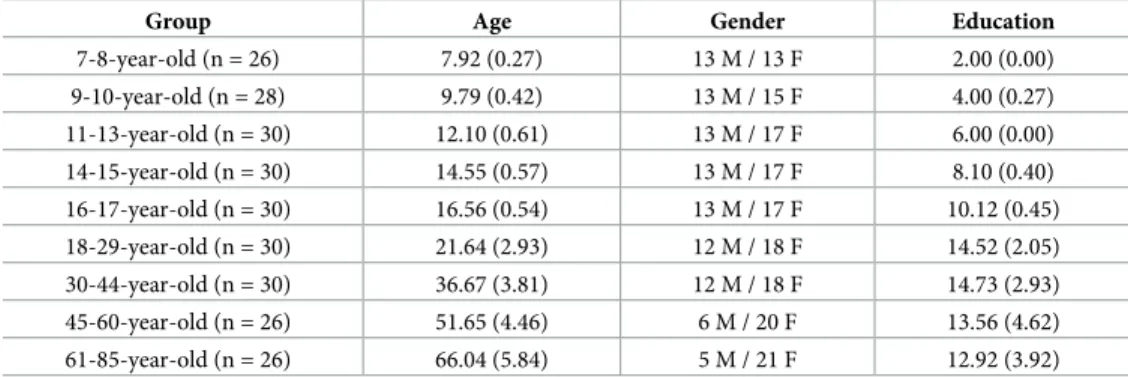
groups is presented inTable 1. None of the participants suffered from any developmental,
psy-chiatric or neurological disorders. All participants gave signed informed consent (parental consent was obtained for children), and they received no financial compensation for their
par-ticipation. The study was approved by the ethics committee of Eo¨tvo¨s Lora´nd University
(Approval Number: 201410) and was conducted in accordance with the Declaration of Helsinki.
Task and procedure
We used the ASRT task [18,37] where a stimulus (a dog’s head) appeared in one of the four
respond to the stimulus events by pressing the corresponding response keys (Z, C, B or M on a QWERTY keyboard) as fast and accurately as they could. The ASRT task consisted of 20 blocks with 85 key presses in each block. The first five responses of each stimulus block served for practice only (and were excluded from the analyses), and then the eight-element alternating sequence (e.g., 2R1R3R4R, where numbers refer to the four locations on the screen, and ‘R’ refers to a randomly selected location out of the four possible ones) was repeated ten times within a block. The stimulus remained on the screen until participants pressed the correct response key, and the next stimulus appeared 120 ms after the correct response. Between blocks, participants received feedback on the screen about their overall reaction time (RT) and accuracy. The computer program generated a different repeating ASRT sequence of the four locations for each participant using a permutation rule such that each of the six unique permu-tations of the four repeating events occurred with equal probability (for more details see e.g., [28,40]).
In this study we focused on the following measures derived from the ASRT task: 1)average
RTs, defined as the average speed across the entire task; 2)general skill learning, defined as the
RT change from the beginning to the end of the task; and 3)triplet learning, defined as faster
responses for more frequent stimuli compared to the less frequent ones (see e.g., [28]).
Statistical analysis
Data preprocessing, calculation of the ASRT measures of interest and statistical analyses
fol-lowed the procedures outlined in previous ASRT studies [18,28,37,41,42]. Briefly, the 20
blocks of the ASRT task were organized into four segments (calledepochs), each consisting of
five blocks (i.e., Blocks 1–5 corresponds to Epoch 1, Blocks 6–10 corresponds to Epoch 2, etc.). We calculated the median RTs of correct responses separately for high- and low-frequency triplets, for each epoch and for each participant.
First, to test age-related differences in general skill learning (and triplet learning) across age groups, the RT values described in the previous paragraph were submitted to a mixed-design ANOVA with EPOCH (1 to 4) and TRIPLET TYPE (high- vs. low-frequency) as the within-subject factor, and GROUP (9 age groups) as the between-within-subject factor. In this ANOVA, the main effect of GROUP can reveal differences across age groups in average speed, the main effect of EPOCH can reveal general skill learning, and the EPOCH x GROUP interaction can reveal differences in general skill learning across age groups. Since the primary focus of this paper is on general skill learning, first we report these main effects and interaction in the Results section. The remaining main effects and interactions involving the TRIPLET factor will be reported in a later section of the Results since those are related to triplet learning.
Table 1. Demographic data (means, standard deviations, and proportions) for all age groups.
Group Age Gender Education
7-8-year-old (n = 26) 7.92 (0.27) 13 M / 13 F 2.00 (0.00) 9-10-year-old (n = 28) 9.79 (0.42) 13 M / 15 F 4.00 (0.27) 11-13-year-old (n = 30) 12.10 (0.61) 13 M / 17 F 6.00 (0.00) 14-15-year-old (n = 30) 14.55 (0.57) 13 M / 17 F 8.10 (0.40) 16-17-year-old (n = 30) 16.56 (0.54) 13 M / 17 F 10.12 (0.45) 18-29-year-old (n = 30) 21.64 (2.93) 12 M / 18 F 14.52 (2.05) 30-44-year-old (n = 30) 36.67 (3.81) 12 M / 18 F 14.73 (2.93) 45-60-year-old (n = 26) 51.65 (4.46) 6 M / 20 F 13.56 (4.62) 61-85-year-old (n = 26) 66.04 (5.84) 5 M / 21 F 12.92 (3.92) https://doi.org/10.1371/journal.pone.0215116.t001
Second, to test age-related differences in general skill learning while controlling for group differences in average RTs, we calculated general skill learning ratio scores. Namely, for each participant, the average RT of Epoch 4 was subtracted from the average RT of Epoch 1 (which provides the raw RT difference score of general skill learning) and then divided by the average RT of that participant in the entire task. An advantage of such a ratio score is that it can be interpreted as a percentage change in RTs during practice relative to one’s average speed. This ratio score was submitted to a Univariate ANOVA with GROUP (9 age groups) as the between-subject factor.
For all ANOVAs, Greenhouse-Geisser epsilon (ε) correction was used when necessary.
Originaldfvalues and correctedpvalues (if applicable) are reported together with partial
eta-squared (ηp2) as the measure of effect size. Post-hoc analysis was conducted by Fisher’s LSD
pairwise comparisons.
Third, to gain a better understanding of between- and within-group heterogeneity, we also present individual data for average RTs and general skill learning indices (raw RT difference, ratio score), with quadratic model fitting. Additionally, the relationship between average RTs and learning measures was tested by Pearson correlation analyses for each age group sepa-rately. Within each age group, we also compared whether average RTs showed a smaller corre-lation with the general skill ratio score than with the general skill raw RT difference using Fisher’s Z-test and controlling for multiple comparisons with Bonferroni correction. These analyses can reveal whether the argument of ‘slower RTs provide more room to improve’ is
supportedwithinage groups and whether the relationship between average RTs and general
skill learning changesacrossage groups. Moreover, these analyses can also reveal whether (and
in which age groups) the ratio scores is adequate for controlling for average RT differences. Fourth, we also explored an alternative, complementary approach to test the potential age-related differences in general skill learning while controlling for the average RTs. Namely, we selected a subsample of participants that exhibited similar average RTs, irrespective of their age groups. Thus, we asked whether participants in different age groups exhibit comparable degree of general skill learning if their average RTs are similar. To put it differently: if a 9-year-old child is as fast as a 16-year-9-year-old adolescent, do they exhibit a similar degree of general skill learning? Due to the fact that young adults are, on average, faster than children and older adults, this selection criterion necessarily leads to the inclusion of faster participants in chil-dren and older adult groups and slower participants in the young adult groups relative to their respective age groups. Nevertheless, it still may provide valuable information for the relation-ship between age and general skill learning while controlling for the average RTs.
Fifth, we also report age-related differences in triplet learning based on the main ANOVA described above (focusing on the main effect of TRIPLET and the interactions involving the
TRIPLET factor [14,43]) and test for a relationship between average RTs and triplet learning
(using Pearson correlation analyses). As described in the Introduction, beyond providing a comparison of how average RTs may affect task-general vs. task-specific learning, we find the presentation of triplet learning results important as it can provide a direct replication test of Janacsek et al.’s [14] study, promoting reproducible research.
Results
Are there age-related differences in average RT and general skill learning?
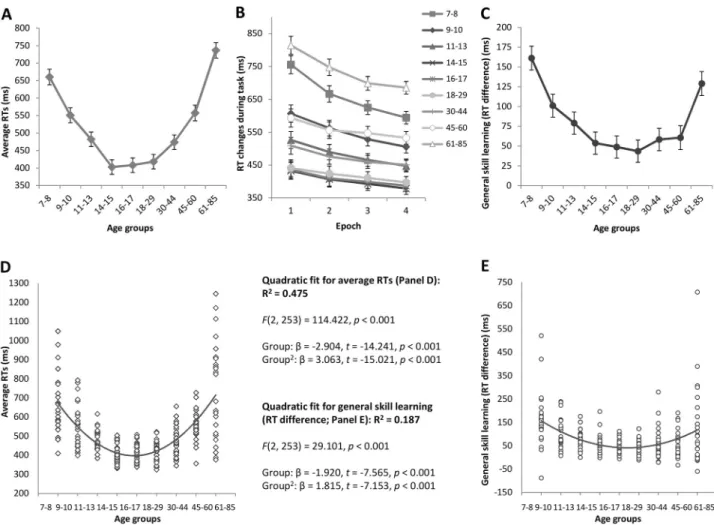
The mixed-design ANOVA revealed a significant main effect of GROUP (F(1, 247) = 28.858,
ηp2= 0.483,p<.001) as the average RTs differed significantly across age groups (Fig 1A). The
LSD post hoc test revealed gradually faster RTs between 7 and 15 years of age (ps<.023),
between 30 and 85 years of age (ps<.060). These results confirm a U-shaped developmental trajectory in average RTs across the lifespan [14].
Regarding general skill learning, the ANOVA revealed a significant main effect of EPOCH
(F(3, 741) = 191.197,ηp
2
= 0.436,p<.001), with significantly faster RTs as the task progressed.
More importantly, the EPOCH×GROUP interaction was also significant (F(24, 741) = 5.484,
ηp 2
= 0.151,p<.001), suggesting significantly different general skill learning across age groups
(Fig 1B). The LSD post-hoc test comparing the RT differences between Epoch 1 and 4 across age groups revealed that the 7-8-year old age group exhibited the greatest general skill
improvement (Fig 1C), significantly differing from all other age groups (ps<0.004) except for
the 61-85-year old group (p= .134). The 9-10- and 11-13-year-old groups showed a smaller
improvement, with no difference between the two groups (p= .277). From adolescence to late
adulthood, the degree of general skill learning further decreased compared to the younger age
groups, with no group differences between 14 and 60 years of age (ps>.409). The
61-85-year-old group’s general skill learning differed significantly from that of the groups between 11 and
60 years of age (ps<.016).
Fig 1. Average RTs and general skill learning across the lifespan. Average RTs refer to the RTs of all correct responses averaged over the entire task
(A). General skill learning refers to the RT changes occurring during the time course of the task (B), which can be quantified as the RT difference between Epoch 1 and Epoch 4 (C). Group averages are presented in panel A-C, and individual data separately for each age group are presented in panel D-E. Error bars indicate standard error of mean (SEM).
To gain a better understanding of between- and within-group differences, individual data
for each participant in each age group are presented inFig 1D and 1E. In line with the
ANOVA results, a quadratic fit for the average RTs explains a large proportion (47.5%) of vari-ability across age groups (Fig 1D). Interestingly, the quadratic fit for the general skill learning (Fig 1E) is substantially weaker compared to the average RT fit, explaining only 18.7% of vari-ability across age groups. After excluding the three slowest participants from the 7–8 and 61-85-year-old groups, the fit is only slightly better, 20.9%, still well below of that for the overall RTs. (Note that excluding these participants affected the ANOVA results of general skill learn-ing reported above only in that the 7-8-year-olds showed significantly greater learnlearn-ing
com-pared to all age groups, including the 61-85-year-olds as well,ps<.023).
Both the developmental trajectories of group averages (Fig 1A and 1C) as well as the qua-dratic fits for average RTs and general skill learning (Fig 1D and 1E) seem to support the argu-ment that if someone is slower, then there is more room to improve during practice. Those age groups that exhibit slower average RTs seem to show greater general skill learning (i.e., more speed-up from Epoch 1 to Epoch 4). Nevertheless, the substantially weaker quadratic fit for general skill learning compared to the average RTs suggests that (between- or within-group) differences in average RTs alone may not be sufficient to explain differences in general skill learning. In the next steps, first we focus on between-group differences, and then we will test the within-group associations between average RTs and general skill learning.
Are there age-related differences in general skill learning when average RT
differences are controlled for?
The Univariate ANOVA on the general skill ratio score yielded a significant main effect of
GROUP (F(8, 247) = 4.602,ηp
2
= 0.130,p<.001), suggesting differences in general skill
learn-ing across age groups (Fig 2A). Based on the LSD post hoc test, the 7-8-year-old group showed the highest general skill ratio score (23.6% improvement relative to their average RTs) that was
significantly different from that of all other age groups (ps<.043). The 9-10- and
11-13-year-old groups exhibited a smaller improvement (17.9% and 16.2%, respectively), with no
differ-ence between the two groups (p= .532). The degree of general skill learning exhibited a further
decrease after that age, and remained comparable between 14 and 85 years of age (ps>0.126;
except for the 18–29 vs. 61-85-year-old groups:p= .057).
Fig 2. General skill learning ratio scores across the lifespan. The ratio scores for group averages (A) and individual data (B) are presented. The ratio
score can be interpreted as a percentage change in performance (e.g., the 7-8-old age group exhibited an approximately 23% speed-up from Epoch 1 to Epoch 4 relative to their average speed during task). Error bars indicate standard error of mean (SEM).
The individual data of the ratio scores are presented inFig 2B. Although the quadratic fit for the general skill ratio scores was weaker than that for the average RTs and for the raw RT difference of general skill learning, it still explained 12.5% of variability across age groups. This is in line with the ANOVA results of significant group differences, existing mainly between children (particularly 7-8-year-olds) and the other age groups.
Comparing the raw RT difference and the ratio score as measures of general skill learning, a considerable difference can be observed in their developmental trajectories: While the 61-85-year-old group seems to have greater general skill learning than the groups between 11 and 60 years of age based on the raw RT difference between Epoch 1 and Epoch 4 (Fig 1C), this greater improvement largely disappears when the ratio score is used (there is only a trend level difference compared to the 18-29-year-old group). This result suggests that in the 61-85-year-old group the observed RT changes during the task may be more affected by the participants’ average speed compared to the other age groups, and thus may reflect other processes as well, over and beyond those related to general skill learning.
A similar approach to control for differences in average RTs is to use the average RT of Epoch 1 instead of the average RT of the entire task when calculating the ratio scores. This approach has been previously used in the study of procedural learning to control for RT
differ-ences across groups (e.g., [33,44]). In this case, performance at the beginning of the task (i.e.,
in Epoch 1) is set to the same level for all participants (the value of 1) and performance changes during the remaining of the task (i.e., in Epochs 2 to 4 in this case) are relative changes com-pared to the performance in Epoch 1. This score can also be interpreted as a percentage change similar to the one used above. We re-ran our analysis with this score and obtained almost iden-tical results as the ones reported above (with small differences in numerical values only).
Are larger average RTs associated with greater general skill learning within
age groups?
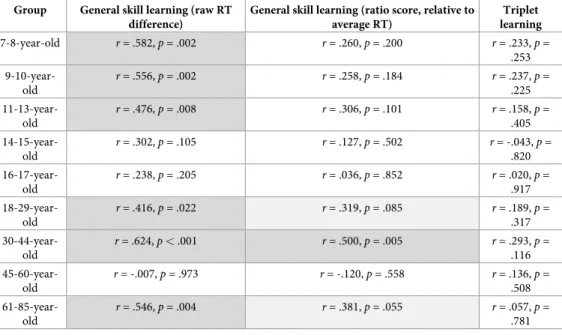
In the next step, we tested the relationship between average RTs and the degree of general skill learning using Pearson correlation analyses for each age group separately. These analyses revealed that, in all age groups, average RTs showed a weaker correlation with the general skill ratio score than with the general skill raw RT difference (based on comparing correlations using Fisher’s Z-test and controlling for multiple comparisons with Bonferroni correction, all
Zs>2.96, allps<.003). This suggests that the ratio score may be a less biased measure of
gen-eral skill learning than the raw RT difference score, although some developmental differences may also be present. The Pearson correlation analyses revealed a moderate positive relation-ship between average RTs and the raw RT difference of general skill learning between 7 and 13 years of age, between 18 and 44 years of age, as well as in the 61-85-year-old group (Table 2). This relationship was eliminated in the groups between 7 and 13 years of age when the ratio score of general skill learning was used. The ratio score may be less effective in controlling for this relationship in adulthood as the average RTs still remained positively correlated with the general skill ratio score in the 30-44-year-old group (and on trend level in the 18-29- and 61-85-year-old groups). It is also important to note that there was no relationship between average RTs and general skill learning (either the raw or the ratio score) in the 14–15 and 16-17-year-old groups, suggesting that the relationship itself may change in different developmental stages. Similarly, there was no relationship between average RTs and general skill learning in the 45-60-year-old group either.
Overall, based on the correlation analysis, there appears to be a positive relationship between average RTs and raw RT changes during task in most age groups, and the ratio score of general skill learning can help decrease or eliminate this relationship.
Do participants in different age groups exhibit comparable degree of
general skill learning if their average RTs are similar?
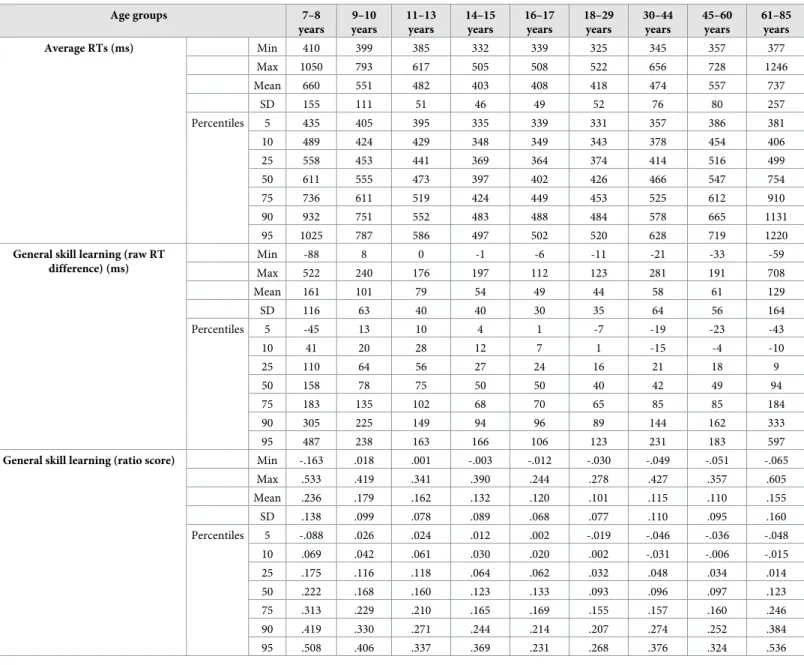
To answer this question, based on the individual data of each age group (cf.Fig 1D), we
selected a subsample of participants whose average RTs were between 400 and 550 ms. The RT range seemed to provide an appropriate balance between maximizing the sample size in each age group and minimizing the potential average RT differences in group averages. Table 3shows to what percentiles of the original sample the selected range of 400–550 ms corresponds.
Since the number of participants by groups is relatively low and unequal, standard statistical
analyses may be less reliable here. Therefore, inFig 3we present the same group averages for
this subsample as the ones presented in Figs1A–1Cand2Afor the whole sample in order to
enable qualitative comparison between the pattern of results.Fig 3Asuggests that, with this
approach, group differences in average RTs can be at least partly eliminated. Importantly, some age differences in general skill learning still remained (Fig 3B–3D). To support the quali-tative interpretation of these results, we compared the ratio score across age groups, focusing primarily on the 7-8- and 61-85-year-olds. This analysis revealed greater general skill ratio
scores for the 7-8-year-olds compared to the 61-85-year-olds (p= .035). Additionally, the
61-85-year-old group’s general skill ratio score did not differ significantly from those between 14
and 60 years of age (ps>.125). Although this statistical analysis should be treated carefully
because of the low and unbalanced sample sizes across groups, it is important to highlight that the results presented here (both qualitatively and quantitatively) support the interpretation of age-related differences in general skill learning obtained in the whole sample. Specifically, chil-dren (particularly 7-8-year-olds) seem to show better general skill learning compared to later ages, and this advantage cannot be explained by their overall slower response speed, as it
Table 2. Relationship between average RTs and indices of general skill (raw RT difference and ratio scores) and triplet learning for each age group.
Group General skill learning (raw RT difference)
General skill learning (ratio score, relative to average RT) Triplet learning 7-8-year-old r= .582,p= .002 r= .260,p= .200 r= .233,p= .253 9-10-year-old r= .556,p= .002 r= .258,p= .184 r= .237,p= .225 11-13-year-old r= .476,p= .008 r= .306,p= .101 r= .158,p= .405 14-15-year-old r= .302,p= .105 r= .127,p= .502 r= -.043,p= .820 16-17-year-old r= .238,p= .205 r= .036,p= .852 r= .020,p= .917 18-29-year-old r= .416,p= .022 r= .319,p= .085 r= .189,p= .317 30-44-year-old r= .624,p<.001 r= .500,p= .005 r= .293,p= .116 45-60-year-old r= -.007,p= .973 r= -.120,p= .558 r= .136,p= .508 61-85-year-old r= .546,p= .004 r= .381,p= .055 r= .057,p= .781 Note. Pearson correlation coefficients are reported. Significant correlations (p<.05) are highlighted with a darker gray background, and trend level correlations (p<.1) are highlighted with a lighter gray background.
persists even after controlling for the average RTs. In contrast, older adults may not show bet-ter general skill learning, and the observed greabet-ter RT changes during task may be due to other factors, including overall slower response speed, as their advantage diminishes when average RTs are controlled for.
Are there age-related differences in triplet learning? Additionally, is there a
relationship between triplet learning scores and average RTs?
Although it is not of the main interest of the current paper, we briefly report the results of
trip-let learning as well (Fig 4). The main ANOVA (described in theStatistical analysissection)
revealed a significant a main effect of TRIPLET (F(1, 247) = 228.365,ηp2= 0.480,p<.001),
with significantly faster RTs for more frequent triplets compared to the less frequent ones. The
TRIPLET×GROUP interaction was also significant (F(8, 247) = 2.598,ηp2= 0.078,p= .010).
Table 3. Minimum and maximum values, mean, standard deviation (SD) and percentiles of average RTs and general skill learning for each age group. Age groups 7–8 years 9–10 years 11–13 years 14–15 years 16–17 years 18–29 years 30–44 years 45–60 years 61–85 years Average RTs (ms) Min 410 399 385 332 339 325 345 357 377 Max 1050 793 617 505 508 522 656 728 1246 Mean 660 551 482 403 408 418 474 557 737 SD 155 111 51 46 49 52 76 80 257 Percentiles 5 435 405 395 335 339 331 357 386 381 10 489 424 429 348 349 343 378 454 406 25 558 453 441 369 364 374 414 516 499 50 611 555 473 397 402 426 466 547 754 75 736 611 519 424 449 453 525 612 910 90 932 751 552 483 488 484 578 665 1131 95 1025 787 586 497 502 520 628 719 1220
General skill learning (raw RT difference) (ms) Min -88 8 0 -1 -6 -11 -21 -33 -59 Max 522 240 176 197 112 123 281 191 708 Mean 161 101 79 54 49 44 58 61 129 SD 116 63 40 40 30 35 64 56 164 Percentiles 5 -45 13 10 4 1 -7 -19 -23 -43 10 41 20 28 12 7 1 -15 -4 -10 25 110 64 56 27 24 16 21 18 9 50 158 78 75 50 50 40 42 49 94 75 183 135 102 68 70 65 85 85 184 90 305 225 149 94 96 89 144 162 333 95 487 238 163 166 106 123 231 183 597
General skill learning (ratio score) Min -.163 .018 .001 -.003 -.012 -.030 -.049 -.051 -.065
Max .533 .419 .341 .390 .244 .278 .427 .357 .605 Mean .236 .179 .162 .132 .120 .101 .115 .110 .155 SD .138 .099 .078 .089 .068 .077 .110 .095 .160 Percentiles 5 -.088 .026 .024 .012 .002 -.019 -.046 -.036 -.048 10 .069 .042 .061 .030 .020 .002 -.031 -.006 -.015 25 .175 .116 .118 .064 .062 .032 .048 .034 .014 50 .222 .168 .160 .123 .133 .093 .096 .097 .123 75 .313 .229 .210 .165 .169 .155 .157 .160 .246 90 .419 .330 .271 .244 .214 .207 .274 .252 .384 95 .508 .406 .337 .369 .231 .268 .376 .324 .536 https://doi.org/10.1371/journal.pone.0215116.t003
The LSD post hoc test revealed a pattern similar to the one reported in the Janacsek et al. [14]
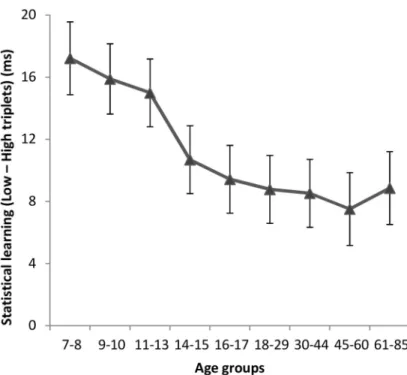
study, with similar triplet learning performance in the 7–13 age range (ps>.490) that was
sig-nificantly higher than the learning scores in the 14–85 age range (p<.001). The TRIPLET×
EPOCH interaction was also significant (F(3, 741) = 8.013,ηp2= 0.031,p<.001), indicating
that participants’ triplet knowledge increased as learning progressed (from 6.5 ms in Epoch 1
to 15 ms in Epoch 4). The TRIPLET×EPOCH×GROUP interaction was not significant (p=
.579), suggesting that the time course of triplet learning was similar in all age groups.
Additionally, we tested the relationship between average RTs and triplet learning scores in each age group separately, and found no significant correlation between these measures in either age group (Table 2). Thus, it seems that while general skill learning may be correlated with average RTs in some developmental stages, supporting the claim of ‘slower RTs, thus more room to improve’, triplet learning scores appear to be unrelated to average RTs.
Fig 3. Average RTs (A) and general skill learning (B-D) across the lifespan for a subsample of the participants to control for age-related average RT differences. Only those participants are included in this subsample whose average RTs are between 400 and 550 ms. For details on the measures
presented here see the legend ofFig 1. Error bars indicate standard error of mean (SEM).
Discussion
Our study aimed to examine age-related differences in general skill learning across the human lifespan and test the argument of whether generally slower response times are associated with greater general skill learning in different developmental stages. We employed the ASRT task, which probes procedural learning, and enables us to disentangle task-general (i.e., general skill) learning from task-specific learning of probabilistic regularities (i.e., statistical learning). A large sample of participants aged between 7 and 85 years were tested on this task. We found a U-shaped developmental trajectory of general skill learning, assessed by raw RT changes dur-ing the task, with children and older adults exhibitdur-ing greater learndur-ing than adolescents and young adults. This developmental trajectory was paralleled with a U-shaped lifespan trajectory of average RTs, lending support to the ‘more room to improve’ argument from a between-group perspective. Nevertheless, our more detailed analyses of both between-between-group and within-group differences suggest a more complex relationship between average speed and gen-eral skill learning across the human lifespan. Importantly, the superior gengen-eral skill learning of children (particularly that of the 7-8-year-olds) was consistently demonstrated across different analysis approaches, while the older adults’ general skill learning decreased to the level of young adults when differences in average speed were controlled for. Finally, task-specific trip-let learning showed a gradual decline across the lifespan, and learning performance seemed to be independent of average speed, regardless of the age group. Overall, our results suggest that children are superior learners in various aspects of procedural learning, including both task-specific and task-general processes of learning.
We used three different approaches to test the lifespan trajectory of general skill learning. Using raw RT measures, we observed a U-shaped trajectory with children and older adults exhibiting greater general skill learning compared to adolescents and younger adults. In
Fig 4. Statistical learning across age groups. Triplet learning score was quantified as an RT difference for low- and
high-frequency triplets, averaged across the entire task. Larger values represent better learning performance. Error bars indicate standard error of mean (SEM).
contrast, when we used RT ratio scores (which is a common approach to control for
differ-ences in average speed across groups; see e.g., [44,45]), the developmental trajectory was no
longer U-shaped. Our results showed an advantage for children compared to adults, while the older adults (the 61-85-year-old group) no longer exhibited greater general skill learning com-pared to the younger adults, suggesting that the greater speed-up observed in raw RT measures may due to different factors in children vs. older adults, even if both age groups show slower average speed compared to young adults. Additionally, as a third approach, we tested age-related differences in a subsample of participants whose average RTs were similar across age groups. Even though the selection of such subsample may have induced some bias (as faster participants of the children and older adult groups and slower participants of the adolescent and young adult groups were included in this analysis), it still may help provide a deeper insight into age differences in general skill learning while controlling for average RT differ-ences. This analysis further confirmed the ratio score results of the whole sample: the 7-8-year-old group exhibited the greatest general skill learning (approximately 20%, comparable to the ratio score of the whole sample of this age group), and then gradually smaller improvements were observed from childhood to adulthood. The 61-85-year-old group did not exhibit greater general skill learning than any other adult group. Thus, overall, children (especially the 7-8-year old age group) exhibited superior general skill learning consistently across analyses. This finding suggests a heightened ability to acquire new skilled behaviors in this developmen-tal stage that cannot be explained by the generally slower responses in childhood.
It is a typically observed pattern in developmental, aging and clinical neuroscience and psy-chology studies that groups with different average speed (e.g., children/older adults vs. young
adults, or patient vs. control groups) are compared on different RT measures [14,46–49]. In
these group comparisons the difference in average speed poses a great challenge to disentangle its effect from other RT measures, such as those related to learning (e.g., speed-up as learning progresses), in order to unravel the more fine-grained group differences in cognitive functions. To better understand the extent of this challenge, here we tested the argument of whether gen-erally slower response times are associated with greater general skill learning (i.e., slower aver-age RTs provide ‘more room to improve’) in different developmental staver-ages. The between-group comparisons showed a similar U-shaped lifespan trajectory both for average speed and general skill learning measured by raw RTs, which can easily be viewed as support for the ‘more room to improve’ argument. However, our more detailed analyses of both between-group and within-between-group differences suggest a more complex relationship between average speed and general skill learning across the human lifespan. In between-group comparisons, as discussed above, children showed superior general skill learning performance compared to other age groups even when average speed across groups was controlled for, either by using ratio scores or in the analysis of a subsample with similar average speed. These results suggest that differences in average speed alone cannot, at least fully, explain the observed differences in general skill learning across the lifespan.
Moreover, when we tested the relationship between average speed and general skill learning
withinage groups, we found correlations in age groups 7 to 13, 18 to 44, and 61 to 85 years but not in adolescents (aged 14 to 17 years) or in middle aged participants (aged 45 to 60 years), suggesting that the relationship between average speed and general skill learning (measured by raw RT differences) is not universal. Importantly, the use of ratio scores for general skill learn-ing appeared to efficiently control for the differences in average speed in children as the corre-lation between average speed and general skill learning disappeared in the 7-13-year-old age groups when such ratio scores were used. In contrast, ratio scores seemed less efficient in con-trolling for average speed differences in adulthood (particularly in the 30-44-year-old group). These findings have important implications for developmental, aging and clinical studies
comparing groups with different average speed: they highlight the importance of testing the relationship between average speed and other RT measures of interest, and the need for find-ing measures that can efficiently control for differences in average speed while not inducfind-ing other biases in group comparisons.
In the current study we also found age-related differences in task-specific triplet learning: the lifespan trajectory resembled a gradual decline across age groups with children exhibiting the best learning performance. This finding provides a direct replication of the Janacsek et al. [14] study in a new, independent sample of participants, suggesting, that at least in learning probabilistic regularities, children show an advantage compared to other age groups. This result supports the ‘children better’ theoretical framework in contrast to other models that
emphasize developmental invariance or peak learning performance in young adulthood [8,23,
32,50]. Additionally, the current study enabled us to test, in the same sample of participants, whether average speed is similarly related to general skill learning vs. triplet learning in order to gain a better understanding of the relationship between various aspects of procedural ing. Interestingly, while average speed showed a positive relationship with general skill learn-ing (see above), no such relationship was observed with triplet learnlearn-ing in any of the age groups. This may emerge from the fact that triplet learning scores are computed as difference
scores between RTs for high- vs. low-frequency triplets [18,37]. Thus, if someone is, on
aver-age, slower than others, s/he will show slower responses tobothtriplet types throughout the
task, but the RT difference to these triplets (i.e., how much faster they respond to high- vs. low-frequency triplets) seems to be independent of the average speed of participants. This
result is in line with findings of To¨ro¨k et al. [51] showing that such triplet learning measures
are resistant to factors that affect general performance changes, such as fatigue effects. Thus, overall, the triplet learning measure appears to be a well-designed, reliable tool for testing the
learning of probabilistic regularities [51,52], and is well-suited for group comparisons, even if
average speed differs across groups. In contrast, other RT measures (e.g., general skill learning measures) may be more sensitive to average speed differences across participants and groups.
Although we found better learning performance in children, it is important to note that
children do not universally show an advantage compared to adults [11,53], and other factors
should also be taken into account to gain a better understanding of procedural learning across the lifespan. Such factors may include the structure to be learned in the task (e.g.,
triplets/sta-tistics, probabilistic or deterministic sequences) [11,25,26,52], their presentation parameters
(e.g., simultaneous or sequential) [36], stimulus timing, task length, fatigue effects [31,51], or
the ratio of motor vs. perceptual components of learning [29,54,55]. Future studies should
systematically test these potential factors. Our study highlights the importance of using tasks that are able to assess different aspects of procedural learning, including the differentiation of performance changes that are related to general skill learning (i.e., task-general learning) vs. those related to learning the structure embedded in the task (i.e., task-specific learning). More-over, the relationship between learning measures and average speed should also be tested and appropriately controlled for, when comparing groups with different average speed. Such research approach could significantly advance our understanding of differences in procedural learning across the lifespan.
Additionally, our study has important implications for a wide range of clinical populations, including neurodevelopmental (e.g., dyslexia, autism, ADHD, Tourette Syndrome) and neuro-degenerative disorders (e.g., Mild Cognitive Impairment, Alzheimer’s disease) as well as psychi-atric conditions (e.g., schizophrenia, depression, bipolar disorder). These clinical populations typically exhibit slower responses compared to the healthy/typically developing control groups [38,46–49,56–58]. Understanding the relationship between average speed and aspects of pro-cedural learning in different developmental stages can help formulate predictions for and test
how various clinical conditions alter these processes, taking age-related differences into account as well. In the current study, we reported detailed parameters of average speed and general skill learning for each age group separately that can be used as reference in future clinical studies.
Here we focused on reaction time measures and their developmental trajectories across the lifespan. Although it is out of the scope of the current paper, it is important to note that accu-racy measures can also be analyzed in at least some tasks of procedural learning. The patterns of overall accuracy and changes in accuracy during learning may exhibit different developmen-tal trajectories and different within-group relationships compared to the reaction time mea-sures. For example, children tend to have lower, whereas older adults tend to have higher overall accuracy than young adults, thus, average accuracy and average speed seems to show
different lifespan trajectories [8,14,42]. It is reasonable to assume that the mechanisms related
to average accuracy as well as to the changes in accuracy during learning are, at least partly, different from the mechanisms related to average speed and its changes (speed-up) during learning. Accuracy measures may be more closely related to attention and action selection func-tions, such as selectively attending to the target stimuli and selecting the appropriate responses to those stimuli. In contrast, reaction time measures usually include correct responses only, and thus, the attentional and action selection processes may affect these measures to a smaller extent. Instead, the average speed and the speed-up due to practice typically observed in procedural learning tasks may be more closely related to achieving greater automaticity that is a
hallmark of skilled behaviors [59,60]. Future studies should directly test these possible
mecha-nisms and their differential contributions to accuracy and reaction time measures.
Conclusions
To summarize, children (especially the 7-8-year-olds) exhibited superior general skill learning consistently across analyses, suggesting a heightened ability to acquire new skilled behaviors in this developmental stage, which extends the ‘children better’ theoretical framework of proce-dural learning [14] to include both task-general and task-specific processes. Our study high-lights the importance of disentangling these processes of procedural learning as they may be
differentially affected by age or clinical conditions (see e.g., [8,35,46]) and may be
differen-tially related to average speed. Here we presented two approaches to control for average speed differences across groups: using ratio scores and testing a subsample of participants with simi-lar average speed. Overall, the argument that slower average speed provides ‘more room to improve’ seems to be not universally true: some age groups across the lifespan and some mea-sures of learning (task-general but not task-specific learning) seem to be more affected by aver-age speed. Thus, our findings highlight the importance to test, and control for, the effect of average speed on other RT measures of cognitive functions, which can fundamentally affect the interpretation of group differences in developmental, aging and clinical psychology and neuroscience studies.
Supporting information
S1 Dataset. The dataset of the experiment for each participant is included in this file (zip format).
(ZIP)
Acknowledgments
This research was supported by the National Brain Research Program (project 2017–1.2.1-NKP-2017-00002); Hungarian Scientific Research Fund (NKFIH-OTKA PD 124148, to K. J.;
NKFIH-OTKA K 128016, to D. N.); Janos Bolyai Research Fellowship of the Hungarian
Acad-emy of Sciences (to K. J.). D. N. is thankful for the support of IME´RA.
Author Contributions
Conceptualization: Dezso Nemeth, Karolina Janacsek. Data curation: Dora Juhasz, Karolina Janacsek. Formal analysis: Dora Juhasz, Karolina Janacsek. Funding acquisition: Dezso Nemeth, Karolina Janacsek. Investigation: Dora Juhasz.
Methodology: Dora Juhasz, Dezso Nemeth, Karolina Janacsek.
Project administration: Dora Juhasz, Dezso Nemeth, Karolina Janacsek. Resources: Dora Juhasz, Dezso Nemeth, Karolina Janacsek.
Software: Karolina Janacsek.
Supervision: Dezso Nemeth, Karolina Janacsek. Visualization: Karolina Janacsek.
Writing – original draft: Dora Juhasz, Dezso Nemeth, Karolina Janacsek. Writing – review & editing: Dezso Nemeth, Karolina Janacsek.
References
1. Nemeth D, Janacsek K, Csifcsak G, Szvoboda G, Howard JH Jr., Howard DV. Interference between sentence processing and probabilistic implicit sequence learning. PLoS One. 2011; 8(6(3)):e17577. 2. Romano Bergstrom JC, Howard JH Jr., Howard DV. Enhanced Implicit Sequence Learning in
College-age Video Game Players and Musicians. Appl Cogn Psychol. 2012; 26(1):91–6.
3. Lieberman MD. Intuition: a social cognitive neuroscience approach. Psychol Bull. 2000; 126(1):109–37. PMID:10668352
4. Ullman MT. The declarative/procedural model: a neurobiological model of language learning, knowl-edge, and use. Neurobiology of language: Elsevier; 2016. p. 953–68.
5. Bialystok E, Craik FI, Binns MA, Ossher L, Freedman M. Effects of bilingualism on the age of onset and progression of MCI and AD: Evidence from executive function tests. Neuropsychology. 2014; 28 (2):290.https://doi.org/10.1037/neu0000023PMID:24245925
6. Perani D, Farsad M, Ballarini T, Lubian F, Malpetti M, Fracchetti A, et al. The impact of bilingualism on brain reserve and metabolic connectivity in Alzheimer’s dementia. Proceedings of the National Acad-emy of Sciences. 2017:201610909.
7. Park DC, Lodi-Smith J, Drew L, Haber S, Hebrank A, Bischof GN, et al. The impact of sustained engagement on cognitive function in older adults: the synapse project. Psychol Sci. 2014; 25(1):103– 12.https://doi.org/10.1177/0956797613499592PMID:24214244
8. Meulemans T, Van der Linden M, Perruchet P. Implicit sequence learning in children. J Exp Child Psy-chol. 1998; 69(3):199–221.https://doi.org/10.1006/jecp.1998.2442PMID:9654439
9. Saffran JR, Aslin RN, Newport EL. Statistical learning by 8-month-old infants. Science. 1996; 274 (5294):1926–8.https://doi.org/10.1126/science.274.5294.1926PMID:8943209
10. Karatekin C, Marcus DJ, White T. Oculomotor and manual indexes of incidental and intentional spatial sequence learning during middle childhood and adolescence. J Exp Child Psychol. 2007; 96(2):107– 30.https://doi.org/10.1016/j.jecp.2006.05.005PMID:16828110
11. Luka´cs A´ , Keme´ny F. Development of different forms of skill learning throughout the lifespan. Cognitive Science. 2015; 39(2):383–404.https://doi.org/10.1111/cogs.12143PMID:25039658
12. Hodel AS, Markant JC, Van Den Heuvel SE, Cirilli-Raether JM, Thomas KM. Developmental differ-ences in effects of task pacing on implicit sequence learning. Front Psychol. 2014; 5:153.https://doi. org/10.3389/fpsyg.2014.00153PMID:24616712
13. Thomas KM, Hunt RH, Vizueta N, Sommer T, Durston S, Yang Y, et al. Evidence of Developmental Dif-ferences in Implicit Sequence Learning: An fMRI Study of Children and Adults. J Cogn Neurosci. 2004; 16(8):1339–51.https://doi.org/10.1162/0898929042304688PMID:15509382
14. Janacsek K, Fiser J, Nemeth D. The best time to acquire new skills: age-related differences in implicit sequence learning across the human lifespan. Developmental Science. 2012; 15(4):496–505.https:// doi.org/10.1111/j.1467-7687.2012.01150.xPMID:22709399
15. Nemeth D, Janacsek K, Fiser J. Age-dependent and coordinated shift in performance between implicit and explicit skill learning. Front Comput Neurosci. 2013; 7.https://doi.org/10.3389/fncom.2013.00147 PMID:24155717
16. Fischer S, Wilhelm I, Born J. Developmental Differences in Sleep’s Role for Implicit Off-line Learning: Comparing Children with Adults. J Cogn Neurosci. 2007; 19(2):214–27.https://doi.org/10.1162/jocn. 2007.19.2.214PMID:17280511
17. Bennett IJ, Howard JH Jr., Howard DV. Age-Related Differences in Implicit Learning of Subtle Third-Order Sequential Structure. Journal of Gerontology: Psychological Sciences. 2007; 62B(2):98–103. 18. Howard JH Jr., Howard DV. Age differences in implicit learning of higher-order dependencies in serial
patterns. Psychol Aging. 1997; 12(4):634–56. PMID:9416632
19. Schuck NW, Frensch PA, Schjeide B-MM, Schro¨der J, Bertram L, Li S-C. Effects of aging and dopa-mine genotypes on the emergence of explicit memory during sequence learning. Neuropsychologia. 2013; 51(13):2757–69.https://doi.org/10.1016/j.neuropsychologia.2013.09.009PMID:24035787 20. Gaillard V, Destrebecqz A, Michiels S, Cleeremans A. Effects of age and practice in sequence learning:
A graded account of ageing, learning, and control. Eur J Cogn Psychol. 2009; 21(2):255–82. 21. Spencer RM, Gouw AM, Ivry RB. Age-related decline of sleep-dependent consolidation. Learn Mem.
2007; 14(7):480–4.https://doi.org/10.1101/lm.569407PMID:17622650
22. Brown RM, Robertson EM, Press DZ. Sequence skill acquisition and off-line learning in normal aging. PLoS One. 2009; 4(8):e6683.https://doi.org/10.1371/journal.pone.0006683PMID:19690610
23. Reber AS. Implicit learning and tacit knowledge: An essay on the cognitive unconscious. Broadbent DE, Mackintosh NJ, McGaugh JL, Treisman A, Tulving E, Weiskrantz L, editors. New York: Oxford Univer-sity Press; 1993.
24. Newport EL. Maturational constraints on language learning. Cognitive Science. 1990; 14(1):11–28. 25. Ko´bor A, Taka´cs A´ , Kardos Z, Janacsek K, Horva´th K, Cse´pe V, et al. ERPs differentiate the sensitivity
to statistical probabilities and the learning of sequential structures during procedural learning. Biol Psy-chol. 2018; 135:180–93.https://doi.org/10.1016/j.biopsycho.2018.04.001PMID:29634990
26. Simor P, Zavecz Z, Horvath K, Elteto N, To¨ro¨k C, Pesthy O, et al. Deconstructing procedural memory: Different learning trajectories and consolidation of sequence and statistical learning. Front Psychol. 2019; 9:2708.https://doi.org/10.3389/fpsyg.2018.02708PMID:30687169
27. Turk-Browne NB, Scholl BJ, Chun MM, Johnson MK. Neural evidence of statistical learning: Efficient detection of visual regularities without awareness. J Cogn Neurosci. 2009; 21(10):1934–45.https://doi. org/10.1162/jocn.2009.21131PMID:18823241
28. Ko´bor A, Janacsek K, Taka´cs A´ , Nemeth D. Statistical learning leads to persistent memory: Evidence for one-year consolidation. Sci Rep. 2017; 7(1):760.https://doi.org/10.1038/s41598-017-00807-3 PMID:28396586
29. Hallgato E, Győri-Dani D, Peka´r J, Janacsek K, Nemeth D. The differential consolidation of perceptual and motor learning in skill acquisition. Cortex. 2013; 49(4):1073–81.https://doi.org/10.1016/j.cortex. 2012.01.002PMID:22325422
30. Robertson EM. The Serial Reaction Time Task: Implicit Motor Skill Learning? J Neurosci. 2007; 27:10073–5.https://doi.org/10.1523/JNEUROSCI.2747-07.2007PMID:17881512
31. Pan SC, Rickard TC. Sleep and motor learning: is there room for consolidation? Psychol Bull. 2015; 141(4):812.https://doi.org/10.1037/bul0000009PMID:25822130
32. Thomas KM, Nelson CA. Serial Reaction Time Learning in Preschooland School-Age Children. J Exp Child Psychol. 2001; 79:364–87.https://doi.org/10.1006/jecp.2000.2613PMID:11511129
33. Bhakuni R, Mutha PK. Learning of bimanual motor sequences in normal aging. Front Aging Neurosci. 2015; 7:76.https://doi.org/10.3389/fnagi.2015.00076PMID:26005417
34. Jiang YV, Capistrano CG, Esler AN, Swallow KM. Directing attention based on incidental learning in children with autism spectrum disorder. Neuropsychology. 2013; 27(2):161.https://doi.org/10.1037/ a0031648PMID:23527644
35. Csabi E, Varszegi-Schulz M, Janacsek K, Malecek N, Nemeth D. The consolidation of implicit sequence memory in obstructive sleep apnea. PLoS One. 2014; 9(10):e109010.https://doi.org/10.1371/journal. pone.0109010PMID:25329462
36. Janacsek K, Nemeth D. Predicting the future: From implicit learning to consolidation. Int J Psychophy-siol. 2012; 83(2):213–21.https://doi.org/10.1016/j.ijpsycho.2011.11.012PMID:22154521
37. Nemeth D, Janacsek K, Londe Z, Ullman MT, Howard DV, Howard JH Jr., Sleep has no critical role in implicit motor sequence learning in young and old adults. Exp Brain Res. 2010; 201(2):351–8.https:// doi.org/10.1007/s00221-009-2024-xPMID:19795111
38. Janacsek K, Borbe´ly-Ipkovich E, Nemeth D, Gonda X. How can the depressed mind extract and remember predictive relationships of the environment? Evidence from implicit probabilistic sequence learning. Prog Neuropsychopharmacol Biol Psychiatry. 2018; 81:17–24.https://doi.org/10.1016/j. pnpbp.2017.09.021PMID:28958916
39. Unoka Z, Vizin G, Bjelik A, Radics D, Nemeth D, Janacsek K. Intact implicit statistical learning in border-line personality disorder. Psychiatry Res. 2017; 255:373–81.https://doi.org/10.1016/j.psychres.2017. 06.072PMID:28662479
40. Szegedi-Hallgato´ E, Janacsek K, Ve´kony T, Tasi LA, Kerepes L, Hompoth EA, et al. Explicit instructions and consolidation promote rewiring of automatic behaviors in the human mind. Sci Rep. 2017; 7 (1):4365.https://doi.org/10.1038/s41598-017-04500-3PMID:28663547
41. Song S, Howard JH Jr., Howard DV. Sleep does not benefit probabilistic motor sequence learning. J Neurosci. 2007; 27(46):12475–83.https://doi.org/10.1523/JNEUROSCI.2062-07.2007PMID: 18003825
42. Howard DV, Howard JH Jr., Japikse K, DiYanni C, Thompson A, Somberg R. Implicit sequence learn-ing: effects of level of structure, adult age, and extended practice. Psychol Aging. 2004; 19(1):79–92. https://doi.org/10.1037/0882-7974.19.1.79PMID:15065933
43. Nemeth D, Janacsek K, Kira´ly K, Londe Z, Ne´meth K, Fazekas K, et al. Probabilistic sequence learning in mild cognitive impairment. Front Hum Neurosci. 2013; 7:318.https://doi.org/10.3389/fnhum.2013. 00318PMID:23847493
44. Nitsche MA, Schauenburg A, Lang N, Liebetanz D, Exner C, Paulus W, et al. Facilitation of implicit motor learning by weak transcranial direct current stimulation of the primary motor cortex in the human. J Cogn Neurosci. 2003; 15(4):619–26.https://doi.org/10.1162/089892903321662994PMID:12803972 45. Urry K, Burns NR, Baetu I. Age-related differences in sequence learning: Findings from two visuo-motor sequence learning tasks. Br J Psychol. 2018; 109(4):830–49.https://doi.org/10.1111/bjop.12299PMID: 29573264
46. Bennett IJ, Romano JC, Howard J, James H., Howard DV. Two forms of implicit learning in young adults with dyslexia. Ann N Y Acad Sci. 2008; 1145(1):184–98.
47. Gordon B, Stark S. Procedural Learning of a Visual Sequence in Individuals With Autism. Focus on Autism and Other Developmental Disabilities. 2007; 22(1):14–22.https://doi.org/10.1177/ 10883576070220010201
48. Taka´cs A´ , Shilon Y, Janacsek K, Ko´bor A, Tremblay A, Ne´meth D, et al. Procedural learning in Tourette syndrome, ADHD, and comorbid Tourette-ADHD: Evidence from a probabilistic sequence learning task. Brain Cogn. 2017; 117:33–40.https://doi.org/10.1016/j.bandc.2017.06.009PMID:28710940 49. Negash S, Petersen LE, Geda YE, Knopman DS, Boeve BF, Smith GE, et al. Effects of ApoE genotype
and mild cognitive impairment on implicit learning. Neurobiol Aging. 2007; 28:885–93.https://doi.org/ 10.1016/j.neurobiolaging.2006.04.004PMID:16701920
50. Fletcher J, Maybery MT, Bennett S. Implicit learning differences: A question of developmental level? J Exp Psychol Learn Mem Cogn. 2000; 26(1):246. PMID:10682301
51. To¨ro¨k B, Janacsek K, Nagy DG, Orba´n G, Nemeth D. Measuring and filtering reactive inhibition is essential for assessing serial decision making and learning. J Exp Psychol Gen. 2017; 146(4):529. https://doi.org/10.1037/xge0000288PMID:28383991
52. Stark-Inbar A, Raza M, Taylor JA, Ivry RB. Individual differences in implicit motor learning: task specific-ity in sensorimotor adaptation and sequence learning. J Neurophysiol. 2016; 117(1):412–28.https://doi. org/10.1152/jn.01141.2015PMID:27832611
53. Zwart FS, Vissers CTW, Kessels RP, Maes JH. Procedural learning across the lifespan: A systematic review with implications for atypical development. J Neuropsychol. 2017.
54. Nemeth D, Hallgato E, Janacsek K, Sandor T, Londe Z. Perceptual and motor factors of implicit skill learning. Neuroreport. 2009; 20(18):1654–8.https://doi.org/10.1097/WNR.0b013e328333ba08PMID: 19901856
55. Deroost N, Soetens E. Perceptual or motor learning in SRT tasks with complex sequence structures. Psychol Res. 2006; 70(2):88–102.https://doi.org/10.1007/s00426-004-0196-3PMID:15611881 56. Schwartz BL, Howard DV, Howard JH Jr., Hovaguimian A. Implicit Learning of Visuospatial Sequences
57. Schmitter-Edgecombe M, Rogers WA. Automatic process development following severe closed head injury. Neuropsychology. 1997; 11(2):296. PMID:9110336
58. Scheu F, Aghotor J, Pfueller U, Moritz S, Bohn F, Weisbrod M, et al. Predictors of performance improve-ments within a cognitive remediation program for schizophrenia. Psychiatry Res. 2013; 209(3):375–80. https://doi.org/10.1016/j.psychres.2013.04.015PMID:23816518
59. Logan GD. Toward an instance theory of automatization. Psychol Rev. 1988; 95(4):492–527. 60. Ashby FG, Crossley MJ. Automaticity and multiple memory systems. Wiley Interdisciplinary Reviews: