Product Cost Management in Developing
Countries: Activity - Based Costing
Emengini, Steve E1*, Ezuwore-Obodoekwe, Charity N2, Ofoegbu, Grace N2 1. Department of Accountancy, University of Nigeria Nsukka, Nigeria. 2. Department of Accountancy, University of Nigeria Nsukka, Nigeria.
Email:[email protected]
Abstract
This Article examines the challenges of Product cost management in relation to Activity – Based Costing (ABC) by manufacturing companies in a developing country like Nigeria. This study is distinct and peculiar to Nigerian environment and examines the challenges of product cost management as it affects ABC/ Traditional costing system and considers whether it merits adoption in a developing country like Nigeria despite its little statistical difference. In order to effectively determine the effect of these challenges, questionnaire was issued to 58 sampled companies in the South East of Nigeria and Test of Hypotheses was done based on production cost data collected from the companies using Student’s t-test and Multivariate Analysis of variance (MANOVA). Findings: there is no statistically significant difference in cost reduction attained by ABC over Traditional costing, though ABC tended to have higher effect. Profits realized in Industrial and brewery sectors of the Manufacturing companies surveyed were higher in ABC than in Traditional costing. Recommendations: ABC should be applied by manufacturing companies in Nigeria since any little difference in cost – savings can influence managers’ decisions. ABC should be adopted because it provides more accurate cost information to management which ordinarily is not visible in Traditional costing system. The challenges of the initial high cost of implementation of ABC should not deter these companies from adoption of ABC since its long run benefits surpasses its costs. Since product costs are lower in ABC, its adoption will help manufacturing companies’ products in developing countries to compete favourably in the international market especially in this era of International financial reporting standards.
Keywords: Activity-Based Costing, Traditional Costing, Effectiveness, Competition,Cost Reduction, Product, Cost, Management, Overhead, Decision – Making.
Introduction
The speed of change in the market place is creating stress on companies to respond quickly and effectively in their cost management strategies. There is an increasing pressure than ever before to squeeze every bit of profit out of the existing infrastructure and resources in the present competitive environment. The concerned company that wants to do this effectively must understand the nature of these resources, how they are developed and whether they are deployed as effectively as they should be.
So in trying to understand the relevance of Activity-Based Costing (ABC) in cost management, it is good to note that traditional accounting has a historical background though changes have taken place since the time the system was developed especially in the 1990’s due to developments in high-tech data management. These changes were from direct labour-intensive and direct-labour-paced to capital intensive and machine-paced production, from a low level of overheads to high level of overheads relative to direct cost, from relatively uncompetitive to a highly competitive International market (Atrill et al 1997). Under the traditional cost accounting system, only manufacturing costs are assigned to products while period costs are not assigned to products but charged to income statement. This is because in this system, predetermined overheads rates are computed by dividing budgeted overhead costs by a measure of the budgeted activity (such as budgeted labour hours). This method results in applying the cost of unused or idle-capacity to products which results in unstable unit product cost. But ABC’s focus is to ensure that all costs are directly traced or allocated to the various products made or services offered usually by application of cost drivers.
Therefore, as many private sector companies moved away from manufacturing into service industries and as fixed costs such as overhead has continued to account for larger proportion of the total cost of goods and services, traditional cost accounting and variance analysis tend to lose its potency over Activity-Based costing. The issue of Activity – Based Costing as a strategy for cost management is no longer a novelty in many advanced countries like U.S and India etc, for instance, the application of Activity-Based costing had started for more than twenty-six (26) years ago judging from the works of Ratliff-miller (2006), Kaplan and Bruns (1987) and Kaplan (1988). But for most developing countries like Uganda, especially Nigeria, the system is still a novelty that requires general awareness on the efficacy of application Activity Based costing. Well, Schmidt (2013) opines that the percentage of organizations using ABC varies from industry to industry. His report equally shows that various surveys carried out depict that highest percentage of organizations using ABC are;
1. Manufacturing sector – 20 – 50 % 2. Financial services sector – 15 – 25 % 3. Public sector - 12 – 18 % 4. Communications - 6 – 12%
Again, analysis of the survey carried out among 82 Malaysian Manufacturing companies to show implementation rate of ABC reveals; 48 companies as Non – adopters (59%), 14 Adopters (17%), 9 Implementers (11%), 7 Users (8%), 4 Abandoneers (5%), (Maelah and Ibrahim, 2006)
STATEMENT OF PROBLEM
It has been the heart beat of every professional management accountant to devise a strategy on how best to analysis the cost structure of a product in order to allocate cost accurately. Traditional costing (Tc) has been accused of allocating overhead costs arbitrarily to products without regards to ranges of time taken to produce a product especially in multi production process. Sometimes, in order to reduce cost, quantity and quality of the product is relegated to the background in the process but that is not a better cost engineering technique. Materiality of the cost savings attained in the application of ABC in product costing is an issue that is to be related to industry economic environment. Part of the problem is the inability of establishing a rational cause and effect relationship between a particular service or product and many types of direct and indirect costs. There is now an increasing competition and growing ranges of products in the global market which now makes it imperative for companies to devise more precise cost measurements for evaluating profits generated
from products and customers.
The extent to which top management decisions are affected by the degree of assimilation and understanding of statistical and cost data communicated to them is a state of the appropriateness of the costing technique applied.
OBJECTIVES OF THE STUDY
The principal objective of this paper is to ascertain the level at which Activity-Based Costing (ABC) can be used in effective product cost management in a manufacturing company. Other sub-objectives include:
1.
To ascertain the extent to which application of ABC can influence level of unity costs in product cost management than traditional costing system.2.
To determine whether the level of the profits attained by either application of ABC or Traditional costing system is influenced by category of manufacturing sector.HYPOTHESES
H01: There is no significant difference between the level of influence on unit costs attained from
ABC and those attained from traditional costing in product cost management.
H02: There is no significant effect on the profits realized from either ABC or Traditional Costing based on
the category of the manufacturing sector.
THEORITICAL FRAMEWORK
Economists versus Accountants view of cost in decision making: To an Economist, cost is an opportunity that is sacrificed when a choice is made. That is why they normally see cost as benefits lost or in some cases, benefits are merely costs avoided. They see cost from the perspective of a decision maker and not as a detached observer (Buchanam, 1969). Hence costs are incurred when a decision is made.
To an Accountant, cost is a resource that is consumed. That is why the accountant holds the opinion that as a commodity is consumed, its cost expires. Whereas an expired cost is an expense and the unexpired cost is an asset. As such, the accountant’s point of view shows that costs are retrospective and objective in which case; they are seen from the perspective of a detached observer. Both economists and accountants agree that costs should be measured in money.
Product Cost Measurement
For purposes of cost management, product cost measurement can be for decision influencing or decision facilitating. Since decisions normally give rise to opportunity costs, neither decision influencing nor decision facilitating is easy to come by. For instance, a cost estimate is normally provided to decision-makers before a decision is made but normally, costs can only be measured after the fact. Consequently, the cost engineer must estimate the costs of the alternative(s) under consideration that gives rise to decision facilitating. But in the case of decision influencing, let us take an instance where costs are measured after decisions have been made and implemented, what is noticed is the measuring techniques and its consequences are usually conveyed prior to the decision. Its effect is that measured costs are used to evaluate managerial performance for the purpose of influencing management choices. In the light of the above, measuring resources consumed in producing a cost item (product) can be viewed from four perspectives;
1. Matching cost items to cost objects (products): Here again, there are about four methods of assigning (matching) costs to product:
a. Direct matching b. Averaging c. Allocating
d. Allocating and then apportioning
We may not discuss the above in details here but suffice it to mention that cost items that are exhausted in producing a single product are direct costs which are normally matched while those cost items that are used in producing a product but were not used up in producing that single product are apportioned. Non-exhaustible costs items are those cost items that benefit one or more cost objects at a time but are not used up in producing a single cost object (product) and therefore must be apportioned (Demski and Feltham 1976).
2. Adjusting prices paid to acquire cost items to reflect economic reality: In this case, a cost item may be supplied and can be exhausted immediately, for instance, kilowatts of electricity, diesel used in powering a plant etc. Therefore, the price paid to acquire the product satisfactorily measures the costs, that is, it reflects the real cost outlay. But non-exhaustible cost items used up in producing a cost object must be apportioned while the exhausted cost items are allocated or Matched (Carlton and Perloff, 1990).
3. Cost allocation: Traditionally, cost allocation can take two forms.
a. Direct cost matching and (b) indirect cost allocation. The cost engineer or manager should be able to distinguish between non-exhaustible cost items traceable to a single cost object (Product), exhaustible cost items benefiting two or more products and non-exhaustible cost items benefiting two or more products. This is because most often, they are lumped together as overhead cost which are pooled in cost centres and distributed to products cost objects. Generally, the cost engineer can use any of the following to allocate cost items to the cost object: (a) Single step allocation (elimination method) (b) step down method (continuous distribution method) (c) reciprocal method (Simultaneous equation). The choice of which to be used depends on complexity of cost data involved and purpose of the cost information (Drury 2010).
4. Using measured costs to influence behavior: In using measured costs as a tool for influencing behavior, we will consider the impact of cost analysis in management control process. The most common instrument in many organizations for management control is responsibility budgeting. So in responsibility budget formulation, organisation’s policies, results of all past policy decisions are converted into financial targets that correspond to the domains of administrative units and their managers (Thompson 1997, Anthony and Young, 1996). In responsibility budget execution, operations are monitored and subordinate managers evaluated and rewarded. Responsibility budgeting requires that authority and responsibility be allocated to officers of the company. Therefore, the information provided in responsibility budget can be used in co-ordinating unit activities as well as to influence the decisions of responsibility centre managers (that is influence their behavior).
Cost Analysis
All we have discussed so far are all aspects of cost analysis. Actually, cost analysis revolves around acquiring an understanding of the costs of products or services being produced or performed and calculating the cost of delivering the products or services.
Specifically, it is a combined process of defining:
a. Product/service (b) establishing the volume of the product/service (c) settling on the relevant cost concept to address the perceived problem (d) determining the costs of some alternatives to the existing products or service delivery patterns, (Keller, 2002). As a process, it is management oriented in the sense that it can be used proactively to provide information that may lead to a change in the managerial environment. As a result, cost analysis is used as a diagnostic tool to detect and /or solve problems before they become major administrative hurdles, for instance, the use of fiscal notes adds value on whether to accept or reject a proposal.
Activity-Based Costing (ABC)
The over-all goal of activity-Based Costing in a manufacturing company is to appropriately assign all costs into product costs. Basically, it is a method for assigning costs to products, services, projects, tasks, or acquisitions based on the activities that transpire in them or the resources consumed by those activities. Traditional costing (TC) is now gradually giving way to activity-Based Costing in many advanced countries. The reason for this development cannot be divorced from the fact that traditional costing has failed to allocate product costs accurately especially in multi-product manufacturing. In multi-product production, a product may exert more weight on the production facilities or take longer time to produce or consume more of a particular resource (for instance, maintenance costs) than another. But the traditional costing method does not take good care of these
differences in the production in allocating overhead costs to products. Variable/marginal costing is not very good for long term product cost planning. Neither is full costing also, the above costing techniques do not take into consideration the accurate amount of load exerted by a product on the production facilities in allocating the product costs. Activity-Based costing seems to take care of this gap. How does it happen? In the first instance, Activity-Based Costing is a process of identifying activities that cause indirect costs and choosing cost drivers to apply those indirect costs to the different products and services (Zimmerman, 2006). Activity-Based Costing uses the factors that drive costs to allocate overhead costs to products or services. In other words, products costs are activity oriented costs based on the cost drivers. Innes and Mitchell (1990), tried to differentiate ABC from Conventional costing by stating that overheads are related to specific activities which are relatively independent of production volume. For instance, purchasing overhead may be related to number of purchase orders; So that it is the volume of such activities (not the volume of production) that consume resources and determine the overhead costs. ABC therefore uses such activities that drive the overheads for both production costing and process control. Initial implementation of ABC requires an understanding and identification of the types of transactions that generate costs within the sections/units of a company. Since ABC uses activities to decide cost allocation, then determining accurate cost driver becomes a very fundamental issue in product cost management. According to Zimmerman (2006), cost drivers are the physical measures of activity, such as machine set ups, number of inspections or number of purchase orders that is most highly associated with the total costs in the activity centre. It is good to note here that cost drivers could be financial or non-financial measures of activity that determine how a product consumes resources in an activity cost centre. Therefore, the choice of appropriate cost driver becomes very strategic in effective product cost management.
Problems and Prospects of use of ABC in a Developing Economy like Nigeria
There is no experiment without a challenge, so also there are many challenges to the application of ABC. The biggest problem is associated with added costs, many managers have noted that the accuracy attributed to ABC, came with great price (Lere, 2002), these costs can be seen in form of added employees (to run the numbers and play time keepers) and costly decisions. Another great concern in the application of ABC in many developing economies is Resource poverty. According to Roztocki, et al, (2004), ‘Resource poverty represents lack of data, limited technical and financial resources and lack of computerization.’ The size of the company is not necessarily the cause for non use of ABC by many companies but most importantly is the company’s core values (tone of management and political will). If we want to categorise the problems associated with application of ABC, then, size may be in the fourth or fifth category. There are two major Cement producing companies in Nigeria and their non application of ABC is not because of size but mostly associated with their core values. If we have perfect and keen competition among manufacturing companies in the developing economies, the companies will be forced to apply every available good costing technique to reduce cost in order to maximize their profitability. ‘ABC is however best utilised in complex organisations that are not completely service-based. Organisations with complex structures can find ABC systems useful, because of its value in situations where costing information is difficult to assess or evaluate. ABC can also become inaccurate in situations with low correlation between the costs being allocated and activities. Such circumstances can render evaluation of costs complicated and inaccurate’ (Bradford, 2008). Success factors in the application of ABC have been highlighted by many scholars (Innes and Mitchell 1991, Innes and Mitchell 1991a, Sohal and Chung 1998, Salawu and Ayoola, 2012). However, with the concept of globalization and introduction of new and better software products that are ABC compliant, product cost management using ABC will be more feasible in the future in developing economies like Nigeria.
METHODOLOGY
This is a descriptive research in which the researcher made use of primary and secondary data. The sampled population was 58 companies from the south east of Nigeria of the registered companies with the Manufacturer’s Association Nigeria. Questionnaire was used together with the budgeted production cost data which was collected from the sampled companies. The analysis and test of hypotheses were done by use of T-test and Multivariate Analysis of variance. The names of companies that supplied their production cost data were denoted by letters A-G. These companies were grouped into industrial and brewery sectors in order to analyse and test hypothesis two appropriately.
Findings
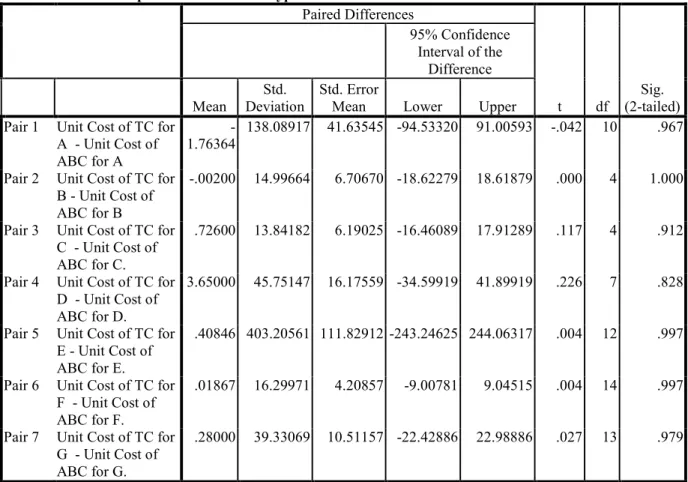
We found out from analysis and test of hypothesis one that unit costs are lower and cost reduction higher in the application of ABC than in the application of traditional costing. Hence P value = 0.967>0.05 and tcal=-0.042, tcritical = 1.8125 for company A, Pvalue = 1.00>0.05 and tcal = 0.000 and tcritical = 2.1318 for company B, Pvalue = 0.912> 0.05, tcal. 0.117 and tcritical 2.1318 for company C, Pvalue = 0.828>0.05, tcal = 0.226 and tcritical = 1.8946 for company D, Pvalue = 0.997 >0.05, tcal = 0.04 and tcritical = 1.7823 for company E, Pvalue
= 0.997 > 0.05, tcal. = 0.004 and tcritical = 1.7613 for company F, Pvalue = 0.979>0.05, tcal = 0.027 and tcritical = 1.7709 for company G. Table A below shows results of the computations.
Table A: Paired Samples Test Result for Hypothesis One Paired Differences t df Sig. (2-tailed) 95% Confidence Interval of the Difference Mean Std. Deviation Std. Error
Mean Lower Upper Pair 1 Unit Cost of TC for
A - Unit Cost of ABC for A
-1.76364
138.08917 41.63545 -94.53320 91.00593 -.042 10 .967
Pair 2 Unit Cost of TC for B - Unit Cost of ABC for B
-.00200 14.99664 6.70670 -18.62279 18.61879 .000 4 1.000
Pair 3 Unit Cost of TC for C - Unit Cost of ABC for C.
.72600 13.84182 6.19025 -16.46089 17.91289 .117 4 .912
Pair 4 Unit Cost of TC for D - Unit Cost of ABC for D.
3.65000 45.75147 16.17559 -34.59919 41.89919 .226 7 .828
Pair 5 Unit Cost of TC for E - Unit Cost of ABC for E.
.40846 403.20561 111.82912 -243.24625 244.06317 .004 12 .997
Pair 6 Unit Cost of TC for F - Unit Cost of ABC for F.
.01867 16.29971 4.20857 -9.00781 9.04515 .004 14 .997
Pair 7 Unit Cost of TC for G - Unit Cost of ABC for G.
.28000 39.33069 10.51157 -22.42886 22.98886 .027 13 .979
Source: Field Survey 2013 (computations).
The above data has helped us to accept the null hypothesis that there is no significant difference in costs incurred in application of ABC and that incurred in application of Traditional costing system. But what is uppermost in the mind of the cost engineer is that any little difference in cost reduction goes a long way in influencing the decisions of the management; not necessarily the level of statistical difference.
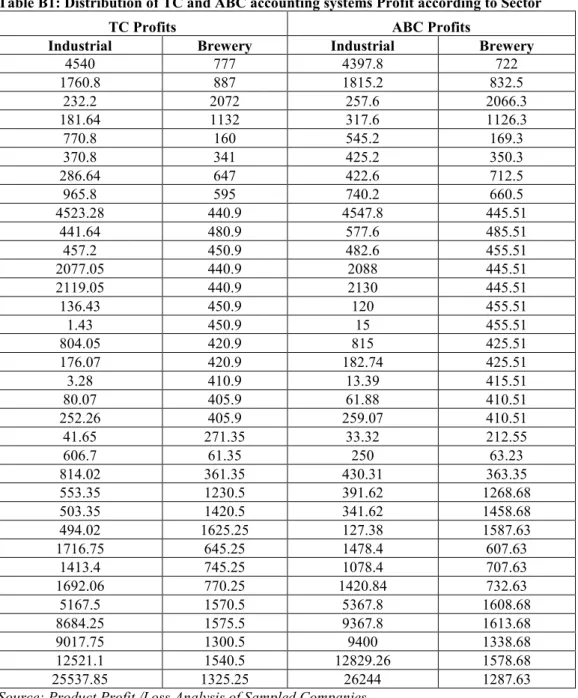
In the analysis and test of hypothesis two, we found that application of ABC has greater effects in profit realized in both industrial and brewery sectors more than Traditional costing. Hence, the tests revealed Lambda = 0.881 and F(2, 65) = 4.396, (P< 0.05), also Tc (f(1,66) = 4.571, P(0.036<0.05). Most of the companies surveyed do not use ABC in their costing systems. Tables B1 – B3 depict the results of the calculations above.
Table B1:Distribution of TC and ABC accounting systems Profit according to Sector
TC Profits ABC Profits
Industrial Brewery Industrial Brewery
4540 777 4397.8 722 1760.8 887 1815.2 832.5 232.2 2072 257.6 2066.3 181.64 1132 317.6 1126.3 770.8 160 545.2 169.3 370.8 341 425.2 350.3 286.64 647 422.6 712.5 965.8 595 740.2 660.5 4523.28 440.9 4547.8 445.51 441.64 480.9 577.6 485.51 457.2 450.9 482.6 455.51 2077.05 440.9 2088 445.51 2119.05 440.9 2130 445.51 136.43 450.9 120 455.51 1.43 450.9 15 455.51 804.05 420.9 815 425.51 176.07 420.9 182.74 425.51 3.28 410.9 13.39 415.51 80.07 405.9 61.88 410.51 252.26 405.9 259.07 410.51 41.65 271.35 33.32 212.55 606.7 61.35 250 63.23 814.02 361.35 430.31 363.35 553.35 1230.5 391.62 1268.68 503.35 1420.5 341.62 1458.68 494.02 1625.25 127.38 1587.63 1716.75 645.25 1478.4 607.63 1413.4 745.25 1078.4 707.63 1692.06 770.25 1420.84 732.63 5167.5 1570.5 5367.8 1608.68 8684.25 1575.5 9367.8 1613.68 9017.75 1300.5 9400 1338.68 12521.1 1540.5 12829.26 1578.68 25537.85 1325.25 26244 1287.63
Source: Product Profit /Loss Analysis of Sampled Companies.
Table B2: Multivariate Testsb
Effect Value F Hypothesis df Error df Sig.
Intercept Pillai's Trace .305 14.267a 2.000 65.000 .000
Wilks' Lambda .695 14.267a 2.000 65.000 .000
Hotelling's Trace .439 14.267a 2.000 65.000 .000 Roy's Largest Root .439 14.267a 2.000 65.000 .000
GROUP Pillai's Trace .119 4.396a 2.000 65.000 .016
Wilks' Lambda .881 4.396a 2.000 65.000 .016
Hotelling's Trace .135 4.396a 2.000 65.000 .016
Roy's Largest Root .135 4.396a 2.000 65.000 .016
a. Exact statistic
b. Design: Intercept + GROUP
Wilk’ Lambda is a test of mean differences, but as an inverse measure it is interpreted unlike other test statistics. That is, with wilk’s Lambda, the smaller the value the more likely it will lead to a rejection of the null hypothesis.
Since the overall Lambda for the group is clearly significant at 0.016, we can now examine the between –
subjects effects.
Table B3: Tests of Between-Subjects Effects
Source
Dependent Variable
Type III Sum of
Squares df Mean Square F Sig.
Corrected Model TCS 5.776E7 1 5.776E7 4.571 .036
ABC 5.768E7 1 5.768E7 4.254 .043
Intercept TCS 1.952E8 1 1.952E8 15.451 .000
ABC 1.956E8 1 1.956E8 14.422 .000
GROUP TCS 5.776E7 1 5.776E7 4.571 .036
ABC 5.768E7 1 5.768E7 4.254 .043
Error TCS 8.339E8 66 1.264E7
ABC 8.950E8 66 1.356E7
Total TCS 1.087E9 68
ABC 1.148E9 68
Corrected Total TCS 8.917E8 67
ABC 9.527E8 67
a. R Squared = .65 (Adjusted R Squared = .51)
b. R Squared = .61 (Adjusted R Squared = .46)
CONCLUSION
Product cost management through application of ABC and traditional costing is geared towards cost reduction. ABC and traditional costing are good strategic costing techniques because our results revealed that there were no significant differences in the cost reduction attained though ABC has a lower reduction cost. We noted that the difference in cost reduction of ABC over Traditional costing was statistically not significant but it has material impact on product portfolio decisions. Manufacturing sector profit realization of ABC was equally higher. The issue here is that in stiff competition, a little difference in cost and profit can influence management decisions greatly.
RECOMMENDATIONS
Based on the findings and discussions in this article, we recommend;
That manufacturing companies in developing countries should develop a good tone of management and core values that will promote the utilisation of ABC in their costing system.
Secondly, manufacturing Companies in the developing countries like Nigeria should avail themselves of specific software in the market which can facilitate application of ABC. Manufacturing companies in developing countries should effectively apply ABC for enhancement of their competitive advantage to earn larger market share in the international market. The study recommends also that initial high cost of implementation of ABC should not deter these companies from adoption of ABC since its long run benefits surpasses its costs.
REFERENCES
Anthony R. N. and Young, D. W (1996), Management Control in Non-profit Organisations, Homewood, I. L. Richard D. Irwin.
Atrill P and McLaney E (1997) Accounting and Finance for non-specialists. New Jersey, Prentice-Hall.
Bradford, M (2008), ‘The application of ABC in modern day Business Accounting,’UK Essays.com. Retrieved on 09/02/2013 from www.Google.com
Buchanam, J. M (1969), Cost and Choice: An inquiry on Economic theory,Chicago: Markham Pub. Company. Carlton, D. W and J.M. Perloff (1990), Modern Industrial organization, Glenview IL, Scott, Foresman-little Brown Higher Education.
Demski, J. and Feltham, G (1976), Cost Determination, Ames: Iowa State University Press. Drury, C (2001), Management and cost accounting; London: Thomson Learning.
Drury, C (2012), Management and cost accounting; London: Book power (ELST).
Emengini, S. E (2012), ‘Efficacy of Cost Based Decisions in Capacity Cost Planning by Manufacturing Companies in Nigeria,’ Unpublished Ph. DThesis, in Department of Accountancy, Nnamdi Azikiwe University, Awka.
Innes, J and Mitchell, F (1990), Activity Based Costing: A Review with Case Studies, Chartered Institute of Management Accountants, London,
Innes, J and Mitchell, F. (1991), Activity Based Costing Management: A Case Study of Development and Implementation; Chartered Institute of Management Accountants, London.
Innes, J and Mitchell, F (1991a), ‘ABC: a survey of CIMA members’, Management Accounting, pp.28-30 Kaplan, R. S and Burns W,(1987), Accounting and management: A field study Perspective; Washington, D.C, Harvard business school press.
Kaplan, R. S and Burns W,(1987), Accounting and management: A field study Perspective; Washington, D.C, Harvard business school press.
Keller, J. T (2002), ‘Cost Information and Government Decision making: A guide to using cost information to improve the quality of decision making in government’, Retrieved, January 21, 2010 from
http://www.yahoo.com.
Lere, J. C (2002), ‘Selling Activity – Based Costing’ CPA Journal,March,
http://www.nysscpa.org/cpajourna/2002/0302/dept/d035402.htm. Retrieved, 21st Jan. 2010 from http://www.yahoo.com
Maelah, R and Ibrahim, D (2006), ‘ Activity-Based costing (ABC): Adoption among Manufacturing Orginisations – The Case of Malaysia,’ International Journal of Business and Society 7(1), 70-101
Ratliff-miller, S. C, Meyer .S and Mchamon G. (2006), ‘Activity- Based costing,’ Accounting for planning and control: Retrieved on September 15, 2009, from http://www.yahoo.com
Roztocki, N. Porter, D. Thomas, R. Needy, K. (2004), ‘A Procedure for Smooth Implementation of Activity – Based Costing in small Companies,’ Engineering Management Journal; 16(4). Dec.
Salawu, R. O and Ayoola, T. J (2012), ‘Activity Based Costing Adoption AmongManufacturing Companies in Nigeria,’ Journal of Modern Accounting andAuditing, 8(1) 40
Sohal, A. S and Chung, W. C (1998), ‘Activity based costing in Manufacturing:Two case studies on Implementation,’ Journal of Integrated ManufacturingSystem, 9(3), 137-147
Schmidt, M (2013), Business Case Essentials, 4th ed. Retrieved on August 20, from www.yahoo.com
Thompson, F (1997), ‘Capital Budgeting’ In International Encyclopedia of public policy and administration,
Boulder Co: West view Press.