The Rolling Bearing Fault Feature Extraction Method Under
Variable Conditions Based on Hilbert-Huang Transform and
Singular Value Decomposition
Hongmei Liu, Xuan Wang and Chen Lu
THE ROLLING BEARING FAULT FEATURE EXTRACTION METHOD UNDER VARIABLE CONDITIONS BASED ON HILBERT-HUANG TRANSFORM AND SINGULAR VALUE DECOMPOSITION.HONGMEI LIU,XUAN WANG AND CHEN LU
Hongmei Liu1, Xuan Wang2 and Chen Lu3
1, 2, 3 School of Reliability and Systems Engineering, Beihang University, Beijing, 100191, China 3 Science & Technology on Reliability & Environmental Engineering Laboratory, Beijing, 100191, China
E-mail: [email protected]
Abstract.The fault diagnosis precision for rolling bearings under variable conditions has always been
unsatisfactory. For solving this problem, a feature extraction method combing the Hilbert-Huang transform with singular value decomposition was proposed in this paper. The method includes three steps. Firstly, instantaneous amplitude matrices were obtained by Hilbert-Huang transform from rolling bearing signals. Secondly, as the fault feature vector, the singular value vector was acquired by applying singular value decomposition to the instantaneous amplitude matrices. Thirdly, the identification and classification of rolling bearing were achieved by Elman neural network classifier. The experiment shows that this method can effectively classify the rolling bearing fault modes with high precision under different operating conditions.
1.Introduction
In the modern rapid developing industry, as the vital component of most mechanisms, the rolling bearing is confronted with an increasing complex working environment. In the recent research, the rolling bearing fault diagnosis under variable working conditions is less effective. So it is of great significance to seek a rolling bearing diagnostic method applicable to different working conditions.
As many conventional methods are unsatisfactory for diagnosis under variable conditions, researchers have been paying more attention to relevant studies. Yumin SHAO presented a fault diagnosis system based on a smart bearing including several sensing devices in order to track the time-varying parameter [1]. Qingbo He addressed manifold learning on generated time-frequency distributions for machine fault signature analysis [2]. In all, all these works play a pivotal role in fault diagnosis under variable conditions. Whereas, some of these works still perform unsatisfactorily in certifying the robustness, and the others sacrifice low-costing with adding additional sensing devices. Thus, a method combining Hilbert-Huang transform (HHT) with singular value decomposition (SVD) is proposed in this paper. Under variable conditions, the fault characteristic frequency of the rolling bearing will change with time, which makes it necessary to take time-frequency analysis. Compared with other time-frequency methods, HHT has a distinct advantage in handling non-stationary and nonlinear data. Nevertheless the result obtained from HHT is always too enormous to apply to variable working conditions. In addition, it is complicated to extract the corresponding amplitude at the time-varying characteristic frequency. In view of this situation, the singular value decomposition could be used for compensation. The SVD greatly compresses the scale of the fault feature vector in the foundation of expressing the original characteristic. Moreover, the singular value has great stability, and it changes little when the matrix elements change, which makes it possible to enhance robustness of the fault diagnosis method under variable conditions.
3
2.The feature extraction method based on HHT and SVD
2.1.The time-frequency signal decomposition based on Hilbert-Huang transform
Hilbert-Huang transform, combining the Empirical Mode Decomposition (EMD) with the Hilbert transform, could be applied to acquire the instantaneous amplitude and instantaneous frequency. After the implementation of EMD, the original signal x t
( )
could be decomposed as follows:( )
( )
1 ( ) n i n i x t c t r t = =∑
+ (1)where ci( )t is the ith IMF component, and ( ) n
r t is the residue. The IMF component
(
1, ,)
ic i= ⋯ n
represents the signal from high frequency to low frequency in different bands. Then, setting IMF equal to c t( ), the analytic signal h t( ) of c t( ) is as follows:
( )
( )
( )( ) ( ) j t
h t c t jc t a t eϕ
= + ɶ = (2)
where cɶ
( )
t is the outcome function after applying Hilbert transform toc t
( )
:( )
1 c t( ) c t d t τ π τ +∞ −∞ = −∫
ɶ( )
a t is the amplitude function and also the envelope signal of the IMF component
c t
( )
:( )
2( )
2( )a t = c t +cɶ t (3)
( )
tϕ is the phase function
( )
t tan ( ( ) / ( ))1 c t c tϕ −
= ɶ (4)
Calculate the derivation of the phase function to obtain the instantaneous frequency:
( )
t d( )
tdt ϕ
ω = (5)
Accordingly, the original signal x t
( )
could be expressed by a time-dependent function containing the instantaneous amplitude and the instantaneous frequency; thus, it is possible to handle the rolling bearing fault diagnosis under time-varying conditions by applying HHT:(
)
1 , Re ( ) exp( ( ) ) n i i i H w t a t j w t dt = =∑
∫
(6)The IMF’s instantaneous amplitude is its envelope signal, which is similar to the periodic signal [3].The envelope signal is beneficial for identifying fault even weak ones. Thus, calculate the amplitude of each analytic signal h t
( )
to get a t( )
, which is the envelope curve of the IMF forfurther analysis. Even so, it is extremely complicated to detect time-varying parameters that representing variable working conditions, to calculate the corresponding fault characteristic frequency and to extract the corresponding amplitude. In this regard, it is hard to achieve rolling bearing fault identification under variable operating conditions. To this end, this paper further proposed SVD in combination with HHT to achieve the rolling bearing fault feature extraction.
2.2.Singular value decomposition based on Hilbert-Huang transform
The singular value has great stability, and it changes little when the matrix elements change [4]. This paper uses the singular value decomposition to obtain the intrinsic characteristic of the feature matrix obtained from HHT. Singular values are able to express the feature of original matrix in the form of several values, which is conductive to compress the scale of the feature vector.
Singular value decomposition is defined as: Suppose M is a m×n matrix. Any matrix M∈Rm n* can
be factored into singular value decomposition [5]:
*
M =U
∑
V (7)where U Rm m*
∈ and V∈Rn n* are orthogonal matrices and
∑
∈Rm n* is diagonal matrix with( )
r=rank M principal positive diagonal entries. The p diagonal entries of
∑
are usually denoted byi
σ for i=1,⋯,p, where p=min m n{ , } and
i
σ are called the singular values of M. The singular
values are the square roots of the nonzero eigenvalues of both MMT and M MT . List the singular values in descending order as commonly suggested.
3.Fault identification and classification
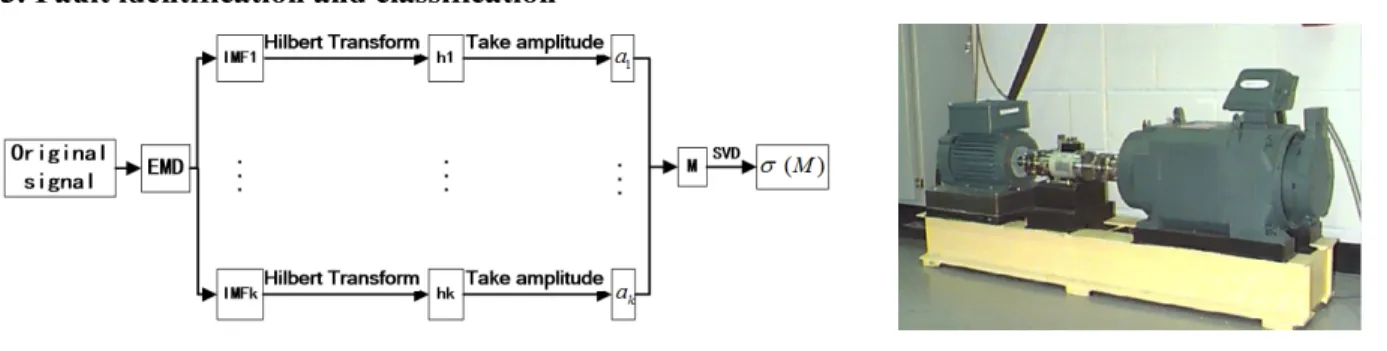
Figure 1. Flowchart of obtaining the feature vector. Figure 2. The test bed. As shown in Figure 1, the original vibration signal is decomposed by EMD, and IMFs are obtained. The prior k IMFs are then extracted for analysis because the first few IMFs have the highest frequency. Then the analytic signal hi is obtained by applying the hilbert transform to each IMF.
Subsequently, the envelope signal ai is obtained after calculating the amplitude of each i h . The
feature matrix M is constructed by a ii
(
=1,⋯,k)
. After applying the SVD to M, the singular valuevector and also the fault feature vector σ
( )
M of the feature matrix M could be obtained:1 2
(M) [ M, M, , Mk ]
σ = σ σ ⋯σ (8)
Then, the status will be identified and classified by utilizing Elman neural networks. 4.Experimental result and discussion
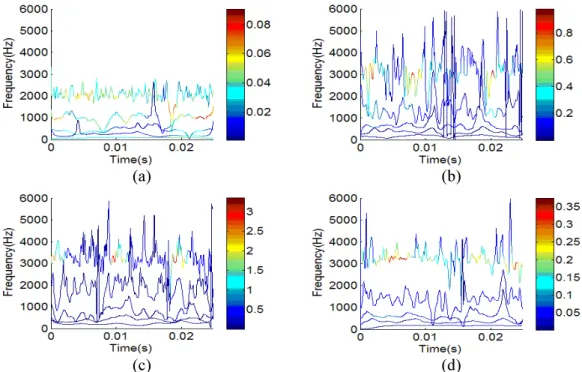
In order to validate the effectiveness of proposed fault diagnosis method, the 6205-2RS deep groove ball bearing is used in the experiment. The test bed of rolling bearing is shown in Figure 2. The vibration data is sampled under different fault modes and operating conditions. The hilbert spectrums of different states are illustrated in Figure 3. The hilbert spectrum of normal signal in Figure 3(a) depicts that the energy distribution is uniform and the peak presents in the frequency band around 1000Hz. Its maximum amplitude is about 0.08. The hilbert spectrum in Figure 3(b) indicates that the dominant energy distributes in the frequency band around 3000Hz and the time-frequency distribution
is complicated in the inner-race fault mode. Its maximum amplitude is about 0.9. For outer-race fault mode, the hilbert spectrum in Figure 3(c) shows that the dominant energy distribution is similar to that of inner-race fault mode. Nevertheless, the maximum amplitude is about 3, which indicates the vibration energy is relatively high. The hilbert spectrum of rolling element fault illustrates that energy rarely distributes in the frequency band from 2000-3000Hz. Besides, the vibration energy is low and its maximum amplitude is only about 0.35. It could be seen that the time-frequency distribution differs under different states. Therefore, the feature matrix could be constructed for fault identification.
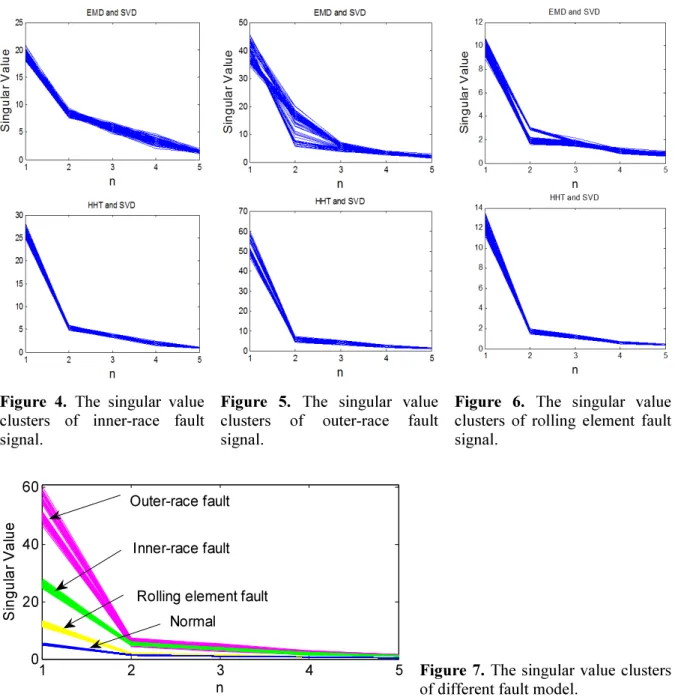
After obtaining instantaneous amplitude matrix, the singular value vector could be acquired by conducting SVD. Under each fault mode, we collected data under four operating conditions corresponding to motor speed of 1730, 1750, 1772, 1797r/min. 25 sets of data are sampled under each operating condition in each fault mode, and 400 sets are obtained in total. In the figure, the singular value vector of each sample is presented as a line. All the singular value lines are presented in the same graph to be observed effectively. The singular value clusters of inner-race fault signal, outer-race fault signal and rolling element fault signal are shown in Figure 4, Figure 5 and Figure 6 respectively. The singular values clusters obtained by EMD and SVD [6, 7] are also illustrated simultaneously for comparison. As these three diagrams depict, the feature extraction method in combination with the HHT and SVD has the prominent advantage over the one with the combination of EMD and SVD. Even under different working conditions, the singular value vector of the same failure mode still remain a high degree of coincidence. The singular value clusters corresponding to the three fault modes mentioned above and the normal state are placed in Figure 7 to observe fault mode separability. The gaps between the four regions used to indicate four fault modes are huge. In other words, it is feasible to use the singular value as the input of the neural network classifier, because the singular value vector of different fault modes retains well separability. To further verify the effectiveness of the proposed method, the Elman neural network is applied for the fault pattern classification, and the precision will be analyzed.
(a) (b)
(c) (d)
Figure 3. Hilbert spectrum of (a) normal (b) inner-race fault (c) outer-race fault (d) rolling element fault.
Figure 4. The singular value clusters of inner-race fault signal.
Figure 5. The singular value clusters of outer-race fault signal.
Figure 6. The singular value clusters of rolling element fault signal. 1 2 3 4 5 0 20 40 60 n S in g u la r V a lu e Outer-race fault Inner-race fault
Rolling element fault Normal
Figure 7. The singular value clusters of different fault model.
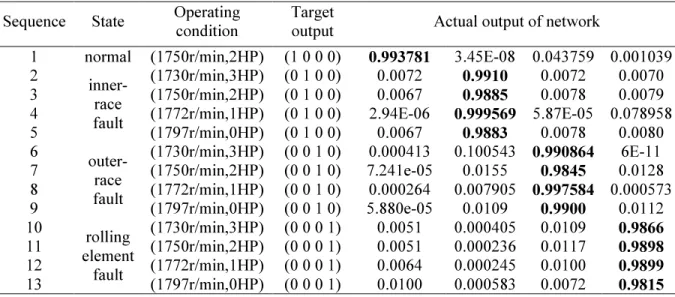
To extract fault feature, singular value feature vector are obtained by the proposed HHT-SVD method, then fault are classified by Elman neural network. The input of Elman neural network is the singular value feature, and the output is set as (1 0 0 0), (0 1 0 0), (0 0 1 0), (0 0 0 1), representing the normal, the inner-race fault, the outer-race fault and the rolling element fault in sequence. The data were divided into a training dataset comprising 25 cases (the neural network training set is not listed here, due to the space limitation) and a testing dataset compromising 375 cases. The partial results of the network neural recognition are listed in Table 1.
Under variable conditions, the actual output of neural network extremely agrees with the target output. In addition, it is not necessary to change parameters while operating conditions varying to a certain point because of the respective merits of the HHT and SVD. Consequently, the proposed method combined with HHT-SVD and neural network can effectively realize the fault diagnosis of rolling bearing under variable working conditions.
Table 1. The neural network recognition results. Sequence State Operating
condition
Target
output Actual output of network
1 normal (1750r/min,2HP) (1 0 0 0) 0.993781 3.45E-08 0.043759 0.001039 2 inner-race fault (1730r/min,3HP) (0 1 0 0) 0.0072 0.9910 0.0072 0.0070 3 (1750r/min,2HP) (0 1 0 0) 0.0067 0.9885 0.0078 0.0079
4 (1772r/min,1HP) (0 1 0 0) 2.94E-06 0.999569 5.87E-05 0.078958
5 (1797r/min,0HP) (0 1 0 0) 0.0067 0.9883 0.0078 0.0080 6 outer-race fault (1730r/min,3HP) (0 0 1 0) 0.000413 0.100543 0.990864 6E-11 7 (1750r/min,2HP) (0 0 1 0) 7.241e-05 0.0155 0.9845 0.0128 8 (1772r/min,1HP) (0 0 1 0) 0.000264 0.007905 0.997584 0.000573 9 (1797r/min,0HP) (0 0 1 0) 5.880e-05 0.0109 0.9900 0.0112 10 rolling element fault (1730r/min,3HP) (0 0 0 1) 0.0051 0.000405 0.0109 0.9866 11 (1750r/min,2HP) (0 0 0 1) 0.0051 0.000236 0.0117 0.9898 12 (1772r/min,1HP) (0 0 0 1) 0.0064 0.000245 0.0100 0.9899 13 (1797r/min,0HP) (0 0 0 1) 0.0100 0.000583 0.0072 0.9815 5.Conclusion
This paper has presented a new feature extraction method with the combination of the HHT and SVD. Firstly, the IMFs were obtained by the EMD. Secondly, the instantaneous amplitude matrix was calculated by applying Hilbert transform to each IMF and then was decomposed by SVD. The experimental results demonstrated the effectiveness of the singular value for different operating conditions, which achieves rolling bearing fault diagnosis under time-varying conditions.
Taking the existing EMD-SVD as a comparison in this paper, the HHT-SVD method proposed in this paper demonstrates its robustness. Finally, the effectiveness is further verified by using the Elman neural network to classify. Based on the discussion above, the superiority of the proposed method in handling the fault detection under the time-varying condition can be verified. Without the need for human intervention and additional cost, this method is an excellent and worth advocating automatic method for fault diagnosis under variable conditions.
Acknowledgment
This research is supported by the National Natural Science Foundation of China (Grant No. 51105019, 61074083, 50705005), as well as the Technology Foundation Program of National Defense (Grant No. Z132010B004).
6.Reference
[1] lotta B, Papi R, Pugi L, Toni P and Violi AG 2001 Proc. Int. Conf. on Advanced Intelligent
Mechatronics (Como/IEEE) 1 237–42
[2] Shao Y, Ge L and Fang J 2008 Proc. Int. Conf. on Automation and Systems (Seoul/IEEE) 1084– 9
[3] He Q, Liu Y, Long Q, et al. 2012 J.IEEE Trans Instrum Meas 61 1218–30
[4] Weidong X, Yibing L, Ying H, et al 2012 World Conf. on Intellectual control and Automation
(Beijing/IEEE) 3173–6
[5] Renjun Z and Husheng W 2010 Proc. Int. Conf. on Computer Design and Applications(ICCDA)
(Qinghuangdao/IEEE) 4 528–32
[6] Martin C D and Porter M A 2012 J. Am Math Mon 119 838–51
[7] Zhu Z and Sun Y 2007 Proc. Int. Conf. on Power Engineering (Singapore/ IEEE) 1247–50 [8] Cheng J, Yu D, Tang J, et al 2009 J. Shock Vib 16 89–98