Dissertations Theses and Dissertations
2017
Technology Integration in Context
Technology Integration in Context
Joanna MarshallLoyola University Chicago
Follow this and additional works at: https://ecommons.luc.edu/luc_diss
Part of the Education Commons
Recommended Citation Recommended Citation
Marshall, Joanna, "Technology Integration in Context" (2017). Dissertations. 2826.
https://ecommons.luc.edu/luc_diss/2826
This Dissertation is brought to you for free and open access by the Theses and Dissertations at Loyola eCommons. It has been accepted for inclusion in Dissertations by an authorized administrator of Loyola eCommons. For more information, please contact [email protected].
LOYOLA UNIVERSITY OF CHICAGO
TECHNOLOGY INTEGRATION IN CONTEXT
A DISSERTATION SUBMITTED TO
THE FACULTY OF THE GRADUATE SCHOOL OF EDUCATION IN CANDIDACY FOR THE DEGREE OF
DOCTOR OF EDUCATION
PROGRAM IN CURRICULUM AND INSTRUCTION
BY
JOANNA MARSHALL
CHICAGO, ILLINOIS MAY 2017
iii
ACKNOWLEDGMENTS
I would like to thank my parents Sybil and Ed Marshall, who never censored anything I ever read. My parents provided me with the freedom growing up to explore any idea or any text without restraint. To my father who I went bookstoring with and opening up whole worlds to me simply by opening up a book. In contrast to my father, the vainest man in the world my mother always emphasized my intellect and expected nothing but excellence from me academically. They have supported all of my educational endeavors that I have embarked on since graduating high school. They helped me get to Boone N.C. while working on my masters degree at Appalachian State and my final degree at Loyola (yes RB this is my last degree program I promise!).
None of this would be possible without my husband, R.B. Green. Words cannot express the gratitude I feel for your love and support. I am grateful for your uncanny ability to just listen to me vent my frustrations while cooking me dinner. You acted as my social director who always made sure I got my work done before having fun. You took on the role of editor since App State. You constantly challenged my arguments and expected me to improve. You provided me with a soundtrack for work and came into my classroom to help my students make music about Chemistry. You accepted me along with all my chaos and all my shoes. Thank you for making me think, for making me laugh and encouraging me to go further.
I have to thank my Girls Gone Mild Crew, Audrey Raden, Beth Welch and Jude Baker who were there with a trip to King Spa, a poker game, a glass of wine or an ear to
iv forward to getting to spend more time with you all.
If it wasn’t for Orit Zentuni –Sade sending me a message on social media asking me if I wanted to create role playing games for my students, this dissertation would be a lot shorter. She encouraged me to take risks in my teaching while providing me tech support and access to web designers all the way from Tel Aviv, Israel. I was able to attempt new uses of technology in my classroom while reconnecting with a dear friend.
Thanks to Elaine Freidberg, editrix extraordinaire. Both RB and I owe you a debt of gratitude for reliving RB of editing duties and providing me with a fresh set of eyes and perspective. The amount of beer and pork products I own you cannot be measured.
This would not be possible without my fellow teachers who volunteered to let me into their classrooms and minds. Their willingness to share their technology integration stories with me and allow me to watch them in action was generous. I learned so much from them and was inspired by their commitment to their students and to myself.
Thanks to Dr. Dave Ensminger for helping me to discover that I had a qualitative researcher lurking inside me. He helped me to focus on my research questions and raised my analysis game. He encouraged me to go out on a limb and dig deeper into myself through self-study. He helped to remind me that its just a dissertation, its not Syria
DEDICATION For Rodger Bernard Green
vi ACKNOWLEDGMENTS……… iii LIST OF FIGURES………. ix GLOSSARY………. x ABSTRACT ………. xii CHAPTER I. INTRODUCTION………. 1 National Context……… 1
Effective Technology Integration ………. 3
Methods ………. 6
Research Questions ……….. 7
Design……… 7
II. LITERATURE REVIEW ……… 11
Effective Technology Integration Defined ………... 11
Lack of Technology Integration ……… 13
Factors That Impact Technology Integration ……… 14
Teacher Beliefs ………. 16
Teacher Knowledge ………. 17
School Context ………. 19
Self –Study ……… 24
Self –Study and Technology Integration ……….. 25
My Story ……… 26 Theoretical Framework……….. 28 III. METHODOLOGY………. 33 Research Questions ……… 33 District Biome……… 35 School Habitat ……….. 37 Participants ……… 38 Data Collection ………. 39 Data Analysis ……… 42 Validity ……….. 44 Limitations ……… 45
IV. CASE STUDY RESULTS ……… 47
Overview of Study……… 47
Research Questions ……….………... 47
Results ………. 49
vii State Biosphere ……… 49 District Biome ……… 51 Building Habitat ………..56 Case Studies..……….58 Jeff ………...59 Gary.……….67 Carrie………75 Ann………82
V. SELF STUDY RESULTS ……….. 88
Overview of Study ………. 88 Research Questions ……… 89 State Biosphere ………91 District Biome ……… 92 Building Habitat ………... 96 Classroom Niche ……… 99
Student Technological Knowledge...………102
TPCK………104
How does the process of studying technology integration practices of other teachers influence my own classroom decisions about technology integration? ...………107
Inter and Intraniche Interactions...………108
New TK ………110
Taking Risks.………110
Adapting to the ecosystem ………112
VI. DISCUSSION ………..117
Overview ………117
Key Findings ………..117
State Biosphere ..………118
District Biome………119
Access and Time………120
TETI...………121 Assessment ………122 Building Habitat ………...123 Classroom Niche...………128 Ability level ………129 TPCK ………130 Social Capital………..132
Expanding the Definition of Effective Technology Integration ……….133
The Ecological Metaphor ………..136
Limitations ……….139
Recommendations ……….140
Suggestion for Further Research ………142
viii A: RECRUITMENT LETTER ………144 B: OBSERVATION PROTCOL ………146 C: INTERVIEW PROTOCOL ………..150 D: CONSENT FORM ………152 REFERENCE LIST ……….155 VITA ………161
ix
LIST OF FIGURES
Figure Page
Figure 1. Case Study Diagram Jeff ………. 67
Figure 2. Case Study Diagram Gary ……… 75
Figure 3. Case Study Diagram Carrie ……….. 82
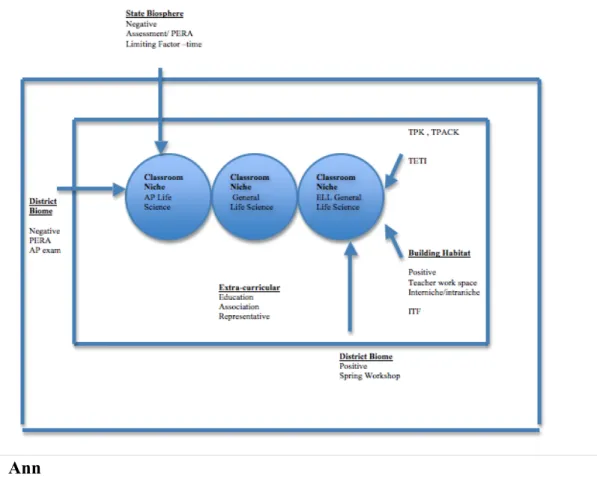
Figure 4. Case Study Diagram Ann ……… 87
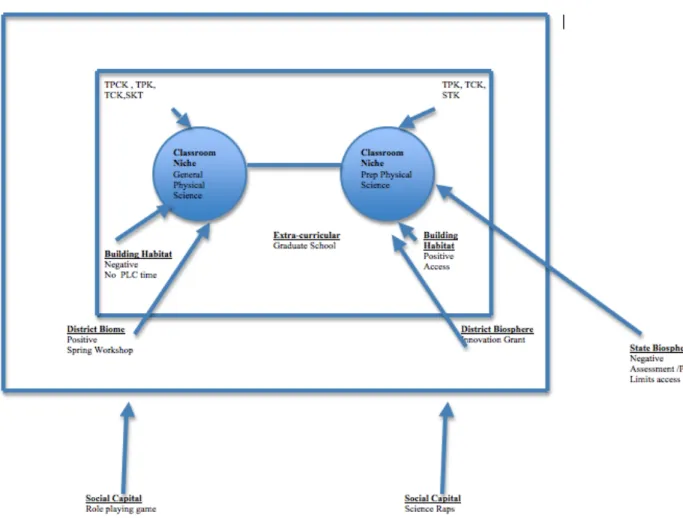
Figure 5. Self-Study Diagram ………..114
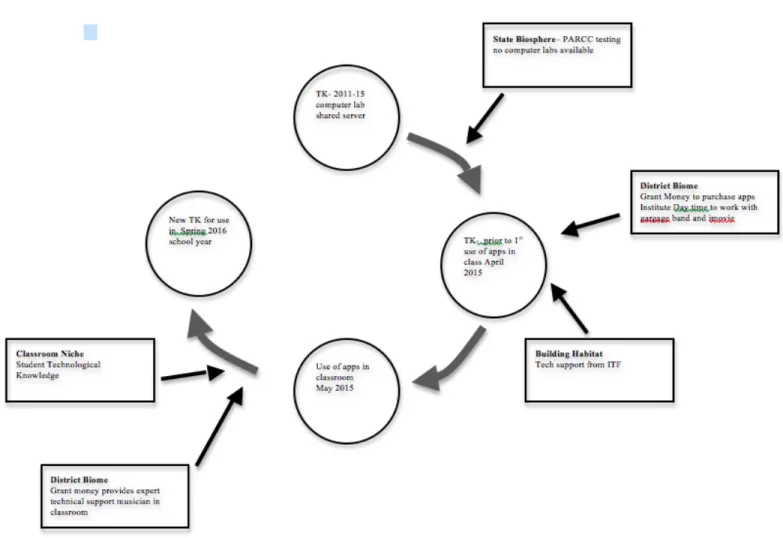
Figure 6. Lab Quest TK Feedback Loop ………115
x
Apple TV/ Air play – this device allows teachers to project their laptop or I-pad screens on to a screen in the classroom. Students also have the ability to project their screens from the I-pad to the classroom screen.
Casper Focus – allows teachers to “focus” students’ I-pad on a specific app, an I-pad classroom management tool
Comic Book- an app that allows for the creation of a comic book that provides layouts, caption and text tools. Users can import or draw their own pictures,
Hover cam- document camera and software that connects to the teacher laptop. Replaces the overhead projector in the classroom. Can take pictures and video.
Hudl technique – an app that allows for the recording of video and slow motion video analysis. Allows for slow motion or frame by frame playback
Kahoot – a free game based learning platform that allows the user to create, play or share learning games.
Noteability- a note taking app for I-pads that allows students to take notes, high light notes, include drawings and audio or video
Puffin – a web browser that allows websites containing Flash animations to run on apple mobile devices.
Safari – Internet browser
xi
Socrative – an app that allows teachers to create assessments that give students immediate feedback in real time
Schoology – A learning management system (LMS) that allows users to create their own pages and share content and resources.
Vernier Lab Quest – a sensor designed to collect data from probes that can create graphs and use wifi or Bluetooth connection to send data to another device wirelessly.
xii
This study employed an ecological framework to examine how multiple contextual variables from the state biosphere, district biome, school habitat and classroom niche impact how teachers decide to integrate technology. It was an opportunity to observe how a teacher’s Technological Pedagogical Content Knowledge operates in a classroom in response to the building, district and state contexts. It was conducted in multiple
classrooms in one school and with science teachers. It included a self-study component. It provided an opportunity to directly observe the interactions between students and teacher as distinct species in the classroom when technology integration occurred. This allowed me to determine how observing other teacher’s technology integration efforts impacted my own use in my classroom. I hope to provide an emic perspective on technology integration and broaden the definition of effective technology integration.
1 CHAPTER 1 INTRODUCTION
National Context
Incorporating technology into education is a priority at the national level. In 2010 the Obama Administration crafted a National Educational Technology Plan endorsing a revolution in education through technology and focuses on learning, assessment, teaching, infrastructure and productivity. This document addresses the 21st Century skills of critical thinking, problems solving, collaboration, and multimedia communications in all content areas. It stresses the value of how information
technologies can produce flexible classrooms and create opportunities for learning to occur unrestricted, anywhere at anytime. (U.S. Department of Education, 2010).
Schools across the country experiment with technology integration in an attempt to achieve the vision articulated in the national plan. States have attempted a variety of approaches to create more flexible classrooms by integrating technology through one to one technology deployments or through Bring Your Own Device (BYOD) policies. The state of Maine began the Maine Learning Technology Initiative (MLTI) started in 2002 by providing all middle school students and teachers with laptops. The program expanded to high schools in 2009. Currently in Maine there is 100% one to one implementation in middle schools and in 55% of high schools. (http://maine.gov/mlti/about/index.shtml). Maine is not alone in this endeavor. The Fairfax County Public Schools in Virginia
created a Making Learning Mobile Project in middle schools and created a one to one tablet program. Some school districts have Bring Your Own Device or BYOD policies. The Katy Independent School District in East Texas implemented a BYOD policy in 2011-2012 school year that allowed students and teachers to bring any wireless mobile digital device into the schools for classroom use. From 2011 to 2012 districts using a BYOD program increased by 47 % (Project Tomorrow, Speak up 2012).
Concurrent with the focus of the Obama Administration on technology integration, is the focus on assessment and responding to problems with NCLB. The Obama Administration signed the Every Student Succeeds Act or ESSA in December of 2015 as a reauthorization of the Elementary and Secondary Education Act (ESEA). This new law replaced the NCLB act from 2002. The goal of ESSA was to return control to the states and to reduce the emphasis on assessment but maintains state-wide assessments to show progress and performance of students.
The Act is described as a move toward assessments that are aligned to college and career ready standards along with critical thinking, problem solving and writing. The act is a response to the one fits all approach of NCLB to schools that were not improving test scores. It requires statewide assessments from 3rd to 8th grade and once in high school. It allows for multiple measures of student learning and progress. (U.S. Department of Education, 2015).
As the current administration emphasizes technology integration and annual statewide assessments, the Common Core Standards began to appear. These Common Core standards were developed through state led efforts starting in 2009. This movement started at the state level and was promoted by state governors who were members of the
3 National Governors Association Center for Best Practices and the Council of Chief State School Officers. It was an attempt to standardize the variety of state standards across the country. They include college and career ready standards and the K-12 standards. By 2015, 42 states had adopted the Common Core State Standards (CCSS) in English / language arts / literacy and math. The state of Illinois adopted the CCSS in 2010. The state of Illinois began to administer online PARCC testing of the English/language arts a/literacy and math in the 2014-15 school year. (Common Core State Standards Initiative, 2016).
ESEA and CCSS along with the PARCC testing create a national context in which assessment is prioritized with states having the freedom to select the assessment and other measures of student progress. Both the National Educational Technology Plan and ESEA include assessment with technology. Technology integration in classrooms across the country occurs within a national context that continues to emphasize assessment. In some cases technology is being harnessed to administer assessments.
Effective Technology Integration
As information communication technology become common tools in classrooms, the concern for their use in education shifts from availability to the question of how to effectively integrate these tools into instruction and learning. Researchers and
organizations rather than those responsible for the integration more typically define the prevailing definition of effective technology integration. Ertmer and Ottenbriet-Leftwich (2010) define effective use as students using computers as a tool to allow them to engage in authentic learning. Kelly (2008) describes good teaching with technology as being used for problem solving, application and analysis not when it is used for having students
practicing basic skills. The Partnership for 21st Century Skills is an organization that promotes the ways in which students should be using technology for communication, collaboration and applying critical thinking to problem solving ( www.p21.org/about-us/our-mission). The International Society for Technology in Education (ITSE) has also produced National Educational Technology Standards (NETS) for both students and teachers. These standards emphasize inquiry based, collaborative, student-centered uses of technologies. Additionally the standards focus on students as knowledge creators, empowered learners, and digital citizens
(www.iste.org/docs/pdfs/20-14_ISTE_Standards-S_PDF.pdf). Hamilton (2007) defines technology integration as when a teacher uses technology to introduce, reinforce, extend, enrich, assess and remediate student learning of curriculum. Researchers and organizations have identified key elements that comprise the construct of effective technology integration. Teachers do not participate in the process of defining effective technology integration. Their voices remain sidelined from this conversation about what constitutes effective technology integration. The role of teacher is that of a faithful implementer of effective technology integration as defined by others. In order for the effective technology integration to occur, teacher voice needs to be brought to the table.
It is important to understand how teachers decide to integrate technology in their classrooms while the national context prioritizes assessment. The goals of effective technology integration seem at odds with standardized testing. How does the externally defined definition of technology integration respond to the assessment context in a classroom? What does effective technology integration look like in practice?
5 It is necessary to understand the broader forces outside the school walls that may impact how teachers make pedagogical decisions about technology integration within their classroom. There needs to be a more through examination of the interplay of school, district and state level contexts on how teachers decide to integrate technology in their classrooms.
Zhao and Frank (2003) propose an ecological metaphor as a way to analyze how technology is used in schools. This framework describes a school as an ecosystem where both computers and teachers are different species while external educational innovations are an invasion of an exotic species. In this framework technology is the invading species and the successful integration depends on how well the technology is compatible with the teaching environment. It describes government institutions as geological forces that shape the landscape of schools and affect technology integration. This model addresses the broader national, state, district, school and classroom contexts.
Applying this model to science teachers engaged in technology integration could provide a more comprehensive understanding of how context impacts teacher use of technology as it includes students and broader contextual components. Hew and Brush (2007) advocate for this type of technology integration study and state, “ few studies included other potentially important variables at the school or district level that may be affecting the integration of technology by teachers” (p247). Hew and Brush call for studies that examine technology use in classrooms not just self reported teacher surveys. They call for research that examines “ the broader contexts such as decision makers outside the school” (p. 247). Ertmer, Gopalakrishnan and Ross (2001) found in their case study of 17 exemplary technology using teachers that exemplary practice is dependent on
many variables that includes the grade level at which teachers are working at and the institutional constraints teachers experience. It is important to determine how a variety of variables impact technology integration.
This study addressed these issues by looking at a district that has mandated goals of increasing standardized test scores, increasing AP enrollment, increasing passing AP scores and decreasing the number of students receiving grades of D’s or F’s. These goals are required by the six high schools that comprise the district and have to be incorporated by teachers when they create their goals as part of their evaluation process. Over the past five years there has been an increase in the number of pilot programs of 1 to 1 iPad use in classrooms throughout the district. For the 2015/2016 school year all students in this district had an iPad. This study provided a unique opportunity to examine how these district initiatives in concert with the state context and current standardized assessment context impacted the decisions science teachers made about technology integration in their classrooms.
Methods
The purpose of this study was to provide an understanding of how the state, district and building contextual factors impacted science teachers’ decision-making process about technology integration. It sought to produce a rich thick description of technology integration as it happens in a variety of classroom contexts. It provided me with an opportunity to examine my own process of technology integration with my special education and ELL students. It sought to give voice to teachers and provide them with an opportunity to define effective technology integration for their specific context.
7 The emic perspective of teachers engaged in the process of technology integration was the focus.
Research Questions
1. How do teachers navigate a variety of contexts when making decisions about how to integrate technology in their instructional practices?
A) How are teachers integrating technology in their classrooms? B) How do the state, district, school, and classroom contexts impact teacher decisions about technology integration?
C) How does a teacher’s knowledge (TPCK) inform and shape their technology practices and decisions?
1. How do I navigate a variety of contexts when making decision about how to integrate technology in my instructional practice?
A) How do I integrate technology in my classroom?
B) How do the state, district, school, and classroom contexts impact my decisions about technology integration?
C) How does my knowledge (TPCK) inform and shape my technology practices and decisions?
2. How does the process of studying technology integration practices of other teachers influence my own classroom decisions about technology integration?
Design
The study was a multi-case study of four science teachers who were in the process of integrating technology with a self-study component as I explored my own use of technology and how it was impacted by conducting this study. Case study was an
appropriate approach to the topic of technology integration in science classrooms and has been used in previous studies on this topic. According to Yin (2014), “case study research arises out of a desire to understand complex social phenomena (p.4). Since this study attempted to understand the interaction among state policies, district level initiatives, building level decisions and classroom context, case study provided a method of
understanding this process. One purpose of self-study is to improve classroom practice, (Allendar, 2005), as it positions the teacher as knowledge creator. (Clarke and Erickson, 2004). The self-study component presented me with an opportunity to investigate my own use of technology in my classroom. It allowed me to determine how observations of other teachers’ use of technology modified and improved my own practice.
The participants were in a Suburban middle class school district that could be described as technologically rich. Teachers have access to computer labs, computer lap top carts and the district provides iPads to students and teachers. Teachers all have a district issued personal lap top. There is an internal university run by the district that provides classes for teachers to integrate iPads into their classrooms. Currently two courses are offered, Teaching with iPads 1 and Teaching with iPads 2, both taught by teachers in the district.
Teachers were observed using technology with their students and interviewed about how they decided to use the technology. Concurrent with the observation and interview process, I kept a research journal about my own technology integration practices with my own students. This study allowed me to understand how observations of my peers impacted my own choices in technology integration. Documents were collected from the Illinois State board of Education, the district website and emails.
9 These data sources of observation in classrooms, interviews, document analysis and a research journal allowed for triangulation. The data was open coded by with each teacher as a case, then subjected to cross case analysis for emerging themes between and across cases.
In this study my role was that of a participant observer since I observed other teachers and investigated my own process of technology integration with my students. Yin (2014) describes an advantage of research as participant observer as providing “ the ability to perceive reality from the viewpoint of someone “inside” a case” (p117). Another advantage is that as participant observer and as a colleague of the teachers participating there is a level of trust and teachers may feel more willing to confide in me since we are “ in the trenches” together. However this could also be a potential source of bias as well since it meant I was wary of teachers wanting to vent their frustrations about barriers to technology integration. An additional potential downside to this position is that “ the participant observer may not have sufficient time to take notes or to raise questions about events from different perspectives as a good observer might”(p.117).
I have a positive approach to technology. All of my students have their own iPads. I have already begun to incorporate iPad apps, on line simulations, and use the website Schoology to deliver content to my students. I also have access to laptop carts, computer labs and have done collaborative projects with my students using I-movie and garage-band. I am interested in incorporating technology into my classroom that allows me to do things that I could not do otherwise. I have taught a course on evaluating Internet sources to teachers as part of my districts’ internal university. The ISTE standards for students have been useful in my approach to the twenty-first century skills both with students and
with teachers. I worked with a web designer to create an online, forensic, role-playing game for my general students. I have my prep level students use an app to create comic book characters based on their research of a specific element and produce raps about chemistry content we have covered over the school year. I also understand that teachers may be contextually constrained in their use of iPads by the structure of the school day (Cuban, 2001). Keeping a research journal helped me to remain reflexive about my role both as researcher and practitioner.
Technology integration is happening currently in schools across the country and this study contributes to furthering an understanding of how teachers navigate this activity. This study is significant because it provides an in depth examination of how science teachers used the technology with specific student populations. This study broadens the focus to understand how multiple contextual factors influence how teachers use technology. Authentic teacher voice and an emic perspective can contribute to moving toward a broader definition of technology integration that is situated in practice. It provided multiple teacher perspectives on technology integration as it happened. As classroom technology becomes ubiquitous it is vital to provide the research community with insight into how teachers navigate the complex process of technology integration. An emic perspective makes space for teachers to create their own definition of effective technology integration that is a function of their multiple contextual realities.
11 CHAPTER 2 LITERATURE REVIEW
Effective technology integration as defined by academics, educational researchers and organizations is not occurring in schools. This complex process is mediated by several factors: the barriers faced by teachers, teacher beliefs, teacher knowledge and context. Teachers are positioned as problematic to effective technology integration. Researchers focus on changing teacher beliefs and increasing teacher knowledge to promote a vision of effective technology integration. There is a need for research that begins to investigate teacher technology use as it is embedded in a variety of contexts.
Effective Technology Integration Defined
Determining what constitutes effective technology integration is not a new endeavor and has plagued education since the 80’s. In this decade the issue was how microcomputers in the classroom could be used to promote learning as a student-centered, self-directed process as opposed to an emphasis on basic skills with drill and practice. Seymour Papert of MIT, advocated this use of microcomputers. He envisioned the microcomputer as an opportunity to help students with metacognition and created a programming language for children called LOGO. He took a broad approach to how computers could revolutionize both teaching and learning. To Papert (1980), a computer
is not just a tool for game playing or drill and practice, it is a device that a student could work with in a manner that allows the student to use metacognition to solve a problem pertinent to them. He viewed the computer as an “ object to think with”(p137). In hisw the computer is not simply a tool for teaching a child how to do math, it is a tool that the child can control and influence, both learn math and learn about their own learning.
Current definitions of effective technology integration are similar to Papert’s. Organizations like Partnership for 21st Century Skills (www.p21.org/our-work/p21-framwork) and ITSE (www.iste.org/students/iste-standards/standards-for-students)agree on a definition of technology integration as using technology to problem solve, analyze, communicate and collaborate. Both focus on using technology for the higher order thinking skills of analysis, synthesis and evaluation. Educational researchers also propose a similar definition of effective integration that focuses on problem based, authentic, student centered uses and a constructivist pedagogy. Ertmer and Leftwich (2013) define best practices as “ technology enabled learning which is seen as a student centered problem based learning in which technology is a tool that allows them to collaborate on authentic learning activities.”(p.180). They also define effective integration as use of “technology as a cognitive tool to facilitate authentic student learning” (p.176). Kelly (2008) suggests that teachers minimally use technology for basic skill practice and focus more on having students participate in “ multi-step projects that require searching the Internet, evaluating what is found and then applying it to the solution of a problem” (p43). This definition builds on the one presented by Papert with the added dimension of collaboration and the use of information communication technology or ICT. Effective
13 technology integration remains defined by academics, educational researchers and organizations, not teachers.
Lack of Technology Integration
Schools have failed to achieve technology integration as defined by educational researchers and organizations. Teachers use technology for record keeping,
communication and planning. They use technology in a teacher directed manner for basic skill practice. Constructivist, problem-based, student-centered uses of technology are not happening in the majority of classrooms nationwide. National survey data from the Pew Internet and American Life project of AP and National Writing Project (Pew Internet 2013) teachers found that of teachers surveyed, 97% of them have access to a projector connected to a laptop or other digital device, 96% had access to a computer lab, 71% had access to a laptop cart. 95% of teachers reported using this access for research and finding information on-line. This survey revealed that teachers primarily use technology to find information and plan for instruction (92%) and teacher-directed activities of online searches. The NEA national survey of teachers determined that most teachers use technology more for administrative tasks and less for instruction related tasks. When teachers did have students use technology, only 32% reported having students use technology to research or solve problems several times a week (NEA, 2008).
This trend continues as researchers focus on technology use in states and school districts across the country. In a study of Florida teachers, only 20% reported using computers as a problem-solving tool (Barron et al, 2003). When examining the practices of teachers who are described as “ tech-savvy” by their schools, Bauer and Kenton (2005) found that they did not integrate computer technology for both teaching and learning.
They found 80% of teachers reported using computers less than 50% of the time. The authors interpreted this as a lack of technology integration since these teachers were described as heavy tech-using teachers. O’Dwyer, Russel and Beber (2004) found that teachers used technology for preparation and were not having students use technology to produce a product.
All of these surveys and studies rely on teachers self-reporting the ways in which they use technology and may not be an accurate representation of actual use of
technology in classrooms. Overall, they reveal that teachers have increased access to technology but employ it to maintain teacher directed classroom practices and prepare for instruction.
Factors that Impact Technology Integration
A variety of factors impact technology integration in classrooms. These factors are barriers encountered by teachers, teacher beliefs, teacher knowledge, and school contextual factors. These factors work in combination to prevent effective integration, or to promote it. One focus of the research on technology in the classroom has been on the barriers teachers encounter when attempting to integrate technology into their
classrooms. These barriers have been described as first order barriers and second order barriers (Ertmer,1999). First-order barriers are external to teachers such as access, administrative support, tech support and time. These barriers are specific to school, district and state contexts. They are environmental factors that impact how teachers use technology. Another set of barriers is described as second-order barriers, which are intrinsic to teachers (Ertmer, 1999). Teacher beliefs about teaching and learning and the role of technology in the classroom are second order barriers.
15 Many studies examine how first order barriers of time, lack of technology support, lack of administrative support, lack of access and assessment prevent teachers from achieving effective technology integration. Hew and Brush (2007) identify the barriers of resources, institution, and subject culture. Bauer and Kenton (2005) examine technical issues and time as barriers. The barrier of time is a common issue in studies both in terms of the structure of the school day and teacher time to plan for instruction. (Chou, Block and Jesness, 2012; Garthwait and Weller, 2005; Grimes and Warschauer, 2008). Technical support is another issue that can prevent technology integration
(Hernandez-Ramos, 2005). One important issue raised by Wachira and Keengwe (2011) is that teachers “reported that they were hardly involved in decision making as to what technology was needed in their schools” (p.20). Teachers identified assessment, student behavior, class size and inclusion of severe needs students as additional barriers (An and Reigluth, 2011). These are all first-order barriers that are a product of the national, district, school and classroom contexts in which teachers function. The statement about teachers’ lack of input into decisions about technology reveals that decisions made outside of the classroom can create contextual barriers to technology integration within the classroom. High stakes, standardized testing and the emphasis on improving test scores is a function of a national context in which classroom technology integration is embedded.
The majority of these studies are quantitative and based on teacher self-reporting. Hernandez –Ramos (2005) and An Reigulth (2011) were mixed-methods studies,which included observations and open-ended questions. These studies all reveal the impact of contextual factors of time and tech support on teachers’ technology integration efforts.
There is a need for an in-depth examination of teachers using technology in classrooms that includes an understanding of how contextual factors of time, class size, and student ability level, all impact teachers’ decisions on how they use technology.
Some research investigates factors that positively contribute to technology
integration. Ely (1999) describes eight conditions that facilitate technology integration as dissatisfaction with the status quo, knowledge and skills of implementers, resources, time, rewards for participants, participation, commitment and leadership. In higher education, Surry Ensminger and Haab (2005) found that the RIPPLES model illustrates factors that can facilitate technology integration. Components of this model are,
resources, infrastructure, people, policies, learning, evaluation and support. Teacher Beliefs
Effective technology can occur when teachers hold constructivist beliefs about technology. Guzey and Roehrig (2012) found that teachers who held constructivist, student-centered beliefs about teaching and learning, used technology for student centered inquiry, and made the choice to use technology in their classrooms. Windschitl and Sahl (2002) found that teachers were able to move toward more constructivist use of technology since they already had constructivist beliefs but that the “ technology did not initiate teachers’ movement toward constructivist pedagogy” (p198). These teachers already held constructivist beliefs and technology became a vehicle to enact those beliefs. Vannatta and Fordham (2004) found that teachers who were more constructivist and open to change tended to use technology more. O’Dwyer, Russel and Beber (2004) determined that teacher self-reported computer proficiency and teachers’ beliefs had a positive impact on tech integration. Teachers’ constructivist beliefs and positive beliefs about
17 computers coupled with a belief in their own competency all combine for an increase in their use of technology in classrooms.
When teachers don’t have constructivist beliefs, educational researchers have suggested ways to engender them with this approach. Ertmer (2005) calls for educators to address teachers’ beliefs to change them so that teachers can “use computers to their full potential “ (p 37). Ertmer and Leftwhich (2013) hold that teacher beliefs are what allow teachers to overcome first order barriers and integrate student-centered, authentic uses of technology. According to Ertmer and Leftwhich (2013), teachers require more
professional development on learner-centered teaching so that teachers can implement a more constructivist approach to technology integration.
Researchers suggest that changing teacher beliefs will lead to effective technology integration. Teacher beliefs can be modified through professional development and communities of practice that move teachers toward student-centered uses of technology (Kopcha, 2008; Lawless and Pelligrino, 2007; Polly and Hannafin, 2010; Rehmat and Bailey,2014 ). The research does not determine if changing teachers’ beliefs enables them to overcome the first-order barriers they may encounter. It lacks an understanding of how teacher beliefs interact with the contextual first order barriers of school culture to
influence technology integration.
Teacher Knowledge
Teachers need technological pedagogical content knowledge (TPCK) to implement effective tech integration. Mishra and Koehler (2008) propose TPCK as a body of knowledge essential for teachers to have in order to attain the goal of technology integration. They view teachers as “an autonomous agent with the power to significantly
influence the appropriate (or inappropriate) integration of technology in teaching” (p3). They view TPCK as being content specific and define teachers as “ curriculum
designers” (p.3). Quantitative studies have shown that for in-service or pre-service teachers, taking a course on using the TPCK framework increases a teachers’ self- reported confidence about their ability to integrate technology effectively (Graham et.al ,2009; Neiss, 2008; Tournaki and Lyublinskaya, 2014). Qualitative studies found similar results,that course work can improve teacher confidence with TPCK (Maeng et al, 2013; Neiss,2005 ).
Research has shown that a methods course specific to content that focuses on developing TPCK in pre-service and in-service teachers is effective at improving their confidence about technology integration (Guzey and Roehrig, 2012; Niess, 2005; Rehmat and Bailey, 2014). This research is limited to an understanding of what these teachers claim to know or what they do during the course. It does not provide information on how these teachers apply TPCK once they are working within a school. It does not reveal how a variety of factors beyond content can interact with the newly acquired TPCK within the context of classroom or the context of a school.
Ertmer and Brantley-Dias (2013) have critiqued TPCK research. They describe the framework as too big and that most research has used surveys to measure teachers TPCK. They view survey results as not producing an accurate representation of participants TPCK. They suggest multiple observations of a teacher in order to provide more generalizability of a teachers’ TPCK and that there are other factors to be
19 study addressed these issues and provided multiple observations of teachers as well as includes these other factors while paying attention to school, district and state policies.
School Context
Technology integration is a function of teachers interacting within a school context. Internationally researchers examine the impact of school context on technology integration. In Taiwan,Hsu and Kuan (2013) found that access to the technology, school support and school culture combine with teacher attributes to determine technology integration but differences between integration are mostly due to teacher attributes and less to school context. In Flanders, researchers found that school policies on ICT and teacher perceptions about those policies impact technology use (Tondeur, Valcke, and Van Braak, 2008). In Turkey, researchers qualitatively determined that school level issues of lack of access to computers and the attitude of principals had a negative impact on technology integration (Akbaba-Altur,2006).
Due to the move toward the Common Core standards, the national context in which technology integration occurs is distinct. In the U.S., Inan and Lowther, (2010) found that school-level factors of availability of computers, technical support and overall support in combination with teacher belief had a positive influence on technology
integration. O’Dwyer, Russel and Beber (2004) studied the school and district
organizational characteristics that are related to the increased use of technology as both a teaching and learning tool in elementary schools. The school-level factors of availability of computers, technical support, and overall support positively influence teachers’ beliefs and teachers’ readiness. They were unable to distinguish between the impact of district policies and school level policies on teacher technology integration and acknowledge that
this process may be different in both middle schools and high schools. Zhao (2002) looked qualitatively at the contextual factors that impact technological innovations. The success of the innovations were dependant upon the interplay between the innovator (teachers) the innovation (the project) and the context (school). When the innovation was considered distant and more progressive than the school culture, the innovation was less likely to succeed. The study also identified human infrastructure as a factor that could inhibit the success of innovations and found that teachers required help from people to write grants, obtain materials and tech support. These finding reveal the impact of school level factors on teachers who innovate with technology. The international and national studies predominately used quantitative methods survey methods to identify the relationship between teacher attributes and school context. They are in agreement that school-level factors can impact technology integration. Overall these studies reveal interplay between the school context and teacher attributes that work in concert to impact technology integration at the classroom level. They maintain their focus on school
context and do not look more broadly at district or state contexts. A deeper understanding of this interplay is required.
The field has tried to address issues of technology integration by addressing the teacher, course content and school context. It has not situated technology integration within the multiple broader contexts in which teachers function. It is important to understand how barriers, teacher belief and teacher knowledge function within multiple contexts beyond the classroom and school context.
The body of research that examines teacher beliefs and teacher knowledge stipulates that if teacher beliefs can be modified to more constructivist pedagogy, and
21 teachers receive training with TPCK, then effective technology integration will occur. The solution to the problem of teachers not having the correct belief or knowledge system is to provide in-service teachers with professional development and for pre-service
teachers to have courses that train them how to integrate technology appropriately (Grahram et al, 2009; Guzey and Roehrig, 2012; Harris,2008; Hew and Brush, 2007; Kopcha, 2010; Lawless and Pelligrino, 2007; Maeng et al, 2013; Neiss, 2005; Rehmat and Bailey, 2014). This approach reduces teachers to technicians. It focuses on the deficiencies of teachers and seeks to change them while ignoring the very real institutional constraints at the national, state, district, school and classroom level that teachers encounter on a daily basis. These multiple contextual elements influence the ways in which teachers can integrate technology. Technology integration may be more complex than current research describes.
O’Dwyer, Russel and Beber (2004) emphasize a need to change teacher beliefs but recognize that it is not the sole responsibility of teachers to increase technology integration. The research acknowledges that teachers face more first- order barriers to integration but seeks to modify teachers to align with an externally defined vision of technology integration (An and Reigeluth, 2011). Ultimately in the examination of school context and teachers, there is still a focus on changing the teachers to accommodate effective technology. The lack of technology integration ideal is the fault of the teachers regardless of the institutional limitations they encounter. The contextual component remains focused on the school level.
This research conforms to the cycle Cuban (1986) identifies in the history of new technologies in education. It “starts with exhilaration about the potential of the
technology, scientific studies that claimed the technology was as effective as a teacher, disappointment in the lack of impact and finally blaming teachers for the lack of use” (p. 7). Each new technological innovation claimed it would change teacher practice and improve student learning. None of the new technologies entering the classroom were a result of teachers demanding the new technology. Cuban sees the cycle as containing hype about technology, study of its impact, dismay at lack of results which culminates in teacher blaming. as a product of non-teachers trying to change teacher classroom
practice. He describes teachers as having “situationally constrained choice”(p. 63). The ways in which teachers will incorporate any technology into their classroom is limited by the institutional constraints of separate subjects, a 50-minute period, tracking of students, high stakes standardized testing and access to the technology itself, all of which are first order contextual barriers. Historically, the advocates for any technology blamed teachers for lack of incorporating the technology into their classrooms. The current research on technology integration continues this tradition. Cuban (1986) explained that teacher were using technology less due to classroom and school limitations. The current research on technology integration conforms to the cycle as identified by Cuban. There is a need to examine how the situational constraints on teachers can impact the ways in which they integrate technology. Previous studies have entered classrooms with a working definition of effective technology integration and then tried to explain why this integration doesn’t happen by examining the barriers and the deficiencies of teachers. Instead of entering in a classroom with a preconceived notion of what constitutes effective technology
integration, I studied how teachers made decisions about technology integration given the state, district, school and classroom context. I wanted to know how teachers responded to
23 the demands of these different contexts. This study allowed for a description of effective technology integration that is situated in practice, produced by teachers, and represents the complexity of technology integration.
There has been some acknowledgement of the impact of school and district policies on technology integration but this is an area in which more research is needed (O’Dwyer, Russel and Beber, 2004; Zhao, 2002). Teachers do not work in vacuums; they are part of an institution. An understanding of the interplay between state, district
initiatives and polices on actual classroom technology use is necessary. This study provided an opportunity to understand how district initiatives and policies along with the current standardized testing environment, impacted the decisions teachers make about technology in their classrooms. It provided an in-depth, emic description of how teachers navigate that process.
None of the case studies of technology integration (Windschitl and Sahl, 2002; Grimes and Warchauer, 2008; Chou, Block and Jesness, 2012; Guzey and Roehrig, 2012) provide information about the ability level of the students. This is a classroom level contextual component that can impact how teachers use technology in their classrooms but has been ignored. Ability-level grouping impacted ways in which I choose to use technology with my prep level students who are 40% special education and 12% ELL students compared to my general level students where I have fewer students with individual education plans or IEPs and fewer ELL students. My study provided an opportunity to address this oversight by going in to tracked classrooms from AP, to honors, to general to prep-level classrooms and determine how ability grouping of students informed the way teachers implemented technology integration. It is an
important contextual component that current research has not addressed. It also allowed me an opportunity to observe how AP and honors teachers are using technology in their classrooms.
The research on technology integration is a conversation between researchers and teacher educators that problematizes teachers. It is research conducted on teachers not with teachers and not by teachers thus authentic teacher voice is marginalized. My study provided a space in which both myself and other teachers told their own technology integration story. In my study none of the teachers were given a choice to use iPads since the district has made the decision to provide them to all students and staff. This provided a unique opportunity to study how teachers make decisions regarding technology use when technology is imposed upon them. Case study and Self-study of teachers engaged in the process of technology integration contributes the missing teacher perspective to the current research.
Self-Study
Self-study or teacher inquiry is the process of teachers investigating their own practice. It is attributed to the work of Joseph Schwab as the humanization of educational inquiry for studying classrooms as a practical way of improving professional practice. (Clarke and Erickson, 2004). It involves a cycle of inquiry in which teachers question their practice, approach a problem, examine research and evidence to create solutions, which are then implemented and evaluated. The new insights gained through this process can be communicated with others. It proposes a view of teaching practice as evolution and can be a site for teachers to investigate themselves and their practice (Bullough and Pinnegar, 2001). It posits the teacher as active creator of knowledge and recognizes that
25 they are engaged in a process of decision making throughout their school day. (Clarke and Erickson, 2004). It has been proposed as a way of improving teacher education. It views personal experience as a source of answers to local questions of practice (Allender, 2005).
Self-Study and Technology Integration
Self-study on technology integration has been conducted with both pre-service and in-service teachers. Dawson and Dana (2007) employed teacher inquiry with pre-service teachers engaged in a practicum on technology integration and found that this methodology allowed pre-service teachers to reflect on their use of technology. It also led to conceptual change in the pre-service teachers, giving them an opportunity to understand their classroom context, review literature, and investigate their use of
technology by collecting data, analyzing that data and sharing their work with other pre- service teachers.
In both China and New Zealand, teachers have used self-study to examine their own technology integration practices. In New Zealand, Sue Hodge (2007) used self-study as she incorporated an interactive whiteboard into her classroom. Li (2014) employed self-study as a method of investigating how to incorporate Information Communication Technology in college classes at the Beijing Institute of Fashion Technology. These studies allowed the educators to focus on their own process of technology integration and created a space for them to reflect on their pedagogical practice. Self-study provided an opportunity to move beyond just reflection and allow these educators to transform both their concepts of technology integration and the way they use it in their various
In the U.S., Dawson (2012) studied in-service teachers involved in a statewide technology initiative by investigating how 353 teachers used technology while
participating in action research. More of this type of research is needed since the U.S. has a unique national context as well as a variety of statewide contexts. This is research that prioritizes teacher perspectives and acknowledges that context is an integral part of technology integration. Self-study provides an opportunity to conduct research that has practical implications for both students and teachers. My study contributed to the emerging field of self-study on technology integration and enabled me to apply
knowledge practically, as I was engaged in technology integration in my own classroom. It allowed for teacher voice to be prioritized, something previous research on technology integration has not done.
My Story
As an undergrad at the University of Illinois, I was introduced to constructivist pedagogy in a curriculum and instruction course. My teacher assistant suggested I read Teaching as Subversive Activity by Neil Postman and Charles Wiengartner, a book that introduced me to the field of media literacy, and the work of Marshall McLuhan. While student teaching I began to read as much of the work of Marshall McLuhan as I could get my hands on. To me this meant a focus on how media impacted how my students
understood science. I began my teaching career in the fall of 1998 and taught physical science. This course covered chemistry, physics, earth science and astronomy. During the astronomy unit, a student informed me that we didn’t land on the moon. He believed this because he watched the program Fox Moon Hoax in History class. I was horrified that a fellow colleague would show students such a program without a critical consideration of
27 it’s content and a lack of knowledge of basic facts. From that moment on, I was
determined to find a way to incorporate media literacy into my science classroom. Early in my teaching career I struggled with how to achieve this fusion.
In 2003, while wandering the Internet on a desktop computer in the teacher workroom, I came across the answer. Appalachian State University in Boone, North Carolina offered a master’s degree in Educational Media with a media literacy
concentration. I was hooked. This program allowed me to apply media literacy to science. I created an elective course called Science and Society to closely examine how media shapes our understanding of science. As long as I could align the course to the College Readiness Standards and show how I was preparing students for the ACT, I had the freedom to teach in a way that was meaningful to me and was aligned with constructivist pedagogy and media literacy principles.
Once the district mandated the goal of increasing AP enrollment in 2006, my school increased the number of AP courses it offered and my Science and Society elective class expired. Again I had to struggle to find another avenue for applying media literacy and constructivist pedagogy at a time when NCLB and my school district increased the emphasis on test scores and test preparation. After completing my degree in 2008, I began to present on media literacy to teachers and parents. I started to work on issues regarding the ways students were using social media, concentrating specifically on cyber bullying, and sexting. These were issues that could be addressed using media literacy skills to help students become critical consumers and producers of media. I created a course called Evaluating Internet Sources that I taught to teachers for the district’s internal university. The focus on twenty-first century skills and the student
standards proposed by ITSE provided me with a rationale to administrators for the need to focus on these issues and allowed me to advocate for a media literacy perspective.
As iPads and cell phones infiltrated my classroom, I was continually faced with a dilemma as to how to use the technology in a way that speaks to my belief in helping students think critically about the media they devour and create. At the same time I am expected to raise students test score. At times these goals seem at odds with each other. This is a struggle I am currently engaged in. Self –study provided me an opportunity to work through this struggle.
Theoretical Framework
Two theoretical frameworks shape this study. The first framework applies an ecosystem metaphor to understanding how multiple contexts impact classroom
technology use. Zhao and Frank (2003) proposed an ecological framework for analyzing technology use in schools. In this framework the schools is an ecosystem, computers and teachers are separate species and external innovations are invading species. This
framework provides a way of understanding technology use in “a multilevel ecological hierarchy” (p.815). The framework outlines factors that influence technology use as the school ecosystem, teachers’ niche in the school ecosystem, the interaction between teachers and school, compatibility between teachers and technology and opportunities for teachers and technology to adapt or experience mutual adaptation. Another component of the metaphor is the process of reciprocal altruism, when teachers are helping each other achieve technology integration.
I modify this metaphor to describe the state context as the biosphere or the complete ecosystem since it was not part of the original metaphor. I chose to start my
29 metaphor at the state level I wanted to broaden the scope of the framework to examine more contexts. The district context represents a specific biome within the biosphere. The school context is a habitat that contains a community composed of administrators, teachers and students along with the abiotic or nonliving components of the habitat such as classes taught, technology infrastructure and physical space. Teachers occupy specific classroom niches within the habitat and interact with other teachers, administrators and student populations. In this study teachers’ niche within the school habitat is the subject taught and the ability level of the course. (ELL, general, prep, honors or AP). I modified the framework in this way because the original framework was employed in research on elementary schools and I applied it in a high school where teachers have distinct courses and ability levels. I incorporated the terms biosphere, biome after consulting my
population ecology textbooks from my undergraduate work in science education. Zhao and Frank(2003) describe the framework as focusing on “the vital role of local context in filtering external resources, opinions and innovations”(p. 831). This model views teacher use of technology as a function of relationships within the school ecosystem and acknowledges the outside political pressure entering the school
ecosystem. Zhao and Frank’s (2003) original study of this framework included, surveys, interviews of administrators and only observed the technology infrastructure in multiple districts and schools (p.819). They did not conduct classroom observations of technology use. In their metaphor Zhao and Frank(2003) define teachers as a keystone species but students are described as a biotic or living component of the habitat. Since I conducted classroom observations, I considered students a keystone species as well. I extended the metaphor to describe barriers to technology integration as limiting factors. A limiting
factor is an environmental resource that is “ far below optimum” for an organism to function (Starr &Taggart,1992, p. 791). Limiting my focus to one state, one district and one school with classroom observations of teachers in a qualitative case study provided an understanding of how the ecosystem metaphor applied to teacher technology use.
The second framework is Technological Pedagogical Content Knowledge (TPCK). TPCK is an expansion of Pedagogical Content Knowledge (PCK) as proposed by Lee Shulman. Shulman (1987) describes PCK as “ the blending of content and pedagogy into an understanding of how particular topics, problems, or issues are organized represented and adapted to the diverse interests and abilities of learners and presented for instruction” (p.8). TPCK is a framework that addresses what teachers need to know to integrate technology. The framework also posits the teacher as having the autonomy to design curriculum. Mishra and Koehler see technology integration efforts as context-dependent and propose that technology integration be tailored to specific content and classroom contexts (2008). This framework proposes that teachers need a variety of types of knowledge, content knowledge (CK), pedagogical knowledge (PK), pedagogical content knowledge (PCK), technological knowledge (TK), technological content
knowledge (TCK), technological pedagogical knowledge (TPK), and finally
technological pedagogical content knowledge (TPCK). Content knowledge (CK) is knowledge about subject matter. Pedagogical knowledge (PK) is knowledge about techniques and methods of instruction and assessment. Pedagogical content knowledge (PCK) is knowledge that is applied is when the teacher is able to transform their subject matter to meet the needs of their students. Technological knowledge (TK) is when a teacher has a broad understanding of technology and knows when and what technologies
31 will enable them to provide their students with an understanding of their specific subject matter. TCK is when a teacher has an ability to see when the technology and content interact and TPK knows how teaching and learning is changed by the use of specific technologies. TPCK is described as knowledge that is obtained through the interplay of content, pedagogy and technology which Mishra and Koehler maintain is necessary for effective teaching with technology (2008). This is a complex but cumbersome framework with many moving pieces. Cox and Graham (2009) have further refined it and proposed an elaborated model of the TPCK framework. They define PK as a teacher’s knowledge of pedagogical activities that could be used, CK as a knowledge of the possible subject specific representations, PCK as the knowledge of both strategies and representations in a specific content, TK as knowledge about emerging technologies, TPK as knowledge of pedagogical activities with emerging technologies, TCK as knowledge of topic-specific representations with emerging technologies and TPCK as knowledge of how to align content-specific activities with representations using emerging technology to enable students to learn content (p.64). It is this elaborated model that I will be using in this study since it further clarifies the constructs of TPCK. The iPad in this elaborated
framework may be considered an emerging technology. Cox and Graham (2009) suggest that these new definitions be used in case study with in-service teachers.. This research provided exactly what these researchers called for and can contribute to understanding how teachers use technology, specifically iPads. Brantley-Dias and Ertmer (2013) have suggested a need for using TPCK “ to facilitate technology-enabled subject –specific teaching and learning” since they view a lack of this type of research in the field (p.115). They state that “we are still missing a thorough description of what TPCK or its
components look like in action” (p.116). This research provided this description and is specific to the subject of science.
Combined these frameworks provided an understanding of how TPCK functions within an environment. I consider TPCK as part of the teacher niche. The TPCK teachers use was studied to determine how it interacts with the state, district and school
ecosystem. These frameworks applied to the self- study since I have a specific teacher niche as the only teacher for prep physical science class and I examined how my TPCK functioned within my niche and within the broader school habitat and district biome.
33 CHAPTER 3 METHODOLOGY
This study attempted to identify how the state biosphere, district biome , school habitat and classroom niches impacted how teachers made decisions about technology integration. It provided an in-depth emic examination of how a teachers’ TPCK
functioned within a specific classroom niches. It is also enabled me to reflect on my own classroom technology integration efforts
Research Questions
1. How do teachers navigate a variety of contexts when making decisions about how to integrate technology in their instructional practices?
A) How are teachers integrating technology in their classrooms? B) How do the state, district, school, and classroom contexts impact teacher decisions about technology integration?
C) How does a teacher’s knowledge (TPCK) inform and shape their technology practices and decisions?
2. How do I navigate a variety of contexts when making decision about how to integrate technology in my instructional practice?
A) How do I integrate technology in my classroom?
B) How do the state, district, school, and classroom contexts impact my decisions about technology integration?
C) How does my knowledge (TPCK) inform and shape my technology practices and decisions?
3. How does the process of studying technology integration practices of other teachers influence my own classroom decisions about technology integration?
This study was conducted using a qualitative, multi-case study and self-study approach. Case studies of technology integration are typically conducted by outside educational researchers not by teachers. All of cases, myself included provided an emic view on teachers engaged in the process of technology integration that prior research lacks. My role of a participant researcher enabled me to provide an in-depth look into how teachers apply their technological pedagogical content knowledge in multiple contexts. Case study is appropriate when “a how or why question is being asked about a contemporary set of events” (Yin, 2014). Case study allows for the description of “an intervention and the real-world context in which it occurred” (p.19). Technology
integration is currently happening in schools across the country and this study contributes to furthering an understanding of how teachers navigate this activity within a variety of contexts. A qualitative approach can provide an understanding of the “complex
interrelationships” (Stake, 1995) and place an emphasis on “contexts as important to understanding” (p.39). Using case study to examine the multiple contextual variables in technology integration is appropriate.
Self-study is a practical approach that allowed me to take what I observe in other classrooms and apply it to my own classroom. Bullough and Pinnegar (2001) describe
35 quality self- study as attending to context. This process helped me to grow as a teacher and provided me insight into how my classroom niche impacted how I decided to use technology with the two students populations that I work with (general level and prep). It allowed me to investigate how my TPCK functions within my teacher niche. LaBoskey (2004) describes the purpose of self-study as research that it is aimed at improvement (p.820). I worked through the conflict between my constructivist, media literacy background and the state, district and school policies that are imposed on me. It was chance for me to reflect critically on how I navigate the process of technology
integration. Observing how other teachers decide to use technology in classroom contexts that differ from my own enabled to me reflect on how I adjusted practices for my specific classroom context. Authentic teacher voice is marginalized in technology integration research and a self-study approach pays “ attention to insider and marginalized voices “( LaBoskey,2004 p. 831). Self-study encouraged me to reflect on my classroom practice, focus on personal conflicts between theory and practice while seeking to improve my use of technology.
District Biome
The district is located in a suburb of a large Midwestern city and is comprised of six high schools. In 2014, the total enrollment was12,000 students. The district commits to investing in technology. In 2006, LCD projectors were provided to classrooms in all of the schools and for the past five years, it has implemented a 1 to 1 iPad deployment. This started in 2010 with allowing teachers to submit proposals to participate in a 1 to 1 iPad pilot program. The first year there were nine proposals for 1 to 1 iPad pilots that included 350 students district wide. Steadily over time the number of proposals created by teachers