www.theoryofgroups.ir
ISSN (print): 2251-7650, ISSN (on-line): 2251-7669 Vol. 7 No. 1 (2018), pp. 23-36.
c
⃝2018 University of Isfahan
www.ui.ac.ir
CONJUGACY CLASSES CONTAINED IN NORMAL SUBGROUPS: AN OVERVIEW
ANTONIO BELTR ´AN, MARA JOS ´E FELIPE AND CARMEN MELCHOR∗
Communicated by Attila Maroti
Abstract. We survey known results concerning how the conjugacy classes contained in a normal subgroup and their sizes exert an influence on the normal structure of a finite group. The approach
is mainly presented in the framework of graphs associated to the conjugacy classes, which have been
introduced and developed in the past few years. We will see how the properties of these graphs, along
with some extensions of the classic Landau’s Theorem on conjugacy classes for normal subgroups,
have been used in order to classify groups and normal subgroups satisfying certain conjugacy class
numerical conditions.
1. Introduction
We will assume that every group is finite. The study of the structural properties of a group
when taking into account the information related to its conjugacy classes is a classical field in Finite
Group Theory, which has been widely developed in the last two decades. We will pay attention to
the conjugacy classes contained in normal subgroups, so this will be an expository paper in which
we outline the major results related to the influence of these classes on the structure of the normal
subgroup. We provide references to the literature for their proofs.
Let N be a normal subgroup of a group G. For each element x ∈ N, the G-conjugacy class of
x, denoted by xG, is the set of elements of N which are conjugate to x in G. We will denote by
MSC(2010): Primary: 20E45; Secondary: 20D15, 20E34. Keywords: Conjugacy classes, normal subgroups, graphs. Received: 23 October 2016, Accepted: 17 January 2017.
∗Corresponding author.
http://dx.doi.org/10.22108/ijgt.2017.21216
ConG(N) = {xG, x ∈ N} the set of G-classes of elements of N, and by csG(N) = {|xG|, x ∈ N}
the set of their sizes. Each element in ConG(N) is the join of conjugacy classes of N, and it easily
follows that its size is a multiple of a single N-class size. Recent results have put forward that
csG(N) continues to maintain a strong influence on the structure ofN, in spite of the fact that there
may exist primes dividing the G-class sizes which, however, do not divide|N|. As a starting point,
the problem concerning those groups having a normal subgroupN such that|csG(N)|= 2 has been
deeply studied. In [22], the nilpotency of N was shown under the additional hypothesis that N
contains some Sylow subgroup of G. This result was completely extended in [3] by eliminating the
latter hypothesis. Precisely, it was proved that if csG(N) ={1, m}, for some integer m, thenN is
either abelian or the direct product of a p-group by a central subgroup ofG.
Regarding groups having normal subgroups with three class sizes, the normal structure under
certain arithmetical conditions on these sizes was described in [1]. Concretely, it was demonstrated
that if csG(N) = {1, m, n} with (m, n) = 1, then N is either a quasi-Frobenius group with abelian
kernel and complement or, up to central factors inG, is ap-group for some primep. The solvability
ofN without assuming additional hypotheses was finally reached in [2], by employing new techniques
based on the study of class sizes in normal sections. Nevertheless, a complete classification of the
structure of N in the case in which csG(N) ={1, m, n} where m dividesn still remains open. We
refer the reader to the surveys [4] and [5] for more specific details on this study. There is much more
research work about the influence of the class sizes on the structure of the group (see for instance
[10] or [17]) but our goal is not to give here an exhaustive list of them.
This paper is divided into three sections. In section 2, we look at several graphs constructed
from the sets of conjugacy classes. We highlight that two interesting surveys dealing with conjugacy
class graphs have already been published (See [13,26, Section 5]). However, the aim of the different
approach that we present here is to compare the results in regard to ordinary conjugacy classes with
those on conjugacy classes contained in a normal subgroup. Essentially, we analyze the common
divisor graph associated to ordinary conjugacy classes of a group G and the corresponding graph
associated toG-classes contained in a normal subgroup. As we will see, the properties firstly obtained
for the ordinary graph are not inherited by the graph of G-classes, which is certainly a subgraph.
Likewise, we examine the diameter and the connectivity of both graphs as well as the relation to
the structure of the groups and normal subgroups. In section 3, we present several results relating
the structure of groups and normal subgroups to the simplest structures that these graphs may
have: when the graphs consists of exactly one, two ore three vertices. These properties are used to
obtain the structure of the normal subgroup when the graph of G-classes has no triangles. Finally,
in section 4, we show an application of the graph ofG-classes and two extensions of the well-known
Landau’s Theorem [25] for G-classes and for G-classes of elements of prime power order contained
2. Graphs associated to conjugacy classes of normal subgroups in finite groups
In 1990, E. A. Bertram, M. Herzog and A. Mann defined in [12] the graph Γ(G) associated to the
sizes of the ordinary conjugacy classes of G as follows: the vertices of Γ(G) are represented by the
non-central conjugacy classes of G and two vertices C and D are connected by an edge if |C| and |D| have a common prime divisor. Let n(Γ(G)) be the number of connected components of Γ(G) and letd(Γ(G)) be its diameter. They proved thatn(Γ(G)) is at most 2 and that when the graph is
connected, then d(Γ(G))≤4. Furthermore, they characterize the disconnected case by proving that
quasi-Frobenius groups with abelian kernel and complements are the only groups whose graphs have
two connected components. Let us recall that a group Gis said to be quasi-Frobenius if G/Z(G) is
a Frobenius group. In this case, the inverse image inGof the kernel and complement ofG/Z(G) are
called the kernel and complement of G, respectively. Later, in [18], C. Chillag, Herzog and Mann
obtained the best bound of the diameter of this graph, which is 3.
If we look at the conjugacy classes contained in a normal subgroupN ofG, then the graph ΓG(N),
which is a subgraph of Γ(G), appears.
Definition 2.1. Let G be a finite group and let N be a normal subgroup in G. We define the graph
ΓG(N) in the following way: the set of vertices is the set of non-central elements of ConG(N), and
two vertices xG and yG are joined by an edge if and only if |xG| and |yG| have a common prime
divisor.
As we pointed out in the introduccion, the fact that the number of connected components and
the diameter of Γ(G) are bounded does not directly imply that the corresponding parameters for
ΓG(N) must be bounded too. There is no relation between Γ(N) and ΓG(N) either. For instance,
Γ(N) can be disconnected while ΓG(N) is not. An example (based on the semilinear affine group
Γ(pn) for appropiate pand n) can be found in [6]. Likewise, the diameters of ΓG(N) and Γ(N) are
not related either. For instance, letP be an extraspecial group of orderp3 withp̸= 2. IfG=P×S3
andN =P×A3, we have that Γ(N) is a complete graph (all non-trivialN-classes have sizep) while
ΓG(N) has diameter 2, since csG(N) = {2, p,2p}. In spite of these facts, n(ΓG(N)) and d(ΓG(N))
are actually bounded. The authors determine the best bounds for both parameters and describe the
structure of N when ΓG(N) is disconnected.
Theorem 2.2. [6, Theorem A]Let G be a finite group and let N be a normal subgroup of G. Then
n(ΓG(N))≤2.
Theorem 2.3. [6, Theorem B] Let G be a finite group and let N be a normal subgroup of G.
(1) If n(ΓG(N)) = 1, then d(ΓG(N))≤3.
Theorem 2.4. [6, Theorem E] Let G be a finite group and N ⊴G. If ΓG(N) has two connected
components then, either N is quasi-Frobenius with abelian kernel and complement or N = P ×A
where P is a p-group and A⩽Z(G).
As it has been said at the begining of this section, a characterization of the structure of G for
the disconnected case of Γ(G) was obtained in [12]. Nonetheless, the converse of Theorem 2.4 is
false. It is known that the special linear group H =SL(2,5) acts Frobeniusly on K ∼=Z11×Z11.
We consider P ∈ Syl5(H) and NH(P) acting Frobeniusly on K. We define the semidirect product
N := KP, which is trivially a normal subgroup of G := KNH(P). Thus, N is a Frobenius group
with abelian kernel and complement and N decomposes into the following disjoint union
N ={1} ∪(K\ {1})∪(∪ k∈K
Pk\ {1}),
and K\ {1} is partitioned into N-classes of cardinality 5, whereas the elements of ∪k∈K(Pk\ {1})
are grouped into N-classes of cardinality 121. Therefore, the set ofN classes is{1,5,121}. AsGis
a Frobenius group with kernel K and complementNH(P), it follows thatK is decomposed exactly
into the trivial class and G-classes of size |NH(P)| = 20. That is to say, the N-classes contained
in K\ {1} are grouped 4 by 4 to form G-classes. On the other hand, the four N-conjugacy classes
contained in∪k∈KPk\{1}of size 121, are grouped in pairs and become twoG-classes of size 121×2.
Thus, csG(N) ={1,20,242} and so ΓG(N) is a connected graph.
We also remark that the case in whichNis ap-group in Theorem2.4actually occurs. For instance,
let Gbe the group of theSmallGroupslibrary ([11]) of GAP([21]) with number 324#8 (them-th
group of ordernin theSmallGroupslibrary is identified byn#m). One can check thatGhas an
abelian normal subgroup N ∼=Z3×Z3 with csG(N) ={1,2,3}, so ΓG(N) is disconnected.
Concerning ordinary classes, L. S. Kazarin characterizes in [23] the structure of a groupGhaving
two “isolated classes”. We recall that a group G is said to have isolated classes if there exist
elements x, y∈Gsuch that every element of Ghas a conjugacy class size coprime to either|xG|or |yG|. Particularly, Kazarin determined the structure of those groupsGwith d(Γ(G)) = 3. It should be noted that similar results have also been studied for other graphs. In [19], S. Dolfi defines the
dual graph of Γ(G) whose vertices are the primes which occur as divisors of the class sizes of G,
and two vertices p andq are joined by an edge if there exists a conjugacy class inG whose size is a
multiple of pq. In [16], Dolfi and C. Casolo describe all finite groupsG for which the dual graph of
Γ(G) is connected and has diameter three. The corresponding dual graph of ΓG(N) was defined in
[6], but the problem of determining the normal structure when its diameter is exactly three is still
open.
Regarding ΓG(N), the structure of the normal subgroupN is determined in [8] when its diameter
the set of primes dividing |G|, and analogously, if X is a set, then π(X) denotes the set of primes
dividing|X|. The following is the above mentioned result.
Theorem 2.5. [8, Theorem 1.1] Let G be a finite group and N⊴G. Suppose that xG and yG are
two non-central G-conjugacy classes of N such that any G-conjugacy class of N has size coprime
with |xG| or |yG|. Let πx = π(xG), πy = π(yG) and π = πx ∪πy. Then N = Oπ′(N)×Oπ(N)
with x, y∈ Oπ(N), which is either a quasi-Frobenius group with abelian kernel and complement or
Oπ(N) =P ×A with A≤Z(N) and P is ap-group for a prime p.
Notice that under the hypotheses of Theorem2.5, there exist only two possibilities: d(ΓG(N))≤2
or d(ΓG(N)) = 3. In the former case, ΓG(N) is disconnected, and the structure of N is already
determined in Theorem 2.4. Nonetheless, this result is shightly improved in [8, Corollary 1.2]. In
the second case, ΓG(N) is connected, since otherwise, each connected component is a complete graph
(Theorem 2.3).
3. Normal subgroups with few conjugacy classes
The simplest cases for the graph ΓG(N) occur when it consists of one, two or three vertices. We
point out that the structure of those normal subgroups which are union of exactly three or four
G-conjugacy classes had already appeared in [30] and [29], respectively.
Theorem 3.1. [30, Main theorem] Let G be a finite group and let H be a normal subgroup of G
which is a union of three conjugacy classes of G. ThenH is an elementary abelianp-group for some
odd prime p, a metabelian p-group, or an extension of an elementary abelian group with a certain
cyclic group.
The following discusses the case which N is union of exactly four G-classes.
Theorem 3.2. [29, Main theorem] Let G be a finite group and let H be a normal subgroup of G
which is a union of four conjugacy classes of G. Then either H is the alternating group A5 or a
metabelian p-group or a group of orderpaqb which is abelian or Frobenius.
From now on, we will only consider non-central conjugacy classes and Theorem3.1and Theorem
3.2will be extended. For any groupG, it is elementary that the case in which Γ(G) has exactly one
vertex cannot happen. However, when consideringG-classes inside a normal subgroup, this situation
changes.
Theorem 3.3. [9, Theorem 3.1]If Gis a group andN is a normal subgroup ofG such that ΓG(N)
has only one vertex, then N is a p-group for some prime p and N/(N ∩Z(G)) is an elementary
The structure of G when Γ(G) has vertices but no edges was obtained in [12]. In this case, by
taking into account that n(Γ(G))≤2, this graph consists of exactly two vertices and it was proved
thatGis isomorphic toS3. This situation does not happen when dealing with ΓG(N). Just take for
instance G=S3 and N =A3. Actually, a more general structure for N arises.
Theorem 3.4. [9, Theorem 4.1.2] Let N be a normal subgroup of a group G such that ΓG(N) has
two vertices and no edge. ThenN is a2-group or a Frobenius group withp-elementary abelian kernel
K, and complement H, which is cyclic of order q, for two different primes p and q. In particular, |N|=pnq withn≥1.
The case where the graph consists of exacty two vertices and one edge does not occur for the
ordinary graph. In fact, in [20] it was given a complete list of all groups G such that Γ(G) has
no triangles, and none of such graphs has exactly two vertices and one edge. Later on, we will
present this classification. However, for normal subgroups and G-classes the following properties
were obtained.
Theorem 3.5. [9, Lemma 4.2.2] Let N be a normal subgroup of a group G such that ΓG(N) has
exactly two vertices and one edge. Then one of the following possibilities holds:
(1) N is ap-group for a prime p.
(2) N = P ×Q with P/(Z(G)∩P) an elementary abelian p-group with p an odd prime, and
Q⊆Z(G)∩N andQ∼=Z2.
(3) N is a Frobenius group with p-elementary abelian kernel K and complement H ∼= Zq for
some distinct primes p and q. In particular, |N|=paq for some a≥1 and the G-classes of
N have cardinality 1, (pa−1)and pa(q−1).
On the other hand, it is proved in [20] that Γ(G) is disconnected with three vertices if and only
ifG∼=D10 orG=∼A4 (Theorem3.9). Such a situation for ΓG(N) is contemplated in the following.
Theorem 3.6. [9, Theorem 5.1.1] Let N be a normal subgroup of a group G. If ΓG(N) has three
vertices and one edge, then N is a {p, q}-group for two primes p and q. Furthermore, either
1) N is ap-group, or
2) N is a quasi-Frobenius group with abelian kernel and complement. In this case,|N∩Z(G)|=
1 or 2.
The case of exactly three vertices connected in a line do not occur for the ordinary graph. This
follows again by using the classification of [20]. For ΓG(N), however, the following result is proved.
Theorem 3.7. [9, Theorem 5.3.1] Let N be a normal subgroup of a group G. If ΓG(N) has three
vertices in a line, then Z(G)∩N = 1 and one of the following cases is satisfied:
(2) N =P ×Q, where P and Qare elementary abelian p and q-groups.
(3) N is a Frobenius group with complement isomorphic to Zq, Zq2 or Q8. In the former case,
the kernel of N is ap-group with exponent ≤p2 and in the last two cases, the kernel ofN is
p-elementary abelian.
In all cases, |N| is divisible by at most two primes.
The structure ofG when Γ(G) consists of exactly one triangle was obtained in [9]. It was proved
that in this case, G∼=Q8 orG∼=D8. In addition, the authors gave an extension for ΓG(N).
Theorem 3.8. [9, Theorem C] Let N be a normal subgroup of a finite group G. If ΓG(N) has
exactly one triangle, then one of the following possibilities holds:
(1) N is ap-group for some primep.
(2) N =P×Q, withP p-elementary abelian andQ q-elementary abelian for some primes pand
q, andZ(G)∩N = 1.
(3) N = P ×Q, with P a p-group for a prime p ̸= 3, and Q ⊆ Z(G) ∩N, Q ∼= Z3 and
P/(Z(G)∩P) has exponent p.
(4) N = P Q, where P is a Sylow p-subgroup, p ̸= 2 and Q is a Sylow 2-subgroup of N. In
addition, P has exponent p, |Z(G)∩N|= 2 and Q/(Z(G)∩N) is2-elementary abelian.
(5) Either N is a Frobenius group with complement Zq, Zq2 or Q8 for a prime q, or there are
two primes p and q such that N/Op(N) is a Frobenius group of order pq and Op(N) has
exponent p. In this case, Z(G)∩N = 1.
(6) N ∼= A5 and G = (N ×K)⟨x⟩ for some K ≤ G and x ∈ G, with x2 ∈ N ×K and
G/K∼=N⟨x⟩ ∼=S5.
As an application of the above results, a theorem for graphs without triangles was achieved. As
we mentioned above, in [20] it was given a complete list of those groups G whose graph Γ(G) has
no triangles, which is the following.
Theorem 3.9. [20, Main theorem] Let G be a non-abelian finite group. Then Γ(G) is a graph
without triangles if and only if G is isomorphic to one of the following solvable groups:
• the symmetric group S3;
• the dihedral groups D10 andD12; • the alternating group A4;
• the group T12 of order 12 given by T12=⟨a, b:a6= 1, b2 =a3, ba=a−1b⟩; • the group T of order 21 given by T =⟨a, b:a3 =b7 = 1, ba=ab2⟩.
It turns out that the property that Γ(G) has no triangles is equivalent to the one that Γ(G) is a
The structure of N when ΓG(N) has no triangles is determined in [9] by appealing to certain
classification theorems concerning CP-groups, that is, groups having all elements of prime-power
order. The authors first needed to prove the solvability ofN.
Theorem 3.10. [9, Theorem 6.1] Let N be a normal subgroup of a group G such that ΓG(N) has
no triangles. Then N is solvable.
Theorem 3.11. [9, Theorem A] Let N be a non-central normal subgroup of a finite group G such
that ΓG(N) has no triangles. Then N is a{p, q}-group and satisfies one of these properties
(1) N is ap-group.
(2) N =P ×Q with P a p-group andQ⊆Z(G)∩N, Q∼=Z2.
(3) N = P ×Q with P a p-group and Q a q-group both elementary abelian with p and q odd
primes. In this case Z(G)∩N = 1.
(4) N is a quasi-Frobenius group with abelian kernel and complement andZ(G)∩N ∼=Z2.
(5) N is a Frobenius group with complement isomorphic to Zq, Zq2 or Q8. In the first case, the
kernel of N is a p-group with exponent less or equal than p2 and in the last two cases, the
kernel of N is p-elementary abelian.
Examples for each one of the cases of this section can be found in [9].
4. Landau’s theorem on conjugacy classes for normal subgroups
Landau’s theorem on conjugacy classes asserts that there are only finitely many finite groups,
up to isomorphism, with exactly k conjugacy classes for any positive integer k. No upper bound
in terms of k for the order of such groups was provided in the original theorem. M. Newman [28]
demonstrated that|G| ≤k2k−1, or equivalently, thatkgoes to infinity with the order ofGaccording
to the inequality
k≥ log2(log2|G|)
2 .
Since then many results have appeared in the literature regarding logarithmic bounds for certain
classes of groups, for instance, nilpotent or “almost nilpotent” groups [15], or solvable groups [14],
as well as extensions of Landau’s result, such as [24] and [27], where only conjugacy classes of
prime-power order elements and of p-regular elements are taken into account.
When dealing with classes contained in a normal subgroup N, a natural question is whether
there exist finitely many groups having a normal subgroup which is the union of a fixed number
of G-classes. The answer is negative if the index |G :N| is not fixed. Indeed, if we take N to be
a p-elementary abelian group of order ps and G is the holomorph group of N, then since Aut(N)
acts transitively on N \ {1}, it follows that N consists only of two G-classes, {1} and N \ {1}.
Nevertheless, Aut(N)∼= GL(s, p) and so |G:N|=|GL(s, p)|may increase as much as we wish. On
bounds for |G|and |N|depending on the number of non-centralG-classes lying in N (instead of all
G-classes) can be provided. Precisely, the authors prove in [7] the following extension of Landau’s
theorem.
Theorem 4.1. [7, Theorem A]Let s, n∈Nsuch thats, n≥1. There exists at most a finite number
of isomorphism classes of finite groups Gwhich contain a normal subgroup N such that |G:N|=n
and N has exactly snon-central G-classes. Moreover,
|G|< n2s+1(s+ 1) s∏−1
i=0
(s+ 1−i)2s−1−i
and
|N|< n2s(s+ 1) s∏−1
i=0
(s+ 1−i)2s−1−i.
Whenn= 1, the previous formula is an improvement of Newman’s bound in terms of the number
of non-central classes in a group. As an application of Theorem4.1, the authors classified groups and
normal subgroups with certain number of non-central G-classes by usingGAP. In order to expedite
this classification, they employed properties of the graph ΓG(N). They explicitly classified those
groups Ghaving a normal subgroup N with one or two non-centralG-conjugacy classes of coprime
sizes for some concrete indices. The reason why they did not deal with the case of two non-centralG
-classes with non-coprime size is because it cannot be ensured thatZ(G)∩N = 1. Thus, the bound of
Theorem4.1cannot be improved and this is too large to be used in an efficient algorithm. However,
when the sizes are coprime this equality always holds, and the bound of |N|can be improved. The
considered indices allow to classify groups by means of the library SmallGroupsofGAP.
To improve the algorithm efficiency in order to find normal subgroups with only one non-central
G-class, the bound of Theorem 4.1 was improved and those normal subgroups that do not satisfy
the conditions of Theorem3.3 were discarded.
Theorem 4.2. [7, Theorem 3.1] Let N be a normal subgroup of a group G with |G:N|=n. If N
has exactly one non-central G-conjugacy class, then |G|< n(n+ 1)2.
In Table 1, we indicate the index, the bound for |G| of Theorem 4.2 and the number of groups
with a normal subgroup containing a single non-central conjugacy class of G.
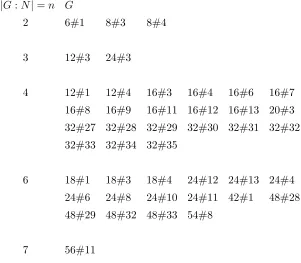
In Table 2, we show the complete classification for the indices that appear in Table 1. It is
re-markable that for index 5 there is no group satisfying the desired conditions.
In order to get normal subgroups with two non-central G-classes of coprime sizes the authors
used [9, Lemma 4.1.1], which asserts that in this clase Z(G)∩N = 1. Also, Theorem 3.4 is used
to improve the efficiency of the algorithm. Moreover, they gave the following improvement of the
Table 1. Number of groups with normal subgroups having one non-central G-class.
|G:N|=n |G| ≤n(n+ 1)2 Number of groups
2 18 3
3 48 2
4 100 21
5 180 0
6 294 16
7 448 1
Table 2. Groups having normal subgroups with one non-central G-class for certain indices.
|G:N|=n G
2 6#1 8#3 8#4
3 12#3 24#3
4 12#1 12#4 16#3 16#4 16#6 16#7
16#8 16#9 16#11 16#12 16#13 20#3
32#27 32#28 32#29 32#30 32#31 32#32
32#33 32#34 32#35
6 18#1 18#3 18#4 24#12 24#13 24#4
24#6 24#8 24#10 24#11 42#1 48#28
48#29 48#32 48#33 54#8
7 56#11
Theorem 4.3. [7, Theorem 3.2] Let N be a normal subgroup of a group G with |G : N| = n.
Suppose that Ghas exactly two non-central conjugacy classes xG1 andxG2 inN and these two classes
have coprime sizes. Let n1 =|CG(x1)|and n2 =|CG(x2)|such that n1 < n2. Then
(i) n+ 1≤n1 ≤3n−1.
(ii) E[ nn1
n1−n] + 1≤n2≤E[
2n1n
n1−n], where E[x]denotes the integer part of x.
(iii) |G| ≤n(n+ 1)(n2+n+ 1).
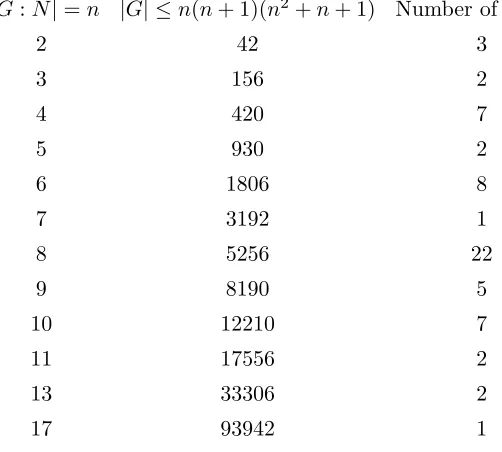
In Table3 we indicate the index, the improved bound for|G|appearing in Theorem 4.3, and the
number of groups with a normal subgroup containing two non-central classes of Gof coprime sizes.
Table 3. Groups with normal subgroups having two non-centralG-classes with
co-prime sizes.
|G:N|=n |G| ≤n(n+ 1)(n2+n+ 1) Number of groups
2 42 3
3 156 2
4 420 7
5 930 2
6 1806 8
7 3192 1
8 5256 22
9 8190 5
10 12210 7
11 17556 2
13 33306 2
17 93942 1
As we pointed out before, L. H´ethelyi and B. K¨ulshammer [24] proved an extension of Landau’s
theorem for prime-power order elements. They did not give, however, any numerical expression for
the upper bound of the group order. Here is their result.
Theorem 4.4. [24, Theorem 1.1] For any positive integer k, there are only finitely many finite
groups, up to isomorphism, with exactly k conjugacy classes of elements of prime power order.
In [7], we provide an explicit function of the bound for solvable groups. If Gis a finite group and
N ⊴G, then kpp(G) denotes the number of conjugacy classes of prime-power order elements of G
and kppG(N) the number of G-classes of prime-power order elements ofN.
Theorem 4.5. [7, Theorem 4.7]IfGis a finite solvable group such thatkpp(G) =k, then|G|⩽γ(k)
where γ is defined as follows: γ(1) = 1 andγ(k) =kγ(k−1)2 for everyk⩾2. Consequently
|G|⩽
k∏−1
i=0
(k−i)2i.
An extenssion of Landau’s result for prime-power order elements lying in a normal subgroup was
also given in [7]. However, one cannot restrict to just non-central G-classes of prime-power order
elements contained in a normal subgroupN ofG. This happens because one can easily see that|N|
and|G|cannot be bounded in terms of the number of such classes although the index|G:N|is fixed.
For instance, suppose that N ⊴G with |G : N|= n and that N has just one non-central G-class
(necessarily of prime-power order elements). ThenN is ap-group for some primepand we can take
N0 ⊴G0 has index n too, and N0 contains exactly one non-central G0-class of prime-power order
elements. Nevertheless, |N0| and |G0| need not be bounded. Therefore, all G-classes, central and
non-central, must be considered. The bounds for|G|and |N|in terms of kppG(N) are given in the
following.
Corollary 4.6. [7, Theorem B]Let G be a finite solvable group and letN ⊴Gsuch that|G:N|=n
and kppG(N) =k. Then |N|⩽∏nki=0−1(nk−i)2i and|G|⩽n∏i=0nk−1(nk−i)2i.
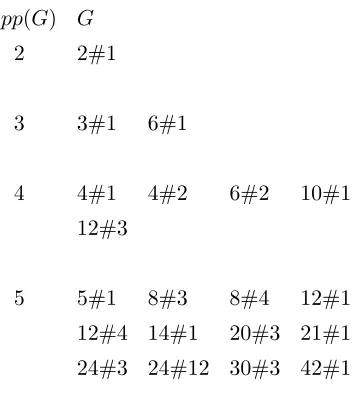
These bounds allow to obtain, with the help ofGAP, a classification of all groups such thatkpp(G)
is 2, 3, 4 or 5. They are listed in Table 4.
Table 4. Classification of solvable groups with small kpp(G).
kpp(G) G
2 2#1
3 3#1 6#1
4 4#1 4#2 6#2 10#1
12#3
5 5#1 8#3 8#4 12#1
12#4 14#1 20#3 21#1
24#3 24#12 30#3 42#1
Acknowledgments
Some of the results of this paper are part of the third author’s Ph.D. thesis at the University Jaume
I of Castell´on, who is financially supported by a predoctoral grant of this university. The first and
second authors are supported by the Valencian Government, Proyecto PROMETEOII/2015/011.
The first and the third authors are also partially supported by Universitat Jaume I, grant
P11B-2015-77.
References
[1] Z. Akhlaghi, A. Beltr´an, M. J. Felipe and M. Khatami, Structure of normal subgroups with threeG-class sizes,
Monatsh. Math.,167(2012) 1–12.
[2] Z. Akhlaghi, A. Beltr´an, M. J. Felipe and M. Khatami, Normal sections, class sizes and solvability of finite gorups,
[3] E. Alemany, A. Beltr´an and M. J. Felipe, Nilpotency of normal subgroups having twoG-class sizes,Proc. Amer.
Math. Soc.,138(2011) 2663–2669.
[4] A. Beltr´an and M. J. Felipe, The influence of class sizes on normal subgroups, Proceeding of the “Meeting on
Group Theory and its applications, on the occasion of Javiel Otal’s 60 th birthday ”,Biblioteca Rev. Mat. Iberoam.,
(2011) 45–55.
[5] A. Beltr´an and M. J. Felipe, A generalization on the solvability of finite groups with three class sizes for normal
subgroups, London Mathematical Society Lecture Notes,422(2013) 173–182.
[6] A. Beltr´an, M. J. Felipe and C. Melchor, Graphs associated to conjugacy classes of normal subgroups in finite
groups,J. Algebra,443(2015) 335–348.
[7] A. Beltr´an, M. J. Felipe and C. Melchor, Landau’s Theorem on conjugacy classes for normal subgroups,Int. J.
Algebra Comput.,26(2016).
[8] A. Beltr´an, M. J. Felipe and C. Melchor, Normal subgroups whose conjugacy class graph has diameter three,Bull.
Aust. Math. Soc.,94(2016) 266–272.
[9] A. Beltr´an, M. J. Felipe and C. Melchor, Triangles in the graph of conjugacy classes of normal subgroups,
Monatshefte f¨ur Mathematik,182(2017) 5–21.
[10] A. Beltr´an, M. J. Felipe and C. Shao,p-divisibility of conjugacy class sizes and normal p-complements,J. Group
Theory,18(2015) 133–141.
[11] H. U. Besche, B. Eick and E. A. O’Brien, A millennium project: constructing small groups, Internat. J. Algebra
Comput.,12(2002) 623 - 644.
[12] E. A. Bertram, M. Herzog and A. Mann, On a graph related to conjugacy classes of groups,Bull. London Math.
Soc.,22(1990) 569–575.
[13] A. R. Camina and R. D. Camina, The influence of conjugacy class sizes on the structure of finite groups: a survey,
Asian-Eur. J. Math.,4(2011) 559–588.
[14] M. Cartwright, A bound on the number of conjugacy classes of a finite soluble group, J. London Math. Soc.,2
(1987) 229–244.
[15] M. Cartwright, The number of conjugacy classes of certain finite groups,Quart. J. Math. Oxford Ser.,36(1985)
393–404.
[16] C. Casolo and S. Dolfi, The diameter of a conjugacy class graph of finite groups, Bull. London Math. Soc.,28
(1996) 141–148.
[17] C. Casolo, S. Dolfi and E. Jabara, Finite groups whose noncentral class sizes have the samep-part for some prime
p,Isr. J. Math.,192(2012) 197–219.
[18] D. Chillag, M. Herzog and A. Mann, On the diameter of a graph related to conjugacy classes of groups, Bull.
London Math. Soc.,25(1993) 255–262.
[19] S. Dolfi, Arithmetical conditions of the length of the conjugacy classes in finite groups, J. Algebra, 174(1995)
753–771.
[20] M. Fang and P. Zhang, Finite groups with graphs containing no triangles,J. Algebra,264(2003) 613–619.
[21] The GAP Group, GAP - Groups, Algorithms and Programming, 2015,www.gap-system.org.
[22] X. Guo and X. Zhao, On the normal subgroup with exactly twoG-conjugacy class sizes,Chin. Ann. Math. B.,
30 (2009) 427–432.
[23] L. S. Kazarin, On groups with isolated conjugacy classes,Izv. Vyssh. Uchebn. Zaved. Mat.,7(1981) 40–45.
[24] L. H´ethelyi and B. K¨ulshammer. Elements of prime-power order and their conjugacy classes in finite groups,J.
[25] E. Landau, ¨Uber die Klassenzahl der bin¨aren quadratischen Formen von negativer Diskriminante, Math. Ann.,
56(1903) 671–676.
[26] M. L. Lewis, An overview of graphs associated with character degrees and conjugacy class sizes in finite groups,
Rocky Mountain J. Math.,38(2008) 175–211.
[27] A. Moret´o and H. N. Nguyen, Variations of Landau’s theorem forp-regular andp-singular conjugacy classes,Israel
J. Math.,212(2016) 961–987.
[28] M. Newman, A bound for the number of conjugacy classes in a group,J. London Math. Soc.,43(1968) 108–110.
[29] U. Riese and M. A. Shahabi, Subgroups which are the union of four conjugacy classes,Comm. Algebra.,29(2001)
695–701.
[30] M. Shahryari and M. A. Shahabi, Subgroups which are the union of three conjugate classes, J. Algebra., 207
(1998) 326–332.
Antonio Beltr´an
Departamento de Matem´aticas, Universidad Jaume I, 12071, Castell´on, Spain
Email: [email protected]
Mar´ıa Jos´e Felipe
Instituto Universitario de Matem´atica Pura y Aplicada, Universidad Polit´ecnica de Valencia, 46022, Valencia, Spain
Email: [email protected]
Carmen Melchor
Departamento de Matem´aticas, Universidad Jaume I, 12071, Castell´on, Spain