UNIVERSIT ´E de Nice – Sophia Antipolis Ecole Doctorale´
STIC Sciences et Technologies de l’Information et de la Communication
Th`
ese de Doctorat
Pr´epar´ee pour obtenir le titre de
Docteur en Sciences de l’Universit´e de Nice – Sophia Antipolis
Discipline : Informatique
Pr´epar´ee `a l’Institut National de Recherche en Informatique
et en Automatique de Sophia Antipolis
par
Mariela PAVLOVA
V´
erification de bytecode et ses applications
Directeurs de th`ese : Gilles
Barthe
et Lilian
Burdy
Soutenue publiquement le 19 janvier 2007
`a l’´
Ecole Sup´erieure en Sciences Informatiques
de Sophia Antipolis
devant le jury compos´e de :
MM. Pierre
Paradinas
Pr´esident
CNAM Paris
Claude
Marche
Rapporteur
Inria Futurs - ProVal
John
Hatcliff
Rapporteur
Kansas State University
David
Naumann
Rapporteur
Stevens Institute of Technology
MM. Gerwi
Klein
Examinateur
University of New South Wales
cette derni`ere, le producteur de code mobile utilise le compilateur certifiant pour g´en´erer le code ´ex´ecutable ainsi qu’un certificat qui montre que le code satisfait les politiques de s´ecurit´e du client qui ´ex´ecute le code mobile. Le compilateur certifiant ´etant automatique, seules des politiques de s´ecurit´es d´ecidables peuvent ˆetre trait´ees, telles la correction du typage, ou l’acc`es s´ecuris´e `a la m´emoire. Le d´eveloppement rapide de technologies dans des domains critiques comme les cartes `a puce requiert des politiques de s´ecurit´es plus complexes (par exemple des propri´et´es fonctionelles) que les politiques de s´ecurit´es d´ecidables.
Pour repondre `a ce besoin, dans cette th`ese nous introduisons les composants suivants: un langage de Mod´elisation de Bytecode d´erivant de JML (Java Modeling Language), un compilateur des annotations du code source au code compil´e, un g´en´erateur de conditions `a v´erifier pour le code compil´e Java, et l’´equivalence entre les obligations de preuve entre le code source et le code compil´e. Bas´ee sur ces composants, notre architecture permet au producteur de code de g´en´erer le certificat de code mobile interactivement et donc permet de certifier des propri´et´es qui vont au del`a des propri´et´es d´ecidables.
Mots Cl´es : program static verification, verification condition generator, program logic, mobile code, PCC, certified code, Java, bytecode, proof preserving compilation, specification languages
Contents
1 Introduction 1
1.1 Contributions . . . 5
1.2 Plan of the thesis . . . 6
2 Java verification overview 7 2.1 Java like statements and expressions . . . 7
2.2 Overview of JML . . . 9
2.2.1 JML expressions . . . 10
2.2.2 Method contracts and method intra specification . . . 10
2.2.3 Ghost variables . . . 11
2.2.4 Light and heavy weight specification. Multiple specification cases . . . 12
2.2.5 Frame conditions . . . 13
2.2.6 Class specification . . . 16
2.3 Program verification using program logic . . . 16
2.4 Weakest precondition predicate transformer for Java like source language . . . 19
2.4.1 Substitution . . . 19
2.4.2 Weakest precondition predicate transformer for expressions . . . 20
2.4.3 Weakest precondition predicate transformer for statements . . . 21
3 Java bytecode language and its operational semantics 25 3.1 Notation . . . 27
3.2 Program, classes, fields and methods . . . 28
3.3 Program types and values . . . 29
3.4 State configuration . . . 30
3.4.1 Modeling the object heap . . . 31
3.4.2 Registers . . . 33
3.4.3 The operand stack . . . 33
3.4.4 Program counter . . . 33
3.5 Throwing and handling exceptions . . . 33
3.6 Method lookup . . . 35
3.7 Design choices for the operational semantics . . . 35
3.8 Bytecode language and its operational semantics . . . 35
3.9 Representing bytecode programs as control flow graphs . . . 43
3.10 Related Work . . . 44
4 Bytecode modeling language 47 4.1 Design features of BML . . . 47
4.2 The subset of JML supported in BML . . . 48
4.2.1 Notation convention . . . 48
4.2.2 BML Grammar . . . 48
4.2.3 Syntax and semantics of BML . . . 50
4.2.3.1 BML expressions . . . 50
4.2.3.2 BML predicates . . . 52
4.2.3.3 Class Specification . . . 52 iii
4.3 Well formed BML specification . . . 53
4.4 Compiling JML into BML . . . 55
4.5 Related work . . . 59
5 Verification condition generator for Java bytecode 61 5.1 Assertion language for the verification condition generator . . . 61
5.1.1 The assertion language . . . 62
5.1.2 Interpretation . . . 62
5.2 Extending method declarations with specification . . . 64
5.3 Weakest precondition calculus . . . 65
5.3.1 Intermediate predicates . . . 67
5.3.2 Weakest precondition in the presence of exceptions . . . 68
5.3.3 Rules for single instruction . . . 69
5.3.4 Verification conditions . . . 74
5.3.4.1 Method implementation respects method contract . . . 74
5.3.4.2 Behavioral subtyping . . . 75
5.4 Example . . . 77
5.5 Related work . . . 78
6 Correctness of the verification condition generator 81 6.1 Formulation of the correctness statement . . . 81
6.2 Proof outline . . . 82
6.3 Relation between syntactic substitution and semantic evaluation . . . 83
6.4 Proof of Correctness . . . 86
6.5 Related work . . . 92
7 Equivalence between Java source and bytecode proof obligations 95 7.1 Compiler . . . 95
7.1.1 Compiling source program constructs in bytecode instructions . . . 97
7.1.2 Properties of the compiler function . . . 100
7.2 Establishing the equivalence between verification conditions on source and bytecode level . . . 104
7.3 Related work . . . 110
8 Constrained memory consumption policies using verification condition genera-tor 113 8.1 Motivating example . . . 114
8.2 Principles . . . 115
8.3 Examples . . . 116
8.3.1 Inheritance and overridden methods . . . 116
8.3.2 Recursive Methods . . . 117
8.3.3 More precise specification . . . 117
8.4 Related work . . . 117
9 A low-footprint Java-to-native compilation scheme using BML 121 9.1 Ahead-of-time & just-in-time compilation . . . 122
9.2 Java runtime exceptions . . . 122
9.3 Optimizing ahead-of-time compiled Java code . . . 123
9.3.1 Methodology for writing specification against runtime exception . . . 124
9.3.2 From program proofs to program optimizations . . . 125
9.4 Experimental results . . . 126
9.4.1 Methodology . . . 126
9.4.2 Results . . . 126 iv
9.5 Limitations . . . 128
9.5.1 Multi-threaded programs . . . 128
9.5.2 Dynamic code loading . . . 128
9.6 Related work . . . 128
10 Conclusion 129 10.1 Results . . . 129
10.2 Future work . . . 130
10.2.1 Verification condition generator . . . 130
10.2.2 Property coverage for the specification language . . . 130
10.2.3 Preservation of verification conditions . . . 131
10.2.4 Towards a PCC architecture . . . 132
A Encoding of BML in the class file format 133 A.1 Class annotation . . . 133
A.1.1 Ghost variables . . . 133
A.1.2 Class invariant . . . 134
A.1.3 History Constraints . . . 134
A.2 Method annotation . . . 134
A.2.1 Method specification . . . 134
A.2.2 Set . . . 136
A.2.3 Assert . . . 136
A.2.4 Loop specification . . . 137
A.3 Codes for BML expressions and formulas . . . 138 B Proofs of properties from Section 7.1.2 139
Chapter 1
Introduction
Since the beginning of programming languages, the problem of program correctness has been an issue. Especially, this is the case today when complex software applications enter into our daily life and perform actions which may potentially compromise confidential data (credit cards) or the performance of the computer system they are executed on (e.g. installing software which may format the hard disk of our PC). Also, errors in software conception may have disastrous effects, for instance the crash of the European Ariane 5 launcher due to execution of a data conversion. More over, software correctness plays a crucial role in the overall software quality in cases the latter take part in the automatic control of engines which may put in danger lives, like airplanes or subways.
Thus, a necessary phase in the program development is the validation of the program imple-mentation, during which the producer checks if the written code conforms to her/his intentions.
A widely used approach is program testing. However, this technique is not capable to cover all the cases of the input space and thus, although the tests have been successful, the implementation may still contain errors. This, of course, is not desirable in particular in the case of critical program applications as is the case for applications which target the domains mentioned above.
Another possibility is to use formal verification methods. Contrary to program testing, formal program verification guarantees that if the verification procedure has been successful then the implementation respects the initial requirements for the software. The field of formal verification is vast and there exist different approaches as for instance model checking, type systems or program logic. In this thesis, we shall focus on the last approach. In Fig. 1.1, we give a general outline of the architecture for verifying source code programs.
Verification conditions
generator
conditionVerification interactive prover Automatic or
Source code Specification
Verification conditions
generator
conditionVerification interactive prover Automatic or
Source code Specification
Figure 1.1: Source verification
As we can see from the figure, the architecture relies on the following components:
• specification of the implementation which expresses the intended behavior of the source pro-gram. The annotations are written in a formal specification language.
• an algorithm which generates logical (verification) conditions from the annotations and the program. Such an algorithm is usually called verification condition generator. The generated verification conditions are such that their truth guarantees that the implementation respects the program specification and thus, that the implementation respects its intended behavior.
• a system for showing the validity of the verification conditions. This is normally done either by an automatic decision procedure or interactive theorem prover. Automatic decision proce-dures do not need user interaction. However, automation cannot deal with difficult theorems because of the undecidability of the logic. Interactive prove assistant is an alternative which is more powerful and can more often “say” if something holds. However, even interactively it could be difficult to show that a theorem holds. Although interactive prove assistants sys-tems are more reliable than automatic decision procedures they need a user interaction and expertise in theorem proving and logic. Thus, depending on the complexity of the verification conditions, an automatic decision procedure or an interactive system is used.
The field of formal verification is well studied and several tools exist for dealing with source verification using program logic. We should mention in the list of the verification tools tailored to source languages the Caveat1 verification framework for C, Caduceus2 for C, the extended static
checker esc/java [72], the Loop tool [60], Krakatoa [76], Jack [28], etc. These tools are tailored to a source language and thus, are helpful for the development process. For instance, the developer may use such verification tools for discovering program bugs and errors. More generally, verification on source code allows the code producer to audit the quality of a software implementation.
Although program logics guarantees source program correctness, it does not say anything about the executable code resulting from the source compilation. Thus, source verification requires a trust in the compiler. However, such a compromise is not always admissible.
This is in particular the case for mobile code scenarios where a code client executes an unknown or untrusted application. Fig. 1.2 shows a schemata of mobile code scenarios. From the figure, we can see that in such scenarios there are two counter parts: a code producer and a code client. The producer generates the code and the client receives the generated code. However, the client normally does not have any evidence that the code respects his requirements.
Executable code
requirementsClient
Compiler
Source code Producer
Client
Figure 1.2: Mobile code
Examples for a mobile code scenario can be the downloading of software components via internet and their execution on a user system which can be a personal computer, PDAs, embedded systems, etc. These software components could be from user specific applications to patches for the operating system.
Thus, it is more suitable to perform the verification directly on the executable or interpreted code. First, because the executable is normally not accompanied by the corresponding source code and second, even if it were this would require trust in the compiler. This would mean that the client should have a similar verification infrastructure as on source code as shown in Fig. 1.3.
1
http://www-list.cea.fr/labos/fr/LSL/caveat/index.html
2
3 Verification conditions generator conditionVerification requirementsClient
Executable code Client
Producer
Compiler
Source code
Automatic or interactive prover
Figure 1.3: Mobile code verification
Providing mechanisms for verification over the executable or interpreted code gives the client the possibility to check if the application respects the requirements of the client system. However, the process of theorem proving is an expensive computational procedure and the client system may potentially not be willing to slow down its execution for verifying the unknown code. Especially, this is the case for small devices which rely on limited computational resources.
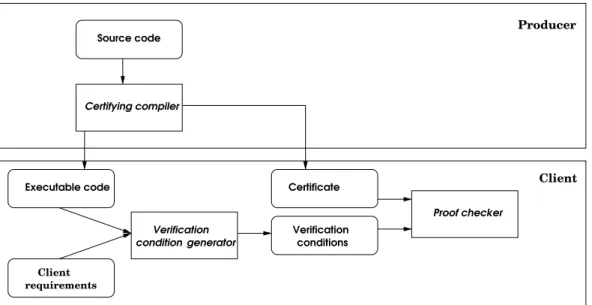
The Proof Carrying Code paradigm (PCC) and the certifying compiler proposed by G.Necula [86] gives a solution to this problem. In the traditional PCC architecture, untrusted code is ac-companied by a proof which certifies that the code is in compliance with the client requirements. In Fig. 1.4, we show the basic components of such framework and the relation between them. The code producer uses the so called certifying compiler. The certifying compiler consists of a compiler and a certifier. The compiler not only compiles source programs into executable (or interpreted bytecode) but also generates annotations for the executable code. The certifier assembles the verifi-cation condition generator over the executable and invokes an automatic decision procedure which will generate a formal proof for the verification conditions. The producer sends the executable code with annotations and the proof to the client. The client then does not have to prove the program. Rather, he generates the verification conditions over the received code and his requirements and then checks if the proof accompanying the code is a proof for the generated verification conditions. Checking a proof w.r.t. a logical statement is much easier then finding its proof. For this, type checking algorithms are used as the verification conditions are interpreted as types and the proofs are interpreted as expressions. The complexity of type checking algorithms is small and thus, do not compromise the performance of the client system.
However, because traditional PCC is completely automated, it can only deal with safety proper-ties, like well typedness or safe memory read and write access. These properties are very important as they guarantee that the execution of the whole system will not be violated by the untrusted application. However, restricting the verification mechanism only to safety properties is not sat-isfactory, because there are potentially situations in which the client security policy may be more complex. For instance, the client may have functional requirements over the unknown code. An example is when an updated version of an interface implementation is downloaded on the client computer system and patches an old implementation of the interface. In this cases, the client system needs guarantees that the unknown software component respects the interface specifica-tion. In such situations, traditional PCC is not appropriate as it will fail to generate the proof automatically.
Executable code Source code
Certifying compiler
generator
conditionVerification Verificationconditions Certificate
requirementsClient
Client Producer
Proof checker
Figure 1.4: Proof carrying code architecture for mobile code
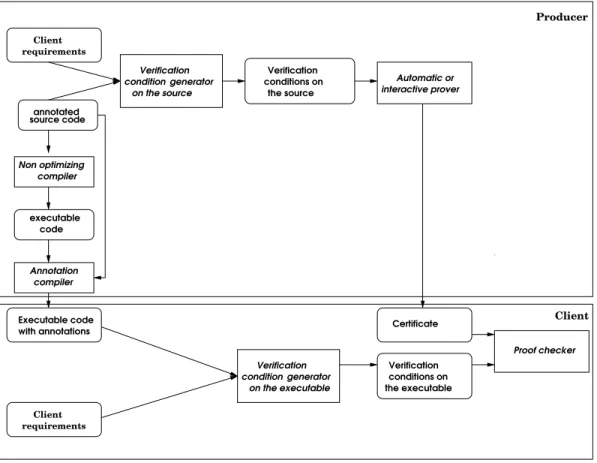
A solution to this problem is to give up automation in the certificate generation and thus, make the process of the proof generation on the producer site interactive as shown in Fig. 1.5. As you can see in the figure, we propose that the producer site generates the certificate interactively over the source code. The advantage of such an approach is that the interactive proof will allow to identify bugs in the source code and correct them until the source becomes conform with the client requirements. Moreover, interactive verification over source code allows to identify points in the source program which must be enforced with annotations (typically, loop invariants) that will allow the verification conditions to get provable. However, there are several points which need to be clarified. The first one is how the client may use a source code certificates for the verification of its executable counterpart. This is actually possible as verification conditions over source and low level code are equivalent if the low level code has been produced by a non optimizing compiler. However, this equivalence is not sufficient to make things work. In particular, sending the executable code and its certificate is not sufficient for the client to check correctly the program. As we said above, the generation of the certificate on the producer site, requires additional annotations. Recall that the validation of the executable program on the client side involves the generation of the verification conditions again. If the client does not have the annotation enforcement for the program, he will not succeed to type check the verification conditions that he generated against the received certificate, even if the program is correct. For this, we propose a compiler from source annotations to annotations on the level of the executable (interpreted) code.
In the following, we present a framework which follows the schemata from Fig. 1.5 which allows to verify statically bytecode programs against potentially non trivial functional and security properties. The framework is tailored to Java bytecode.
The Java platform of Sun Microsystems has gained a lot of popularity in industry for the last two decades. The reasons for its success is that it allows applications to be developed in a high-level language without committing to any specific hardware and since it features security mechanisms which guarantee the innocuousness of downloaded applications. It guarantees type safety via the bytecode verifier and restricts the access of untrusted applications to systems resources trough the sandbox mechanism. The JVM provides an automatic memory management through a garbage collector.
For instance, smart card applications are relying on JavaCard, a dialect of Java tailored to small devices. Such devices, however, impose security restrictions to the software components they run for which platforms like Java do not provide sufficient mechanisms for their guarantee, e.g. preserving of confidentiality or limited use of computational resources. Moreover, the new generation of smart card platforms where installation of software components after the card has
1.1 Contributions 5
interactive proverAutomatic or
Annotation compiler requirementsClient Certificate Proof checker Verification generator condition on the executable Verification the executableconditions on
Non optimizing compiler Producer Verification generator condition
on the source conditions onthe source Verification requirementsClient annotated source code executable code Executable code with annotations Client
Figure 1.5: Proof preserving compilation for mobile code
been issued is possible, opens new security problems. Another example is the J2ME (which stands for Java 2 Micro Edition) which is widely used in mobile phone software industry. Mobile phone users benefit today from the possibility to install new software components on the phone system by the wireless net, however no mechanisms are provided by the Java system to check that they are not malicious, buggy or incompatible with other installed code.
1.1
Contributions
We propose a framework which allows the verification of bytecode programs against complex func-tional and safety properties, which has the following components.
Bytecode Modeling Language We define a specification language for bytecode called BML (short for Bytecode Modeling Language). BML is the bytecode encoding of an important subset of JML (short for Java Modeling Language). The latter is a rich specification language tailored to Java source programs and allows to specify complex functional properties over Java source programs. Thus, BML inherits the expressiveness of a subset JML and allows to encode potentially complex functional and security policies over Java bytecode programs. We define an encoding of BML in the class file which is in conformance with the Java Virtual Machine specification [75]. To our knowledge, BML does not have predecessors that are tailored to Java bytecode.
Verification condition generator for Java bytecode We propose a verification condition gen-erator (VcGen for short) for Java bytecode which is completely independent from the source code. The verification condition generator covers a large subset of Java and deals with arith-metic operations, object creation and manipulation, method invocations, exception throwing and handling, stack manipulation etc. The verification condition relies on a weakest predicate
transformer function adapted for Java bytecode and we have proved its soundness relative to a Java operational semantics. We have an implementation which is integrated in Jack (short for Java Applet Correctness Kit) [28] which is a user friendly plugin for the eclipse ide3.
Compiler from source to bytecode annotations We define a compiler from JML to BML which allows Java bytecode benefit from the JML source specification. The compiler does not depend on a particular Java compiler but requires it to be non optimizing The JML compilation results in enriching the class file with the BML encoding of the specification. Equivalence between source and bytecode proof obligations Such an equivalence is
use-ful when programs and requirements over them are complex. In this case, an interactive verification procedure over the source code could be helpful. (e.g. proving the verification conditions in an interactive theorem prover). First, interactive procedure is suitable where automatic decision procedures will not cope with difficult theorems which is potentially the case for sophisticated security policies or functional requirements. Second, using verification on source code is useful as program bugs and errors can be easily identified and corrected. Because of the relative equivalence between source and bytecode proof obligations, once the verification conditions over the source and the program requirements expressed as specifica-tions are proved the bytecode and the certificate (the proof of the verification condispecifica-tions) produced over the source can be shipped to the client.
We have shown the usefulness of bytecode verification condition generator in two cases. The first one is the verification of constrained memory consumption policies. Indeed, it is an important issue for devices with limited resources as smart cards to have a guarantee that a newly installed application will not corrupt the whole system because of malevolent resource usage. In such critical situations, bytecode verification is suitable as it does not compromise the compiler. This work was published in [20].
We have also shown how this methodology can be applied to bytecode to native compiler opti-mizations. The speed and small memory footprint size of executable code is important especially for constrained devices. In order to speed up the execution Java-to-native compilation can be done. But this comes on the price of a large memory footprint. We apply our verification framework for decreasing the size of the native code size by identifying check sides in the native code which can be removed. This gave issue to the publication [33].
1.2
Plan of the thesis
The present thesis is organized as follows. In the next Chapter 2, we give an overview of the basic ideas in Java source verification. We present there the JML language, a Java like source language and verification condition generator for the source language. We also discuss different approaches in program verification using program logic. Chapter 3 presents the bytecode language and its operational semantics which will be used all along the thesis for the definition of the verification condition generator and the proof of its soundness. Chapter 4 presents the syntax and semantics of the Bytecode Modeling Language (BML) and the compiler from JML to BML. In Chapter 5, we turn to the definition of the verification condition generator and Chapter 6 presents the proof of its soundness. In Chapter 7, we shall focus on the relation between verification conditions on source and bytecode level and we shall see under what conditions they are the same modulo names and basic types. Chapter 8 presents an application of the bytecode verification condition generator and BML to the verification of constraint memory consumption policies. Chapter 9 shows how we can build a Java-to-Native compiler using our verification framework.
3
Chapter 2
Java verification overview
The purpose of this chapter is to remind the reader the basic principles in the formal verification of Java programs. Because the concepts on Java source and bytecode verification are similar, we have decided to give here an overview of them on Java source. We hope that this will be a gentle introduction to the rest of the thesis especially for those which are not acquainted with Java bytecode.
As we already stated in the introductory chapter, a formal program verification relies on three elements: a specification language in which to express the requirements that a program must satisfy, a verification procedure for generating verification conditions whose validity implies that the program respects its specification and finally, a system to decide the validity of the verification conditions. In this chapter and in the rest of thesis, we shall focus on the first two components. In particular,in Section 2.1, we shall present a Java like programming language supporting the most important features of Java. We also present JML, the de facto Java specification language tailored to Java. This will be done in Section 2.2. Section 2.3 presents a discussion about the different approaches for program verification using program logic. In Section 2.4, we shall define over it a verification condition calculus.
2.1
Java like statements and expressions
Java programs are a set of classes. As the JVM says“ A class declaration specifies a new reference type and provides its implementation. . . . The body of a class declares members (fields and methods) and constructors.”. Fields represent the state of an object of the class where those fields are declared. Fields have a name and a type. Thus, a field declaration in a class states the name and type of the field. Methods are the constructs in a class which execute and allow to change the state of the objects at runtime. Class constructors are special methods which initialize a new object of this class. Constructors have the same name as the class to which they belong. A method declaration includes the method name, the list of arguments which specifies their names and types, the method return type as well as the method body. A method body in Java represents a Java statement. Statements are program constructs whose role is to determine the control flow of the program during execution. Statements manipulate program constructs which represent values. Those constructs are the expressions of the language. Expressions do not determine the control flow but they evaluate to values. Values in our language are either references or integers. For an illustration, consider the class declaration:
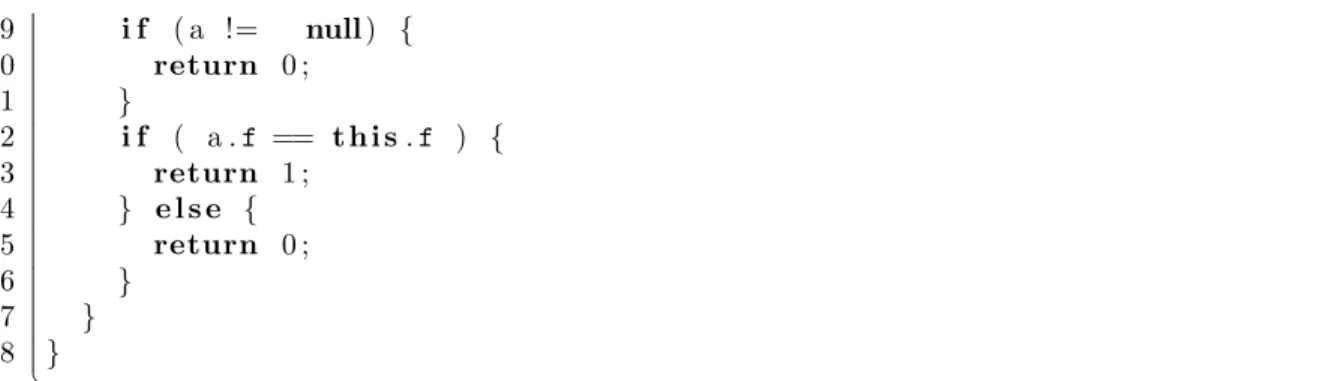
1 c l a s s A { 2 int f; 3 4 A(int c ) { 5 f = c ; 6 } 7 8 int eqField ( A a ) {
9 i f ( a != null) { 10 return 0 ; 11 } 12 i f ( a .f == t h i s.f ) { 13 return 1 ; 14 } e l s e { 15 return 0 ; 16 } 17 } 18 }
The example shows the declaration of class A. The class first declares a field namedfof type integer (line 2). Then follows the declaration of the class constructor which initializes the field f
to the value of the parameter c (lines 4-6). The last component of the class is the methodeqField
which tests if the parameter a of type A is equal to the receiver of the method call by returning 0 or 1 (lines 8-18). Thus, the body of eqFieldfirst checks if a is not null and if it is returns 0. Otherwise, if the fieldfin the current object and in the object passed as the parameter a are equal then the method returns 1 and if not returns 0.
In the following, we shall concentrate in more detail on the statements and expressions typical for object oriented languages e.g. object manipulation and creation, method invocation, throwing and handling exceptions and subroutines. Fig. 2.1 gives the formal grammar.
E ::=IntConst |null |this |E op E |E.f |Var |(Class)E |E.m() |new Class() op ∈ {+,−,∗,} E cond ::=E cond E cond ∈ {≤, <,≥, >,=,6=} S ::=S;S
|if(E cond)then{S}else{S} |try{S}catch(Exc){S} |try{S}finally{S} |throwE
|while(E cond)[INV,modif] {S} |returnE
|E =E
Figure 2.1: Source language
The nonterminalS introduces the grammar for statements. The statements that are supported are standard control flow constructs like compositional statement, conditional statement, assign-ment stateassign-ment, return stateassign-ment etc. They have the usual semantics of programs with exceptional
2.2 Overview of JML 9
and normal termination. For instance, the meaning of the compositional statementsS;S is that if the first statement terminates execution normally then the second statement is executed. More-over, if the first or second statement terminates on exception then the whole statement terminates on exception
The constructtry{S}catch(Exc){S}allows for handling exceptions. Its meaning is that if the statement following thetrykeyword throws an exception of typeExcthen the exception will be caught by the statement following thecatchkeyword. The language also supports try finally statements, a construct which is particular to the Java language. The meaning of the construct is that no matter how the statement following the keywordtry terminates (on an exception or normally), the statement introduced by the keyword finally must execute after it. If the try block terminates normally then the whole try statement will terminate as the finally block. If the try block terminates on exception Exc and if the finally block terminates normally, the whole try finally statement terminates on the exception Exc. If the try block terminates on exception Exc and if the finally block terminates on exception Exc’ then the whole try finally terminates on exception Exc’. Loop statements are also supported. Note that their syntax includes a formula
INV which must hold whenever the loop entry is reached as well as a list of expressions modif
which lists the locations that may not have the same value at the beginning and at the end of a loop iteration. Note that a variable should not be in the listmodifeven if during a loop iteration its value is changed as far as at the end of the iteration the value it had in the beginning of the iteration is restored.
Let us now turn to the expression grammar. As we can see from the figure, the language supports integer constantsIntConst, the null constantnulldenoting the empty reference, a constructthis for referring to the current object, arithmetic expressionsE opE whereop∈ {+,−, div, rem,∗}. The value stored in a field namedffor the object referenceE is denoted with the constructE.f, cast expressions with (Class)E and method local variables and parameters with identifiers taken from the setVar. The language also has constructs for expressing method invocation. Thus, the first expression in the syntax of the method invocation E.m() stands for the receiver object of the method call and m is the name of the invoked method. For the sake of clarity we consider only non void instance methods which does not receive parameters. Moreover, we assume that methods always return a value. The language supports also instance creation construct. Note that constructors like methods do not take arguments. The semantics of instance creation expression newClassis that it creates a new reference of typeClassin the heap which is initialized by the class constructorClass. For class constructors, we also assume that they do not take parameters for the same reasons as above. A relation between expressions is denoted with E cond E where
cond ∈ {≤, <,≥, >,=,6=}. We could have considered a larger set of boolean expressions like for instance logical connectors∧,∨. . .but we limit our language only to relational expressions for the sake of simplicity without losing any particular feature of the language.
2.2
Overview of JML
JML [67] (short for Java Modeling Language) is a behavioral interface specification language tai-lored to Java applications which follows the design-by-contract approach (see [23]).
Over the last few years, JML has become the de facto specification language for Java source code programs. Several case studies have demonstrated that JML can be used to specify realistic industrial examples, and that the different tools allow to find errors in the implementations (see e.g. [25]). One of the reasons for its success is that JML uses a Java-like syntax. Other important factors for the success of JML are its expressiveness and flexibility.
JML is supported by several verification tools. Originally, it has been designed as a language of the runtime assertion checker [32] created by Yoonsik Cheon and G.T. Leavens. The JML runtime assertion checker compiles both the Java code and the JML specification into executable bytecode and thus, in this case, the verification consists in executing the resulting bytecode. Several static checkers based on formal logic exist which use JML as a specification language. Esc/java [72] whose first version used a subset of JML 1 is among the first tools supporting JML. Among the
static checkers with JML are the Loop tool developed by the Formal group at the University of 1
Nijmegen, the Jack tool developed at Gemplus, the Krakatoa tool developed by the ProVal group at Inria, France. The tool Daikon [41] tool uses a subset of JML for detecting loop invariants by run of programs. A detailed overview of the tools which support JML can be found in [27]. In the following, we shall proceed with the description of the basic features of JML which correspond basically to the JML Level0 subset of JML.
2.2.1
JML expressions
Expressions manipulated in JML are side-effect free Java expressions, extended with specification-specific keywords. JML specification-specifications are written as comments so they are not visible by Java compilers. The JML syntax is close to the Java syntax: JML extends the Java syntax with few keywords and operators. Special JML operators are, for instance, \resultwhich stands for the value that a method returns if it is not void, the\old(expression)operator designates the value of expression in the prestate of a method and is usually used in the method’s postcondition,
\typeof(expression)which stands for the dynamic type ofexpression, etc.
2.2.2
Method contracts and method intra specification
Method contracts consists of the conditions upon which relies and the conditions that the method guarantees. The conditions upon which a method relies are expressed in specifications as the method precondition, i.e. the method requires them to hold in its pre state. The conditions which a method guarantees are expressed in specifications as the method postcondition, i.e. they express what the method guarantees to the methods that may invoke it. Method contracts are visible by the other methods in the program as they inform the other methods what they must establish when calling them current method and what the current method guarantees them. Moreover, JML provides a third component in the method contract, the so called frame condition which introduces the locations that can be modified by the method. Frame conditions are actually desugared as part of the postcondition as we shall see later in subsection 2.2.5. For an insight information on method contracts, the reader may refer to [23].
Specifying methods may involve writing specification which is not visible by “the outside world” (the other methods in the program) but which are useful for the program verification process. An example for such a specification are the loop invariants, which express a property which holds at the borders of a loop iteration. Moreover, here we shall allow that a loop is also accompanied by a frame condition which as in the case of method frame conditions specifies which locations may be modified in a loop. Such an extension of JML is used in the tool Jack [28]. We provide a more insight discussion about them later in subsection 2.2.5.
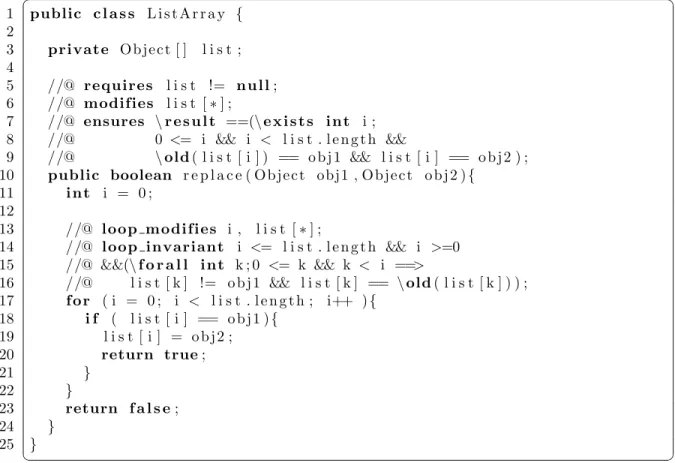
For introducing method preconditions, postconditions and method frame conditions in JML the keywords requires, ensures and modifies keywords are used respectively. Also for loop invariants and loop frame conditions, the keywordsloop invariantandloop modifiesare used. Fig. 2.2 gives an example of a Java class that models a list stored in a private array field. The method replacewill search in the array for the first occurrence of the objectobj1passed as first argument and if found, it will be replaced with the object passed as second argumentobj2and the method will return true; otherwise it returns false. Thus the method specification between lines 5 and 9 which exposes the method contract states the following. First the precondition (line 5 ) requires from any caller to assure that the instance variablelistis notnull. The frame condition (line 6) states that the method may only modify any of the elements in the instance field list. The method postcondition (lines 7—9) states the method will returntrueonly if the replacement has been done. The method body contains a loop (lines 17—22) which is specified with a loop fame condition and a loop invariant (lines 13—16). The loop invariant (lines 14—16) says that all the elements of the list that are inspected up to now are different from the parameter objectobj1
as well as the local variable iis a valid index in the array list. The loop frame condition (line 13) states that only the local variableiand any element of the array fieldlistmay be modified in the loop.
2.2 Overview of JML 11 1 public c l a s s L i s t A r r a y { 2 3 private Object [ ] l i s t ; 4 5 //@ requires l i s t != null; 6 //@ modifies l i s t [∗] ; 7 //@ ensures \r e s u l t ==(\e x i s t s int i ; 8 //@ 0 <= i && i < l i s t . l e n g t h && 9 //@ \old( l i s t [ i ] ) == o b j 1 && l i s t [ i ] == o b j 2 ) ; 10 public boolean r e p l a c e ( Object obj1 , Object o b j 2 ){
11 int i = 0 ; 12
13 //@ loop modifies i , l i s t [∗] ;
14 //@ loop invariant i <= l i s t . l e n g t h && i >=0 15 //@ &&(\f o r a l l int k ; 0 <= k && k < i ==>
16 //@ l i s t [ k ] != o b j 1 && l i s t [ k ] == \old( l i s t [ k ] ) ) ; 17 for ( i = 0 ; i < l i s t . l e n g t h ; i++ ){ 18 i f ( l i s t [ i ] == o b j 1 ){ 19 l i s t [ i ] = o b j 2 ; 20 return true; 21 } 22 } 23 return f a l s e; 24 } 25 }
Figure 2.2: class ListArray with JML annotations
2.2.3
Ghost variables
JML also allows the declaration of special JML variables, that are used only for specification purposes. These variables are declared in comments with theghostmodificator and may be used only in specification clauses. Those variables can also be assigned. Ghost variables are usually used for expressing properties which can not be expressed with the program variables.
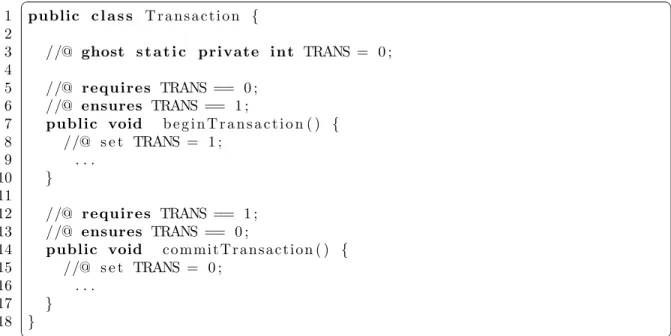
We illustrate the utility of such variables through an example. Let us have a classTransaction
which manages transactions in the program as shown in Fig. 2.3. The class is provided with a method for opening transactions (beginTransaction) and a method for closing transactions (commitTransaction). Suppose that we want to guarantee that in an application there are never nested transactions. A possibility is to declare a methodgetTransactionDepthwhich counts the number of open transactions and use dynamic checks for guaranteeing that there are no nested transactions. But this would require to modify the code which is not desirable. Another approach would be to use the methodgetTransactionDepthas far as its execution does not affect the pro-gram state (i.e. it is pure) in the specification e.g. the precondition of methodbeginTransaction
will be //@ requires getTransactionDepth() == 0. However, the treatment of pure methods is complicated and its semantics is still not well established. Ghost variables can be used for specifying the no nested transaction property in a simple way. The specification of the methods
beginTransaction andcommitTransactionmodels the property for no nested transactions via the ghost variable TRANS(declared on line 3) which keeps track if there is a running transaction or not. In particular, if the value of TRANSis 0 then there is no running transaction and if it has value 1 then there is a running transaction. Thus, when the method beginTransaction is invoked the precondition (line 5) requires that there should be no running transaction and when the method is terminated the postcondition guarantees (line 6) that there is already a transaction running. We can also remark that the variableTRANSis set to its new value (line 8) in the body
beginTransaction. Note that this is a simple way for specifying this property without modifying the code.
1 public c l a s s T r a n s a c t i o n {
2
3 //@ ghost s t a t i c private int TRANS = 0 ; 4 5 //@ requires TRANS == 0 ; 6 //@ ensures TRANS == 1 ; 7 public void b e g i n T r a n s a c t i o n ( ) { 8 //@ s e t TRANS = 1 ; 9 . . . 10 } 11 12 //@ requires TRANS == 1 ; 13 //@ ensures TRANS == 0 ;
14 public void commitTransaction ( ) {
15 //@ s e t TRANS = 0 ; 16 . . .
17 }
18 }
Figure 2.3: specifying No Nested Transaction property with ghost variable
2.2.4
Light and heavy weight specification. Multiple specification cases
A useful feature of JML is that it allows two kinds of method specification, alight andheavy weight specification. An example for alightspecification is the annotation of methodreplace(lines 5—9) in Fig. 2.2. The specification in the example states what is the expected behavior of the method and under what conditions it might be called. The user, however in JML, has also the possibility to write detailed method specifications which allow to describe what are the different cases on which a method might be called and what is the behavior of the method in every case. This specification style is called a heavy weight specification. Heavy weight specification are introduced by the JML keywordsnormal behaviorandexceptional behavior. As the keywords suggest every of them specifies a specific normal or exceptional behavior of a method. (see [66]).
The keywordnormal behaviorintroduces a precondition, frame condition and postcondition such that if the precondition holds in the prestate of the method then the method will terminate normally and the postcondition will hold in the poststate.
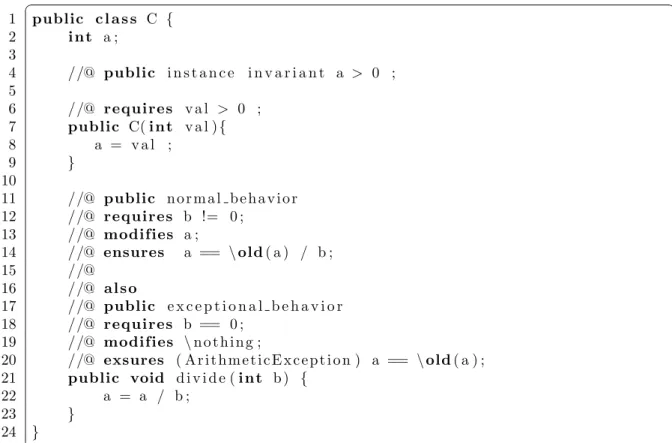
An example for aheavy weight specification is given in Fig. 2.4. In the figure, method divide
has two behaviors, one in case the method terminates normally (lines 11—14) and the other (lines 17—20) in case the method terminates by throwing an object reference of ArithmeticException. In the normal behavior case, the exceptional postcondition is omitted specification as by default if the precondition (line 12 ) holds this assures that no exceptional termination is possible. Another observation over the example is that the exceptional behavior is introduced with the JML keyword also. The keywordalso serves for introducing every new behavior of a method except the first one. Note that the keywordalsois used in case a method overrides a method from the super class. In this case, the method specification (heavy orlight weight) is preceded by the keywordalsoto indicate that the method should respect also the specification of the super method.
In a light weight specification style the specifier might omit some of the specification. For instance, in Fig. 2.4, the constructor C is provided only with a precondition. On verification time, the missing part of an incomplete light weight specification is set to its default values. The default value for omitted precondition and postcondition in a light weight specification is true and for frame condition is nothing2.
Aheavy weight specification is a syntactic sugar which is suitable for the specification process and makes easier the understanding of the specified code. The verification of a heavy weight
spec-2
the default value for frame conditions may depend on our choice. For instance, in Jack the developer can set the default value for frame conditions tonothingoreverything
2.2 Overview of JML 13 1 public c l a s s C { 2 int a ; 3 4 //@ public i n s t a n c e i n v a r i a n t a > 0 ; 5 6 //@ requires v a l > 0 ; 7 public C(int v a l ){ 8 a = v a l ; 9 } 10 11 //@ public n o r m a l b e h a v i o r 12 //@ requires b != 0 ; 13 //@ modifies a ; 14 //@ ensures a == \old( a ) / b ; 15 //@ 16 //@ also 17 //@ public e x c e p t i o n a l b e h a v i o r 18 //@ requires b == 0 ; 19 //@ modifies \n o t h i n g ; 20 //@ exsures ( A r i t h m e t i c E x c e p t i o n ) a == \old( a ) ; 21 public void d i v i d e (int b ) {
22 a = a / b ;
23 }
24 }
Figure 2.4: An example for a method with a heavy weight specification in JML
ification involves appropriate desugaring of such specification corresponding to its semantics. The meaning ofnormal behaviorclause guarantees that the method will not terminate on an excep-tion and thus the excepexcep-tional postcondiexcep-tion for any kind of excepexcep-tion, i.e. for the excepexcep-tion class
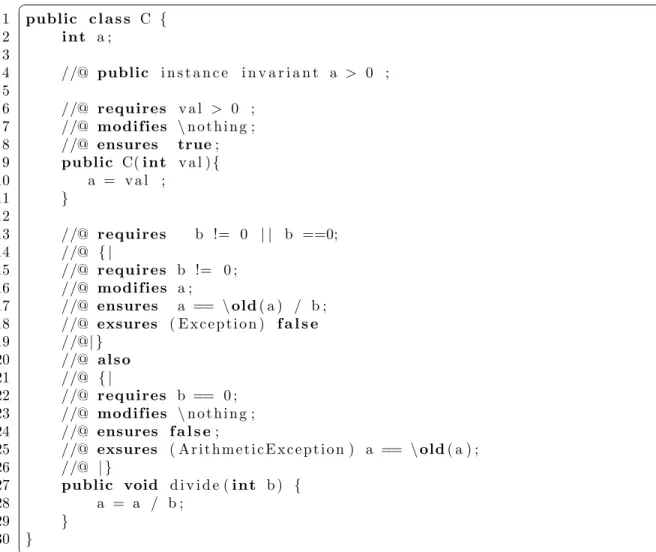
Exceptionisfalse. Similarly, anexceptional behaviorclause guarantees that if its precondition holds then the method terminates on exception and the specified exceptional postcondition will hold, i.e. its ensures clause is alwaysfalse. In case a method has several specification cases, then one of the preconditions of its specification cases must hold when the method starts execu-tion. Moreover, if the precondition of a particular method specification case holds in the method prestate then the postcondition of this specification case must hold.
Fig. 2.5 shows the desugared version of the method specification from Fig. 2.4. As we can see, the specification of the constructor C contains all the specification clauses, where the postcondition is set to the default postconditiontrue. The specification of the method divide does not contain the syntactic sugar normal behavior and exceptional behavior but explicitly specifies the behavior of the method in the two cases. Particularly, it contains now two specification cases surrounded by the tags {| |}. The first one corresponds to the normal behavior case, i.e. the exceptional postcondition is set to false and the second specification case corresponds to the exceptional behavior, i.e. the normal postcondition is set tofalse.
2.2.5
Frame conditions
As we can see in Fig. 2.4 JML allows for specifying a modifies clause for methods. Themodifies clause or also the frame condition declares which are the locations that a method may modify. The example in Fig. 2.2 shows that we also allow frame condition in the loop introduced by the keyword loop modifies. The semantics of the method and loop frame conditions is almost the same except for the fact that a loop frame condition may mention method parameters or local variables. Also, in the case for method frame condition their semantics is part of the method postcondition while the semantics of loop frame conditions can be encoded as part of the corresponding loop invariant.
1 public c l a s s C { 2 int a ; 3 4 //@ public i n s t a n c e i n v a r i a n t a > 0 ; 5 6 //@ requires v a l > 0 ; 7 //@ modifies \n o t h i n g ; 8 //@ ensures true; 9 public C(int v a l ){ 10 a = v a l ; 11 } 12 13 //@ requires b != 0 | | b ==0; 14 //@ { | 15 //@ requires b != 0 ; 16 //@ modifies a ; 17 //@ ensures a == \old( a ) / b ; 18 //@ exsures ( E x c e p t i o n ) f a l s e 19 //@| } 20 //@ also 21 //@ { | 22 //@ requires b == 0 ; 23 //@ modifies \n o t h i n g ; 24 //@ ensures f a l s e; 25 //@ exsures ( A r i t h m e t i c E x c e p t i o n ) a == \old( a ) ; 26 //@ | }
27 public void d i v i d e (int b ) {
28 a = a / b ;
29 }
30 }
Figure 2.5: Desugared specification of the example from Fig. 2.4
In the following, let us look what is the meaning of the loop frame condition. The semantics of a loop modifies list can be encoded as part of the invariant as a condition which states that all the locations not mentioned in the loop modifies list must have the same value at the beginning and at the end state of a loop iteration. We illustrate this by an example. If a loop is specified with an invariantINVand the list of modified locations contains the expression a. f:
1 //@ loop modifies a . f ; 2 //@ loop invariant I ; 3 while ( e ) { 4 . . . 5 }
then the augmented invariant resulting from the desugaring of the modifies clause is :
1 //@ loop invariant I &&
2 //@ \f o r a l l r e f ; r e f != a ==> r e f . f == r e f . f ’ && 3 //@ \f o r a l l g \f o r a l l r e f ; g != f ==> r e f . g == r e f . g’ 4 while ( e ) { 5 . . . 6 }
The first conjunct of the new invariant is the specified invariant I. The second conjunct expresses the fact the value in the field f for every object which is different from the reference a must have
2.2 Overview of JML 15
the same value in the beginning ( ref . f)and in the end of an iteration ( ref . f’). Note that if an expression has the same value at every beginning and end of a loop iteration then it has the same value at the beginning and end of the loop. The third conjunct expresses the fact that the value of any other field g different from f for any object ref changes its value in the beginning and end of a loop iteration. This third part makes the verification of modifies frame conditions difficult as one has to enumerate explicitly all the fields of all the classes which are reachable. We do not discuss further the desugaring of the method modifies clauses in the method’s postcondition as it is the same as for loop modifies clauses.
A very similar treatment of the method and loop modifies clauses is done in Jack both on the Java source and Java bytecode verification condition generators. For method modifies, the difference from the above formula is that the third conjunct is missing as we already said it is difficult to enumerate the whole heap. For loop modifies they are not verified but only assumed for the same reason of keeping the number of verification conditions reasonable.
In [77], the authors report for a change in the formalization of the heap in the verification tool Krakatoa which allows to treat also in a similar way as Jack the modifies clauses for methods. In this article, the authors also describe how to calculate read write effects of methods which allows to construct a reasonable part of the third conjunct above.
May be here we may point out that not only the assertion of modifies clauses play a role in a verification condition but also their assumption. Assuming modifies clauses on method invocation and over the verification conditions for a loop allow to an appropriate verification condition gener-ator to initialize properly the variables or locations that are not modified by the loop or method. Consider the following example for a method m which calculates the sum of the k natural numbers in a loop where k is a method parameter:
1 2 c l a s s A { 3 int f ; 4 //@ requires k >= 0 ; 5 //@ modifies t h i s. f ; 6 //@ ensures \r e s u l t == t h i s. f ∗(t h i s. f +1)/2; 7 public int m(int k ) {
8 t h i s. f = k ; 9 int sum = 0 ; 10
11 //@ loop modifies sum , i ;
12 //@ loop invariant sum == ( i∗( i +1))/2 && i<=k ; 13 for (int i = 0 ; i < k ; i ++) { 14 sum = sum + i ; 15 } 16 return sum ; 17 } 18 }
Before calculating the sum the instance variable a. f is set to the value of the parameter k. Assuming then the modifies clause of the loop allows to initialize properly the value of a. f and to establish that the program is correct w.r.t. the specification. Of course, the verification condition condition generator must propagate the verification conditions up to the entry of the method body. Such a verification scheme based on a weakest precondition predicate transformers allows for writing smaller specifications. Of course, here we could have used a stronger invariant (add in the loop invariant the fact that a. f == k ) but in real programs the number of variables is usually larger than in this small example and the specification burden of the programmer will be inadmissible. Actually, both verification condition generators on Java source and bytecode in Jack propagate the verification conditions related to method correctness up to the method body entry point.
2.2.6
Class specification
JML can be used to specify not only methods but also properties of a class or interface. A Java class may be specified with an invariant or history constraints. An invariant of a class is a predicate which holds at all visible states of every object of this class ). A visible state of an object is basically one of these cases:
1. at the poststate of a constructor where this object is a receiver 2. at the prestate of a finalizer of that object
3. at the prestate and poststate of every method where this object is a receiver 4. in a state when no method, constructor or finalizer of this object is in progress
For a detailed discussion on visible states, the reader may refer to the JML reference manual [67]. An invariant may be either static (i.e. talks only about static fields) or instance (talks about instance fields). The classCin Fig.2.4 has also an instance invariant which states that the instance variable ais always greater than0. A Class history constraints is similar to a class invariant but it does not describe one visible state but rather relates a visible state and any visible state that occurs later in the execution. It can be seen as a transitive relation between the visible states of an object.
Let us now see how instance class invariants can be expressed as method pre and postconditions (the treatment of static class invariants and history constraints has the same features thus, we do not discuss them further but the reader may refer to [67]). From the first case of visible states described above, an instance invariant must be established by the constructor of this class which means that it must be part of the constructor’s postcondition. From the second case it follows that the invariant of an object must be part of the precondition of the finalizers of this object. From the third case it follows that every method (not a constructor neither a finalizer) which has as a receiver an object must have as part of its pre and postcondition the object’s invariant. The fourth case of a visible state implies that every method which does not have as a receiver the object must preserve this object’s invariant. This actually means that every constructor must preserve (has as pre and postcondition) the invariant of all objects except for the receiver object’s invariant which must be only established in the poststate. Similarly, a finalizer of an object must preserve the invariants of all the other objects and include in its precondition the object’s invariant. Also every method must preserve the invariants of the objects of all classes. This actually makes the verification of class invariants a difficult task as the invariants of all objects in the heap must be mentioned in every method’s pre and postcondition (except for the particular cases of constructors and finalizers). When applications are large, the number of verification conditions may be practically unmanageable and thus the verification process may be very hard. Another problem is that the verification is non modular, i.e. extending an application with a new class requires to verify the whole application once again in order to establish that the application does not violate the invariant of the objects of the newly added class. That is why verification tools may make some compromises. In JACK, for instance, constructors in a class Cpreserve the invariants of all objects of classC and establish the invariant of the receiver object of the constructor. Non constructor and non finalizer methods declared in class C preserve the invariant of all objects of classC.
A recent approach which relies on alias control type systems [38, 85] facilitates the verification of invariants and makes it modular. This technique relies on a hierarchy relation of “owner and owned” objects in the heap where only owners of an object may modify its contents. The alias control is guaranteed through ownership type systems which check that only an owner of a reference can modify its contents. Such technique can be used also for the sound treatment of layer object structures [83].
2.3
Program verification using program logic
Now that we have defined the source language and its specification language, let us see what are the possible approaches for verifying that a program respects its specification.
2.3 Program verification using program logic 17
A first possibility is to formalize the semantics of programs and then to perform the verification directly over this formalization. For instance, this was done in a first version of the Loop tool [60] where a denotational semantics for programs was formalized in the theorem prover PVS. However, such a verification needs a lot of user interaction which makes difficult that this approach scale up. Another approach then consists in using an axiomatic semantics of the programming language for the verification process. Axiomatic program semantics has been first introduced by C.A.R. Hoare [53] and is usually known under the name of Hoare logic. A later version of the Loop tool [60] and the interactive Java verification system Jive [79] are examples for Java program verification tools which use a Hoare style reasoning. Hoare logic consists in a system of inference rules defined inductively over the statement structure. The inference rules manipulate Hoare logic triples. A Hoare triple consists of a predicate P re, a statement S and a predicate P ost, such that if P re holds in the initial state ofS, then P ostholds in the final state of S. For denoting such a Hoare triple we use the notation{P re}S{P ost}. Correctness of programS w.r.t. a preconditionP reand postcondition P ost is then established if a derivation tree can be built by applying the inference rule of the Hoare logic over the triple{P re}S{P ost}and the leaves of the tree are either axioms or valid formulas. Validity of formulas in the leaves of a Hoare logic tree is established by a decision procedure or a theorem prover. The inference rules in a Hoare logic are such that their premise states what should hold for the substatements of a statementS in order that the specification for
S holds. Because Hoare logic is syntax directed, reasoning about programs using a Hoare logic is easier than working directly on the semantics of the programming language. However, Hoare style verification needs still a considerable amount of user interaction. For instance, we may consider the Hoare logic rule for the compositional statement given below:
{P re}S1{P ost0} {P ost0}S2{P ost}
{P re}S1;S2{P ost}
The rule states that if there is a predicate P ost0 such that the triples {P re}S1{P ost0} and
{P ost0}S2{P ost}hold then the triple{P re}S
1;S2{P ost}holds. Although the inference rule tells
us what must be proved for the substatements for establishing the correctness of{P re}S1;S2{P ost},
it does not tell which is the predicateP ost0. A user interaction is needed to determineP ost0. This
situation occurs often also with the other rules in the logic. Actually, even for small programs, a lot of human interaction is necessary when using Hoare style reasoning.
Another possibility is to apply a more calculation approach. It consists in an algorithm
wp which from a given postcondition P ost of statement S calculates the weakest predicate
wp(S, P ost) that must hold in the prestate of S. Then, for establishing that S respects a pre-conditionP re and the postcondition P ost it is sufficient to show that P re implies wp(S, P ost), i.e. that the verification condition P re ⇒ wp(S, P ost) holds. The calculation of the weakest predicate can also be a difficult task because the weakest precondition for a while statement of
wp(while(c)S}, P ost) =X is the weakest solution of the following recurrence: (¬c∧X)⇒P ost∧
X⇒c⇒wp(S, X)
Actually, the predicateX is the loop invariant but it is a fact there is no automatic procedure for finding an invariant for any loop. This means that the weakest precondition function can neither be completely automated. However, there do exist techniques for an approximative calculation of invariants: induction -iteration [103] based on iteration of the weakest precondition function over the loop body, predicate abstraction methods [45] using abstract interpretation or dynamic invariant detection (used in the Daikon tool [40]). For instance, the extended static checker for Java ESC/java uses the Daikon tool for inferring loop invariants [87]. Unfortunately, all of these approaches have shortcomings either because the calculation is very intensive and may loop forever (in the first case), because of an under-approximation (as in the second case) or not always returning a result (as in the third case). We can actually “help” thewp by supplying the loop invariants for the loop statements. In that case, the rule ofwp in the case for loop would be :
wp(while(c)[INV]S}, P ost) =
INV∧
(INV∧ ¬c)⇒P ost∧
which makes thewp automated. In this case, although we do not calculate the weakest precondition but a weak precondition it is actually sufficient for our purposes. Note that in the following, we will continue to call the predicate transformer which uses annotations a weakest precondition predicate transformer function.
Note that there also exists a strongest postcondition predicate transformer function which works in a forward direction (contrary to the weakest precondition). However, the strongest postcondition predicate transformer did not gain popularity because of the way it treats assignments. Particu-larly, the strongest postcondition calculus quantifies existentially over the old value of the assigned variable while in a weakest predicate transformer assignments are treated with substitutions. For more detailed information on strongest postcondition calculus the reader may refer to [39]. Us-ing weakest predicate transformers in program verification thus, avoids to deal with Hoare logic inference rules. This means that the user interacts (if needed) only in proving the verification conditions. This approach underlines the extended static checker for ESC/java [72], the Jack tool [28] and Krakatoa [76]. These tools scale up and has been used in verification of real case studies [57, 16, 62].
Another aspect of program verification using logical methods is also whether the verification should be performed directly over the original program or an intermediate language should be used. Let us see what are intermediate languages and how they can be used in the verification scheme. For instance, the simple guarded command language can be used as an intermediate language in the verification procedure. The guarded command language supports only few program constructs but which are sufficiently expressive to encode a rich programming language. If a guarded command language is used in the verification procedure this would mean a stage where bytecode programs are transformed in guarded command language programs. Using guarded command language as an intermediate representation of programs is useful because the verification condition generator can interface and can be extended to interface easily several programming languages. Moreover, if a change in the logic must be made, the change will impact only the constructs of the intermediate language which in the case of a guarded command language are few. Such an intermediate repre-sentation is used in the extended static checker ESC/java ([72]) and the Java verification system Krakatoa [76] which uses the input language of the verification tool Why3. However, we consider
that an intermediate language opens a gap between the verified code and the source code as we verify a program in the intermediate language and not the original source program. Establishing the correctness of a verification systems which uses an intermediate language may be not trivial as the stages of the transformation of the original source program to its encoding in the intermediate language must be also proved correct. In particular, the verification ESC/java tool which uses an intermediate language does not have a proof of correctness [44].
A point that we would like also to discuss here is the use of loop frame conditions. For instance, as we saw from the examples in JML and our source language, we accompany loops not only with loop invariants but with loop frame conditions, i.e. list of locations that may be modified by a loop. Although this complicates slightly the verification condition generator, the loop frame condition is useful as it can work on weaker specification than a verification condition generator which does not support it. This in particular, implies that the burden of writing specification becomes definitely lighter, as the person which specifies an application must identify notthe strongest loop invariant
but a loop invariant. Of course, he should also identify the locations which are modified by the loop (locations that may have different values at the end and at the beginning of a loop iteration). However, modified locations in a loop is easier than identifying the variables not modified in the loop which must be done if we decide not use loop frame conditions.
To conclude, we consider that using predicate transformers for the generation of verification conditions makes the verification condition generator automatic. Moreover, performing the veri-fication directly on the program code is more reliable as it guarantees that the proved program corresponds to the program that we want to prove. Last, we opt for specification which includes frame conditions as this leverages the specification burden.
3
2.4 Weakest precondition predicate transformer for Java like source language 19
2.4
Weakest precondition predicate transformer for Java
like source language
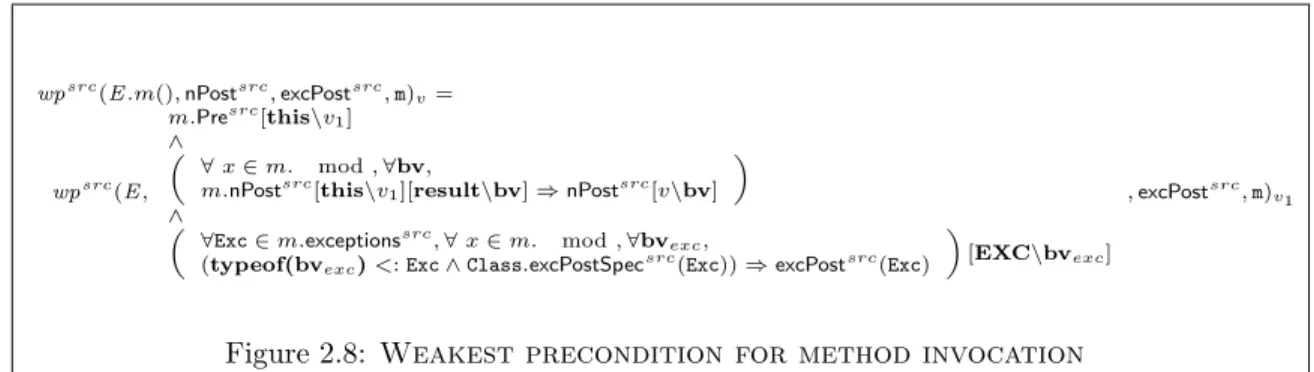
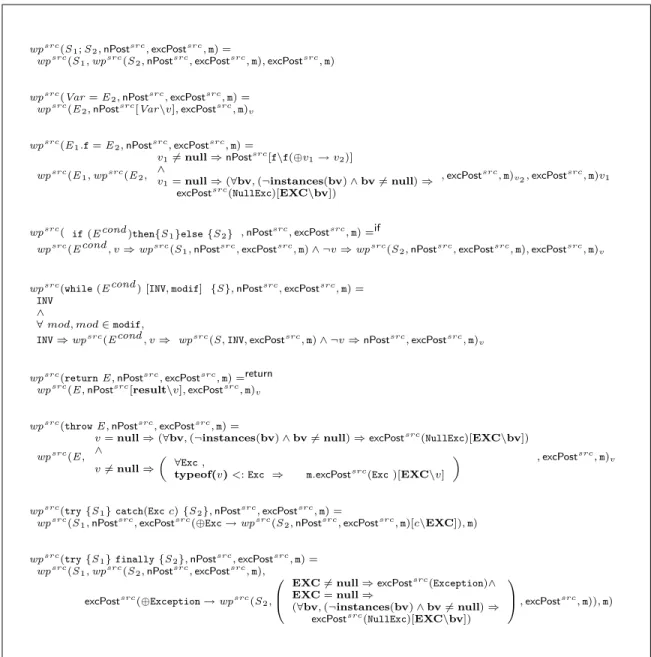
We proceed here with the presentation of the weakest predicate transformer function. We would like first to remark that our predicate transformer deals both with normal and exceptional termination of programs. Among the first works on exceptional termination in weakest precondition predicate transformers is the work of R.Leino [71]. We adopt here a similar approach as the above cited work. Thus, the predicate transformer takes as arguments a statementS, a normal postcondition
nPostsrc and an exceptional postcondition functionexcPostsrc.
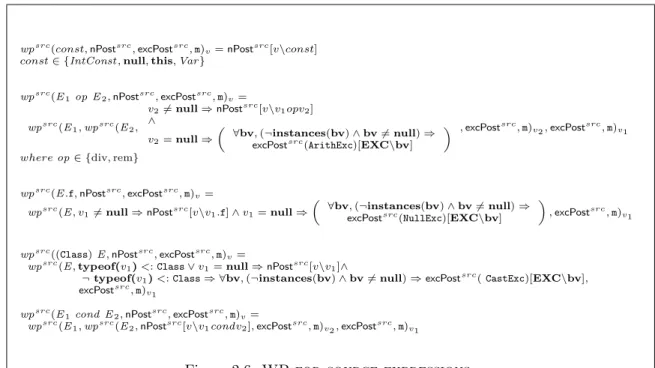
The intended meaning of the predicateW P that should be calculated by a weakest predicate transformer function againstS,nPostsrc andexcPostsrc. The predicateW P must be such that if it holds in the pre state ofS and ifS terminates normally thennPostsrcholds in the poststate and ifS terminates on exception Exc thenexcPostsrc(Exc) holds. The functionexcPostsrc returns the predicateexcPostsrc(Exc) that must hold in a particular program point if at this point an exception of typeExcis thrown.
In the following, we will use function updates for the exceptional postcondition of the form
excPostsrc(⊕Exc0 →P) overexcPostsrc which are defined in the usual way:
excPostsrc(⊕Exc0→P)(Exc) =
P if Exc<: Exc0
excPostsrc(Exc) else
Note that allowing for exceptional termination in the programming language, makes the defini-tion of thewp more complicated than standard definitions of the weakest precondition predicate. Usually, those assume that programs terminate normally. Consider, for instance the standard rule of the weakest precondition predicate transformer over the conditional statement:
wp((E cond)then{S1}else{S2},nPostsrc) =
E cond ⇒wp(S1,nPostsrc)∧ ¬E cond ⇒wp(S2,nPostsrc)
This rule is correct as far as the evaluation of the expression E cond evaluates normally. But in our settings, this is not always the case. For instance, if E cond is the relational expression
a.f>0 andaevaluates tonull the above rule does not capture the semantics of the exceptional termination. As we shall see in the following, the definition presented here will allow us to manage in appropriate way exceptional termination4. In particular, we extend thewp function also over
expressions which makes the predicate calculus sensible to the exceptional and normal termination of the expression evaluation. A similar weakest precondition predicate transformer underlines the verification condition of the Jack verification framework.
In the following, we shall limit ourselves to a simpler specification than described in the previous Section 2.2. Particularly, we shall assume that methods are provided only with one specification case for the sake of clarity. Extending the definitions here to multiple specification cases should not present a major difficulty.
We shall also assume here that frame conditions are correct, i.e. we shall not desugar them into the appropriate specification (postconditions in the case of method frame conditions and loop invariants in the case of loop frame conditions) as described in subsection 2.2.5.
In the following, we give a brief discussion on the substitution over expressions and afterwords, we concentrate on the definition of a weakest precondition predicate transformer function over the source expressions and statements.
2.4.1
Substitution
Substitution is defined inductively in a standard way over the expression and formula structure. Still, we extend substitution to deal with field and array updates as follows:
4
although here, we rule out these cases, such a definition also allows for dealing with side effects of expression evaluation like change the value of a variable or location during the evaluation as for instance is the case for Java expressions like i++