Does high-quality auditing decrease the
use of collateral? Analysis from the perspective
of lenders’ self-protection
Yang Yang
Accounting Department, Zhongnan University of Economics and Law, China
A R T I C L E I N F O
Article history: Received 15 May 2013 Accepted 11 August 2014 Available online 18 September 2014 Keywords: Credit risk Loan collateral Audit quality Ownership structure A B S T R A C T
We examine the association between audit quality and the use of collateral in a sample of Chinese firms from 2005 to 2011. Using the full sample, we docu-ment a negative relationship between audit quality and the use of collateral that is consistent with lenders’ interests. We also show that audit quality and collateral are regarded as alternative means of reducing debt credit risk. Our conclusions are robust after using an auditor-switching test, the Heckman two-stage model and a propensity-score matching model to address endogene-ity issues. China’s institutional background is also considered. First, we find that in the group of firms in which large shareholders are able to control bor-rowers’ activities, the substitution effects between collateral and audit quality are reduced when the degree of separation between large shareholders’ control and ownership is high. Second, these substitution effects are greater when the borrowers’ ultimate controller is a state-owned enterprise (SOE) rather than a non-state-owned enterprise (NSOE). Third, the differences in substitution effects between NSOEs and SOEs are smaller in areas with a high market-development index. We conclude that the substitution effects are smaller in high credit risk firms than in low credit risk firms.
Ó2014 Production and hosting by Elsevier B.V. on behalf of China Journal of Accounting Research. Founded by Sun Yat-sen University and City University of Hong Kong.
1. Introduction
Bank loans play an important role in borrowers’ external financing. Unlike developed foreign markets, China is undergoing economic transition, as its emerging equity market emerged as recently as 1990. In addition, its public
http://dx.doi.org/10.1016/j.cjar.2014.08.003
1755-3091/Ó2014 Production and hosting by Elsevier B.V. on behalf of China Journal of Accounting Research. Founded by Sun Yat-sen University and City University of Hong Kong.
E-mail address:[email protected]
H O S T E D BY Contents lists available atScienceDirect
China Journal of Accounting Research
bond market remains undeveloped, long-term bond financing makes up only a small proportion (less than 5%) of its long-term debt. Therefore, bank loans are still vital to corporate funding in China.Chen et al. (2010)and Chen and Xiao (2012) find that despite the significant growth of China’s equity market, borrowers still rely overwhelmingly on banks to satisfy their need for capital.1Allen et al. (2005)show that the proportion of GDP comprised by bank loans is higher in China than in other developing countries. Moreover, as important intermediaries, banks are vital to the adjustment of the allocation of capital. They provide not only capital loans, but macroeconomic regulation. Chen and Li (2011) show that the industries involved in China’s 5-year support plan have preferential access to capital and exhi-bit better performance than industries not involved in the plan. We know that bank loans are significant not only to borrowers but to policy makers, as they make a large contribution to the development of China’s economy.
Collateral, together with interest rates, debt maturity and other covenants, is widespread in debt contracts. It is used to solve the moral-hazard and adverse-selection problems caused by information asymmetry (Bester, 1985; Chan and Kanatas, 1985; Boot et al., 1991).La Porta et al. (1998)argue that collateral is central to the relationship between lenders and borrowers. Collateral requirements arise from the agency problem that afflicts financial relationships, especially with regard to debt financing. Collateral is not only an ex-ante mech-anism of interest alignment but an ex-post mechmech-anism of control allocation, used to supervise borrowers and
to minimize losses when a borrower defaults on a loan repayment (Aghion and Bolton, 1992).
External auditing is a useful mechanism of both corporate governance and external supervision. High-qual-ity auditing can improve the qualHigh-qual-ity of financial information (Becker and Defond, 1998; Francis et al., 1999; Teoh and Wong, 1993; Qi, 2004; Wu and Li, 2006), increase the transparency of accounting information
(Chen and Wang, 2006) and decrease a company’s capital costs (Khurana and Raman, 2004; Pittman and
Fortin, 2004). In addition, many empirical studies show that when making decisions, lenders consider the
quality of accounting information as well as several key financial measures (Chen et al., 2010; Rao and
Hu, 2005; Goncharov and Zimmerman, 2007). The quality of accounting information also affects the useful-ness of a debt contract (Lu et al., 2008). As important stakeholders, lenders can use high-quality external auditing to decrease credit risk.
However, there is a trade-off between the use of collateral and the necessity of high-quality auditing. Although collateral is determined ex-ante, it may incur the costs of screening and monitoring the pledged assets, as well as disposal expenses and losses due to the sale of specialized assets (Chen et al., 2012). External audit quality may be affected by many factors, such as the purchasing of audit opinion and the collusion of auditors with borrowers, which severely depreciate external audit quality. This is not in the interests of lenders. The question arises of whether lenders use the optimal means to control credit risk when designing debt con-tracts?2We focus on collateral in this study, on the grounds that the total number of bank loans is incapable of reflecting bank-loan restrictions, as bank loans can be divided into collateral, guarantor and credit loans according to their degree of restriction.3We believe that the use of collateral and guarantor loans more accu-rately reflects our expected relationships between lenders and borrowers, leading to more reliable results.Chen (2011)uses credit loans to examine the relationship between auditor reputation and borrowers’ bank loans.
1
Chen et al. (2012)show that the capital raised from banks each year ranged from RMB 1250 to RMB 3100 billion between 2001 and 2006, whereas the capital raised from the stock market during this period was only between RMB 30 and RMB 250 billion a year. Chen andXiao (2012)calculate that the ratios of bank loans and capital raised from the equity market to GDP, and show that the proportion constituted by bank loans is 75 times greater than that of capital raised from the equity market.
2 We regard collateral as a debt contract issue determined ex-ante, as borrowers use their assets or properties to pledge collateral.
Compared with external auditing, collateral is a better way to prevent credit risk. However, neither collateral nor external audit is free of costs, and both have some problems. The aim of our study is to examine the degree to which lenders rely on audit quality, which is reflected in the reduction of collateral.
3 Bank loans can be divided into the following categories, according to their level of restriction: collateral loans, guarantor loans and
credit loans. Collateral involves two kinds of loans, namely pledged loans and mortgage loans. A guarantor loan is a loan for which a third party has joint or guaranteed liability, if the loan defaults. Mortgage loans are bank loans secured on the borrower’s property or the property of the third party. Pledge loans are secured on the borrower’s or third party’s movable property or rights of claim. If the borrower defaults on the loan, the lender is permitted to dispose of the pledged or mortgaged properties to cover their losses and prevent credit risk. Therefore, we believe that collateral and guarantor loans, especially collateral loans are more effective in helping lender to avoid credit risk. We use the proportion of collateral loans in our main tests, and the proportion of collateral and guarantor loans in our sensitivity tests.
We aim to answer two main questions. First, from the perspective of self-protection, how do lenders use collateral and external auditing to minimize credit risks, and are these strategies generally substitutable or
complementary?Black et al. (2004), Nikolaev (2010) andChen et al. (2012) examine this problem, but fail
to reach the same conclusions. Second, how does China’s institutional background affect the relationship between audit quality and collateral? The country’s firms are dominated by large shareholders, shareholders are highly concentrated and lenders are ineffectively protected (Xiao, 2007). Therefore, we consider the extent of large shareholders’ control and the degree of separation of the controlling owner’s control and ownership. We also address the nature of the ultimate controller and the market-development index, as we wish to deter-mine how China’s institutional background affects lenders’ decisions, specifically with regard to the relation-ship between the use of collateral and external auditing.
The first empirical study of the ultimate controller and the agency problem between controlling owners and minority shareholders was conducted byLa Porta et al. (1999). Researchers examining the role of large
share-holders tend to hold two distinct views: one set of researchers emphasize alignment effects (Kanga and
Shivdasani, 1995; Kahn and Winton, 1998), the other highlights entrenchment effects (Claessens et al., 2000).Xiao (2007) and La Porta et al. (1999)find that borrowers have a highly concentrated, rather than dis-persed ownership structure, especially in developing countries. A large shareholder leverages control through stock pyramids or cross-shareholdings while keeping his or her level of ownership low, which results in a high level of separation between control and ownership (Luo and Tang, 2008; La Porta et al., 1999). The motivation for separating control and ownership has two further dimensions, depending on the role of the large
share-holder. First, alignment and risk-diversification (Pan and Yu, 2012); and second, the agency problem and
entrenchment (Claessens et al., 2002;Johnson, 2000). Although the separation of control and ownership has
a considerable influence on the agency problem between large shareholders and minority shareholders (Su
and Zhu, 2003; Yu and Xia, 2003a, 2003b), we should also consider the basic premise that the large shareholder has a high level of control (Pan and Yu, 2012;Fan and Wong, 2002; Morck et al., 2005). If we directly examine the relationship between the agency problem and the separation of control and ownership, without considering this important premise, we may draw unreliable conclusions. Therefore, we need to determine whether the large shareholder has a high level of control, before examining the relationship between the agency problems and the separation of control and ownership.Xiao (2007)and Chen and Wang (2010) note that the ultimate controller may be either a state-owned or non-state-owned borrower. SOEs and NSOEs have many different character-istics (Cull and Xu, 2005;Chen et al., 2010; Fan et al., 2007; Lin and Li, 2004). For instance, SOEs have more opportunities than NSOEs to obtain capital, but face a lower credit risk (Allen et al., 2005; Guariglia et al., 2011). Unlike the developed markets in Western countries, China’s regional economic development is unbal-anced, with vast differences between regions in terms of legal development and marketization (Yu and Pan, 2008;Fan and Wang, 2009). With greater legal development and marketization, decisions regarding bank loans
are more marketized, and more independent of government power (Jiang and Li, 2006;Fang, 2007; Yu and
Pan, 2008a, 2008b; Wei and Shen, 2009). As a result, SOEs face greater credit risk.
We find that the use of collateral and high-quality external auditing are regarded as substitutes by lenders making decisions about bank loans. We notice that in the group of firms whose large shareholders are capable of controlling borrowers, these substitution effects are reduced when the degree of separation of control and ownership is high. In the other group, however, the substitution effects are not found to increase. We show that the substitution effects between collateral and high-quality auditing are greater in SOEs, but we also prove that a higher market development index can reduce the differences between SOEs and NSOEs.
This study makes several potential contributions to the literature. First, we take a novel perspective in examining how lenders protect themselves by influencing borrowers’ activities through high-quality auditing and collateral requirements. Most prior studies have addressed this problem from the borrower’s perspective, and conclude that high-quality auditing helps borrowers to obtain bank loans and reduce the cost of borrow-ing. For example,Hu and Tang (2007)notes the relationship between interest rates and auditing.Liao et al. (2010) use going-concern opinions to examine the role of auditors. Our results show that lenders use high-quality auditing and collateral requirements to influence borrowers’ actions; high-high-quality auditing and collat-eral are regarded as substitutes, and their substitution effects are adjusted according to the credit risk of the borrower, which depends on the institutional environment. Second, our study enriches the existing literature on the determinants of collateral. Prior researchers note that collateral is affected by the degree of information
asymmetry (Brick and Palia, 2007; Chakraborty and Hu, 2006;Jimenez et al., 2006), the relationship between lenders and borrowers (Sharpe, 1990; Rajan, 1992), the level of competition in the loan market (Besanko and Thakor, 1987), and the costs (benefits) of screening borrowers (Manove and Padilla, 1999; Manove et al., 2001). We note that high-quality external auditing decreases the use of collateral and that the extent of this decrease depends on the level of credit risk. Third, our study contributes to existing research on large share-holders’ separation of control and ownership. Although Prior researchers have used the separation of control and ownership to examine entrenchment, agency or alignment effects, few studies have addressed its financial consequences, such as the cost of borrowing. Lin et al. (2011) sample firms from a number of foreign coun-tries’ to examine the relationship between the degree of separation of control and ownership and the cost of borrowing, as reflected in interest-rate spreads. We divide our sample into two groups to examine the influence of the degree of separation of control and ownership on the relationship between collateral and high-quality auditing. Our results indicate that in high control group, the substitution effects between collateral and high-quality auditing are only weakened when the degree of separation of control and ownership is high. However, we do not find these effects to be stronger in the low-control group, when the degree of separation of control and ownership is high. Our evidence offers insight into the incentives for and consequences of large sharehold-ers’ separation of control and ownership. Finally, followingArmstrong et al. (2010) and Skinner (2011), we examine the interaction between various aspects of debt contracts to determine, specifically, whether they are substitutable or complementary. We seek to ascertain whether various mechanisms are used as alternatives or complements. Prior researchers have noticed the relationships between collateral and other contracting issues and characteristics and the quality of accounting (Zhang, 2008; Nikolaev, 2010; Chen et al., 2012;
Black et al., 2004). The focus of our study is the use of an external monitoring mechanism, namely, external auditing. We examine the relationship between external auditing and the use of collateral, and then investigate the effects on this relationship of different levels of credit risk.
The rest of the paper is structured as follows. We develop our hypotheses in Section 2, and present the research design, sample selection and data in Section3. We present the results of our main tests in Section4
and results of our sensitivity tests in Section5. Section6concludes the study.
2. Development of hypotheses
According to contract theory and agency theory, an enterprise is formed from the combination of various kinds of contracts. During the design and implementation process, proper monitoring mechanisms should be used to align stakeholders’ interests (Jensen and Meckling, 1976). The focus of our study is the agency prob-lem between lenders and borrowers, whose conflicts of interest mainly concern asset substitution (Jensen and Meckling, 1976), under-investment (Myers, 1977) and equity delusion (Smith and Warner, 1979), specifically the fear that borrowers will expropriate lenders. The aim of our study is to determine whether a lender will adjust the use of collateral when he or she knows the borrower’s audit quality, and whether the degree of adjustment is always the same.
2.1. Collateral and audit quality
From the perspective of self-protection, agency costs can be decreased by using alignment mechanisms to solve the agency problem between lenders and borrower. Collateral and external auditing are two such mech-anisms. The use of collateral is necessitated by information asymmetry between lenders and borrowers, and is
a common component of bank loans (Yang and Qian, 2008).Bester (1985)andChan and Kanatas (1985)find
that in conditions of information asymmetry, collateral can reduce interest rates and may be regarded as a
signal of better credit quality. Many researchers have focused on the role of external audit. Becker and
Defond (1998)and Francis (1999) note that the clients of Big-four audit firms have lower discretional accruals than the clients of non-Big-4 firms. Qi et al. (2004) andWu and Li (2006)test the Big-4 measure of audit qual-ity and find that the Big-4 audit firms do provide a high audit qualqual-ity.Teoh and Wong (1993)note that clients of the Big-4 have a higher earnings-response coefficient than clients of other audit firms.Khurana and Raman (2004)report that the use of a Big-4 firm can reduce the cost of both equity capital and debt (Pittman and
Fortin, 2004). These researchers argue that external auditing can improve the quality of borrowers’ financial information and decrease information risks, helping lenders to make decisions.
In addition, lenders that pay serious attention to borrowers’ financial information are found to make better decisions (Goncharov and Zimmerman, 2007), and thus alleviate credit risk.Chen et al. (2010)find that many
debt contracts are available, based on different accounting measures.Rao and Hu (2005)document the roles
of financial measures and accounting information in lenders’ decision making, and show that lenders fre-quently consider borrowers’ information. Grama et al. (2008) find that lenders are likely to give more severe debt contracts to borrowers involved in financial restatements.Lu et al. (2008)report that earnings manage-ment impairs the effectiveness of debt contracts.
In addition,Chen et al. (2012)show that the use of collateral incurs the costs of screening and monitoring the pledged assets, as well as disposal expenses; it also brings lenders’ losses due to the sale of specialized assets.Manove and Padilla (1999)observe that lenders generally seek to give capital to high-quality borrow-ers, but when costs, benefits and the level of competition are taken into consideration, lenders’ decisions are unlikely to be so prudential; even in an undeveloped bank-loans market, lenders regard the use of collateral as a substitute for ineffective monitoring (Manove et al., 2001). When designing debt contracts, do lenders use the optimal means to control credit risk? Does the tradeoff between costs and benefits influence lenders’ decisions? Finally, the relationship between debt contract issues and other mechanisms remains an empirical problem.
Hu and Tang (2007) documents that higher-quality audit opinions and larger auditor offices reduce interest rates and increase the maturity of debt.Chen (2011)finds that auditors’ reputation the number and proportion of borrowers’ credit bank loans increases as the auditor’s reputation increases.Black et al. (2004)use a
bank-industry sample to prove that external regulation and debt covenants are substitutable, whereas, Nikolaev
(2010)finds that conservatism and debt covenants are complementary.Chen et al. (2012)show that lenders generally regard collateral and conservatism as substitutable, but when the borrower has a low credit quality or a high proportion of intangible assets, the lender will reverse this assumption, regarding collateral and con-servatism as complementary. As the studies above are not in complete accordance, we rely on our empirical analysis to identify the more accurate of the following two alternatives.
H1a. Collateral requirements are positively related to high-quality external auditing. H1b. Collateral requirements are negatively related to high-quality external auditing.
2.2. Collateral, separation of control and ownership and audit quality
The first empirical studies of the ultimate controller and the agency problem between controlling owners and minority shareholders were conducted by La Ports et al. (1999) and Shleifer and Vishny (1997, 1999). According toLa Porta et al. (1999)the agency problem that arises between large shareholders and minority shareholders has become more severe than that between shareholders and managers. Researchers examining the role of large stockholders tend to emphasize either alignment effects or entrenchment effects (Claessens et al., 2000).Kanga and Shivdasani (1995)note that large stockholders can alleviate the“free-rider”problem associated with minority shareholders, and large shareholders have an incentive to monitor managers (Kahn and Winton, 1998). Theses scholars conclude that the presence of large shareholders can improve corporate governance by preventing managers from acting in their self-interest. However, these studies are based on the ownership structure of U.S. firms, which are highly dispersed. Samples of firms from other countries show that ownership structures in these areas are not dispersed but highly concentrated, especially in developing countries (La Porta et al., 1999; Franks and Mayer, 1998; Cronqvist and Nilsson, 2003).Xiao (2007) notes that Chinese firms have a highly concentrated ownership structure, usually dominated by a single large stock-holder. This large shareholder has the incentive to leverage control through stock pyramids or cross-share-holdings while minimizing his or her ownership, which results in a high level of separation of control and ownership (Luo and Tang, 2008; La Porta et al., 1999). This separation of control and ownership has received considerable attention from scholars. The empirical research pertaining to the incentives for and consequences of separating control and ownership can be divided into two groups. The researchers in the first group agree that a high level of separation of control and ownership can result in an alignment of interests by encouraging
the monitoring of managers. They show that under these conditions, a small amount of capital is required to supervise a large number of managers, due to diversification. This reduces investment risk (Pan and Yu, 2012). The researchers in the other group document that a large degree of separation of control and ownership can help large shareholders to expropriate from minority shareholders through tunneling activities, leading to
agency or entrenchment effects (Johnson et al., 2000). Su and Zhu (2003) observe that large stockholders
can cause severe agency problems for borrowers, as large shareholders may expropriate from minority share-holders by increasing their separation of control and ownership. This increases both credit risk and the like-lihood of remaining in financial distress (Lin et al., 2011).
However, directly examining the relationship between the agency problem and the degree of separation of control and ownership without considering the control rights of the large shareholder may lead to unreliable results.Fan and Wong (2002) and Morck et al. (2005)document that the large shareholder can only engage in tunneling activities to gain private benefits and thereby reduce company value if he or she has considerable
control rights. Majority control may even be required. Pan and Yu (2012) concur that substantial control
rights are required for a large shareholder to engage in tunneling; also they show that the degree of entrench-ment and alignentrench-ment differs according to the level of control. Shleifer and Vishny (1997) find that when a large shareholder is capable of controlling the borrower, he or she is more likely to force a manager to engage in asset substitution and expropriate from the lender. However, the authors also show that this would result in a high credit risk and increase the likelihood of remaining in financial distress (Lin et al., 2011).We thus predict that in the high-control group, the entrenchment and agency effects will be stronger than the alignment effects when the degree of separation of control and ownership is high, resulting in higher credit risk. In con-trast, we predict the alignment effects will be stronger than the entrenchment and agency effects in the low-con-trol group when the degree of separation of conlow-con-trol and ownership is high. We thus expect a high degree of separation of control and ownership to improve corporate governance, as it may encourage large shareholders to monitor managers and improve the efficiency of investment.
From the perspective of lenders’ self-protection and considering the tradeoff between costs and benefits, a lender is more likely to regard external auditing and collateral as substitutes for a borrower with lower credit risk when a borrower chooses a high-quality auditor. In this way, the lender can minimize risk. Even when the borrower’s credit risk is extremely high, the lender is able to regard external auditing and collateral as com-plementary. We thus test the following hypotheses empirically.
H2. When the large shareholder is able to control the borrower and the degree of separation of control and ownership is higher, the substitution effects between collateral and high-quality auditing are weaker. H3. When the large shareholder is unable to control the borrower and the degree of separation of control and ownership is higher, the substitution effects between collateral and high-quality auditing are stronger. 2.3. Collateral, nature of controller, market development and audit quality
There are two distinct groups of Chinese firms: state-owned enterprises (SOEs) and non-state-owned enter-prises (NSOEs). Since 1978, China has sought to convert SOEs from firms whose sole proprietor is the state to modern Western-style corporations (Cull and Xu, 2005). Although many decision rights have been delegated to the corporatized SOEs, the government retains the ultimate rights to make decisions about the disposal of assets and mergers and acquisitions undertaken by listed firms, as well as the right to appoint the CEOs. As SOEs lack the right to dispose of state assets, they are subsidized by the government when they face financial distress. Nevertheless, the CEOs of SOEs have multiple responsibilities (Chen et al., 2010). The promotion and compensation of CEOs of SOEs’ are determined more by their success in fulfilling various political and social objectives than by their firms’ operating and accounting performance (Fan et al., 2007). Li and Li (2004) find that SOEs face more divergent policy burdens than NSOEs, which lead to soft-budget constraints. The implicit insurance provided by the government and its control over state-owned banks are important sources of existing soft-budget constraints. Despite these constraints, SOEs have a lower credit risk. First, as the Chinese govern-ment has been engaged in the corporatization or partial privatization of these enterprises, it has an incentive to ensure that they remain financially sound. Second, the competition for listing in China is extremely intense;
SOEs must perform better than other firms to be chosen to list. A number of studies provide evidence that com-pared with NSOEs, SOEs have preferential access to capital; specifically, they have more opportunities to obtain capital and their capital costs are lower (Allen et al., 2005; Ayyagari et al., 2010; Guariglia et al., 2011). Unlike the developed markets in Western countries, China’s regional economic development is unbalanced; there are substantial differences between regions in terms of legal development and marketization (Yu and Pan, 2008;Fan and Wang, 2009). This makes China’s institutional setting a natural forum in which to study the relationship between market development and the differences in substitution effects between SOEs and
NSOEs (Wang et al., 2008). Jiang and Li (2006) note that when the government has little power over bank
loans and financing activities are well developed, the differences between SOEs and NSOEs in terms of bank
loans are reduced. According toFang (2007), decision making regarding bank loans is more marketized and
independent when the institutional environment is improved, government power over bank loans is decreased and soft-budget constraints are relaxed. Under such conditions, lenders are likely to give SOEs more severe debt contracts, alleviating the financial discrimination associated with the nature of ownership.Yu and Pan (2008a)find that NSOEs’ political relationships may affect bank loans and that these effects are stronger when the levels of financing and legal development are low. SOEs’ bank loans are negatively related to the levels of
financing and legal development, which contradicts the findings of La Porta et al. (1998) in “Law and
Finance.” Wei and Shen (2009)find that when the degree of government intervention is high, SOEs are less
able to obtain credit loans when lenders are well protected. We expect an increase in market development to decrease the supportive effects of government intervention in SOEs’ bank loans.
When SOEs choose high-quality auditors, lender decrease their collateral requirements to reduce credit risk; the degree of adjustment is also larger for SOEs than NSOEs. With the development of the market envi-ronment, the degree of government intervention in lenders’ decisions decreases, which increases the credit risk faced by SOEs. In a region with more developed markets, the gap in collateral requirements between SOEs and NSOEs is smaller than that in less developed regions. We thus test the following hypotheses empirically.
H4. The substitution effects between collateral and high-quality auditing are stronger in SOEs than NSOEs.
H5. When market-development index is higher, the enhancement effects of SOEs are weaker.
3. Research design
3.1. Measurement of main variables 3.1.1. Measurement of collateral
Collateral is the proportion of collateral loans, that is calculated as the ratio of total loans collateralized to total loans outstanding at the end of the year. We do not use a dummy variable for collateral. The information on bank loans is obtained from financial statements. In the main tests, we use the proportion of collateral loans to measure collateral; in the sensitivity tests, we use the proportion of collateral loans plus that of guarantor loans.4 3.1.2. Measurement of audit quality
Researchers have used a range of variables to measure audit quality, such as the size of the office (reputa-tion) (DeAngelo, 1981). Clients of Big-4 audit firms have lower discretional accruals and higher earnings
response coefficients than the clients of non-Big-4 firms (Becker and Defond, 1998; Francis, 1999; Teoh
and Wong, 1993). Following Hu and Tang (2007)and Wu (2006) we use accounting-firm size as a dummy variable to measure audit quality. If the firm is in the Big-4 or Big-10, the dummy variable is 1; otherwise, it is 0. However, some researchers regard accounting-firm size as a poor proxy for audit quality, and it is
4
Bank loans can be divided into collateral loans, guarantor loans and credit loans, according to their level of restriction. The use of collateral involves two kinds of loans: pledged loans and mortgage loans. We use the proportion of collateral loans to measure the use of collateral. Some scholars use the proportion of collateral and guarantor loans to measure collateral (Chen and Xiao, 2012), and we have
noticed that the information on bank loans disclosed in financial reports, sometimes are related to “collateral and guarantee loans.”
Therefore, we use the proportion of collateral loans to measure collateral in our main tests, and the proportion of collateral and guarantor loans in our sensitivity tests. Our predictions are generally well supported.
misleading to homogenize the audit quality of the Big-4, due to differences in the institutional environment (Liu and Zhou, 2007). We use discretional accruals to solve these problems. First, we divide the full sample into two groups according to audit quality and then compare the means of the two groups to determine whether the differences are significant.
3.2. Main test models
In H1aand H1b, we predict that collateral and audit quality are negatively and positively related,
respec-tively. We use the models developed byRajan and Zingales (1995)andChen et al. (2012)to test these hypoth-eses, as follows.5
Model 1:
Collateralt¼a0þa1Auditt1þa2Soetþa3Wedgetþa4Levtþa5Sizetþa6Roatþa7Intcovt
þa8Growthtþa9Currenttþa10Agetþa11Guarantþa12Ltdebttþa13Goet
þa14Intangibletþa15Cfovoltþa16Debtcovtþa17Salescashtþai;jYeari;jþai;jIndi;jþei;j
We expect the sign ofa1to be significantly negative or positive. In Model 1, we use Soe as a control variable
because we expect SOEs to be less likely than NSOEs to provide collateral for their debt. We thus expect the sign of Soe to be negative. We also include leverage and the percentage of long-term debt in Model 1, because we expect these variables to be positively related to collateral. To address firm performance, operational risk and solvency, we add the following variables in Model 1: return on assets, natural logarithm of total assets, interest-coverage ratio, growth of assets and current ratio. We also use the number of years since the firm’s establishment to control for the bank-firm relationship, because the results of previous literature indicate that the bank-firm relationship can solve the information-asymmetry problem and decrease the use of collateral. However, others believe that banks’ information superiority enables them to ask for high interest, thereby exacerbating the agency problem. Therefore the relationship between collateral and age is expected to be either negative or positive. We predict that the sign of the market-development index, a proxy for market develop-ment, will be positive, because the higher the level of competition, the more likely the use of collateral. We use the percentage of intangible assets, the volatility of net operating cash flow, the debt coverage and the sales cash flow ratio to control for the ability to provide collateral and the operating cash flow. Finally, we use year and industry dummy variables to control for year and industry factors.
Model 2:
Collateralt¼a0þa1Auditt1þa2Wedgetþa3Auditt1Wedgetþa4Soetþa5Levtþa6Sizetþa7Roat
þa8Intcovtþa9Growthtþa10Currenttþa11Agetþa12Guarantþa13Ltdebttþa14Goet
þa15Intangibletþa16Cfovoltþa17Debtcovþa18Salescashtþai;jYeari;jþai;jIndi;jþei;j
We use Model 2 to examine H2 and H3. We predict that if the large shareholder has a high level of control, a3will be significantly positive; if the large shareholder has a low level of control, we expecta3to be
signif-icantly negative. Model 3:
Collateralt¼a0þa1Auditt1þa2Soetþa3Wedgetþa4Auditt1Soetþa5Auditt1SoetGoet
þa6Levtþa7Sizetþa8Roatþa9Intcovtþa10Growthtþa11Currenttþa12Aget
þa13Guarantþa14Ltdebttþa15Goetþa16Intangibletþa17Cfovoltþa18Debtcovt
þa19Salescashtþai;jYeari;jþai;jIndi;jþei;j
5
In accordance with the reviewers’ suggestions, we use the debt-coverage ratio to proxy for cash flow, because lenders pay considerable attention to cash flow. We also use the percentage of intangible assets to control for the borrowers’ ability to provide collateral. In addition, we adjust the framework of our main results in the following ways. First, we test the significance of H1. Second, we use a measure of auditor change, Heckman two-stage model and the PSM technique as robustness tests and to address endogeneity issues. Finally, we use Model 2 and Model 3 to test H2, H3, H4 and H5.
We use Model 3 to examine H4 and H5, in which we predict that a4will be significantly negative anda5
significantly positive, respectively. 3.3. Sample selection and data
We use a sample of listed A-share Chinese firms from 2005 to 2011. Our sample selection process is as fol-lows. First, we omit the ST,*ST and PT firms, as they are fail to provide the necessary information to examine the relationship between collateral and high audit quality. Next, we omit firms from the finance industry, because these do not fit our aims of examining bank loans. We then omit firms with listings later than 2006 and firms with fewer than three firm-year observations. In addition, we omit firms whose ultimate con-trolling shareholder cannot be identified. Finally, we eliminate observations that provide insufficient data to calculate audit quality or Z-scores, firms with zero bank loans, and firms for which we are unable to identify major loan sources or the number of collateral loans at the end of the year. After eliminating these observa-tions, we have 4877 observations from 828 firms, of which SOEs comprise 3148 observations and NSOEs pro-vide 1729.6We winsorize several of the control variables at the 1% level. Our data on collateral and guarantor loans, audit quality, ultimate controlling shareholders and other financial details are obtained from the
Chi-nese Stock Market and Accounting Research (CSMAR) database (seeTable 1).
4. Empirical results
4.1. Descriptive statistics for main variables
Table 2provides the descriptive statistics for the main variables.
Table 2reveals that the mean of proportion of collateral in the full sample is 0.420, which differs fromChen et al.’s (2012)results of 0.262 for a sample of firms from 2001 to 2006.The mean of proportion of collateral and guarantor loans together is 0.74, which is consistent with Chen and Xiao’s (2012) findings. This result indicates that collateral and/or guarantor loans are widespread in debt contracts. Firms with a high audit quality com-prise 30% of our sample; that is, appropriately one third of the firms sampled have chosen international Big-4 or domestic Big-10 auditors. SOEs comprise 64.5% of the sample. There are large differences between the max-imum and minmax-imum values for the other control variables, such as, interest coverage, market development, number of years since the firm was established and separation of control and ownership. This result indicates that these characteristics differ between firms, which are consistent with the literature.7Our descriptive statis-tics for the main variables are generally consistent with those presented byChen et al. (2012).
Table 3lists the descriptive statistics for firms divided according to audit quality.
Table 3displays the differences in means between the groups and the results oft-tests. The mean discretion-ary accruals differ significantly between the groups, which suggest that our choice of criteria to build the high audit quality variable is appropriate for our sample. The proportion of collateral is significantly higher in the low audit quality group than in the high-quality group. This is preliminary proof of Hypothesis 1, in which we predict that collateral and audit quality are regarded as alternatives. We also find that with the exception of the current ratio, proportion of guarantor loans, leverage and separation of control and ownership, the mean of the variables are significantly higher in the high audit quality group, than in the low-quality group.
Table 4 lists descriptive statistics for the dummy variables for separation of control and owner-ship, large shareholders’ control rights and market development.
6 The sample used in the draft paper comprised 4919 observations. Following the reviewers’ recommendations, we have added several
variables to our model, and thus have lost 42 observations (due to missing data) to give 4877 observations, of which 3148 pertain to SOEs and 1729 to Non-SOEs.
7
These results are not winsorized, because we use dummy variables for market development and separation of ownership and control in the main tests. The reviewers also note the problems with the interest-coverage ratio and the measure of separation of ownership and control. In the descriptive statistics, we state that a continuous variable is used to represent the degree of separation of ownership and control, with a mean of 6.783. The mean degree of separation of ownership and control is thus 6.783%. The data are collected directly from the CSMAR database and our method is as described by La Porta (1997). The interest-coverage ratio is calculated as= EBIT/interest expenses.
Table 1
Definitions of variables.
Variables Definitions
Collateral Collater1: proportion of collateral loans in total outstanding loans at the end of the year
Collater2: proportion of collateral and guarantor loans at the end of the year
Audit Auditor dummy variable, equal to 1 if the auditor was an international Big-4 or domestic Big-10 firm in the previous year,
and otherwise 0
Discretional accruals in the previous year, calculated from the modified Jones model
Change Change1: auditor-change dummy variable, equal to 1 if the client has switched from a international Big-4 or
non-domestic Big-10 audit firm to an international Big-4 or non-domestic Big-10, and otherwise 0
Change2: auditor-change dummy variable, equal to 1 if auditor has switched from an international 4 or domestic Big-10 audit firm to another auditor, and otherwise 0
Wedge Dummy variable for separation of control and ownership. Mean, median and the 2/3 measure are used as criteria to
classify the variable. In the main tests, we use the 2/3 measure as the criterion; in the sensitivity tests, we use mean and median as the criteria
Wedge1 Continuous variable of separation of control and ownership
Control Dummy variable for large shareholders’ level of control, with 25% and 30% as criteria. In the main tests, we use the 30%
measure to distinguish between high and low control rights levels; in the sensitivity tests, we use 25% as the criterion
Current Current ratio, calculated as current assets divided by current liabilities
Lev Leverage, calculated as total assets divided by total liabilities
Intcov Interest-coverage ratio, calculated as income before interest and tax expenses divided by interest expenses
Roa Return on assets at the end of the year
Ltdebt Percentage of long-term debt, calculated as the ratio of long-term debt to total loans outstanding at the end of the year
Guaran Proportion of guarantor loans, calculated as the ratio of guarantor loans to total loans outstanding at the end of the year
Size Natural logarithm of total assets at the end of the year
Soe Nature of the controller, which equals 1 if the firm is an SOE, and otherwise 0
Age Number of years since the firm was established.
Geo Dummy variable for market development; mean, median and a 2/3 measure are used as criteria. In the main tests, we use
the median as our criterion; in the sensitivity tests, we use the median and the 2/3 measure as criteria
Geo1 Continuous variable of market development.
Growth Growth in total assets, calculated as the difference between ending total assets and beginning total assets, divided by
beginning total assets
Intangible Proportion of the intangible assets at the end of the year
Cfovol Standard deviation of the net operating cash flow in the previous three years, a proxy for volatility of operating cash flow
Debtcov Debt-coverage ratio, calculated as the total amount borrowed divided by the net operating cash flow, a proxy for operating
cash flow
Salescash Sales cash flow ratio, calculated as operating income divided by net operating cash flow, a proxy for operating cash flow
Table 2
Descriptive statistics.
Variables Mean Min. Median P75 Max.
Collateral 0.420 0 0.344 0.761 1 Auditor 0.297 0 0 1 1 Soe 0.645 0 1 1 1 Wedge1 6.801 0 0.514 13.59 44.48 Guaran 0.319 0 0.221 0.580 1 Ltdebt 0.321 0 0.249 0.550 1 Ltdebt 8.462 0.380 8.420 10.42 11.80 Geo1 0.129 0.353 0.0898 0.219 1.086 Lev 0.560 0.189 0.559 0.668 1.399 Roa 0.0332 0.181 0.0294 0.0574 0.211 Size 21.74 19.13 21.65 22.41 24.81 Current 1.204 0.191 1.099 1.470 3.727 Age 12.83 5 13 16 23 Intcov 8.524 11.92 3.534 7.935 131.6 Cfovol 0.0410 0.00224 0.0304 0.0527 0.328 Intangible 0.0490 0 0.0306 0.0614 0.354 Debtcov 0.104 0.499 0.0861 0.177 1.414 Salescash 0.0803 1.596 0.0731 0.160 0.962
We use various criteria to build our dummy variables. With regard to the degree of separation of control and ownership, the mean and 2/3 values do not differ significantly between the groups. Neither the mean nor the 2/3 values are significantly different for market development. When 25% is chosen as a criterion, high-con-trol firms represent 73.7% of the sample, whereas the 30% criterion yields 60.2% of high-conhigh-con-trol firms. There-fore, we use 30% as the criterion in the main tests, and 25% in the sensitivity tests.
4.2. Correlation coefficients of main variables
Table 5lists the correlation coefficients of the main variables.
The results displayed in Table 5show that the correlation between collateral and audit quality is negative (0.1638), which is consistent with our prediction. SOEs are less likely than NSOEs to pledge collateral (0.2491), which makes them better able to obtain credit loans. Moreover, SOEs have longer debt maturity, which is reflected in the high proportion of long-term debt (0.0593). Our results support the conclusion that long-term debt is more difficult to monitor than short-term debt. We find the level of market development to be negatively related to collateral (0.0995), which indicates that when lenders are better protected, borrowers are less likely to pledge collateral. Debt maturity is significantly longer in the high audit quality group than in the low-quality group (0.0922), which proves that external auditing may affect borrowers’ debt maturity. Despite the high correlation between collateral and guarantor loans (0.5628), the other data are reasonable; there is no evidence of multicollinearity.
4.3. Main results
After controlling for year and industry factors, we use Model 1, 2 and 3 to examine H1, H2, H3, H4 and H5. First, we use Model 1 to test H1; next, we use auditor switching, the Heckman two-stage model and pro-pensity-score matching (PSM) as robustness tests; finally, we use Model 2 and 3 to test H2 to H5.
4.3.1. H1 and endogeneity issues
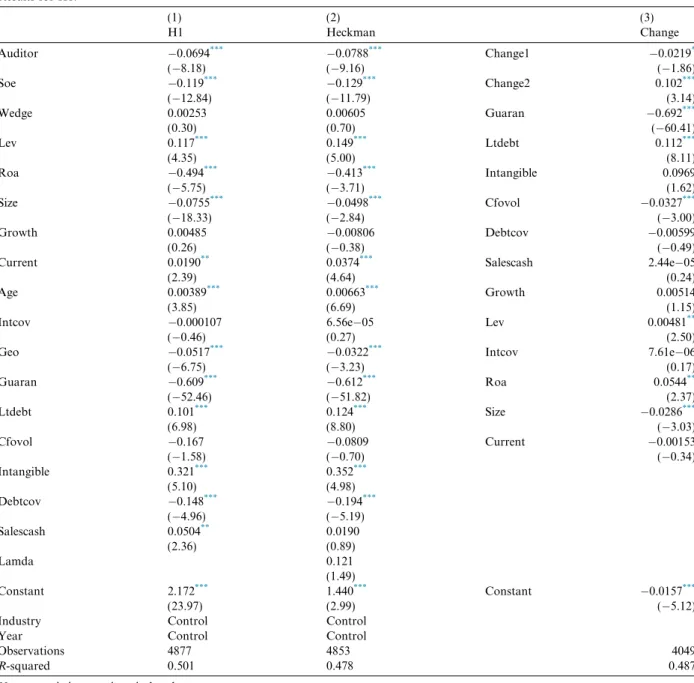
Tables 6 and 7list the results of testing H1 and the sensitivity tests. The first column displays the results for Model 1. We find the relationship between collateral and audit quality to be significantly negative at the 1% level (0.0649, t-stat. =8.18). Thus, H1b is supported, because collateral and high-quality auditing are
Table 3
Descriptive statistics by audit quality.
Variables Auditor = 0 Auditor = 1 Diff. in mean t-Test
Mean Median Mean Median
DA 0.106 0.078 0.096 0.077 0.010 3.020*** Collateral 0.459 0.403 0.329 0.228 0.130 11.59*** Soe 0.621 1 0.704 1 0.083 5.586*** Wedge1 6.727 0.590 6.978 0.411 0.251 0.913 Geo 8.348 8.140 8.732 8.770 0.384 5.981*** Guaran 0.316 0.213 0.325 0.237 0.009 0.877 Ltdebt 0.303 0.226 0.364 0.319 0.061 6.463*** Growth 0.118 0.078 0.155 0.117 0.037 5.059*** Lev 0.559 0.555 0.563 0.566 0.006 0.766 Roa 0.031 0.027 0.040 0.035 0.009 5.322*** Size 21.57 21.52 22.17 22.03 0.600 17.76*** Current 1.202 1.093 1.209 1.115 0.007 0.367 Age 12.48 12 13.66 13 1.180 9.724*** Intcov 8.045 3.333 9.658 4.073 1.613 2.802*** Cfovol 0.043 0.031 0.038 0.029 0.005 4.179*** Intangible 0.049 0.030 0.048 0.032 0.001 0.780 Debtcov 0.108 0.090 0.094 0.076 0.014 2.447** Salescash 0.084 0.077 0.071 0.062 0.013 1.752
regarded as substitutes by lenders. Apart from interest coverage and growth of assets, the control variables are all significant at the 1% level. In addition, we find that the number of years since establishment and the current ratio are positively related to collateral, which is not the expected result. SOEs are likely to pledge less collat-eral than NSOEs. High leverage, low return on assets, small size, a low level of market development and a high proportion of long-term debt all increase the likelihood of a firm using collateral. Interestingly, the degree of separation of control and ownership is not significant even at the 10% level, but this outcome is consistent with our prediction. Prior researchers note that the incentives to separate control and ownership are mixed. Such a
separation may improve alignment and reduce risk by increasing the efficiency of monitoring (Pan and Yu,
2012), or cause agency and entrenchment effects through tunneling activities; the relationship between these two sets of effects cannot be simply negative or positive.
The self-selection problem is a type of endogeneity problem regularly encountered in studies of auditors, especially when the size of an audit firm is used to measure audit quality, as in our study. Borrowers are likely to have certain preferences when choosing auditors, which may result in biased samples, in turn affecting the accuracy and validity of the results. An auditor-switching sensitivity test of auditor change can partly solve the self-selection problem. Following previous literature, we also use the two-stage Heckman (1979) model to pro-vide a fuller solution to the problem. The second column ofTable 6provides the results of the Heckman two-stage method. When the inverse Mills ratio is added to the equation, collateral and audit quality are again found to be significantly negatively related. In the first stage, we use a probit regression to test not only the control variables in Model 1, but other variables such as the ratio of receivables and inventory to total assets, and a dummy variable for audit opinion in the previous year. However, we report only the results of the sec-Table 4
Descriptive statistics for the dummy variables for separation of control and ownership, large shareholders’ control rights and market development.
Variables Grouping criteria Mean Median Min. Max. Std.
Wedgea Mean 0.381 0 0 1 0.486 Median 0.500 1 0 1 0.500 2/3 0.334 0 0 1 0.472 Whether Exists 0.515 1 0 1 0.500 Control 25% 0.737 1 0 1 0.440 30% 0.602 1 0 1 0.490 Geo Mean 0.498 0 0 1 0.500 Median 0.489 0 0 1 0.500 2/3 0.332 0 0 1 0.471
a The reviewers recommended that we proxy for the degree of separation of ownership and control using a dummy variable indicating
the existence of separation between ownership and control. We provide the descriptive statistics for this dummy variable inTable 4.
Table 5
Correlation coefficients of main variables.
Collateral Auditor Soe Geo1 Wedg1 Guaran Ltdebt
Collateral 1 Auditor 0.1638* 1 (0.000) Soe 0.2491* 0.0798* 1 (0.000) (0.000) Geo1 0.0995* 0.0854* 0.0814* 1 (0.000) (0.000) (0.000) Wedge1 0.0134 0.0131 0.3343* 0.00850 1 (0.351) (0.361) (0.000) (0.553) Guaran 0.5628* 0.0126 0.0111 0.0538* 0.0738* 1 (0.000) (0.381) (0.438) (0.000) (0.000) Ltdebt 0.0593* 0.0922* 0.0769* 0.1070* 0.00950 0.0955* 1 (0.000) (0.000) (0.000) (0.000) (0.506) (0.000)
ond stage, which support our prediction that collateral is negatively related to audit quality (0.0788, t=9.16).
As documented in the main tests, substitution effects are found to exist between collateral and high-quality auditing. We use an auditor-switching test to further examine the relationship between collateral and high-quality auditing. The auditor’s size (reputation) is used to build the auditor dummy. We predict that the pro-portion of collateral will increase if the borrower switches from an international Big-4 or domestic Big-10 to another auditor, and the proportion of collateral will decrease if the borrower switches from a non-interna-tional Big-4 and non-domestic Big-10 to an internanon-interna-tional big-4 or domestic big-10. We do not examine the Table 6 Results for H1. (1) (2) (3) H1 Heckman Change Auditor 0.0694*** 0.0788*** Change1 0.0219* (8.18) (9.16) (1.86) Soe 0.119*** 0.129*** Change2 0.102*** (12.84) (11.79) (3.14) Wedge 0.00253 0.00605 Guaran 0.692*** (0.30) (0.70) (60.41) Lev 0.117*** 0.149*** Ltdebt 0.112*** (4.35) (5.00) (8.11) Roa 0.494*** 0.413*** Intangible 0.0969 (5.75) (3.71) (1.62) Size 0.0755*** 0.0498*** Cfovol 0.0327*** (18.33) (2.84) (3.00) Growth 0.00485 0.00806 Debtcov 0.00599 (0.26) (0.38) (0.49)
Current 0.0190** 0.0374*** Salescash 2.44e05
(2.39) (4.64) (0.24)
Age 0.00389*** 0.00663*** Growth 0.00514
(3.85) (6.69) (1.15)
Intcov 0.000107 6.56e05 Lev 0.00481**
(0.46) (0.27) (2.50) Geo 0.0517*** 0.0322*** Intcov 7.61e 06 (6.75) (3.23) (0.17) Guaran 0.609*** 0.612*** Roa 0.0544** (52.46) (51.82) (2.37) Ltdebt 0.101*** 0.124*** Size 0.0286*** (6.98) (8.80) (3.03) Cfovol 0.167 0.0809 Current 0.00153 (1.58) (0.70) (0.34) Intangible 0.321*** 0.352*** (5.10) (4.98) Debtcov 0.148*** 0.194*** (4.96) (5.19) Salescash 0.0504** 0.0190 (2.36) (0.89) Lamda 0.121 (1.49) Constant 2.172*** 1.440*** Constant 0.0157*** (23.97) (2.99) (5.12)
Industry Control Control
Year Control Control
Observations 4877 4853 4049
R-squared 0.501 0.478 0.487
Note: t-statistics are given in brackets. * p< 0.1. ** p< 0.05. *** p< 0.01.
difference between high-quality auditors and low-quality auditors, because according to our criteria, this kind of switch does not affect lenders’ decisions. Our predictions are fully confirmed by the results of the regres-sions. There are 251 cases of auditor-switching in our sample, of which 28 firms switch from high-quality audi-tors to low quality audiaudi-tors and 223 firms switch from low quality audiaudi-tors to high-quality audiaudi-tors.8The
results shown in the third column support our predictions. The values of Change1 (0.0219, t=1.86)
and Change2 (0.102,t= 3.14) indicate that when the firm moves from a low-quality auditor to a high-quality auditor, the use of collateral decreases; when the high-quality auditor is replaced by a low-quality auditor, the use of collateral increases.
The results of the propensity-score matching are listed inTable 7. There are two main stages. During the first stage, the observations are graded according to the control variables and their scores are then matched. During the second stage, we calculate the differences between the control group and the treatment group, namely the low audit quality group and the high audit quality group. We use four methods to calculate these differences. The results of the second stage are listed inTable 7, and support our prediction that high audit quality can reduce the use of collateral.
4.3.2. Results for H2 to H5
The first three columns ofTable 8 provide the results of testing hypotheses 2 and 3. We first determine
whether the large shareholder has a high or low level of control rights, then we divide the sample accordingly into two groups. We predict that in the high-control group, the high level of separation of control and own-ership rights will weaken the substitution effects between collateral and high-quality auditing, as it will increase the opportunity for large shareholders to expropriate from minority shareholders, resulting in a higher credit risk. In the low-control group, however, a high level of separation of control and ownership may strengthen the substitution effects between collateral and high-quality auditing by helping large shareholders to monitor managers and reducing investment risk through diversification. This will reduce credit risk and increase the efficiency of investment. The results displayed in the second column ofTable 8show that in the high-control group, collateral and high-quality auditing are always significantly negatively related at the 1% level (0.103, t-stat =6.97), and that the auditor * wedge interaction is significantly positive at the 5% level (0.0439,t -stat = 2.12). This confirms Hypothesis 2, in which we predict that the substitution effects are weaker in the high-control group when the degree of separation of control and ownership is high. However, there is no evi-dence to support Hypothesis 3, which relates to the low-control group, as Auditor * wedge is not significantly
negative (0.0251, t-stat =0.94). This result may be attributed to the non-significant differences between
entrenchment effects and alignment effects in the low-control group. Moreover, we find Wedge to be signifi-cantly positive at the 5% level (0.0327,t-stat = 2.06).
Table 7
Propensity-score matching. Treatment
method
Nearest-neighbor method Radius-matching method Divided-matching method Kernel-matching method
Treat auditor = 1 Control auditor = 0 Treat auditor = 1 Control auditor = 0 Treat auditor = 1 Control auditor = 0 Treat auditor = 1 Control auditor = 0 ATT 0.071 0.113 0.074 0.080 t-Statistic 4.308*** 9.898*** 6.732*** 9.112*** Frequency 200 200 50 200
Notes:(1) ATT represents the difference in the use of collateral between the two groups, namely average treatment effects; (2) The treatment group and control group are the high audit quality group and the low audit quality group, respectively; (3) we report the ATT
andt-statistics after matching.
*p< 0.1. **p< 0.05. ***
p< 0.01.
8
Model 4 is designed to calculate the changes between the current year and the previous year. We do not use the data for 2004 as a benchmark; instead, we generate the lagged variables directly from the sample from 2005 to 2011. Consequently, our sample is reduced by 828 observations, from 4877 to 4049 observations.
The fourth column displays the results of Model 3, which was designed to test Hypotheses 4 and 5. We expect the substitution effects between collateral and high-quality auditing to be stronger when the borrower is an SOE rather than an NSOE, because SOEs have a lower credit risk, for several reasons. However, we also expect the enhancement effects of SOE to be weaker when the level of market development is high, because a more devel-oped market is likely to reduce the government’s intervention in bank loans. This will increase the credit risk faced by SOEs; thereby reducing the difference in credit risk between SOEs and NSOEs. The results of the regression fully confirm our prediction. As Auditor * Soe is significantly negative at the 1% level (0.0951,t-stat =4.72), the substitution effects are stronger in SOEs than in NSOEs, so Hypothesis 4 is supported. In addition, Audi-tor * Soe * Geo is significantly positive at the 5% level (0.0412,t-stat = 2.24) which confirms our prediction in Hypothesis 5 that the enhancement effects of SOEs are reduced when the level of market development is high. 5. Sensitivity tests
5.1. Using Z-score model to evaluate credit risk
Hypotheses 2, 3, 4 and 5 are developed based on the grounds that SOEs are likely to have a lower credit risk and that borrowers face a higher credit risk when large stockholders have substantial control rights and a high degree of separation of control and ownership; and the latter predictions does not apply to the low control rights group. In this section, we use Altman’s (1968) Z-score model to validate our reasoning by examining the differences in Z-scores between the two groups, as a lower Z-score indicates a higher credit risk.
The Z-score model is as follows.
Z-score¼1:2ðcurrent assets=total assetsÞ þ1:4ðequity-capital stockÞ=total assets þ3:3ðEBIT=total assetsÞ þ0:6ðstock-market capitalization=total liabilityÞ þ0:99ðsales revenue=total assetsÞ
Z-score is used as the dependent variable, with the nature of the ultimate controller, the degree of separa-tion of control and ownership, and several control variables on the right-hand side of the equasepara-tion. The con-trol variables comprise firm size, firm leverage, current ratio, return on assets, interest coverage, the number of years since the firm was established, a dummy variable for loss, and variables controlling for year and industry factors. We find that SOEs have higher Z-scores than NSOEs. The Z-score for the high control rights group is not significantly lower when the separation of control and ownership is greater, but the Z-score for the low control rights group is significantly higher when the separation of control and ownership is greater. The results are generally consistent with our predictions, but are not reported in this paper.
5.2. Alternative measures of collateral, large-shareholder control rights, degree of separation of control and ownership, and the level of market development
In our main tests, we use the proportion of collateral as the explained variable and a 30% measure, a 2/3 measure and the median as criteria to build variables for large-shareholder control rights, separation of con-trol and ownership and market development. In this section, however, the proportion of collateral and guar-antor loans is the explained variable. We use a 25% measure as the criterion to build a dummy variable for large-shareholder control rights; then the mean and median are used as criteria to build a dummy variable for separation of control and ownership, and the mean and 2/3 measure as the criteria for a market-develop-ment dummy variable. We use these alternative measures to regress Models 1, 2, and 3 and, reexamine all the five hypotheses. Our predictions are generally supported but the results are not reported in this paper. 5.3. Measurement of audit quality
In the main tests, we use the international Big-4 and the domestic Big-10 measures as a combined proxy for audit quality. We also use discretional accruals, calculated using the modified Jones model to verify the proxy.
Although the international Big-4 firms occupy less than 5% of our sample, we use only international Big-4 firms as a proxy for audit quality to test all of the hypotheses. Our predictions are generally supported.
6. Conclusion
In this study, we attempt to ascertain from the perspective of lenders whether external auditing contributes to borrowers’ bank loans by reducing collateral requirements, as suggested in the literature. We also aim to Table 8
Results for H2 to H5.
(1) (3) (6) (4)
H2,3 H2 H3 H4,5
Full sample High control Low control Full sample
Auditor 0.0922*** 0.103*** 0.0365* 0.0271* (7.70) (6.97) (1.85) (1.84) Soe 0.129*** 0.148*** 0.0819*** 0.103*** (13.52) (11.16) (5.78) (9.62) Wedge 0.0153 0.0147 0.0327** 0.0281*** (1.49) (1.11) (2.06) (3.20) Auditor * Soe 0.0951*** (4.72)
Auditor * Soe * Geo 0.0412**
(2.24) Auditor * Wedge 0.0258 0.0439** 0.0251 (1.56) (2.12) (0.94) Lev 0.172*** 0.168*** 0.133*** 0.165*** (6.40) (4.13) (3.69) (6.11) Roa 0.514*** 0.695*** 0.256** 0.535*** (5.91) (5.69) (2.11) (6.16) Size 0.0764*** 0.0779*** 0.0595*** 0.0758*** (18.40) (14.71) (8.65) (18.27) Growth 0.00454 0.0123 0.0194 0.00390 (0.24) (0.51) (0.66) (0.21) Current 0.0360*** 0.0301*** 0.0269** 0.0321*** (4.61) (2.84) (2.39) (4.07) Age 0.00638*** 0.00266* 0.00392*** 0.00677*** (6.52) (1.92) (2.64) (6.92) Intcov 0.000175 0.000140 0.000516 0.000168 (0.74) (0.47) (1.35) (0.72) Geo 0.0402*** 0.0628*** 0.0241** 0.0503*** (5.22) (6.25) (2.05) (5.85) Guaran 0.617*** 0.544*** 0.725*** 0.621*** (52.76) (37.09) (38.72) (53.13) Ltdebt 0.122*** 0.114*** 0.0796*** 0.131*** (8.73) (6.34) (3.60) (9.13) Cfovol 0.00373 0.0421 0.0820 0.00605 (0.04) (0.30) (0.52) (0.06) Intangible 0.303*** 0.397*** 0.237** 0.265*** (4.80) (4.86) (2.48) (4.20) Debtcov 0.168*** 0.169*** 0.112** 0.167*** (5.58) (4.34) (2.44) (5.54) Salescash 0.0272 0.0635** 0.0235 0.0313 (1.27) (2.25) (0.73) (1.46) Constant 2.151*** 2.211*** 1.870*** 2.125*** (23.78) (19.29) (12.46) (23.42)
Industry Control Control Control Control
Year Control Control Control Control
Observations 4877 2935 1942 4877
determine whether the relationship between collateral and high-quality auditing is affected by the nature of the ultimate controller and the borrowers’ ownership structure. Our results show that lenders regard collateral and high-quality auditing as alternative means of preventing credit risk. In China’s institutional context, single shareholders are dominant, shareholders are highly concentrated and lenders are ineffectively protected. In this setting, the substitution effects between collateral and high-quality auditing are greater in SOEs than NSOEs, as SOEs have lower credit risk. We also notice that when the market development level is higher, the supportive effects of government’s intervention in SOEs’ bank loans are reduced, the credit risk faced by SOEs is stronger and the enhancement effects of substitution in SOEs are weaker. In addition, when the large shareholder has considerable control rights, the substitution effects between collateral and high-quality auditing are weakened if the borrower has a high level of separation of control and ownership. When the large shareholder can control the borrower and there is a high level of separation of control and ownership the entrenchment and agency effects are stronger than the alignment effects, so the borrower faces a higher credit risk. In contrast, a greater separation of control and ownership does not result in stronger alignment effects than entrenchment and agency effects in the group with fewer control rights. Our evidence shows that high-quality auditing and collateral are regarded as alternatives when lenders make self-protection decisions, but that degree of their substitutability is adjusted by lenders according to the borrower’s level of credit risk. To further examine our predictions, we use alternative measures, an auditor-switching test and Altman’s Z-score model as sensitivity tests. We also use Heckman’s two-stage regression model to address self-selection problems associated with auditor choice, and propensity score matching to deal with endogeneity. Our predic-tions are generally well supported by the results of the main tests and the sensitivity tests. Finally, the limita-tions of our study should be acknowledged. First, although the international Big-4 and domestic Big-10 measures of audit quality generally support our predictions, and we conduct sensitivity tests to examine these measures further, it possible that our results contain measurement errors. Second, we control for debt matu-rity, then examine the relationship between collateral and external auditing, which may lead to the problem of endogeneity caused by interest rates. However, previous literature shows that interest rates in China are tightly regulated by the government, preventing lenders from using interest rates to distinguish between the high- and low-risk borrowers. Due to this limited functionality (Chen et al., 2012;Podpiera, 2006; Koivu, 2009), we do not use interest rates as a control variable in our models, nor do we conduct further tests to examine this problem.
References
Aghion, P., Bolton, P., 1992. An incomplete contracts approach to financial contracting. Rev. Econ. Stud. 59, 473–494. Allen, D., Qian, J., Qian, M.J., 2005. Law, finance and economic growth in China. J. Financ. Econ. 77, 57–116.
Armstrong, C.S., Guay, W.R., Weber, J.P., 2010. The role of information and financial reporting in corporate governance and debt contracting. J. Account. Econ. 50 (2–3), 179–234.
Ayyagari, M., Demirgu¨c-Kunt, Asli, Maksimovic, V., 2010. Formal versus informal finance: evidence from China. Rev. Financ. Stud. 23 (8), 3048–3097.
Becker, C.L., Defond, E.A.M.L., 1998. The effect of audit quality on earnings management. Contemp. Account. Res. 15, 1–24. Besanko, D., Thakor, A.V., 1987. Competitive equilibria in the credit market under asymmetric information. J. Econ. Theory 42, 167–182. Bester, H., 1985. Screening vs. rationing in credit markets with imperfect information. Am. Econ. Rev. 75, 850–855.
Black, E.L., Carnes, T.A., Mosebach, M., Moyer, S.E., 2004. Regulatory monitoring as a substitute for debt covenants. J. Account. Econ. 37 (3), 367–391.
Boot, A.W., Thakor, A.V., Udell, G.F., 1991. Secured lending and default risk: equilibrium analysis, policy implications and empirical results. Econ. J. 101, 458–472.
Brick, I.E., Palia, D., 2007. Evidence of jointress in the terms of relationship lending. J. Financ. Intermed. 16, 452–476.
Chakraborty, A., Hu, C.X., 2006. Lending relationship in line-of-credit and nonline-of-credit loans: evidence from collateral use in small business. J. Financ. Intermed. 15, 86–107.
Chan, Y.S., Kanatas, G., 1985. Asymmetric valuation and the role of collateral in loan agreements. J. Money Credit Bank. 17, 85–95. Chen, H.W., Wang, Y.Y., Chen, J.Z., Lobo, G.J., 2010. Association between borrower and lender state ownership and accounting
conservatism. J. Account. Res. 48, 973–1014.
Chen, J.Z., Lobo, G.J., Wang, Y.Y., Yu, L.S., 2012. Loan Collateral and Accounting Conservatism. Working Paper. Chen, J., 2011. Auditor reputation and bank loans allocation—evidence from bank credit loans decision. Audit Res. 5, 90–97. Claessens, S., Djankov, S., Lang, L.H.P., 2000. The separation of ownership and control in East Asian corporations. J. Financ. Econ. 58,
81–112.