Graphical Feature Selection for Multilabel
Classification Tasks
Gerardo Lastra, Oscar Luaces, Jose R. Quevedo, and Antonio Bahamonde Artificial Intelligence Center. University of Oviedo at Gij´on, Asturias, Spain
www.aic.uniovi.es
Abstract. Multilabel was introduced as an extension of multi-class clas-sification to cope with complex learning tasks in different application fields as text categorization, video o music tagging or bio-medical label-ing of gene functions or diseases. The aim is to predict a set of classes (called labels in this context) instead of a single one. In this paper we deal with the problem of feature selection in multilabel classification. We use a graphical model to represent the relationships among labels and features. The topology of the graph can be characterized in terms of relevance in the sense used in feature selection tasks. In this frame-work, we compare two strategies implemented with different multilabel learners. The strategy that considers simultaneously the set of all labels outperforms the method that considers each label separately.
1
Introduction
Many complex classification tasks share that each instance can be assigned with more than one class or label instead of a single one. These tasks are called multil-abelto emphasize the multiplicity of labels. This is the case of text categorization where items have to be tagged for future retrieval; frequently, news or other kind of documents should be annotated with more than one label according to differ-ent points of view. Other application fields include semantic annotation of images and video, functional genomics, music categorization into emotions and directed marketing. Tsoumakas et al. in [11, 12] have made a detailed presentation of multilabel classification and their applications.
From a computational perspective, the aim of multilabel classification is to obtain simultaneouslya collection of binary classifications; the positive classes are referred to aslabels, the so-calledrelevantlabels of the instances. A number of strategies to tackle multilabel classification tasks have been published. Basically, they can be divided in two groups [11, 12].
Strategies in the first group try to transform the learning tasks into a set of single-label (binary or multiclass) classification tasks.Binary Relevance (BR)
is the most simple, but very effective, transformation strategy. Each label is classified as relevant or irrelevant without any relation with the other labels.
On the other hand,proper multilabelstrategies try to take advantage of cor-relation or interdependence between labels. The presence or absence of a label
in the set assigned to an instance may be conditioned not only by the feature values of the instance, but also by the values of the remaining labels.
Feature selection is an important issue in machine learning in general. In multilabel, accordingly to [12], most feature selection tasks have been addressed by extending the techniques available for single-label classification using the bridge provided by multilabel transformations. Thus, when the BR strategy is used, it is straightforward to employ a feature subset selection on each binary classification task, and then combining somehow the results [16]. In [10], the authors present a feature selection strategy based on the transformation called
label powerset.
Kong et al. [6] presented a multilabel selection method in the special case where instances are graphs so that the selection has to find subgraphs. Finally, in [18] feature selection is performed using a combination of principal component analysis with a genetic algorithm.
We propose to extend a well known filter devised for multiclass classification tasks,FCBF (Fast Correlation-Based Filter)[17]. This filter computes the rela-tion between features and the target class using a non-linear correlarela-tion measure, the Symmetrical Uncertainty (SU). For this reason we have to assume that all feature values are discrete.
The core idea of the method proposed here is to represent the relationships between the variables involved (features and labels) in a multilabel classification task by means of a graph computed in two stages. First, we build the matrix of SU scores for all pairs of variables. Then, we compute the spanning tree of the complete undirected graph where the nodes are the variables, and the edges are weighted by SU scores.
Clearly, the inspiration underlying this apporach is rooted in seminal papers such as [2]; in this case a spanning tree was used to factorize a probability distribution from a Bayesian point of view. In [14], this kind of graphs were used for multi-dimensional classifications. Our approach, however, is not based on Bayesian networks. We prove that the spanning tree links can be characterized in terms of relevance (in the sense of feature selection) and redundance of features and labels.
The paper is organized as follows. In the next section we present the formal framework for multilabel classification including the definition of scores and loss functions devised to measure the performance of classifiers. Then we present the graphical model that relates features and labels. The fourth section is devoted to report and discuss a number of experiments carried out to evaluate the proposals of the paper. The last section summarizes some conclusions about the work presented here.
2
Formal Framework for Multilabel Classification
A formal presentation of a multilabel classification learning task can be given as follows. LetLbe a finite and non-empty set of labels{l1, . . . , l|L|}, and letX be
an input space. A multilabel classification task can be represented by a dataset D={(x1, Y1), . . . ,(x|D|, Y|D|)} (1) of pairs of instancesxi ∈ X and subsets of labelsYi⊂L. The goal is to induce fromD a hypothesis defined as follows.
Definition 1. A multilabel hypothesis is a function h from the input space to the set of subsets (power set) of labelsP(L); in symbols,
h:X −→P(L) ={0,1}L. (2) Given a multilabel classification taskD, there is a straightforward approach to induce a multilabel hypothesis from a dataset D, the so-calledBinary Rele-vancestrategy. For eachl∈L, this approach induces a binary hypothesis
hl:X −→ {0,1}, (3)
and then its predictions are defined as
h(x) ={l:hl(x) = 1}.
In any case, the predictionh(x) of a multilabel hypothesis can be understood as the set ofrelevant labels retrieved for aquery x. Thus, multilabel classifica-tion can be seen as a kind of Informaclassifica-tion Retrieval task for each instance; in this case the labels play the role of documents. Performance in Information Retrieval is compared using different measures in order to consider different perspectives. The most frequently used measures are Recall (proportion of all relevant doc-uments (labels) that are found by a search) and P recision (proportion of re-trieved documents (labels) that are relevant). The harmonic average of the two amounts is used to capture the goodness of a hypothesis in a single measure. In the weighted case, the measure is calledFβ. The idea is to measure a tradeoff betweenRecallandP recision.
For further reference, let us recall the formal definitions of these measures. Thus, for a prediction of a multilabel hypothesis h(x), and a subset of truly relevantlabelsY ⊂L, we can compute the following contingency matrix,
Y L\Y h(x) a b L\h(x) c d
(4)
in which each entry (a, b, c, d) is the number of labels of the intersection of the corresponding sets of the row and column. Notice for instance, that a is the number of relevant labels in Y predicted byhforx.
According to the matrix, (Eq. 4), we thus have the following definitions. Definition 2. The Recallin aquery(i.e. an instance x) is defined as the pro-portion of relevant labels Y included in h(x):
R(h(x), Y) = a a+c =
|h(x)∩Y|
Definition 3. The Precision is defined as the proportion of retrieved labels in
h(x) that are relevantY:
P(h(x), Y) = a a+b =
|h(x)∩Y|
|h(x)| . (6)
Finally, the tradeoff is formalized by
Definition 4. The Fβ is defined, in general, by
Fβ(h(x), Y) =(1 +β
2)P R
β2P+R =
(1 +β2)a
(1 +β2)a+b+β2c. (7)
The most frequently used F-measure isF1. For ease of reference, let us state the
formula ofF1for a multilabel classifierhand a pair (x, Y):
F1(h(x), Y) =
2|h(x)∩Y|
|Y|+|h(x)|. (8)
These measures are not proper loss functions in the sense that high scores mean good performance. Thus, for instance, to obtain a loss function from Fβ scores it is necessary to compute the complementary (1−Fβ). In any case, when we try to optimize Fβ, we mean to improve the performance according to this measure; that is, to maximizeFβ or to minimize 1−Fβ.
So far, we have presented functions able to evaluate the performance of a hypothesis on one instancex. To extend these functions to a test set, we shall use the so-called microaverage extension of these score functions. For further reference, let
D0=(xi, Yi) :i= 1, . . . ,|D0|
be a multilabel dataset used for testing. Moreover, for ease of reading, we have expressed the microaverage ofF1 as percentages in the experiments reported at
the end of the paper. Thus, the formulas for a hypothesishare the following:
F1(h, D0) = 100 |D0| |D0| X i=1 2|h(x0i)∩Yi0| |Yi0|+|h(x0i)|. (9)
Additionally, to avoid cumbersome notation, we have overloaded the meaning of the symbolF1for the microaverage extensions.
3
Modeling the Relationships of Labels and Attributes
In this section we introduce a graphical representation of the relevance rela-tionship between labels and the attributes or features used to describe input instances; in this paper we shall use attribute and feature as synonyms. To make a formal presentation, throughout this section, letDbe a multilabel classification task (Eq. 1) with instances x∈ X, and labels inL.IfX can be represented by vectors of dimension |X |, D can be seeing as a matrixMgiven by
M= [X L] (10)
whereXandLare matrices with|D|rows (one for each training example), and |X |and|L|columns respectively. The first matrix,X, collects the input instance
descriptions; while columns represent attributes (or features). As we said in the Introduction, we assume that the entries of matrixXare discrete values. On the
other hand, the matrix Lhas Boolean values:L[i, j] = 1 if and only if the i-th example ofDhas the labellj ∈L.
In this paper we extend the filter FCBF (Fast Correlation-Based Filter) in-troduced in [17] to multilabel classification tasks. Since this filter was devised for dealing with multiclass classification tasks, we need to involve the whole set of labels. From a formal point of view, FCBF deals with a matrix Xand just one column of matrix L. Thus, we are going to review the selection method of
FCBF using the matrixMthat collects all labels at the same time.
Given a single class and a collection of predictive attributes or features, the filter FCBF proceeds in two steps: relevance and redundancy analysis, in this order. For both steps the filter uses the so-calledsymmetrical uncertainty, a normalized version of the mutual information. Let us now rewrite the formulation of this measure applied to the columns of the matrixM. It is based on a nonlinear
correlation, theentropy, a measure of the uncertainty that is defined for a column mj of the matrix as follows
H(mj) =− |D| X
i=1
Pr(mij) log2(Pr(mij)). (11) Additionally, the entropy of a columnmj after observing the values of another columnmk is defined as H(mj|mk) =− |D| X r=1 Pr(mrk) |D| X s=1 Pr(msj|m r k) log2(Pr(m s j|m r k)), (12) where Pr(mr
k) denotes the prior probabilities for all possible values of column mk; and Pr(msj|mrk) denotes the posterior probabilities ofmj.
In a similar way, it is possible to defineH(mj, mk) using in (Eq. 11) the joint probability distribution.
The information gain (IG) of mj given mk, also known as the Kullback-Leibler divergence, is defined as the difference between the prior and posterior entropy to the observed values ofmj. In symbols,
IG(mj|mk) =H(mj)−H(mj|mk) =H(mj) +H(mk)−H(mj, mk). (13) The information gain is a symmetrical measure. To ensure a range of values in [0,1], FCBF uses a normalized version, thesymmetrical uncertainty (SU)defined as follows SU(mj, mk) = 2 IG(m j|mk) H(mj) +H(mk) = 2 1− H(mj, mk) H(mj) +H(mk) . (14)
To return the list of relevant variables for a single variable, FCBF first re-moves those attributes whoseSU is lower or equal than a given threshold. Then, FCBF orders the remaining attributes in descending order of theirSU with the class, and applies an iterative process to eliminate redundancy. This process is based on approximate Markov blankets; in the multilabel context, this concept can be formulated as follows.
Definition 5. (Approximate Markov Blanket) Given three different columnsm,
mi andmj in M,mj forms an approximate Markov blanket formi if and only
if
SU(mj, m)≥SU(mi, m)∧SU(mi, mj)≥SU(mi, m). (15) Notice that the aim of this definition in [17] is to mark the feature mi as
redundantwithmj when the goal is to predict the values ofm. To avoid tie situ-ations that would require random choices, we exclude the equalities of (Eq. 15). In other words, we assume that all SU values are different. Hence, for further reference, we make the following definitions.
Definition 6. (Redundancy) The columnmiis redundant withmjfor predicting m if and only if
SU(mj, m)> SU(mi, m)∧SU(mi, mj)> SU(mi, m). (16) Once we have reviewed the core of FCBF, to extend it to multilabel classifi-cation tasks, we start computing the Symmetrical Uncertainty (SU) for all pairs of columns of matrixM.
Definition 7. (Symmetrical Uncertainty Matrix) Given a multilabel classifica-tion task D, with labels in L, the SU matrix is formed by the symmetrical un-certainty of all columns of M(Eq. 10),
SU= [SU(m, m0) :m, m0∈columns].
This matrix represents a weighted undirected graph in which the set of vertices is the set ofcolumns; that is, the set of attributes ofX and labels inL. Toorder
this graph, we now compute the spanning tree with maximumSU values. Definition 8. (Maximum Spanning Tree) MST is the maximum spanning tree of the SUmatrix.
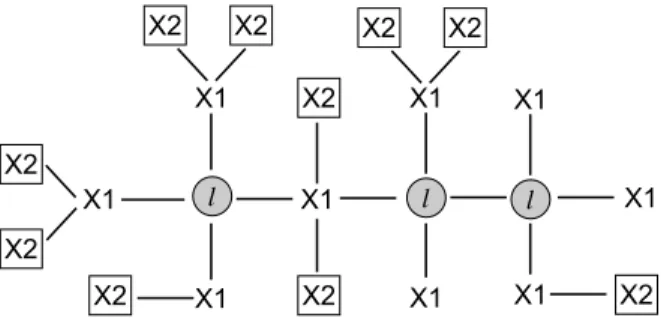
Figure 1 shows one MST for an hypothetical dataset. Our aim now is to explain the meaning of this tree in terms of relevance of the attributes and labels. The general idea is to compare the topology of the MST with the results of applying the filter FCBF considering each column as the category and the others as predictors.
To compute the MST we may use, for instance, Kruskal’s algorithm [7]. The edges are ordered from the highest to the lowestSU values. Then, starting from an empty MST, the algorithm iteratively adds one edge to the MST at each step, provided that it does not form a cycle in the tree. We shall see that this basic building step can be interpreted in terms of redundancy. First, however, we state some propositions to establish the ideas presented here.
X1 X1 X2 X1 X1 X1 X1 X2 l X1 X1 X2 X2 X2 X2 X2 X2 X1 X2 X2 l l
Fig. 1.Maximum Spanning Tree of an hypothetical multilabel task, see definition 8. Nodes marked withl stand forlabels. Nodes with anXirepresent attributes:X1 are the attributes at distance 1 from labels, andX2 are attributes at distance 2
Proposition 1. If m and m0 are two adjacent nodes in the MST defined in (Def. 8), then m0 is relevant for musing the filter FCBF.
Proof. If we assume that there is another labelm00that removesm0from the list of relevant nodes for m, thenm0 will be redundant with m00form. In symbols, SU(m00, m)> SU(m0, m)∧SU(m00, m0)> SU(m0, m). (17) In this case, however, the link betweenm andm0 could not be included in the MST. Therefore, there cannot exist such a nodem00, and som0 is relevant form according to the filter FCBF.
Proposition 2. Ifm is adjacent tom0, and this label is adjacent tom00 (m006= m) in the MST, then m00 is redundant withm0 form.
Proof. Consider the triangle of verticesm, m0, m00in the complete graph repre-sented by theSU matrix (Def. 7). Since the edgem−m00is not included in the MST, we have that
SU(m0, m)> SU(m00, m)∧SU(m00, m0)> SU(m00, m). Thus,m00 is redundant withm0 formaccording to (Def. 6).
The conclusion is that, given a column m in M, its adjacent labels in the MST are relevant for it. Moreover, if m, m0, m00 is a path in the MST, m00 is relevant form0, which is in turn relevant form. Hence,m00is redundant withm0 for m. However, sometimes redundant information helps classifiers to increase their performance, thus we may heuristically select some redundant items in order to achieve better performance. In our case, this heuristic is implemented fixing in the graph the distance to targets from predictors; this distance will be calledlevel of proximity.
3.1 Multilabel Ranker
Taking into account the previous results, in order to select a subset of features to predict the labels, given a dataset D, we can fix a level of proximity k, and then our proposal is the following:
– Compute the Symmetrical Uncertainty MatrixSUof attributes and labels. – Compute the Maximum Spanning Tree (MST).
– Select the attribute nodes whose distance to any label is smaller than or equal tok, see Figure 1.
Notice that this method produces a ranking of features; thus, we call it Mul-tilabel Feature Ranker (MLfR). In fact, increasing the level of proximity (k) we obtain a sequel of features in decreasing order of usefulness to predict a set of labels. However, the features are returned in chunks(in quanta) instead of one by one. In general, there are more than one feature at a given distance from the set of labels.
4
Experimental Results
In this section we report a number of experiments conducted to test the multil-abel feature ranker MLfR in two and complementary dimensions: the classifica-tion performance and the quality of the ranking.
First we check the capacity of MLfR to optimize a performance score likeF1
(Eq. 9). For this purpose, with each training data we built the MST (Def. 8) and then we selected the bestk (Section 3.1) using an internal (in the training set) 2-fold cross validation repeated 5 times [4]. The range ofkvalues included
{1,2, . . . ,20}andk50,k75andk100, wherektis the smallestkvalue that ensures that thet% of all features are selected. Since the aim was to compare strategies for feature selection, the number of discretization bins were constant in all cases. To obtain a multilabel learner with this selection scheme we used two state of the art multilabel baselearners. The first one is IBLR-ML [1]. We used the implementation provided by the authors in the libraryMulan [13, 12], which is built on the top ofWeka [15]. We wrote an interface with MatLab. The second base learner used was theEnsemble of Classifier Chains(ECC) [9] in the version described in [3]; for this reason we called itECC*. The implementation was made in MatLab using theBRbuilt withLibLinear[8, 5] with the default parameters: a logistic regression learner with regularization parameterC= 1.
On the other hand, to test the quality of the ranking of features produced by MLfR, we computed the number of features selected by the first chunk (k= 1) and theF1achieved with those features. To summarize in one number the quality
of the first chunk of the ranking, we computed the contributionof each feature to theF1as follows,
contribution= F1(K= 1)
To compare the results obtained by MLfR, we computed theF1scores achieved
by the base learners without performing any selection at all. Additionally, to compare the quality of the rankings we wanted to contrast the multilabel rank-ing with a purely binary ranker; that is, a ranker that considers labels one by one. To make a fair comparison we implemented a binary relevance version of MLfR as follows. For each labell∈L, we computed MLfR considering only that label. The set of features at distancekfrom lobtained in this way, M Lf Rl(k), were joined together for all labels to get a chunk of levelkin the so-calledBinary Relevance Feature Ranker (BRfR).
BRf R(k) =[ l∈L
M Lf Rl(k) (19)
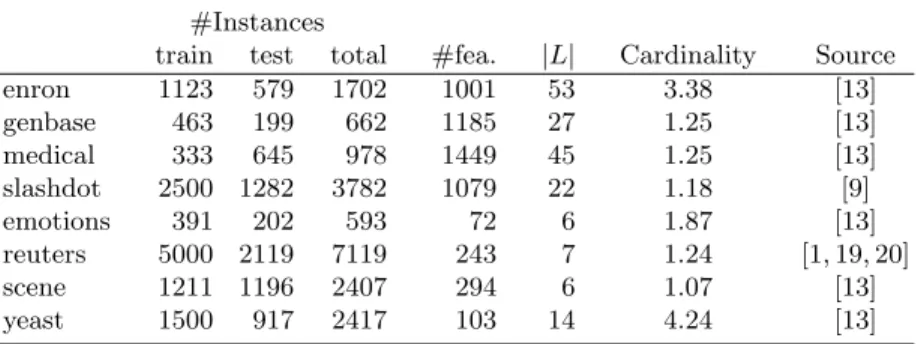
The comparison presented here was carried out using 8 datasets previously used in experiments reported in other papers about multilabel classification. Table 1 shows a summarized description of these datasets including references to their sources. Attributes with continuous values have been discretized in 10 bins using asame frequencyprocedure. The comparison was performed using a simple hold-out method. We used the split of datasets in training and testing sets provided by the sources of the data, when available. The size of the splits are also shown in Table 1. Other details about the datasets, included preprocessing, can be found following the references provided in the table.
Table 1.The datasets used in the experiments, associated statistics, and references to the sources of the data
#Instances
train test total #fea. |L| Cardinality Source
enron 1123 579 1702 1001 53 3.38 [13] genbase 463 199 662 1185 27 1.25 [13] medical 333 645 978 1449 45 1.25 [13] slashdot 2500 1282 3782 1079 22 1.18 [9] emotions 391 202 593 72 6 1.87 [13] reuters 5000 2119 7119 243 7 1.24 [1, 19, 20] scene 1211 1196 2407 294 6 1.07 [13] yeast 1500 917 2417 103 14 4.24 [13]
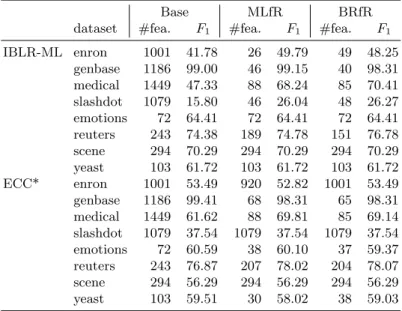
The scores achieved inF1by the classifiers compared are shown in Table 2.
To make statistical comparisons we considered together the scores obtained with all base learners, since the objective was to compare different selection strategies and not base learner scores.
Thus, we observe that although the scores obtained by selectors are higher in average than those achieved without any selection, the differences are not significant using a paired, two-sided, Wilcoxon signed rank test. Also, there are no significant differences between the scores obtained with the two selection approaches. On the other hand, both selectors reduce considerably the number
Table 2.Number of features andF1scores achieved in test data when the aim in grid
search (for selectors) was to optimizeF1
Base MLfR BRfR
dataset #fea. F1 #fea. F1 #fea. F1
IBLR-ML enron 1001 41.78 26 49.79 49 48.25 genbase 1186 99.00 46 99.15 40 98.31 medical 1449 47.33 88 68.24 85 70.41 slashdot 1079 15.80 46 26.04 48 26.27 emotions 72 64.41 72 64.41 72 64.41 reuters 243 74.38 189 74.78 151 76.78 scene 294 70.29 294 70.29 294 70.29 yeast 103 61.72 103 61.72 103 61.72 ECC* enron 1001 53.49 920 52.82 1001 53.49 genbase 1186 99.41 68 98.31 65 98.31 medical 1449 61.62 88 69.81 85 69.14 slashdot 1079 37.54 1079 37.54 1079 37.54 emotions 72 60.59 38 60.10 37 59.37 reuters 243 76.87 207 78.02 204 78.07 scene 294 56.29 294 56.29 294 56.29 yeast 103 59.51 30 58.02 38 59.03
Table 3.F1 and number of features selected in the first chunk (k= 1) for MLfR and
BRfR. The scores achieved when no selection is performed is included for comparison. Additionally, for each ranker we computed the contribution of each feature to theF1
score (see Eq. 18)
Base MLfR BRfR
dataset #fea. F1 #fea. F1 contri. #fea. F1 contri.
IBLR-ML enron 1001 41.78 26 49.79 1.92 49 48.25 0.98 genbase 1186 99.00 46 99.41 2.16 40 99.15 2.48 medical 1449 47.33 88 68.24 0.78 85 70.41 0.83 slashdot 1079 15.80 46 26.04 0.57 48 26.27 0.55 emotions 72 64.41 1 33.04 33.04 5 52.44 10.49 reuters 243 74.38 44 74.13 1.68 45 73.93 1.64 scene 294 70.29 3 24.58 8.19 6 38.35 6.39 yeast 103 61.72 2 51.58 25.79 9 54.65 6.07 ECC* enron 1001 53.49 26 42.58 1.64 49 51.77 1.06 genbase 1186 99.41 46 97.81 2.13 40 98.31 2.46 medical 1449 61.62 88 69.81 0.79 85 69.14 0.81 slashdot 1079 37.54 46 25.72 0.56 48 25.40 0.53 emotions 72 60.59 1 36.42 36.42 5 49.97 9.99 reuters 243 76.87 44 74.95 1.70 45 74.91 1.66 scene 294 56.29 3 13.85 4.62 6 25.98 4.33 yeast 103 59.51 2 54.33 27.16 9 56.57 6.29
of features used for classification. The differences are not significant between selectors.
It could be expected important reductions of the number of features and the error rates for high dimensional problems such as Enron or Slashdot. But the scores shown in Table 2 for ECC* report null or insignificant reductions; the reason can be found in the poor quality of the classifiers, both datasets provide the smallestF1 scores for this learner.
The statistically significant differences appear when we check the quality of the first chunk. Thus, the contribution of each of the features obtained with MLfR for k = 1 is significantly higher than that of the features returned by BRfR in the same conditions. In this sense we conclude that the ranking learned from a multilabel point of view is better than the ranking obtained considering each label separately.
5
Conclusions
We have presented an algorithm to learn a ranking of the features involved in a multilabel classification task. It is an extension of the FCBF (Fast Correlation-Based Filter) [17], and it uses a graphical representation of features and labels. The method so obtained, MLfR (multilabel feature ranker), was compared with a version that considers each label separately, in the same way as BR (Binary Relevance) learns a multilabel classifier. We experimentally tested that the mul-tilabel version achieves significantly better results than the BR release when testing the quality of the rankings.
Moreover, the graph built by MLfR provides a valuable representation of the correlation and interdependence between labels and features. We proved formally that the topology of the graph can be read in terms of relevancy and redundance of the features and labels.
6
Acknowledgements
The research reported here is supported in part under grant TIN2008-06247 from the MICINN (Ministerio de Ciencia e Innovaci´on, Spain). We would also like to acknowledge all those people who generously shared the datasets and software used in this paper.
References
1. Cheng, W., H¨ullermeier, E.: Combining Instance-Based Learning and Logistic Re-gression for Multilabel Classification. Machine Learning 76(2), 211–225 (2009) 2. Chow, C., Liu, C.: Approximating Discrete Probability Distributions with
Depen-dence Trees. IEEE Transactions on Information Theory 14(3), 462–467 (1968) 3. Dembczy´nski, K., Cheng, W., H¨ullermeier, E.: Bayes optimal multilabel
classi-fication via probabilistic classifier chains. Proceedings of the 27th International Conference on Machine Learning (ICML) (2010)
4. Dietterich, T.: Approximate statistical tests for comparing supervised classification learning algorithms. Neural Computation 10(7), 1895–1923 (1998)
5. Fan, R., Chang, K., Hsieh, C., Wang, X., Lin, C.: LIBLINEAR: A Library for Large Linear Classification. Journal of Machine Learning Research 9, 1871–1874 (2008)
6. Kong, X., Yu, P.: Multi-label feature selection for graph classification. In: 2010 IEEE International Conference on Data Mining (ICDM’10). pp. 274–283. IEEE (2010)
7. Kruskal Jr, J.: On the Shortest Spanning Subtree of a Graph and the Traveling Salesman Problem. Proceedings of the American Mathematical Society 7(1), 48–50 (1956)
8. Lin, C.J., Weng, R.C., Keerthi, S.S.: Trust Region Newton Method for Logistic Regression. Journal of Machine Learning Research 9, 627–650 (2008)
9. Read, J., Pfahringer, B., Holmes, G., Frank, E.: Classifier Chains for Multi-label Classification. In: Proceedings of European Conference on Machine Learning and Knowledge Discovery in Databases (ECML-PKDD). pp. 254–269 (2009)
10. Trohidis, K., Tsoumakas, G., Kalliris, G., Vlahavas, I.: Multilabel classification of music into emotions. In: Proc. 9th International Conference on Music Information Retrieval (ISMIR 2008), Philadelphia, PA, USA. vol. 2008 (2008)
11. Tsoumakas, G., Katakis, I.: Multi Label Classification: An Overview. International Journal of Data Warehousing and Mining 3(3), 1–13 (2007)
12. Tsoumakas, G., Katakis, I., Vlahavas, I.: Mining Multilabel Data. In O. Maimon and L. Rokach (Ed.), Data Mining and Knowledge Discovery Handbook, Springer (2010)
13. Tsoumakas, G., Vilcek, J., Spyromitros, L.: Mulan: A Java Library for Multi-Label Learning. http://mulan.sourceforge.net/
14. Van Der Gaag, L., De Waal, P.: Multi-dimensional Bayesian Network Classifiers. In: Proceedings of the Third European Workshop in Probabilistic Graphical Models, Prague. pp. 107–114 (2006)
15. Witten, I., Frank, E.: Data Mining: Practical Machine Learning Tools and Tech-niques. Morgan Kaufmann Pub (2005)
16. Yang, Y., Pedersen, J.: A comparative study on feature selection in text catego-rization. In: Proceedings of the International Conference on Machine Learning, (ICML’97),. pp. 412–420. Citeseer (1997)
17. Yu, L., Liu, H.: Efficient Feature Selection via Analysis of Relevance and Redun-dancy. Journal of Machine Learning Research 5, 1205–1224 (2004)
18. Zhang, M.L., Pe˜na, J.M., Robles, V.: Feature selection for multi-label naive bayes classification. Inf. Sci. 179, 3218–3229 (September 2009)
19. Zhang, M.L., Zhou, Z.: M3MIML: A Maximum Margin Method for Multi-instance Multi-label Learning. In: Eighth IEEE International Conference on Data Mining, 2008. ICDM’08. pp. 688–697 (2008)
20. Zhou, Z.: Learning And Mining from DatA (LAMDA). http://lamda.nju.edu.cn/data.ashx