h0iF3
Z
7/4
POLICY
RESEARCH
WORKING
PAPER
2716
Does Foreign Bank
How does entry by foreignbanks affect lending to small
Penetration Reduce
and medium-size enterprisesAccess to Credit in
in developing countries?Analysis of data from a large
Developing Countries?
cross-country survey ofenterprises finds that foreign bank entry benefits firms of all
Evidence from Asking Borrowers
sizes, although it seems tobenefit larger firms more.
George R. G. Clarke
Robert Cull
Maria Soledad Martinez Peria
The World Bank
Development Research Group
Finance
U
November 2001
Public Disclosure Authorized
Public Disclosure Authorized
Public Disclosure Authorized
| POLICY RESEARCH WORKING PAPER 2716
Summary findings
Existing evidence on the effect of foreign bank Clarke, Cull, and Martinez Peria use data f^nom a large penetration on lending to small and medium-size cross-country survey of enterprises to investi-.rte this enterprises is ambiguous. Case studies of developing issue. Their results suggest that foreign bank p2netration counitries show that foreign banks lend less to such firms improves financing conditions (both the quantities of than domestic banks do. But cross-country studies find financing and the terms) for enterprises of all sizes, that foreign bank entry fosters competition and reduces although it seems to benefit larger firms more. interest rates, benefits that should extend to all firms.
This paper-a product of Finance, Development Research Group-is part of a larger effort in the group to understand the impact of entry by foreign banks on domestic banking systems in developing countries. Copies of the paper alre available free from the World Bank, 1818 H StreetNW, Washington, DC 20433. Please contact Paulina Sintim-Aboagye, room MC3-422, telephone 202-473-7644, fax 202-522-1155, email address psintimaboagyeCixworldbank.org. Policy Research Working Papers are also posted on the Web at http://econ.worldbank.org. The authors may be c :>ntacted at gclarkeCiiworldbank.org, rcull(qworldbank.org, or mmartinezperiaCa worldbank.org. November 2001. (37 pages)
The Policy Research Wlorking Paper Series dissc "nates the find ngs of wvork inz progress to encourage the exchantge of idcas z,5out development issues. An objective of the series is to get the indinigs out quickly, even if the presentationis are less than fully polished. Thc
papers carry the names 4f the authors and should be cited accordingly. The findings, inzterpretations, anaei concluisionis expressed il this
paper are entirely those of the authors. They do not necessarily represent the ,ieue ot the W"orld B ntk, its Executive l)irectors, or the
DOES FOREIGN BANK PENETRATION REDUCE ACCESS
TO CREDIT IN DEVELOPING COUNTRIES?
EVIDENCE FROM ASKING BORROWERS
*George R. G. Clarke, Robert Cull, and Maria Soledad Martinez Peria Development Research Group
The World Bank
Keywords: foreign bank penetration, small business lending JEL: G21,G32
Some of the data used in this paper are from the World Business Environment Survey (WBES) 02000 The World Bank Group. We would like to thank Gerard Caprio and Asli Demirgu,c-Kunt for helpful comments and advice. We
are also grateful to Luke Haggarty and Andrew Stone for their help with the WBES data. Contact information:
Robert Cull, World Bank, 1818 H Street NW MC3-300, Washington, DC 20433. Phone: (202)473-6365. Fax: (202)522-1155. E-mail:[email protected].
I. INTRODUCTION
In recent years, foreign banks have achieved an increasingly important role in many developing countries. In Argentina, Chile, the Czech Republic, Hungary, and Poland, foreign-controlled banks hold over fifty percent of total banking sector assets. Although foreign bank penetration is more modest in other developing countries, including many in Asia, Africa, the Middle East, and the Former Soviet Union, it has increased in most countries over the past decade. While foreign bank entry might improve financial intermediation by increasing competition, improving stability, and enhancing sector efficiency, some observers have suggested that it might also have some adverse effects. Among other things, opponents argue that increased foreign bank penetration in developing countries might reduce access to credit, particularly for small and medium-sized enterprises (SMEs). So far, however, the empirical evidence on this issue has been ambiguous.
Recent cross-country studies find that entry by foreign banks increases both competition and banking sector stability, factors that should benefit all borrowers. Using an 80-country sample of developed and developing countries between 1988 and 1995, Claessens et al. (2000) find that entry by foreign banks reduced both the profitability and expenses of domestic banks. In line with these results, Barth et al (2001 c) find that net interest margins and overhead costs were lower in countries with fewer restrictions on entry into banking, whether for foreign or domestic banks. In addition, they also show that major banking crises were less frequent in countries with fewer limitations on foreign bank entry and ownership.' Dages et al. (2000) argue that foreign bank penetration does not necessarily threaten financial sector stability by showing that foreign banks in Argentina and Mexico exhibited stronger and less volatile loan growth than
domestic banks between 1994 and 1999. Finally, examining the behavior of U.S. bank claims on a broad set of countries since the mid-1980s, Goldberg (2001) finds that U.S. banks did not retrench their lending significantly following period of crises.
Aside from increasing competition and improving stability, there is evidence that foreign bank entry might also benefit borrowers in developing countries by improving banking sector efficiency. In contrast to studies of foreign bank entry in the United States, several papers on developing countries have found that foreign banks, which are often from developed countries,
are more efficient than their domestic competitors.2 Furthermore, studies have found that foreign
banks tend to expand into areas where local profit opportunities are greatest, consistent with the hypothesis that foreign investors utilize their know-how and human resources to restructure
inefficient banks.3
Despite the benefits associated with greater competition, stability, and efficiency, opponents of foreign bank entry argue that this process might still harm small and medium-sized enterprises. One reason for this is that foreign entrants tend to be large (Focarelli and Pozzolo, 2000). Evidence from the United States indicates that large and organizationally complex institutions find it difficult
to lend to informationally opaque small and medium-sized enterprises.4 These organizational
diseconomies might explain why a number of studies have found that foreign banks appear to allocate greater shares of their lending portfolios to commercial and industrial loans, providing indirect evidence that foreign banks might be more important in the market for loans to large companies. Goldberg (1992) notes that foreign banks operating in the U.S. held 28.5% of all
commercial and industrial loans, but only 22.6 % of all banking assets.5 In addition, in a survey of
271 foreign banks operating in the U.S., Cho et al. (1987) find that 56% pointed to trade finance as
trading, all services that are likely to benefit large businesses disproportionately. Similarly, for Argentina in the late 1 990s, Clarke et al. (2000) find that foreign banks devoted about 35% of their loan portfolios to manufacturing, while private domestic banks devoted less than 20% to that sector.
Direct evidence on small business lending in Latin America is largely consistent with the assertion that foreign banks lend less to small and medium-sized enterprises than to large firms. Berger et al. (2000) find that small businesses in Argentina were less likely than larger ones to
receive any credit from large banks or from foreign banks.6 Also analyzing the case of Argentina,
Escude et al. (2001) find that while foreign banks allocated a smaller share of their lending portfolio to SMEs, they granted almost half of the total credit to this sector in the year 2000. Looking at a larger set of countries, Clarke et al. (2001) find that foreign banks in Argentina, Chile, Colombia, and Peru generally lent a smaller fraction of their funds to SMEs than similar domestic banks in the late 1990s. However, they find that other factors might have mitigated this. First, they find that differences between foreign and domestic banks were far less pronounced for large banks than they were for small banks in all four countries. In fact, in two of the four countries, Chile and Colombia, their econometric analysis suggests that large foreign banks might actually have lent relatively more to SMEs than large domestic banks after controlling for other factors that affect lending to these businesses. Further, they find that the growth rate of real lending to SMEs was higher for foreign banks than for domestic banks in Peru, and was also higher for large foreign banks than large domestic banks in Argentina and Chile.
The evidence regarding increased lending to SMEs by large foreign banks found in Clarke
et al. (2001) might be explained by recent changes in technology. Mester (1997) argues that
advances in credit scoring methodologies coupled with enhanced computer power and increased data availability might change the nature of small business lending. These factors could make it less
necessary for a bank to have a physical presence in all geographic areas in which it lends (Petersen and Rajan, 2000) and could help large foreign banks to overcome some of the diseconomies and difficulties in lending to small borrowers.
However, even if foreign banks continue to primarily focus on serving large customers, foreign entry might still benefit small borrowers. Competition for large customers could displace some domestic banks, forcing them to seek new market niches such as providing credit to SNIEs. Consistent with this, Bonin and Abel (2000) find that as foreign bank penetration increased in Hungary some smaller domestic banks sought new market areas. Similarly, in a survey of banks from 78 countries, Jenkins (2000) finds that, 44 percent of those banks that lent to small and rmicro enterprises indicated that changed market conditions and increased competition in lending to large
7
and medium-sized enterprises were the two most important reasons for doing so.
As illustrated in the discussion above, studies that have focused on foreign versus domestic bank behavior (using individual bank balance sheet data) have not provided a defini.tive answer on the net effect of foreign bank entry on access to credit for small and medium-sized enterprises. Isolating the effect of foreign bank entry on domestic banks' lending from macroeconomic changes can be difficult in country case studies, especially since relatively few commercial banks operate in many developing countries.8 Furthermore, comparable cross-country data on lending to SMEs is not easily available, especially since small local banks tend
to be important in this area of lending.9
Rather than relying upon information from bank balance sheets, this paper uses responses from a survey of over 4,000 enterprises in 38 developing and transition economies, to study whether borrowers' perceptions regarding interest rates and access to long-term credit are
positively associated with the presence of foreign banks. If the potential advantages of foreign bank entry - improved sector efficiency, a subset of domestic banks forced by competitive pressures into new market niches, and new credit scoring technologies - outweigh the general tendency of large foreign banks to eschew SME lending, borrowers should rate access to credit (both quantities and terms) as easier in countries with relatively high levels of foreign bank penetration. Thus, our analysis should help to sort out whether the benefits of foreign bank entry found in other cross-country studies accrue to all borrowers or only to a lucky subset.
The remainder of the paper is organized as follows. Section II describes the data used in this study. Section III discusses the estimation method. The empirical results are presented in section IV. Section V concludes.
II. DATA
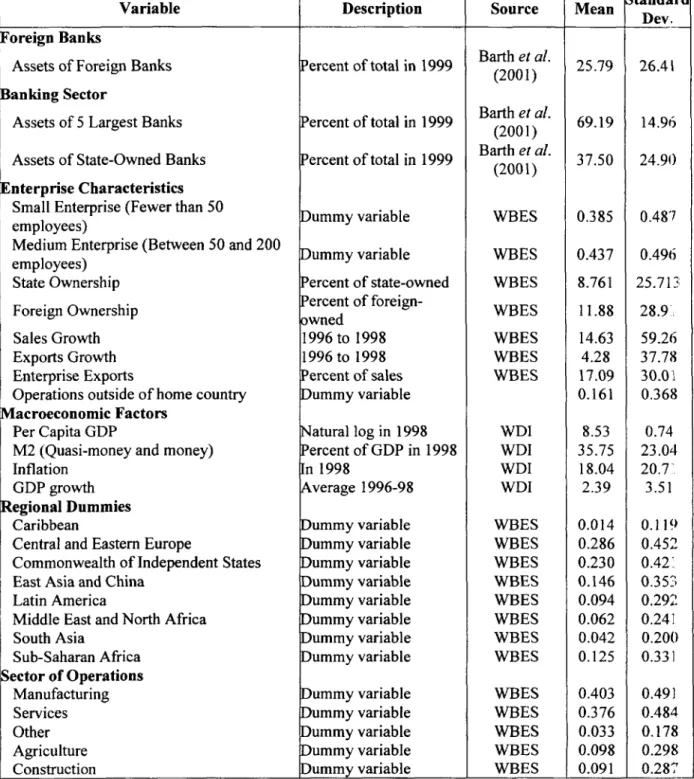
The data used in this paper come from two main sources: the World Business Environment Survey (WBES) and a database on bank regulation and supervision compiled by Barth et al. (2001b). These data are supplemented with macroeconomic data from the World Bank's World Development Indicators. Table I provides a list of the 38 countries included in the sample, which is restricted to developing and transition economies. Table II provides summary statistics for the main variables used in this analysis.
The World Business Environment Survey (WBES) is a major cross-sectional survey of industrial and service enterprises conducted in developing and transition countries in 1999 by the
World Bank and several other agencies.10 The main purpose of the WBES is to identify
economies. The survey, therefore, has a large number of questions on how taxation and regulation, the performance of the financial sector, the institutional environment, and corruption affect business operations. In contrast, the survey includes little information on enterprise performance. In particular, it does not collect balance sheets or profit and loss statements from participating enterprises, although some information on assets, sales, employees, and enterprise growth is included." In addition, the survey provides some information on broad sector of operations, on ownership, on how enterprises financed investment, and on export performance.
The dependent variables in this study capture enterprises' perceptions about access to financing from the banking sector. As part of the WBES, enterprise managers were asked to assess how problematic several financing issues were to the operation and growth of their
business on a four-point scale, with higher numbers indicating greater problems.'2 In this study,
we focus on the two measures most directly related to the formal banking sector - perceptions about interest rates and access to long-term loans.
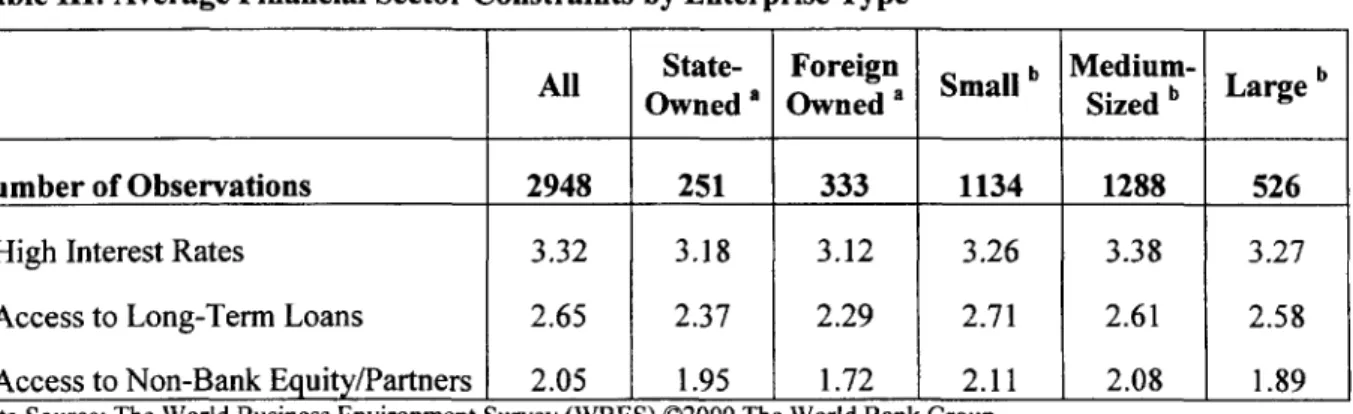
Table III shows average ratings provided by enterprises of various types in the sample countries. Small enterprises generally rated access to long-term loans and access to non-bank equity as greater constraints than medium-sized or large enterprises. However, medium-sized enterprises generally rated interest rates as a bigger problem than small or large enterprises. In addition, state- and foreign-owned enterprises generally rated all three issues as lesser constraints than private domestic enterprises. These findings are not entirely surprising. State-owned enterprises might have better access to government financing and foreign-owned enterprises, which in developing countries are often owned by enterprises or individuals from developed countries, might have access to financing from their home countries.
One potential concern about perception-related studies is that enterprise managers might have different perceptions about what constitutes a 'major' or 'minor' problem and, therefore, might rate equivalent obstacles differently. For example, a pessimistic manager might rate an obstacle as a 'major' problem, while a more optimistic manager might rate the same obstacle as only a 'moderate' or 'minor' obstacle. Since this introduces error into the dependent variable, this should not have a large effect on results so long as the error is not systematically correlated with the independent variables (i.e., mismeasurement of a dependent variable can generally be
absorbed by the disturbance term in the regression).'3 However, if enterprise managers'
responses are systematically correlated with enterprise or country-level characteristics this could
be a problem.14 In particular, estimates would be biased if enterprise managers' pessimism were
systematically correlated with the degree of penetration by foreign banks or with other country-level variables. Thus, to provide a check on robustness, we also examine enterprise managers' perceptions about access to non-bank equity. Although foreign ownership in the banking sector might have a some small long-term influence on the development and performance of the non-banking financial sector, the effect should be less pronounced than the impact foreign ownership has on the banking sector. If foreign ownership in the banking sector is as strongly related to perceptions about the non-banking financial sector as the banking sector, this might suggest
evidence of either systematic bias or omitted variables.
In addition to questions about perceptions about the effect of financing on enterprise operations and growth, firms were also asked about how they financed fixed investment. Although they were not asked to provide estimates of the value of fixed investment over the previous year, they were asked what proportion was financed through funds from several different sources, including commercial banks. Table IV provides summary statistics for the
share of investment financed through retained earnings, commercial banks, government subsidies and loans, and informal sources. Retained earnings were the most important source of financing for all types and sizes of enterprises. Commercial banks were the second most important source of financing for large and medium-sized enterprises (28.8 and 17.8 percent of investment respectively). In contrast, small enterprises financed considerably less investment through commercial banks (12.7 percent of investment) and, in fact, on average financed a greater proportion of investment through informal sources such as family and friends, ;md moneylenders. State-owned enterprises generally financed smaller proportions of investment through commercial banks (9.4 percent) than other enterprises, relying more on funds from the government (21.9 percent). This might explain why state-owned enterprises generally saw financial sector constraints as less problematic than privately owned enterprises (see Table III).
The second major source of data is from a survey of central banks conducted b) the
World Bank.15 Barth et al. (2001b) produced a survey consisting of 175 questions covering
various aspects of banking sector development, which they sent to national regulatory and supervisory agencies in both developed and developing countries. They obtained at least partial responses from 107 countries, mostly between late 1998 and early 2000 (see footnote 7 in Barth
et al., 2001b). In addition to questions about bank supervision and regulation, they also asked
about the structure of bank ownership, including the share of assets held by banks that are over 50 percent foreign owned, the share of assets in state-owned banks, and the percent of deposits held by the 5 largest banks. These are the main banking sector variables from this source used in the empirical analysis. In addition to these variables, several variables related to the regulatory and supervisory environments are included in some model specifications to control for the quality of bank supervision and restrictions on entry. It is plausible that restrictions on entry
might be correlated with foreign bank penetration (e.g., if supervisory authorities use restrictions on entry to restrict the presence of foreign banks) and with reduced access to credit (e.g., if entry restrictions reduce domestic competition). Similarly, the quality of supervision might also affect both foreign banks' entry decisions and sector performance. To control for this in the empirical analysis, two indices presented in Barth et al. (2001a) are included in some model
specifications.'6
Finally, the estimations include controls for the macroeconomic environment in which firms operate. In particular, we control for countries' GDP per capita, level of financial development (as measured by the ratio of M2 to GDP), inflation rate, and average growth rate. All of these variables come from the World Bank's World Development Indicators database. Other things being equal, access to credit could be better and foreign penetration could be higher in countries that are more financially developed and have better growth opportunities. We include the macro variables to be able to disentangle the independent effect of foreign penetration on access to credit.
III. ECONOMETRIC METHODOLOGY
Three of the dependent variables used in this analysis - enterprise managers' responses to questions about whether high interest rates, access to long-term loans, and to non-bank financing
represent obstacles to enterprise operations and growth - are limited dependent variables.'7
These variables can take four discrete values, in ascending order, corresponding to no obstacle, minor obstacle, moderate obstacle and major obstacle. Since the responses to the questions about perceptions are ordered, but are not actual count data, we estimate this model as an ordered
response model. That is, we assume that the enterprise managers' underlying response model can be described by equation (1) below:
Obstacle, = AiXi +f 2Cj+ui (1)
where Xij are various characteristics of enterprise i in country j that affect the managers' perceptions about obstacles to growth, Cj are characteristics of country j that affect the managers'
perceptions and u1j is a disturbance term. The manager classifies the obstacle as being in class
'k' (e.g., a moderate problem) if ak-l < Obstacle1j < Xk, where the ak's are a series of nuisance
parameters that are estimated along with the coefficient vector (i.e., ,B). It is assumed that the disturbance term, which includes differences in individual managers' perceptions about wNhat constitutes a 'major', 'minor', 'moderate' problem has a normal distribution. The model is estimated using standard maximum likelihood estimation. Positive coefficients on variables indicate that increases in that variable make enterprise managers more likely to rate the obsiacle as a greater problem (i.e., it increases the likelihood that they rate the problem as a 'maior' problem).
We assume that the share of fixed investment financed through commercial bank loans is a linear function of enterprise (Xij) and country (Cj) level characteristics, as described in equation (2).
Financing, =
Axu+
,2i
+uU (2)
Since many enterprises did not finance any investment through loans from commercial banks in the year prior to the WBES, the share of fixed investment financed through commercial bank
loans is bounded below by zero (and above by 100 percent). The model is therefore estimated as a standard two-limit Tobit model, assuming that the error term has a normal distribution.
IV.
EMPIRICAL RESULTSForeign Penetration in the Banking Sector. Controlling for macroeconomic conditions
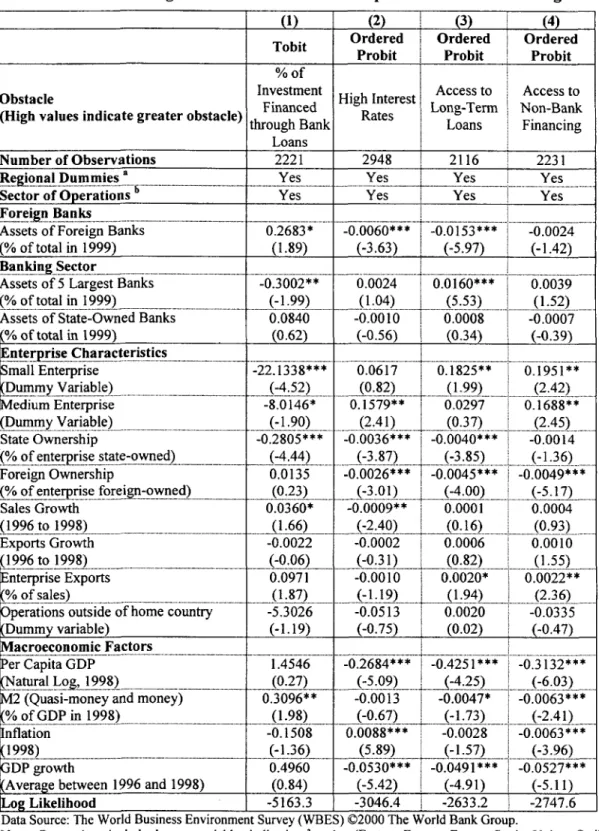
and other factors that might explain access to credit, we find that in countries where foreign penetration in the banking sector was higher (i.e., where foreign banks account for a greater share of banking sector assets), enterprises financed a greater share of investment through bank lending (see Table V, column 1). In addition to being statistically significant at a 10 percent level, the impact of foreign penetration in the banking sector appears large. In particular, increasing the share of bank assets held by foreign-owned banks by 1 percentage point raises the average share of investment financed through bank lending by 0.27 percentage points.
Consistent with this, enterprises rated high interest rates and access to long-term loans as lesser obstacles to enterprise operations and growth in countries with a larger degree of foreign penetration in the banking sector (see Table V, columns 2 and 3).18 In both cases the coefficient on foreign penetration is statistically significant at a one-percent level or higher. In contrast, foreign penetration is not significantly correlated with enterprises' perceptions concerning access to non-bank financing (see Table V, column 4). Since we would expect foreign penetration in the banking sector to impact the non-banking financial sector less than the banking sector, this provides some reassurance that the correlation between foreign penetration and enterprises' perceptions about the banking sector is not spurious.
Enterprise Size. As noted earlier, small (fewer than 50 employees) and medium-sized
considerably less investment through the banking sector than large enterprises (more than 200
employees) did (see Table IV).19 This remains true even after controlling for other factors that
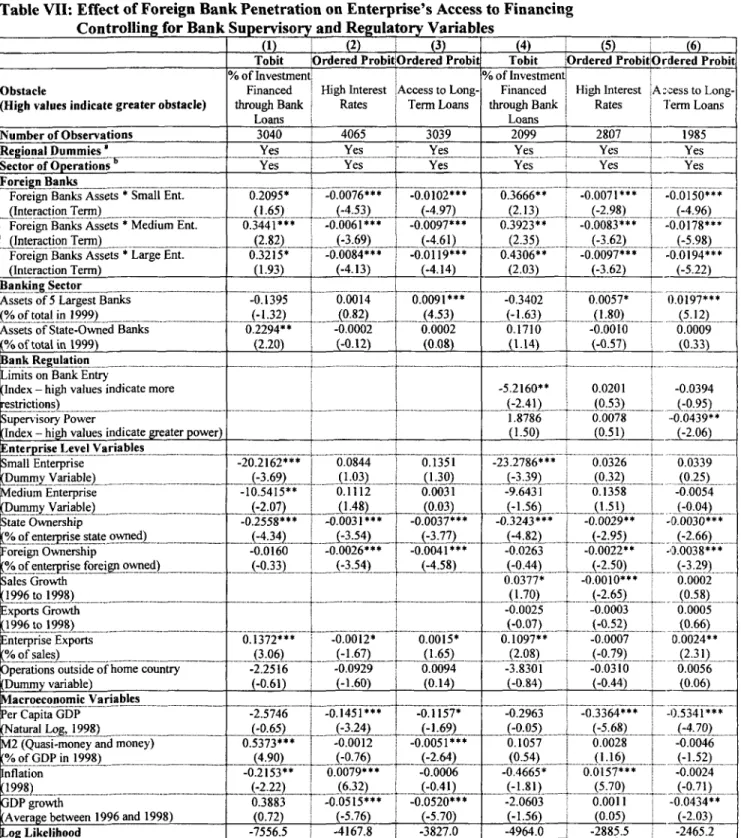
might affect access to financing. On average, small and medium-sized enterprises financed 22.1 percentage points and 8.0 percentage points less of their fixed investment through bank loans than similar large enterprises (see Table V, column 1). In both cases the difference is statistically significant at least at the 10 percent level. Results are similar after allowing foreign bank ownership to affect small, medium-sized, and large enterprises differently (see Table VI, col imn 1), after dropping the controls for enterprise performance (see, Table VII column 1) and after accounting for differences in bank regulation and supervision (see Table VII, column 4).
Small and medium-sized enterprises also generally rated high interest rates, access to long-term loans, and access to non-bank financing as greater constraints on enterprise operations and growth than large enterprises. These differences are statistically significant in several cases. However, there is no clear pattern when comparing small and medium-sized enterprises. Akfter controlling for other factors that might affect enterprise performance, medium-sized enterprises rated high interest rates as a greater constraint than small (or large) enterprises, while small enterprises rated access to non-bank financing and long-term loans as greater constraints than medium enterprises.
Interaction between Enterprise Size and Foreign Penetration in the Banking Sector.
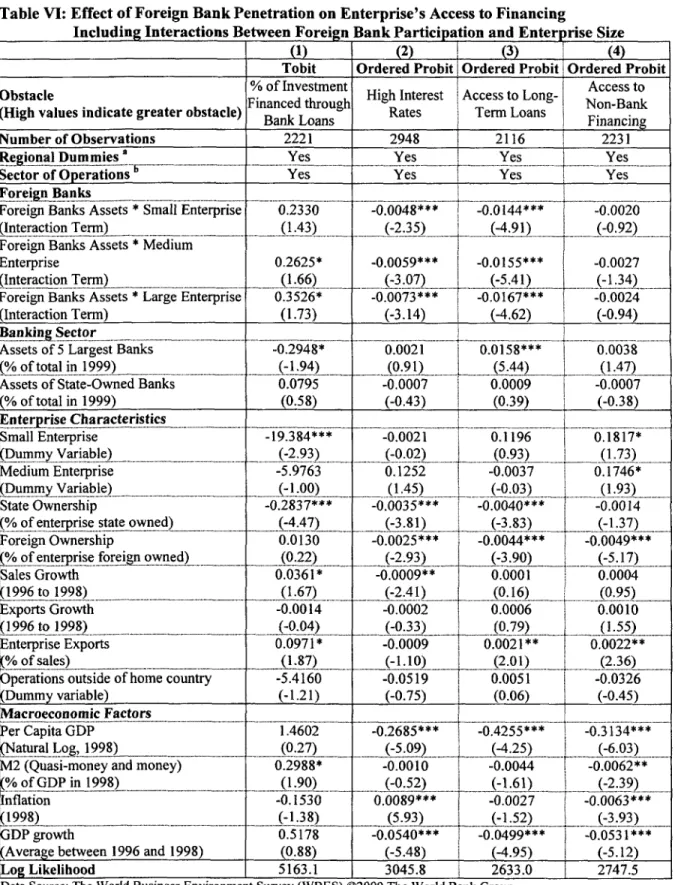
Although on average enterprises saw interest rates and access to long-term loans as lesser constraints and financed greater shares of investment through commercial banks in countries where foreign bank penetration was greater, it is still possible that the benefits primarily go to medium or large enterprises. To test whether this is the case, interaction terms between enterprise size and the extent of foreign bank penetration are included in the regressions in Table
VI.20 When we include these interaction terms in the regression for the share of investment financed through commercial bank loans, the coefficient on foreign penetration is larger for large enterprises than it is for medium or small enterprises (see Table VI, column 1). Further, the coefficient on the interaction term for small enterprises is statistically insignificant at conventional significance levels. The point estimates of the coefficients suggest that a 1 percentage point increase in foreign bank assets raises the share of investment financed through commercial bank loans by 0.23, 0.26, and 0.35 percentage points for small, medium, and large enterprises, respectively.
The results are similar for the measures of the obstacles to enterprise operations and growth imposed by high interest rates and access to long-term financing. Increased foreign penetration generally affects the perceptions of small and medium enterprise managers less than managers of large enterprises. Increasing foreign bank penetration from 5.1 percent (foreign
bank penetration at the level of the 20th percentile of countries in the sample) to 50.9 percent
(80th percentile) decreases the probability that the average enterprise manager would rate interest
rates and access to long-term loans as a major constraint by 9.6 and 23.7 percentage points,
respectively (see Table VIII).21 However, the impact is smaller for small enterprises (8.1 and
23.6 percentage points respectively) than for large enterprises (12.3 and 25.1 percentage points).
Although these results might suggest that large (and medium-sized) enterprises benefit more than small enterprises from foreign penetration in the banking sector, it is important to note two things. First, the null hypothesis that foreign penetration affects all enterprises equally
22
cannot be rejected in any of the three equations. Second, even if foreign penetration is more
favorable for large enterprises, there is strong evidence that it also benefits small and medium-sized enterprises. The empirical results suggest that both small and medium-medium-sized enterprises
rate access to long-term loans and high interest rates as lesser obstacles and that medium-sized enterprises finance more investment through commercial bank loans in countries with higher levels of foreign penetration.
Other Banking Sector Variables. In addition to foreign bank penetration, the analysis
includes two extra variables to control for other differences in the structure of banking sectors across countries: the share of assets in the 5 largest banks, which is used as a proxy for sector concentration, and the share of assets in state-owned banks. Concentration might affect lending if it affects the level of competition in the banking sector. For example, banks in concentrated markets might find it easier to collude, raising interest rates, and restricting access to long-term loans, or large banks might have different lending strategies from smaller banks. Similarly,
state-owned banks might also behave differently than private banks.23
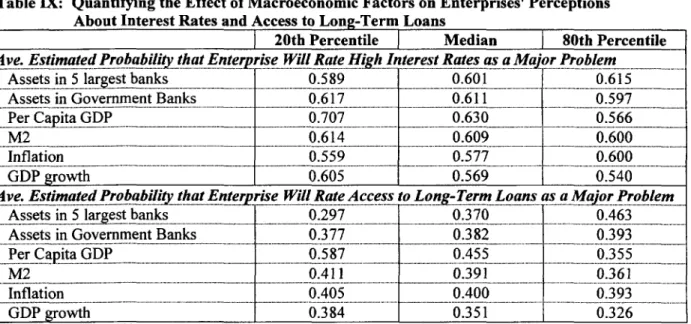
In all regressions, the coefficients on government ownership are statistically insignificant. The coefficients on sector concentration are statistically significant and positive in the regression for enterprises' perceptions about access to long-term loans, suggesting that concentration tends to make access to such financing more difficult. Increasing the share of assets in the five largest banks from the value for the 20th percentile (51.2 percent) to the value for the 80th percentile (81.2 percent) raises the estimated average probability that an enterprise would rate access to
long-term loans as a major problem from 29.7 percent to 46.3 percent (see Table IX).24
Also consistent with the observation that increased concentration makes access to long-term loans more difficult, the coefficient on concentration is negative and significant in the
regression for the share of investment financed through commercial bank loans.2 5 Based upon
banks would decrease the share of investment financed through commercial bank loans by 0.3 percentage points. This result, however, is not robust to the exclusion of the two measures of enterprise performance (see Table VII, Column 1).
Enterprise Characteristics. Both state- and foreign-owned enterprises rated interest rates
and access to long-term loans as lesser constraints than similar private domestic enterprises (see Table V). State-owned enterprises also financed smaller shares of investment through bank loans than private enterprises (see Table V), even after controlling for other factors that might affect financing. A 1 percentage point increase in government ownership reduces the share of investment financed through bank loans by 0.3 percentage points. Although state-owned enterprises might finance less investment through bank loans because they find it more difficult to raise financing from commercial banks, the evidence is also consistent with the possibility that that state-owned enterprises might rely less on bank loans because they have access to other sources of financing. As noted earlier, state-owned enterprises financed 21 percent of investment with government funds (see Table IV). Consequently, since they have access to state financing, it is not surprising that they rate interest rates and access to long-term loans as less severe constraints than private enterprises do.
In contrast to state-owned enterprises, foreign-owned enterprises financed higher shares of investment through commercial banks than private domestic enterprises (see Table IV), although the difference becomes statistically insignificant after controlling for other factors (e.g., size) that might affect bank borrowing (see Table V). One plausible reason why foreign-owned enterprises might rate access to financing and high interest rates as lesser constraints than private domestic enterprises might be because the former have access to banks in their home countries. However, domestic enterprises that have operations outside of their home country did not
generally rate interest rates or access to long-term loans as lesser constraints than enterprises that
did not operate outside of their home market (see Table V).26
Firm Performance. As noted previously, the WBES does not provide detailed information on enterprise performance and, therefore, it is difficult to test the link between enterprise performance and financing as an obstacle to enterprise operations and growth using this data set. Although two of the performance-related measures that are included in the analysis, sales growth and export growth, might be endogenous in the equation for the share of investment financed through bank loans (i.e., if access to bank loans allows faster growth), results are similar when these variables are omitted (compare Table VI and Table VII). In practice, neither of these variables appears to strongly affect perceptions about financing (see Table V), although enterprises with faster sales growth did finance more investment through bank loans than similar enterprises that were growing more slowly. Exporters also tended to finance more investment through commercial bank loans. It is possible that this is because exports also serve as a proxy for overall firm performance - several studies have found that
exporters are more efficient than similar non-exporters.27
Macroeconomic Control Variables. In addition to the enterprise level controls, several
variables are also included in the estimation to account for macroeconomic factors that might
affect access to loans or interest rates.28 In general, the macroeconomic variables have the
expected signs and are often, but not always, statistically significant. Table IX provides estimates of the magnitude of the effect of changes in the macroeconomic variables on enterprise performance. Enterprises in countries with higher per capita income report that high interest rates, access to long-term loans, and access to non-bank equity are lesser constraints than sinmilar enterprises in countries with lower per capita income (see Table V). Similarly, enterprises in
countries that are growing more rapidly also report that all three aspects of financing are lesser constraints than enterprises in slower growing economies. However, these variables do not have a statistically significant effect on the share of investment financed through bank loans.
Enterprises in countries with better-developed financial markets, as measured by the ratio of money and quasi-money to GDP, appear to see all aspects of financing as lesser constraints on enterprise performance than firms in countries with less developed financial markets (see Table V).29 However, the coefficients are not always statistically significant. Further, financial market development also appears to be correlated with the share of investment financed through bank loans in developing and transition economies. A I percentage point increase in the ratio of M2 to GDP raises the share of investment financed through bank loans by 0.31 percentage points. Finally, although enterprises in countries with higher rates of inflation tended to report that high interest rates were a greater constraint on enterprise operations and growth, they did not indicate that access to long-term loans was a greater problem than similar enterprises in countries where inflation was lower. One slightly anomalous result is that enterprises in countries with high rates of inflation generally rated access to non-bank financing as a lesser constraint than enterprises in countries where inflation was lower. In general, these results are robust to the inclusion of the interaction terms (see Table VI) and the exclusion of the enterprise performance variables (see Table VII).
Regulatory Variables. The previous results suggest that enterprises finance more
investment through bank loans and feel less constrained by high interest rates and access to long-term loans in countries with high foreign bank penetration. However, it is plausible that foreign bank penetration might be affected by the quality of regulation and supervision or by ease of entry, which might also affect the perceptions and behavior of enterprises. For example, foreign
banks might find it easier to enter banking sectors of countries with relatively liberal entry requirements. However, these same countries might also have more competitive domestic banking sectors, which might, in turn, lead to favorable financing outcomes for enterprises. To control for the possibility that the quality of supervision or entry restrictions might affect aczess to loans or interest rates, one variable representing restrictions on entry and another for supervisory power are added to the base regressions (see Table VII, columns 4-6). Although the coefficients on the regulatory variables are sometimes statistically insignificant, it appears that enterprises tend to finance less investment through bank loans in countries where bank entry is more restricted. Also, enterprises rate access to long-term loans as lesser constraints on operations and growth in countries where supervisors have greater power. The first result would be consistent with the hypothesis that competition might be greater in countries with fewer entry
restrictions.
Including the additional regulatory variables does not appear to affect other results greatly, although some of the macroeconomic variables become statistically insignificant. In particular, the coefficients on foreign penetration tend to become slightly larger in absolute value and remain statistically significant for enterprises of all sizes. One noticeable change is that the coefficient on concentration becomes statistically significant in the regression for constraints imposed by high interest rates, in addition to being significant in the regression for constraints imposed by access to long-term loans. This provides further evidence that market concentra:ion
in the banking sector might impose a constraint upon enterprises in that country.30
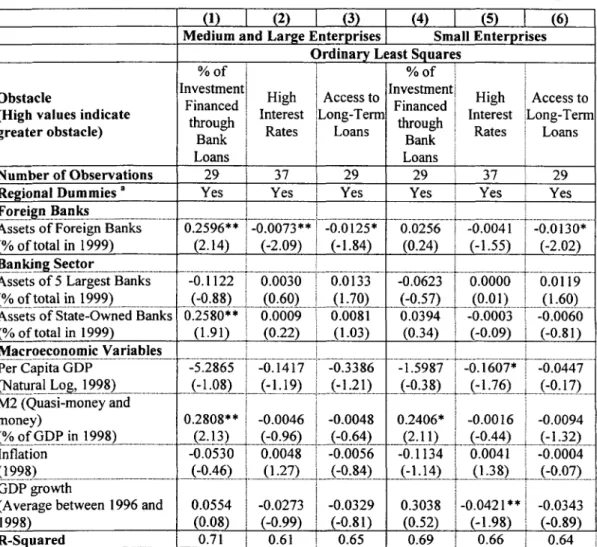
Cross-Country Analysis. As a check for robustness, in addition to the enterprise-level
regressions discussed above, we also present results from cross-country regressions for enterprises of different sizes. Since there are very few large enterprises in many countries in our
sample - often fewer than ten - medium and large enterprises are pooled together when calculating averages. The dependent variables are averaged over all enterprises of that type (e.g., small enterprises) in each country. These average scores are then regressed on the banking
sector and the macroeconomic variables.31 Despite the low number of observations, the results
are broadly similar to those from the enterprise level analysis, although significance levels tend to be lower (Table X). Both small and medium-sized and large enterprises rated access to long-term loans as lesser constraints in countries with higher levels of foreign bank penetration. In addition, medium and large enterprises rated interest rates as lesser constraints in countries with higher levels of foreign bank penetration and tended to finance greater proportions of investment through bank loans. Although the coefficients on foreign bank penetration in the regressions for interest rates and percent of investment financed through bank loans have similar signs for small enterprises, they are statistically insignificant. The coefficients on the other macro and banking sector control variables generally have the same signs as in the enterprise-level regressions, although they are mostly statistically insignificant.
V. CONCLUSION
Policymakers in developing countries are often concerned that even if increased penetration by foreign banks improves sector efficiency, sector stability and competition, it might have some harmful side effects. In particular, it has been suggested that foreign entry might result in less credit to some sectors of the economy, particularly small and medium-sized enterprises. Combining responses from a survey of over 4,000 enterprises in 38 developing and transition economies with data on the degree of foreign bank penetration in those countries, this
Overall, the empirical results strongly support the assertion that foreign bank penetration improves firrns' access to credit. Enterprises in countries with high levels of foreign bank penetration tended to rate interest rates and access to long-term loans as lesser constraints on enterprise operations and growth than enterprises in countries with less foreign penetration. Further, the benefits of high levels of foreign bank penetration do not appear to accrue only to large enterprises. Although some evidence suggests that entry by foreign banks benefits large enterprises more than small ones, there is strong evidence that even small enterprises benefit in some ways and there is no evidence that they are harmed by foreign bank entry.
At first sight, this result might seem inconsistent with developing country case studliLes that find that foreign banks lend smaller shares of their portfolios to small and medium-sized
enterprises than similar domestic banks. There are a number of reasons why this is not necessarily so. First, cross-country evidence suggests that increased foreign bank entry is associated with lower interest margins and overhead costs. If improved efficiency results in an expansion in total lending, the amount of lending to SMEs might increase even if the share of lending to them falls. Second, increased foreign bank participation might cause domestic banLks to modify their behavior. In particular, foreign competition for larger clients might force exisling
domestic banks to seek new market niches, which could benefit small borrowers in the medium term. The findings from this study are broadly consistent with these explanations: although small enterprises appear to benefit from higher penetration by foreign banks, large enterprises appear to gain more.
REFERENCES
Avery, Robert B. and Katherine A. Samolyk, 2000, Bank Consolidation and the Provision of Banking Services: The Case of Small Commercial Loans, Federal Deposit Insurance Corporation working paper.
Barajas, Adolfo, Roberto Steiner, and Natalia Salazar, 2000, Foreign Investment in Colombia's Financial Sector, in Claessens, S. and Marion Jansen, eds.: The Internationalization of
Financial Services: Issues and Lessons for Developing Countries (Kluwer Academic
Press, Boston, MA).
Barth, James R., Gerard Caprio, and Ross Levine, 2001a, Bank Regulation and Supervision: What Works Best? Mimeo, World Bank, Washington DC.
Barth, James R., Gerard Caprio, and Ross Levine, 2001b, The Regulation and Supervision of Banks Around the World: A New Database, Policy Research Working Paper #2588,
World Bank, Washington DC.
Barth, James, Gerard Caprio, and Ross Levine, 2001c, Banking Systems Around the Globe: Do Regulation and Ownership Affect Performnance and Stability? Forthcoming in Mishkin, Frederic ed.:, Prudential Regulation and Supervision: What Works and What Doesn't, (National Bureau of Economic Research, Boston, MA).
Berger, Allen N. and Gregory F. Udell, 1995, Relationship Lending and Lines of Credit in Small Firm finance, Journal of Business, 68: 351-382.
Berger, Allen N. and Gregory F. Udell, 1996, Universal Banking and the Future of Small Business Lending, in Anthony Saunders and Ingo Walter eds.:, Financial System design:
The Case for Universal Banking, (Irwin Publishing, Burr Ridge, IL.)
Berger, Allen N., Anil K. Kashyap, and Joseph M. Scalise, 1995, The Transfornation of the U.S. Banking Industry: What a Long Strange Trip It's Been, Brookings Papers on Economic
Activity 2, 55-218.
Berger, Allen N., Anthony Saunders, Joseph M. Scalise, and Gregory F. Udell, 1998, The Effects of Bank Mergers and Acquisitions on Small Business Lending, Journal of Financial
Economics, 50(2), 187-229.
Berger, Allen N., Leora F. Klapper, and Gregory F. Udell, 2000a, The Ability of Banks to Lend to Informationally Opaque Small Businesses, Mimeo, World Bank, Washington DC. Berger, Allen N., Robert DeYoung, Hesna Genay, and Gregory F. Udell, 2000b, Globalization of
Financial Institutions: Evidence from Cross-Border Banking Performance, Brookings
Bonin, John and Istvan Abel, 2000, Retail Banking in Hungary: A Foreign Affair? Mimeo, Wesleyan University, Middletown, CT. Prepared as background paper for, World Bank,
World Development Report 2002: Building Institutions for Markets.
Chang, C. Edward, Iftekhar Hasan, and William C. Hunter, 1998, Efficiency of Multinational Banks: An Empirical Investigation, Applied Financial Economics 8(6), 1-8.
Cho, Kang Rae, Suresh Krishnan, and Douglas Nigh, 1987, The State of Foreign Banking Presence in the United States, International Journal of Bank Marketing 5(2), 5 9-75. Claessens, Stijn and Marion Jansen (eds.), 2000, The Internationalization of Financial Services:
Issues and Lessons for Developing Countries, (Kluwer Academic Press, Boston, MA).
Claessens, Stijn, Asli Demirgiu,-Kunt, and Harry Huizinga, 2000, The Role of Foreign Banks in Domestic Banking Systems, in: Claessens, Stijn and Marion Jansen, eds.: The
Internationalization of Financial Services: Issues and Lessons for Developing Countries,
(Kluwer Academic Press, Boston, MA).
Claessens, Stijn, Asli Demirgiiu-Kunt, and Harry Huizinga, 2001, How Does Foreign Entry Affect the Domestic Banking Market?, Journal of Banking and Finance 25 (5), 891-911. Clarke, George R.G., and Robert Cull, 1999, Why Privatize? The Case of Argentina's Public
Provincial Banks, World Development 27 (5), 867-888.
Clarke, George R.G. and Robert Cull, forthcoming, Political and Economic Determinants of the Likelihood of Privatizing Argentine Public Banks, Journal of Law and Economics. Clarke, George, Robert Cull, Laura D'Amato, and Andrea Molinari, 2000, On the Kindness of
Strangers? The Impact of Foreign Entry on Domestic Banks in Argentina, in: Claessens, Stijn and Marion Jansen, eds.: The Internationalization of Financial Services. Issues
and Lessons for Developing Countries, (Kluwer Academic Press, Boston MA).
Clarke, George, Robert Cull, Maria Soledad Martinez Peria, and Susana M. Sanchez, 2001, "Bank Lending to Small Businesses in Latin America: Does Bank Origin Matter"' Mimeo, World Bank, Washington DC.
Dages, Gerard, Linda Goldberg, and Daniel Kinney, 2000, Federal Reserve Bank of New York Economic Policy Review, September.
Demirguic-Kunt, Asli and Harry Huizinga, 1999, Determinants of Commercial Bank Interest Margins and Profitability: Some International Evidence, World Bank Economic Review,
13(2): 379-408.
Demirgui,-Kunt, Asli and Ross Levine, 2000, Bank Concentration: Cross-Country Evidence, World Bank mimeo.
Demirgui,-Kunt, Asli, Ross Levine, and Hong G. Min, 1998, Opening to Foreign Banks: Issues of Stability, Efficiency and Growth, in Proceedings of the Bank of Korea Conference on
the Implications of Globalization of World Financial Markets.
DeYoung, Robert and Daniel E. Nolle, 1996, Foreign-owned banks in the United States: Earning Market Share of Buying it?, Journal of Money, Credit, and Banking, 28(4), 622-36. Escude Guillermo, Tamara Burdisso, Marcelo Catena, Laura D'Amato, George Mc Candless,
and Tomas Murphy, 2001, "Las MIPyMES y el Mercado de Credito en la Argentina," Documento de Trabajo Nro. 15, Banco Central de la Repuiblica Argentina,
Focarelli, Dario and Alberto Pozzolo, 2000, The Determinants of Cross-Border Shareholding: An Analysis with Bank-Level Data from OECD Countries, Paper presented at the Federal Reserve Bank of Chicago Bank Structure Conference, May.
Goldberg, Lawrence G., 1992, The Competitive Impact of Foreign Commercial Banks in the United States, in R. Alton Gilbert, ed.:, The Changing Market in Financial Services,
Proceedings of the Fifteenth Annual Economic Policy Conference of the Federal Reserve Bank of St. Louis, (Kluwer Academic, Norwell, MA).
Goldberg, Linda B., 2001, "When is U.S. Bank Lending to Emerging Markets Volatile?," Federal Reserve Bank of New York, Mimeo.
Greene, William, 2000, Econometric Analysis, 4h Edition, (Prentice Hall, Upper Saddle River, NJ.)
Hasan, Iftekhar and William Curt Hunter, 1996, Efficiency of Japanese Multinational Banks in the United States, in Andrew H. Chen, ed.:, Research in Finance, Volume 14, (Greenwich, CT and London: JAI Press).
Hellman, Joel, Geraint Jones, Daniel Kaufmann, and Mark Schankerman, 2000, Measuring Governance and State Capture: The Role of Bureaucrats and Firms in Shaping the Business Envirornent, European Bank for Reconstruction and Development Working Paper # 51, London, UK.
Jenkins, Hatice, 2000, Commercial Bank Behavior in Micro and Small Enterprise Finance, Development Discussion Paper # 741, Harvard Institute for International Development, Harvard University, Boston, MA.
Keeton, William R., 1995, Multi-Office Bank Lending to Small Businesses: Some New Evidence, Federal Reserve Bank of Kansas City Economic Review 80(2), 45-57.
Levonian, Mark and J. Soller, 1995, Small Banks, Small Loans, Small Business, Mimeo, Federal Reserve Bank of San Francisco, San Francisco, CA.
Mahajan, Arvind, Nanda Rangan, and Ashgar Zardkoohi, 1996, Cost Structures in Multinational and Domestic Banking, Journal of Banking and Finance 20(2): 238-306.
Mester, Loretta J., 1997, What's the Point of Credit Scoring?, Federal Reserve Bank of
Philadelphia Business Review, Sept.-Oct.: 3-16.
Miller, Stewart R. and Arvind Parkhe, 1999, Home-Country Environment as a Source of International Competitiveness: An Analysis of the Global Banking Industry, Michigan State University, Mimeo.
Parkhe, Arvind and Stewart R. Miller, 1999, Is There a Liability of Foreignness in Global Banking? An Empirical Test of U.S. Banks' X-Efficiency, Michigan State University, Mimeo.
Peek, Joe and Eric S. Rosengren, 1996, Small Business Credit Availability: How Important Iis Size of Lender?, in Anthony Saunders and Ingo Walter, eds., Financial System Design.:
The Case for Universal Banking, (Irwin Publishing, Burr Ridge, IL.)
Petersen, Mitchell A. and Raghuram G. Rajan, 2000, Does Distance Still Matter? Th.e Information Revolution in Small Business Lending, mimeo.
Strahan, Philip E. and James P. Weston, 1996, Small Business Lending and Bank Consolidation: Is There Cause for Concern?, Federal Reserve Bank of New York Current Issues in
Economics and Finance 2, 1-6.
Table I: Countries Included in the Analysis. Country List
Argentina Guatemala Poland
Bangladesh Honduras Portugal
Belarus India Rumania
Bolivia Indonesia Russia
Botswana Lithuania Senegal
Brazil Malawi Slovenia
Cambodia Malaysia South
Chile Mexico Thailand
Croatia Moldova Trinidad
Czech Nigeria Turkey
Egypt Panama Venezuela
Estonia Peru Zambia
Table II: Sample Means for Independent Variables.
Variable Description Source Mean StaDevar Foreign Banks
Assets of Foreign Banks Percent of total in 1999 Barth et al. 25.79 26.41
(200 1)
Banking Sector
Assets of 5 Largest Banks Percent of total in 1999 Barth et al. 69.19 14.96
(2001)
Assets of State-Owned Banks Percent of total in 1999 Barth et al. 37.50 24.94)
(2001)
Enterprise Characteristics
Small Enterprise (Fewer than 50 Dummy variable WBES 0.385 0.487
employees)
Medium Enterprise (Between 50 and 200 Dummy variable WBES 0.437 0.496
employees)
State Ownership Percent of state-owned WBES 8.761 25.713
Foreign Ownership Percent of foreign- WBES 11.88 28.9
owned
Sales Growth 1996 to 1998 WBES 14.63 59.26
Exports Growth 1996 to 1998 WBES 4.28 37.78
Enterprise Exports Percent of sales WBES 17.09 30.01
Operations outside of home country Dummy variable 0.161 0.368
Macroeconomic Factors
Per Capita GDP Natural log in 1998 WDI 8.53 0.74
M2 (Quasi-money and money) Percent of GDP in 1998 WDI 35.75 23.04
Inflation n 1998 WDI 18.04 20.7
GDP growth Average 1996-98 WDI 2.39 3.51
Regional Dummies
Caribbean Dummy variable WBES 0.014 0.11 9
Central and Eastern Europe Dummy variable WBES 0.286 0.452
Commonwealth of Independent States Dummy variable WBES 0.230 0.42
East Asia and China ummy variable WBES 0.146 0.353
Latin America Dummy variable WBES 0.094 0.292
Middle East and North Africa Dummy variable WBES 0.062 0.24]
South Asia Dummy variable WBES 0.042 0.200
Sub-Saharan Africa Dummy variable WBES 0.125 0.331
Sector of Operations
Manufacturing Dummy variable WBES 0.403 0.491
Services Dummy variable WBES 0.376 0.484
Other Dummy variable WBES 0.033 0.178
Agriculture Dummy variable WBES 0.098 0.298
Construction Pummy variable WBES 0.091 0.287
Note: WBES indicates The World Business Environment Survey (WBES) 02000 The World Bank Group and WDI refers to the World Bank's World Development Indicators. Averages are calculated for the sample from the regression shown in Column ' of Table V.
Table III: Average Financial Sector Constraints by Enterprise Type
State- Foreign b Medium- b
All Owned'a Owned'a Small Sized b Largeb
Number of Observations 2948 251 333 1134 1288 526
High Interest Rates 3.32 3.18 3.12 3.26 3.38 3.27
Access to Long-Term Loans 2.65 2.37 2.29 2.71 2.61 2.58
Access to Non-Bank Equity/Partners 2.05 1.95 1.72 2.11 2.08 1.89
Data Source: The World Business Environment Survey (WBES) 02000 The World Bank Group
Note: Averages are calculated using the observations included in regressions in Table V. Observations are for high interest rates - fewer observations were available for the other two measures. Averages are simple averages of ratings given by enterprise managers in answer to questions such as: "Using [a four-point scale], can you please tell in tum how problematic are these different financing issues for the operation and growth of your business." The scores are as follows: I indicates no obstacle; 2 indicates a minor obstacle; 3 indicates a moderate obstacle; and 4 indicates a major obstacle."
a State- and Foreign-owned implies that over 50 percent of the enterprise is owned by that source. b Small enterprises have fewer than 50 employees, medium-sized enterprises between 50 and 200, and large enterprises have over 200.
Table IV: Share (%) of Investment Financed through Different Sources by Enterprise Type
State- Foreign b Medium- b
All Owned ' Owned a Small Sized b Large
Number of Observations 2221 205 172 890 1020 311 Retained Earnings 52.9 51.4 47.6 53.4 55.1 44.6 Commercial Banks 17.3 9.4 29.6 12.7 17.8 28.8 Government 3.6 21.9 0.2 0.7 5.6 5.6 Informal Sources 7.8 0.9 1.7 15.6 3.0 1.1 Other Sources d 18.4 16.4 21.0 17.7 18.4 20.0
Data Source: The World Business Environment Survey (WBES) C2000 The World Bank Group. Note: Average are calculated based on the observations included in regressions in Table V.
a State- and Foreign-owned implies that over 50 percent of the enterprise is owned by that group. b Small enterprises have fewer
than 50 employees, medium-sized enterprises between 50 and 200, and large enterprises have over 200. c Informal sources include family and friends, money lenders, and other traditional or informal sources. d Other sources include supplier credit, leasing arrangements, equity and sale of stock, and other unspecified sources.
Table V: Effect of Foreign Bank Penetration on Enterprises' Access to Financing Ordered Ordered Ordered Tobit ~Probit Probit Probit % of
bstacle ~~~~~~~~~Investment Hg nest Access to Access to Financed Rts Long-Term Non-Bank
(High values indicate greater obstacle) thouhBakLoneFnncn
Loans
Number of Observations 2221 2948 2116 2231
!egi~onal Dummies aYes _ Yes Yes Yes
... . . . _..._ .. . . ... .. .. . . .
Sector Of Operations 6Yes Yes Yes Yes
Foreign Banks
ssetso of _Fore_i_g_n B"ank_s ,-__,__-____ 0.2683* -0.0060*** ~OO5-3- -_06.05062-4' (% of total in 1999) (1.89) (-3.63) (-5.97) (-1.42)
a n k in gS.. ...e .... ... ... ...
Assets of 5 Largest Banks -0.3002** 0.0024 0.0 160*** 0.0039
(% of total in_1999) (-1 99) -(1.04) (5.3) _ (1.52)
ssets of State-Owned Banks 0.0840 -0.0010 0.0008 -0.0007
%0oof total in 1999) (0.62) (-0.56) (0.34) (-0.39)
...
t.e...p c....te ris tic...s.... ... . .C....a. ... .... ... .. .... ..-...
Small Enterprise -22.1338*** 0.0617 0.1825** 0. 1951* Dummjjy Variable) ... (:4.52) (0.82) _199 (2.42) Medium Enterprise -8.0146* 0.1579** 0.0297 0.1688** Variable) ~ ~ (1. 90) _(2.41) .__(0.37) (2.45) Sate Ownership -0.2805*** -0.0036*** -0.0040*** -0.0014 %of eterriestate-owned) (-4.44) (-3.87) (-3.85)_ (:1.36)-Foreign Ownership 0.0135 -0.0026*** -0.0045*** -0.0049*** %oeneprise foreign-owned) __ (0.23) (-.01 (-4.00).. (-5.17 Sales Growth 0.0360* -0.0009** 0.0001 0.0004 1996 to 1998) (1.66) (-.40) (0.16)(09)-Exports Growth -0.0022 -0.0002 0.0006 0.00 10 (1996 to 1998) (-006) (-0.31) (082 (1.55) Enterprise Exports 0.097 1 -0.00 10 0.0020* 0.0022** (%_of sales) (1.87) (-119) _ 19)(.6
Operations outside of home country -5.3026 -0.05 13 0.0020 -0.0335 (Dummy variable) (-1.19) (-075) (0.02) (-0.47) Macroeconomic Factors Per Capita GDP 1.4546 -0.2684*** -0.4251 *** -0.3132* ** - atral o~g,1998) (0.27) (-5.09) (-4.25) - (-6.03) M2 (Quasi-money admoney) 0.3096** -0.00 13 -0.0047* -0.0063*** (%of GDP in 1998)- -(1.98) -(-067) (-1.73) (-2.41) Inflation -0.1508 0.0088*** -0.0028 -0.0063*** (1998) (-1.36) (.9 -. 7 -. 6 GDP gowth 0.4960 -0.0530*** -0.0491*** -0.0527*** (Average between 1996 and 1998) (0.84) (-5.42) (-4.91) - -5.11)
Log Likelihood -5163.3 -3046.4 . -2633.2 -2747.6
Data Source: The World Business Environment Survey (WBES) 02000 The World Bank Group.
Note: Regressions include dummy variables indicating a region (Eastemn Europe; Formner Soviet Union; Caribbean; East Asia;
Latin America; Middle East and North Africa; South Asia; and Sub-Saharan Africa) and b sector of operations (manufacturing, services, agriculture, and other). T-statistics are in parentheses. ** Sig. at 1% level ** Sig. at 5% level * Sig. at 10% level.
Table VI: Effect of Foreign Bank Penetration on Enterprise's Access to Financing
Including Interactions Be teen Foreign Bank Participation and Enterprise Size
____________________________ Tobit Ordered Probit' Ordered Probit: Ordered Probit
% of Investment Access to
Obstacle Fiacdtruh High Interest Access to Long- NnBI
(High values indicate greater obstacle) Rates Term Loans
____ ____ ____ ___ ____ ____ ___ Bank Loans _ _ _ _ _ __ Financing
Number of Observations 2221 2948 2116 2231
fgional Dummies' Yes Yes Yes Yes
Sector oOertosYsYes Yes Yes
Foreignl Banks Assets *Small Enterprise -0.2330 -0.0048*** - 0.0144** -0.0020
Interaction Term - _(.3(-2.35) _ (-4.91) __ (-092)
Foreign Banks Assets *Medium
Enterprise 0.2625* -0.0059*** -0.0155*** -0.0027 (Interaction Term) (1.66) (-3.07) (-541) (L134) o5reign Banks Assets *Large Enterprise 0.3 526* -0.0073*** -0.0167*** -0.0,024 Interaction Term) (1.73) (-3.14) (-4.62) - -. 94) Banking
Sector-.--Assets of 5 Largest Banks -0.2948* 0.0021 -0.0158*** 0.0038
%of total in 1999) (-1.94 (09)(.)-(17)_
Assets ofSae-Owned Banks 0.0795 -0.0007 0.0009 -0.0007 (% of total in 1999) (0.58) (-0.43) (0.39) (-038) Enterrise Characteristics Small Enterprise -19.384*** -0.0021 0.1196 0.1817* DmyVariable) -- (-2.93) (:0.02) (0.93) _ (1.73) edium Enterprise -5.9763 0.1252 -0.0037 0. 1746* Dummy .Variable) - -1.00)- -(1.45) _ (-0.03) _ (1.93) -State Ownership -0.2837*** -0.0035*** -0.0040-*** -0.00 14 (ofenterprise state owned) (-4.47) 8)(-3.83)(-.7--.
ori n Owersi 0.0130 -0.0025*** -0.0044** -I 0.0049*** %of enterprise foreign owned) (0.22) 293(390(517
Sales Growth 0.0361* -0.0009**~__ 0.0001 0.0004 (1996 to 1998 -(1.67) (-2.41) (0.16) (.5 xpo rt s _G r"o wth -0.00 14 -0.0002 0.0006 0.00 10 (1996 to 1998 (-0.04) (-033)(07)1.5 Enterprise Exports 0.0971* -0.0009 0.0021* 0.0022** % of sales) -(1.87) (-1.10) (2.01) (2.36)
Operations outside of home country -5.4 160 -0.05 19 0.005 1 -0.0326 (Dummy variable) (-1.21) (-075) (0.06) (-0.45)
acroeconomic Factors
~er Capita GDP ... --- ---- ."460 1 62i -0285* 0.4255*** -0.3134***
(atural Log, 1998) (0.27) __ _(-5.09)-.5
-k)--M2 (Quasi-money and money) 0.2988* -0.0010 -0.0044 -0.0062** %ofGDPin 1998) (1.9~~ ~ - ~~~~~~0) (0.52) (-1.61) (-2.39) Inflation -0.1530 0.0089***i'_] -0.0027 -0.0063***
(1998) (-1.38) (5.93) (-1.52) (-3.93 _
b6P
got 0.5178 -0.0540*** -0.0499*** -0.0531*** (Average between 1996 and 1998) (0.88) (-5.48) (-4.95) (-5.12)Log Likelihood 5163.1 3045.8 2633.0 2747.5
Data Source: The World Business Environment Survey (WBES) 02000 The World Bank Group.
Note: Regressions include dummy variables indicating a region (Eastern Europe; Former Soviet Union; Caribbean; East Asia;
Latin America; Middle East and North Africa; South Asia; and Sub-Saharan Africa) and b sector of operations (manufacturing,
Table VII: Effect of Foreign Bank Penetration on Enterprise's Access to Financinig
Controlling for Bank Supervisory and Regulatory Variables ____
(1) (2) i (3) (4)(5)
Tobit .Ordered Probit Ordered Probit Tobit :Ordered Probit Ordered Probit
% of Investment, % of Investment.
Obstacle Financed High Interest Access to Long- Financed High Interest 'A z-.,ess to Long-(High values indicate greater obstacle) through Bank Rates Termn Loans through Bank Rates T'erm Loans
Loans ____ __Loans
Number of Observations 3040 4065 3039 2099 2807 1985
R!gional Dummies' Yes Yes Yes _ Yes Yes Yes
Sector of OperationsbYs Yes Yes Yes Yes Yes
...
o.. n- ... .. . - --- ---- -...
Ba n k s. ... ... . .. ...
Foreign Banks Assets *Small Ent. 0 2095* -0.0076*** -00102*** 0.3666* -00071** .0.0150***
(lInteraction Termn) - ~ (165) (-453) 1 (497) __ (2.13 (2,98) .. (... -4.96)
ForeignBanks Asses*Medlm Ent. 034** 0.0061*** -00097*** 0.3923** -00083*** -0.6ffg*" (Interaction Term) -~~~~~~~~ - (2 82) ~~(-3.69) i ( 461) _ _(.3)(3.62) (-5.98)
ForeipnBanks Assets *Large Ent. 0.3215* -0.0084** -0019* ....0O.... 4306* -00097*** 0-0194***
(Interaction Term) (1.93) (-4.13) (-4.14) (2.03) (36)(.2
apnkin Sector 362(522
Assets of 5 Largs"t Baks0.1395 0.0014 0.009i*** -0.3402 0 0057* 0) 0197***
(% of total in 1999)~. ... (1...
of State-Owned Banks 0(1...32) (0.82 )(.3)(1.63 8)(5!)
ssets ofSaeOndBns02294** -0.0002 0.0002 0.1710 -00010 0.0009
% of total in 1999) . (2.20) (-012) 1 (0.08) (1.14) (-057) I (0.33) B a k R g la i n..k R e...gu...la..ti..on... .... .... -- ... ... . . .... ... ... ..
imits on Bank Entry
(Index - high values indicate more -5.2160** 0.0201 -0.0394
rstrictions) (-2.41) (053(-95
;upervisory Power 1.8786 0.0078 .-0.0439**
Index -high value idcae rater power) _______ ______ 1.50) (0.51) 1 (-2.06)
n t r... .. . .. L... e l.... V a ri.. a b....le s ... . ... ... --- --- ... ... .. . . ...-... ... ... ... . ... ... 5mall Enterprise -20 2162*** 0.0844 0.1351 -23.2786*** 0.0326 0.0339 D my Varia-ble)_ (39 !0) -(.0-3.3)(2)_ (05 dedium Enterprise -10.5415* 0.1112 0.0031 9.6431 0.1358 -0.005 DmyVariable) -- -207 - (j.48)… … 003 -1.56) (.51 . -0.04) -StateOwnership ~ ~ ~ ~ ~ ~ 02558*** ~~~ 0.0031* -0.0037*** -0.3243*** -0.0029** -0.0030***
O/o of enterprise state owed .. (-44) (-354...(3.7) -4.82) (9) - 2.66)
oreipn Ownership -0.0160 -0.0026*** -0.0041** -0.0263 -0.0022** -. .0038***
.fenterprise foreign owned) (-0 33) (-354) - -4.58) (-0.44)2 329
ales Growth ~~~~~~~~ ~~~~~~~~~ -0.0010*** ~ ~~~~~~~~~~0.0377* 0.0002 1996 to t?98) -- - - ~~~~~~ ~ ~~~~~~~ - (-.65)(.8 ~ ~~~~~~~~~~~~~~~(1.70) xports Growth ~~~~~~~ ~ ~~~~~~~ -0.0003 ~ ~~~~~~~~~~~-0.0025 0.0005 1996 to 1998) - . -. 7 -0.52) (.6 -nteprie Eport 0.372** 0.0012* 0.0015* 0.1097** -0.0007 0 0024** %of sales).(3.06) (-1.67) (1.65) (2.08) (0.79)(21
Operations outside of home country -256 -0.0929 1 0.0094 -3.8301 -0.0310 0.0056 (Dummy variable) (-061) (-1.60) (0.14) (-084) (-044) (0.06)
M
acroeconomic Variables ... ... ... ...---- -2~~~~~~~~~~5746 - 0l5** i0 1757 -0.2963 -0.3364*** 1).5341***
(Natural Log, 1998) (-065) (-.4 -1.69(-05 - -(-68(47)
2 (Quasi-money and money) 0.5373*** -0.0012 -0.0051*** 0.1057 I 0.0028 -0.0046
'% of GDP in 1998) (4290)- ....--.. 6....4 (054 (.1)-1.52)-nflation ~~~~~~~~0.2153** 0.0079*** -0.0006 -0.4665* 0.0157*** -0.0024 99 --8) -. .... (.-2... .22)- (6.32) (-0.41) _ _(-1.81 (7)(-0.71) 3DP growth 0.3883 -0.0515*** -0.0520*** -2.0603 0.0011 -0.0434**
PAverage between 1996 and 1998) (0.72) (-5.76) (-5.70) (-1.56) - (0-05) (-2.03)
Log Likelihood -7556.5 -4167.8 -3827.0 -4964.0 -2885.5 -2465.2 Data Source: The World Business Environment Survey (WBES) C~2000 The World Bank Group. Note: Regressions include dummy variables indicating region (Eastem Europe; Former Soviet Union; Caribbean; East Asia; Latin America; Middle East and North Africa; South Asia: and Sub-Saharan Africa) and b sector of operations (manufacturing, services, agriculture, and other). T-statistics are in parentheses. ** Sig. at 1%