City, University of London Institutional Repository
Citation
:
Jansson, A., Bittner, R. M., Ewert, S. and Weyde, T. ORCID:
0000-0001-8028-9905 (2019). Joint singing voice separation and F0 estimation with deep U-net architectures.
2019 27th European Signal Processing Conference (EUSIPCO), 2019-S, doi:
10.23919/EUSIPCO.2019.8902550
This is the accepted version of the paper.
This version of the publication may differ from the final published
version.
Permanent repository link:
https://openaccess.city.ac.uk/id/eprint/23669/
Link to published version
:
10.23919/EUSIPCO.2019.8902550
Copyright and reuse:
City Research Online aims to make research
outputs of City, University of London available to a wider audience.
Copyright and Moral Rights remain with the author(s) and/or copyright
holders. URLs from City Research Online may be freely distributed and
linked to.
City Research Online:
http://openaccess.city.ac.uk/
[email protected]
Joint Singing Voice Separation and F0 Estimation
with Deep U-Net Architectures
Andreas Jansson
City, University of London / Spotify Inc. New York, USA
Rachel M. Bittner
Spotify Inc. New York, USA
Sebastian Ewert
Spotify Inc. London, UK
Tillman Weyde
City, University of London London, UK
Abstract—Vocal source separation and fundamental frequency estimation in music are tightly related tasks. The outputs of vocal source separation systems have previously been used as inputs to vocal fundamental frequency estimation systems; conversely, vocal fundamental frequency has been used as side information to improve vocal source separation. In this paper, we propose several different approaches for jointly separating vocals and estimating fundamental frequency. We show that joint learning is advantageous for these tasks, and that a stacked architecture which first performs vocal separation outperforms the other configurations considered. Furthermore, the best joint model achieves state-of-the-art results for vocal-f0 estimation on the
iKala dataset. Finally, we highlight the importance of performing
polyphonic, rather than monophonic vocal-f0estimation for many
real-world cases.
Index Terms—music, voice, singing, fundamental frequency estimation, pitch, melody, source separation, multitask learning
I. INTRODUCTION
The singing voice plays a major role in most music cultures around the world. In music signal processing, two common tasks related to the singing voice are vocal separation (recov-ering a recording of the singing voice from a complete song)
and vocal f0 estimation (estimating the fundamental frequency
of the singing voice over time). As demonstrated in [17], there are dependencies between the two tasks, which allowed for improving the performance on one task by integrating information obtained via a method designed for the other. These dependencies can be modeled in different ways. For example, the fundamental frequency can be estimated and employed as side information in the separation process [10], [17]. Alternatively, an estimate of the clean singing voice can be used as input to simplify the estimation of the fundamental frequency of the voice [4]. Given that both directions were successfully exploited in the past, it remains unclear how these dependencies should be modeled, especially given that prior work typically solves one task independently of the other and conditions the other on the resulting point estimate — eliminating the potential benefits of circular influence. Attempts have been made to learn both tasks iteratively, in an alternating fashion [7]. Learned joint pitch and separation models have been proposed for speech [19]. However, we are not aware of prior work in music that jointly performs vocal separation and vocal melody estimation.
Another important aspect of combining models for different tasks is the issue of a resulting mismatch between the data
0.4 0.5 0.6 0.7 0.8 0.9 1.0 OA
RPA
pYin (Clean Vocal) pYin (Sep. Vocal) Crepe (Clean Vocal) Crepe (Sep. Vocal)
Deep Salience (Clean Vocal) Deep Salience (Sep. Vocal) Deep Melody (Mix) Melodia (Mix)
Fig. 1. Performance of pYIN [11], Crepe [9], and Deep Salience [2] on the iKala [3] dataset. pYIN and Crepe are run on clean iKala vocals and on vocals computed by running a source separation algorithm (“Source Only” in Figure 3) from iKala mixtures as input. Deep Salience and Melodia are run on iKala mixtures as input. Boxplots show the distribution ofOAandRPA over each track in the dataset.
distributions at training and test time. Consider performing
vocal f0 estimation by first applying a source separation
algorithm to a mixed signal and then running a standard pitch tracker. Pitch trackers are typically designed based on two assumptions: the signal being pitch tracked has little to no noise or interference, and is monophonic. Due to these assumptions, pitch tracker performance can suffer from artifacts introduced by source separation, which can include residual sounds that are pitched or other interference in the background. Figure 1 shows the performance of three different pitch tracking algorithms — Crepe [9], pYIN [11], and Deep Salience [1] on both clean and source-separated vocals in the iKala dataset [3]. The
Overall Accuracy (OA) and Raw Pitch Accuracy (RPA) metrics
(standard metrics in pitch tracking, see [15] for a description) considerably decrease for all three algorithms when applied to source separated instead of clean vocals. Additionally, for songs containing more than one singing voice, many current
source separation systems tend to isolateallsinging voices; the
resulting polyphonic signal can severely reduce the accuracy of pitch trackers.
Given this interdependent nature of the two tasks, it is an open question how to design a joint estimator, and whether such a system would actually yield benefits. As a first contribution in this paper, we demonstrate that incorporating “oracle” (ground
TABLE I
DEFINITIONS OF RECURRING NOTATIONS Notation Description
ym,yv mixture and vocal audio signals
Ym,Yv magnitude STFT of mixture and vocal audio
Sv vocalf0 salience produced by Deep Salience onYv[1]
ˆ
Yv,Sˆv model estimate ofYv,Sv
ˆ
Mv model estimated ratio mask
truth) information for both pitch and separated vocals can indeed improve the learned results for the other task. As a second contribution, we then design, implement and evaluate different model architectures that estimate pitch and vocals individually or jointly in a variety of ways, each reflecting a different perspective on the interdependency of the two tasks. Finally, inspired by end-to-end unfolding techniques for representing iterative re-estimation processes of dependent components inside a network [18] as well as stacking networks [12], we propose an architecture which resolves the task dependencies within a sequential re-estimation model.
II. INPUT ANDOUTPUTREPRESENTATIONS
We make use of an internal dataset of roughly 2500 pairs of
music audio signalsymand corresponding isolated vocal audio
signalyvfrom a number of musical genres, including pop, rock
and rap vocals. All singing voices present in the mixtureymare
included in the isolated vocals signal yv, meaning thatyv may
— and often does — contain more than one active voice at a
time (e.g. a lead singer and background harmonies).ymandyv
are converted to mono with a sample rate of 22050 Hz. LetYm
and Yv be the magnitude of the Short Time Fourier Transform
(STFT) spectrogram of ym and yv respectively. STFTs are
computed with a hop size of 256 and with 1024 points in the FFT, as shown in Figure 2 (left) and (middle) respectively.
Our dataset does not contain ground truth vocalf0
annota-tions. As a proxy for ground truthf0, we run the Deep Salience
multiple-f0estimation model [1] on the isolated vocals yv in
our training set. Deep Salience predicts a matrix Sv of f0
salience values — i.e. the likelihood of an f0 value being
present over a grid of time-frequency points (see Figure 2, right). Note that this algorithm does not assume the audio is monophonic — if multiple pitches are present at the same time,
there can be multiple high-likelihood f0 bins. Sv is the target
output for the vocal f0 estimation (pitch) component of our
models. Note that we are training a model to reproduce the output of another trained model (Deep Salience), similar to a teacher-student training paradigm [6]. One notable difference
is we are training our model to produce Sv given mixtures
as input, while the pre-trained Deep Salience model is given isolated vocalsas input. This also means that the performance of our model will likely be upper bounded by the performance of Deep Salience on isolated vocals.
The largest public datasets with mixtures, corresponding
isolated vocals and annotated vocal f0 are iKala [3] (≈ 2
hours) and MedleyDB [2] (≈3hours, since only half of the
tracks contain vocals). Because Deep Salience was trained using
0.0 2.3 4.7 0.0 2.2 4.3 6.5 8.6 10.8 Frequency (kHz) Ym 0.0 2.3 4.7 0.0 2.2 4.3 6.5 8.6 10.8 Frequency (kHz) Yv 0.0 2.3 4.7 32.7 73.6 165.5 372.2 837.3 1883.5 Frequency (Hz) Sv 26.6 28.4 30.2 Time (s) 0.0 2.2 4.3 6.5 8.6 10.8 Frequency (kHz) 26.6 28.4 30.2 Time (s) 0.0 2.2 4.3 6.5 8.6 10.8 Frequency (kHz) 26.6 28.4 30.2 Time (s) 32.7 73.6 165.5 372.2 837.3 1883.5 Frequency (Hz)
Fig. 2. An example of the input and output representations used for training. (Left) Input magnitude STFT of the mixture audio. (Middle) Target magnitude STFT of the isolated vocal audio. (Right) Target vocal salience produced by the Deep Salience algorithm [1]. The top row shows an example where there is one solo singer, while in the bottom row, three singers are singing in harmony.
MedleyDB, we evaluate the performance of our models on
iKala. We compare vocalf0outputs with iKala’sf0annotations
using themir_eval[13] implementation of standard melody
metrics [15]. Vocal source separation outputs are evaluated
using the Signal-to-Distortion Ratio (SDR) metric1 from the
mir_evalimplementation of BSS Eval[16].
III. MODELOVERVIEW ANDTRAINING
The models presented in the subsequent sections are com-posed of one or more U-Nets [14]. We use the same architecture
as in [8] for estimating both vocal separation Yˆv and vocal
f0 salienceSˆv. The vocal separation network produces a soft
ratio mask Mˆv from where we derive the vocal magnitude
STFTYˆv= ˆMvYm, and is optimized by minimizing the L1
loss ˆ Yv−Yv
1. The isolated vocal signalyˆvis synthesized by
applying the phase of the original complex mixture spectrogram to the estimated magnitude spectrogram, and transforming to the time-domain by means of the Inverse Short Time Fourier
Transform (ISTFT). The salience network outputsSˆv directly
and is optimized with L2 loss
Sˆv−Sv 2 .
In the case of monophonic targets (e.g. as in iKala),f0 time
series are generated fromSˆv by returning the frequency with
maximum likelihood at each time frame. The voicing (when the voice is active/inactive) is determined by a simple threshold on the maximum likelihood at each time frame; frames where the likelihood falls below the threshold are reported as “unvoiced”. In the results from our models, we fix the voicing threshold
to0.4. For the comparison models (Crepe, Melodia, etc.), we
compute performance for a full grid of possible thresholds, and report the performance for the threshold that maximizes performance in each case (“oracle” threshold).
IV. BASELINES ANDORACLEEXPERIMENTS
As a baseline, we first train separate models, shown in
Figure 3 (left):Pitch onlywhich estimatesf0salience given
mixtures as inputs, andSource onlywhich performs vocal
1Signal-to-Interference and Signal-to-Artifact Ratios followed the same trends as SDR and are therefore not included.
Mixture
Source Only Oracle Vocals
Pitch Only Oracle Pitch
Fig. 3. (Left) Baseline models take the mixture magnitude STFTYmas input, and output vocalf0salienceSˆvin “Pitch Only”, and the vocal magnitude STFTYˆv“Source Only”. (Right) Oracle models which are given “perfect” input information. “Oracle Source” is given isolated vocals magnitude STFTs
Yvas input and trained to outputSv. “Oracle Pitch” is givenYmand oracle vocalf0 salienceSvas input and trained to outputYv.
source separation. These models are completely independent and do not share weights. As an upper bound, we train models
that receiveoracleinformation —Oracle Vocalswhich
esti-mates vocal salienceSˆv given ground truth vocalsYv as input,
and Oracle Pitch which estimates the vocal spectrogram
magnitudes Yˆv given the mixture Ym and ground truth f0
salience Sv as inputs, as shown in Figure 3 (right). Oracle
Vocalstells us how well we can estimatef0performance given perfect information, i.e. the performance reported provides an estimate for the upper bound achievable with this architecture
and number of parameter. Oracle Pitchtells us how much
it helps source separation performance to have f0 salience as
side information, and similarly gives us an upper bound on source separation performance.
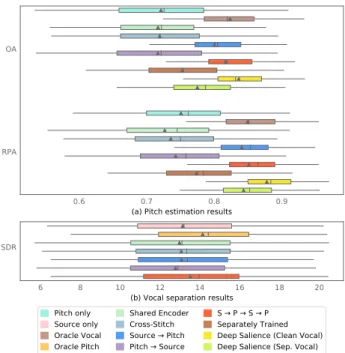
The results in Figure 4a clearly show that a vocal pitch
esti-mator trained on clean vocals Yv (Oracle Vocals) performs
better than one trained on mixturesYm(Pitch only). This is
consistent with Figure 1 where pitch trackers with clean vocals as input outperform pitch trackers that operate on mixtures. A similar effect can be seen for vocal separation in Figure 4b,
where the inclusion of ground truth pitch salienceSv improves
the source separation metric.
V. JOINTMODELS
In the following section, we present a series of different architectures that perform both vocal source separation and
f0 salience estimation. Figure 5 gives an overview of the
architectures we compare; they share information in various ways, either through weight sharing (treating the problem in a standard multitask setup) or by directly giving the outputs of one stage of the model as input to the next.
A. Conventional Multitask Models
We first experiment with architectures that share weights
for both tasks. The Shared Encoder model, Figure 5 (top
left), shows the simplest such architecture, which has one encoder that is shared and separate decoders for each task. The results for this experiment show that the shared encoder
model is inferior to disjoint models for both vocalf0estimation
(Figure 4a) and vocal separation (Figure 4b). One potential explanation for this result is that the shared encoder reduces the number of parameters in the network by 25%.
0.6 0.7 0.8 0.9
(a) Pitch estimation results
OA
RPA
6 8 10 12 14 16 18 20
(b) Vocal separation results
SDR Pitch only Source only Oracle Vocal Oracle Pitch Shared Encoder Cross-Stitch Source Pitch Pitch Source S P S P Separately Trained Deep Salience (Clean Vocal) Deep Salience (Sep. Vocal)
Fig. 4. Performance comparison of our experiments, oracle, and baseline models, evaluated on iKala. (Top) Single-f0 metrics. (Bottom) Vocal source
separation metrics.
Shared Encoder
Source → Pitch Pitch → Source
Cross-Stitch
Separately Trained
Mixture
S → P → S → P
Fig. 5. Joint U-Net models. Each model takes the magnitude spectrogram of the mixtureYmas input and outputs estimates of the vocal magnitude spectrogramYˆvand the vocalf0 salienceSˆv. In Pitch→Sourcemodel,
Ymis given as additional input to the vocal source separation portion of the model (indicated by a dotted line), and similarly in theS→P→S→Pmodel, the first vocal estimateYˆ0
vis given as additional input to the second vocal source separation model. InSeparately Trained, each network is trained separately, first optimizingYˆv, and then using the optimizedYˆvas input to a second model that outputsSˆv.
In theCross-Stitchmodel, shown in Figure 5 (top right),
each output has separate encoder-decoders, but the encoders are concatenated before being passed to the individual decoders. However, the skip connections are task-specific. This model has a capacity equivalent to that of the two baseline models, and should not suffer from the same potential capacity issue of the
Shared Encoder model.Cross-Stitchperforms slightly better
models on both tasks. B. Stacked Models
In Figure 5, (bottom left and middle), the tasks are learned
in a cascaded manner. In the Source→Pitch model, a first
U-Net computes Yˆv given Ym, and a second U-Net computes
ˆ
Sv given Yˆv as input. Pitch→Source is similar but in the
reverse order, and with the addition of concatenatingYmand
ˆ
Sv as input to the second U-Net model. This concatenation
was added because there is not enough information inSˆvalone
to compute Yˆv — the mixture information is needed as well.
As shown in Figure 4a, Source→Pitch outperforms all
of Pitch only, Shared Encoder and Cross-Stitch for pitch estimation. This is perhaps unsurprising, since the
baseline model trained on clean vocals (Oracle Vocals)
performs better than the baseline trained on mixtures (Pitch
only). However,Pitch→Source does not result in a similar
improvement for vocal separation, even thoughOracle Pitch
saw significant improvements. We hypothesize that the lack of accuracy of pitch estimates from mixture (see Figure 4a) prevents improvements of the vocal separation on the level of Oracle Pitch.
C. Stacked Refinement
In our final experiment, we attempt to further refine the
results of Source→Pitch. Stacked Refinement [5] is an
architectural pattern in which a network module is repeated, feeding the output of a module as input to an identically designed module, with different weights. We adapt this pattern
to our domain by extendingSource→Pitchto a “Source→
Pitch→Source→Pitch” (S→P→S→P) network 5 (right). We
notate the output of the first source network Yˆ0
v and the output
of the first pitch network Sˆ0v. The second source network is
fed a concatenation of Yˆv0 and Sˆv0, and it outputs Yˆv, which it
then feeds into the second pitch network to output Sˆv. This
allows higher level modules to learn a refinement function from initial predictions to cleaner predictions. The scores for the resulting model are plotted in Figure 4a and Figure 4b. The stacked refinement model surpasses the performance of all of our other models for both vocal source separation and vocal melody estimation.
The second source separation network is presented with an adequate pitch estimation, which provides additional guidance to refine the vocal source estimate. It is a somewhat surprising result that the difference for melody estimation is higher than the difference for vocal separation, since that implies that the inputs to the first and second melody estimation networks have little difference. We hypothesize that the doubled network capacity might be an important additional factor in explaining this result.
VI. JOINT VS. SEPARATETRAINING
We saw in the previous section that Source→Pitch
per-forms better than the other configurations of the same network capacity. In order to test if the joint training is necessary, we
take the outputYˆv ofSource onlyas input to a model which
TABLE II
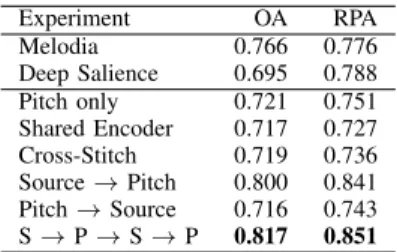
VOCALMELODYESTIMATIONRESULTS ON THE IKALADATASET
Experiment OA RPA Melodia 0.766 0.776 Deep Salience 0.695 0.788 Pitch only 0.721 0.751 Shared Encoder 0.717 0.727 Cross-Stitch 0.719 0.736 Source→Pitch 0.800 0.841 Pitch→Source 0.716 0.743 S→P→S→P 0.817 0.851
outputsSˆv, as shown in Figure 5 (Separately Trained
bottom, 2nd from right). The results, plotted asSeparately
Trainedin Figure 4a, show that joint optimization is indeed beneficial for vocal melody estimation. This is possibly because our pitch model is “borrowing” capacity from the separation model, or alternatively because the separation results become more tailored towards pitch estimation.
VII. DISCUSSION
A. Vocal Melody Estimation from Mixtures
The fusion of vocal source separation and vocal salience estimation results in system that is able to estimate vocal melody from musical mixtures. As we saw in Section I, vocal pitch trackers that take isolated vocals as input have higher accuracy than systems that estimate vocal melody directly from a mixture. We now pose the question of whether our
jointly trained vocal separator and multi-f0 estimator can
predict single-f0 vocal melody as well as pitch trackers that
were explicitly trained to predict single-f0 from mixtures.
Table II shows the standard melody metric averages on the iKala dataset for our models and two strong baseline models, Melodia [15] and Deep Salience [1]. We see that our best
model (S→P→S→P) does indeed perform better than both
other models on vocal melody estimating from polyphonic mixtures.
B. Qualitative Analysis
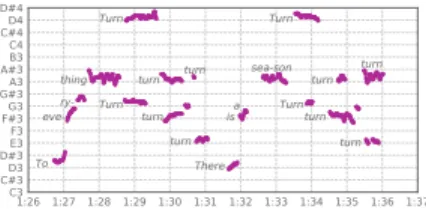
To build an intuition of the characteristics of the model’s pitch estimates, we zoom in on a few bars of the 1965 pop song “Turn! Turn! Turn!” by The Byrds. Figure 6 shows the final
pitch estimation usingS→P→S→P, with a voicing threshold
set to 0.4. Since we do not have vocal melody ground truth
for this track, we only show the model outputs. While there are a few scattered false positives, the majority of the pitch estimates appear to belong to vocal notes. The likelihoods for sustained notes sometimes drop below the voicing threshold, leaving only activations at the initial note onset transient.
It is also instructive to visualize the raw estimated pitch salience, before applying the voicing threshold. Figure 7 show vocal salience matrices, estimated on the first phrase of the example above, using our model (left) and Crepe (right). The most striking difference is our model’s ability to predict multiple simultaneous vocal parts, while Crepe oscillates between the two notes. Despite the fact that our model is presented with a full mixture, and Crepe with vocals
Fig. 6. Vocalf0 estimation fromS→P→S→Pon an excerpt from the pop
song “Turn! Turn! Turn!” by The Byrds.
isolated by the source separation output of our model, our model produces a cleaner salience matrix, with fewer artifacts. It appears that during the joint training procedure, the vocal melody estimation module learns to ignore source separation artifacts, despite the fact that artifacts are present in this excerpt. It should also be noted that our model is less precise than Crepe, lacking some of the fine-grained sharpness of the vibratos that Crepe more accurately captures.
1:26 1:27 1:28 1:29 1:30 1:31 1:32 Time (min:sec) 32 49 74 113 171 259 392 594 899 1360 2059 Frequency (Hz) 1:26 1:27 1:28 1:29 1:30 1:31 1:32 Time (min:sec) 0.0 0.1 0.2 0.3 0.4 0.5 0.6 0.7 0.8
Fig. 7. Estimated salience matrixSˆv. Left: ourS→P→S→P model, predicted from mixtureYm. Right: Crepe, predicted from estimated vocal sourceYˆv. The excerpts begins with one voice, and a second voice enters at 1:29.
VIII. CONCLUSIONS ANDFUTUREWORK
In this work, one of the biggest challenges was in assessing
whycertain models performed better or worse than others, and
in this paper we suggested hypotheses with possible reasons. Future work includes testing these specific hypotheses to obtain better insights about the specific advantages and disadvantages of these architectures. Beyond this, we would like to explore
applying joint f0 and source separation models to other types
of pitched sources beyond the singing voice, such as the piano. We think the same ideas could also be applied to drum separation and drum transcription. Overall, we explored a number of different architectures for jointly separating vocals and estimating fundamental frequency in a single data driven system based on deep U-Net neural network architectures. We saw that including oracle information improves performance,
in particular for vocal-f0 information. A joint stacked model
that first performs vocal source separation followed by vocal
f0estimation approaches the performance of the oracle models,
and outperformed conventional multitask architectures, which underscores the value of incorporating domain knowledge when designing models. Additionally, we showed that the
model achieves state-of-the-art results for vocal-f0 estimation
on the iKala dataset. Finally, we highlighted the importance
of performing polyphonic, rather than monophonic vocal-f0
estimation for many real-world cases.
REFERENCES
[1] Rachel M. Bittner, Brian McFee, Justin Salamon, Peter Li, and Juan P. Bello. Deep salience representations for F0 estimation in polyphonic music. InProceedings of the International Society for Music Information Retrieval Conference (ISMIR), October 2017.
[2] Rachel M. Bittner, Justin Salamon, Mike Tierney, Matthias Mauch, Chris Cannam, and Juan Pablo Bello. MedleyDB: A multitrack dataset for annotation-intensive MIR research. InProceedings of the International Society for Music Information Retrieval Conference (ISMIR), 2014. [3] Tak-Shing Chan, Tzu-Chun Yeh, Zhe-Cheng Fan, Hung-Wei Chen, Li Su,
Yi-Hsuan Yang, and Roger Jang. Vocal activity informed singing voice separation with the ikala dataset. In2015 IEEE International Conference on Acoustics, Speech and Signal Processing (ICASSP), pages 718–722. IEEE, 2015.
[4] Jean-Louis Durrieu, Ga¨el Richard, Bertrand David, and C´edric F´evotte. Source/filter model for unsupervised main melody extraction from polyphonic audio signals. IEEE Trans. Audio, Speech & Language Processing, 18(3):564–575, 2010.
[5] Sheng He and Lambert Schomaker. Deepotsu: Document enhancement and binarization using iterative deep learning. Pattern Recognition, Jan 2019.
[6] Geoffrey Hinton, Oriol Vinyals, and Jeff Dean. Distilling the knowledge in a neural network. arXiv preprint arXiv:1503.02531, 2015.
[7] Chao-Ling Hsu, DeLiang Wang, Jyh-Shing Roger Jang, and Ke Hu. A tandem algorithm for singing pitch extraction and voice separation from music accompaniment. IEEE Trans. Audio, Speech & Language Processing, 20(5):1482–1491, 2012.
[8] Andreas Jansson, Eric Humphrey, Nicola Montecchio, Rachel M. Bittner, Aparna Kumar, and Tillman Weyde. Singing voice separation with deep u-net convolutional networks. InProceedings of the International Society for Music Information Retrieval Conference (ISMIR), 2017.
[9] Jong Wook Kim, Justin Salamon, Peter Li, and Juan Pablo Bello. Crepe: A convolutional representation for pitch estimation. In 2018 IEEE International Conference on Acoustics, Speech and Signal Processing (ICASSP), pages 161–165. IEEE, 2018.
[10] Yipeng Li and DeLiang Wang. Separation of singing voice from music accompaniment for monaural recordings. IEEE Transactions on Audio, Speech, and Language Processing, 15(4):1475–1487, 2007.
[11] Matthias Mauch and Simon Dixon. pyin: A fundamental frequency estimator using probabilistic threshold distributions. In 2014 IEEE International Conference on Acoustics, Speech and Signal Processing (ICASSP), pages 659–663. IEEE, 2014.
[12] Sungheon Park, Taehoon Kim, Kyogu Lee, and Nojun Kwak. Music source separation using stacked hourglass networks. InProceedings of the International Society for Music Information Retrieval Conference (ISMIR), 2018.
[13] Colin Raffel, Brian McFee, Eric Humphrey, Justin Salamon, Oriol Nieto, Dawen Liang, and Daniel PW Ellis. mir eval: A transparent implementation of common mir metrics. In Proceedings of the International Society for Music Information Retrieval Conference (ISMIR), 2014.
[14] Olaf Ronneberger, Philipp Fischer, and Thomas Brox. U-net: Convo-lutional networks for biomedical image segmentation. InInternational Conference on Medical image computing and computer-assisted inter-vention, pages 234–241. Springer, 2015.
[15] Justin Salamon, Emilia G´omez, Daniel PW Ellis, and Ga¨el Richard. Melody extraction from polyphonic music signals: Approaches, applica-tions, and challenges. IEEE Signal Processing Magazine, 31(2):118–134, 2014.
[16] Emmanuel Vincent, R´emi Gribonval, and C´edric F´evotte. Performance measurement in blind audio source separation. IEEE transactions on audio, speech, and language processing, 14(4):1462–1469, 2006. [17] Tuomas Virtanen, Annamaria Mesaros, and Matti Ryyn¨anen. Combining
pitch-based inference and non-negative spectrogram factorization in separating vocals from polyphonic music. InINTERSPEECH, 2008. [18] Scott Wisdom, John Hershey, Jonathan Le Roux, and Shinji Watanabe.
Deep unfolding for multichannel source separation. InProceedings of the IEEE International Conference on Acoustics, Speech and Signal Processing (ICASSP), pages 121–125, 2016.
[19] Xueliang Zhang, Hui Zhang, Shuai Nie, Guanglai Gao, and Wenju Liu. A pairwise algorithm using the deep stacking network for speech separation and pitch estimation. IEEE/ACM Transactions on Audio, Speech, and Language Processing, 24(6):1066–1078, 2016.
![Fig. 1. Performance of pYIN [11], Crepe [9], and Deep Salience [2] on the iKala [3] dataset](https://thumb-us.123doks.com/thumbv2/123dok_us/487517.2557732/2.918.476.820.189.504/fig-performance-pyin-crepe-deep-salience-ikala-dataset.webp)