Systems for Implicit Data
Xiaohu Liu
Doctor of Philosophy
University of York
Electronics
September 2014
Abstract
Recommender systems are software tools and techniques providing suggestions and recommendations for items to be of use to a user [18,44,55,56]. These sug-gestions can help users make better decisions on choosing products or services, such as which film to watch, what music to listen to or which travel insurance to buy. When making suggestions, many recommender systems do not consider contextual information, such as location or time [5]. Recommender systems that make use of contextual information are called context-aware recommender systems.
Many context-aware recommender systems can not generate reliable rec-ommendations on sparse data. Besides, in most context-aware recommender systems, the contexts are pre-defined and not personalised. These limitations of existing methods usually lead to inaccurate recommendations.
In this thesis, new context-aware recommendation methods are presented. In these methods, personalised contexts are defined based on users’ activity patterns. The underlying associations between contexts are analysed, and similar contexts are combined so that the system can make use of existing data collected in similar contexts. Experimental results from two datasets show that the proposed methods can achieve significantly higher recommendation accuracy than existing context-aware recommendation methods.
Abstract ii
Table of contents iii
List of figures vii
List of tables viii
1 Introduction 1
1.1 Recommender Systems . . . 2
1.1.1 Traditional Recommender Systems . . . 2
1.1.2 Context-Aware Recommender Systems . . . 3
1.2 Motivations . . . 5
1.2.1 Data Sparsity and Context Generalisation . . . 5
1.2.2 Non-Personalised Context . . . 7
1.2.3 Inability to Separate User Modelling from Context Mod-elling . . . 9
1.3 Contributions . . . 10
1.4 Thesis Structure . . . 11
2 Recommender Systems 13 2.1 Traditional Recommender Systems . . . 13
2.1.1 Content-Based Methods . . . 16
2.1.2 Collaborative Methods . . . 20
iv
2.2 Motivation for Context-Aware Systems . . . 25
2.3 Summary . . . 27
3 Review of Context-Aware Recommender Systems 28 3.1 Lack of Contextual Data . . . 28
3.2 Transaction Based Method . . . 30
3.2.1 Contextual Pre-Filtering . . . 31
3.2.2 Contextual Post-Filtering . . . 31
3.2.3 Drawbacks of Contextualisation: Non-Personalised Con-texts and Data Sparsity . . . 32
3.3 Session Based Method . . . 35
3.3.1 Non-personalised session based methods . . . 35
3.3.2 Personalised session based methods . . . 35
3.4 Evaluation of Context-Aware Recommender Systems . . . 37
3.4.1 Rating Prediction Accuracy . . . 37
3.4.2 Relevance Prediction Accuracy . . . 38
3.4.3 User Space Coverage . . . 40
3.4.4 Significance . . . 40
3.5 Summary . . . 41
4 Probabilistic Contextual Filtering 43 4.1 Introduction . . . 43
4.2 Probabilistic Contextual Filtering . . . 47
4.2.1 Modelling Action Patterns . . . 48
4.2.2 Constructing Datasets . . . 53
4.2.3 Predicting Preferences . . . 55
4.3 Experimental Method . . . 56
4.3.1 Data for Testing PCF . . . 56
4.3.2 Testing and Analysis Criteria . . . 58
4.3.3 Testing Method of PCF . . . 61
4.4 Results and Analysis of PCF . . . 63
4.4.2 Comparison with Traditional Recommendation Method . 64
4.4.3 Comparison with Traditional Contextual Filtering . . . . 66
4.4.4 Discussion . . . 68
4.5 Summary . . . 71
5 Probabilistic Contextual Clustering 72 5.1 Introduction . . . 72
5.2 Probabilistic Contextual Clustering . . . 74
5.2.1 Session Modelling Based on Item Distribution . . . 75
5.2.2 Constructing Datasets . . . 77
5.2.3 Predicting Preferences . . . 78
5.3 Incorporating Item Tags . . . 80
5.3.1 Session Modelling Based on Tag Distribution . . . 82
5.4 Experimental Method . . . 84
5.4.1 Data for Testing PCC . . . 84
5.4.2 Testing Method of PCC . . . 84
5.5 Results and Analysis of PCC . . . 87
5.5.1 Comparing PCC on item distribution with traditional recommendation method . . . 87
5.5.2 Comparing PCC on item distribution with session based model . . . 89
5.5.3 Comparing PCC on item tag distribution with tradi-tional recommendation method . . . 91
5.5.4 Comparing PCC on item tag distribution with query driven method . . . 93
5.5.5 Comparing PCC on item distribution with PCC on item tag distribution . . . 95
5.6 Summary . . . 96
6 Clustering Based Probabilistic Contextual Filtering 98 6.1 Introduction . . . 98
vi
6.2.1 Modelling Action Patterns . . . 101
6.2.2 Generating Sessions . . . 101
6.2.3 Modelling Item Distributions . . . 102
6.2.4 Constructing Datasets . . . 103
6.2.5 Predicting Preferences . . . 104
6.3 Experimental Method . . . 105
6.3.1 Data for Testing CBPCF . . . 105
6.3.2 Testing Method of CBPCF . . . 105
6.4 Results and Analysis of CBPCF . . . 106
6.4.1 Comparison with traditional recommendation method . . 106
6.4.2 Comparison with probabilistic contextual filtering . . . . 108
6.4.3 Analysis of CBPCF . . . 109
6.5 Summary and Future Work . . . 110
7 Conclusions 111 7.1 Review of Research Questions . . . 111
7.2 Summary and Contribution . . . 113
7.3 Limitation of PCF, PCC and CBPCF . . . 115
7.4 Future Work . . . 116
7.4.1 Improvements and Extensions to PCF, PCC and CBPCF116 7.4.2 Context-Aware Recommender Systems . . . 118
7.5 Discussion . . . 119
Nomenclature 120
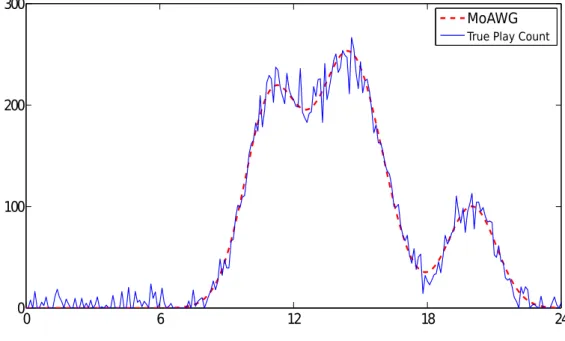
3.1 The hierarchical structure of contextual information . . . 33 4.1 A typical user’s total play count at different times of the day . . 57 4.2 The number of items a typical user purchased on different days
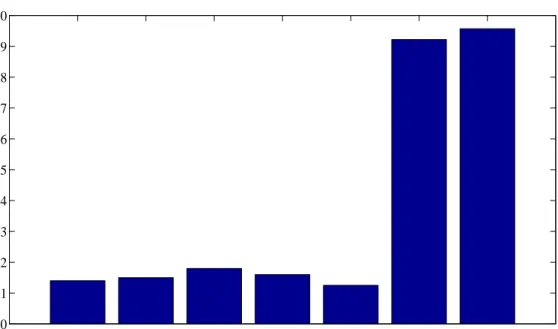
of the week . . . 59 4.3 The average number of items a typical user purchased in one
transaction . . . 59 4.4 A user’s play count modelled by MoAWG. . . 64
List of tables
3.1 Possible results of a recommendation [65] . . . 39
4.1 Precision of Probabilistic Contextual Filtering as K increases . . 63
4.2 Precisions of MF and PCF + MF . . . 65
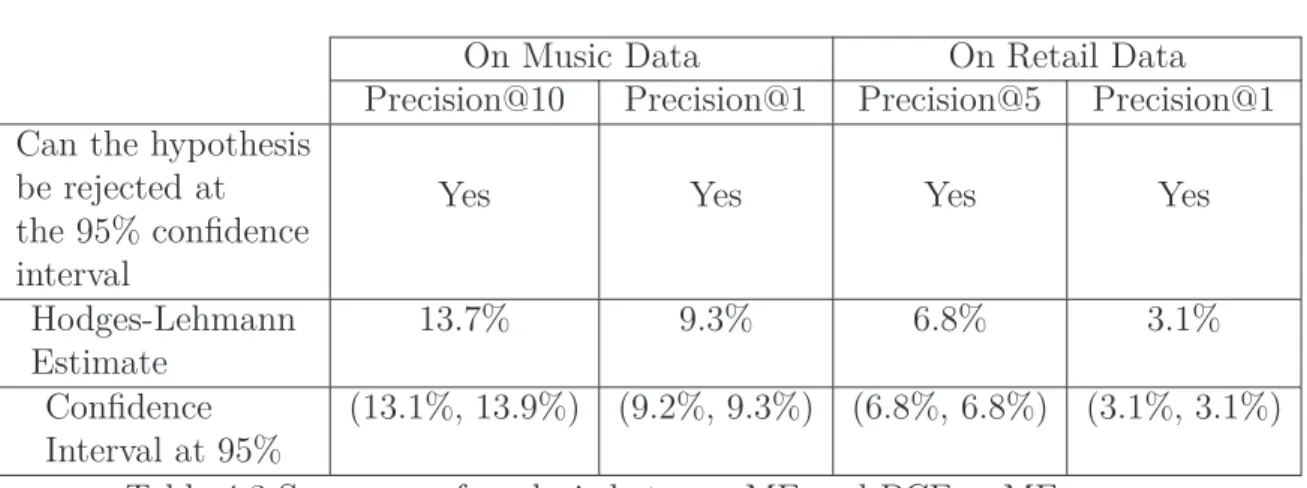
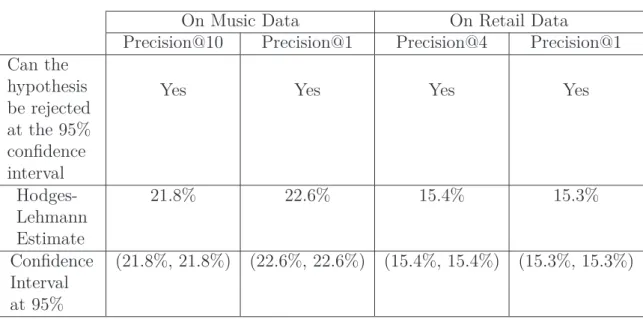
4.3 Summary of analysis between MF and PCF + MF . . . 65
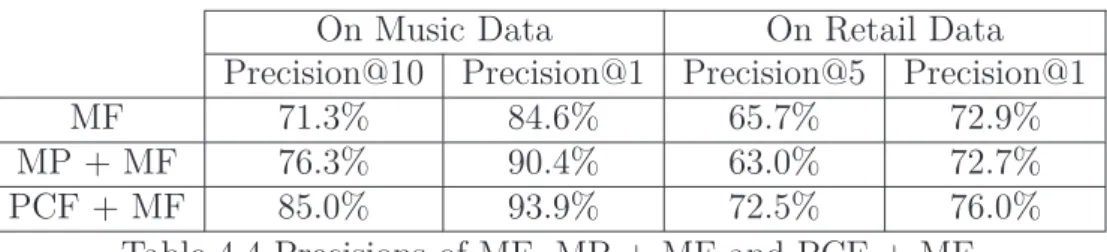
4.4 Precisions of MF, MP + MF and PCF + MF . . . 66
4.5 Summary of analysis between MP+ MF and PCF + MF . . . . 66
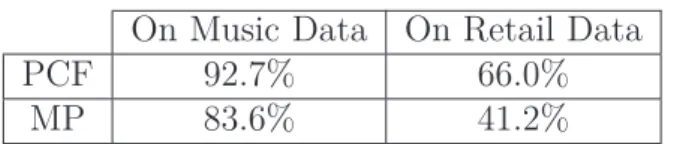
4.6 User space coverage of PCF and MP . . . 68
5.1 Precisions of MF and PCC + MF . . . 88
5.2 Summary of analysis between MF and PCC + MF . . . 88
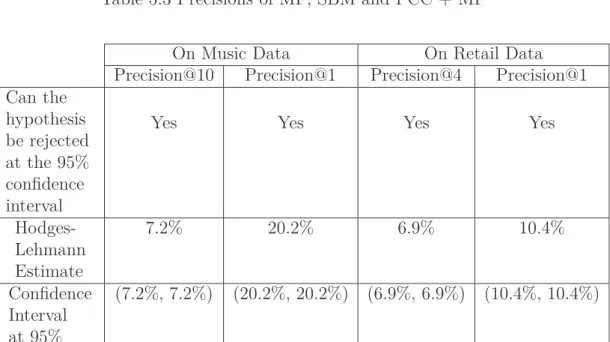
5.3 Precisions of MF, SBM and PCC + MF . . . 90
5.4 Summary of analysis between SBM and PCC + MF . . . 90
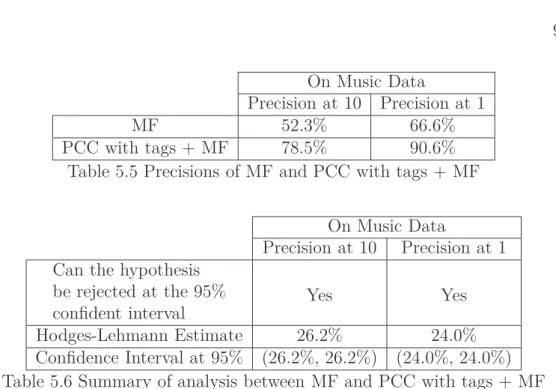
5.5 Precisions of MF and PCC with tags + MF . . . 92
5.6 Summary of analysis between MF and PCC with tags + MF . . 92
5.7 Precisions of MF, QD and PCC with tags + MF . . . 93
5.8 Summary of analysis between QD and PCC with tags + MF . . 93
5.9 Precisions of PCC + MF and PCC with tags + MF . . . 95
5.10 Summary of analysis between PCC + MF and PCC with tags + MF . . . 95
6.1 Precisions of MF and CBPCF + MF . . . 107
6.2 Summary of analysis between MF and CBPCF + MF . . . 107
6.3 Precisions of MF, PCF + MF and CBPCF + MF . . . 108 6.4 Summary of analysis between PCF + MF and CBPCF + MF . 109
I would like to thank my supervisors, Prof. Jon Timmis and Dr. Rogério de Lemos, for their encouragement and guidance.
I would like to thank my thesis advisor, Fiona Polack for her patience. I also thank my parents, for their love and support.
Special thanks goes to my fiancée, for her patience and company.
My gratitude also goes to the NCR Financial Solutions Group for funding this project.
Declaration
I hereby declare that except where specific reference is made to the work of others, the contents of this thesis are original and have not been submitted in whole or in part for consideration for any other degree or qualification in this, or any other university. This thesis is my own work and contains nothing which is the outcome of work done in collaboration with others, except as specified in the text and Acknowledgements. All sources are acknowledged as References.
Introduction
Recommender systems (RS) are software tools and techniques providing sug-gestions and recommendations for items to be of use to a user [18,44,55,56]. These suggestions can help users make better decisions on choosing products or services, such as which film to watch, which restaurant to have dinner or which travel insurance to buy. Recommender systems were first studied as an independent research area in the 1990s [4]. Much work has been done in industry and academia on developing various new approaches [56].
When making suggestions, many RS do not consider contextual informa-tion, such as locainforma-tion, time and the company of other people [5]. However, the context can be of great importance in many cases. For example, the mu-sic a user prefers for a romantic dinner can be quite different from the mumu-sic the user would like to listen to in a party. Recommender systems that make use of contextual information are called context-aware recommender systems (CARS), and the recommendations they make are called context-aware recom-mendations [35]. To clarify the terminology, in this thesis, the recommender systems that do not take into consideration any contextual information are called traditional recommender systems.
This thesis is focused on context-aware recommender systems. We study two major issues in the field of CARS: non-personalised contexts and data
spar-2 sity. Based on user activity data, we identify user’s periodic activity patterns. Personalised contexts are defined based on these patterns to improve accuracy of recommendations . We analyse the underlying association between contexts based on item co-occurrence, so that contexts can be clustered and combined into overlapped “topics”. Therefore, for a given context, the system can infer the user’s preferences based on other different yet similar contexts. Conse-quently, the system can provide accurate context-aware recommendations on relatively sparse datasets.
In this Chapter, we first present an overview of recommender systems, especially context-aware recommender systems in Section 1.1. Then we discuss the motivations and contributions of the work in Section 1.2 and 1.3. Finally the structure of the thesis is presented in Section 1.4.
1.1
Recommender Systems
1.1.1
Traditional Recommender Systems
Typically, recommender systems provide the user with a ranked list of items (such as books, articles, films, etc.), which the user may be interested in [56]. To generate this list, RS need to predict user’s preferences on these items. In order to complete this task, recommender systems must first collect user pref-erences, either explicitly or implicitly [56]. For example, a film recommender system may ask a user to rate the films the user has watched (explicit data); a music recommender system may consider the user listening to a track repeat-edly as the implicit sign of preference for the track (implicit data). In most cases, the task of the RS is predicting the user’s preferences on the items that the user has not purchased or used [4]. The items that are predicted to be the most desired are then recommended to the user.
In the field of traditional recommender systems, collaborative filtering, or
im-plemented techniques for predicting user’s preference [17]. For a given user, collaborative methods recommend the items that users with similar preferences like [41]. Most collaborative methods are based on ratings (explicit data) [39]. The similarity of two users is computed based on their rating histories. There-fore, the collaborative methods are sometimes referred to as “people-to-people correlation” [56]. Collaborative methods only require user-item ratings [41]. No domain knowledge is needed. Therefore, collaborative methods can be eas-ily applied in areas where ratings are available. However, the user usually has to rate a sufficient number of items before the RS with collaborative methods can accurately predict the user’s preference [4].
Content-based methods recommend the items which are similar to the ones
that the user preferred in the past. The similarity of items is computed based on the features (“content”) associated with the items. For example, if a user has positively rated a film that belongs to the romance genre, the system may recommend other films from this genre. The content-based approach has its roots in information retrieval research [58]. Because of the early advancements made by information retrieval, many content-based systems can only recom-mend items containing textual information [4]. Content-based methods require both “content” of items and user feedbacks (implicit or explicit). However, in some cases, the “content” of is difficult to obtain.
1.1.2
Context-Aware Recommender Systems
What is context?
When we say “take this”, “this” can be a cup, a ruler, or anything. It is unclear what “this” refers to, if we do not know anything abut the current context. Context has been defined in many research areas from different angles. In recommender systems, context includes extensive information. Schilit et al. [62] define context as:
4 Chen et al. [23] define context as:
Context is the set of environmental states and settings that either deter-mines an application’s behaviour or in which an application event occurs and is interesting to the user.
Abowd et al. [1] give a more specific definition:
Context is any information that can be used to characterise the situation of an entity. An entity is a person, place, or object that is considered relevant to the interaction between a user and an application, including the user and applications themselves.
In the area of CARS, companion location and time are most widely used [71]. However, other factors such as weather and noise level may also become important information in some cases [5].
How can context be incorporated?
Since there are many existing traditional recommender systems, it is there-fore intuitive to simply add a contextual filter to an existing traditional rec-ommender system [4]. That is, we can simply “contextualise” the existing traditional RS, rather than building a new model. Based on which stage the contextual information is used at, context-aware recommender systems can be divided into contextual pre-filtering and contextual post-filtering [5].
The contextual pre-filtering system contains a pre-processing filter, which can contextualise the input data of the traditional RS [50]. That is, the infor-mation about the current context is used for selecting the relevant set of data [5]. Then, the preference of the user in the current context can be predicted by a traditional recommender system based on the selected data.
Similar to contextual pre-filtering, post-filtering also makes use of exist-ing traditional RS. The contextual post-filterexist-ing methods ignore contextual information in the input data at the beginning, when generating traditional recommendations; then, the contextual post-filtering methods improve the ob-tained recommendations using contextual information [5]. The improvements
can be made by either filtering out irrelevant items for the given context, or adjusting the ranking of items [5].
Sometime, it is not possible to obtain additional contextual information directly. However, we do know what items the user has chosen in the current context (these items are also called seed items). Therefore, if we assume the context remains the same, we can still make context-aware recommendations by [21]:
• recommending items that are similar to the seed items, or
• identifying the characteristics of the current context based on the seed items and then recommending suitable items.
These methods are called session based methods.
1.2
Motivations
In this section, we discuss the limitations of existing context-aware recom-mender systems, and the motivations for our work.
1.2.1
Data Sparsity and Context Generalisation
In traditional recommender systems, the prediction process usually begin with the specification of the initial rating set. The ratings can be explicitly collected from the users or inferred by the RS implicitly [5]. Then the RS computes the rating function R
R:U ser×Item→Rating
for all the (user, item) pairs that have not been rated by the users [5].
If the recommender system is based on explicit data, each user has to rate a sufficient number of items before the system can learn the user’s preference and present the user with reliable recommendations [4]. However, in reality, most
6 users are reluctant to provide ratings [49]. Typically, users rate only a small proportion of the items that are available [10]. Therefore, the dataset is sparse. In the field of traditional RS, this is usually solved by applying collaborative methods with latent factors [4], such as matrix factorisation [40]. However, in context-aware recommender systems, these methods are not always effective [5]. In CARS, the dataset becomes extremely sparse since the rating function R is extended into three dimensions [5]
R:U ser×Item×Context→Rating
For example, in traditional music recommender systems, the user only needs to provide one general rating for the track that the user has played. However, to make context-aware recommendations, ideally, we would like to ask the user to rate the track for all the possible contexts, e.g. whether the track is suitable to play when driving, before sleeping, or during a party. The RS should be able to estimate the rating function for all the (user, item, context) combinations that have not been rated by the users. Therefore, the corresponding rating set can be much sparser compared to the dataset for traditional recommendation. In these cases, even employing the recommendation techniques that are able to deal with the data sparsity in traditional RS still leads to poor recommen-dations [11]. In some applications, due to severe data sparsity, for many users, the system is simply not able to provide context-aware recommendations at all [5].
Context generalisation is proposed to solve the problem of data sparsity in CARS [2]. In this method, a more general context is used instead of the exact context. For example, the temporal context can be changed from Saturday to weekend to obtain more data. Although some work has been carried out to improve the performance of context generalisation [36], context generalisation has some intrinsic limitations:
1. Generalisation can lead to inaccurate prediction.
context, in which the user may have different preference. There is a trade-off between accuracy and the level of generalisation.
2. There are too many possible generalisations of the given context [5]. With highly granular contexts, there can be a very large number of gen-eralisations of the given context. It is impossible to empirically evaluate the predictive performance on each generalised context due to high com-putational cost.
These problems suggest that a different method is needed to deal with the data sparsity of CARS specifically. Therefore, the first research question of this thesis is: whether we can develop a CARS that is able to overcome data sparsity, in order to provide more accurate recommendations for more users, compared to existing CARS.
1.2.2
Non-Personalised Context
Another issue in CARS is that all the temporal contexts are usually predefined based on common sense [5]. For example, in music recommender systems, it is common to define a set of non-personalised temporal contexts, such as morning, afternoon and evening in advance. The boundaries between these temporal contexts are the same for all the users. In reality, this can be problematic:
1. Different preference in the same temporal context.
Some people may start the day much earlier or later than others. There-fore, different users may have different preferences in the predefined con-text, such as “evening”. More importantly, for some users, these prede-fined temporal contexts can be too general. For example, a user listens to rock & roll every morning to wake him up; when he is working in the morning, he listens to classical music. The temporal context “morning” becomes meaningless because it covers such a long period of the day. In the same “morning” the user’s preference can still change significantly. In this case, it might be better to divide the “morning” into two or more
8 shorter contexts. However, it is impossible to know this if we use the same set of temporal contexts for all the users, and do not analyse each user’s listening habits.
2. Same preference in different temporal contexts
In the area of CARS, it is usually reasonable to assume that users have different preferences in different contexts [5]. However, sometimes, in different temporal contexts, a user’s preferences could be the same. For example, during working days, a user’s listening preference in the context “morning” may be the same as in the context “afternoon”. Therefore, it is not necessary to define two different contexts “morning” and “after-noon” for this given user in terms of music listening. Let’s also consider the following example of grocery shopping: a housewife goes to the su-permarket on Monday afternoon and Thursday morning every week for groceries. The items she needs to purchase in these two temporal con-texts are almost the same. If we can combine these two concon-texts, we can obtain more data for each of them, generating accurate and reliable recommendations in both contexts. Therefore, in this case, it is neither necessary nor appropriate to view these two contexts as different ones. However, in this example, it is almost impossible to discover the sim-ilarity between these two contexts based on the temporal information. We also need to analyse what items the user chooses to consume in each context, and whether these chosen items have something in common. These problems suggest that we should not define a set of non-personalised contexts based on common sense. A new method is needed to discover and define contexts for each user. Therefore, the second research question of this thesis is: whether we can develop a CARS that is able to define personalised contexts based on users’ activity patterns, and to discover the underlying associ-ation between contexts, so that the system can achieve higher recommendassoci-ation accuracy than existing CARS.
1.2.3
Inability to Separate User Modelling from
Con-text Modelling
Although the session based CARS can generate context-aware recommenda-tions based on seed items, they usually have the following problems:
1. Inability to build a complete user profile.
In such systems, recommendations are based on the items the user just chose in the current context (seed items). The given user’s general pref-erence has little influence on the recommendations. That is, the recom-mendations are not personalised. The same seed items would lead to the same recommendations.
2. Inability to select different features for user modelling and context mod-elling.
In these systems, models with latent factors are employed to reduce the number of features in the data [37]. These new features are selected for either context profiling or user profiling. However, once the features are selected, they are used for both tasks. This can lead to inaccurate recommendations.
Since there are various traditional RS that can be used for user modelling, the key question here is how can we use these traditional methods along with session based methods, achieving accurate user modelling and context mod-elling at the same time. Therefore, the third research question of this thesis is: whether we can develop a session based CARS that is able to employ two separate models for user profiling and context profiling respectively, to achieve higher recommendation accuracy than existing session based CARS.
Although the three research questions focus on different problems of CARS, they are actually the same fundamental question of CARS from different an-gles: how can we make better use of the contextual data we have, infer more information about user’s preferences in different contexts, and make more
accu-10
rate context-aware recommendations. In the following chapters, we review indi-vidual research question, along with this fundamental question of CARS.
1.3
Contributions
The main contributions of this thesis can be summarised as follows:
1. The development of a novel contextualisation method that can define personalised temporal contexts and make accurate context-aware recom-mendation on sparse dataset.
By working on implicit usage data, users’ periodic action patterns can be identified. For every user, personalised temporal contexts are defined based on these periodic action patterns. For each user action, we com-pute the probability that the action is performed in each context, and use the probability as weight. Consequently, we can make use of data collected in all contexts but with different weights. Therefore, compared to existing contextual filtering methods, our approach can increase rec-ommendation accuracy and provide recrec-ommendations for more users. 2. The development of a novel session based contextualisation method that
can uncover the underlying association between contexts across all the users, cluster similar contexts into overlapped groups, and apply tradi-tional recommendation methods to generate accurate recommendations. We analyse the underlying association and similarity between contexts based on item co-occurrence and item tag co-occurrence. By doing this, we can cluster similar contexts into overlapped groups. For each group, a contextualised dataset is constructed, so that traditional recommenda-tion methods can then be employed. Therefore, in our method, context modelling and user modelling are independent of one another. For a given context, based on the items the user just chose, we can infer the characteristics of the context and identify the corresponding groups of
contexts to make accurate and reliable recommendations.
3. The development of a recommendation method that can combine our personalised contextualisation with the context clustering approach. The method is developed for implicit data. It combines the personalised contextualisation with our session based clustering method. In this ap-proach, we first employ personalised contextualisation to identify person-alised contexts. Then we cluster the contexts into groups based on item distributions. Therefore, the data collected in the same group of contexts can be combined to overcome data sparsity, reduce time complexity, and to generate accurate recommendations.
1.4
Thesis Structure
The thesis is organised as follows:• Chapter 2 first introduces the field of traditional RS. The basic terms and ideas are outlined, along with the commonly used recommendation methods. Then we focus on the motivation of CARS, the importance of contextual information.
• Chapter 3 reviews the field of context-aware recommender systems. We introduce the fundamental issue and challenge in the field of CARS, discuss existing solutions and their drawbacks, which motivate our work. Besides, the appropriate evaluation methods for CARS are discussed in the chapter.
• Chapter 4 presents a personalised contextualisation method based on implicit data: the idea, the implementation, and the results.
• Chapter 5 presents a session based CARS that can identify and cluster contexts into groups. The experimental results and analysis are also presented.
12 • Chapter 6 presents a context-aware recommendation approach that com-bines the methods presented in Chapter 4 and Chapter 5. Results and analysis on different datasets are presented.
• In Chapter 7, the thesis is summarised and the main contributions are presented. A number of opportunities for future work in this area are discussed.
Recommender Systems
As we introduced in Chapter 1, recommender systems can help users make better decisions on choosing products or services. A well designed RS is able to recommend items that suit the user’s needs and wants, therefore improving the user’s experience and increasing the number of items sold [56].
In this chapter, we first introduce the fields of traditional recommender systems, the RS that do not take into consideration contextual information. The basic terms and ideas are introduced, along with the commonly used recommendation methods. Then we outline the motivation for context-aware recommender systems.
2.1
Traditional Recommender Systems
The RS is primarily directed towards individuals who lack sufficient personal experience or competence to evaluate the potentially overwhelming number of alternative items that a Web site, for example, may offer [55]. A RS normally focuses on recommending a specific type of item (e.g., CDs, or news) and accordingly its design and the core recommendation technique used to generate the recommendations are customised to provide useful and effective suggestions for that specific type of item [56].
14 To provide recommendations, RS try to predict what the most suitable items are, based on the user’s preferences. In order to complete such a task, RS need to collect users preferences, which are either explicitly expressed by the users (explicit data), e.g., as ratings for products, or inferred by interpreting user actions (implicit data) [61]. The explicit user ratings are usually more accurate since they are directly expressed by the users. Compared to explicit ratings, implicit data has the following characteristics [33]:
1. No negative ratings. By observing the user’s behaviour, we can infer which item the user probably likes if the user has purchased or interacted with the item. However, it is hard to reliably infer which items a user does not like. For instance, a user did not purchase an item, simply because he did not know about the item.
2. Implicit data is inherently noisy. While we passively track the users behaviour, we can only guess their preferences and true motives. For example, we may view purchase behaviour for an individual, but this does not necessarily indicate a positive view of the product. The item may have been purchased as a gift, or perhaps the user is disappointed with the product.
3. Evaluation of systems based on implicit data requires appropriate mea-sures. In the traditional setting where a user is specifying a numeric ratings, the difference between the predicted ratings and the true ratings can be computed to measure success in prediction. However, those met-rics usually can not be applied to systems based on implicit data since the true ratings are not available.
Therefore, most recommender systems are based on explicit user ratings [4]. In most cases, the task of RS is predicting user’s ratings on the items that the user has not purchased or used [4]. The items with highest predicted ratings are recommended to the user.
Formally, the problem of recommendation can be described as follows. Let U be the user (customer) set, and W be the set containing all the items such
as books, films or insurance packages. In reality, both sets can be very large, from a few hundreds to millions. Ratings are used to indicate the usefulness of an item to a certain user. Letrij represent the rating that user ui has given
on item wj. The rating matrix contains all the user-item ratings. In reality
the matrix can be quite sparse. This is because compared to the total number of items inW, the number of items a user has interacted with is usually small, and the user does not rate all the items that he or she has interacted with [49]. Let R be the function that maps the user-item pairs to ratings:
R:U ser×Item→Rating
The recommender systems estimate the rating function R for all the (user, item) pairs that have not been rated yet by the users [5]. That is, the RS need to compute ˆrij, the predicted value of rij for all the unknown rij. For
every user in U, the goal of the RS is to find the item or items in W that have the highest ˆrij. Therefore the central task of recommender systems is to find a
functionRthat can accurately predict the rating for each user-item pair. There are many ways to predict user-item ratings. Traditional recommenda-tion methods are usually divided into the following three categories [10]:
1. Content-based methods
These methods apply to items containing textual features, i.e. “content”, such as documents or news articles. The systems compare the contents of the items that the user likes, i.e. the items with relatively higher rij,
and analyse their commonalities. The rating on an item is predicted based on how similar its content is to that of the items the user likes. 2. Collaborative methods
In these methods, users with similar tastes and preferences are identified by comparing their ratings. A rating on a certain item by the given user is predicted based on similar users’ ratings on this item.
16 3. Hybrid methods
These approaches combine collaborative and content based methods in various ways.
2.1.1
Content-Based Methods
Content-based methods make use of the features associated with items. For example, to recommend news articles to a user, the content-based RS tries to find what specific keywords are often used in the articles that the user finds interesting. Then news articles containing these keywords would be recom-mended [48].
The content-based approach has its roots in information retrieval research [58]. Because of the significant and early advancements made by information retrieval, many content-based systems focus on recommending items contain-ing textual information, so that keywords can be used as item features. The improvement over traditional information retrieval approaches comes from the use of user profile and item profile [4].
Formally, let Content(wj) be the item profile of item wj. It is usually
built by extracting a set of features from item wj. Since most content-based
systems are designed to recommend items containing text, these extracted features are usually keywords that can be used to describe the characteristics of items. The importance or informativeness of keyword si in item profile
Content(wj) is represented by weightvij. It can be defined in several different
ways [48]. One of the most famous measures for specifying keyword weight is the term frequency/inverse document frequency (TF-IDF) [58]. Assume fij is
the number of times keywordsi appears inContent(wj). ThenT Fij, the term
frequency of word si in the profile ofwj, is defined as follows [58]:
T Fij =
fij
fmax
where fmax is the max value of fij for all i. Usually, the word that appears
in many item profiles is not very useful in identifying relevant items. There-fore, the term frequency is used together with the inverse document frequency (IDF).IDFi, the inverse document frequency of the wordsi is defined as:
IDFi =log
N ni
(2.2) whereN is the total number of items (profiles), andni is the number of profiles
containing word si. Then, the TF-IDF weight vij for word si in item profile
Content(wj) is defined as:
vij =T Fij×IDFi (2.3)
The profile of itemwjcan then be defined as a vector of keyword weights:
Content(wj) = (v1j, v2j, ..., vSj) (2.4)
where S is the number of unique keywords in the data.
Since the profile of item wj can be represented by a vector, the similarity
between two item profiles can be calculated by some scoring heuristic defined in terms of vectors, such as the cosine similarity measure [48]. Therefore, the content-based RS can recommend the items that are most similar to the user’s favourite items. A user profile can be built by combining the profiles of items that the user likes [53]. Therefore, the similarity between the user profile and the item profile can be computed in a similar way. The candidate items with highest similarities are recommended to the user.
Besides the traditional methods that are based on information retrieval techniques, other model based content methods have also been developed. These techniques differ from information retrieval based approaches in that they predict utility based not on a heuristic formula, such as a cosine
simi-18 larity measure, but rather on a model learned from the underlying data using statistical and machine learning techniques [43]. For example, in [51], a naive Bayesian classifier is used to determine whether the web page is relevant based on the probability that a given page belongs to a certain class (relevant or irrelevant), given the set of keywords on that page. This method is based on the assumption that all the words are independent. While the keyword independence assumption does not necessarily apply in many applications, experimental results demonstrate that naive Bayesian classifiers still produce high classification accuracy [51].
New Item
When a new item first appears, it has not been rated by any user, and some-times will not be rated for a period of time [4]. In content-based recommender systems, the similarity between an item profile and a user profile is computed based on their contents. Therefore, a new item can be recommended, provided its associated features are available. That is, the user’s rating on a certain item can be predicted even if the item has not been rated by any users [4]. For ex-ample, before the release date of the film, no user can rate the film. However, some features of the film, such as genre, cast and even storyline, are usually available before the release date. Therefore, the recommender systems can build the profile of the film, and compare it with the given user’s profile to determine whether this film should be recommended to the user.
New User
If a user has not rated a sufficient number of items, a content-based recom-mender system cannot provide accurate and reliable recommendations (new user problem) [66]. If a new user has only rated a few items, the profile of the user may not contain enough information to represent the user’s actual interests and preferences. Therefore, the RS can not generate accurate recom-mendations.
The content-based RS will only recommend items that are similar to those the user rated positively in the past. The recommendations tend to become increasingly overspecialised [10]. For example, if a user who likes Italian food has never been to a Greek restaurant in the past, the content-based RS is not likely to recommend a Greek restaurant to this user, even the best Greek restaurant in the city. This is because compared to Italian restaurants, a Greek restaurant can never be similar enough to be recommended. Moreover, the user may not want a recommendation that is so similar. For example, a user recently purchased a textbook and gave a high rating for the book. This does not mean he wants to buy all other versions of this book. Therefore, in some cases, content-based RS also need to filter out items that are too similar to the items the user has purchased [13]. However, the lack of diversity remains a serious issue of content-based recommender systems [20].
Limited Content Analysis
Content-based methods can be easily applied to items containing textual data. But applying content-based methods to multimedia data, e.g, graphical im-ages, audio streams, is much more difficult [4]. In many applications, it is not practical to assign textual features by hand or obtain them from other sources. Besides, if two items are represented by the same features, it is not possible to discern the difference between the two items. For example, the commonly used TF-IDF technique ignores the order of words. Therefore, it cannot tell the difference between two documents if they have the same word frequencies [66].
Lack of Semantic Intelligence
Content-based methods classify items as positive or negative based on textual features (keywords) associated with the items. Large number of examples of both positive and negative data is required, to ensure reliable “syntactic” evi-dence of user interests, so that the RS can generate accurate recommendations. A problem with these methods is the “lack of intelligence” [43]. For example, if the user is interested in “French impressionism”, content-based methods will
20 only find items that contain these exact words [43]. That is, an item related to Claude Monet will not be recommended in this case, though it is relevant. Semantic intelligence is needed. However, in reality, most recommender sys-tems do not use semantic analysis techniques due to its high computational cost [4].
2.1.2
Collaborative Methods
Collaborative methods (or collaborative filtering methods) significantly differ from content-based methods. In collaborative methods, users with similar tastes and preferences are identified by comparing their ratings. The user’s rating on a certain item is predicted based on his similar peers’ ratings on that item. Unlike content-based methods, in collaborative filtering systems, the “contents” of items are not needed. This is convenient since it is not always possible to obtain features of items.
Generally, collaborative methods can be divided into two classes [17]: 1. Memory based methods
Heuristics that make rating predictions based on the entire collection of items previously rated by the users. That is, the value of the unknown rating for the user-item pair is computed as an aggregate of ratings of some other similar peers of the given user.
2. Model based methods
These methods try to learn a probabilistic model from the available rat-ings, and then use the model to predict the ratings.
Memory Based Methods
In memory based collaborative systems, the value of the unknown rating for the given item is usually computed as an aggregate of the ratings of other users for that item. For example, it can be computed as weighted sum of the ratings from the N most similar users on the same item.
Various methods have been used to compute the similarity between users in collaborative RS. Pearson correlation is one of the most popular approaches (also known as user based Pearson) [54]. Let Sxy be the set of items rated by
both user x and user y. The similarity between the two users, simxy, is given
by simxy = P s∈Sxy(rxs−rx)(rys−ry) q P s∈Sxy(rxs−rx)2 q P s∈Sxy(rys−ry)2 (2.5)
where rxs is the rating of item s given by user x, rys is the rating of item s
given by user y, rx is the average value of ratings given by user x, ry is the
average value of ratings given by user y. The similarities between any two users are calculated. Then, to predict the rating for the unknown user-item pair, the weighted average of all the ratings on that item are calculated, and the similarity between users is used as weight.
This user based Pearson is intuitive and easy to implement. However, when the number of users is high, computing the similarities between users becomes very time-consuming. In some cases, the number of items is much smaller than that of the users. Therefore, the similarities between items are calculated in a very similar way. [60]. This solves the problem of scalability of user based method.
Cosine based approaches are also used to calculate the similarities between users [17]. In these approaches, two users x and y are treated as two M-dimensional vectors, where M is the number of items that both users have rated, and themth element of the vector is the user’s rating on themth item. The similarity between user x and y can be measured by the cosine of the angle between them:
simxy =cos(−→x ,−→y) (2.6)
Different recommender systems may use different methods to compute the similarities, either between users or between items. Sometimes, the number
22 of users or items becomes very large. Therefore, computing the similarities can take a long time. In many application, the similarities are computed in advance [4], so when the user asks for recommendations, the RS can respond immediately.
Model Based Methods
In contrast to the memory based method, model based methods try to learn a probabilistic model from the ratings, and then use the model to predict the unknown ratings. This allows the system to learn patterns from the data and make more accurate predictions for the users [39]. Various machine learning methods can be used to predict user-item ratings.
Sometimes, the rating scale can be continuous, e.g. ratings in the Jester joke recommender system [29] can take any value between -10 and 10, such as -1.5. A regression method is therefore more appropriate. This approach is similar to the weighted sum method. But instead of directly using the ratings of similar items, it uses an approximation of the ratings based on regression model [29].
Instead of viewing the recommendation process as a prediction problem, it can also be viewed as a sequential optimization problem and uses a Markov decision process (MDP) model for recommender systems [64]. An MDP is a model for sequential stochastic decision problems, which is often used in applications where an agent is influencing its surrounding environment through actions. Working on an Israeli online book store, Mitos, the deployed MDP recommender system produced a considerably higher profit than the system without using MDP [64].
The restricted Boltzmann machine (RBM) is a stochastic generative model [67]. It is a neural network with one input layer and one hidden layer. For collaborative filtering, the visible units correspond to items [57]. For each user the visible units are activated by the items rated by the user. In [57], the accuracy of RBM applied on collaborative filtering problems is superior compared to memory based methods and linear models, because of its
non-linearity. The computational cost is usually acceptable and the probabilities of the hidden layer need to be pre-calculated [34].
Data Sparsity and Matrix Factorisation
An important issue with collaborative methods is data sparsity [10]. In most applications, the number of ratings obtained is very small, compared to the number of ratings that need to be predicted. Therefore, effective prediction of ratings from a small number of examples is important. Various model based methods have been proposed to solve the problem of data sparsity in rec-ommender systems. In [52], a user profile containing age, gender, employment information is built, in order to identify similar users. This is known as Person-ality Diagnosis. However, this requires additional information from the user. Moreover, similar personalities can not guarantee similar tastes [52]. A differ-ent method for dealing with sparse rating matrix is proposed in [59], where Singular Value Decomposition (SVD) is used to reduce the dimensionality of a sparse ratings matrix. Following the idea of SVD, matrix factorisation (MF) is employed to deal with the data sparsity of rating matrix [27]. Matrix
factorisation maps both users and items to a joint latent factor space of dimen-sionality f, such that user-item interactions are modelled as inner products in that space. As the Netflix1 competition has demonstrated, matrix
factorisa-tion models can be superior to classic memory based techniques in terms of recommendation accuracy (top three teams all made use of MF). Especially on sparse dataset, it can generate much more accurate recommendations than most memory based and model based methods [40]. Therefore MF is widely used in many applications [40].
New User Problem
Similar to content-based methods, collaborative methods also require ratings from the user to make accurate recommendations. If a user has not rated enough number of items, the collaborative RS can not make personalised rec-ommendations.
1
24
New Item Problem
Collaborative systems rely solely on users’ ratings to make recommendations. Therefore, until a new item is rated by a substantial number of users, the RS would not be able to recommend the item to any users [61].
2.1.3
Hybrid Methods
To avoid the limitations of pure content-based method and pure collaborative method, many hybrid approaches combine the two. These methods can be classified into the following [4]:
1. Implement separate collaborative and content-based systems, and com-bine their results.
2. Incorporate some collaborative characteristics into a content-based ap-proach.
3. Incorporate some content-based characteristics into a collaborative ap-proach.
4. Construct a general unifying model that incorporates both content-based and collaborative characteristics.
Combining Results
The most intuitive way to combine content and collaborative methods is to implement two different systems separately, and then combine the results from individual systems. Pazzani proposes a linear combination to combine the rat-ings from different recommender systems [52]. Similarly, Claypool et al. use a voting scheme to combine the results of the two systems [25]. Instead of com-bining the results, we can also measure which recommender system is “better” given certain situations. Billsus and Pazzani propose a method in which the recommendation with higher level of confidence is selected [13]. Tran and Co-hen employ a different method, in which the RS whose recommendations are more consistent with past ratings of users is chosen [70].
The combination (ensemble) of different types of recommendation rithms can lead to significant performance improvements over individual algo-rithms [34]. However, training multiple recommender systems and combining their results can be computationally expensive [63]. Therefore, the criteria used to evaluate the RS, the trade-off between speed and accuracy become very important.
Combining Recommender Systems
Several hybrid methods add collaborative characteristics to content-based mod-els. Usually, a dimensionality reduction technique is applied to a group of content-based profiles. Soboroff and Nicholas use a latent semantic indexing method to create a collaborative view of user profiles, where user profiles are represented by feature vectors [68]. Also, several hybrid methods incorpo-rate some content-based characteristics into a collaborative approach. Pazzani propose a “collaboration via content” method, in which content-based profiles are maintained to compute the similarities together with traditional collabo-rative filtering [52]. This method can help address the data sparsity problems. Similarly, Melville et al. use a content-method is to obtain additional ratings [47]. Collaborative filtering is then used on both true ratings and predicted ratings.
In some hybrid method, a single unifying recommendation model is em-ployed, rather than combining content-based and collaborative methods. Basu et al. propose a single rule-based hybrid classifier[12]. Ansari et al. use Bayesian mixed-effects regression models for predictions while Markov chain Monte Carlo methods are used to estimate the parameters [8].
2.2
Motivation for Context-Aware Systems
Traditional recommender systems do not take contextual information into ac-count. The recommendations are made solely based on user-item information [5]. However, the context includes information regarding the current situation.26 It can be vital in many applications.
In Chapter 1, we presented the definition of context [1]:
Context is any information that can be used to characterise the situation of an entity. An entity is a person, place, or object that is considered relevant to the interaction between a user and an application, including the user and applications themselves.
This definition covers most aspects of context dealt with in this field. There-fore, it is used in this thesis.
In many cases, a user’s preference depends on the given circumstances, such as when, where, and with whom the product will be consumed. For example, when recommending a film, the tradition RS only considers the following:
a. the characteristics of the film and b. the user who wants to watch the film.
However, contextual information should also be considered. For example, the following information might be used:
c. with whom the film will be seen (e.g. alone, with girlfriend / children); d. when the film will be seen (e.g. weekday / weekend, morning / afternoon / evening);
e. where the film will be seen (e.g. at home / in the theatre, on the train / plane );
The omission of any of the above information can lead to inappropriate recommendations, e.g. recommending a film that contains intense sequences of violence to a user who is going to watch the film with children. Hence, Adomavicius and Tuzhilin argue that the contextual information does matter in recommender systems and it is important to develop context-aware rec-ommender systems that take contextual information into consideration [3]. Therefore, the rating function R is defined in three-dimension space (as
op-posed to the traditional two-dimension user-item space): R:U ser×Item×Context→Rating
In the example of film recommendation we talked about in this section, the Contextcan contain information c, d and e. Each of these can affectRating.
2.3
Summary
In this chapter, we first introduced the traditional recommender systems: how they work, on what type of data. Then we focused on the motivation for context-aware recommender systems. We described the importance of contex-tual information, how they can affect user’s preferences significantly.
In the following chapter, we present a review of the field of CARS: the challenge of CARS, existing methods and their drawbacks.
Chapter 3
Review of Context-Aware
Recommender Systems
In the previous chapter, we provide the necessary background of recommender systems. In this chapter, we review the field of context-aware recommender systems. We first introduce the fundamental issue and challenge in the field of CARS. Then we discuss existing solutions and their drawbacks, which motivate the work in this thesis.
3.1
Lack of Contextual Data
As we discussed in Chapter 1 and Chapter 2, the dataset of RS is usually sparse. In CARS, the rating function R is extended into three dimensions [5]
R:U ser×Item×Context→Rating
A general user-item rating used in traditional RS can not indicate the user’s preference in different contexts. To make context-aware recommendations, ideally, we would like to ask the user to rate the item in a context, e.g. whether the track is suitable to play when driving, before sleeping, or for a party. However, in reality it is almost impossible to obtain such rating by constantly
asking the user to rate products in different contexts explicitly. This is very different from traditional RS, which rely on user-item ratings.
In recent years, smart mobile phones become increasingly popular. A typ-ical smart phone, such the iphone 51
, contains a GPS chipset, which can ac-curately locate the user. Theoretically, companies, such as Apple2, can easily
track the user’s location [72]. The location of user can be vital to the study of many context-aware recommender systems. However, Apple has been very protective of its data and relevant research. It has never given public access to any CARS related data. Online music listening platform Spotify3 has more
than half a million users [69]. Spotify is making context-aware recommenda-tion to its users based on time and locarecommenda-tion, but has never released any user data or published any research work. For researchers, it is difficult to conduct research on CARS without necessary data. The lack of real contextual data was and still is the fundamental issue of CARS.
The same issue is also identified by other researchers. For example, Ado-mavicius and Tuzhilin argue that most work on context-aware recommender systems has been conceptual, where a certain method has been developed, tested on some (often limited) data [5]. Verbert et al. also outline that a big
challenge of CARS is lack of publicly available data sets [71].
Therefore, the very challenge that all researchers of CARS must face ishow to obtain (enough) contextual data, and effectively learn user’s preference from the data. The lack of contextual data must be considered before designing any
context-aware recommender systems.
Since we can not ask the user explicitly, we must collect contextual infor-mation in a different way. In general, we can obtain or infer context via the following two types of approaches:
1. Make use of implicit transaction data. For example, we can obtain tem-1 http://www.apple.com/shop/buy-iphone/iphone5s 2 http://www.apple.com 3 https://www.spotify.com/
30 poral information from transaction timestamps, and infer user’s prefer-ence from transactions.
2. Make use of active sessions. If we know what items the user has chosen in an ongoing session (e.g. browsing session, music listening session) we can analyse the characteristics of the session, and make context-aware recommendations.
In the following sections, we introduce these two types of method, discuss their pros and cons respectively.
3.2
Transaction Based Method
If we can obtain context from implicit transaction data, we can include the contextual information into the recommendation process, and make use of ex-isting traditional RS. Based on which stage the contextual information is used at, context-aware systems can be divided into the following groups [5]:
1. Contextual pre-filtering (or contextualisation of recommendation input) Contextual pre-filtering system contains a pre-processing filter, which is used to contextualise the input data of the traditional recommender systems [50]. That is, information about the current context is used for selecting or constructing the relevant set of data. Then, preferences can be predicted using a traditional recommender system on the selected data.
2. Contextual post-filtering (or contextualisation of recommendation out-put)
Contextual post-filtering also makes use of existing traditional recom-mender systems. The contextual post-filtering approaches ignore con-textual information in the input data when generating a list of tradi-tional recommendations. Then, the contextual post-filtering approaches adjust the obtained recommendations using contextual information [5].
The adjustments can be made by either filtering out irrelevant items for the given context, or adjusting the ranking of items on the list.
These methods are also call contextualisation methods, since they either contextualise the input or the output to generate context-aware recommenda-tions.
3.2.1
Contextual Pre-Filtering
There are various RS that can be used for a traditional recommendation task. It is intuitive to simply add a contextual filter to the existing RS than to develop an entirely new model [4]. A contextual pre-filtering system usually contains a pre-processing filter, which can contextualise the input data for the recommender system [50].
Following this idea, a reduction based method is proposed in [36], which reduces the problem of contextual recommendations to the two dimensional User×Item recommendation space. First, the data selection is carried out: the data that is relevant to the given context is chosen for the next step. Then, traditional recommendation methods are used to to predict users’ preferences based on contextualised data. This method is the frequently used as bench-mark for context-aware recommender systems [5].
3.2.2
Contextual Post-Filtering
Similarly to contextual pre-filtering, post-filtering also makes use of an existing recommender system. The contextual post-filtering approach ignores context information in the input data when generating recommendations. Then, the contextual post-filtering approach adjusts the obtained recommendation list for each user using contextual information [5]. The recommendation list ad-justments can be made by:
32 • Adjusting the ranking of recommendations on the list (based on the given
context).
Post-filtering methods can provide quick response to the user. The tradi-tional recommendation tasks can be done in advance. When context-aware recommendations are required, the system can quickly contextualise (filter or adjust) the traditional recommendations results.
3.2.3
Drawbacks of Contextualisation: Non-Personalised
Contexts and Data Sparsity
In this section, we discuss the common issues of the contextualisation methods we have introduced in previous section.
Sometimes, with contextual pre-filtering methods, the exact context can be too narrow. After data selection in contextual pre-filtering, the data sparsity increases. Therefore, the system may not have sufficient data to make accurate recommendations [5]. Consider the film recommendation task: a person wants to see a film with his girlfriend in a theatre, on Friday evening. If the exact context is used, it is likely that results are not accurate and reliable. First, we may not have enough data that can match the exact context. In this case, it is possible we may not get any recommendations at all for this very specific context. Second, it is not necessary to use the exact context. For example, the suitable films for Friday evening may not be very different from the films for Saturday evening. Incorporating a more general context, such as weekend evening in this example, will not reduce the accuracy, but provide diverse and reliable recommendations, since the system can learn from further training data.
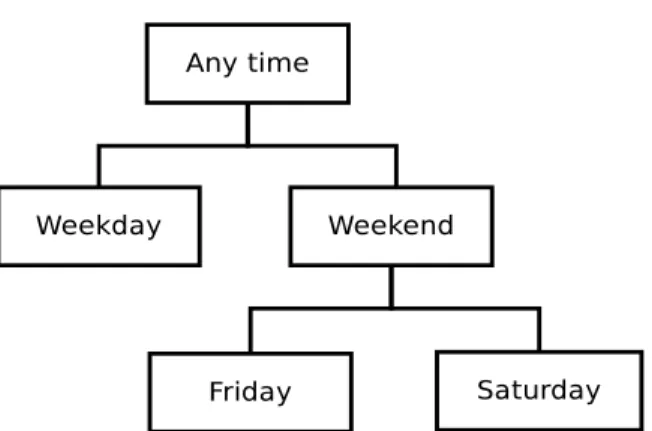
Context generalisation is proposed to address this problem [2]. Consider we have context c = (company, place, time). Using the film recommendation example, we have c = (girlfriend, theatre, Friday evening). For every com-ponent in the context, a generalised set S, which has a hierarchical structure
Fig. 3.1 The hierarchical structure of contextual information
of contextual information, can be defined (see Figure 3.1). We can define a different Sfor each component of the context, and several hierarchies for more general context, as the following example shows:
• Time: Friday evening → weekend evening → evening → any time • Place: theatre→ any place
• Company: girlfriend→ friend → any company
Then we can have multiple generalised contexts for c = (girlfriend, theatre, Friday evening). For example:
• c1 = (girlfriend, any place, Friday evening)
• c2 = (friend, theatre, Weekend evening)
• c3 = (friend, any place, any time)
Note that the set of possible contexts here must be pre-defined, or the sys-tem is not able to make use of the context. In fact, in most context-aware recommender systems, the contexts are pre-defined. This can be problematic, especially when it comes to temporal contexts. Some people may start the day much earlier or later than others. Therefore, different users may have different preferences in the pre-defined context, such as “evening”. More im-portantly, these pre-defined temporal contexts can be too general for some users. In a relatively long and general context, the user’s preference can still change significantly. However, if the context is not general enough, the RS
34 can not obtain enough data to learn the user’s preference. Beside, there may be many generalised contexts. Therefore, it is very important to determine which context to use and how general the context should be. One option is to use a manual, expert-driven approach [5]; e.g., always generalise specific days of the week into a more general Weekday or Weekend. However, in different applications, the type of context we are interested in may be different. The generalisation rules may not be appropriate in all applications. It is also impos-sible to manually specify all the generalisation rules in a system that involves a very large number of possible contexts. Another option is to use a more au-tomated approach that could empirically evaluate the predictive performance of the recommender system on contextualised input datasets obtained from each generalised pre-filter. Then the RS chooses the pre-filter with the best performance. In cases of applications with highly granular contexts, there may be a very large number of possible context generalisations. It is not possible to empirically evaluate the predictive performance on each generalised context due to high computational cost.
Contextual post-filtering is faced with the same problems. In fact, the prob-lems of context generalisation are shared by all the contextualisation methods. In these approaches, the contextualisation process requires us to define a set of contexts first, which are not personalised. Exact and detailed context can again lead to data sparsity; while generalised context leads to inaccurate rec-ommendations.
These limitations of contextualisation methods suggest that a new context-aware recommendation method is needed. Therefore, as we introduced in Section 1.2, the following research questions are raised:
• whether we can develop a recommendation method that is able to over-come the data sparsity in context-aware recommender systems.
• whether we can develop a recommendation method that is able to define personalised contexts.
3.3
Session Based Method
Sometimes, it is not possible to obtain additional contextual information. How-ever, we do know what items the user has chosen in the current context (also known as “seed items”). Therefore, if we assume the context remains the same, we can make context-aware recommendations based on these seed items.
Following this idea, several methods are proposed to make context-aware recommendations. In these methods, a context is usually defined as an active, continuous session with the system, such as a music listening session, or a web browsing session [7, 30].
3.3.1
Non-personalised session based methods
In these methods, recommendations are based on the items that the user just chose in the current context (seed items). The given user’s general preference has little influence on the recommendations. That is, the recommendations are not personalised. The same seed items would lead to the same recommenda-tions. For example, Hariri et al. propose a context-aware music recommender system that can infer contextual information based on the most recent se-quence of songs liked by the user [30]. Given a sese-quence of songs in a user’s current interaction, the discovered patterns in sequence are used to predict the next track in the playlist. This method can not generate personalised rec-ommendations, because based on the same sequence of songs, the RS always generate the same recommendations, without considering user’s general taste reflected in other contexts (sessions).
3.3.2
Personalised session based methods
In these methods, each session is typically viewed as a mixture of various “top-ics”, and each “topic” has unique item distributions. Therefore, the central task of session based methods is to discover the underlying association
be-36 tween contexts, and to identify similar contexts (sessions) based on the topic mixture. Most session based methods are based on some latent factor model. These latent factors determine the characteristics of “topics”, thereby the char-acteristics of a context. In these methods, the user-item interaction data are replaced with user-topic data. These new features (topics) are selected for either context profiling or user profiling [37]. However, once the features are selected, they are used for both tasks.
The Latent Dirichlet Allcation (LDA) is a widely used latent factor model. It can be used to model the distributions of items in sessions. LDA was origi-nally proposed for modelling text documents, extracting useful features from a set documents[16]. LDA models each document (session) as a mixture of latent topics where each topic is a distribution over the vocabulary (items).
Based on LDA model, Hariri et al. propose the Query-driven context-aware recommendation (QD), a model that integrates user profiles, item represen-tations, and contextual information [31]. In this method, tags or keywords associated with the item are used. Therefore, each item can be represented as a “bag of words”, which is equivalent to a document. LDA model is used to generate the features (topics) of these documents; each topic (feature) is a distribution over tags; user, item and context are all represented as mixture of various features. However, as we discussed earlier in this chapter, matrix factorisation has been proven to be superior in modelling user item interaction. If we could separate the modelling of context, use separate sets of features for contexts and items, we may be able to generate more accurate recommenda-tions.
Similar to QD, Zheleva et al. propose a music-listening session based model (SBM) [73]. This method is also based on LDA model. However, tags and keywords are not used in this method. Therefore, each topic is simply a dis-tribution over items instead of tags. Users and contexts are represented as mixtures of features (topics). If we could separate the modelling of context and user, use different features, we may be able to generate more accurate
recommendations.
The above issues of existing session based methods suggest that a new approach is needed. The new approach should be able to model user’s general preference, and to model the underlying association between contexts. More importantly, the modelling of users and contexts should be independent of each other, as we discussed in our third research question in Chapter 1. Therefore, accurate user modelling and accurate context modelling can be achieved at the same time.
3.4
Evaluation of Context-Aware Recommender
Systems
Most popular recommender systems are based on explicit data. The criteria for evaluating those systems may not be suitable for CARS. In this section, we review commonly used testing and analysis criteria, and choose the appropriate ones for our method.
3.4.1
Rating Prediction Accuracy
The recommender system generates predicted ratings ˆrij for a test set of
user-item pairs (user ui, item wj)