Workaholism and Relationship Quality:
A Spillover–Crossover Perspective
Arnold B. Bakker
Erasmus University Rotterdam and Research Institute of Psychology & Health
Evangelia Demerouti
Utrecht University and Research Institute of Psychology & Health
Ronald Burke
York UniversityThis study of 168 dual-earner couples examined the relationship between workaholism and relationship satisfaction. More specifically, on the basis of the literature, it was hypothesized that workaholism is positively related to work–family conflict. In addition, the authors predicted that workaholism is related to reduced support provided to the partner, through work–family conflict, and that individuals who receive considerable support from their partners are more satisfied with their relationship. Finally, the authors hypothesized direct crossover of relationship satisfaction between partners. The results of structural equation modeling analyses using the matched responses of both partners supported these hypotheses. Moreover, in line with predictions, the authors found that gender did not affect the strength of the relationships in the proposed model. The authors discuss workplace interventions as possible ways to help workaholics and their partners.
Keywords:crossover, relationship satisfaction, workaholism, work–family conflict
Researchers have been interested in the relation-ship of work experiences and relationrelation-ship quality for some time as it became clear that the boundaries between work and family are permeable. Earlier stud-ies have identified two different ways in which de-mands and strain are carried over from the work to the family domain (Bolger, DeLongis, Kessler, & Wethington, 1989; Westman, 2002). Work–family conflict or spillover is a within-person across-domains transmission of demands and consequent strain from one area of life to another. Previous research has primarily focused on how experiences in the work domain are transferred to and interfere with the nonwork domain for the same individual (e.g., Byron, 2005; Lambert, 1990; Leiter & Durup, 1996). In contrast, crossover involves transmission across individuals, whereby demands and their consequent
strain cross over between closely related persons (Westman, 2001, 2002). Thus, in crossover, stress experienced in the workplace by an individual may lead to stress being experienced by the individual’s partner at home. Whereas spillover is an
intraindi-vidualtransmission of stress or strain, crossover is a
dyadic, interindividual transmission of stress or strain.
The earliest studies examined job demands re-ported by job incumbents (usually men) and the satisfaction and well-being of their spouses (usually women; see Barling, DuPre, & Hepburn, 1998; Burke, Weir, & DuWors, 1980b; Jackson & Maslach, 1982; Jones & Fletcher, 1993a, 1993b, 1996; Long & Voges, 1987). These studies typically found that higher levels of job demands reported by incumbents were associated with marital dissatisfaction and poorer psychological well-being of their spouses.
In the current study, we focused on the relationship betweenworkaholismand partners’ relationship sat-isfaction. Specifically, we examined whether the ten-dency of employees to invest too much time and effort in their work (Andreassen, Ursin, & Eriksen, 2007) may initiate a process through which employ-ees’ behavior influences their partners and diminishes their relationship satisfaction. Only a few studies have examined the consequences of workaholism for relationship quality, and those studies relied
exclu-Arnold B. Bakker, Department of Work and Organiza-tional Psychology, Erasmus University Rotterdam and Re-search Institute of Psychology & Health; Evangelia Demer-outi, Department of Social and Organizational Psychology, Utrecht University and Research Institute of Psychology & Health; Ronald Burke, School of Business, York Univer-sity, Toronto, Ontario, Canada.
Correspondence concerning this article should be ad-dressed to Arnold Bakker, Erasmus University Rotterdam, Institute of Psychology, PO Box 1738, T12-47, 3000 DR Rotterdam, the Netherlands. E-mail: [email protected]
sively on one source of information (self-reports from employees or from their partners). The only exception is the study by McMillan, O’Driscoll, and Brady (2004). Unfortunately, this particular study had a small sample size (n⫽46 workaholics,n⫽42 nonworkaholics, andn⫽40 partners) and lacked the statistical power to show differences between worka-holics’ and nonworkaworka-holics’ ratings of relationship quality (e.g., relationship adjustment, consensus, sat-isfaction) or the ratings provided by their partners. Moreover, the study examined merely differences in self- and partner’s ratings rather than the mechanism through which workaholism intrudes into the rela-tionship. This means that we still know little about how workaholism affects the quality of one’s inti-mate relationship. The central aim of the present study was to fill this gap, and to examine whether workaholism influences partners’ relationship satis-faction through an indirect process of crossover me-diated by work–family conflict and social support provided to the partner. Our crossover approach pro-vides another level of analysis to previous ap-proaches by adding the interindividual level, specif-ically the dyad, as another focus of study (Westman, 2002).
Workaholism and Relationship Quality
Workaholism is an individual difference character-istic referring to self-imposed demands, compulsive overworking, an inability to regulate work habits, and an overindulgence in work to the exclusion of most other life activities (Robinson, 1997). There is accu-mulating evidence that workaholism is related to poorer psychological and physical well-being (e.g., Andreassen et al., 2007; Burke & Matthiesen, 2004; Spence & Robbins, 1992). Furthermore, because workaholics are willing to sacrifice personal relation-ships to derive satisfaction from work (Porter, 2001), it is not surprising that research suggests a negative relationship between workaholism and relationship quality.
For example, Robinson and Post (1997) found that work addicts were more likely to perceive their fam-ilies as having worse communication, less clearly established family roles, and less affective involve-ment than individuals with low levels of work addic-tion behaviors. In addiaddic-tion, Robinson, Flowers, and Carroll (2001) reported that workaholics showed loss of emotional attachment, caring, and desire; reduced positive feelings for the spouse; and reduced physical attraction as compared with nonworkaholics. Consis-tent with these findings, Burke (1999b) reported that
workaholics scored significantly lower on family sat-isfaction than other types of workers (work enthusi-asts, unengaged workers, relaxed workers, and dis-enchanted workers). However, in their study among workaholics and their partners, McMillan et al. (2004) did not find evidence for disturbances in close relationships.
Related evidence for a relationship between wor-kaholism and relationship quality comes from re-search on the relationship between Type A behavior of job incumbents (mainly men) and the satisfaction and well-being of their spouses (Barling, Bluen, & Moss, 1990; Burke & Weir, 1980; Burke, Weir, & DuWors, 1979, 1980a). This research is relevant given that research has confirmed a positive relation-ship between Type A behavior and workaholism (e.g., Burke, 1999b; Burke, Koyuncu, & Fiksen-baum, 2006). Friedman and Rosenman (1974), the creators of the Type A behavior concept, first sug-gested that Type A behavior was associated with poorer relationship quality. Burke and Weir (1980) found that a measure of global Type A behavior of husbands correlated positively with their own marital dissatisfaction and with their wives’ marital dissatis-faction (Burke et al., 1979). Barling et al. (1990), in a sample of 134 medical practitioners and their wives, considered two Type A components identified by Pred, Spence, and Helmreich (1986) in a study of marital dissatisfaction. These components were achievement striving and impatience–irritability. Husbands’ impatience–irritability (impatience, anger, irritability, and hostility) was associated with their own and their wives’ marital dissatisfaction, whereas achievement striving was not correlated with these.
Writers with a clinical orientation (Killinger, 1991; Oates, 1971; Robinson, 1998) have also suggested that workaholism is associated with reduced levels of relationship quality. Robinson and his colleagues (Robinson, 1996a, 1996b, 1998; Robinson & Kelley, 1998; Robinson & Post, 1995, 1997) consider work addiction as a symptom of a diseased family system. Work addiction, similar to other addictive behaviors is, to them, intergenerational and passed on to future generations through family processes and dynamics. Although not tested directly (i.e., workaholism scores of parents were not examined in relation to workaholism scores of their children), Robinson and his colleagues equate elevated health symptoms of workaholic fa-thers with elevated health symptoms of their children (e.g., anxiety and depression) as support for such a relationship (Robinson, 1999; Robinson & Kelley, 1998; Robinson & Post, 1995). Furthermore, Robin-son and Post (1997) report data from a sample of 107
self-identified workaholics (members of Workaholics Anonymous chapters in North America) who com-pleted the Work Addiction Risk Test (WART) and a family assessment instrument. Three levels of WART scores were compared. High scores differed from low and medium scores on six of the seven family assessment scales, indicating poorer relation-ship quality in all cases.
A Spillover–Crossover Perspective
The studies reviewed so far are typical of the early research on the crossover of work experiences and job strain to family satisfaction and functioning (Westman, 2006). More recent crossover research designs have incorporated partner dyads (e.g., Bak-ker, Demerouti, & Schaufeli, 2005; Hammer, Allen, & Grigsby, 1997; Westman & Vinokur, 1998). Job and family demands are the common antecedents of the crossover process. Westman (2001, 2006) also includes workaholism as a factor in an individual’s personal attributes that may be involved in the cross-over process.
Westman (2006) has suggested several possible mechanisms to explain the crossover process. First, direct crossover can take place between the two spouses or partners through empathic processes. That is, because spouses/partners spend considerable time together, they become aware of and are affected by each other’s affective states. Second, the spouses/ partners may share some common stressors (e.g., financial pressures, life events) that can lead to in-creased levels of common strains (e.g., negative af-fect). Third, crossover may be an indirect process. That is, there is an indirect crossover of strain medi-ated by the communication and interaction of the spouses/partners (e.g., coping strategies, social
un-dermining, and lack of social support). In the current study, we particularly focused on the latter process. We expected that one partner’s workaholism would have a negative influence on the other partner’s re-lationship satisfaction, through the experience of work-to-family conflict (WFC) and reduced social support provided to the partner (see Figure 1).
Because workaholism is a phenomenon that leads people to spend excessive time on their work at the expense of other activities, workaholics should differ from others regarding the extent to which they expe-rience work–family conflict as well as the quality of their intimate relationships (Taris, Schaufeli, & Ver-hoeven, 2005).Work-to-family conflictis defined as “a form of interrole conflict in which the role pres-sures from the work and family domains are mutually incompatible in some respect” (Greenhaus & Beutell, 1985, p. 77). Thus, participation in the family role is made more difficult by virtue of participation in the work role. Some studies have indeed shown a posi-tive relationship between workaholism and work– family conflict (e.g., Bonebright, Clay, & Anken-mann, 2000; Taris et al., 2005). In addition, from a personal resources perspective (e.g., Hobfoll, 2002), compulsive tendencies make workaholics devote more resources (e.g., time, effort) to work, leaving them with fewer resources to devote to their family. Finally, Burke (2002) found that workaholics per-ceive their workplace environment as more demand-ing and stressful and less supportive of work–life balance; previous research has shown that perceived job demands are positively related to WFC (Demer-outi, Geurts, & Kompier, 2004). It can therefore be hypothesized that workaholics experience more work– family conflict (Hypothesis 1; see also Figure 1).
In addition, because they are immersed in their work (Schaufeli, Taris, & Van Rhenen, 2008)—also
Social Support Received by Women -+ Women’s Relationship Satisfaction Men’s WFC Men’s Workaholism + Social Support Received by Men -+ Men’s Relationship Satisfaction Women’s WFC Women’s Workaholism +
while at home (Taris et al., 2005)—workaholics offer less emotional and instrumental support to their part-ners. However, we expected that workaholism is related to reduced support, only through WFC (full mediation; Hypothesis 2). This view is consistent with the role scarcity hypothesis (Edwards & Rothbard, 2000). Ac-cordingly, people possess limited and fixed amounts of resources (e.g., time and energy). Managing multiple roles (of employee and spouse) is problematic as they draw on the same, scarce resources.
Furthermore, the literature on family processes shows that stressed couples exhibit high levels of negative, unsupportive interactions and conflicts (Westman & Vinokur, 1998). The increased distress (associated with the experience of WFC) and its accompanying frustration lead an individual to initi-ate or exacerbiniti-ate a negative interaction sequence with the partner (Westman, 2005). Using a multi-source study among 337 couples, Matthews, Conger, and Wickrama (1996) showed that both husbands and wives’ WFC was indirectly (through psychological distress) related to hostile interactions and lowered marital warmth and supportiveness between the part-ners. It should be noted that social support has gen-erally been studied as amoderatorof the WFC–strain relationship (e.g., Fu & Shaffer, 2001; Suchet & Barling, 1986) and not as a mediator or intervening process variable in the relationship between WFC and outcomes. Thus, in the present study, we took a totally different approach than previous research and were inspired by previous crossover studies suggest-ing that social support may be a mediator variable (Westman, 2006).
Previous research has suggested that social support has a direct effect and serves a health-restorative role by meeting basic human needs for social contact, regardless of the level of stress present (Wheaton, 1985). This generalized beneficial effect of social support occurs because social networks provide pos-itive interactions, affirmation, and encouragement that lead to an overall sense of worth, self-esteem, and positive affect (e.g., Cohen & Wills, 1985; Krause & Borawski-Clark, 1994; Viswesvaran, Sanchez, & Fisher, 1999). On the basis of this, we also predicted that individuals who receive considerable sup-port from their partners are more satisfied with their relationship (Hypothesis 3; see also Figure 1).
Next to these relationships involved in the indirect crossover process (cf. Westman, 2005), we hypothe-sized direct crossover of relationship satisfaction be-tween partners (Hypothesis 4). We expected this di-rect crossover only in the domain of relationship satisfaction given that the marital relationship
consti-tutes a sphere that is commonly shared by both part-ners (Mauno & Kinnunen, 1999). The direct trans-mission of relationship satisfaction can be substantiated using Westman’s (2001) theory regard-ing direct effects (i.e., through an empathetic reac-tion; see also Bakker & Demerouti, in press). The only study that examined the crossover of positive experiences (marital satisfaction) in addition to the transmission of negative experiences (exhaustion and psychosomatic complaints) found no empirical sup-port for crossover (Mauno & Kinnunen, 1999). How-ever, Matthews, Del Priore, Acitelli, and Barnes-Farrell (2006) found a significant correlation of .67 for relationship satisfaction within couples. It should be noted that these effects were not the focus of the study by Matthews et al. (2006), but they do serve to provide initial evidence for a crossover of relation-ship satisfaction.
Because the literature suggests that men do not consistently differ from women in their levels of workaholism (Burke, 1999a; Doerfler & Kammer, 1986) and work–family interference (Barnett & Hyde, 2001; Grandey & Cropanzano, 1999), we ex-pected that men would not differ from women in terms of the strength of the hypothesized relation-ships. This implies that the same mechanism applies to both men and women, which can be further justi-fied by the nature of the present sample, namely young dual-earner parents. Kaufman and Uhlenberg (2000) found that whereas older employees seem to favor the “good provider” model, implying that they worked more after having become parents, younger employees showed more evidence of the “involved father” model in which work effort did not increase with parenthood. This is evidence that the traditional gender role differences in organizing work and family life are less applicable to younger generations, with both parents being involved in family-related work. Thus, our final hypothesis was that gender would not affect the strength of the relationships in the proposed model (Hypothesis 5). The hypotheses are summarized and graphically displayed in Figure 1.
Method
Procedure
The data were collected in the Netherlands by means of two questionnaires. To ensure that both partners were working, we approached participants through the daycare center where they brought their child(ren). In total, 10 different daycare centers par-ticipated in the study. We left two identical
question-naires, one for each partner, in the child’s pigeonhole. The questionnaires were code-numbered to match the partners correctly. Despite this code numbering, the participants remained unidentified as both question-naires were answered anonymously. Participants were included in the study on a voluntary basis. The partners were kindly requested to fill out the questionnaires independently. Respondents returned their question-naires in closed envelopes to a special box placed in a central position at the entrance of the daycare center. The dual-earner parents provided information with re-spect to their levels of workaholism, WFC, received social support, and relationship satisfaction.
Participants
The participants in the study were 168 couples of dual-earner parents in the Netherlands. Of the 900 questionnaires distributed, 360 were returned, result-ing in a response rate of 40%. Twenty-four question-naires could not be used in the analyses because only one partner participated, thus leaving 336 question-naires or 168 couples for data analyses. Men were slightly older than women,t(334)⫽4.70,p⬍.001 (menM ⫽ 35.79 years,SD ⫽ 4.59; women M ⫽
33.60 years,SD ⫽ 3.88; d⫽.52, 95% confidence interval [CI] ⫽ 0.30, 0.73). All couples had chil-d(ren) younger than 3 years old who lived at home, and 33% had at least one additional child between 4 and 12 years of age. The most frequently mentioned level of education was university (36%), followed by college education (31%). There was no difference between the genders regarding educational level,
t(334) ⫽1.32, p ⫽ .19. However, women worked more often with people (74%) than did men (55%),
2(1)⫽11.67,p⬍.001, whereas men worked more
often with information (31%) than did women (21%),
2(1)⫽4.48, p⬍.05. For example, more women
(30.7%) than men (9.6%) worked in health care (as a doctor, nurse, therapist), whereas more men worked in industry—as a production manager, constructor, engineer (men: 10.2%; women: 1.8%)—and in busi-ness—as a manager, consultant, salesperson (men: 34.3%; women: 26.5%). In addition, more men (40%) than women (19%) had a supervisory role,
2(1)⫽17.27,p⬍.001.
Measures
Workaholism was measured with the Dutch ver-sion (Taris et al., 2005) of the Compulsive Tenden-cies (CT) subscale of the WART (Robinson, 1999). Taris et al. (2005) build a strong case for use of the
CT subscale as adequately representative of worka-holism. The overlap between the full 25-item WART and the CT subscale was high (.89⬍r⬍.93,ps⬍ .001). In addition, the patterns of correlations with other concepts (e.g., working overtime, WFC, and exhaustion) were very similar. Thus, the full WART and its CT subscale appear to measure the same concept. The scale includes nine items, such as “I feel guilty when I am not working on something,” and “I put myself under pressure with self-imposed dead-lines when I work” (1⫽never, 4⫽always).
WFC was assessed with three items that are a selection of the Dutch questionnaire Survey Work– Home Interference—Nijmegen (SWING; Geurts et al., 2005). The authors of the scale generated an item pool derived from 21 published scales (e.g., Kopel-man, Greenhaus, & Connolly, 1983; Netemeyer, Boles, & McMurrian, 1996), and consequently, using multiple raters, they selected the nine items best fitting the working definition of WFC (together with other criteria of minimal confounding with health outcomes, or work and home characteristics, as well as meaningful content in the Dutch language). The three items used in the present study (see also De-merouti, Bakker, & Bulters, 2004) are, “How often does it happen that you do not fully enjoy the com-pany of your spouse/family/friends because you worry about your work?” “How often does it happen that you find it difficult to fulfill your domestic obli-gations because you are constantly thinking about your work?” and “How often does it happen that your work schedule makes it difficult for you to fulfill your domestic obligations?” Responses are made on a 5-point scale (1⫽never, 5⫽always). We used the data of a previous Dutch study among 751 postal em-ployees (Wagena & Geurts, 2000) to examine the rela-tionship between the three-item index used in the present study and the original nine-item scale. The correlation was high (r⫽.90,p⬍.01).
Social support was assessed using Abbey, Abra-mis, and Caplan’s (1985) eight-item scale. Respon-dents were asked to indicate to what extent their partner “gave support when needed,” “told things that strengthened their self-confidence,” “listened to them when they felt the need to talk about things that were very important to them,” and so on. Thus, social support was assessed by partners rather than through self-ratings. The answer format was a 5-point scale ranging fromnot at all(1) toa great deal(5).
Participants were asked to indicate their satisfaction in the current intimate relationship. We used five items from the Relational Interaction Satisfaction Scale (Buunk, 1990), for example, “I feel happy when I’m
with my partner,” and “It is going well between my partner and me” (1⫽never,5⫽always).
Data Analysis
The matched responses of both partners were an-alyzed with structural equation modeling (SEM) techniques, using the AMOS 7 software package (Arbuckle, 2006). We analyzed the covariance matrix using the maximum likelihood method of estimation. Besides the chi-square statistic, the analysis assessed the goodness-of-fit index (GFI), the root-mean-square error of approximation (RMSEA), the non-normed fit index (NNFI), the incremental fit index (IFI), and the comparative fit index (CFI). The theo-retical model we tested is presented in Figure 1. Because of the large number of items and the inclu-sion of both men’s and women’s variables in one overall model, it was not possible to conduct SEM analysis on a full disaggregation model. For this reason, a partial disaggregation model (Bagozzi & Edwards, 1998) was tested by creating two compos-ites, that is, parcels of items per construct as recom-mended by Hall, Snell, and Foust (1999). Worka-holism, received social support, and relationship satisfaction were each included as latent factors with two halves of their scales as indicators. WFC was included as a latent factor with one indicator, namely the scale score. To control for random measurement error, the error variance of WFC was set equal to the product of its variance and the one minus the internal consistency (Jo¨reskog & So¨rbom, 1993). All structural paths in the model were constrained to be equal for men and women. Finally, we modeled the relationships
between men’s and women’s variables as covaria-tions between the errors of the respective variables (e.g., a covariation between the errors of men’s WFC and women’s WFC). Only the crossover relationship between men’s and women’s relationship satisfaction was modeled as a reciprocal relationship (see also Demerouti, Bakker, & Schaufeli, 2005).
Results
Descriptive Statistics
The means, standard deviations, internal consisten-cies (Cronbach’s alpha), and correlations between the study variables are displayed in Table 1. As can be seen, all variables have satisfactory reliabilities, with Cronbach’s alpha coefficients of .74 or higher. Fur-thermore, men scored higher than their partners on workaholism,t(334)⫽3.56,p⬍.001,d⫽.39, 95% CI⫽0.17, 0.60; and WFC,t(334)⫽3.33,p⬍.001,
d⫽.37, 95% CI⫽0.15, 0.59. The effect of gender on these two variables is medium (cf. Cohen, 1992).
Test of the Workaholism Model
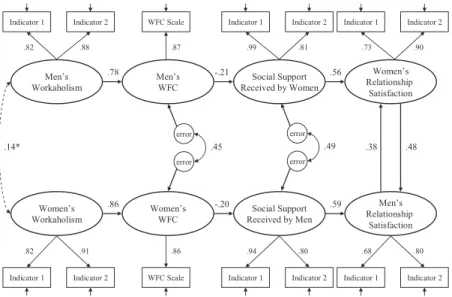
Results of the SEM analysis showed that the pro-posed workaholism model (displayed in Figure 2) fit adequately to the data,2(72)⫽123.81, GFI⫽.90,
IFI⫽.96, NNFI⫽.95, CFI⫽.96, RMSEA⫽.07. Consistent with Hypothesis 1, workaholism was pos-itively related to WFC (men  ⫽ .78, p ⬍ .001; women ⫽ .86, p⬍ .001). WFC, in turn, was a significant predictor of one’s partners’ experience of
Table 1
Means, Standard Deviations, Cronbach’s Alpha (on the Diagonal), and Correlations for the Workaholism Model Variables
Variable M SD 1 2 3 4 5 6 7 8
Men (n⫽168)
1. Workaholism 2.16a .47 (.80)
2. Work–family conflict 1.92a .65 .65ⴱⴱ (.77)
3. Social support from partner 4.07a .55 ⫺.13 ⫺.31ⴱⴱ (.88)
4. Relationship satisfaction 3.34a .54 .04 .07 .20ⴱ (.84)
Women (n⫽168)
5. Workaholism 1.97b .48 .11 .12 ⫺.10 ⫺.12 (.81)
6. Work–family conflict 1.69b .58 .14 .21ⴱⴱ ⫺.22ⴱⴱ ⫺.13 .67ⴱⴱ (.74)
7. Social support from partner 3.99a .60 ⫺.19ⴱ ⫺.32ⴱⴱ .52ⴱⴱ .21ⴱⴱ ⫺.18ⴱ ⫺.25ⴱⴱ (.87)
Relationship satisfaction 3.36a .54 ⫺.09 ⫺.05 .19ⴱ .60ⴱⴱ ⫺.25ⴱⴱ ⫺.20ⴱ .43ⴱⴱ (.88) Note. Means with different subscripts for men and women indicate that the variables differ between both groups at thep⬍
.001 level.
social support (men ⫽ ⫺.21,p⬍.001; women ⫽
⫺.20,p⬍.001).
To test Hypothesis 2, which stated that worka-holism is related to (reduced) support through WFC, we performed the Sobel test (Preacher & Hayes, 2004). The results indicated that WFC fully mediates the relationship between men’s workaholism and women’s experience of social support (z ⫽ ⫺3.50,
p⬍ .001) and between women’s workaholism and men’s experience of social support (z⫽ ⫺3.60,p⬍
.001). This means that Hypothesis 2 is accepted. Furthermore, and in line with Hypothesis 3, social support was positively related to relationship satis-faction (men ⫽.59,p⬍.001; women ⫽.56,p⬍
.001). In addition, men’s relationship satisfaction was significantly related to women’s relationship satisfac-tion ( ⫽ .38,p⬍.001), and vice versa ( ⫽ .48,
p⬍.001). Moreover, AMOS provides the so-called stability index for reciprocal relationships. In general, stability indices below the value 1 indicate that the nonrecursive model has an admissible solution (Ar-buckle, 2006). The stability index regarding the re-ciprocal relationship between husbands’ and wives’ marital satisfaction was far below the value 1 in the current study, namely .18. This means that Hypoth-esis 4 is supported as well.
Finally, to test the hypothesis that gender does not affect the strength of the relationships in the proposed
model (Hypothesis 5), we compared the constrained model with an unconstrained model. Results of the chi-square difference test indicated that there were no substantial differences between men and women,
⌬2(4)⫽8.14,ns, thus confirming Hypothesis 5.
Discussion
The present study adds to the literature on holism by examining the association between worka-holism, WFC, and partner relationship satisfaction using the dyad as the unit of analysis. Previous stud-ies almost exclusively relied on one source of infor-mation (self-reports from employees or from their partners), and therefore suffered from self-presenta-tion and common method variance problems. The main contribution of this study is that it revealed a relationship between workaholism and employees’ behavior in private life, as reported by their partners. Both men and women reported on their own worka-holism and WFC, and their partners reported on the support they received as well as their relationship satisfaction. Results clearly supported our spillover hypothesis by showing that workaholism is positively related to WFC. Thus, those employees with com-pulsive tendencies to spend an extremely high per-centage of their time on work showed more interfer-ence of work with private life. They were more
Social Support Received by Women 1 2 . -8 7 . Women’s Relationship Satisfaction Men’s WFC Men’s Workaholism .56 Social Support Received by Men 0 2 . -6 8 . Men’s Relationship Satisfaction Women’s WFC Women’s Workaholism .59
Indicator 1 Indicator 2 WFC Scale Indicator 1 Indicator 2 1 8 . 9 9 . 7 8 . 8 8 . 2 8 . Indicator 1 Indicator 2 .73 .90 error error .45 .14* error error .49 .38 .48
Indicator 1 Indicator 2 WFC Scale Indicator 1 Indicator 2 Indicator 1 Indicator 2 0 8 . 8 6 . 0 8 . 4 9 . 6 8 . 1 9 . 2 8 .
Figure 2. Standardized solution (maximum likelihood estimates) of the proposed worka-holism model. All parameters are significant at thep ⬍ .05 level or lower, except the parameter with an asterisk.
inclined to think and worry about their work when at home, gave priority to their work, and neglected their domestic obligations and the relationship with their partner. As a consequence, their partners were less supported, resulting in reduced relationship satisfac-tion. This supports our indirect crossover hypothesis stating that work-related behaviors and strain may crossover to the partner and intrude into family life. Thus, the current contribution also lies in the fact that it reveals the process that takes place when work interferes with private life because employees are obsessed with work. The findings are in line with Hobfoll’s (2002) conservation of resources theory. Accordingly, compulsive tendencies make worka-holics devote more resources (e.g., time, emotions) to work, leaving them with fewer resources to devote to their family. In addition, our results are consistent with the role scarcity hypothesis (Edwards & Roth-bard, 2000), postulating that people possess limited and fixed amounts of resources (e.g., time and en-ergy). Managing multiple roles (e.g., of employee, spouse, and parent) is problematic as they draw on the same, scarce resources. Previous research has demonstrated that especially time- and strain-based conflict (i.e., fulfillment of demands in one domain is difficult owing to the time devoted to and strain produced in the other domain, respectively) are as-sociated with various negative work-, family-, and stress-related outcome variables (see, for a meta-analysis, Allen, Herst, Bruck, & Sutton, 2000).
Finally, our findings expand previous spillover and crossover research by showing how the two streams of literature are related. WFC not only has ramifications for oneself but also for one’s partner. Consistent with Westman’s (2006) crossover theory, we showed that there is an indirect crossover of strain (workaholism and WFC) mediated by interaction of the partners (through lack of social support). Next to this indirect crossover, the study provides evidence for direct crossover of relationship satisfaction between partners. While rela-tionship satisfaction constitutes an experience that is commonly shared by both partners (Mauno & Kin-nunen, 1999), empirical evidence is scarce and our study is the first to provide support for such a relation-ship. Thus, next to the crossover of negative experi-ences, our study confirms that crossover of positive experiences takes place within couples.
As hypothesized, we found no substantial gender differences regarding the process through which wor-kaholism intrudes in and negatively influences the relationship. Although men reported slightly higher workaholism and WFC levels, this did not change the way through which workaholism of the one partner
was related to relationship satisfaction of the other partner. Perhaps one reason why we did not find gender differences is that our sample included highly educated and young couples with enhanced family obligations due to their young children. This might have led both partners to be equally involved in family life. Irrespective of gender, the more the focal person reported workaholism, the more WFC s/he experienced. WFC represents the linking mechanism between work-related factors on the one hand and family or individual outcomes on the other hand (Voydanoff, 2002), and indicates the degree to which the person allows that negative attributes of the work domain are transferred to the home domain. As soon as WFC came into play, individuals apparently with-drew supportive behavior toward their partners, irre-spective of their gender, which coincided with dimin-ished relationship satisfaction. Conceptually similar findings have been reported in the past. Moen and Yu (2000) found that working conditions, working hours, and life quality, including stress, WFC, and coping/mastery, differed between men and women. However, the factors associated with life quality were similar across genders, implying similar linking mechanisms between work and life outcomes.
Limitations
Although a strength of our study design is the exploration and matching of data within and between couples, there are some limitations that need to be raised. This study focused on intergender relation-ships, and the generalizability of the results to same-gender couples is unknown. In addition, our study was conducted in the Netherlands, which limits the external validity of our findings. There is a growing recognition that larger social, cultural, and political contexts may affect individuals’ perceptions and ex-periences within the work–family domain (e.g., Lewis, 1997; Westman, 2002). For instance, in the Netherlands, the state is responsible for providing work–family supports (e.g., childcare arrangements), whereas in other countries (e.g., the United States) companies are the primary providers of work–family assistance to employees. Thus, the specific cultural context may have affected our findings, which there-fore need to be interpreted with care. Furthermore, our response rate was relatively low (40%), which may question the generalizability of our findings. It should be noted, however, that low response rates are not uncommon in crossover research (e.g., Demer-outi et al., 2005; Mauno & Kinnunen, 1999). Dual-earner couples are often too busy with their work and
private life to respond. Finally, we used a cross-sectional design, which precludes causal inferences. This means that the relationships proposed by our model await further testing in longitudinal research. This is more important given that workaholism may also partly be a consequence of poor relationship satisfaction (as an escape coping strategy).
Despite these limitations, the current study sug-gests that workaholism has negative consequences for relationship quality. Workaholics let their work interfere with private life and seem less inclined to help their partners, which reduces their partners’ re-lationship satisfaction. This ultimately seems to fire back given that partners’ relationship satisfaction was reciprocally related.
Addressing Workaholism
How can employers help workaholics and worka-holics help themselves? Fassel and Schaef (1989) offer the following ideas. Employers should pay at-tention to the performance and work habits of em-ployees and be alert to warning signs of worka-holism. They should not reward addictive behavior, but recognize those employees who are productive but also lead balanced lives. They should ensure that employees take vacation time away from work. Fi-nally, job insecurity, work overload, limited career opportunities, and lack of control can make employ-ees feel compelled to work longer. If these factors exist, employers should try to minimize their impact on the atmosphere within the organization.
Even better would be to optimize the work envi-ronment such that employees are exposed to chal-lenging (but not too high) job demands and sufficient job resources. Several studies (Bakker, in press; Bak-ker & Demerouti, 2007) have shown that job resources (e.g., job control, performance feedback, opportunities for development) foster work engagement—a more positive form of employee well-being than worka-holism (Schaufeli, Taris, & Bakker, 2006). Such job resources can readily be mobilized through existing human resource management strategies, including training, coaching, and job evaluation conversations. Haas (1991) also highlights the role that managers can play in assisting their workaholic employees to change. Workaholic employees should be referred to an employee assistance program or a recovery pro-gram to start treatment processes. Managers should help prioritize projects for employees as long-term and short-term assignments. Workaholics must be encouraged and helped to delegate their work. The employee should be given specific times to take
breaks and to leave work. It may also be possible to reduce the negative effects of workaholism, particu-larly well-being and health consequences, through stress management training. The development of workplace values that promote new, more balanced priorities and healthier lifestyles will support those workaholism types who want to change their behav-iors, as well as their partners.
References
Abbey, A., Abramis, D. J., & Caplan, R. D. (1985). Effects of different sources of social support and social conflict on well-being.Basic and Applied Social Psychology, 6,
111–129.
Allen, T. D., Herst, D. E. L., Bruck, C. S., & Sutton, M. (2000). Consequences associated with work-to-family conflict: A review and agenda for future research. Jour-nal of OccupatioJour-nal Health Psychology, 5,278 –308. Andreassen, C. S., Ursin, H., & Eriksen, H. R. (2007). The
relationship between strong motivation to work (“worka-holism”) and health.Psychology and Health, 22,615– 629. Arbuckle, J. L. (2006).Amos(Version 7.0) [Computer
soft-ware]. Chicago: SPSS.
Bagozzi, R. P., & Edwards, J. R. (1998). A general frame-work for representing constructs in organizational re-search.Organizational Research Methods, 1,45– 87. Bakker, A. B. (in press). Building engagement in the
work-place. In C. Cooper & R. Burke (Eds.),The peak per-forming organization.New York: Routledge.
Bakker, A. B., & Demerouti, E. (2007). The job demands– resources model: State of the art.Journal of Managerial Psychology, 22,309 –328.
Bakker, A. B., & Demerouti, E. (in press). The crossover of work engagement: A closer look at the role of empathy.
Journal of Managerial Psychology.
Bakker, A. B., Demerouti, E., & Schaufeli, W. B. (2005). The crossover of burnout and work engagement among working couples.Human Relations, 58,661– 689. Barling, J., Bluen, S., & Moss, V. (1990). Type A behavior
and marital dissatisfaction: Disentangling the effects of achievement striving and impatience–irritability.Journal of Psychology, 124,311–319.
Barling, J., DuPre, K., & Hepburn, C. (1998). Effects of parents’ job insecurity on children’s work beliefs and attitudes.Journal of Applied Psychology, 83,112–118. Barnett, R. C., & Hyde, J. S. (2001). Women, men, work,
and family.American Psychologist, 56,781–796. Bolger, N., DeLongis, A., Kessler, R., & Wethington, E.
(1989). The contagion of stress across multiple roles.
Journal of Marriage and the Family, 51,175–183. Bonebright, C. A., Clay, D. L., & Ankenmann, R. D.
(2000). The relationship of workaholism with work–life conflict, life satisfaction, and purpose in life.Journal of Counseling Psychology, 47,469 – 477.
Burke, R. J. (1999a). Workaholism in organizations: Gender differences.Sex Roles, 41,333–345.
Burke, R. J. (1999b). Workaholism in organizations: The role of personal beliefs and fears. Anxiety, Stress and Coping, 13,1–12.
aggressive and results-oriented organizational cultures?
Career Development International, 7,211–217. Burke, R. J., Koyuncu, M., & Fiksenbaum, L. (2006).
Workaholism among women managers and professionals in banking in Turkey: Possible antecedents and conse-quences. Unpublished manuscript. Toronto: Schulich School of Business.
Burke, R. J., & Matthiesen, S. B. (2004). Workaholism among Norwegian journalists: Antecedents and conse-quences.Stress and Health, 20,301–308.
Burke, R. J., & Weir, T. (1980). The Type A experience: Occupational and life demands, satisfaction and well-being.Journal of Human Stress, 6,28 –38.
Burke, R. J., Weir, T., & DuWors, R. E. (1979). Type A behavior of administrators and wives’ reports of marital satisfaction and well-being.Journal of Applied Psychol-ogy, 64,57– 65.
Burke, R. J., Weir, T., & DuWors, R. E. (1980a). Perceived Type A behavior of husbands’ and wives’ satisfaction and well-being. Journal of Occupational Behavior, 1,
139 –150.
Burke, R. J., Weir, T., & DuWors, R. E. (1980b). Work demands on administrators and spouse well-being. Hu-man Relations, 33,253–278.
Buunk, B. P. (1990). Relational Interaction Satisfaction Scale. In J. Touliatos, B. F. Perlmutter, & M. A. Straus (Eds.),Handbook of family measurement techniques(pp. 106 –107). Newbury Park, CA: Sage.
Byron, K. (2005). A meta-analytic review of work–family conflict and its antecedents.Journal of Vocational Be-havior, 67,169 –198.
Cohen, J. (1992). A power primer.Psychological Bulletin, 112,155–159.
Cohen, S., & Wills, T. A. (1985). Stress, social support, and the buffering hypothesis. Psychological Bulletin, 98,
310 –350.
Demerouti, E., Bakker, A. B., & Bulters, A. (2004). The loss spiral of work pressure, work– home interference and exhaustion: Reciprocal relationships in a three-wave study.Journal of Vocational Behavior, 64,131–149. Demerouti, E., Bakker, A. B., & Schaufeli, W. B. (2005).
Spillover and crossover of exhaustion and life satisfac-tion among dual-earner parents. Journal of Vocational Behavior, 67,266 –289.
Demerouti, E., Geurts, S. A. E., & Kompier, M. A. J. (2004). Demands and resources as antecedents of posi-tive and negaposi-tive interference between work and home.
Equal Opportunities International, 23,6 –35.
Doerfler, M. C., & Kammer, P. P. (1986). Workaholism: Sex and sex role stereotyping among female profession-als.Sex Roles, 14,551–560.
Edwards, J. R., & Rothbard, N. P. (2000). Mechanisms linking work and family: Clarifying the relationship be-tween work and family constructs.Academy of Manage-ment Review, 25,178 –199.
Fassel, D., & Schaef, A. W. (1989). The high cost of workaholism.Business and Health, 34,38 – 42. Friedman, M., & Rosenman, R. H. (1974).Type A behavior
and your heart.New York: Knopf.
Fu, C. K., & Shaffer, M. A. (2001). The tug of work and family: Direct and indirect domain-specific determinants of work–family conflict.Personnel Review, 30,502–522. Geurts, S. A., Taris, T. W., Kompier, M. A. J., Dikkers, S. J. E., Van Hooff, M., & Kinnunen, U. (2005). Work–
home interaction from a work–psychological perspec-tive: Development and validation of a new questionnaire, the SWING.Work & Stress, 19,319 –339.
Grandey, A. A., & Cropanzano, R. (1999). The conservation of resources model applied to work–family conflict and strain.Journal of Vocational Behavior, 54,350 –370. Greenhaus, J. H., & Beutell, N. J. (1985). Sources of
con-flict between work and family roles.Academy of Man-agement Review, 10,76 – 88.
Haas, R. (1991). Strategies to cope with a cultural phenom-enon—Workaholism.Business and Health, 36,4. Hall, R. J., Snell, A. F., & Foust, M. S. (1999). Item
parceling strategies in SEM: Investigating the subtle ef-fects of unmodeled secondary constructs.Organizational Research Methods, 2,233–256.
Hammer, L. B., Allen, E., & Grigsby, T. D. (1997). Work– family conflict in dual-earner couples: Within individual and crossover effects of work and family. Journal of Vocational Behavior, 50,185–203.
Hobfoll, S. E. (2002). Social and psychological resources and adaptation.Review of General Psychology, 6,307–324. Jackson, S. E., & Maslach, C. (1982). After-effects of
job-related stress: Families as victims.Journal of Occu-pational Behavior, 3,63–77.
Jones, F., & Fletcher, B. (1993a). An empirical study of occupational stress transmission in working couples. Hu-man Relations, 46,881–902.
Jones, F., & Fletcher, B. (1993b). Transmission of occupa-tional stress: A study of daily fluctuations in work stress and strain and their impact on marital partners. In H. J. Schroder, K. Rescke, M. Johnston, & S. Maes (Eds.),
Health psychology: Potential diversity (pp. 328 –338). Regensburg, Germany: Roderer Verlag.
Jones, F., & Fletcher, B. (1996). Taking work home: A study of daily fluctuations in work stressors, effects of mood and impact on marital partners.Journal of Occu-pational and Organizational Psychology, 690,89 –106. Jo¨reskog, K. G., & So¨rbom, D. (1993).LISREL 8: User’s
reference guide.Chicago: Scientific Software International. Kaufman, G., & Uhlenberg, P. (2000). The influence of par-enthood on work effort of married men and women.Social Forces, 78,931–947.
Killinger, B. (1991).Workaholics: The respectable addicts.
New York: Simon & Schuster.
Kopelman, R. E., Greenhaus, J. H., & Connolly, T. F. (1983). A model of work, family, and interrole conflict: A construct validation study. Organizational Behavior and Human Performance, 32,198 –213.
Krause, N., & Borawski-Clark, E. (1994). Clarifying the functions of social support in later life. Research on Aging, 16,251–279.
Lambert, S. (1990). Processes linking work and family: A critical review and research agenda.Human Relations, 43, 3,239 –257.
Leiter, M. P., & Durup, M. J. (1996). Work, home, and in-between: A longitudinal study of spillover.Journal of Applied Behavioral Science, 32,29 – 47.
Lewis, S. (1997). An international perspective on work– family issues. In S. Parasuraman & J. H. Greenhaus (Eds.), Integrating work and family: Challenges and choices for a changing world(pp. 91–103). Westport, CT: Quorum Books.
source of their husbands’ occupational stress?Journal of Occupational Psychology, 60,235–242.
Matthews, L. S., Conger, R. D., & Wickrama, K. A. S. (1996). Work–family conflict and marital quality: Medi-ating processes.Social Psychology Quarterly, 59,62–79. Matthews, R. A., Del Priore, R. E., Acitelli, L. K., & Barnes-Farrell, J. L. (2006). Work-to-relationship con-flict: Crossover effects in dual-earner couples.Journal of Occupational Health Psychology, 11,228 –240. Mauno, S., & Kinnunen, U. (1999). The effects of job
stressors on marital satisfaction in Finnish dual-earner couples.Journal of Organizational Behavior, 20,879 – 895.
McMillan, L. H. W., O’Driscoll, M. P., & Brady, E. C. (2004). The impact of workaholism on personal relation-ships.British Journal of Guidance & Counselling, 32,
171–186.
Moen, P., & Yu, Y. (2000). Effective work/life strategies: Working couples, work conditions, gender, and life qual-ity.Social Problems, 47,291–326.
Netemeyer, R. G., Boles, J. S., & McMurrian, R. (1996). Development and validation of work–family conflict and family–work conflict scales.Journal of Applied Psychol-ogy, 81,400 – 410.
Oates, W. (1971).Confessions of a workaholic: The facts about work addiction.New York: World Publishing. Porter, G. (2001). Workaholic tendencies and the high
po-tential for stress among co-workers.International Jour-nal of Stress Management, 8,147–164.
Preacher, K. J., & Hayes, A. F. (2004). SPSS and SAS procedures for estimating indirect effects in simple me-diation models. Behavior Research Methods, Instru-ments, & Computers, 36,717–731.
Pred, R. S., Spence, J. T., & Helmreich, R. L. (1986). The development of new scales for the Jenkins Activity Sur-vey measure of the Type A construct.Social and Behav-ioral Sciences Documents, 16,51–52.
Robinson, B. E. (1996a). The psychosocial and familial dimensions of work addiction: Preliminary perspective and hypotheses. Journal of Counseling and Develop-ment, 74,447– 452.
Robinson, B. E. (1996b). The relationship between work addiction and family functioning: Clinical implications for marriage and family therapists. Journal of Family Psychotherapy, 7,13–39.
Robinson, B. E. (1997). Work addiction and the family: Conceptual research considerations.Early Child Devel-opment and Care, 137,77–92.
Robinson, B. E. (1998).Chained to the desk: A guidebook for workaholics, their partners and children and the clinicians who treat them.New York: New York Uni-versity Press.
Robinson, B. E. (1999). Spouses of workaholics: Clinical implications for psychotherapy.Psychotherapy, 35,260 – 268.
Robinson, B. E., Flowers, C., & Carroll, J. (2001). Work stress and marriage: A theoretical model examining the relationships between workaholism and marital cohesion.
International Journal of Stress Management, 8,165–175. Robinson, B. E., & Kelley, L. (1998). Adult children of workaholics: Self-concept, anxiety, depression, and locus of control. American Journal of Family Therapy, 26,
35–50.
Robinson, B. E., & Post, P. (1995). Work addiction as a function of family of origin and its influence on current family functioning.The Family Journal, 3,200 –206. Robinson, B. E., & Post, P. (1997). Risk of work addiction
to family functioning.Psychological Reports, 81,91–95. Schaufeli, W. B., Taris, T. W., & Bakker, A. B. (2006). Dr. Jekyll and Mr. Hide: On the differences between work engagement and workaholism. In R. Burke (Ed.),Work hours and work addiction(pp. 193–252). Northampton, MA: Edward Elgar.
Schaufeli, W. B., Taris, T. W., & Van Rhenen, W. (2008). Workaholism, burnout, and work engagement: Three of a kind or three different kinds of employee well-being? Ap-plied Psychology: An International Review, 57,173–203. Spence, J. T., & Robbins, A. S. (1992). Workaholism:
Definition, measurement, and preliminary results. Jour-nal of PersoJour-nality Assessment, 58,160 –178.
Suchet, M., & Barling, J. (1986). Employed mothers: Inter-role conflict, spouse support and marital functioning.
Journal of Occupational Behavior, 7,167–178. Taris, T. W., Schaufeli, W. B., & Verhoeven, L. C. (2005).
Workaholism in the Netherlands: Measurement and im-plications for job strain and work–nonwork conflict. Ap-plied Psychology: An International Review, 54,37– 60. Viswesvaran, C., Sanchez, J. I., & Fisher, J. (1999). The role of
social support in the process of work stress: A meta-analysis.Journal of Vocational Behavior, 54,314 –334. Voydanoff, P. (2002). Linkages between the work–family
interface and work, family, and individual outcomes.
Journal of Family Issues, 23,138 –164.
Wagena, E., & Geurts, S. (2000). SWING: Ontwikkeling en validering van de “Survey Werk-thuis Interferentie— Nijmegen” [SWING: Development and validation of the “Survey work-home interference—Nijmegen”].Gedrag & Gezondheid, 28,138 –158.
Westman, M. (2001). Stress and strain crossover.Human Relations, 54,557–591.
Westman, M. (2002). Crossover of stress and strain in the family and in the workplace. In P. L. Perrewe´ & D. C. Ganster (Eds.),Research in occupational stress and well-being (Vol. 2, pp. 143–181). New York: JAI Press/ Elsevier Science.
Westman, M. (2005). Cross-cultural differences in crossover research. In S. A. Y. Poelmans (Ed.),Work and family: An international research perspective. Series in applied psy-chology(pp. 241–260). Mahwah, NJ: Erlbaum.
Westman, M. (2006). Crossover of stress and strain in the work–family context. In F. Jones, R. J. Burke, & M. Westman (Eds.), Work–life balance: A psychological perspective. East Sussex, England: Psychology Press. Westman, M., & Vinokur, A. (1998). Unraveling the
rela-tionship of distress levels within couples: Common stres-sors, emphatic reactions, or crossover via social interac-tions?Human Relations, 51,137–156.
Wheaton, B. (1985). Models for the stress-buffering func-tions of coping resources.Journal of Health and Social Behavior, 26,352–364.
Received January 17, 2007 Revision received April 15, 2008