Understanding Order Flow
October 2005
Martin D. D. Evans1 Richard K. Lyons
Georgetown University and NBER U.C. Berkeley and NBER
Department of Economics Haas School of Business
Washington DC 20057 Berkeley, CA 94720-1900
Tel: (202) 338-2991 Tel: (510) 643-2027
[email protected] [email protected]
Abstract
This paper develops a model for understanding end-user order ‡ow in the FX market. The model ad-dresses several puzzling …ndings. First, the estimated price–impact of ‡ow from di¤erent end–user segments is, dollar–for–dollar, quite di¤erent. Second, order ‡ow from segments traditionally thought to be liquidity– motivated actually has power to forecast exchange rates. Third, about one third of order ‡ow’s power to forecast exchange rates one month ahead comes from ‡ow’s ability to forecast future ‡ow, whereas the re-maining two–thirds applies to price components unrelated to future ‡ow. We show that all of these features arise naturally from end–user heterogeneity, in a setting where order ‡ow provides timely information to market–makers about the state of the macroeconomy.
Keywords: Exchange rates, forecasting, microstructure, order ‡ow. JEL Codes: F3, F4, G1.
1Corresponding author: Martin Evans. Both authors thank the National Science Foundation for …nancial
sup-port, including a clearing-house for micro-based research on exchange rates (at georgetown.edu/faculty/evansm1 and at faculty.haas.berkeley.edu/lyons).
Introduction
This paper addresses order ‡ow heterogeneity and its empirical implications. By order ‡ow heterogeneity, we mean transactions initiated by agents of di¤erent types (e.g., non-…nancial corporations versus hedge funds versus mutual funds). Recent theoretical work on exchange rates stresses the analytical importance of heterogeneity across agents, stemming from both dispersed information and non-informational shocks to asset demands (e.g., Bacchetta and van Wincoop 2003, Hau and Rey 2002, Dunne, Hau, and Moore 2004, Evans and Lyons 2004a,b). Empirical predictions from these models are borne out: trades have causal and persistent e¤ects on price, a …nding that runs counter to textbook exchange rate models (e.g., Evans and Lyons 2002a,b, Payne 2003, among many others).2 Theory generally assumes, however, that agents are symmetrically heterogeneous; that is to say, they di¤er, but in the same way. In contrast, trades in the foreign exchange (FX) market come from categories of agents that are quite di¤erent: they have di¤erent motivations, di¤erent attitudes toward risk, and di¤erent horizons. Extant theory provides little guidance for empiricists seeking to exploit transaction data that is disaggregated into segments.3
Several puzzling empirical …ndings suggest that new modeling is needed. First, the price impact of order ‡ow is, dollar–for–dollar, quite di¤erent across end–user segments. This is not what one would expect to see if agents are symmetrically heterogeneous. Second, order ‡ow from segments traditionally thought to be liquidity–motivated actually has power to forecast exchange rates. Third, about one third of order ‡ow’s power to forecast exchange rates comes from ‡ow’s ability to forecast future ‡ow, whereas the remaining two–thirds applies to price components unrelated to future ‡ow. In this paper, we present a model where all these features arise naturally from heterogeneity across end–user segments, in a setting where order ‡ow provides timely information to market-makers about the state of the macroeconomy.
A one-period version of the Kyle (1985) model illustrates why intuition based on standard microstructure models is an unreliable guide to empirical work using order ‡ow data from di¤erent end-user (henceforth "customers") segments. In this model, the change in price quoted by a market-maker (i.e., the change in the log exchange ratest) depends on the total order ‡ow arriving in the market,xt:
st= xt;
where , the price–impact coe¢ cient, governs the sensitivity of the market–maker’s price quote to order ‡ow. By assumption, the market-maker cannot distinguish di¤erent order ‡ow components, but must instead respond to the aggregated total ‡owxt. Expected order ‡ow in this model is zero. Even in dynamic versions of the Kyle model, the market-maker expects order ‡ow to be zero in each period (a property that also applies
2In textbook models, all of which assume that variables relevant to exchange rates are common knowledge (CK), trades per
se have no causal e¤ect on price. Demand shifts have causal e¤ects on price. But because demand shifts come from public information only, prices adjust before transactions occur, so no causality from trades to price is present. Put di¤erently, in CK environments demand and order ‡ow are quite di¤erent, whereas in purely non-CK environments they are the same.
3Recent research using transaction data from di¤erent segments includes Froot and Ramadorai (2002), Carpenter and Wang
(2003), Mende and Menkho¤ (2003), Bjønnes, Rime, and Solheim (2004), Marsh and O’Rourke (2005), and Sager and Taylor (2005).
to standard versions of the other canonical information model, the Glosten and Milgrom 1985 model). This conditional i.i.d. structure is an analytically attractive feature of these models.
Now suppose that a researcher has a dataset that breaks total FX customer ‡ow at a given bank into three segments, say short-term investors (e.g., hedge funds), long-term investors (e.g., mutual funds), and international-trade-based (e.g., non-…nancial corporations); xi
t fori= 1;2;3. The researcher then runs the regression:
st= 1x1t+ 2x2t+ 3x3t+ t: (1)
With the perspective of the Kyle model, it would be natural to interpret the i coe¢ cients as price–impact parameters. However, this would be problematic for three reasons: First, the three regressors are not likely to be independent intratemporally. Indeed, in our data the order ‡ows from di¤erent segments are signi…cantly correlated. If thexi
tsare known to covary, and each of the ’s are non-zero, then no one coe¢ cient summarizes the total price–impact of changes in a single ‡ow segment. Second, the three regressors are not likely to be independent intertemporally. In fact, the ‡ow segments in our dataset are signi…cantly auto-correlated. In this context, the speci…cation in (1) is a reduced-form for potentially complex microeconomic dynamics. As non-structural estimates, the ’s are not reliable measures of the price–impact of incremental trades. Third, the speci…cation misses the fact that regressors in equation (1) come from a single bank, whereas the ‡ows that move the exchange rate are the market-wide ‡ows from all segments. This is problematic in terms of price–impact parameters: positive correlation between ‡ow segments across banks means that when the regression omits other-bank ‡ows, the ‡ows from the source bank are getting too much price–impact credit (a form of omitted variable bias). More fundamentally, the FX market is not transparent, at least not with respect to customer ‡ows, so that the ‡ows that drive stproximately are in fact the interdealer ‡ows. The exchange rate re‡ects the information in any individual bank’s customer ‡ows only when other dealers learn that information.
We present both simulation results and empirical estimates. The simulation results address the relation in our model between exchange rates and customer order ‡ows. The empirical estimates are based on roughly six years of customer transaction data from Citibank. Our simulations show that:
customer ‡ows provide more precise information about fundamentals when the mix of customers is tilted toward longer-horizon participants;
‡ows from customer segments can produce negative coe¢ cients in contemporaneous return regressions, even when positively correlated with fundamentals; and
customer ‡ows forecast returns because they are correlated with the future market-wide information ‡ow that dealers use to revise their FX prices.
Based on our empirical analysis we …nd that:
contemporaneous correlations across ‡ow segments are low at the daily frequency, but high at the monthly frequency;
some customer segments do produce negative coe¢ cients in contemporaneous return regressions; the proportion of excess return variation that segment ‡ows explain rises with the horizon; and about one-third of order ‡ow’s power to forecast exchange rates one month ahead comes from ‡ow’s ability to forecast future ‡ow, with the remaining two-thirds applying to price components unrelated to future ‡ow.
The remainder of the paper is in three sections. Section 1 presents the model. Section 2 describes our data, and presents our empirical analysis and the model simulations. Section 3 concludes. We provide technical details on how we solve the model in an appendix.
1
Model
The model we develop is based on Evans and Lyons (2004a,b). These papers embed the salient features of the spot FX market in a general equilibrium setting to study how information concerning the macroeconomy is transmitted to exchange rates via trading. The model we present here considers this transmission process in greater detail, emphasizing the role of end–user heterogeneity.
Our model focuses on the behavior of two groups of participants in the spot FX market: dealers and end– user customers. Dealers act as …nancial intermediaries. They quote prices at which they are willing to trade, and they initiate trade with each other. All non-dealer market participants are termed customers. This group comprises individuals, …rms, and …nancial institutions such as hedge and mutual funds. Customers have the opportunity to initiate trade with dealers at the prices they quote. The resulting pattern of trade de…nes customer order ‡ow. In particular, positive customer order ‡ow occurs at a given bank when the value of customer orders to purchase foreign currency at the quoted spot rate exceeds the value of orders to sell. Customer order ‡ow is only observed by the recipient dealer. Any information contained in customer order ‡ow only becomes known to dealers across the market as the result of interdealer trading. This information aggregation process was the focus of earlier models of FX trading (e.g., Evans and Lyons 2002a, and 2004a). In this paper we focus on how the information contained in customer order ‡ow is related to customer–type. For this purpose we distinguish between liquidity-motivated traders, short-term investors, and long-term investors. We then examine how di¤erences across customer types a¤ects the information contained in customer order ‡ow, and how this, in turn, a¤ects the joint dynamics of order ‡ows and exchange rates.
1.1
Dealers
There are a large number of dealers who act as intermediaries in the spot FX market. As such, each dealer quotes prices at which he stands ready to buy or sell foreign currency to customers and other dealers. Dealers also have the opportunity to initiate transactions with other dealers at the prices they quote. Thus, unlike
standard international macro models, the behavior of the spot exchange rate is determined entirely by the FX prices dealers quote.
In Evans and Lyons (2004a) we derive an expression for the foreign currency prices dealers quote from their preferences and the trading rules in the market. These rules determine the sequence of quoting and trading during each period. We are interested in the transmission of information over periods of a month or more, so we refer to each period as a month. At the start of each month dealers quote FX prices to customers. Under our trading rules these prices are good for any amount and are publicly observed. Each dealer then receives orders from a distinct subset of customers. Customer orders are only observed by the recipient dealer and so may represent a source of private information. Dealers next quote prices in the interdealer market. These prices, too, are good for any quantity and are publicly observed. Dealers then have the opportunity to trade among themselves. Interdealer trading is simultaneous and trading with multiple partners is feasible. This sequencing of events obviously oversimpli…es actual trading in the market. In reality dealers quote prices to customers and other dealers, receive orders from customers and other dealers, and initiate their own trades on an continual basis. Our simpli…ed sequencing allows us to focus on how information conveyed by customer orders is transmitted among dealers and embedded in spot rates. In this sense, trading between dealers and customers, and among dealers in our model, are metaphors for the many rounds of quoting and trading that take place during an actual month. As in Evans and Lyons (2004a), we allow for greater transparency in interdealer trading than is present in the actual FX market to compensate for the simpli…ed sequencing.
In our trading environment, optimal quote decisions take a simple form; all dealers quote the same price for foreign currency to both customers and other dealers. We represent the month-tquote as
st= (1 b)Edt 1
X
i=0
bift+i; (2)
where 1 > b > 0: st is the log price of foreign currency quoted by all dealers, and ft denotes exchange rate fundamentals. While equation (2) takes the present value form familiar from standard international macro models, here it represents how dealers quote the price for foreign currency in equilibrium. In the market setting we consider, all dealers choose to quote the same price because doing otherwise opens them up to arbitrage, a costly proposition. Consequently, the month-t quote must be a function of information known to all dealers. We incorporate this requirement in (2) with the expectations operatorEdt;that denotes expectations conditioned on information common to all dealers at the start of month t, d
t. This is not to say that all dealers have the same information. Far from it. The customer order ‡ows received by individual dealers represent an important source of private information, so there is likely to be a good deal of information heterogeneity across dealers at any one time. Equation (2) implies that dealer quotes only re‡ect that part of fundamental information that is common to all dealers.
The de…nition of fundamentals in equation (2) depends on the macroeconomic structure of the model. For example,ftmay include home and foreign money supplies and household consumption, as in Evans and Lyons (2004b), or “output gaps” and in‡ation rates as in Engel and West (2005). For our purpose here we
need not take a stand on the composition of fundamentals. It su¢ ces that all dealers agree on the elements offt;and its equilibrium process. For simplicity, we assume that this process is a random walk:
ft=ft 1+ut+vt; (3)
whereut i:d:d:N(0; 2
u)andvt i:d:d:N(0; 2v). Innovations to fundamentals come from two sources. ut shocks are immediately observed by all dealers and customers (i.e., ut is publicly observed at the start of montht):These shocks represent public news that has an immediate and known consequence for fundamen-tals. Thevt shocks to fundamentals are not immediately observed. Individual dealers and customers may have some information on vt as it occurs, but the information is imprecise and private. This information may come from private research, in the case of hedge or mutual funds, or from orders for goods and services in case of individual …rms (i.e., in the form of micro information). Over time, information onvt is collected and aggregated by government agencies.
The distinction between the utand vt shocks plays an important role in our model. The month–t spot exchange rate is determined by the foreign currency price that all dealers quote at the start of montht:This price can incorporate information contained in theutshock because it is observed by all dealers and has a known consequence for fundamentals. By contrast,vtshocks will not a¤ect the month tspot rate because they are not known to all dealers. Our focus is on how information concerning thevtshocks becomes known to dealers, and how this information is re‡ected in the dynamics of spot rates.
Dealers learn about the vt shocks from two sources. The …rst is via the scheduled macroeconomic announcements made by government agencies. These announcements provide information about past values of vt because it takes time for the agencies to compile and aggregate the information. We shall assume that macro announcements at the start of montht reveal the true value ofvt 2: This means that the true state of fundamentals in month t 2; ft 2; is common knowledge after the month t announcement. The second source of information to dealers comes from order ‡ow. Recall that customer order ‡ow is a source of private information to dealers. In general, customer order ‡ows will not be perfectly correlated across dealers because customers have heterogenous reasons for trading. Consequently, information contained in individual customer order ‡ows only becomes known to all dealers if and when it is re‡ected in interdealer trading. The process by which private information from customer order ‡ows becomes common knowledge to all dealers is analyzed in detail in Evans and Lyons (2004a). Here we make a reduced-form assumption about this information aggregation process. In particular, we assume it takes a month of interdealer trading before all dealers know the aggregate of customer orders hitting the market. Letxt denote aggregate customer order ‡ow from month t trading (i.e.,xtis the sum of the signed customer orders placed with individual dealers at the start of montht). We assume that interdealer trading in month–tis su¢ ciently informative to reveal the value ofxt to all dealers by the start of montht+ 1:Interdealer trading does not reveal the constituent components ofxt.
In summary, the information available to all dealers at the start of each month is given by:
d
t+1=fut+1; vt 1; xtg [ dt: (4) Since the spot exchange rate in month t is simply the FX price quoted by all dealers given common infor-mation d
t;the evolution of dt shown here plays a key role in driving exchange rates.
1.2
Customers
The customer orders received by actual foreign exchange dealers come from a variety of sources: individuals, non-…nancial …rms, and …nancial …rms such as pension funds, mutual funds and hedge funds. We will not attempt to model each separately. Instead, we note that the customer pool comprises heterogeneous agents with di¤erent preferences. We represent this heterogeneity by splitting the customer pool into three groups: short-term investors, long-term investors, and international-trade-based agents.
Both short–and long-term investors choose to allocate their wealth between domestic and foreign bonds based on their private forecasts of returns. In particular, we assume that there is a continuum of short-term investors on the unit interval indexed byi. The desired foreign bond position for investor iis given by
asi;t= sEi;t[st+1 st]; (5)
where s >0 andE
i;t denotes expectations conditioned on short-term investori’s information at the start of month t; s
i;t: For simplicity we assume that domestic and foreign interest rates are equal so st+1 st represents the excess return on foreign bond holdings. Of course, if investors held equities or other risky assets in addition, returns on these assets would also a¤ect their desired portfolio position. Again we ignore this possibility for the sake of clarity. The s parameter measures the sensitivity of the investor’s portfolio
choice to expected returns. Greater risk aversion and/or uncertainty concerning future returns is represented by a smaller value for s:
Long-term investors have a two– rather than one–month horizon. In equilibrium, it takes two months before shocks to fundamentals are fully and permanently re‡ected in the spot rate. A two-month horizon is therefore su¢ cient to represent the preferences of far-sighted investors. Again, there is a continuum of these investors on the unit interval. The desired foreign bond position of long-term investorj is given by
alj;t= lEj;t[st+2 st]; (6)
where l >0 and E
j;t denotes expectations conditioned on lj;t: As above, we ignore the possibility that long-term investors could hold other assets. The portfolio position of long-term investors may be more or less sensitive to variations in expected returns depending of the value of l:
investors. In particular, the customer order ‡ows from each group in montht are given by
xst =
Z 1 0
asi;t asi;t 1 di; (7a)
xlt =
Z 1 0
alj;t alj;t 1 dj: (7b)
Notice that both order ‡ows aggregate the expectations of individual investors concerning the future path of the exchange rate. As such, they aggregate the private information that individuals use in forming these expectations. We assume that this private information comes in the form of signals concerning vt: In particular, at the start of montht;each short–term investori and long–term investorj receives a noisy signal concerning the value ofvt;v~i;t andv~j;t, where
~
vi;t = vt+ i;t; (8a)
~
vj;t = vt+ j;t: (8b)
The idiosyncratic noise terms, i;t and j;t; are i.i.d. normally distributed shocks with zero means and variances equal to 2; and R1
0 i;tdi =
R1
0 j;tdj = 0: Unlike dealers, investors do not observe order ‡ows. Rather they observe spot rates, public news, macro announcements and private signals. The information used in their portfolio decisions is therefore characterized by:
s
i;t+1 = fut+1; vt 1; st+1;vi;t+1~ g [ si;t; (9a)
l
j;t+1 = fut+1; vt 1; st+1;v~j;t+1g [ lj;t: (9b) The third component of order ‡ow comes from the agents engaged in international trade in goods and services. We do not model this source of order ‡ow in any detail but rather assume a speci…cation with two key features.4 First, order ‡ows from this source are persistent, and second they are correlated with exchange rate fundamentals. Speci…cally, we assume that the order ‡ow associated with real trade, hereafter trade-based order ‡ow,xtt; follows an AR(1) process:
xtt = xtt 1+ vt+"t; (10)
with j j <1; where "t i:i:d:N(0; 2"): When is non–zero, changes in real economic activity that a¤ect exchange rate fundamentals also a¤ect the demand for foreign currency by trade-based agents, which in turn shows up order ‡ow. Our speci…cation also includes a liquidity shock"t, a component of trade-based order ‡ow unrelated to changing fundamentals.
Equations (7) and (10) describe the three components that comprise aggregate customer order ‡ow during
montht:
xt=xst+xlt+xtt: (11)
A key assumption in our model is that interdealer trading allows all dealers to learn the value ofxtby the end of montht trading, but not the constituent components,xst; xlt andxtt
1.3
Solving the Model
An equilibrium in our model comprises: (i) a process for spot rates consistent with the quote equation (2) given the equilibrium evolution of common dealer information d
t in (4), and (ii) a process for aggregate customer order ‡ow in (11) consistent with investor expectations. Finding these processes is complicated by the fact that the information conveyed to dealers by order ‡ow is itself a function of how investors use their private information in forecasting the future exchange rate.
We solve the model by the “conjecture and veri…cation”method. Speci…cally, we …rst conjecture the form for equilibrium quotes consistent with (2) and an assumption about the form of d
t:Next, we compute the components of customer order ‡ow consistent with the exchange rate process implied by these conjectures. This provides us with an expression for aggregate customer order ‡ow,xt. Finally, we verify that our initial conjecture concerning dealer information, (i.e., the evolution of dt)can be supported by an inference problem based on public news, macro announcements and the process forxt:
We start with the process for the exchange rate. Our speci…cation for the fundamentals process in (3) implies that the quote equation in (2) simpli…es to st = Edtft: Thus, the log price of FX quoted by all dealers is simply their estimate of current fundamentals based on common information. This implies that the equilibrium depreciation rate can be written as st+1=Edt+1ft+1 Edtft:Now equation (3) also implies thatEd
tft+1=Edtft;so combining these expressions gives:
st+1= (Edt+1 Edt)ft+1: (12)
Thus, the equilibrium depreciation rate betweentandt+1is solely determined by the ‡ow of new information to all dealers concerning the state of fundamentals int+ 1:We term this, the market-wide information ‡ow. On important implication of (12) is that the depreciation rate must be uncorrelated with any elements in
d
t:This rules out serial correlation in st, among other things.
The next step is to break down the market-wide information ‡ow into its component parts. For this purpose, we apply the expectations operatorsEdt+1 andEdt to the identityft+1=ft 2+ut+1+ut+ut 1+
(vt+1+vt+vt 1):This gives
st+1 = (Edt+1 Edt)ft 2+ (Edt+1 Edt) (ut+1+ut+ut 1) + (Edt+1 Edt)(vt+1+vt+vt 1);
= ut+1+ (Edt+1 Edt)vt+ (vt 1 Edtvt 1): (13)
and macro announcements make the true state of fundamentals common knowledge with a two month delay. This means that Ed
t+1ft 2 = Edtft 2 =ft 2: Second, the public news shocks, ut; are by de…nition common knowledge and unanticipated so(Ed
t+1 Edt) (ut+ut 1) = 0; Etdut+1 = 0; and Edt+1ut+1 =ut+1: Third, dealer estimates of thevtshocks combine their priors with their observations of order ‡ow and macro announcements. At the start of month t; dealers know the order ‡ows from earlier trading months (i.e., xt 1; xt 2; :::);and the history of macro announcements (i.e.,vt 2; vt 3; :::). These sources are uninformative about the value ofvt or vt+1 because customers were unaware of these shocks when making their trading decisions in montht 1 and earlier. As a consequence,Ed
t+1vt+1=Edtvt+1= 0;andEdt+1vt 1=vt 1: Equation (13) is helpful for understanding the joint dynamics of exchange rates and order ‡ow. The equation provides a decomposition of the new information dealers use in revising the FX prices they quote betweentandt+ 1:As one would expect, the public news component,ut+1, has an immediate impact on the depreciation rate because it leads all dealers to revise their estimate of fundamentals,ft+1: The other two components of the information ‡ow come from revisions in dealer estimates ofvtandvt 1:These revisions come from two sources: the macro announcement on the value of vt 1 made at the start of t+ 1; and the customer order ‡ow from month t trading, xt: The (Ed
t+1 Edt)vt component identi…es what dealers learn aboutvtbefore it becomes known publicly via the macro announcement int+ 2:The last component, vt 1 Edtvt 1; identi…es the new information in the macro announcement made at the start oft+ 1: The relative importance of these last two components depends on the information content of customer order ‡ow. The information in order ‡ow depends on the actions of customers. In particular, investor order ‡ows,xs
t andxl
t;will only contain information onvtif investors …nd it useful to use their private information onvtto forecast returns. To analyze the information content in customer order ‡ow we must therefore examine how investors allocate their portfolios. For this purpose, we need a conjecture for the equilibrium depreciation process. This conjectured process needs to be consistent with (13) and so relies on an assumption about dealer expectations which must also be veri…ed. We conjecture (and verify below) that the equilibrium process for the depreciation rate can be written as
st+1=ut+1+ vt+ (1 )vt 1+ "t "t 1; (14)
where and are parameters that need to be determined.
Recall that both short– and long–term investors receive a private signal concerning the value of vt at the start of montht:These signals are described in equation (8). This speci…cation implies that for short-term investor i; Ei;tvt = ~vi;t; and long-term investor j; Ej;tvt = ~vj;t where 2v=( 2v+ 2): Investor expectations concerning the value of vt 1 are similarly given by Ei;tvt 1 = ~vi;t 1 and Ej;tvt= ~vj;t 1: It might seem strange that these estimates incorporate no information from monthtvariables. However, recall from equation (12) that the depreciation rate depends on the new information received during monthtby all dealers:Thus, variables known to dealers are the start oftwill be of no use to investors in forecasting st+1: This leaves investors’ month t signals, ~vi;t and v~j;t; but these variables are uncorrelated withvt 1; so the montht 1 estimate remains the best estimate ofvt 1 for each investor in month t:Investor expectations
concerning the"tshocks are more straightforward. Only dealers observe customer order ‡ow, so individual investors have no information on the values of "t and "t 1 at the start of montht:5 Investor expectations concerning the rate of depreciation can therefore be computed from (14) as:
Ei;t[st+1 st] = ~vi;t+ (1 ) ~vi;t 1; Ej;t[st+2 st] = v~j;t+ (1 ) ~vj;t 1:
Using these expressions to identify investor expectations in (5) and (6), and combining the results with (7) and (8), gives us the following expressions for the investor components of customer order ‡ow:
xst = s ( vt+ (1 2 )vt 1 (1 )vt 2); (15)
xlt = l (vt vt 1 (1 )vt 2): (16)
Notice that in aggregate the investor order ‡ows provide information onvtandvt 1even though the value of these shocks is not known to individual investors. Aggregation of the order ‡ows eliminates the idiosyncratic component of investors’private information so that dealers can make more precise inferences aboutvt and vt 1 using aggregate order ‡ow than would be possible from the currency orders of individual customers. Equations (15) and (16) also show the investor order ‡ows are related to fundamentals even though investors are not concerned with the behavior of fundamentals per se. Investors care about returns which are in turn determined by how dealers change their FX quotes. They only use their information onvtinsofar as it helps them predict dealer quotes. If investor behavior makes customer order ‡ow more informative to dealers about the behavior of fundamentals, it will only be because investors found it in their best interest to use their private information onvtin managing their portfolios.
All that now remains is to verify that equation (14) is consistent with equation (13) given dealer inferences regardingvt andvt 1 based on macro announcements and their observations of aggregate customer order ‡ow,xt=xs
t+xlt+xtt;wherexst; xlt andxtt follow (10), (15) and (16). This is a relatively complex problem, so we relegate the technical details to the Appendix.
1.4
Customer Characteristics and Order Flow
We now turn to the properties of the equilibrium. Equation (14) shows that the equilibrium depreciation rate st+1 is driven by three factors: public newsut+1;fundamental newsvt;and liquidity shocks,"t:
st+1=ut+1+ vt+ (1 )vt 1+ "t "t 1: (14)
The parameter measures the equilibrium in‡uence of liquidity shocks on the depreciation rate. Recall that liquidity shocks are uncorrelated with actual fundamentals,ft;so if dealers observedftcontemporaneously
5Investors eventually learn the values of"
tusing the information in news, macro announcements and the history of exchange
(i.e., Ed
tft=ft), their FX quotes would not depend on liquidity shocks. Dealers can use order ‡ow,xt; to revise their estimates offt+1between the start of monthstandt+ 1;and these revisions drive spot rates (see equation 12). So any shock that contributes to unexpected aggregate order ‡ow,xt Edtxt;will a¤ect st+1 provided order ‡ow contains some information on the behavior of fundamentals that cannot be learnt from other sources. In sum, therefore, will be non-zero in any equilibrium where dealers …nd customer order ‡ow informative about fundamentals. Note, however, that even in these cases, the e¤ect of a liquidity shock on the price of FX is short-lived. Equation (14) implies that the e¤ect of a"tshock increases dealer quotes for the log price of FX by "t in month t+ 1; and lowers their quotes by "t in montht+ 2. Intuitively, by the start of montht+ 2;all dealers can infer the exact value of "tfrom macro announcements and their observations on order ‡ow. They can therefore re…ne their earlier inferences regarding fundamentals based onxt:
The parameter indicates the speed with which dealers learn about fundamentals from order ‡ow. In the extreme case where order ‡ow is completely uninformative, macro announcements would be the only source of information onvt:In this case would equal zero, andvtshocks would impact dealer quotes with a two month lag, which is the reporting lag for macro announcements. At the other extreme, if observations onxtallowed dealers to estimate the value ofvtwith complete precision by the start of montht+ 1; would equal one. Under these circumstances, the montht+ 1announcement concerning the value ofvt 1 would be informationally redundant as far as dealers were concerned, so the value ofvt 1 would not a¤ect the change in their FX quotes, st+1:
We can now turn to the focus of our analysis; namely, the question of how the information content of order ‡ow is related to the characteristics of customers. In our model, the characteristics of customer order ‡ow depend on the investors’sensitivities, s and l; the precision of private information, ;and the
correlation between fundamentals and trade-based order ‡ow, governed by :Ideally, we would like to study the analytical dependence of and on these parameters, but the complexity of the model makes this impossible. We therefore base our analysis on calibrated solutions to the model.
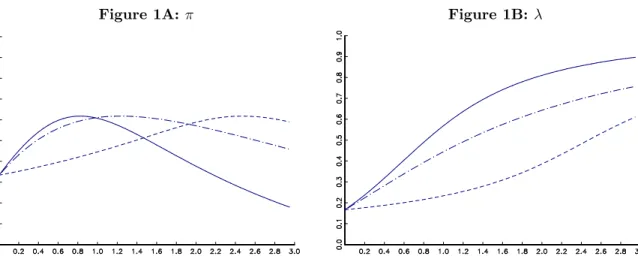
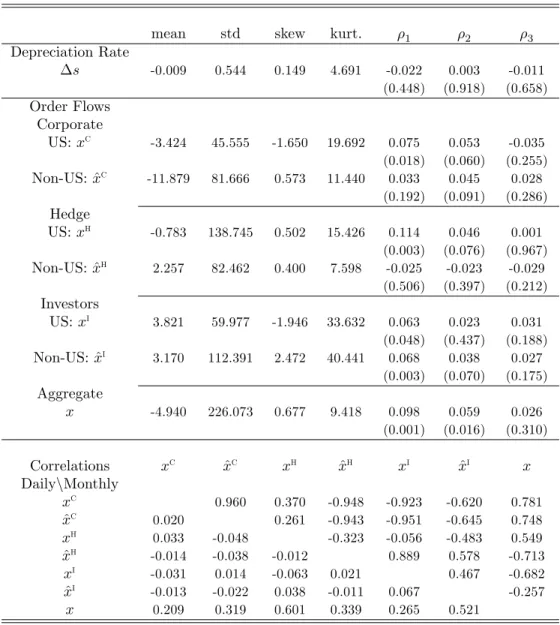
Figure 1 plots the equilibrium values of and for di¤erent values of sand l computed from solutions
to the model where 2
v= 2; 2u= 0:01; "2= 10; = 0:3and = 1:6 We have examined the equilibrium values of and based on many other calibrations and found that the basic characteristics displayed in Figure 1 are robust. We will therefore use these values as a baseline parameterization in much of the numerical analysis of the model below. As we shall see, their use enables the model to replicate many important features of the data.
Two features stand out from the plots in Figure 1. First, the equilibrium values of are relatively insensitive to the di¤erent values for s and l;the values for range between 0.13 and 0.23. Second, the greater the sensitivity of investors to expected returns, the faster is the speed with which dealers learn about
6The parameters s; l and are not separately identi…ed because they only appear in the order ‡ow equations as s
and l :For simplicity, we normalize to one so that we can disscuss the results in terms of s and l:Of couse, increasing
(decreasing) the precision of the private signals increases (decreases) ;and so is analytically equilivant to raising (lowering) s
Figure 1A: Figure 1B:
Notes: Equilibrium values for and graphed as functions of the investor sensitivity parameters = ( s; l):
The solid lines represent the case where = s = l; dashed lines the case where = s and l = 0; and
dot-dashed lines the case where = land s= 0:The other parameters in the model are 2
v= 2; 2u= 0:01; 2
"= 10; = 0:3;and = = 1:
fundamentals from order ‡ow (i.e., is increasing in s and l).
To understand the economics behind these results, we …rst note that = = 0:17when customer order ‡ow is driven solely by trade-based agents. In this equilibrium, order ‡ow,xt;is not particularly informative about fundamentals because it does not incorporate any of the private information onvtavailable to investors. Consequently, most of the impact ofvtshocks on spot rates is delayed for two months until it is fully revealed by macro announcements. The equilibrium value of rises with increases in both sand lbecause aggregate
order ‡ow now contains private information from investors on the values of vt: Importantly, order ‡ow is more informative to dealers in these equilibria because investors have a greater incentive to act on their private information. Investors recognize that dealers place greater weight on order ‡ow when revising their FX quotes, and use their private information on vt to forecast these revisions. At the same time, their own portfolio choices are more sensitive to private information, with the result that in aggregate, order ‡ow provides a more precise signal to dealers concerningvt:
Figure 1 also shows how and are related to the degree of forward–looking behavior driving order ‡ow. The dashed and dashed-dot plots show the equilibrium values of and for cases where investors are either all short–term (i.e., l = 0) or long–term (i.e., s = 0). Here we see that order ‡ow is more
informative when only long-term investors contribute to order ‡ow. The reason is that private information has a larger impact on investor expectations concerning two-month returns than one-month returns (i.e., @Ej;t[st+2 st]=@~vj;t= and@Ej;t[st+1 st]=@vj;t~ = < ). Consequently, the order ‡ows generated by long-term investors will be more sensitive tovtshocks than the ‡ows from short-term investors (see equations 15 and 16).
‡ow. In particular, we have demonstrated that customer order ‡ows provide more precise and timely infor-mation concerning fundamentals to dealers when the pool of customers is more forward-looking and willing to react to private information.
2
Empirical Analysis
2.1
Data
Our empirical analysis utilizes a dataset that comprises customer order ‡ows, spot rates and interest rates over approximately six years. The order ‡ows come from the customer orders received by Citibank in the USD/EUR market from April 1993 to June 1999.7. Citibank’s share of customer orders in the USD/EUR market at that time was in the 10-15 percent range, no other bank had a larger market share in these currencies. The customer orders are aggregated at the daily frequency and measure in $m the imbalance between customer orders to purchase and sell euros. Days “begin” at 00:00 GMT and any trades executed with customers over a weekend – a relatively rare event – are included in Monday’s order ‡ows. Thus a trading week comprises …ve days. Daily order ‡ows are split into three categories: non-…nancial corporations –henceforth “Corporations”, unleveraged …nancial institutions (e.g., mutual funds)— henceforth “Investors”, and leveraged …nancial institutions (e.g., hedge funds)— henceforth “Hedge”. We also distinguish between trades executed with Citibank in the US, and those elsewhere within Citibank’s global trading operation (referred to as “Non-US”). Thus, our customer order ‡ows are partitioned into six non-overlapping segments corresponding to three participant types and two trade locations. We take the daydspot rate as the o¤er rate (USD/EUR) quoted by Citibank at the end of trading (approximately 17:00 GMT) on day d 1: Excess returns are computed from these quotes using Euro deposit rates of the appropriate maturity from Datastream.
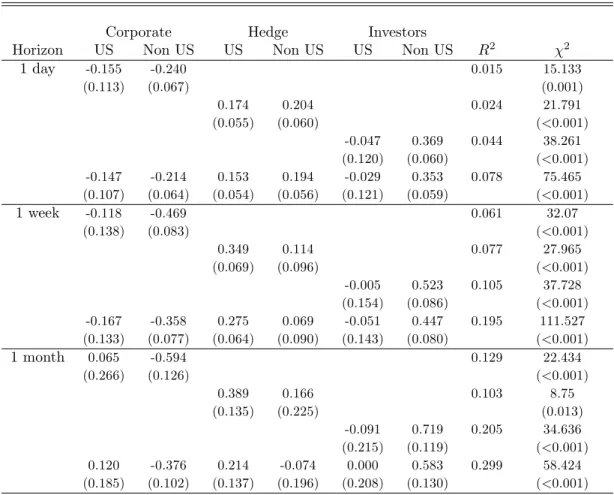
Table 1 presents descriptive statistics on depreciation rates and the customer order ‡ows. Since overnight interest rates are approximately equal in our sample, the daily depreciation rate behaves very similarly to excess returns, and neither displays any signi…cant serial correlation. By contrast, both the aggregate and disaggregated customer order ‡ows received by Citibank are serially correlated. The estimated autocorrela-tion coe¢ cients are quite small, but many are positive and highly statistically signi…cant. These statistical patterns are repeated at the weekly and monthly frequency: Depreciation rates and excess returns are serially uncorrelated while some of the order ‡ow segments display a small but signi…cant degree of autocorrelation. (We do not report these lower frequency results to conserve space.) Our theoretical model is consistent with these features of the data. The depreciation rate is serially uncorrelated by construction, as we noted above. Aggregate customer order ‡ow is slightly positively autocorrelated under our baseline parameterization with
s= l= 1 :The …rst order autocorrelation in xtis equal to 0.05.
The lower portion of Table 1 reports the contemporaneous order ‡ow correlations at the daily and monthly
7Before January 1999, data for the euro are synthesized from data in the underlying markets against the dollar, using weights
Table 1: Sample Statistics
mean std skew kurt. 1 2 3
Depreciation Rate s -0.009 0.544 0.149 4.691 -0.022 0.003 -0.011 (0.448) (0.918) (0.658) Order Flows Corporate US:xc -3.424 45.555 -1.650 19.692 0.075 0.053 -0.035 (0.018) (0.060) (0.255) Non-US:x^c -11.879 81.666 0.573 11.440 0.033 0.045 0.028 (0.192) (0.091) (0.286) Hedge US:xh -0.783 138.745 0.502 15.426 0.114 0.046 0.001 (0.003) (0.076) (0.967) Non-US:x^h 2.257 82.462 0.400 7.598 -0.025 -0.023 -0.029 (0.506) (0.397) (0.212) Investors US:xi 3.821 59.977 -1.946 33.632 0.063 0.023 0.031 (0.048) (0.437) (0.188) Non-US:x^i 3.170 112.391 2.472 40.441 0.068 0.038 0.027 (0.003) (0.070) (0.175) Aggregate x -4.940 226.073 0.677 9.418 0.098 0.059 0.026 (0.001) (0.016) (0.310) Correlations xc ^xc xh x^h xi x^i x DailynMonthly xc 0.960 0.370 -0.948 -0.923 -0.620 0.781 ^ xc 0.020 0.261 -0.943 -0.951 -0.645 0.748 xh 0.033 -0.048 -0.323 -0.056 -0.483 0.549 ^ xh -0.014 -0.038 -0.012 0.889 0.578 -0.713 xi -0.031 0.014 -0.063 0.021 0.467 -0.682 ^ xi -0.013 -0.022 0.038 -0.011 0.067 -0.257 x 0.209 0.319 0.601 0.339 0.265 0.521
Notes: The depreciation rate, s, are calculated as the daily change in the natural log of the spot price (USD/EUR) x 100. Order ‡ows are daily aggregates for the euro in $m. The statistics reported below iare the sample autocorrelations at lag i. P-values for the
null hypothesis of no autocorrelation are reported in parenthesis. The lower panel reports correlations between the order ‡ows at the daily frequency below the leading diagonal and at the monthly frequency above the leading diagonal. The sample spans the period 4/01/93 – 6/30/99, and includes observations on 1682 trading days.
frequency. At the daily frequency, the correlations between the ‡ow segments are quite small, but at the monthly frequency they range from approximately -0.95 to 0.95. This di¤erence in the correlation structure is important for understanding the results presented below.
Table 2: Contemporaneous Return Regressions
Corporate Hedge Investors
Horizon US Non US US Non US US Non US R2 2
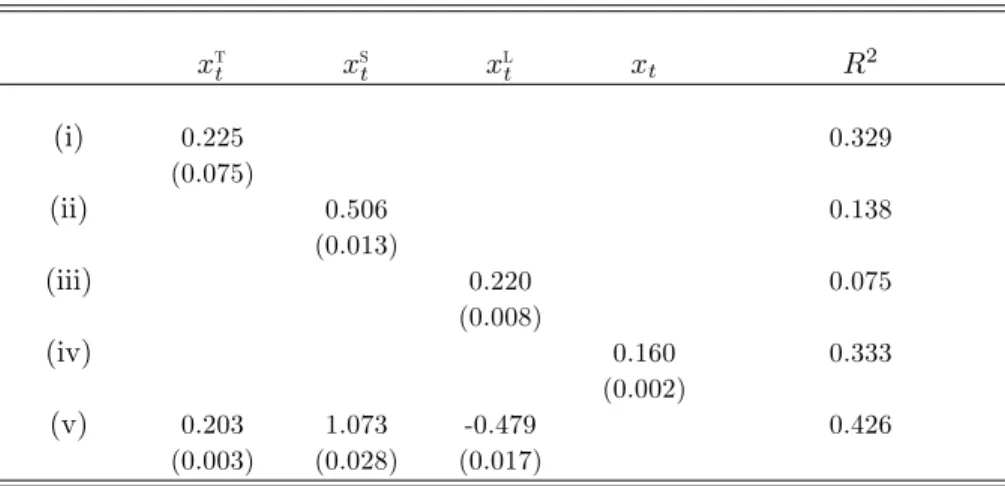
1 day -0.155 -0.240 0.015 15.133 (0.113) (0.067) (0.001) 0.174 0.204 0.024 21.791 (0.055) (0.060) (<0.001) -0.047 0.369 0.044 38.261 (0.120) (0.060) (<0.001) -0.147 -0.214 0.153 0.194 -0.029 0.353 0.078 75.465 (0.107) (0.064) (0.054) (0.056) (0.121) (0.059) (<0.001) 1 week -0.118 -0.469 0.061 32.07 (0.138) (0.083) (<0.001) 0.349 0.114 0.077 27.965 (0.069) (0.096) (<0.001) -0.005 0.523 0.105 37.728 (0.154) (0.086) (<0.001) -0.167 -0.358 0.275 0.069 -0.051 0.447 0.195 111.527 (0.133) (0.077) (0.064) (0.090) (0.143) (0.080) (<0.001) 1 month 0.065 -0.594 0.129 22.434 (0.266) (0.126) (<0.001) 0.389 0.166 0.103 8.75 (0.135) (0.225) (0.013) -0.091 0.719 0.205 34.636 (0.215) (0.119) (<0.001) 0.120 -0.376 0.214 -0.074 0.000 0.583 0.299 58.424 (0.185) (0.102) (0.137) (0.196) (0.208) (0.130) (<0.001) Notes: The table reports OLS estimates of the coe¢ cients in the regression of excess returns,
erd+h;on the customer order ‡ow segments that aggregate net orders for the euro in $m on days
d to d+h 1: Estimates are computed at the daily frequency, with h = 5 and 20 for the 1-week and 1-month horizon regressions. The table reports asymptotic standard errors corrected for heteroskedasticity in parentheses. For the 1-week and 1-month results, standard errors are also corrected for the induced MA(h-1) process in from overlapping observations. The right hand column reports Wald tests and p-values for the null that all the coe¢ cients on the order ‡ows are zero.
2.2
Customer Orders and Returns
We begin our empirical analysis of the relationship between exchange rates and customer order ‡ows in Table 2. Here we report the results of regressing excess returns on Citibank’s customer ‡ows at the one day, one week and one month horizon. Excess returns are computed aserd+h sd+h sd+rihd wheresdis the log of the quote at the start of dayd;andrih
d is the interest di¤erential on daydforhday deposits. Order ‡ows for each segment are aggregated from daydto dayd+h 1:Thus the order ‡ows cover the same period as the revision in dealer quotes determining excess returns.
seg-ments are quite di¤erent from each other. Some are positive, some are negative, some are highly statistically signi…cant, others are not. Second, while the coe¢ cients on order ‡ow are jointly signi…cant in every re-gression we consider, the proportion of the variation in excess returns that they account for rises with the horizon. For example, using all six order ‡ow segments, theR2statistics rise from 8 percent at one day, to 30 percent at the one month horizon. Third, the explanatory power of the order ‡ows shown here is much less than that reported for interdealer order ‡ows. Evans and Lyons (2002a), for example, report that interdealer order ‡ow accounts for approximately 60 percent of the variations in the $/DM at the daily frequency.
These …ndings appear puzzling when judged against the perspective of a standard market-making model, like Kyle (1985). In particular, the negative coe¢ cients in Table 2 seem to indicate, rather counter–intuitively, that market-makers view orders to purchase the euro from some customers as an indicator that the euro is overvalued. Similarly, it is hard to understand why orders from some customers appear to carry information at one frequency but not at others. Remember that there is no serial correlation in returns, so quote revisions at the monthly frequency are just the sum of daily revisions.
Our model provides the key to understanding the results in Table 2. Recall from the model that the depreciation rate re‡ects the revision in dealer quotes driven by new information concerning fundamentals. This information arrives in the form of public news, macro announcements and interdealer order ‡ow, but not the customer order ‡ows of individual dealers such as Citibank: Any information concerning fundamentals contained in the customer ‡ows received by individual banks a¤ects the FX price quoted by dealers only once it is inferred from the interdealer order ‡ows observed by all dealers. This distinction between individual customer order ‡ows and aggregate interdealer order ‡ow is crucial to understanding the results in Table 2. Our model simulations are useful in quantify this distinction. Speci…cally, we …rst solve the model for our baseline parameterization with s= l= 1:We then use the equilibrium values of and to simulate data
on the depreciation rate, st+1; aggregate order ‡ow, xt;and its components, xtt; xst and xlt for a sample spanning 10,000 months. Table 3 reports the results from regressing the depreciation rate on the customer order ‡ows in this simulated data.
Rows (i) –(iii) of Table 3 show that the revision in dealer quotes between the start of monthstandt+ 1
is positively correlated with the individual components of customer order ‡ow. Notice that none of these individual ‡ows accounts for more that one third of the variation in quotes. This is not due to the presence of public news shocks, they account for less than one percent of the variance in st+1 in our simulations.8 Rather, the lowR2statistics indicate that none of the order ‡ow components is strongly correlated with the ‡ow of information dealers use to revised their quotes. Of course dealers in our model are assumed to observe aggregate customer order ‡ow, xt; rather than its components, but in row (iv) we see thatxt accounts for only one third of the variation in quotes. Individual order ‡ows are not strongly correlated with the ‡ow of information dealers use to revise quotes.
8This implication of our simulations is consistent with empirical evidence on the exchange rate e¤ects of macro news. For
example, while Andersen et al. (2003) …nd that news items can account for a signi…cant proportion of the variation in exchange rates in the …ve-minutes following their release, they also note that news items account for only 0.2 percent of exchange rate variations over their full sample. For further discussion, see Evans and Lyons (2003).
Table 3: Simulated Return Regressions xtt xst xlt xt R2 (i) 0.225 0.329 (0.075) (ii) 0.506 0.138 (0.013) (iii) 0.220 0.075 (0.008) (iv) 0.160 0.333 (0.002) (v) 0.203 1.073 -0.479 0.426 (0.003) (0.028) (0.017)
Notes: The table reports OLS estimates of the coe¢ cients in regressions of the depreciation rate, st+1; on aggregate order ‡ow, xt; trade-based order ‡ow,
xtt; and the order ‡ows from short– and long–term investors, xst and xlt: The
regressions are estimated with 10,000 months of simulated data computed from the solution of our model using the baseline parameterization with s= l= 1:
OLS standard errors are reported in parenthesis.
In row (v) we report the results from regressing the depreciation rate on all three components of customer order ‡ow. Here we see two important implications of the model. First, the coe¢ cients on the order ‡ow components are quite di¤erent from each other. The coe¢ cients on the short-term component,xs
t;is twice the size of the estimate from the univariate regression in row (ii), and the coe¢ cient on the long-term component, xlt;falls from the univariate estimate of 0.22 to -0.48. Thus, the model can produce heterogeneity of the kind observed in the coe¢ cient estimates on Citibank’s customer order ‡ows. The second implication concerns theR2 statistic of 0.43. The individual components of customer order ‡ow in our model account for almost 30 percent more of the variation in dealer quotes than aggregate customer order ‡ow alone.
The results in Table 3 are robust to variations in the parameter values used to solve the model. They arise from two key features: First, realizations of aggregate order ‡ow, xt; are much less informative about shocks to fundamentals than the ‡ow of information reaching dealers between the start of monthtandt+ 1: In our model dealers make inferences regarding fundamentals by combining their observation on xt with the history of macro announcements (i.e., vt 1; vt 2;::)and earlier ‡ows (i.e., xt 1; xt 2; :::): The resulting dealer estimates of vt are much more precise than any estimate of vt based solely on xt: Consequently, variations in xt account for a relatively small fraction of the variation in depreciation rates because they poorly approximate the actual ‡ow of information on fundamentals dealers use in revising the FX quotes. The second key feature concerns the correlations between the order ‡ow components. In our simulations the correlation between the investor components is approximately 0.9, and the correlation between the trade-based and either investor component is approximately 0.3. These positive correlations are a robust feature of the model because, as equations (10), (15) and (16) show, the components of order ‡ow are driven by
common shocks to fundamentals. At the same time, the components are less than perfectly correlated thanks to di¤erences in investor preferences and the presence of liquidity shocks. These characteristics imply that variations in the three order ‡ow segments are jointly a better approximation to the ‡ow of information a¤ecting dealer quotes than a single order ‡ow, even the aggregate order ‡ow observed by dealers. This is why the R2 statistic in row (v) of Table 3 is almost 30 percent higher than the statistics from regressions using a single order ‡ow. The correlation across order ‡ow segments also means that the coe¢ cients on the order ‡ow components have no structural interpretation. Realizations ofvt; vt 1; "t and"t 1 characterize the ‡ow of information from aggregate order ‡ow and macro announcements dealers use to revise quotes (see equation 14). The di¤erent coe¢ cients on the order ‡ows simply re‡ect how these shocks are re‡ected in the depreciation rate and the order ‡ow components.9
Although there is no exact mapping from Citibank’s customer ‡ows to the components of customer order ‡ow in our model, the discussion above provides theoretical perspective on the empirical …ndings in Table 2. Citibank’s customer ‡ows are representative of the customer orders received by other (large) dealers, but they are not the vehicle through which information is impounded into FX quotes. Rather they represent one factor driving interdealer order ‡ow that is itself an important source of information to dealers setting FX quotes across the market. Essentially the same relationship exists in our model between the components of customer order ‡ow and the aggregate order ‡ow used by dealers to revise quotes. The one di¤erence is that Citibank’s’customer orders undoubtedly contain idiosyncratic elements that are absent from xtt; xst and xl
t: According to this view then, the results in Table 2 re‡ect the fact that Citibank’s customer ‡ows approximate the ‡ow of information dealers are using across the market to revise their FX quotes. The individual coe¢ cients have no structural interpretation in terms of measuring the price-impact of di¤erent customer orders, they simply map variations in customer ‡ows into an estimate of the information ‡ow being used by dealers across the market. This interpretation can also account for the increase in explanatory power of customer ‡ows as we move from horizons of one day to one month. As the horizon lengthens, the idiosyncratic elements in Citibank’s’ customer ‡ows become relatively less important, with the result that the ‡ows are more precise proxies for the market-wide ‡ow of information driving quotes. This interpretation is also consistent with the observation from Table 1 that the correlations between customer ‡ow segments are much higher at the monthly frequency than at the daily frequency.
2.3
Forecasting Returns
One novel implication of our model is that it takes time before shocks to fundamentals are fully re‡ected in exchange rates. This fact is clear from the equation for the equilibrium depreciation process:
st+1=ut+1+ vt+ (1 )vt 1+ "t "t 1: (14)
9For example, liquidity shocks, "
t;contribute one-for-one to trade-based order ‡ow, xtt;and increases the log FX quote
between tandt+ 1(see equation 14). Since liquidity shocks have no e¤ect on the other order ‡ow components, regression analysis tells us that the coe¢ cient onxt
Recall that in the extreme case where order ‡ow is completely uninformative about fundamentals, equals
0; so vt shocks a¤ect dealer quotes with a two month lag. At the other extreme, if observations on order ‡ow allow dealers to make completely precise estimates ofvt by the start of montht+ 1; equals one. In equilibrium, the value of lies between these extremes because order ‡ow is somewhat informative. In fact, our numerical results in Figure 1 showed that the equilibrium value of is higher when the pool of customers placing orders with dealers is more forward-looking.
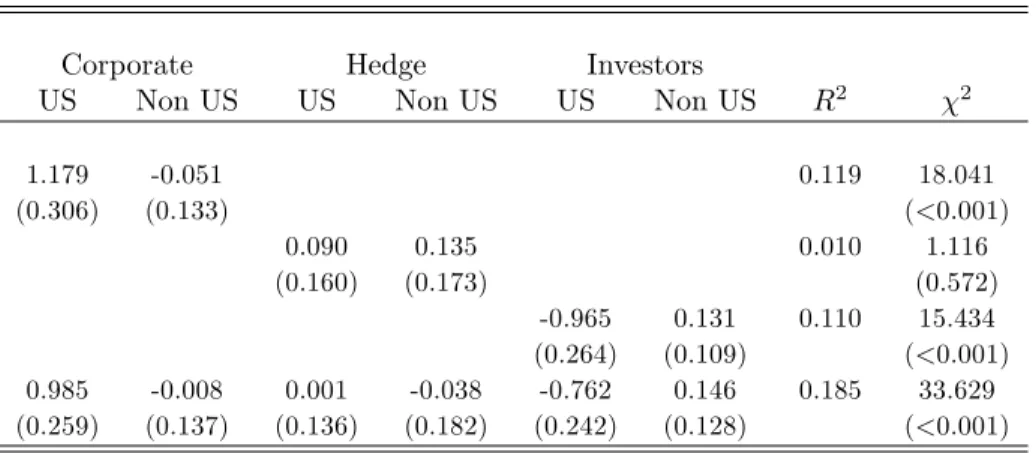
In this section, we examine the implications of equation (14) for the intertemporal relationship between customer order ‡ows and returns. We begin by examining the relationship between future excess returns and current customer order ‡ows. In particular, Table 4 reports the results of regressing excess returns between monthtand montht+ 1; ert+1;on Citibank’s customer order ‡ows during montht 1:Notice that unlike the regressions in Table 2, the customer order ‡ows come from trading prior to the period covering the revision in quotes.
Table 4: Forecasting Regressions
Corporate Hedge Investors
US Non US US Non US US Non US R2 2
1.179 -0.051 0.119 18.041 (0.306) (0.133) (<0.001) 0.090 0.135 0.010 1.116 (0.160) (0.173) (0.572) -0.965 0.131 0.110 15.434 (0.264) (0.109) (<0.001) 0.985 -0.008 0.001 -0.038 -0.762 0.146 0.185 33.629 (0.259) (0.137) (0.136) (0.182) (0.242) (0.128) (<0.001) Notes: The table reports OLS estimates of the coe¢ cients in the regression of monthly excess returns,erd+h;on the customer order ‡ow segments from trading
on days d h to d 1: Estimates are computed at the daily frequency with
h= 20trading days The table reports asymptotic standard errors in parentheses corrected for heteroskedasticity and an MA(h-1) process. The right hand column reports Wald tests and p-values for the null that all the coe¢ cients on the order ‡ows are zero.
The results in Table 4 show that customer order ‡ows have remarkable forecasting power for future quote revisions. The six ‡ow segments jointly account for approximately 19 percent of the variation in future excess returns. This level of forecasting power is an order of magnitude above that usually found in exchange rate equations. For example, the forecast power of interest di¤erentials for monthly excess returns is only in the 2 – 4 percent range. We also note, once again, that there are large di¤erences in the estimated coe¢ cients across ‡ow segments and across speci…cations.
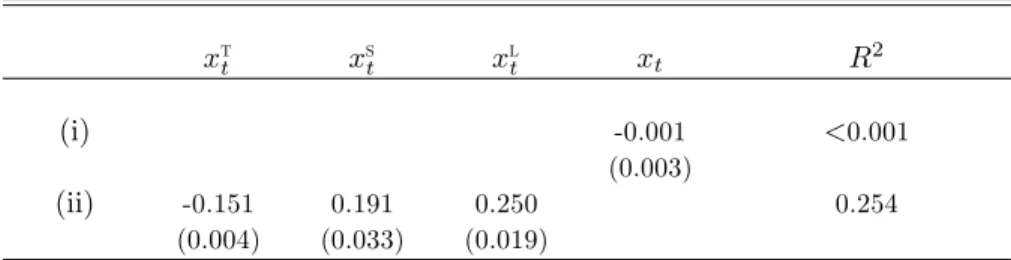
To gain theoretical perspective on these results, we return to simulations of our model. Table 5 reports the results of regressing the depreciation rate, st+1; on the aggregate and disaggregate customer order
‡ows from trading in month t 1; {xt 1 xtt 1; xst 1; xlt 1g: As above, the regressions are estimated from 10,000 monthly observations of simulated data computed from a solution to the model using our benchmark parameterization.
Row (i) of Table 5 shows that aggregate customer order ‡ow has no forecasting power for the future depreciation rate; both the coe¢ cient estimate and R2 statistic are very close to zero. By contrast, as the results in row (ii) show, the components of customer order ‡ow have substantial forecasting power. In this case theR2statistic is approximately 0.25 –a …gure somewhat higher than we found using all six segments of Citibank’s customer ‡ows. The estimated coe¢ cients on the three order ‡ow segments are also quite di¤erent from each other, but each is highly statistically signi…cant.
Table 5: Simulated Forecasting Regressions
xt t xst xlt xt R2 (i) -0.001 <0.001 (0.003) (ii) -0.151 0.191 0.250 0.254 (0.004) (0.033) (0.019)
Notes: The table reports OLS estimates of the coe¢ cients in the regression of the depreciation rate, st+1;on the aggregate and disaggregate customer order
‡ows from trading in mountht 1;{xt 1 xtt 1; xst 1; xlt 1g:The regressions are
estimated with 10,000 months of simulated data computed from the solution of our model using the baseline parameterization with s = l= 1:OLS standard errors are reported in parenthesis.
The results in Table 5 are easily understood using the equation for the equilibrium depreciation rate, equation (14). The equilibrium values for and are approximately 0.57 and 0.22 under our baseline parameterization. These values imply that order ‡ow is informative about fundamentals, but dealer inferences are not so precise that all the e¤ects ofvt shocks are immediately re‡ected in FX quotes. In short, it takes time in this equilibrium for dealers to fully learn about shocks to fundamentals. As consequence, the market-wide ‡ow of information driving the revision in dealer quotes betweentandt+ 1depends on the history ofvt and"tshocks before they become common knowledge to dealers. This history–dependence shows up in the presence of thevt 1 and"t 1terms in equation (14). Now, in sofar as order ‡ow segments from montht 1 trading are correlated withvt 1 and "t 1; these ‡ows will be correlated with the market-wide information ‡ow driving quote revisions, and so they will have forecasting power for the future depreciation rate as we see in Table 5.
It should be stressed that this result does not rely on ine¢ cient inference by dealers. In our model, dealers make optimal use of their observations on aggregate order ‡ow and macro announcements to revised their FX quotes. Rather, the forecasting power from the ‡ow segments re‡ects the fact that they jointly contain more information about fundamentals than the observed history of aggregate order ‡ow and macro
announcements up to the start of montht:Aggregating the segments destroys this information advantage, with the result that aggregate order ‡ow should have no forecasting power for the future depreciation rate. Indeed, this is exactly what we see in row (i) of Table 5.
We conjecture that this same mechanism accounts for the forecasting power of Citibank’s customer ‡ows. If these order ‡ows contain more information about fundamentals than was contemporaneously known to dealers across the market, and some of this information became widely known via the ensuing interdealer order ‡ow and incorporated into quotes, then the customer ‡ows should have forecasting power for future excess returns. Once again, the estimated coe¢ cients on the ‡ow segments do not have a structural interpre-tation, they simply map variations in the ‡ow segments into the ‡ow of information concerning fundamentals that has yet to be fully assimilated by dealers across the market.
2.4
Returns, Order Flows and the Pace of Information Aggregation
We have argued that Citibank’s customer orders have forecasting power for future returns because they are correlated with the market-wide information ‡ow that dealers use to revise their FX quotes. Moreover, this correlation arises because it takes time for information about fundamentals to be fully assimilated across the market. If, on the contrary, information about the latest change in fundamentals becomes available to dealers quickly because interdealer order ‡ow is very informative, customer ‡ows would have no forecasting power for future returns.
If the quality of market-wide information means that dealers are slow to fully learn about changes in fundamentals, customer order ‡ows will contain private information on not just the latest changes in fundamentals, but also past changes that are not yet common knowledge. In our model, the revision in quotes betweent and t+ 1 depends on bothvt and vt 1 when 1 < <0 (see equation 14). This means that investors use their private information on bothvtandvt 1 when forecasting returns and placing their month–tFX orders. Aggregate customer order ‡ow in monthtwill therefore aggregate private information on not just the most recent shock to fundamentals,vt;but also the earlier shock,vt 1;which is not yet known to all dealers. Notice that this backward–looking feature of order ‡ow does not arise because investors are backward–looking. It occurs, instead, because forward–looking investors recognize that information aggregation across dealers is not instantaneous.
These observations provide a new perspective on the contemporaneous relationship between returns and customer order ‡ows shown in Table 2. In particular, they raise the possibility that Citibank’s customer ‡ows proxy for the market-wide ‡ow of information received by dealers concerning a history of changes in fundamentals. If this is indeed the case, the projection of returns on contemporaneous customer ‡ows should be forecastable with lagged ‡ows. To investigate this possibility, we …rst compute the …tted values and residuals,erbt+1and^t+1;from the contemporaneous regression for excess returns between monthtandt+ 1 on the six customer ‡ow segments reported in the lower panel of Table 2. We then regress erbt+1 and^t+1 on the six ‡ow segments from trading during montht 1:The regression estimates are reported in Table 6. The results in row (i) show that Citibank’s customer ‡ows have signi…cant forecasting power for the
Table 6: Order Flow Decompositions
Corporate Hedge Investors
US Non US US Non US US Non US R2 2
(i) 0.202 -0.073 0.052 0.091 -0.239 0.010 0.070 13.383 (0.169) (0.069) (0.047) (0.112) (0.098) (0.067) (0.037) (ii) 0.706 0.091 0.035 -0.252 -0.492 0.188 0.130 20.897 (0.244) (0.112) (0.100) (0.174) (0.186) (0.123) (0.002) Notes: The table reports OLS estimates of the coe¢ cients of regressions oferbd+20 (row i)
and^d+20 (row ii) on the six order ‡ow segments from trading on days d 20 tod 1;
whereerbd+20and^d+20are the …tted values and residuals from the regression oferd+20on
the six ‡ows from daysdtod+ 19(see the last row in Table 2). Estimates are computed at the daily frequency. The table reports asymptotic standard errors in parentheses corrected for heteroskedasticity and an MA(19) process. The right hand column reports Wald tests and p-values for the null that all the coe¢ cients on the order ‡ows are zero.
projection of returns on contemporaneous ‡ows estimated by ert+1:b This …nding is consistent with the idea that the market-wide information ‡ow during month t contains information about earlier changes in fundamentals that are not yet common knowledge to dealers. Row (ii) of Table 6 reports the results of regressing the residuals from the contemporaneous regression,^t+1; on the lagged customer ‡ows. Here too the ‡ows have signi…cant forecasting power. Over our sample they account for 13 percent of the variations in the residuals:
These …nding are broadly consistent with our model. In Table 7 we report the results from regressing
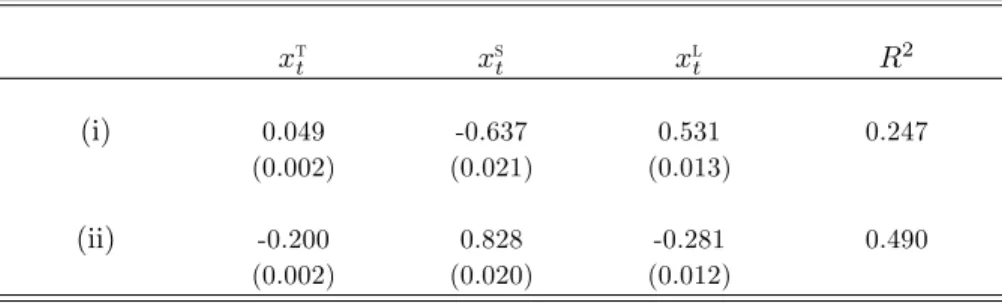
cst+1 and ^t+1 on the lagged customer ‡ow components, {xtt 1; xst 1; xlt 1g where cst+1 and ^t+1 are the …tted values and residuals from the contemporaneous regression of st+1 on xtt; xst; and xlt shown in row (v) of Table 3. As in the Citibank data, we see that lagged customer ‡ows have forecasting power for both the projection of the depreciation rate on the contemporaneous ‡ow components, and the associated projection error. The only signi…cant di¤erence between these …ndings and the results in Table 6 is that the R2 statistics are approximately 3.5 times larger –a point we shall return to.
The results in row (i) of Table 7 indicate that about one quarter of the market-wide information ‡ow captured by variations in the contemporaneous projection relates to historical changes in fundamentals. Recall that these results are derived from simulations in which the equilibrium value of is approximately 0.57, so dealer learning about earlier changes in fundamentals makes a signi…cant contribution to quote revisions. Citibank’s customer ‡ows are a less precise proxy for the market-wide information ‡ow than the customer ‡ow segments in our model, so the R2 statistic of 0.07 in row (i) of Table 6 almost surely understates the importance of dealer learning in the actual market.
Dealer learning also explains the results in row (ii) of Table 7. Here we see that lagged customer ‡ows have forecasting power for the component of the depreciation rate that is uncorrelated with contemporaneous
Table 7: Simulated Forecast Decompositions xtt xst xlt R2 (i) 0.049 -0.637 0.531 0.247 (0.002) (0.021) (0.013) (ii) -0.200 0.828 -0.281 0.490 (0.002) (0.020) (0.012)
Notes: The table reports OLS estimates of the coe¢ cients from regressions of
cst+1(row i) and^t+1(rows ii) on the lagged customer ‡ow components, {xtt 1;
xst 1; xlt 1g;where cst+1 and^t+1 are the …tted values and residuals from the
regression of st+1onxtt; xst;andxlt shown in row (v) of Table 3. OLS standard
errors are reported in parenthesis.
customer ‡ows. Public news shocks, ut+1, contribute to this component in our model (see equation 14), but they are uncorrelated with order ‡ows by construction and so cannot account for the results in the table. Instead the forecasting power comes from elements in the market-wide information ‡ow driving quote revision that are not proxied by current customer ‡ows. Recall that dealers use observations on aggregate customer ‡ow and macro announcements to revise their quotes. When is less than unity, these variables capture information fromvt; vt 1; "tand "t 1; an information ‡ow that cannot be precisely represented by the projection of st+1 onxtt; xts and xlt. The associated projection error will therefore contain both vt 1 and"t 1;elements that are correlated with lagged customer ‡ows. Thus, the three customer ‡ow segments contain more information about fundamentals than aggregate ‡ow, but they cannot be used to completely characterize the market-wide information ‡ow when it takes time for dealers to learn about changes in fundamentals. Similarly, Citibank’s customer ‡ows are not known across the market but appear to provide a partial contemporaneous characterization of the market-wide information ‡ow. Other elements in this market-wide ‡ow relate to earlier changes in fundaments that are not yet common knowledge to dealers but are correlated with lagged Citibank’s customer ‡ows. The R2 statistic in row (ii) of Table 6 is lower than its counterpart in Table 7 because Citibank’s customer orders are less informative about the market-wide information ‡ow than the components of customer order ‡ow in our model.
3
Conclusion
This paper addressed order ‡ow heterogeneity and its empirical implications. It is common for empiricists working in this area to apply results from stylized microstructure models when interpreting their results. Our analysis highlights the many pitfalls. For example, when employing datasets with ‡ows from multiple end-user segments, some researchers have neglected to account for the contemporaneous correlation among the ‡ow regressors. In this setting, estimated coe¢ cients are not unbiased re‡ections of the total price-impact of