SOCIAL SECURITY AND RETIREMENT
DECISION: A POSITIVE AND NORMATIVE
APPROACH
∗
Helmuth Cremer
Toulouse School of Economics (GREMAQ, IDEI and Institut
Universitaire de France)
Jean-Marie Lozachmeur
Toulouse School of Economics (GREMAQ and IDEI)
Pierre Pestieau
CREPP, University of Li`ege
Abstract. Social insurance for the elderly is judged responsible for the widely observed trend towards early retirement. In a world oflaissez-faireor in a first-best setting, there would be no such trend. However, when first-first-best instruments are not available, because health and productivity are not observable, the optimal social insurance policy may imply a distortion on the retirement decision. The main point we make is that while there is no doubt that retirement systems induce an excessive bias towards early retirement in many countries, a complete elimination of this bias (i.e. a switch to an actuarially fair system) is not the right answer for two reasons. First, some distortions are second-best optimal. This is the normative argument. Second, and on the positive side, the elimination of the bias might be problematic from a political perspective. Depending on the political process, either it may not be feasible or alternatively it may tend to undermine the political support for the pension system itself.
Keywords. Social security, Early retirement, Optimal income taxation, Majority voting
1. Introduction
Over the last decades one has observed a trend towards lower and lower participation rates of elderly male workers in Europe. For men aged 60–64 these rates were above 70% in the early 1960s and they have fallen to below 20% in Belgium, France, Italy and the Netherlands. It has been shown that this trend, which applies as well to
∗This paper was presented at the FINRET Conference (LSE, 15–16 September 2005), at the RTN Saving
and Retirement Conference (PSE, Paris, 18–19 May 2006) and in a seminar at the Labour Institute for Economic Research (Helsinki, March 2006).
Journal of Economic Surveys(2008) Vol. 22, No. 2, pp. 213–233
women and to the younger age group 55-60, can be in great part explained by the incentive structure underlying social protection programmes aimed at elderly workers: pension plans, but also unemployment and disability insurance, and early retirement schemes. As a result, these social protection programmes are far from being actuarially fair as regards the retirement decision, more in countries such as Germany or France than in countries such as Sweden or Finland. In this paper we survey recent work aimed at addressing two questions. First, do such biases towards early retirement result from bad policy or can they be vindicated on equity and efficiency grounds? Second, can the political process at work in Europe explain that today in so many countries workers retire much before the ‘normal’ age of retirement? As a corollary to the latter question, why is it so difficult to reform the system now that all governments agree that something has to be done?
This survey is organized as follows.1 In Section 2, we present the facts and the standard explanation: even though they live longer and longer, people retire earlier and earlier mainly because of biases inherent to the social security system. Those biases are explained by the unfounded belief that retiring elderly workers fosters youth employment and by the behaviour of firms which want to replace over-paid elderly workers by under-paid young workers. In Section 3, we use a linear retirement scheme. We first analyse the optimal scheme from a utilitarian viewpoint. Then we turn to majority voting models. Individuals vote either for payroll taxes that induce an age of retirement or they directly vote for some uniform age of retirement. In this section we also explain why there is so much resistance to raising the age of retirement even though such a reform is welfare improving, if not Pareto improving. In Section 4, we present the optimal non-linear retirement scheme using an optimal income tax setting with two sources of asymmetric information, ability and health. Even though this survey is concerned with a theoretical and conceptual question, the underlying issue has obvious policy implications. To understand these, our results have to be put in a proper perspective. The paper does show that some downward distortion in the retirement decision is unavoidable in a second-best setting. However, this doesnotjustify the ridiculous activity rates of elderly workers one observes in countries such as France or Germany. There is no doubt that in these countries raising the age of retirement is desirable not only because it generates additional resources to both the pension administration and the individuals but also because these additional public resources can be used for redistribution.
This point is particularly relevant in times of aging populations. With a PAYG system and increasing longevity, one normally expects an increase in the age of retirement and in the rate of contribution and a cut in pension benefits. If the age of retirement is kept constant at a rather low level, relying on just the two other instruments is most likely inefficient. Compared to a reform wherein the adjustment to aging goes only through a decrease in benefits (the contribution rate being unchanged because of tax competition), one has shown that for a country like Belgium allowing for an increase in the age of retirement could be Pareto improving (Cremer and Pestieau, 2003).
To sum up, the main point we make is that while there is no doubt that retirement systems induce an excessive bias towards early retirement in many countries, a
complete elimination of this bias (i.e. a switch to an actuarially fair system) is not the right answer. This is so for two reasons. First, some distortions are second-best optimal. This is the normative argument. Second, and on the positive side, the elimination of the bias might be problematic from a political perspective. Depending on the political process, either it may not be feasible or alternatively it may tend to undermine the political support for the pension system itself.
2. The Evidence
Over the coming decades, the EU will face an acceleration of demographic aging due to three main factors: the baby-boom generation reaching retirement age, continued increase in life expectancy and decreased fertility. All three factors jointly create a major financial challenge for pension systems when the number of pensioners will rapidly increase and the size of the working age population will diminish.2
By the year 2050, Europeans will live at least 4–5 years longer than today. Such an increase will raise the cost of providing the same pension level by 25% to 30%. At the same time, large cohorts born after World War II will reach retirement age and subsequent cohorts are much smaller as a result of lower birth rates. As a consequence, one expects a quasi doubling of the old age dependency ratio, i.e. the number of people of statutory retirement age (65+) to the potentially working population (15–64). In the year 2000 those over 65 years represented about one quarter of the working age population in the EU25. By 2050, this figure will be nearly 50%.
This is the demographic challenge that Europe is facing and has to prepare for.
In a laissez-faire world or alternatively in a first-best optimal economy, a large
part of this challenge could be addressed by adjusting the age of retirement to the increased longevity. Controlling for growth, it is rather intuitive that in a
laissez-faire setting, if my longevity is increasing I will work longer in order to keep an
appropriate rate of replacement (ratio of pension to earnings). And yet this is not what we observe in a number of European countries. Over the last decades, the rate of activity of elderly workers and the effective age of retirement have steadily decreased. Attempts to reverse this evolution have very often been met with heavy resistance.
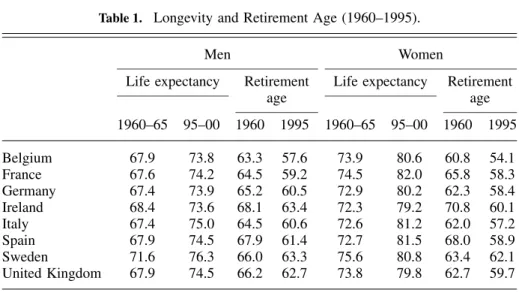
The effective retirement age in the EU ranges from 57 in Belgium to 63.1 in Ireland (with an EU15 average of 59.9). The average employment rate among older workers (55–64) is 38.8%, with Belgium and Luxembourg at the lower end (about 25%) and Sweden at the higher end (66.8%).3 The evolution is even more striking. Table 1
provides the change in longevity and retirement age in eight European countries during the period 1960–1995. It shows clearly that the commonly observed increase in the length of retirement that is represented in Figure 1 is due as much to a decreasing activity rate than to an increase in life expectancy. But why have we observed such a decline in the rate of employment in old age? In the late 1990s, both the National Bureau of Economic Research and the OECD documented a strong relationship across countries between social security incentives to retire and
Table 1. Longevity and Retirement Age (1960–1995).
Men Women
Life expectancy Retirement Life expectancy Retirement
age age 1960–65 95–00 1960 1995 1960–65 95–00 1960 1995 Belgium 67.9 73.8 63.3 57.6 73.9 80.6 60.8 54.1 France 67.6 74.2 64.5 59.2 74.5 82.0 65.8 58.3 Germany 67.4 73.9 65.2 60.5 72.9 80.2 62.3 58.4 Ireland 68.4 73.6 68.1 63.4 72.3 79.2 70.8 60.1 Italy 67.4 75.0 64.5 60.6 72.6 81.2 62.0 57.2 Spain 67.9 74.5 67.9 61.4 72.7 81.5 68.0 58.9 Sweden 71.6 76.3 66.0 63.3 75.6 80.8 63.4 62.1 United Kingdom 67.9 74.5 66.2 62.7 73.8 79.8 62.7 59.7
Source:Cremer and Pestieau (2003).
0 5 10 15 20 United States United Kingdom Sweden Spain Netherlands Japan Italy Germany France Canada Belgium years in retirement 1995 1967
Figure 1. Years in Retirement of Males in 1967 and in 1995. Source: Bl¨ondal and Scarpetta (1998).
R = 0,812 20 25 30 35 40 45 50 55 60 65 70 0 0,5 1 1,5 2 2,5
Logarithm of tax force
U nus e d c a pa c ity United Kingdom Spain United States Canada Germany Sweden Japan NetherlandsItaly Belgium France
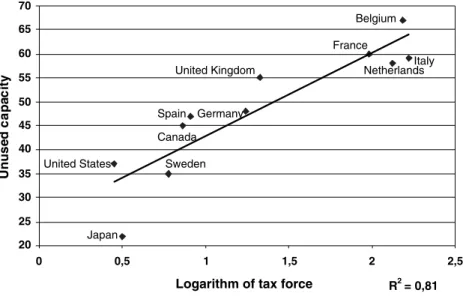
Figure 2. Unused Capacity Versus Tax Force. Source: Gruber and Wise (1999).
the proportion of older persons out of the labour force (Bl¨ondal and Scarpetta, 1998a, b; Gruber and Wise, 1999, 2005). In measuring incentives to retire, these authors include not only pension benefits, but also disability, unemployment and early retirement compensations as these are available to elderly workers and may induce them to retire before the first eligibility age for the standard pension system. Suppose that through these alternative programmes workers can leave the labour market as early as age 55. For each age t above 55, one computes the difference between the expected discounted value of social security benefits if retirement is at aget + 1 and the present value if retirement is at aget. This difference, called the accrual of benefit between age t and aget + 1, is often negative implying a reduction in total compensation from working an additional year.
The negative of the accrual to net wage earnings ratio is the so-called implicit tax on continued work. By summing the implicit tax over age 55–65, we obtain the so-called tax force to retire. Figure 2 shows the relationship between the tax force and unused labour force capacity – the proportion of men between age 55 and 65 that are out of the labour force. It is clear that there is a very strong correspondence between the two. This clearly shows that the social security systems in many countries provide strong incentives to leave the labour force at older ages. As shown by Gruber and Wise (2005) such a decline in labour force participation puts enormous pressure on the financial solvency of social security systems.
The normal course of action at this stage would be to raise the age of retirement or more formally to make the overall social security system more actuarially neutral. Reforms in that direction have been conducted in some countries such as Finland and
People in their late 50's should give up work to make way for younger and unemployed
0 50 100
GreecePortugal Spain Italy
LuxemburgFrance BelgiumGermany Sweden
Finland Austria Netherlands Ireland Denmark UK EU 15 agree
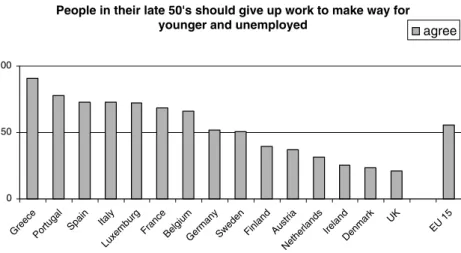
Figure 3. Perceived Inter-generational Redistribution. Source: EC (2003).
Sweden. In other countries, particularly in those which need reforms the most they have failed. In a recent EU-wide opinion survey carried out in 2001, it appears that raising the pensionable age is not a popular response to the challenge of demographic aging: fewer than a quarter of Europeans would support such a move. At the same time, the view that older workers should make room on the labour market for younger and unemployed people is still widely held in spite of evidence that there is no relation between the two. The idea that there is a given number of jobs that need to be shared, what is known as thelump-of-labour-fallacy, still appears to be shared in the public opinion of many countries, particularly those with a low effective age of retirement.4 This appears clearly in Figure 3.5
3. Linear Pension Scheme
3.1 Basic Model
We consider a small open economy within a two overlapping generations setting. Both interest raterand wage w are given. At each point in timettwo generations coexist: Lt young workers andLt−1 old workers and retirees with Lt = Lt−1(1+ nt). Individuals differ in two ways: the generation they belong to and their productivity wi with mean w and median wm. We make the conventional (and empirically supported) assumption that the median productivity is smaller than the mean (wm <w).6 Individual labour supply is given and normalized to 1 in the first period; it is endogenous in the second period and equal tozi 1. This variablezi can be viewed as the age of retirement.7
Lifetime utility is given by
u(c,d,z)=u(c)+βu[d−h(z)] (1)
where candd denote first and second period consumption,u(·) is strictly concave and h(·) strictly convex;β is a time discount factor. In the absence of any pension system, each individual solves the following problem:
max si,zi
u[wi−si]+βu[(1+r)si+wizi−h(zi)] (2)
where si ≥0 denotes saving. There is a liquidity constraint so that negative saving is not possible.
The optimality conditions are
wi =h(zi) (3)
and, denoting xi =di−h(zi) the second period consumption net of the monetary value of labour disutility,
−u(ci)+β(1+r)u(xi)=0 (si >0)
<0 (si =0)
(4) Liquidity constraints are a key feature. Particularly with flat rate benefits, they happen to be binding for households with low (first period) income. These households gain from the redistribution operated through the pension system and would want to transfer part of these benefits into the first period. However, the liquidity constraints prevent them from borrowing against their future pension.
Turning to the utilitarian first-best, we can express the problem of the social planner as follows: max ci,di,zi i ni u(ci)+βu[di−h(zi)]−μ ci + di 1+r −wi− wizi 1+r (5) whereni is the fraction of workers of typeiandμthe Lagrange multiplier associated with the revenue constraint. The first-order conditions are given by
u(ci)=u(xi)β(1+r)=μ (6)
and
wi =h(zi) (7)
In words, equation (6) shows that consumption levels are equalized across individu-als. Whenβ(1+r)=1 they are also equalized across periods (ci =xi). Equation (7) shows that retirement age is the same as in thelaissez-faire.
We now introduce the pension scheme. It has three key features: first the payroll tax is proportional to earnings with rate τ; second, it is based on the PAYGO principle; third, it has a contributory and a flat rate benefit component. (In the literature, the term Bismarckian or earning related is used as an alternative to contributory and Beveridgean to flat rate benefits.) Formally, the pension of a worker
with wagewi is
p(wi)=(1+n)τ[αwi+(1−α)w]+τ[αziwi+(1−α)w z] (8)
where w z=iniwizi is the average second period income, while α is the contributory share.8 Note that the tax rate τ applies to the earnings of both young
workers (first term in (8)) and old workers (second term). Substituting into the individual problem (2) yields the objective function
u[wi(1−τ)−si]+βu[wizi(1−τ(1−α))+(1+r)si
+τ((1+n)(αwi+(1−α) ¯w)+(1−α)w z)−h(zi)] (9) and the choice ofzi is given by
wi[1−τ(1−α)]=h(zi) (10)
To interpret these expressions let us compare them to their counterparts under an alternative pension system, indexed FF, that is both fully funded and non-redistributive. Under such a system we would have
pF F(wi)=(1+r+zi)τwi The individual’s objective is then given by
u[wi(1−τ)−si]+βu[wizi+(1+r)(τwi+si)−h(zi)]
and retirement age is determined by (7). With anFFand ‘contributory’ system (i.e. a PAYGO scheme with α=1), there is no distortion and the age of retirement is at its first-best level (for every individual). With the considered PAYGO system, on the other hand, it follows from (10) that as soon as we have some redistribution, which is the case whenα<1, a distortion towards early retirement is unavoidable. This applies not only to the linear case, but also to the non-linear tax as we show in Section 4. Observe that a way to avoid this distortion (even whenα<1) would be to differentiate taxes between periods with τ1 and τ2 and set τ2 = 0. We shall
also examine this possibility below.
3.2 Optimal Linear Scheme
We now consider the utilitarian optimum obtained by maximizing the sum of utilities (9) subject to the revenue constraint (8). The instruments areαandτ. This problem is solved by Cremeret al.(2007d) who show that the level ofαis crucially affected by the liquidity constraint. When this constraint is not binding (for any individual), one hasα=0;9 otherwise the optimal pension formula involves ‘targeting’, i.e. one
obtains α < 0.10 Roughly speaking, without liquidity constraint the Beveridgean
pension scheme is equivalent to a Sheshinsky type linear income tax (with the lump-sum payment occurring in the second period). With liquidity constraint, this solution may leave poor households with too few resources in the first period. This problem can be mitigated by lowering the tax and by making the second period payment (means tested) decreasing with income. In either case, a positive tax rate obtains under plausible assumptions and the value ofτ depends on two terms: the
covariance between the marginal utility of income u(xi) and pre-tax income wzi (equity term) and the elasticity ofzwith respect to net-of-tax wage rate (w(1−τ)) (efficiency term). Not surprisingly, the expression for the optimal tax rate thus has the same structure as in the traditional optimal linear income tax problem.11
Besides the distinction between Bismarckian and Beveridgean systems, there is another question: assuming flat rate benefits, should the tax rate be the same in the two periods? Or to put it otherwise, should there be a tax rebate in the second period in order to mitigate the tax distortion? As mentioned above, setting τ2 = 0
completely eliminates distortion of the retirement age, even whenα=0. To address this issue, we derive the utilitarian optimum as above except that the instruments are now τ1 and τ2 (while αis set at zero). The solution is derived in Casamatta
et al. (2005b) for the case where h(z) = z2/2 and the expression for τ
2 is given
by
τ2 = −
cov[u(x),w2] Eu(x)Ew2
The negative covariance in the numerator reflects the standard equity consideration and the negative labour elasticity the efficiency objective.12 The following main
results emerge. First, the tax on first period earnings is less than 100%, even though first period earnings are tax-inelastic. This is because of the liquidity constraint. Second, a 0% tax on second period earnings is not desirable because a utilitarian social planner wants to redistribute that income. Consequently, there is a positive tax on second period income withα=0 which induces a distortion towards early retirement; see equation (10). Whether the first period tax is higher than that of the second period will depend on the liquidity constraints, the tax elasticity ofzand the density ofw.
To sum up, with a uniform tax we necessarily obtainα<1 and when the tax rate is allowed to differ, we haveτ2 >0. Consequently, whatever the specific features
of the solution, it always involves a distorted retirement decision.
3.3 Voting on the Age of Retirement
In this section we survey recent work on the political economy of early retirement. The specific feature of these models is that retirement age is endogenous. This can be viewed as an extension of existing surveys devoted to the political economy of pensions in which retirement age is given. For example, de Walque (2005) presents an overview of the literature designed to explain the size and the type of pay-as-you-go pension systems. He is particularly interested by the effect of aging on the generosity of the systems. One of the results one finds in this line of work is that public pensions chosen by a majority of voters tend to be more generous than what would result from social welfare maximization.13
We now turn to the specific issue of voting on the age of retirement. There are two ways of looking at the positive choice of the age of retirement. First, one could think of voting on a mandatory age of retirementz or one could vote on the tax-transfer parameters of the pension system that induce an endogenous age of retirement. For
example, in the above example, the level ofzchosen by an individual is a function of the net wage in the second period,wi[1−τ(1−α)], which in turn depends on the parameters of the pension scheme.14
Voting on the age of retirement implies an assumption concerning whether the tax or the benefit is defined. Using the simple flat rate benefit system (i.e. with α=0), we have
τ(zw+w)=(1−z)p
The choice ofz will not be the same if we posit τ or pas given. The traditional distinction between defined contribution and defined benefits schemes appears crucial here. For more on this, see Lacomba and Lagos (1999) and Fenge and Pestieau (2005).
The second approach, namely the vote on the parameters of a linear retirement schedule, is adopted in Casamattaet al.(2005b), where individuals vote on the tax rateτ to be applied in the two periods and a rebate θ <1 that reduces the tax in the second period. Using the notation τ1 and τ2, we have τ1 = τ and τ2 = θτ.
Observe thatθ =τ2 =0 would yield the case where the retirement decision is not
distorted.
Using a sequential voting procedure (firstθ, thenτ) the authors show that for a given value ofθ, high tax rates are supported by the old and by low productivity young individuals. From the perspective of this survey, the most important result is that the introduction ofθ, namely the distortion on the retirement choice, increases the political support for the pension system. More precisely, when θ increases the number of voters who favour a positive tax (and are thus in favour of a retirement sys-tem) increases. Conversely, a decrease (or an elimination) of the bias undermines the political support of the pension system.15Note however that even withθ =τ
2 =0,
the political outcome will be a positive tax for plausible density of earnings. Finally, considering the simultaneous choice of θ and τ through an issue by issue voting procedure `a la Shepsle,16 it appears that the equilibrium, if any, always implies a
downward distortion on the age of retirement.
Casamattaet al.(2005a) also study the determination of a (linear) pension scheme through the political process. They consider a situation in which the choice of the retirement age is subject to a double burden: the tax burden that has been studied so far and another burden that arises from the system when working one more year does not increase the social security wealth. In other words, the increase (if any) of the yearly pension is not sufficient to compensate for the forgone benefits during the extra year of activity. A simple way to introduce this double burden is to assume that total (lifetime) pension is given by p − δz where δ > 0 is the penalty from postponing retirement. With a flat rate value of p, the worker then choosesz such that it maximizes
u[w(1−τ)z+p−δz−h(z)] The choice ofzis then determined by
The authors show that such a double burden would be rejected by both a utilitarian and a Rawlsian social planner. Furthermore, each individual would reject it as a ‘citizen candidate’.17 Nevertheless, it can be supported by a particular structure of
social (or political) weights biased towards the more productive workers. The idea underlying this result is that the implicit tax is the result of a compromise: whereas a low tax rate is chosen so as to favour the highly productive workers, the policy maker chooses a positive value of δ in order to compensate the low productive workers. According to this result, a double burden could emerge from the political process as long as this process implies that sufficient weight is put on the more productive workers while the less productive workers continue to receive a positive weight. Similarly, a reform towards a more neutral system may not be supported by the political process.
Up to now, no mention of incomplete working history for family or unemployment reasons was made. In that respect Conde Ruiz and Galasso (2003) try to provide a positive theory of early retirement.18They find that the majority which supports early
retirement is composed of elderly with incomplete working history and low-ability workers.
3.4 Political Resistance to Reforms
In the previous sections we have shown that both normative and positive approaches imply some distortion inducing early retirement. Another question is why reforms that appear to be desirable for a majority of people following a shock, e.g. a demographic one, cannot be implemented.19
Cremer and Pestieau (2003) argue that some reforms are rejected because individuals do not understand what is the alternative non-reform scenario. Consider a society facing a sudden increase in the dependency ratio. The choice offered to voters is between raising the age of retirement while keeping the same benefits or keeping the age or retirement unchanged but cutting benefits. A majority should back the increase in retirement age and yet it does not. The reason is that most people believe that the alternative to the reform is an unsustainable status quo (same benefits and same retirement age) and not a reduction in benefits.20
Another line of explanation comes from the uncertainty as to the future. Consider a society consisting of individuals distinguished according to their productivity (wH >wL) and their health (γH >γL). Their second period utility is
u wiz(1−τ)+p− h(z) γi
wherez is a mandatory age of retirement. Assume for simplicity that there are only three types of individuals: type 1 has a low productivity, wL, and poor health, γL; type 2 has the same productivity but good healthγH; type 3 has a higher productivity than the two other types wH and good health γH. Assume that people with high productivity (type 3) as well as people with low productivity but good health γH (type 2) gain from reform consisting in raisingz. Further assume that people with low productivity and bad health (type 1) lose.
Consider now a vote that takes place after people have discovered their type. In other words, voters know both their productivity and their health status.21 When
type 1 individuals represent less then half of the total population, the reform would be supported by a majority of individuals. Contrast this to a situation where the vote takes place before individuals know their health status. Then it is not impossible that all low wage individuals would oppose the reform, so that it would be defeated as long as type 3 individuals do not represent on their own a majority.22Consequently,
if types 2 and 3 together form a majority (while no single type represents more than half of the population), a reform that would beex postfavoured by a majority may not be adopted ex ante because voters are uncertain about the way they are individually affected by this reform.
4. Non-linear Schemes
Up to now we have discussed the issue of retirement and social security within a linear framework. Linearity is easier in a normative setting and yields more intuitive results. Furthermore it is necessary for a political economy treatment of the issue at hand. It is limited, however, as one knows that the government can do better using a non-linear scheme. And in practice both taxes and benefits typically involve at least some non-linearities. In this section, we study a non-linear scheme for public pensions and taxes. We first present the basic model and then turn to a number of applications.
4.1 Basic Model
This model comes from Cremeret al.(2004a). Consider an individual with lifetime normalized to one and retirement agez. His consumption over his lifetime is equal to earnings minus taxes plus pension benefits. Formally, using a continuous time framework and zero interest rate, one writes
1 0 c(t)dt = z 0 w(1−τ)dt+ 1 z p(z)dt
where wτ is the amount of payroll taxes and p(z) the level of benefits depending on the age of retirement. Implicit to this budget constraint, there is a flow of saving (negative or positive). Assuming a zero time discount rate, lifetime utility is given by U = 1 0 u(c(t))dt− z 0 ρ(t)dt
whereu(·) is the utility for consumption andρ(t) reflects the instantaneous disutility of labour, that includes both tastes and health aspects.
With these assumptions one can obtain a reduced form for both the budget constraint and the utility function:
and
U =u(c)−R(z)
where R(z)=0zρ(t)dt and T(z) is a non-linear tax-transfer scheme consisting of two terms: T(z)= z 0 wτdt− 1 z p(z)dt =zτw−(1−z)p(z) (11)
The first term represents total (lifetime) payroll taxes and the second is overall pension benefits. Note that differentiating T(z), we obtain the implicit tax on prolonged activity consisting of three terms: payroll tax, forgone pension benefit and the change in social security wealth:
T(z)=τw +p(z)−(1−z)p(z)
We now introduce two types of heterogeneity with two values for each:wHandwL (wH >wL) andR1 and R2(R1 > R2). We thus have four types of individuals:H2
(high productivity, good health or low disutility for labour), H1 (high productivity, bad health),L2 (low productivity, good health) andL1 (low productivity, bad health). Let ni j denote the proportion of typesij. In a first stage we assume that both wj and Ri are common knowledge and we look at the first-best problem given by the following Lagrangian: L= i j ni j[u(ci j)−Ri(zi j)]−γ i j ni j[ci j−wjzi j] One readily obtains the following optimality conditions:
u(ci j) =γ
Ri(zi j)=γwj
In other words, in the utilitarian first-best all consumption levels are equal; the age of retirement is higher for the more productive and the healthier individuals.
If both health and productivity were observable such a solution could be decentralized by determining the appropriate lump-sum taxesTi j that could induce everyone to consume the same amount. The optimal condition for the choice of zi j is indeed the same as the one of laissez-faire.
We now present a number of applications of this model to the issue of retirement in the case of informational asymmetry. The first one concerns the design of an optimal tax-transfer scheme when health is not observable. The second focuses also on the health variable and considers the case where a high R(z) can be due to bad health or to a strong preference for leisure. Both situations are indistinguishable except through costly audit. The third application focuses also on the health issue and includes the possibility of private and public investment in medical care with the aim of lowering R(z). We then discuss the issue of disability insurance in a dynamic framework. A final subsection is devoted to earnings tests and to the so-called ‘Canada Dry pensions’.
4.2 Health Heterogeneity and Implicit Taxation
To simplify further the above model, we assume that only health distinguishes individuals. In other words, they all have the same productivity and only differ in health. The second-best problem can then be expressed by the following Lagrangian:
L=
i
ni[u(ci)−Ri(zi)−γ(hci−w zi)] +λ[u(c2)−R2(z2)−u(c1)+R2(z1)]
where γ is the multiplier associated with the revenue constraint and λ with the self-selection constraint making sure that the individual with the better health does not mimic the individual with the worse health.
Cremeret al.(2004a) obtain the following results:
c1 <c2 T(z1)>0 T(z2)=0
Compared to the first-best, type 2 individuals’ choice of retirement is not distorted. However, for type 1 asymmetric information results in a lower consumption and also an earlier age of retirement. Put differently, the marginal tax on the retirement age is positive. Intuitively this property can be explained by the fact that type 1 individuals have steeper indifference curves at any given point in the (z, c) space than type 2 individuals. This is because type 1 individuals must be compensated more to accept to work longer than the mimicking individual (they are less healthy and have a higher weekly labour supply). This implies that, starting from the first best tradeoff, a variation dz1 < 0 along with a variation dc1 = (MRS1cz)dz1 has
no (first-order) effect on the utility of type 1, but it decreases the utility of type 2 mimicking type 1. Consequently, the downward distortion inz1 is a way to relax an
otherwise binding self-selection constraint.
In conclusion, we have here an implicit tax on prolonged activity at least for some individuals that results from constrained social welfare maximization.
4.3 Audit on Health
A natural way to resorb at least part of the lack of information is to introduce audits. If we consider bad health as a sort of disability, to avoid that healthy workers claim undeserved benefits disability tests can be conducted.
4.3.1 Perfect Audit
Cremer et al. (2004b) introduce a particular type of audit, namely a costly but error-proof audit. Formally any individual claiming to have type 1 is audited with probability π. This audit is perfect and has a marginal cost k such that with truthtelling the number of audits isn1π and total costn1kπ. If type 2 individuals
Note that without audit the optimal policy of the previous section implies truthtelling. Audits affect both the resource constraint and the self-selection constraint as follows:
i
ni(w zi−hci−n1kπ)=0
u(c2)−R2(z2)−(1−π)[u(c1)−R2(z1)]−πu=0
Increasing the audit probability is costly but it allows for relaxing the incentive constraint by lowering the level of utility achievable by the mimicker. In the optimal solution, a compromise is found between these two considerations.
Ifk=0, the central planner uses an audit probability that makes the self-selection constraint non-binding. The first-best solution is achieved without any distortion. As
kincreases, audit has to be restricted to a decreasing number of type 1 individuals. The distortion on the choice of the retirement age is increased. Naturally, when the audit cost is too high we go back to the problem of the previous section.
4.3.2 Indistinguishable Individual
Assume now that there are three types of individuals indexed D,LandH. The first two types of individuals both have a high labour disutility R1 (>R2). Individuals of
typeDare truly disabled while those of typeL are just leisure prone. Individuals of typeHhave a low labour disutilityR2. In alaissez-fairesetting typesDandLwould
retire at the same age (zD =zL <zH) and consume a rather low level (cD=cL <
cH). Suppose that the social planner wants to favour the truly disabled at the expense of the leisure-prone workers. Given that these two types are indistinguishable, the self-selection constraint implies that they must have the same utility level. The only way to differentiate them is through audits.
Cremer et al. (2007c) show that when the social planner treats the disutility for work of the leisure-prone workers as equal to that of the healthy workers, the solution with audits discriminates between the disabled and the leisure prone allowing the former to retire earlier but above all to consume more than the latter. From a practical perspective, we can think about the payment made to individuals who are subject to audits as disability benefits.
Formally the social objective function is
i=H,L,D
niu(ci)−nHR2(zH)−nLR2(zL)−nDR1(zD)
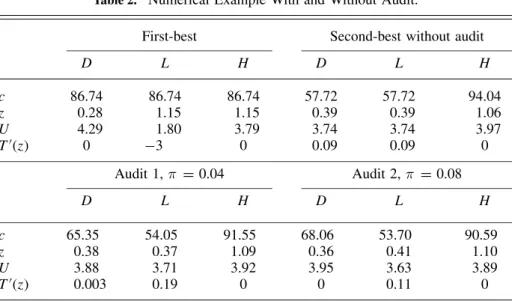
We present a numerical example illustrating the problem at hand. We consider two audits: audit 1 is costlier than audit 2. Table 2 gives the results for four settings: first-best, second-best without audit, second-best with cheap and expensive audit. The optimum audit probability is determined endogenously and cheap audit means that the probability of audit is relatively higher than with expensive audit. In the first-best, the three types receive the same consumption and both individuals H and Lwork more than individualD. There is a subsidy to induce the leisure-prone individuals to retire at the same age as the healthy ones. In the second-best without audit D
Table 2. Numerical Example With and Without Audit.
First-best Second-best without audit
D L H D L H c 86.74 86.74 86.74 57.72 57.72 94.04 z 0.28 1.15 1.15 0.39 0.39 1.06 U 4.29 1.80 3.79 3.74 3.74 3.97 T(z) 0 −3 0 0.09 0.09 0 Audit 1,π =0.04 Audit 2,π =0.08 D L H D L H c 65.35 54.05 91.55 68.06 53.70 90.59 z 0.38 0.37 1.09 0.36 0.41 1.10 U 3.88 3.71 3.92 3.95 3.63 3.89 T(z) 0.003 0.19 0 0 0.11 0
andLcannot be distinguished; they both face a tax on postponed retirement. Audit improves the welfare of the disabled at the expense of the two other types. With audit 1 D’s utility increases and that ofLdecreases. The retirement age hardly changes, but the consumption levels are very different. With audit 2, the difference betweenL
andDis sharper: lower retirement age, higher consumption level and higher utility. With audit 1 both Land D face a tax on postponed activity; individuals H must be prevented from mimicking either LorD. When audit gets less costly,H is not willing to mimicD. A tax onzDis thus superfluous.
It is a bit surprising that even though the difference between typesDandLis the nature of their disutility to effort, truly disabled end up working later than the leisure-prone workers, at least with expensive audits. The reason is that compensating type
D with additional consumption happens to be a more efficient device in terms of incentive compatibility constraints than granting him an earlier age of retirement. 4.3.3 Imperfect Audit
In most cases audits are far from being perfect; they do not always reveal who is truly disabled and who is not. Diamond and Sheshinsky (1995) have allowed for errors in auditing.23 Their paper analyses optimal disability and retirement (or
welfare) benefits with imperfect (but free) disability evaluation. Errors can be of both types with some able workers judged disabled and some disabled workers judged able with a certain probability. The retirement decision is binary: individuals either work a given amount of time or do not work at all. Individuals only differ with respect to their disutility of work. When this parameter is above a certain threshold value, they do not work. The optimal policy implies that society is divided into three groups: (i) healthy workers; (ii) healthy and disabled individuals who
stop working and are tagged as disabled; (iii) disabled who were tagged as healthy individuals and who receive minimal benefits (welfare payments) that are lower than disability benefits. The individuals tagged as disabled are paid more generously than the untagged disabled because the benefits they get do not affect the work incentives of the healthy workers. In other words, asymmetric information implies some type of discrimination among disabled workers.
4.4 Health Care and Retirement
We have just seen that the distortion that arises from asymmetric information on health can be eliminated or at least reduced thanks to audits. We now turn to another device for reducing distortions, namely health expenditures that would mitigate health differentials.
Cremer et al. (2007b) study the design of a social security scheme which can be supplemented by health care. They consider a setting where agents differ both in their productivity and in their health status. The health status determines the disutility of intensive (work week) and extensive (career length) work. Additionally, it is also affected by health expenditures. Thus, an increase in health expenditures can lower the disutility of work. Social preferences are assumed to be utilitarian and neither the health status nor the productivity of individuals are publicly observable. They consider the case for public provision of health services as an additional
instrument which is used along with an optimal tax policy. They show that, under plausible conditions, government intervention in the health care sector should combine subsidization of (privately provided) health care with public provision of health services.24
4.5 Disability Insurance in a Dynamic Framework
The models reviewed so far assume that consumers allocate consumption and labour supply over their life cycle. Nevertheless the models are essentially of static nature in the sense that no new information is revealed over the life cycle. In reality, however, people learn about their health status over time and this feature can be expected to affect the design of retirement and disability insurance.
Such dynamic properties of the optimal disability insurance scheme have been first analysed by Diamond and Mirrlees (1978, 1986). They consider ex anteidentical individuals who face at each period of their life a probability of becoming disabled. When disabled, individuals definitely stop working while non-disabled individuals retire at a planned retirement age. The government aims at providing a disability insurance scheme without observing the health status of the agents. These authors show that because of asymmetric information, disability benefits should increase with the age of entry in the disability system. The tax system decentralizing this optimum has two basic properties. First, there is a positive tax on continued activity that decreases with age until it reaches zero at the planned retirement age. Second, there should be a marginal tax on savings. This arises because individuals can use savings as a reinsurance device. As typical in the insurance literature, this reinforces
the moral hazard problem. Consequently, the government taxes savings in order to relax moral hazard problems. The nature of this tax depends on what the government observes. If savings are observable as anonymous transactions, then the government can only use a positive linear tax on savings (see Diamond and Mirrlees, 1995). If savings are observable at the individual’s level, the government can use a non-linear tax on savings. As suggested by Golosov and Tsyvinski (2004), this non-non-linear tax should be of the form of a wealth-tested transfer programme. In other words, disabled individuals receive disability benefits only if their assets are sufficiently low.
4.6 The Desirability of Earnings Test and ‘Canada Dry’ Pensions
In a number of countries, individuals cannot at the same time draw public pension benefits and earn some income beyond a rather low ceiling (€6000 in Belgium). This restriction on earnings after retirement was widespread a few decades ago; it is now progressively abandoned.
Its mainraison d’ˆetrewas the so-calledlump-of-labour fallacy, which is not taken seriously anymore. There might be another reason pertaining to redistribution in a second-best framework.
Cremeret al.(2007a) using the above approach that is in the line of the optimal income tax literature look at what they call a two-career model. At the end of the first career individuals are ‘formally’ retired and can draw pension benefits. The question is whether the income earned in the second career has to be more heavily taxed than the income earned in the first career. They show that under some conditions earnings after formal retirement have to be more heavily taxed than earnings before formal retirement. This would vindicate the existence of an earnings test in some particular cases.
The Canada Dry pension system is used in some countries as one of the routes to early retirement. Firms lay off aged workers they find costly for what they produce. To obtain their support in the absence of a formal early retirement programme, they add more or less openly some compensations supplementing the unemployment benefits they will get till formal retirement. As the Canada Dry ginger ale ‘looks like beer, has the color of beer, but is not beer’,25such a package (unemployment
compensation plus a direct payment) looks like, but is not, a pension. In Cremer
et al. (2006), we show that there are cases where Canada Dry pensions may be
desirable. In other words, even if the government could prevent them, it would not be optimal to do so.
5. Conclusion
In a number of countries the effective age of retirement is well below the statutory age and below what is the optimal age of retirement (at a utilitarian optimum) as well as the age that individuals would choose to retire in alaissez-faireeconomy. It seems that the main explanation for such a phenomenon lies in the way social security is organized. Pensions but also disability and unemployment insurance along with the tax system induce elderly workers to exit the labour force before they reach the age of 65 that is the statutory age in many countries.
Why do we observe those disincentives to prolong activity? Is it due to bad design or can it be justified on normative grounds? In this paper, we show that at least some distortions can be justified when public authorities use social insurance for redistribution when only distortionary tax tools are available. We consider a model with two sources of heterogeneity, health and productivity, and we show that distortions towards early retirement arise in a second-best setting. These distortions can be reduced when some uncertainty can be resorbed through audits or when some differences in health can be reduced through public health care.
We also deal with the issue of retirement from a political economy viewpoint. It appears that early retirement can result from majority voting when the pension system is partially redistributive. We also show why some reforms which are clearly welfare improving can be opposed by a majority of workers.
Acknowledgements
We are grateful to all the participants for their comments. We particularly thank the two referees and the editor for their helpful and constructive suggestions.
Notes
1. For other surveys, see Fenge and Pestieau (2005) and Cremeret al.(2005). 2. See EC (2003) for the evidence provided in this section.
3. See EC (2003). Retirement age figures are for 2000–2001 and employment rates for 2001.
4. Popularized by Paul Krugman (NY Times, 10.07.03), the ‘lump-of-labour fallacy’ is the idea that there is a fixed amount of work to be done in the world, so any increase in the amount each worker can produce reduces the number of available jobs. 5. See on this Boeriet al.(2001).
6. This assumption is used in the voting models discussed in Section 3.3.
7. Assume that each generation lasts 30 years. Lifetime consists of 30 years of childhood and training that are not accounted for, 30 years of full activity and a last period of 30 years the first part of which is devoted to work and lasts 30zyears. The age of retirement is thus 60+30z.
8. Also called the Bismarckian parameter. Whenα= 1, one has a pure contributory system which is similar to a ‘notional defined contributions’ system. Whenα=0, one has a Beveridgean flat rate benefit system.
9. To be more precise α= 0 is a solution, but it is not unique. What matters is the value ofτ(1−α) . Any combination ofτ andαthat satisfyτ(1−α)=τ∗, where τ∗ is the optimum tax rate withα=1, yields exactly the same outcome. The main point from our perspective is that this necessarily impliesα<1.
10. Whenα<0, pension benefits decrease as income increases in the same way as in an income-tested programme.
11. See Sheshinsky (1972).
12. With h(z)=z2/2, the optimal level ofzis given by z= (1−τ)w. Consequently pre-tax incomewzis proportional tow2.
13. See also Galasso and Profeta (2002).
14. This assumes away an income effect, which is implied by quasi-linear utility functions.
15. Concentrating on the case wherer = n, the intuition behind this result is roughly speaking as follows. When θ = 0, there is no second period tax and individuals choose a positive tax rateif and only if w ≤w, i.e. if their productivity (and hence their first period income) is lower than average. Individuals favouring a positive tax rate are those for whom the rate of return of the PAYG system, (1+n)w/w, is higher than the rate of return of private savings, 1 + r. If one introduces a bias in the system (θ > 0) second period incomes are redistributed from individuals with a productivity level higher thanE(w2)>wtowards individuals with a lower productivity. Therefore, individuals such thatw≤w continue to favour a positive tax rate but some individuals with a higher productivity also do.
16. See Shepsle (1979).
17. In other words, the double burden would not arise when the social welfare function puts all the weight on a single individual.
18. See also Conde Ruiz and Galasso (2004).
19. On the political sustainability of reforms see also Butler (2000) and Galasso and Profeta (2004).
20. This argument that people do not understand the consequences of not reforming their pension system is surprising. Yet it is confirmed by a number of studies. See for example Boeriet al.(2001).
21. The relevant health status being that around their prospective retirement age. 22. This idea comes from Fernandez and Rodrik (1991).
23. See also Parssons (1996).
24. When health expenditures are observable at the individual’s level, public provision or subsidization are equivalent instruments. However, when these expenditures are only observable at the aggregate level (health expenditures are anonymous transactions), the subsidy on health expenditures can only be linear and uniform public provision can be shown to be desirable as an additional tool (see also Cremer and Gahvari, 1997).
25. Old commercial for Canada Dry on the European continent.
References
Bl¨ondal, S. and Scarpetta, S. (1998a)Falling Participation Rates among Older Workers in the OECD Countries.Paris: OECD.
Bl¨ondal, S. and Scarpetta, S. (1998b) The retirement decision in OECD countries. OECD Economic Department WP 202.
Boeri, T., Borsch-Supan, A. and Tabellini, G. (2001) Would you like to shrink the welfare state? The opinions of European citizens.Economic Policy32: 7–50.
Butler, M. (2000) The political feasibility of pension reform options: the case of Switzerland.Journal of Public Economics75: 389–416.
Casamatta, G., Cremer, H. and Pestieau, P. (2005a) Is there a political support for the double burden on prolonged activity?Journal of Governance, forthcoming.
Casamatta, G., Cremer, H. and Pestieau, P. (2005b) Voting on pension with endogenous retirement age.International Tax and Public Finance12: 7–28.
Conde-Ruiz, J.I. and Galasso, V. (2003) Early retirement.Review of Economic Dynamics 6: 12–36.
Conde-Ruiz, J.I. and Galasso, V. (2004) The macroeconomics of early retirement.Journal of Public Economics88: 1849–1869.
Cremer, H. and Gahvari, F. (1997) In-kind transfers, self-selection and optimal tax policy. European Economic Review41: 97–114.
Cremer, H. and Pestieau, P. (2003) The double dividend of postponing retirement. International Tax and Public Finance10: 419–434.
Cremer, H., Lozachmeur, J.-M. and Pestieau, P. (2004a) Social security, variable retirement age and optimal income taxation.Journal of Public Economics88: 2259–2281. Cremer, H., Lozachmeur, J.-M. and Pestieau, P. (2004b) Optimal retirement and disability
benefits with audit.FinanzArchiv60: 278–295.
Cremer, H., Lozachmeur, J.-M. and Pestieau, P. (2005) D´epart `a la retraite et taxation optimale.Revue d’Economie Politique115: 163–172.
Cremer, H., Lozachmeur, J.-M. and Pestieau, P. (2006) Desirable misuse of unemployment benefits: the economics of Canada Dry pensions. CORE DP 2006/70.
Cremer, H., Lozachmeur, J.-M. and Pestieau, P. (2007a) Social desirability of earnings tests.European Economic Review, forthcoming.
Cremer, H., Lozachmeur, J.-M. and Pestieau, P. (2007b) Retirement age and health expenditures.Annales d’Economie et de Statistique83–84: 167–186.
Cremer, H., Lozachmeur, J.-M. and Pestieau, P. (2007c) Disability testing and retirement. BE Journal of Economic Analysis and Policy (Contributions)7.
Cremer, H., De Donder P., Maldonado D. and Pestieau, P. (2007d) Designing a linear pension scheme with forced savings and wage heterogeneity. International Tax and Public Finance, forthcoming.
Diamond, P. and Mirrlees, J. (1978) A model of social insurance with variable retirement. Journal of Public Economics10: 295–336.
Diamond, P. and Mirrlees, J. (1986) Payroll tax financed social insurance with variable retirement.Scandinavian Journal of Economics88: 25–50.
Diamond, P. and Mirrlees, J. (1995) Social insurance with variable retirement and private savings. Mimeo.
Diamond, P. and Sheshinski, E. (1995) Economic aspects of optimal disability benefits. Journal of Public Economics57: 1–23.
EC (2003) Adequate and sustainable pension. Joint Report by the Commission and the Council, Employment and Social Affairs, Brussels.
Fenge, R. and Pestieau, P. (2005) Social Security and Retirement. Cambridge, MA: MIT Press.
Fernandez, R. and Rodrik, D. (1991) Resistance to reform: status quo bias in the presence of individual-specific uncertainty.American Economic Review81: 1146–1155. Galasso, V. and Profeta, P. (2002) The political economy of social security. A survey.
European Journal of Political Economy18: 1–29.
Galasso, V. and Profeta, P. (2004) Lessons for an ageing society: the political sustainability of social security systems.Economic Policy38: 63–115.
Golosov, M. and Tsyvinski, A. (2004) Designing optimal disability insurance: a case for asset testing. NBER Working Paper No. 10792.
Gruber, J. and Wise, D. (1999)Social Security and Retirement around the World. Chicago, IL: University of Chicago Press.
Gruber, J. and Wise, D. (2005) Social security programs and retirement around the world: fiscal implications. Introduction and summary. NBER Working Paper 11290. Parssons, D.O. (1996) Imperfect tagging in social insurance programs. Journal of Public
Economics62: 183–207.
Pestieau, P. (2001) Are we retiring too early?Ifo Studien47: 263–281.
Shepsle, L.K. (1979) Institutional arrangements and equilibrium in multidimensional voting models.American Journal of Political Science23: 27–59.
Sheshinski, E. (1973) The optimal linear income tax. Review of Economic Studies 39: 297–302.
de Walque, G. (2005) Voting on pensions. A survey. Journal of Economic Surveys 19: 181–209.