The Leader Election Protocol of IEEE 1394 in Maude
Alberto Verdejo, Isabel Pita, and Narciso Mart´ı-OlietTechnical Report 118.01
Dpto. de Sistemas Inform´aticos y Programaci´on Universidad Complutense de Madrid. Spain
leader election protocol from the IEEE 1394 serial multimedia bus. The descriptions are given using the language Maude based on rewriting logic. Particularly, the time aspects of the protocol are studied. The descriptions are first validated by an ex-haustive exploration of all the possible behaviors and states reachable from an initial configuration of a network, checking that always only one leader is chosen. The cor-rectness of the protocol is showed by a formal proof that the desirable properties of the protocol are always fulfilled.
Contents
1 Introduction 1
2 Informal overview of the protocol 1
3 Object-oriented specification in Maude 3
4 First description of the protocol (with synchronous communication) 4
5 Timed, asynchronous communication description 5
5.1 Time in rewriting logic and Maude . . . 6
5.2 Second description of the protocol . . . 7
5.3 Third description of the protocol . . . 10
5.4 An example . . . 12 6 Model-checking analysis 13 6.1 Maude’s metalevel . . . 13 6.2 Search strategy . . . 14 6.3 Example . . . 15 7 Formal proof 17 7.1 Verification of synchronous description . . . 17
7.2 Verification of second description . . . 18
7.2.1 Network properties . . . 18
7.2.2 Safety properties . . . 19
7.2.3 Liveness properties . . . 20
7.2.4 Total correctness . . . 24
7.3 Verification of third description . . . 24
7.3.1 If there is a cycle in the network, an error message is generated. . . 24
7.3.2 Total correctness . . . 25
8 Conclusion 26 A Complete Maude specification 28 A.1 Synchronous communication description . . . 28
A.2 Timed, asynchronous communication description . . . 28
A.3 Search strategy . . . 34
1
1
Introduction
Rewriting logic [Mes92, Mes98] and Maude [CDE+
99, CDE+
00b] have emerged as an ex-cellent framework where communication protocols can be specified and analyzed [DMT98, DMT00].
Rewriting logic was first proposed by Meseguer as a unified framework for concurrency in 1990. Since then much work has been done on the use of rewriting logic as a logi-cal and semantic framework [MOM93], and on the development of the Maude language [CDE+
99]. In the last few years the application of rewriting logic and Maude to the spec-ification of real systems has started, mainly for applications of distributed architectures and communication protocols [DMT98]. In [DMT00] a formal methodology for specify-ing and analyzspecify-ing communication protocols is presented. It is arranged as a sequence of increasingly stronger methods, including:
1. Formal specification, in order to obtain a formal model of the system, in which ambiguities are clarified.
2. Execution of the specification, for simulation and debugging purposes, leading to better versions of the specification.
3. Formal model-checking analysis, in order to find errors by considering all possible behaviors of highly distributed and nondeterministic systems.
4. Narrowing analysis, in which all behaviors from the possibly infinite set of states described by a symbolic expression are analyzed.
5. Formal proof, where the correctness of critical properties is verified by using a formal technique.
In this paper we use methods 1–3 to specify and analyze three descriptions of the leader election protocol of IEEE 1394 serial multimedia bus (the “FireWire”), and we use method 5 to verify them.
Although formal methods were not used in the development of the IEEE 1394 standard, various aspects of the system have been described elsewhere using a variety of different techniques, including I/O automata [DGRV97], µCRL [SvdZ98], and E-LOTOS [SV99]. Thus this example is becoming something of a benchmark for formal methods [MS00, SMR01]. We show how Maude, a high-level language and high-performance system sup-porting both equational and rewriting logic computation, can also be used as a formal specification language. We use the object-oriented specification style of Maude [CDE+99], which allows formalization of both synchronous and asynchronous concurrent object sys-tems.
2
Informal overview of the protocol
The serial multimedia bus IEEE 1394 [IEE95] connects together systems and devices in order to carry all forms of digitized video and audio quickly, reliably, and inexpensively. Its architecture is scalable, and it is “hot-pluggable,” so a designer or user can add or subtract systems and peripherals easily at any time. The IEEE 1394 as a whole is complex,
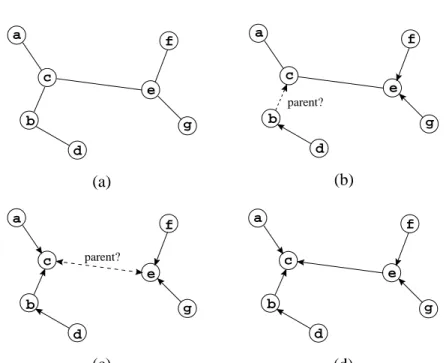
b e g f c d a b e g f c d a b e g f c d a b e g f c d a (d) (a) (c) parent? (b) parent?
Figure 1: Network configurations during the leader election protocol
comprising of several different subprotocols, each concerned with different tasks (e.g., data transfer between nodes in the network, bus arbitration, leader election). The standard is described in layers, in the style of OSI (Open Systems Interconnection), and each layer is split into different phases [IEE95]. In this paper only the tree identify phase (leader election) of the physical layer is described.
Informally, the tree identify phase of IEEE 1394 is a leader election protocol taking place after a bus reset in the network (i.e., when a node is added to, or removed from, the network). Immediately after a bus reset all nodes in the network have equal status, and know only to which other nodes they are connected. A leader (root) must be elected to serve as the bus manager for the other phases of the IEEE 1394. Figure 1(a) shows the initial state of a possible network. Connections between nodes are indicated by solid lines. The protocol is only successful if the original network is connected and acyclic.
Each node carries out a series of negotiations with its neighbors in order to establish the direction of the parent-child relationship between them. More specifically, if a node has nconnections then it receives “be my parent” requests from all, or all but one, of its connections.
Assumingnorn−1 requests have been made, the node then moves into an acknowl-edgement phase, where it sends acknowlacknowl-edgements “you are my child” to all the nodes which sent “be my parent” in the previous phase. When all acknowledgements have been sent, either the node hasnchildren and therefore is the root node, or the node sends a “be my parent” request on the so far unused connection and awaits an acknowledgement from the parent. Leaf nodes skip the initial receive requests phase and move straight to this point; they have only one connection and, therefore it must be their parent. Figure 1(b) shows the instant when nodes d, f and g have their parents already decided (solid con-nections with arrows pointing to the parent), and nodebis asking nodecto be its parent
3
(the queried relationship is shown by a dotted line).
Communication between nodes is asynchronous; therefore it is possible that two nodes might simultaneously request each other to be its parent, leading to root contention (each wants the other to be the root, see Figure 1(c)). To resolve root contention, each node selects a random Boolean. The value of the Boolean specifies a long or short wait before resending the “be my parent” request. This may lead to contention again, but fairness guarantees that eventually one node will become the root.
When all negotiations are concluded, the node which has established that it is the parent ofall its connected nodes must be the root node of a spanning tree of the network. See Figure 1(d) in which node cis the root node.
3
Object-oriented specification in Maude
Before giving the protocol description, we present how object-oriented specifications are written in Maude. This description has been extracted from [CDE+00b].
Anobjectin a given state is represented as a term< O : C | a1 : v1,..., an : vn >
whereOis the object’s name, belonging to a setOidof object identifiers,Cis itsclass, the
ai’s are the names of the object’sattributes, and the vi’s are their corresponding values. Messages are defined by the user for each application.
In a concurrent object-oriented system the concurrent state, which is called a config-uration, has the structure of a multiset made up of objects and messages that evolves by concurrent rewriting (modulo the multiset structural axioms of associativity, commutativ-ity, and identity) using rules that describe the effects of communication events between some objects and messages. The rewrite rules in the module specify in a declarative way the behavior associated with the messages. The general form of such rules is
M1. . . MnhO1 :F1 |atts1i. . .hOm :Fm |attsmi −→ hOi1 :F ′ i1 |atts ′ i1i. . .hOik :F ′ ik |atts ′ iki hQ1 :D1 |atts′′ 1i. . .hQp :Dp|atts ′′ pi M′ 1. . . M ′ q if C
where k, p, q≥0, the Ms are message expressions, i1, . . . , ik are different numbers among the original 1, . . . , m, and C is a rule condition. The result of applying a rewrite rule is that the messages M1, . . . , Mn disappear; the state and possibly the class of the objects Oi1, . . . , Oik may change; all the other objects Oj vanish; new objects Q1, . . . , Qp are
created; and new messages M′
1, . . . , M
′
q are sent.
Since the above rule involves several objects and messages in its lefthand side, we say that it is a synchronous rule. It is conceptually important to distinguish the special case of rules involving at most one object and one message in their lefthand side. These rules are called asynchronous and have the form
(M) hO:F |attsi −→(hO :F′ |atts′ i) hQ1 :D1 |atts′′ 1i. . .hQp :Dp|atts′′pi M′ 1. . . M ′ q if C
By convention, the only object attributes made explicit in a rule are those relevant for that rule. In particular, the attributes mentioned only in the lefthand side of the rule are preserved unchanged, the original values of attributes mentioned only in the righthand side of the rule do not matter, and all attributes not explicitly mentioned are left unchanged.
4
First description of the protocol (with synchronous
com-munication)
We begin with a simple description of the protocol, without time considerations, where communication between nodes is assumed to be synchronous, i.e., a message is sent and received simultaneously; therefore, there is no need for acknowledgements, and contention cannot arise.
In the IEEE 1394 we have nodes and communications between nodes that relate nat-urally to objects and messages. In this first description, nodes are represented by objects of class Nodewith the following attributes:
• neig : SetIden, the set of identifiers of the neighbor nodes with whom this node has not yet communicated. This is initialized to the set of all nodes (object identifiers) connected to this node and decreases with every “be my parent” request until it is either empty (and this node is the root) or it has one element (which is the parent of this node); and
• done : Bool, a flag which is set when the tree identify phase of the protocol has finished for this node, because it has been elected as the root node or because it already knows which node is its parent.
Since communication is synchronous in this description, we do not need messages to represent the “be my parent” requests or the acknowledgements. However, we add a “leader” message which is sent by the elected leader to indicate that a leader has been chosen. This provides us with a means of checking the requirement that a single leader is eventually elected (see Section 6).
The following module introduces identifiers and sets of identifiers. (fmod IDENTIFIERS is protecting QID .
sorts Iden SetIden .
subsorts Qid < Iden < SetIden . op empty : -> SetIden .
op __ : SetIden SetIden -> SetIden [assoc comm id: empty] . endfm)
5
The object-oriented module describing the protocol starts declaring the node identifiers as valid object identifiers, the class Nodewith its attributes, and the message leader: (omod FIREWIRE-SYNC is protecting IDENTIFIERS .
subsort Iden < Oid .
class Node | neig : SetIden, done : Bool . msg leader_ : Iden -> Msg .
Now we have to describe the node’s behavior by means of rewrite rules. The first rule describes how a nodeJ, which has only one identifierIin its attribute neig, sends a “be my parent” request to the node I, and how node I receives the request and removes J
from its set of communications still to make; node J also finishes the identify phase by setting the attributedone.
vars I J : Iden . var NEs : SetIden . rl [rec] :
< I : Node | neig : J NEs, done : false > < J : Node | neig : I, done : false >
=> < I : Node | neig : NEs > < J : Node | done : true > .
Note that nondeterminism arises when there are two connected nodes with only one identifier in their attributeneig. Any one of them can act as the sender.
The other rule states when a node is elected as the leader. rl [leader] :
< I : Node | neig : empty, done : false > => < I : Node | done : true > (leader I) . endom)
5
Timed, asynchronous communication description
The previous description is very simple, but is not an accurate depiction of events in the real protocol, where messages are sent along wires of variable length, and therefore message passing is asynchronous and subject to delay. Since the communication is asynchronous, acknowledgement messages are needed, and a particular problem arises when two nodes might simultaneously request each other to be its parent, leading to root contention. Using only the asynchronous explicit communication via messages of Maude leads us to a description of the protocol which does not work as expected, in the sense that there is the possibility that the root contention phase and the receive “be my parent” requests phase alternate forever. Hence the timing aspects of the protocol cannot be ignored, and in the root contention phase nodes have to wait a short or long (randomly chosen) time period before resending the “be my parent” requests.
Before showing this new, timed description, we briefly summarize the ideas in [ ¨Olv00, ¨
OM02] about how to introduce time in rewriting logic and Maude, and particularly in an object-oriented specification.
5.1 Time in rewriting logic and Maude
A real-time rewrite theory is a rewrite theory with a sort Timethat represents the time values, and which fulfills several properties, like being a commutative monoid (Time,+,0) with additional operations ≤, <, and −. (“monus”). We use the module TIMEDOMAIN
to represent the time values, with a sort Time whose values are the natural numbers, and which is a subsort of the sort TimeInf, which in addition contains the constant INF
representing ∞ (see [ ¨Olv00]).
Rules are divided into tick rules, that model the elapse of time on a system, and instantaneous rules, that model changes in (part of) the system and are assumed to take zero time. To ensure that time advances uniformly in all the parts of a state, we need a new sort ClockedSystem, with a free constructor {_|_} : State Time -> ClockedSystem. In the term{ s | t },s denotes theglobal state andt denotes the total time elapsed in a computation if in the initial state the clock had value 0. Uniform time elapse is then ensured if every tick rule is of the form{ s | t } −→ { s′ | t+τ }, whereτ denotes the
duration of the rule. These rules are calledglobal rules because they rewrite terms of sort
ClockedSystem. Other rules are calledlocal rules, because they do not act on the system as a whole, but only on some system components. Having local rules allows parallelism because they can be applied to different parts of the system at the same time. Local rules are always viewed as instantaneous rules that take zero time.
In general, it must also be ensured that time does not advance if instantaneous actions have to be performed. Although in many cases it is possible to add conditions on the tick rules such that time will not elapse if some time-critical rule is enabled (and this is our case here, as explained below), a general approach is to divide the rules in a real-time rewrite theory intoeager andlazy rules, and use internal strategies to restrict the possible rewrites by requiring that the application of eager rules takes precedence over the application of lazy rules (see Section 6.2).
These ideas can also be applied to object-oriented systems [ ¨OM02]. In this case, the global state will be a term of sort Configuration, and since it has a rich structure, it is both natural and necessary to have an explicit operation δ denoting the effect of time elapse on the whole state. In this way, the operation δ will be defined for each possible element in a configuration of objects and messages, describing the effect of time on this particular element, and there will be equations, as shown below, which distribute the effect of time to the whole system. In this case, tick rules should be of the form{ s | t } −→ { δ(s, τ) | t+τ }.
An operationmtegiving the maximum time elapse permissible to ensure timeliness of time-critical actions, and defined separately for each object and message, is also useful, as we will see below. The following general module declares these operations, and how they distribute over the elements (noneis the empty configuration):
(omod TIMEDOOSYSTEM is protecting TIMEDOMAIN . sorts State ClockedSystem .
subsort Configuration < State .
op ‘{_|_‘} : State Time -> ClockedSystem . op delta : Configuration Time -> Configuration . vars CF CF’ : Configuration . var T : Time . eq delta(none, T) = none .
5.2 Second description of the protocol 7
if CF =/= none and CF’ =/= none . op mte : Configuration -> TimeInf .
eq mte(none) = INF .
ceq mte(CF CF’) = min(mte(CF), mte(CF’))
if CF =/= none and CF’ =/= none . endom)
5.2 Second description of the protocol
In this second description each node passes through different phases (as explained in Section 2) which are declared as follows:
(fmod PHASES is sort Phase .
ops rec ack waitParent contention self : -> Phase . endfm)
When a node is in the rec phase, it is receiving “be my parent” requests from its neighbors. In theack phase, the node sends acknowledgements “you are my child” to all the nodes which sent “be my parent” in the previous phase. In the waitParent phase, the node waits for the acknowledgement from its parent. In the contention phase, the node waits a long or short time before resending the “be my parent” request. A node is in the self phase when either it has been elected as the leader, or it has received the acknowledgement from its parent.
The attributes of the class Node, defined in module FIREWIRE-ASYNC extending the module TIMEDOOSYSTEM, are now the following:
class Node | neig : SetIden, children : SetIden, phase : Phase, rootConDelay : DefTime .
The children attribute represents the set of children to be acknowledged; phase
represents the phase in which the node is; and rootConDelay is an alarm used in the root contention phase. The sort DefTimeextends Time, which represents the time values [ ¨OM02], with a new constantnoTimeValueused when the clock is disabled.
sort DefTime . subsort Time < DefTime . op noTimeValue : -> DefTime .
In addition to the leader message, we introduce two new messages which have as arguments the sender, the receiver, and the time needed to reach the receiver:
msg from_to_be‘my‘parent‘with‘delay_ : Iden Iden Time -> Msg . msg from_to_acknowledgement‘with‘delay_ : Iden Iden Time -> Msg .
For example, the messagefrom I to J be my parent with delay Tdenotes that a “be my parent” request has been sent from node I to node J, and it will reach J in T
units of time. A message with delay 0 is urgent, in the sense that it has to be attended by the receiver before time elapses. The mte operation will ensure that this requirement is fulfilled, as we will see below.
The first rule1
states that a nodeIin therecphase, and with more than one neighbor, can receive a “be my parent” request with delay 0 from its neighbor J. The identifierJis stored in the childrenattribute:
vars I J K : Iden . vars NEs CHs : SetIden . crl [rec] :
(from J to I be my parent with delay 0)
< I : Node | neig : J NEs, children : CHs, phase : rec > => < I : Node | neig : NEs, children : J CHs >
if NEs =/= empty .
When a node is in the rec phase and there is only one connection unused, either it may move to the next phase,ack, or it can receive the last request before going into this phase:
rl [recN-1] :
< I : Node | neig : J, children : CHs, phase : rec > => < I : Node | phase : ack > .
rl [recLeader] :
(from J to I be my parent with delay 0)
< I : Node | neig : J, children : CHs, phase : rec >
=> < I : Node | neig : empty, children : J CHs, phase : ack > .
In the acknowledgement phase the node sends acknowledgements “you are my child” to all the nodes which previously sent “be my parent” requests:
rl [ack] :
< I : Node | children : J CHs, phase : ack > => < I : Node | children : CHs >
(from I to J acknowledgement with delay timeLink(I,J)) .
The operationtimeLink : Iden Iden -> Timerepresents a table with the time val-ues denoting the delays between nodes.
When all acknowledgements have been sent, either the node has the set neig empty and therefore is the root node, or it sends a “be my parent” request on the so far unused connection and awaits an acknowledgement from the parent. Note that leaf nodes skip the initial receive requests phase and move straight to this point.
rl [ackLeader] :
< I : Node | neig : empty, children : empty, phase : ack > => < I : Node | phase : self > (leader I) .
rl [ackParent] :
< I : Node | neig : J, children : empty, phase : ack > => < I : Node | phase : waitParent >
(from I to J be my parent with delay timeLink(I,J)) .
1
Although for the sake of simplicity we present here local rules rewriting terms of sortConfiguration, in fact in the full specification we use global rules that rewrite terms of sortClockedSystem. This is done in order to avoid, basically, problems with function mtewhich has Configuration as an argument sort. See Appendix A.2 for complete code in third description.
5.2 Second description of the protocol 9
rl [wait1] :
(from J to I acknowledgement with delay 0) < I : Node | neig : J, phase : waitParent > => < I : Node | phase : self > .
If a parent request has been sent, then the node waits for an acknowledgement. If a parent request arrives instead, then the node and the originating node of the parent request are in contention for leader.
In the IEEE 1394 standard, contention is resolved by choosing a random Boolean b
and waiting for a short or long time depending on b before sampling the relevant port to check for a “be my parent” request from the other node. If the request is there then this node should agree to be the root and send an acknowledgement to the other; if the message is not present, then this node will resend its own “be my parent” request.
In our representation, a random Boolean is chosen (by means of the value N in the random number generator RAN) and a wait time selected. If a “be my parent” request arrives during that time then the wait aborts and the request is dealt with; if the wait time expires then the node resends “be my parent.”
rl [wait2] :
(from J to I be my parent with delay 0) < I : Node | neig : J, phase : waitParent > < RAN : RandomNGen | seed : N >
=> < I : Node | phase : contention,
rootConDelay : if (N % 2 == 0) then ROOT-CONT-FAST else ROOT-CONT-SLOW fi >
< RAN : RandomNGen | seed : random(N) > . rl [contenReceive] :
(from J to I be my parent with delay 0) < I : Node | neig : J, phase : contention >
=> < I : Node | neig : empty, children : J, phase : ack, rootConDelay : noTimeValue > .
rl [contenSend] :
< I : Node | neig : J, phase : contention, rootConDelay : 0 > => < I : Node | phase : waitParent, rootConDelay : noTimeValue >
(from I to J be my parent with delay timeLink(I,J)) .
Objects of class RandomNGen are pseudorandom number generators. The class decla-ration and therandomoperation are as follows:
class RandomNGen | seed : MachineInt .
op random : MachineInt -> MachineInt . *** next random number var N : MachineInt .
eq random(N) = ((104 * N) + 7921) % 10609 .
We have to define now how time affects objects and messages, that is, we have to define the deltaoperation denoting the effect of time elapse on objects and messages, and also which is the maximum time elapse allowed (to ensure timeliness of time-critical actions) by an object or message (following ideas developed in [ ¨Olv00, ¨OM02]):
vars T T’ : Time . var DT : DefTime .
eq delta(< I : Node | rootConDelay : DT >, T) = if DT == noTimeValue then < I : Node | >
else < I : Node | rootConDelay : DT monus T > fi .
eq delta(< RAN : RandomNGen | >, T) = < RAN : RandomNGen | > . eq delta(leader I, T) = leader I .
eq delta(from I to J be my parent with delay T, T’) = from I to J be my parent with delay (T monus T’) . eq delta(from I to J acknowledgement with delay T, T’) =
from I to J acknowledgement with delay (T monus T’) . eq mte(< I : Node | neig : J K NEs, phase : rec >) = INF . eq mte(< I : Node | neig : J, phase : rec >) = 0 .
eq mte(< I : Node | phase : ack >) = 0 .
eq mte(< I : Node | phase : waitParent >) = INF .
eq mte(< I : Node | phase : contention, rootConDelay : T >) = T . eq mte(< I : Node | phase : self >) = INF .
eq mte(< RAN : RandomNGen | >) = INF .
eq mte( from I to J be my parent with delay T ) = T . eq mte( from I to J acknowledgement with delay T ) = T . eq mte( leader I ) = INF .
The tick rule that lets time pass if there is no rule that can be applied immediately is as follows:
var C : Configuration .
crl [tick] : { C | T } => { delta(C, mte(C)) | T plus mte(C) } if mte(C) =/= INF and mte(C) =/= 0 .
Due to our definition of the operationmte, this rule can only be applied when no other rules are enabled.
5.3 Third description of the protocol
There are two timing considerations that we have not dealt with in the second description. The first one is whether or not the CONFIG-TIMEOUT has been exceeded. This indicates that the network has been set up incorrectly (i.e., it includes a loop) and an error has to be reported. The second timing consideration concerns the force root parameter, fr. Normally it is possible for a node to move to theack phase when n−1 communications have been made (where n is the number of neighbors of the node). Setting fr forces the node to wait a bit longer, in the hope that all n communications will be made (and the node becomes the leader). These two considerations affect only the first phase of the protocol, the receive “be my parent” requests phase.
The class Nodeis modified by adding three new attributes: class Node | neig : SetIden, children : SetIden,
phase : Phase, rootConDelay : DefTime, CONFIG-TIMEOUTalarm : DefTime,
fr : Bool, FORCE-ROOTalarm : DefTime .
The attribute CONFIG-TIMEOUTalarm is an alarm initialized with the time constant
CONFIG-TIMEOUT, and it is decreased when time elapses. If it reaches the value 0, the node realizes that the network has a loop; an error is reported, via the following new message
5.3 Third description of the protocol 11
msg error : -> Msg .
and the node’s attribute phaseis set to the new Phase valueerror.
The fr Boolean attribute is set to truewhen the node is intended to be the leader. In this case, the FORCE-ROOTalarm attribute is initialized to the time constant FRTIME, which determines how long a node delays going into the next phase although it has already received “be my parent” requests from all but one of its neighbors. This alarm is also decreased when time elapses, and when it reaches the value 0, it is turned off, setting its value to noTimeValueand thefr attribute tofalse. If thefr attribute is initially false, the FORCE-ROOTalarmis initialized to noTimeValue.
Let us now see how the rewrite rules are modified. Therecrule is not modified because it is not affected by the new considerations. Two rules are added, controlling when the alarms notify that the value 0 has been reached, and showing what has to be done in each case:
rl [error] :
< I : Node | phase : rec, CONFIG-TIMEOUTalarm : 0 > => < I : Node | phase : error > error .
rl [stopAlarm] :
< I : Node | phase : rec, fr : true, FORCE-ROOTalarm : 0 > => < I : Node | fr : false, FORCE-ROOTalarm : noTimeValue > .
The recN-1rule is modified because now a node in the rec phase moves to the next phase only if itsfr attribute has the valuefalse. In this case both alarms are turned off:
rl [recN-1] :
< I : Node | neig : J, children : CHs, fr : false, phase : rec > => < I : Node | phase : ack, CONFIG-TIMEOUTalarm : noTimeValue,
FORCE-ROOTalarm : noTimeValue > .
Both alarms are also turned off if the last “be my parent” request is received while the node is in the recphase:
rl [recLeader] :
(from J to I be my parent with delay 0)
< I : Node | neig : J, children : CHs, phase : rec >
=> < I : Node | neig : empty, children : J CHs, phase : ack, fr : false, FORCE-ROOTalarm : noTimeValue,
CONFIG-TIMEOUTalarm : noTimeValue > .
The rest of the rules, describing the next phases, are kept unmodified. However, the operations deltaand mteare redefined as follows:
eq delta(< A : Node | phase : rec, CONFIG-TIMEOUTalarm : DT, FORCE-ROOTalarm : DT’ >, T) =
if DT == noTimeValue then
(if DT’ == noTimeValue then < A : Node | >
else < A : Node | FORCE-ROOTalarm : DT’ monus T > fi)
else
< A : Node | CONFIG-TIMEOUTalarm : DT monus T > else < A : Node | CONFIG-TIMEOUTalarm : DT monus T,
FORCE-ROOTalarm : DT’ monus T > fi)
fi .
eq delta(< A : Node | phase : contention, rootConDelay : DT >, T) = if DT == noTimeValue then < A : Node | >
else < A : Node | rootConDelay : DT monus T > fi . ceq delta(< A : Node | phase : PH >, T) = < A : Node | >
if (PH == ack or PH == waitParent or PH == self or PH == error) . eq delta( leader I, T ) = leader I .
eq delta( error, T ) = error .
eq delta( from I to J be my parent with delay T, T’) = from I to J be my parent with delay (T monus T’) . eq delta( from I to J acknowledgement with delay T, T’) =
from I to J acknowledgement with delay (T monus T’) . eq mte( from I to J be my parent with delay T ) = T . eq mte( from I to J acknowledgement with delay T ) = T . eq mte( leader I ) = INF .
eq mte( error ) = INF .
eq mte(< A : Node | neig : I J NEs, phase : rec, CONFIG-TIMEOUTalarm : DT, FORCE-ROOTalarm : DT’ >) =
if DT == noTimeValue then
(if DT’ == noTimeValue then INF else DT’ fi) else
(if DT’ == noTimeValue then DT else min(DT, DT’) fi) fi .
eq mte(< A : Node | neig : J, phase : rec, fr : true, FORCE-ROOTalarm : T >) = T .
eq mte(< A : Node | neig : J, phase : rec, fr : false >) = 0 . eq mte(< A : Node | phase : ack >) = 0 .
eq mte(< A : Node | phase : waitParent >) = INF .
eq mte(< A : Node | phase : contention, rootConDelay : T >) = T . eq mte(< A : Node | phase : self >) = INF .
eq mte(< A : Node | phase : error >) = INF .
The complete code for this third decription can be found in Appendix A.2.
5.4 An example
The descriptions of the protocol are executable on the Maude system. We can take ad-vantage of this fact in order to get confidence on the correctness of the protocol. First, we define a configuration denoting the initial state of the network, in Figure 1(a), using the timed description in Section 5.2.
13
op network7 : -> Configuration . op dftATTRS : -> AttributeSet .
eq dftATTRS = children : empty, phase : rec, rootConDelay : noTimeValue .
eq network7 = < ’Random : RandomNGen | seed : 13 > < ’a : Node | neig : ’c, dftATTRS > < ’b : Node | neig : ’c ’d, dftATTRS > < ’c : Node | neig : ’a ’b ’e, dftATTRS > < ’d : Node | neig : ’b, dftATTRS > < ’e : Node | neig : ’c ’f ’g, dftATTRS > < ’f : Node | neig : ’e, dftATTRS > < ’g : Node | neig : ’e, dftATTRS > . eq timeLink(’a,’c) = 7 . eq timeLink(’c,’a) = 7 . eq timeLink(’b,’c) = 7 . eq timeLink(’c,’b) = 7 . eq timeLink(’b,’d) = 10 . eq timeLink(’d,’b) = 10 . eq timeLink(’c,’e) = 20 . eq timeLink(’e,’c) = 20 . eq timeLink(’e,’f) = 8 . eq timeLink(’f,’e) = 8 . eq timeLink(’e,’g) = 10 . eq timeLink(’g,’e) = 10 . endom)
We can then ask the Maude system to rewrite the initial configuration by using its default strategy:
Maude> (rew { network7 | 0 } .) result ClockedSystem : { leader ’c
< ’e : Node | neig : ’c, restATTRS > < ’d : Node | neig : ’b, restATTRS > < ’a : Node | neig : ’c, restATTRS > < ’f : Node | neig : ’e, restATTRS > < ’b : Node | neig : ’c, restATTRS > < ’g : Node | neig : ’e, restATTRS > < ’c : Node | neig : empty, restATTRS >
< ’Random : RandomNGen | seed : 9655 > | 920 }
where, in order to make the term presentation more readable, we have substituted by hand the attributes which are the same for all nodes, as follows:
restATTRS = children : empty, phase : self, rootConDelay : noTimeValue
6
Model-checking analysis
There are two desirable properties that this protocol has to fulfill: A single leader is chosen (safety), and a leader is eventually chosen (liveness).
We show in this section how the reflective capabilities of rewriting logic and Maude [Cla00, CM01, CDE+
99] can be used to show that the specifications of the protocols work in the expected way when applied to a concrete network. This is done by checking that these two properties are fulfilled at the end of the protocol in all possible behaviors of the protocol starting with the initial configuration representing the concrete network.
6.1 Maude’s metalevel
Rewriting logic is reflective [Cla00, CM01], that is, there is a finitely presented rewrite theoryU that isuniversal in the sense that we can represent any finitely presented rewrite
theory R (including U itself) and any terms t, t′
in R as terms R and t, t′ inU, and we
then have the following equivalence R ⊢t−→t′
⇔ U ⊢ hR, ti −→ hR, t′i.
In Maude, key functionality of the universal theoryU has been efficiently implemented in the functional module META-LEVEL, where Maude terms are reified as elements of a data typeTerm, Maude modules are reified as terms in a data typeModule, the process of reducing a term to normal form is reified by a function meta-reduce, and the process of applying a rule of a system module to a subject term is reified by a functionmeta-apply
[CDE+ 99].
6.2 Search strategy
We validate our specifications by making an exhaustive exploration of all possible behaviors in the tree of possible rewritings of a term representing the initial state of the network. In this tree we search for all the irreducible terms and observe that in all irreducible, reachable terms only one leader message exists. The depth-first strategy is based on the work in [BMM98, CDE+00a]. The module implementing the search strategy is parameterized with respect to a constant equal to the metarepresentation of the Maude module which we want to work with. Hence we define a parameter theory with a constantMODrepresenting the module, and a constant labels representing the list of labels of rewrite rules to be applied:
(fth AMODULE is including META-LEVEL . op MOD : -> Module .
op labels : -> QidList . endfth)
The module containing the strategy, extendingMETA-LEVEL, is then the parameterized module SEARCH[M :: AMODULE]. The strategy controls the possible rewritings of a term by means of the metalevel function meta-apply. The operationmeta-apply returns one of the possible one-step rewritings at the top level of a given term. We first define an operationallRewthat returnsall the possibleone-step sequential rewritings [Mes92] of a given term Tby using rewrite rules with labels in the listlabels.
The operations needed to find all the possible rewritings are as follows: op allRew : Term QidList -> TermList .
op topRew : Term Qid MachineInt -> TermList . op lowerRew : Term Qid -> TermList .
var T : Term . var L : Qid . var LS : QidList . eq allRew(T, nil) = ~ .
eq allRew(T, L LS) = topRew(T, L, 0), *** rew. at the top of T lowerRew(T, L), *** rew. of (proper) subterms allRew(T, LS) . *** rew. with labels LS
Now we can define an operationallSol to search in the (conceptual) tree of all pos-sible rewritings of a term Tfor irreducible terms, that is, terms that cannot be rewritten anymore.
6.3 Example 15
sort TermSet . subsort Term < TermSet . op ‘{‘} : -> TermSet .
op _U_ : TermSet TermSet -> TermSet [assoc comm id: {}] . eq T U T = T .
op allSol : Term -> TermSet .
op allSolDepth : TermList -> TermSet . var TL : TermList .
eq allSol(T) = allSolDepth(meta-reduce(MOD,T)) . eq allSolDepth(~) = {} .
eq allSolDepth( T ) =
if allRew(T, labels) == ~ then T
else allSolDepth(allRew(T, labels)) fi . eq allSolDepth( (T, TL) ) =
if allRew(T, labels) == ~ then ( T U allSolDepth(TL) ) else allSolDepth((allRew(T, labels), TL)) fi .
Before looking at an example, we consider two possible modifications of this strategy. First, let us consider that we have separated the protocol rules into eager and lazy rules (as commented in Section 5.1). We can then modify theallSolDepthoperation to ensure that eager rules are applied first, and that lazy rules are applied only when there is no eager rule enabled.
eq allSolDepth( T ) =
if allRew(T, eagerLabels) == ~ then (if allRew(T, lazyLabels) == ~ then T
else allSolDepth(allRew(T, lazyLabels)) fi) else allSolDepth(allRew(T, eagerLabels)) fi . eq allSolDepth( (T, TL) ) =
if allRew(T, eagerLabels) == ~ then
(if allRew(T, lazyLabels) == ~ then ( T U allSolDepth(TL) ) else allSolDepth((allRew(T, lazyLabels), TL)) fi)
else allSolDepth((allRew(T, eagerLabels), TL)) fi .
Secondly, the strategy can also be modified in order to keep, for each term T, the rewrite steps which have been done to reach T from the initial term. This is useful if an error is found when validating the protocol; in this case, the path leading to the error configuration shows a counterexample of the correctness of the protocol (see [DMT98]).
6.3 Example
We show now how the strategy is used to prove that the timed description of the protocol always works well, in all possible behaviors, when applied to the concrete network in module EXAMPLE (Section 5.4). In order to instantiate the generic module SEARCH, we need the metarepresentation of module EXAMPLE. We use the Full Maude function up to obtain the metarepresentation of a module or a term [CDE+
99]. (mod META-FIREWIRE is including META-LEVEL . op METAFW : -> Module . eq METAFW = up(EXAMPLE) . endm)
(view ModuleFW from AMODULE to META-FIREWIRE is op MOD to METAFW .
op labels to (’rec ’recN-1 ’recLeader ’ack ’ackLeader ’ackParent ’wait1 ’wait2 ’contenReceive ’contenSend ’tick) . endv)
(mod SEARCH-FW is
protecting SEARCH[ModuleFW] . endm)
Now we can test the example. Since, in this case, only one solution is found (modulo idempotency) we can use the downoperation (which is in a sense inverse to up) in order to display the output in a more readable form. The Maude result is as follows:
Maude> (down EXAMPLE : red allSol(up(EXAMPLE, { network7 | 0 })) .) result ClockedSystem : { leader ’c
< ’e : Node | neig : ’c, restATTRS > < ’d : Node | neig : ’b, restATTRS > < ’a : Node | neig : ’c, restATTRS > < ’f : Node | neig : ’e, restATTRS > < ’b : Node | neig : ’c, restATTRS > < ’g : Node | neig : ’e, restATTRS > < ’c : Node | neig : empty, restATTRS >
< ’Random : RandomNGen | seed : 9655 > | 920 }
We observe that only one leader has been elected, and that the reached configuration is the one in Figure 1(d).
Now, we test the protocol with a network where two final configurations can be reached. The network and the Maude module defining it are as follows:
c b a e f g 7 7 7 7 40
(omod EXAMPLE is protecting FIREWIRE-ASYNC . op network6 : -> Configuration .
op dftATTRS : -> AttributeSet .
eq dftATTRS = children : empty, phase : rec, rootConDelay : noTimeValue . eq network6 = < ’a : Node | neig : ’c, defaultATTRS >
< ’b : Node | neig : ’c, defaultATTRS > < ’c : Node | neig : ’a ’b ’e, defaultATTRS > < ’e : Node | neig : ’c ’f ’g, defaultATTRS > < ’f : Node | neig : ’e, defaultATTRS > < ’g : Node | neig : ’e, defaultATTRS > < ’Random : RandomNGen | seed : 13 > . eq timeLink(’a,’b) = 10 . eq timeLink(’a,’c) = 7 . eq timeLink(’c,’e) = 40 . eq timeLink(’e,’f) = 7 . eq timeLink(’e,’g) = 7 .
var I J : Qid . ceq timeLink(J,I) = timeLink(I,J) if I < J . endom)
After instantiating the search strategy with the metarepresentation of this newEXAMPLE
module, we can ask Maude to search all the reachable final configurations. All of them have only one leader chosen, as expected.
17
Maude> (down EXAMPLE : red allSol(up(EXAMPLE, { network6 | 0 })) .) result ClockedSystem : { leader ’c
< ’e : Node | neig : ’c, restATTRS > < ’a : Node | neig : ’c, restATTRS > < ’c : Node | neig : empty, restATTRS > < ’b : Node | neig : ’c, restATTRS > < ’f : Node | neig : ’e, restATTRS > < ’g : Node | neig : ’e, restATTRS > < ’Random : RandomNGen | seed : 9655 > | 997 }
& { leader ’e
< ’e : Node | neig : empty, restATTRS > < ’a : Node | neig : ’c, restATTRS > < ’c : Node | neig : ’e, restATTRS > < ’b : Node | neig : ’c, restATTRS > < ’f : Node | neig : ’e, restATTRS > < ’g : Node | neig : ’e, restATTRS > < ’Random : RandomNGen | seed : 9655 > | 997 }
7
Formal proof
The desirable properties for this protocol are that a single leader is chosen, and that this leader is eventually chosen, as stated in Section 6. To prove them, we defineobservations that allow us to state properties of a configuration of the system. Then we observe the changes made by the rewrite rules in the configurations until the leader is chosen.
7.1 Verification of synchronous description
For the synchronous case, we define the following observation:
• nodes is a set of pairs hA;Si where A is a network node identifier andS is the set of nodes such that B ∈S iff both< A : Node | neig : B NEs, done : false >
and < B : Node | done : false >appear in the configuration.
If we take the second component of each pair hA;Si to be the adjacency list of the node represented in the first component, thennodes represents a network (directed graph) with the nodes in the initial configuration for which the protocol has not finished yet.
We assume that the network is initially correct, in the sense that the set nodes repre-sents a symmetric (that is, the links are bidirectional), connected, and acyclic network. We have checked that if these conditions are fulfilled initially, then they are always fulfilled.
The desirable properties of the protocol are derived by induction from the following: 1. If there are at least two pairs in nodes then the rulerec can be applied. We know
that if|nodes| ≥2, then there existAandBsuch that< A ; B >innodes, because it is connected and acyclic. Since the network is symmetric, we know that there exists
NEssuch that < B ; A NEs >innodes. Thus, the rulereccan be applied.
2. The cardinality of nodes always decreases in one unit when a rule is applied. The proof is straightforward from the rules that model the system.
3. Since nodes is symmetric, if there is only one pair < A ; S > in nodes, its set of neighbors Sis empty.
4. Sincenodes is connected and symmetric, there may be at most one element innodes such that its set of neighbors is empty.
7.2 Verification of second description
The method above is extended in order to prove the correctness of the timed description. The main idea is to have different observations for the sets of nodes in each phase and look for sets of nodes that represent symmetric, connected, and acyclic networks. We will prove that if the sets are not empty then some actions can take place, and the number of elements in the sets decreases until all sets are empty.
Given a configuration of objects and messages, we consider the following observations defined by sets of pairs:
RecN:< A ; B NEs CHs > in RecN, N >0 iff
< A : Node | neig : B NEs, children : CHs, phase : rec >,
whereN is the number of node identifiers in the node’s attributeneig.
AckC:< A ; B CHs> in AckC, C >0 iff
< A : Node | neig : B, children : CHs, phase : ack > or < A : Node | neig : empty, children : B CHs, phase : ack > whereCis the number of node identifiers in the node’s attributechildren.
Ack0:< A ; B > in Ack0 iff
< A : Node | neig : B, children : empty, phase : ack >,
< A ; empty > in Ack0 iff
< A : Node | neig : empty, children : empty, phase : ack >
Wait:< A ; B > in Waitiff< A : Node | neig : B, phase : waitParent > and there is no message from B to A acknowledgement with delay T in the system.
ContentionT :< A ; B > in ContentionT iff
< A : Node | neig : B, phase : contention, rootConDelay : T > whereT is the value of therootConDelayattribute.
All the sets are pairwise disjoint, since a node cannot be in two phases at the same time.
7.2.1 Network properties
Now, the set Nodes is defined by: Nodes=[ N RecN∪ [ C AckC∪ [ T ContentionT ∪Wait.
There are not two pairs inNodes with the same first component; then, if we take the second component of each pair to be the adjacency list of the node represented in the first component,Nodes represents a network (directed graph), and initially Nodes=S
NRecN, because all the other subsets are empty. Notice that the set containing only the pair< A ; empty > represents a network with only one node.
IfS
NRecN represents, at the beginning, a symmetric, connected and acyclic network, then Nodes represents always a symmetric, connected and acyclic network.
7.2 Verification of second description 19
Nodes is symmetric. IfNodes represents a symmetric network, in the sense that if we have a link between nodes A and B then we also have a link between nodes B and
A, then it will always represent a symmetric network. We have checked that when we apply a rewrite rule, either a pair is removed from one subset but it is added to another one, or both < A ; B NEs CHs>and < B ; A NEs’ CHs’>are removed from Nodes, or both are added to it.
Nodes is connected. We prove that, if Nodes represents at the beginning a connected network, it will always represent a connected network, by checking that when a pair is removed from the setNodes, it is either of the form< A ; B >or< A ; empty >
and this means that it represents a leaf of the network, that is, it is connected to at most one other node. Then, by removing only leaves, the network is still connected. States in which pairs have been removed fromNodes are reached by applying one of the following rewrite rules:
• ackLeader. Looking at the lefthand side of the rule, it is required that the node is in phase ack and the neig and children attributes are both empty; therefore, the pair that represents the observation is like< A ; empty >. • ack. When this rule is applied the message from A to B acknowledgement
with delay T is added to the system, then the pair < B ; A > is removed from the setNodes since it should be in the subsetWait. If this rule is applied, it is becauseBis in thechildrenattribute of A, and this means that a “be my parent” request was previously sent fromBtoA. Then, nodeBhas been in phase
waitParent, and it must still be in this phase, since no other acknowledgement message could be in the system. Thus, when ackis applied, we stop observing node B, because we are sure that rule wait1 will be applied and node B will reach phaseself.
Nodes has no cycles. If Nodes represents at the beginning an acyclic network, it will always represent an acyclic network. Since none of the rewrite rules introduces new pairs inNodes and since at the beginning it is acyclic, then cycles cannot be created.
7.2.2 Safety properties
Informally speaking, we prove that a single leader is chosen by proving that if a rewrite rule is applied in the system, at most one node is removed from the network represented by the set Nodes. Then if the algorithm finishes, that is, if the set Nodes becomes empty, at the end the network represented byNodes will have only one node that will be represented by a pair of the form < A ; empty >. Hence the rule ackLeader can be applied and a leader is declared. There cannot be more than one leader, since the network is connected.
If the set Nodes becomes empty, there should be a leader. Two rules remove pairs from Nodes:
• ack. If we observe the state reached when we apply this rule, we have removed a node identifierBfrom the second component of a pair< A ; B CHs >, and a pair of the form < B ; A >. In the network represented by Nodes this means that we have removed nodeBfrom the network.
• ackLeader. If we observe the state reached when we apply this rule, we have removed a pair of the form< A ; empty >from the setNodes, and this means that we have removed nodeAfrom the network.
In both cases we remove only one node from the network represented byNodes each time we apply a rewrite rule. IfNodes becomes empty, at the end the network should have only one node which is of the form < A ; empty >. Then we can apply rule
ackLeaderand a leader is chosen.
There is only one leader. Since the network represented byNodes is always connected, there can only be a pair of the form < A ; empty > in Nodes if the network has only one node. Since we do not add nodes to the network, we can only have one leader.
7.2.3 Liveness properties
Informally speaking, we prove that if there are pairs in Nodes then we can apply some rewrite rule in the system, and if we apply a rule, some positive number that depends on the pairs in Nodes decreases, and becomes zero when there are no more pairs in Nodes. Then Nodes should become empty, which means that the algorithm has finished. The
contentionphase presents some problems, since the function does not decrease sometimes when the rules that treat the contention are applied. In this part we prove termination using the assumption that we are in a fair system and contention cannot occur forever.
Property 1: If there are pairs in Nodes, then there is at least one rule that
can be applied in the system.
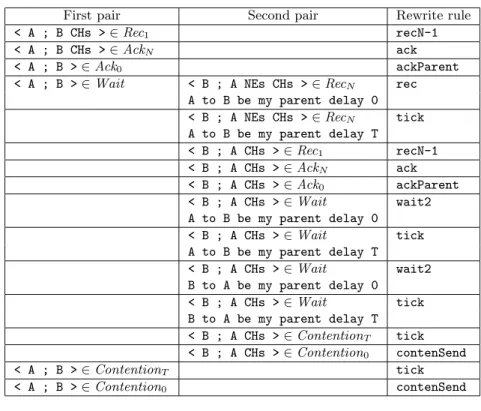
Since the network represented by the pairs inNodes is acyclic, then either the network has only one node, or the network has at least one leaf, that is, there is a pair of the form < A ; B CHs > in Nodes with B the only value in the neigattribute of node A. In the first case we can apply rule ackLeader. In the second case, and since the network is symmetric, there is < B ; A NEs CHs’ >inNodes. Table 1 shows the rewrite rules that can be applied for each pair of nodes. When the second pair is not present, it means that it does not matter the subset in which the pair is. In the cases the rewrite rule is tick, we mean that this rule can be applied if there is no time-critical rule that can be applied.
Property 2: A node can only come into the contention phase a finite number of times.
Now we prove that in a fair system, and assuming that
ROOT-CONT-FAST≫max{I,J}(timeLink(I,J)) (1)
ROOT-CONT-SLOW≫max{I,J}(timeLink(I,J)) (2)
ROOT-CONT-FAST−ROOT-CONT-SLOW≫max{I,J}(timeLink(I,J)) (3)
a node cannot be forever changing between the contention and waitParent phases by applying rules wait2and contenSend; equivalently, the rewrite rulecontenReceive will be applied.
We mean by fairness that all the rewrite rules that can be applied will be applied, and that the random number generator produces even and odd numbers and therefore the
7.2 Verification of second description 21 First pair Second pair Rewrite rule
< A ; B CHs >∈Rec1 recN-1
< A ; B CHs >∈AckN ack
< A ; B >∈Ack0 ackParent
< A ; B >∈Wait < B ; A NEs CHs >∈RecN rec
A to B be my parent delay 0 < B ; A NEs CHs >∈RecN tick
A to B be my parent delay T < B ; A CHs >∈Rec1 recN-1 < B ; A CHs >∈AckN ack < B ; A CHs >∈Ack0 ackParent < B ; A CHs >∈Wait wait2 A to B be my parent delay 0 < B ; A CHs >∈Wait tick A to B be my parent delay T < B ; A CHs >∈Wait wait2 B to A be my parent delay 0 < B ; A CHs >∈Wait tick B to A be my parent delay T < B ; A CHs >∈ContentionT tick < B ; A CHs >∈Contention0 contenSend < A ; B >∈ContentionT tick < A ; B >∈Contention0 contenSend
Table 1: Rules that can be applied in the system
A contention B contention RA A waitParent B contention from A to B delayT1 T1 A waitParent B ack
Figure 2: Contention possibility 1 whereRA< RB
rootConDelayattribute of a node in thecontentionphase can be eitherROOT-CONT-FAST
or ROOT-CONT-SLOW. Equations 1, 2, and 3 express that both constants are much greater than the maximum link delay between the nodes, and that their difference is also much greater [IEE95].
The configurations we can have when the contention takes places are the following ones:
1. Both nodes are in phase contention. Then,
• If RA < RB, where RA is the rootConDelayconstant selected by node A, the system reaches the moment in time RAand, by means of thecontenSendrule, Agoes into thewaitParentphase and a messagefrom A to B be my parent with delay T1 is sent. Then by assumption 3, the moment in time T1 occurs beforeRBand this message reaches nodeBwhen it is still in phasecontention. Then nodeBwill go into phaseackby means of thecontenReceiverule. This situation corresponds to Figure 2.
• IfRB< RA, the situation is symmetric to the previous one, and nodeAwill go into phaseack.
A contention B contention RA=RB A waitParent B contention from A to B delayT1 RA=RB A waitParent B waitParent from A to B delayT1 from B to A delayT2 Figure 3: Contention possibility 1 whereRA=RB
A contention B waitParent from A to B delayT1 T1 A contention B contention
Figure 4: Contention possibility 2
• If RA = RB, then RA and RB occur simultaneously, and the system will ap-ply the contenSend rule to both nodes before the time of the “be my par-ent” message of the first node that applies thecontenSend rule has been con-sumed. This means that both nodes will go into thewaitParentphase and the two messages from A to B be my parent with delay T1 and from B to A be my parent with delay T2 will be in the system. Now we are in the initial configuration 4 (see below) and both nodes will go again into the contention
phase. This situation is depicted in Figure 3, where we suppose that the rule
contenSend is first applied to nodeAby the system.
In this case, we make use of the fact that we are in a fair system and the constants selected by A and Bwill be in some moment different and therefore we will not have this case forever.
2. Node A is in phase contention, node B is in phase waitParent, and there is a message from A to B be my parent with delay T1 in the system. Then, by as-sumptions 1 and 2,T1 occurs beforeRA, and by means of thewait2ruleBgoes into thecontention phase, and we are in case 1. See Figure 4.
3. Node A is in phase waitParent, node B is in phase contention, and there is a messagefrom B to A be my parent with delay T2 in the system. This situation is symmetric to case 2.
4. Both nodes are in the waitParentphase, and there are two messagesfrom A to B be my parent with delay T1andfrom B to A be my parent with delay T2in the system. Then, by assumptions 1 and 2, bothT1 and T2 occur before any of the RA and RB can take place. This means that bothAand Bgo into the contention
phase, and we are again back in the first case. See Figure 5.
If a node goes out of thecontentionphase by means of thecontenReceiverule, it will not go back to the contentionphase since it will be in theackphase with no neighbors. Then, the only rules that can be applied to it are firstack, and then ackLeader.
7.2 Verification of second description 23 A waitParent B waitParent from A to B delayT1 from B to A delayT2 T1 A waitParent B contention from B to A delayT′ T2 A contention B contention
Figure 5: Contention possibility 4 Before the rule Rule After the rule 5∗N ∗T ∗n rec 5∗N ∗T ∗(n−1)−1 5∗N ∗T recN-1 4∗T ∗(n+ 1)≤4∗T∗N 5∗N ∗T recLeader 4∗T ∗(n+ 1)−1<4∗T∗N 4∗T ∗(n+ 1) ack ≤4∗T ∗n+T + 1 4∗T ackLeader 0 4∗T ackParent ≤2 +T 1 wait1 0 2 wait2 0 f(C) tick f(C)−mte(C)∗nm(C)
Table 2: Values of function f
LetN be the total number of nodes in the network and T the maximum delay of the
timeLinktable. We define:
rec(I) = 5∗N∗T∗n if< I ; NEs >∈Recn 0 otherwise ack(I) = 4∗T∗(n+ 1) if< I ; J CHs >∈Ackn 0 otherwise wait(I) = 1 if< I ; J >∈Wait 0 otherwise
nm(C) = number of messages with time in configurationC
times(C) = sum of times in messages in configurationC
Consider the function f(C) = X
I∈Node
rec(I)+ack(I)+wait(I)+nm(C) +times(C) .
We show in Table 2 the value of the function f in a configuration and the value of the same function after we have applied a rewrite rule in the system to the configuration. All the values are relative, in the sense that they only represent the value of the substate that changes when the rewrite rule is applied. We observe that in all cases the value of the function decreases.
Rules contenReceiveand contenSendare not represented in the table because they do not decrease the value of the function, but on the contrary, they increase it. This does
not matter since we have proved above that these rules cannot be applied forever for a pair of nodes, and that if two nodes solve their contention they will not have another contention.
Sincef(C)≥0 and it decreases when we apply the rewrite rules, then, although it can be increased by a finite quantity, we conclude that we cannot apply rewrite rules forever in the system.
7.2.4 Total correctness
Since we cannot apply rules forever in the system (Property 3), the set Nodes should become empty (Property 1), and if this set becomes empty there should be one and only one leader (Section 7.2.2).
7.3 Verification of third description
First we will prove that by using this description of the protocol cycles are detected. Then we will show how the new rules affect the proof of correctness given for the timed asynchronous description with no cycle detection in Section 7.2.
7.3.1 If there is a cycle in the network, an error message is generated. Property 1: If a node is in a cycle, then it does not change from the recphase until an error message is generated.
If the node is in a cycle it has at least two neighbours. The rules that change a node from the rec phase are recN-1 and recLeader, which cannot be applied since the node has more than one neighbour, anderror, which generates the error message.
Property 2: If the network has a cycle, then the CONFIG-TIMEOUTalarmattribute of some node that is in the cycle is set to 0.
We divide the set of nodes in two subsets: one with the nodes that are in a cycle, and the other with the nodes that are not in a cycle. If a node is not in a cycle, there are a finite number of rewrites that can take place before it reaches theselfphase. If a node is in a cycle, rule reccan be applied at most as many times as the number of nodes in the network that are connected to this node but are not in the cycle. Once there is no rewrite rule different fromtickthat can be applied to the nodes, only time can pass changing the
CONFIG-TIMEOUTalarm attribute. This attribute will decrease in the nodes of the cycle until some of them become 0.
Property 3: If the CONFIG-TIMEOUTalarmattribute of a node is set to 0 and the node does not change from the recphase, the value of theCONFIG-TIMEOUTalarm
attribute does not change any more.
The rules that change the value of theCONFIG-TIMEOUTalarmattribute are: • recN-1and recLeader, that change the phase of the node to theackphase. • tick, that decreases the value of the attribute. But this rule cannot be applied
if the CONFIG-TIMEOUTalarm attribute is 0, since in this case the mte operation is evaluated to 0.
7.3 Verification of third description 25
• error, that changes the phase of the node to theerror phase.
Property 4: If there is a cycle in the network then an error is generated.
By Properties 2 and 3, there is a node whoseCONFIG-TIMEOUTalarmattribute is set to 0, and this value cannot change, and by Property 1, the node should be in the recphase. Looking at the lefthand side of the error rewrite rule we check that it can be applied, and since we assume that we are in a fair system the error message will be generated.
7.3.2 Total correctness
We will prove that, if there is no error, a single leader is chosen and that the leader is eventually chosen. We can extend the method used in the previous proofs in Section 7.2 in order to deal with the new rules and the rules that have changed.
We consider the same observations as in the case with no cycle detection, since although we have introduced a new phase,error, this is afinal phase in the sense that once a node is in that phase there is no rewrite rule in the system that can be applied to it.
Since we suppose that there is no error, we also have that the network represented by the set Nodes is symmetric, connected, and with no cycles.
The proof of the safety properties does not change, since we suppose that there is no error, and then we do not introduce any rewrite rule that removes pairs from the set Nodes.
The proof of the liveness properties is slightly changed. First, Property 1 of Section 7.2.3 needs to take into account the new definition of the recN-1rewrite rule. If the first pair < A ; B Chs >∈Rec1 then we have the following additional cases for Table 1:
• if fr is falsethen apply rulerecN-1;
• if FORCE-ROOTalarmis 0 and fris truethen apply rulestopAlarm;
• if FORCE-ROOTalarmis greater than 0 andfr is truethen apply ruletick.
The proof of Property 2 does not change, since the new rules do not affect the
contention phase.
For Property 3, we check that the new rules decrease the function’s value. We change the function definition ofnm(C)andtimes(C) to take into account also objects with time values:
nm(C) = number of objects and messages with time not equal tonoTimeValue in configurationC
times(C) = sum of times in objects and messages in configurationC
• Rule error: the function has a value of 5∗N ∗T ∗n+ 1 before we apply the rule and 0 after the rule is applied.
• Rule stopAlarm: the function has a value of 5∗N ∗T∗n+ 1 before we apply the rule and 5∗N ∗T∗nafter the rule is applied.
• Rule recN-1: the function has a value of 5∗N ∗T before we apply the rule and 4∗T∗(n+ 1) after the rule is applied.
• Rule recLeader: the function has a value of 5∗N ∗T+ 1 before we apply the rule and 4∗T∗(n+ 1) after the rule is applied.
Since the three properties are verified, the liveness property is fulfilled and therefore we have total correctness, as before.
8
Conclusion
We have shown how rewriting logic and Maude can be used to specify and analyze at different abstract levels a communication protocol such as the FireWire leader election protocol. We have also shown how the timing aspects of the protocol can be modeled in an easy and structured way in rewriting logic, by means of operations that define the effect of time elapse and rewrite rules that let time pass.
We see this work as another contribution to the research area of specification and analysis of several kinds of communication protocols in Maude, as described in [DMT98, DMT00], as well as to the development of the formal methodology that we have sum-marized in the introduction. As far as we know, this paper describes the first examples where the strongest method of formal proof has been applied to a protocol in the context of Maude programs. In our opinion, it is necessary to have more examples in order to consolidate this methodology, and to develop tools that can help in the simulation and analysis of such examples.
Acknowledgement
We thank Carron Shankland for discussions about the leader election protocol and its time aspects, and Peter ¨Olveczky for suggestions about how to introduce time in our specifications.
References
[BMM98] Roberto Bruni, Jos´e Meseguer, and Ugo Montanari. Internal strategies in a rewriting implementation of tile systems. In Claude Kirchner and H´el`ene Kirchner, editors, Proceedings Second International Workshop on Rewriting Logic and its Applications, WRLA’98, Pont-`a-Mousson, France, September 1–4, 1998, volume 15 of Electronic Notes in Theoretical Computer Science. Elsevier, 1998. http://www.elsevier.nl/ locate/entcs/volume15.html.
[CDE+99] Manuel Clavel, Francisco Dur´an, Steven Eker, Patrick Lincoln, Narciso Mart´ı-Oliet,
Jos´e Meseguer, and Jos´e Quesada. Maude: Specification and Programming in Rewrit-ing Logic. Computer Science Laboratory, SRI International, 1999. http://maude. cs.uiuc.edu/maude1/manual.
[CDE+00a] M. Clavel, F. Dur´an, S. Eker, P. Lincoln, N. Mart´ı-Oliet, J. Meseguer, and J. Quesada.
Using Maude. In T. Maibaum, editor,Proc. Third Int. Conf. Fundamental Approaches to Software Engineering, FASE 2000, Berlin, Germany, March/April 2000, LNCS 1783, pages 371–374. Springer, 2000.
REFERENCES 27
[CDE+00b] Manuel Clavel, Francisco Dur´an, Steven Eker, Patrick Lincoln, Narciso Mart´ı-Oliet,
Jos´e Meseguer, and Jos´e Quesada. A Maude Tutorial. Computer Science Laboratory, SRI International, 2000. http://maude.cs.uiuc.edu/papers.
[Cla00] Manuel Clavel. Reflection in Rewriting Logic: Metalogical Foundations and Metapro-gramming Applications. CSLI Publications, 2000.
[CM01] Manuel Clavel and Jos´e Meseguer. Reflection in conditional rewriting logic.Theoretical Computer Science, 2001. To appear.
[DGRV97] M.C.A. Devillers, W.O.D. Griffioen, J. Romijn, and F. Vaandrager. Verification of a leader election protocol — formal methods applied to IEEE 1394. Technical Report CSI-R9728, Computing Science Institute, University of Nijmegen, 1997.
[DMT98] Grit Denker, Jos´e Meseguer, and Carolyn Talcott. Protocol specification and analysis in Maude. In N. Heintze and J. Wing, editors,Proc. of Workshop on Formal Methods and Security Protocols, 25 June 1998, Indianapolis, Indiana, 1998. http://www.cs. bell-labs.com/who/nch/fmsp/index.html.
[DMT00] Grit Denker, Jos´e Meseguer, and Carolyn Talcott. Formal specification and analysis of active networks and communication protocols: The Maude experience. In Proc. DARPA Information Survivability Conference and Exposition DICEX 2000, Vol. 1, Hilton Head, South Carolina, January 2000, pages 251–265. IEEE, 2000.
[IEE95] Institute of Electrical and Electronics Engineers. IEEE Standard for a High Perfor-mance Serial Bus. Std 1394-1995, 1995.
[Mes92] Jos´e Meseguer. Conditional rewriting logic as a unified model of concurrency. Theo-retical Computer Science, 96(1):73–155, 1992.
[Mes98] Jos´e Meseguer. Research directions in rewriting logic. In U. Berger and H. Schwichten-berg, editors,Computational Logic, NATO Advanced Study Institute, Marktoberdorf, Germany, July 29 – August 6, 1997, NATO ASI Series F: Computer and Systems Sciences 165, pages 347–398. Springer, 1998.
[MOM93] N. Mart´ı-Oliet and J. Meseguer. Rewriting logic as a logical and semantic framework. Technical Report SRI-CSL-93-05, SRI International, Computer Science Laboratory, 1993. http://maude.cs.uiuc.edu/papers.
[MS00] S. Maharaj and C. Shankland. A Survey of Formal Methods Applied to Leader Election in IEEE 1394. Journal of Universal Computer Science, 6(11):1145–1163, 2000. [ ¨Olv00] Peter Csaba ¨Olveczky. Specification and Analysis of Real-Time and Hybrid Systems
in Rewriting Logic. PhD thesis, University of Bergen, Norway, 2000. http://maude. cs.uiuc.edu/papers.
[ ¨OM02] Peter Csaba ¨Olveczky and Jos´e Meseguer. Specification of real-time and hybrid sys-tems in rewriting logic. Theoretical Computer Science, 285(2):359–405, 2002.
[SMR01] Carron Shankland, Savi Maharaj, and Judi Romijn. International workshop on ap-plication of formal methods to IEEE 1394 standard, 2001. http://www.cs.stir.ac. uk/firewire-workshop.
[SV99] Carron Shankland and Alberto Verdejo. Time, E-LOTOS, and the FireWire. In Marco Ajmone Marsan, Juan Quemada, Tom´as Robles, and Manuel Silva, editors, Formal Methods and Telecommunications (FM&T’99), pages 103–119. Prensas Uni-versitarias de Zaragoza, 1999.
[SvdZ98] C. Shankland and M. van der Zwaag. The Tree Identify Protocol of IEEE 1394 in
A
Complete Maude specification
A.1 Synchronous communication description (fmod IDENTIFIERS is
protecting QID . sorts Iden SetIden .
subsorts Qid < Iden < SetIden . op empty : -> SetIden .
op __ : SetIden SetIden -> SetIden [assoc comm id: empty] . endfm)
(omod FIREWIRE is
protecting IDENTIFIERS . subsort Iden < Oid .
class Node | neig : SetIden, done : Bool . msg leader_ : Iden -> Msg .
sort System .
op ‘{_‘} : Configuration -> System . vars I J : Iden .
var NEs : SetIden . var C : Configuration . rl [rec] :
{ < I : Node | neig : J NEs, done : false > < J : Node | neig : I, done : false > C } => { < I : Node | neig : NEs >
< J : Node | done : true > C } . rl [ackLeader] :
{ < I : Node | neig : empty, done : false > C } => { < I : Node | done : true > (leader I) C } . endom)
A.2 Timed, asynchronous communication description
The following diagram shows module importation, and helps to understand the module structure in this description of the protocol.
A.2 Timed, asynchronous communication description 29 TIMEDEXAMPLE TIMEDFIREWIRE RANDOM TIMEDOOSYSTEM TIMEDOMAIN NAT-INF IDENTIFIERS TIMEDPHASES (fmod NAT-INF is protecting MACHINE-INT . sorts Nat NzNat NatInf . subsort Nat < MachineInt . subsort NzNat < Nat .
subsort NzNat < NzMachineInt . subsort Nat < NatInf .
var NZ : NzMachineInt . mb 0 : Nat .
cmb NZ : NzNat if NZ > 0 . op INF : -> NatInf .
op _plus_ : NatInf NatInf -> NatInf [assoc comm] . op _monus_ : NatInf Nat -> NatInf .
op _lt_ : NatInf NatInf -> Bool . op _le_ : NatInf NatInf -> Bool .
op min : NatInf NatInf -> NatInf [comm] . op max : NatInf NatInf -> NatInf [comm] . vars N N’ : Nat .
vars NI NI’ : NatInf . eq N plus N’ = N + N’ . eq NI plus INF = INF .
eq N monus N’ = if N lt N’ then 0 else (N - N’) fi . eq INF monus N’ = INF .
eq N lt N’ = N < N’ . eq N lt INF = true . eq INF lt NI = false .