Contents lists available atScienceDirect
Theoretical Computer Science
journal homepage:www.elsevier.com/locate/tcs
Note
Limiting negations in non-deterministic circuits
Hiroki Morizumi
∗Graduate School of Information Sciences, Tohoku University, Sendai 980-8579, Japan
a r t i c l e i n f o
Article history:
Received 7 March 2009
Received in revised form 8 May 2009 Accepted 10 May 2009 Communicated by A. Razborov Keywords: Circuit complexity Negation-limited circuit Non-deterministic circuit Inversion complexity
a b s t r a c t
The minimum number of NOT gates in a Boolean circuit computing a Boolean functionfis called the inversion complexity off. In 1958, Markov determined the inversion complexity of every Boolean function and, in particular, proved thatdlog2(n+1)eNOT gates are sufficient to compute any Boolean function onn variables. In this paper, we consider circuits computing non-deterministically and determine the inversion complexity of every Boolean function. In particular, we prove that one NOT gate is sufficient to compute any Boolean function in non-deterministic circuits if we can use an arbitrary number of guess inputs.
©2009 Elsevier B.V. All rights reserved.
1. Introduction
No superlinear lower bound has been known so far on the size of Boolean circuits computing an explicit Boolean function, while exponential lower bounds have been known on the size ofmonotonecircuits, which consist of only AND and OR gates and do not include NOT gates [1,4,12]. It is natural to ask: what happens if a limited number of NOT gates are allowed? This motivates us to study thenegation-limitedcircuit complexity under various scenarios [2,3,5,8,14].
When we consider Boolean circuits with a limited number of NOT gates, there is a basic question: Can a given Boolean function be computed by a circuit with a limited number of NOT gates? This question was answered by Markov [10] in 1958 and the result plays an important role in the study of the negation-limited circuit complexity. Theinversion complexity
of a Boolean functionf is the minimum number of NOT gates required to construct a Boolean circuit computingf, and Markov completely determined the inversion complexity of every Boolean functionf. In particular, it has been shown that
d
log2(
n+
1)
e
NOT gates are sufficient to compute any Boolean function.In restricted circuits, this situation changes. After more than 30 years from the result of Markov, Santha and Wilson [13] investigated the inversion complexity inconstant depth circuitsand showed that, under this restriction
d
log2(
n+
1)
e
, NOT gates are not sufficient to compute a Boolean function. The result has been extended tobounded depth circuitsby Sung and Tanaka [15]. In this paper, we investigate the opposite direction, i.e., whether or not in more powerful circuits the inversion complexity decreases. We consider circuits computing non-deterministically. Non-deterministic circuits appear in the definition of NP/poly and are studied in, e.g., [9]. The definition of non-deterministic circuits will be given in Section2. We completely determine the inversion complexity of every Boolean function in non-deterministic circuits. In particular, we prove that one NOT gate is sufficient to compute any Boolean function in non-deterministic circuits if we can use an arbitrary number of guess inputs. The comparison of deterministic computation and non-deterministic computation has been studied under various situations, e.g., Turing machines, finite automatons and communication complexity. Our results can be considered a comparison of the inversion complexity in deterministic circuits and non-deterministic circuits.∗Corresponding address: Graduate School of Informatics, Kyoto University, Kyoto 606-8501, Japan. Tel.: +81 75 753 5388; fax: +81 75 753 5972. E-mail address:[email protected].
0304-3975/$ – see front matter©2009 Elsevier B.V. All rights reserved. doi:10.1016/j.tcs.2009.05.018
H. Morizumi / Theoretical Computer Science 410 (2009) 3988–3994 3989
2. Preliminaries
Acircuitis an acyclic Boolean circuit which consists of AND gates of fan-in two, OR gates of fan-in two and NOT gates. The
sizeof a circuit is the number of AND gates, OR gates and NOT gates in the circuit. Anon-deterministic circuitis a circuit with actual inputs
(
x1, . . . ,
xn)
∈ {
0,
1}
nand some further inputs(
y1, . . . ,
ym)
∈ {
0,
1}
mcalledguess inputs. A non-deterministic circuit computes a Boolean functionf as follows: Forx∈ {
0,
1}
n,f(
x)
=
1 iff there exists a setting of the guess inputs{
y1, . . . ,
ym}
which makes the circuit output 1. In this paper, we call a circuit without guess inputs adeterministic circuittodistinguish it from a non-deterministic circuit, and we call a non-deterministic circuit which hasmguess inputs and includes at mostrNOT gates an
(
m,
r)
non-deterministic circuit.Letxandx0be Boolean vectors in
{
0,
1}
n.x≤
x0meansxi
≤
x0ifor all 1≤
i≤
n.x<
x0meansx
≤
x0andxi
<
x0ifor somei. A Boolean functionfis calledmonotoneiff
(
x)
≤
f(
x0)
wheneverx≤
x0.The theorem of Markov [10] is in the following. We denote the inversion complexity of a Boolean function f in deterministic circuits byI
(
f)
. Achainis an increasing sequencex1<
x2<
· · ·
<
xkof Boolean vectors in{
0,
1}
n. Thedecrease dX
(
f)
of a Boolean functionf on a chainXis the number of indicesisuch thatf(
xi)
6≤
f(
xi+1)
. Thedecrease d(
f)
off is the maximum ofdX(
f)
over all increasing sequencesX. Markov gave the tight bound of the inversion complexity for every Boolean function.Theorem 1 (Markov[10]). For every Boolean function f , I
(
f)
= d
log2(
d(
f)
+
1)
e
.
InTheorem 1, the Boolean functionfcan also be a multi-output function.
3. Inversion complexity in non-deterministic circuits
3.1. Result
We denote byIndc
(
f,
m)
the inversion complexity of a Boolean functionf in non-deterministic circuits with at mostm guess inputs. We consider only single-output Boolean functions, since non-deterministic circuits are not defined as ones computing multi-output Boolean functions. We determineIndc(
f,
m)
for every Boolean function as the following theorem: Theorem 2.For every Boolean function f ,Indc
(
f,
m)
= d
log2(
d(
f)/
2m+
1)
e
.
If we do not consider the number of guess inputs, we obtain the following corollary fromTheorem 2. We denote byIndc
(
f)
the inversion complexity offin non-deterministic circuits with an arbitrary number of guess inputs.Corollary 1. For every Boolean function f , Indc
(
f)
=
n
0 if f is monotone; 1 otherwise.Proof. Iffis monotone, thend
(
f)
=
0 and thereforeIndc(
f,
m)
=
0 for allm.Iff is not monotone, thend
(
f) >
0 and thereforeIndc(
f,
m) >
0 for allm. We substituted
log2d(
f)
e
form, thenIndc
(
f,
d(
f))
=
1.In the rest of this section, we proveTheorem 2.
3.2. Easy upper bound
Before we proveTheorem 2, we give a simple construction of non-deterministic circuits computing a Boolean function
f, which construction gives
Indc
(
f,
m)
≤
max{
I(
f)
−
m,
0} +
1.
The upper bound ofIndc
(
f,
m)
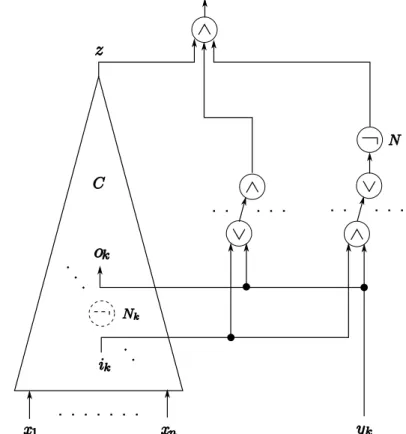
above is at most 1 larger than the one ofTheorem 2. The construction and the proof sketch are as follows.ByTheorem 1, for every Boolean functionf, there is a deterministic circuitCwhich computesf and includesI
(
f)
NOT gatesN1, . . . ,
NI(f). Letikandokbe the input and the output ofNkrespectively for 1≤
k≤
I(
f)
. Letzbe the output ofC. We construct the(
m,
max{
I(
f)
−
m,
0} +
1)
non-deterministic circuitC0computingf fromCas follows. SeeFig. 1. Intuitively speaking,mguess inputs are used to guess the outputs ofmNOT gates and one additional NOT gate is needed to guarantee correctness of the guess.1. RemoveNkinCfor 1
≤
k≤
m.2. Prepare one NOT gateNand guess inputsy1
,
y2, . . . ,
ym.3. Connectykto all gates which were connected from the output ofNkfor 1
≤
k≤
m. Thus now,ok=
yk. 4. Computez∧
(
∧
mk=1(
ik∨
yk))
∧
(
¬ ∨
mk=1(
ik∧
yk))
as the output ofC0.Ifik
=
yk=
0 for somek, then(
∧
mk=1(
ik∨
yk))
=
0. Ifik=
yk=
1 for somek, then(
¬ ∨
km=1(
ik∧
yk))
=
0. Therefore the output ofC0depends only on the case withik
= ¬
ykfor all 1≤
k≤
m. In this case,z=
f sinceok=
yk= ¬
ikfor all 1≤
k≤
m.Fig. 1.A simple construction. (Actually, the gates with more than two fan-in in the figure consist of some gates with two fan-in.)
3.3. Tight upper bound
We proveIndc
(
f,
m)
≤ d
log2(
d(
f)/
2m+
1)
e
. In the simple construction mentioned above, we use one NOT gateNonly for guaranteeing that the guess inputs satisfy the condition we hope. In the following proof, for the guarantee we do not use one new NOT gate, but we reuse the other NOT gates.Proof (The Upper Bound of Indc
(
f,
m)
). We use induction onm.Base:m
=
0. A non-deterministic circuit with no guess input is a deterministic circuit. Therefore byTheorem 1,Indc
(
f,
0)
= d
log2(
d(
f)
+
1)
e
.
Induction step: Suppose
Indc
(
f,
m0)
≤ d
log2(
d(
f)/
2m 0+
1)
e
for allm0
≤
m−
1.First we separatef to three functionsf1
,
f2andf3so thatf1∨
f2∨
f3=
f as follows. SeeFig. 2. LetS1be the set of all vectorsx∈ {
0,
1}
nsuch that for every chainXstarting withx,dX
(
f)
=
0 and f(
x)
=
1.
LetS2be the set of all vectorsx
∈ {
0,
1}
nsuch thatx6∈
S1and for every chainXstarting withx,dX
(
f)
≤ d
d(
f)/
2e
.
LetS3be the set of all vectorsx
∈ {
0,
1}
nsuch thatx6∈
S1∪
S2. Fori=
1,
2,
3, we definefias follows:fi
(
x)
=
n
f(
x)
ifx∈
S i; 0 otherwise. We defineftas follows: ft(
x)
=
n
1 ifx∈
S 1∪
S2; 0 otherwise.Sincef2
=
0 outside ofS2 andS2 does not include any vectorx∈ {
0,
1}
nsuch that for a chain X starting withx,dX
(
f) >
d
d(
f)/
2e
,H. Morizumi / Theoretical Computer Science 410 (2009) 3988–3994 3991
Fig. 2.The separation off.
Next we show that
d
(
f3)
≤ b
d(
f)/
2c
.
We assume thatd
(
f3) >
b
d(
f)/
2c
. Sincef3=
0 outside ofS3, there is a chainX1ending in a vectorx∈
S3and such thatdX1
(
f) >
b
d(
f)/
2c −
1. Sincexis not inS2, there is a chainX2starting withxand such thatdX2(
f)
≥ d
d(
f)/
2e +
1. LetX0bethe chain which is obtained by connectingX1andX2. Then,
dX0
(
f)
=
dX1(
f)
+
dX2(
f)
> (
b
d(
f)/
2c −
1)
+
(
d
d(
f)/
2e +
1)
=
d(
f).
Thus a contradiction happens.
Letr
= d
log2(
d
d(
f)/
2e
/
2m−1+
1)
e
. By the supposition, there are(
m−
1,
r)
non-deterministic circuitsC 2 andC3 computingf2andf3respectively. LetNjkbe thekth NOT gate from the input side inCjforj=
2,
3 and 1≤
k≤
r. More precisely, we choose each numberkso that there is no path from the output ofNjkto the input ofNjk0ifk0≤
k. Letijkandojkbe the input and the output ofNjkrespectively. IfNjkdoes not exist, then we defineijk
=
0. Letzjbe the output ofCjforj
=
2,
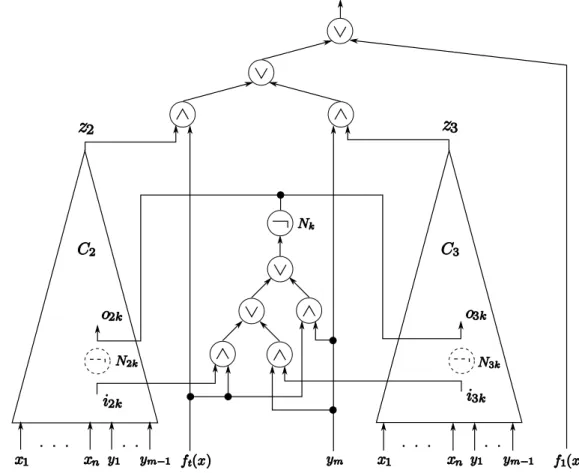
3. Sincef1andftare monotone functions by the definition, there are deterministic circuitsC1andCtwhich include no NOT gate and computef1andftrespectively. We construct the(
m,
r)
non-deterministic circuitCcomputingffromC1,
C2,
C3 andCtas follows. SeeFig. 3. In the figure,C1andCtare omitted.1. Remove all NOT gates inC2andC3.
2. PreparerNOT gatesN1
,
N2, . . . ,
Nrand a new guess inputym.3. Connect
(
i2k∧
ft)
∨
(
i3k∧
ym)
∨
(
ft∧
ym)
to the input ofNkfor 1≤
k≤
r.4. Connect the output ofNkto all gates which were connected from the output ofN2korN3kfor 1
≤
k≤
r. Thus now,o2k
=
o3k= ¬
((
i2k∧
ft)
∨
(
i3k∧
ym)
∨
(
ft∧
ym)).
5. Compute(
z2∧
ft)
∨
(
z3∧
ym)
∨
f1as the output ofC.AlthoughChas connections between the gates ofC2and the gates ofC3,Chas no loop, since if there is a path of an order
ij1k1
,
oj2k2,
ij3k3,
oj4k4, thenk1≤
k2≤
k3≤
k4. We show thatCcomputesffor each of the following three cases. Case 1: The inputxis inS1.By the definition ofS1,f
(
x)
=
1 for allx∈
S1. Sincef1(
x)
=
1 for allx∈
S1, the output ofCis(
z2∧
ft)
∨
(
z3∧
ym)
∨
f1=
1for arbitraryy1
, . . . ,
ym. ThusCcomputesf(
x)
for allx∈
S1. Case 2: The inputxis inS2.By the definition,ft
(
x)
=
1 andf1(
x)
=
0 for allx∈
S2. Ifym=
1, then we can show that the output ofCis 0 as follows. Sinceft(
x)
=
1 andym=
1,o2k
=
o3k= ¬
((
i2k∧
ft)
∨
(
i3k∧
ym)
∨
(
ft∧
ym))
=
0.
Then, by the following lemma, we can show that the output ofCis 0.Fig. 3.The(m,r)non-deterministic circuit computingf. (The subcircuits computingf1(x)andft(x)are omitted.)
Proof. We use thatfj
(
1,
1, . . . ,
1)
=
0, which is proved as follows. If f(
1,
1, . . . ,
1)
=
0, thenfj(
1,
1, . . . ,
1)
=
0 sincefjis defined asf or 0. Iff(
1,
1, . . . ,
1)
=
1, then(
1,
1, . . . ,
1)
is included inS1and is not included inSj. Thereforefj
(
1,
1, . . . ,
1)
=
0.We assume that there arex
=
(
x1,
x2, . . . ,
xn)
andy=
(
y1,
y2, . . . ,
ym−1)
such thatzj=
1. On the other hand, we consider the originalCj, i.e.,Cjbefore the construction ofC. Sincefj(
1,
1, . . . ,
1)
=
0, if the inputs ofCjarex0=
(
1,
1, . . . ,
1)
andy, thenzj=
0. (The output of NOT gates may be 0 and may be 1.) These two cases include a contradiction sincezjis computed by only AND gates and OR gates fromx1,
x2, . . . ,
xnandy1,
y2, . . . ,
ym−1andoj1,
oj2, . . . ,
ojr.Therefore the output ofCdepends only on the case withym
=
0. The output ofCis(
z2∧
ft)
∨
(
z3∧
ym)
∨
f1=
z2.
Since
o2k
= ¬
((
i2k∧
ft)
∨
(
i3k∧
ym)
∨
(
ft∧
ym))
= ¬
i2k,
the output ofCisz2
=
f2=
f for allx∈
S2. Case 3: The inputxis inS3.By the definition,ft
(
x)
=
0 andf1(
x)
=
0 for allx∈
S3. Ifym=
0, then the output ofCis(
z2∧
ft)
∨
(
z3∧
ym)
∨
f1=
0.
Therefore the output ofCdepends only on the case withym
=
1. Then the output ofCis(
z2∧
ft)
∨
(
z3∧
ym)
∨
f1=
z3.
Since
o3k
= ¬
((
i2k∧
ft)
∨
(
i3k∧
ym)
∨
(
ft∧
ym))
= ¬
i3k,
H. Morizumi / Theoretical Computer Science 410 (2009) 3988–3994 3993
ThusCis an
(
m,
r)
non-deterministic circuit computingf. The number of NOT gates inCis at mostr. Ifd(
f)
is an even number, thenr
= d
log2(
d
d(
f)/
2e
/
2m−1+
1)
e
= d
log2(
d(
f)/
2m+
1)
e
.
Ifd
(
f)
is an odd number, thenr
= d
log2(
d
d(
f)/
2e
/
2m −1+
1)
e
= d
log2((
d(
f)
+
1)/
2m+
1)
e
= d
log2((
d(
f)
+
1+
2m)/
2m)
e
= d
log2(
d(
f)
+
2m+
1)
e −
m= d
log2(
d(
f)
+
2m)
e −
m= d
log2(
d(
f)/
2m+
1)
e
.
Therefore Indc(
f,
m)
≤ d
log2(
d(
f)/
2m+
1)
e
.
3.4. Lower boundWe proveIndc
(
f,
m)
≥ d
log2(
d(
f)/
2m+
1)
e
. We denote the output of a circuitCgiven an inputxand a guess inputybyC
(
x,
y)
.Proof (The Lower Bound of Indc
(
f,
m)
). We use induction onm.Base:m
=
0. A non-deterministic circuit with no guess input is a deterministic circuit. Therefore byTheorem 1,Indc
(
f,
0)
= d
log2(
d(
f)
+
1)
e
.
Induction step: Suppose
Indc
(
f,
m0)
≥ d
log2(
d(
f)/
2m 0+
1)
e
for allm0
≤
m−
1. LetC be an(
m,
r)
non-deterministic circuit computing a Boolean functionf. LetXbe an increasing sequencex1<
x2<
· · ·
<
xkof Boolean vectors in{
0,
1}
nsuch thatdX(
f)
=
d(
f)
. In other words, we focus on one of the increasing sequences on which the decrease off is the maximum. For allisuch thatf(
xi)
6≤
f(
xi+1)
,f(
xi)
=
1 andf
(
xi+1)
=
0. SinceCis a non-deterministic circuit,Cgivenxioutputs 1 forsomeguess input, andCgivenxi+1outputs 0 forallguess inputs. Letyi
∈ {
0,
1}
mbe a setting to guess inputs of the circuit such thatC(
xi,
yi)
=
1 for eachi. Ifyim=
0 for at least half ofyi’s, then we fix the last guess inputymofCto 0; otherwise, we fixymto 1. LetC0be the obtained
(
m−
1,
r)
non-deterministic circuit.C0computes 1 for at leastd
d(
f)/
2e
xi’s and computes 0 for allxi+1’s. Letf0be a Boolean function computed byC0. Thend(
f0)
≥
d X(
f0)
≥ d
d(
f)/
2e
. By the supposition, r≥
Indc(
f0,
m−
1)
≥ d
log2(
d(
f0)/
2m−1+
1)
e
≥ d
log2(
d
d(
f)/
2e
/
2m−1+
1)
e
≥ d
log2(
d(
f)/
2m+
1)
e
.
4. Concluding remarksIn this paper we completely determined the inversion complexity of every Boolean function in non-deterministic circuits. In particular, we proved that one NOT gate is sufficient to compute any Boolean function, which means that non-deterministic computation can reduce the number of required NOT gates to compute an arbitrary Boolean function from
d
log2(
n+
1)
e
to 1 in the comparison ofTheorem 1. Another interesting computation is probabilistic computation. No result is known for the inversion complexity in probabilistic circuits. For more about probabilistic circuits, see, e.g., Chap. 12 of [16]. Finally, we note that our construction in Section3.2implies a relation about the size of non-deterministic circuits and negation-limited non-deterministic circuits. The relation corresponds to the known relations in deterministic circuits [5–7, 11]. We denote bysizendc(
f)
the size of the smallest non-deterministic circuit computing a functionf (with an arbitrary number of guess inputs) and denote bysizendcr
(
f)
the size of the smallest non-deterministic circuit computingfwith at mostrNOT gates. By a similar construction to the one in Section3.2, we can prove the following theorem. Note that two AND gates and two OR gates are added for eachNkin the construction.
Theorem 3.For every Boolean function f , sizendc1
(
f)
≤
4sizendc(
f).
ByTheorem 3, if there is a non-deterministic circuit which computesf and has polynomial size, then there is a non-deterministic circuit which computesfand has polynomial size and at most one NOT gate.
Acknowledgment
I would like to thank anonymous referees of an early version of this paper, in which the main result wasCorollary 1of this paper. Two of the referees pointed out that the problem could be extended to one which has a consideration of the number of guess inputs. I especially thank one of the referees who pointed out that the result in the early version could be extended to the one in Section3.2.
References
[1] N. Alon, R.B. Boppana, The monotone circuit complexity of Boolean functions, Combinatorica 7 (1) (1987) 1–22.
[2] K. Amano, A. Maruoka, A superpolynomial lower bound for a circuit computing the clique function with at most(1/6)log lognnegation gates, SIAM J. Comput. 35 (1) (2005) 201–216.
[3] K. Amano, A. Maruoka, J. Tarui, On the negation-limited circuit complexity of merging, Discrete Appl. Math. 126 (1) (2003) 3–8.
[4] A.E. Andreev, On a method for obtaining lower bounds for the complexity of individual monotone functions, Sov. Math. Doklady 31 (3) (1985) 530–534. [5] R. Beals, T. Nishino, K. Tanaka, On the complexity of negation-limited Boolean networks, SIAM J. Comput. 27 (5) (1998) 1334–1347.
[6] M.J. Fischer, The complexity of negation-limited networks — A brief survey, in: Automata Theory and Formal Languages (2nd GI Conference), in: LNCS, vol. 33, 1975, pp. 71–82.
[7] M.J. Fischer, Lectures on network complexity, Technical Report 1104, CS Department, Yale University, 1974 (revised 1996). [8] S. Jukna, On the minimum number of negations leading to super-polynomial savings, Inform. Process. Lett. 89 (2) (2004) 71–74. [9] M. Karchmer, A. Wigderson, Characterizing non-deterministic circuit size, in: Proc. of 25th STOC, 1993, pp. 532–540.
[10] A.A. Markov, On the inversion complexity of a system of functions, J. ACM 5 (4) (1958) 331–334.
[11] H. Morizumi, G. Suzuki, Negation-limited inverters of linear size, in: Proc. of 19th ISAAC, in: LNCS, vol. 5369, 2008, pp. 605–614. [12] A.A. Razborov, Lower bounds on the monotone complexity of some Boolean functions, Sov. Math. Doklady 31 (1985) 354–357. [13] M. Santha, C. Wilson, Limiting negations in constant depth circuits, SIAM J. Comput. 22 (2) (1993) 294–302.
[14] S. Sung, K. Tanaka, An exponential gap with the removal of one negation gate, Inform. Process. Lett. 82 (3) (2002) 155–157.
[15] S. Sung, K. Tanaka, Limiting negations in bounded-depth circuits: An extension of Markov’s theorem, in: Proc. of 14th ISAAC, in: LNCS, vol. 2906, 2003, pp. 108–116.