1
Supply Chain Resilience in a Developing Country Context:
A Case Study on the Interconnectedness of Threats, Strategies, and Outcomes
Abstract
Purpose: In the few prior empirical studies on Supply Chain Resilience (SCRES), the focus has been on the developed world. Yet organisations in developing countries constitute a significant part of global supply chains and have also experienced the disastrous effects of supply chain failures. The purpose of this paper is therefore to empirically investigate SCRES in a developing country context, and to show that this also provides theoretical insights into the nature of what we mean by resilience. Design/methodology/approach: Using a case study approach, a supply network of 20 manufacturing firms in Uganda is analysed based on a total of 45 interviews.
Findings: The perceived threats to SCRES in this context are mainly small-scale, chronic disruptive events rather than the discrete, large-scale catastrophic events typically emphasised in the literature. The data reveals how threats of disruption, resilience strategies, and outcomes are inter-related in complex, coupled and non-linear ways. These interrelationships are explained by the political, cultural, and territorial embeddedness of the supply network in a developing country. Further, this embeddedness contributes to the phenomenon of supply chain risk migration, whereby an attempt to mitigate one threat produces another threat and/or shifts the threat to another point in the supply network.
Practical implications: Managers should be aware, for example, of potential risk migration from one threat to another when crafting strategies to build SCRES. Equally, the potential for risk migration across the supply network means managers should look at the supply chain holistically because actors along the chain are so interconnected.
Originality/value: The paper goes beyond the extant literature by highlighting how SCRES is not only about responding to specific, isolated threats but about the continuous management of risk migration. It demonstrates that resilience requires both an understanding of the interconnectedness of threats, strategies, and outcomes and an understanding of the embeddedness of the supply network. Finally, our focus on the context of a developing country reveals that resilience should be equally concerned both with smaller in scale, chronic disruptions and with occasional, large-scale catastrophic events.
Keywords: Supply Chain Resilience (SCRES); Threats; Strategies; Embeddedness; Risk Migration.
2
1. Introduction
Recent research has emphasised the importance of Supply Chain Resilience (SCRES) for surviving the adverse effects of disruptive events (e.g. Carvalho et al., 2012; Brandon-Jones et al., 2014). SCRES is based on the premise that not all risks are avoidable (Jüttner & Maklan, 2011;Hohenstein et al., 2015), but by building resilience, firms can manage the threat of disruption to their supply chains and continue delivering goods and services to customers (Ambulkar et al., 2015;Scholten & Schilder, 2015). Although we are yet to reach full consensus on a definition of SCRES (Scholten et al., 2014; Kim et al., 2015), most scholars agree that it is concerned with a supply chain’s readiness, effective response to, and recovery from a disruption – returning to the previous level or, preferably, an even better level of operational performance (Hohenstein et al., 2015; Tukamuhabwa et al., 2015). SCRES is an important topic in the operations and supply chain management literature that is in need of more research (Ambulkar et al., 2015;Hohenstein et al., 2015;Kim et al., 2015;Scholten & Schilder, 2015). To date, few empirical studies on SCRES have been reported in the literature; and those that have been published were mainly conducted in Western Europe and North America (e.g. Zsidisin & Wagner, 2010; Gölgeci & Ponomarov, 2013; Scholten & Schilder, 2015), leaving developing countries severely underrepresented. Yet developing countries, which constitute a significant part of global supply chains and the world’s population, have similarly experienced the devastating effects of supply chain failures (Chika et al., 2011). Further, there are grounds for believing that the most catastrophic effects of supply chain failures (particularly on human life) have been experienced in developing economies. Recent research on SCRES has examined the resilience of supply chains to product counterfeiters (Stevenson & Busby, 2015), and this can be a particularly acute problem in developing countries (Chika et al., 2011). Indeed, it was reported that the infiltration of counterfeit drugs into pharmaceutical supply chains led to the death of 2,500 people in 1995 and 192,000 people in 2001 in Nigeria and China, respectively (Chan et al., 2010). In addition, developing countries are more vulnerable to particular supply chain risks such as political turmoil, including rebel activities and post-election violence, and to bribery, poor transportation infrastructure, corruption and other unethical business practices (Lakovou et al., 2007; Transparency International, 2013). In 2011, Uganda suffered a severe crisis in fuel and raw material supply chains that disrupted the production and delivery of many goods and services. This sparked massive country-wide protests, and was followed by a violent police crackdown and many fatalities (The Independent, 2011). It therefore follows that we should be concerned with the resilience of developing world supply chains not only because, in a globally-connected world, their failure has repercussions elsewhere (Pereira et al., 2014; Kim et al., 2015;Levalle & Nof, 2015), but because the human consequences can be so significant.
3
Maklan, 2011; Johnson et al., 2013), with their outcomes either complementing or contradicting each other. Thus, it becomes important to study resilience systemically. In other words, investigating the inter-relationships between threats of disruption (and the conditions that lead to threats), strategies, and outcomes rather than analysing them individually and separately.
Against this backdrop, we adopt a case study approach, conducting interviews across a supply network of 20 manufacturing firms in Uganda, to address two research questions:
1. What do manufacturing firms in a developing country perceive to be the threats to their supply chains; what strategies do they adopt to build resilience; and what are the outcomes of implementing these strategies?
2. How are such threats of disruption and strategies interrelated; and what does this mean for supply chain resilience?
The study finds that threats of disruption, strategies and their outcomes are strongly interconnected, with threats commonly being side-effects of strategies, and attempts to build resilience commonly producing unexpected, further adaptations within the supply chain that themselves require intervention. Thus, to build resilience, it becomes important to appreciate the interconnectedness of threats, strategies, and outcomes. We also find that it is important to understand the context in which the supply chain is located in order to explain such inter-relationships. Therefore, we draw on an embeddedness framework to examine how the political, geographical and cultural context contributes to a phenomenon of supply chain risk migration and influences SCRES.
The remainder of this paper is organised as follows. In Section 2, the relevant literature on SCRES is reviewed before Section 3 outlines the research method used. Section 4 presents a first level analysis of the data according to threats, SCRES strategies, and outcomes. This is followed by Section 5, which presents a second level analysis that reveals the interconnections between threats, strategies, and outcomes; and which adopts an embeddedness perspective to explain how and why such interconnectedness comes about. Conclusions are thereafter provided in Section 6.
2. Literature Review
4
chain structural relationships affect SCRES, arguing that resilience should be analysed from a network perspective. Many of these studies highlighted the need for more empirical work on SCRES.
Tukamuhabwa et al. (2015) recently conducted a systematic literature review on SCRES based on 91 articles and found that the number of empirical papers – case studies or surveys – was limited to just 19 articles. Further, most of this empirical work was conducted in developed countries, particularly in Western Europe and North America (e.g. Gölgeci & Ponomarov, 2013; Wieland & Wallenburg, 2013; Scholten & Schilder, 2015). This prior work has also focused on high-profile catastrophic, discrete events, e.g. terrorist attacks (Rice & Caniato, 2003), the global financial crisis (Jüttner & Maklan, 2011), rail crashes (Johnson et al., 2013), war (Urciuoli et al., 2014), and Hurricane Katrina (Scholten et al., 2014). A similar focus on large-scale disasters can also be found in conceptual papers on SCRES (e.g. Day, 2014; Saenz & Revilla, 2014). This focus is understandable, but large-scale disasters are rare and common definitions of SCRES do not connect it solely to such disasters. Most supply chains are much more likely to be dealing with chronic, repeated threats of disruption, and it is such threats that are arguably more likely to be undermining their capabilities.
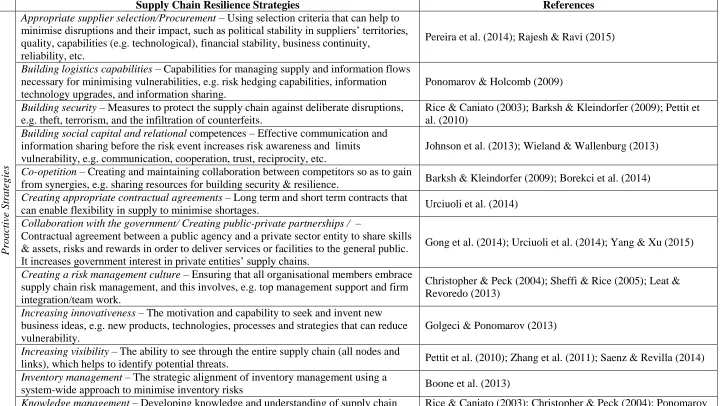
Much of the empirical work on SCRES has focused on investigating factors that could facilitate the building of SCRES, referred to variously as antecedents, enablers, practices, capabilities, and competencies. Hohenstein et al. (2015) recently argued that all of these can, in some way, be considered SCRES strategies and include broad ideas such as improving flexibility, creating redundancy, building collaborative supply chain relationships, improving supply chain agility, and enhancing visibility. More specific practices highlighted in the literature, such asinformation sharing (Brandon-Jones et al., 2014) and reconfiguring resources (Ambulkar et al., 2015), can be considered components of collaboration and flexibility, respectively.
5
Some particular strategies can be either proactive or reactive depending on when and why they are applied. Collaboration, for example, can help to mitigate before disruptions occur, e.g. by enabling information sharing and the deployment of other strategies, including supplier development. But collaboration can also support post-disruption recovery by enabling supply chain actors to share resources and provide a coordinated response (Nishiguchi & Beaudet 1998; Scholten et al., 2014). Meanwhile, some strategies may be planned and crafted before a disruption but only applied after the disruption. For example, redundant suppliers may be selected before the risk event but only contracted afterwards.
The relationships between the strategies in Table I are clearly complex and remain ambiguous (Jüttner & Maklan, 2011; Johnson et al., 2013; Hohenstein et al., 2015). For example, while scholars such as Soni et al. (2014) considered information sharing, visibility, and collaboration as separate strategies for building SCRES, others (e.g. Gunasekaran et al., 2015;Kamalahmadi & Parast, 2016) have considered information sharing to be a component of collaboration. It is also argued that forming collaborative supply chain relationships and creating redundancy can improve flexibility (Jüttner & Maklan, 2011; Scholten & Schilder, 2015); and that both flexibility and collaboration can improve agility, allowing companies to react faster and select a suitable option for mitigating the effects of disruptive events (Carvalho et al., 2012; Gunasekaran et al., 2015). In addition, strategies like building social capital and relational competences can be regarded as facilitators of collaboration (Tukamuhabwa et al., 2015). This clearly points to a need to investigate the relationships among these constructs more systematically.
[Take in Table I]
6
to improve its agility and resilience to the Japanese earthquake and tsunami of 2011, whereby Cisco was able to map out its supply base beyond tier one suppliers and to field 118 customer enquiries. Visibility is also related to another strategy, i.e. that of using information and communication technology. For example, it is argued that such technology plays a major role in the continuous monitoring of supply chains by increasing visibility (Gunasekaran et al., 2015).
Furthermore, the SCRES strategy of appropriate supplier selection from Table I is related to the SCRES strategy of supply chain re-design. More specifically, appropriate supplier selection helps to appropriately re-design the supply chain by incorporating competent suppliers in order to mitigate supply-side disruptions (e.g. Gunasekaran et al., 2015). Moreover, redundancy, which involves the duplication of capacity in order to continue operations during a failure, has been linked to flexibility (e.g. Jüttner & Maklan 2011; Kristianto et al., 2014). Redundancy avails resources needed to facilitate supply chain flexibility, which facilitates response through the adaptable deployment of resources, avoiding delays and thereby increasing SCRES (Jüttner & Maklan, 2011). Flexibility can also be achieved through another strategy, that of appropriate contracting, e.g. by creating flexible contractual arrangements (Tukamuhabwa et al., 2015).
Although the above strategies appear to potentially complement each other, they can also conflict. For example, building particularly close collaborative relationships can conflict with some aspects of flexibility (Stevenson & Spring, 2007; Scholten & Schilder, 2015) while creating redundancy to facilitate flexibility may result in liquidity risk (Jüttner & Maklan, 2011). Also, collaboration may cause additional threats, e.g. through sharing sensitive information (e.g. Jüttner and Maklan, 2011); and horizontal collaboration between suppliers may increase supply chain risk through collusion (Choi & Krause, 2006). Finally, flexibility through multiple sourcing and the opening of many branches by firms may also culminate in liquidity risk (e.g. Jüttner and Maklan, 2011).
In summary, two important gaps can be identified in the literature:
1. There is a need for further empirical work on SCRES, particularly across a network of firms and in a developing country context. Developing countries are an important player in global supply chains and face supply chain disruptions, yet they are underrepresented in the literature. As will be briefly highlighted in Section 3.2, developing countries have specific practices and conditions that may either produce threats of disruption or hinder the implementation of certain resilience strategies.
7 3. Method
3.1 Research Design
This paper responds to the need for more empirical research into SCRES, and the need to expand current understanding of SCRES to include developing country contexts. The nascent state of the literature on SCRES in general, and particularly in developing countries, calls for a qualitative, exploratory study (Saunders et al., 2009). We are interested in what manufacturing firms perceive to be the threats to their supply chains; the strategies they adopt to build resilience; the outcomes of implementing these strategies; and, importantly, how threats of disruption, resilience strategies, and outcomes are interrelated. These are favourable conditions for adopting the case study approach (Stuart et al., 2002) as it enables a thorough examination of complex, real-life phenomena leading to new, in-depth insights (Eisenhardt, 1989, Yin, 2009). Exploring the interrelatedness of threats, strategies, and outcomes would be much more difficult using other common empirical methods, such as a cross-sectional survey. The value of the case study approach to our research will become further evident in our findings. In particular, informants disclosed some of the unethical practices that occur in supply chains that affect SCRES, including corruption, theft, and product counterfeiting. Obtaining this insight was possible by meeting the informants face-to-face and building a rapport with them. It is unlikely that this insight would have been obtained using, for example, an online survey.
Our qualitative case study approach generates explanation from analysis rather than testing prior hypotheses, and this allows us to develop our particular line of theorising about SCRES (e.g. Ketokivi & Choi, 2014). A multiple case study approach is adopted. This aids external validity, guards against observer bias (Voss et al., 2002, Barratt et al., 2011), aids triangulation, and creates more testable and robust theory (Eisenhardt, 1989, Yin, 2009).
3.2 Context and Case Selection
8
and poor quality products, and refusing to pay suppliers post-delivery (Ntayi et al., 2012). More generally, Uganda is considered one of the world’s most corrupt countries, suffering from the politics of patronage and interference with the rule of law (Mbabazi & Yu, 2015).
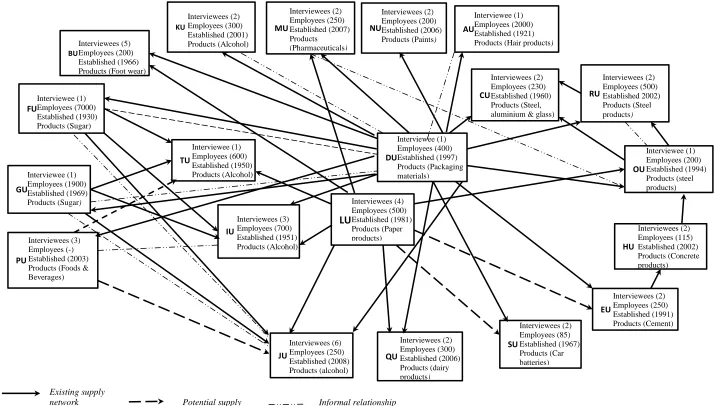
The firms participating in the study have been anonymised and are referred to as AU, BU, and so on through to TU, with Figure 1 illustrating the network of firms studied and their brief profiles, including the number of interviewees per firm and the formal and informal linkages between the firms. Following the principles of theoretical sampling (Eisenhardt, 1989; Dubois & Araujo, 2007), the studied firms had to be in a developing country and connected to one another in a supply network. Sampling was also based on emerging findings. For example, it was decided that competitors and part-government-owned firms should be incorporated to reflect the recurring themes from the initial interviews of unfair competition and corruption. Access began with JU, a brewery where one of the authors had previously worked and where it was known several supply chain disruptions had been encountered. Employees from JU later facilitated access to three of their suppliers: two sugar manufacturers (FU & GU) and one packaging materials producer (DU). The data collected from DU, which is the largest manufacturer of packaging materials and other paper products in Uganda, revealed disruptions that affected their customers. Hence, their customers were contacted (i.e. BU, FU, PU, IU, TU, QU, SU, EU, OU, RU, CU, AU, NU, MU and KU). Some of these companies also supplied one another. For example, GU and FU supplied beer manufacturers IU, JU and TU; and EU supplied HU, which also supplied OU. The number of companies studied (20) was determined following the principle of theoretical saturation – when no new categories or dimensions emerged from additional data (e.g. Manuj & Pohlen, 2012).
[Take in Figure 1]
3.3 The Interview Protocol
9 3.4 Data Collection
In total, 45 semi-structured, audio-recorded, face-to-face interviews lasting approximately one hour each were conducted with managers and other key personnel knowledgeable in supply chain related functions. Multiple interviewees per firm were used wherever possible to minimise bias. Interviewees were chosen from different authority levels and consisted of a Managing Director, a General Manager, 33 managers, and 10 officers in functions related to supply chain, procurement, logistics, operations, marketing, and distribution. Interviews were transcribed before the transcripts were sent back to the interviewees for validation. We moved back and forth between data collection and analysis so the ideas emerging from the data were reconfirmed in new data and new ideas were further confirmed by the already collected data, as recommended by Morse et al. (2002).
3.5 Data Analysis
The unit of analysis was a supply network fragment, i.e. some portion of the supply network that respondents referred to as their ‘supply chains’. Data was analysed following grounded analysis principles. The aim was to avoid being constrained by prior theory, to remain open to being surprised by the data, and to make sense of the emerging surprises (Ketokivi & Choi, 2014). Repeated readings of the transcripts were first conducted to understand the data and identify data fragments that referred in some way to certain aspects of our research questions. Data analysis was then undertaken at two levels, as described below.
First, there was a reductionistic analysis to develop a category structure for the data. There were three high-level categories: supply chain threats, resilience strategies, and strategy outcomes. A lower level set of categories was also developed through cross-case analysis (Barratt et al., 2011), comparing different instances of the same code. The category structure was refined by identifying differences and similarities among the categories (Strauss & Corbin, 1990), followed by merging and eliminating to reach consistency, as recommended in Miles et al. (2014).
10
threats such as corruption, product counterfeiting, unfair competition, and dishonest employees originated from the supply network’s embeddedness in a developing country characterised by weak political and legal controls.
4. First Level Analysis: Categorisation of Threats, Strategies and Outcomes
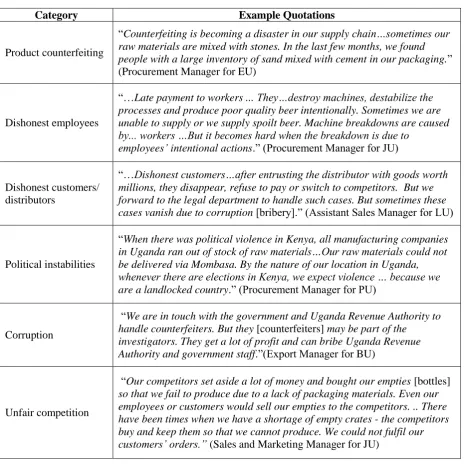
This section briefly outlines the first level analysis, where the data is categorised according to supply chain threats, SCRES strategies, and corresponding outcomes. This categorisation is illustrated in Table II.
[Take in Table II]
Supply chain threats were divided into the following two types:
Endogenous threats originating from within the supply chain, which were then further divided into:
(i) supply-side threats of disruption originating from upstream; (ii) firm level threats originating from within the focal company; and, (iii) demand-side threats originating from downstream.
Exogenous threats originating from outside the supply chain, which were further divided into: (i)
geopolitical; and, (ii) economic threats.
From the interview data, it became clear that interviewees had a broad understanding of the term “threat”. Some responses referred to threatening events and others to threatening conditions that produced or compounded a threat. Table II revealed that the case study firms are mostly concerned with smaller in scale, chronic threats of disruption, e.g. product counterfeiting, raw material delays, financial difficulties, machine breakdowns, etc. rather than large-scale discrete events. Only five interviewees highlighted natural disasters while 17 referred to machine breakdowns and 20 to raw material delays & shortages. In Table III, we provide example quotations from the interviewees for the six categories of threats marked with an asterisk in Table II. These specific threats appear particularly relevant to the context of the study. For example, the threat of political instabilities arose from being located in a landlocked country and relying on politically unstable Kenya as a transit route to a sea port. This makes political disruption that impedes transportation to, and through, Kenyan ports a problem for Ugandan suppliers and distributors. The threats were also often inter-related. For example, JU reported that the threat of financial difficulties results in late payment to workers. In retaliation, workers cause new disruptions, e.g. by destroying machines and deliberately producing poor quality products. The analysis of this inter-relatedness will be developed further in Section 5.
[Take in Table III]
11
unexpected outcomes of adopting a particular strategy, e.g. side-effects or new threats, although clearly there will be positive outcomes of adopting SCRES strategies. Further, the strategies reported are also evidently inter-related – threats lead to strategies, which can sometimes have adverse outcomes that require further strategies to deal with them, and potentially further negative side-effects. This inter-relatedness of outcomes, like the inter-relatedness of threats, appears fundamental to how supply chains behave when any attempt is made to intervene in them. The second level analysis, in the next section, is therefore focused on the interconnectedness of threats, strategies, and outcomes.
5.Second Level Analysis: Interconnectedness of Threats, Strategies and Outcomes
The interviews and first level analysis revealed instances of interconnectedness between threats, strategies, and outcomes. The second level analysis therefore involved: (i) identifying all instances in the data when informants described a causal connection between, or among, the threats (and associated conditions), strategies, and outcomes identified in Section 4; and, (ii) assembling these into a causal network, as briefly described in Section 3.5. The most important nodes in this network, in terms of the number of incoming and outgoing links to the nodes, are given in Table IV. The network consists of 90 nodes in total, but space precludes showing the entire table. Therefore, Table IV is limited to the nodes with over ten links (22 nodes) and a further five nodes that are particularly relevant to our discussion.
[Take in Table IV]
12
5.1 Example Network Fragment One:Effects of Limited Local Supply Market on SCRES The first example starts with the threat of a limited local supply market (see Figure 2, beginning from the box to the left-hand side labelled “limited local supply market”).Sixteen firms (AU, CU, EU, FU, HU, IU, JU, KU, LU, MU, NU, PU, QU, RU, SU, & TU) highlighted the threat of a limited local supply market. Twelve of these firms argued that this leads to long distance sourcing, resulting in the upstream threat of delays and shortages of raw materials and spares. If a firm runs out of raw materials, this can halt production, which then disrupts the downstream network. In CU, long distance sourcing causes communication and information flow problems, which make it difficult to establish collaborative relationships with suppliers, causing further delays and shortages. Some firms (e.g. AU, FU, LU, & PU) respond to raw material shortages from long distance sourcing by maintaining strategic stocks. But this increases stock holding costs, including the costs of theft, and ties up working capital, particularly for expensive materials and spares. This results in the threat of running into financial difficulties. AU’s Marketing Manager stated: “Our source of raw materials is far away. So we keep stocks for at least five months to cater for delays. For example, materials arriving from
Japan can take three months, which ties [up] our capital and creates financial problems.” Further, the financial difficulties resulting from maintaining strategic stocks mean firms fail to pay suppliers or customs on time, resulting in a circular effect – the return of (further) material delays and shortages. JU’s Procurement & Logistics Officer explained: “We place orders, but deliveries are delayed due to a lack of finances, for example to pay for customs clearance – sometimes because money is tied [up] in inventory ... [we] lack enough raw materials and this affects our production.”
[Take in Figure 2]
Firms such as IU, KU, PU, & RU indicated that they use local sourcing to mitigate the disruptions caused by long distance suppliers, but they conceded that this compromises quality, which negatively affects their downstream customers. Some companies (e.g. AU, CU, JU, LU, MU, PU, RU, & SU) indicated that they mitigate delays by developing collaborative relationships with suppliers, but AU, JU, and PU argued that forming deep relationships limits flexibility to switch suppliers when faced with a crisis, causing further delays and shortages.
LU, PU, and RU also reported that co-opetition, a form of collaboration with rival firms, helps create resilience against raw material delays and shortages. Interviewees claimed that they borrow materials from other firms (without interest) and replace the goods when their consignment arrives. PU’s Procurement Manager stated: “We work together with our competitors by getting raw materials from them and replacing them when ours are delivered … This kind of arrangement is facilitated by
our networks as managers. We know each other and we communicate during crises to bail each other
13
embeddedness of the supply network, as will be explained in Section 5.3. Informants from LU, for example, reported that they exchange information with competitors to mitigate threats, e.g. reporting on dishonest distributors. But it was also revealed that co-opetition can present confidentiality risks. For example, PU’s Brand Manager stated: “We do not collaborate with some of our competitors for confidentiality reasons”. PU’s Procurement Manager also indicated that some competitors use their informal, social networks to bribe government officials to evade or pay fewer taxes, which results in unfair competition.
The effects described above produce non-linearity in that there is no simple, linear relationship between the disturbances experienced by the supply network and the reliability and availability of the final product – because they are mediated by a series of adaptations and effects within the network. This non-linearity seemed clear to the informants. For example, IU’s Finance Manager explained: “a quality problem was initially seen as small but later turned out to affect the whole supply chain. It
started from the supplier with poor quality materials, meaning we produced poor quality items, which
we delivered to customers. The complaints that followed, including litigation, affected our entire
system”. The threat of a disturbance (delays and shortages of spares and raw materials) is shaped by another threat (limited local supply market), which triggers a condition (long distance sourcing), with the adaptation to this (e.g. maintaining strategic stocks) creating other threats (such as financial losses from tying capital up in stock). This in turn can lead to other threats and circular effects, including the reoccurrence of the original threat (e.g. raw material delays and shortages) but with different antecedents (e.g. a failure to pay suppliers or customs). Firms such as CU further revealed that they find it difficult to implement SCRES strategies (e.g. collaboration with suppliers) against other threats due to communication barriers and poor information flow created by long distances from suppliers. Thus, a particular condition can affect resilience through multiple routes – first, by producing threats; and second, by constraining the implementation of other resilience strategies.
This analysis shows that the consequences of a particular threat and/or condition, as well as the mitigating strategies, can propagate through the supply network. Thus, in the process of trying to attain resilience, risk shifts or migrates rather than being resolved, e.g. as one threat becomes transformed into another. This migration of one kind of risk to another is generally accompanied by a movement from one point in the supply network to another (e.g. from upstream to downstream) – and this will be further revealed in the second example. In this first example, an attempt to mitigate a threat originating from the supply side caused firm level threats, such as financial difficulties, which affected both the upstream and downstream supply chain.
14
delivery of their products through, for example, product adulteration, which leads to poor quality products that affect a firm’s reputation with its customers; malicious machine damages (leading to breakdowns), which also affect product quality and require stock holding (with its associated problems); and stock theft, which has direct financial implications for the firm. Firms such as BU, EU, and HU argued that the culture of dishonesty through connivance is deeply entrenched in employees. But dishonest behaviour is sometimes caused by the late payment of salaries (due to financial difficulties). For example, JU’s Regional Sales Manager explained that their field-based sales personnel sometimes disappear with company money when salaries are delayed. Likewise, the Procurement Manager of JU, a brewery, commented that workers: “…stop working, destroy machines, destabilize the processes and produce poor quality beer intentionally. Sometimes, we are
unable to supply or we supply spoilt beer.” Such behaviour produces an obvious non-linearity for the network, whereby relatively minor perturbations become amplified through cycles of repeated delay and protest, as evident in the closed loops of causation in Figure 3. Indeed, TU’s Trade Marketing Manager explained: “Late staff payment is a problem that started small but has eventually affected the whole supply chain. Production is affected, the market is affected and we fail to get cash inflows to pay our suppliers.” Firms such as BU attempt to overcome financial difficulties so they can pay employees by using financial management strategies (e.g. by reducing customer credit limits and demanding cash payments). But this leads to reputational risk and the loss of customers, further reducing financial inflows. BU’s Export Manager noted: “The company policy makers have decided to demand cash transactions and this has made some customers abandon us and shift to our
competitors, further reducing our sales revenue.”
[Take in Figure 3]
Employee misbehaviour is a disruption threat in its own right, but it also produces other threats, e.g. financial difficulties, and limits the implementation of SCRES strategies against other threats. For example, stock theft hinders the use of strategic stocks for safeguarding against shortages and delivery failures, as noted by HU’s Marketing Manager: “Sometimes, we store a lot of cement but we have thieves [employees]…sometimes we run out of stock unexpectedly, affecting clients and the company … we cannot fulfil the orders, which reduces our cash flows.” Respondents from JU argued that a loss of income due to employee misbehaviour results in further staff payment problems, which in turn leads to further misbehaviour – a vicious cycle, as illustrated in Figure 4 (beginning from the top left of the figure).
[Take in Figure 4]
15
time and space. And the relationships between the threats experienced by the network and the ultimate effects are evidently non-linear and generally stochastic. The result is the migration of supply chain risks and a process of continuing adaptation. This still leaves the question of what lies behind this interrelatedness. We have observed how the initiating threats in our examples above, and many of the causal influences that have been discussed, characterise the Ugandan context. It is the context that seems to produce the difficulty of partitioning the different elements of resilience – the multiple threats and strategies. This is supported by Table IV, where most of the nodes that have no incoming links are grounded in the context, e.g. government policy, corruption, insufficient skilled manpower, and geographical location (landlockedness). Hence, an embeddedness theoretical framework is adopted in Section 5.3 to understand how the presence of the supply network, or part of it, in a developing country affects its resilience. Section 5.4 then focuses in more detail on the phenomenon of risk migration, which appears to arise from the embeddedness of the supply network.
5.3 The Embeddedness Perspective on SCRES
Embeddedness is a multi-disciplinary concept that has been given a number of different meanings (e.g. Polanyi, 1944; Granovetter, 1985; Halinen & Törnroos, 1998; Hess, 2004). For example, Hess (2004) defined embeddedness “as the set of social relationships between economic and non-economic actors (individuals as well as aggregate groups of individuals, i.e. organisations), which in turn create distinctive patterns of constraints and incentives for economic action and behaviour”. Meanwhile, Halinen & Törnroos (1998) defined embeddedness as “companies' relations with, and dependence on, various types of networks.” What is common to all definitions of embeddedness is the idea that economic actors exist in, and are influenced by, networks of relationships with other economic or non-economic actors, either directly or indirectly (Choi & Kim, 2008). Thus, embeddedness can be both voluntary and involuntary. Researchers from different disciplines have provided different perspectives to explain who is embedded in what. For example, economic sociologists maintain that economic behaviour, individuals and companies are embedded in networks of ongoing social relations (Hess, 2004). Organisational and business studies scholars argue that firms and networks are embedded in time, space, social structures, markets, technological systems, and political systems, while economic geographers stipulate that firms are embedded in networks and institutional settings of local or regional geographical scale (Hess, 2004).
16
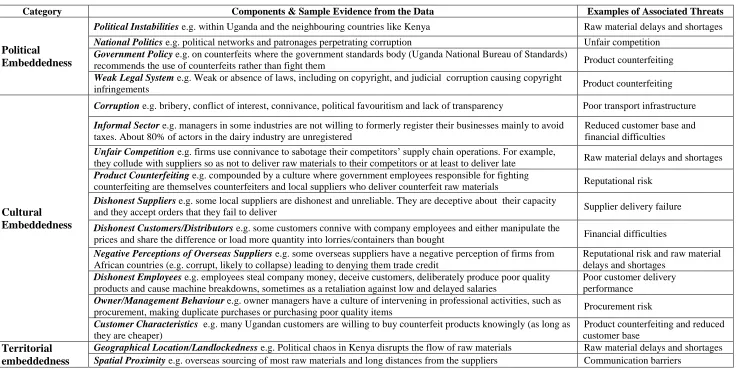
– thuswe do not include network embeddedness. In contrast, most prior supply chain research that has adopted an embeddedness perspective, with the recent exception of Wu & Pullman (2015), has focused almost exclusively on network (structural and relational) embeddedness. Moreover, prior work has portrayed embeddedness as an entirely positive phenomenon or facilitator (e.g. Choi & Kim, 2008; Gligor & Autry, 2012; Kim, 2014). Indeed, embeddedness can improve collaboration, adaptation, and responsiveness (Uzzi, 1997). However, embeddedness can also be a source of constraint, e.g. by promoting unethical practices (Granovetter, 1985) and increasing vulnerability to exogenous shocks and information asymmetry (Uzzi, 1997). This can be clearly understood if we consider the broader context in which the supply network is embedded, rather than how the supply network embeds entities within it. We focus on the following three categories of embeddedness: 1. Cultural embeddedness: the collective understanding of beliefs, values and symbols, which
provide scripts that guide economic strategies and goals (Dequech, 2003).
2. Political embeddedness: the manner in which economic institutions and decisions are shaped by a struggle for power that involves economic actors and non-market institutions, including national policies and state legal frameworks (Hardy et al., 2005).
3. Territorial embeddedness: concerning the geographical location of business, e.g. proximity, and different networks of relationships in that location (Halinen &Törnroos, 1998)
Table V summarises the key aspects of embeddedness contained in the data, where much of the focus is on cultural embeddedness, and the associated threats. As can be observed from Table V, the three categories can overlap. For example, although a factor such as corruption can be analysed from a cultural perspective – where people may view it as a norm – it can also be argued to be a political factor arising from a weak legal system, government policy, or a lack of political will. Similarly, factors such as a weak legal system could be perpetuated by culture, such as when the civil society legitimises bribery. Further, a supply network may be embedded in political and cultural milieus due to its territorial embeddedness, e.g. being located in a generally underdeveloped continent experiencing political immaturity and economic constraints.
[Take in Table V]
17
political will and corruption in African countries including Uganda. It is public knowledge.
Corruption has now become part of the government and our daily activities. No bribe, no service, no survival.” Other threats were found to originate from territorial embeddedness, such as being located far away from the source of raw materials and in a landlocked country, which creates vulnerability to political instabilities in the transit route country. For example, PU’s Procurement Manager explained: “When there was political violence in Kenya, all manufacturing companies in Uganda ran out of
stocks of raw materials … They could not be delivered via Mombasa.”
It was also found that some SCRES strategies yielded unexpected adverse outcomes as a result of embeddedness. For example, maintaining strategic stocks to guard against the raw material delays and shortages that result from long distance sourcing can become ineffective due to the cultural acceptability of theft by employees. Further, although informal networking can create resilience against certain threats (e.g. financial difficulties and raw material delays) and reinforce strategies (e.g. co-opetition), it can also act as a barrier to SCRES due to cultural and political embeddedness (e.g. when firms use their informal networks to avoid taxes). JU’s Procurement & Logistics Officer stated: “Some competitors lobby the government and dodge or pay low taxes. There is corruption in government where beneficiaries pay less or no tax and end up charging a lower price, which affects
our customer base.”
Being voluntarily embedded in one aspect sometimes implies automatic embeddedness in another. In the data, for example, being (voluntarily) territorially embedded in a landlocked country (e.g. as a location decision) implies also being embedded in the conditions of the transit neighbouring country involuntarily. This shows that embeddedness can be complex (e.g. a combination of territorial and political), and this can produce threats that would not occur if the embeddedness were simple. Being embedded in a landlocked country need not be a threat to a firm’s SCRES in itself; nor need be political instability in a neighbouring country.
5.4 Supply Chain Risk Migration
18
is an unending process of responding and adapting both to threats and to the outcomes of prior adaptations.
The supply chain risk migration matrix introduced in Figure 5 illustrates that, in the process of creating SCRES, a threat can migrate from one form to another and/or from one point in the supply network to another. The horizontal axis in Figure 5 represents the threat (T) while the vertical axis represents the point in the supply network (N), e.g. in the upstream or downstream. The bottom left-hand quadrant (T1NA) represents the initial network point NA, which is threatened by T1. An attempt is therefore made to mitigate threat T1. Risk migration may manifest in three forms, i.e. T2NA, T1NB, or T2NB. The bottom right-hand quadrant, T2NA, shows thetransformation of a threat T1 into another threat T2 at the same point in the network NA. For example, mitigating the upstream threat of raw material delays and shortages by keeping strategic stocks resulted in financial difficulties, leading to another upstream threat of loss of reputation with suppliers due to a failure to pay them. The top left-hand quadrant, T1NB, shows the migration of original threat T1 to a different point in the network (NB). For example, mitigating the threat of financial difficulties resulting from defaulting customers by demanding cash payments resulted in a reduced customer base and cash inflows – leading to an upstream threat of failure to pay suppliers (financial difficulties). Finally, the top right-hand quadrant, T2NB, shows the migration of a threat (T1 to T2) and of the point in the network where the threat is experienced (NA to NB). For example, to mitigate the upstream threat of dishonest suppliers who adulterated products and supplied poor quality materials, some companies screened quality at suppliers’ sites and conducted audits. But this caused raw material delays, which disrupted production schedules and led to the downstream threat of late delivery to customers and a reduced customer base.
[Take in Figure 5]
It is important to be aware of the phenomenon of risk migration when implementing strategies to build SCRES. The matrix in Figure 5 reminds us that threats and strategies are interconnected. The fact that SCRES strategies produce unexpected adverse outcomes informs managers that SCRES should not be viewed as a static phenomenon; and the capacity to adapt should be built into the system so it has the flexibility to respond to different manifestations of threats.
6. Discussion and Conclusions
19
suggest that firms in a developing country are mainly concerned with smaller in scale, chronic threats of disruption, many of which are endogenous. Non-linearities inherent in the supply networks mean that these chronic threats may have considerable consequences for resilience. This adds to our understanding of what is perceived to be important to building supply chain resilience.
Against this backdrop, our study makes the following main contributions:
1. Our findings show that resilience, and the conditions that influence it, require an understanding of the interconnectedness of threats, strategies, and their outcomes. This is different to the perspective typically adopted in the extant literature where it appears to be suggested that resilience is about identifying threats and determining corresponding strategies (e.g. Pettit et al., 2013). In contrast, our study suggests that resilience is not linear and is a continual process, which logically suggests that it is non-stationary and can be gained or lost over time. This relates to the phenomenon of supply chain risk migration, whereby implementing a resilience strategy may produce another threat, either at the same or a different point in the supply network. The concept of risk migration can be traced to the risk literature (e.g. Grabowski & Roberts, 1997; Alcock & Busby, 2006), but it has not previously been expressly considered in SCRES research.
2. Our findings highlight that resilience requires that consideration be given to the context in which the supply chain is embedded. The embeddedness perspective emphasises how the environment brings about the connections between threats, strategies, and outcomes. Prior empirical SCRES research has focussed only on the strategies for building SCRES (Hohenstein et al., 2015) without systemically considering the threats that provoke such strategies and their outcomes. Moreover, our study goes beyond previous supply chain research where embeddedness has been portrayed as a purely positive concept, and beyond its prior primary focus on the structural and relational dimensions of embeddedness (e.g. Choi & Kim, 2008; Gligor & Autry, 2012; Kim, 2014). Further, although embeddedness has been linked to supply chain risk (e.g. Song et al., 2012), and to both adaptation and responsiveness (Uzzi, 1997), it has not previously been applied to facilitate understanding of SCRES.
6.1. The Importance of Context
The literature on SCRES has thus far focused on the developed world; hence this work contributes towards providing greater representation in the SCRES literature of developing country contexts. These countries typically lag behind, for example, in terms of the level of industry maturity, business practices, governance structures, and infrastructures. Thus, the threats faced by firms and supply chains in developing countries, and the way in which these threats are handled, may differ from the developed country context that has been largely studied in the SCRES literature; but further research has been required in developing country contexts to explore this.
20
chronic problems – far less so with the large-scale, catastrophic events emphasised in the literature (e.g. hurricanes, terrorism, etc.). The theory frame of embeddedness has proven to be an important lens for making sense of the conditions, threats, strategies, and outcomes encountered in the Ugandan context. Table V, for example, identified the political, cultural, and territorial aspects of embeddedness that were revealed in the data and that contributed in some way to the threats that manifested in the fragment of the supply network that we have studied. In this work, important territorial aspects included landlockedness, political aspects included political instability and a weak legal system, and cultural aspects included corruption and product counterfeiting. It seems likely that the combination of aspects contained in Table V will be relatively unique to Uganda, but other contexts will feature some of these aspects and potentially others that are not identified in this data. Hence, further research is required in other developing country contexts, including from an embeddedness perspective. Of course, aspects of embeddedness were also evident in how firms responded to the threats, including co-opetition, whereby competitors borrow raw materials from each other to mitigate raw material delays, which was linked to the importance of social ties and informal networks that develop in Uganda’s cultural context. It is important that this, more supportive aspect of the context that we have studied is not overlooked.
Although the work is situated in Uganda, it is argued to be of wider relevance, and not only because of the global nature of supply chains and the flow of goods into and out of Uganda to other nations around the world. We have demonstrated how understanding the political, cultural, and territorial context in which a supply network is embedded is key to understanding the threats of disruption to the supply chain and the interrelatedness of threats, strategies, and outcomes. Embeddedness creates complexity in the threat-strategy-outcome network, and this constrains resilience as it means it is difficult to intervene in the system in a definite way – aspects of embeddedness create unanticipated outcomes from an intervention. This reflects the more general principle of the importance of context and its influence on operations and supply chain management related phenomena such as resilience. Moreover, although the particular underlying causes of the phenomenon we have identified may be specific to Uganda, supply chain risk migration is argued to be a much more widely relevant phenomenon that will be important in other settings than Uganda.
6.2 Managerial Implications and Future Research
21
interconnected. Managers should also be aware that the threats to the resilience of their supply chains are not necessarily large-scale discrete events – they are also events of continuous possibilities. Hence, they should not underestimate seemingly small but chronic events because they are capable of gradually weakening the supply network, resulting in either major consequences (due to non-linearity) or a reduced capability to respond to future catastrophic events. Furthermore, this study is not only of relevance to managers in developing countries but also to global sourcing managers buying from developing countries. Managers in general need to be aware of the context in which their supply chains are embedded if they are to understand the potential threats and the conditions that might render their SCRES strategies ineffective; and mapping out the kind of network we have used in our analysis may be a useful approach for managers in understanding the interconnectedness of threats and the consequences of their interventions.
Although our case study approach provides rich data, it has focused on a specific network of firms in a narrow range of industries and within a single country. It thus has limited generalisability. It was also cross-sectional in nature, which limits our understanding of the longitudinal process of adaptation in building SCRES. We found that SCRES involves continuously adapting to smaller in scale, chronic threats as well as to the consequences of such adaptations, which depicts SCRES as a dynamic process rather than a static attribute of a supply chain. This requires longitudinal observation to understand fully, and longitudinal data is also needed to understand how resilience is gained or lost over time. Finally, Figure 5 illustrated the supply chain risk migration phenomenon identified in the data. This could be further developed in future research. For example, the vertical axis refers to the point in the supply network where a threat is located (or has migrated towards), i.e. NA vs. NB. This could be expanded to reflect both up and downstream migration or to indicate the proximity/distance from the previous point where the threat was located. The horizontal axis refers to the threat encountered and whether this is the same threat as before or whether mitigation has created a new threat, i.e. T1 vs. T2. This could be expanded, for example, to reflect changes in the probability or impact of a threat on the supply network.
References
Ali, A., Mahfouz, A., and Arisha, A., 2017. Analysing Supply Chain Resilience: Integrating the Constructs in a
Concept Mapping Framework via a Systematic Literature Review. Supply Chain Management: An
International Journal 22(1), 16-39.
Ambulkar, S., Blackhurst, J., and Grawe, S., 2015. Firm's Resilience to Supply Chain Disruptions: Scale
Development and Empirical Examination. Journal of Operations Management 33–34, 111–122.
Barksh, N., and Kleindorfer, P., 2009. Co-opetition and Investment for Supply Chain Resilience. Production and
Operation Management 18 (6), 583-603.
Barratt, M., Choi, T., and Li, M., 2011. Qualitative Case Studies in Operations Management: Trends, Research
22
Brandon-Jones, E., Squire, B., Autry, C., and Petersen, K., 2014. A Contingent Resource-Based Perspective of
Supply Chain Resilience and Robustness. Journal of Supply Chain Management 50 (3), 55-73
Borekci, D., Rofcanin, Y., and Gürbüz, H., 2014. Organisational Resilience and Relational Dynamics in Triadic
Networks: A Multiple Case Analysis. International Journal of Production Research
DOI:10.1080/00207543.2014.903346, 1-29.
Boone, C., Craighead, C., Hanna, B., and Nair, A., 2013. Implementation of a System Approach for Enhanced
Supply Chain Continuity and Resiliency: A Longitudinal Study. Journal of Business Logistics 34 (3), 222–
235.
Cardoso, S., Barbosa-Póvoa, A., Relvas, S., and Novais, A., 2015. Resilience Metrics in the Assessment of
Complex Supply-chains Performance Operating under Demand Uncertainty. Omega 56, 53-73.
Carvalho, H., Cruz-Machado, V., and Tavares, G., 2012. A Mapping Framework for Assessing Supply Chain
Resilience. International Journal of Logistics Systems and Management 12 (3), 354–373.
Chan, V., I. Lui, G. Lun, and N. Nagji. 2010. From Nigeria to Benin: Applying a Vendor Awareness Initiative
to Combat the Counterfeit Drug Trade. The Meducator 1 (17): 9–12.
Chika, A., Bello, S., Jimoh, A., and Umar, T., 2011. The Menace of Fake Drugs: Consequences, Causes and
Possible Solutions. Research Journal of Medical Sciences 5(5), 257-261.
Christopher, M., and Peck, H., 2004. Building the Resilient Supply Chain. International Journal of Logistics
Management 15(2), 1-13.
Dabhilkar, M., Birkie, S. E., and Kaulio, M., 2016. Supply-Side Resilience as Practice Bundles: A Critical
Incident Study. International Journal of Operations & Production Management 36(8), 948-970.
Das, K. and Lashkari, R., 2015. Risk Readiness and Resiliency Planning for a Supply Chain. International
Journal of Production Research.In Press, DOI: 10.1080/00207543.2015.1057624
Day, M., 2014. Fostering Emergent Resilience: The Complex Adaptive Supply Network of Disaster Relief.
International Journal of Production Research 52 (7), 1970-1988.
Dequech, D., 2003. Cognitive and Cultural Embeddedness: Combining Institutional Economics and Economic
Sociology. Journal of Economic Issues 37 (2), 461-470.
Dubois, A., and Araujo, L., 2007. Case Research in Purchasing and Supply Management: Opportunities and
Challenges. Journal of Purchasing & Supply Management 13, 170–181.
Easterby Smith, M., Thorpe, R., and Jackson, P., 2008. Management Research. 3rd edition, Sage Publications
Ltd.
Eisenhardt, K., 1989. Building Theories from Case Study Research. Academy of Management Review 14 (4),
532-550.
Gligor, D., and Autry, W., 2012. The Role of Personal Relationships in Facilitating Supply Chain
Communications: A Qualitative Study. Journal of Supply Chain Management 48 (1) 24-43.
Gong, J., Mitchell, J., Krishnamurthy, A., and Wallace, W., 2014. An Interdependent Layered Network Model
for a Resilient Supply Chain. Omega 46, 104 -116.
Gölgeci, I., and Ponomarov, S., 2013. Does Firm Innovativeness Enable Effective Responses to Supply Chain
Disruptions? An Empirical Study. Supply Chain Management: An International Journal 18 (6), 604–617.
Grabowski, M., and Roberts, K., 1997. Risk Mitigation in Large-Scale Systems; Lessons from high reliability
23
Granovetter, M., 1985. Economic Action and Social Structure: The Problem of Embeddedness. American
Journal of Sociology 91(3), 481-510.
Halinen, A., and Törnroos , J., 1998. The Role of Embeddedness in the Evolution of Business Networks.
Scandinavian Journal of Management 14, 187-205.
Hardy, J., Currie, F., and YE, Z., 2005. Cultural and Political Embeddedness, Foreign Investment and Locality
in Transforming Economies: the Case of ABB in Poland and China. Competition and Change 9 (3) 277–297.
Hess, M., 2004. Spatial relationships? Towards a Reconceptualization of Embeddedness. Progress in Human
Geography 28 (2), 165-186.
Hohenstein, N., Feisel, E., Hartmann, E., and Giunipero, L., 2015. Research on the Phenomenon of Supply
Chain Resilience. International Journal of Physical Distribution & Logistics Management 45 (1-2), 90 – 117.
Hollnagel, E. (2011), Epilogue: RAG: the resilience analysis grid, in Hollnagel, E., Paries, J., Woods, D. and
Wreathall, J. (Eds), Resilience Engineering in Practice: A Guidebook, Ashgate Press, Surrey, pp. 275-296.
Johnson, N., Elliott, D., and Drake, P., 2013. Exploring the Role of Social Capital in Facilitating Supply Chain
Resilience. Supply Chain Management: An International Journal 18 (3), 324 – 336.
Jüttner, U., and Maklan, S., 2011. Supply Chain Resilience in the Global Financial Crisis: An Empirical Study.
Supply Chain Management: An International Journal 16 (4), 246–259.
Ketokivi, M., and Choi, T., 2014. Renaissance of Case Research as a Scientific Method. Journal of Operations
Management 32, 232-240.
Kim, Y., 2014. Understanding Supplier Structural Embeddedness: A Social Network Perspective. Journal of
Operations Management 32 (5) 219–231.
Kim, Y., Chen, Y., and Linderman, K., 2015. Supply Network Disruption and Resilience: A Network Structural
Perspective. Journal of Operations Management 33-34, 43-59.
Kristianto, Y., Gunasekaran, A., Helo, P., and Hao, Y., 2014. A model of Resilient Supply Chain Network
Design: A Two-stage Programming with Fuzzy Shortest Path. Expert Systems with Applications 41(1), 39–49.
Kong, X. and Li, X., 2008. Creating the Resilient Supply Chain: The Role of Knowledge Management
Resources. proceedings of the IEEE Wireless Communications, Networking and Mobile Computing, 1-4.
Lakovou, E., D. Vlachos, and A. Xanthopoulos. 2007. An Analytical Methodological Framework for the
Optimal Design of Resilient Supply Chains. International Journal of Logistics Economics and Globalisation 1
(1): 1–20.
Leat, P., and Revoredo-Giha, C., 2013. Risk and Resilience in Agri-food Supply Chains: The Case of the ASDA
Pork Link Supply Chain in Scotland. Supply Chain Management: An International Journal 18 (2), 219 – 231.
Levalle, R., and Nof, S., 2015. Resilience by Teaming in Supply Network Formation and Re-configuration.
International Journal of Production Economics 160, 80-93.
Manuj, I., and Pohlen, T., 2012. A Reviewer’s Guide to the Grounded Theory Methodology in Logistics and
Supply Chain Management Research. International Journal of Physical Distribution & Logistics Management
42 (8-9), 784-803.
Mbabazi, G., and Yu, P., 2015. Patronage Driven Corruption Undermining the Fight against Poverty in Uganda.
African Social Science Review 7(1), 54-70.
Mensah, P., Merkuryev, Y., and Longo, F., 2015. Using ICT in Developing a Resilient Supply Chain Strategy.
24
Miles, M., Huberman, A., and Saldana, J., 2014. Qualitative Data Analysis: A Methods Sourcebook, 3rd ed.,
Sage Publications Inc, Los Angeles.
Morse, J., Barrett, M., Mayan, M., Olson, K., and Spiers, J., 2002. Verification Strategies for Establishing
Reliability and Validity in Qualitative Research, International Journal of Qualitative Methods 1 (2), 1-19.
Nishiguchi, T. and Beaudet, A., 1998. The Toyota group and the Aisin fire. Sloan Management Review 40(1), 49–59.
Ntayi, J., Eyaa, E., and Semukono, F., 2012. Perceived Enforcement of Informal Buyer- Supplier Contractual
Arrangements in Ugandan Small and Medium Enterprises (SMES). Global Journal of Management and
Business Research 12 (8), 1-19.
Obwona, M., Shinyekwa, I., Kiiza, J., and Hisali, E., 2014. The Evolution of Industry in Uganda. The World
Institute for Development Economics Research. Working Paper (2014/021), 1-57.
Pereira, C., Christopher, M., and Da Silva, L., 2014. Achieving Supply Chain Resilience: The Role of
Procurement. Supply Chain Management: An International Journal 19 (5-6), 626 – 642.
Pettit, J., Fiksel. J., and Croxton, K., 2010. Ensuring Supply Chain Resilience: Development of a Conceptual
frame work. Journal of Business Logistics 31(1), 1-21.
Polanyi, K., 1944. The Great Transformation: The Political and Economic Origins of Our Time, Boston: Beacon
Press.
Ponis, S., and Koronis, E., 2012. Supply Chain Resilience: Definition of Concept and Its Formative Elements.
Journal of Applied Business Research 28 (5), 921-930.
Ponomarov, S., and Holcomb, C., 2009. Understanding the Concept of Supply Chain Resilience. International
Journal of Logistics Management 20 (1), 124 – 143.
Rajesh, R., and Ravi, V., 2015. Supplier Selection in Resilient Supply Chains: A Grey Relational Analysis
Approach. Journal of Cleaner Production 86, 43-59.
Rice, J. and Caniato, F., 2003. Building a Secure and Resilient Supply Network. Supply Chain Management
Review 7(5), 22-30.
Saenz, J. and Revilla, E., 2014. Creating More Resilient Supply Chains. MIT Sloan Management Review
Summer, 2014, 22-24.
Saunders, M., Lewis, P., and Thornhill, A., 2009. Research Methods for Business Students, Pearson Education,
Harlow, UK.
Scholten, K. and Schilder, S., 2015. The Role of Collaboration in Supply Chain Resilience. Supply Chain
Management: An International Journal 20 (4), 1-29 http://dx.doi.org/10.1108/SCM-11-2014-0386
Scholten, K., Scott, P., and Fynes, B., 2014. Mitigation Processes – Antecedents for Building Supply Chain
Resilience. Supply Chain Management: An International Journal 19 (2), 211–228.
Sheffi, Y., and Rice, J., 2005. A Supply Chain View of the Resilient Enterprise. MIT Sloan Management
Review 47(1), 41-48.
Song, J., Bai, L., and Yang, C., 2012. Risk Control Research Framework of Supply Chain of Embeddedness
Structure Based on Perspective of Risk Conduction. Fifth International Joint Conference on Computational
Sciences and Optimization, IEEE, 751-754.
Soni, U. and Jain, V., 2011. Minimizing the Vulnerabilities of Supply Chain: A New Framework for Enhancing
25
Spiegler, V., Naim, M., and Wikner, M., 2012. A Control Engineering Approach to the Assessment of Supply
Chain Resilience. International Journal of Production Research 50 (21), 6162-6187.
Stevenson, M., and Spring, M., 2007. Flexibility From a Supply Chain Perspective: Definition and Review.
International Journal of Operations & Production Management 27 (7), 685 – 713.
Stevenson, M., and Busby, J., 2015. An Exploratory Analysis of Counterfeiting Strategies: Towards
Counterfeit-Resilient Supply Chains. International Journal of Operations & Production Management 35 (1),
110-144.
Strauss, A., and Corbin, J., 1990. Basic of Qualitative Research: Grounded Theory Procedures and Techniques.
London: Sage Publications.
Stuart, I., McCutcheon, D., Handfield, R., McLachlin, R., and Samson, D., 2002. Effective Case Research in
Operations Management: A Process Perspective, Journal of Operations Management 20, 419–433.
Tang, C., 2006. Robust Strategies for Mitigating Supply Chain Disruptions. International Journal of Logistics:
Research and Applications 9(1), 33–45.
The Independent July 27, 2011. Uganda’s walk-to-work protests to resume next month
http://www.independent.co.ug/ugandatalks/2011/07/uganda%E2%80%99s-walk-to-work-protests-to-resume-next-month/ . Last accessed April 17th, 2015.
Transparency International. 2013. Corruption Perceptions Index 2013. Accessed March 30, 2015.
http://www.transparency.org/ cpi2013/
Tukamuhabwa, B.R., Stevenson, M., Busby, J., and Zorzini, M., 2015. Supply Chain Resilience: Definition,
Review and Theoretical Foundations for Further Study, International Journal of Production Research 53:18,
5592-5623.
UBS (Uganda Bureau of Statistics) Report 2011. Census on Business Establishments, pp1-169
http://www.ubos.org/onlinefiles/uploads/ubos/pdf%20documents/2010%20COBE%20Report.pdf. Last
accessed 15th April, 2015.
Urciuoli, L., Mohanty, S., Hintsa, J., and Boekesteijn, E., 2014. The Resilience of Energy Supply Chains: A
Multiple Case Study Approach on Oil and Gas Supply Chains to Europe. Supply Chain Management: An
International Journal 19 (1), 46–63.
Uzzi, B., 1997. Social Structure and Competition in Inter-firm Networks: The Paradox of Embeddedness.
Administrative Science Quarterly 42 (1), 35-67.
Voss, C., Tsikriktsis, N., and Frohlich, M., 2002. Case Research in Operations Management, International
Journal of Operations & Production Management 22 (2), 195-219.
Wieland, A. and Wallenburg, C., 2013. The Influence of Relational Competencies on Supply Chain Resilience:
A Relational View. International Journal of Physical Distribution & Logistics Management 43 (4), 300 – 320.
World Bank Report, 2015. The Growth Challenge. Can Ugandan Cities go to Work? Uganda economic update,
5th edition.
http://www.worldbank.org/content/dam/Worldbank/document/Africa/Uganda/Report/uganda-economic-update-march-2015.pdf . Accessed May 2nd , 2015.
Wu, Z., and Pullman, M., 2015. Cultural Embeddedness in Supply Networks, Journal of Operations
Management 37, 45-58.
Yang, Y., and Xu, X., 2015. Post-disaster Grain Supply Chain Resilience with Government Aid. Transportation
26
Yin, R., 2009. Case Study Research: Design and Methods, Sage, Thousand Oaks.
Zhang, D., Dadkhah, P., and Ekwall D., 2011. How Robustness and Resilience Support Security Business
against Antagonistic Threats in Transport Network. Journal of Transport Security 4 (3), 201-219.
Zsidisin, G. and Wagner, S., 2010. Do Perceptions Become Reality? The Moderating Role of Supply Chain
27 Appendix A: Semi-Structured Interview Guide
General information
Interviewee information
- Job title and description
- Years spent in the position and company
- How does your role link in with the supply chain decision-making processes?
Company information
- Company name and industry sector - Business starting date
- Number of employees and average turnover for the last two years - Nature of operation (incl. multinational or domestic, mode of entry) - What is the nature of your products, e.g. standard, variety, customised? - Your major suppliers (main countries/ regions)
- Your major customers (main countries/ regions)
- Strategic objectives of this company (e.g. cost leadership, differentiation, focus on a particular segment, etc.)
Supply Chain Threats, Resilience Strategies, and Outcomes
Please describe the threats to your supply chains
- Supply related threats originating from suppliers
- Firm level threats originating from the focal firms but affecting the upstream or downstream - Customer related threats originating from the downstream
- External threats originating from outside the supply chain
What strategies do you apply to build resilience against each of the threats you mentioned?
- Demand management strategies - Supply management strategies - Relationship management strategies - Information management strategies, etc.