Introductory Turbulence Modeling
Lectures Notes by
Ismail B. Celik
West Virginia University
Mechanical & Aerospace Engineering Dept.
P.O. Box 6106
Morgantown, WV 26506-6106
TABLE OF CONTENTS
Page
TABLE OF CONTENTS ...ii
NOMENCLATURE...iv
1.0 INTRODUCTION...1
2.0 REYNOLDS TIME AVERAGING ...6
3.0 AVERAGED TRANSPORT EQUATIONS...9
4.0 DERIVATION OF THE REYNOLDS STRESS EQUATIONS ...11
5.0 THE EDDY VISCOSITY/DIFFUSIVITY CONCEPT ...17
6.0 ALGEBRAIC TURULENCE MODELS: ZERO-EQUATION MODELS ...20
FREE SHEAR FLOWS...21
WALL BOUNDED FLOWS...23
Van-Driest Model...24
Cebeci-Smith Model (1974) ...24
Baldwin-Lomax Model (1978) ...25
7.0 ONE-EQUATION TURBULENCE MODELS ...27
EXACT TURBULENT KINETIC ENERGY EQUATION...27
MODELED TURBULENT KINETIC ENERGY EQUATION...29
8.0 TWO-EQUATION TURBULENCE MODELS ...33
GENERAL TWO-EQUATION MODEL ASSUMPTIONS...33
THE K-ε MODEL...35
THE K-ω MODEL...38
DETERMINATION OF CLOSURE COEFFICIENTS...39
APPLICATIONS OF TWO-EQUATION MODELS...40
9.0 WALL BOUNDED FLOWS ...42
REVIEW OF TURBULENT FLOW NEAR A WALL...42
TWO-EQUATION MODEL BEHAVIOR NEAR A SOLID SURFACE...43
EFFECTS OF SURFACE ROUGHNESS...45
RESOLUTION OF THE VISCOUS SUBLAYER...45
APPLICATION OF WALL FUNCTIONS...46
10.0 EFFECTS OF BUOYANCY ...51
ALGEBRAIC STRESS MODELS...54
SECOND ORDER CLOSURE MODELS: RSM...56
LARGE EDDY SIMULATION...57
12.0 CONCLUSIONS...60
BIBLIOGRAPHY ... Error! Bookmark not defined. APPENDICES ...68
APPENDIX A: TAYLOR SERIES EXPANSION...68
APPENDIX B: SUBLAYER ANALYSIS...69
APPENDIX C: CONSERVATION EQUATIONS...76
C.1 Conservation of Mass ...76
C.2 Conservation of Momentum...76
C.3 Derivation of the k-Equation from the Reynolds Stresses...78
C.4 Derivation of the Dissipation Rate Equation ...80
APPENDIX D: GOVERNING EQUATIONS WITH THE EFFECTS OF BUOYANCY...83
D.1 Mass...83
D.2 Buoyancy (Mass) Equation ...84
D.3 Momentum ...84
D.4 Mean Flow Energy Equation ...85
D.5 TKE Equation with the Effects of Buoyancy ...86
APPENDIX E: REYNOLDS-AVERAGED EQUATIONS...89
E.1 Reynolds-Averaged Momentum Equation ...89
E.2 Reynolds-Averaged Thermal Energy Equation ...90
NOMENCLATURE
EnglishBk production of turbulent kinetic energy by buoyancy
Bε production of turbulent dissipation by buoyancy
Cf friction coefficient
Dk destruction of turbulent kinetic energy
Dε destruction of turbulent dissipation
k specific turbulent kinetic energy
lmfp mean-free path length
lmix mixing length
p pressure
p* modified pressure
Pk production of turbulent kinetic energy
Pε production of turbulent dissipation
qi Reynolds flux
S source term
Sij mean strain rate tensor
t time u velocity
u+ dimensionless velocity (wall variables)
u* friction velocity
x horizontal displacement (displacement in the streamwise direction)
y+ dimensionless vertical distance (wall variables)
Greek Symbols
δ boundary layer thickness
δv* displacement thickness
δij Kroenecker delta function
ε dissipation rate of turbulent kinetic energy
φ generic scalar variable
φ' fluctuating component of time-averaged variable φ
Φ mean component of time-averaged variable φ
φ Reynolds time averaged variable φ
Γ diffusion coefficient
Γt turbulent diffusivity
κ von-Karman constant
νt eddy viscosity
Πij pressure-strain correlation tensor
ρ density
σ turbulent Prandtl-Schmidt number
σk Prandtl-Schmidt number for k
τij Reynolds stress tensor
τw wall shear stress
ω dissipation per unit turbulent kinetic energy (specific dissipation)
1.0 INTRODUCTION
Theoretical analysis and prediction of turbulence has been, and to this date still is, the fundamental problem of fluid dynamics, particularly of computational fluid dynamics (CFD). The major difficulty arises from the random or chaotic nature of turbulence phenomena. Because of this unpredictability, it has been customary to work with the time averaged forms of the governing equations, which inevitably results in terms involving higher order correlations of fluctuating quantities of flow variables. The semi-empirical mathematical models introduced for calculation of these unknown correlations form the basis for turbulence modeling. It is the focus of the present study to investigate the main principles of turbulence modeling, including examination of the physics of turbulence, closure models, and application to specific flow conditions. Since turbulent flow calculations usually involve CFD, special emphasis is given to this topic throughout this study.
There are three key elements involved in CFD: (1) grid generation
(2) algorithm development (3) turbulence modeling
While for the first two elements precise mathematical theories exist, the concept of turbulence modeling is far less precise due to the complex nature of turbulent flow. Turbulence is three-dimensional and time-dependent, and a great deal of information is required to describe all of the mechanics of the flow. Using the work of previous investigators (e.g. Prandtl, Taylor, and von Karman), an ideal turbulence model attempts to capture the essence of the relevant physics, while introducing as little complexity as possible. The description of a turbulent flow may require a wide range of information, from simple definitions of the skin friction or heat transfer coefficients, all the way up to more complex energy spectra and turbulence fluctuation magnitudes and scales, depending on the particular application. The complexity of the mathematical models increases with the amount of information required about the flowfield, and is reflected by the way in which the turbulence is modeled, from simple mixing-length models to the complete solution of the full Navier-Stokes equations.
The Physics of Turbulence
In 1937, Taylor and von Karman proposed the following definition of turbulence: "Turbulence is an irregular motion which in general makes its appearance in fluids, gaseous or liquid, when they flow past solid surfaces or even when neighboring streams of the same fluid flow past or over one another"
Some of the key elements of turbulence are that it occurs over a large range of length and time scales, at high Reynolds number, and is fully three-dimensional and time-dependent. Turbulent flows are much more irregular and intermittent in contrast with laminar flow, and turbulence typically develops as an instability of laminar flow. For a real (i.e. viscous) fluid, these instabilities result from the interactions of the non-linear inertial terms and the viscous terms contained in the Navier-Stokes equations, which are very complex due to the fact that turbulence is rotational, three-dimensional, and time-dependant.
The rotational and three-dimensional natures of turbulence are closely linked, as vortex stretching is required to maintain the constantly fluctuating vorticity. As vortex stretching is absent in two-dimensional flows, turbulence must be three-dimensional. This implies that there are no two-dimensional approximations, thus making the problem of resolving turbulent flows a difficult problem.
The time-dependant nature of turbulence, with a wide range of time scales (i.e. frequencies), means that statistical averaging techniques are required to approximate random fluctuations. Time averaging, however, leads to correlations in the equations of motion that are unknown a priori. This is the classic closure problem of turbulence, which requires modeled expressions to account for the additional unknowns, and is the primary focus of turbulence modeling.
Turbulence is a continuous phenomenon that exists on a large range of length and time scales, which are still larger than molecular scales. In order to visualize turbulent flows, one often refers to turbulent eddies, which can be thought of as a local swirling motion whose characteristic dimension is on the order of the local turbulence length scale. Turbulent eddies also overlap in space, where larger eddies carry smaller ones. As there exists a large range of different scales (or turbulent eddy sizes), an energy cascade exists by which energy is transferred from the larger scales to the smaller scales, and eventually to the smallest scales where the energy is dissipated into heat by molecular viscosity. Turbulent flows are thus always dissipative.
Turbulent flows also exhibit a largely enhanced diffusivity. This turbulent diffusion greatly enhances the transfer of mass, momentum, and energy. The apparent stresses, therefore, may be of several orders of magnitude greater than in the corresponding laminar case.
The fact that the Navier-Stokes equations are non-linear for turbulent flows leads to interactions between fluctuations of different wavelengths and directions. The wavelengths of the motion may be as large as a characteristic scale on the order of the width of the flow, all the way to the smallest scales, which are limited by the viscous dissipation of energy. The action of vortex stretching is mainly responsible for spreading the motion over a wide range of wavelengths. Wavelengths which are nearly comparable to the characteristic mean-flow scales interact most strongly with the mean flow. This implies that the larger-scale turbulent eddies are most responsible for the energy transfer and enhanced diffusivity. In turn, these large eddies cause random stretching of the vortex elements of the smaller eddies, and energy is cascades down from the largest to the smallest scales.
Future chapters will examine some of the above aspects of turbulence as they relate to case specific issues.
A Brief History of Turbulence Modeling
The origin of the time-averaged Navier-Stokes equations dates back to the late nineteenth century when Reynolds (1895) published results from his research on turbulence. The earliest attempts at developing a mathematical description of the turbulent stresses, which is the core of the closure problem, were performed by Boussinesq (1877) with the introduction of the eddy viscosity concept. Neither of these authors, however, attempted to solve the time-averaged Navier-Stokes equations in any kind of systematic manner.
More information regarding the physics of viscous flow was still required, until Prandtl's discovery of the boundary layer in 1904. Prandtl (1925) later introduced the concept of the mixing-length model, which prescribed an algebraic relation for the turbulent stresses. This early development was the cornerstone for nearly all turbulence modeling efforts for the next twenty years. The mixing length model is now known as an algebraic, or zero-equation model. To develop a more realistic mathematical model of the turbulent stresses, Prandtl (1945) introduced the first one-equation model by proposing that the eddy viscosity depends on the turbulent kinetic energy, k, solving a differential equation to approximate the exact equation for k. This one-equation model improved the turbulence predictions by taking into account the effects of flow history
The problem of specifying a turbulence length scale still remained. This information, which can be thought of as a characteristic scale of the turbulent eddies, changes for different flows, and thus is required for a more complete description of the turbulence. A more complete model would be one that can be applied to a given turbulent flow by prescribing boundary and/or initial conditions. Kolmogorov (1942) introduced the first complete turbulence model, by modeling the turbulent kinetic energy k, and introducing a second parameter ω that he referred to as the rate of dissipation of energy per unit volume and time. This two-equation model, termed the k-ω model, used the reciprocal of ω as the turbulence time scale, while the quantity 12 ω
k served as a
turbulence length scale, solving a differential equation for ω similar to the solution method for k. Because of the complexity of the mathematics, which required the solution of nonlinear differential equations, it went virtually without application for many years, before the availability of computers.
Rotta (1951) pioneered the use of the Boussinesq approximation in turbulence models to solve for the Reynolds stresses. This approach is called a second-order or second-moment closure. Such models naturally incorporate non-local and history effects, such as streamline curvature and body forces. The previous eddy viscosity models failed to account for such effects. For a three-dimensional flow, these second-order closure models introduce seven equations, one for a turbulence length scale, and six for the Reynolds stresses. As with Kolmogorov's k-ω model, the complex nature of this model awaited adequate computer resources.
Thus, by the early 1950's, four main categories of turbulence models had developed: (1) Algebraic (Zero-Equation) Models
(2) One-Equation Models (3) Two-Equation Models
(4) Second-Order Closure Models
With increased computer capabilities beginning in the 1960's, further development of all four of these classes of turbulence models has occurred. The most important modern developments are given below for each class.
Algebraic (Zero-Equation) Models
Van Driest (1956) devised a viscous damping correction for the mixing-length model. This correction is still in use in most modern turbulence models. Cebeci and Smith (1974) refined the eddy viscosity/mixing-length concept for better use with attached boundary layers. Baldwin and Lomax (1978) proposed an alternative algebraic model to eliminate some of the difficulty in defining a turbulence length scale from the shear-layer thickness.
One-Equation Models
While employing a much simpler approach than two-equation or second-order closure models, one-equation models have been somewhat unpopular and have not showed a great deal of success. One notable exception was the model formulated by Bradshaw, Ferris, and Atwell (1967), whose model was tested against the best experimental data of the day at the 1968 Stanford Conference on Computation and Turbulent Boundary Layers. There has been some renewed interest in the last several years due to the ease with which one-equation models can be solved numerically, relative to more complex two-equation or second-order closure models.
Two-Equation Models
While Kolmogorov's k-ω model was the first two-equation model, the most extensive work has been done by Daly and Harlow (1970) and Launder and Spalding (1972). Launder's k-ε model is the most widely used two-equation turbulence model; here ε is the dissipation rate of turbulent kinetic energy. Independently of Kolmogorov, Saffman (1970) developed a k-ω model that shows advantages to the more well known k-ε model, especially for integrating through the viscous sublayer and in flows with adverse pressure gradients.
Second-Order Closure Models
Due to the increased complexity of this class of turbulence models, second-order closure models do not share the same wide use as the more popular two-equation or algebraic models. The most noteworthy efforts in the development of this class of models was performed by Donaldson and Rosenbaum (1968), Daly and Harlow (1970), and Launder, Reece, and Rodi (1975). The latter has become the baseline second-order closure model, with more recent contributions made by Lumley (1978), Speziale (1985, 1987a), Reynolds (1987), and many other thereafter, who have added mathematical rigor to the model formulation.
While the present study is not intended to be a complete catalogue of all turbulence models, more detailed description is given for some of the above models in later chapters. The concept of the closure problem will also be investigated, along with a discussion of case specific issues as they relate to different types of flows. We should note here that unfortunately there are not many text books in the literature which can be used for teaching turbulence modeling, in contrast to the existence of hundreds of thousands of journal and conference papers in the literature about this subject. We would mention the three books that present authors consider as the best for teaching purposes. These are due to Launder and Spalding (1972), Rodi (1980), and Wilcox (1993).
2.0 REYNOLDS TIME AVERAGING
A turbulence model is defined as a set of equations (algebraic or differential) which determine the turbulent transport terms in the mean flow equations and thus close the system of equations. Turbulence models are based on hypotheses about the turbulent processes and require empirical input in the form of model constants or functions; they do not simulate the details of the turbulent motion, but only the effect of turbulence on the mean flow behavior. The concept of Reynolds averaging and the averaged conservation equations are some of the main concepts that form the basis of turbulence modeling.
Since all turbulent flows are transient and three-dimensional, the engineer is generally forced to develop methods for averaged quantities to extract any useful information. The most popular method for dealing with turbulent flows is Reynolds averaging which provides information about the overall mean flow properties. The main idea behind Reynolds time-averaging is to express any variable, φ(x,t), which is a function of time and space, as the sum of a mean and a fluctuating component as given by
φ( , )x t = Φ( )x +φ' ( , )x t (2.1)
Here we use the notation that the uppercase symbols denote the time average of that quantity. For stationary turbulence, this average is defined by
Φ( )x ( , )x t lim ( , )x t dt t t = = →∞ +
∫
φ τ φ τ τ 1 (2.2)where, by definition, the average of the fluctuating component is zero. For engineering applications it is assumed that τ is much greater than the time scale of the turbulent fluctuations. For some flows the average flow may vary slowly with time when compared to the time of the turbulent fluctuations. For these flows the definition given in Eq. (2.2) may be replaced by
φ( , )x t = Φ( , )x t +φ'( , )x t (2.3) where Φ( , )x t ( , )x t ( , )x t dt t t =φ = +
∫
τ φ τ 1 (2.4)and it is assumed that the time scale of the turbulent fluctuations is much less than τ , and that
τ is much less than the time scale relative to the mean flow (i.e. period of oscillations for an oscillating flow or wave). With the preceding definition in mind, the following rules apply to Reynolds time averaging.
1. The time average of any constant value (scalar or vector) is equal to the value of the constant given by
A= =a a (2.5)
2. The time average of a time-averaged quantity is the same as the time average itself
A
a= (2.6)
3. Because time averaging involves a definite integral, it is a linear operator in that the average of a sum equals the sum of the averages as in
a+ = + = +b a b A B (2.7)
4. The time average of a mean quantity times a fluctuating quantity is zero since it is similar to a constant times the average of a fluctuating quantity.
0
'
'
Ψ
=
φ
Ψ
=
φ
(2.8)5. The time average of the product of two variable quantities is given by ) ' )( ' ( φ ψ φψ = Φ+ Ψ+ (2.9)
which can be written as
φψ = ΦΨ Φ+ ψ'+Ψφ φ ψ'+ ' '
Here we use the fact that the two uppercase quantities are averages, and use Eq. (2.6) and (2.8) to set the second and third terms to zero. Also, realizing that the average of the product of two fluctuating quantities is not necessarily zero gives
φψ = ΦΨ+φ ψ' ' (2.10)
6. The time average of a spatial derivative is given by
( ) ( )
i i i i i i x x x x x x ∂ ′ ∂ + ∂ Φ ∂ = + Φ = + Φ = φ ∂ ∂φ ∂ ∂ ∂ φ ∂ ∂ ∂φ ( ') ' (2.11)Since the average of any fluctuating component is zero, the last term on the right is zero. This indicates that the average of the spatial derivative of a variable is equal to the derivative of the average of the variable, or
∂φ ∂ ∂ ∂ ∂ ∂ xi xi xi = Φ = Φ (2.12)
7. The Reynolds average of a derivative with respect to time is zero for stationary turbulence. For non-stationary turbulence, the term given by
t t x
∂ ∂φ( , )
is the average of the time-derivative of a scalar quantity φ.
Applying Eq. (2.12) to the term given above yields
( )
t t x t t x ∂ ∂ = , ) , ( φ ∂ ∂φ (2.13)Applying Reynolds decomposition to the scalar in Eq. (2.13) yields
( )
x,t =Φ( ) ( )
x,t +φ′ x,t =Φ( )
x,tφ (2.14)
because the average of a mean quantity yields the mean quantity, while the time-average of a fluctuating component is zero. Substituting into Eq. (2.13) yields
( )
t t x t t x ∂ Φ ∂ = , ) , ( ∂ ∂φ (2.15)Which shows that the average of a time derivative is equal to the time derivative of the average.
3.0 AVERAGED TRANSPORT EQUATIONS
With the concept of Reynolds time-averaging and the rules defining its application, we turn our attention to the general conservation equations governing fluid flow and transport phenomena. First, we consider incompressible fluids with constant properties. The equation of continuity is given by 0 = ∂ ∂ i i x u (3.1)
In general, the equation of continuity is
( )
=0 ∂ ∂ + ∂ ∂ i i u x t ρ ρ (3.2)Here and after, the tensor (index) notation is used such that repeated indices indicates summation
(e.g. 32 2 2 2 1 u u u u
ui i = + + in three dimensions). Taking the Reynolds time-average of Eq. (3.1)
gives ( + ')= + '=0 i i i i i i i x u x U x u U ∂ ∂ ∂ ∂ ∂ ∂ (3.3) or 0 = i i x U ∂ ∂ (3.4)
For incompressible flows, it follows from Eq. (3.3) that the divergence of the fluctuating velocity components is also zero and is given by
0 ' = i i x u ∂ ∂ (3.5)
In addition to the continuity equation, the other governing equations for incompressible flow are the momentum equation given by
(
)
[ ]
ji i j i j i j i s g x x p u u x t u ρ µ ∂ ∂ ∂ ∂ ρ ∂ ∂ ∂ ρ ∂ + =− + + 2 ) ( (3.6) where( )
( )
+ = j i i j ji u x u x s ∂ ∂ ∂ ∂ 2 1 (3.7)and the simplified thermal energy equation which is given by
( )
S x T x T u x t T i i i i + = + ∂ ∂ α ∂ ∂ ∂ ∂ ∂ ∂( ) (3.8) ρA generic scalar transport equation can also be included in this set of equations and is given by
(
)
φ ∂ ∂φ ∂ ∂ φ ρ ∂ ∂ ∂ ρφ ∂ p c i i i i S S x x u x t + + Γ = + ) ( (3.9)Taking the Reynolds time average for Eqs. (3.6), (3.8), and (3.9) gives the Reynolds time averaged momentum equation as
( )
(
)
( )
(
i' j')
j ji j i j i j i u u x S x x P U U x U t ∂ ρ ∂ µ ∂ ∂ ∂ ∂ ρ ∂ ∂ ρ ∂ ∂ + =− + − (3.10)the Reynolds time averaged thermal energy equation as
( )
u T S x T x T u x t T i i i i i + − = + ' ' ) ( ∂ ∂ α ∂ ∂ ∂ ∂ ∂ ∂ (3.11)and the Reynolds averaged scalar transport equation as
(
)
+ + Φ − Φ Γ = Φ + Φ p c i i i i i S S u x x U x t ' ' ) ( φ ρ ∂ ∂ ∂ ∂ ρ ∂ ∂ ∂ ρ ∂ (3.12)The full derivations for Eqs. (3.10), (3.11), and (3.12) are given in Appendix C.
The Reynolds averaged continuity equation is basically the same as the unaveraged equation in that there are no new terms. However, additional flux terms arise in the momentum and scalar equations. The extra terms in the momentum equation are given by
τij′ =−ρui′u′j (3.13)
which are known as the Reynolds stresses, and the extra terms in both the scalar transport and energy equation take the form
q
i=
−
ρ
u
′
iφ
′
(3.14)which are referred to as Reynolds (or turbulent) fluxes. These additional fluxes arise from the convective transport due to turbulent fluctuations. When an equation is time-averaged, the influence of the fluctuations over the averaging time period is included via these additional flux terms. In the course of Reynolds averaging of the conservation equations, these additional fluxes have been generated but no new equations were obtained to account for these new unknowns. Turbulence models provide closure to Eqs. (3.10), (3.11), and (3.12) by providing models for the fluxes given by Eqs. (3.13) and (3.14).
4.0 DERIVATION OF THE REYNOLDS STRESS EQUATIONS
In the Reynolds averaged momentum equation, as was given in Eq. (3.10), the extra terms, which are commonly called the Reynolds stresses, can be expressed as a tensor
τi j = −ρu ui' j' (4.1)
where the first index indicates the plane along which the stress acts, and the second gives the coordinate direction. Here the primes indicate that this average stress is obtained from the turbulent fluctuation part of the instantaneous velocity, which is given by
ui =Ui+ui' (4.2)
To find an equation for the Reynolds stresses, first consider the Navier-Stokes equations for incompressible fluids, given by
1 1 + − = + k i k i k i k i x u x x p x u u t u ∂ ∂ µ ∂ ∂ ρ ∂ ∂ ρ ∂ ∂ ∂ ∂ (4.3) or 1 1 + − = + k j k j k j k j x u x x p x u u t u ∂ ∂ µ ∂ ∂ ρ ∂ ∂ ρ ∂ ∂ ∂ ∂ (4.4)
Note that these equations are written in a non-conservative form using the equation of continuity. With the eventual goal of finding the material, or substantial, time derivative of the Reynolds stress equations, realize that the material time derivative of the non-averaged terms can be written as D u u Dt u D u Dt u D u Dt i j i j j i ( ' ' ) ' ( ' ) ' ( ' ) ρ = ρ + ρ (4.5)
using the chain rule, and also that the Navier Stokes equations written in terms of ui contain the
fluctuating terms ui′. With this in mind, intuitively multiply Eq. (4.3) by u′j and multiply Eq.
(4.4) by ui′ yielding u u t u u u x u p x u x u x j i j k i k j i j k i k '∂ ' ' ' ∂ ∂ ∂ ρ ∂ ∂ ρ ∂ ∂ µ ∂∂ + = − + 1 1 (4.6) and u u t u u u x u p x u x u x i j i k j k i j i k j k '∂ ' ' ' ∂ ∂ ∂ ρ ∂ ∂ ρ ∂ ∂ µ ∂ ∂ + = − + 1 1 (4.7)
To obtain the derivative as given in Eq. (4.5), take the time average of Eqs. (4.6) and (4.7) and add them together to give
(I) (II) (III)
1 ' + 1 ' 1 ' 1 ' ' ' ' ' + − + − = + + + k j k i k i k j j i i j k j k i k i k j j i i j x u x u x u x u x p u x p u x u u u x u u u t u u t u u ∂ ∂ µ ∂ ∂ ρ ∂ ∂ µ ∂ ∂ ρ ∂∂ ρ ∂∂ ρ ∂ ∂ ∂∂ ∂ ∂ ∂ ∂ (4.8) (IV)
where the transient, convective, pressure, and viscous stress terms have been grouped together. To put Eq. (4.8) in the form of the Reynolds equation, each set of terms is considered separately. First consider the unsteady term given by
(I) = u u t u u t j i i j '∂ ' ∂ ∂ ∂ + (4.9)
which can be re-written as
(I) = u U u t u U u t j i i i j j '∂( ') ' ( ') ∂ ∂ ∂ + + + or (I) = t u u t U u t u u t U u i j j i i j i j ∂ ∂ ∂ ∂ ∂ ∂ ∂ ∂ ( ') ' ) ( ' ) ' ( ' ) ( ' + + +
Applying the rule that the average of a fluctuating quantity times a mean value is zero, the first and third terms disappear. Using the chain rule, and the fact that the average of a time derivative is equal to the time derivative of the average, gives the final form as
(I) = u u t u u t u u t j i i j j i '∂ ' ( ' ') ∂ ∂ ∂ ∂ ∂ + = (4.10)
Second, consider the convective term in Eq. (4.8) given by
(II) = k j k i k i k j x u u u x u u u ∂ ∂ ∂ ∂ ' ' + (4.11)
(II) = u U u U u x u U u U u x j k k i i k i k k j j k ' ( + ' )∂( + ' )+ ' ( + ' ) ( + ' ) ∂ ∂ ∂
which can be re-written as
(II) = k j k i k j k i k j k i k j k i k i k j k i k j k i k j k i k j x u u u x U u u x u U u x U U u x u u u x U u u x u U u x U U u ∂ ∂ ∂ ∂ ∂ ∂ ∂ ∂ ∂ ∂ ∂ ∂ ∂ ∂ ∂ ∂ ' ' ' ' ' ' ' ' ' ' ' ' ' ' ' ' + + + + + + + (4.12)
Using the rule for the mean of an already averaged quantity times a fluctuating variable (See Eq. (2.8)), the first and fifth terms in Eq. (4.12) are zero. The second and sixth term may be combined using the chain rule, and the fourth and eight terms may also be combined using the chain rule, resulting in
(II) = U u u x u u U x u u u x u u U x k i j k j k i k k i j k i k j k ∂ ∂ ∂ ∂ ∂ ∂ ∂ ∂ ( ' ' ) ' ' ' ( ' ' ) ' ' + + + (4.13)
Now for Eq. (4.13) consider the first, second and fourth terms. In the first, Uk may be treated as a constant and it may be removed from under the average sign; also the rule for a spatial derivative may be used. In the second and fourth terms the derivative of the mean velocities may be treated as a constant. Using these, Eq. (4.13) may be written as
(II) = U u u x u u U x u u u x u u U x k i j k j k i k k i j k i k j k ∂ ∂ ∂∂ ∂ ∂ ∂ ∂ ( ' ') ' ' ' ( ' ') ' ' + + + (4.14)
The third term in Eq. (4.14) can be modified by realizing that from the continuity equation, Eq. (3.5), it follows ∂ ∂ ∂ ∂ u x u u u x k k i j k k ' ' ' ' ' ' = =0 (4.15)
Using Eq. (4.15) and the chain rule, Eq (4.14) may be written in its final form as
(II) = U u u x u u U x u u u x u u U x k i j k j k i k i j k k i k j k ∂ ∂ ∂ ∂ ∂ ∂ ∂ ∂ ( ' ') ' ' ( ' ' ' ) ' ' + + + (4.16)
Third, consider the pressure term in Eq. (4.8) given as (III) = u p x u p x j i i j '−1 + '−1 ρ ∂ ∂ ρ ∂ ∂ (4.17)
which can be re-written as
(III) = u P x u p x u P x u p x j i j i i j i j '−1 + '−1 ' + '−1 + '−1 ' ρ ∂ ∂ ρ ∂ ∂ ρ ∂ ∂ ρ ∂ ∂
Here the first and third terms are zero. The second and fourth terms can be re-written using the chain rule as −u p = − x p u x p u x i j i j i j ' ∂ ' ' ' ( ' ' ) ∂ ∂ ∂ ∂ ∂ (4.18) and −u p = − x p u x p u x j i j i j i '∂ ' ' ' ( ' ' ) ∂ ∂ ∂ ∂ ∂ (4.19)
Using the Kronecker delta function, δij , the pressure expressions may be written in their final form as (III) = 1 1
[
]
ρ ∂ ∂ ∂ ∂ ρ ∂ ∂ δ δ p u x u x x p u p u i j j i k i jk j ik ' '+ ' ( ' ') ( ' ') − + (4.20)Finally, consider the viscous stress term in Eq. (4.8) given by
(IV) = u x u x u x u x j k i k i k j k '1 '1 ρ ∂ ∂ µ ∂∂ ρ ∂ ∂ µ ∂ ∂ + (4.21)
Canceling the average Ui terms, as has been done in previous derivations, gives
(IV) = 1 1 ρ ∂ ∂ µ ∂∂ ρ ∂ ∂ µ ∂ ∂ u x u x u x u x j k i k i k j k ' ' ' ' +
and applying the chain rule twice yields
(IV) = 1 1 1 ρ ∂ ∂ µ ∂ ∂ ρ ∂ ∂ µ ∂ ∂ ρµ ∂∂ ∂ ∂ x u u x x u u x u x u x k j i k k i j k i k j k ' ' ' ' ' ' + - 2 (4.22)
and (IV) = 1 ρ ∂ ∂ µ ∂ ∂ ρµ∂∂ ∂ ∂ x u u x u x u x k i j k i k j k ' ' ' ' - 2 1 (4.23)
which completes the manipulation of the viscous term.
Collecting the transient, convective, pressure, and viscous terms together gives
∂ ∂ (u u' ') t j i + U u u x u u U x u u u x u u U x k i j k j k i k i j k k i k j k ∂ ∂ ∂ ∂ ∂ ∂ ∂ ∂ ( ' ') ' ' ( ' ' ' ) ' ' + + + =
[
]
1 1 ρ ∂ ∂ ∂ ∂ ρ ∂ ∂ δ δ p u x u x x p u p u i j j i k j ik j ik ' '+ ' ( ' ') ( ' ') − + + (4.24) 1 ρ ∂ ∂ µ ∂ ∂ ρµ∂∂ ∂ ∂ x u u x u x u x k i j k i k j k ' ' ' ' - 2 1 which is equivalent to Eq. (4.8).Multiplying Eq. (4.24) by -ρ and re-arranging terms gives
t u uj i ∂ ρ ∂( ' ') − k k j i k j k i k i k j k j i k x u u u x U u u x U u u x u u U ∂ ρ ∂ ∂ ∂ ρ ∂ ∂ ρ ∂ ρ ∂ ( ' ' ' ) ' ' ' ' ) ' ' ( + + = − (4.25) k j k i x u x u ∂ ∂ ∂ ∂ µ ' ' 2 +
[
i jk j ik]
k i j j i pu pu x x u x u p δ δ ∂ ∂ ∂ ∂ ∂ ∂ ) ' ' ( ) ' ' ( ' ' ' + + + − ' ' − k j i k x u u x ∂ ∂ µ ∂ ∂where the Reynolds Stress terms may be seen in the derivatives on the LHS.
Applying the definition given by Eq. (4.1) the Reynolds stress equation may now be written in its most recognizable form as
∂τ ∂ ij t ) k j ik k i jk k ij k x U x U x ) ( U ∂ ∂ τ ∂ ∂ τ ∂ τ ∂ − − = + + −εij Πij C x ) ( x k ijk ij k + + ∂ τ ∂ υ ∂ ∂ (4.26) where = ij ε µ ∂ ∂ ∂ ∂ 2 u x u x i k j k ' '
Πij i j j i p u x u x = + ' ∂ ' ' ∂ ∂ ∂ and
[
]
Cijk = (ρu u ui' j' k')+( 'p ui')δjk +( 'p uj')δikAs has been seen from the momentum equation, when turbulent flows are considered the averaged flux of momentum due to the turbulent fluctuations must be taken into account. Though the influence of these fluctuations is known, no direct means of calculating them exists. With the derivation of the Reynolds stress equation, the influences on the stress term can be identified, but with the derivation new terms (higher order correlations) are generated which of themselves are unknown. While the Reynolds equations provide insight into the nature of the turbulent stresses, the engineer must find some way to close the equations before they can be used. Finding closure equations for calculating these extra terms is the basis of turbulence modeling.
5.0 THE EDDY VISCOSITY/DIFFUSIVITY CONCEPT
The oldest proposal for modeling the turbulent or Reynolds stresses turns out to be a significant part of most turbulence models of practical use today. The main idea behind this model is Boussinesq's eddy-viscosity concept, which assumes that, in analogy to the viscous stresses in laminar flows, the turbulent stresses are proportional to the mean velocity gradient. This approach stems from treating turbulent eddies in a similar way that molecules are treated and analyzed in kinetic theory. Here eddies replace molecules as carriers of thermal energy and momentum. The eddy viscosity concept is best considered in light of molecular transport of momentum. For a purely shearing flow, the average stress due to molecular motion acting on a plane can be given by
τxy = −ρu v'' '' (5.1)
where u′′ and v′′ denote molecular velocities. A typical derivation of this shear stress can be
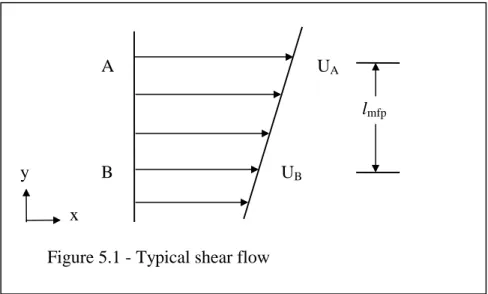
accomplished by considering the shear flow illustrated in Figure 5.1 (Wilcox, 1993). Here the stress exerted in the horizontal direction by the fluid particles, or molecules, at point B on a plane at point A, whose normal is in the y-direction, can be given by
Area u u m B A xy ) ( − = τ (5.2)
where the area in Eq. (5.2) is that of the vertical plane at A.
A UA
lmfp
y B UB
x
Figure 5.1 - Typical shear flow
For a perfect gas, the average vertical velocity can be taken to be the thermal velocity, vth. A typical particle will move with this velocity along its mean free path, lmfp, before colliding with another molecule and transferring its momentum.
If a molecule is considered to move along its mean free path along the vertical distance from B to A, then the shear stress on the lower side of plane A may be written as
dy dU l v C th mfp xy ρ τ =− (5.3)
where C is a proportionality constant. From kinetic theory, for a perfect gas this constant can be shown to be 0.5. This then allows the viscosity of a perfect gas to be defined by
mfp thl v ρ µ 2 1 = (5.4)
Now the shear stress given in Eq. (5.1) may be written as
dy dU v u xy ρ µ τ =− '' ''= (5.5)
Realize that in Eq. (5.3) the Taylor series defining the velocity has been truncated after the first term. This approximation requires that (Wilcox, 1993)
1 2 2 − << dy U d dy dU lmfp (5.6)
This approximation also assumes that the horizontal velocity remains essentially constant at any plane. Since molecules will be transferring horizontal momentum to and from a plane, the velocity at any plane may be considered effectively constant only if the molecules experience many collisions on the time scale relative to the mean flow. This stipulation requires
1 − << dy dU v lmfp th (5.7)
Both of these stipulations are satisfied for virtually all flows of engineering interest, given that vth is on the order of the speed of sound in the fluid and lmfp is relatively small. They are mentioned
here since anyone performing turbulence modeling and trying to mimic eddy transport, by analogy to molecular transport, must at least be aware of these stipulations.
Using a concept similar to the molecular viscosity for molecular stresses, the concept of the eddy viscosity may be used to model the Reynolds stresses. For general flow situations the eddy viscosity model may be written as
− ′ ′ = + − u u U x U x k i j t i j j i ij ν ∂ ∂ ∂ ∂ δ 2 3 (5.8)
where νt is the turbulent or eddy viscosity, and k is the turbulent kinetic energy. In contrast to the molecular viscosity, the turbulent viscosity is not a fluid property but depends strongly on the state of turbulence; νt may vary significantly from one point in the flow to another and also from flow to flow. The main problem in this concept is to determine the distribution of νt.
Inclusion of the second part of the eddy viscosity expression assures that the sum of the normal stresses is equal to 2k, which is required by definition of k. The normal stresses act like pressure forces, and thus the second part constitutes pressure. Eq. (5.8) is used to eliminate u u′ ′i j in the momentum equation. The second part can be absorbed into the pressure-gradient term so that, in effect, the static pressure is replaced as an unknown quantity by the modified pressure given by
p p ρk
3 2
*= + . (5.9)
Therefore, the appearance of k in Eq. (5.8) does not necessarily require the
determination of k to make use of the eddy viscosity formulation; the main objective is then to determine the eddy viscosity.
In direct analogy to the turbulent momentum transport, the turbulent heat or mass transport is often assumed to be related to the gradient of the transported quantity, with eddies again replacing molecules as the carriers. With this concept, the Reynolds flux terms may be expressed using − ′ ′ =u x i t i φ ∂φ ∂ Γ (5.10)
Here Γt is the turbulent diffusivity of heat or mass and has units equivalent to the thermal diffusivity of m2/s. Like the eddy viscosity, Γtis not a fluid property but depends on the state of the turbulence. The eddy diffusivity is usually related to the turbulent eddy viscosity via
σ νt
t =
Γ (5.11)
where σ is the turbulent Prandtl or Schmidt number, which is a constant approximately equal to one.
As will be shown in later sections, the primary goal of many turbulence models is to find some prescription for the eddy viscosity to model the Reynolds stresses. These may range from the relatively simple algebraic models, to the more complex models such as the k-ε model, where two additional transport equations are solved in addition to the mean flow equations.
6.0 ALGEBRAIC TURULENCE MODELS: ZERO-EQUATION MODELS
The simplest turbulence models, also referred to as zero equation models, use a Boussinesq eddy viscosity approach to calculate the Reynolds stress. In direct analogy to the molecular transport of momentum, Prandtl’s mixing length model assumes that turbulent eddies cling together and maintain their momentum for a distance, lmix, and are propelled by some turbulent velocity, vmix. With these assumptions, the Reynolds stress terms are modeled bydy dU l v v u ρ mix mix ρ = − ' ' (6.1)
for a two-dimensional shear flow as is shown in Figure 5.1. This model further postulates that the mixing velocity, vmix, is of the same order of magnitude as the (horizontal) fluctuating velocities of the eddies, which can be supported through experimental results for a wide range of turbulent flows. With this assumption
dy dU l w v u vmix ≈ ' ≈ ' ≈ ' ≈ mix (6.2)
or, in terms of the eddy, or turbulent, viscosity for a shear flow
( )
dy dU lmix t 2 ρ µ = (6.3)which can be implied from Eq. (6.1). This definition for the eddy viscosity can also be implied on dimensional grounds. With these definitions in mind, the objective of most algebraic models is to find some prescription for the turbulent mixing length, in order to provide closure to Eqs. (6.1) and (6.3).
The idea that a turbulent mixing length can be used in a similar way that the molecular mean free path is used to calculate the viscosity for a perfect gas provides a reasonable approach to calculating the eddy viscosity. However, this approach must be examined in light of the same assumptions made for the analysis of the molecular viscosity in Section 5.0. The appropriateness of this model can be questioned by considering the two requirements that were considered for the case of molecular mixing (Tennekes and Lumley, 1983), namely
1 2 2 − << dy U d dy dU lmix (6.4) and 1 − << dy dU v lmix th (6.5)
It has been shown experimentally, that close to a wall lmix is proportional to the normal distance from the wall. Also, near a solid surface the velocity gradient varies inversely with y, as deduced from the law of the wall for a turbulent velocity profile. Considering these facts in light of Eq. (6.4), the mixing length model does not give solid justification for the first order Taylor series truncation that is used in the molecular viscosity equation. The fact that the average time for collisions dy dU l v mix mix ≈ (6.6)
is large, also guarantees that the momentum of an eddy will undergo changes due to other collisions before it travels the full distance of its mixing length (Tennekes and Lumley, 1983). This fact is not taken into consideration since the molecular length of travel is defined as the undisturbed distance that a molecule travels before collision. These comparisons show that the mixing length model does not have a strong theoretical background as it is usually perceived. Despite the shortcomings, however, in practice it can actually be calibrated to give good engineering and trend predictions.
Free shear flows
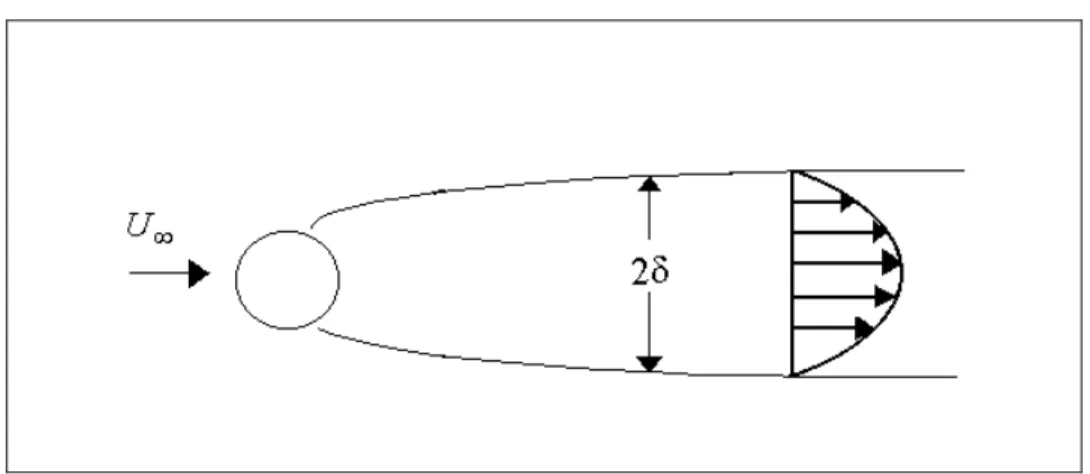
A flow is termed "free" if it can be considered to be unbounded by any solid surface. Since walls and boundary conditions at solid surfaces complicate turbulence models, two-dimensional, free shear flows form a good set of cases to study the applicability of a turbulence model. This stems from the fact that only one significant turbulent stress exists in two-dimensional flows. Three flows that can be considered are the far wake, the mixing layer, and the jet. A wake forms downstream of any object placed in the path of a flowing fluid, a mixing layer occurs between two parallel streams moving at different speeds, and a jet occurs when a fluid is injected into a second quiescent fluid. A far wake is shown in Figure 6.1.
For each of these cases the assumption can be made that the mixing length is some constant times the local layer width, δ, or
lmix = αδ(x) (6.7)
This constant must be determined through some empirical input, as well as the governing equations. For all three flows the standard boundary layer (or thin shear layer) equations can be used. Two assumptions governing the eventual solution of the problem are that the pressure is constant and that molecular transport of momentum is negligible compared to the turbulent transport. From the similarity analysis and numerical solutions that are obtained for this class of flows, the values governing the mixing length are given in Table 6.1.
For each of the free shear cases, the analytical prediction of the velocity gives a sharp turbulent/non-turbulent interface. These interfaces, while existing in reality, are generally characterized by time fluctuations and have smooth properties when averaged, not sharp interfaces. This unphysical prediction of the mixing length model is characteristic of many turbulence models where a region has a turbulent/non-turbulent interface. The intermittent, transient nature of turbulence is therefore not accounted for at the interface in these solutions.
Table 6.1 - Mixing length constants for free shear flows (Wilcox, 1993)
Flow Type: Far Wake Plane Jet Radial Jet Plane Mixing Layer
Wall bounded flows
In free shear flows the mixing length was shown to be constant across a layer and proportional to the width of the layer. For flows near a solid surface, a different prescription must be used, notably since the mixing length can not physically extend beyond the boundary established by the solid surface.
For flow near a flat wall or plate, using the experimental fact that momentum changes are negligible and the shear stress is approximately constant, it can be shown (Wilcox, 1993), using boundary layer theory, that
+ + + = dy du t) 0 . 1 ( 0 . 1 ν ν (6.8)
where u+ =uu∗, y+ = yu∗ ν (u* = τw ρ, τw = wall shear stress) are the familiar dimensionless
velocity and vertical distance (also known as wall variables) as used in the law of the wall. In the viscous sublayer, where viscous forces dominate turbulent fluctuations, Eq. (6.8) becomes (see Appendix B)
u+ =y+ (6.9)
For wall flows, based on experimental observations, it is taken that the mixing length is proportional to the distance from the surface, or in terms of the eddy viscosity as given by Eq. (6.3) dy dU y t 2 2 κ ν = (6.10)
Also, in the fully turbulent zone, effects of molecular viscosity are low compared with νt. This allows Eq. (6.8) to be written as
2 0 . 1 = + ++ dy du y κ (6.11)
which can be integrated (with the assumption that the turbulent shear stress is constant) to give
u+ = 1 y+ +C
κln( ) (6.12)
and shows that the mixing length concept is consistent with the experimental law of the wall if the mixing length is taken to vary in proportion to the distance normal from the surface. Since Eq. (6.12) is a good estimate only in the log layer, and not close to the wall in the viscous sublayer or in the outer layer, several modifications to the approximation for lmix have been devised. Three of the better known modifications are the Van-Driest, Cebeci-Smith (1974), and Baldwin-Lomax (1978) models.
Van-Driest Model
To make lmix approach zero more quickly in the viscous sublayer, this model specifies
(
)
[
− + +]
= o
mix y y A
l κ 1 exp / (6.13)
where Ao+ = 26. This model is based primarily on experimental evidence, but it is also based on the idea that the Reynolds stress approaches zero near the wall in proportion to y3. This has been shown to be the case in DNS simulations.
Cebeci-Smith Model (1974)
For wall boundary layers, this model provides a complete specification of the mixing length and eddy viscosity over the entire range of the viscous sublayer, log layer, and defect or outer layer. Here the eddy viscosity is given in the inner region by
2 / 1 2 2 2 ) ( + = x V y U lmix t ∂ ∂ ∂ ∂ ν y≤ym (6.14) with lmix =κy
[
1−exp(−y+ /A+)]
(6.15) 2 / 1 2 / 1 26 − + + = τ ρu dx dP y A (6.16)The outer layer viscosity is given by
νt =α δUe v KlebF yδ * ( ; ) y>ym (6.17) with α = 0.0168 and FKleb( ; )yδ . y δ = + − 1 5 5 6 1 (6.18)
Here ym is the smallest value of y for which the inner and outer eddy viscosities are equal, δ is the boundary layer thickness, and δv∗ is the velocity or displacement thickness for incompressible
flow. FKleb is Klebanoff’s intermittency function, which was proposed to account for the fact that in approaching the free stream from within a boundary layer, the flow is sometimes laminar and sometimes turbulent (i.e. intermittent).
Some general improvements of this model are that it includes boundary layers with pressure gradients by modifying the value of A+ in Van-Dreist's mixing length formula. This model is also very popular because of its ease of implementation in a computer program; here the main problem is the computation of δ and δv*. It is also worth noting that, in general, the point where y = ym and the Reynolds stress is a maximum occurs well inside the log layer.
Baldwin-Lomax Model (1978)
The Baldwin-Lomax model (Baldwin and Lomax, 1978) was formulated to be used in applications where the boundary layer thickness, δ, and displacement thickness, δv*, are not easily determined. As in the Cebeci-Smith model (Cebeci and Smith, 1974), this model also uses an inner and an outer layer eddy viscosity. The inner viscosity is given by
ω
ν 2
) ( mix
t = l y≤ym (6.19)
where the symbol, ω ,is the magnitude of the vorticity vector for three dimensional flows. Here the vorticity provides a more general parameter for determining the magnitude of the mixing velocity than the velocity gradient as is given in Eq. (6.2). The mixing length is calculated from the Van-Driest equation:
lmix =κy
[
1−exp(−y+ /Ao+)]
(6.20)The outer viscosity is given by
νt =ραC Fcp WakeFKleb( ,y ymax/CKleb) y>ym (6.21)
where
FWake =min
[
ymax maxF ,C ywk maxU2dif /Fmax]
(6.22) = 1 max( ) max
ω
κ
mix y l F (6.23)This model avoids the need to locate the boundary layer edge by calculating the outer layer length scale in terms of the vorticity instead of the displacement or thickness. By replacing Ueδ*v in the Cebici-Smith model by CcpFWake
if FWake = ymax maxF then δv mxzω e y U * = 2 (6.24)
if FWake =C ywk maxU2dif /Fmax then δ
ω = Udif
(6.25)
Here ymax is the value of y at which lmix of ω achieves its maximum value, and Udif is the maximum value of the velocity for boundary layers. The constants in this model are given by
κ = 0.40 α = 0.0168 A+o = 26
Ccp = 1.6 CKleb = 0.3 Cwk = 1
Both the Cebici-Smith (1974) and the Baldwin-Lomax (1978) models yield reasonable results for such applications as fully developed pipe or channel flow and boundary layer flow. One interesting observation for pipe and channel flow is that subtle differences in a model’s prediction for Reynolds stress can lead to much larger differences in velocity profile predictions. This is a common accuracy dilemma with many turbulence models. Both models have been fine tuned for boundary layer flow and therefore provide good agreement with experimental data for reasonable pressure gradients and mild adverse pressure gradients.
For separated flows, algebraic models generally perform poorly due to their inability to account for flow history effects. The effects of flow history account for the fact that the turbulent eddies in a zone of separation occur on a time scale independent of the mean strain rate. Several modifications to the algebraic models have been proposed to improve their prediction of separated flows, most notably a model proposed by Johnson and King (1985). This model solves an extra ordinary differential equation, in addition to the Reynolds equations, to satisfy a “non-equilibrium” parameter that determines the maximum Reynolds stress.
In general, zero-equation algebraic models perform reasonably well for free shear flows; however, the mixing length specification for these flows is highly problem dependent. For wall bounded flows and boundary layer flows the Cebeci-Smith (1974) and Baldwin-Lomax (1978) models give good engineering predictions when compared to experimental values of the friction coefficients and velocity profiles. This is partially due to the modifications these models have received to match experimental data, especially for boundary layer flows. Neither model is reliable for predicting extraordinarily complex flows or separated flows, however they have historically provided sound engineering solutions for problems within their range of applicability. The Johnson-King (1985) model mentioned above gives better prediction for separated flows by solving an extra differential equation. This model is referred to as a “half-equation” model due to the fact that the additional equation solved is an ordinary differential equation. As will be shown in the next section on one and two equation models, a major classification of turbulence modeling is based on the solutions of additional partial differential equations that determine characteristic turbulent velocity and length scales.
7.0 ONE-EQUATION TURBULENCE MODELS
As an alternative to the algebraic or mixing length model, one-equation models have been developed in an attempt to improve turbulent flow predictions by solving one additional transport equation. While several different turbulent scales have been used as the variable in the extra transport equation, the most popular method is to solve for the characteristic turbulent velocity scale proportional to the square root of the specific kinetic energy of the turbulent fluctuations. This quantity is usually just referred to as the turbulence kinetic energy and is denoted by k. The Reynolds stresses are then related to this scale in a similar manner in which τij was related to vmix and lmix in algebraic models. Since the modeled k equation is generally the basis for all one and two equation models, the exact differential equation for the turbulence kinetic energy, and the physical interpretation of the terms in the turbulence kinetic energy equation, will be considered first. Then, with some understanding of the exact equation, the methods used to model the k equation will be considered.
Exact Turbulent Kinetic Energy Equation
As has been mentioned, an obvious choice for the characteristic velocity scale in a turbulent flow is the square root of the kinetic energy of the turbulent fluctuations. Using the primed quantities to denote the velocity fluctuations, the Reynolds averaged kinetic energy of the turbulent eddies can be written on a per unit mass basis as
(
)
k = 1 + +
2 u u' ' v v' ' w w' ' (7.1)
An equation for k may be obtained by realizing that Eq. (7.1) is just 1/2times the sum of the normal Reynolds stresses. By setting j = i and k = j in Eq. (4.26), which is equivalent to taking the trace of the Reynolds stress tensor, the k equation for an incompressible fluid can be deduced as
( )
− − + ∂ ∂ − = + ' ' ' ' ' 2 1 ' ' j j i i j j k i k i j i ij j j u p u u u x k x x u x u x U k U x t k ρ ∂ ∂ µ ∂ ∂ ∂ ∂ µ ∂ ∂ τ ∂ ∂ ρ ∂ ∂ ρ (7.2) I II III IVThe full derivation of Eq. (7.2) is given in Appendix C. As was seen in the derivation for the Reynolds stress equation, the k equation involves several higher order correlations of fluctuating velocity components, which cannot be determined. Therefore, before attempting to model Eq. (7.2), it is beneficial to consider the physical processes represented by each term in the k equation.
The first and second term on the left-hand side of Eq. (7.2) represent the rate of change of the turbulent kinetic energy in an Eulerian frame of reference (time rate of change plus advection) and are familiar from any generic scalar transport equation.
The first term on the right-hand side of Eq. (7.2) is generally known as the production term, and represents the specific kinetic energy per unit volume that an eddy will gain per unit time due to the mean (flow) strain rate. If the equation for the kinetic energy of the mean flow is considered, it can be shown that this term actually appears as a sink in that equation. This should be expected and further verifies that the production of turbulence kinetic energy is indeed a result of the mean flow losing kinetic energy.
The second term on the left-hand side of Eq. (7.2) is referred to as dissipation, and represents the mean rate at which the kinetic energy of the smallest turbulent eddies is transferred to thermal energy at the molecular level. The dissipation is denoted as ε and is given by
(II) = k i k i x u x u ∂ ∂ ν ε = ∂ ' ∂ ' (7.3)
The dissipation is essentially the mean rate at which work is done by the fluctuating strain rate against fluctuating viscous stresses. It can be seen that because the fluctuating strain rate is multiplied by itself, the term given by Eq. (7.3) is always positive. Hence, the role of the dissipation will be to always act as a sink (or destruction) term in the turbulent kinetic energy equation. It should also be noted that the fluctuating strain rate is generally much larger than the mean rate of strain when the Reynolds number of a given flow is large.
The third term in Eq (7.2) represents the diffusion, not destruction, of turbulent energy by the molecular motion that is equally responsibly for diffusing the mean flow momentum. This term is given by (III) = ∂ ∂x µ ∂∂ k x j j (7.4)
and can be seen to have the same general form of any generic scalar diffusion term.
The last term in Eq. (7.2), containing the triple fluctuating velocity correlation and the pressure fluctuations, is given by
(IV) = ∂
(
)
∂xj −ρu u ui' i' j'−p u' j' (7.5) The first part of this term represents the rate at which turbulent energy is transported through the flow via turbulent fluctuations. The second part of this term is equivalent to the flow work done on a differential control volume due to the pressure fluctuations. Essentially this amounts to a transport (or redistribution) by pressure fluctuations. Each of the terms included in Eq. (7.4) and
(7.5) have the tendency to redistribute the specific kinetic energy of the flow. This is directly analogous to the way in which scalar gradients and turbulent fluctuations transport any generic scalar. It is important, then, to realize that the transport by gradient diffusion, turbulent fluctuations, and pressure fluctuations can only redistribute the turbulent kinetic energy in a given flow. However, the first two terms on the RHS of Eq. (7.2) actually represent a source and a sink by which turbulent kinetic energy may be produced or destroyed.
Modeled Turbulent Kinetic Energy Equation
If the k equation is going to be used for any purpose other than lending some physical insight into the behavior of the energy contained by the turbulent fluctuations, some way of obtaining its solution must be sought. As with all Reynolds averaged, turbulence equations, the higher order correlations of fluctuating quantities produce more unknowns than available equations, resulting in the familiar closure problem. Therefore, if the k equation is to be solved, some correlation for the Reynolds stresses, dissipation, turbulent diffusion, and pressure diffusion must be specified in light of physical reasoning and experimental evidence. The specification of these terms in the specific turbulent kinetic energy equation is generally the starting point in all one and two equation turbulence models.
The first assumption made in modeling the k equation is that the Boussinesq eddy viscosity approximation is valid and that the Reynolds stresses can be modeled by
ij i j j i t ij k x U x U δ ρ ∂ ∂ ∂ ∂ µ τ 3 2 − + = (7.6)
for an incompressible fluid. The eddy viscosity in Eq. (7.6) is based on a similar concept that was used for algebraic models and is generally given by
l k t 2 / 1 ρ µ ≈ (7.7)
where l is some turbulence length scale. This length scale, l, may be similar to the mixing length, but is written without the subscript “mix” to avoid confusion with mixing length models. The characteristic velocity scale in Eq. (7.7) is taken to be the square root of k, since the turbulent fluctuations at a point in the flowfield are representative of the turbulent transport of momentum. The prescription for µt given by Eq. (7.7) is very similar to that given by
mix mix t ρv l
µ ≈ (7.8)
for the algebraic or mixing length model, where vmix was generally taken to be related to a single
velocity gradient in the flow. Implicit in either prescription for the eddy viscosity is the assumption that the turbulence behaves on a time scale proportional to that of the mean flow.
that can result using an eddy viscosity model for certain classes of flows. It should be noted that Eq. (7.7) is an isotropic relation, which assumes that momentum transport in all directions is the same at a given point in space. However, if used appropriately, this concept yields predictions with acceptable accuracy for a wide range of engineering applications.
The physical reasoning used in modeling the dissipation term is not distinctive; however, the same general conclusion of how epsilon should scale can be inferred by several considerations. A first approximation for ε may be obtained by considering a steady, homogenous, thin shear layer where it can be shown that production and dissipation of turbulent kinetic energy balance (i.e. flow is in local equilibrium). Mathematically this may be written as
ε ∂ ∂ ν ∂ ∂ = ∂ ∂ = − k i k i j i j i x u x u x U u u ' ' ' ' (7.9)
from Eq. (7.2). Since homogeneous, shear generated turbulence can be characterized by one length scale, l, and one velocity scale, u, the left hand side of Eq. (7.9) may be taken to scale approximately as u3/l. Hence, for turbulent flows where production balances dissipation, if the turbulence can be characterized by one length and one velocity scale, the dissipation may be taken to scale according to
ε ≈ u3
l (7.10)
where the length scale l, and the velocity scale u, are characteristic of the turbulent flow.
Another interpretation of the dissipation term may be to consider that the rate of energy dissipation is controlled by inviscid mechanisms, the interaction of the largest eddies. The large eddies cascade energy to the smaller scales, which adjust to accommodate the energy dissipation. Therefore the dissipation should scale in proportion to the scales determined by the largest eddies (see, e.g. Tennekes and Lumley, 1983). Using dimensional analysis, in terms of a single turbulent velocity scale, u, and a single turbulence length scale, l, leads to Eq. (7.10).
The estimate obtained in this fashion rests on one of the primary assumptions of turbulence theory; it claims that the large eddies lose most of their energy in one turnover time. It does not claim that the large eddy dissipates the energy directly, but that it is dissipative because it creates smaller eddies. This interpretation is independent of the assumption that production balances dissipation and may be taken as a good approximation for many types of flows. The absence of this assumption may be implied from the fact that it is already accounted for since at the small scales, turbulence production effectively balances dissipation. In other words, at high Reynolds numbers, the local equilibrium assumption is usually valid.
White (1991) comes to the same conclusion based on a somewhat more physically based argument. If an eddy of size l is moving with speed u, its energy dissipated per unit mass should be approximated by l u l u l u velocity drag 3 3 2 2 ) ( mass ) )( ( ≈ ≈ ≈ ρ ρ ε (7.11)
Given these arguments for the scales of the dissipation, and taking the square root of the turbulent kinetic energy as the characteristic velocity scale, the dissipation is generally modeled by
ε ≈ k
l
3 2/
(7.12)
The turbulent transport of k, and the pressure diffusion terms, are generally modeled by assuming a gradient diffusion transport mechanism. This method is similar to that used for generic scalar transport in a turbulent flow as was given in Section 5.0. While this method is normally applied to the terms involving the turbulent fluctuations, it is common practice to group the pressure fluctuation term, which is generally small for incompressible flows, with the gradient diffusion term. With these assumptions the turbulent transport of k and the pressure fluctuation term are given by − − = ' ' ' ' ' 2 1 j j i i j k t u u u pu x k ρ ∂ ∂ σ µ (7.13)
where σk is a closure coefficient known as the Prandtl-Schmidt number for k.
Combining the modeled terms for the Reynolds stress, dissipation, turbulent diffusion, and pressure diffusion with the transient, convective, and viscous terms gives the modeled k equation as
( )
+ + − = + j t t j j i ij j j x k x x U k U x t k ∂ ∂ σ µ µ ∂ ∂ ρε ∂ ∂ τ ∂ ∂ ρ ∂ ∂ ρ ( (7.14)with the dissipation and eddy viscosity given by
ε = CDk l 3 2/ (7.15) l k C t 2 / 1 ρ µ = µ (7.16)
where CD and Cµ are constants.
An obvious requirement is still the determination of the length scale, l, which for a one-equation model must still be specified algebraically in accordance to some mean flow parameters. Since the one-equation model is based primarily on several of the same assumptions as the mixing
proportional to lmix. For many one-equation models, the algebraic prescriptions used for the mixing length provide a logical starting place. One popular version of this model (Emmons, 1954; Glushko, 1965) involves setting σk = 1.0, with CD varying between 0.07 and 0.09, along with length scale prescriptions similar to those for the mixing length model. This model is somewhat simple, involving less closure coefficients than several mixing length models; however, the necessary prescription of l by algebraic equations, which vary from problem to problem, is a definite limitation. Hence even with a characteristic velocity scale, one-equation models are still incomplete.
Typical applications for one-equation models involve primarily the same types of flows as did mixing