Improving Web Application Testing with User Session Data
Sebastian Elbaum
y, Srikanth Karre
y, Gregg Rothermel
z,
yDepartment of Computer Science and
Engineering
University of Nebraska - Lincoln
Lincoln, Nebraska
f
elbaum,skarre
g@cse.unl.edu
z
Department of Computer Science
Oregon State University
Corvallis, Oregon
[email protected]
Abstract
Web applications have become critical components of the global information infrastructure, and it is important that they be validated to ensure their reliability. Therefore, many techniques and tools for validating web applications have been created. Only a few of these techniques, however, have addressed problems of testing the functionality of web applications, and those that do have not fully considered the unique attributes of web applications. In this paper we explore the notion that user session data gathered as users operate web applications can be successfully employed in the testing of those applications, particularly as those appli-cations evolve and experience different usage profiles. We report results of an experiment comparing new and existing test generation techniques for web applications, assessing both the adequacy of the generated tests and their ability to detect faults on a point-of-sale web application. Our re-sults show that user session data can produce test suites as effective overall as those produced by existing white-box techniques, but at less expense. Moreover, the classes of faults detected differ somewhat across approaches, suggest-ing that the techniques may be complimentary.
1. Introduction
Web applications are among the fastest growing classes of software systems in use today. These applications are being used to support a wide range of important activities: business functions such as product sale and distribution, scientific activities such as information sharing and pro-posal review, and medical activities such as expert-system based diagnoses. Given the importance of such applica-tions, faulty web applications can have far-ranging conse-quences on businesses, economies, scientific progress, and health. It is important that web applications be reliable, and to help with this, they should be validated.
To address this problem, many types of web application validation techniques have been proposed and many tools have been created. Most of these techniques and tools, however, focus on aspects of validation such as protocol conformance, load testing, broken link detection, and var-ious static analyses, and do not directly address validation of functional requirements. Those tools that do focus on functional requirements primarily provide infrastructure to support capture-replay: recording tester input sequences for use in testing and regression testing.
Recently, a few more formal approaches for testing the functional requirements of web applications have been pro-posed [11, 17]. In essence, these are “white-box” ap-proaches, building system models from inspection of code, identifying test requirements from those models, and requir-ing extensive human participation in the generation of test cases to fulfill those requirements. The approaches have shown promise in early empirical studies in terms of support for constructing “adequate” (by some criterion) test suites. However, the approaches also have drawbacks, in part due to differences between web applications and systems devel-oped and operated under more traditional paradigms.
Among these differences, we consider three in particular. First, the usage of web applications can change rapidly. For example, a web site with a popular name that is caught by a search engine can suddenly find itself receiving hundreds of thousands of hits per day rather than just dozens [12]. In such cases, test suites designed with particular user profiles in mind may turn out to be inappropriate.
Second, web applications typically undergo maintenance at a faster rate than other software systems; this mainte-nance often consists of small incremental changes [9]. To accommodate such changes, testing approaches must be au-tomatable and test suites must be adaptable.
Finally, web applications typically involve complex, multi-tiered, heterogeneous architectures including web servers, application servers, database servers, and clients
acting as interpreters. Testing approaches must be able to handle the various components in this architecture.
Although some recently proposed techniques for testing the functional requirements of web applications [11, 17] partially address this third difference, the first two differ-ences have not yet been addressed. Thus, in this paper, we propose a testing approach that utilizes data captured in user sessions to create test cases. We describe two stand-alone implementations of this approach, and a hybrid implemen-tation that combines the approach with techniques such as the existing white-box approaches just described. We re-port results of an empirical study comparing these imple-mentations of our approach with two different implemen-tations of an existing approach recently proposed by Ricca and Tonella [17]. Unlike previous studies of web applica-tion testing techniques, however, our study assesses the fault detection effectiveness of the approaches.
In the next section we briefly describe the characteristics of the class of web applications that we are considering, and then we review related work on testing these applications. Section 3 describes Ricca and Tonella’s technique in greater detail, and then describes our new approach and its imple-mentations. Section 4 presents the design and results of our empirical study of these techniques, and Section 5 summa-rizes and comments on future work.
2. Background and Related Work
2.1. Web applications
A web site can be differentiated from a web application based on the “ability of a user to affect the state of the busi-ness logic on the server” [4]. In other words, requests made of a web application go beyond navigational requests, in-cluding some form of data that needs further decomposition and analysis to be served.
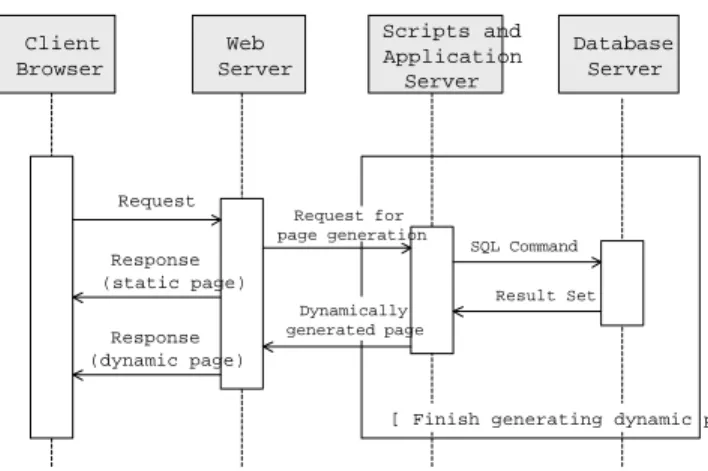
Figure 1 shows how a simple web application operates. A user (client) sends a request through a web browser. The web server responds by delivering content to the client. This content generally takes the form of some markup language (e.g., HTML) that is later interpreted by the browser to ren-der a web page at the user site. For example, if a request consists of just a URL (Uniform Resource Locator – a web site address), the server may just fetch a static web page.
Other requests are more complicated and require further infrastructure. For example, in an e-commerce site, a re-quest might include not just a URL, but also data provided by the user. Users provide data primarily through forms consisting of input fields (textboxes, checkboxes, selection lists) rendered in a web page. This information is translated into a set of name-value pairs (input fields’ names and their values) and becomes part of the request.
Although the web server receives this request, further el-ements are needed to process it. First, a group of scripts and
Client Browser Web Server Scripts and Application Server Database Server
[ Finish generating dynamic p Request Request for page generation Response (dynamic page) Dynamically generated page Result Set SQL Command Response (static page)
Figure 1.Sequence diagram of a web application.
perhaps an application server may parse the request, query a database server to retrieve information about the item, and then employ further formatting scripts to generate HTML code on the fly to address the user request. This newly gen-erated page, gengen-erated at run time and depending on user’s input, is called a dynamic web page.
In this context, the application server, database, and scripts collaborate to assemble a response that fits the re-quest. Although in practice requests can be more complex, this example illustrates that there are multiple and varied technical components behind the web server. It is also im-portant to note that scripts such as those just referred to are changed frequently [13], and the technologies supporting them change often, as evident in the frequent appearance of new standards for web protocols (e.g., XML, XSL, SOAP and CCS [10]).
2.2. Related work
The testing of web applications has been led by indus-try, whose techniques have been oriented primarily toward validation of non-functional requirements. This is evident in the number and variety of existing tools available for the relatively new web application domain. These tools range from markup text language validators and link checkers to various load testing and performance measurement tools.1
The variety and quantity of tools for testing functional requirements of web applications, on the other hand, is much more limited. The most common class of functional testing tools provide infrastructure to support the capture and replay of particular user scenarios [16, 18]. Testers exe-cute possible user scenarios, and the tools record events and translate them into a series of scripts that can be replayed later for functional and regression testing. Other classes 1A comprehensive list of these tools is available at http://www.softwareqatest.com/qatweb1.html.
of functional testing tools generate test cases by combin-ing some type of web site path exploration algorithm with tester provided inputs [13, 15]. A prototype framework in-tegrating these various features is presented in [19].
Recently, two more formal techniques have been pro-posed to facilitate testing of functional requirements in web applications. Both techniques employ forms of model-based testing, but can be classified as “white-box” tech-niques, since they rely on information gathered from the web application code to generate the models on which they base their testing. Liu et al. [11] propose WebTestModel, which considers each web application component as an ob-ject and generates test cases based on data flow between those objects. Ricca and Tonella [17] propose a model based on the Unified Modeling Language (UML), to enable web application evolution analysis and test case generation. Both these techniques, in essence, extend traditional path-based test generation and data flow adequacy assessment to the web application domain; the second also builds on the existence of popular UML modelling capabilities.
It is worth noting that the effectiveness of these tech-niques has been evaluated only in terms of ability to achieve coverage adequacy. We find no reports to date of studies as-sessing fault detection capabilities of the techniques.
3. Web-Application Testing Techniques
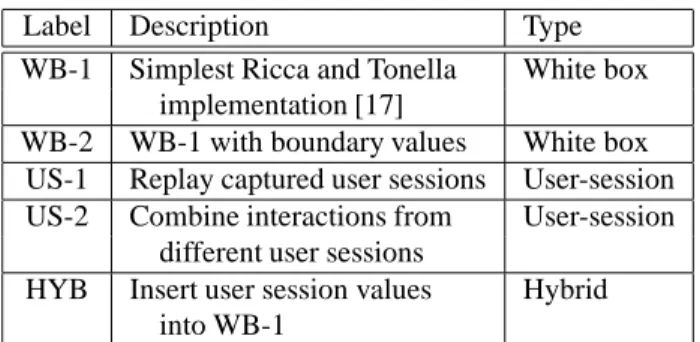
In this section we provide further details about the par-ticular techniques that we have investigated, including ex-isting approaches and user-session based approaches. We first describe our implementations of Ricca and Tonella’s approach. This approach is representative of the white-box techniques described in Section 2; it has also shown suc-cess in terms of coverage adequacy, and has been presented in detail sufficient to allow its implementation, given a few assumptions. Next, we introduce two new techniques for use in testing functional requirements of web applications. Our techniques are based on data captured in user sessions, and they exploit the availability of user inputs for automatic test case generation. Last, we present one possible inte-gration of these two approaches. Table 1 summarizes the techniques.
3.1. Ricca and Tonella’s approach
Conceptually, Ricca and Tonella’s [17] approach creates a model in which nodes represent web objects (web pages, forms, frames), and edges represent relationships and inter-actions among the objects (include, submit, split, link).
For example, Figure 2 shows a model of a component of an application for on-line book purchasing, following the graphical representation used in [17]. The diagram starts at the BookDetail node. This node is dynamically gener-ated in response to a request to browse a particular book.
Label Description Type
WB-1 Simplest Ricca and Tonella White box implementation [17]
WB-2 WB-1 with boundary values White box US-1 Replay captured user sessions User-session US-2 Combine interactions from User-session
different user sessions
HYB Insert user session values Hybrid into WB-1
Table 1.Web application testing techniques.
When rendered by the browser, this page contains informa-tion about the book and also includes (through edges e1 and e4) two forms: one to add the book to the shopping cart and one to rate the book. Both forms collect user input. If the rating form is submitted (e5), a new BookDetail page is gen-erated with the updated rating for the book. If a valid book quantity is submitted (e2), the shopping cart is updated and a corresponding dynamically generated page is sent to the browser. Otherwise, BookDetail is sent again (e3).
(valid quantity) submit submit include ShoppingCart input: quantity (invalid quantity) e2 e4 e5 submit include e3 e1 input:rating Form Form BookDetail Dynamic Page Dynamic Page
Figure 2.UML model of an e-commerce application. To generate test requirements and cases, a path expres-sion to match the graph is generated following a procedure similar to the one introduced by Beizer [2]. The path ex-pression corresponding to the example from Figure 2 is (e1e3)+(e4e5), whereindicates zero or more occur-rences of the immediately preceding edge(s) and + indi-cates an alternative.
The path expression is used to generate quasi test cases in combination with heuristics to minimize the number of test cases required to satisfy a given criterion. For
exam-ple, from the path expression for Figure 2, we can derive the sample quasi test cases: e1e3,e1e2, ande4e5. A (hu-man) tester then provides input values so that the tests can be executed. In this approach, then, a test case consists of a sequence of web pages to be visited, together with their corresponding name-value pairs.
We consider two implementations of this approach. Our first implementation, WB-1, attempts to match the method-ology presented in [17]. Test cases are generated from the path expression following the suggested procedure, but we were forced to make some assumptions about the imple-mentation where details were not available. Specifically: (1) we tested only independent paths; (2) for search fields that could generate many different pages, we tested using only one input value; and (3) we ignored circular links and textual differences in dynamically generated pages. Once the quasi test cases were generated from the path expres-sion, we filled the forms so that they could be executed.
Our second implementation, WB-2, relaxes some of the assumptions established for WB-1 and incorporates a more elaborate approach for input value selection. In contrast to WB-1, WB-2 uses boundary values as inputs, and uti-lizes an “each condition/all conditions” strategy to combine them [3]. The test suite consists of test cases in which each variable is set to true once with all the other variables set to false, plus one test case in which all variables are true. The objective of using boundary values and the “each con-dition/all conditions” strategy was to add formalism to the process of inputting data into the forms, as recommended in one of the examples in [17]. In addition, this technique con-siders not only differences in links, forms, and frames, but also textual differences when evaluating dynamically gen-erated pages.
3.2. User-session based techniques
One limiting factor in the use of white box web appli-cation testing techniques such as Ricca and Tonella’s is the cost of finding inputs that exercise the system as desired. Selection of such inputs is slow and must be accomplished manually [17]. User-session based techniques can help with this problem by transparently collecting user interactions and transforming them into test cases. The techniques cap-ture and store the clients’ requests in the form of URLs and name-value pairs, and then apply strategies to these to gen-erate test cases.
Because normal web application operation consists of re-ceiving and processing requests, and because a web appli-cation runs in just one environment which the organization performing the testing controls, the collection of client re-quest information can be accomplished easily. For example, with minimal configuration changes, the Apache web server can log all received requests [1]. Another slightly more powerful but less transparent alternative that can capture all
name-value pairs consists of adding snippets of javascript to the delivered webpages so that all requests invoke a server-side logging script.
As a consequence, user-session based techniques do not require additional infrastructure to collect this data, limiting the impact on web application performance. This is equiv-alent to having a built-in instrumentation mechanism, an approach well suited to web applications. Another advan-tage of collecting just the requests is that at that higher ab-straction level, some of the complexities introduced by het-erogeneous web application architectures are hidden. This lessens the dependencies of user-session based techniques on changes in web application components.
Given the collected URL and name-value pairs, there are many ways in which test cases could be generated. The simplest approach is to sequentially replay individual user sessions. A second approach is to replay a mixture of inter-actions from several users. A third approach is to replay ses-sions in parallel so that requests are handled concurrently. A fourth approach is to mix regular user requests with requests that are likely to be problematic (e.g., navigating backward and forward while submitting a form).
A complicating factor for these approaches involves web
application state. When a specific user request is made
of a web application, the outcome of that request may de-pend on factors not completely captured in URL and name-value pairs alone; for example, an airline reservation re-quest may function differently depending on the pool of available seats. Further, the ability to execute subsequent tests may depend on the system state achieved by preceding tests. The simplest approach of replaying user sessions in their entirety is not affected by application state, provided that initial system state is known and can be instantiated. The use of more complex approaches such as intermixed or parallel replay, however, might often be affected by state.
In such cases, one approach for using user-session data is to periodically take snapshots of the state values (or of a subset of those values) that potentially affect web appli-cation response. Associating such snapshots with specific requests, or sequences of requests, increases the likelihood of being able to reproduce portions of user sessions, at the cost of resources and infrastructure.
A second alternative is to ignore state when generating test cases. The resulting test cases may not precisely re-produce the user activity on which they are based, but they may still usefully distribute testing effort relative to one as-pect of the users’ operational profile (the asas-pect captured by the operation) in a manner not achieved by white-box test-ing. From this perspective, the process of using user session data to generate test cases is related to the notion of parti-tioning the input domain of an application under test in the hopes of being able to effectively sample from the resulting partitions [21]. In this context, the potential usefulness of
user-session based testing techniques, like the potential use-fulness of white-box testing techniques, need not rest solely on being able to exactly reproduce a particular user session. Rather, that usefulness may reside in using user session data to provide effective partitioning heuristics, together with in-put data that can be transformed into test cases related to the resulting partitions.
The approaches that we have described for generating test data from user sessions and for addressing the prob-lem of application state each have potential costs and ben-efits that must be explored. In this paper, we focus on two specific user-session based techniques — a technique that applies entire sessions, and a technique that replays a mix-ture of sessions — each without incorporating information on state. These techniques are relatively simple, and if they prove effective this would motivate further research on more complex techniques, and further exploration of the tradeoffs among techniques.
Our first technique, US-1, transforms each individual user session into a test case. Given m user sessions, U
1 ;U
2 ;:::U
m, with user session U i consisting of n re-questsr 1 ;r 2 ;:::r n, where each r iconsists of url[name value], the test case corresponding toU
i is generated by formatting each of the requests, fromr
1to r
n, into an http request that can be sent to a web server. The resulting test suite containsmtest cases, one for each user session. (For simplicity, we define a user session as beginning when a re-quest from a new IP address reaches the server and ending when the user leaves the web site or the session times out.)
Our second user-session based technique, US-2, gener-ates new user sessions based on the pool of collected data, creating test cases that contain requests belonging to differ-ent users. US-2 is meant to expose error conditions caused by the use of sometimes conflicting data provided by differ-ent users. US-2 generates a test case as follows:
randomly select unused sessionU
afrom session pool; copy requestsr
1through r
i, where
iis a random num-ber greater than 1 but smaller thann, into the test case; randomly select sessionU
b, where
b 6=a, and search for anyr
jwith the same URL as r
i, and if an equiva-lent request is not found, select another sessionU
b; add all the requests fromU
aafter r
jto the test case; markU
a “used”, and repeat the process until no more unused sessions are available in the pool.
In a sense, US-1 is analogous to a constrained version of a capture-replay tool (e.g, Rational Robot [16]) in which we capture just the URL and name-value pairs that occur throughout a session. In contrast to approaches that capture user events at the client site, however, which can become complicated as the number of users grow, our approach cap-tures just the URL and name-value pairs that are the result of a sequence of the user’s events, captured at the server site.
This alleviates some of the privacy problems introduced by the more intensive instrumentation used by some capture-replay tools.
Both US-1 and US-2 also have several other potential advantages. First, by utilizing user requests as the base for generating test cases, the techniques are less dependent on the complex and fast changing technology underlying web applications, which is one of the major limitations of white box approaches designed to work with a subset of the avail-able protocols. Second, the level of effort involved in cap-turing URL and name-value pairs is relatively small as these are already processed by web applications. This is not the case with white box approaches such as Ricca and Tonella’s, which require a high degree of tester participation. Third, with these approaches, each user is a potential tester: this implies potential for an economy of scale in which addi-tional users provide more inputs for use in test generation. The potential power of the techniques resides in the num-ber and representativeness of the URL and name-value pairs collected, and the possibility of their use in generating a more powerful test suite (an advantage that must be bal-anced, however, against the cost of gathering the associated user-session data). Finally, both approaches, unlike tradi-tional capture and replay approaches, automatically capture authentic user interactions for use in deriving test cases, as opposed to interactions created by testers.
We are not proposing, however, to rely solely on users to assess web application quality. Our approach is meant to be applied either in the beta testing phase to generate a baseline test suite based on interactions with friendly customers, or during subsequent maintenance to enhance a test suite that was originally generated by a more traditional method. Fur-ther, the approach can help testers monitor and improve test suite quality as the web application evolves, and as its usage proceeds beyond the bounds anticipated in earlier releases and earlier testing.
3.3. Integrating user-session and white box methods
The strengths of structured white-box web application testing techniques such as Ricca and Tonella’s might be more successfully leveraged if they can make use of inputs collected during user sessions. This suggests a hybrid test-ing technique combintest-ing techniques presented in the pre-ceding sections with white-box techniques. Such a tech-nique could decrease the cost of input selection, but it re-mains to be seen whether a user session’s value pairs will be effective at detecting faults.We wished to investigate this question and thus we also implemented a hybrid technique. Conceptually, the inte-gration process matches equivalent user-session sequences with the paths defined by Ricca and Tonella’s quasi test cases (quasi because they do not provide values, just tar-get URL paths). Given a quasi test caseqtgenerated by an
WB implementation,qt is translated into a URL sequence urlSeq
qt. Then, the technique iterates through all col-lected user sessions to identify those that contain the entire urlSeq
qt. Once the relevant user sessions have been iden-tified, the name-value pairs corresponding to the matching requests in each session are used to complete theurlSeq
qt, transformingqtinto an executable test case. The process continues until all possible test cases have been generated by combining each WB quasi test case with all user ses-sions with an equivalent sequence.
4. Empirical Study
4.1. Research questions
RQ1. The first question we address is, how effective are the WB techniques at exposing faults in a web application? Evaluating the effectiveness of the WB techniques will help us assess them, and also provide a baseline against which to compare user-session based techniques.
RQ2. Our second research question concerns the cost-effectiveness of user-session based techniques. We conjec-ture that test suites generated through these techniques pro-vide a useful combination of effectiveness and efficiency.
RQ3. Last, we want to know what relationship exists be-tween the number of user sessions and the effectiveness of the test suites generated based on those sessions’ interac-tions. Answering this question will help us explore the cost-effectiveness of user-session based test suite generation.
4.2. Variables and metrics
The testing techniques listed in Table 1 constitute our in-dependent variables, and are represented by the labels WB-1, WB-2, US-WB-1, US-2, and HYB.
The dependent variables we wish to capture are cover-age and fault detection effectiveness. We use two covercover-age metrics: percentage of functions covered and percentage of blocks covered in the perl code that generated the dynamic web pages and accessed the databases. Percentage of faults detected constitutes our other measure of effectiveness.
4.3. Experimental setting
4.3.1 E-commerce site
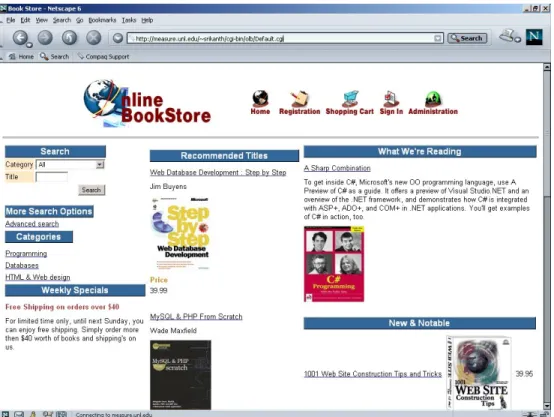
The free and open source on-line bookstore available at go-tocode.com constituted the skeleton of our e-commerce ap-plication. The e-bookstore functionalities are divided into two groups: customer activities and administration activ-ities. This study concentrates on functionalities that are
accessible to the customer, not the administration compo-nent. Figure 3 provides a screenshot of the application. Customers can search, browse, register, operate a shopping cart, and purchase books on-line through this site, which operates like other similar popular sites on the web.
Customer functionality is implemented through Perl scripts and modules to handle data and the dynamic genera-tion of HTML pages, Mysql to manage database accesses, a database structure composed of seven tables tracking books, transactions, and other data objects, and Javascript and cookies to provide identification and personalization func-tionality. An Apache Web Server hosted the application.
We populated the database with information from 100 books (e.g., title, authors, short description, category, price, rating). We adapted the look of the site so that the registra-tion procedure was expedited and logins minimized, which made the navigation process more similar to commercial sites. Last, to capture the information required by the user-session techniques, we modified the scripts generating dy-namic web pages. As a result, the generated web pages in-cluded additional Javascript code to capture user events and to invoke a logging server-side script.
4.3.2 Fault seeding
We wished to evaluate the performance of web testing tech-niques with respect to the detection of faults. Such faults were not available with our subject application; thus, to obtain them, we followed a procedure similar to one de-fined and employed in previous studies of testing techniques [6, 8, 22]. We recruited two graduate students of computer science, each with at least two years of programming expe-rience, and instructed them to insert faults that were as re-alistic as possible based on their experience. To direct their efforts we gave them a random generator that indicated the approximate location of where a fault was to be seeded, and gave them the following list of fault types to consider:2
Scripting faults. This includes faults associated with variables, such as definitions, deletions, or changes in values, and faults associated with control flow, such as addition of new blocks, redefinitions of execution con-ditions, removal of blocks, changes in execution order, and addition or removal of function calls.
Web page faults. This includes addition, deletion, or modification of name-value pairs. Such changes occur in one or more names or values.
Database query faults. This type of fault consists of the modification of a query expression, which could affect the type of operation, the table to access, fields within the table, or the values of search keys or record values. 2These directives are adapted from the fault classification in [14].
Figure 3.Screenshot of e-commerce site used in our experiment.
The graduate students assigned to the task seeded a to-tal of 50 faults. Nine faults were discarded: two were in unused sections of code and the rest had no impact on the application (e.g., the value of a variable was changed after its last usage).
4.3.3 Assignment for participants in study
Once the web application was set up, the challenge was to have users access the site and behave like “typical” users of this type of e-commerce site. Users navigate sites like ours to browse and perhaps purchase books if the material and price are appropriate for their needs and budget. We wished to provide the context and incentive for users to in-teract with our application under similar circumstances.
To achieve these goals, we instructed our study partici-pants to follow a three step process. First, they completed an on-line form with simple demographic data. This step was required only for the first session of each user. Sec-ond, the description of four computer science courses was made available to the participants; the participants needed to select two of those courses. The final step required the participants to access the e-bookstore site to select the most appropriate book(s) for the courses they selected.
To select the most appropriate books, participants had to search and browse until they found those that they con-sidered most appropriate. We provided no definition of
ap-propriateness, so it meant different things to different users, which is supposed to lead to a variety of activities. How-ever, we did provide an incentive so that users took the task completion seriously. The instructions indicated that on completion of the experiment, the five users who selected the most appropriate books for the courses would each re-ceive a ten dollar gift certificate. Further directions spec-ified that, if more than five users selected the most appro-priate books, the amount spent would be evaluated, and ties would be broken by considering the time spent on the web site. Again, the objective was to recreate the conditions ob-served for similar web applications.
4.4. Execution and processing
The US-1, US-2, and HYB techniques required user participation to generate test suites. A list of candidate participants was assembled, containing primarily students from the Department of Computer Science and Engineer-ing at UNL. An email statEngineer-ing participation requirements and incentives was sent to the students on the list. The e-commerce site was then made available to the users for two weeks. Data collected from the user sessions was logged to support subsequent test case generation, which occurred off-line. There were 99 user sessions logged. Fourteen per-cent of the sessions could not be used because, despite in-structions, some users accessed the web site using browsers
Metric WB-1 WB-2 US-1 US-2 HYB
abs % abs % abs % abs % abs %
Test Suite Size 28 – 64 – 85 – 84 – 1089 –
Block Coverage 263 66 306 76 263 66 255 64 260 65
Function Coverage 65 97 66 99 65 97 64 96 65 97
Faults Detected 22 51 25 58 23 53 23 53 23 53
Table 2.Summary data on technique effectiveness.
other than those required. In total, 73 distinct users con-tributed to the 85 useful sessions. The users had an average age of 24 and 94 percent had on-line buying experience.
After the test suites corresponding to each technique were generated, we ran them on the fault-free web appli-cation, which served as an oracle. Then, to measure func-tion and block coverage, the applicafunc-tion was instrumented so that a counter would be incremented each time one of those entities was executed. The e-bookstore had a total of 67 functions and 400 blocks. Measuring coverage required a second execution of each test suite.
Last, we evaluated the test suites generated through each technique by activating the seeded faults individually, and determining which faults were revealed by which test cases. Since we had a total of 43 faults, this last step required an equal number of runs of each test suite.
4.5. Results
4.5.1 On technique effectiveness
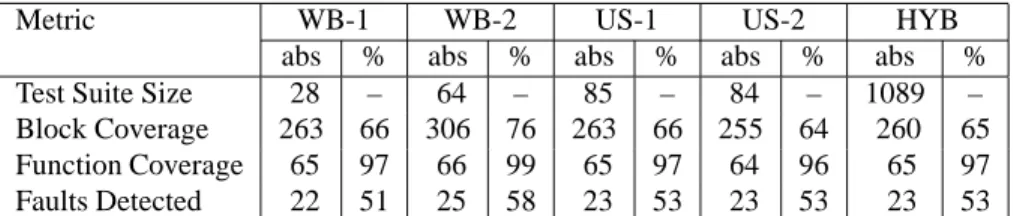
The results of executing the test suites generated by each of the techniques are presented in Table 2. These results cor-respond to RQ1 and RQ2, as defined in Section 4.1, and are presented in absolute values and percentages. Over-all, WB techniques used the fewest test cases, while the HYB approach employed the greatest number (1089). WB-2 provided the greatest fault detection power with 58% of the faults detected, and the greatest coverage with 76% and 99% of the blocks and functions covered, respectively. Both user-session based techniques performed similarly, not as effectively as WB-2, but slightly better than WB-1. US-2 did not discover more faults than US-1 and the HYB ap-proach did not provide additional fault detection or cover-age. This summary, however, fails to reveal some interest-ing facts about the differences between techniques.
First, although the overall results for fault detection are similar, differences between the approaches are more evi-dent when individual faults are analyzed. A detailed com-parison of the most powerful white box and user session based techniques is presented in Table 3. The first row of the table lists the blocks covered, functions covered, and faults detected by WB-2 and US-1. The second and third rows present the same information but focusing on blocks,
Technique Blocks Functions Faults
Combination abs % abs % abs %
(WB2\US1) 255 64 65 97 20 47
(WB2 US1) 51 13 1 1 5 12
(US1 WB2) 8 2 0 0 3 7
(WB2[US1) 314 79 66 99 28 65
Table 3.Detailed comparison of WB-2 and US-1.
functions, or faults uniquely associated with one technique and not the other. The fourth row shows the result of exe-cuting the tests generated by both techniques.
It is evident from the table that the blocks covered by WB-2 and US-1 are not the same: 8 blocks were covered only by US-1, while 51 others were covered only by WB-2. A similar observation can be made about functions covered. Also, 3 of the faults found by US-1 were not found by WB-2, and 5 faults were found only by WB-2. Similar differ-ences occurred with the other techniques. This supports the hypothesis that the distinct approaches we considered are able to find different types of faults. Further, in spite of the unimpressive performance of HYB as we implemented it, the last row row of Table 3 shows that when the test cases of both techniques (representing both approaches) are com-bined, the resulting coverage and fault detection capabilities are better than for any individual technique.
Second, there are some type of faults that user-session based approaches could rarely capture. Those faults have to do with particular name-value pairs that could not be generated using the forms available through the delivered web pages. For example, when doing a book evaluation in the application, five levels (from 1 to 5 stars) are available through the web site. The only way to construct a request with evaluation values outside that range is to generate the request outside the rendered page. This scenario is rarely originated by regular users, but it could have appeared if the site were detected by search robots that perform that type of request. Again, additional exposure time could have helped accomplish this, but it is more likely that this type of request would be generated by design instead of by user activity. In addition, although we could not identify a certain type of faults that WB techniques are likely to miss, we observed
that strategies such as that followed by WB-2 helped lessen the impact of tester input choices on the effectiveness of WB techniques.
4.5.2 On user-sessions versus effectiveness
A detailed analysis of our data revealed that certain tech-niques could have performed better given some adjust-ments. WB-2 could have discovered one more fault if the “each condition/all condition” strategy was replaced by a more powerful strategy such as “all variants” [3]. Still, such an approach would require significant additional hu-man participation, and lead to scalability problems.
US-1, on the other hand, could have detected five ad-ditional faults, increasing its fault detection effectiveness to 68% (better than the other techniques) if additional ex-posure was provided through more user sessions. Two of these additional faults were not discovered by WB-2, and required a special combination of input values to be ex-posed. For example, one fault could have been exposed if a user had attempted to access the shopping cart prior to completing the registration procedure. The three other faults that could have been discovered by US-1, and that were captured by WB-2, required erroneous inputs that did not appear in the collected user sessions. For example, the registration procedure required a password and a confirma-tion for that password. A fault was exposed when these inputs did not match. WB-2 caught that fault but US-1 did not since no user session exhibited that behavior.
In this study, the effectiveness of user-session based techniques improved as the number of collected sessions in-creased. Figure 4 shows the relationship between the num-ber of user sessions collected for and employed by US-1, and its effectiveness under the various metrics considered. The x-axis presents the individual sessions from 1 to 85 (corresponding one to one with the test cases generated by US-1), the bars represent the US-1 test case value for the corresponding y-variable, and the line represents the cumu-lative count of unique faults exposed or blocks and func-tions covered, as additional sessions exercised the applica-tion.
The figure shows that test cases generated from user sessions varied in terms of coverage and fault exposure, and that the cumulative increases in the dependent vari-ables were slower over time. Within the ranges observed, a positive trend in the cumulative counts suggests that user-session based techniques might continue to improve as ad-ditional sessions (and potentially adad-ditional user behaviors) are collected; however, this trend might also be tempered by the costs of collecting and analyzing additional data, and as the number of detectable faults remaining in the system is reduced. The costs of experimentation constrained our ability to collect further sessions to investigage this; further
studies on commercial sites with thousands of sessions per day would provide the opportunity to further analyze such trends.
Using larger numbers of sessions, however, introduces at least one additional challenge in addition to the cost of collecting and managing sessions: the oracle problem [20]. That is, what is the expected output in response to a request, and how do we perform an effective comparison of results to expected results? In a regression testing context, where a web application evolves and produces new versions, this problem can be partially addressed by the procedure we em-ployed in our experiment, where the outputs of one version constitute a baseline against which posterior versions’ out-puts are compared. This is similar to the solutions provided by capture-replay tools, but at a larger scale.
Still, this scenario presumes that the correctness of re-sults of executing test cases on a baseline can be deter-mined, that initial states can be collected and reused in test execution, and that the execution of thousands of generated test cases can be made affordable. One approach that might help with error detection involves techniques for automat-ically detecting anomalous behaviors among large sets of executions [5]; these techniques might allow large numbers of generated test cases to be retained usefully.
A second approach involves using existing techniques to reduce test suite size while maintaining coverage by remov-ing redundant test cases from the suite. We briefly explored this second approach, adapting the test suite reduction tech-nique of Harrold et al. [7] and applying it to the test cases generated with US-1. When applied at a functional level, test suite reduction could have reduced test suite size by 98%, with a loss of only three faults (20 were detected). Test suite reduction on block level information reduced the test suite size by 93%, detecting one fewer fault than the complete US-1 original test suite. These results suggest that combining reduction techniques with user-session tech-niques could be helpful for handling the large number of re-quests found in commercial e-commerce sites. As defined, however, test suite reduction techniques function only on complete data sets. New techniques will have to be devel-oped to incrementally handle the collection and processing of data as it arrives.
4.6. Threats to validity
This study, like any other, has some limitations. In this section we identify the primary limitations that could have influenced the results and we explain how we tried to con-trol unwanted sources of variation. Some of these limita-tions are unavoidable consequences of the decision to use controlled experimentation; however, the advantage of con-trol is more certain knowledge of causality.
First, we needed to set up infrastructure to reproduce a web application that resembled as closely as possible those
Faults 0 5 10 15 20 25 0 20 40 60 80 Blocks 0 50 100 150 200 250 300 0 20 40 60 80 Functions 0 10 20 30 40 50 60 0 20 40 60 80 Session Number
Figure 4. Relationship between the number of user sessions collected and the effectiveness of US-1.
found in the real world. To control for potential threats caused by the lack of representativeness of the web tion, we carefully adapted an existing e-commerce applica-tion, populating its database, and configuring the site ship-ping and personalization attributes. In spite of this effort, the resulting web site included just a subset of the technolo-gies used in the field, so our results can be claimed to gen-eralize only to web applications using similar technologies. Additional web applications must be studied to overcome these threats to external validity.
Second, we needed to seed faults in the application so that we could evaluate the testing techniques. Although nat-urally occurring faults are preferred, obtaining a web appli-cation with a large number of known faults was not feasible. As a consequence, we opted for a fault seeding process sim-ilar to those commonly used in previous research to measure testing techniques’ fault-detection effectiveness. The risk of seeding faults that are not representative of the faults found in web applications is still a threat to external validity. For example, we did not simulate the existence of faults on the client side (e.g., javascript faults).
Third, our user-session based techniques employ user in-teractions, which implies that we required collection of data from users interacting with the e-commerce site we had set up. User navigation and buying patterns were not our focus, but we wished to reproduce the activities users might per-form in this type of site. The instructions for participants in-cluded a task and an incentive to make the experience more realistic for a set of potential customers, but are still just an approximation of reality and constitute a threat to ex-ternal validity because of representativeness, and a threat to internal validity because they could have constituted a nuisance variable that affected the results. Similarly, the in-put selection that drive the WB techniques is influenced by the testers’s ability and intuition for input selection. We di-minished the impact of this threat by providing a common strategy for all testers to select their input values.
5. Conclusion
We have presented and quantified a new approach for testing web applications. This new approach differs from
existing approaches in that it leverages captured user be-havior to generate test cases, leading to a reduction in the amount of required tester intervention. Further, the re-sults of a controlled experiment indicate that this approach’s effectiveness is comparable and likely complementary to more formal white box testing approaches.
These results suggest several directions for future work. First, the combination of traditional testing techniques and user-session data would seem to possess a potential that we have not been able to fully exploit. New ways must be found to successfully integrate these approaches. In addi-tion, more complex techniques that consider other factors affecting the approach must be explored; such factors in-clude web application states and concurrent user requests.
Second, the analysis of user-session techniques suggests that using a large number of captured used sessions involves tradeoffs. Additional sessions may provide additional fault detection power, but a larger number of sessions also im-plies more test preparation and execution time. Techniques for filtering sessions will need to be investigated.
Third, the applicability of the user-session test genera-tion approach will certainly be affected by the efficiency of the data collection process. Further studies are needed to determine under what types of loads this approach is cost-effective. Furthermore, given the observed asymptotic im-provement in fault detection, studies will need to consider whether this approach should be applied to all or just a sub-set of the user-sessions.
Finally, we believe that there are many applications for user-session data that have not been fully explored in the domain of web applications. For example, user-session data could be used to assess the appropriateness of an ex-isting test suite in the face of shifting operational profiles. Through such approaches, we hope to be able to harness the power of user profile data to improve the reliability of this important class of software applications.
Acknowledgments
This work was supported in part by the NSF Informa-tion Technology Research program under Awards CCR-0080898 and CCR-0080900 to University of Nebraska, Lin-coln and Oregon State University. The e-commerce ap-plication was made available by gotocode.com. Madeline Hardojo assisted in the fault seeding process. We especially thank the users who participated in the study, and we thank the reviewers for their helpful comments.
References
[1] Apache-Organization. Apache http server version 2.0 docu-mentation. http://httpd.apache.org/docs-2.0/.
[2] B. Beizer. Softw. Testing Techniques. Van Nostrand Rein-hold, New York, NY, 1990.
[3] R. Binder. Testing Object-Oriented Systems. Addison Wes-ley, Reading, MA, 2000.
[4] J. Conallen. Building Web Applications with UML. Addison-Wesley Publishing Company, Reading, MA, 2000.
[5] W. Dickinson, D. Leon, and A. Podgurski. Finding failures by cluster analysis of execution profiles. In Proceedings of the International Conference on Software Engineering, pages 339 – 348, May 2001.
[6] S. Elbaum, A. G. Malishevsky, and G. Rothermel. Test case prioritization: A family of empirical studies. IEEE Transac-tions on Software Engineering, 28(2):159–182, Feb. 2002. [7] M. Harrold, R. Gupta, and M. Soffa. A methodology for
controlling the size of a test suite. ACM Transactions on Software Engineering and Methodology, 2(3):270–285, July 1993.
[8] M. Hutchins, H. Foster, T. Goradia, and T. Ostrand. Ex-periments on the effectiveness of dataflow- and controlflow-based test adequacy criteria. In Proceedings of the Interna-tional Conference on Software Engineering, pages 191–200, May 1994.
[9] E. Kirda, M. Jazayeri, C. Kerer, and M. Schranz. Experi-ences in Engineering Flexible Web Services. IEEE Multi-Media, 8(1):58–65, Jan. 2001.
[10] T. Lee. World wide web consortium. http://www.w3.org/. [11] C. Liu, D. Kung, P. Hsia, and C. Hsu. Structural testing
of web applications. In Proceedings of the 11th IEEE In-ternational Symposium on Software Reliability Engineering, pages 84–96, Oct. 2000.
[12] S. Manley and M. Seltzer. Web facts and fantasy. In Pro-ceedings of the 1997 Usenix Symposium on Internet Tech-nologies and Systems, Monterey, CA, 1997.
[13] B. Michael, F. Juliana, and G. Patrice. Veri-web:automatically testing dynamic web sites. In Proceedings of 11th International WWW Conference, Honulolu, May 2002.
[14] A. Nikora and J. Munson. Software evolution and the fault process. In Proceedings of the Twenty Third Annual Soft-ware Engineering Workshop, NASA/Goddard Space Flight Center, 1998.
[15] Parasoft. WebKing. http://www.parasoft.com/jsp/products. [16] Rational-Corporation. Rational testing robot.
http://www.rational.com/products/robot/.
[17] F. Ricca and P. Tonella. Analysis and testing of web appli-cations. In Proceedings of the International Conference on Software Engineering, pages 25–34, May 2001.
[18] I. Software Research. eValid. http://www.soft.com/eValid/. [19] J. Tzay, J. Huang, F. Wang, and W. Chu. Constructing an
Object-Oriented Architecture for Web Application Testing. Journal of Information Science and Engineering , 18(1):59– 84, Jan. 2002.
[20] E. J. Weyuker. On testing non-testable programs. The Com-puting Journal, 15(4):465–470, 1982.
[21] E. J. Weyuker and B. Jeng. Analyzing partition testing strategies. IEEE Transactions on Software Engineering, 17(7):703–711, July 1991.
[22] W. Wong, J. Horgan, S. London, and A. Mathur. Effect of test set minimization on fault detection effectiveness. In Pro-ceedings of the 17th International Conference on Software Engineering, pages 41–50, Apr. 1995.