rcelona Sup
ercomputing Center
Supercomputers & Biomedical research:
High Performance Computational Biomechanics
Mariano Vázquez Barcelona Supercomputing Center Centro Nacional de Supercomputación Spain
ercomputing Center
BSC & HPC in Biomedical Researchrcelona Sup
ercomputing Center
BSC-CNS Research Departments Computer Science Performance tools Computer architectures Programming models Earth Science Air quality Life Science Genomics ProteomicsComputer Applications in Science and Engineering
ercomputing Center
CASE Department - Application lines
Environment Energy
Aerospace
Trains and Automotive Oil and Gas
Artificial Societies High Energy Physics Materials Sciences
rcelona Sup
ercomputing Center
BSC-CNS is the only supercomputing center with +60 researchers devoted to
HPC-based Biomedical Research:
Bioinformatics (45 Life Science Department) Biomechanics (15 - 20 CASE Department)
ercomputing Center
Computational BiomechanicsBa
rcelona Sup
ercomputing Center
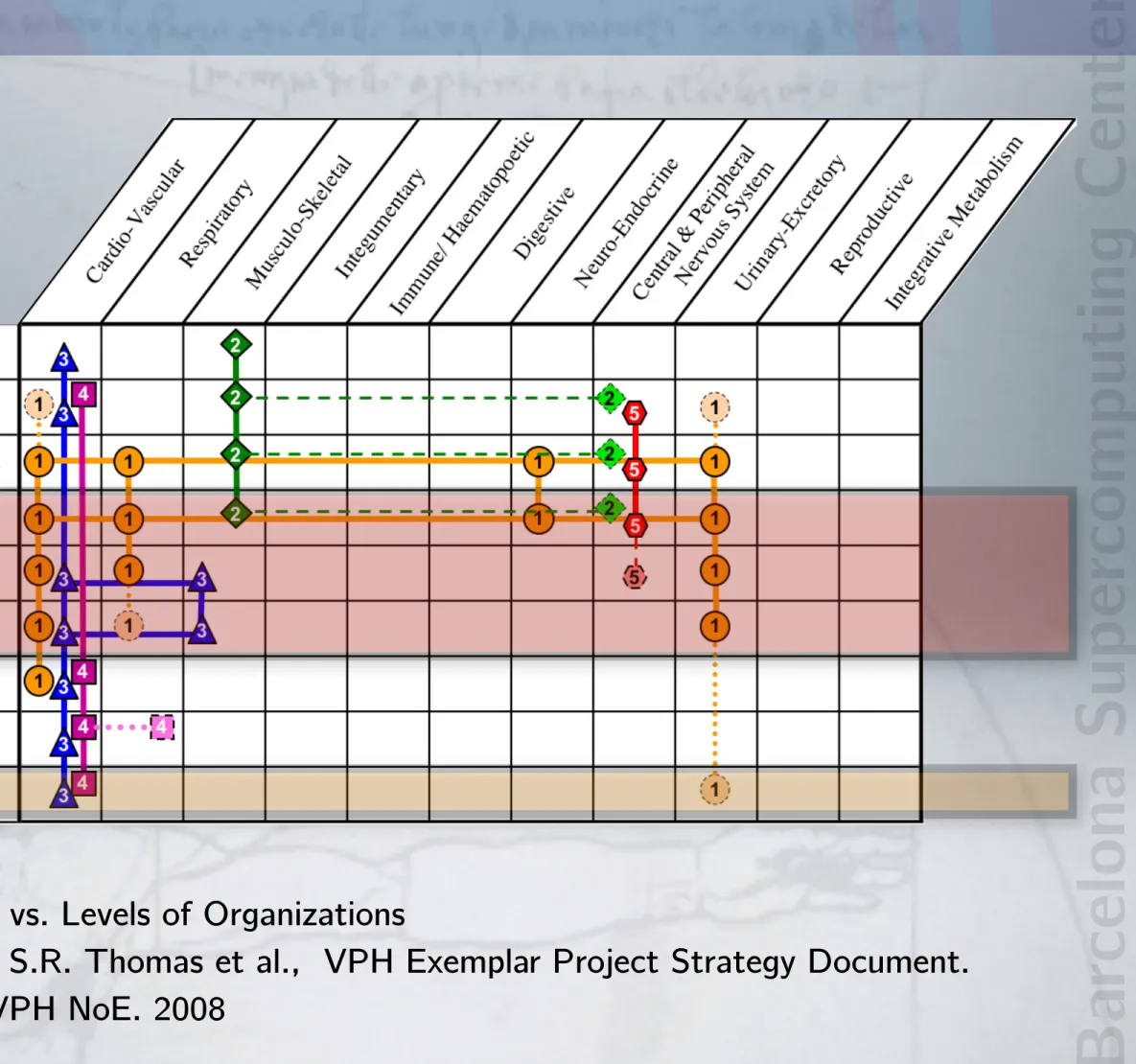
VPH NoE (223920) Deliverable 9 (D2.2) VPH Exemplar Project Strategy Document
Figure 1. Organ Systems vs. Levels of Organization. The figure shows, for each of the five seedEPs (indicated by the numbered colored symbols), the vertical and horizontal integration activities. Note that emphasis is on the horizontal and vertical links
themselves. Dark symbols indicate existing activities; pale symbols represent activities under development. (NB: compared to the similar figure in the Description of Work, this has a new column for Integrative Metabolism)
Figure 2. seedEPs vs. WP3 tasks. n="needed", c="contribution".
ToolKit Tasks
CNRS
ULB
KI
IMIM
ERCIM
3.2 - model ML
(n)/c
n
(c)
3.3 - data ML
n
n
3.4 - tools/GUI
n
n/c
n
n/c
n/c
3.5 - workflow
n
c
3.6 - model repositories
n/c
n/c
n
3.7 - data repositories
c
c
n
(c)
n
3.8 - data fusion
n
(n)/(c)
(n)/(c)
n
3.9 - grid access
(n)/(c)
c
Organ Systems vs. Levels of Organizations
Extracted from S.R. Thomas et al., VPH Exemplar Project Strategy Document. Deliverable 9, VPH NoE. 2008
Biomechanics
ercomputing Center
Drugs from the lab to the patientsA finished new drug: 12 to 15 years to be obtained, can cost over 1 BEuros
The idea of a target can come from academia, clinical research or the commercial sector
It may take several years to get a supporting volume of background for that target to be
considered in the drug discovery programmes
Then suitable molecules which possess the necessary characteristics are screened to make the drugs.
From Principles of early drug discovery. Br J Pharmacol. 2011 March, 162(6):1239-1249.
rcelona Sup
ercomputing Center
Drugs from the lab to the patients
Why could a drug fail in the clinic? They do not work
They are not safe.
Molecular interactions are not the only set of variables in a physiological system.
Reasons for fail or success:
Overall interaction of various components Dynamical responses
Non-directly related mechanisms Coupling with a larger system
ercomputing Center
Understanding biological systemsBiological systems are extremely complex Strong variability
High degree of uncertainty in the Physiological models Scarce experimental dada
Costly experiments Test
Improve modeling Predict behavior
rcelona Sup
ercomputing Center
Keywords Drug action Drug delivery Treatment planning Medical trainingDesign: prosthesis, stents, valves, bio-materials, experimental and manufacturing kits... Study surgical procedures and treatments
...
Targets
Biomedical research: know better and deeper, improve diagnose and treatment Pharma industry: reduce time and costs of “from-design-to-market” cycle
Medical devices manufacturers: design better devices
ercomputing Center
The research programCASE Department: Biomechanics at organ level
Multi-scale & multi-physics problems where HPC is a must
Parallelization on supercomputers (regular use of thousands of cores) Simulate complex biomedical problems
Deep commitment of MDs in all projects
Strong collaboration links with MDs, physiologists, clinical image researchers A Computational Man: the best possible “dummy” for biomedical research
First, create the dummy. Then, adapt it to patients.
rcelona Sup
ercomputing Center
Biomechanical Systems
Bio-engineers:
Develop the Physiological models Deal with medical image processing
Computational scientists:
Developing computational tools to run simulations
Provide the required simulation capacity
Medical doctors:
Healing is the final objective
Diagnose and treatment planning Understanding biological systems Physiological models
They provide the main motivation and insight to the problem
ercomputing Center
Alya RedHPC-based Biomechanical Simulations
Cardiac computational models Respiratory system
Cerebral aneurisms rupture risk Long skeletal muscles
rcelona Sup
ercomputing Center
Multi-physics modular code for High Performance Computational Mechanics Born in 2004
Designed from scratch to solve multiphysics problems with high parallel efficiency
Numerical solution of PDE’s
Variational methods are preferred (FEM, FVM) Hybrid meshes, non-conforming meshes
Explicit and Implicit formulations
Coupling between multi-physics (loose or strong)
Advanced meshing issues
Parallelization by MPI and OpenMP Automatic mesh partition using Metis
ercomputing Center
HPC Simulation Tools: Alya
Benchmark
Aneurism geometry provided by R. Cebral Uniform refinement up to 1.6B tetrahedra Incompressible flow 4000 6000 8000 10000 12000 14000 16000 2048 8192 16384 730k 183k 92k Speed up Number of CPU’s
Average # elements per CPU Ideal
rcelona Sup
ercomputing Center
Alya Red
HPC-based Biomechanical Simulations
Cardiac computational models
Respiratory system
Cerebral aneurisms rupture risk Long skeletal muscles
ercomputing Center
Muscle pumping action of the heartThe Cardiovascular In-Silico Experimental Laboratory
Multiphysics - multiscale Complex geometries
Very expensive computational modelling HPC-based
As comprehensive as possible
Biomechanics
rcelona Sup
ercomputing Center
Muscle pumping action of the heart
The Cardiovascular In-Silico Experimental Laboratory
Multiphysics - multiscale Complex geometries
Very expensive computational modelling HPC-based
As comprehensive as possible
The goals:
A computational scenario to implement models and analyze their behavior
under different conditions
Study healthy hearts, pathologies, treatments, drugs action
Adapt the mean model to patients
Biomechanics
ercomputing Center
Biomechanics
Cardiac Computational Model
Francesc Carreras
Unitat Imatge Cardiaca Htal. de Sant Pau (Spain) Manel Ballester
Univ. de Lleida (Spain) José Guerra
Htal. de Sant Pau (Spain)
Debora Gil, Ferrán Poveda and Agnés Borràs
Centro de Visión por Computador
Universitat Autonoma de Barcelona (Spain) Pablo Blanco, Lab. Nac. de Cálculo
Científico (Brasil)
Antoine Jerusalem, University of Oxford (UK)
Dan Einstein, Pacific Northwest National Lab (USA)
Pablo Lamata and David Nordsletten, King’s College London (UK)
rcelona Sup
ercomputing Center
Electrical Propagation
Mechanical Deformation Blood Flow
Volume
Bounda
ries
Coupling
Biomechanics
Cardiac Computational Model
ercomputing Center
Electrical Propagation Mechanical Deformation Volume Bo und ari es Electrophysiology:Linear anisotropic (fibers) diffusion + non-linear
source terms
Electro-mechanical coupling, Ca+ is the key
Biomechanics
Cardiac Computational Model
Blood Flow
ALE + Immersed Boundaries
rcelona Sup
ercomputing Center
Biomechanics Cardiac Computational Model
ercomputing Center
Cardiac Computational Model CCM
Scalability: Electro - Mechanical problem
Marenostrum III - BSC
Benchmark:
Refined Oxford Rabbit Model 28M tetra
rcelona Sup
ercomputing Center
Alya Red
HPC-based Biomechanical Simulations
Cardiac computational models
Respiratory system
Cerebral aneurisms rupture risk Long skeletal muscles
ercomputing Center
European PRACE project: The Computational Respiratory System In collaboration with Imperial College London - Jackson State Univ.
Transitional flow 30 million CPU hours allotted in Jugene and Curie Heavy postprocess
Computational Respiratory System
rcelona Sup
ercomputing Center
The Computational Dummy
A Computational Man: the best possible “dummy” for biomedical research
First, create the dummy. Then, adapt it to patients.
Case I: Perform simulations on the dummies and offer the data-base for analysis
Case II: Perform simulations on the dummies for biomedical design
Case III: Perform personalized simulations on patients for diagnose and treatment
ercomputing Center
Respiratory system Imperial College London Jackson State Universityrcelona Sup
ercomputing Center
Respiratory system
Imperial College London
ercomputing Center
Respiratory system
rcelona Sup
ercomputing Center
Massive particle tracking
Scenario:
High definition CFD simulations (tens to hundreds million elements) Complex geometries, as complete and comprehensive as possible
Up to several million Lagrangian particles tracked, labelled to be identified Trajectories computed on the fly, not as postprocess
Hundreds of processors for each run
Several runs: gender, age, Physical condition; all run at different regimes
Run the simulations
Create a data base and analyze the results
How could we identify and track the particles efficiently?
ercomputing Center
Particle tracking
rcelona Sup
ercomputing Center
Computational Respiratory System
Particle tracking: Particle deposition
ercomputing Center
Computational Respiratory System
Particle tracking:
Ba
rcelona Sup
ercomputing Center
Computational Respiratory System
Fichero de datos simulación Paraview
NosePlugin
Conector ODBC
HIVE
SQL query SQL fetch rows Trasform vkt data BBDD remote connection Cluster HADOOP namenode HADOOP taskTraker HADOOP slave HADOOP
slave HADOOPslave HADOOPslave HADOOPslave
Resultado.csv ETL NosePlugin VTK points data Paraview plugin Paraview interface Parallel Database
ercomputing Center
Computational Respiratory System
rcelona Sup
ercomputing Center
Improve the dummies:
Run the cases of the respiratory system, assessing the mesh grain Improve the Physical models: humidity, boundary conditions, etc Improve mesh mapping from healthy geometries to impaired ones Improve geometries fusion
Integrate postprocess in a “doctors friendly environment” FSI in a full heart, studying specially parallelization issues
Drug (blockers) effect
Develop an atria fiber model
Develop a mapper for fiber fields from DTI
Integrate Alya with ADAN (“EU-Brazil CC” project)
Contact problem for prostheses to help diastole in impaired hearts
ercomputing Center
Supercomputers & Biomedical research:
High Performance Computational Biomechanics