M
ost veterinarians see a Pet with some form of ear disease every day. So it’s important to be comfortable per-forming routine ear examinations. Thorough exams allow you to monitor potential ear problems and catch ear disease early—before it becomes acute or chronic. A mismanaged ear infection can severely damage the Pet-family bond if a dog or cat exhibits negative, pain-related behavior or eventually requires a lifetime of care—to say nothing of what it does to the client-practitioner bond. Routine ear exams provide an opportunity to offer top-quality preventive care, as well as educate clients on general ear health and the recur-rent nature of ear infections so they can mon-itor their Pet’s ears, identify changes early and seek immediate veterinary care.According to the Banfield Clinical Database, canine ear disease is the third most common disease seen in Banfield hospitals. The database reveals that 18.2 percent of sick dogs seen in our practices are diagnosed with otitis externa and 8.9 percent of dogs seen during wellness examinations exhibit signs of the disease. The figures are lower for cats: 5.3 percent of sick cats are diagnosed with otitis externa and 3.1 percent of well cats exhibit
signs of the disease. Conducting a thorough ear exam is the first step in identifying why these problems develop (Figure 1). Read on to hone your ear examination skills.
All in the design
A dog’s ear canal, which has two compart-ments, is anatomically different than the hu-man ear (Figure 2, page 18). At the opening, the vertical canal travels downward toward the angle of the dog’s jaw. It then makes a 45-degree turn, moving horizontally toward the eardrum. The structure and length of the canal make it difficult to visualize and treat. Dogs with long, pendulous ears, such as Cocker Spaniels, Labrador Retrievers, Bas-set Hounds, Golden Retrievers, and Irish Setters, are more predisposed to ear prob-lems than breeds with short, erect ears. Long ears fold and cover the ear canal, pre-venting air from entering and drying it. The result is a moist, warm ear canal that is the perfect environment for growing organisms. Because cats have upright pinnae (prick ears), they experience fewer ear infections. However, cats are more susceptible to ear mites than dogs.
Other dog breeds have different physical features predisposing them to ear disease. Shar-Peis have stenotic ear canals. Heavily coated breeds, including Poodles and Lhasa
Inside the ear
The first step in diagnosing and treating ear disease
is to correctly perform the examination.
By Brenda Burnham
McQuillan,
DVMContributing Author
Figure 1
The outward appearance of the healthy ear.
Illustr
ations b
y Chr
istian Hammer
Apsos, have a higher density of compound hair follicles in their ear canals. Breeds that have increased apocrine and ceruminous glands, such as Labrador Retrievers and Spaniels, produce more earwax.
Whether you check cats’ or dogs’ ears during a routine physical or while evaluat-ing a disease process you must follow some basic steps. The first is looking at the pinna.
1. Examine the pinna
Evaluate the dorsal and ventral surfaces of the pinna visually, and lightly touch them with your fingers. You might miss small swellings or thickened areas because of a thick hair coat, so slowly feel the entire sur-face. Look for unexpected high temperature, sensitivity and changes in tissue as indica-tions of inflammation. Also examine the margin, noting any hair loss and the pres-ence of lesions with scales or crusting.
2. Check the external ear canal
Next, lift the pinna toward the dorsal midline to evaluate the external ear canal. Beginning
with a visual exam, determine the presence of masses. Check for exudate and, if you see any, note the color, amount and whether an odor is present. In your exam notes, record the normal skin tone and any inflammation. Palpate the outer wall of the vertical canal for flexibility and to determine whether the canal has narrowed. If the outer wall is firm, mineralization may have occurred in re-sponse to chronic infection. In this case, there may be a need for survey films of the skull focusing on the vertical and horizontal canals and the bullae. Suspected otits media may also be an indication for radiographs.
3. Break out the otoscope
The otoscopic examination provides a de-tailed view of the ear canal. Pets that present with infection, as well as some healthy Pets, may need to be sedated or anesthetized. It’s important to let clients know that immobi-lizing the Pet allows for a more comprehen-sive assessment of the ears and eliminates pain from the exam. Clients do not want their Pets physically restrained and in pain when an alternative is available.
Otoscopic exams are necessary for all Pets, even healthy ones. However, they are particularly important for Pets with the fol-lowing clinical signs:
■ Scratching or rubbing the ears ■ Head shaking
■ Ear odor
■ Ear discharge, redness or swelling ■ Hair loss around the ears
■ Signs of facial nerve paralysis indicating
middle ear disease
■ Head tilt indicating middle ear disease ■ Deafness.
To conduct an otoscopic exam, first select the appropriate ear cone size. For Pets with healthy ears, choose the largest cone Figure 2 Cochlea Auditory tube Middle ear cavity Auditory ossicles Tympanic membrane Horizontal canal Vertical canal
The anatomic structure of the ear canal.
that fits well in the ear and does not cause discomfort. For an inflamed ear, choose a cone that fits without rubbing against the canal wall to minimize pain. It’s important to remember that this is one of the most painful examinations for Pets.
Elevate the pinna dorsally and introduce the cone’s tip into the external portion of the vertical canal. If proper traction and direction are not applied, the canal cannot be clearly observed. Continue guiding the cone deeper into the canal to view the horizontal portion. Note the color and health of the entire canal, as well as the color and consistency of any discharge and tissue pathology. Some Pets might have a small amount of cerumen, hair or both in the canal. This is normal if the ear has no strange odor and the canal is pink and healthy-looking. Note any ear canal abnor-malities, including masses, ulcerations and foreign bodies, in the medical records.
4. View the tympanic membrane
The tympanic membrane, or eardrum, should be visible during the otoscopic examination. If it’s not, consider the following possibilities:
■ Proper tension is not being applied to the
pinna so the ear canal is not straight, causing the tip of the cone to press against the canal wall.
■ Exudate or a foreign body is obstructing
the view.
■ The ear cone is too short.
■ Stenosis or fibrosis is prohibiting the ear
cone from being inserted far enough to see the tympanic membrane. Remember that some breeds, like Shar-Peis, are pre-disposed to fibrosis.
■ The eardrum is ruptured and only a black
area is visible.
If the dog is too painful for you to view the tympanum, sedate him and add pain
management to the therapy. Sedation may be necessary with fibrosis. Even though some Pets’ canal walls still have the flexibil-ity to allow you to move the cone deep enough to see the eardrum, it is very painful. If nothing prohibits you, examine the tym-panic membrane. Healthy eardrums are flat or slightly concave, semitranslucent, light gray and somewhat glistening. A diseased eardrum may have a convex bulge from fluid collection in the middle ear. It also may be opaque and have an erythematous rim at the margins. In cases of trauma or advanced dis-ease, the tympanic membrane may be only partially formed or missing altogether.
5. Collect a cytology sample
Diagnostic tests are essential to identify the cause of infection and treat and manage ear disease (see Managing otitis, page 32). Do not prescribe medication or clean the ear until you have collected a cytology sample to help identify the presence of mites, yeast, neoplastic cells or bacteria. Use the same sample collection technique for dogs and cats. First, lift the pinna and insert the tip of a cotton swab into the vertical portion of the canal. Gently roll the swab tip against the canal wall to obtain the material needed.
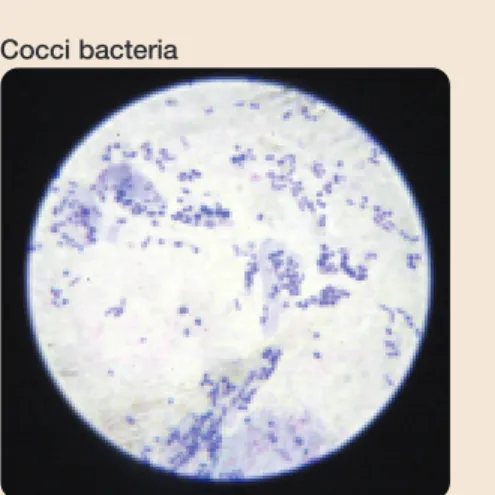
Once you have collected a sample, roll the swab against a glass slide. Don’t make the material too thick or smear evaluation will be difficult. Perform the cytologic staining pro-cedures. Examine the dried slide under oil immersion to determine whether yeast, bac-teria or fungi are present. To see mites or eggs, examine the slide on low-power magnifica-tion. Mites might also be visible during oto-scopic examination. Organisms found in the ear include the following (Figure 3, page 22):
■ Yeast (Malassezia pachydermatis): A
immersion field, while a yeast otitis often has 25 or more yeasts/oil immersion field.
■ Bacteria:When found on an ear swab,
bacteria can be normal or secondary flora. Staphylococcus intermedius is the most common bacteria in otitis externa and media, but Pseudomonas, Proteus and
Corynebacteriumspecies and Escherichia coli are also found. If the percentage of bacteria is beyond normal flora numbers or if there is a prevalence of gram-negative rods, submit a bacterial culture. Also con-sider a bacterial culture if the ear infection does not resolve with standard therapy.
Photos:
Banfield Lab Atlas
Figure 3:Harmful Organisms of the Ear Canal
Yeast (Malassezia
pachy-dermatis) (1,000x): This is a
severe or 3+ yeast infection (21 to 30 organisms in each field). Note that some are budding, and note the relative size compared with bacteria in the photos. Yeasts are stained dark using oil emersion.
Cocci bacteria(1,000x): Severe or 3+ infection identified using Wright’s stain.
Rod-shaped bacteria (1,000x): A very severe or 4+ infection (more than 30
organisms in each field) identified using Wright’s stain.
Mixed rod-shaped and cocci bacteria(1,000x): Severe or 3+ infection identified using Wright’s stain.
Ear mite eggs(100x): Found in earwax, they are large, dark and oval. A mineral oil
preparation technique was used.
Otodectesspecies(100x): A
round ear mite has two short rear legs and six additional legs with a body size equal in width and length. A mineral oil prep-aration was used for cytology.
▼ ▼ ▼ ▼ ▼ ▼
Yeast Cocci bacteria
Rod-shaped bacteria Mixed rod-shaped and cocci bacteria
Otodectesspecies
Ear mite eggs
■ Ear mites: Applying a few drops of
miner-al oil to the cotton-tipped swab before placing it in the ear canal allows for better sample collection. Roll that swab into a small well of mineral oil on a glass slide and place a cover slip over the area. When collecting a culture sample, watch for signs of a bacterial infection, such as odor or a yellowish-green debris. Try to collect the
culture and cytology swabs at the same time to avoid removing the Pet from the kennel twice. This is most beneficial if the Pet is frac-tious or in pain. Perform a culture if bacteria are present, if bacterial numbers are above the normal flora range, if rods and cocci are present or if polymorphic bacteria are in the ear (i.e., large and small cocci or single cocci and chains of cocci on the same slide).
Diagnostic Algorithm for Otic Disorders
Ear discharge
History,
physical exam
Enlarged pinna:
rule out aural hematoma
Otoscopic exam
Unable to
visualize tympanum
Tympanum intact:
do ear swab
cytology
Collect samples for
cytology and culture
Culture and sensitivity
testing
Clean ear (may require sedation
or anesthesia)
Tympanum not intact:
rule out otitis media
Rule out underlying atopy
or food allergy
Food allergy trial
Allergy testing
Skull radiographs
Tympanum not intact:
rule out otitis media
6. Educate clients
Although this step appears last, you should begin teaching clients about ear care at their Pet’s very first veterinary visit—and you should continue the educational process throughout the Pet’s life. Each breed of dog and cat has individual characteristics, and it’s your obligation to talk with clients about how those differences affect diagnosing, treating and managing ear disease.
Discussing the disease before it mani-fests is the best approach for long-term compliance because clients are aware that problems can occur. It also lets them know what an integral part they play in their Pet’s long-term care.
Even well-prepared veterinarians and clients cannot totally prevent ear disease, so develop an education program for clients
whose Pets have ear problems. The program should provide information on:
■ Ear cleaning techniques ■ Causes of ear infections
■ Medications and their application
process
■ Long-term treatment plans for chronic
ear problems
■ Surgical options
■ Long-term prognosis and medical costs ■ Pain management and quality of life
for Pets.
Clients will appreciate this preventive approach to ear disease management. Incorporate the veterinary team into the process so clients feel comfortable asking questions. Confident clients are more likely to comply with your recommendations and home care. They’ll know that even though ear disease is an everyday problem, your level of care is anything but routine.
Selected Reading
1. Tilley LP, Smith Jr FWK.The 5-Minute
Veterinary Consult: Canine and Feline. 3rd ed. Philadelphia, PA: Lippincott Williams & Wilkins, 2003;952-955.
2. Birchard SJ, Sherding RG.Saunders Manual
of Small Animal Practice.2nd ed. Philadelphia:
W.B. Saunders Co, 2000.
Brenda Burnham McQuillan, DVM,graduated
from Oklahoma State University College of Veterinary Medicine focusing on small Pet and equine practice. Before veterinary school, she was a veterinary technician for 10 years. After graduating, Dr. Burnham McQuillan managed the Pet side of the business at a mixed animal practice in Little Rock, Ark., and at River Valley Small Animal and Equine Clinic in Michigan. She joined Banfield, the Pet Hospital, in 1998 as an associate doctor and became chief of staff at Orland Hills Hospital, later becoming a partner doctor. Earlier this year, Dr. Burnham McQuillan was promoted to medical director for the Chicago region.