Venue: University of Cambridge /The Moeller Centre
Operationalising Dynamic Capabilities: A Supply Network Configuration Approach
Leila Sadat Alinaghian
University of Cambridge
Engineering Department, Institute for Manufacturing
[email protected]
Abstract
Operationalising Dynamic Capabilities: A Supply Network Configuration Approach Leila Alinaghian ([email protected]) Doctoral Student 2010-2014
Supervisor: Dr. Jagjit Srai
Advisor: Professor Sir Mike Gregory
Institute for Manufacturing, Department of Engineering, University of Cambridge
Building on the existing dominant strategic management paradigms, Dynamic Capabilities view offers considerable value by explaining how certain firms achieve sustainable competitive advantage in situations of rapid change through continually adapting and reconfiguring resources. Despite their increasing relevance in several settings, the fundamental constructs of the dynamic capabilities are not properly operationalised.
While operationlaisation of dynamic capabilities has been acknowledged in the literature, they are characterised as processes or routines. However, recent research indicates that firms? dynamic capabilities also include structures as one of the two business models? cornerstones that enable them to sense and seize new opportunities and renew their existing asset base. This finding suggests a relationship between the configuration and routines captured by a firm. Moreover, it is believed that in order to further understanding of the dynamic capabilities required in high-velocity contexts, the level of analysis has to be expanded from that of the organisation to strategic nets, and also to the macro networks forming their environment. The emergence of institutional or informal networks, formed by clusters or groups of firms appears to be the major new feature of the contemporary industrial economy. Accordingly, winners in the global marketplace have been firms that not only take timely actions in response to the highly changing environment in terms of new products and services, but also explore and exploit their internal and network latent potential (e.g. through taking different positions in the value chain, aggregating, disaggregating etc) by benefiting of network visioning, coordinating network portfolio position and network orchestration.
questions concerning supply network footprints, much of the existing research has focused primarily on
intra-organisational network and has adopted a rather static perspective. The practice studies reveal that while all these approaches depict where the Promised Land is, by the time firms design such a network, the world is changed. On the other hand, the studies aiming to characterise dynamic supply networks mainly focus on operational flexibility. While strategic flexibility has been acknowledged, the focus has been on firm level. All these models provide useful insights into supply chain flexibility. However, they have limited relevance to network flexibility (or adaptability). Adaptability refers to a willingness to reconfigure supply chains when necessary, without ties to legacy issues or the way the chain has been operated previously to respond to market opportunities and/or explore inter-firm network potential.
This research aims to explore the relationship between supply network configuration and dynamic capabilities through bridging the two communities of OM and Strategic Management. Accordingly, the research seeks to examine the following question: ??How do firms operationalise dynamic capabilities through supply network reconfiguration? ?? The conceptual framework is developed around two axes of dynamic capabilities? role and nature. The literature has tended to consider the central role of dynamic capabilities as related to the change of key internal components of the firm such as resources and capabilities. However, this research expands the unit of analysis from intra-organisation resources and routine to inter-organisation to explore how firms co-evolve inter-firm routines within their business network. Dynamic capabilities with the new role aim to continuously reconfigure firms expanded networks. Additionally, while dynamic capabilities have been defined as abilities (or capabilities) or as processes or routines, this research suggests a relationship between the configuration (both organisational and network) and routines captured by a firm. A case study approach is proposed, employing the developed conceptual framework. Additionally, a case selection index is identified and a list of dynamic capabilities exemplars is suggested.
Operationalising Dynamic Capabilities: A Supply Network
Configuration Approach
Leila Sadat Alinaghian ([email protected])
Jagjit Singh Srai
Sir Mike Gregory
Institute
for
Manufacturing,
Department
of
Engineering,
University
of
Cambridge
1.
Introduction
1.1
Background
Recent research reveals that in the new environment described as rapidly changing and highly
dynamic (Teece et al., 1997), hypercompetitive (D’Aveni, 1994) and high velocity (Eisenhardt and
Martin, 2000), the average period for which firms are able to sustain competitive advantage has
decreased over time (Wiggins and Ruefli, 2005). The high mortality rate of commercial corporations
also suggests that being successful at one point in time is no guarantee of continued survival
(O’Reilly and Tushman, 2008). Based on a sample of 226 US largest manufacturing firms, Louca and
Mendonca (2002) also assert that the giants of late 20th century are not the same as those at the
beginning of that period.
The emergence of institutional and industrial networks, formed by clusters or groups of firms also
appears to be the major new feature of the current industrial economy (Belussi and Arcangeli, 1998;
Blundel, 2002). According to Christopher (2000, p. 39), ‘’companies now have entered the new era
where the prizes will go to those organisations who can better structure, coordinate, and manage
the relationships with their partners in a network committed to better, closer, and more agile
relationships with their final customers’’ (Harland, 1996; Handfield, 2002; Ketchen Jr and Hult, 2007;
Srai and Gregory, 2008). Fine (1998, 2000) also affirms that, as industry clockspeeds increase,
companies are forced more and more to compete as inter‐organisational networks, rather than on a
firm‐by‐firm basis (Meijboom et al., 2007).
The existing strategic paradigms endeavour to explain how firms achieve and sustain competitive
advantage. While the strategic paradigms asserting that rents flow from privileged product market
positions (e.g. competitive forces, strategic conflicts) enjoy popularity, these models address the
profitability of the industries rather than individual firms. Although they present a perspective in
which environmental influences matter greatly, firms are left with a considerable range of
alternative choices regarding whether or how they will take advantage of the opportunities the
Rooting in a much older discussion of corporate strengths and weaknesses (Penrose, 1959),
however, Resource Based View (RBV) suggests that firms build enduring advantages only through
firm‐specific capabilities and assets and the existence of isolating mechanisms as the main barrier for
imitation is the fundamental determinants of firm performance (Rumelt, 1984; Teece, 1984;
Wemerfelt, 1984).
However, the RBV is not able to provide explanations as to how some successful firms demonstrated
timely responsiveness and rapid and flexible innovation in situations of rapid change (Teece et al.,
1997). Building on the previous dominant strategic management paradigms, Dynamic Capabilities
view (DCV) offers considerable value by explaining how certain firms achieve sustainable
competitive advantage through continually adapting and reconfiguring resources.
1.2
Formulating
the
Research
Question
In recent years, dynamic capabilities have been largely subject to theoretical debates (Ambrosini and
Bowman, 2009; Barreto, 2010; Di Stefano et al., 2010; Easterby‐Smith et al., 2009; Makadok, 2001;
Pavlou and El‐sawy, 2011; Verona and Ravasi, 2003; Williamson, 1999). It is argued that fundamental
constructs of dynamic capabilities are not properly operationalised (Barreto, 2010; Williamson,
1999). They are described as abstract concepts lacking specified and exact components (Galunic and
Eisenhardt, 2001; Pavlou and El‐sawy, 2011) which are difficult to observe (Simonin, 1999), resistant
to measurement (Barreto, 2010; Kraatz and Zajac, 2001; Mulders and Romme, 2009) and hidden
until exercised (Easterby‐Smith et al., 2009).
Accordingly, exploring the ways that firms can develop and nurture these second‐order capabilities
(i.e. dynamic capabilities) along with assessing how effectively the capability performs its function
and how well it enables firm to make a living in terms of a set of empirically straightforward and
valid measures creates an attractive research agenda (Barreto, 2010; Daneels, 2002; Helfat et al.,
2007; Mulders and Romme, 2009).
Moreover, dynamic capabilities concept has been largely focused on the firms and its application to
the real world context of inter‐dependent inter‐firm network has not been explored (Defee and
Fugate, 2010; Esper et al., 2007; Moller et al., 2002). Moller and colleague (2002) assert that
Industrial Network Theory (INT) (Håkansson and Snehota, 1995) provides a foundation for
conceptualising dynamic capabilities in a network context. According to INT, an inter‐firm network
refers to any group of related firms or actors that are interconnected in exchange relationships
(Håkansson and Snehota 1995; Johannison, 1987).
Recent studies suggest that the increasing specialisation and uncertainty of economic activities has
made firms more and more build strategic networks described as a particular inter‐firm network
with stable inter‐organisational ties, which are strategically important to participating firms (Amit
and Zott, 2001). A strategic network (or network organisation) is distinguished from a simple
network by the ‘’density, multiplicity, and reciprocity of ties and a shared value system defining
Accordingly, this research aims to adopt a network perspective exploring how firms co‐evolve inter‐
firm routines and assets within their business network in order to respond to the highly dynamic
network‐environments. The concept of ‘’network configuration’’ informed by configuration theory
as a modern variation of contingency theory (Donnaldson, 1996) appears to have great potentials for
contributing to the network perspective of DCV. The concept of ‘’network configuration’’ is applied
in various contexts such as global R&D networks (Hanses and Srai, 2011), international
manufacturing networks (Shi and Gregory, 1998), global engineering networks (Zhang et al., 2008),
international supply networks (Srai and Gregory, 2008) and service supply networks (Srai, 2010).
At its simplest level, configuration is defined as an arrangement of parts or elements that gives the
whole its inherent form (Chandra & Grabis, 2007). The key configuration dimensions of inter‐firm
networks in general and strategic networks in particular emerging from the literature include
network structure, network dynamics, network coordination, network relationships and
product/services architecture (Dyer and Singh, 1998; Fisher, 1997; Lamming et al., 2000; Shi and
Gregory, 1998; Srai and Gregory, 2008; Zhang et al., 2008). Recent studies suggest that alternative
kinds of network configurations (i.e. a particular arrangement of different configuration positions)
have different and intrinsic capabilities (Srai and Gregory, 2008). The configuration therefore can
bridge very effectively and efficiently between the strategic requirements from corporate or
business level and the network capabilities during the system design (Shi and Gregory, 1998).
Configuration theory holds that fit between contingency and configuration dimensions’ position is
limited to just a few configurations or gestalts, that is, fits (Miller, 1986).
While operationlaisation of dynamic capabilities has been acknowledged in the literature, they are
largely characterised as processes or routines (Eisenhardt and Martin, 2000; Teece et al., 1997).
Indeed, the literature is lacking distinct network configuration models across the products/ services
value chain (i.e. R&D, design, supply, production, logistics and after‐sale services) facilitating
dynamic capabilities. However, recent research indicates that firms’ dynamic capabilities include
intra firm structures (as a configuration dimension) (e.g. Galunic and Eisenhardt, 2001; Karim, 2006;
Rindova and Kotha, 2001) that enable them to sense and seize new opportunities and renew their
existing asset base. This finding suggests a relationship between the network configuration (both
intra‐firm and inter‐firm) and dynamic capabilities (Mason and Leek, 2008).
The literature domain pertaining to supply chain (network) is found to give new insights into
operationalisation of dynamic capabilities endeavours. A supply chain is the network of
organisations that are involved, through upstream and downstream linkages, in the different
processes and activities that produce value in the form of products and services in the hands of the
ultimate customer (Christopher, 1992; 1998; Harland, 1996). The dominant role of supply chains in
achieving and sustaining competitive advantage is increasingly highlighted in recent years (Defee
and Fugate, 2010; Esper et al., 2007; Harland, 1996; Handfield, 2002; Ketchen Jr and Hult, 2007; Srai
and Gregory, 2005).
Studies also reveal that as industry clock‐speeds continue to accelerate, many capabilities in the existing networks need replacement and/or upgrading (Fine, 2000). However, much of the existing research has focused primarily on intra‐organisational network capabilities and/or adopted a rather static perspective (Shi, 2003). The existing endeavours aiming to characterise dynamic inter‐firm
networks, mainly focus on operational flexibility. While they have focused on flexibility as a response
to changes in demand, there is a much wider range of reasons why inter‐firm networks need to be
flexible. The change could also be coped through re‐designing or re‐configuring the network, known
as adaptability (Lee, 2004; Stevenson and Spring, 2007).
1.3
Objective
The principal objective in this research is to develop an inter‐firm dynamic capabilities concept,
taking a configuration perspective, addressing an acknowledged gap in the literature (Defee and
Fugate, 2010; Moller et al., 2002; Esper et al., 2007).
Bridging the two communities of OM and Strategic Management, the research aims to explore the
relationship between supply network configuration and dynamic capabilities through exploring
particular network configurations associated with distinct dynamic capabilities profiles. As discussed,
network configurations can be examined at both intra‐firm and inter‐firm level. The research seeks
to examine the following questions:
RQ: How do firms operationalise dynamic capabilities through supply network
reconfiguration?
What (what are inter‐firm dynamic capabilities constructs)
o Defining the inter‐firm network dynamic capabilities concept
How (how firms co‐evolve inter‐firm routines and assets within their business network in respond to the
highly dynamic environments)
o Exploring intra and inter‐firm processes that facilitate dynamism
o Exploring particular network configurations enabling firms to achieve dynamic fit
The remainder of the paper is organised as follows. First, systematic review protocol is elaborated.
Second, the research question is positioned in the theory, using definitions synthesised from the
literature. The main literature domains of dynamic capabilities and supply chain (network) design
and operations, with a focus on operationalisation of dynamic capabilities and dynamic supply chain
are described and summarised. The justification for bringing the two areas together, despite the
relatively little extant literature doing so, is made. Synthesising and organising the findings from the
literature, the research conceptual framework is put forward.
Then, the research approach including the proposed research methods in terms of philosophical
selection criteria, developed case selection index, data dimension and data collection instruments
are presented respectively. Finally, some concluding remarks in term of potential contributions to
academia and industry and future steps are provided.
2.
Review
Protocol
The core literature reviewed in this research has been collected systematically using a title, keyword,
and abstract content search of the literature contained within the business and management subject
databases. This has been supplemented by a citation review of the key literature. Using this
approach, the review begins to cross over from strategic management into operations management
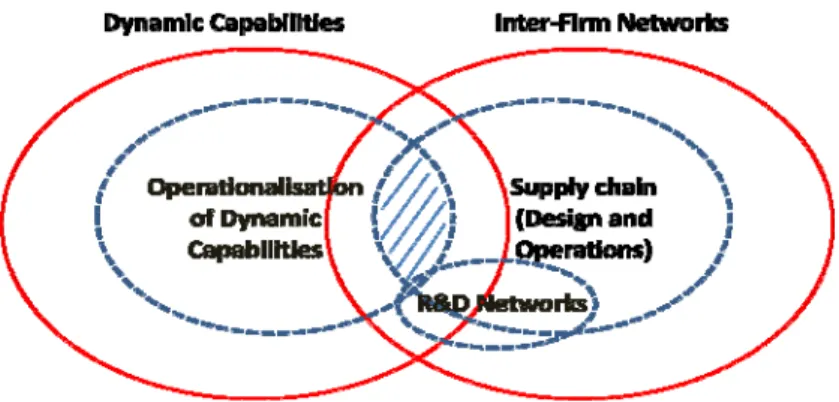
and supply chain management literature. The review aims to cover the three key domains (Figure 1‐
Research Map) of operationalisation of dynamic capabilities, dynamic supply chains and their
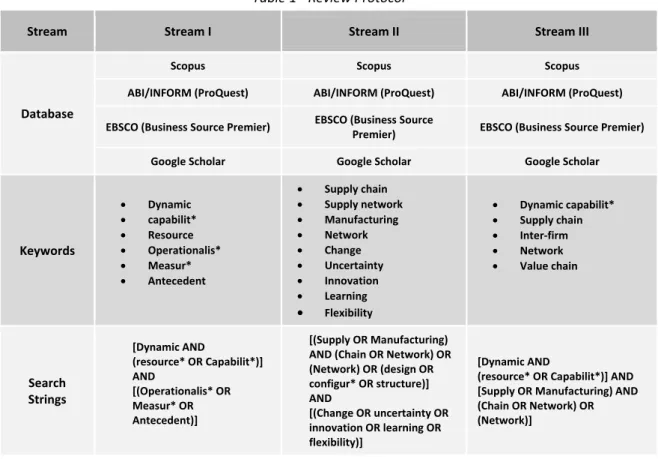
intersection in terms of stream I, II and III respectively. Table 1 below details the databases referred
to during this review. The first three with their comprehensive searching of a wide number of
journals in the fields of interest, were explored with Google Scholar used as a cross check at the end.
The table also details the keywords used to form the search string applied to the databases
discussed.
Table 1 ‐ Review Protocol
Stream Stream I Stream II Stream III
Database
Scopus Scopus Scopus
ABI/INFORM (ProQuest) ABI/INFORM (ProQuest) ABI/INFORM (ProQuest)
EBSCO (Business Source Premier) EBSCO (Business Source
Premier) EBSCO (Business Source Premier)
Google Scholar Google Scholar Google Scholar
Keywords Dynamic capabilit* Resource Operationalis* Measur* Antecedent Supply chain Supply network Manufacturing Network Change Uncertainty Innovation Learning Flexibility Dynamic capabilit* Supply chain Inter‐firm Network Value chain Search Strings [Dynamic AND (resource* OR Capabilit*)] AND [(Operationalis* OR Measur* OR Antecedent)] [(Supply OR Manufacturing)
AND (Chain OR Network) OR
(Network) OR (design OR configur* OR structure)] AND [(Change OR uncertainty OR innovation OR learning OR flexibility)] [Dynamic AND
(resource* OR Capabilit*)] AND
[Supply OR Manufacturing) AND
(Chain OR Network) OR
(Network)]
Having conducted the searches elaborated above, the papers extracted have been evaluated. In the
first round, they have been limited to those published in the scholarly journals. Citation analysis has
that citation counts are a valid measure of prominence and influence. This is a standard assumption
for bibliometric analyses (Di Stefano et al., 2010). Finally, the quality appraisal in terms of their
contribution, underlying theories and methodology is conducted. The processes described resulted
in 62, 22 and 28 papers in stream I, II and III respectively. The precise final core source list that was
used in compiling this review including their detailed information is attached in Appendix A.
The stream II is found to provide deep insights for operationalisation of dynamic capabilities (stream
I) in the network context despite the fact that the concept of dynamic capabilities hasn’t been
applied explicitly. In addition to the domains discussed, the research also concentrates on those
endeavours applying dynamic capabilities explicitly at the network level especially international
supply networks (Stream III). However, the third stream also includes papers discussing other parts
of manufacturing value chains (e.g. R&D networks, production networks, service network etc).
The review conducted has contributed to a better understanding of phenomena of interest,
formulation of research question, development of research conceptual framework and research
design aiming to answer to the following questions:
Operationalisation of dynamic capabilities in terms of processes, antecedents and outcome
Supply chain design and operations in highly changing environments
Benefiting of strategic supply chains design in operationalisation of dynamic capabilities
Investigation of dynamic capabilities within a inter‐firm network context in terms of both
processes and configurations
The characteristics of a highly changing environment in terms of macro clusters
3.
Literature
Review
Figure 1 below illustrates the main literature fields which are of interest in this review. The dynamic
capabilities literature describing the historical development of the field, definitions and typologies
and then recent endeavours of operationalisation of dynamic capabilities in terms of processes,
antecedents, contributors and outcome is reviewed (section 2.1).
The literature domain pertaining to supply chain (section 2.2) is found to give new insights into
operationalisation of dynamic capabilities endeavours, given the difficulty of maintaining a
competitive advantage through firm‐centric dynamic capabilities due to the changing locus of value
creation. Moreover, there is a growing recognition that modern competition is being fought ‘‘supply
chain versus supply chain’’ rather than ‘‘firm versus firm’’. The capability of the supply network has
therefore become a vital source of competitive advantage in international markets (Srai and
Gregory, 2005). Accordingly, supply networks appear to have great potential for contributing to
dynamic capabilities view as a novel unit of analysis (Abrahamsson et al., 2003; Defee and Fugate,
2010; Esper et al., 2007; Wei and Wang, 2007). While the dynamic capabilities literature recognises
that the external environment affects learning (Teece et al., 1997; Teece, 2007) and that routines
evolve as a result of dialogue and interaction within and across units, departments or functions,
these studies have not attempted to adopt a network perspective or explore how firms co‐evolve
inter‐firm routines within their business network. Interestingly, the dynamic capabilities perspective
also provides a theoretical foundation that may be used to better understand and predict the
success of supply chain firms (Defee and Fugate, 2010).
However, in the new environment described as rapidly changing and highly dynamic (Teece et al.,
1997), hypercompetitive (D’Aveni, 1994) and high velocity (Eisenhardt and Martin, 2000), the
effectiveness of strategic supply chain management is closely tied to three attributes: agility,
adaptability, and alignment (e.g., Christopher, 2000; Lee, 2004; Stevenson and Spring, 2007). While
agility provides supply chains with the ability to react quickly to unexpected or rapid shifts in supply
and demand, adaptability refers to a willingness to reshape supply chains when necessary, without
ties to legacy issues or the way the chain has been operated previously. In fact it characterises the
ease (mobility) with which the supply chain can be re‐configured. Since supply chains can no longer
be expected to preserve their structure over a long horizon, appropriate mechanisms for supporting
re‐configurability should be embedded in supply chain configuration decisions (Chandra and Grabis,
2007).
Finally, section 2.3 describes the existing attempts applying the concept of dynamic capabilities in
the network context with a focus on international supply networks. However, dynamic capabilities
have largely been ignored in the logistics and supply chain literature. With few exceptions (e.g.
collaboration as a capability; knowledge accessing and co‐evolving), the focus has been on operating
routines (Zollo and Winter, 2002) where dynamic capabilities have been acknowledged in a supply
chain context (Abrahamsson et al, 2003). For example, research describing the need for flexible and
agile logistics capabilities has focused on the creation of a logistics system by one firm in the supply
chain that can deal with swings in order volume and product variety rather than dynamic capabilities
as source of flexibility and agility (Defee and Fugate, 2010).
2.1
Dynamic
Capabilities
Teece et al.’s (1990) working paper is the first contribution developing explicitly the notion of
dynamic capabilities. They contend that it is not only the bundle of resources that matter, but the
formally published in 1994 by Teece and Pisano. They explained that the RBV was not able to
provide explanations as to how some successful firms demonstrated ‘timely responsiveness and
rapid and flexible product innovation, along with the management capability to effectively
coordinate and redeploy internal and external competences’ (Teece and Pisano 1994, 537). The 1990
and 1994 work were then elaborated upon in Teece et al. (1997) when they explicitly argued how
the dynamic capability view could overcome the limitations of the RBV. They then defined dynamic
capabilities as ‘the firm’s ability to integrate, build, and reconfigure internal and external
competences to address rapidly changing environments’ (1997, 516).
Although the dynamic capabilities paradigm is barely two decades old, its conceptual underpinnings
are much older. Elements of the approach can be found in Schumpeter (1942) work on processes of
creative destruction and innovation‐based competition, resource‐based view (RBV) of the firm,
which was developed by Penrose (1959), Richardson (1972) and Nelson and Winter (1982), Cyert
and March’s (1963) work on the behavioural aspects of firms, Williamson’s (1975, 1985) work on
markets and hierarchies and asset specificity, Prahalad and Hamel (1990), Teece (1976, 1982; 1986;
1988) and Rumelt (1984) and in Hayes, Wheelwright, and Clark (1988). Figure 2 below illustrates the
conceptual underpinnings and the historical development of dynamic capabilities literature from the
early 40s (Ambrosini and Bowman, 2009; Augier and Teece, 2009; Macher and Mowery, 2009; Teece
and Pisano, 1994; Teece et al., 1997).
Figure 2 – The historical development of dynamic capabilities literature and the underpinnings Compiled by author Key sources: Ambrosini and Bowman, 2009; Augier and Teece, 2009; Eisenhardt and Martin, 2000; Helfat et al.,
Definitions
Several alternative conceptualisations of dynamic capabilities are offered. These proposals vary
significantly in terms of the main elements (e.g. nature, role, context, creation and development,
outcome and the degree of heterogeneity) highlighting the major theoretical and underpinnings
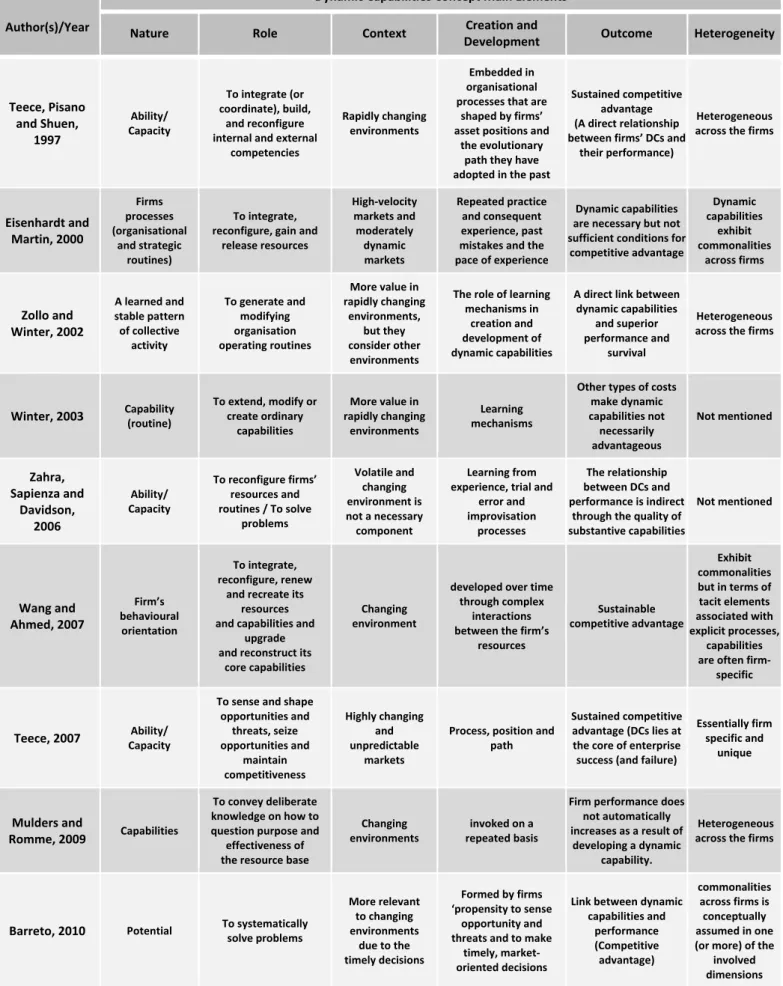
(Barreto, 2010). The seminal works have been summarised in terms of definitions proposed around
the main building blocks of dynamic capabilities in Table 2.
As noted by many scholars, almost every author (e.g., Eisenhardt and Martin, 2000; Teece et al.,
1997; Zahra et al., 2006; Zollo and Winter, 2002; Winter, 2003) has submitted an individual set of
definitions for dynamic capabilities. Notwithstanding the efforts of Helfat et al. (2007), Wang and
Ahmed (2007), Mulders and Romme (2009) and Barreto (2010) to develop widely held definitions in
the field. Helfat et al. (2007) define dynamic capabilities as the capacity of an organisation to
purposefully create, extend, or modify its resource base. This definition is precise enough to be
meaningful, yet broad enough to allow scholars to learn more about the nature and origins of
dynamic capabilities through investigation. It accommodates both Teece’s (1997) view that dynamic
capabilities enable a firm to respond to environmental change as well as Eisenhardt and Martin’s
(2000) broader notion that they can also be the source of disruptive change.
By their definition, Wang and Ahmed (2007) first argue that dynamic capabilities are not simply
processes, but embedded in processes. Processes are often explicit and thus can be transferred
more easily within the firm or across firms. Capabilities refer to a firm’s capacity to deploy resources,
usually in combination, and encapsulate both explicit processes and those tacit elements (such as
know‐how and leadership) embedded in the processes.
Reviewing the diverse research streams on dynamic capabilities, Barreto (2010) also suggests a new
conceptualisation of dynamic capability as an aggregate multidimensional. He defined dynamic
capability as a firm’s specific potential (to solve problems systematically) to stress the fact that,
although one should expect that, on average, firms with higher levels of dynamic capability present
higher levels of performance, there is no assurance that such a potential is actually realised by each
firms and that is actually produces the expected results. By considering four distinct but
simultaneously necessary components (propensities to sense opportunities and threats, to make
timely decisions, to make market‐oriented decision and to change the firm’s resource base), this
definition depart from previous concerns regarding the obscurity and intractability of the construct
and facilitates operationalisation of the construct in future empirical research (Barreto, 2010).
According to Easterby‐Smith and colleagues (2009) the slowness to converge on a common
definition may be due to variations within the community that contributed to the development of
this concept. Scholars coming from different research traditions have viewed dynamic capabilities
with different lenses, reflecting their different backgrounds. Some of them followed an approach
closer to RBV, whereas others tended to undertake an approach more akin to evolutionary
economics (Barreto, 2010). Winter (2003) and his co‐authors (e.g. Zollo and Winter, 2002), for
example, define dynamic capabilities in terms of routines, a central feature of evolutionary
economics. In contrast, Eisenhardt and Martin (2000) define them in terms of processes whose
Author(s)/Year
Dynamic Capabilities Concept Main Elements
Nature Role Context Creation and
Development Outcome Heterogeneity
Teece, Pisano and Shuen, 1997 Ability/ Capacity To integrate (or coordinate), build, and reconfigure
internal and external
competencies
Rapidly changing
environments
Embedded in
organisational
processes that are
shaped by firms’
asset positions and
the evolutionary
path they have
adopted in the past
Sustained competitive
advantage
(A direct relationship
between firms’ DCs and
their performance)
Heterogeneous
across the firms
Eisenhardt and Martin, 2000 Firms processes (organisational and strategic routines) To integrate,
reconfigure, gain and
release resources High‐velocity markets and moderately dynamic markets Repeated practice and consequent experience, past
mistakes and the
pace of experience
Dynamic capabilities
are necessary but not
sufficient conditions for
competitive advantage Dynamic capabilities exhibit commonalities across firms Zollo and Winter, 2002 A learned and stable pattern of collective activity To generate and modifying organisation operating routines More value in rapidly changing environments, but they consider other environments
The role of learning
mechanisms in
creation and
development of
dynamic capabilities
A direct link between
dynamic capabilities
and superior
performance and
survival
Heterogeneous
across the firms
Winter, 2003 Capability(routine)
To extend, modify or create ordinary capabilities More value in rapidly changing environments Learning mechanisms
Other types of costs
make dynamic capabilities not necessarily advantageous Not mentioned Zahra, Sapienza and Davidson, 2006 Ability/ Capacity To reconfigure firms’ resources and routines / To solve problems Volatile and changing environment is not a necessary component Learning from
experience, trial and
error and improvisation processes The relationship between DCs and performance is indirect
through the quality of
substantive capabilities Not mentioned Wang and Ahmed, 2007 Firm’s behavioural orientation To integrate, reconfigure, renew
and recreate its
resources
and capabilities and
upgrade
and reconstruct its
core capabilities
Changing
environment
developed over time
through complex
interactions
between the firm’s
resources Sustainable competitive advantage Exhibit commonalities but in terms of tacit elements associated with explicit processes, capabilities
are often firm‐
specific
Teece, 2007 CapacityAbility/
To sense and shape
opportunities and threats, seize opportunities and maintain competitiveness Highly changing and unpredictable markets
Process, position and
path
Sustained competitive
advantage (DCs lies at
the core of enterprise
success (and failure)
Essentially firm specific and unique Mulders and Romme, 2009 Capabilities To convey deliberate knowledge on how to
question purpose and
effectiveness of
the resource base
Changing
environments
invoked on a
repeated basis
Firm performance does
not automatically
increases as a result of
developing a dynamic
capability.
Heterogeneous
across the firms
Barreto, 2010 Potential To systematically
solve problems More relevant to changing environments due to the timely decisions Formed by firms ‘propensity to sense opportunity and
threats and to make
timely, market‐
oriented decisions
Link between dynamic
capabilities and performance (Competitive advantage) commonalities across firms is conceptually assumed in one
(or more) of the
involved
dimensions
Moreover, Schreyogg and Kliesch‐Eberl (2007) assert that while at first sight the approaches on
dynamic capabilities build a fairly homogenous class, a closer look reveals remarkable differences
among them calling for a differentiated discussion. They identified three different theories of
dynamic capabilities labelled (1) the radical dynamisation approach, (2) the integrative approach
(The most prominent approach towards a theory of dynamic capabilities has been provided by Teece
et al. (1997)) and (3) the innovation routine approach. The first treats dynamic capabilities as a
functional equivalent to classical capabilities in dynamic environments. The second fosters the idea
of amending capabilities by adding a dynamic dimension and the last assigns the task of
dynamisation to a special type of routine called innovation routine (Rothaermel and Hess, 2007). The
third approach to dynamising capabilities basically suggests supplying the missing dynamic
dimension (Lawson and Samson (2001) by installing separate innovation routines that allow a firm to
overcome the rigidity trap (paradox) of organisational capabilities (Zollo and Winter, 2002).
2.2
Supply
Chains
(Networks)
According to Giannakis and Croom (2004), the term ‘’supply chain management’’ was first used in its
popular sense through a consideration of strategic issues within the Logistics literature by Oliver and
Weber (1982). The development of the supply chain management concepts was initially along the
lines of physical distribution and transport, using the techniques of industrial dynamics through the
incorporation of theoretical concepts and research in strategic management, industrial organisation,
institutional and production economics (transaction costs), inter‐organisational relationships and
system theory. Another antecedent can be found in the Total Cost approach to distribution and
logistics (Lewis, 1956). Both of these approaches showed that focusing on a single element in the
chain cannot assure the effectiveness of the whole system. Figure 3 below illustrates the historical
development of ‘supply chain’ literature around 4 different levels of analysis (i.e., functional, dyadic,
chain and network) along with the chronology of theoretical developments that influenced this area
of knowledge.
Supply chains have come to be understood as relatively stable groups of firms engaged in the
sequence of production and distribution activities required to serve the end‐customer. For example,
Christopher (1998, Chapter 1) explains that:
. . . the supply chain is the network of organisations that are involved, through upstream and
downstream linkages, in the different processes and activities that produce value in the form of
Figure 3 – The historical development of ‘supply chain’ literature
Supply
Chain
(Network)
Capabilities
The last decade has witnessed an increase in research seeking to incorporate different strategic
management perspectives in the field of operations management and strategy (Hitt, 2011; ketchen
Jr and Hult, 2007; Smart, Bessant and Gupta, 2007). In particular, the resource‐based view examining
how certain assets and capabilities set a foundation for competitive advantage and superior
performance (Barney, 1991) provides theoretical underpinnings for best value supply chains. Best
value supply chains reflect the assumption that unique resources and capabilities exist at the supply
chain level, and that supply chains can be inimitable competitive weapons (Ketchen Jr and Hult,
2007).
Accordingly, the capability of the supply network has therefore becomes a critical determinant in
business capability and performance. Wu, Melnyk and Flynn (2010) label operational capabilities as a
subset of the organisational capabilities construct, and believe that insights gained from research on
Compiled by author
Key sources: Burgess et al., 2006; Caddy and Helou, 2007; Christopher, 1992; 1998; Chandra and Grabis, 2007; Giannakis, Croom and Slack, 2004; Handfield, 2002; Harland, 1996; Harland et al., 2001; Hitt, 2011; Ketchen Jr and Hult, 2007; Lamming, 1996; Lambert and Cooper, 2000; Voss, 1995; Womack et al., 1990
organisational capabilities can be readily applied to the study of operational capabilities. While
organisational capabilities has been defined as information‐based, tangible, intangible processes
that are firm‐specific and are developed over time through complex interactions among the firm’s
resources, for the purpose of achieving a particular end result (Helfat and Peteraf, 2003; Makadok
(2001), Wu and colleagues (2010) define operational capabilities as firm‐specific sets of skills,
processes, and routines, developed within the operations management system, that are regularly
used in solving its problems through configuring its operational resources. Operational capabilities
are also defined as supply chain enabling processes (or primary capabilities) (Srai and Gregory,
2005). However, those capabilities that are more generic, or are derived capabilities, that result
perhaps from a combination of SC capabilities have been separated out; these are termed Meta‐SC
and include concept such as agility, flexibility, innovation etc (Table 3).
Recent research also has discussed companies developing both internal and external (e.g. cross‐
organisational) capabilities (Gibson et al., 2009) in order to differentiate world‐class supply chain
organisations from the rest of the pack. The most frequently described internal capabilities were
supply chain orientation (characterised by top management support and a willingness to invest) and
agility (characterised by learning and continuous improvement). These internal capabilities formed
the foundation for top performance, but the best organisations were also found to possess one or
more capability(ies) that cut across and involved multiple organisations working together to create
and maintain a competitive advantage (Defee and Fugate, 2010). While some capabilities may deal
specifically with adaptation, learning, and change processes, all capabilities have the potential to
accommodate change.
4.
Positioning
the
Field
of
Inquiry
Having reviewed the core sources in each research stream, a matrix framework has been developed
(Figure 4). The proposed framework aims to categorise the relevant domains of dynamic capabilities
and dynamic supply chains and brings these two together in terms of an integrated unit.
As shown, Dynamic capabilities can take on multiple roles in organisations. The literature has tended
to consider the central role of dynamic capabilities as related to the change of key internal
components of the firm such as resources and capabilities (e.g. Eisenhart and Martin, 2000; Helfat et
al., 2007; Teece et al., 1997; Winter, 2003), operating routines (Zollo and Winter, 2002), and
resources and routines (Zahra et al., 2006) (Barreto, 2010; Easterby‐Smith et al., 2009). While some
authors describe it as an ability to integrate resources, reconfigure resources, creating new
resources and shedding resources (Ambrosini and Bowman, 2009), others concern dynamic
Figure 4 –The matrix framework
While dynamic capabilities literature recognises the role of external environment, these studies have
not attempted to adopt a network perspective or explore how firms co‐evolve inter‐firm routines
within their business network (Mason and Leek, 2008; Moller et al., 2002). In fact, the application of
dynamic capabilities to the real world context of inter‐dependent inter‐firm network has not been
explored. Relational View describes relationship between firms as an increasingly important unit of
analysis for understanding competitive advantage (Dyer and singh, 1998). Authors also suggest that
antecedents to dynamic capabilities, which they describe as “processes to integrate, reconfigure,
gain, and release resources—to match and even create market change,” can be found at the
individual, firm, or network level (Eisenhardt and Martin, 2000; Rothaermel and Hess, 2007).
Accordingly, this research is mainly adopted an inter‐firm view.
Dynamic capabilities have been defined as abilities (or capabilities) but also as processes or routines.
According to Teece and colleagues (1997) the essence of dynamic capabilities is embedded in
organisational processes. Eisenhardt and Martin (2000) present dynamic capabilities as specific and
identifiable processes, whereas Zollo and Winter (2002) following an early definition of routines
consider dynamic capabilities as learned and stable patterns of activities. This research is grounded
in the observations of Hamel and Prahalad (1994), who identify two cornerstones of business models
(1) structure: how firms perceive the structure of their firm, their business network and their
position within it; and (2) routines: how firms develop effective operational routines to exploit the
potential value of the network (Mason and Leek, 2008). Accordingly, this research aims to explore
both process dimension (DC – P) and configuration dimension (DC – C) associated to dynamic
capabilities. This suggests a constant and iterative need for creation, integration and reconfiguration
of both structure and routines (Mason and Leek, 2008; Teece et al., 1997; Zahra et al., 2006; Zollo
and Winter, 2002).
Operationalisation
of
Dynamic
Capabilities
Operationalisation is the process of defining a fuzzy concept so as to make the concept clearly
distinguishable or measurable and to understand it in terms of empirical observations. Accordingly,
operationalisation formalises theories' ideas and concepts into applicable models. In order to
interpret how effectively dynamic capabilities affect competitive advantage, scholars have explored
the operational mechanisms of dynamic capabilities in terms of organisational processes and
routines, antecedents, facilitators (contributors) and outcome. Each of these will be considered in
turn.
Identification
of
Proposed
Set
of
Dynamic
Capabilities
Processes
Eisenhardt and Martin (2000) argue that dynamic capabilities are a set of specific and identifiable
processes by which managers alter their resource base—acquire and shed resources, integrate them
together, and recombine them—to generate new value‐creating strategies. For instance, product
development routines by which managers combine their varied skills and functional backgrounds to
create revenue producing products and services (e.g., Eisenhardt and Martin, 2000; Winter, 2003;
Deeds et al., 1999; Verona and Ravasi, 2003; Rosenbloom, 2000; Rothaermel and Hess, 2007; Marsh
and Stock, 2003; Danneels, 2002; D’Este, 2002) are such a dynamic capability. New products have
been indicated as the most natural driving force behind change and renewal at the corporate level
(Nonaka, 1994; Daneels, 2002).
Similarly, strategic decision making is a dynamic capability in which managers group their various
business, functional, and personal expertise to make the choices that shape the major strategic
moves of the firm (e.g., Arragon‐Correa and Sharma, 2003; Eisenhardt and Martin, 2000; Helfat et
al., 2007; Pablo et al., 2007; Rosenbloom, 2000; Slater et al., 2006). The need to incorporate
decision‐making propensities in the definition of dynamic capabilities is supported in several studies
(e.g. Moliterno and Wiersema, 2007).
Alliance and acquisition routines that bring new resources into the firm from external sources is also
mentioned as a key dynamic capability (Eisenhardt and Martin, 2000; Kale and Singh, 2007; Karim
and Mitchell, 2000; Rosenbloom, 2000; Zollo and Winter, 2002). Karim and Mitchell (2000) explain
that acquisitions allow firms to reconfigure their mix of resources and to overcome failure and
exploit opportunities in their environment.
Rindova and Kotha (2001) mentioned continuous transformation of organisational forms as a
process pertinent to dynamic capabilities. In their framework, they propose that firms rely on
continuous morphing to regenerate competitive advantage under conditions of rapid change
through comprehensive and continuous redefinition of the products and services a firm provides,
changes in the resources and capabilities deployed, and a mode of organising that facilitates creating
and using new resources and capabilities. Dynamic capabilities are also explored by focusing on the
corporate‐level processes by which multi‐business firms reconfiguring their business units (e.g.
Galunic and Eisenhardt, 2001; Karim, 2006).
More recently, some studies have added additional components to what are elsewhere considered
to be the constituents of dynamic capabilities. Schreyogg and Kliesch‐Ebrel (2007) proposed the
consideration of ‘’capability monitoring,’’ a separate organisational function removed from the
operational level and intended to observe both a firm’s capabilities usage and evolvement and the
firm’s external environment. Teece (2007) suggested that, in addition to the resource reconfiguring
capabilities, there are two even more fundamental types of capabilities involved: the capability to
sense and shape opportunities and threats and the capability to seize opportunities (Barreto, 2010;
Easterby‐Smith et al., 2009). He also contends that enterprises with strong dynamic capabilities not
only adapt to business ecosystems, but also shape them through innovation and through
collaboration with other enterprises, entities, and institutions (Menguc and Auh, 2006; Teece, 2007).
Specifically, Bowman and Ambrosini (2003) building on Teece et al. (1997) explain that dynamic
capabilities processes comprise four main clusters: reconfiguration, leveraging, learning and creative
integration. Reconfiguration refers to the transformation and recombination of assets and
resources. Leveraging involves replicating a process or system that is operating in one business unit
into another, or extending a resource by deploying it into a new domain. Learning allows tasks to be
performed more effectively and efficiently as an outcome of experimentation, reflecting on failure
and success. Finally, creative integration relates to the ability of the firm to integrate its assets and
resources, resulting in a new resource configuration.
Wang and Ahmed (2007) also identify three main component factors of dynamic capabilities, namely
adaptive capability, absorptive capability and innovative capability. Adaptive capability is a firm’s
ability to adapt their product–market scope to respond to external opportunities. Absorptive
capacity is the firm’s ability to assimilate and replicate new knowledge gained from external sources.
Innovative capability refers to a firm’s ability to develop new products and/or markets, through
aligning strategic innovative orientation with innovative behaviours and processes (Rothaermel and
Hess, 2007).
Following Winter (2003) and Teece (2007), Pavlou and El‐sawy (2011) define dynamic capabilities as
those capabilities that help units extend, modify, and reconfigure their existing operational
capabilities into new ones that better match the changing environment. The proposed dynamic
capabilities that are proposed as tools for reconfiguring existing operational capabilities are: (i)
sensing; (ii) learning, (iii) integration, and (iv) coordination capabilities. Sensing capability is the
ability to spot, interpret, and pursue opportunities in the environment through generating,
disseminating and responding to market intelligence (Galunic & Rodan, 1998; Kogut & Zander, 1996;
Teece, 2007). Learning capability is the ability to revamp existing operational capabilities with new
knowledge through acquiring, assimilating, transforming, and exploiting knowledge (Zahra and
George, 2002). Integrating capability is the ability to embed new knowledge into the new
operational capabilities by creating a shared understanding and collective sense‐making.
Coordinating capability is the ability to orchestrate and deploy tasks, resources, and activities in the
new operational capabilities (Helfat and Peteraf, 2003).
Identification
of
Proposed
Set
of
Antecedents
and
Contributors
This section characterises the mechanisms that guide the genesis and evolution of dynamic
capabilities. As discussed earlier, the mechanisms proposed are both in terms of routines and
structures. While most of the research describes the structures supporting the dynamisms at the
firm level in terms of organisational structure, internal hierarchies, their departments and their
functions, some recent endeavours depict the way firms identify, interact and exploit network value
to support dynamic capabilities creation and development.
Teece and colleagues (1997) identify several classes of factors that will help determine a firm's
distinctive competence and dynamic capabilities. They organise these in three categories: processes,
positions, and paths. They suggest that while the essence of competences and capabilities is
embedded in organisational processes of one kind or another (managerial and organisational,
learning and reconfiguration processes), the content of these processes and the opportunities they
afford for developing competitive advantage are shaped significantly by the assets the firm
possesses and by the evolutionary path it has adopted/inherited. The internal ‘paths and positions’
that have a moderating effect include managerial behaviours and perceptions, and the presence of
complementary assets and resources (Ambrosini and Bowman, 2009).
Eisenhardt and Martin (2000) suggest that effective product development routines typically involve
the participation of cross‐functional teams that bring together different sources of expertise which is
often facilitated by strong or ‘heavyweight’ team leaders. Marsh and Stock (2003) discuss how
knowledge acquisition, distribution, interpretation, retention, and application and action activities
feed the process of inter‐temporal integration. Based on an in‐depth analysis of a leading company
in the hearing‐aid industry, Verona and Ravasi (2003) also indicate how continuous innovation
requires the simultaneous presence of three fundamental processes of knowledge creations and
absorption, knowledge integration and knowledge reconfiguration at the organisational level. The
authors map the resources and structures that underpin such capabilities in terms of actors, physical
resources, structures and systems and culture. Deeds, DeCarolis and Coombs (1999) suggest that
new product development is a function of a firm’s geographic location (close proximity of
organisations with similar interests), scientific (research team) capabilities, external contacts
(strategic alliances), and the functional and educational background of top managers. Similarly,
based on an examination of the history of Mergentbaler Linotype, a firm that has survived three
revolutions in 1990, Tripsas (1997) highlights two key contributors to dynamic technical capability:
external integrative capability and geographically distributed research sites. Using two wave panel
data on a sample of U.S. public manufacturing firms, Danneels’s (2008) also proposes key
organisational features that nurture firms marketing and R&D second‐order competences. They
include willingness to cannibalise, constructive conflict, tolerance for failure, environmental scanning
and slack resource.
Similarly, successful acquisition processes are characterised by pre‐acquisition routines that assess
cultural similarity and consistency of vision and post‐acquisition routines that pay particular
attention to the speed of integration and the strategic redeployment of assets across the two firms
(Eisenhardt and Martin, 2000). Kale and Singh (2007) see the alliance learning process as a process
management know‐how and best practices. Drawing on prior research on dynamic capabilities (Zollo
and Winter, 2002) and the knowledge‐based view of the firm (Grant, 1996; Nonaka, 1994), the
authors suggest that such a process involves deliberate efforts to articulate, codify, share, and
internalise alliance management knowhow in firms.
Zollo and Winter (2002) address the role of experience accumulation, knowledge artification and
knowledge codification processes in the evolution of dynamic as well as operational routines. The
argument is made that dynamic capabilities are shaped by co‐evolution of these learning
mechanisms. At any point in time, firms adopt a mix of learning behaviours constituted by a semi‐
automatic accumulation of experience and by deliberate investments in knowledge articulation and
codification activities (Eisenhardt and Martin, 2000). This acknowledges that dynamic capabilities do
not appear as a fully formed capability; they are typically the outcome of experience and learning
within the organisation (Ambrosini and Bowman, 2009). Cepeda and Vera (2007) also, based on a
sample of 107 firms in the information technology and communication industry in Spain clarify the
link between dynamic capabilities and operational capabilities by building on a knowledge
management (KM) perspective to unpack the concept of dynamic capabilities. In doing so, they
describe the KM processes associated with dynamic capability development and utilisation in terms
of creation, transfer, retention, and utilisation of an enterprise's explicit and tacit knowledge assets
and their effect on operational capabilities.
Jantunen and colleagues (2005) study in a sample of 217 firms in the manufacturing and service
sectors indicate that a firm’s entrepreneurial orientation and its reconfiguring capabilities have an
effect on its international performance. The concept of entrepreneurial orientation is a
multidimensional construct, which in its commonly used form consists of dimensions of
innovativeness, proactiveness and risk‐taking (Covin and Slevin, 1989; Wiklund, 1999). This study
complements existing studies, and the results suggest that it is not only the firm’s entrepreneurial
behaviour, but also its ability to create new asset configurations that have an effect on performance
in international markets. Similarly, Jiao and colleagues (2010) find that entrepreneurial orientation
and continuous organisational learning have positive effects on dynamic capabilities.
In a broad model of the various activities associated with the creation of dynamic capabilities and
their effect on a company’s performance, Zahra et al. (2006) also place a particular emphasis on
firms’ entrepreneurial activities as those activities influencing the selection of resources and skills
and promoting organisational learning processes to capture external knowledge as new situations
arise. These choices combine to create new substantive capabilities and the organisation’s
knowledge base.
There is also significant debate over what type of organisational structure is best suited to utilise
effective dynamic capabilities in high velocity markets. The literature proposes numerous
organisational designs including dynamic community (Galunic and Eisenhardt, 2001); modular design
(Karim, 2006; Pil and Cohen, 2006); ambidextrous (Benner & Tushman, 2003), hybrid, decentralised
(Teece et aI., 1997), autonomous, integrated and switching but there is no consensus as to an ideal