Dynamic Capabilities and Knowledge
Management: an Integrative
Role for Learning?
*
Mark Easterby-Smith and Isabel M. Prieto
w
Lancaster University, Department of Management Learning, Lancaster University Management School, Lancaster LA1 4YX, UK, andwUniversidad de Valladolid, Avda. Valle de Esgueva 6, 47011-Valladolid, Spain
Emails: [email protected]; [email protected]
Modern strategic management theories try to explain why firms differ, because new sources of competitive advantage are keenly sought in the dynamic and complex environment of global competition. Two areas in particular have attracted the attention of researchers: the role of dynamic capabilities, and the firm’s abilities for knowledge management. In this paper, we argue that there is a link between these two concepts, which has not been fully articulated in the literature. The aim of the paper is therefore to ascertain the conceptual connection between them as a basis for future research. Our proposed framework acknowledges and critiques the distinct roots of each field, identifies boundaries, and proposes relationships between the constructs and firm performance.
Introduction
The terms ‘dynamic capabilities’ and ‘knowledge management’ are commonly used in discussions of how best to manage organizations in dynamic and discontinuous environments. The dynamic capabilities approach of strategic management (Eisenhardt and Martin, 2000; Teece, Pisano and Shuen, 1997) seeks to explain why some organi-zations are more successful than others in building competitive advantage within dynamic markets. Meanwhile, knowledge management has been presented as a fundamental strategic initiative and the most important guarantor of sustainable competitive advantage for firms
(Grant, 1996). While the dynamic capabilities view emphasizes the renewal of resources by reconfiguring them into new capabilities and competences (Teece, Pisano and Shuen, 1997), knowledge management research often focuses on providing solutions to managers to create, retain, transfer and use an enterprise’s explicit and tacit knowledge (Cepeda and Vera, 2005).
Up to a point, the two fields have acknowl-edged the importance of each other. Researchers focusing on dynamic capabilities have recognized that their nature and evolution can be described in terms of knowledge (Eisenhardt and Martin, 2000), and that the ability to create, integrate, transfer and use knowledge on an ongoing basis underpins the firm’s capabilities and competitive advantage (Teece, 1998). At the same time, some scholars with a primary interest in knowledge processes have started to examine conceptual links to dynamic capabilities (He and Wong, 2004; Sambamurthy and Subramani, 2005), and others have investigated empirically how dynamic capabilities can be facilitated by knowledge
*The financial support of the Economic and Social Research Council to Mark Easterby-Smith, Grant Number RES-331-25-0018 under the Advanced Institute of Management Research initiative, is gratefully ac-knowledged. The financial support of the Fundacio´n Caja Madrid (Spain) to Isabel Prieto is gratefully acknowledged.
DOI: 10.1111/j.1467-8551.2007.00543.x
management (Cepeda and Vera, 2005; Gold, Malhotra and Segars, 2001; Haas and Hansen, 2005; Sher and Lee, 2004).
However, although these recent studies have started to draw on each other’s domains, these attempts have been partial and eclectic, in the sense that they have adopted and used elements that fit their own purposes, without necessarily being aware of the depth of the rivers in which they are fishing. This is problematic for three reasons. First, there are occasions when research-ers unconsciously use ideas and models drawn from the other fields without being aware of the discussions that have led to constructs emerging, and this sometimes leads to conceptual confusion between the fields. Second, researchers may be unaware of the potential limitations in the other field, and this can mean that they build ideas on foundations that are not as secure as they might imagine. Third, without deeper knowledge of the other field, researchers may often miss out on opportunities to develop their own fields more substantially.
In this paper we therefore seek to understand the potential convergence between dynamic capabilities and knowledge management, to provide a theoretical account of the overlaps and complementarities existing between them, and to establish a theoretical link between these constructs and performance. We start by review-ing critically the two constructs and acknowl-edging their distinct roots; next, we examine the overlaps between dynamic capabilities and knowledge management, and the boundaries/ differences that distinguish them; third, we propose a model which explicitly integrates the two concepts and discusses potential links to performance; and finally, we present conclusions and directions for future research.
Evolution of constructs: debates
and critiques
Dynamic capabilities
The idea of dynamic capability originated in the strategy field and was encapsulated in the classic paper by Teece, Pisano and Schuen (1997). This has spawned a number of papers, which have formed a dominant perspective, although in recent years the idea of dynamic capabilities has also been adopted by functional disciplines such
as marketing, human resources and information technology. We therefore start by reviewing some key debates within the ‘dominant’ tradition, and then summarize some of the perspectives and contributions from functional disciplines. We finish the section with a summary of the main areas of agreement and disagreement with regard to dynamic capabilities.
Dynamic capabilities are frequently positioned as an extension of the resource-based view, which suggests that each organization possesses a different profile of tangible and intangible re-sources and capabilities, and these differences account for variations in organizations’ compet-itive positions and their performance (Amit and Schoemaker, 1993; Barney, 1991; Penrose, 1959; Peteraf, 1993; Reed and DeFillippi, 1990; Ru-melt, 1984; Wernerfelt, 1984). The core principles of the resource-based view are that resources and capabilities which are simultaneously valuable, rare, imperfectly imitable and non-substitutable – the VRIN conditions – are the main source of above-normal rents and competitive advantage (Barney, 1991; Wernerfelt, 1984). In a recent restatement of resource-based theory, Peteraf and Barney (2003) caution against overgeneralizing the theory and emphasize that it is only intended to explain performance differentials within the same industry.
The resource-based view has come in for some criticism, however. Priem and Butler (2001) argue that it is essentially a static theory that has difficulty incorporating the evolution over time of the resources and capabilities that form the basis of competitive advantage. And Teece, Pisano and Shuen (1997) argue that it recognizes but does not explain the sources of heterogeneity, nor does it explain the nature of isolating mechanisms that enable competitive advantages to be sustained. Accordingly, they propose the dynamic capabil-ities view, which stresses that in turbulent environmental conditions a firm must rely on the ability to create, maintain and renew its bases of competitive advantage. In this sense, it parallels the ideas of Schumpeterian competition, where competitive advantage is based on ‘creative destruction’ of existing resources and ‘novel combinations’ of new functional competences (Pavlou and El Sawy, 2004).
market change. Their oft-quoted definition is: ‘dynamic capabilities are the firm’s ability to integrate, build, and reconfigure internal and external competences to address rapidly changing environments’ (Teece, Pisano and Shuen, 1997, p. 516). They stress the importance of the firm’s current asset position, history (path dependence) and the organizational processes or routines, including learning as ‘a process by which repeti-tion and experimentarepeti-tion enable tasks to be performed better and quicker. It also enables new production opportunities to be identified’ (p. 520).
There are a number of critiques of the paper by Teece, Pisano and Shuen (1997). Zollo and Winter (2002), for example, claim that it is tautological because it defines a ‘capability’ as an ‘ability’; likewise Priem and Butler (2001) point out that dynamic capabilities are generally only identified where there is a sustained compet-itive advantage, and therefore it is tautological to claim that they are properties which induce competitive advantage. This leads to a general complaint that the concept of dynamic capabil-ities is insufficiently underpinned by empirical data, since the Teece paper was based on summarizing studies which had been designed to examine phenomena other than dynamic capabilities.
Subsequent discussions have spawned three main debates. Eisenhardt and Martin (2000) suggest that, although the model of Teece, Pisano and Shuen (1997) works well in moderately dynamic environments, it does not work so well in what they refer to as ‘high-velocity markets’. In these conditions, the apparent stability of dynamic capabilities breaks down, and they become ‘unstable processes that are challenging to sustain’ (2000, p. 1106). They also question whether dynamic capabilities are unique to individual firms, reflecting individual idiosyncra-sies and specific path dependences, or whether they exhibit commonalities across firms, so they are not themselves likely to be sources of competitive advantage. Distinctiveness comes in the specific ways firms develop and employ them, and this variability gives firms a basis to pursue different types of competitive advantage (Zahra and George, 2002). Thus, dynamic capabilities are essential, but it is how such capabilities are deployed and used within a context that enables them to be successful or otherwise.
A second debate centres on the relationship between resources, routines and capabilities: whether the focus should be on the adaptation of resources themselves (Helfat and Peteraf, 2003), on the routines that make resources operative, or upon the routines which enable resources to be reconfigured (Zollo and Winter, 2002). Winter (2003), and previously Collis (1994), try to address this issue by differentiating a capability hierarchy in which operational (zero-level), dynamic (first-order) and learning (second-order) capabilities are intrinsically linked to one another. Operational capabilities or routines are geared towards the operational functioning of the organization; dynamic capabilities are dedicated to the modification of operational routines; finally, learning capabilities facilitate the creation and modification of dynamic capabilities.
This leads to the third debate around the role of learning. Some authors (Bowman and Am-brosini, 2003; Teece, Pisano and Shuen, 1997) have referred to learning as a specific type of process underlying dynamic capabilities, which is based on repetition, experimentation and identi-fication of new opportunities. Conversely, Zott (2003) identifies learning of resource deployment as a performance-relevant attribute of dynamic capabilities. Other authors (Eisenhardt and Mar-tin, 2000; Winter, 2003) argue that learning mechanisms guide the evolution of dynamic capabilities. These conflicting positions, some-times semantic, are partially resolved by Zollo and Winter (2002), who consider dynamic cap-abilities to be the result of learning to shape operational capabilities, and this again reflects the idea that learning may itself be considered as a ‘second-order’ dynamic capability.
and Winter, 2002). Fifth, the process of learning may be a central element in the creation and renewal of dynamic capabilities. Examination of the processes by which firms learn is thus critical to understanding dynamic capabilities (Maho-ney, 1995; Zollo and Winter, 2002).
Finally, it is interesting to conclude this section with some brief observations on how the idea of dynamic capabilities has also been adopted by the functional literature. There are two threads to this literature: first, that functional capabilities produce the routines which lead to general dynamic capabilities; second, that functional routines and procedures themselves embody dynamic capabilities. An example of the former from the field of marketing is the introduction of mechanisms to maintain close relationships with customers, which can enable companies to respond very quickly to potential or actual changes in the market. Thus, Verona and Ravasi (2003) examined how Oticon, the hearing aid company, maintains panels of consumers who not only provide feedback on existing products but also become major contributors to the development of new products; similarly, Griffith and Harvey (2001) examine the way marketing mechanisms can create flexibility and productiv-ity when developing global products.
Within the field of human resource manage-ment, the introduction of ‘high-performance work systems’, through mechanisms such as empowerment, reduced hierarchy and a strong emphasis on training and development, is in-tended to create the flexibility and dynamism that enables companies to compete successfully in global markets (Sparrow, Brewster and Harris, 2004). Similarly, many companies deliberately move expatriates across subsidiaries and national boundaries in order to build and disseminate capabilities (Chung, Gibbons and Schoch, 2006; Minbaeva and Michailova, 2004).
The alternative view is that dynamic capabil-ities can be embodied in functional capabilcapabil-ities. This can be illustrated from within the retail, banking and consulting industries where the existence of IT-based information systems creates both efficiencies and flexibilities that lead to competitive advantage (Chuang, 2004; Lin and Silva, 2005). Gratton and Ghoshal (2005) claim that organizations possess distinct ‘signatures’ which are leadership and relational processes that are deeply embedded in the history and traditions
of organizations, providing unique and inimita-ble dynamic capabilities, and hence sustainainimita-ble competitive advantage. On balance, we think that the former view is more useful for our present discussion because it provides clearer distinctions between core constructs, so this is how we will present the role of knowledge management later in the paper.
In this section, we have tried to demonstrate and explain some of the major themes in the rapidly expanding literature on dynamic capabil-ities. We have also identified current critiques, debates and areas of the emerging consensus. We think it is important that scholars from outside this field are aware of the critiques and debates; but for our present purposes we will extend the points around the emerging consensus where we seek to examine potential areas of overlap between dynamic capabilities and knowledge management in the next section.
Knowledge management
The idea of knowledge management has become important due to the increased awareness of the importance of knowledge for the organization’s prosperity and survival, and due to the increased availability of IT to store, distribute and gen-erally ‘manage’ knowledge. In particular, the ‘knowledge-based view’ of the firm proposes knowledge as a key resource, and therefore is a development of the resource-based view as a source of competitive advantage (Grant, 1996; Kogut and Zander, 1992).
the interaction of tacit and explicit forms of knowledge.
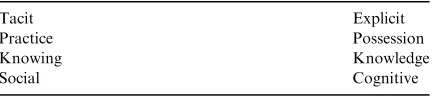
Many of the authors in this field consider that the primary challenge lies in understanding the nature and processes of tacit knowledge as opposed to explicit knowledge (Orlikowski, 2002; Tsoukas, 2003). Thus, Lave and Wenger (1991) develop the view that knowledge is ‘situated’ in the practice of everyday work rather than being the possession of individuals; other authors such as Cook and Brown (1999) and Brown and Duguid (1998) articulate a parallel distinction between ‘knowing’ and ‘knowledge’; and others (Cook and Yanow, 1993; Nicolini and Meznar, 1995; Nicolini, Gherardi and Yanow, 2003) develop the idea that organizational knowledge is sustained through social processes within ‘communities of practice’, rather than being the sum of individual cognitions. Although the distinction may seem simplistic, it is important, and the contrasting traditions are summarized in Table 1.
There has also been an interest in how the creation, development, retention and transfer of knowledge can be described as a learning process. In this respect, Chiva and Allegre (2005) argue that there are parallels between the possession/ practice divide in knowledge management and a cognitive/social divide within organizational learning theory. Additionally, the framework proposed by Crossan, Lane and White (1999) conceives of organizational learning as a dynamic process of strategic renewal, involving a tension between creating new knowledge (exploration) and using existing knowledge (exploitation). Both forms of knowledge can originate from outside the organization, as with ‘absorptive capacity’ (Zahra and George, 2002), or from inside the organization through various mechanisms of intra-organizational knowledge sharing (Tsai, 2002).
We now turn toknowledge management, which is concerned with identifying, developing and leveraging knowledge in organizations to help them to compete (Alavi and Leidner, 2001). Similar to organizational knowledge, there is a
basic divide between those interested in the technology of knowledge management and those who see human processes as being paramount (Alvesson and Karreman, 2001; Easterby-Smith and Araujo, 1999; Gloet and Berrell, 2003). The technology side focuses on the information processing and business information systems which are designed to manage knowledge. Key knowledge management initiatives include IT infrastructures, data warehouses and virtual centres of expertise, as well as other technical and managerial procedures. The human side focuses on the sense-making behaviours of individuals, on social relations and cultural factors when handling organizational knowledge, and frequently touches on fundamental questions about the organization.
These two perspectives derive from different epistemological positions, respectively positivism and social constructionism, and this affects both the forms of knowledge that are valued and how they should be managed (Swan et al., 1999). However, because both share an interest in knowledge for the benefit of the organization, they have been considered complementary rather than exclusive views, giving rise to an integrative perspective which some authors have named ‘socio-technical’ (Pan and Scarbrough, 1999). This integrative perspective describes the organi-zation from both the technological and human approaches, suggesting IT and social factors are independent but interacting components. An alternative of the socio-technical view is the ‘contingency’ framework of Hansen, Nohria and Tierney (1999) which suggests that, when the primary task is easily routinized or standardized, then the technical solutions are more appropriate; but when tasks are not easily routinized then the human solutions are preferable.
[image:5.567.55.271.631.679.2]But the knowledge management literature has also been criticized on a number of grounds. First is the assumption that knowledge can actually be ‘managed’ in a systematic way by organizations, which is seen as unduly prescriptive (Vera and Crossan, 2003). Second, the emphasis on the management of knowledge often focuses on managing the knowledge that is easily handled, and it neglects tacit forms of knowledge which are harder to codify and yet potentially more significant for competitive advantage. Third, the bulk of the literature concentrates on the technical side of knowledge management, and Table 1. Contrasting forms of organizational knowledge
Tacit Explicit
Practice Possession
Knowing Knowledge
therefore neglects the more complex social and political factors which influence, for example, whether or not employees will contribute to, or use, organizational knowledge management sys-tems (Tenkasi and Boland, 1996).
In sum, there are parallels between the literature on organizational knowledge and knowledge management. There is reasonable consensus about two distinct ways of under-standing and managing organizational knowl-edge, although there are finer points between kinds of knowledge and debates about how it can best be transmitted, particularly in tacit form. And there is uncertainty about whether this has to be based on personal experience or whether it is best distributed through communities of practice. There are choices about how knowledge management strategies should adapt to different task characteristics, and also there is growing awareness of the potential role of learning in the creation and dissemination of knowledge, parti-cularly when it is in tacit form.
Boundaries and overlaps
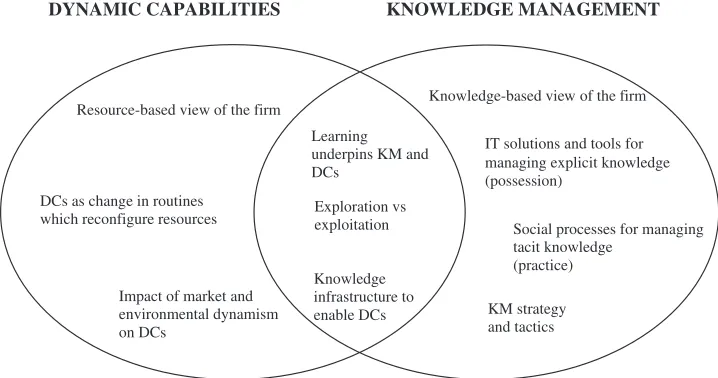
In the preceding section we reviewed current thinking, debates and critiques of the dynamic capabilities and knowledge management litera-tures. There are a number of areas of potential overlap, but also features where the contribution of one or the other is distinctive. Figure 1
summarizes our conclusions about the domains and boundaries of the dynamic capabilities and knowledge management fields. We show dynamic capabilities and knowledge management as over-lapping fields of research, but recognize that there are topics which are dealt with primarily by one, or other, field. We therefore start this section by summarizing what is distinctive in the literature regarding each of dynamic capabilities and knowledge management. We then explore where there are areas of overlap, or potential synergies.
Distinct contributions
As suggested earlier in this paper, the idea of dynamic capabilities emerges as an extension of the resource-based view of the firm, while edge management is more consistent with knowl-edge-based theories of the firm. Although the last builds upon and extends the former, the resource-based view broadly focuses on firms’ resources, whether tangible or intangible, property-based or knowledge-based. The premise of most dynamic capabilities research is that organizations must use and renew their tangible and intangible resources and capabilities to sustain competitive advantage in rapidly changing environments. Conversely, the knowledge-based view focuses mainly on the stock of knowledge resources in the firm, on understanding what knowledge is, on
DYNAMIC CAPABILITIES KNOWLEDGE MANAGEMENT
Social processes for managing tacit knowledge
(practice)
managing explicit knowledge (possession)
Exploration vs exploitation Learning underpins KM and DCs
DCs as change in routines which reconfigure resources
Impact of market and environmental dynamism on DCs
KM strategy and tactics
Resource-based view of the firm Knowledge-based view of the firm
Knowledge infrastructure to enable DCs
[image:6.567.110.469.462.651.2]IT solutions and tools for
defining knowledge typologies, and on how best it can be managed.
As mentioned above, the dynamic capabilities perspective seeks to explain how firms achieve and sustain competitive advantage within ever-changing environments. The critical aspects of dynamic capabilities are the ability of the firm to identify the changing market environment, to sense the need and the opportunity, and then to accomplish the necessary transformation in its routines which reconfigures resources and creates significant value.
There is a growing agreement in the literature that dimensions of the general competitive environment of a business (environmental con-tingencies) will influence the development of dynamic capabilities (Eisenhardt and Martin, 2000). Furthermore, certain characteristics of the general business environment (i.e. uncertainty, complexity, munificence) moderate the relation-ship between dynamic capabilities and competi-tive advantage (Aragon-Correa and Sharma, 2003; Benner and Tushman, 2003; Marsh and Stock, 2003; Pavlou and El Sawy, 2004). In the case of the knowledge management literature, although it has a contingency side, it tends to be focused on the internal characteristics, includ-ing forms of knowledge and types of tasks, that influence the suitability of knowledge management initiatives (Becerra-Ferna´ndez and Sabherwal, 2001; Spender, 1996).
The knowledge management literature has most explicitly discussed whether knowledge is a possession or if it is embedded in practice by differentiating knowledge and knowing (Orli-kowski, 2002). Therefore, knowledge can be understood as something that individuals, groups or organizationshave(knowledge as possession); but also as something that individuals, groups and organizations do (knowledge as practice). Both forms of knowledge have a role to play, depending on the types of knowledge and tasks that are involved.
The distinction between knowledge as posses-sion and knowledge as practice is reflected in the alternative approaches to knowledge manage-ment. Most of the contributions of the knowledge management literature to date have focused on IT-based tools and systems, whereby technical knowledge management infrastructures are pre-sented as a pipeline to knowledge codification and organization (Alavi and Leidner, 2001;
Davenport and Prusak, 1998; Gold, Malhotra and Segars, 2001) and to extensive knowledge transfer (Davenport and Prusak, 1998; Ko, Kirsch and King, 2005; Van den Brink, 2003) as a coordination mechanism (Tanriverdi, 2005).
Meanwhile critiques have begun to argue that technical solutions cannot provide a full under-standing of complex situations (Bender and Fish, 2000) and lack the emotional richness and depth of live interaction (Swan et al., 1999). We also note the importance of social processes, and thus the management of people, social networks and communities within organizations in order to handle the problem of sharing tacit knowledge. Hence knowledge management initiatives should be consciously and deliberately concerned with the processes of developing, sharing and using tacit knowledge, skills and expertise.
Lastly, knowledge management needs to in-clude both strategic and tactical efforts if it is to be aligned with business strategy (Vera and Crossan, 2003). At the strategic level, the knowl-edge required to execute the firm’s strategic intent needs to be identified and compared with existing knowledge, in order to locate strategic knowledge gaps (Zack, 1999). A knowledge management strategy should indicate plans for manipulating knowledge and other organizational resources and will guide members to manipulate knowl-edge, producing and consuming resources in the process. At the tactical level, knowledge manage-ment is about the everyday enabling of the specific processes through which knowledge is created, captured, transferred, integrated and applied; it thus facilitates the manipulation of resources to develop needed knowledge on the basis of day-to-day work.
Overlaps
can be defined in terms of the processes of knowledge creation, retention, application etc. (Vera and Crossan, 2003), they fit together in such a way that knowledge management can be considered as ‘managed learning’ within organi-zations by providing solutions to these knowl-edge-associated processes (Prieto, 2003; Vera and Crossan, 2003). We conclude that organizational learning thus represents an opportunity to unify the insights from both dynamic capabilities and knowledge management.
A second area of overlap is that dynamic capabilities depend upon the evolution of knowl-edge through both exploration and exploitation (Levinthal and March, 1993). Exploration activ-ities are primarily aimed to introduce the varia-tions that generate new ideas and to select the most appropriate ones through, for example, alliances (Das, 2006) and organizational net-working (Hendry and Brown, 2006). Exploitation involves the replication of existing methods into new contexts and their wider dissemination. The benefits of exploitation are thus based on increased efficiency, while that of exploration is based on increased innovation. Although the field of dynamic capabilities emphasizes the renewal of the firm’s overall resources and the field of knowledge management focuses on knowledge-specific resources and routines, both fields have produced a number of research papers about the processes of knowledge exploration and exploita-tion. For example, Zollo and Winter (2002) link dynamic capabilities to a ‘knowledge evolution cycle’ that involves both exploration and exploi-tation, and Swan et al. (1999, 2000) recognize that the objective of knowledge management can be to enhance both knowledge exploitation and exploration.
After two decades of research on the explora-tion–exploitation trade-off (Adler, Goldoftas and Levine, 1999; He and Wong, 2004), scholars in organization theory have concluded that the degree of success of business organizations lies in their potential to conduct both exploration and exploitation activities simultaneously (Levinthal and March, 1993; March, 1991; Oshri, Pan and Newell, 2006). Dynamic capabilities are manifest when a firm simultaneously explores and exploits its knowledge and competences. This combina-tion is reflected in the concept of ambidexterity introduced by Gibson and Birkinshaw (2004) which involves two essential dimensions – performance
management and social support – that give rise to dynamic capabilities.
Finally, both dynamic capabilities and knowl-edge management researchers have identified knowledge resources that are critical to achieving and sustaining competitiveness (Tidd, Bessant and Pavitt, 1997). Researchers such as Lawson and Samson (2001) and Verona and Ravasi (2003) identify personal skills and knowledge, physical technical systems, structural and man-agerial systems, and cultural values and norms as essential constituents for building dynamic capabilities. In the knowledge management lit-erature there is also convergence around cultural, structural, human and technological factors as key elements of a successful knowledge man-agement infrastructure which can support the generation, acquisition, retention, transfer and utilization of knowledge (Chuang, 2004; Gold, Malhotra and Segars, 2001; Lee and Choi, 2003; Van den Brink, 2003). Human, cultural and structural conditions traditionally fit around the internal social context of the firm, while techno-logical conditions conform to the technical context of the firm.
Building on the conclusions from this initial review, the following section presents an integra-tive framework that relates dynamic capabilities and knowledge management to firm performance.
Towards an integrative framework
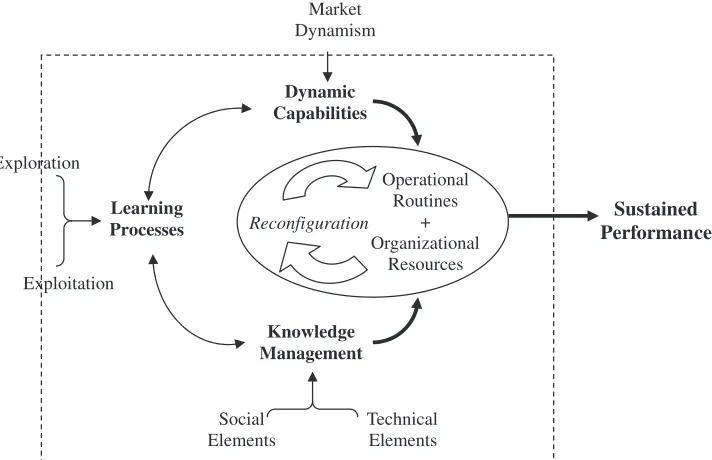
Since this model is quite complex, we will explain it in stages, starting with the more obvious links between knowledge management and dynamic capabilities, then explaining the potential mediating role of learning capabilities, and finishing with a discussion of the potential links to performance.
Knowledge management and dynamic capabilities
The core of the model is about ensuring that the firm has the organizational resources (which include knowledge) and operational routines (which include functional capabilities) that are appropriate to the current business context. These are what Winter (2003) refers to as operational (zero-order) capabilities; and me-chanisms need to be in place to ensure that they can be appropriately reconfigured as business circumstances change.
In the upper half of the figure we illustrate the role of dynamic capabilities as the (first-order) capability to modify existing resources and operational routines over time. The need for reconfiguration and renewal of these resources and routines may emanate from changes in the organizational conditions and from changes in the environmental conditions (Zahra, Sapienza and Davidsson, 2006). Thus dynamic capabilities are developed in response to a variety of
conditions including market dynamism. In mod-erately dynamic environments, as suggested by Eisenhardt and Martin (2000), dynamic capabil-ities take on a relatively stable, predictable and analytic form, and rely heavily on existing knowledge in enabling the reconfiguration of resources and routines. But in high-velocity markets this apparent stability breaks down, and consequently dynamic capabilities become ‘simple, experiential, unstable processes that rely on quickly created new knowledge and iterative execution to produce adaptive, but unpredict-able outcomes’ (Eisenhardt and Martin, 2000, p. 1106).
In the lower half of the figure we develop the role of knowledge management. Here we are suggesting that knowledge management may also be considered as a first-order capability (Gold, Malhotra and Segars, 2001) which contributes to the reconfiguration of resources and operational routines, both because knowledge is a resource in its own right and because operational routines will be derived from the knowledge that resides within functional disciplines such as marketing, human resources and information systems. Ac-cording to Pan and Scarbrough (1999), Lee and Choi (2003) and Chuang (2004), knowledge management capabilities need to encompass an appropriate combination of social relationships, managerial practices and technical tools, thus
Operational Routines
+ Organizational
Resources
Reconfiguration
Knowledge Management Learning
Processes
Exploitation Exploration
Technical Elements Market
Dynamism
Social Elements
Dynamic Capabilities
[image:9.567.102.458.62.292.2]Sustained Performance
developing and deploying the knowledge types which are embodied in practice with the knowl-edge that can be possessed.
The most appropriate balance between the two forms of knowledge depends on managerial choices that will take account of the current business strategy (Cepeda and Vera, 2005; Vera and Crossan, 2003). However, we suggest that it is mostly when knowledge management moti-vates and supports people and collective activities that dynamic capabilities can be triggered, and therefore social elements may be more signifi-cant than technical ones (Prieto and Easterby-Smith, 2006). As stated by Robey, Boudreau and Rose (2000, p. 139): ‘Information technologies are subject to complex social processes as they are implemented and used in organizations; they are not plugged in and played without the involve-ment of numerous actors over significant periods of time.’ Therefore firms must create and renew social contexts which enable individuals to engage in both internal and external learning processes in the course of their day-to-day work. This task is difficult if we consider that not only are people the key enablers of creating and using knowledge for competitive advantage, but they may also be the major constraints (Biloslavo and Zornada, 2004).
The role of learning
We have located learning processes on the left-hand side of the figure because they mediate between knowledge management and dynamic capabilities, and contribute to the evolution of both; as such, they are second-order capabilities using the classification of Winter (2003). The bidirectional arrows to and from learning pro-cesses indicate that there is mutual interaction between learning processes, dynamic capabilities and knowledge management.
We agree with Zollo and Winter (2002) that exploration and exploitation are both critical learning processes. Exploration is important because it involves moving outside the bound-aries of current practice; but exploitation also has a role, provided there are sufficient mechanisms in place to ensure that the consequences of exploitative actions are fed back as a way of reviewing the routines which underpin them. As noted above, there needs to be an appropriate balance between exploration and exploitation
activities, because it may be difficult to be good at both processes simultaneously (Teece, Pisano and Shuen, 1997), and this is again a matter of strategic choice. There also needs to be a recognition that they contain different logics which require different structures, methods and behaviours (He and Wong, 2004), and the way in which they operate will vary according to different industrial and competitive circum-stances. As previously suggested, market dyna-mism shapes the pattern of dynamic capabilities, and will influence the strategic choices between knowledge exploration and exploitation, together with choices between internal and external knowledge.
There is also a strong link between learning processes and knowledge management. The organizational learning literature has explicitly discussed the development of a learning system or infrastructure that affects and is affected by learning processes (Vera and Crossan, 2003). This learning infrastructure consists of embedded learning in the technical procedures and social relationships that are pooled through knowledge management. At a practical level, Zollo and Winter (2002) argue that it is possible to organize ‘learning mechanisms’ of experience accumula-tion, knowledge articulation and codification which encapsulate these learning processes. And more specific organizational practices such as skill development, mentoring and reward systems are reported by Orlikowski (2002) as leading to the development of capabilities. These learning mechanisms enable the configuration and recon-figuration (i.e. dynamic capabilities) of the firm’s operational resources and routines (Cepeda and Vera, 2005), and are catalysed by the manage-ment of the firm’s knowledge resources.
The impact on business performance
Here we follow the arguments of Eisenhardt and Martin (2000), Winter (2003) and Zahra, Sapienza and Davidsson (2006), among others, in suggesting that competitive advantage does not come from dynamic capabilities themselves but from the new configurations of resources and operational routines resulting from them. Em-pirical evidence in knowledge management lit-erature also suggests that, in order to achieve a better understanding of knowledge manage-ment performance, companies should attempt to link knowledge processes and resources with intermediate outcomes that transform knowl-edge into business value (Carlucci, Marr and Schiuma, 2004; Gold, Malhotra and Segars, 2001; Lee and Choi, 2003). As defined earlier, operational routines or capabilities are the visible outcome of dynamic capabilities. These capabilities are geared towards the operational functioning of the firm, and they can affect performance measures and lead to above-average returns.
In particular, operational capabilities incorpor-ating knowledge processes and resources in the form of differential and complementary techno-logical and marketing competences (Danneels, 2002) and human resource competences (Hodg-kinson and Sparrow, 2002) provide a sustainable competitive advantage to the organization (Tan-riverdi, 2005). Technological competences give the firm the capacity to design and manufacture products with certain attributes, and include basic research, research and development, product design, and quality assurance tools. Marketing competences allow firms to serve certain custo-mers and include abilities in managing sales, distribution channels, brand names and advertis-ing, together with knowledge of customer needs. Human resource competences allow the organi-zation both to harness the commitment of organizational members and to introduce flex-ibility in the application of plans (the dynamic element) which is most important when compet-ing in global markets.
Finally, anecdotal evidence suggests that the relative contribution of knowledge management and dynamic capabilities to a firm’s competitive advantage may vary according to several factors. In reviewing the literature, one encounters a very broad range of factors that possibly influence performance results. Resource conditions (Holsap-ple and Joshi, 2000), firm conditions (Holsap(Holsap-ple
and Joshi, 2000; Zollo and Winter, 2002) and environmental conditions (Benner and Tushman, 2003; Massey, Montoya-Weiss and O’Driscoll, 2002; Zollo and Winter, 2002) are usually mentioned as major influences that may lever or constrain the outcomes of knowledge-enabled capabilities. Specially, in integrating this contin-gent perspective, several authors have proposed that patterns of effective capabilities (those that enhance organizational fit and performance) vary with market dynamism or a competitive business environment (Aragon-Correa and Sharma, 2003; Eisenhardt and Martin, 2000; Keskin, 2005; Marsh and Stock, 2003).
Conclusions and directions for
future research
This paper deals with the co-evolution of dynamic capabilities and knowledge management fields by providing synthesis and integration of these closely related concepts. The lack of explicit connection that we note between the dynamic capabilities and knowledge management dis-courses can be related to the distributed nature of the adoption of these discourses, with a variety of communities encountering ideas in different ways. However, we have critically reviewed previous research in an effort to understand how these discourses fit together and how they can be integrated into a more meaningful conceptual model for both academia and practi-tioners. We propose the present framework as an instrument to facilitate communication between researchers.
and dynamic capabilities lead to a better perfor-mance when they support the operational func-tioning of the firm. We therefore argue that knowledge management enabled dynamic cap-abilities are antecedents of specific operational/ functional competences which in turn have a significant effect on business performance.
There are a number of practical implications from our analysis and the model proposed. First is the need to understand the complex relation-ship between dynamic capabilities and knowl-edge, and the role of knowledge management infrastructures in this process. Second is the need to adopt a holistic approach to dynamic cap-abilities, incorporating both the exploration and exploitation of knowledge and competences as underlying dimensions of successful dynamic capabilities. In so doing, firms have the oppor-tunity to learn from exploration and exploita-tion, so that they can build their knowledge base and direct the resource conversion activ-ities of the firm. Third, it is important to understand the way contingency factors based on market dynamism affect the appropriate balance between exploration and exploitation on one hand, and between social and technical processes of knowledge management on the other hand. Fourth, there is a need to under-stand the critical importance of learning pro-cesses, both because they underpin resource and operational renewal processes and because they mediate between environmental dynamism and the appropriate configuration of organizational capabilities.
Relatively few studies have provided empirical insights into the mutually reinforcing interaction between knowledge management and dynamic capabilities. This indicates an important direction for future empirical work, with the opportunity to test the relationships implicit in the proposed integrative model. In testing these relationships, future research needs to address the choice of appropriate measures and methodology. Several instruments are available in the knowledge management literature, while dynamic capabil-ities have yet received limited empirical verifica-tion. There is also potential to examine explicitly the links between other functional strategies and dynamic capabilities, perhaps using the model as a general framework. Finally, future research could build on Cepeda and Vera’s (2005) operationalization of dynamic capabilities as
mediators of the link between knowledge man-agement and business performance.
References
Adler, P. S., B. Goldoftas and D. I. Levine (1999). ‘Flexibility versus efficiency? A case study of model changeovers in the Toyota production system’,Organization Science,10(1), pp. 43–68.
Alavi, M. and D. E. Leidner (2001). ‘Review: Knowledge management and knowledge management systems concep-tual foundations and research issues’,MIS Quarterly,25(1), pp. 107–136.
Alvesson, M. and D. Karreman (2001). ‘Odd couple: making sense of the curious concept of knowledge management’,
Journal of Management Studies,38(7), pp. 995–1018. Amit, R. and P. J. H. Schoemaker (1993). ‘Strategic assets and
organizational rents’,Strategic Management Journal,14(1), pp. 33–46.
Aragon-Correa, J. A. and S. Sharma (2003). ‘A contingent resource-based view of proactive corporate environmental strategy’,Academy of Management Review,28(1), pp. 71–88. Barney, J. B. (1991). ‘Firm resources and sustained competitive
advantage’,Journal of Management,17(1), pp. 99–120. Becerra-Ferna´ndez, I. and R. Sabherwal (2001). ‘Organizational
knowledge management: a contingency perspective’,Journal of Management Information Systems,18(1), pp. 23–55. Bender, S. and A. Fish (2000). ‘The transfer of knowledge and
the retention of expertise: the continuing need for global assignments’,Journal of Knowledge Management,4(2), pp. 125–150.
Benner, M. J. and M. L. Tushman (2003). ‘Exploitation, exploration and process management: the productivity dilemma revisited’,Academy of Management Review,28(2), pp. 238–256.
Biloslavo, R. and M. Zornada (2004). ‘Development of a knowledge management framework within the systems context’, Proceedings of the 5th European Conference on Organizational Knowledge, Learning and Capabilities, In-nsbruck, Austria, 2–3 April.
Bowman, C. and V. Ambrosin (2003). ‘How the resource-based and the dynamic capability views of the firm inform corporate-level strategy’, British Journal of Management,
14, pp. 289–303.
Brown, J. and P. Duguid (1998). ‘Organizing knowledge’,
California Management Review,40(3), pp. 90–111. Carlucci, D., B. Marr and G. Schiuma (2004). ‘The knowledge
value chain: how intellectual capital impacts on business performance’,International Journal of Technology Manage-ment,27(6/7), pp. 575–590.
Cepeda, G. and D. Vera (2005). ‘Knowledge management and firm performance: examining the mediating link of dynamic capabilities’, 4th International Meeting of the Iberoamerican Academy of Management, Lisbon, Portugal.
Chiva, R. and J. Allegre (2005). ‘Organizational learning and organizational knowledge: the integration of two ap-proaches’,Management Learning,36(1), pp. 49–68. Chuang, S. (2004). ‘A resource-based perspective on knowledge
empirical investigation’, Expert Systems with Applications,
27, pp. 459–465.
Chung, L. H., P. T. Gibbons and H. P. Schoch (2006). ‘The management of information and managers in subsidiaries of multinational corporations’,British Journal of Management,
17, pp. 153–165.
Collis, D. J. (1994). ‘Research note: How valuable are organizational capabilities?’,Strategic Management Journal,
15, pp. 143–152.
Cook, S. and J. S. Brown (1999). ‘Bridging epistemologies: the generative dance between organizational knowledge and organizational knowing’,Organization Science,10, pp. 381– 400.
Cook, S. and D. Yanow (1993). ‘Culture and organizational learning’,Journal of Management Inquiry,2(4), pp. 373–390. Crossan, M. M., H. W. Lane and R. E. White (1999). ‘An organizational learning framework: from intuition to institu-tion’,Academy of Management Review,24(3), pp. 522–537. Danneels, E. (2002). ‘The dynamics of product innovation and
firm competences’,Strategic Management Journal, 23(12), pp. 1095–1121.
Das, T. K. (2006). ‘Strategic alliance temporalities and partner opportunism’, British Journal of Management, 17 (1), pp. 1–22.
Davenport, T. H. and L. Prusak (1998).Working Knowledge. How Organizations Manage What They Know. Boston, MA: Harvard Business School Press.
Dougherty, D., H. Barnard and D. Dunne (2004). ‘Exploring the everyday dynamics of dynamic capabilities’. 3rd Annual MIT/UCI Knowledge and Organizations Conference, Lagu-na Beach, CA.
Easterby-Smith, M. and L. Araujo (1999). ‘Organizational learning: current debates and opportunities’. In M. Easterby-Smith and L. Araujo (eds),Organizational Learning and the Learning Organization: Development in Theory and Practice. London: Sage.
Eisenhardt, K. M. and J. K. Martin (2000). ‘Dynamic capabilities: what are they?’,Strategic Management Journal,
21, pp. 1105–1121.
Gibson, C. B. and J. Birkinshaw (2004). ‘The antecedents, consequences, and mediating role of organizational ambidex-terity’,Academy of Management Journal,47(2), pp. 209–226. Gloet, M. and M. Berrell (2003). ‘The dual paradigm nature of knowledge management: implications for achieving quality outcomes in human resource management’, Journal of Knowledge Management,7(1), pp. 78–89.
Gold, A. H., A. Malhotra and A. H. Segars (2001). ‘Knowledge management: an organizational capabilities perspective’,
Journal of Management Information Systems, 18 (1), pp. 185–214.
Grant, R. (1996). ‘Toward a knowledge-based theory of the firm’, Strategic Management Journal, 17 (Winter special issue), pp. 199–122.
Gratton, L. and S. Ghoshal (2005). ‘Beyond best practice’,MIT Sloan Management Review,46(3), pp. 49–57.
Griffith, M. G. and D. A. Harvey (2001). ‘Intercultural communication model for use in global relationship net-works’,Journal of International Marketing,9(3), pp. 87–103. Haas, M. R. and M. T. Hansen (2005). ‘When using knowledge can hurt performance: the value of organizational capabilities in a management consulting company’, Strategic Manage-ment Journal,26(1), pp. 1–24.
Hansen, M. T., N. Nohria and T. Tierney (1999). ‘What’s your strategy for managing knowledge?’,Harvard Business Review,
77(2), pp. 106–116.
He, Z. and P. Wong (2004). ‘Exploration vs. exploitation: an empirical test of the ambidexterity hypothesis’,Organization Science,15(4), pp. 481–494.
Helfat, C. E. and M. A. Peteraf (2003). ‘The dynamic resource-based view: capability lifecycles’, Strategic Management Journal,24, pp. 997–1010.
Hendry, C. and J. Brown (2006). ‘Organizational networking in UK biotechnology clusters’,British Journal of Management,
17(1), pp. 55–74.
Hodgkinson, G. P. and P. R. Sparrow (2002).The Competent Organization. Buckingham: Open University Press. Holsapple, C. W. and K. D. Joshi (2000). ‘An investigation of
factors that influence the management of knowledge in organizations’, Journal of Strategic Information Systems,9
(2), pp. 235–261.
Keskin, H. (2005). ‘The relationships between explicit and tacit oriented KM strategy, and firm perfor-mance’, Journal of American Academy of Business, 7 (1), pp. 169–175.
Ko, D., L. J. Kirsch and W. R. King (2005). ‘Antecedents of knowledge transfer from consultants to clients in enterprise system implementation’, MIS Quarterly, 29 (1), pp. 59–85.
Kogut, B. and U. Zander (1992). ‘Knowledge of the firm, combinative capabilities, and the replication of technology’,
Organization Science,3(3), pp. 383–397.
Lave, J. and E. Wenger (1991).Situated Learning: Legitimate Peripheral Participation. Cambridge: Cambridge University Press.
Lawson, B. and D. Samson (2001). ‘Developing innovation capability in organisations: a dynamic capabilities approach’,
International Journal of Innovation Management, 5(3), pp. 377–400.
Lee, H. and B. Choi (2003). ‘Knowledge management enablers, processes, and organizational performance: an integrative view and empirical examination’, Journal of Management Information Systems,20(1), pp. 179–228.
Levinthal, D. A. and J. G. March (1993). ‘The myopia of learning’,Strategic Management Journal,14, pp. 95–112. Lin, A. and L. Silva (2005). ‘The social and political
construction of technological frameworks’,European Journal of Information Systems,14, pp. 49–59.
Mahoney, J. T. (1995). ‘The management of resources and the resources of management’,Journal of Business Research,33, pp. 91–101.
March, J. G. (1991). ‘Exploration and exploitation in organiza-tional learning’,Organization Science,2(1), pp. 71–87. Marsh, S. J. and G. N. Stock (2003). ‘Building dynamic
capabilities in new product development through intertem-poral integration’, Journal of Product Innovation Manage-ment,20, pp. 136–148.
Massey, A. P., M. M. Montoya-Weiss and T. M. O’Driscoll (2002). ‘Knowledge management pursuit of performance: insights from Nortel Networks’,MIS Quarterly,26(3), pp. 269–289.
Nicolini, D. and M. B. Meznar (1995). ‘The social construction of organizational learning: conceptual and practical issues in the field’,Human Relations,48(7), pp. 727–746.
Nicolini, D., S. Gherardi and D. Yanow (eds) (2003).Knowing in Organisations: a Practice-based Approach. London: M. E. Sharp.
Nonaka, I. and H. Takeuchi (1995).The Knowledge Creating Company. New York: Oxford University Press.
Orlikowski, W. U. (2002). ‘Knowing in practice: enacting a collective capability in distributed organizing’,Organization Science,13(3), pp. 249–273.
Oshri, I., S. L. Pan and S. Newell (2006). ‘Managing trade-offs and tensions between knowledge management initiatives and expertise development practices’,Management Learning, 37
(1), pp. 63–82.
Pan, S. L. and H. Scarbrough (1999). ‘Knowledge management in practice: an exploratory case study’,Technology Analysis and Strategic Management,11(3), pp. 359–374.
Pavlou, P. A. and O. A. El Sawy (2004). ‘Understanding the ‘‘black-box’’ of dynamic capabilities: a missing link to the strategic role of IT in turbulent environments?’, Working Paper. Anderson School of Management, University of California, Riverside.
Penrose, E. (1959). The Theory of the Growth of the Firm. London: Basil Blackwell.
Peteraf, M. (1993). ‘The cornerstones of competitive advantage: a resource-based view’, Strategic Management Journal, 14
(3), pp. 179–191.
Peteraf, M. and J. Barney (2003). ‘Unravelling the resource-based tangle’,Managerial and Decision Economics, 24, pp. 309–323.
Polanyi, M. (1967).The Tacit Dimension. London: Routledge and Kegan Paul.
Priem, R. L. and J. E. Butler (2001). ‘Is the resource-based view a useful perspective for strategic management research?’,
Academy of Management Review,26(1), pp. 22–40. Prieto, I. (2003). ‘Una valoracio´n de la gestio´n del conocimiento
para el desarrollo de la capacidad de aprendizaje en las organizaciones: propuesta de un modelo integrador’,Tesis Doctoral. Departamento de Economı´a y Administracio´n de Empresas, Universidad de Valladolid.
Prieto, I. M. and M. Easterby-Smith (2006). ‘Dynamic capabilities and the role of organizational knowledge: an exploration’, European Journal of Information Systems, 15
(5), pp. 500–510.
Reed, R. and R. J. DeFillippi (1990). ‘Causal ambiguity, barriers to imitation, and sustainable competitive advantage’,
Academy of Management Review,15(1), pp. 88–102. Robey, D., M. Boudreau and G. M. Rose (2000). ‘Information
technology and organizational learning: a review and assessment of research’,Accounting Management and Infor-mation Technologies,10, pp. 125–155.
Rumelt, R. P. (1984). ‘Towards a strategy theory of the firm’. In R. B. Lamb (ed.),Competitive Strategic Management, pp. 556–570. Englewood Cliffs, NJ: Prentice Hall.
Sambamurthy, V. and M. Subramani (2005). ‘Special issue on information technology and knowledge management’,MIS Quarterly,29(1), pp. 1–7.
Sher, P. J. and V. C. Lee (2004). ‘Information technology as a facilitator for enhancing dynamic capabilities through knowl-edge management’, Information and Management, 41, pp. 933–945.
Sparrow, P., C. Brewster and H. Harris (2004). Globalising Human Resource Management. London: Routledge. Spender, J. C. (1996). ‘Making knowledge the basis of a
dynamic theory of the firm’,Strategic Management Journal,
17(Winter special issue), pp. 45–62.
Swan, J., S. Newell, H. Scarbrough and D. Hislop (1999). ‘Knowledge management and innovation: networks and networking’, Journal of Knowledge Management,3(4), pp. 262–275.
Swan, J., S. Newell, H. Scarbrough and D. Hislop (2000). ‘Limits of IT-driven knowledge management initiatives for interactive innovation processes: towards a community-based approach’, Proceedings of the 33rd Hawaii International Conference on System Sciences. Washington, DC: IEEE Computer Society.
Tanriverdi, H. (2005). ‘Information technologies related-ness, knowledge management capability, and perfor-mance of multi-business firms’,MIS Quarterly,29(2), pp. 311–334.
Teece, D. J. (1998). ‘Capturing value from knowledge assets’,
California Management Review,40(3), pp. 55–79.
Teece, D. J., G. Pisano and A. Shuen (1997). ‘Dynamic capabilities and strategic management’, Strategic Manage-ment Journal,17(Winter special issue), pp. 509–533. Tenkasi, R. V. and R. J. Boland (1996). ‘Exploring knowledge
diversity in knowledge intensive firms: a new role for information systems’, Journal of Organizational Change Management,9(1), pp. 79–91.
Tidd, J., J. Bessant and K. Pavitt (1997).Managing Innovation: Integrating Technological, Market and Organisational Change. London: Wiley.
Tsai, W. (2002). ‘Social structure of ‘‘coopetition’’ within a multinational organisation: coordination, competition, and intra-organizational knowledge sharing’, Organization Science,13(2), pp. 179–190.
Tsoukas, H. (2003). ‘Do we really understand tacit knowl-edge?’. In M. Easterby-Smith and M. A. Lyles (eds),
Blackwell Handbook of Organizational Learning and Knowl-edge Management, pp. 410–427. Oxford: Blackwell. Van den Brink, P. (2003). ‘Social, organizational and
techno-logical conditions that enable knowledge sharing’,Doctoral thesis. Technische Universiteit Delft, Amsterdam.
Vera, D. and M. Crossan (2003). ‘Organizational learning and knowledge management: toward an integrative framework’. In M. Easterby-Smith and M. A. Lyles (eds), Blackwell Handbook of Organizational Learning and Knowledge Man-agement, pp. 123–141. Oxford: Blackwell.
Verona, G. and D. Ravasi (2003). ‘Unbundling dynamic capabilities: an exploratory study of continuous product innovation’, Industrial and Corporate Change, 12 (3), pp. 577–606.
Wernerfelt, B. (1984). ‘A resource-based view of the firm’,
Strategic Management Journal,5(2), pp. 171–180. Winter, S. G. (2003). ‘Understanding dynamic capabilities’,
Strategic Management Journal,24, pp. 991–995.
Zack, M. H. (1999). ‘Developing a knowledge strategy’,
California Management Review,41(3), pp. 125–145. Zahra, S. A. and G. George (2002). ‘Absorptive capacity: a
review, reconceptualization, and extension’, Academy of Management Review,27(2), pp. 185–203.
and research agenda’,Journal of Management Studies,43(4), pp. 917–955.
Zollo, M. and S. G. Winter (2002). ‘Deliberate learning and the evolution of dynamic capabilities’,Organization Science,13
(3), pp. 339–351.
Zott, C. (2003). ‘Dynamic capabilities and the emergence of intra-industry differential firm performance: insights from a simulation study’,Strategic Management Journal,24, pp. 97–125.
Mark Easterby-Smith is Professor of Management Learning at Lancaster University Management School and past Chair of the British Academy of Management. His research interests focus on understanding the socio-cultural processes that underlie learning within and between organizations, the nature of dynamic capabilities, and methodologies in management research. He has published papers in Management Learning, Journal of Management Studies, Human Relations, Academy of Management Journal and Academy of Management Executive, and is co-editor of the Blackwell Handbook of Organizational Learning and Knowledge Management.