Genetic Programming
Hyper-heuristics for
Job Shop Scheduling
by
Rachel Joanne Hunt
A thesis
submitted to the Victoria University of Wellington in fulfilment of the
requirements for the degree of Doctor of Philosophy in Operations Research. Victoria University of Wellington
Abstract
Scheduling problems arise whenever there is a choice of order in which a number of tasks should be performed; they arise commonly, daily and everywhere. A job shop is a common manufacturing environment in wh-ich a schedule for processing a set of jobs through a set of machines needs to be constructed. Job shop scheduling (JSS) has been called a fascinating challenge as it is computationally hard and prevalent in the real-world. Developing more effective ways of scheduling jobs could increase prof-itability through increasing throughput and decreasing costs. Dispatching rules (DRs) are one of the most popular scheduling heuristics. DRs are easy to implement, have low computational cost, and cope well with the dynamic nature of real-world manufacturing environments. However, the manual development of DRs is time consuming and requires expert kno-wledge of the scheduling environment. Genetic programming (GP) is an evolutionary computation method which is ideal for automatically dis-covering DRs. This is a hyper-heuristic approach, as GP is searching the search space of heuristic (DR) solutions rather than constructing a sched-ule directly.
The overall goal of this thesis is to develop GP based hyper-heuristics for the efficient evolution (automatic generation) of robust, reusable and effective scheduling heuristics for JSS environments, with greater interpre-tability.
Firstly, this thesis investigates using GP to evolve optimal DRs for the static two-machine JSS problem with makespan objective function. The re-sults show that some evolved DRs were equivalent to an optimal schedu-ling algorithm. This validates both the GP based hyper-heuristic approach for generating DRs for JSS and the representation used.
gh the use of wider-looking terminals and local search to provide addi-tional fitness information. The results show that incorporating features of the state of the wider shop improves the mean performance of the best evolved DRs, and that the inclusion of local search in evaluation evolves DRs which make better decisions over the local time horizon, and attain lower total weighted tardiness.
Thirdly, this thesis proposes using strongly typed GP (STGP) to ad-dress the challenging issue of interpretability of DRs evolved by GP. Sev-eral grammars are investigated and the results show that the DRs evolved in the semantically constrained search space of STGP do not have (on av-erage) performance that is as good as unconstrained. However, the inter-pretability of evolved rules is substantially improved.
Fourthly, this thesis investigates using multiobjective GP to encourage evolution of DRs which are more readily interpretable by human oper-ators. This approach evolves DRs with similar performance but smaller size. Fragment analysis identifies popular combinations of terminals wh-ich are then used as high level terminals; the inclusion of these terminals improved the mean performance of the best evolved DRs.
Through this thesis the following major contributions have been made: (1) the first use of GP to evolve optimal DRs for the static two-machine job shop with makespan objective function; (2) an approach to develop-ing less-myopic DRs through the inclusion of wider lookdevelop-ing terminals and the use of local search to provide additional fitness information over an ex-tended decision horizon; (3) the first use of STGP for the automatic discov-ery of DRs with better interpretability and semantic validity for increased trust; and (4) the first multiobjective GP approach that considers multiple objectives investigating the trade-off between scheduling behaviour and interpretability. This is also the first work that uses analysis of evolved GP individuals to perform feature selection and construction for JSS.
List of Publications
Hunt, R., Johnston, M. and Zhang, M. “Evolving machine-specific dis-patching rules for a two-machine job shop using genetic programming”. In Proceedings of the IEEE Congress on Evolutionary Computation(2014), pp. 618–625.
Hunt, R., Johnston, M. and Zhang, M. “Evolving “less-myopic” schedu-ling rules for dynamic job shop scheduschedu-ling using genetic programming”. InProceedings of the Genetic and Evolutionary Computation Conference(2014), pp. 927–934. (Best paper nomination - GP Track).
Hunt, R., Johnston, M. and Zhang, M. “Using local search to evaluate
dis-patching rules in dynamic job shop scheduling”. In Proceedings of
Evolu-tionary Computation in Combinatorial Optimization(2015), pp. 222–233.
Hunt, R., Johnston, M. and Zhang, M. “Evolving dispatching rules with greater understandability for dynamic job shop scheduling”. Submitted to Evolutionary Computation Journal (MIT Press)(2015), 36pp. (under second review).
Hunt, R., Johnston, M. and Zhang, M. “Multiobjective genetic program-ming for feature selection and dispatching rule generation in job shop
scheduling”. Submitted to IEEE Transactions on Cybernetics. (2015), 14pp.
(under review).
Acknowledgements
I would like to thank my supervisors, Prof Mengjie Zhang and Dr Mark Johnston, for their guidance, support and encouragement throughout the course of my PhD study. Thank you for the hours of reading of my drafts of papers and of this thesis, and for the carefully thought out red pen wh-ich they have had on their return. Thank you for challenging me to dig deeper and question why. I am especially grateful to Dr Mark Johnston for continuing to supervise the last half of this thesis from his new posi-tion in the UK.
I am grateful for the financial support of the Victoria Doctoral Schol-arship and the Victoria Doctoral Submission ScholSchol-arship. I have enjoyed being part of the Evolutionary Computation Research Group (ECRG) and Evolutionary Computation for Scheduling and Combinatorial Optimisa-tion subgroup.
I am incredibly blessed to have such a caring and supportive family. Thank you to my amazing husband Simon for listening to my frustrations and lovingly motivating me to keep going. Thank you to my fantastic par-ents, Andrew and Janice, for the coffee dates when they were needed, for listening to my research ideas, and for celebrating in my successes along the way. Thank you to my great friend Claire, for her prayerful support and encouragement.
Contents
List of Publications iii
Acknowledgements v
List of Tables xiii
List of Figures xxi
List of Notations xxix
List of Abbreviations xxxi
Glossary of Terms xxxiii
1 Introduction 1
1.1 Problem Statement . . . 1
1.2 Motivations . . . 3
1.2.1 Challenges of Scheduling . . . 3
1.2.2 Why Genetic Programming? . . . 5
1.2.3 Limitations of Existing Work . . . 7
1.3 Research Goals . . . 9
1.4 Major Contributions . . . 16
1.5 Organisation of Thesis . . . 19 vii
2 Literature Review 23
2.1 Introduction . . . 23
2.1.1 Scheduling . . . 24
2.1.2 Heuristics, Meta-heuristics and Hyper-heuristics . . . 25
2.1.3 Evolutionary Computation . . . 27
2.2 Job Shop Scheduling . . . 29
2.2.1 The Job Shop Model . . . 31
2.2.2 Scheduling Algorithms for Static JSS . . . 34
2.2.3 Scheduling Methods in Dynamic Environments . . . 40
2.3 Genetic Programming . . . 43 2.3.1 Representation . . . 44 2.3.2 Population Initialisation . . . 45 2.3.3 Evaluation . . . 46 2.3.4 Selection . . . 47 2.3.5 Genetic Operators . . . 47 2.3.6 Basic GP Algorithm . . . 49
2.3.7 Multiobjective Genetic Programming . . . 51
2.3.8 Semantic Constraint in GP . . . 53
2.4 Local Search . . . 55
2.5 Feature Manipulation . . . 56
2.5.1 GP based Feature Manipulation . . . 56
2.5.2 Feature Manipulation for Scheduling . . . 57
2.6 GP for Generating Heuristics for JSS . . . 58
2.6.1 Genetic Programming for Automatic Generation of DRs . . . 59
2.6.2 Other Evolutionary Computation based Methods for Scheduling . . . 69
2.7 Chapter Summary . . . 70
3 Dispatching Rules for Two-Machine Job Shop Scheduling 73 3.1 Introduction . . . 73
CONTENTS ix
3.2 Optimal DR Representation for Static JSS . . . 74
3.3 Can GP Evolve Optimal DRs for Static JSS? . . . 80
3.3.1 GP System for Static Two-Machine JSS . . . 80
3.3.2 Initial Experimental Results on Static Problems . . . . 83
3.3.3 Improvements through Parameter Settings . . . 84
3.3.4 Improvements in Representation . . . 85
3.4 Machine Specific DRs for Dynamic JSS . . . 87
3.4.1 Representation of GP Individuals for Machine Spe-cific DRs . . . 88
3.4.2 GP System for Dynamic JSS . . . 88
3.4.3 Dynamic Two-Machine JSS Experimental Results . . 94
3.4.4 Analysis of Evolved Programs . . . 98
3.5 Chapter Summary . . . 101
4 Automatic Discovery of “Less-Myopic” Dispatching Rules 105 4.1 Introduction . . . 105
4.1.1 Chapter Goals . . . 106
4.1.2 Chapter Organisation . . . 107
4.2 Less-Myopic Feature Sets . . . 107
4.2.1 Terminal and Function Sets . . . 107
4.2.2 GP System Setup . . . 110
4.2.3 Experimental Results . . . 112
4.2.4 Analysis of Evolved DRs . . . 118
4.2.5 Feature Set Conclusions . . . 119
4.3 Using Local Search to Evaluate DRs . . . 122
4.3.1 Local Search based Evaluation . . . 124
4.3.2 Initial Experiment . . . 130
4.3.3 Extended Experiments . . . 135
4.3.4 Experimental Results . . . 138
4.3.5 Local Search Conclusions . . . 147
4.4 Local Search to Investigate Tie Breaking . . . 150
4.4.2 GP System Setup . . . 152
4.4.3 Results . . . 154
4.5 Chapter Summary . . . 154
5 Evolving Dispatching Rules with Greater Understandability 159 5.1 Introduction . . . 159
5.1.1 Chapter Goals . . . 161
5.1.2 Chapter Organisation . . . 162
5.2 Method and Experimental Design . . . 163
5.2.1 GP System for Automatic Generation of DRs . . . 163
5.2.2 Job Shop Scenarios . . . 163
5.2.3 Function and Terminal Sets . . . 166
5.2.4 GP Parameter Settings . . . 167
5.3 Experimental Results . . . 169
5.3.1 Stage One: Arithmetic GP and STGP . . . 170
5.3.2 Stage Two: Inclusion of If, Max and Min . . . 179
5.3.3 Stage Three: Specialised Conditionals . . . 187
5.4 Analysis of Evolved Rules . . . 192
5.4.1 Fragment Analysis . . . 195
5.4.2 Best Evolved DRs . . . 199
5.5 Further Discussions . . . 209
5.5.1 DR Size . . . 211
5.5.2 Comparison of Performance in Testing vs Extreme Testing . . . 214
5.5.3 Training and Testing Times . . . 216
5.5.4 Exploration of Performance Decrease in STGP . . . . 216
5.6 Chapter Summary . . . 218
6 Multiobjective Genetic Programming for Feature Selection and Dispatching Rule Generation in Job Shop Scheduling 223 6.1 Introduction . . . 223
CONTENTS xi
6.1.2 Chapter Organisation . . . 226
6.2 MOGP for Evolving Interpretable DRs . . . 227
6.2.1 Representation of Semantically Constrained DRs . . 227
6.2.2 Multiobjective Fitness . . . 229
6.2.3 Job Shop Simulation Model . . . 229
6.2.4 Benchmark Methods for Comparison . . . 232
6.3 Stage One: Initial Investigation . . . 233
6.4 Stage Two: Higher-level Constructed Terminals . . . 236
6.5 Stage Three: Specialised Conditional Operators . . . 239
6.6 Stage Four: Feature Reduction . . . 244
6.7 Further Analysis . . . 247
6.7.1 Comparison of Results by Stages . . . 247
6.7.2 Extremes . . . 252
6.7.3 Aggregate Pareto Fronts . . . 255
6.7.4 Trade-Offs between Pairs of Objectives . . . 257
6.7.5 Attribute Sets . . . 262
6.8 Chapter Summary . . . 264
7 Conclusions 267 7.1 Achieved Objectives . . . 267
7.2 Main Conclusions . . . 270
7.2.1 Optimal Dispatching Rules . . . 270
7.2.2 Less-Myopic Dispatching Rules . . . 272
7.2.3 Interpretability of Evolved Dispatching Rules . . . . 274
7.2.4 Multiobjective GP for Interpretable DRs . . . 275
7.2.5 Feature Manipulation in JSS using GP . . . 277
7.3 Future Work . . . 278
List of Tables
1.1 Mapping of contributions (Contrib) to research objectives
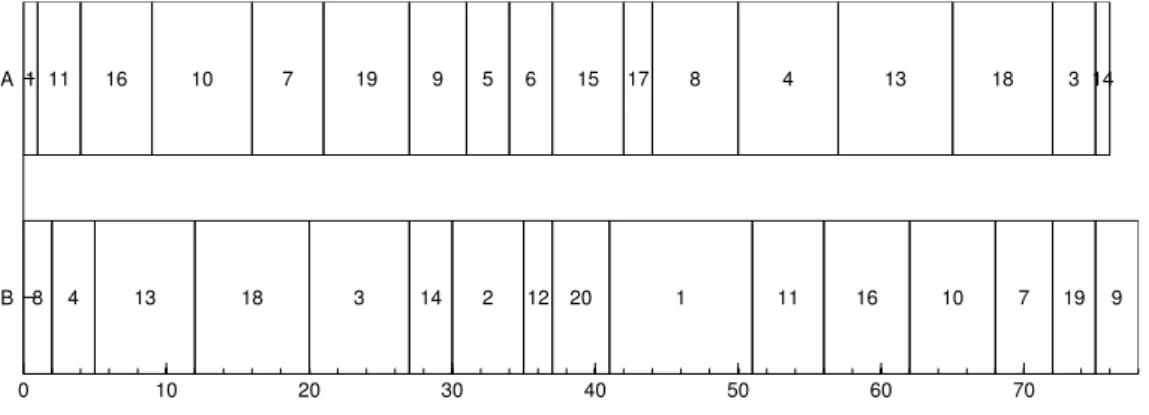
(RO). . . 16 2.1 Processing times and paths of 20 jobs forJ2| |Cmax. . . 37
3.1 GP terminal set for static two-machine JSS problem with
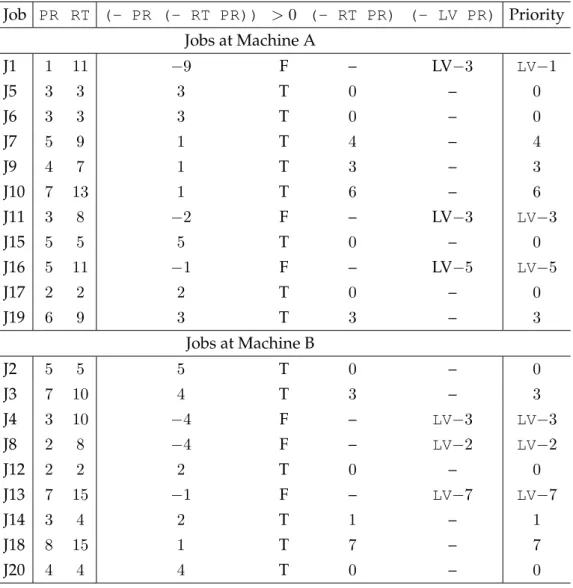
makespan objective GP system. . . 76 3.2 Evaluation of priorities of jobs J1 to J20 using the
dispatch-ing rule in Figure 3.1. T indicates (- PR (- RT PR)) is
greater than 0 (i.e. (- PR (- RT PR))> 0is true) and F
indicates that(- PR (- RT PR))is less than or equal to 0. 78
3.3 Configurations of proportions of job types for static
two-machine training problem instances. . . 83
3.4 Configurations of proportions of job types for training
sce-narios (TC1–TC4) and testing scesce-narios (C1–C14) for
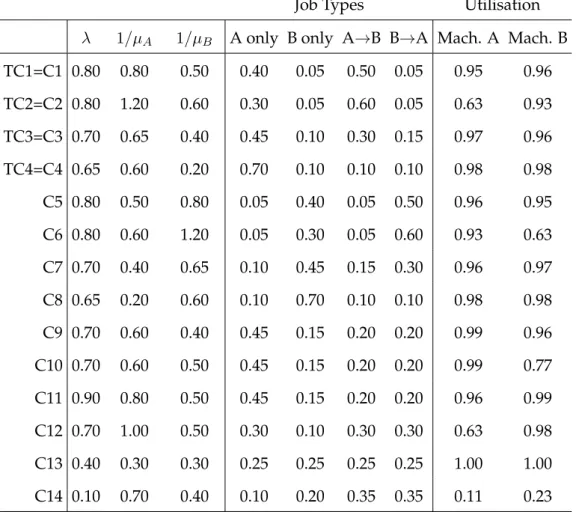
dyna-mic two-machine job shop problem instances. . . 92
3.5 GP terminal set for dynamic two-machine GP system. . . 93
3.6 Approximate order of performance of methods on each
sce-nario of dynamic two-machine job shop. . . 97
3.7 Comparison of mean performance, mean±standard
devia-tion of training/evoludevia-tion and testing times of the four GP methods over 40 runs and three benchmark dispatching
ru-les for dynamic two-machine job shop. . . 98
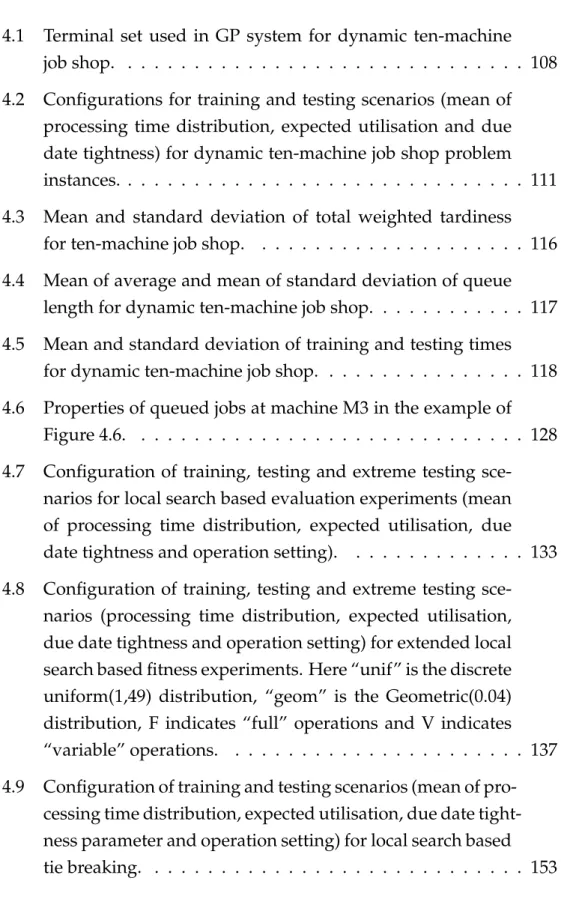
4.1 Terminal set used in GP system for dynamic ten-machine job shop. . . 108
4.2 Configurations for training and testing scenarios (mean of
processing time distribution, expected utilisation and due date tightness) for dynamic ten-machine job shop problem instances. . . 111
4.3 Mean and standard deviation of total weighted tardiness
for ten-machine job shop. . . 116
4.4 Mean of average and mean of standard deviation of queue
length for dynamic ten-machine job shop. . . 117
4.5 Mean and standard deviation of training and testing times
for dynamic ten-machine job shop. . . 118
4.6 Properties of queued jobs at machine M3 in the example of
Figure 4.6. . . 128
4.7 Configuration of training, testing and extreme testing
sce-narios for local search based evaluation experiments (mean of processing time distribution, expected utilisation, due date tightness and operation setting). . . 133
4.8 Configuration of training, testing and extreme testing
sce-narios (processing time distribution, expected utilisation, due date tightness and operation setting) for extended local search based fitness experiments. Here “unif” is the discrete uniform(1,49) distribution, “geom” is the Geometric(0.04) distribution, F indicates “full” operations and V indicates “variable” operations. . . 137 4.9 Configuration of training and testing scenarios (mean of
pro-cessing time distribution, expected utilisation, due date tight-ness parameter and operation setting) for local search based tie breaking. . . 153
LIST OF TABLES xv
5.1 Configuration of training, testing and extreme testing
sce-narios (processing time distribution, expected utilisation, due date tightness and operation setting). Here “unif” is the discrete uniform(1,49) distribution, “geom” is the Geo-metric(0.04) distribution, F indicates “full” operations and V indicates “variable” operations. . . 164
5.2 Allowable interactions for each operator in{∗,%,+,−,max,min}
for Grammar 1. Where interaction is allowed the type of the result is given, and the cell is coloured black if the in-teraction is not allowed. Terminals are split into four dif-ferent type categories: Crepresents counts,Xrepresents job
weight (and other ratios), Drepresents time durations and
Trepresents absolute (clock) times. . . 168
5.3 Grammar 1 for STGP. This is the grammar based
represen-tation of the allowable interactions for the arithmetic oper-ators and four basic types presented in Table 5.2. The four types representing the initial terminal set, X, C, D and T are used. Any interaction which returns type I is not allowable in this basic grammar. . . 171
5.4 Allowable interactions for each operator in{∗,%,+,−,max,min}
for Grammar 1A. Where interaction is allowed the type of the result is given, and the cell is coloured black if the inter-action is not allowed. Terminals are split into five different type categories: C,X,D,T, and new typeIwhich represents inverse time durations. . . 173
5.5 Mean and standard deviation of total weighted tardiness on test problem instances of Stage 1 (lower values are better). Values that are statistically significantly better than all other GP and STGP methods across the same row across Tables
5.5, 5.9 and 5.11 are in bold. Where there are two values
in a row that are bold, they are not statistically significantly different from each other, but are statistically significantly better than all remaining methods. . . 177
5.6 Mean and standard deviation of total weighted tardiness
on extreme test problem instances of Stage 1 (lower values are better). Values that are statistically significantly better than all others across the same row across Tables 5.6, 5.10
and 5.12 are in bold. Where there are two values in a row
that are bold, they are not statistically significantly different from each other, but are statistically significantly better than all remaining methods. . . 178
5.7 Allowable interactions for each operator in{×,%,+,−,max,min}
for Grammar 1S. Where interaction is allowed the type of the result is given, and the cell is coloured black if the inter-action is not allowed. Terminals are split into six different type categories: C, X, D,T, I, and new type S which repre-sents squared time durations. . . 180
5.8 Allowable interactions for each operator in{×,%,+,−,max,min}
for Grammar 1F. Where interaction is allowed the type of the result is given, and the cell is coloured black if the inter-action is not allowed. Terminals are split into seven differ-ent type categories: C, X, D, T, I, S and new type Fwhich represents inverse-square-durations. . . 181
LIST OF TABLES xvii
5.9 Mean and standard deviation of total weighted tardiness
on test problem instances of Stage 2 (lower values are bet-ter). Values that are statistically significantly better than all others across the same row across Tables 5.5, 5.9 and 5.11
are in bold. Where there are two values in a row that are
bold, they are not statistically significantly different from each other, but are statistically significantly better than all remaining methods. . . 185
5.10 Mean and standard deviation of total weighted tardiness on extreme test problem instances of Stage 2 (lower values are better). Values that are statistically significantly better than all others across the same row across Tables 5.6, 5.10
and 5.12 are in bold. Where there are two values in a row
that are bold, they are not statistically significantly different from each other, but are statistically significantly better than all remaining methods. . . 186
5.11 Mean and standard deviation of total weighted tardiness on test problem instances of Stage 3 (lower values are bet-ter). Values that are statistically significantly better than all others across the same row across Tables 5.5, 5.9 and 5.11
are in bold. Where there are two values in a row that are
bold, they are not statistically significantly different from each other, but are statistically significantly better than all remaining methods. . . 190
5.12 Mean and standard deviation of total weighted tardiness on extreme test problem instances of Stage 3 (lower values are better). Values that are statistically significantly better than all others across the same row across Tables 5.6, 5.10
and 5.12 are in bold. Where there are two values in a row
that are bold, they are not statistically significantly different from each other, but are statistically significantly better than all remaining methods. . . 191 5.13 Number of occurrences of functions and terminals in rules
and number of rules functions and terminals occur in for Stage 1 methods. . . 193 5.14 Number of occurrences of functions and terminals in rules
and number of rules functions and terminals occur in for Stage 2 methods. . . 194 5.15 Number of occurrences of functions and terminals in rules
and number of rules functions and terminals occur in for Stage 3 methods. . . 196 5.16 Number of occurrences of fragments of depth two for Stage
1 methods. We have combined (op A B) and (op B A) and present the top 10 most common fragments for each method. 197 5.17 Number of occurrences of fragments of depth two for Stage
2 methods. We have combined (op A B) and (op B A) and present the top 10 most common fragments for each method. 198 5.18 Number of occurrences of fragments of depth two for Stage
3 methods. We have combined (op A B) and (op B A) and present the top 10 most common fragments for each method. 200 5.19 Mean and standard deviation of evolution time and test
time for GP and STGP. . . 217
LIST OF TABLES xix
6.2 Stage 1. Top six most frequently appearing fragments in
Pareto-fronts of MOGP1,N and MOGP1,N, and top six most
frequently appearing fragments in best-of-run DRs of SOGP1
at Stage 1. The number of times the fragment appears and the number of rules the fragment appears in are given for each. . . 237
6.3 Higher-level constructed terminals introduced at Stage 2. . . 238
6.4 Occurrence of each function as a percentage of all function
occurrences in DRs evolved by each method, and occur-rence of each terminal as a percentage of all terminal oc-currences in DRs evolved by each method. . . 246
6.5 Table of mean ± standard deviation of evolution times in
List of Figures
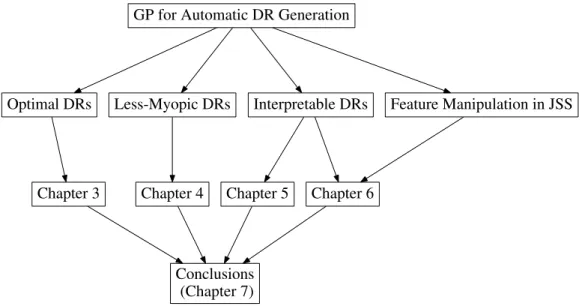
1.1 Overall structure of the thesis contribution chapters. . . 19
2.1 Gantt Chart showing optimal processing schedules at
ma-chinesAandBfor the example static two-machine job shop
problem instance in Table 2.1. . . 37 2.2 GP syntax tree of((2∗(x+ 1))−y). . . 45
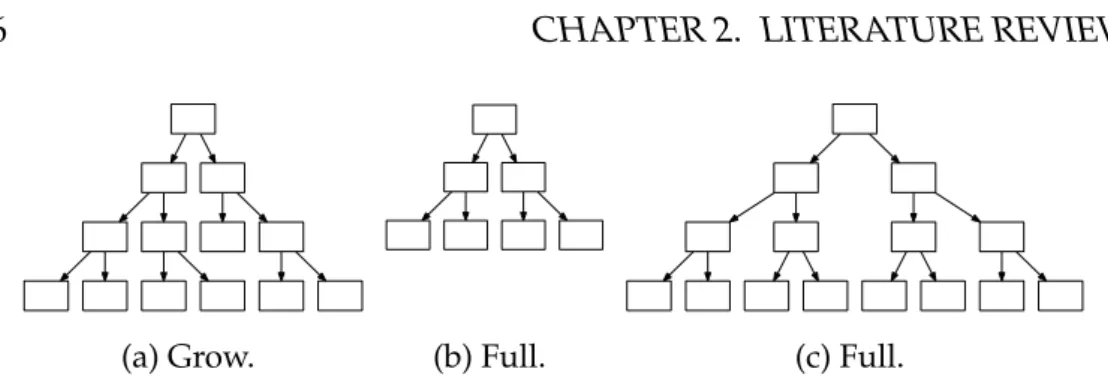
2.3 GP tree initialisation methods, under the
ramped-half-and-half method trees of these shapes are able to be generated
for any maximum depth greater than three. . . 46
2.4 GP subtree mutation. . . 47 2.5 GP subtree crossover. . . 49
3.1 An optimal dispatching rule for the static two-machine job
shop with makespan objective, represented using tree-based GP. . . 77
3.2 An optimal dispatching rule for the static two-machine job
shop, using theNPRterminal. . . 85
3.3 An optimal dispatching rule for the static two-machine job
shop evolved by GP. . . 86
3.4 Representations of tree-based GP dispatching rules for the
dynamic two-machine GP system. . . 89
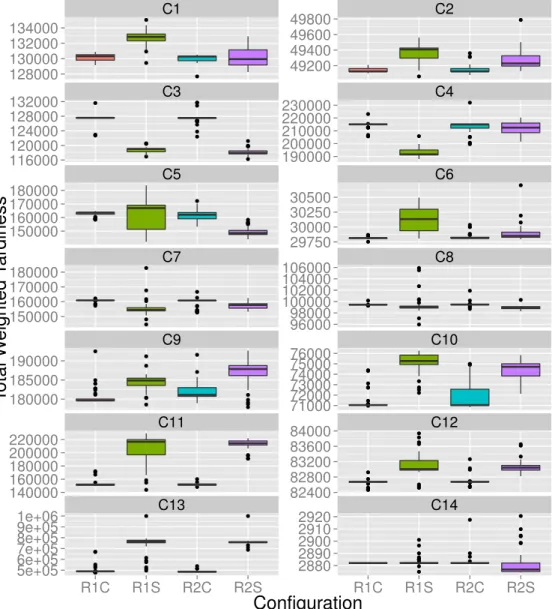
3.5 Boxplots showing results (lower TWT is better) of methods R1S, R1C, R2S and R2C across the 14 configurations for dy-namic two-machine job shop (vertical scales differ between subfigures). . . 95
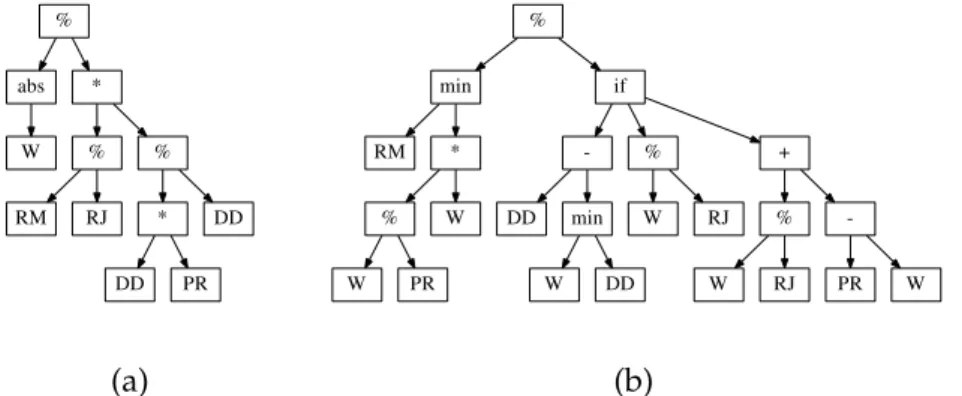
3.6 Best evolved R1C individuals for dynamic two-machine job
shop. . . 99
3.7 Best evolved R2C individual for dynamic two-machine job
shop. . . 100
4.1 Violin plots presenting results (TWT) of test scenarios for
NGP-4op, LMGP-4op, NGP-8op and LMGP-8op on ten-machine dynamic job shop. Note that the vertical axis scales are dif-ferent in each subfigure. . . 114
4.2 One of the best performing LMGP-4op DRs on the test
sce-narios. . . 118
4.3 One of the best performing LMGP-8op DRs on the test
sce-narios. . . 120
4.4 One of the best performing NGP-8op DRs on the test
sce-narios. . . 121
4.5 Diagram of evaluation process when a machine becomes
available to process a job. . . 125
4.6 Example showing a full ten-machine job shop at a particular
scheduling point (time= 0). . . 127
4.7 Example showing next machines visited by jobs at machine
M3 under different ordering of jobs at machine M3. . . 128
4.8 Aggregate non-dominated front on problem instance from
T1. . . 134
4.9 Aggregate non-dominated front on problem instance from
XT1. . . 134 4.10 Aggregate non-dominated fronts from MOMF, MOSW and
MOTR, and best-of-run individuals from BMMF, BMSW and BMTR on scenario T10. . . 139
LIST OF FIGURES xxiii 4.11 Aggregate non-dominated fronts from MOMF, MOSW and
MOTR, and best-of-run individuals from BMMF, BMSW and BMTR on scenario XT12. . . 141 4.12 Normalised TWT and penalty values across all test and
ex-treme test instances. . . 142 4.13 Violin plot of mean queue length over all dispatch points,
mean queue length when local search is used and positive
penaltyis assigned, and mean queue length when local
sea-rch is used and no penalty is assigned with BMMF on test
instances. . . 144 4.14 Violin plot of mean queue length over all dispatch points,
mean queue length when local search is used and positive
penaltyis assigned, and mean queue length when local
sea-rch is used and no penalty is assigned with BMMF on
ex-treme test instances. . . 145 4.15 Mean penalty per queued job for all queue lengths on
sce-nario T10. . . 146 4.16 Mean penalty per queued job for all queue lengths on
sce-nario XT12. . . 148 4.17 Evolved DR with best overall performance, evolved by MOSW.149 4.18 Plots of Mean Penalty for each Tie frequency across test and
extreme test instances. . . 155 4.19 Aggregate non-dominated fronts from TB-MO, and
best-of-run individuals from TB-SO and Benchmark GP on scenario T1. . . 156 4.20 Aggregate non-dominated fronts from TB-MO, and
best-of-run individuals from TB-SO and Benchmark GP on scenario T2. . . 156 4.21 Aggregate non-dominated fronts from TB-MO, and
best-of-run individuals from TB-SO and Benchmark GP on scenario XT1. . . 157
4.22 Aggregate non-dominated fronts from TB-MO, and best-of-run individuals from TB-SO and Benchmark GP on scenario XT2. . . 157
5.1 Violin plots presenting results (TWT in 1000s) of test scenar-ios for Stage 1 GP and STGP methods. Note that the verti-cal axis sverti-cales are different in each subfigure. These figures shows the distribution of TWT values attained from the 50 independent GP runs of each method. . . 175
5.2 Violin plots presenting results (TWT in 1000s) of extreme
test scenarios for Stage 1 GP and STGP methods. Note that the vertical axis scales are different in each subfigure. These figures shows the distribution of TWT values attained from the 50 independent GP runs of each method. . . 176 5.3 Violin plots presenting results (TWT in 1000s) of test
scenar-ios for Stage 2 GP and STGP methods. Note that the verti-cal axis sverti-cales are different in each subfigure. These figures shows the distribution of TWT values attained from the 50 independent GP runs of each method. . . 182
5.4 Violin plots presenting results (TWT in 1000s) of extreme
test scenarios for Stage 2 GP and STGP methods. Note that the vertical axis scales are different in each subfigure. These figures shows the distribution of TWT values attained from the 50 independent GP runs of each method. . . 183 5.5 Violin plots presenting results (TWT in 1000s) of test
scenar-ios for Stage 3 GP and STGP methods. Note that the verti-cal axis sverti-cales are different in each subfigure. These figures shows the distribution of TWT values attained from the 50 independent GP runs of each method. . . 188
LIST OF FIGURES xxv
5.6 Violin plots presenting results (TWT in 1000s) of extreme
test scenarios for Stage 3 GP and STGP methods. Note that the vertical axis scales are different in each subfigure. These figures shows the distribution of TWT values attained from the 50 independent GP runs of each method. . . 189
5.7 An evolved rule from GP1 which outperformed ATC on
34/48 test instances and WCOVERT on 36/48 test instances. 201
5.8 An evolved rule fromST1which outperformed ATC on 33/48
test instances and WCOVERT on 39/48 test instances. . . 201
5.9 An evolved rule from ST1A which outperformed ATC on
25/48 test instances and WCOVERT on 32/48 test instances. 202
5.10 An evolved rule from ST1B which outperformed ATC on
34/48 test instances and WCOVERT on 38/48 test instances. 202
5.11 An evolved rule from ST1S which outperformed ATC on
26/48 test instances and WCOVERT on 34/48 test instances. 203
5.12 An evolved rule from ST1F which outperformed ATC on
25/48 test instances and WCOVERT on 37/48 test instances. 203
5.13 An evolved rule from GP2, and in simplified form below,
which outperformed ATC on 44/48 test instances and WCOVERT on 47/48 test instances. . . 204
5.14 An evolved rule fromST2which outperformed ATC on 35/48
test instances and WCOVERT on 43/48 test instances. . . 205
5.15 An evolved rule from ST2A which outperformed ATC on
39/48 test instances and WCOVERT on 43/48 test instances. 206
5.16 An evolved rule from ST2S which outperformed ATC on
23/48 test instances and WCOVERT on 33/48 test instances. 207
5.17 An evolved rule from ST2F which outperformed ATC on
29/48 test instances and WCOVERT on 38/48 test instances. 207
5.18 An evolved rule from GP3 which outperformed ATC on
5.19 An evolved rule fromST3which outperformed ATC on 36/48 test instances and WCOVERT on 38/48 test instances. . . 208
5.20 An evolved rule from ST3A which outperformed ATC on
31/48 test instances and WCOVERT on 43/48 test instances. 210
5.21 An evolved rule from ST3S which outperformed ATC on
33/48 test instances and WCOVERT on 42/48 test instances. 211
5.22 An evolved rule from ST3F which outperformed ATC on
18/48 test instances and WCOVERT on 28/48 test instances. 212 5.23 Number of instances DRs in Figures 5.7 to 5.22 that
outper-form WCOVERT (left) and ATC (right) on 50 problem in-stances from each test and extreme test scenario. . . 214
5.24 Mean Z-score of DRs in Figures 5.7 to 5.22 across 50
prob-lem instances from each test and extreme test scenario. . . . 215 5.25 Mean best-of-generation fitness (mean normalised TWT) across
all methods through 50 generations of evolution. . . 218 6.1 Paired plot of Stage 1 results. This plot contains the Pareto
fronts of 500 runs for all methods, 5188 DRs (2495 distinct
DRs) from MOGP1,N, 4640 DRs (1982 distinct DRs) from
MOGP1,S and 500 DRs from SOGP1. . . 234
6.2 Plot of normalised TWT over test instances vs extreme test
instances. The bottom plot zooms in on the area of best test and extreme test instances. . . 235 6.3 Paired plot of Stage 2 results. This plot contains the Pareto
fronts of 500 runs for all methods, 6299 DRs (2885 distinct
DRs) from MOGP2,N, 6585 DRs (2268 distinct DRs) from
MOGP2,S and 500 DRs from SOGP2. . . 240
6.4 Plot of normalised TWT over test instances vs extreme test
instances. The bottom plot zooms in on the area of best test and extreme test instances. . . 241
LIST OF FIGURES xxvii 6.5 Paired plot of Stage 3 results. This plot contains the Pareto
fronts of 500 runs for all methods, 8535 DRs (3159 distinct
DRs) from MOGP3,N, 7376 DRs (2280 distinct DRs) from
MOGP3,S and 500 DRs from SOGP3. . . 243
6.6 Plots of normalised TWT over test instances vs extreme test
instances for Stage 3. The bottom plot zooms in on the area of best test and extreme test instances. . . 244 6.7 Paired plot of Stage 4 results. This plot contains the Pareto
fronts of 500 runs for all methods, 9610 DRs (3401 distinct
DRs) from MOGP4,N, 7894 DRs (2343 distinct DRs) from
MOGP4,S and 500 DRs from SOGP4. . . 248
6.8 Plot of normalised TWT over test instances vs extreme test
instances for Stage 4. The bottom plot zooms in on the area of best test and extreme test instances. . . 249
6.9 Paired plots of results and plots of normalised TWT over
test instances vs normalised TWT over extreme test instances using the NumNodes as the plotting symbol for MOGP with NSGA-II (a)–(d), MOGP with SPEA2 (e)–(h) and SOGP (i)–(l).250 6.10 DR with the lowest mean normalised TWT on test and on
extreme test scenarios. . . 254 6.11 Two of the best DRs evolved by MOGP methods. . . 255 6.12 Rotated 3D plot of aggregate non-dominated Pareto fronts
from each method. . . 256
6.13 Graph of mean±standard deviation of mean normalised TWT
vs size of DR. The graph is cut off at 20 nodes for space, and methods are offset from each other for visibility. . . 258
6.14 Graph of mean±standard deviation of mean normalised TWT
vs number of distinct terminal nodes. The methods are off-set from each other for visibility. . . 260 6.15 Most frequently occurring attribute subsets of size two to
List of Notation
Nj Number of operations of jobj
Oj Set of operations of jobj wj Weight of jobj
dj Due date of jobj
rj Release date of jobj into the shop Cj Completion time of jobj
fj Flowtime of jobj Tj Tardiness of jobj σj,i ith operation of jobj
p(σj,i) Processing time of operationσi,j m(σj,i) Machine required to processσi,j
List of Abbreviations
ACO Ant colony optimisation
ATC Apparent tardiness cost (dispatching rule)
DR Dispatching rule
DJSS Dynamic job shop scheduling
EA Evolutionary algorithm
EC Evolutionary computation
EDD Earliest due date (dispatching rule)
EMO Evolutionary multiobjective optimisation
ES Evolutionary strategy
EP Evolutionary programming
FCFS First-come-first-served (dispatching rule)
GA Genetic algorithm
GP Genetic programming
GPHH Genetic programming based hyper-heuristic
HH Hyper-heuristic
JSS Job shop scheduling
MO Multiobjective
MOEA Multiobjective evolutionary algorithm
MOGP Multiobjective genetic programming
MOGPHH Multiobjective genetic programming based hyper-heuristic
MS Minimum slack (dispatching rule)
NSGA-II Non-dominated sorting genetic algorithm II
PSO Particle swarm optimisation
SI Swarm intelligence
SPEA2 Strength Pareto evolution algorithm 2
SPT Shortest processing time (dispatching rule)
S/RPT Slack per remaining processing time (dispatching rule)
STGP Strongly typed genetic programming
TWT Total weighted tardiness
WCOVERT Weighted cost over time (dispatching rule)
Glossary of Terms
This glossary lists the definitions of common terms used through this the-sis.
arrival rate The rate at which jobs arrive into a dynamic manufacturing system, often following a stochastic process.
balanced job shop A job shop where the average processing times of op-erations is the same on all machines.
crossover A genetic operator in which genes of two parent individuals are selected, manipulated and recombined to produce a new set of genes for the child individual.
dispatching rule A scheduling heuristic which assigns a priority value to each job waiting in a specific machine’s queue, and selects the highest priority job to begin scheduling.
dynamic job shop scheduling A job shop scheduling problem where jobs arrive throughout time according to a stochastic process, and there is no knowledge about the job until its arrival into the shop.
elitism A genetic operator which selects only the fittest individuals of the parent population up to the prescribed proportion.
evaluation The process of measuring the fitness of individuals within a GP population during the evolutionary process.
evolutionary computation The field of study of population based optimi-sation methods which simulate evolution inspired by biology.
feature An attribute of the problem domain.
feature construction The process of combining existing features of a (ma-chine learning) task to make new features.
feature manipulation The process of altering the input space of a (mach-ine learning) task to improve the performance and (learning) quality.
feature selection A combinatorial optimisation problem which aims to find a subset of the original features which is as small as possible but still sufficiently describes the problem space.
fitness A measure of how well adapted an individual is to perform a spe-cific task.
genetic operators Sources of variation in the evolutionary process: cross-over, elitism and mutation.
genetic programming (GP) An evolutionary computation method.
grammar A context-free grammar is given by(S, N,Σ, P), whereS is the start symbol, N is a set of non-terminals, Σis the set of terminals, andP is the set of production rules of the grammar.
heuristic A “rule of thumb” which seeks a good solution at reasonable computational cost but does not guarantee optimality.
hyper-heuristic Search method for choosing or generating heuristics (or components of heuristics) to solve a range of optimisation problems.
initialisation The process of randomly generating the initial population of individuals in GP before the evolutionary process proceeds.
xxxv
job A task to be scheduled, consisting of a sequence of a least one
op-eration which must be processed on specific machines in the shop system.
job shop A manufacturing environment with a set of machines, and a set of jobs to be processed through the machines, where each job has a specified route through the machines.
job shop scheduling (JSS) The task of creating a schedule for processing jobs in a job shop manufacturing environment.
machine A resource which processes jobs in a manufacturing system.
makespan The maximum completion time (i.e. the completion time of the last job to finish processing).
meta-heuristic Problem independent strategies which guide the search process to find optimal, or near-optimal, solutions to optimisation problems.
mutation A genetic operator which takes an individual, chooses a muta-tion point at random, and the subtree routed at that point is replaced with a randomly generated subtree to create the child individual.
myopic Short-sighted.
non-domination A solution which is not dominated by any other solution across all objectives in a multiobjective optimisation problem.
objective function A measure of job delivery speed or customer satisfac-tion which is to be optimised.
operation A component part of a job, with a specified machine and pro-cessing time.
Pareto front The set of non-dominated solutions in a multiobjective opti-misation problem.
queue The set of jobs waiting at a machine to be processed.
release time The time that a job enters the manufacturing system and is available to be scheduled.
representation The form in which a heuristic rule or genetic program is represented for evolution and computation purposes.
schedule An allocation of jobs to machines, including the start time of each operation within each job.
scheduling The process of constructing a schedule.
selection The process of determining which individuals are to be used for the genetic operators.
shop A manufacturing environment with a set of machines (resources)
available to process a set of jobs (tasks).
static job shop scheduling All jobs are available and all their properties known at the start time of the manufacturing process.
tardiness How overdue a completed job is (tardiness is zero when the job is completed early).
unbalanced job shop A job shop where the average processing time of operations is not the same on all machines.
utilisation The proportion of time a machine is not idle.
Chapter 1
Introduction
1.1
Problem Statement
Job shop scheduling (JSS) is a common and difficult problem that has been described as a “fascinating challenge” [28] and has been widely studied
in the academic literature over the past 60 years [48, 116]. A job shop is
a manufacturing environment in which products (i.e. jobs) are produced by following a product-specific route through a finite set of machines. JSS
problems are computationally challenging, falling in the class ofNP-hard
problems with only a few exceptions [12]. Further, there are many facto-ries around the world (tens of thousands in the USA alone) that follow the job shop model, producing billions of dollars worth of products each year [62]. The development of more effective means of scheduling jobs is worthwhile as it has the potential to increase throughput, decrease costs, and increase profitability [62].
Job shop scheduling is a combinatorial optimisation problem consist-ing of a set of machines and a set of jobs which must be processed by the machines, subject to a set of constraints and with the aim of finding a schedule of jobs which optimises some measure of delivery speed or cus-tomer satisfaction [48].
The job shop scheduling problem has two main forms: the static job 1
shop deals with the scheduling of an entirely known set of jobs; whereas in the dynamic job shop no job information is known until the job arrives into the shop system at an unknown time [118]. Due to the availability of knowledge in the static job shop problem, scheduling often uses tradit-ional combinatorial approaches, such as branch-and-bound [72], total enu-meration and Lagrangian relaxation [49]. However, in dynamic job shop scheduling problems there are no optimal solutions, as all the information is only known at the end of the scheduling period, therefore methods that construct complete schedules in advance are not able to be used. Heuris-tics (including dispatching rules) are commonly used scheduling methods in dynamic job shop environments [12, 116].
Dispatching rules (DRs), also known as priority rules or scheduling ru-les, are popular for job shop scheduling due to their ease of implementa-tion, low time complexity (and hence low computational cost), and ability to cope with both static and dynamic environments [12]. Dispatching ru-les are mathematical functions of attributes of the job shop, machines and jobs currently queued at a machine awaiting dispatch. They assign a pri-ority value to each job waiting in the machine queue, whenever a machine becomes available to process a job. The job that is assigned the highest priority value is selected to begin processing. This means scheduling de-cisions are made as they are to be implemented, which is why dispatching rules cope with dynamic environments so well. As dispatching rules are heuristics, they cannot be guaranteed to give optimal solutions [131].
The manual development of dispatching rules is a time consuming process that requires domain knowledge. Manually designed dispatch-ing rules are frequently specific to a particular job shop scheduldispatch-ing in-stance, defined by the number of machines, objective function, utilisation, etc. An approach to overcoming this problem that has gained popular-ity over the past twenty years [62] is the use of evolutionary computation
based techniques to automatically discover new dispatching rules. These
1.2. MOTIVATIONS 3 the search space of potential heuristics (i.e. dispatching rules) rather than searching the space of solutions (i.e. schedules of jobs) directly. Genetic Programming (GP) [70] is an evolutionary computation technique which has been shown to be an ideal candidate for use as a hyper-heuristic for shop scheduling problems [21]. The main reason for this is the common representation of GP, tree-based GP [70], naturally lends itself to represent mathematical functions, and hence to represent dispatching rules. GP is also relatively easy to implement and has variable length encoding.
The overall goal of this thesis is to develop genetic programming ba-sed hyper-heuristics for the efficient evolution (automatic generation) of robust, reusable and effective scheduling heuristics for job shop schedu-ling environments, with greater interpretability.
1.2
Motivations
The purpose of this section is to provide the motivations for this thesis. Firstly, we introduce some of the challenges of scheduling. Secondly, we describe why GP is an ideal evolutionary computation method to use to develop scheduling heuristics. Finally, we discuss limitations of the exist-ing research.
1.2.1
Challenges of Scheduling
Job shops are a common real-world scheduling environment [62] and the complexity of the scheduling task combined with real-world prevalence has led to scheduling in such environments being widely studied for many years [62]. Scheduling is a very challenging problem. Often the scale of the problem is very large, with many hundreds of tasks (jobs) needing to be scheduled across many tens or hundreds of resources (machines). Even for the smallest of scheduling problems, finding the best possible solution can quickly become near impossible. For a ‘simple’ static single machine problem with 10 jobs, there are10! = 3,628,800possible sequences of jobs.
As the number of jobs and machines increases, the number of possible se-quences increases and the scheduling task becomes increasingly difficult.
The majority of scheduling problems areNP-hard [12].
This computational challenge, and the fact thatmanyreal-world
man-ufacturing and service environments use/need scheduling, means that there is real benefit to be found from improving scheduling. Increasing throughput of production and decreasing costs from, e.g., idle machines, inventory costs from holding partially completed items, and late delivery costs, all lead to increasing profitability.
Job shop scheduling in real-world situations is certainly a multiobject-ive problem; objectmultiobject-ive functions that relate to both the customer and the business sides of manufacturing, as well as business values such as envi-ronmental impact through power use or emissions, may all be of interest to the scheduler. Sometimes these objectives may work together, e.g., min-imising flowtime (the time jobs are in the shop system) is likely to lead to lower inventory costs. However, frequently the objectives of interest are in conflict, e.g., minimising the number of tardy jobs and minimising the flowtime.
When the multiobjective nature of the scheduling task itself is com-bined with the task of finding better means of scheduling, the task be-comes even more difficult. An effective and efficient scheduling rule must not only be good in terms of the multiple objectives of the scheduling prob-lem but also in terms of the multiple attributes of a good scheduler. Fur-ther, the majority of manually designed dispatching rules and algorithms are designed for specific job shop scheduling instances, and do not gener-alise well across different shop settings. Scheduling is a major challenge due to the dynamic nature of the task. In dynamic job shops not only are jobs arriving at unknown times, but the machines may break down unex-pectedly as well.
1.2. MOTIVATIONS 5
1.2.2
Why Genetic Programming?
Genetic programming is an ideal evolutionary computation method to au-tomatically generate dispatching rules because of the following reasons.
Representation. Tree-based genetic programming [70] is the most com-mon form of genetic programming; programs are represented as tre-es, made up of function and terminal nodes. Dispatching rules are mathematical functions used to determine the priority of jobs await-ing processawait-ing, and choose which job must begin next. Such mathe-matical functions are naturally represented as trees with mathemat-ical functions as the function nodes, and constants and variables of the job shop problem domain as the terminal nodes in GP.
Variable Length Encoding. One advantage of genetic programming over other evolutionary computation methods is that the size of the pro-gram trees evolved is able to vary [7], between a minimum depth,
m1, and maximum depth, m2. This means genetic programming is
covering a larger search space of potential functions than a fixed length method such as a genetic algorithm. This is suitable for JSS where variable lengths of rules are needed, particularly for dyna-mic JSS environments which are complex and therefore require more complex dispatching rules to schedule effectively.
Previous Research. There is a large body of research using genetic pro-gramming for the automated design of scheduling rules [50, 56, 57, 83, 95, 96, 98, 107], giving us confidence in the approach and set-ting successful precedents. These approaches are classified as hyper-heuristic approaches [29, 21], as GP is searching for a scheduling heuristic (the dispatching rule) rather than searching for a sched-ule of jobs directly. Dispatching rsched-ules (DRs) are able to be reused in new JSS problems, with the same and different parameters, unlike the development of a schedule which is specific to a given instance. This is an advantage of the hyper-heuristic approach. GP has been
used to develop DRs in a range of scheduling environments, from the simpler static two-machine flow shop [42], through job shops with many machines [50], dynamic flexible JSS [126], to very com-plex manufacturing environments such as semi-conductor manufac-turing [108]. These works consider differing simplifications of the JSS model; some focus on static problems [83] and others on dyna-mic problems [50]. Works focus on different objectives of delivery speed, including those based on makespan [58, 57], flowtime [50], tardiness [58], and combinations of these [126]. Further works also consider evolving due date assignment rules alongside DRs [94] and DRs for order acceptance and scheduling [106]. Rules evolved by GP are frequently reported to compete with rules from the literature [94, 57]. However, there are limitations to this body of existing re-search which are discussed below.
Ease of Implementation. It is relatively easy to implement a genetic pro-gramming based system to evolve dispatching rules, using one of the many existing GP software packages, such as ECJ [78]. These pack-ages require extension to include a job shop discrete-event simula-tion model to evaluate how good a dispatching rule is. Suitable func-tions need to be identified as DRs are mathematical funcfunc-tions and there are a large number of such functions which can be explored. It is less easy to identify which variables relevant to the problem do-main of job shop scheduling should be included. The attributes of machines (e.g. number of jobs in the queue or how long the machine has been idle), jobs (e.g. the processing time of the current operation or the due date) and of the shop as a whole (e.g. the current clock time of the simulation) are naturally represented as terminals.
1.2. MOTIVATIONS 7
1.2.3
Limitations of Existing Work
Genetic programming has been used for the automated design of dis-patching rules and other forms of scheduling policy. However, there are limitations to the research that has been conducted.
Dispatching rules evolved by most approaches lack a global perspec-tive as the features of the jobs, machines and the shop used are mainly lim-ited to the current state of the current machine and its queue. Research has
explored the use oflook-aheadfunctions to try and improve the scheduling
performance, as they have the ability to significantly improve schedules
when used with a reasonable DR [43]. Most DRs constructnon-delay
sched-ules where a machine cannot be idle while there is an operation awaiting processing [110]. Some works [98, 50] incorporate a “look-ahead” in which a machine is notified that a job will be arriving once it is finished its cur-rent operation. When the jobs in the queue at the machine are evaluated, if the job which has not yet arrived has the highest priority then the machine is able to enforce idle time, and wait for the job to arrive. However, there are other ways in which dispatching rules can be encouraged to take into account the wider state of the shop. Ways in which the longer term conse-quences of a particular scheduling decision are yet to be investigated.
Another limitation of DRs evolved automatically is their interpretabi-lity. The interpretability of heuristics evolved by genetic programming,
and black box optimisers, has been identified as a crucial aspect to gain
the trust of operators or managers [16]. How well, or even whether, these
people are able to understand and interprethowandwhythe DR works is
therefore important if DRs evolved using evolutionary computation (EC) techniques are to be used in real-world situations. One particular limi-tation is that many of the comparisons made in evolved DRs cannot be readily interpreted in terms of units, i.e., semantically most DRs evolved using GP are incorrect [58] because standard tree-based GP allows the un-restricted composition of available functions and features, subject only to the tree-depth restriction. Knowing how well a given rule will generalise
across different distributions of arrivals and processing times, and differ-ent scales of shops (number of machines and jobs), is also necessary if they are to be used in practice. Means of improving the interpretability previ-ously employed include online rule simplification techniques [61, 66, 137], analysis and visualisation of priority indices [15], and identifying weak-nesses in decision logic of a given dispatching rule [17]. The interpre-tability of DRs evolved by GP is a particularly interesting problem as it has been reported that there is evidence that complex scheduling envi-ronments require heuristics with a certain level of complexity, so often an easy-to-interpret representation can result in lower quality heuristics [15]. Job shop scheduling is inherently a multiobjective problem. Often the multiple objectives explored in research are different manufacturing objec-tives such as tardiness and flowtime, or utilisation levels of the machines in the shop. While the job shop scheduling task is recognised as a multi-objective problem, we believe that the effectiveness of a dispatching rule should also be multiobjective. A limitation of existing research into mu-ltiobjective genetic programming for the automated design of scheduling
rules is that very frequently researchers have been interested only in the
performance of the evolved rules in terms of a measures of manufactur-ing speed or efficiency. There are other factors which are important if ru-les designed without human expert domain knowledge are to be trusted by human operators involved in the manufacturing process, particularly, how are the evolved rules to be understood? There are many more poten-tial objectives to be explored relating directly to the scheduling problem as well as to the evolved dispatching rule that can enable the discovery of dispatching rules which better account for the issues of myopia (“short-sightedness”) and understandability.
Job shop scheduling problems have a large number of attributes wh-ich could potentially be used in the terminal set of a genetic programming approach, and hence could appear in a useful dispatching rule. However, not all of these attributes are important, and some may be redundant in
1.3. RESEARCH GOALS 9 the presence of other attributes. The disadvantage of using a large num-ber of attributes is that the more attributes, the larger the search space that GP has to cover. These attributes are often known as ‘features’ within the machine learning and evolutionary computation communities. In this the-sis we will use the terms ‘feature’ and ‘attribute’ interchangeably. Feature manipulation [91] is the process of altering the input space of a (mach-ine learning) task to improve the performance and (learning) quality. In scheduling, the input space consists of the attributes that are chosen from the scheduling domain to be part of the terminal set, together with the function set. Feature selection is one form of feature manipulation, which aims to find a subset of the original features which is as small as possible but still sufficiently describes the problem space [67]. Feature construc-tion [77, 92] is another form of feature manipulaconstruc-tion; existing features are combined to make new features. Feature manipulation in genetic pro-gramming for scheduling has not previously been explored. GP performs feature selectionautomaticallyas the most effective GP trees survive to fu-ture generations, but seldom are the feafu-tures appearing across best-of-run evolved dispatching rules examined and the information gleaned used. GP can also be considered to perform feature construction automatically, as there are ‘fragments’ or sub-branches of the GP trees which may appear frequently in multiple trees and these may be used as constructed features. Overall, the use of feature manipulation aims to reduce the size of the sea-rch space, improve the learning performance, and potentially make the output easier to interpret.
1.3
Research Goals
The overall goal of this thesis is to develop genetic programming based hyper-heuristics for the efficient evolution (automatic generation) of ro-bust, reusable and effective scheduling heuristics for job shop scheduling environments, with greater interpretability. The focus of this research is to
investigate how the use of genetic programming to discover new dispatch-ing rules for job shop scheduldispatch-ing problems can be improved through stud-ying the representations used, the incorporation of additional feedback on the performance of dispatching rules through other heuristic methods and the inclusion of additional objectives. We aim to use genetic programming to evolve new dispatching rules that are effective, incorporate attributes of the wider shop system and are interpretable to human operators. The evolved rules should be reusable in unseen job shop scheduling scenarios and competitive with existing dispatching rules from the literature. There is always some gap between the robustness and reusability of scheduling rules. Evolved rules not only need to be robust and reusable in terms of ef-fective performance across different machine configurations, but we also should be able to understand the rules enough to trust the use of them across different configurations by increasing our understanding and inter-pretation of the way they work.
This thesis will address the following research objectives:
1. Investigate whether GP can discover dispatching rules which are competi-tive with known optimal approaches on static job shop scheduling problems. The static two-machine job shop scheduling environment is perhaps
the simplest of all job shop environments. The makespan, Cmax, is
the maximum completion time of all jobs (1, . . . , N) in the shop, i.e.,
Cmax = max{C1, . . . , CN}, where Cj is the completion time of job j.
When the objective of interest is to minimise the makespan, Jack-son’s algorithm [55] gives the minimum makespan. It is not clear (initially) whether GP can evolve rules that perform as well as Jack-son’s algorithm, i.e., alwaysdispatching jobs in a way that gives the optimal makespan. We aim to find a good representation within GP to evolve such rules. Success in this task can be considered as certi-fication of the representation being used and of the search capability of GP. This will give confidence in the ability of the system to evolve heuristics for the more complicated job shop environments for
wh-1.3. RESEARCH GOALS 11 ich we do not have an optimal solution to compare against. If GP is not able to evolve a heuristic which can match the performance of Jackson’s algorithm then the representation being used should be modified.
Specific sub-objectives to investigate are:
(a) Investigate representation of Jackson’s algorithm as a dispatch-ing rule and how a dispatchdispatch-ing rule can be shown to be equiva-lent to Jackson’s algorithm.
(b) Investigate whether GP candiscovera dispatching rule which is
equivalent to Jackson’s algorithm.
(c) Investigate evolving two dispatching rules simultaneously, one for each machine in the dynamic two-machine job shop, and compare this to the standard approach of using one dispatching rule to make scheduling decisions at all machines in the shop. While focusing on the simpler job shop environments, as part of the baseline of the thesis, we will also investigate the dyna-mic two-machine job shop. The typical approach to evolution-ary scheduling takes the single best DR evolved by the system and applies this DR to determine which job should be processed next ateverymachine in the shop (the job shop model is simpli-fied to use one DR). However there are other ways that a fixed amount of computational time could be used to develop rules for a system.
2. Investigate the use of GP to develop “less myopic” scheduling rules. The majority of current research lies at two extremes: a global ap-proach through optimisation methods where an entire schedule is constructed or the other extreme of very local approaches using dis-patching rules. Disdis-patching rules are generally myopic, i.e., short sighted, and take into account the local and current conditions of the
shop only [2, 42]. Dispatching rules generally examine the proper-ties of the machine which is now available, including the queue of jobs awaiting processing at that machine at that point in time. The dispatching rule is used to make scheduling decisions at each ma-chine in the job shop independently, so there is no consideration of the movement of jobs from one machine to another, or the impact a decision may have on the subsequent machines, whether positive or negative [108].
We will investigate two approaches to encourage dispatching rules to take into account the wider state of the shop and the consequences of scheduling decisions over an extended decision horizon. These aim to address the following sub-objectives:
(a) Determine which possible attributes of jobs, machines and/or the shop system as a whole are useful to improve DR performance and how “less-myopic” features improve the scheduling performance.
The attributes used in the terminal set have a large impact on the performance of the evolved scheduling rules, determining what information is available to the GP system, and how lo-cal/global the approach is. We will incorporate features from the wider shop system, to see if the rules evolved are less-myopic and give improved performance.
(b) Investigate whether the inclusion of local search as an additional means of providing feedback on the fitness of a given dispatching rule throu-ghout evolution can improve the performance and generalisation abil-ity of evolved DRs.
We want to find dispatching rules that make good decisions. The incorporation of local search allows us to examine the wider local effect of dispatching decisions over an extended decision horizon, and investigate whether this can encourage the evolu-tion of dispatching rules that schedule jobs in an order which is better for more than just the first job dispatched, leading to
1.3. RESEARCH GOALS 13 better global performance and better generalisation to unseen problem instances.
3. Investigate whether a strongly typed GP (STGP) based hyper-heuristic ap-proach can be used to encourage the evolution of interpretable dispatching rules.
The effectiveness and suitability of a dispatching rule evolved by ge-netic programming is normally measured only in terms of the sched-uling objectives such as tardiness or flowtime, but for dispatching rules to be used in real-world scheduling environments they must be able to be trusted by human managers and operators involved in the scheduling process. This aspect of how well the rules are able to be understood, interpreted and trusted is often neglected in the existing literature. Further, rules evolved with only the standard GP constraints of closure are often semantically incorrect.
One approach to creating dispatching rules with greater interpretabi-lity and semantic validity is to limit the allowable interaction be-tween functions and terminals using STGP. STGP works by directly specifying which children each non-terminal can have; which is done indirectly in STGP by specifying the data types of each argument of each function as well as the data types returned by each terminal and function [85].
The following sub-objectives will be investigated:
(a) Develop terminal types and grammar(s) to specify the allow-able interactions between these types which can be enforced with the use of STGP.
(b) Investigate how the level of interpretability and performance compares between rules evolved using STGP, those evolved by the traditional GP based generation of dispatching rules, and manually designed rules from the literature.
(c) Evaluate whether the use of STGP can be justified (if perfor-mance is worse) as an acceptable compromise for improvement in interpretability.
(d) Investigate what insight can be gained into how a measure mi-ght be developed to evaluate and compare interpretability of automatically evolved rules.
4. Investigate how multiobjective GP can be used to discover dispatching rules for dynamic JSS which are effective in terms of scheduling objectives and are also more easily understood by human operators.
The aim of this objective is not the development of a new GP algo-rithm, but analysis of how we can better use GP for automatic gener-ation of DRs. Scheduling is inherently a multiobjective problem, for example, there is a trade-off between the size of the planning hori-zon and the computational cost of creating the schedule, or between training time and robustness. This is a well identified issue.
We believe that DR performance is also multiobjective; performance in terms of the scheduling objectives is important but so is the int-erpretability of DRs and the trust that practitioners are able to place in DRs. In particular we investigate the trade-off between the size of the GP trees (compactness of heuristics/solutions) and understand-ability/interpretability of heuristics/solutions, and specifically we will:
(a) Investigate whether interpretability can be improved by the in-clusion of objectives relating to the size of the DR.
(b) Determine which of the two MO algorithms, NSGA-II [32] and SPEA2 [146] performs better for GP to evolve interpretable ru-les.
5. Investigate using the knowledge implicitly discovered through GP to per-form feature manipulation to improve dispatching rule perper-formance.
1.3. RESEARCH GOALS 15 Attribute/feature selection is an important part of developing an ef-fective GP based approach for the automatic discovery of dispatch-ing rules. While it has been acknowledged that a scheduldispatch-ing rule it-self is often not as important as the interrelationships of the attributes in the rule, and the relevance of these attributes to the problem struc-ture [42], the study of the attributes used, and in what combinations, is generally neglected in the scheduling community. The knowledge automatically discovered by GP through the terminals selected can be viewed as feature selection and can be used to alter the terminal set. Feature manipulation using GP has not been investigated in the JSS literature.
Analysis of the best-of-run evolved dispatching rules, searching for commonly occurring fragments of terminals and functions, can di-rect us to perform feature construction. Common fragments will be used as “higher-level constructed features”. Using this additional in-formation from the results of GP runs will enable us to reduce the use of terminals which are redundant or less useful and reduce the size of the search space. Including additional higher-level features may improve the learning performance, and as each higher-level feature will be interpreted before being included in the terminal set, this has the potential to improve the interpretability of the output.
Specific sub-objectives that will be investigated are:
(a) Investigate whether the restriction of the search space through STGP reveals good components or combinations of components that we can use to further restrict or alter the terminals included in the terminal set.
(b) Investigate whether feature manipulation guided by GP can im-prove interpretability.
Table 1.1: Mapping of contributions (Contrib) to research objectives (RO).
Contrib 1 Contrib 2 Contrib 3 Contrib 4
RO1 × RO2 × RO3 × × RO4 × RO5 ×
1.4
Major Contributions
This thesis makes the following major contributions. The mapping of con-tributions to research objectives is shown in Table 1.1.
1. This thesis presents an investigation into evolving dispatching rules for the static two-machine job shop with makespan objective func-tion. This is the first time that GP has been used to evolve dis-patching rules that are optimal for this problem. This was proved by showing that the evolved rule scheduled queued jobs in such a way that the makespan is always equal to the makespan attained by using the optimal scheduling algorithm, Jackson’s algorithm. This work validates both the genetic programming based approach for generating dispatching rules for the JSS problem, and the represen-tation used.
Part of this contribution has been published in:
Hunt, R., Johnston, M. and Zhang, M. “Evolving machine-specific dispatching rules for a two-machine job shop using genetic
program-ming”. In Proceedings of the IEEE Congress on Evolutionary
Computa-tion(2014), pp. 618–625.
2. This thesis presents an approach to developing “less-myopic” dis-patching rules through the inclusion of additional terminals in the
1.4. MAJOR CONTRIBUTIONS 17 feature set and the use of local search to provide additional feed-back on the fitness of dispatching rules during evolution. The results show that inclusion of less-myopic terminals improves the mean per-formance, and decreases the standard deviation of performance of the best evolved rules, and that the inclusion of local search in eval-uation leads to the evolution of dispatching rules which make better decisions over the local time horizon, and attain lower total weigh-ted tardiness.
Parts of this contribution have been published in:
Hunt, R., Johnston, M. and Zhang, M. “Evolving “less-myopic” sche-duling rules for dynamic job shop schesche-duling using genetic
progra-mming”. In Proceedings of the Genetic and Evolutionary Computation
Conference(2014), pp. 927–934.
Hunt, R., Johnston, M. and Zhang, M. “Using local search to
evalu-ate dispatching rules in dyn