Knowledge Management in Research
and Education for Product Development
Albert Albers, Christian Sauter, Thomas Maier Institute of Product Development
University of Karlsruhe (TH) Kaiserstr. 10 D-76131 Karlsruhe [email protected] [email protected] [email protected] Abstract:
The Institute of Product Development (IPEK) is an institute in the faculty of mechanical engineering at the University of Karlsruhe (TH), respectively the Karlsruhe Institute of Technology (KIT), the merger of the University of Karlsruhe (TH) with the Forschungszentrum Karlsruhe. Approximately 70 employees work in research and education, administration and machine shop. The unifying goal of the research at IPEK is to improve product development processes. Every year roughly 2500 students participate in the courses offered by the institute and new research findings are continuously being taken over into the lectures and tutorials. The knowledge intensive activities in research and education together with a relatively high fluctuation of academic assistants, distribution of the institute over three locations on and off campus and a continuously growing number of employees require efficient means for knowledge management. In this contribution we present aspects of the knowledge management approach at the Institute of Product Development and show how aspects of knowledge management are being addressed in engineering design education in courses with up to 500 students.
1. Introduction and Motivation
The Institute of Product Development (IPEK) is an institute in the faculty of mechanical engineering at the University of Karlsruhe (TH), respectively the Karlsruhe Institute of Technology (KIT), the merger of the Universität Karlsruhe with the Forschungszentrum Karlsruhe. Approximately 70 employees work in research and education, administration and machine shop. The unifying goal of the research at IPEK is to improve product development processes. Every year roughly 2500 students participate in the courses offered by the institute. An important aspect of the Karlsruhe Education Model [ABB06] is that new research results are continuously being transferred into lectures, tutorials and workshops. Research and design education are knowledge intensive tasks. The group of academic assistants makes up the majority of employees at the institute. Most academic assistants work only for 4 to 5 years at the institute, so the fluctuation rate is relatively high. New colleagues need to gain insight into research and education activities fast and
loss of knowledge through leaving employees must be seen as a serious threat to productivity. The Institute is distributed over three locations and even though the distances between the buildings are only a few kilometers, they are a hindrance to the exchange of knowledge at the institute. During the last ten years the number of employees has been continuously growing. So the diverse and continuously evolving tasks in research and education in combination with the organizational boundary conditions require an efficient knowledge management approach.
2. Overview
The knowledge management approach at the Institute of Product Development consists of a set of different means or elements which cover human and organizational aspects as well as technological solutions. First of all the free exchange of ideas and knowledge and a constant search for improvement and possible synergy effects across research groups inside the organization are policies imposed and required top down by the head of the institute and the senior researchers. Several organizational means are designed to support the open exchange of ideas and knowledge. These means range from annual two or three day retreats to weekly coffee meetings or a section with current news articles on the webpage. The institute retreats are an occasion for discussions about currents research, questioning of established practices and team building activities. Other examples are voluntary bi-weekly academic seminars with short presentations on topics that span several research groups or diploma thesis presentations. Information technology alone is certainly not the sole solution for knowledge management but it often is an important element. For the remainder of this contribution we focus more on technological aspects. We give an overview on the tools used for knowledge management at IPEK and present some solutions a bit more in detail. The IT back office provides the necessary basic infrastructure for more specialized knowledge management tools including web servers and networking infrastructure. To support collaboration throughout the three locations, almost all tools can be accessed through an internet browser. As shown in Figure 1, the set of the most important tools consists of a proprietary document and file management system, MS Exchange, wikis, a quality management handbook where processes are documented, a glossary, a product data management system (PTC PDM-Link) for 3D product models, a content management system (CMS) for the public website and a project management system.
IT Back Office
Wikis NetworkDrive DMS “ProjectRepository” MS Project Server IPEK Glossary CMS QM Handbook IPEK Bookmarks PTC PDM‐Link MS Exchange …
One goal of the KM approach at IPEK is to provide a “single point of entry” to the tools mentioned above throughout the entire organization for all users. A “single point of entry” where users can choose from and access all tools makes it also easier to find the right tool in a certain context. Most tools can be accessed through a web interface.
3. Document Management
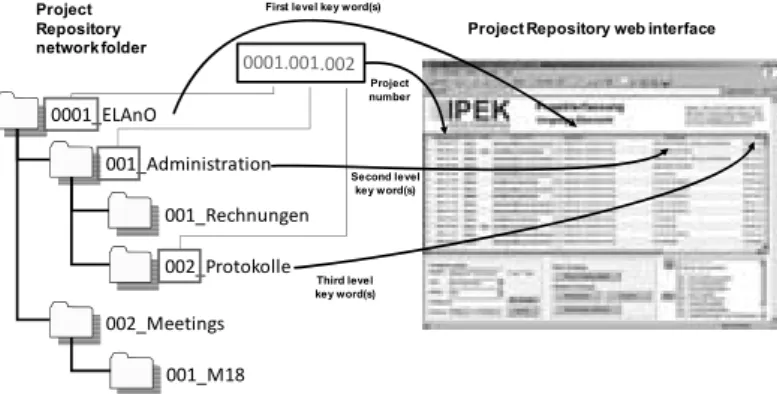
The IPEK Project Repository is a proprietary document and file management system. The IPEK project repository in contrast to many other solutions is an add-on solution. It consists of three parts, a web-accessible user interface as shown in figure 2, a network drive for files and MS Exchange public folders for Emails. As the documents in the Project Repository are stored in a network drive, all files can be accessed in multiple ways depending on the situation or user preferences. As the web interface is a pure add-on tool, system dependency is reduced in comparisadd-on to integrated document management systems which store the documents a database. Documents in the Project Repository are classified by several attributes including key words, responsible person, id-number, status and others.
0001_ELAnO 001_Administration 002_Protokolle 001_Rechnungen 002_Meetings 001_M18 0001.001.002 Project number First level key word(s)
Second level key word(s) Third level key word(s) Project Repository
networkfolder Project Repository web interface
Figure 2 Correlation between network folders and web interface of IPEK Project Repository Even though the system is primarily designed for digital documents, paper documents can also be included. In this case the folder path is simply replaced by a real physical location. The project repository has proven to be a helpful means when employees leave the institute. The system can easily provide a list of all activities for which a leaving employee is responsible. Currently there are approximately 400’000 files contained within the IPEK project repository.
4. Integration of Knowledge Management Aspects in Engineering
Design Education
The objective of academic education of mechanical engineers is to generate the competencies and to impart the knowledge being necessary for an efficient product development in an industrial surrounding. For starting their career, graduates need to have professional engineering skills as well as other competences like problem solving,
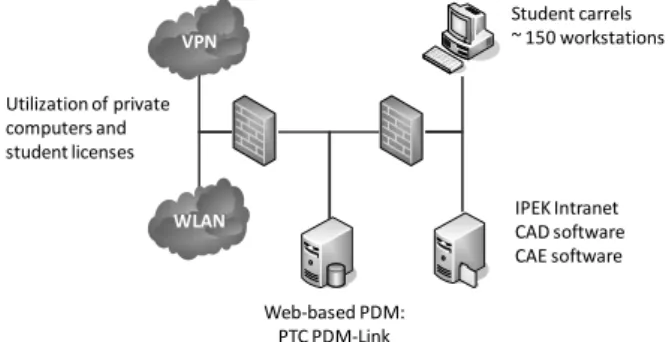
ideation and also knowledge management. For meeting these requirements in academic education, the Karlsruhe education model for product development (KALEP) was developed at IPEK. This approach is implemented in the pre-diploma course “Mechanical Design” with approx. 500 students as well as in the final year design course “Integrated Product Development” (IP) with 42 selected students. In every course of mechanical engineering design, teamwork is required. The tasks for the students reach a relatively high level of complexity so that the tasks can only be solved efficiently with systematic collaboration and consideration of knowledge management aspects. During their pre-diploma studies, students of Mechanical Engineering at the University of Karlsruhe have to participate in a mechanical design course for three consecutive semesters. In the summer semester 2008 the task for the project work was to design a pair of legs for a humanoid robot. More than 500 students took part in this project. In order to make the students aware of the importance and need for knowledge management in collaborative product design, they were given a wiki (Dokuwiki) in combination with a web-accessible PDM/CAD system (PTC PDM-Link/ProEngineer) and an introduction to how wikis and PDM systems can support knowledge management in collaborative project work. There are several reasons for the proposed CAD and PDM utilization in the pre-diploma studies. Students need to get to know their later working environment as early as possible. We furthermore believe that engineering design must not only be taught in theory, but also in its practical application. The technical enabling of these goals is somewhat difficult due to the large number of students in the pre-diploma-studies. In total the CAD/PDM usage extends over three semesters, which results in over 1000 users per semester. The current amount of 140 work-stations at the institute can only allow a part of the students to do their project work simultaneously. The external access to PDM-Link enables the students to also work from other computers within the campus-wlan or their homes. To enable such a broad IT infrastructure for knowledge management, virtual server environments are being used. This environment is based on VMWare Infrastructure, which makes experimenting with and evaluation of different data and knowledge-management systems comparatively easy. VPN IPEK Intranet CAD software CAE software Web‐based PDM: PTC PDM‐Link WLAN
ÆVersatile access to PDM‐Link via local workstations, university‐wlan and vpn Student carrels ~ 150 workstations Utilization of private
computers and student licenses
Figure 3: CAD/PDM Infrastructure for engineering design education
At the end of the course a questionnaire survey was conducted. The questionnaire consisted of 42 questions and a total of 527 responses to the survey were obtained. In general, the students seemed to find the DokuWiki relatively simple to use. Only 17% of
the students disagreed that the use of the DokuWiki was simple while 55% agreed. Half of the students said that they were able to easily find information within their own team’s namespace, while 25% said they were not. Finally, the majority of the students (71%) responded that they could not quickly find information in other teams’ namespaces, while 11% said they could. 46% of respondents said they imported sketches of their conceptual/principle designs. However, only 26% agreed (while 45% disagreed) that the wiki allowed them to easily record conceptual/principle design ideas. Another interesting aspect of the wiki is its use for communication. While 71% of the respondents said they most often worked with the wiki at home (21% said at the university) only 28% said they used it for communication with their team. Also, 67% responded that it was easier to communicate using email rather than the team wiki. An open question for suggestions of improvements showed that many students wished the wiki to provide more and easier formatting. Many students also wished for easier ways to include graphics in general and especially sketches for the wiki to be more useful for product development.
5. Summary and Future Work
In this paper an overview on knowledge management activities and tools at the Institute of Product Development was given. The use of wiki in research and education was presented. An example was given how students in mechanical engineering are being introduced to the topic and tools of knowledge management in engineering design course work. One goal for future knowledge management activities is to apply the flexible functionalities of MS Sharepoint [E07, HA07] to provide users a more integrated and customizable point of entry to the knowledge management tool suite. Future work will also comprise further investigation on the suitability of knowledge management approaches and tools, especially wikis, for collaborative product development in combination with universally applicable product lifecycle process models and problem solving process models [AM07, Al08].
6. Literature
[ABB06] Albers, Albert, Burkardt, Norbert, and Meboldt, Mirko: "The Karlsruhe Education Model for Product Development “KaLeP” in Higher Education," in International Design Conference – Design 2006Dubrovnik, 2006.
[E07] English, Bill: Micrososft Office Sharepoint Server 2007 - Das Handbuch. Unterschleißheim: Microsoft Press Deutschland, 2007.
[HA07] Holliday, John, Alexander, John, Julian, Jeff, Robillard, Eli, Schwartz, Brendon, Ranlett, Matt, Attis, J. Dan, Buenz, Adam, and Rizzo, Tom: Professional Sharepoint 2007 Development. Indianapolis, Indiana: Wiley Publishing Inc., 2007.
[AM07] Albers, Alber and Meboldt, Mirko: "SPALTEN Matrix - Product Development Process on the Basis of Systems Engineering and Systematic Problem Solving," inThe Future of Product Development, K. F. L., Ed.: Springer, 2007.
[Al08] Albers, Albert, Deigendesch, Tobias, and Meboldt, Mirko: "Handling Complexity – a Methodological Approach comprising Process and Knowledge Management," inTMCE, 2008.