Sarwat Nizamani
, Nasrullah Memon
1The Mærsck McKinne Møller Institute, University of Southern Denmark
2Department of Computer Science, Sindh University Campus Mirpurkhas, Pakistan
emal:{saniz,memon}@mmmi.sdu.dk
Abstract
In this paper we present a model for email authorship identification (EAI) by employing a Cluster-based Classification (CCM ) technique. Traditionally, stylometric features have been successfully employed in various authorship analysis tasks; we extend the traditional feature-set to include some more interesting and effective features for email authorship identification (e.g. the last punctuation mark used in an email, the tendency of an author to use capitalization at the start of an email, or the punctuation after a greeting or farewell). We also included Info Gain feature selection based content features. It is observed that the use of such features in the authorship identification process has a positive impact on the accuracy of the authorship identification task. We performed experiments to justify our arguments and compared the results with other base line models. Experimental results reveal that the proposed CCM -based email authorship identification model, along with the proposed feature set, outperforms the state-of-the-art support vector machine (SVM )-based models, as well as the models proposed by Iqbal et al. [1, 2]. The proposed model attains an accuracy rate of 94% for 10 authors, 89% for 25 authors, and 81% for 50 authors, respectively on Enron dataset, while 89.5% accuracy has been achieved on authors' constructed real email dataset. The results on Enron dataset have been achieved on quite a large number of authors as compared to the models proposed by Iqbal et al. [1, 2].
Keywords
CCM; e ma il authorship analysis; feature selection; machine learning; stylometric features; SVM1
Introduction
Written co mmunicat ion that e mploys the use of co mputers is referred to as co mputer mediated communicat ion (CM C), and ema il is one of the most important and widely used forms of CM C. Other types of CM C inc lude online messages, blogs, forums and instant messaging services. Among all CM C, e ma il has re mained a key source of written co mmunication, especially in the last few decades. Due to its salient features, it is the preferred source of written co mmunication for a lmost every population connected to the Internet. It is a very quick, asynchronous written communication channel which is used for various purposes ranging from forma l to in forma l co mmunicat ion. Formal e ma ils include officia l correspondence, meeting ca lls, se minar calls, business communication, o rder p lace ments, and flight reservations to name a fe w, wh ile informa l e ma il communicat ion includes personal ema ils, greetings and invitation e ma ils (fa mily and friends). These are a ll e xa mples of the positive and legal applications of ema il; but, there also exist a number of illegitimate and negative purposes for e mail as well. As the Internet grows at a quicker rate each year, the same is also true for cybercrime [3]. According to Loader and Tho mas[3], any illega l act using CM C is termed as a cybercrime. Ema il is a prime target for cybercriminals, as it has many unique features that enable the fac ilitation of criminal act ivity [4]. One can easily hide his/her identity while sending fraudulent emails, and anonymous messages can be sent to a number of rec ipients to spread fear among them. An e mail message can spread among a la rge population, across a large geographic location , litera lly in an instant. As we discussed above, email has been used for many illegal uses; the most prolific is the sending of “spam” mails [6], wh ich are
solicitous messages that the receiver is not interested in. Spa m e ma ils can be of various types, and usually spam e ma ils are sent by unknown identities. Most of the spa m we receive is sent for advertise ment purposes. The other type of spam is sent specifica lly to obtain personal information (for e xa mple : the ma il may outline a fraudulent contest for which the rece ivers may win a prize, if only they send the scammer their bank account information). Another use of spam email is “phishing” [7], or email that includes a link to a fraudulent website. These types of spam e ma ils a re sent with bad intentions, but even an average person may send a fake e ma il for the sake of fun and then share it with others as well. There are ce rtain service providers1 that provide services for sending fake e ma ils.
Apart fro m these spam e ma ils, the 9/11 co mmission report [4] reveals that a number of e ma ils were sent by the terrorists before the event took place. The investigations of the Mumbai attacks in 2008 [5] show that some e ma ils we re d iscovered revealing hard evidence o f the attacks. This motivates us to put into place such a system that can reveal the identities of those criminals who intend to commence crimes using computer technology.
The study used to reveal the identities of illic it e mails comes under the category of “authorship analysis.” Authorship analysis [8, 9, 10] has been studied in different dimensions ever since it began, in 1887, when Mandenhal [11] ana lyzed the writ ings of Bacon, Marlowe and Shakespeare to distinguish their styles fro m one another. The authorship analysis study ranges from identify ing the true author of a research artic le [12] to writer identification o f literary te xts [11]. It a lso ranges fro m revealing the identity of te xt messages that may be a post of a foru m [9] or an e ma il message [1, 2, 13]. Each type of writing has its unique characteristics, so the authorship analysis model designed for one kind of writing may fa il to identify the author of another kind of writ ing. The reason is that some writings may be written by literary scholars, but others might be written by undereducated or near-illiterate authors. Therefore, there is a need for a research study for authorship identification separately, for each kind of writ ing.
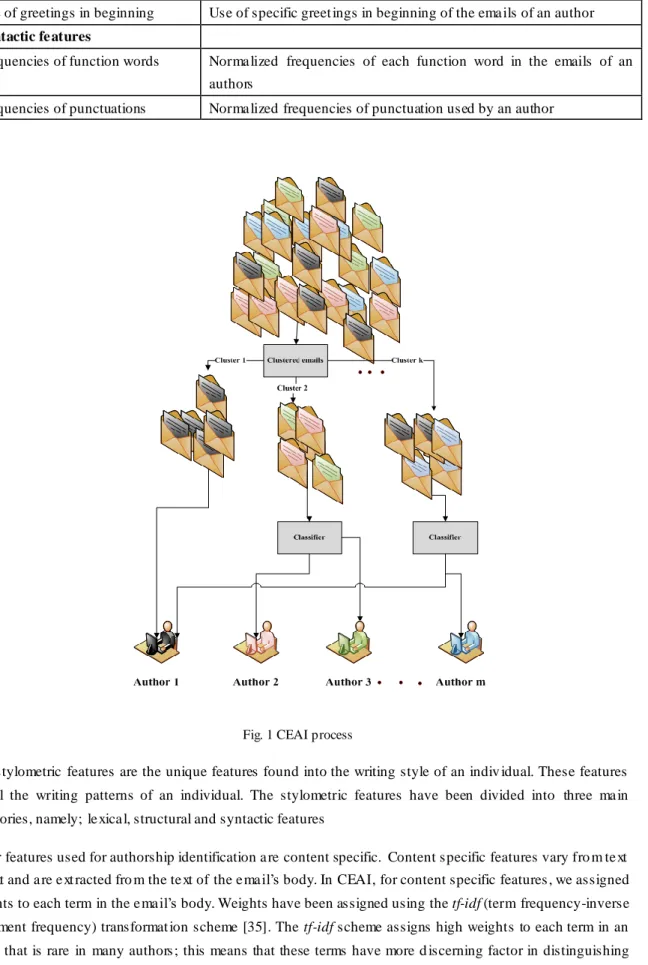
In this paper we propose a CCM [14] -based EAI mode l (CEAI), which is essentially a c luster-based classification model for e ma il authorship identification. First, ema ils are clustered, based on similar content , even though they may be discovered as written by different authors. For e xa mple , the use of similar words may be found in ema ils fro m different authors, but each author may have other different patterns, such as unique greeting styles or punctuations. Thus, in each cluster the number of authors is less than the original number of authors in the original e ma il set. The classificat ion technique, SVM [15] is then applied on each cluster. The classification results are imp roved when there are fe wer c lasses; in our case, each distinguished author is a class. The classification then identifies the rest of the distinguishing patterns of different authors’ ema ils in each cluster. This process is elaborated in Section 3 and shown in Fig 1.
We highlight the contributions of the paper as follows:
Adaptation of a new te xt c lassification model (CCM) for e mail authorship identification
The use of extended feature set for the EAI task
The successful use of the feature selection technique fo r content features for the task
Achieved high accuracy of the task for s ome what la rge number of authors
1
In this paper, we have applied proposed model on a publicly ava ilab le Enron e mail dataset2 and on real ema ils dataset constructed by the authors, for e xpe rimental eva luations. A brief overvie w o f En ron’s e ma il dataset is presented in the next Section, followed by the proble m statement.
1.1
Datasets
The Enron e mail dataset [16] is a large collection of rea l e ma ils of an organization, wh ich once was a global organization. The original dataset contains 619,446 e mail messages belonging to 158 e mp loyees of the Enron organization. The dataset was put online by Willa m Cohnen of CMU in March 2004. The dataset is processed by many researchers according to their require ments. The dataset used in this study is proc essed by Shetty and Adibi [17] and is available for down load in a SQL du mp3 file at the University of Southern California ’s website4. Enron dataset is a benchmark dataset used for e xpe rimentation for various ema il related research. We also applied the proposed model on real e ma il dataset (created by us) which is co mprised of 7 authors and 30 e ma ils of each author.
1.2
Problem Statement
We define our problem as assigning an author to an anonymou s email a fter analyzing its features. Mathematically, the ema il authorship identificat ion proble m is represented as:
}
,....
,
{
e
1e
2e
nE
(1)
}
,...,
,
{
a
1a
2a
mA
(2)}
,...,
,
{
f
1f
2f
lF
(3) j iA
E
A
E
F
EAI
(
,
,
)
(4)Where E is a set of e ma ils in the dataset, A is the set of authors of the e mails in the dataset, and EAI(F,E,A) is a mapping function of e ma il ei to author aj, defined over F, E and A, while F is a set of features. Init ia lly, during training, the e ma ils of each author are analy zed and unique features are extracted wh ile a tra ining model is constructed. At testing time, the test email is checked against the features of all users. It is assigned an author who has greater simila rity with the e ma il being tested. The whole process is discussed in Sect ion 3 and illustrated using algorithms.
The rest of the paper is organized as fo llo ws: The re lated work is discussed in Section 2, where the p roposed model is described in Section 3. Expe rimental results and discussions are presented in Section 4 while the conclusion, along with future work, is given in Section 5.
2
Related Work
2
http://www.cs.c mu.edu/~enron/
3 My SQL dump file is a backup file of large database 4
In this section we discuss related wo rk in connection to CEAI. We also brie fly elaborate the research dimensions in the e mail do main contained herein. The research in the e ma il do ma in can be divided in t wo types; (1) the e mail traffic analysis [18]; and (2) the e mail content analysis [7, 19]. Ema il traffic ana lysis usually uses the ema il's header inc luding the sender and receiver's e ma il addresses, the email sending date, the type of receiver (To, Cc or Bcc) and the ema il subject. Email content analysis focuses on the email body and occasionally the subject field of the header. In this paper we deal with the content (body) of the e ma il message, and the sender part of the email header. In the header, the research main ly focuses on Social Network Analysis [20] of an e ma il network. It uses the links between the sender and the rece iver o f an e ma il and sometimes uses the date of the link to conduct time stamp ing experiments. In the email content analysis, the research is mainly conducted using text min ing and Natural Language Processing [21] techniques. Some of the dimensions for e mail content analysis are automatically categorizing e ma ils [19] into user-defined folders, analy zing e ma ils for spam [6]contents, analyzing e mails for authorship identification [1], ana lyzing ema ils for phishing e mails [7], etc.
Authorship analysis [10]can be characterized as regarding a section of writing based on its writing style to identify its true author. This analysis includes linguistics techniques, statistical analysis and machine lea rning techniques to draw a conclusion regard ing the author of a part icular writing. The authors [22] described some characteristics of authorship analysis, that are applicab le to software forensics. Broadly, authorship analysis can be researched into three dimensions, name ly; authorship identificat ion, authorship characterizat ion ,and similarity detection.
Authorship identification [10] can be described as identifying the author of a te xt fro m anonymous writ ing, based on the author's past writing records. Authorship identification has been pre viously researched as a text classification [23] prob le m in which the authors are each considered classes, and the writ ing is considered as text to be classified. It uses machine learning technique to decide whether a text has been written by a particular author or at least the likelihood that the text has been written by a particular author.
Authorship characterization [10] can be termed as creat ing author profile fro m an author's past writings. Somet imes this could include the author's gender, educational background and language familiarity as well.
Similarity detection [10] can be described as comparing some portion of a writing, without actually knowing the author and then deciding how many simila rities are found in each writing style. This technique is main ly used as study in anti-plagia ris m.
Authorship analysis research can be found early in its history, when Mandenhal [11] conducted a study to compare the writing styles of English authors Bacon, Marlowe and Shakespea re. Mosteller and Wallece [12] conducted experiments to identify the true authors for the disputed Federalist5 art ic les that promoted the ratification of the U.S. Constitution .
The research conducted by de Vel et al. [24] considered the ema il authorship as a topic authorship categorization proble m. A corpus of ema ils taken fo r the study was very small; only 156 e ma ils were taken, all of the m belonged to a newsgroup. Three authors and three topics were used in the study, as it was
5
prelimina ry work in the e mail authorship area and showed pro mising results. The authors also proposed structural features that have since become a part of stylometric features for the task of authorship identification.
The authors [25] presented a study in which the importance of writeprints was evaluated for la w enforce ment to prevent cybercrimes. The authors claimed that the feature selection technique could use a cyber crimina l's writeprint to identify the m, much like using fingerprints as a form of identification in the "real" world.
The author [26] presented a detailed survey on authorship identification tasks. The study explored various aspects of the authorship task and research advances in the area. The survey first investigated the use of stylometric features for the task in various studies, then presented a detailed ana lysis of authorship attribution methods.
Koppel et al. [27] present detailed study on computational methods in authorship identification. The authors discuss authorship study literature in detail in connection to three main approaches used overtime, wh ich include authorship characterizat ion, similarity detection and authorship identification . Koppel et a l. [28] present an approach for decomposing mult i-author documents in authorial co mponents. The technique used by the authors for the same purpose was an un-supervised machine learn ing technique.
A fra me work fo r authorship identification for online messages was presented by Zheng et al. [10], in wh ich authors extracted four types of writing style features for e.g. le xica l, synta ctic, content specific and structural features and applied a machine lea rning classification algorithm for authorship identification. Authors considered authorship identification as a classification proble m. High accuracy was achieved using a support vector mach ine [29] c lassifie r; however, e xpe riments were a lso conducted using a decision tree [30] and back propagation neural network [31].The authors conducted the series of e xperiments on English and Chinese online messages with a ma ximu m of 600 messages us ed for e xperiments for both English and Chinese datasets. The study achieved promising results on the English dataset, and satisfactory results on the Chinese dataset. However, this dataset was very small.
In the literature, researchers attempted to e xplo re new features overtime for the authorship identificat ion task. With other writing style features, content specific features we re a lso e mbedded for the authorship identification task by Iqbal et al. [1] and Zeng et al. [10] . The effectiveness of such features, like word usage frequency, was obvious, but it was realized that it would be topic specific. St ill, these features are considered important for the authorship identification task.
If we look back to the earlier developments for authors hip identificat ion , Yu le [32] identified that sentence length would be a useful feature for the authorship identification task. Yule [33], in h is later work, he also suggested the richness of the vocabulary features to support the task. These features are still conside red very useful for identifying a writing style.
The authors [8] applied authorship identification in a slightly d iffe rent way, by applying stylo metric authorship identification in the electronic market for scalability and robustness. The e xperimental results were successful by achieving good results.
The stylometric approach was applied by Abbasi and Chen [9] for both identity level identification and similarity detection, using the writeprint model for various online messages. In the study, the authors used an e xtended feature set in addition to baseline stylometric features, and performed a series of expe rim ents on various online message datasets.
Iqbal et al. [13] developed a write-print based approach by mining frequent pattern s. Write-print based approach considers a set of suspected authors for a ma lic ious ema il. The frequent patterns are e xtracted fro m the ma licious e ma il and is matched against the frequent patterns of each suspected authors' e mails and the most plausible author is assigned to that ma lic ious ema il.
A cluster-based writeprint model fo r the ema il authorship was developed by Iqbal et al. [1] in order to evaluate on the Enron ema il dataset. The experiments were conducted using three clustering algorithms. The results given by the authors are on just a small portion of the Enron email dataset (500 -1000 e ma ils). The study [1] first clustered each author's emails, then extracted stylometric features and mined the frequent patterns fro m them. Afterwa rds, the frequent patterns were matched fro m the e ma ils of d iffe rent authors, and the study kept only those patterns in the model wh ich we re unique to each author. In the study, the authors reported the results on 5 and 10 authors only. The accuracy achieved was 90% for 5 authors and 80% for 10 authors respectively, where for each author, 100 messages were used. In another study of e ma il authorship identification, Iqbal et a l. [2] which is e xtension of Iqbal et al. [13] conducted e xperiments using up to 20 authors and the accuracy achieved was below 75%.
We propose an email authorship identification model using CCM, which is a cluster-based classification model. Better results are achieved on quite a large ema il dataset with just slightly higher number of authors. The model has been applied on 10, 25 and 50 authors and has achieved promising results. In this paper, no limit has been placed on the number of e ma ils for each author because at investigation time it is not necessary that the number of e ma ils available fro m each suspected author should be the same. The average number of ema ils per authors used for experiments is 600 and average number of words per email is 135. The proposed model CEAI achieved 94.3 % for 10 authors, 89% for 25 authors, and 81.3% for 50 authors, respectively. According to Iqbal et al. [2], the number of suspects under forensics investigation is usually considered less than 10, as the authors [2] mentioned in their d iscussions with a La w En force ment Un it in Canada. Therefore, the results achieved using the CEA I model are 81.3 % for 50 authors -- quite a pro mising results.
Thus, here under we present s ome research questions that are answered by the proposed model; then we discuss the proposed model;
2.1
Research Questions
Do e xtended features have a positive impact on EA I accuracy?
Does Info Ga in feature selection based content features have a positive impact on the accuracy of the model?
Will CCM be able to attain high accuracy for the EAI task?
Will the CCM-based EAI model be able to distinguish among many authors?This section is divided into subsections to outline the proposed model. An overvie w of the mode l is provided first, followed by a description of the feature set construction. Afterwa rds, the algorithmic details of the model are e laborated; fina lly the architecture o f the mode l is illustrated, followed by some imp le mentation details.
3.1
Overvie w of CEAI
The current study presents an Email Authorship Identification model bas ed on CCM. The model uses a top-down approach to group the emails into clusters , although, the clusters created do not directly map to each author due to similarities in the writing styles of various authors. However, with the help of c lusters , the authors who share a writing style are g rouped. The classification a lgorith m SVM is then applied to each cluster to further separate each author’s writ ing, as shown in Fig. 1. This way the authors are div ided into clusters and in each cluster there are fewer authors. Thus, the classification model works well to classify the authors in c lusters , and the overall accuracy o f the EAI task increases by employ ing CCM on a slightly large number of authors as compared to the model [1, 2] on Enron dataset.
3.2
Feature Set Construction
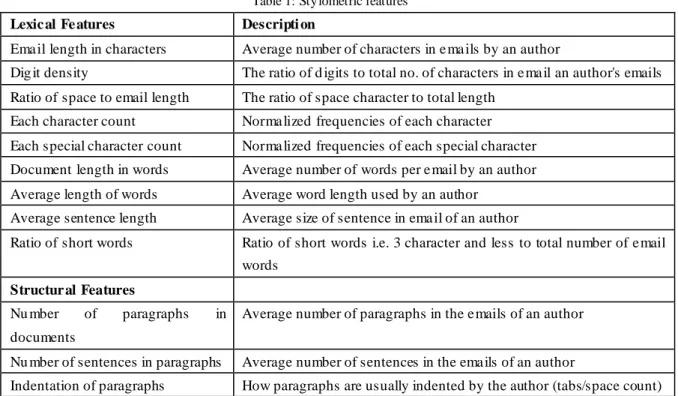
As the proposed model uses machine learning techniques – clustering and classification – for the success of any machine learning model, it is worth to first construct a feature set. In the EAI task, features are used to represent the author as his/her writeprints. As fingerprints [1] have historically been used by law enforce ment e xperts to uniquely identify criminals , writeprints [1, 9] could be used to identify authors to their writing styles. Researchers can apply their results, to cybercrimes, especially to fraudulent ema ils, by revealing the identity of the author. It was rea lized that, like unique fingerprints , each writer may have unique writing style. These unique writing style features are termed as “stylometric” [9] and have previously been used in studies [1, 9, 10, 34], to identify authors using lexica l, structural and syntactic features . In Table 1, we provide a list of some stylometric features that are commonly used in an authorship identification study.
Table 1: Stylometric features
Lexic al Fe atures Descripti on
Ema il length in characters Average number of characters in e ma ils by an author
Dig it density The ratio of d igits to total no. of characters in e ma il an author's emails Ratio of space to email length The ratio of space character to total length
Each character count Norma lized frequencies of each character Each special character count Norma lized frequencies of each special character Document length in words Average number of words per e mail by an author Average length of words Average word length used by an author
Average sentence length Average size of sentence in ema il of an author
Ratio of short words Ratio of short words i.e. 3 character and less to total number of e mail words
Structur al Features
Nu mber of paragraphs in documents
Average number of paragraphs in the e mails of an author
Nu mber of sentences in paragraphs Average number of sentences in the ema ils of an author
Use of greetings in beginning Use of specific greet ings in beginning of the ema ils of an author Syntactic fe atures
Frequencies of function words Norma lized frequencies of each function word in the emails of an authors
Frequencies of punctuations Norma lized frequencies of punctuation used by an author
Fig. 1 CEAI process
The stylometric features are the unique features found into the writing style of an indiv idual. These features reveal the writing patterns of an individual. The stylometric features have been divided into three ma in categories, namely; le xica l, structural and syntactic features
Other features used for authorship identification a re content specific. Content specific features vary fro m te xt to text and a re e xt racted fro m the te xt of the e ma il’s body. In CEAI, for content specific features , we assigned weights to each term in the e ma il’s body. Weights have been assigned using the tf-idf (term frequency-inverse document frequency) transformat ion scheme [35]. The tf-idf scheme assigns high weights to each term in an ema il that is rare in many authors ; this means that these terms have more d iscerning factor in distinguishing the ema ils of various authors.
|
|
)
,
(
)
,
(
e
e
t
f
e
t
tf
(5)}
:
{
1
|
|
log
)
,
(
e
t
e
E
e
t
idf
(6))
,
(
*
)
,
(
)
,
(
t
e
tf
t
e
idf
t
e
fidf
t
(7)Where f(t,e) returns the frequency of term t in e ma il e and |e| is the size of the e mail body in terms of number of words; therefore, tf(t,e) returns the norma lized frequency (in the range of 0 and 1) of term t in e mail e. The function idf(t,e) returns the inverse document frequency. This assigns highest weight to the terms in e mails which a re p resent in e ma ils of few authors. |E| is the total nu mber of e ma ils in the dataset, while {e: t
e}returns the number of e mails that contain term t in the body. In the content-specific feature set, we keep only the terms that have the minimu m frequency 3. Still the number of these terms is too high, so we applied the feature selection using Info Gain[36]. Equations (8)-(10) give mathemat ical representation of the Info Ga in feature selection method, which assigns ranks to the content terms . We selected the top-ranking 1000 terms by reducing up to 90% of the content features and ma intaining the accuracy of the model.
IG
(
A
,
f
)
H
(
A
)
H
(
A
|
f
)
(8)(
)
(
)
log
(
)
1 2
m ii
A
P
i
A
p
A
H
(9)(
|
)
(
|
)
log
(
|
)
1 2
m if
i
A
P
f
i
A
p
f
A
H
(10)Where H(A) is the entropy of author A, m is the total nu mber of authors in the dataset. The IG(A,f) is an Info Gain function that returns the importance of feature f as a d istinguishing feature for author A. Besides the use of the above given features, our manual analysis yields the use of the fe w addit ional features that increase the effectiveness and accuracy of the proposed model.
Frequently used farewell words before signature
Ending punctuation
Frequently used punctuation
Modern features: Sent fro m mob ile device feature
Use of repetitive words (me,me,me/ yes,yes,yes)
Time format 2:00, 2 o’ clock
Single sentence / questioning email
Punctuation after and before farewe ll
Punctuation after greeting
Punctuation in short or inco mplete sentences
We show the effectiveness of these features in comparison to baseline features in e xperimental results in Section 4.
For le xica l and structural features e xtraction Java feature functions are created, where for syntactic features commonly used function words and punctuations have been used that have the capability of distinguishing the authors. We e xtracted the content specific features using WEKA [37] which is a freely available, open source mach ine lea rning tool.
We imple mented Java classes for mapping each feature type to the corresponding Attribute Relat ion File Format (A RFF) which is a WEKA-specific data file. Le xical features (character based/ word based) were e xtracted as the ratio of the frequencies to the total nu mber of characters/words. In other features, such as the last punctuation feature, five inde xes are reserved. The inde x of the full stop is turned on when the email contained full stop at the end of the email body while all the other indexes of the last punctuation feature are turned off. In continuation to the imple mentation details, we discuss algorith mic details of the model in the next Section.
3.3
Algorithmic Details
In this section some algorith mic details of the proposed model are provided. The DataCleaning algorithm (Algorith m 1) is designed to extract the required part of the dataset, which is necessary for e xperimentation. The algorith m cleans the dataset and filters out the meaningless parts from the original dataset. In an un-cleaned dataset there are many p ieces of informat ion wh ich are not needed for the authorship identification task. For e xperiments , we retrieved the body (Step 6 o f the algorith m) of the e ma il and fro m the header, the sender name is retrieved (Steps 3 and 4); in other words the author of ema il. The forwarded e mails (i.e . the e ma ils that did not belong to the sender) and also the referenced te xt fro m the e mails has been re moved (Steps 7 to 14). The author signatures have also been removed (Steps 15 and 16) because an anonymous author would never use his or her true identity. After c leaning the dataset, we applied some preprocessing steps necessary for the authorship identification task. These steps included tokenizat ion, filtering greetings and farewe ll tokens. The stop words (function words) are not re moved because the habitual use of these words provided clues for the identity of the true author of the email. In the algorith m the functions GetHeader(),GetSender(), GetReftype(), GetBody() anf GetSginature, were applied using SQL queries to retrieve the header, sender, reference type, body and signature of the ema il message, respectively. The RemoveReftext() is the function applied to re move the referenced part of the message that is not part of the current message body; and the function Delete() is used to simp ly de lete the fo rwa rded e ma il. Both of these functions are applied using SQL queries.
When the emails of different authors were manually analy zed, it was realized that the ending punctuation ma rk feature, in co mb ination with other features , could be helpful for identifying the author of an e mail. Algorith m 2 describes the steps for e xtracting the last punctuation mark of the e mail body. In the algorith m, Steps 4 through 14, check and e xtract the various punctuation marks at the end of the email body.
In addition to our e xtended features, the baseline features used in the study are similar to Abbasi and Chen [9]. It was observed that these unique features, found in the emails written by one author but not found in the ema ils written by other authors have positive impact on the authorship identification task. The e xtended features included stylistic as well as content-based features. After clean ing and preprocessing, we e xtracted the features, then applied the feature selection and applied CCM for the EAI task. Algorith m 3 has been designed to extract diffe rent feature types. Initia lly the feature set is empty, then various feature types are e xtracted by separate functions such as the Construct_Lexical_features(),Construct_Structural_features()
Construct_Syntactic_features(), whichare used to extract le xical, structural and syntactic features respectively.
Extract_Content_features() extracted content-based features. Finally, all the features are added to the feature set and saved to an ARFF file format. A mong other features listed in Section 3.2, we present algorith m 2 which e xt racts the last punctuation type feature.
Cluster creation is the ma in part of the CEAI model; hence BuildCluster (Algorithm 4) creates k-c lusters of ema ils using k-means [38] c lustering algorith m. The para meter k is selected using visualizat ion, which is one of the most common method [39] for selecting value of k because it is considered to be useful for validating clustering results [40]. The function sim(c[i], c[j]) returns the similarity score between clusters, and it returns high score when e mails in both clusters share common authors. At the time clusters are created, authors of ema ils are not kept in account; the algorithm groups the emails into clusters sharing various features. When merg ing is performed, the authors of the message are kept into account, and those clusters are merged that contain ema ils fro m co mmon authors. It may be noted that when there is no optimized c luster, then the clusters are merged. An optimized c luster is one, whose size is greater than the threshold (the number of samples ema ils is at least twice of the number of authors in the cluster) and the cluster contains emails fro m subset of authors. For a better understanding of the model, interested readers may refer to the authors' already published work [14].
In order to apply the CCM model using various features , the final algorithm EAI (A lgorith m 5) is developed. The algorithm rece ives three para meters as input E, F and A. The a lgorithm discusses all the steps of the EAI
task and it is the main a lgorith m of CEAI model. The function BuildCluster creates clusters (Step 1) and the parameter k is determined by using visualizat ion. The Steps 2 through 27 a re run for each c luster, first the test is conducted if the cluster is co mprised of a ll the e mails belonging to single author, if so, the ema ils are assigned that author and cluster is returned in the final model (Steps 3-7 ). Ne xt a test is conducted if the cluster size is less than a threshold, if so, the cluster is merged in most similar c luster (Steps 8-18). When a cluster is determined, whose size is greater than the threshold and not all e ma ils belong to one author, a classifier is tra ined for that cluster and if its accuracy is higher than its parent classifie r, the c lassifier is added in the final mode l and the classifie r is considered to be the optimized c lassifier. If classifie r doe s not return optima l results, further step of clustering takes place and the process is repeated.
The authorship identification task usually is concerned with a provision of samp les of candidate authors' sample writing and the task is to determine the most p lausible author of the test sample a mong the candidate authors. It should be noted that in this paper the proposed model is limited to the author identificat ion task. In order to address the problem of unknown author, a non -parametric statistical test [41] is to be adapted. The test is referred as Kruskal-Wallis test [42], wh ich is a non-para metric method to rank each feature with respect to all authors in the training set. Once an ema il has been assigned an author using the proposed model, the test is applied using similarity metric, to check whether the e mail be longs to the author's word distribution. If the ema il's word distribution differs fro m the assigned author's emails in the training set, the email is recognized to belong to an unknown author. The test is applied only when the tra ining e ma ils fro m the assigned author are used. In the Kruskal-Wa llis test, the null hypothesis is rejected which articulates that for all the authors, the words' distribution re ma ins same [42].
Algorithm 1. DataCleaning (Dataset)
2:
for (i = 1 to n)3:
Header= GetHeader (email[ i])4:
Sender=GetSender(Header)5:
Rtype=GetReftype(Header)6:
Body= GetBody(email[ i])7:
if( rtype = Re)8:
Body = RemoveReftext(Body)9:
else if (rtype = Fwd)10
and ( (append Body = FYI )11
or (append Body = NULL))12:
Delete (email[i])13
Continue14:
end if15:
Signature=GetSignature( Body)16:
Body=Body-Signature17:
email[ i]=Sender+Body18:
Cleaned_Dataset= Cleaned_Dataset + email[ i]19:
end for20:
EndAlgorithm 2. LastPunctuation(body)
1:
In intialize full_stop=null, q_mark=null,
2: exclam_symb=null, semi_coll=null,
3: comma=null
4:
if
(last_punct = ‘.’)
5: full_stop=1
6:
else if
(last_punct = ‘?’)
7: q_mark = 1
8:
Else el else if
(last_punct = ‘,’)
9: comma=1
10:
else if
(last_punct = ‘!’)
11: exclam_symb=1
12:
else if
(last_punct=’;’)
13: semi_coll=1
14:
end_if
15:
End
Algorithm 3. FeatureFunctionConstructor(Dataset)
1:
feature_set=NULL
2:
Lexical_features= Construct_Lexical features()
3:
Structural_features= Construct_Structural_ features()
4:
Syntactic_features=Construct_Syntactic_features()
5:
Content_features= Extract_Content_features
6:
feature_set=Lextical_features+Structural_features+...
7
Syntactic_features+Content_features
8:
writeArff: features_set
9:
End
Algorithm 4. BuildCluster(E,K) 1: C[1..k]=K-means(E,k) 2: if(sim (C[i], C[j]) > th) 3: Merge (C[i], C[j])4: end if
5: End
Algorithm 5. EAI(E,A,F)
1: BuildClusters(E, k)
2: for each cluster c(i=1 to k)
3: if (ci contains emails that belong only to one author a)
4: for each email e in ci
5: author(e)=a
6: end foreach
7: add(ci,CEAI) //add cluster center to CEAI
8: else if (|ci| < µ) // µ is threshold
9: max= 0.0
10: for each pairs of clusters c (j=2 to k) //all clusters except ci
11: if (max < similar ity(ci, cj))
12: max = similarity(ci, cj)
13: cl=cj
14: m=j //current most similar cluster
15: end if 16: end foreach 17: cj=union(cl, ci) 18: delete(cm) 19: else BuildClassifiers(ci, SVM) 20: if (isOptimized(SVM(ci)) 21: add( SVM(ci),CEAI) 22: else 23: BuildCluster(k,ci) 24: goto 2 25: end if 26 end if 27: end foreach 28: End
3.4
CEAI Architecture
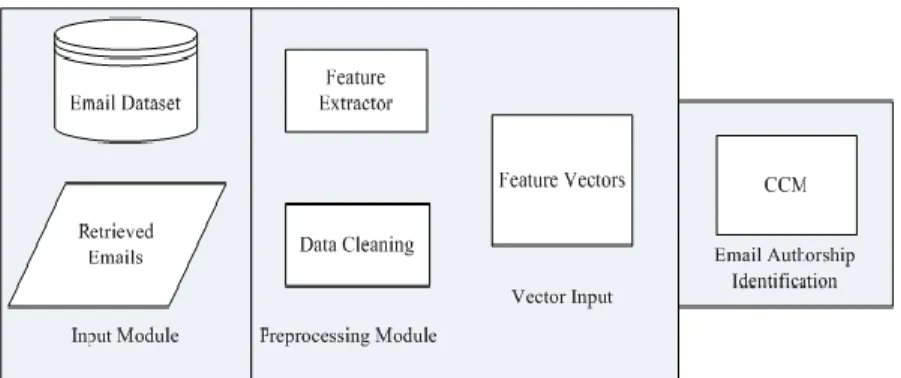
The architectural vie w of the proposed model describes the systematic processing of the model by illustrating the interaction of various modules. The architecture of CEAI co mprises of input, preprocessing, vector input and an EAI module (CCM model) as shown in Fig. 2. The input module receives raw e ma ils in a SQL du mp file (co mpressed database file), the du mp file is then transformed to SQL tables . The Input module then retrieves ema ils fro m the tables and makes them ava ilab le in a form that could be processed by the preprocessing module. The e mails received fro m the input module contain unnecessary data which is not required fo r e ma il authorship identification process. It is the responsibility of data c leaning module to re move needless data and ma ke available the required e ma il data. As an e ma il is co mprised of two main parts ; the header and the body, first the data is cleaned by retrieving the header and the body of the email. Afterwards, the sender is retrieved fro m the header, depending on the refe rence type, the body is c leaned. The body is cleaned by re moving forwarded informat ion if any forwarded p iece of data is in the e ma il; rep lied part of the ema il is re moved if an e ma il is rep ly of another e mail in order to preserve only the sender's text.
sub-module. The le xica l, structural and syntactic features are extracted using Java code, while the content features are e xt racted using WEKA preprocessing module. Once all feature types are e xtracted in preprocessing module, all the feature types are then combined and converted to a feature vector. The feature vector is then given as an input to authorship identification module which uses CCM based approach for ema il authorship identification.
Fig. 2: CEAI Architecture
3.5
Implementation Details
The architectural design section described the basic modules of CEAI. In this section, we discuss the imple mentation details of each of the module. There a re three types of imp le mentations required for the proposed model; (a) dataset retrieval (input) and data cleaning which is performed using MySQL server; (b) feature ext raction is the second type of imple mentation, wh ich is imple mented using Java co de and ARFF files are generated which are then given to WEKA for applying the proposed approach ; (c) the third type of imple mentation is to apply the proposed approach using WEKA, by first clustering and then classification.
Initia lly the required part of the dataset is e xtracted using the MySQL queries. For e xtracting the sender's te xt fro m the e mail and re moving fo rwa rded te xt and re ferenced te xt , MySQL queries are used. Once unnecessary parts of the dataset are re moved, feature e xtraction is performed. Content-specific features are e xt racted using WEKA's StringToWordVector filter by assigning weights to each content term, then the Info Ga in features selection is applied to rank the content terms according to author identification capability. For rest of the feature e xtract ion, Java code has been imp le mented, which also co mbines all of the features in A RFF format, which is comprised of feature vector fo r each e ma il. When dataset is available as feature vectors, k-means [38] clustering algorith m has been applied using WEKA on the ARFF file and on each optimized cluster, the SVM [15] algorith m is run fro m within W EKA. After presenting details of the proposed model, the e xperimental results and evaluation are discussed in the next Section.
4
Experime ntal Results and Evaluation
This section is divided in to sub-sections : Section 4.1 describes the e xperimental setup; Section 4.2 discusses the experimental evaluation, and Section 4.3 inc ludes the results and a discussion.
4.1
Experime ntal Setup
In order to perfo rm e xperiments, we retrieved just the “Sent” ema ils of the En ron e mployees fro m the dataset, because the true identities of the authors are ava ilab le with their na mes . First, we randomly selected 50 authors, then retrieved the “Sent” e ma ils of those 50 authors. We retrieved the e mail bodies fro m the message
table and along with the sender names by joining queries on the Message and the Employee_list tables from the database. We performed five types of e xpe riments on the ema ils of 50 authors for the authorship identification task. The first experiment is co mprised of baseline stylometric features and an SVM classifie r. The second set of e xperiments is conducted using baseline stylometric features with e xtended features and an SVM c lassifie r for the author identificat ion. In the third set of e xpe riments we used baseline stylometric features with the Info Ga in feature selection based content features. In the fourth set of experiments we used e xtended baseline stylometric features with Info Ga in feature selection based content features. In the last set of e xperiments, we used extended baseline stylometric features, with Info Gain feature selection based content features, and for authorship identificat ion we used CCM. We then retrieved the e ma ils of 25, and then 10 authors respectively, and a lso performed all five types of e xpe riments on both 25 and 10 authors . For authors' constructed dataset all of the five kinds of e xperiments have been performed.
4.2 Evaluation Criteria
The evaluation criteria used in our e xperiments is stratified 10 fold cross validation, as the same is used in study [2]. The 10 fo ld c ross validation is a method by which the dataset is divided into ten subsets. Algorith ms run for ten rounds; in each round, one subset is used for testing while the other nine are used for training. In each round, a d iffe rent subset is taken for testing. Finally, the average of accuracy rate is calculated to find the final accuracy rate. This method of evaluation is considered to be more effective because each email is considered for its author to be predicted, thus every ema il is used exactly once in test set and nine times in the tra ining set for each set of e xpe riments. The fina l accuracy of a ll the runs is returned as average.
4.2.1 Evaluation measures
The evaluation measure used in our study is the accuracy, which is calcu lated as:
100
*
FN
FP
TN
TP
TN
TP
Accuracy
(11)Where TP is the number of authors correctly classified to be the positive classes , whereas TN is the number of authors correctly classified to be the negative classes , while FP is the number of authors incorrectly returned by the model as positive classes , and FN is the nu mber of authors incorrectly returned by the mode l as negative classes, where in fact they were positive. In general, TP+TN is the number of e mails with correctly identified authors and TP+TN+FP+FN is the total number o f e ma ils . The accuracy of CCM for EAI is measured as the average rate of accuracy which is the percentage of correctly identified authors of emails . It is given by the follo wing equation:
)
*
|
(|
1
1
k i i i CCMc
ac
n
Accuracy
(12)Where k is the number of the c lusters in the model; |ci| is the numbe r of e mails in cluster i; aci is the accuracy of classifie r in cluster i; and n is the total number of e ma ils.
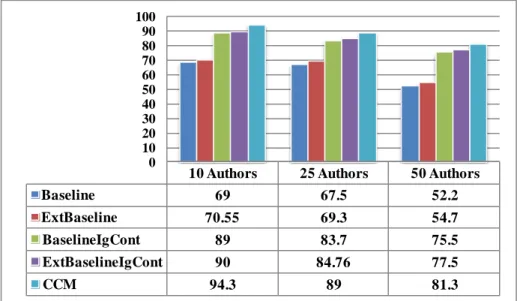
Fig 3. Experimental Results of CCM based EAI for 10, 25 and 50 authors
Fig 4. Experimental results of CCM based EAI on authors' dataset for 7 authors
4.3 Results and Discussion
The e xperimental results for 10, 25 and 50 authors on benchmark En ron dataset are given in Fig. 3. The results clearly depict that the model CEAI ach ieves the highest accuracy for the ema il authorship identification task on 10, 25 and 50 authors. We present the summa ry of a ll e xpe riments ’ types in Table 2. In each e xpe riment, various feature sets are incorporated step-by-step and starting with the baseline stylometric features , which a re trad itionally used for an authorship analysis task. Afterwards, e xtended features, which slightly imp roved the accuracy of the task, are used. Info Ga in based content features are then added, which keeps only the content features which have the capability of distinguishing each author. The original nu mber of content features is too large and the Info Gain based content feature selection maintains the balance between dimensionality reduction and accuracy of the task. The accuracy of the task increased greatly with the addition of these features . The first four e xperiments are performed using SVM and the last e xperiment has been conducted using CCM on the final set of features that again imp roves the accuracy of task. All five types of e xperiments have been performed on authors' constructed real e ma il dataset of seven authors. Analogous effects of all types of e xperiments have been observed on this dataset; though a bit less accuracy has been achieved, due to the fact that for this new dataset we have sma lle r a mount of e mails for each author as compared to the Enron dataset.
10 Authors 25 Authors 50 Authors
Baseline 69 67.5 52.2 ExtBaseline 70.55 69.3 54.7 BaselineIgCont 89 83.7 75.5 ExtBaselineIgCont 90 84.76 77.5 CCM 94.3 89 81.3 0 10 20 30 40 50 60 70 80 90 100 0 10 20 30 40 50 60 70 80 90 100
Table 2. Su mmary e xperiments
Exp. No.
Fe ature Set Model
1 Baseline SVM
2 Extended Baseline SVM
3 Baseline plus IG feature selection based content features
SVM
4 Extended Baseline plus IG feature selection based content features
SVM
5 Extended Baseline plus IG feature selection based content features
CCM
We achieved highest accuracy, 94%, on 10 authors, whereas accuracy decreased to some e xtent for 25 authors that is 89%, and 50 authors which is 81%, respectively on Enron dataset; while 89.5 % accuracy has been achieved on authors' constructed dataset.
5
Conclusion and Future Work
In this paper we present a model for e ma il authorship identification (EAI) and its evaluation on the publicly available Enron e mail dataset as well as authors' constructed dataset. The contributions of the paper are twofold: (i) to evaluate the use of additional features with baseline stylometric features for the EAI task and Info Gain feature selection based content features ; and (ii) the development o f a new model for the EAI task. Our e xpe riments show that additional features have positive impact on authorship identification accuracy, and the evaluations confirm that CEAI achieves an accuracy of 94% on 10 authors, 89% on 25 authors, and 81% on 50 authors and 89.5% accuracy has been achieved on authors' dataset of seven authors. The promising results are achieved as compared to previous models [1, 2] on benchmark En ron dataset and used a slightly larger nu mber of authors in the e xpe riments (50 authors as compared to 20 authors). It has been observed that the accuracy of the task decreases to some e xtent with the increase of authors. It is still necessary to improve the ema il authorship identification task by introducing new features or by improving the model so that it may be scalable to an unlimited nu mber of e mail authors . At present the proposed model is capable for authorship identification, but in future we would like to e xtend the model to authorship verificat ion in case if an e ma il belongs to anonymous author, to identify the e mail as unknown. We plan to extend our e xperiments of the authorship identification on other online social media, especially in foru ms in Eng lish as well as in Urdu languages.
References
[1] F. Iqbal , H. Binsalleh, B. Fung, M Debbai, "M ining Writeprints from anonymous e-mails for forensic investigation". Digital Investigation; 7(1-2), pp 56-64, 2010
[2] Iqbal F. Iqbal , H. Binsalleh, B. Fung, M Debbai ,"M . A unified data mining solution for authorship analysis in anonymous textual communications". Information Sciences; 231, pp. 98-112 , 2013
[3] B. Loader, D.Thomas (Eds), Cybercrime: Law enforcement, security and surveillance in the information age. Routledge; 2000.
[4] The 9/11 Commission Report; 2002. Available online on
http://www.gpo.gov/fdsys/pkg/GPO-911REPORT/pdf/GPO-911REPORT.pdf.
[5] M umbai terror attacks: Telangana inaction triggered serial blast s, claims e-mail. The Economic Times; 2011. Available: http://articles.economictimes.indiatimes.com/2011-07-16/news/29781742_1_serial-blasts-ammonium-nitrate-based-terror -outfits
[6] X. Carrerars, L. S. M arquez, J. G. Salgado, "Boosting trees for anti-spam email filtering". In Proceedings of 4th International Conference on Recent Advances in Natural Language Processing (RANLP-01). Tzigov Chark, BG, pp.58-64, 2001
[7] I. Fette, N. Sadeh, A. Tomasic, "Learning to Detect Phishing Emails". Technical Report. In Proceedings of the 16th international conference on World Wide Web (WWW '07). New York, USA. pp. 649-656, 2006
[8] A. Abbasi , H. Chen, J. F. Nunamaker. " Stylometric identification in electronic market: Scalability and robustness", Journal of M anagement Information System, 25(1), pp.49-78, 2008
[9]A. Abbasi, H. Chen. "Writeprint: A stylometric approach to identity level identification and similarity detection in cyberspace". ACM Transaction on Information System, 26(2):1-29, 2008
[10] R. Zheng, J. Li, H. Chen, Z. Huang. "A framework for authorship identification of online messages: Writing-style features and classification techniques". Journal of the American Society for Information Science and Technology, 57(3), pp.378-393, 2006.
[11] T. C. M andenhal. "The characteristics curves of composition science". Science 1887, 9(214s), pp. 237-246, 1887 [12] F. M osteller, D.L. Wallace, "Inference and disputed authorship: the federalist". In: behavioral science: quantitative methods edition. M assachusetts: Addison-Wesley, 1964.
[13] F. Iqbal, R. Hadjidj, B. Fung, M . Debbabi, "A novel approach of mining write-prints for authorship attribution in e-mail forensics." digital investigation 5 (2008): S42-S51, 2008
[14] S. Nizamani S, N. M emon N, U. K. Wiil, P. Karampelas, "CCM : A Text Classification M odel by Clustering", International Conference on Advances in Social Networks Analysis and M ining (ASONAM ). Kaohsiung, Taiwan, pp.461-467, 2011.
[15] Vladimir N. Vapnik. The Nature of Statistical Learning Theory. Springer, 1995
[16] The Enron email dataset; 2009. Available at http://www.cs.cmu.edu/~enron/ . Last accessed on 28-01-2013
[17] J,Shetty, J. Adibi. "The Enron email dataset database schema and brief statistical report", 2004. Available on http://www.isi.edu/~adibi/Enron/Enron_Dataset_Report.pdf.
[18] R.. Clayton, "Email traffic: A quantitative snapshot". In Proceedings of 4th Conference on Email and Anti-Spam (CEAS-07). California, U SA, 2007. Available at http://www.cl.cam.ac.uk/~rnc1/forwarding.pdf
[19] J. Yang, S. Y. Park. "Email categorization using fast machine learning algorithms". In Proceedings of the 5th International Conference on Discovery Science. London, UK, pp. 316-323, 2002
[20] J. Diesner, T. L. Frantz, K. M . Carley. "Communication networks from the Enron email corpus: It's always about the people. Enron is no different". Computational & M athematical Organization Theory, 11(3), pp. 201-228, 2005
[21] A. M cCallum, X. Wang, A. Corrada-Emmanuel. "Topic and role discovery in social networks with experiments on Enron and Academic email". Journal of Artificial Intelligence Research, 30(1), pp. 249-272, 2007
[22] A. Gray, P. Sallis, S. M acDonnel. "Software forensics: Extending authorship analysis techniques too computer programs" . In Proceedings of the 3rd Bi-annual Conference of the International Association of Forensic Linguists (IAFL). Durham NC, USA, pp. 1-8, 1997
[23] F. Sebastiani F, "M achine learning in automated text categorization". ACM Computing surveys, 34(1),pp. 1-47, 2002 [24] O. de Vel, A. Anderson, M . Corney, G. Mohay, "M ining Email Content for Author Identification Forensics". ACM
SIGM OD Record , 30(4): pp. 55-64, 2001
[25] J. Li, R. Zheng, H. Chen, "From fingerprint to writeprint". Communications of the ACM 2006; 49(4), pp.76-82, 2006 [26] E. Stamatatos, "A survey of modern authorship attribution methods". Journal of the American Society for information Science and Technology , 60(3), 538-556, 2009
[27] M . Koppel, J. Schler, J., S. Argamon, "Computational methods in authorship attribution". Journal of the American Society for information Science and Technology , 60(1), 9-26, S, 2009
[28] M . Koppel, N. Akiva, I. Dershowitz, N. Dershowitz, "Unsupervised decomposition of a document into authorial components". InProceedings of the 49th Annual M eeting of the Association for Computational Linguistics:Human Language Technologies-Volume 1. pp. 1356-1364, 2011
[29] T. Joachims, "A statistical learning model of text classification for Support Vector M achines". In Proceedings of the 24th Annual International Conference on Research and Development in Information Retrieval (ACM SIGIR ). New York, USA, pp. 128-136, 2001.
[30] J. R. Quinlan J R., "C4.5: Programs for machine learning". M organ Kaufmann Publishers, 1993
[31] M . A. Otair, W. A, Salameh, "Speeding up Back-Propagation Neural Networks", In Proceedings of Informing Science and IT Education Joint Conference. Arizona, USA, pp. 167-173, 2005
[32] G. U. Yule, "On sentence length as a statistical characteristics of style in prose". Biometrika, 30(3/4), pp.363-390, 1938
[33] G. U. Yule, The statistical study of literary vocabulary. Cambridge, UK. Cambridge University Press, 1944
[34] H. Baayen, H. V. Halteren, F. Tweedie. "Outside the cave of shadows: using syntactic annotation to enhance authorship attribution". Literary and Linguistic Computing, 11(3), pp. 121-132, 1996
[35] K. S. Jones, "A statistical interpretation of term specificity and its application in retrieval". Journal of Documentation, 28(1), pp. 11-21, 1972
[36] C. E. Shannon, "A M athematical theory of communication". A Bell System Technical Journal, 27(3), pp. 379-423, 1948
[37] M . Hall, E. Frank, G. Holmes,B. Pfahringer, P. Reutemann, I. H. Witten, "The WEKA Data mining software: AnUpdate". ACM SIGKDD 2009, 11(1), pp. 10-18, 2009
[38] X. Wu, V. Kumar, J. R. Quinlan, J. Ghosh, Q. Yang, H. M otoda, G. J. M cLachlan, A. Ng, B. Liu, P.S. Yu, Z. H. Zhou, M . Steinbach, D. J. Hand, D. Steinberg. "Top 10 algorithms in data mining". Survey paper. Knowl Inf Syst, pp.14:1–37, 2008
[39] K. Chen, L. Liu, "VISTA: Validating and refining clusters via visualization. Information Visualization", 3(4), pp. 257-270, 2004
[40] D. T. Pham, S. S. Dimov, C. D. Nguyen, "Selection of K in K-means clustering". Proceedings of the Institution of Mechanical Engineers, Part C: Journal of Mechanical Engineer ing Science, 219(1), pp. 103-119, 2005
[41] P. Cerchiello, P. Giudici, "Non parametric statistical models for on-line text classification". Advances in Data Analysis and Classification, 6(4), pp.277-288, 2012
[42] H. W. Kruskal, and W. A. Wallis. "Use of ranks in one-criterion variance analysis."Journal of the American statistical Association47.260 , pp. 583-621, 1952