DOI 10.3233/JCS-2009-0385 IOS Press
Static analysis for detecting taint-style vulnerabilities in
web applications
Nenad Jovanovic
a, Christopher Kruegel
b,∗and Engin Kirda
c aSecure Systems Lab, Technical University Vienna, Vienna, AustriaE-mail: [email protected] bUC Santa Barbara, CA, USA E-mail: [email protected]
cInstitut Eurecom, Sophia Antipolis, France E-mail: [email protected]
The number and the importance of web applications have increased rapidly over the last years. At the same time, the quantity and impact of security vulnerabilities in such applications have grown as well. Since manual code reviews are time-consuming, error-prone and costly, the need for automated solutions has become evident.
In this paper, we address the problem of vulnerable web applications by means of static source code analysis. More precisely, we use flow-sensitive, interprocedural and context-sensitive data flow analysis to discover vulnerable points in a program. In addition to thetaint analysisat the core of our engine, we employ a precise alias analysis targeted at the unique reference semantics commonly found in scripting languages. Moreover, we enhance the quality and quantity of the generated vulnerability reports by em-ploying an iterative two-phase algorithm for fast and precise resolution of file inclusions. The presented concepts are targeted at the general class of taint-style vulnerabilities and can be easily applied to the de-tection of vulnerability types such as SQL injection, cross-site scripting (XSS), and command injection.
We implemented the presented concepts in Pixy, a high-precision static analysis tool aimed at detecting cross-site scripting and SQL injection vulnerabilities in PHP programs. To demonstrate the effectiveness of our techniques, we analyzed a number of popular, open-source web applications and discovered hun-dreds of previously unknown vulnerabilities. Both the high analysis speed as well as the low number of generated false positives show that our techniques can be used for conducting effective security audits. Keywords: Program analysis, static analysis, data flow analysis, alias analysis, web application security, scripting languages security, cross-site scripting, SQL injection, PHP
1. Introduction
Web applications have become one of the most important communication channels between various kinds of service providers and clients on the Internet. Along with the heightened importance of web applications, the negative impact of security flaws
*Corresponding author: C. Kruegel, Department of Computer Science, University of California, Santa Barbara, CA 93106, USA. Tel.: +1 805 893 6198; Fax: +1 805 893 8553; E-mail: [email protected].
in such applications has grown as well. Vulnerabilities that may lead to the compro-mise of sensitive information are being reported continuously, and the costs of the resulting damages are increasing. The main reasons for this phenomenon are time and financial constraints, limited programming skills, and lack of security awareness on part of the developers.
The existing approaches for mitigating threats to web applications can be divided into client-side and server-side solutions. The only client-side tool known to the authors is Noxes [23], an application-level firewall offering protection in case of suspectedcross-site scripting (XSS) attacks that attempt to steal user credentials. Server-side solutions have the advantage of being able to discover a larger range of vulnerabilities, and the benefit of a security flaw fixed by the service provider is in-stantly propagated to all its clients. These server-side techniques can be further clas-sified into dynamic and static approaches. Dynamic tools (e.g., [15,29,33], and Perl’s taint mode [41]) try to detect attacks while executing the audited program, whereas static analyzers [16,17,20,26,27,42,46] scan the entire web application’s source code for vulnerabilities before it is deployed.
In this paper, we present Pixy, a tool for statically detecting XSS and SQL injection vulnerabilities in PHP 4 [32] code by means of data flow analysis. We chose PHP as target language since it is widely used for creating web applications [37], and a substantial number of security advisories refer to PHP programs [4]. Of course, the general concepts can be equally applied to othertaint-stylevulnerabilities, for example, command injection attacks (see Section 2). The main contributions of this paper are as follows:
• A flow-sensitive, interprocedural, and context-sensitive data flow analysis for PHP, targeted at detecting taint-style vulnerabilities. This analysis process had to overcome significant conceptual challenges due to the untyped nature of PHP.
• A precise alias analysis targeted at the unique reference semantics commonly found in scripting languages. This analysis generates precise results even for conceptually difficult aliasing problems. Without a preceding alias analysis, taint analysis would generate false positives as well as false negatives in con-junction with aliases.
• We enhance the quality and quantity of the generated vulnerability reports as well as our tool’s usability by integrating an iterative two-phase algorithm for fast and precise resolution of file inclusions. In C, include statements only con-tain static file names and thus, can be resolved easily. In PHP, however, include statements can be composed of arbitrary expressions, which requires more so-phisticated resolution techniques.
• We present empirical results that demonstrate that our tool can be used to detect XSS and SQL injection vulnerabilities in real-world programs. The analysis process is fast, completely automatic, and produces few false positives.
2. Taint-style vulnerabilities, XSS attacks and SQL injection
The presented work is targeted at the detection of taint-style vulnerabilities.
Tainteddata denotes data that originates from potentially malicious users and thus, can cause security problems at vulnerable points in the program (calledsensitive sinks). Tainted data may enter the program at specific places, and can spread across the program via assignments and similar constructs. Using a set of suitable oper-ations, tainted data can beuntainted (sanitized), removing its harmful properties. Many important types of vulnerabilities (e.g., cross-site scripting, SQL injection, or script injection) can be seen as instances of this general class oftaint-style vulnerabil-ities. An overview of taint-style vulnerabilities is given by Livshits and Lam in [26]. Section 12 discusses related work that attempts to detect this type of vulnerability.
2.1. Cross-site scripting (XSS)
One of the main purposes of XSS attacks [5] is to steal the credentials (e.g., the cookie) of an authenticated user. Every web request that contains an authentication cookie is treated by the server as a request of the corresponding user as long as she does not explicitly log out. Thus, everyone who manages to steal a cookie is able to impersonate its owner for the current session. The browser automatically sends a cookie only to the web site that created it, but with JavaScript, a cookie can be sent to arbitrary locations. Fortunately, the access rights of JavaScript programs are restricted by thesame-origin policy. That is, a JavaScript program has access only to cookies that belong to the site from which the code originated.
XSS attacks circumvent the same-origin policy by injecting malicious JavaScript into the output of vulnerable applications. In this case, the malicious code appears to originate from the trusted site and thus, has complete access to all (sensitive) data related to this site. For example, consider the following simple PHP script, where a user’s search query is displayed after submitting it:
echo "You searched for " . $_GET[’s’];
The user’s search query is retrieved from a GET parameter. Therefore, it can also be supplied in a specifically crafted URL such as the following, which results in the user’s cookie being sent to “evilserver.com”:
http://vulnerable.com/post.php?s=<script>document.location =’evilserver.com/steal.php?’+document.cookie</script>
All that the attacker has to do is to trick a user into clicking this link, for example, by sending it to the victim via email. As soon as the user clicks on this link, her browser visits the pagepost.phpon the vulnerable site, with the GET parameter “s” set
to the malicious JavaScript code. As a result, the malicious code is embedded in the application’s reply page, and now has access to the user’s cookie. The JavaScript code sends the cookie to the attacker, who can now use it to impersonate the victim. The particular type of XSS vulnerability discussed above is calledreflectedXSS, since the attacker’s malicious input is immediately returned (i.e., reflected) to the victim. There also exists a second type of XSS, where the application first stores the input into a database or the file system. At a later stage, the application retrieves this data through database queries or file reads, and finally sends it to the victim. For instance, suchstoredXSS vulnerabilities often occur in web guestbooks or forums, where a visitor leaves a comment that is later accessed by another visitor.
In general, an XSS vulnerability is present in a web application if malicious con-tent (e.g., JavaScript) received by the application is not properly stripped from the output sent back to a user. When speaking in terms of the sketched class of taint-style vulnerabilities, XSS can be roughly described by the following properties:
• Entry pointsinto the program: GET, POST and COOKIE arrays.
• Sanitization routines: PHP functions such as htmlentities() and htmlspe-cialchars(), and type casts that destroy potentially malicious characters or trans-form them into harmless ones (such as casts to integer).
• Sensitive sinks: All routines that display data on the screen, such as echo(), print() and printf().
Currently, our tool can only handle reflected XSS vulnerabilities. However, it is straightforward to use it for the detection of stored XSS as well, given a certain program policy with regard to the taint status of persistently stored data. For instance, it is customary that data is not sanitized before it is stored to a database or to the file system, which means that it has to be sanitized after its later retrieval. In our system, this can be modeled by adding the corresponding data retrieval functions to the set of entry points. Analogously, the application’s policy can demand that all data is sanitizedbeforeit is stored. In this case, data storage functions have to be defined as sensitive sinks. Mixed policies are more difficult to handle. For instance, an application could expect a certain database table to contain only sanitized values, whereas some other table might also be allowed to contain unsanitized values. Here, the analysis would also have to resolve the names of the tables that are used for storage and retrieval. To the best of our knowledge, there exist no studies that answer the question which of these policies is prevalent in real-world programs.
2.2. SQL injection (SQLI)
Many web applications make use of a backend database for storing data such as client accounts, postings, or user preferences. The interaction with the database is typically performed by means of SQL queries. These queries are often assembled dynamically by the program, which combines predefined SQL language elements with user input. For instance, the query in the following PHP snippet attempts to
retrieve an account based on a name and password that are provided by the user through an HTTP GET request:
mysql_query("SELECT * FROM users WHERE name=’$_GET[name]’ AND pw=’$_GET[pw]’");
An SQL injection vulnerability occurs whenever an attacker is able to alter the syn-tactic structure of such queries in an unexpected way [40]. Given the example above, by providing an emptynameparameter and a specially craftedpwparameter (un-derlined), an attacker could trick the application into issuing the following query to the database:
SELECT * FROM users WHERE name=” AND pw=’’ OR name=’admin
The effect of the altered query is that the account of the user “admin” is returned, bypassing the application’s authentication mechanism. In other cases, SQLI attacks can also seriously corrupt the backend database, or even compromise the entire host that the web application runs on.
SQL injection can be roughly described by the following properties:
• Entry pointsinto the program: GET, POST and COOKIE arrays.
• Sanitization routines: PHP functions, such as mysql_escape_string(), that es-cape parts of the input that could interfere with the intended meaning of a SQL query.
• Sensitive sinks: All routines that use data to perform SQL queries, for example, mysql_query().
3. Data flow analysis
The goal of our analysis is to determine whether it is possible that tainted data reaches sensitive sinks without being properly sanitized. To this end, we have to identify the taint value1of variables that are used in these sinks. For this, we apply
the technique of data flow analysis, which is a well-understood topic in computer sci-ence and has been used in compiler optimizations for decades [1,28,30]. In a general sense, the purpose of data flow analysis is to statically compute certain information for every single program point (or for coarser units such as functions). For instance,
literal analysiscomputes, for each program point, the literal values that variables may hold.
Note that we use the term “literal analysis” to refer to the classic combination of constant propagation and constant folding. The reason is that in PHP terminology,
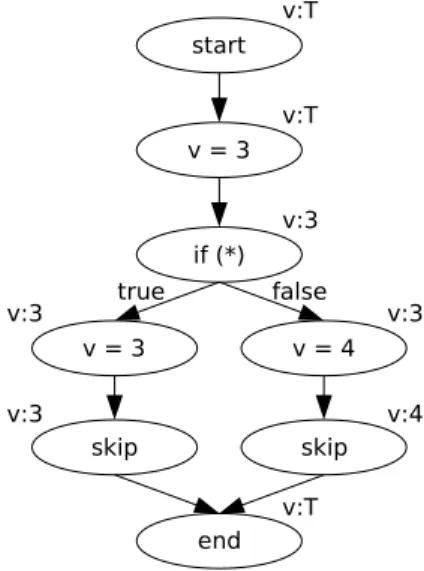
the word “constant” has a meaning that is different from the usual meaning (where it denotes a literal value). In PHP, a constant is a special type of variable that can only hold simple values (e.g., it cannot contain array elements), and that cannot change after it has been defined. To avoid confusion due to the collision of the two different meanings of the word “constant”, we will use the term “literal analysis” in this paper. To illustrate how data flow analysis is used to perform literal analysis, imagine a fictitious programming language that uses only one variable (v) and two literals (the integers 3 and 4). Data flow analysis operates on the control flow graph (CFG) of a program. Figure 1 shows the CFG for a simple example program. In this figure, each CFG node is associated with its final data flow information after the analy-sis has finished. “Skip” nodes represent empty instructions. Assume further that the condition of the “if” branch cannot be resolved statically, for example, because it depends on the value of an environment variable. We use the symbol!(“top”) for theunknown literal, which indicates that the exact value of the literal cannot be de-termined. This is the case on program entry, since in our programming language, a variable contains random garbage before being initialized. After performing literal analysis for this program, each CFG node is associated with information about which literal is mapped to variablevbeforeexecuting that node. Note that the exact value for variablevafter the “if” construct is also unknown, because the analysis can-not determine which branch will be taken at runtime. Inside the branches, however, precise information is available.
An important concept used in the theory of data flow analysis is that of alattice,2
Fig. 1. Example CFG with associated resulting analysis information.
2To be precise, data flow analysis requires a complete lattice that satisfies the ascending chain condition, or equivalently, a semi-lattice with a unit that satisfies the ascending chain condition [30].
Fig. 2. A simple lattice.
which is used to represent the type of information that is to be collected. Every piece of information that could ever be associated with a CFG node by the analysis must be contained as an element of the used lattice. The lattice for our previous example is depicted in Fig. 2. Note that an additionalbottom element⊥is required by the analysis algorithm for marking nodes as “not visited yet” at the beginning. Each line in Fig. 2 indicates an ordering between the elements at its end points with regard to precision. For instance, the element (v:3) is more precise (less conservative) than (v:!), written as (v:3)!(v:!). In this sense, the bottom element is defined as be-ing smaller than all other elements. Theleast upper bound#of two elements is the smallest element that is greater than or equal to both of the elements. For example, (v:3)#(v:4)=(v:!), and (v:3)#(⊥)=(v:3). The#operator is used for conserv-atively combining the information of merging paths (e.g., after “if” branches), which can also be seen at the end node in Fig. 1.
In this paper, the notation with regard to lattice structure and the least upper bound operation follows Nielson et al. [30]. Other authors, especially in the advent of data flow analysis (introduced by Kildall [22]), used an alternative, but equivalent no-tation. In this other notation, more precise elements were located at the top of the lattice, instead of at its bottom.
Another important ingredient for data flow analyses aretransfer functions. Each CFG node is associated with such a transfer function, which takes a lattice element as input and returns a lattice element as output. The purpose of transfer functions is to model the semantics of their corresponding node with respect to the collected in-formation. In our example in Fig. 1, all assignment nodes possess a transfer function that adjusts the literal mapping of the assigned variable accordingly.
After specifying a data flow analysis with its underlying lattice and transfer func-tions, an iterative algorithm for computing the results is initiated. Beginning at the program’s entry node, this algorithm propagates analysis information through the program by applying transfer functions and combining information at merge points. As soon as a fixed point is reached, where additional computations do not lead to changes anymore, the algorithm terminates, and the analysis is finished.
Aflow-sensitiveanalysis considers the ordering of program instructions, whereas a
flow-insensitiveanalysis does not (i.e., reordering instructions inside a function does not affect its results).Interproceduralanalyses take function calls into account, while
in-terprocedural analyses are able to distinguish between different call sites to a func-tion,context-insensitiveinterprocedural analyses are not, and, therefore, confuse the information computed for different calls to the same function. Hence, a high pre-cision can be achieved by performing an analysis that is flow-sensitive, interproce-dural, and context-sensitive. Our presented scanner is equipped with a combination of all these desirable features. Of course, precision can always be further enhanced (with the trade-off that performance is reduced). For instance, it would be possible to define an analysis that ispath-sensitive, such that impossible paths due to contra-dicting guard conditions of program branches can be recognized.
An analysis issoundif the information it generates is a safe approximation of the real information. In the context of vulnerability scans, a sound analysis must include all vulnerabilities in its report.Completenessdenotes the opposite notion, meaning that a complete analysis must not generate any false alarms (false positives). Our system is unsound with respect to the language features mentioned in Section 9.4 (most notably, object-orientation), because these features are modeled in an opti-mistic way. That is, we apply a simple approximation of these language constructs, assuming that no tainted values can originate from there. At the same time, our sys-tem is incomplete, as it may generate false warnings due to the conservative nature of data flow analysis. A detailed discussion of the generated false positives will be presented in Section 11.
Sometimes, the terms “sound” and “complete” are used in a reversed way, de-pending on how the underlying mathematical notions are translated into the con-text of vulnerability analysis. In this paper, we follow the interpretation used in [19] and [36], which corresponds to the explanations given above.
Note that the theory ofabstract interpretationis closely related to data flow analy-sis, although it is formulated on a higher level. A comprehensive overview of abstract interpretation, data flow analysis and other program analyses is given in [30], and a vivid introduction to the topic can be found at [31].
4. PHP front-end
In order to conduct static analysis, the input program has to be parsed and trans-formed into a form that makes the following analysis as easy as possible. This first step includes the linearization of arbitrarily deep expressions in the original language as well as the reduction of various loop and branch constructs such as “foreach” and “switch” to combinations of “if”s and “goto”s. The resulting intermediate represen-tation,P-Tac, resembles the classicthree-address code(TAC) presented in [1]. TAC is an assembly-like language characterized by statements with at most three operands and the general form “x=y op z”. For example, the input statement “a=1+b+c” would be translated into the corresponding TAC sequence “t1=1+b; t2=t1+c; a = t2”. The variables t1 and t2 are temporaries introduced in the course of the translation, and do not appear elsewhere in the program.
4.1. Parse tree construction
As the first step towards the desired intermediate representation, the input PHP code is parsed and stored as a parse tree for further processing. PhpParser, our tool for generating parse trees for PHP code, is a combination of the Java lexical analyzer JFlex [18], the Java parser Cup [8], and the Flex and Bison specification files from the sources of the PHP interpreter [32]. Due to a few incompatibilities of Flex and Bison with their Java counterparts, we carefully modified JFlex and Cup in order to accept the original specification files and to permit the convenient definition of Java actions for constructing the parse tree. The PhpParser package contains a more detailed documentation of these modifications.
4.2. Intermediate representation: P-Tac
As mentioned previously, the constructed parse tree is transformed intoP-Tac, a linearized form of the original PHP script resembling three-address code [1], and kept as a control flow graph for each encountered function. The code in the global scope (external to all user-defined functions) is moved into a special “main” func-tion, which represents the starting point of the PHP script. All loop constructs (while, for, switch) are replaced by equivalent “if”-branches in order to prevent unneces-sary redundancies in the following analysis.Constantsin PHP are specified with the built-in “define” function, whereas values such as 77 or “foo” will be termed as lit-erals. Table 1 gives an overview of the most important CFG nodes created by the P-Tac converter. Theplaceabstraction denotes variables, constants, and literals and was introduced to permit more concise specifications. Function calls are represented by three CFG nodes to make the design of interprocedural transfer functions easier (a call preparation node, the actual call node, and a call return node). Calls to func-tions for which no definition was found are replaced by calls to the specialunknown
Table 1
Main types of CFG nodes in P-Tac
CFG Node Shape/Description Simple assignment {var}={place} Unary assignment {var}={op} {place} Binary assignment {var}={place} {op} {place} Array assignment {var}=array()
Reference assignment {var} &={var}
Unset unset({var})
Global global {var}
Call preparation A call node’s predecessor Call Represents a function call Call return A call node’s successor
function. During taint analysis, calls to this function are approximated in a conser-vative way, meaning that the return value is considered to be tainted. Analogously, literal analysis considers the return value to be unknown (!). Alias analysis treats such calls as no-op statements, which have no effect on the computation of alias information.
5. Analysis back-end
A straightforward approach to solving the problem of detecting taint-style vulner-abilities would be to immediately conduct ataint analysison the intermediate repre-sentation generated by the front-end. This taint analysis would identify points where tainted data can enter the program, propagate taint values along assignments and sim-ilar constructs, and inform the user of every sensitive sink that receives tainted input. However, to enable the analysis to produce correct and precise results, significant preparatory work is required. For instance, whenever a variable is assigned a tainted value, this taint value must not be propagated only to the variable itself, but also to all its aliases (variables pointing to the same memory location). Hence, information about alias relationships has to be provided by a precedingalias analysis. Moreover, the dynamic nature of PHP’s file inclusion mechanism requires aliteral analysisfor resolving the names of the files that are to be included (see Section 10). These three components (literal analysis, alias analysis, and taint analysis) will be discussed in the following sections separately.
One of the key features of our analysis is its high precision, since it is flow-sensitive, interprocedural, and context-sensitive. Moreover, we are the first to give a detailed description of how to perform an alias analysis for an untyped, reference-based scripting language such as PHP. Although there exists a rich literature on C pointer analysis, it is questionable whether these techniques can be directly applied to the semantically different problem of alias analysis for PHP references. As men-tioned by Xie and Aiken in [46], static analysis of scripting languages is regarded as a difficult problem and has not achieved much attention so far. In this context, even apparently trivial issues such as the simulation of the effects of a simple assignment require careful considerations. For instance, multi-dimensional arrays can contain elements that are neither explicitly addressed nor declared. To correctly handle the assignment of such a multi-dimensional array to another array variable, these hid-den elements must be taken into account. The following sections will address these issues in detail.
6. Literal analysis: Basics
The purpose of literal analysis is to determine, for each program point, the literal that a variable or a constant can hold. This information can be used for improving
the precision of the overall analysis in various ways. For instance, our prototype uses the computed information for resolving the names of files to be included. Other potential uses of literals information are the resolution of variable variables, variable array indices, and variable function calls.
6.1. Carrier lattice definition
As mentioned in Section 3, an important building block for data flow analyses is the underlying lattice. The lattice used for literal analysis basically resembles the simple lattice for our toy programming language that was introduced in Fig. 2, with two differences. First, the literal analysis lattice does not provide mappings for a sin-gle variable, but for all variables and constants that appear in the scanned program. Second, it is able to describe the mapping to any possible literal, and not just to the literals 3 and 4. Since the number of possible literals is infinite, this means that the “breadth” of the lattice (when shown as Hasse diagram [44]) is infinite as well. Fig-ure 3 shows a fragment of a lattice for a program with two variables ($a and $b) and one constant (CONST) to provide an intuitive feeling for the ordering among lattice elements. Note that the lower two elements differ only in the value that the variable $a is holding. Hence, the least upper bound of these two elements is identical except that it maps $a to!. The top element of the whole lattice (which is not depicted in Fig. 3) maps all variables and constants to the unknown literal!, meaning that we know “absolutely nothing”. As in the previous simple lattice, the bottom element (not depicted either) is just a special placeholder element needed by the analysis algorithm.
6.2. Transfer functions definition
After defining the underlying lattice for the analysis, each CFG node has to be associated with a transfer function. These transfer functions determine how the an-alyzed information is affected when control flows through the corresponding CFG node. That is, it takes the lattice element entering the node as input, and returns a lattice element reflecting the node’s semantics as output. The most straightfor-ward example for literal analysis is a node of the form “simple_variable = lit-eral”, with the term simple variable denoting a variable that is neither an array
nor an array element. For such a node, the transfer function only has to adjust the literal mapping of that variable. For example, the statement “$a = 5” as-signs the literal value 5 to the variable $a in the lattice. For CFG nodes such as “simple_variable=variable”, the assigned literal is not immediately available, but has to be extracted from the incoming lattice element by inspecting the mapping of the variable on the right side. Nodes like “simple_variable = constant” can be treated analogously to “simple_variable=variable”.
Additional complexity arises when taking arrays, array elements, and non-literal array indices into account. The reason is that PHP is an untyped language without explicit type declarations. That is, it provides no explicit information about whether a variable is an array or not. A possible solution to this problem would be to perform an additional type inference. In our system, we take an alternative approach, which has turned out to be sufficient in practice. It is based on a simple, syntax-based detection of arrays and array elements. More precisely, our analysis considers a variable to be an array if it is indexed at some point in the program. For instance, if the expression “$a[2]” appears somewhere in the program, then variable “$a” certainly is an array. At the same time, the corresponding index to the array ($a[2]) obviously is an array element. Unfortunately, the absence of such expressions does not necessarily imply that a variable is not an array. This is demonstrated in Fig. 4. Here, $b is never indexed, but is still an array due to the assignment of array $a. This means that the intuitive introductory examples involving “simple_variable” need to be extended to deal with this issue, as we have no guarantee that a variable is really simple. Array elements do not suffer from this uncertainty: While $a[1] surely is an array element, $a is not.
In the course of our work, we found that the problem space regarding arrays and array elements can be divided into four cases. These cases depend only on character-istics of the variable on theleftside of the assignment. An overview of these cases is given in Table 2, which also contains information about taint analysis and aliases. These topics will be dealt with later in this paper and can be ignored for the moment. Note that the four cases coverallpossible situations that can occur in a program (modulo the limitations with regard to object-orientation discussed in Section 9.4). In the rest of this section, we will discuss the four cases in order of increasing com-plexity.
The simplest, first case applies when the left variable is not an array element (which can be easily decided because there is no array subscript) and not known
1 $a[1] = 7; // $a obviously is an array 2 $b = $a; // $b is a hidden array:
3 // it is not indexed anywhere
4 $c = $b;
5 echo $c[1]; // $c obviously is an array
Table 2
Actions performed by literal analysis and taint analysis for simple assignment nodes depending on the left-hand variable
Left variable Literal analysis Taint analysis Not an array element and not
known as array (“normal vari-able”)
strong update for must-aliases, weak update for may-aliases
strong update (taint, CA flag) for must-aliases, weak update (taint, CA flag) for may-aliases Array, but not an array element strong overlap target.caFlag=source.caFlag;
strong overlap (taint) Array element (and maybe an
array) without non-literal in-dices
strong overlap target.root.caFlag "= source.caFlag; strong over-lap (taint)
Array element (and maybe an array) with non-literal indices
weak overlap for all MI vari-ables
target.root.caFlag "= source.caFlag; weak over-lap (taint) for all MI variables
as array.3Here, the analysis proceeds just as in the introductory “simple_variable”
example, without taking into account whether the variable on the right side might have array elements or not. This punctual overwrite operation is calledstrong update. Note that when using this simple approach, precision might suffer. For instance, in Fig. 4, the analysis cannot determine that $c[1] is mapped to the literal 7 at the end of the program. However, this issue did not lead to significant losses in precision during our experiments.
The second of the four cases that need to be distinguished is when the left variable is an array, but not an array element. A useful concept in this respect is that of an
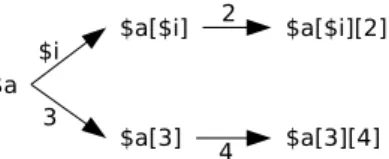
array tree, which describes an array and its contents as a tree. The array variable itself is the tree’s root, the array’s elements are interior nodes and leaves, and its indices are edge labels. For example, Fig. 5 shows the tree for a two-dimensional array with the elements $a[$i][2] and $a[3][4]. Literals can be associated with each node to represent the current mappings. Intuitively, the analysis has to “overlap” the array tree of the left variable with the array tree of the right variable such that literals for matching nodes are overwritten. For instance, in the course of the assignment of array $b to array $a ($a=$b), the literal of $b[1] must overwrite the literal of $a[1]. The literals of nodes on the left side for which there is no matching node on the right side generally have to be set to!because it is uncertain whether therereallyis no matching node (due to the possibility that the array might contain hidden elements). In Fig. 4, for example, $c[1] is set to!after the assignment in Line 4 because the analysis cannot determine whether there is an element $b[1] or not. An exception to this rule can be made if there is a literal or a constant on the right side of the assignment. Since literals and constants can never be arrays, the analysis is free to set the literals of all array elements on the left side to NULL (which corresponds to the
3Note that we use the phrase “not known as array” to include the possibility that a variable might be a “hidden” array.
Fig. 5. Array tree example.
strongOverlap(Variable target, Place source) { if source known as array
if target known as array
for all direct elements of target
if there is a direct element of source with the same direct index
strongOverlap(target element, source element) else
set the array tree of the direct element to !
else if source is literal or constant set the array tree below target to NULL else
set the array tree below target to !
set the target literal to the source literal }
Fig. 6. Strong overlap algorithm.
actual semantics in PHP). A recursive algorithm for performing all these operations is given in Fig. 6, where the termdirect element denotes an array element that is retrieved by adding a single index (thedirect index) to its enclosing array.
Cases three and four require the understanding that array elements can have one or more literal indices. An example would be $a[1][$i][2], which has one non-literal and two non-literal indices. Suchnon-literal array elementshave to be treated in a special way because they can represent multiple variables (such as $a[1][8][2] or $a[1][9][2] for the given example). Our analysis handles them in a pessimistic way in that they are mapped to!. Otherwise, it would be necessary to track the non-literal indices of these elements and recompute the taint value of a non-non-literal array element whenever one of its indices changes. For example, if the variable $i changes at some point in the program, the analysis would have to recompute the values for all array elements with at least one index containing $i (such as $a[$i] or $b[$a[$i]]). Our experiments did not suggest that this additional complexity would lead to a significant gain in precision.
In the third case, the left variable is an array element without non-literal indices. This variable may also be an array (i.e., it does not matter whether it is known as array or not). This case is handled in the same way as case two, using the strong overlap algorithm. Note, however, that taint analysis (discussed in Section 9) will perform different operations for these two situations.
In the fourth and last case, the left variable is an array element with non-literal indices and maybe an array. As already mentioned, this case has to be treated sep-arately because it is not certain which array element is actually meant by the non-literal array element. For instance, when assigning the non-literal 3 to $a[$i], the analysis has to consider that this might affect $a[8], $a[9], or any other element. So, instead of overwriting the literals of the possibly affected variables with the literal 3, we have to conservatively replace them with the least upper bound of the old and the new literal. For example, if the old literal of $a[8] was 7, it becomes!. If it was 3, it remains 3. This approach can be formulated in a succinct way using the termsMI variablesandweak overlap. TheMI variablesof a non-literal array element are all variables that aremaybe identicalto this array element. For example, $a[8] and $a[9] are MI variables of $a[$i]. These are the variables that might be affected by an as-signment, and hence, have to be conservatively updated by the analysis. Theweak overlapalgorithm is analogous to the strong overlap algorithm, with the difference that all overwrite operations are replaced by least upper bound operations. This way, the analysis can handle assignments of the fourth type by performing a weak overlap for all MI variables.
6.3. Dependence on alias analysis
In the explanations given so far, we omitted an important problem. PHP allows the creation of aliases, which means that two or more variables can point to the same memory location. If one of these variables is assigned a new value, it also affects the aliases of the variable. Ignoring this issue would prevent literal analysis from producing correct results in a number of cases. The following Section 7 provides a more detailed introduction to PHP references and describes an alias analysis that collects the alias information required by literal analysis. Section 8 revisits literal analysis when alias information is taken into account, and presents transfer functions for the remaining CFG nodes.
Note that in our current approach, we employ literal analysis only for resolving file inclusions (Section 10). Judging from the experiences we made during our empirical evaluation, the names used in file inclusion operations never depend on aliasing in practice. This is why our literal analysis does not make use of the fully-fledged alias analysis that will be described in the next section, resulting in a performance boost without loss of precision. In spite of this fact, we will describe how literal analysis can benefit from alias analysis. One reason is that we believe this description to be useful for other researchers. The other reason is that the underlying concepts are analogous to those necessary for feeding alias information into taint analysis (Section 9).
7. Alias analysis
Two or more variables arealiasesat a certain program point if their values are stored at the same memory location. Two variables aremust-aliasesif they are aliases regardless of the actual path that is taken by the program during run-time. If these variables are aliases only for some program paths, while not for others, they are calledmay-aliases. We will give a short introduction to aliases in PHP to demonstrate why alias information is required for precise results, and to highlight the differences between PHP aliases and pointers in other programming languages. After this prob-lem definition, we specify the workings of our alias analysis, which is responsible for computing the desired information.
7.1. Aliases in PHP
In PHP, aliases between variables can be introduced by using thereference opera-tor“&”. This operator can be applied directly in assignments, or in combination with formal and actual function parameters to perform a call-by-reference. Figure 7 shows a simple example for creating an alias relationship between variables $a and $b (on Line 2). This figure also demonstrates why taint analysis requires access to alias in-formation. Without this information, taint analysis would not be able to decide that the assignment on Line 3 does not only affect $a, but also the aliased variable $b. As a result, we would miss the fact that $b eventually holds a tainted value, which leads to the XSS vulnerability on Line 4. Analogously, the lack of aliasing information can cause false positives.
In the past, extensive work has been devoted to the area of alias analysis (e.g., [2, 6,24,39,45], to mention only a few). An overview of existing solutions and open issues is given by Hind in [14]. During our investigations on how to solve the prob-lem of computing alias information for PHP programs, we were considering to use one of these existing analyses. However, many of the existing approaches had some particular limitation that made sense in the context of C programs, but which we were not willing to accept for PHP programs. For instance, the well-known analy-ses of Andersen [2], Steensgaard [39] and Das [9] are flow-insensitive. While this considerably speeds up the analysis, the generated results are less precise than with a flow-sensitive analysis, which can lead to false positives. Apart from their mere
1 $b = ’nice’; // $b: untainted
2 $a =& $b; // $a and $b: untainted 3 $a = $evil; // $a and $b: tainted 4 echo $b; // XSS vulnerability
existence, a major problem with such false positives is that it can be difficult to determine their cause (i.e., flow-insensitivity) during the manual inspection of the generated vulnerability reports.
Another problem with reusing existing approaches is that there seems to be no straightforward translation of alias analysis techniques designed for C to a technique that can be used for PHP programs. One reason for the current absence of such a translation is that there are semantic differences between references and pointers. The PHP manual [32] devotes a whole chapter to explaining references and high-lighting the differences to C pointers. In essence, while C pointers are special vari-ables that contain memory addresses, PHP references aresymbol table aliases[32] that do not directly address memory locations. That is, alias relationships between variables in PHP are represented internally through equivalence in the context of symbol tables, and not through identical pointer values (i.e., memory addresses). Besides, PHP is dynamically typed, which means that the types of variables are not declared explicitly in the program’s source code. Instead, the types of variables are decided at runtime, and can change during program execution. Moreover, PHP does not provide a separate data type for references. Instead,allvariables are references by nature, even those containing only scalar values.
Figure 8 illustrates another difference, which occurs in combination with parame-ter passing. When enparame-tering function “a” on Line 6, the formal parameparame-ter $p has been aliased with the actual parameter $x1. However, since $x1 and $p are now only sym-bol table aliases, the reference assignment on Line 7 only re-references $p, leaving $x1 unmodified. In C, passing and modifying a pointer in this way would make the pointer corresponding to $x1 point to $x2 after returning from the function call on Line 3. Also note that PHP references are mutable, as opposed to references in C++. To the best of our knowledge, the issues discussed above have not been addressed in the literature so far. Minamide [27] and Huang et al. [16] briefly mention their use of alias analysis for PHP, but without providing details. Similarly, Liu et al. [25] only give a short mention that they have applied existing pointer analysis algorithms to Python programs. 1 $x1 = 1; 2 $x2 = 2; 3 a($x1); 4 echo $x1; // $x1 is still ’1’ 5 6 function a(&$p) { 7 $p =& $GLOBALS[’x2’]; 8 }
7.2. Intraprocedural alias analysis
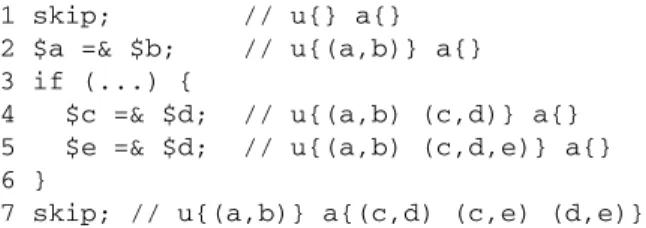
Figure 9 shows a program snippet annotated with alias information that is valid after the execution of the corresponding code line. In this figure (and in the follow-ing ones), we represent must-alias (“u”) and may-alias (“a”) information separately. At the beginning of the program on Line 1, there exist no aliases yet. After the ref-erence assignment on Line 2, variables $a and $b are aliases. We encode this fact by adding a newmust-alias groupto the must-alias information. Must-alias groups are unordered and disjoint sets of variables that are must-aliases. On Line 4, a second group is created after redirecting $c to $d. This new group is extended by variable $e as result of the statement on Line 5. Finally, we have to merge the information enter-ing from two different paths after the if-construct on Line 7. Intuitively, it is clear that all must-aliases created inside the if-construct must be converted into may-aliases. Instead of using sets of variables, we encode may-aliases by means of unordered variable pairs. Hence, the must-alias group (c,d,e) is split into the three may-alias pairs (c,d), (c,e) and (d,e). The reason for this asymmetric encoding of must-alias and may-alias information is that it simplifies the algorithms necessary for interpro-cedural analysis (given in the Appendix). Figure 28 in the Appendix shows the com-bination operator algorithm that is used for merging alias information at the meeting point of different program paths (based on the construction of complete graphs). Note that this combination operator does not simply compute must-aliases through intersection and may-aliases through union (although these steps are performed as parts of the algorithm). For instance, using such a straightforward procedure to com-bine the information from Lines 2 and 5 of Fig. 9 would result in empty may-alias information, which deviates from the correct result shown on Line 7.
The separate tracking of must-alias and may-alias information (instead of using only may-alias information) is motivated by the resulting precision gain. Consider the case where variables $a and $b are must-aliases and tainted. When encountering an operation that untaints $a, our analysis is able to correctly untaint $b as well. If the analysis only possesses may-alias information, it would have to make a conservative decision and leave $b tainted.
1 skip; // u{} a{}
2 $a =& $b; // u{(a,b)} a{} 3 if (...) {
4 $c =& $d; // u{(a,b) (c,d)} a{} 5 $e =& $d; // u{(a,b) (c,d,e)} a{} 6 }
7 skip; // u{(a,b)} a{(c,d) (c,e) (d,e)}
7.3. Interprocedural PHP concepts
Before going into the details of our interprocedural alias analysis, we will give a brief overview of the PHP concepts necessary for understanding the following sec-tions. In terms of scoping, there are two types of variables in PHP: local variables, which appear in the local scope of functions, and global variables, which are located in the global scope (i.e., outside every function). Note that formal function parame-ters belong to the class of local variables. From inside functions, global variables can be accessed in two ways. The first method is using the “global” keyword. A state-ment such as “global $x” has the effect that the local variable $x is aliased with the global variable $x. The other way is to access global variables directly via the spe-cial “$GLOBALS” array, which is visible at every point in the program. Using this array, global variables can even be re-referenced from inside functions, whereas the “global” keyword does not offer this possibility.
7.4. Interprocedural alias analysis
The main problem arising with interprocedural analysis is the handling of recur-sive function calls. Every instance of a called function contains its own copies of its local variables (variable incarnations). In most cases, it is not possible to decide statically how deep recursive call chains can become since the depth may depend on dynamic aspects, such as values originating from databases, or user input. Hence, static analysis would be faced with an infinite number of variable incarnations. Since this would mean that the underlying lattice would not satisfy the ascending chain condition [30] (i.e., it would have an infinite height), the analysis would not termi-nate in such cases. Our solution to this problem (as first presented in [21]) is the following:
Inside functions, the analysis only tracks information about global variables and its own local variable incarnations.
In the global scope, only global variables are considered. This important rule leads to a finite number of variables during the analysis and forms the basis for our alias analysis approach.
When encountering a function call during the analysis, the following two ques-tions arise:
1. What alias information has to be propagated into the callee?
2. What alias information is valid after control flow returns to the caller? We will first give a brief overview of the answers to these questions. A more detailed treatment will be presented afterwards. From the callee’s point of view, the analysis
has to provide the following information:
• Aliases between global variables.
• Aliases between the callee’s formal parameters.
• Aliases between global variables and the callee’s formal parameters.
From the caller’s point of view, the following information has to be obtained after the function returned:
• Aliases between global variables.
• Aliases between global variables and the caller’s local variables.
The aliases between the caller’s local variables cannot be modified by the callee. Note that this does not imply that thevaluesof the caller’s locals cannot be modified by the callee (but such changes of values are not relevant for alias analysis). Simi-larly, the aliases between the callee’s local variables are always the same on function entry.
The alias relationships listed above cover all possible cases that can occur in an application. Thus, they represent a complete partitioning of the problem space, mak-ing our approach sound with regard to the currently supported language constructs (i.e., modulo the limitations discussed in Section 9.4). In the following sections, we will discuss each of the above issues in detail, ordered by increasing complexity of the necessary concepts. The detailed algorithms can be found in the Appendix.
7.4.1. Aliases between global variables
The alias relationships between global variables are important for both the caller and the callee. On the one hand, the callee must know about how global variables are aliased at the time the function call is performed. On the other hand, the caller must be informed about how the global aliasing information was modified by the callee. These aspects can be treated in a straightforward way, similar to the method applied by Sharir and Pnueli in their classic treatment of interprocedural analysis [38]. This means that alias information about global variables is propagated verbatim into the callee. Inside the callee, this information can be modified analogously to the mod-ification of local aliases. Finally, the (perhaps modified) global alias information is propagated back to the caller.
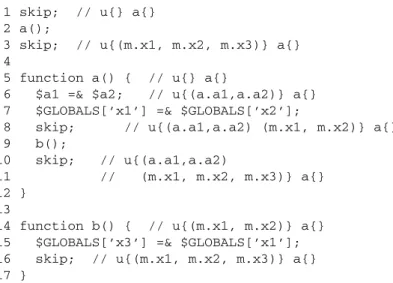
An example for the handling of global variables is given in Fig. 10. In this figure, we extend our notation by prefixing variable names with the name of the contain-ing function. Global variables are considered to be contained in the special “main” function, abbreviated with “m”. When calling function “a” on Line 2, there is no aliasing at all. This empty alias information is propagated into the function. From the function’s entry until the call to “b” on Line 9, we simply apply our intraproce-dural techniques. As mentioned above, each function only tracks information about global variables and its own local variables. Therefore, the information about the local variables of “a” is removed prior to propagation into “b”. The information about global variables, however, is propagated as it is. Inside function “b”, the global
1 skip; // u{} a{} 2 a();
3 skip; // u{(m.x1, m.x2, m.x3)} a{} 4
5 function a() { // u{} a{}
6 $a1 =& $a2; // u{(a.a1,a.a2)} a{} 7 $GLOBALS[’x1’] =& $GLOBALS[’x2’];
8 skip; // u{(a.a1,a.a2) (m.x1, m.x2)} a{} 9 b();
10 skip; // u{(a.a1,a.a2)
11 // (m.x1, m.x2, m.x3)} a{}
12 } 13
14 function b() { // u{(m.x1, m.x2)} a{} 15 $GLOBALS[’x3’] =& $GLOBALS[’x1’]; 16 skip; // u{(m.x1, m.x2, m.x3)} a{} 17 }
Fig. 10. Aliases between global variables.
aliases are modified by the statement on Line 15. On Line 10, this modified infor-mation is returned to function “a”, which also restores the alias inforinfor-mation for its own local variables. May-aliases between global variables, which have not occurred in this example, are treated analogously.
7.4.2. Aliases between the callee’s formal parameters
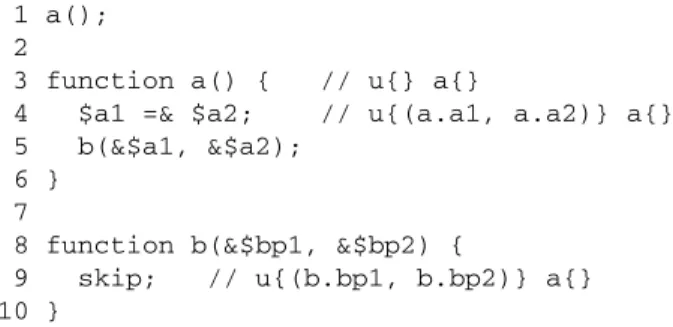
Aliases betweenformalparameters appear when there exists an alias relationship between the correspondingactualcall-by-reference parameters. For instance, func-tion “b” in Fig. 11 has two call-by-reference parameters, $bp1 and $bp2. The cor-responding actual parameters are $a1 and $a2, which are must-aliases at the time of the call to function “b”. As a result, the formal parameters $bp1 and $bp2 are must-aliases on function entry.
For the treatment of may-aliases between formal parameters, additional consid-erations are necessary. First, recalling that may-alias pairs are unordered, we can identify three types of may-alias pairs that can exist at the time of a function call: (local, local), (global, global), and (local, global). Next, we can distinguish several cases depending on how many elements of a may-alias pair are used as actual call-by-reference parameter (either one or both). Of course, if no element of a may-alias pair is used as parameter, it cannot induce aliases between formal parameters. Ta-ble 3 provides an overview of all possiTa-ble cases and the may-alias pairs resulting for the callee. The table shows the may-aliases between the formal parameters of a func-tion with signature b(&bp1, &bp2) that result from different calls to this funcfunc-tion (given in the first column) and different may-aliases at the time of the function call (given by the second column, labeled with “Entering may-aliases”). An example for
1 a(); 2
3 function a() { // u{} a{}
4 $a1 =& $a2; // u{(a.a1, a.a2)} a{} 5 b(&$a1, &$a2);
6 } 7
8 function b(&$bp1, &$bp2) {
9 skip; // u{(b.bp1, b.bp2)} a{} 10 }
Fig. 11. Must-aliases between formal parameters.
Table 3
May-aliases between formal parameters resulting from calls to a function with signature b(&bp1, &bp2) Function call Entering may-aliases Resulting relevant Resulting irrelevant
may-aliases may-aliases b(&$local_1, –) (local_1, local_2) none (bp1, local_2) b(&$local_1, &$local_2) (local_1, local_2) (bp1, bp2) (bp1, local_2),
(bp2, local_1) b(&$global_1, –) (global_1, global_2) (bp1, global_2) none b(&$global_1, &$global_2) (global_1, global_2) (bp1, global_2), none
(bp2, global_1), (bp1, bp2)
b(&$local, –) (local, global) (bp1, global) none b(&$global, –) (local, global) none (bp1, local) b(&$local, &$global) (local, global) (bp1, bp2), (bp2, local)
(bp1, global)
the case in the second row of Table 3 is shown in Fig. 12. Here, the may-alias pair ($a1, $a2), which consists of two local variables, reaches the call to function “b” on Line 8. Both of these local variables are used as actual call-by-reference parameters. Hence, this initially results in three may-alias pairs: ($bp1, $bp2), ($bp1, $a2) and ($bp2, $a1). The last two pairs are not propagated to the callee, since they contain local variables of the caller. Figure 29 in the Appendix shows the exact algorithm that was applied in this case.
7.4.3. Aliases between global variables and the callee’s formal parameters
For detecting aliases between global variables and the callee’s formal parameters, we have to consider the following cases for the actual call-by-reference parameter:
• The parameter is a must-alias of a global variable.
1 a(); 2
3 function a() { // u{} a{} 4 if (...) {
5 $a1 =& $a2; // u{(a.a1,a.a2)} a{}
6 }
7 skip; // u{} a{(a.a1,a.a2)} 8 b(&$a1, &$a2);
9 } 10
11 function b(&$bp1, &$bp2) {
12 skip; // u{} a{(b.bp1,b.bp2)} 13 }
Fig. 12. May-aliases between formal parameters.
1 a(); 2
3 function a() { // u{} a{}
4 $a1 =& $GLOBALS[’x1’]; // u{(a.a1,m.x1)} a{} 5 b(&$a1);
6 } 7
8 function b(&$bp1) { // u{(m.x1,b.bp1)} a{} 9 skip;
10 }
Fig. 13. Must-aliases between formal parameters and global variables.
• It is a may-alias of a global variable.
Fortunately, these cases are quite simple and can be handled with the same means as those that have been applied in the previous section. Figure 13 shows an example for the first case. At the call to function “b” on Line 5, variable $a is a must-alias of the global variable $x1. Since $a is used as actual call-by-reference parameter, this means that the formal parameter $bp1 becomes a must-alias of $x1 on function entry.
7.4.4. Aliases between global variables and the caller’s local variables
As mentioned previously, the aliases between local variables of a caller cannot be changed by a callee. However, the aliases between the caller’s local variables and global variables can be modified by the callee in the following ways:
1. If a local variable is aliased with a global variable at the time of the function call:
(a) Other global variables can beredirectedto this global variable, and hence, to the local variable. That is, the alias information of other global variables can be changed such that these other global variables are now aliasing the aforementioned global variable (and thus, the local variable as well). (b) This global variable can be redirected to something else, and hence, away
from the local variable.
2. If a local variable is aliased with a formal parameter through call-by-reference: (a) Global variables can be redirected to this formal parameter, and hence, to
the local variable.
Note that each of these cases implies a number of subcases depending on whether must- or may-aliasing is performed. Our basic rule for interprocedural analyses for-bids the propagation of aliasing information about local variables to other func-tions. Hence, another mechanism is necessary to be able to collect information about changes of aliasing relations between global variables and local variables. For this purpose, we will present the notion ofshadow variables.
Shadow variables. Our analysis uses two types of special variables for solving the problem mentioned above. The first type, calledformal-shadows(orf-shadows), are introduced at the beginning of every function. There is one f-shadow for each for-mal parameter of a function, and each f-shadow is aliased with its corresponding formal parameter at the beginning of this function. For instance, consider the func-tion with signature “a($ap1, $ap2)”. The analysis introduces the f-shadows $ap1_fs and $ap2_fs at the beginning of the function, and aliases them with their formal parameters. Therefore, $ap1_fs references the same memory location as $ap1, and $ap2_fs references the same memory location as $ap2. Analogously, the second type of shadows are theglobal-shadows(org-shadows), which are also introduced at the beginning of every function. For each global variable, there is one g-shadow per function, and each g-shadow is aliased with its corresponding global variable at the beginning of the function. For instance, if there are two global variables $x1 and $x2 in the program, then each function is assigned its own shadow variable $x1_gs for $x1, as well as a shadow variable $x2_gs for $x2. These definitions lead to the following properties of shadow variables:
• Shadow variables are local variables.
• Shadow variables cannot be accessed by the programmer, since they are fresh variables introduced by the analysis. This implies that they are never re-referenced after their initialization performed by the analysis.
Intuitively, the f-shadows of a function have the purpose of representing local vari-ables of the caller that were aliased with a formal parameter of the function at the time of the call. Analogously, g-shadows represent local variables of the caller that were aliased with a global variable at the time of the function’s invocation. This
provides us with the means to determine how the aliases between the caller’s local variables and global variables are modified by function calls.
To illustrate the value of shadow variables, consider Fig. 14, which shows a code snippet covered by Case 1b. At the time of the call to function “b” on Line 10, the local variable $a1 is a must-alias of the global variable $x1. Inside the called function on Line 18, this global variable is re-referenced to another global variable. Without using g-shadows, the analysis would not be able to determine that $a1 is no longer aliased with $x1 when control flow returns to function “a” (remember that propa-gating local variables into the callee is not allowed). With the g-shadow, however, the analysis is able to extract this vital fact: In the information flowing back from function “b”, the g-shadow of $x1 is not aliased with $x1 any more. Recalling the purpose of g-shadows, we know that the g-shadow of $x1 is indirectly representing $a1 (since $a1 was an alias of $x1 at the time of the call). Hence, we can deduce that $a1 is not aliased with $x1 any longer. Also, note that the fact that the global variable $x1 becomes an alias of the global variable $x2 is returned to the caller as well.
The detailed algorithm covering all presented cases can be found in Figure 27 in the Appendix. The interested reader is referred to our web site [34] for a compre-hensive collection of examples that have been used to test our algorithms in practice. These examples clearly demonstrate the ability of our analysis to solve even difficult aliasing problems.
1 a();
2 skip; // u{(m.x1, m.x2)} a{} 3
4 function a() { // u{(m.x1, a.x1_gs)
5 // (m.x2, a.x2_gs)} a{}
6
7 $a1 =& $GLOBALS[’x1’];
8 skip; // u{(m.x1, a.x1_gs, a.a1)
9 // (m.x2, a.x2_gs)} a{}
10 b();
11 skip; // u{(m.x1, m.x2, a.x2_gs)
12 // (a.a1, a.x1_gs)} a{}
13 } 14
15 function b() { // u{(m.x1, b.x1_gs)
16 // (m.x2, b.x2_gs)} a{}
17
18 $GLOBALS[’x1’] =& $GLOBALS[’x2’]; 19
20 skip; // u{(m.x2, b.x2_gs, m.x1)} a{} 21 }
7.5. Complexity
Since we have integrated our alias analysis into a standard data flow analysis framework, the worst case for the number of basic operations (least upper bound operations and transfer function applications) applied by the underlying iterative al-gorithm is O(n·h), wherendenotes the number of CFG nodes, andhdenotes the height of the used lattice [30]. In this rare worst case, the analysis information for every node in the program moves only one step up in the lattice for each pass of the algorithm, and eventually reaches the top element. In our alias analysis, the top element (i.e., the element that holds the least precise information) represents the in-formation that every variable in the program is a may-alias of every other variable. In this top element, the number of may-alias pairs equals!v−1
i=1i= (v−21)·v, where vdenotes the number of variables in the program. Note that the actual number of variables that the analysis operates on (v) is higher than the number of variables in the scanned program (V), due to the requirement of shadow variables. In the worst
case, the program has only global variables, which results inv=2·V. The precision of the information of the top lattice element can be improved by removing one alias pair after the other, which is equivalent to moving down the lattice step by step, until the empty lattice element is reached. As a result, the height of the lattice is identi-cal to the number of may-alias pairs in the top lattice element, leading to a quadratic number O(n·v2) of basic operations in the worst case. The basic operations are linear
in the size of their input elements, and hence, do not change the quadratic runtime behavior.
Regarding space requirements, the worst case occurs if every CFG node is associ-ated with the largest possible lattice element. Thus, the worst-case space complexity is O(n·s), wheresdenotes the maximum lattice element size. The largest element is the top lattice element, which requires(v−21)·v space, leading to a worst case space complexity of O(n·v2). Note that our empirical results indicate that the practical
time and space requirements are typically significantly lower than in the worst case, since complex alias relationships are rare in real-world PHP programs.
8. Literal analysis revisited
Using the information collected by alias analysis, we can extend the basic concepts for literal analysis presented in Section 6 to correctly include alias relationships. For a simple assignment of the form “$a=$b”, the aliases of the variable on the left side are relevant for literal analysis. The reason is that all aliases of variable $a are also affected by the assignment. Of the four cases that literal analysis had to distinguish in Section 6, all but the first involved an array or array element on the left side. Since we only consider references to simple variables, there cannot exist aliases for the variable on the left side in these cases. Hence, no further extensions are necessary. In the first case, however, the left variable is not an array element (and not known as
array), and therefore, might possess aliases. Must-aliases of this variable are treated by the transfer function with a strong update, i.e., their literals are simply overwritten with the literal read from the right side of the assignment. As there is no sufficient certainty for may-aliases, they must be handled conservatively by a weak update. That is, all aliases of the variable on the left-hand side are assigned the least upper bound of their literal and the literal from the right side. An overview of the possible cases and actions for simple assignment nodes is given in Table 2.
Now that the transfer function definition for simple assignment nodes is com-pleted, the transfer functions for the other relevant CFG nodes can be introduced. Forunary assignment nodessuch as “$a=−$b”, the literal resulting from the ap-plication of the operator on the right side is computed first, and then the presented technique for simple assignment nodes is used. For example, if $b evaluates to 3, $a is assigned−3. Special care was taken to reflect PHP’s implicit type conversion mechanisms, which are beyond the scope of this paper. The treatment ofbinary as-signment nodessuch as “$a=$b+$c” is analogous to unary assignments, with the sole difference that the operator on the right side takes two input arguments instead of one. Note that when we do not dispose of specific information for an operand (i.e., if it is!), the result of the operation is also!. In essence, the actions performed by the transfer functions introduced above correspond to the classic combination of constant propagation and constant folding.
Forreference assignment nodessuch as “$a=& $b”, it is sufficient to overwrite the literal of $a with the literal of $b, since reference statements have been restricted to simple variables.Global nodescan be handled as normal assignments, with the operand variable on the left side and an equally-named variable from the global scope on the right side. In the case ofunset nodes, the unset variable and all its literal array elements are set to the NULL literal, which represents the PHP null value. As far as literal analysis is concerned,array assignment nodeshave the same semantic effects as unset nodes, and can be treated in the same way.
What remains to be specified are the interprocedural transfer functions. Atcall preparation nodes, we iterate through each formal parameter of the callee. If there exists a corresponding actual parameter, the analysis captures the value transfer by simulating an assignment with the shape “formal parameter = actual parameter”. When the programmer specifies default values for formal parameters, an invocation does not have to provide actual parameters for these. For example, a function with the signature “foo($p=7)” does not have to be called with any actual parameters at all. In such cases, the analysis simply performs assignments with the shape “for-mal parameter=default value”. Afterwards, local variables are reset to their initial values (i.e., those values that the variables were assigned at the very beginning of the analysis). The reason is that, analogous to the interprocedural rule given in Sec-tion 7.4, values of local variable incarnaSec-tions must only be tracked inside the funcSec-tion that these variables belong to.
At thecall return node, the analysis must make sure that both global and local variables of the caller receive correct values in accordance to the effects that the