T
his section offers a conceptual model for managing change, establishing an environment conducive to change, leveraging evidence, and using the Institute for Healthcare Innovation’s (IHI) Model for Improvement to bring about lasting change. Washington State has implemented several quality improvement initiatives aimed at improving maternal and neonatal outcomes such as making data publicly available, payment reform and efforts to reduce early elective delivery. Despite these statewide programs, national guidelines and available evidence, variations in practice across health systems and providers remain. Managing change in complex healthcare systems requires tailored approaches that consider the challenges within, and external to, each system. Although no single roadmap can drive improvement for all health systems, adapting practical strategies and tools to the local environment can help institutions manage change.Quality Improvement (QI) methodologies are broadly used across the health care sector to enact change. Six Sigma is a quality improvement methodology developed by Japanese manufacturers and brought to the U.S. in the 1980s by the
communications company Motorola. Six Sigma uses data and statistical methods to identify variation in the products of manufacturing processes and identify and correct the factors leading to variability (Larson,
2003). It also uses specially trained staff (e.g. “black belts”) to facilitate change. While originally developed
for manufacturing, Six Sigma has been adopted by many sectors of the economy, including healthcare.
Hospital systems now routinely employ “black belts”
and use Six Sigma methodologies to improve quality, mitigate waste and reduce errors (Pande, Neuman & Cavanaugh, 2001; Larson, 2003).
There is a vast amount of literature on Six Sigma QI methodologies, some of which has been tailored to the healthcare setting. This section on managing change offers a conceptual model for establishing an environment, based on Six Sigma methodologies, that is conducive to change and leverages the evidence provided in this toolkit, using the Institute for Healthcare Innovation’s Model for Improvement to bring about lasting change (see www.ihi.org for additional information, tools, publication, white papers and other materials).
“
Every system is perfectly designed to get the results it gets.”
— Paul Batalden, MD
Introduction
Establishing an Environment Conducive to Change
Managing Change
It is important to establish a change-oriented
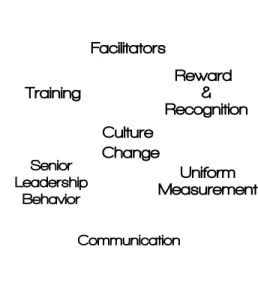
environment throughout an organization to facilitate adoption of QI efforts. The Six Sigma literature describes the ideal environment needed to create continuous and long-lasting culture change (Figure 4.1).
Figure 4.1. Components of a Successful Change Environment (Larson, 2003)
Senior Executive Behavior
The backing of senior executives is key to initiating and maintaining culture change. Senior executives
have the power to establish “stretch” goals and hold
others accountable to achieve them. They have tools to spark and reinforce changes, such as policies and
procedures, financial resources, and communications
vehicles (Larson, 2003). In the IHI Breakthrough Series on Reducing Cesarean Section Rates, Flamm and colleagues (1997) contend that senior leadership
commitment to an effort is likely “the most
important single variable in an organization’s ability
to achieve breakthrough improvement.”
Facilitators
Facilitators are individuals with the skill and expertise needed to promote and expedite the desired changes. For example, strategies to reduce
Cesarean deliveries that involve enforcing “hard stop” policies (e.g. no scheduled elective inductions
under 39 weeks) are often carried out by nurses. Thus, having nurses as an integral part of the
improvement team can help to facilitate this type of change effort (Bingham & Main, 2010).
In complex environments like healthcare, change is best accomplished by improvement teams made up of facilitators from a variety of areas and experience. For example, an improvement team for a labor intervention might, depending upon the objectives, include an obstetrician, a lead nurse, a community doula, an anesthesiologist, a quality improvement specialist (e.g. a Six Sigma black-belt), and a statistician. Including frontline workers on the QI
team can be strategic given the influence they have
on day-to-day decisions critical to change efforts (Bingham & Main, 2010).
Uniform Measurement
Chaillet and colleagues (2006) assert that
establishing uniform measurement processes allows organizations to track the results of interventions and lends credibility to overall QI efforts. Six Sigma is a data-driven discipline and provides a variety of easily accessed tools and methodologies to identify and track areas for improvement. The
Evidence-based Strategies section of this toolkit also indicates moderate strength of evidence that conducting data audits and providing feedback to key decision makers (e.g. obstetricians, lead nurses, management) are successful methods for reducing Cesarean deliveries (Chaillet & Dumont, 2007). Communication & Training
Bingham and Main (2010) discuss the silos within healthcare systems as one of several barriers to QI. They suggest that formal and informal
communication, including communication tools such as guidelines and checklists, help to overcome these barriers.
While providing training to physicians and hospital staff alone is not likely to bring about change in practice, training combined with the communication
of “hard stop” hospital policies communicated
to physicians has been shown to be effective at reducing Cesarean deliveries (Clark et al., 2010). Audit and feedback, as discussed earlier, is another
Training Culture Change Facilitators Reward & Recognition Uniform Measurement Communication Senior Leadership Behavior
Intermountain Healthcare in Utah is widely acknowledged for its innovative and tenacious approach to continuous QI. Intermountain is comprised of 22 hospitals, over 800 physicians and 33,000 employees. Intermountain’s initiative to decrease planned induction of labor provides an illustration of how a successful QI environment can facilitate rapid and lasting change.
In 2001, Intermountain was responsible for over 50% of the births in the state of Utah (Oshiro, Henry, Wilson, Branch & Varner, 2009). Nine of its urban facilities in Utah and Idaho engaged in a QI program to reduce Cesarean births by reducing early-term (prior to 39 weeks gestation) elective deliveries. Baseline data taken from Intermountain’s electronic health system (EHR) showed that 28% of all Intermountain elective deliveries were early-term. Within six months of beginning their QI project, the prevalence of early elective deliveries decreased to less than 10%, and after six years remained at less than 3% (Oshiro et al., 2009). The factors described as optimal to lasting culture change were all present during Intermountain’s initiative. Senior executives supported the QI effort and the improvement team included people necessary to facilitate the initiative. Intermountain had a ready QI group, the “Women and Newborn Service Line
Quality Team,” comprised of physicians, nurse and administrative leaders, a statistician, and a data manager. At the time the QI goal was identified this team was already established and empowered by leadership to take
action.
The team’s first step was to collect baseline data and identify the root causes of the high rate of early
elective deliveries. The team analyzed data from Intermountain’s EHR and met with providers to understand the barriers to implementing a new policy to eliminate elective deliveries.
Through this investigation they discovered the following:
Women induced were most likely to deliver on weekdays during the day, indicating a possible association of induction with provider convenience
Obstetric care providers believed that the American College of Obstetricians and Gynecologists’ guidelines regarding early elective delivery were unwarranted and that the practice was safe
Physicians wanted to make independent decisions
Providers choosing elective inductions were unaware of the individual and system-wide outcomes of early-term induction
Nurses were uncomfortable enforcing guidelines around induction
Taking into account the baseline data and the concerns of nurses, the QI team developed a final policy
requiring a mandatory second opinion from the hospital’s obstetrics and gynecology chairperson or from the attending perinatologist. They implemented a communication and training program for physicians that included presenting the new policy along with evidence-based data on harms. They also created education materials for patients (Oshiro et al., 2009).
As the initiative continued, the team provided uniform data reports to obstetricians and nurses. The
reports included system, hospital, and individual-level process and outcomes data. Intermountain reports that this audit and feedback was central to physician adoption of the new policy (Oshiro et al., 2009).
In addition to the resources Intermountain executives devoted to maintaining the QI team, which implemented and sustained this work, hospital administrative leaders were rewarded through incentive compensation for achieving the goals of reducing elective early-term deliveries (Oshiro et al., 2009).
Case Study:
Managing Change
communication strategy that can help to reduce Cesarean deliveries (Chaillet & Dumont, 2007). Reward &
Recognition
Ultimately, celebrating achievements that improve quality through reward and recognition helps to reinforce organizational focus on QI (Larson, 2003). Examples include
financial incentives and
public recognition for reduction in Cesarean deliveries while
maintaining or improving health outcomes.
Leveraging Evidence &
Tools for Rapid Quality
Improvement
Even with an effective change environment, such as Intermountain’s, designing, implementing and sustaining change in the fast-paced and often under-resourced healthcare sector can be challenging. Fortunately there is evidence for and guidance from contemporary examples of how to successfully carry out obstetric change initiatives in diverse clinical settings (Fisch, English, Pedaline, Brooks & Simhan, 2009; Reisner, Wallin, Zingheim & Luthy, 2009; Clark et al., 2010; Donovan, Lannon, Bailit, Rose, Iams & Byczkowski, 2010). A variety of tools exist to facilitate change management, including the IHI Plan-Do-Study-Act (PDSA) rapid cycles of change and others. Since IHI’s materials are readily accessible and have already been adopted in many healthcare settings, this section explores using PDSA cycles to implement evidence-based interventions to reduce Cesarean deliveries.
The Model for Improvement
The Model for Improvement provides a framework for conducting rapid cycle quality improvement efforts (Langley, Nolan, Nolan, Norman & Provost,
1996). This model has been used widely in healthcare due to its conceptual simplicity and focus on
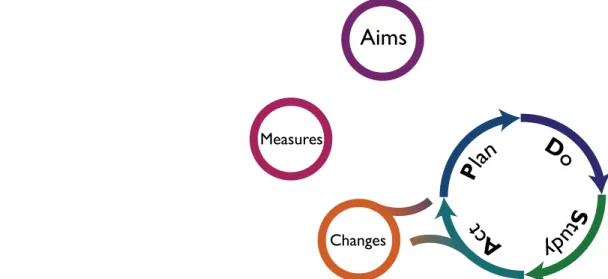
incremental change. The Model for Improvement describes preliminary planning steps followed by an improvement process referred to as the Plan-Do-Study-Act cycle (PDSA) (Figure 4.2).
Establishing Aims, Prioritizing Changes & Determining Measures Using Evidence The preliminary steps in the Model for Improvement include selecting aims and determining which
interventions to undertake. While setting the overarching aim of a QI effort may be simple (e.g. to reduce Cesarean deliveries by 20% or to achieve an NTSV rate of 20%), deciding on sub-aims and prioritizing interventions can be complex. Table 2.2 Number Needed to Treat (NNT) for Strategies to Reduce Risk of Cesarean Birth in the Evidence-based Strategies section of this toolkit identifies
multiple strategies with moderate to high strength of evidence for reducing Cesarean deliveries. The process of determining which strategies to implement and in what order should be as data-driven as possible.
Figure 4.2. Model for Improvement (adapted from Langley et al., 1996)
Aims
What are we trying to accomplish?
Measures
How will we know that a change is an improvement?
Changes
What change can we make that will result in
improvement?
D
o
S
tud
y
A
ct
P
lan
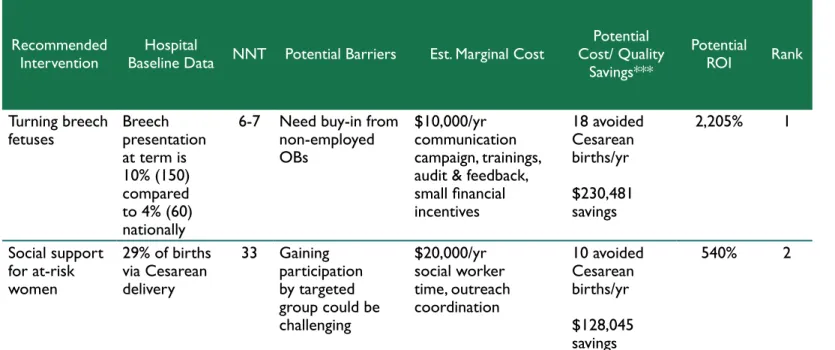
Ranking possible evidence-based interventions using a uniform rubric, such as the example provided in Table 4.1 could facilitate prioritizing interventions. Factors to consider include:
Institutional metrics related to each evidence-based intervention (i.e. how big a problem is this in this hospital?)
Number needed to treat (i.e. to avoid one Cesarean delivery) according to the evidence (e.g. how big an effect are we likely to get in this facility?)
Barriers to implementation such as complex drivers of Cesarean deliveries for your population (e.g. prior failed QI efforts, low stakeholder support)
Estimated cost of the intervention and potential annual cost savings (using hospital metrics, local and national cost data and expected NNT)
Possible return on investment based on these estimates
Once the QI intervention has been selected, aims developed and measures agreed upon, the team is ready to begin implementing a Plan-Do-Study-Act (PDSA) cycle (IHI’s model for rapid QI test cycles).
Implementing the
Interventions:
Plan-Do-Study-Act (PDSA) Cycle
Each PDSA cycle undertakes a small effort over a brief time frame and is intended to move the organization closer to its overarching aim (Langley et al., 1996). The four steps in the PDSA cycle are described next using turning breech fetuses as an example.
PLAN: Determine the objective, actions & outcome, process & balance measures for the PDSA cycle, and set expectations for the test
In the example of turning breech fetuses, the team
must first develop its overarching objective, such as:
During the first year of the intervention, our
physicians will attempt to turn breech fetuses 50% of the time, and we will have avoided 116 Cesarean deliveries.
The next step in planning is to determine which tactics have the potential to accomplish the intended goal. It may be helpful for the team to spend
additional time understanding the root causes of problems in order to plan appropriately to overcome
the identified barriers. A helpful QI tool is called “root cause analysis,” and a “fishbone” diagram
(Figure 4.3) is a commonly used method to depict
Recommended
Intervention Baseline Data NNT Potential BarriersHospital Est. Marginal Cost
Potential Cost/ Quality Savings*** Potential ROI Rank Turning breech
fetuses Breech presentation at term is 10% (150) compared to 4% (60) nationally
6-7 Need buy-in from non-employed OBs
$10,000/yr communication campaign, trainings, audit & feedback,
small financial incentives 18 avoided Cesarean births/yr $230,481 savings 2,205% 1 Social support for at-risk women 29% of births via Cesarean delivery 33 Gaining participation by targeted group could be challenging $20,000/yr social worker time, outreach coordination 10 avoided Cesarean births/yr $128,045 savings 540% 2
the factors that contribute to a problem (Larson, 2003).
Figure 4.3. Turning Breech Fetuses Fishbone Diagram & Root Cause
Identification
In this fishbone example, many of the barriers relate
to physicians needing, but not having, information. The team can consider evidence-based tactics to address these barriers.
Adequate time spent planning the QI intervention is key to its success. Bringing in team members with QI or project management experience to help
flesh out the work plan for the intervention will
help ensure it proceeds as planned. Using evidence-based interventions can also increase the likelihood of success. There are a number of system-level changes described in the literature that demonstrate a moderate strength of evidence for decreasing Cesarean deliveries:
Mandatory second opinion policy
Regular presentation of cases
Peer, leader, or outside team feedback
Professional & public education
Clinical practice guideline implementation
Hospital payment & liability forms
Nursing staff eduction
Audit & feedback
In the turning breech fetuses example above,
professional education and audit and feedback were presented as possible strategies to achieve change.
Establish Measures
Part of the planning process is deciding on metrics that are closely tied to the expected results of the intervention. These metrics need to be measured systematically and communicated regularly so that
the team can determine quickly and easily if the intervention is having the desired effect. There are three types of measures needed for each QI intervention: outcome, process, and balance (IHI, 2011).
Examples of outcome, process and balance
measures for turning breech fetuses are included in Figure 4.4.
Figure 4.4. Example of Quality Improvement Measures
Outcome measures are those which directly relate to the desired future state. While outcome measures are important, they are longer term metrics than are needed to know if the QI effort is
Managing Change
Problem
Too many breech presentations at hospital Environment Patients Process Clinicians Patient perceptions Time constraints
Liability concerns Knowledge gaps
Low financial incentives
Few training opportunities
Variation in practice guidelines Time not scheduled in visit No audit & feedback from hospitals to clinicians
Root Cause Need training Lack of a war eness Concern f or harm Do not see magnitude
of pr oblem
Outcome Measures During Year 1, our physicians will attempt to turn 80% of breech fetuses to avoid 18 Cesarean deliveries. Process Measures 95% of our physicians will be able to correctly answer follow-up questions on required eduction for turning breech fetuses.
Aggregate data (by practice & physician) will be provided as a baseline, and then on monthly basis. 100% of eligible women will be offered external cephalic version.
Each quarter, Cesarean births due to breech fetuses will decrease by 5. Balance Measures There will be no statistically significant increase in adverse events due to attempts to turn breech fetuses.
Process measures are those intermediate
metrics that help determine if the planned steps are occurring, and if they are helping the organization work toward the desired outcome.
Balance measures alert the team to unintended outcomes that may arise when implementing system change. It is important to be vigilant about potential harms of QI interventions in healthcare. Balance measures assist in determining whether a change is an improvement or possibly causing harm.
DO: Implement the test & collect the data to measure its effects
This is the part of the PDSA cycle when the team implements its plan, takes measurements, and begins to see if the plan is leading to improvements.
It is easy to experience planning fatigue which can lead to poor QI implementation. This is the time to ensure that the team has adequate time and resources to implement its plan.
In the turning breech fetuses example, the team might adopt a multi-pronged approach such as that described in Figure 4.5.
Figure 4.5. Plan Components
STUDY: Analyze the results of the test & compare those to pre-determined expectations
As discussed above, collecting and analyzing data
during and after the “do” part of the cycle helps
the team determine if the intervention is working
as planned, needs to be modified to better address the problem identified for change, or needs to be stopped due to adverse events. The team’s “black
belts” and data staff can add tremendous value to
the QI endeavor by ensuring that the uniform data collected during the implementation of the test are
properly analyzed for statistical significance.
ACT: Consider what changes should be made, if any, to make the intervention more successful
With an implementation cycle complete and data reviewed, it is time to decide the next step. This may include rolling out the intervention on a larger scale, modifying it in some way and re-doing a PDSA cycle to increase its effectiveness, or determining that the test is unsuccessful, and after documenting lessons learned, shelving it.
Depending upon its resources and tolerance for change efforts, an institution may elect to implement several PDSA cycles at one time. As long as the metrics selected enable the team to determine which of the improvement efforts is creating the desired change, an institution may go further faster towards its goal of reducing Cesarean births. To assist change efforts and PDSA cycles, Main suggests the addition of systemic and rigorous audit and feedback (2011). For a hospital or hospital
system this might include benchmarking to regional, state or national norms. A local system or hospital might start with monitoring the Joint Commission Perinatal Care (PC) set of measures (i.e. PC-01 Elective Delivery, PC-02 Cesarean Section, PC-03 Antenatal Steroids) by provider or provider groups using run-charts similar to those used in the Ohio Perinatal Quality Collaborative (OPQC, 2010). These types of reporting, whether they be public and private reporting of providers’ outcomes, can assist in prioritizing PDSA efforts and help to detect an underlying causes to variations in care (Figure 4.5). Woodall offers a comprehensive review of controls charting in health care with examples; advantages and disadvantages of charting methods, and details on how a control charting might support quality efforts (2006).
Train
Design & implement a system-widetraining program on evidence-based guidelines & methods for turning breech fetuses
Communicate Enlist senior leadership in disseminating
professional info & disseminate
patient-centered info about the benefits of turning breech fetuses
Audit & Feedback
Develop system, practice & physician level reports on training outcomes & Cesarean births to distribute monthly with info on turning breech fetuses
D
o
S
t
udy
A
c
t
P
l
a
n
Managing Change
Figure 4.5. Percent of Ohio Births Induced at 37-38 Weeks with No
Apparent Medical Indication for Early Delivery, by OPQC Member
Status & Month (January 2006-February 2013)
Conclusion
Managing change to reduce Cesarean births is a substantial undertaking. Although each setting is different and presents its own challenges, incorporating evidence, using a framework for ensuring the environment is conducive to change and utilizing the Model for Improvement can help to bring about lasting quality improvement.
Section References
1. Bingham, D. & Main, E. (2010). Effective implementation strategies and tactics for leading change on maternity units. Journal of Perinatal & Neonatal Nursing, 24(1): 32-42. 2. Chaillet, N., Dubé, E., Dugas, M., Audibert, F., Tourigny,
C., Fraser, W.D. & Dumont, A. (2006). Evidence-based strategies for implementing guidelines in obstetrics: A systemic review. Obstetrics & Gynecology, 108(5): 1234-45. 3. Chaillet, N. & Dumont, A. (2007). Evidence-based
strategies for reducing Cesarean section rates: A meta-analysis. Birth, 34(1): 53-64.
4. Clark, S.L., Frye, D.R., Meyers, J.A., Belfort, M.A., Dildy, G.A., Kofford, S., Englebright, J. & Perlin, J.A. (2010). Reduction in elective delivery at <39 weeks of gestation: comparative effectiveness of 3 approaches to change and the impact on neonatal intensive care admission and stillbirth. American Journal of Obstetrics & Gynecology, 203(5): 449.e1-6.
5. Donovan, E.F., Lannon, C., Bailit, J., Rose, B., Iams, J.D. & Byczkowski, T. (2010). A statewide initiative to reduce inappropriate scheduled births at 360/7–386/7weeks’ tation. American Journal of Obstetrics & Gynecology, 202(3): 243.e1-8.
6. Fisch, J.M., English, D., Pedaline, S., Brooks, K. & Simhan, H.N. (2009). Labor induction process improvement: a patient quality-of-care initiative. Obstetrics & Gynecology, 113(4): 797-803.
7. Flamm, B., Kabcenell, A., Berwick, D.M. & Roessner, J. (1997). Reducing Cesarean section rates while maintaining
maternal and infant outcomes. Boston, MA: Institute for
Healthcare Improvement.
8. Institute for Healthcare Improvement [IHI]. (2011). Science of Improvement: Establishing measures. Retrieved on 3-15-13 from: http:// www.ihi.org/knowledge/Pages/HowtoImprove/ ScienceofImprovementEstablishingMeasures.aspx 9. Langley, G., Nolan, K., Nolan, T., Norman, C. & Provost,
L. (1996). The Improvement Guide: A practical approach to
enhancing organizational performance. San Francisco, CA:
Jossey-Bass Publishers.
10. Larson, A. (2003). Demystifying Six Sigma: A
company-wide approach to continuous improvement. New York, NY:
AMACOM.
11. Main, E.K., Morton, C.H., Hopkins, D., Giuliani, G., Melsop, K. & Gould, J.B. (2011). Cesarean Deliveries, Outcomes, and Opportunities for Change in California: Toward a Public Agenda for Maternity Care Safety and Quality. CMQCC White Paper.
12. Main, E., Oshiro, B., Chagolla, B., Bingham, D., Dang-Kilduff, L. & Kowalewski, L. (2010). Elimination of non-medically indicated (elective) deliveries before 39 weeks gestaiontional age. (California Maternal Quality Care Collaborative Toolkit to Transform Maternity Care) developed under contract #08-85012 with the California Department of Public Health; Maternal, Child, and Adolscent Health Division; First edition published by March of Dimes.
13. The Ohio Perinatal Quality Collaborative Writing Committee [OPQC]. (2010). A statewide initiative to reduce inappropriate scheduled births at 36 0/7-38 6/7 weeks’ gestation. American Journal of Obstetrics &
Gynecology, 202(243.e).
14. Oshiro, B.T., Henry, E., Wilson, J., Branch, D.W. & Varner, M.W. (2009). Decreasing elective deliveries before 39 weeks of gestation in an integrated healthcare system.
Obstetrics & Gynecology, 113(4): 804-11.
15. Pande, P.S., Neuman, R.P., & Cavanagh, R.R. (2001). The
Six Sigma Way: How GE, Motorola, and Other Top Companies
are Honing Their Performance. New York, NY: McGraw-Hill
Professional.
16. Reisner, D.P., Wallin, T.K., Zingheim, R.W. & Luthy, D.A. (2009). Reduction of elective inductions in a large community hospital. American Journal of Obstetrics &
Gynecology, 200(6): 674.e1-7.
17. Truven Health Analytics. (2013). The cost of having a baby in the United States. Report prepared for
Childbirth Connection. Retrieved from: http://transform.
childbirthconnection.org/reports/cost/
18. Woodall, W. (2006). The Use of Control Charts in Health-Care and Public-Health Surveillance. Journal of Quality
Technology, 38(2): 89-104.
Source: Ohio Perinatal Quality Collaborative (2013)
5% 10% 15% 20% 25% 30% Jan 06 OPQC Non-OPQC