DEVELOPING RESILIENCE AND MANAGING CHANGE IN TECHNOLOGY-ENHANCED
LEARNING ENVIRONMENTS
JANET FRANCES BUCHAN
BSc, HigherDipEd, MEd
University of Southern Queensland
Submitted for the Award of
Doctor of Philosophy
ABSTRACT
In the competitive higher education environment there is pressure for organisational change at all levels, from major organisational structural change to introducing new curricula or new and innovative educational technology. However, current educational and organisational management strategies in higher education do not adequately address an emerging issue, that of managing for change and
uncertainty. The aim of this research was to fill this gap, focusing educational management back on the domain of teaching and learning through a focus on the learning environment.
This thesis explored new heuristics for understanding and managing changing technology-enhanced learning environments. The source of inspiration was concepts and theoretical frameworks from the field of environmental management, including Resilience Thinking and the social-ecological systems approach which grounded the research.
The research took the form of a single case study situated in a regional, mixed mode university in NSW. The time frame corresponded to a period of five years of rapid organisational change which included the institution-wide introduction of a new learning management system (LMS) and other educational technology. The unit of analysis was the technology-enhanced learning environment. The research
methods used were primarily qualitative and included the use of ethnography and autoethnography. Data collection included interviews, document analysis, reflective journal and observation and meeting notes.
institutional initiatives. The Adaptive Cycle Framework was developed for understanding change and transformation in the technology-enhanced learning environment in the case. Investigation of individual adaptability to change provided new insights into institutional change management approaches. The heuristic of transformability contributed towards understanding the adaptability of the organisation and its capacity to predict, plan for and support ongoing changes in educational technology. Finally, features of a resilient institutional system were identified.
STATEMENT OF ORIGINAL AUTHORSHIP
The work contained in this thesis has not been previously submitted to meet requirements for an award at this or any other higher education institution. To the best of my knowledge and belief, the thesis contains no material previously published or written by another person except where due reference is made.
--- ---
Signature of Candidate Date
Janet Frances Buchan
ENDORSEMENT
--- ---
Signature of Supervisor Date
Assoc. Prof. Anne Jasman
--- ---
Signature of Supervisor Date
ACKNOWLEDGEMENTS
Throughout the course of this research there were many people who contributed to its final outcomes.
I thank my colleagues at Charles Sturt University who gave freely of their time to share their insights, and acknowledge those who gave me licence to capture and learn from our changing professional times.
To my supervisors, Associate Professors Dr Anne Jasman and Dr Peter McIlveen: I thank you for your professionalism, encouragement, wisdom and valuable insight – shared in the face of many personal challenges - which has
ensured that this work is the best it can be. Remembering also the late Professor Alan Smith who was instrumental in grounding me in the research process.
For my understanding and patient children Elizabeth, Ann, Sarah and Matthew – the accomplished young people you have become are a daily inspiration.
Finally, to my ever-understanding and supportive husband, Alastair. Your determination to make the world a better place has been a driving force and motivation for completing this work.
CONTENTS
Abstract ... iii
Statement of Original Authorship ... v
Acknowledgements ...vii
List of Figures ... xvii
List of Figures in Appendices ... xix
List of Tables ... xx
List of Tables in Appendices ... xxi
Peer Reviewed Publications ...xxiii
Professional Presentations and Workshops arising from the Research ... xxiv
Glossary ... xxvii
CHAPTER 1: Introduction ... 1
1.1. The Research Problem ... 1
1.2. Background to the Case Study ... 4
1.3. Professional Context ... 7
1.4. How the Study was Conducted ... 7
1.5. The Potential Value of the Research ... 8
CHAPTER 2: Review of the Literature... 11
2.1. Introduction: The Global Context ... 11
2.2. The Learning Environment ... 16
2.3. Management ... 22
Educational Management ... 23
2.3.1. Organisational Management ... 25
2.3.2. Change Management ... 29
2.3.3. Environmental Management ... 31
2.3.4. 2.4. Resilience Thinking: Theoretical Background ... 36
2.5. Systems Thinking ... 40
2.6. Social-Ecological Systems Foundations ... 41
Heuristics ... 42
2.6.1. Building Blocks of Social Systems ... 43
2.6.2. Propositions for Understanding Resilience in Social-Ecological 2.6.3. Systems ... 45
The Social-Ecological System in Context - Asking the Right 2.6.4. Questions ... 46
CHAPTER 3: Methodology and Research Design ... 51
3.1. The Research Questions ... 51
3.2. Research Design ... 51
Design Considerations and Decisions ... 52
3.2.1. Blueprint for the Study ... 54
3.2.2. 3.3. Choice of Approach and Methodology ... 58
Case Study ... 58
3.3.1. Use of Ethnography ... 60
3.3.2. Use of Autoethnography ... 61
3.5. Defining the Unit of Study ... 64
3.6. Data Collection and Analysis ... 66
Research Timeline ... 66
3.6.1. Focusing and Bounding the Collection of Data ... 68
3.6.2. Sampling ... 68
3.6.3. Data Collection Methods ... 69
3.6.4. Data Analysis ... 86
3.6.5. Data Display ... 88
3.6.6. 3.7. Ethical Considerations ... 88
Ethics Processes ... 88
3.7.1. CHAPTER 4: Study 1, Part 1 - Describing the Contemporary Technology-Enhanced Learning Environment ... 93
4.1. Introduction ... 93
4.2. Method ... 94
4.3. Findings... 96
The Learning Environment as Defined by the University ... 97
4.3.1. Theme 1 – Spatial ... 101
4.3.2. Theme 2 – Temporal ... 105
4.3.3. Theme 3 – Social ... 108
4.3.4. Theme 4 – Technological (including Educational Technology) .. 112
4.3.5. Theme 5 – Interactions ... 118
4.3.6. 4.4. Discussion ... 122
Spatial Dimension ... 123
Social Dimension... 126
4.4.3. Technological Dimension (including Educational Technology) . 129 4.4.4. Interactions and Connectedness ... 130
4.4.5. Resources ... 132
4.4.6. 4.5. Conclusion ... 133
CHAPTER 5: Study 1, Part 2 – Investigating the Application of the Social-Ecological System Approach to the Case ... 137
5.1. Overview of the Chapter ... 137
5.2. Method ... 138
Panarchy: Method Highlights ... 140
5.2.1. Adaptive Cycle: Method Highlights ... 140
5.2.2. Adaptability: Method Highlights ... 141
5.2.3. Transformability: Method Highlights ... 142
5.2.4. Resilience: Method Highlights ... 143
5.2.5. 5.3. Heuristic 1 - Panarchy... 145
Background ... 145
5.3.1. Findings... 148
5.3.2. Discussion ... 158
5.3.3. Conclusion ... 159
5.3.4. 5.4. Heuristic 2 - The Adaptive Cycle ... 162
Background ... 162
5.4.1. Findings... 166
5.4.2. Discussion ... 175
5.4.3. Conclusion ... 180
Background ... 185
5.5.1. Findings... 186
5.5.2. Discussion ... 221
5.5.3. Conclusion ... 228
5.5.4. 5.6. Heuristic 4 – Transformability ... 230
Background ... 230
5.6.1. Findings... 233
5.6.2. Discussion ... 247
5.6.3. Conclusion ... 253
5.6.4. 5.7. Heuristic 5 - Resilience ... 254
Background ... 254
5.7.1. Findings... 255
5.7.2. Discussion ... 267
5.7.3. Conclusion ... 275
5.7.4. 5.8. Summary Study 1, Part 2 ... 277
CHAPTER 6: Study 2 - Autoethnography ... 283
6.1. Asking for Enlightenment ... 283
6.2. Professional Context ... 285
6.3. The Research Process ... 286
6.4. The Mission ... 287
6.5. Developing Resilience: How do you Know it is Not Working? .. 289
Systems and Stability States... 295
6.5.1. The Ball-in-the-Basin ... 297
6.6. What is the Systemic Effect of our Actions? ... 302
6.7. Learning from History? ... 305
Eight Principles for Educational Technology Change Management 307 6.7.1. CHAPTER 7: Conclusions and Future Directions ... 311
7.1. Understanding the Technology-Enhanced Learning Environment312 7.2. Understanding the Application of the Social-Ecological Systems Approach to the Case ... 315
Outcomes of the Research... 315
7.2.1. Managing Change ... 317
7.2.2. Individual Perspectives on Change ... 319
7.2.3. Value of the Research ... 319
7.2.4. Future Directions ... 320
7.2.5. REFERENCES 323 APPENDICES 337 Appendix 1 Annotated list of Publications Arising from the Research. ... 337
Appendix 2 Preliminary Aims of the Research and Findings relating to Adaptive Management ... 341
Appendix 3 Research Methods ... 344
A 3.1. Set 1 Interview Questions ... 344
A 3.2. Set 2 Interview Questions ... 345
A 3.3. Set 3a Interview Questions ... 345
A 3.4. Set 3b Interview Questions ... 350
A 3.5. Set 4 Interview Questions ... 352
Appendix 4 Coding for Participants ... 357
Appendix 5 Data Collection and Analysis ... 360
Appendix 6 Institutional Supporting Documents ... 373
Appendix 7 Narrative – A Week in the Life ... 376
Appendix 8 Data Supporting the Heuristics of the Adaptive Cycle and Panarchy 381 A 8.1. Application of Panarchy in Practice: Improvements to Para-analysis ... 381
A 8.2. The Adaptive Cycle in Practice ... 384
A 8.3. Educational Technology: Administrative Teaching and Systems and Tools ... 402
Appendix 9 Data Supporting the Heuristic of Resilience ... 414
LIST OF FIGURES
Figure 2.1. Conceptual map of the literature which grounds the research. ...12
Figure 2.2. Model of the learning environment. ...18
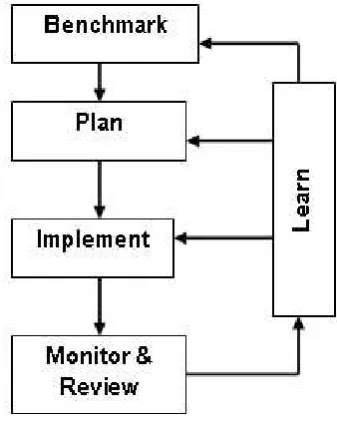
Figure 2.3. An Adaptive Management Framework. ...35
Figure 2.4. The system as a ball-in-the-basin model. ...38
Figure 2.5. The social-ecological system. ...42
Figure 2.6. The five heuristics of the social-ecological system. ...43
Figure 3.1. Methodology and research design...52
Figure 3.2. Original Conceptual Framework 2007. ...55
Figure 3.3. Blueprint for the study. ...57
Figure 3.4. Representation of the unit of study as a cross-section. ...66
Figure 4.1. The Dimensions Model of the Technology-Enhanced Learning Environment. ... 123
Figure 4.2. The groupings of people in the learning environment. ... 128
Figure 5.1. (repeat of Figure 2.6) The five heuristics of the social-ecological system. ... 137
Figure 5.2. Hierarchy of vegetation, landform structures and the atmospheric processes for the Everglades system. ... 146
Figure 5.3. Panarchical connections shown as three levels of nested cycles. ... 147
Figure 5.5. A para-analysis view of the institutional impact scale of teaching and
administrative systems used by educational designers in 2010. ... 154
Figure 5.6. A para-analysis view of the impact of teaching and administrative systems used by academic staff in 2012. ... 155
Figure 5.7. A Simple representation of the adaptive cycle. ... 163
Figure 5.8. The first version of the adaptive cycle. ... 164
Figure 5.9. The original representation of the Adaptive Cycle Framework. ... 167
Figure 5.10. The Adaptive Cycle Framework. ... 171
Figure 5.11. A Representation of a dynamic and stable institutional [system]. .... 184
Figure 5.12. The changing structure of CSU’s divisions and units that supported learning and teaching in 2010. ... 237
Figure 5.13. The changing structure of divisions and units supporting learning resource provision in 2011. ... 237
Figure 5.14. The changing system which supported and fostered learning and teaching at CSU. ... 238
Figure 5.15. SCOOPE - a guide to Institutional System Variables. ... 251
Figure 6.1. An Integrated Evaluation Framework for CSU Interact. ... 292
Figure 6.2. The relationship between the learning environment, the organisation and the external environment. ... 294
Figure 6.3. The organisation in action and stabilising the system. ... 295
LIST OF FIGURES IN APPENDICES
Figure A 6.1. Dashboard of Systems for ICT Enabled Learning and Teaching
2009. ... 373
Figure A 6.2. Dashboard of Systems for ICT Enabled Learning and Teaching 2010. ... 374
Figure A 6.3. Dashboard of Systems for ICT Enabled Learning and Teaching 2011. ... 375
Figure A 8.1. EDs’ perceptions with respect to the CSU Degree Initiative. ... 385
Figure A 8.2. EDs’ perceptions of the move from Print to Online. ... 385
Figure A 8.3. Perceptions of personal positions. ... 386
Figure A 8.4. Perceptions of institutional positions. ... 386
LIST OF TABLES
Table 3.1. Summary of Data Collection Methods, Instruments and Purpose. 71
Table 3.2. Summary of Participant Coding. 74
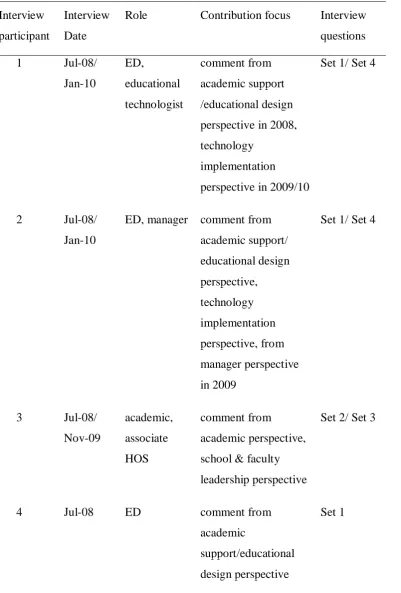
Table 3.3. Summary of Interview Participant Identification Data. 78 Table 5.1. Summary of Snapshots used to examine the Heuristics in the Case. 139
Table 5.2. Events and Changes which Impacted on the Learning and Teaching
Environment. 150
Table 5.3. Summary of Transformational Impacts of Learning Technology at an
Individual Level. 172
Table 5.4. Summary of Features Contributing to the Revolt and Remember
Capabilities of an Institution. 175
Table 5.5. Interview Participants’ Ratings of Ability to Adapt to Change and
Technological Change. 192
Table 5.6. Summary: Adaptability at the Individual Level. 208 Table 5.7. Summary: Institutional Strategies Contributing to Individual
Adaptability. 220
Table 5.8. Personal Strategies and Qualities for Managing Change in
Technology. 225
Table 5.9. Requirements for Adaptability and Transformational Change. 246 Table 5.10. Locus of Control/Sphere of Influence Classification of Shocks and
Disturbances in a System. 256
Table 5.11. Summary of shocks/disturbances which influenced the system. 257 Table 5.12. Summary of Resilience Features Mapped against the Functions of the
LIST OF TABLES IN APPENDICES
Table A 3.1. Timeline: Research Activity and Data Collection.... 353
Table A 4.1. Detailed List of Coding for Participants. ... 357
Table A 5.1. Data Collection Matrix.... 360
Table A 5.2. Retention of Data. ... 361
Table A 5.3. Observation and Learning Opportunities. ... 363
Table A 5.4. Matrix for Upper Level Sorting of Data. ... 366
Table A 5.5. Panarchy: Mapping Matrix for Dates of Key Events. ... 367
Table A 5.6. Transformability: Mapping Key Features. ... 368
Table A 5.7. Adaptive Cycle: Mapping features of the Phases. ... 369
Table A 5.8. Adaptive Cycle Institutionalisation Phase: Mapping matrix. ... 369
Table A 5.9. Coding used to Classify and Describe Document Data. ... 370
Table A 8.1. Measurement of Institutional Impact Scale. ... 382
Table A 8.2. Change in the Stability Landscape against the six Institutional System Variables. ... 387
Table A 8.3. Educational Technology: Administrative Teaching and Systems and Tools. ... 402
Table A 8.5. Transformation at an Institutional level: Reorganisation Phase - Innovation and Renewal. ... 408 Table A 8.6. Transformation at an Institutional Level: Rapid Growth Phase. .... 411 Table A 8.7. Transformation at an Institutional Level- Institutionalisation Phase.
... 412
Table A 9.1. Changes in Normal Functions of the System. ... 414 Table A 9.2. Changes observed in the Functions (roles) of People. ... 419 Table A 9.3. Impact of the Availability of Interact on the Functions and Activities
PEER REVIEWED PUBLICATIONS
1. Buchan, J. (2008). Rethinking management strategies for the online learning environment. Paper presented at the ALT-C Conference. Rethinking the digital divide 9-11 September 2008. Leeds UK, Leeds. Available from http://janetbuchan.wordpress.com/wp-admin/post.php?post=61&action=edit 2. Buchan, J. (2008). Tools for survival in a changing educational technology
environment. Paper presented at the ascilite Conference. Where are you now in the landscape of educational technology? Proceedings ascilite 2008 Melbourne.
3. Buchan, J. (2010). Putting ourselves in the big picture: A sustainable approach to project management for e-learning. Journal of Distance Education, 24(1), 55-75.
4. Buchan, J. (2010). Developing a dynamic and responsive online learning environment. A case study of a large Australian university. In B. C. Ozkan (Ed.), Free and open source software for e-learning: Issues, challenges and successes. USA: IGI Global.
5. Buchan, J. (2010). Developing a dynamic and responsive online learning environment: A case study of a large Australian university. International Journal of Open Source Software and Processes, 2(1), 32-48.
6. Buchan, J. (2011). The chicken or the egg? Investigating the transformational impact of learning technology. Research in Learning Technology, 19(2), 155-172.
7. Buchan, J. (In press). The changing nature of learning and teaching at Charles Sturt University 2008-2011, DeHub, Australia, ISBN, TBA. A paper
commissioned for Childs, M., Brown, M., Keppell, M., Nicholas, Z., Hunter, C. & Hard, N. (2012). Learning leadership in Higher Education: the big and small actions of many people. DeHub, Australia.
8. Buchan, J. (2012). Sustaining new approaches to learning and teaching with technology - more than just a Wicked Problem. Paper presented at the ascilite Conference. Future challenges, sustainable futures, Wellington, NZ.
PROFESSIONAL PRESENTATIONS AND WORKSHOPS ARISING FROM
THE RESEARCH
Date Title of presentation Group to which presented Focus
2008
December
Tools for survival in a
changing educational
technology environment
Ascilite conference 2008.
Full paper.
Adaptive cycle
2009
February
Tools for survival in a
changing educational
technology environment
CSU Middle Managers’
Forum
Adaptive cycle
2009
May
LTS Culture, systems,
skills: Learning Resource
Development Workshop,
Orange
LTS leadership,
management and senior
staff involved with
learning resource
development
Adaptive cycle
2009
May
Are we there yet?
Adapting to a changing
world
Faculty of Education
EDM team, annual team
Indaba (Forum)
Adaptive cycle &
para-analysis
2009
July
Supporting the successful
implementation and use of
an open source learning
management system.
Experiences from the
introduction of Sakai at
CSU
ANU Presentation to
WATTLE support team
and Centre for Educational
Development & Academic
Method
Adaptive cycle &
para-analysis
2009
September
Strategies for the
widespread uptake of
Sakai in tertiary and
AuSakai Workshop 16
September
Adaptive cycle &
para-analysis,
Date Title of presentation Group to which presented Focus
higher education systems etc.
2010
September
Riding the waves of
technological change
USQ LTSU/ADFI visiting
scholar.
http://www.usq.edu.au/lea
rnteach/learnres/vsarchive/
buchan
Adaptive cycle &
para-analysis,
social-ecological
systems etc.
2010
December
Developing strategies to
introduce and manage
technological change and
innovation in higher
education towards learning
and teaching
transformation
Ascilite Workshop
5 December
Adaptive cycle &
para-analysis,
social-ecological
systems etc.
2010
December
Learning and Teaching
Services Leadership
Committee
Presentation Adaptive cycle,
social-ecological systems 2011 September Exploring the transformational potential
of Sakai (CLE) as an
educational technology AuSakai Conference. Canberra Transformation 2011 September
Developing resilience and
managing change in
technology-enhanced
learning environments
CSU Faculty of
Education. Technology in
Teaching Research Group
Overview of
Ph.D. study
2011
November
The transformation we
have to have: preparing
students for a sustainable
future
CSU ED 2011
Conference. Internal. A
thinkpiece
Managing
change,
adaptability
Date Title of presentation Group to which presented Focus
March change: Educational
Designers’ Professional
Development programme.
and Teaching Services.
Educational Designers and
senior staff
management.
Adaptability
2012
November
Keeping our feet planted
firmly in the air
CSU ED 2012
Conference. Internal
Dimensions of
the learning
GLOSSARY
This glossary contains terminology and abbreviations relevant to the case study. Some generic terminology is drawn from the literature while other terms are context-specific and reflect modified or new terminology. The origin of those terms is described in the Findings in the case. Bringing all key terms up front provides an easy reference point for the reader.
Unless otherwise indicated, all terms relate to the context of the case study institution, Charles Sturt University.
Adaptability - The capacity of the social components in a system to experience change, including technological change
Adaptive cycle - A key dynamic of the social-ecological systems approach describing the dynamics of an ecosystem and how the system might respond to changes in the environment
Adaptive management – A management approach which uses management as a tool not only to change the system, but as a tool to learn about the system through a structured, iterative process of robust decision making, identifying uncertainties, and then establishing methodologies to test hypotheses concerning those uncertainties
AUQA – Australian Universities Quality Agency
Boundaries - The boundary of a system is determined by the purpose of the system CELT – Centre for Enhancing Learning and Teaching
CLE – Collaborative Learning Environment, Sakai community source software Course – A course is the equivalent of a program of study. A course is made up of a number of subjects or units
DE – Distance education
Disturbance – See shock/disturbance DIT – Division of Information Technology
DLTS – Division of Learning and Teaching Services DLS – Division of Library Services
DOMS – Digital Object Management System
Ecological system (ecosystem) - A place that consists of living and non-living (physical) components
ED – Educational Designer
EDM – Educational Design and Media section in the Division of Learning and Teaching Services
EMS – Educational Management Studies field
Feedbacks - A cause and effect relationship in the system whereby a change in one component or variable can be shown to have an effect on other parts of the system
Function - The activity or output of a system. “Function” is generally used for a non-human system, the word “purpose” for a non-human one but the distinction is not
absolute, since many systems have both human and nonhuman elements
HOS – Head of School
ICT - Information Communication Technology
Identity (of system) - The purpose of the system where the purpose grounds the function and output of the system
Interact – See CSU Interact.
Interview participant IP – Participants who were interviewed as part of the data collection process
IVT - Interactive Video Teaching LMC – Learning Materials Centre
LML – Learning Media Laboratory (within Centre for Enhancing Learning and Teaching)
LMLC - Learning Media Laboratory Coordinator LMS - Learning Management System
MDC – Media Development Coordinator
Metaphor – A framework used to help interpret events and to create a world view MOOC – Massive Open Online Course
MSI – Mandatory Subject Information Policy
OLE - Online learning environment in the case study university, consisting of Interact and other learning technologies
Organisation – The term applied to the generic context of the case and used to distinguish the business origins and focus of the university
Panarchy – One of two dynamics of the five heuristics of the social-ecological systems approach
Resilience - Resilience is the capacity of a system to undergo some change without crossing a threshold, to absorb disturbance and to retain essentially the same
structure, function and feedbacks. Resilience (capital R) is used for the overarching concept and resilience (small r) refers to the heuristic. The more general application of resilience outside of the environmental management field (in this study) is denoted by resilience (small r)
Sakai – An international community which develops community (open) source software and systems
Shock/disturbance - A shock is an external impact to the system which impacts the system. A disturbance is an impact which comes from within the system. Within the case study context the terms are used whereby shock refers to a larger impact and disturbance a lesser impact
SLTI - Strategic Learning, Teaching and Innovation section in Division of Learning and Teaching Services
Social-ecological system - The interaction between two systems namely, social systems and ecological systems
Social-ecological system heuristics - The dynamics of a social-ecological system can be described and understood by two heuristics: the adaptive cycle and panarchy. The properties which determine the dynamics of the social-ecological system are
resilience, adaptability and transformability
Stability landscape - The extent of the different possible states of system space, defined by a set of control variables in which stability domains are embedded
Structure of system – The components, people and physical resources, which make up the system
System - For consistency within the context of Resilience the term system is
analogous with the stability landscape as applied to the property of transformability TAFE – Tertiary and Further Education Institution
Technology-enhanced learning environment - The environment in which learning that is supported and facilitated by technology takes place
Thresholds - Levels in controlling variables where feedbacks to the rest of the social-ecological system change
Transformability - The capacity to create a fundamentally new system when the existing system is untenable
VLE – Virtual learning environment. The VLE was an in-house developed system made up of a number of tools and did not have Web 2.0 capabilities
CHAPTER 1: INTRODUCTION
1.1. The Research Problem
In the competitive higher education environment there is pressure for organisational change at all levels, from major organisational structural change to introducing new curriculum or new and innovative educational technology (Bacsich & Pepler, 2009; Conole, 2013; Reushle, McDonald, & Postle, 2009). In the twenty years since the development of the World Wide Web there has been significant investment in educational technology by higher education institutions (Bates & Sangra, 2011). Funding for information technology remains a top institutional issue (Allison, De Blois, & 2008 EDUCAUSE Current Issues Committee, 2008) and there is pressure on institutional management to factor in the perspective of the campus community members and to be able demonstrate the value of existing services and investments, as well as the true cost of future decisions (Ingerman, Yang, & Committee., 2010).
The academic process involves the creation and sharing of knowledge. Ideas are challenged and rigorous research required so that claims and decisions are challenged before they are accepted within the discipline area. In the university institution, the very nature of the academic process can create a tension between university management making decisions about institutional change and outcomes and acceptance of these decisions by the academic community - without the debate (Keller, 1983). There is a tendency towards the disarticulation of studies of
management from other education processes taking place in institutions. The aim of this research is to fill this gap and to focus educational management back on the domain of teaching and learning through the focus on the learning environment.
(Buchan & Buchan, 2003). Environmental managers have developed a range of techniques and tools towards developing sustainability and to manage the impact of ecological disasters and constant environmental changes. Of interest to the field of higher education management, and in particular for those involved in managing the rapidly changing educational technology environment (Johnson, Levine, Smith, Smythe, & Stone, 2009; New Media Consortium, 2012), are two things. Firstly, that there is intrinsic value in the learning environment; secondly, the solutions coming out of the environmental field for understanding the nexus between the people (social) and environmental (ecological) elements in order to manage that environment wisely for the benefit of future generations.
Insight into the essence of the problems facing environmental management in a changing world, and the role of Resilience Thinking in building “capacity to work with change, as opposed to being a victim of it”, is provided by Walker et al.
Current approaches to sustainable NRM [natural resource management] are modelled on average conditions, ignore major disturbances, and seek to optimise some components of a system in isolation of others. This approach fails to acknowledge how the world actually works; increasing efficiency and optimising performance is good for economic purpose but fails to acknowledge secondary effects and feedback that can cause changes that affect the bigger system and can affect sustainability; resilience thinking (emphasis added) is about understanding and engaging with a changing world. By understanding how and why the system as a whole is changing, we are better placed to build a capacity to work with change, as opposed to being a victim of it (Walker, Anderies, Kinzig, & Ryan, 2006, p. 6).
The concept of Resilience was introduced into environmental management as a way of thinking that would contribute to an understanding of constantly changing systems.
not the presumption of sufficient knowledge, but the recognition of our
ignorance; not the assumption that future events are expected, but that they will be unexpected…The resilience framework can accommodate this shift of perspective, for it does not require a precise capacity to predict the future, but only a qualitative capacity to devise systems that can absorb and accommodate future events in whatever unexpected form they may take (Holling, 1973, p. 21).
Potential was seen for the application of Resilience within the field of educational management, Resilience thus formed a major part of the theoretical foundations to this research. This is represented in the Overarching Conceptual Framework (see Methodology, Figure 3.2) where the connection is made between Resilience at the individual level and Resilience at the institutional level.
The primary focus of this Ph.D. study became the rigorous examination of new heuristics for understanding and managing changing technology-enhanced learning environments. The source of inspiration for those new heuristics was the field of environmental management.
The research problem
Current educational and organisational management processes/strategies in higher education do not adequately address the urgent issues; of how to understand and manage the learning environment in the face of constant change in the broader educational environment.
As the speed of change in educational technology continues to increase, there is a lack of suitable strategies that educators and managers can use to
1.2. Background to the Case Study
The research took the form of a single case study, situated in Charles Sturt University. Charles Sturt University (CSU) is a regional, multi-campus university based in NSW with campuses in Bathurst, Wagga Wagga, Albury-Wodonga, Dubbo, Orange, Canberra, Port Macquarie, Parramatta, Manly, and Ontario Canada. It also has study centres in cities such as Melbourne and Sydney as well as links with international partner institutions. The multi-campus nature of CSU creates particular challenges for the logistics of administration, teaching and the support of learning and teaching. Faculties, divisions and institutes must necessarily work across the campuses and all four faculties have at least one fully cross-campus school. CSU is a dual-mode university offering courses (programs) in on-campus and distance
education (DE) modes. The official enrolment mode choices students have for their subjects is either internal (on-campus) or distance education (DE). At the time of this research the University had approximately 38,000 students of whom approximately two-thirds were enrolled as distance education (DE) students. In order to address the changing needs of student enrolments, the diversity of study programs and the logistics of cross-campus courses and schools, the use of technology in its broadest sense, and teaching with ICT’s (information communication technology) was becoming increasingly important.
The University’s Mission was outlined in the new University Strategy 2007-2011 (Charles Sturt University, 2006).
As a national university Charles Sturt University’s mission [was]:
• To provide distinctive educational programs for the professions that prepare students for work and citizenship
• To conduct strategic and applied research which is nationally and internationally recognised
• To lead in the quality provision of flexible learning and teaching, and
• To enhance its communities, which include: – rural and regional Australia
– the professions, industries and students for whom we provide research and education, and
– national and international institutions, scholars and researchers with whom our staff and students are linked (Charles Sturt University, 2006).
Of importance to this research was the new Mission’s focus on increasing its national and international presence and on becoming a leader in “the quality provision of flexible learning and teaching” with the attendant dependence on technology that this would require. At that time the notion of blended learning was contested in policy but relevant in practice in the institution (Buchan, Rafferty, & Munday, 2009; Tulloch, Uys, Arthur, & Buckland, 2005).
In late 2006 the following key drivers for the development and timing of this study were identified in my working environment at CSU (Buchan 2007, original Ph.D. proposal).
• The restructuring of the faculties from five to four faculties and the associated widespread use of cross-campus schools.
• The implementation of a new University Strategy 2007-2011.
• The implementation of a new University Learning and Teaching Plan.
• The implementation of a new Course Plan.
• The introduction of two institutes; The Flexible Learning Institute and the Educating for Practice Institute.
• The development on the main campuses of new Learning Commons, including a new Learning Commons and the Teaching and Learning Hub at Albury in a campus expansion.
• The choice by the University to adopt a community source Learning Management System, Sakai, from 2007 onwards to enhance CSU’s online learning environment (OLE).
the university from an integrated, in-house developed virtual learning environment, known locally as the VLE (Virtual Learning Environment), to an online learning environment (OLE) encompassing Web 2.0 tools. The new OLE was named CSU Interact. This heralded a major paradigm shift in the way learning and teaching occurred at the university. A major institutional project, the OLE Program, was established to oversee the multiple projects and coordinate the implementation of Interact. This would be one of the largest multi-stakeholder educational technology projects the university had seen. In the words of our (then) Manager for Educational Design and Educational Technology at the February 2007 launch of the Centre for Enhancing Learning and Teaching (CELT) implementation of CSU Interact; “If at the end of the introduction of Interact we have not seen a significant transformation in learning and teaching at this university – we will have failed”.
During the years of this study CSU was undergoing significant and transformative change in response to the new CSU Strategy 2007-2011 and to changes in the broader higher education environment (Bradley, Noonan, Nugent, & Scales, 2008; Charles Sturt University, 2006). Change and the challenges and issues change raises were noted in many forums and contexts throughout the study.
In 2008 one of CSU’s commitments to its students was; “The world is
changing. Get ready. Preparing leaders for a changing world”. In his presentation for the position of Dean, Faculty of Science CSU the candidate noted the need to align his vision and the university’s moves and many changes; “we are at a stage where we are still vulnerable if we stand still” (Candidate for Dean, Faculty of Science,
December 2007, pers.comm).
In the transition from the Centre for Enhancing Learning and Teaching to Learning and Teaching Services it was noted that; “The ED role is changing and they will need a new identity. To become more change agents than helpers” (Executive Director of Learning and Teaching Services, CSU, February 2008, pers. Comm.).
the impossible in a short space of time without the resources” (Faculty Forum participant, February 2010, pers.comm.). The rhetoric of “waves” and even a “tsunami of change issues” became common, and there was a perceived tension between organisational management approaches and strategies suitable for the academic learning environment.
1.3. Professional Context
My position in the study was as a researcher-practitioner. Over the time period of the research I was designated to play a key part in the implementation of CSU Interact (hereafter referred to as Interact) and the implementation, management and dissemination of other educational technology. This was done from within multiple, changing professional roles including educational designer, educational technologist and team manager. The details and significance of these changing roles is explicated in the Methodology (see Chapter 3) and in Study 2, the autoethnographic report of the case study (see Chapter 6).
1.4. How the Study was Conducted
The research used a case study approach with Charles Sturt University as the single case study and the broad unit of analysis. The narrow unit of analysis and key focus was confined to the technology-enhanced learning environment. The narrow unit of study is described in the Methodology, see Figure 3.4. The major focus of the research was the exploration of the application of the five heuristics of a social-ecological systems approach to the case in two separate studies.
The time period covered was from 2007 to 2011 which corresponded to the implementation of the University’s new Strategy. A variety of data collection methods were used to address the many faceted research study and these are described in detail in the Methodology and Research Design (see Chapter 3).
single focal point, which is the learning environment and change. This is illustrated in a single conceptual map, Figure 2.1.
The research question posed was:
How can the technology-enhanced learning environment be understood and managed in the face of constant change in the broader educational
environment?
with the research sub-question:
How can the contemporary technology-enhanced learning environment be described?
The Methodology and Research Design, along with the ethical considerations which underpin the study, are described in Chapter 3. Study 1 is an ethnographic case study of Charles Sturt University’s technology-enhanced learning environment. The first part of Study 1, reported in Chapter 4, describes the investigation into the research sub-question. The second part of Study 1, reported in Chapter 5, describes the investigation into fulfilling the primary research question.
Selected aspects of the findings are explored in Study 2, an autoethnography of the case study which is described in Chapter 6.
Finally, the Conclusion and Future Directions (see Chapter 7) bring together an expansive piece of research and set the scene for ensuring that there is ongoing impact of this important, original work.
1.5. The Potential Value of the Research
At the start of the study in 2007 Charles Sturt University was just beginning to enter the world of learning management systems and Web 2.0 technology and was at the cusp of major, disruptive technological change in line with world-wide
theoretical insights and practical approaches to managing the changing technology-enhanced learning environment.
The challenges for universities are demanding. Over the course of this research the Bradley Review (2008) stimulated major changes in the Australian higher
education environment. On a global scale, during the course of the study Australia weathered the Global Financial Crisis; there were changes in governments and world leaders in Australia (2007, 2010), the UK (2010) and the USA (2008) among others. There were major advances in technology over the time period including a rise in mobile learning, the introduction of tablet computing and social-networking (New Media Consortium, 2012). Throughout the world higher education institutions continue to grapple with the provision of educational technology in a changing institutional environment (Oblinger, 2012).
CHAPTER 2: REVIEW OF THE LITERATURE
2.1. Introduction: The Global Context
“The purpose of theories … is not to explain what is; it is to give a sense of what might be. We cannot predict the specific of future possibilities, but we might be able to define the consequences that limit or expand those future possibilities. As a consequence, the properties we need to choose are not those chosen to describe the existing state of a system and its behaviors, but rather ones chosen to identify the properties and processes that shape the future” (Holling & Gunderson, 2002, p. 32).
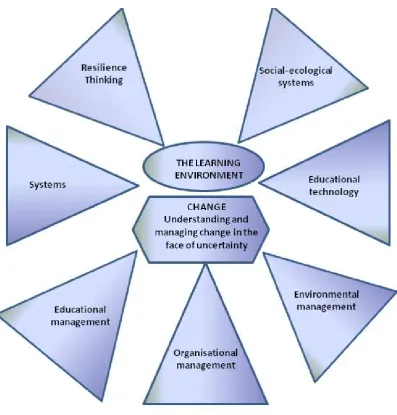
The literature which grounds this research is wide-ranging and draws from a number of disciplines. A conceptual map of the literature which informed the research is illustrated in Figure 2.1. The central kernel of the literature map shows the intersection of the literature and depicts what became the final focus of the study: the focus on the learning environment and that of understanding and managing change in the face of uncertainty. The many areas of literature which informed the study are depicted as shards of knowledge. The representation is generalised and there is no quantitative distinction in the size of the shards. However, the
convergence of the shards towards a central focal point is significant because it demonstrates the common elements and contribution made to the study from a variety of fields of knowledge.
Figure 2.1. Conceptual map of the literature which grounds the research.
The decade of the 1990's saw the massification and diversification of Higher Education and a consistent worldwide reform agenda for the finance and
management of universities (Johnstone, 1998). This included countries disparate in wealth and political-economic systems. Five themes were noted in Johnstone’s 1990's reform agenda:
1. expansion and diversification;
2. fiscal pressure - measure in low and declining per-student expenditures, overcrowding, low-paid faculty, lack of academic equipment;
4. the demand of greater accountability - on the part of institutions, faculty, on behalf of students, employers;
5. the demand for greater quality and efficiency, more rigor, more relevance and more learning.
These are all aspects that still resonate today (Bradley et al., 2008).
Private sectors continued to grow in some countries with market-responsive learning taking place. Entrepreneurship on the part of institutions, the faculty and departments was growing. It was noted that the quest for productivity and efficiency was dominated by cost considerations rather than by outputs or learning.
An early warning on the use of technology in higher education was given by Johnstone in his worldwide review. He noted that there is a risk that “technology continues to be incorporated by individual faculty, mainly as ‘add-ons’ to
conventional teaching and curricula, without the accompanying changes in the instructional production function that are required to realize useful productivity gains” (Johnstone, 1998, p. 28). There was widespread recognition that the learning (or pedagogy) should drive the implementation of technology, not technology drive the learning.
The Bradley Review of Higher Education in 2008 (Bradley et al., 2008) underpinned the direction of Australian Higher Education for the duration of this research.
The review was established to address the question of whether this critical sector of education is structured, organised and financed to position Australia to compete effectively in the new globalised economy. The panel has concluded that, while the system has great strengths, it faces significant, emerging threats which require decisive action. To address these, major reforms are recommended to the financing and regulatory frameworks for higher education (Bradley et al., 2008, p. xvii).
the cap on university fees and removing the cap on enrolments and funding on the basis of student demand finally became a reality in 2012.
The Bradley Review had a mixed reception. Across the higher education sector there were early concerns about funding for the different initiatives. The (then) Deputy Prime Minister and Minister for Education, Julia Gillard, noted that “Budgetary constraints will affect the immediacy of our response. We can’t implement it all today or tomorrow.’ (Holden, 2008).
Diana Oblinger, President and CEO of EDUCAUSE put forward some
“Questions for the future” in an article that was the result of global collaboration on the future of higher education (CAUDIT, JISC, SURF, and EDUCAUSE 2010). The following extract sets the global context for this study.
[T]he Council of Australian University Directors of Information Technology (CAUDIT, http://www.caudit.edu.au/), the U.S.-based EDUCAUSE
(http://www.educause.edu/), the United Kingdom's Joint Information Systems Committee (JISC, http://www.jisc.ac.uk/), and the Netherlands' SURF
foundation (http://www.surffoundation.nl/en/) undertook a collaborative
visioning of the future of higher education. Although information technology is the focus of all four of these associations, the resulting white paper (from which this article is drawn) explores higher education overall, not just information technology. The value of information technology lies in the activities it supports, which span virtually every college and university system for managing finances, learning, research, security, sustainability, and more. IT professionals thus need to understand the larger issues faced by their
institutions: the drivers of change and the enablers, themes, and questions for the future (Oblinger, 2010, p. 44).
Oblinger (p. 44) also notes that higher education is;
the Netherlands differ in many ways, similar forces are driving change in higher education in all four countries.
To enable higher education institutions to respond to a rapidly changing landscape, over the years there has been a call for moves into a variety of areas. There have been moves into flexible learning (Scott, 2003), blended learning, e-learning (online e-learning), more recently the focus has shifted to mobile e-learning (m-learning) and mass education in the form of Massive Open Online Courses
(MOOCs).
In the late 2000’s there was an increasing focus on innovation as a
distinguishing factor in the competitive higher education environment. The types of innovation being courted were widespread and included: innovation in teaching approaches (Childs, Brown, Keppell, Hard, & Hunter, 2011; Hannan, 2005); learning and teaching spaces (Keppell, Souter, & Riddle, 2012) and leadership and
management approaches (Bates & Sangra, 2011; Philip Uys & Tulloch, 2007).
There is increasing, repetitive recognition that the sustainability of innovation and constant change at a variety of levels in the higher education sector needs to be addressed. The term sustainability in its broadest sense seems to reoccur whenever there is widespread interest in a new model or mode of learning and teaching, or a new wave of technology. This is often highlighted in the themes of special editions of professional journals or conferences for professional organisations.
The themes of professional conferences in the area of higher education management and educational technology from 2010 to 2012 give an indication of some of the pressing issues facing the higher education sector. Current research contributing to solutions to some of those issues and where the priority areas for research and action could lie in the years ahead in this field are documented in the conference proceedings.
• Ascilite 2010 conference – “Curriculum, technology and transformation for an uncertain future.” (Available from
• DE HUB/ODLAA Summit 2011 – Education 2011-2021. “Global challenges and perspectives of blended and distance learning.” (Available from
http://www.dehub.edu.au/summit2011/. Accessed 8 March 2013)
• Association for Learning Technology UK 2011 conference – “Thriving in a colder and more challenging climate.” (Available from
http://www.alt.ac.uk/altc/alt-c-2011 . Accessed 8 March 2013)
• 2011 CSUed Conference – “Transforming University education: Developing a Culture of Collaboration, Integration and sustainability.” (Available from http://www.csu.edu.au/division/landt/csued Accessed 8 March 2013)
• Tertiary Education Management Conference 2011 conference – “Riding the Waves” (Original conference web page unavailable. http://temc.org.au/)
• The Ascilite 2012 conference presentations reflected on “Future challenges, sustainable futures” with this background to the conference theme:
Waves of global uncertainty coupled with local crisis and government reforms are reshaping the tertiary education landscape. In the backdrop of these
challenges new digital technology is enabling new models of teaching and learning. Yet, serious questions remain over the sustainability of these new models and the claims about the potential of new technology, especially in the face of deeper challenges (http://www.ascilite.org.au/index.php?p=conference).
These national and global challenges for higher education sector impacted on Charles Sturt University which, as a regional university, was responding to the external changes during the implementation of a new University Strategy.
2.2. The Learning Environment
current management approaches do not adequately address the needs of the learning environment, in particular the technology-enhanced learning environment.
The term learning environment is liberally used throughout the educational literature from school (K-12) to higher education levels (Brown & Adler, 2008; Hall, Ramsay, & Raven, 2002; Henning & Van der Westhuizen, 2004; Victoria, 2006) and within organisational policy (Charles Sturt University, 2006; Hannan, 2005). Perhaps the only commonality in its definition being that everyone has their own
understanding and perception of the learning environment - within their own context. At its simplest, the learning environment has been described as the “place” within which learning takes place (Confessore & Kops, 1998; Gourley, 2007).
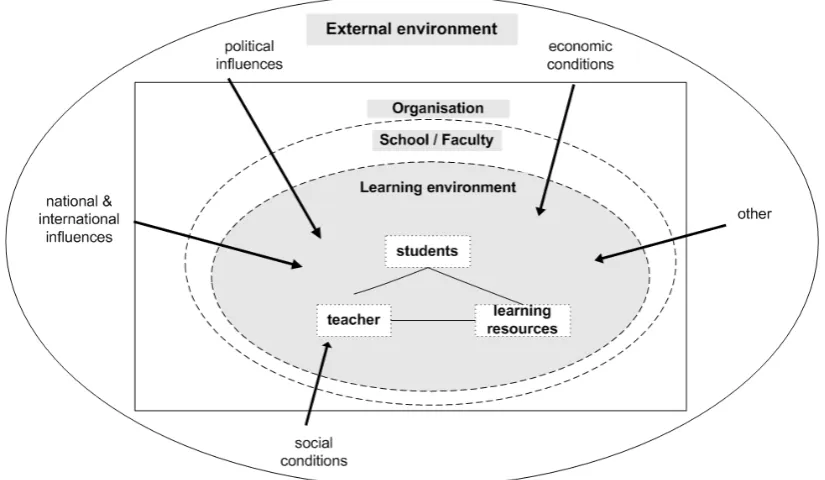
Early attempts to visualise the institutional learning environment were made during exploratory research into the application of adaptive management (Buchan, 2004; Buchan & Buchan, 2003). That early research into adaptive management matured to underpin this research. The model of the learning environment, developed in an exploratory study, depicts the relationship between the learning environment and the different impact levels within the organisation and the external environment (see Figure 2.2). The model provides a way for managers to understand their sphere of influence, with attendant limitations, in the institution. The sphere of influence for the Vice-Chancellor is the whole organisation - the University. For a Dean it is the Faculty, for a Head of School it is the school, while for the lecturer it might be the (virtual) class or subject/course.
For lecturers, those elements of the learning experience under their control can positively influence the way students approach their study and the consequent
Figure 2.2. Model of the learning environment. (Buchan, 2008b, p. 102).
These early representations of the interactions in the learning environment are consistent with more recent research into learning environments where the focus is on more than the physical or virtual space but has a focus on tools and infrastructure. Cheers, Eng and Postle (2012) put forward an experiential space as a learning
environment where there is a call for an emphasis on interactions. Jones (2012, p. 104) describes networked learning environments as; “the totality of surrounding conditions, mediated by digital networks, within which education or learning can take place”.
At the start of this research in 2007 the implications of the application and use of educational technology in envisioning alternative learning spaces, not just
different approaches to learning, were only just beginning to be understood. To some extent practitioners were only just coming to grips with applying educational
Although the term “environment” is used in connection with “learning”, in the literature, there does not appear to be much deliberate combining of the terms into the term learning environment. References to the learning environment are
numerous, loose and inconsistent in recent publications on learning spaces (C. Jones, 2012). The term learning environment is often separated from the learning space (Rafferty, 2012). While this is not necessarily a problem, it is important to this research to understand and validate the position of the learning environment within the context of the research.
Barron’s learning ecology framework draws on ecological perspectives as well as constructs developed from socio-cultural and activity theory, where learning ecology is defined as the set of contexts found in physical or virtual spaces that provide opportunities for learning (Barron, 2006). Each context is comprised of a unique configuration of activities, material resources, relationships, and the interactions which emerge from them. “An ecology is basically an open, complex, adaptive system comprising elements that are dynamic and interdependent. One of the things that makes an ecology so powerful and adaptive to new environments is its diversity” (Brown, 2002).
Brown’s work focuses on the World Wide Web as a transformative learning technology. Written in the relatively early stages of the widespread use of the internet as a learning medium, Brown’s work was visionary and theoretical. Other key aspects include the potential role of how knowledge is created (tacit and explicit) and the notion of distributed intelligence. This leads into the description of the technology-enhanced learning environment in the case.
The Technology-Enhanced Learning Environment 2.2.1.
2009). The term managed learning environment has been used to describe the institution-wide IT systems which support learning and teaching (Conole, White, & Oliver, 2007).
Secondly, there is the broader, learning space and interaction view where technology-enhanced learning refers to the support of any learning activity through technology (Browne et al., 2010). The technology-enhanced learning environment can refer to any setting where technology is integrated into learning and instruction and is used to enhance the learning experience of a user (Mckenzie, 1998; Spector & Davidsen, 2000). The preferencing of terms such as e-learning and online learning has been purposefully avoided in this study because those terms focus more specifically on the pedagogical aspects of the approach to designing the learning experience (Richardson, 2002). Given the rapidly changing technology in education, debate over the semantics of such terminology is also best avoided. This research has a somewhat more fundamental and practical focus, that of the management of the technology-enhanced learning environment and the support of learning activity through technology. The learning experience and particular pedagogical approaches are just one part of understanding the whole learning environment (Centre for the Advancement of Teaching and Learning, 2007).
Although widely used the term technology-enhanced learning environment or TELE, is a manufactured term and like many of the terms associated with
educational technology; e-learning, online learning, computer-based training (CBT) , computer assisted assessment (CAA), it is likely to date. It does, however, reflect most closely the role of educational technology in the case. A definition for technology-enhanced learning (TEL) which has been widely used in longitudinal surveys is: any online facility or system that directly supports learning and teaching (Browne et al., 2010). This facility may include a formal virtual learning
“Learning technology is the broad range of communication, information and related technologies that can be used to support learning, teaching, and assessment” (Association for Learning Technology, 2013). The distinction is made here between educational technology, also referred to as learning technology and information technology (IT) systems and software.
While students and staff may not make a distinction between a software application or system used for course administration or one specifically for teaching or designing and creating learning experiences, this distinction is emerging as an important practical consideration in the broader scheme of institutional support and management of technology-enhanced learning environments (Conole, White, et al., 2007; Goldstein, 2004; Jackson, 2007; Padron, 2008; Philip Uys & Tulloch, 2007). The increased dependence of users of educational technology on core IT systems and hardware and wireless connections is not to be underestimated. For example, Koester (2011) reports a nearly 95 percent increase in the number of unique wireless users on their California campus compared with a year earlier.
Charles Sturt University has a high portion of distance education (DE)
enrolments making up approximately two thirds of its students. Historically, delivery of its DE courses was through print resources with increasing online support of subjects from the late 1990’s onwards. In order to take into account the variety and changing modes of delivery and presentation of digital media at the university over the time period of the study, the definition of the technology-enhanced learning environment applied in this research was necessarily broader than “online”. The definition to be used is:
Technology-enhanced learning environment - The environment in which learning that is supported and facilitated by technology takes place. At the start of this research in 2007 the concept of personal learning
and continues today (Mott, 2010; Sclater, 2008). The evolution in thinking in the personal learning environments has continued apace, consistent with the rapid growth in technology supporting social-networking. It has moved away from the tools to settle on what happens in the environment, that is, the interactions and the learning. Of interest in this research, with its focus on the nexus of organisational management and the learning environment, is the early promise of personal learning environments for knowledge development and sharing in the domain of
organisational learning. Personal learning environment applications were perceived to have the potential to develop organisational learning within the enterprise
(Attwell, 2007).
Looi (2000) uses the metaphor of a learning ecology to examine the phenomenon of learning on the internet. Looi notes that learning is a process “in which learners construct knowledge and negotiate meanings together” and draws attention to the community focus by using the ecological term population.
“Ecological theory focuses on populations, not individuals, and on the dynamics of the relationship between populations and environment” (Looi, 2000, p. 57). The Web is seen as an information space in the pre-Web 2.0 era in which the article was written.
Finally, George Siemens’ theories and work on connectivism gives some grounding for understanding the processes of learning and draws a link between complex systems, complexity and the learning environment. Connectivism is the integration of principles explored by chaos, network and complexity and self-organization theories. Siemens contests that learning is a process that occurs within environments of shifting core elements, not entirely under the control of the
individual and that the connections that enable us to learn more are more important than our current state of knowing (Siemens, 2005).
2.3. Management
management: educational management, organisational management environmental management and change management. Ackoff notes that:
Managers are not confronted with problems that are independent of each other, but with dynamic situations that consist of complex systems of changing problems that interact with each other. I call such situations messes…Managers do not solve problems, they manage messes (Russell Ackoff, quoted in
Meadows, 2009, p. 1).
On the surface this appears as a flippant observation, but is very relevant to this work where the connections between management, changing or dynamic institutional situations and complex systems will become apparent.
Educational Management 2.3.1.
Educational management studies (EMS) is a field of study and practice concerned with the operation and management of educational organisations. It provides a source of research relevant to university management challenges posed in this study. The literature is broad-scoping and includes educational management, administration and leadership. A key reference in this field includes the Journal of Educational Management and Leadership (formerly Educational Management Administration & Leadership).
leadership and Australians tend to use these terms loosely and interchangeably (Bush, 2006).
In the early days at least, the EMS field functioned primarily as a
recontextualising field whereby texts and discourses from other fields; most notably business management studies, industrial psychology and the political-administrative fields, were interpreted, reordered and recreated as texts and practices for, and in, educational institutions. Some of the problems noted were that the types of models finding their way into educational management; for example total quality
management, reengineering and leadership, and terms such as Human Resource Management and competitive edge, have their origins in the field of production. By appropriating the discourse from the fields of production and from the political-administrative field the values of those fields was absorbed “and from which it is difficult to engage” (Fitz, 1999, p. 315). While the studies of management models may bring about the promise of improvement and may offer processes to make an organisation run more efficiently, the discourse of values has important implications for this research.
The decision to explore environmental management strategies in this study was premised on the assumption that there is intrinsic value in the learning environment, thereby promoting a focus on the learning environment. This is explored in Study 1, Part 1 (see Chapter 4: Study 1, Part 1 - Describing the Contemporary Technology-Enhanced Learning Environment).
The research also challenges institutional managers to consider different approaches to management - approaches which have their origins in a different field with different discourse and values.
Organisational Management 2.3.2.
Higher education institutions support an organisational environment so an understanding of the structure, processes and peoples’ thinking in that environment is useful in order to respect existing good practice and to look for ways to improve the management of the technology-enhanced learning environment. The literature around organisational management relevant to this research includes organisational learning, continuous improvement processes, evidence-informed management and change management.
There is little consistency in the use of the terms organisation and institution in the literature around university management (Bacsich & Pepler, 2008; Benson & Palaskas, 2006; Bush, 2006). The distinction in how the terms are used in this dissertation is made on the semantics of the context. Organisation will be used mainly in the more generic context and to distinguish the business origins/focus of the university. Institution will be used in a more specific context and to draw the focus back to the educational context of the university, reflecting the origins of educational institutions as enduring social structures.
Historically, management and organisational studies arose out of a need to provide greater efficiency for the manufacturing and mining sector. Chester Barnard was the father of organisational theory (circa 1938) and sired the birth of
organisational science through scholars like James March, Richard Cyert and psychologist Herbert Simon. Contributors to the human relations school of organisational analysis included Chris Argyris, Douglas McGregor, Keith Davis, William Whyte, Azalesnik and F Herzberg (Keller, 1983).
Management is “the study – and actual direction – of organizations other than the comprehensively political, i.e. organizations outside those with the monopoly use of coercive power” (Keller, 1983, p. 40). Management was originally associated with business and commerce but in the 1970’s and 1980’s there was a move away from the industrial origins of management and servicing companies, to servicing
concern for all universities and colleges. In dealing with the emerging needs of management in organisations whose core business is the provision of educational services, Keller (1983, p. 44) notes that the existing management practices were not only inadequate, but provided significant challenges.
The authority needed is not the old kind of giving orders but one that decides on term realistic objectives, devises shrewd strategies, and defines long-term goals towards which members …can work…Management has not yet considered in any depth what is involved in managing an organisation heavily populated with people whose prime contribution consists of intellectual effort.
The challenges remain today, although there have been a nu