Proceedings in
System Dynamics and Innovation in Food Networks 2016
The Measuring the Efficiency of Food Chains – Selected Approaches
1Sebastian Jarzębowski
2, Agnieszka Bezat-Jarzębowska
32Warsaw University of Life Sciences, Nowoursynowska Street 166, 02-787 Warsaw.
3Institute of Agricultural and Food Economics – National Research Institute, Świętokrzyska Street 20, 00-002
Warsaw
ABSTRACT
The aim adopted in the paper is to review methods for assessing the efficiency of supply chains and to carry out their critical evaluation. Literature studies, interviews, analysis of processes in the chains are used for analyzing of interdependence between the individual stages of supply chain and identifying the efficiency of entire supply chain. An important aspect is to determine the possibility of assessing the efficiency of supply chains in selected sectors of agribusiness by using approaches presented in the paper. Within the analyzedmethods, the stochastic frontier approach can be an useful tool for estimating the efficiency on the firm level. However, the efficiency scores obtained from estimation of the stochastic frontier have a little use for policy implications and management purposes if the empirical studies do not investigate the sources of the inefficiency. Thus, it is recommended to include into the models external factors like, for instance, the degree of competitive pressure, the ownershipform, various managerial characteristics, network characteristics and production quality indicators of inputs or outputs.
Keywords: supply chain management;food supply chains; efficiency
1.
Introduction
One assumes that in competitive market equilibrium the price is fixed for producer-processor. In this
situation enterprises operating on a competitive market seek possibilities for maximization of expected profit by increasing production. The increase in production contributes to economic growth and thus to the growth of overall economic welfare. But on most of markets in countries with a high GDP per capita (eg. countries of Western Europe or North America) the rate of production growth in a sector is determined by
low demand increment.4
1Research granted by National Science Centre from the funds for science in years 2011-2014 as a scientific project no
2011/01/B/HS4/02612 Degree of integration in supply chain and efficiency of food processing enterprises.
Therefore, the low growth rate of demand must determine the change of
efficiency-based relations treated as a main growth factor in the sector. Thus, the Authors believe that not
the increase ofinput factors but the efficiency of its use is the main factor of producers’ competitiveness
that is expressed by the ability for long-term and effective growth and performance. To sustain long-term
growth and profitability in a competitive environment, industrial enterprises must continuously improve
their efficiency (Sudit, 1995). The search for potential improvement of efficiency has also been spurred on by
the realization that not only does single enterprise compete against each otherbut also entire supply chains
(Christopher, 1992). Taking into account the interactions occurring between the different stages of the supply chain and the structure of activities within and between companies is critical for the efficiency of the entire supply chain. Therefore questions concerning the measurement of efficiency are increasingly important. Methods for process improvements are mostly developed and introduced by practitioners, however many of them use simple techniques rather than analytical methods. The performance measures used in most companies have several problems that prevent them from effectively measuring supply chain performance. Many measures identified as supply chain metrics are actually measures of internal logistics
operations such as fill rate, lead time, on-time performance, damage and responsiveness (Gilmour, 1999)
4Researches confirm that a given growth of demand for agri-food products, occurring at aspecific time, determines also the output growth
and are not the multi-firm measures that are necessary to measure the performance of the supply chain
(Beamon, 1989). Therefore there is a strong demand for methods of efficiency assessment and analyzing of
benchmarking results, which can be used for design, analysis and improvement of processes in the supply
chains. The supply chain must be viewed as one entity and any measurement system should span the entire
supply chain (Holberg, 2000). Nevertheless, a review of the literature shows that there are not many
applications of the methods for efficiency assessment in the area of supply chain management(Reiner and
Hofmann, 2006). More research is needed to develop supply chain metrics and to overcome the
implementation barriers (Cooper et al., 1997).
Within the framework of the paper selected approaches of efficiency assessment of supply chains are analyzed and their critical evaluation is carried out (see the section 3.). In addition to the literature studies an interview in form of consultation with Prof. Douglas Lambert (USA) is conducted. As an outcome of the paper the considerations of possibility of assessing the efficiency of supply chains in selected sectors of agribusiness by using approaches presented in the paper are included (see the section 3.).
2.
Characteristic of food supply chain
The process of food production, that takes place in each national economy within the framework of its subsystem known as food economy, is the point of reference in the agribusiness chains (Grabowski, 1998).
According to A.Zalewski(1989), food economy is among the most important and the most complex segments
of the national economy. It covers the whole process of material production associated directly and indirectly with food production and distribution. It consists of manufacturing the means of production for agriculture,
agriculture and food industry. According to A. Woś (1998), the concept of the food economy is a term that
preceded the development of the theory of agribusiness and was used for the determination of related links of
the national economy,which are directly and indirectly involved in food production and distribution.
Food production and distribution are one of the key conditions for functioning of the agribusiness. The way and principles of food movement from the farmer to consumer are determined by agribusiness links
that form the food chain. F. Tomczak (2004) states that the food chain provides the food supply from the
farm gate to the consumer, transforming agricultural raw materials into products that may be easily purchased, prepared and consumed. The chain includes purchasing, processing, distributing companies as well as food service companies and retail traders, and as a result of the overall transformation and economic
needs it is constantly changing and being developed.
Different types of entities may be distinguished within the structure of the food chain (Lazzarini et al., 2001), namely: agriculture, food industry, wholesale and retail trade. In the literature, one can also find other systematics. On the basis of literature review it was stated that the structure characterizing the food supply chains should include agriculture, purchase and trade of agricultural products, food industry,
wholesale and retail trade and other entities, such as: government institutions, local government
institutions, service providers including providers of means for agricultural production. They are a network of organizations involved, due to relationships with suppliers and customers, in a variety of processes and
activities that create value in a form of products and services delivered to final consumer (Rutkowski, 2004).
The supply chain with respect to food products can be defined as "cooperation in different functional areas of agricultural producers, intermediary companies (trade), processing companies, manufacturing, services
and their customers, between which flow streams of agri-food products, information, and funds"
(Jarzębowski andKlepacki, 2013).
The supply chain can be analyzed by the contribution of individual stages while creating added value. Within the framework of the food supply chain, it may be noticed that in the long term the share of agricultural products in consumers’ budget shows a continuous downward trend. In this context, the reference to an example of the Dutch market has been made, where more and more value added is generated within the stage of processing, trade and services, and less on the level of agricultural production. This trend intensified in the early nineties. Reducing share of farmers in the overall income of the supply chain need not to be directly related to their performance, which is determined rather by return on investment and labor productivity (Ondersteijn et al., 2006).
The observed phenomenon may be a result of significant changes in food consumption. One can
noticed ashift from consumption of fresh products in the direction of processes products and from
consumption at homes towards consumption outside homes. Production of processed food requires the
involvement of the greater part of value added than in the case of fresh products. This shift in the way of
share. The main problem of modern agriculture is that societies become wealthier, while farmers in these
countries are getting poorer. Asstated by A.Czyżewski et al. (2006) added value in the market mechanism is
distributed in such way that most of the gain goes to those who are closest to the consumer. Market redistributes added value depreciating agriculture, thus the government should step into the sphere of
intermodal flows in order to transfer the created and not realized by farmers value added (Kowalski and
Rembisz, 2005). Also capital integration of farmers and processing companies may be a mechanism that counteracts the depreciation (e.g. it takes place in milk processing).
The otherfeature ofthe food supply chainis a product thatis a subject ofspecific safety requirements
designed to protectthe final customer(the consumer).Throughout the food supply chain the adequate level of quality, hygiene and wholesomeness for all intermediate and final products should be provided. Wholesomeness of products should be provided at the beginning of the chain, so on farms, including their
suppliers of inputs and services (Bezat and Jarzębowski, 2011), through tradeand processing (primary and
secondary) to the distribution system, including consumer products, as well as final consumers. Thus,a wide
variety of standards and rulesaffectsthe activities of enterprises in the food chain.Regulations concerning
the quality of agricultural products are the important aspect associated with the specificity of food
processing. The growing requirements of consumers cause that more and more attention is paid to high
quality of these products. At the same time the quality shows a direct relationshipwith the price of the
product andhas a direct relationshipwith the standards(Makarski, 1998).
Furthermore, one of the main elements of food safety is assurance of identifying the origin of the
product which was described in the EU Regulations No. 178/2002 or 1935/2004. The regulation 178/2002
was remitted to lay down the general principles and requirements of food law, establishing the European
Food Safety Authority and lay down procedures in matters of food safety (Regulation, 2002). The
requirement 178/2002 should guarantee the full traceability of food demanding from each stage of supply chain collecting data about products. It obliges companies in the food chain to guarantee the traceability of its products as well as to recall of unsafely products (products recall actions). In this way tracking and tracing of food from the producers to industry and from logistic services to final costumers will be possible (Bezat
and Jarzębowski, 2008). The Regulation has shown that food processing companies should implement a
system that allows the identification of the product from primary production up to final consumers (tracking) and in the opposite direction (tracing). These companies should also, if necessary, share
information about their suppliers and recipients of the relevant services (Regulation, 2002). With the
concept of traceability it is possible to indicate where in the chain some problems occurred.
The central condition is the chain-wide coordination of the data exchange and the tracking and tracing
of the data which should include quantity, type of raw materials, origin (import, country), supplier information, transport and warehousing information. The linking of defined product unities with the accompanying parameters relevant for product and the access possibilities on the suitable information is the basis of the development of traceability systems (Bezat and Jarzębowski, 2008). This is particularly important in supply chains, in which the cargo handling, transport and processing of raw materials (lots of them) are mix with each other frequently. Defining units and size (Traceable Resource Unit) allows tracking goods,
clear differentiating of specific parts and forming new parties arising from the combination of the others.
The implementation of solutions supporting food security covering the entire supply chain is voluntary and depends on the market situation and the structure of companies' customers. However, the recipient
may, depending on their market power, influence the quality policy of its suppliers which are forced to
provide information about the use of manufacturing technologies and their impact on hygiene and quality of
the delivered products. Thus, the assurance of products' wholesomeness is dependent on proper
communication with customers and consumers, and creation of the quality tracking systems is a challenge for the entire supply chain.
3.
Selected approaches of efficiency assessment of supply chain
The selected approaches of efficiency assessment of supply chains, published in leading Journals
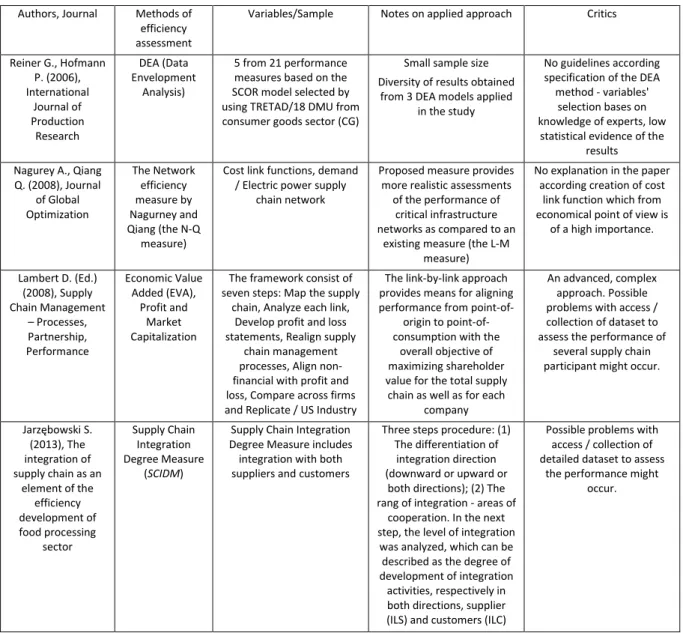
dealing with logistics and supply chain management were analyzed. For each approach the methods of efficiency assessment, variable set and sample ware analyzed and criticized (see Table 1).
Researchers confirm that several performance measures integrated with the best practice processes
must be analyzed (Imai and Itami, 1984]. Implementing a supply chain strategy requires metrics that align
performance with the objectives of other members of the supply. D. Lambert points out that several factors are contributing to management’s need for new types of measures for managing the supply chain including (Kappich, 1989):
• The lack of measures that capture performance across the entire supply chain.
• The requirement to go beyond internal metrics and take a supply chain perspective.
• The need to determine the interrelationship between corporate performance and supply chain
performance.
• The complexity of supply chain management.
• The requirement to align activities and share joint performance measurement information to
implement strategy that achieves supply chain objectives.
• The desire to expand the “line of sight” within the supply chain.
• The requirement to allocate benefits and burdens resulting from functional shifts with thesupply chain.
• The need to differentiate the supply chain to obtain a competitive advantage.
• The goal of encouraging cooperative behavior across corporate functions and across firms in the
supply chain.
The aspects mentioned above could be treated as an advice for researchers working on complex methods for efficiency assessment of entire supply chain.
Tab. 1. Analysis of selected papers on efficiency in the supply chain Authors, Journal Methods of
efficiency
assessment
Variables/Sample Notes on applied approach Critics
Reiner G., Hofmann P. (2006), International Journal of Production Research DEA (Data Envelopment Analysis) 5 from 21 performance measures based on the SCOR model selected by using TRETAD/18 DMU from consumer goods sector (CG)
Small sample size Diversity of results obtained
from 3 DEA models applied in the study
No guidelines according specification of the DEA method - variables'
selection bases on knowledge of experts, low
statistical evidence of the results Nagurey A., Qiang
Q. (2008), Journal of Global Optimization The Network efficiency measure by Nagurney and Qiang (the N-Q measure)
Cost link functions, demand / Electric power supply
chain network
Proposed measure provides more realistic assessments
of the performance of critical infrastructure networks as compared to an
existing measure (the L-M measure)
No explanation in the paper according creation of cost
link function which from economical point of view is
of a high importance. Lambert D. (Ed.) (2008), Supply Chain Management – Processes, Partnership, Performance Economic Value Added (EVA), Profit and Market Capitalization
The framework consist of seven steps: Map the supply
chain, Analyze each link, Develop profit and loss statements, Realign supply
chain management processes, Align non
-financialwith profit and loss, Compare across firms and Replicate / US Industry
The link-by-link approach provides means for aligning performance from point-of
-origin to point-of
-consumption with the overall objective of maximizing shareholder value for the total supply
chain as well as for each company
An advanced, complex approach.Possible problems with access / collection of dataset to assess the performance of
several supply chain participant might occur.
Jarzębowski S. (2013), The integration of supply chain as an element of the efficiency development of food processing sector Supply Chain Integration Degree Measure (SCIDM)
Supply Chain Integration Degree Measure includes integration with both suppliers and customers
Three steps procedure: (1) The differentiation of
integration direction (downward or upward or
both directions); (2) The rang of integration - areas of
cooperation. In the next step, the level of integration
was analyzed, which can be described as the degree of development of integration
activities, respectively in both directions, supplier (ILS) and customers (ILC)
Possible problems with access / collection of detailed dataset to assess
the performance might occur.
Source: own work.
Approaches listed in the Table 1 are described in following sections.
Approach of G. Reiner and P. Hofmann
Within the framework of the paper of G. Reiner and P. Hofmann (2006) a composite measure of the
total efficiency by using DEA (Data Envelopment Analysis) method to identify the "bestpractice" chain was
proposed. Multiple input and output indicators were included in the analysis. The comparable set of data
from different companies was collected on the base of widely accepted industry standard, the Supply Chain
Operations Reference (SCOR, 2012). Within the framework of the analysis 18 enterprises from different
branches of the consumer goods industry (CG) were included and 7 variables were selected by using TRETAD
analysis. One could note that such low number of analyzed objects is unacceptable because of the “curseof
dimensionality”, typical to the nonparametric methods (e.g. DEA), that requires increasing asample in order
to eliminate the significant measurement error and imprecise estimates (for example resulting from large
confidence interval) (Kneip et al., 1998). However, one should bear in mind that a small sample can cause
that a lot of DMUs will be on the frontier, which in consequence will significantly increase the average efficiency ratio (Adler and Golany, 2007). One can observe diversity of results obtained from three DEA models applied in the study. This is so because the efficiency measurements can differ depending on the model specification (input- vs. output-oriented models) and the variable specification (e.g. the degree of
aggregation and the units used to measure inputs and outputs). At the same time – in the context of the
Approach of A. Nagurney and Q. Qiang
Within the framework of the paper of A. Nagurney and Q. Qiang (2008) network
performance/efficiency measure (the N-Q measure) that captures demands, flows, costs, as well as the
behavior of users of the network, was demonstrated. This measure can be applied "to assess the efficiency
of critical infrastructure networks as well as importance and ranking of network components" (nodes and
links). Based on the N-Q measure one can identify which networks components have the greatest impact in
terms of their removal and, hence, which are important from both vulnerability as well as security standpoints. The Authors use the concept of network equilibrium to construct the analyzed network, for which it is assumed that sum of path flows must be equal to the demand, flow on a link is equal to the sum of the flows on the paths which contain that link and the user cost on a path is equal to the sum of users
costs on links which make up the path. Inthe approach presented by A. Nagurey and Q. Qiang (2008) the
demand's value and user cost link functions are assumed to be given which is quite restrictive because demand and cost might vary at different points of time. In the paper one do not find any explanation according to creation of cost link function which from economical point of view is of a high importance.
Approach of the Global Supply Chain Forum
Despite the complexity and overlap existing in most supply chains, managers can develop metrics to align the performance of key business processes across multiple companies. In the research conducted by
the Global Supply Chain Forum in USA a framework that aligns performance at each link (supplier-customer
pair) within the supply chain is proposed. The framework begins with the linkages at the focal company and moves outward a link at a time. The link-by-link approach provides means for aligning performance from
point-of-origin to point-of-consumption with the overall objective of maximizing shareholder value for the
total supply chain as well as for each company. The framework consists of seven steps (Lambert, 2008):
• Map the supply chain from point-of-origin to point-of-consumption to identify where key linkages exist.
• Use the customer relationship management and supplier relationship management processes to
analyze each link (customer-supplier pair) and determine where additional value can be created for the
supply chain. The authors propose the measurement how customer and supplier relationship management (CRM & SRM) affects Economic Value Added (EVA).
• Develop customer and supplier profit and loss (P&L) statements to assess the effect of the relationship
on profitability and shareholder value of the two firms. The authors propose to use acombined
customer-supplier profitability analysis. When the customer P&L are aggregated for all customers and
corporate joint costs deducted, the results represent overall firm performance.
• Realign supply chain management processes and activities to achieve performance objectives.
• Establish non-financial performance measures that align individual behavior with supply chain
management process objectives and financial goals. The authors propose to identify process improvement opportunities. Customer and supplier reports should capture the impact of improved performance in each process.
• Compare shareholder value and market capitalization across firms with supply chain objectives and
revise process and performance measures as necessary. This is the final step in the framework and shows how order fulfillment affects Economic Value Added (EVA).
• Replicate steps at each link in the supply chain. By analyzing the processes at each link and
understanding the value the link creates, managers can align the supply chain management processes in order to provide the best value for consumers and highest profitability and shareholder value for each company.
Managers should assess whether the process changes and metrics employed have produced the targeted levels of profitability and shareholder value. They may need to refine the processes or make additional trade-offs to achieve the targets.
A single inventory turn metric for the supply chain cannot capture the differences that an improvement in turns will have at each level or for the total supply chain. Performance, as measured by total inventory
carrying cost, would be abetter measure since it considers both the cash value of the inventory at various
positions in the supply chain as well as varying opportunity costs for inventory investments for various
inventory backwards in the supply chain towards the point of origin. The further it goes back across the
supply chain, the lower the overall inventory carrying costs for the entire supply chain. Consequently,
inventory turns and other commonly used logistics measures are inadequate for evaluating and aligning performance across multiple companies in the supply chain.
Supply Chain Integration Degree Measure Approach
Within the approach the issue of integration in the supply chain was raised. The Author indicates that
efficiency of enterprise can be increased if there is a strong cooperation within the entire chain. The
integration with environment (external organizations) of the system is also highlighted (acompany is
understood as the system). Cooperation is here the main element of the organizational integration of a
company with environment (Steffen and Born, 1995). The integration is described both in terms of
traditional logistics functions (Gustin et al., 1995) and of removing barriers (or boundaries) between
organizations (Naylor et al., 1999). The need for integration between an enterprise and its environment
increases with the degree of intensification of global competition. In this context, the concept of integration, considered as a key factor in achieving better results by an enterprise, is one of the most important topics in the scientific literature. The aspect of the ownership right plays here an important role. According to
A. Alchian and H. Demsetz (1972), owners of resources increase their productivity – and thus the efficiency
of useof the resources – through cooperative specialization, and this leads to an increase in demand for
various types of organizations supporting cooperation. In the literature one can find arguments indicating
that the integration of resources within a single enterprise is more efficient than making transactions
through the price system (the market). This is confirmed by A.D.Chandler (1977) stating that the internal
organizational coordination triggers higher productivity, as well as it results in reduced costs and higher profits than coordination by the market. The author continues that what economists call “economies of scale” does not come from an increase in the production volume within one plant, but from use of internal
networks between plants within oneenterprise and use of internal coordination (Gruszecki, 2002).
Within the framework of the monograph of S. Jarzębowski (2013) a stochastic frontier approach was adapted to assess the efficiency of the supply chain. In the case of the SFA, it is possible to examine the impact of exogenous variables. In the context of this work, a variable showing the cooperation in the chain
was included into the model. The supply chain integration's degree was constructed. The SCIDM (Supply
Chain Integration Degree Measure) includes integration with both suppliers and customers5
∑∑
∑∑
= = = =⋅
+
⋅
=
k i n j j i k i n j ji
ILS
IRC
ILC
IRS
SCIDM
1 1 1 1
. The
construction ofthe measure of supply chain integrationcan beformulated as follows:
where:
SCIDM – Supply Chain Integration's Degree Measure,
IRS – Supplier Integration Range,
ILS – Supplier Integration Level,
IRC – Customer Integration Range,
ILC – Customer Integration Level,
i – Areas of cooperation, where
i
∈
(
1
,...,
k
)
,j – Integration activity, where
j
∈
(
1
,...,
n
)
.The aspects, that are often highlighted in the literature, were used while constructing the Supply Chain
Integration's Degree Measure, emphasizing their key importance. Within the first element the differentiation of integration direction was made, thus it determines whether there is a downward integration with suppliers or an upward integration with customers or integration in both directions. The
second aspect analyzed the rang of integration - areas of cooperation. In the next step, the level of
integration was analyzed, which can be described as the degree of development of integration activities, respectively in both directions, supplier (ILS) and customers (ILC) within the areas of cooperation defined in
the previous step (the IRS and IRC). The level of integration was measured as the number of activities in the
areas and scope of sophistication of integration practices (in the scale of low, medium and high).
4.
Conclusions
Within the framework of the paper the theoretical background for efficiency assessment of entire
supply chain is analyzed. Based on the presented approaches some implications for modeling of
interdependence between the individual stages of food supply chain and for efficiency modeling of entire food supply chain are included in the paper.
As mentioned in the paper, the low growth rate of demand for agri-food products must determine the
change of efficiency-based relations treated as a main growth factor in the food sector. Within the
framework of the paper Authors indicate that efficiency of enterprise can be increased if there is a strong cooperation within the entire chain. The concept of integration, considered as a key factor in achieving better results by an enterprise, is one of the most important topics in the scientific literature.
The Authors believe that by taking into account the interactions occurring between the different stages
of the food supply chain and the complex structure of activities within and between companies from the agri-food sector the search for potential improvement of efficiency is not the task not only for single enterprises but also for entire supply chains. Therefore the supply chain must be viewed as one entity and any measurement system should span the entire supply chain. Managers need to see the areas where supply chain performance can be improved, so they can focus their attention, and obtain higher levels of performance. Thus, more research is needed to develop supply chain metrics and to overcome the
implementation barriers. There is a need for acollaborative work of managers of entire supply chain on
developing aligned metrics for efficiency assessment. The alignment of metrics enables managers to identify
and institutionalize the organizational, operationaland behavioral changes needed to manage relationship in
the supply chain. Aligned metrics can assist in shifting managers’ focus to attaining the operational goals of the enterprise-wide supply chain.
References
Adler, N., Golany, B. (2007). PCA-DEA. Reducing the curse of dimensionality. [in:] Zhu J., Cook, W.D. (Ed.)
Modeling Data Irregularities and Structural Complexities in Data Envelopment Analysis. New York,
Springer, pp 139-153.
Alchian, A.A., Demsetz, H. (1972). Production, information costs, and economic organization. American
Economic Review, Vol. 62, No. 5, pp 777-795.
Bezat, A., Jarzębowski, S. (2008). The effective traceability on the example of Polish supply chain. [in:] Glauben, T. (Ed.), Hanf, J., Kopsidis, M., Pieniadz, A., Reinsberg, K., Agri-food business: global
challenges – innovative solutions, Halle, IAMO, pp 47-57.
Bezat, A., Jarzębowski, S. (2011).Traceability w łańcuchu dostaw przetwórstwa spożywczego. Logistyka 2, pp
75-84.
Beamon, B.M. (1989). Measuring Supply Chain Performance. International Journal of Operations and
Production Management19(3), pp 275-292.
Christopher, M. (1992). Logistics and Supply Chain Management - Strategies for Reducing Costs and
Improving Services. London, Pitman Publishing.
Cooper, M.C., Lambert, D.M., Pagh, J.D. (1997).Supply Chain Management: More Than a Name for Logistics.
The International Journal of Logistics Management8(1), pp 1-14.
Czyżewski, A., Poczta, A., Wawrzyniak, Ł. (2006). Interesy europejskiego rolnictwa w świetle globalnych
uwarunkowań polityki gospodarczej. Ekonomista 3, pp 350-351.
Figiel, Sz., Rembisz, W. (2009). Przesłanki wzrostu produkcji w sektorze rolno-spożywczym - ujęcie
analityczne iempiryczne. Multiannual Programme 2005-2009, 169, Warsaw, Institute of Agricultural
and Food Economics –National Research Institute.
Frohlich, M.T., Westerbrook, R. (2001).Arcs of integration: an international study of supply chain strategies.
Journal of Operations Management19(2), pp 185-200.
Gilmour, P. A.(1999).Strategic Audit Framework to Improve Supply Chain Performance. Journal of Business
and Industrial Marketing 14(5/6), pp 355-363.
Gruszecki T. (2002). Współczesne teorie przedsiębiorstwa. Warsaw, PWN.
Holberg, S.A., (2000). Systems Perspective on Supply Chain Measurements. International Journal of Physical
Imai, K., Itami, H. (1984).Interpenetration of Organization and Market. International Journal of Industrial
Organization 4, pp 285-310.
Jarzębowski, S. (2013), Integracja łańcucha dostaw jako element kształtowania efektywności sektora
przetwórstwa rolno-spożywczego. Warsaw, SGGWw Warszawie.
Jarzębowski, S., Klepacki, B.(2013). Łańcuchy dostaw w gospodarce żywnościowej. Zeszyty Naukowe SGGW
w Warszawie, Ekonomiki i Organizacja Gospodarki Żywnościowej 102, pp 107-117.
Kappich, L.(1989).Theorie der internationalen Unternehmenstätigkeit. München, VVF.
Kneip, A., Park, B.U., Simar, L.A. (1998). Note on the Convergence of Nonparametric DEA estimators for
production efficiency scores. Econometric Theory 14, pp 783-793.
Kowalski, A., Rembisz, W. (2005).Rynek rolny i interwencjonizm a efektywność i sprawiedliwość społeczna.
Warsaw, Institute of Agricultural and Food Economics–National Research Institute.
Lambert, D.M.(2008). Supply chain Management: Processes, partnerships, performance. 3rd Edition, Supply Chain Management Institute, Sarasota.
Lazzarini, S., Chaddad, F., Cook, M.(2001). Integrating supply chain and network analysis: the study of net
chains. Journal on Chain and Network Science 1 (1), pp 7-22.
Makarski, S. (1998).Funkcjonowanie rynku rolno-żywnościowego, Lublin, UMCS.
Nagurney, A., Qiang, Q. (2008). A Network Efficiency Measure with Application to Critical Infrastructure
Networks. Journal of Global Optimization 40, pp 261-275.
Naylor, J.B., Naim, M.M., Berry, D. (1999). Leagality: Integrating the lean and agile manufacturing paradigms
in the total supply chain. International Journal of Production Economics 62(1-2), pp 107-118.
Ondersteijn, Ch., Wijnands, J., Hurine, R., Kooten, O. (2006). Quantifying the agri-food supply chain.
Dordrecht, Springer.
Reiner, G., Hofmann, P. (2006). Efficiency analysis of supply chain processes. International Journal of
Production Research 44(23), pp 5056-5087.
Regulation, (2002). Regulation (EC) No 178/2002 of the European Parliament and of the Council of 28
January 2002 laying down the general principles and requirements of food law, establishing the
European Food Safety Authority and laying down procedures in matters of food safety, 2002,
available at: http://eur
-lex.europa.eu/LexUriServ/LexUriServ.do?uri=OJ:L:2002:031:0001:0024:en:PDF
Rutkowski, K. (2004).Zarządzanie łańcuchem dostaw – próba sprecyzowania terminu i określenia związków z
logistyką. GMiL 12.
SCOR, (2015).Supply Chain Council. Available online at: http://www.supply-chain.org (accessed September 2015).
Steffen, G., Born, D. (1995). Prowadzenie gospodarstw i przedsiębiorstw wrolnictwie [Betriebs- und
Unternehmensführung in der Landwirtschaft]. Warsaw, Książka i Wiedza.
Stock, J.R., Lambert, D.M.(2001).Strategic Logistics Management. 4th Ed., Burr Ridge, IL, Mc-GrawHill Irwin,
pp 187-221.
Sudit, E.F. (1995). Productivity management in industrial operations. European Journal of Operational
Research 85(3), pp 435-543.
Tomczak, F. (2004), Od rolnictwa do Agrobiznesu. Transformacja gospodarki rolniczo-żywnościowej Stanów
Zjednoczonych Ameryki Północnej. Warsaw, SGH w Warszawie.
Vickery, S.K., Jayaram, J., Droge, C., Calantone, R. (2003).The effects of an integrative supply chain strategy on customer service and financial performance: an analysis of direct versus indirect relationships.
Journal of Operations Management 21, pp 532-539.
Walker, W.T. (1999). Use Global Performance Measures to Align the Enterprise Trading Partners. [in:]
Anderson, D.L. (Ed.) Achieving Supply Chain Excellence Through Technology. San Francisco, CA:
Montgomery research, pp 287-297.
Woś, A. (1998). Gospodarka żywnościowa. Kompleks gospodarki żywnościowej. [w:] Encyklopedia
agrobiznesu. Warsaw, Fundacja Innowacja.