Creating Educational
Experiences through the
Objects Children Bring to
School
A thesis submitted to the University of Stirling for the degree of Doctor of Philosophy in Education Muriel Logan March 2014
ii
1 RESEARCHING CHILDREN’S BROUGHT-IN OBJECT EXPERIENCES IN A SCOTTISHEDUCATIONAL CONTEXT 5
1.1 Introducing the gaps that inspired this research 5
1.1.1 Research aim and research questions as ways to investigate further 9
1.2 The Scottish early childhood context 10
1.2.1 Scottish policies and guidance as ongoing developments 17 1.2.2 Engaging with the concept of experience 18
1.3 Brief overview of this document prior to moving on to review the literature 20
2 OBJECTS, PEDAGOGIES AND RELATIONSHIPS: PERSPECTIVES IN THE
LITERATURE 22
2.1 Introducing the broader contexts of children’s object research 22
2.2 Objects in educational settings 23
2.2.1 Theorising about objects in a children’s world 23 2.2.2 Contemporary empirical work around children’s objects 34 2.2.3 Studies about objects, children and gender 36 2.2.4 Current Scottish use of object theories in educational settings 37
2.3 Pedagogical practices and theories in early childhood settings 37
2.3.1 19th and 20th Century pedagogical movements 39
2.3.2 21st Century framings of pedagogy 41
2.3.3 Experiential and active pedagogies 43
2.3.4 Socio-cultural pedagogies 48
2.3.5 Postmodern and relational pedagogies 50 2.3.6 Comparisons between these pedagogical practices and theories 53
2.4 Relationships in early childhood settings 56
2.4.1 Home/School relationships 57
2.4.2 Relationships and continuity between pre-school and school 58
iii
3.1 Pragmatism and reality in the making 60
3.2 Dewey’s pragmatism as a philosophy based in scientific understanding 61
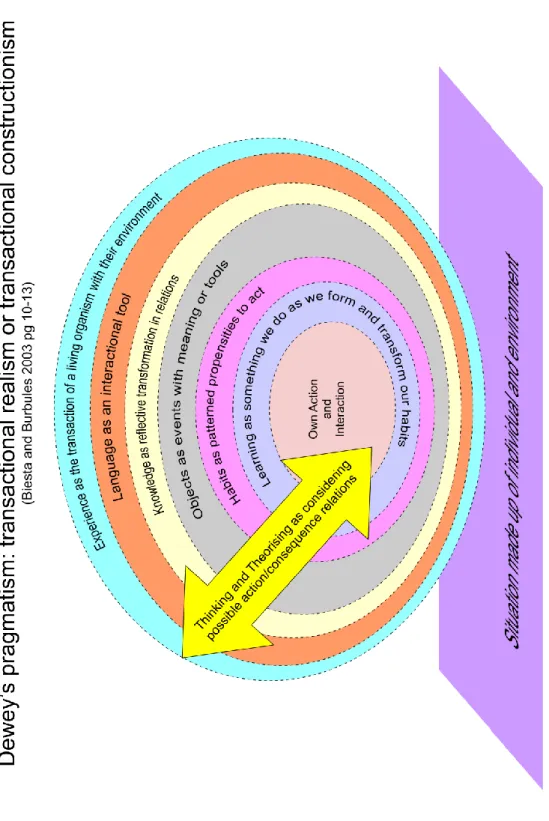
3.2.1 Learning as something we do as we form and transform our habits 64 3.2.2 Habits as patterned propensities to act 66 3.2.3 Objects as events with meaning or tools 67 3.2.4 Situation made up of individual and environment 67 3.2.5 Knowledge as reflective transformation in relations 68
3.2.6 Language as an interactional tool 71
3.2.7 Thinking as the ability to give mental consideration to past and future action and consequence
relations 71
3.2.8 Experience as the transaction of a living organism with their environment 74 3.2.9 The point of Dewey’s philosophical view 75
3.3 Dewey’s view of quality and practitioners’ roles in educational experiences 76
3.3.1 Continuity as essential to an experience’s quality 80 3.3.2 Practitioners’ roles in recognising and developing continuities of experience 83 3.3.3 Interaction as essential to an experience’s quality 85 3.3.4 Practitioners’ roles in developing interactions within experiences 86
3.4 How Dewey’s thinking contributes to this research 88
4 METHODOLOGY AND METHODS: TRANSACTIONAL REALISM AND ITS
APPLICATION TO THIS RESEARCH 91
4.1 Methodology – experimenting with transactional realism 92
4.1.1 Practitioners have agency 94
4.1.2 Practitioners’ roles are evident in what is said and done 95
4.1.3 Knowing is something we do 96
4.1.4 Researching experience 97
4.1.5 Inference and engaging with the “doings” and “sayings” of others 97
4.2 Seeing situations as domains of thoughtful choices for shaping of experiences 98 4.3 Recognising experimental methods as part of Dewey’s framing of how we learn 100
iv
4.3.4 Analysis as pattern recognition within the evidence 115
4.4 Reflecting on methodology and methods prior to moving on to describe the findings 119
5 FINDINGS AROUND CHILDREN’S BROUGHT-IN OBJECT EXPERIENCES 120
5.1 Introduction: Research questions as continuities 120
5.2 Objects children bring to nursery and school 127
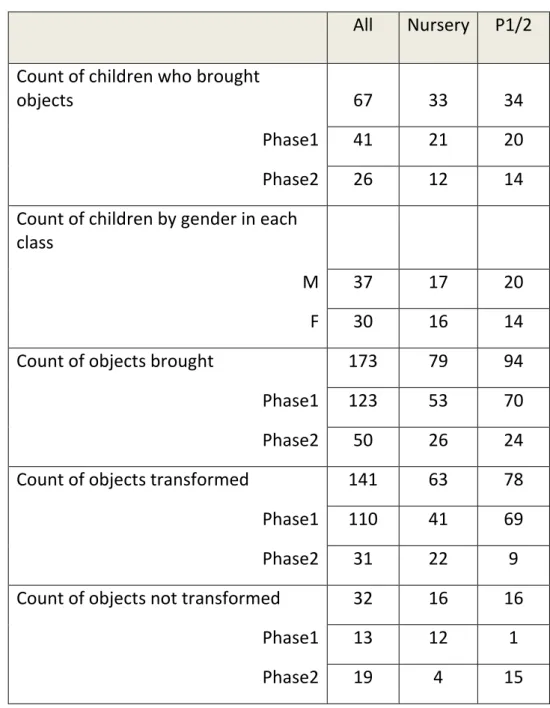
5.2.1 Numbers for brought-in objects 128
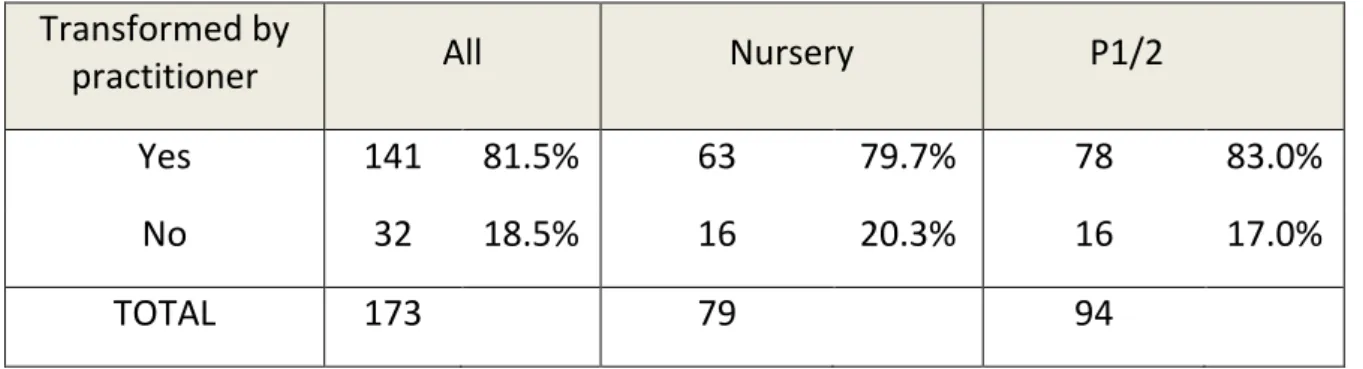
5.2.2 Number of transformed objects 129
5.2.3 Brought-in objects categorised and described 131 5.2.4 Physical and social properties of brought-in objects 134 5.2.5 Summarising the brought-in object findings 172
5.3 Practitioners’ pedagogical responses to objects children bring with them 173
5.3.1 Shared pedagogical practices with objects in both classrooms 179 5.3.2 Specific pedagogical practices with objects in the Nursery 200 5.3.3 Specific pedagogical practices with objects in Primary 1/2 208 5.3.4 Comparing the Nursery and Primary 1/2 patterns of practice with objects 213
5.4 Relationships illuminate similarities and differences in practice purposes 223
5.4.1 Relationships, objects and learning in Nursery and Primary 1/2 224 5.4.2 Relationships between practitioner and child 225 5.4.3 Relationships between practitioners and families 228 5.4.4 Relationships between child and learning/knowledge/curriculum 232 5.4.5 Relationships between child and peers 236
5.5 Reflecting on the three research findings prior to interpreting them 239
6 DISCUSSION: INTERPRETING THE FINDINGS THROUGH DEWEY’S THEORY 241
6.1 Relating evidence to theories: exploring the findings through a Deweyian framework 242
6.1.1 Interpretations of object roles using Dewey’s framing of continuity 244 6.1.2 Interpretations of pedagogical practices using Dewey’s framing of habits 254 6.1.3 Interpretations of relationships and learning through experiences 255
v
6.2.3 Language of experience: tools for thinking and theorising 268
6.3 Implications of this study 271
6.3.1 Developing a language for experiences 271 6.3.2 Supporting a holistic perspective on learning and experience 276 6.3.3 Challenging our assumptions – together 280
6.3.4 Curricularising vs curriculum 282
6.3.5 “Doing” versus “thinking about doing” 285 6.3.6 Reflections on research experience 289
6.4 Final reflections prior to moving on 291
7 APPENDICES 293
7.1 Summary of the Four Capacities underpinning the Scottish Curriculum for Excellence 293
7.2 Participating Practitioner’s Details 294
7.3 Sample of handwritten page of field notes 295
7.4 Sample Classroom Observation Daily Notes 296
7.5 Sample Researcher's Notes 299
7.6 Initial Data Coding 300
7.7 Sample of data recorded for each object 306
7.8 Semi-structured Practitioner Interview Questions 307
7.9 Example of Practitioner Interview Data 308
7.10 Samples of Practitioner Interview Card Sorting Data 310
7.11 Object Brands List 314
7.12 Object Types Summary 317
7.13 Objects Received From Summary 318
vi
Table 1-1: Research aim and research questions 9
Table 5-1: Summary statistics 128
Table 5-2: Number of transformed objects summary 131
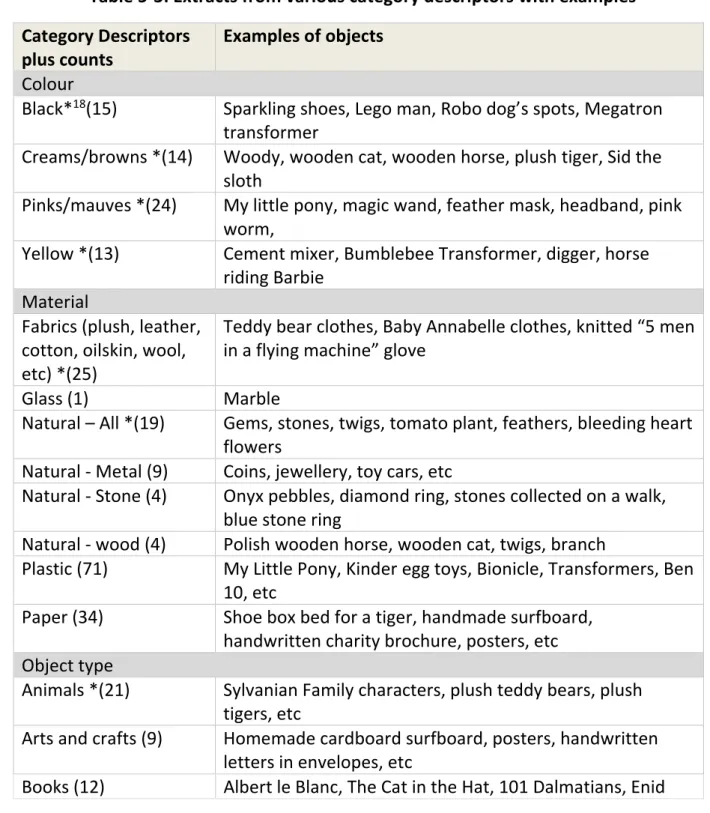
Table 5-3: Extracts from various category descriptors with examples 133
Table 5-4: Object sizes 136
Table 5-5: Examples of largest objects 136
Table 5-6: Examples of smallest objects 137
Table 5-7: Examples of typically sized objects 138
Table 5-8: Object materials 140
Table 5-9: Fabric type 141
Table 5-10: Examples of a gendered length of pile on plush toys 142
Table 5-11: Object textures summary 144
Table 5-12: Object colours 145
Table 5-13: Strong colours on children's objects 146
Table 5-14: Visibly gendered objects summary 148
Table 5-15: Activities associated with girls’ brought-in objects 149 Table 5-16: Activity types associated with boys’ brought-in objects 151
Table 5-17: Nursery boys' branded characters: superheroes 152
Table 5-18: Range of brought-in objects example 1 156
Table 5-19: Range of brought-in objects example 2 156
Table 5-20: Range of brought-in objects example 3 157
Table 5-21: Object sources as mentioned in conversations summary 158
Table 5-22: Mention of speculative history of manufacture 161
Table 5-23: Object brands summary 166
Table 5-24: Examples of texture: natural materials 170
Table 5-25: Examples of object colour: strong colours 171
Table 5-26: Examples of object colour: objects brought by boys 171 Table 5-27: Examples of object colour: objects brought by girls 172
vii
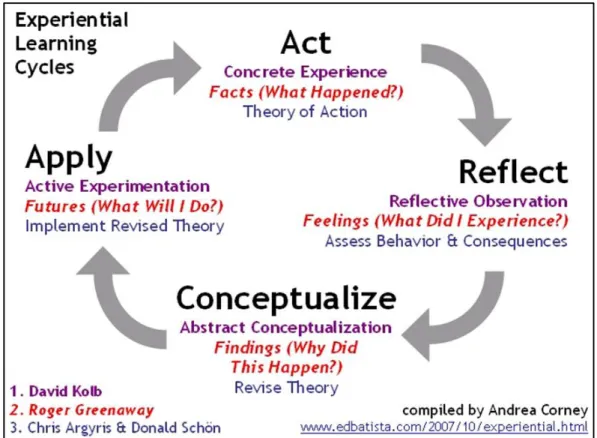
Figure 2-1: Experiential Learning Cycle Examples ... 45
Figure 3-1: Dewey’s pragmatism diagram ... 62
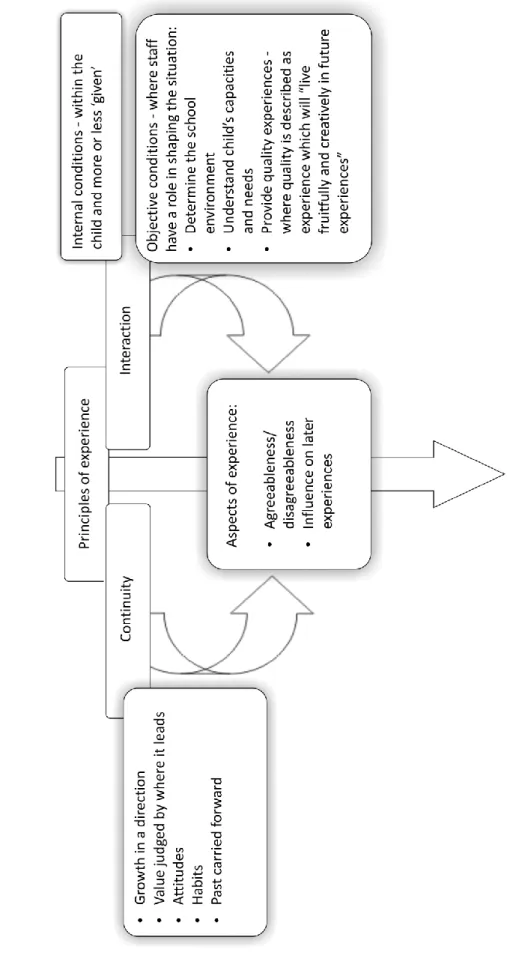
Figure 3-2: Brief Summary of Dewey's View of a Good Educational Experience ... 79
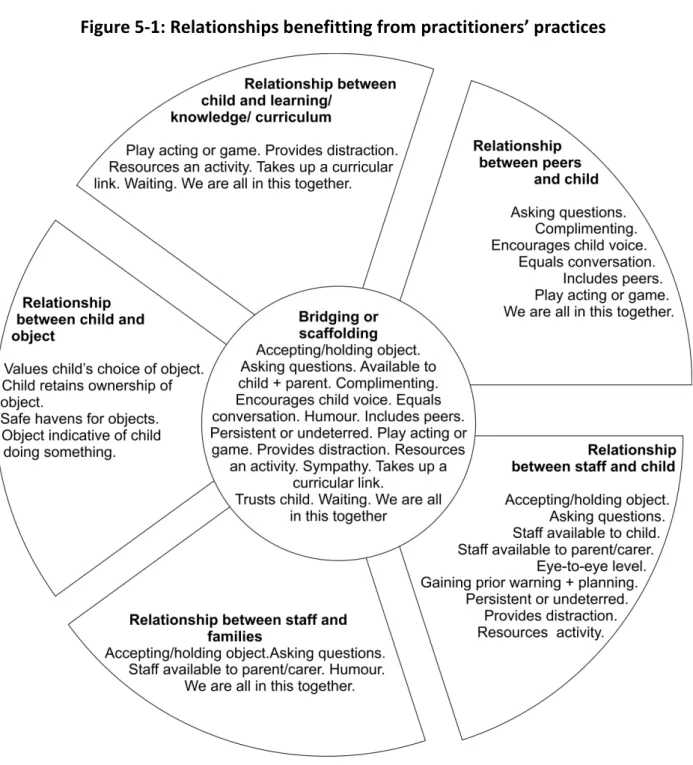
Figure 5-1: Relationships benefitting from practitioners’ practices ... 126
Figure 5-2: Pedagogical practice pathway... 199
Figure 5-3: Example of Nursery Pattern 1: All children apart from older boys ... 201
Figure 5-4: Nursery Pattern 2a: Older boys with conflict then practitioner engagement ... 205
Figure 5-5: Nursery Pattern 2b: Older boys without visible conflict... 207
viii
Image 5-1: A Nursery practitioner’s response to a preliminary findings card sorting
task 125
Image 5-2: Enid Blyton book 130
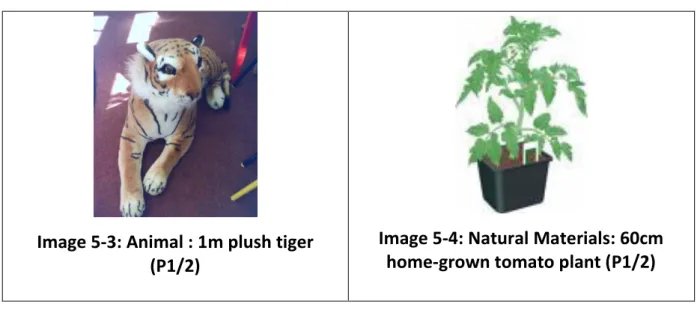
Image 5-3: Animal : 1m plush tiger (P1/2) 136
Image 5-4: Natural Materials: 60cm home-grown tomato plant (P1/2) 136
Image 5-5: Adventure Figures: Minute plastic men (P1/2) 137
Image 5-6: Natural Materials: Onyx pebbles (Nursery) 137
Image 5-7: Natural Materials: Acorn (P1/2) 137
Image 5-8: Money: Tiny golden coins (P1/2) 137
Image 5-9: Action Figures: Power Ranger (Nursery) 138
Image 5-10: Reading: 101 Dalmatians (P1/2) 138
Image 5-11: Girl's toy unicorn with long-piled plush 142
Image 5-12: Boy's more life-like plush toy 142
Image 5-13: Bright green Ben 10 playing cards 146
Image 5-14: Brightly coloured kaleidoscope 146
Image 5-15: Ben 10 rucksack "for our supplies" 152
Image 5-16: Ben 10 alien ship as both "the enemy" and "escape pod" 152 Image 5-17: Pirate “he only has one hand but this hook is COOL!” 152
Image 5-18: Power rangers – “red and yellow means danger” 152
Image 5-19: Power rangers – “pink… guys can do ANYTHING we want” 152
Image 5-20: Power ranger - "red and different" 152
Image 5-21: Toy Story Woody "has lots of friends" 152
Image 5-22: Transformer Optimus Prime - "can change so you can drive home " 152
Image 5-23: Superman "with sounds" 153
Image 5-24: Lego bionicle 153
Image 5-25: Megatron (arm only) - "we can each build our own one" 153 Image 5-26: Transformers Bumblebee - "I can give you a ride" 153
Image 5-27: Batman - "Bats are cool!" 153
Image 5-28: Transformers Bumblebee - "I like to stay in my car" 153 Image 5-29: Ben 10 Omnitrix - "We can turn into anything we want to" 153
Image 5-30: Ben 10 bouncy ball 153
Image 5-31: Ben 10 playing cards - "They're our tickets" 153 Image 5-32: Ben 10 Omnitrix - "Mine will double the strength of yours" 153
Image 5-33: Australian bush hat 156
ix
Image 5-37: "Five little men in a flying saucer" glove 161
Image 5-38: All Blacks Scorecard 163
Image 5-39: Texture: crackling stems and pliable leaves with crisp flowers (P1/2) 170 Image 5-40: Texture: raw egg includes hard, smooth, soft and slimy (P1/2) 170
Image 5-41: Colour: Strong yellow (Nursery) 171
Image 5-42: Colour: Strong red (P1/2) 171
Image 5-43: Colour: objects brought by boys (Nursery) 171
Image 5-44: Colour: objects brought by boys (P1/2) 171
Image 5-45: Colour: objects brought by girls (Nursery) 172
Image 5-46: Colour: objects brought by girls (Nursery) 172
Image 5-47: Plush tiger 177
Image 5-48: Nursery children make their own worms and worm nest 201
Image 5-49: Sylvanian Family Rabbits 203
Image 5-50: Paula’s tomato plant 210
Image 5-51: Wall-E 219
Image 5-52: Pink worms 230
Image 5-53: High School Musical magazine 234
Image 6-1: Superman 284
x
Vignette 5-1: Nancy’s Emerald Ring 123
Vignette 5-2: Ms Patrick and Phoebe’s Enid Blyton book 130
Vignette 5-3: Miss Potter and Preston’s Bag of “Natural Materials” 135 Vignette 5-4: Ms Nesbit and Norman’s Umbro watch “with 55 on it” 160
Vignette 5-5: Ms Potter and Paulo's All Blacks' Scorecard 163
Vignette 5-6: Ms Penny and Parker's Tiger's Lunch 177
Vignette 5-7: Ms Nash and Naomi’s Sylvanian Family rabbits 203
Vignette 5-8: Ms Patrick and Paula’s tomato plant 210
Vignette 5-9: Ms Naplock and Nevin’s ‘Wall-E’ 219
Vignette 5-10: Ms Potter and Paco’s Zeebeez 221
Vignette 5-11: Ms Nesbitt and Natasha’s pink worm 230
Vignette 5-12: Ms Nesbit and Nelly’s High School Musical Magazine 234
xi
This thesis is a presentation of my original research work.
Wherever contributions of others are involved, every effort is made to indicate this clearly, with due reference to the literature, and acknowledgement of collaborative research and discussions.
The work was conducted under the guidance of Dr Christine Stephen and Professor Lydia Plowman, at the School of Education, University of Stirling.
Signature
1
Thanks and Dedication
This project was funded by the UK’s Economic and Social Research Council’s (ESRC) grant/project number ES/F042612/1. It would not have been possible for me to do this research without the ESRC’s funding and support and I am most grateful for their willingness to engage with trainee researchers in ways that help to turn possibilities into realities. In addition, this research would never have been completed without my husband’s bearing the costs of my not earning for the years after the ESRC financial grant ended.
Huge thanks go to the local education authority, practitioners, families and children who agreed to participate in this research. They knew they were taking a step into the unknown and took it anyway. In a culture laced with multiple layers of
compliance the practitioners’ willingness to be open to the presence of a researcher was inspiring and showed a level of commitment to valuable experiences in
children’s lives which is most commendable. It also speaks to a wealth of resources present in the early childhood practitioners in Scotland and to these participating practitioner’s quiet confidence and creativity as they engaged with the challenges of a new curriculum.
In addition, the Stirling School of Education provided a fertile space for ideas. Professor Gert Biesta’s quest to make the opportunities which are possible through theoretical ways of thinking available to all was an essential part of this thesis too. His unerring ability to understand why I was floundering and to connect where I was to various theorists’ views was inspiring even when it left me feeling like a minnow in a sea of predators. In particular, his explanations of Dewey’s views about
educational experiences helped me to see Dewey’s ideas from my own experiences as a teacher who was trying to learn to think like a researcher. His plain English and thoughtful, open-ended responses to my never-ending questions helped me to find
2
ways of thinking and asking questions about what I had seen practitioners engage with in these two early childhood classrooms.
In the beginning all of the ideas were way beyond me. Over time, and with
considerable effort from my supervisors, Professor Lydia Plowman and Dr Christine Stephen, I have been encouraged to try new things and improvise my way toward a way of thinking about what mattered to practitioners in two early childhood
classrooms when children acted on their inclinations to bring objects from their out-of-school lives into school. The efforts my supervisors put into helping me to think in new ways and from different perspectives were both patient and persistent and I am most grateful for their kindness and faithfulness towards me through the ups and downs which were part of my experience as a trainee researcher. In all sorts of ways, I could not have done it without them.
And finally, and in every way possible, I thank my family. Both my mother and my mother-in-law shared their homes with us for two years so that we were able to continue to do what we thought important. My husband, Steve, and my children, Jen and Ali, have made my on-going battles to be an educational researcher part of their everyday lives for the last few years. It is my hope that I have not put my
children off higher education and that when their future opportunities prove difficult I will be able to return the gift of optimism they have given me during this process as well as cook, clean and do their washing for them (they have it in writing now!) The family’s contributions have always been practical as well as emotional: Steve and Jen have proof-read endless versions of the thesis, Ali has been perpetually kind and diffused household tensions with his calm response under pressure and more
recently kept me supplied with wood for the fire, Steve has applied his technical skills to this document’s final layout, converted my rough sketches into graphics, helped me understand Excel’s intricacies as well as made thousands of cups of coffee, paid all the bills, picked me up every time I was ready to quit and reminded me that in this family there is always a loving, Godly way to do the things that matter.
3
Abstract
The Scottish Curriculum for Excellence is framed, without visible theory, in language embedding the value of children’s experiences. In association with a policy
encouraging practitioners to develop healthy home/school links, early childhood practitioners develop pedagogical practices in support of this curricular language of experience. One aspect coming into focus is children’s experiences in general rather than only those which take place within institutional walls. One way children
introduce their out-of-school experiences into classrooms is by voluntarily bringing treasured objects from home to early childhood setting doors.
By jointly engaging with John Dewey’s view that worthwhile educational experiences are developed through interactions and continuities, the pedagogic practices of twelve early childhood practitioners and the view that each child-initiated object episode could be viewed as part of a child’s experience this research aims to better understand practitioners’ development of educational experiences through their responses to the objects forty children voluntarily brought to school. In support of this aim three research questions focused on 1) what objects children brought? 2) what practitioners said and did with the objects? and 3) what practice similarities and differences were visible across two consecutive age groups: 3-5 year olds in a nursery (preschool) and 5-7 year olds in a composite Primary 1/2 class (formal schooling)?
During an eight month period in 2009 data were collected by classroom
observations, collection of photographic images and practitioner interviews in a government-funded, denominational, early childhood setting in a Scottish village school. Data were analysed for the physical and social properties of children’s objects, practitioner’s pedagogic practices when engaging with the brought-in objects and similarities and differences in object-related classroom behaviours as epitomised in the relationships in each classroom.
4
The findings were that practitioners made use of three main pedagogical practices when engaging with children’s brought-in objects: transforming objects into
educational resources, shaping in-school object experiences and building a range of relationships around these objects. While the broad patterns of practice used in both classrooms were similar the details of practice showed underlying framings of children and their futures were different in each classroom.
It is arguedthat what Dewey’s views offer, in the context of these findings, is a theoretical framing of experience that opens new possibilities for practitioner’s individual and group reflections on their current practices and collaborative practice development. His is one of the languages of experience available as practitioners and policy makers around the world grapple with educational questions.
5
1
RESEARCHING CHILDREN’S BROUGHT-IN OBJECT
EXPERIENCES IN A SCOTTISH EDUCATIONAL CONTEXT
1.1
Introducing the gaps that inspired this research
Experience is a key term in Scottish education. It is central in:
both previous curricula (either explicitly or implicitly) for children between three through five (LT Scotland 1999) and five through seven (LT Scotland 2009a) years of age
the new Curriculum for Excellence (with extensive use in assessment
documentation such as LT Scotland 2009c; Scottish Executive 2006a; Scottish Executive 2007b)
curricular guidance documents (Learning and Teaching Scotland 2005) which aim to clarify the role of pedagogy in active learning in the early years and beyond.
Yet, nowhere in these documents, is there any definition, explanation, or theorising of experience apart from mentioning a small number of previous Scottish and international educational luminaries, including Montessori, Piaget and Vygotsky (Learning and Teaching Scotland 2005 p15).
Four studies in particular helped to highlight a gap in the literature to which this research aims to respond. Firstly, Marsh’s (2003) study of young children’s literacy practices found the school influenced home practices by sending reading materials home with little reciprocal influence on school practices from home literacy practices even when children brought books from home into school. This raised the question as to what influence home objects might currently have in a school context.
Secondly, a TLRP study (Hughes 2007) used shoeboxes in a home/school exchange programme to investigate and collaborate on shared “funds of knowledge” for the benefit of children’s literacy and mathematics. While the study found considerable
6
benefit from the home/school exchange, the particular objects exchanged were not necessarily chosen by children and so were more reflective of parent or teacher choices. This suggested there was room to investigate objects children chose to bring to school. Thirdly, Kibele’s (2006 p ix) study looked at the toys children interacted with in a childcare setting and found that, for children, “(T)toy play serves as a key focus for making meaning of the world around them and their place in it” while “(T)the meaning of objects is located not in the objects themselves, but as they are activated.” I interpreted Kibele’s recent focus on young children, and the roles objects played for them, as opening the way for a focus on practitioners’ practices in relation to children’s objects - particularly those objects children chose to bring from home. And finally, Jones et al (2012) described how practitioners who work in early childhood settings make choices as to whether or not to engage with an object which a child voluntarily brings from home to an educational setting. Some children’s objects were welcomed, or treated with “affection”, and others were carefully filtered, or completely excluded and treated as “infection”.
In summary, these four studies suggest gaps in current research of objects used for educational purposes. The gaps include:
1. Objects which go against the norm by flowing from home into school. 2. Objects agentic children choose to bring to school of their own volition. 3. Pedagogical practices in relation to these voluntarily brought-in objects.
In response to these gaps in the research this empirical study used qualitative methods to better understand two main aspects:
1. The objects which 40 Scottish children voluntarily brought to school during an eight month period during 2009.
2. The pedagogical practices of twelve early childhood practitioners as they engaged with objects children voluntarily brought from home into two Scottish classrooms.
7
The three research questions which shaped this investigation were:
1. What objects did children bring?
2. What pedagogical practices did practitioners use when engaging with the objects children brought?
3. What similarities and differences were there between the practices in the Nursery classroom and those in the Primary 1/2 classroom?
In the two classrooms involved in this research, practitioners routinely engaged with children’s voluntarily brought-in objects to develop what they spoke of as “children’s experiences”. This research provides descriptions of three main pedagogical
practices found by focusing on the practitioners’ roles in the practitioner-child-object interactions at the classroom doors and beyond. These practices are 1) transforming children’s voluntarily brought-in objects into educational resources, 2) shaping in-school object-related experiences for children and 3) building relationships. Detailed descriptions of these pedagogical practices in a Nursery1 and a Primary 1/22
composite3 classroom illustrate how the, jointly applicable, Early Level 4 of the
Scottish Curriculum for Excellence5 (CfE) was interpreted via implicit framings of
experience.
Research findings include, in the first place, details of the objects children voluntarily brought. This provides a unique view of a junction between these children’s homes
1 Nursery is the word used in this particular local education authority to mean a preschool provision situated in
a school setting and applies to children between the ages of three to five years-of-age when the school year begins.
2 Primary 1/2 refers to the first two years of formal schooling in Scotland and applies to children between the
ages of five to seven years-of-age when the school year begins. In this research the abbreviation P1/2 is used to refer to the Primary 1/2 group.
3 Composite classes: Where children from what, in a larger school, would be two different year groups are
taught in one classroom by one teacher due to limited classroom space and low numbers of pupils in each year group. This is a relatively common practice is smaller Scottish schools. In this research the composite class included children in Primary 1 (first year of formal schooling) and Primary 2 (second year of formal schooling).
4 Early Level is that portion of the CfE (below) which children between the ages of roughly 3-7 are likely to be
engaged with during Nursery and Primary 1/2.
5Curriculum for Excellence (CfE) refers to the new Scottish curriculum, covering children from 3-18
8
and school education, as well as descriptions of 3-7 year old children’s portable object preferences in a Scottish village in 2009 and the properties of these children’s objects which were useful to practitioners in their shaping of children’s educational experiences.
In the second place, descriptions of the pedagogical practices used by practitioners to shape in-school brought-in object experiences provides detailed accounts of how a similar pattern of practice can be interpreted in two different ways and raises
questions about the role of implicit and explicit theories in shaping joined-up early childhood practices in collaboratively purposeful ways.
In the third place, descriptions of the kinds of relationships practitioners’ interactions with children’s objects developed suggest that while practitioners are skilled
relationship builders with materials and people there may be possibilities to be investigated in building a more complex relationship between practitioners and educational theorising in order for them to be able to describe, frame in a broader context and then defend their practices in collaborative ways.
Some tensions between two cultures of pedagogy are evident when the similarities and differences between Nursery and P1/2 patterns of developing children’s
experiences are considered. A similar pattern of practice was used by all
practitioners to shape children’s interactions with these brought-in objects and to build a range of relationships to support children’s brought-in object experiences by linking children’s out-of-school experiences with in-school experiences. Yet, the tacit theories underlying Nursery and P1/2 classroom practices showed different
approaches to the Early Level of the CfE.
While policy makers might like to imagine education as a plan-and-deliver process (Stephen & Brown 2004 p26) what happened with the objects which these children voluntarily brought from home is representative of the reality of early childhood education: planning is broad, practitioner’s personality and ability to engage on the
9
day matters and much of the day is spent welcoming, then collaboratively
transforming the newly experienced into the further experienced with children who respond in their own individual ways. Education in this creative sense is highly unpredictable, intensely personal and an always messy human endeavour in which children act to learn and engage collaboratively with the world in ways which build their futures. But these intensely personal educational processes, in most Western societies at least, are bounded and shaped by a mixture of public purposes (Moss & Petrie 2002) which include curricular documents, government social policy initiatives, a culture of compliance (Palaiologou 2012) in public services, workforce issues (HMIE 2007; Simpson 2010) and economic pressures. This contested context is subject to additional challenges in Scotland as the CfEreframes practitioners’ roles and opens up further possibilities for collaborative and creative practice development within schools (The Scottish Government 2010a).
1.1.1
Research aim and research questions as ways to investigate further
In summary the research aim and research questions were:
Table 1-1: Research aim and research questions
Research Aim and Research Questions
Aim To better understand the pedagogical practices practitioners used to create educational experiences as children voluntarily brought objects from home into an early childhood setting.
Research Questions
1. What objects did children voluntarily bring?
2. What pedagogical practices did practitioners use to engage with the objects children voluntarily brought?
3. What similarities and differences were there between the pedagogical practices used in the Nursery and Primary 1/2 classroom?
10
1.2
The Scottish early childhood context
Historically, a range of different types of early childhood provisions, from
government funded nurseries to businesses and charities, were responsible for the care and education of children between three and five years of age in what is locally referred to as childcare, nursery or preschool depending on the type of provider. In Scotland a re-framing from childcare to education has been taking place since the late 1990’s (Cohen, Moss, & Petrie 2004 p191). The introduction of a government funded pre-school voucher system, and its associated need to show good quality for its investment, led to a higher degree of interest in the quality of provision for young children (Stephen and Brown 1999). In addition, the Researching Effective Pedagogy in the Early Years (REPEY) (Siraj-Blatchford et al. 2002) study, which was an analysis of pedagogy in settings described as “providers of good practice to children and families” (p10), found that qualified practitioners engaged in more “sustained shared thinking” (p12) and that less qualified practitioners were better pedagogues when supervised by more qualified practitioners. Once children entered school in the year they turned five they were seen as part of a school provision. Increasingly since the introduction in 1999 of A Curriculum Framework for Children 3-5 (Scottish
Consultative Council on the Curriculum 1999) the Scottish early childhood provision has been encouraged to move from a framing as childcare to one of education. As suggested by Cohen et al (2004), in England, Scotland and Sweden “childcare can be educationalised” (p203) by what they refer to as administration, organisation and a range of conceptual questions.
Currently, Primary school education in Scotland is provided by qualified teachers registered with the General Teaching Council of Scotland. In the past, preschools attached to schools included a teacher among their practitioners while most
preschools run as private businesses did not (HMIE 2007). More recently, a few Local Education Authorities have provided a teacher in a consultative role (Powell 2007) for the benefit of private businesses within their region. In response to a number of
11
pressures, including a new government funding arrangement with local authorities which reduced funding and removed the ring-fencing of local education budgets, a number of local education authorities are now providing a shared teacher across a group of preschools rather than employ a full-time teacher in each one (EIS 2008). This shared teacher provision has been the subject of debate within schools and local authorities and a non-supportive reception from the main Scottish teachers’ union, the Educational Institute of Scotland (EIS). It has gone so far as to publish and distribute to all schools a booklet emphasising parents’ statutory rights to insist that their preschool children be taught by a qualified teacher (EIS 2010). However, as those practitioners who are not registered as teachers are currently paid less than those who are, it is unlikely that either preschools run as private businesses or government funded local education authorities will be in a position to fund the cost of a full-time teacher in all nurseries. More recently, the pressures on government funding mean that schools are increasingly looking to practitioners without teacher registration to manage their preschools.
Preschools not attached to a primary school have been largely staffed by adults with a wide range of qualifications. Over time these practitioners have been required to register with the Scottish Commission for the Regulation of Care (SCRC 2010) and to have a specified level of training in order to supervise or manage an early childhood setting. It seems possible that preschools, both those run by a local authority and those operated as businesses, will continue to recruit most of their practitioners with qualifications other than teaching.
The CfE, as the recent statutory curricular reframing process, strengthens the merger of these provisions under its Early Level6 of educational provision. Early childhood
6 Early Level is a term used in the Scottish CfE to describe the first level of the planning and assessment
documentation used to frame and record a child’s educational development between 3-18 years old. It is applied as developmentally appropriate for each child so some children may be working to a higher level while
12
provision covers children roughly aged three through six years of age (in Scotland, preschool through Primary 1) and is framed in a language of children’s experiences and development. This merging of provisions, when seen in the light of Scotland’s almost universal uptake of half-day government-funded preschool provision for children (The Scottish Government 2011) from their third birthday until they enter school, means that almost all Scottish children aged three or four years old plus all of the school-attending five to seven year olds are recipients of pedagogical practices (in support of this Early Level framing of education as well as more broadly
applicable) which are described in curriculum guidance documents as active learning (LT Scotland 2008; Scottish Executive 2007a). In addition, further curricular guidance provides a range of descriptive statements about children’s experiences and
expected outcomes (for example LT Scotland 2009b lists experiences and outcomes for expressive arts). In spite of the large number of children involved, as yet, the tacit theoretical viewpoints which underpin this Early Level are largely undisclosed (Stephen 2010). In this environment of unstated theories7 practitioners are given
responsibility for innovation at school level (The Scottish Government 2010b), so will account for their practice development at both a school level and to external
overseeing authorities. Associated with policy initiatives are high degrees of regulation (Dahlberg & Moss 2005) and pressures for increased professionalism (Osgood 2006) in the workforce. In this context, there is a place for research which makes visible the complexity of the practitioners’ roles in interpreting these
government interventions into day-to-day pedagogical practices.
A degree of tension, centred in part in the role of play, is still present between nursery (pre-school) and school provisions. Rogers (2010) describes how child’s play
others may work at the Early Level for longer. This means that age is only a very rough measure of its applicability.
7 The CfE Building the curriculum 3: A framework for learning and teaching (2010) guidance document uses a
language of learning and teaching, as was the previous curriculum’s framing, without any specification as to its theoretical underpinnings.
13
is viewed as the form of pedagogy most suitable in pre-school while in schools there is often a play of work. She suggests that by making use of relational pedagogy, such as Reggio Emilio or Taguchi, the role of play across all of the early childhood might be transformed from its current tensions towards a role “foregrounding relationships within play, thus seeing play pedagogy as emergent, co-constructed and relational… children’s play might inform classroom pedagogy rather than, as is the case in many early childhood classrooms and in some accounts of pedagogy in the literature, pedagogy informing children’s play” (p6).
The practitioners who participated in this research came from a range of different training backgrounds as is typical of most Scottish early childhood provisions. Given the diversity of qualifications, a degree of contention about early childhood staffing in Scotland (EIS 2008) and the wider UK (Nutbrown 2012), as well as a desire to move forward rather than get stuck in current staffing debates, all staff who participated in this research are referred to as practitioners: this use is intended to reflect neither qualifications nor job titles but is a single term to focus attention on their shared expertise in developing early childhood pedagogical practices. (Details of
practitioner’s qualifications, job titles and years of experience are provided in Appendix 7.2 Participating Practitioner’s Details, page 294)
As part of the Scottish Curriculum for Excellence change process, practitioners were tasked with both increased freedom to collaboratively shape this curriculum
development and increased responsibility for developing their own practices in accordance with the standards envisioned by this curriculum (Scottish Executive 2006a p1). This meant that both Nursery and P1/2 practitioners were involved in setting-based curriculum development in which they were expected to evidence both their creativity and knowledge of the local context as well as their
understanding of education as defined by the outcomes- and experience-descriptive curricular guidance documents. Practitioners’ engagement in this process meant they were attuned to considering their own practice individually and in groups. For
14
them, the new curriculum provided opportunities to do things in different ways and to collaboratively develop and fine tune their own practices in support of the
experiences and outcomes typified in these curricular documents.
Given what has been described in Scotland as an atheoretical curriculum (Priestley 2011), that relies on the word experience, it seemed potentially useful to use ideas from John Dewey’s pragmatism, with its detailed understandings of experience, to frame the research and inform the findings. His views - on how experiences are developed, where quality lies in educational experiences and practitioners’ roles in developing good educational experiences for children - are used to engage with the view, from analysis of classroom observations and practitioner interviews, of pupil experience as a core educational concept in the Scottish and international contexts.
This research is thus set in a context of two different traditions of practice,
preschools and schools, and evidences qualities of practice from both teachers and Early Childhood Practitioners8 (ECPs) (which is the current title given in this particular
local authority to Nursery and classroom practitioners from training pathways other than teaching). By framing all staff as pedagogical practitioners (practitioners for short) this research aims to make use of an alternative view of good educational experiences for children using Dewey’s ideas around experience, including interactions and continuity.
To honour a more joined-up descriptor or early childhood staff and since pedagogy can connote both the science and art of education and is respected across a wide range of educational philosophies, the term ‘practitioner’ is used to refer to the classroom staff who participated in this research.
88 Early Childhood Practitioner (ECP) is the current designation for staff in early years settings whose
qualification is not a General Teaching Council Scotland (GTCS) registered teaching qualification. ECP is more of a job title than evidence of a particular training pathway.
15
In addition to engaging with a new curriculum, schools in Scotland are required by statute to engage with parents. The Scottish Schools (Parental Involvement) Act aims to modernise and strengthen a framework for supporting parental involvement in school education and, by implication, nurseries under the all-encompassing
descriptor “broad principles and benefits of parental involvement in a child’s education” (Scottish Executive 2006b p1). While the act emphasises that parental involvement improves outcomes for children, much of the framing of responsibilities is in relation to schools influencing homes rather than homes influencing schools. This makes for an increased pressure for parental involvement in school programmes but has not necessarily produced a raised school interest in children’s home lives. In contrast, this research describes child-initiated influences from home to school.
The CfE requires a different kind of commitment from practitioners, namely collaborative curricular development as well as delivery. Thus the role of
practitioners in Scottish schools has shifted from one of delivering a set, and largely defined, curriculum to one in which practitioners are expected to collaboratively develop and deliver an appropriate curriculum detailed in guidance documents as “experiences” to attain “outcomes” for the children in their care (For example LT Scotland 2009e is the document which describes experiences and outcomes for science).
The CfE’s framing of curriculum development as a practitioners’ role has substantially altered the early childhood context in that curriculum development practices, which have existed in preschool settings for a long time prior to the new legislation, now apply to the primary school teachers as well as preschool practitioners so are open to whole-school discussion. While preschool practitioners will have developed their own curriculum in support of the previous curricular framework (LT Scotland 1999), the framing of the current curriculum in terms of local, collaborative curriculum development has legitimised their long-standing practice of tailoring the curriculum to the children present. It has also increased the value of a range of curriculum and
16
pedagogical practice development skills, well-practiced for preschool practitioners, which previously may have been undervalued in primary schools.
At the same time as these practices are now more valued, there is a new sense of permission to go further, be more creative and develop innovative practices in collaborative groups. However, in conjunction with this burgeoning development is an undercurrent of concern expressed by practitioners in relation to the oversight of schools by local authorities, the education inspectorate and various bodies tasked with standards of care across public services. Within a longstanding culture of compliance (Alexander 2008b; Reeves 2008; Stephen 2010) practitioners who are developing their own practices will need to defend them across public fora. For example, as inspection reports are publicly available on the web they have influence in shaping public perceptions of individual settings. Previously, when assessment criteria were clearly defined in relation to the curricular guidelines, inspections were based on evidencing good practice in relation to these defined targets. Under the new curriculum the goals have shifted and practitioners in this research setting stated they were not sure where the goals had shifted to or even if the culture of compliance was to be replaced by a new culture.
This new curriculum aims, among other things, to provide a more seamless
progression from a child’s entry at three years of age through starting school at five years of age. While attendance for children aged three and four years old is not compulsory the high percentage of Scottish children who attend early childhood settings means most young children will be in educational settings for some portion of each school week from three years of age. In addition, as UK schools tend to start children in formal schooling at an earlier age than most other European countries (Eurydice at NFER 2010), the Early Level is seen as a way to make starting school more gradual and a smoother transition for children. At the same time it is seen as an opportunity for extending its active learning practices throughout the school (The Scottish Government 2010a).
17
At the time data were being collected, the CfE was in its third year of use in a phased roll-out process which started with Primary 1 pupils in the 2006-2007 school year and moved up with this cohort year on year. However, the documents specifically pertinent to the Early Level of the curriculum only became available in 2006 as subject guidelines (Scottish Executive 2006a). Of specific import to early childhood, in 2007, Building the Curriculum 2 – Active learning in the early years (Scottish Executive 2007c)became available. Thus, at the time of data collection, all early childhood practitioners were coming to terms with the new Early Level structure and expectations outlined in these documents and the associated changes in practice which were to go with it. Included, were two guidance documents focusing on
pedagogy and listening (Learning and Teaching Scotland 2005; Learning and Teaching Scotland 2006 respectively). During data collection in 2008, the relatively recent publication of documents specific to the Early Level meant that practitioners were, in practice, terminology, documentation and planning making reference to the previous Curriculum Framework for 3-5, the previous 5-14 Curriculum framework and the growing collection of CfE documents.
1.2.1
Scottish policies and guidance as ongoing developments
In Scotland, preschool and school settings share a range of policy and guidance documents whose intention is to help shape day-to-day classroom pedagogical practices and support practice development. These are described in chronological order as this helps to illustrate how policy or guidance responds to current issues in the on-going CfE development.
First of these is a guidance document entitled Let’s talk about pedagogy (Learning and Teaching Scotland 2005). Issued in 2005, just post the 2004 announcement of a new Scottish curriculum, it suggests an increased focus on pedagogy as a way forward in the on-going work of shaping the education of children by use of a common language with which to describe and develop classroom practices. In the new climate of increased practitioners’ responsibility for the development of
18
practices in support of a new curriculum, the second publication in the same series,
Let’s talk about listening to children (Learning and Teaching Scotland 2006)
emphasises the importance of engaging with where children are, in ways suggestive of more of an emergent framing of learning. This was followed in 2007 (HMIE ) by a report from the Scottish Inspectorate of Education highlighting the key role of practitioners in providing quality pre-school education. CfE guidance documents combine the focus on listening to children, active learning and professional practices in Building the curriculum 2 – active learning and professional practice (The Scottish Government 2007) which was followed shortly by the various experiences and outcomes documents which framed children’s learning as experiences. While it might have been expected that the policy guidance to follow this focus on
experiences in learning would be theory to support this view, what followed was a further guidance document (The Scottish Government 2010b p2) which, while it uses some language associated with emergence (such as “interdisciplinary learning,” “school as a community” and “connections”) reverted to the previous curriculum’s stance and framed education as “learning and teaching.”
1.2.2
Engaging with the concept of experience
In this Scottish context experience is a concept much used in the new curricular documents9, associated guidance documents and by practitioners who participated
in this research. A Google Advanced Search for experience on the website for Education Scotland (the website of the government bodies charged with disseminating educational documents, practices, standards, inspections and
compliance) produced a count of 5,690 hits, as of the end of September 2011, which illustrates the use these documents make of the word experience. So did the
practitioners who took part in this project. However, across the same pages of the website there were no hits for either “define experience,” “experience defined” or
19
“experience described” which supports the view that while experience is an
extensively used word there is little or no definition of the word provided. While this lack of definition allows plenty of room for innovative interpretation, it also suggests a possible lack of shared or detailed thinking about what now appears to be a central concept in the development and delivery of pedagogical practices in support of a new curriculum.
Two factors influenced the inclusion of John Dewey’s views on experience in this research:
1. Practitioners on-going references to children’s experiences suggested that experience was the concept practitioners were using to frame their practice development and delivery.
2. The CfE’s extensive use of the term experience, without a theoretical framing of the concept, suggests that practitioners may be in a difficult position as they are expected to deliver “excellent” (Scottish Executive 2006a p1) experiences but have no overall framing of either experience or of what an excellent experience might look like. The CfE describes its purposes as the four capacities: “a successful learner, a confident individual, a responsible citizen and an effective contributor10.” While these capacities describe what might
be considered outcomes of educational experiences, they do not directly address the concept of experience, let alone tie the concept into relationships with other aspects of education such as interactions, continuity, learning, habit, knowledge or thinking.
By engaging with Dewey’s framing of experience, this research offers an example of one of many different current, and historical, theoretical viewpoints which offer
10 Further details regarding each of these Four Capacities are provided in Appendix 7.1 Summary of the Four
Capacities underpinning the Scottish Curriculum for Excellence, page 298. It is particularly worth noting the details on the fourth capacity – effective contributor – as these highlight the intended outcomes under the CfE in relation to children’s contributions to their own education.
20
potentially transformative ways to think pedagogically about the concept of experience.
1.3
Brief overview of this document prior to moving on to review
the literature
This chapter has introduced this research and its focus by addressing gaps in the literature and placing it in its particularly Scottish educational context. What follows is a chapter by chapter overview of the rest of this document.
Chapter 2: Objects, pedagogies and relationships: perspectives in the literature
positions this research within historical and current views of educational objects and the pedagogies and relationships associated with them. It also looks at pedagogy as a way of talking about what educational practitioners ‘do’ as well as how they, and others, reflect on what they do.
Chapter 3: Dewey’s pragmatism as a way of thinking about educational experiences
provides a brief overview of the Deweyian concepts around experience. This includes explaining, very briefly, his concepts of continuity and interaction as ways of both thinking about and evaluating the quality of educational experiences.
Chapter 4: Methodology and Methods: Transactional realism and its application to this research describes the methodology, and what Dewey referred to as
‘experimental11’ methods used in this project, as my interpretation of his
transactional realism frames both the researcher’s stance and behaviours as well as what it is possible to know in this empirical research setting.
11 Dewey’s use of ‘experimental’ is centred in his view of knowledge as what we might describe as a ‘best
current approximation.’ He took the view that we continue to experiment, so as to fine tune our
understandings through our thinking, ‘trial and error’ experiments and our ability to reflect and make changes to our behaviours, so that they are more appropriate to our understanding of the world and our place in it.
21
Chapter 5: Findings around children’s brought-in object experiences describes the three main findings: out-of-school experiences are drawn in through objects,
pedagogical practices shape opportunities for interactions in an educational situation and relationships offer a way to compare purposes across two practices.
Chapter 6: Discussion: Interpreting the findings through Dewey’s theory interprets the research findings in light of Dewey’s views, discusses some of the issues raised by the findings, and considers what this particular framing of experience might offer to Scottish early childhood education.
22
2
OBJECTS, PEDAGOGIES AND RELATIONSHIPS:
PERSPECTIVES IN THE LITERATURE
2.1
Introducing the broader contexts of children’s object research
Overall, children’s objects, including those classified as toys, have been researched from numerous points of view including:
the marketing of children’s toys with a focus on increasing toy consumption or understanding techniques used to do so (Bainbridge 2010; Gunter & Furnham 1998; Hansen et al. 2002; Kline & Pentecost 1990; Lindstrom & Seybold 2004; Nadesan 2002; Seiter 1992),
children’s use of toys and technology at home with a focus on understanding the socio-cultural role children’s objects play in home environments
(Plowman et al. 2011b; Plowman et al. 2012; Plowman, McPake, & Stephen 2008; Plowman, McPake, & Stephen 2010; Plowman, Stephen, & McPake 2008) ,
toy histories where the intention is to understand human relationships with toys over time (Gelman, Manczak, & Noles 2012; Gould 2011; Jackson 2010; Mammas & Spandidos 2012; Prochner 2011; Sharon 2010),
the use of objects by disabled children with a focus on better understanding a disability or enabling therapeutic benefits (Charity & Philip ; Holmes &
Procaccino 2009; Maestro & Muratori 2008; McPartland et al. 2011;
Prothmann, Ettrich, & Prothmann 2009; Williams, Costall, & Reddy 1999) and
the archaeological studies of toys to better understand the past (Barton & Somerville 2012; Ekholm 1946; Lindauer & Arizona State Univ. 1997; Okoro 2008; Smith 2010).
This project differs from all of these viewpoints in its use of children’s objects as a starting point for an educational investigation.
23
2.2
Objects in educational settings
Objects are defined, for the purposes of this review, as made of a material or having a physical presence. While Miller (2005) referred to this simplest of definitions of materiality as “a vulgar theory of mere things as artefacts” (p3) it is just such objects which were the opening focus of this research and are reviewed from literature. Since children exist in a material world and engage with physical objects, including responsive human beings, it is important to look at pertinent literature on the topic of children’s material objects. In this research, the children’s objects that matter were brought into educational settings, so the literature reviewed is largely restricted to children’s objects within educational settings. While current early childhood education in Western cultures might be viewed as object intensive, there is less literature about objects used for, and by, children in educational contexts than one might expect to find.
In this segment on children’s educational objects, we first review theorising about children’s objects in educational settings then educationally relevant contemporary empirical work on children’s objects.
2.2.1
Theorising about objects in a children’s world
Firstly, I provide a brief note about the historical contexts in which these theorists were working and writing. Across both the United States of America (USA) and much of Europe, the late 18th and 19th Centuries were turbulent times. After the French
Revolution, Europe was in considerable political and social tumult with an increased awareness of the rights of the common man. While universities continued to train the sons of the wealthy, education for others was a haphazard private provision with payment required, no shared standards or system, a largely untrained staff and was still unavailable to the poor. Gradually, education became a tool for transforming what were seen as the uneducated masses into thinking citizens (Weston 2000).
24
However, not until Froebel’s kindergartens, was it thought useful to educate preschool children.
As part of his war effort to destabilise the Southern States during the American Civil War, Abraham Lincoln passed the 1863 Emancipation Proclamation (Foner 2011). This presidential proclamation saw the legal freeing of slaves living in what Lincoln viewed as the rebellious Confederate States. After the war ended the Northern States, to which these ‘freemen’ had escaped, recognised a need to educate them as well as poor children in their jurisdictions. There followed an increasing public
interest in more universal education (Foner 2011). With education still largely in the domain of religious organisations and for the training of their own staff, one of the dominant pedagogies which helped enable a spread of education from these private, religious organisations to more public institutions was known as the Monitorial System (Silver & Silver 2013). With untrained staff and in mixed age and ability classrooms, it was based on more able pupils being used to help the teacher by passing on what they had learned to less able pupils, predominantly through recitation. By making free, or very low cost, use of the more able pupils it was felt possible to increase the number of pupils per teacher and offer an education to a wider group than was conceivable prior to the introduction of this pedagogy. However, following on from the 1837 Mann reforms in the American state of
Massachusetts, which created a system of schools at public expense for primary and later secondary schools in addition to introducing a statewide system of trained teachers, there was a relatively rapid spread of state provisions of schools and a decline in the use of the Monitorial system in the USA. This public provision rapidly became available in towns and cities but continued to be scarce in rural areas, where most Americans lived, before the 1880’s (Monroe 1911). Similarly in the United Kingdom, in spite of a long history of universities and education for the sons of the wealthy, the first national primary education act was not passed until 1846 (Silver & Silver 2013).
25
Kagan et al (2007) describe how, by the late 19th century, much of Western, Central and parts of Eastern Europe had begun to provide primary education in reading, writing, and arithmetic. They describe this widening of the availability of education as due, in part, to politicians thinking education would bring about more orderly political behaviours. Having made available primary education, many European nations were giving further attention to secondary education by the time of World War I.
Thus the early theorists described below, such as Froebel and Dewey, were writing at a time when education was undergoing rapid change. Whereas it had been seen as largely a domain of wealthy boys there was an increasing awareness of the need for publicly funded education to be available to everyone. While for the later theorists, such as Montessori, Piaget, Vygotsky and Winnicott, publicly funded education was the norm, it was fraught with issues of quality, staff training and questions of
appropriate pedagogies, including those for the youngest children. Further, with the two World Wars, poverty and considerable social and political upheavals, particularly in Europe, were an ongoing issue. Against the background of substantial social change taking place across the last two centuries, in both the USA and Europe, a number of educational theorists put forward their views on appropriate educational pedagogies (see Chapter2.3 Pedagogical practices and theories in the Early Years, page 37) and here, on the role of objects in a children’s educational world.
Dewey, as part of what he described as his scientific way of viewing the world, made the following statement:
An object… is a set of qualities treated as potentialities for specified existential consequences… The greater the number of interactions, of operations, and of consequences, the more complex is the constitution of a give substantial object. …Being a substantial object defines a specific function. (Dewey 2007 p129)
26
While Dewey applied the word object, or thing, to more than just physical objects, his definitions included physical objects (see Chapter 3.2.3 Objects as events with meaning or tools, page 67, for a more detailed discussion of his view of things or objects). What is useful in this statement is his understanding of a definitive relationship between a “substantial object” and a specific function as one of many possibilities. Also of interest is his view that the relationship grew more ‘substantial’ across more interactions with similar consequences. We might rephrase this, for the purposes of this review about children’s objects, as his being emphatic about there being a relationship between an object and a purpose. This suggests that an object becomes what it is used for: a tool for doing something particular. Dewey also emphasises that the relationship between object and purpose was one of many possible relationships: purpose was in the object’s use and a different use would mean a different purpose. It is just such object-purpose relationships which shape the structure of this section of the literature review. Literature about object-purpose relationships is discussed under headings describing theoretical thinking about object purposes: 1) objects as tools 2) objects as tools for developmental progress 3)
objects as social tools which are socially mediated and 4) transitional objects as tools for change. First, objects as tools are discussed in conjunction with the literature.
Objects as tools
Theorising an object as a tool suggests that the function, or purpose, or end, or what it is able to do for us, matters. It further suggests that any adult design, or adult choice to make use of a tool, is related to a hoped-for end. While these ends, or purposes, are not guaranteed, there is at least a strongly held hope that engaging with the object itself may be a means to that particular end. The potential end, for educational objects, is framed as a particular educational purpose. There appear to be a number of different educational purposes, or desired outcomes, associated with historical theoretical thinking about educational objects as tools.
27
First, and possibly one of the most well-known set of objects as tools for learning a particular outcome, was Froebel’s “gifts.” Each set of objects, or “gift,” was intended to help develop a child’s understanding of certain “universal properties” (Wiggin & Smith 1895 p34) by “stimulat(ing) the recall of a concept…that was latently present in the child’s mind” (Montessori & Gutek 2004 p29). For example, the first of Froebel’s “gifts” was a collection of “six soft woollen balls colored (sic) in the six standard colors (sic) derived from the spectrum, namely, red, orange, yellow, green, blue, and violet. The balls should be provided with strings for use in various
motions” (Wiggin & Smith 1895 p6). Here the “soft woollen balls,” as tools, were associated with the outcome of a child’s understanding of the concepts “Unity, Activity and Color (sic)” (Wiggin & Smith 1895 p6). As a child progressed through the various sets of objects, each set was deemed to include tools for developing
awareness of a particular concept. Liebschner provides further detail regarding Froebel’s objects’ purposes when he describes them as “educational aids”, or what we might refer to as tools:
(Froebel) "…envisaged that the Gifts will teach the child to use his (or her) environment as an educational aid; secondly, that they will give the child an indication of the connection between human life and life in nature; and finally that they will create a bond between the adult and the child who play with them." (Liebschner 2002 p82)
In other words, there were “connections” or “bond(s)” to be made between: 1) child and environment, 2) child, human life and the natural world and 3) child and adult. Froebel’s objects were designed, over others, as connection-making tools and as particularly suited to the principles he saw as essential in early childhood education. Blow supports connection-making as the object’s intention when she says:
“The sequences which the child builds, as well as the sequence of the
28
form ‘remembers the next inferior and predicts the next higher,’ and on the other to the process of historic development, which magnifies the present by linking with it the past and the future.” (Blow in Wiggin & Smith 1895 p2)
While there are, also, suggestions of developmental stages in this statement, these are discussed in the following section (see Objects as tools for developmental progress, page 30).
Further, the literature reminds us that objects as tools may have purposes which are open to disputes based on differing views of how the world works. For example, the objects designed by Froebel were largely rejected by Montessori as “symbolism based on unscientific metaphysics” (Gutek 2004 p6). Her objects were, instead, designed according to her observation that “children preferred not to pretend” (Lillard 2013 p150). In this view, objects should be “self-correcting” whereas Froebelian objects required a teacher to make sure children were using them correctly (Gutek 2004 p6). If it could be said that the objects, or tools, Froebel provided were deemed to aid symbolic leaping in a particular direction, then
Montessori’s tools were deemed to provide self-correction and child-centred success in particular physical and cognitive skills. Their self-correcting attribute developed a child’s independence and confidence in their own abilities and reduced possible negative feedback from practitioners about using an object incorrectly (Lillard 2013 p152).
The object’s material of manufacture - particularly Froebel’s, but also objects from other theorists such as Montessori - are viewed by Kinchin and O’Connor (2012) as "…tools for exploring and understanding the fundamental structure and
interconnectedness of the natural world and fostering the creativity and curiosity of developing young minds” (p33) by virtue of their being made of natural materials and systematically ordered. This suggests that the meaning-making which is possible around objects is a multi-layered concept with multiple connections possible.