COMPARATIVE STUDY ON THE
IMMUNOMODULATORY EFFECTS EXERTED IN
VITRO BY LOW CONCENTRATIONS OF
ORGANOPHOSPHORUS COMPOUNDS ON
LYMPHOCYTE PROLIFERATION
DANIELA LUIZA BACONI1, GINA MANDA2*, IONELA NEAGOE2, CAROLINA CONSTANTIN2, CRISTIAN BĂLĂLĂU3, MARIA BÂRCĂ1
1”Carol Davila” University of Medicine and Pharmacy, Faculty of Pharmacy, Traian Vuia 6, Bucharest, Romania
2”Victor Babeş” National Institute of Pathology, Splaiul Independentei 99 – 101, Bucharest, Romania
3“Carol Davila” University of Medicine and Pharmacy, Faculty of Medicine, Sf. Pantelimon Emergency Hospital, Sos Pantelimon 340 – 342, Bucharest, Romania
*corresponding author: [email protected]
Abstract
The aim of the study was the investigation of the immunotoxic potential of some organophosphorus compounds (OPH) on the proliferation capacity of normal human lymphocytes and K562 lymphoblastic cells. We studied the effects of chlorpyrifos (CPF), diazinon (DZN) and malathion (MLT) in the concentration range 1-1000 ng/mL. The proliferation of peripheral lymphocytes (resting and phytohemaglutinine (PHA)-activated) was measured by the tritium-labeled uridine incorporation method and of the lymphoblastic K562 cells was additionally measured by the MTS reduction test (MTS: [3-(4,5-dimethylthiazol-2yl)-5-(3-carboxymethoxyphenyl)-2-(4-sulfophenyl)-2H-tetrazolium). In addition, the isolation, quantification and electrophoresis characterization of RNA from K562 cells were performed.
The results indicate that the membrane integrity, evaluated by means of lactate dehydrogenase (LDH) release, is not altered by OPH, thus indicating that these compounds do not show rough cellular toxicity. At the concentration of 1µg/mL, DZN inhibits uridine incorporation by peripheral normal lymphocytes, resting or polyclonally stimulated ex vivo; at the same concentration, MLT exerts a slightly inhibitory action, but experimental activation of lymphocytes cancels these inhibitory signals. CPF has no statistically significant action on uridine incorporation. Distinct effects (both stimulatory and inhibitory) were noticed, independent of the experimental model used (isolated lymphocytes and whole blood). Surprisingly, OPH can sustain uridine incorporation by the neoplasic cells in a manner dependent on some critical concentrations, and tend to inhibit uridine incorporation by K562 cells at lower concentrations than 1µg/mL. The results suggest that CPF moderately inhibits RNA synthesis, while DZN and, at a lesser extent, MLT, have clear inhibitory effects.
In all the investigated experimental models, cellular activation induced by OPH was also registered, mainly at low concentrations. The observed dose-dependent biphasic effects suggest potential receptor-dependent mechanisms of action. The study indicates that
DZN, but not CPF, tends to restrain cell proliferation. MLT is only slightly more potent than CPF in inhibiting lymphocyte proliferation.
Rezumat
Scopul acestui studiu a fost investigarea potenţialului imunotoxic al unor compuşi organofosforici (COF) asupra capacităţii proliferative a limfocitelor umane normale şi celulor limfoblastice K562. Am studiat efectele clorpirifosului (CPF), diazinonului (DZN) şi malationului (MLT), în domeniul de concentraţii 1-1000 ng/mL. Proliferarea limfocitelor periferice (în repaus şi activate cu fitohemaglutinina, PHA) a fost măsurată prin metoda încorporării uridinei tritiate, iar a celulelor limfoblastice K562 a fost evaluată suplimentar prin testul de reducere a MTS ([3-(4,5-dimetiltiazol-2il)-5-(3-carboximetoxifenil)-2-(4-sulfofenil)-2H-tetrazolium). În plus, a fost realizată izolarea, cuantificarea şi caracterizarea electroforetică a ARN-ului din celulele K562.
Rezultatele indică faptul că, integritatea membranei, evaluată prin eliberarea de lactat dehidrogenază (LDH), nu este afectată de COF, indicând că aceşti compuşi nu exercită toxicitate marcată asupra limfocitelor normale şi neoplazice. La concentraţia de 1µg/mL, DZN inhibă încorporarea uridinei de către limfocitele periferice normale, în repaus sau stimulate policlonal ex vivo; la aceeaşi concentraţie, MLT exercită o acţiune inhibitoare uşoară, dar activarea experimentală a limfocitelor anulează aceste semnale inhibitoare. CPF nu are acţiune semnificativă statistic privind încorporarea uridinei.
Au fost observate efecte distincte (atât stimulatoare, cât şi inhibitoare), independent de modelul experimental utilizat (limfocite izolate sau sânge integral). Surprinzător, COF pot susţine încorporarea uridinei de către celulele neoplazice într-un mod dependent de existenţa unor concentraţii critice şi au tendinţa de a inhiba încorporarea uridinei de către celulele K562 la concentraţii mai mici de 1µg/mL. Rezultatele sugerează că CPF inhibă moderat sinteza de ARN, în timp ce DZN şi, într-o mai mică măsură, MLT, au efecte inhibitoare clare.
În toate modelele experimentale investigate, a fost, de asemenea, înregistrată activare celulară indusă de COF, în principal, la concentraţii mici. Efectele bifazice doză -dependente observate sugerează posibile mecanisme de acţiune dependente de receptor. Studiul indică faptul că DZN, dar nu CPF, tinde să restrângă proliferarea celulelor. MLT este mai puţin potent decât CPF în inhibarea.proliferării limfocitelor.
Keywords: organophosphorus compounds, chlorpyrifos, diazinon, malathion, immunotoxicity, human blood lymphocytes, K562 lymphoblastic cells
Introduction
In the last 20 years, experimental evidence has been accumulated that the organophosphorus pesticides could affect the immune answer [4, 5, 10]. Most results indicate the decrease of the immune function following acute exposure, but increased immune activity at low, non-colinergic doses of organophosphorus (OPH) compounds was also observed [5]. Malathion (MLT) was reported to induce immunotoxicity via apoptosis in murine splenocytes in vitro [1] and to inhibit the cytokine production by the human peripheral blood mononuclear cells [6]. At extremely low doses (1 µg/mL),
chlorpyrifos (CPF) was shown to induce cytotoxic effects leading to cell death in poultry lymphocyte cell lines [8]. In vitro studies showed that certain orhanophosphorus compounds significantly decrease the activity of NK and cytotoxic T lymphocytes [7]. Chronic occupational exposure to CPF was correlated to the disturbances in the proportion of lymphocytes (the increase of CD26 phenotype and the decrease CD5 percentage), the reduction of the mitogenesis in response to phytohemaglutinine (PHA), as well as the increase of the autoantibodies [10].
The aim of this paper was the evaluation of the immunotoxic potential of certain organophosphorus compounds (CPF, diazinon - DZN, and MLT) on the proliferation/activation capacity of normal human lymphocytes and K562 lymphoblastic cells.
Materials and Methods
The tested organophoshorus compounds were CPF, MLT, and DZN, standard substances Pestanal® (Riedel de-Häen). Biological samples used were: venous human blood collected from healthy volunteers, human lymphocytes isolated from peripheral blood (Boyum method, [2]; the study was conducted according to the principles of Declaration of Helsinki, 1964 and its amendments, and all volunteers gave their written informed consent prior to the study inclusion), and the lymphoblastic K562 cell line, purchased from ECACC collection (UK) and maintained by in vitro
cultivation. PHA purchased from Sigma was used as polyclonal mitogen for T lymphocytes. The cells have been cultivated in the culture conditions suitable for the cell proliferation experiments, as it has been previously described [3, 9]. The cellular membrane integrity was assessed by means of lactate dehydrogenase (LDH) release test by using CytoTox 96® Non-Radioactive Cytotoxicity Assay kit (Promega Corporation); the activation/proliferation was measured by means of the tritium-labeled uridine (3H-Urd) incorporation method (detects RNA synthesis which
requires uridine incorporation via the salvage pathway of nucleotide biosynthesis) [3, 9] and the MTS reduction test by using CellTiter 96® AQueous Non-Radioactive Cell Proliferation Assay kit (detects the number of
viable cells and, consequently, cell multiplication) (Promega Corporation). The isolation, quantification and electrophoretic characterization of RNA from the lymphoblastic leukemia K562 cells were performed using the SV Total RNA Isolation kit (Promega Corporation). The experimental results are presented as individual data and as mean value ± standard error of the mean (S.E.) for each parameter. The effect exerted by an OPH compound was calculated as the ratio between the values obtained for each compound
and the control value. Comparison between groups was performed by using the t-Student test.
Results and Discussion
Our findings regarding the membrane integrity, evaluated as cellular LDH release, show that it is not altered by OPH compounds, thus indicating that these compounds do not show rough cellular toxicity.
Effects of CPF, MLT, DZN on lymphocyte proliferation
We further investigated the effects exerted in vitro by CPF, MLT, DZN at a concentration of 1 µg per 106 cells/mL on the proliferative capacity of human lymphocytes, in two experimental models: isolated lymphocytes and whole blood. Experimental results show that MLT and DZN inhibit statistically significant (p = 0.029 and 0.032) the isolated human lymphocytes proliferation, in the absence of the experimental stimulus PHA (Figure 1) and CPF has modest inhibitory effects (p = 0.094). After the experimental polyclonal activation of T lymphocytes with PHA, only DZN (Figure 1) exerts a significant inhibitory effect (p = 0.015). The findings suggest that CPF and to a lesser extent, MLT, transmitted moderate inhibitory signals to lymphocytes, which are counterbalanced by the potent mitogen stimuli such as PHA. However, DZN exerts certain immunotoxic effects on the polyclonal proliferation of lymphocytes, blocking the activation/proliferation of cells both in the basal state and after the polyclonal activation. Figure 1a presents the results obtained for absolute proliferation values, measured as counts per minute (CPM), both in PHA-stimulated (+PHA) and non-PHA-stimulated (-PHA) cells, whereas Figure 1b shows a comparison of the effects of the three OPH compounds.
Isolated human lymphocythes
0 5000 10000 15000 20000 Control CPF MLT DZN Prolif erat ion (C PM ) -PHA +PHA
a) absolute proliferation values (counts per minute = CPM) in absence and presence of
OPH; PHA= phytohemaglutinine
Isolated human lymphocythes
0 0.2 0.4 0.6 0.8 1 1.2 CPF MLT DZN Ef fec t -PHA +PHA
b) effect relative to control exerted by OPH
Figure 1
The effect exerted in vitro by CPF, MLT, DZN at a concentration of 1 µg/1x106cells/mL on the proliferative capacity of isolated human lymphocytes
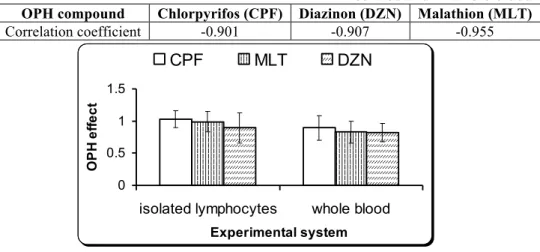
The experimental results indicate that OPH exert statistically similar effects on cell proliferation in the whole blood experimental system and isolated lymphocites (Figure 2). However, it appears that the effects exerted by the pesticides in isolated cell system are negatively correlated with those obtained in whole blood system (Table I), indicating that the soluble factors in the whole blood interfere dramatically with the signals directly delivered to lymphocytes by CPF, MLT and DZN. Analyzing the individual experimental data, we find that the pesticides can modulate in both ways the proliferative response of the isolated lymphocytes whether they are experimentally activated or not. Consequently, distinct effects (both stimulatory and inhibitory) were noticed (Figure 3), independent of the experimental model used (isolated lymphocytes and whole blood).
Table I
Pearson correlations for the effects of OPH compounds in a concentration of 1µg/mL per 106 cell/mL on the proliferative capacity of the human lymphocytes,
isolated and in whole blood
OPH compound Chlorpyrifos (CPF) Diazinon (DZN) Malathion (MLT)
Correlation coefficient -0.901 -0.907 -0.955
0 0.5 1 1.5
isolated lymphocytes whole blood Experimental system OP H e ff e c t CPF MLT DZN Figure 2
The effect exerted in vitro by CPF, MLT, DZN at 1 µg per 106 cells/ mL on the
proliferative capacity of human lymphocytes, in isolated cells and whole blood experimental models (evaluated by means of 3H-Urd incorporation method)
Effects of CPF, MLT, DZN on K562 lymphoblastic cell proliferation
The results of the effect of CPF, MLT and DZN on the proliferative capacity of human lymphocytes resting or polyclonal stimulated ex vivo,
showed, surprisingly, that in some cases, the pesticides may enhance the cell proliferation. To clarify this aspect, we investigated the in vitro effects of OPH compounds on the highly proliferative cells, such as the tumor cells from K562 human lymphoblastic cell line.
-PHA 0 5000 10000 15000 control CPF MLT DZN L y mp h o c y te s (C P M ) 0 200 400 600 800 Wh o le b lo o d (C P M )
lymphocytes whole blood
a) subject 1, non-stimulated +PHA 0 5000 10000 15000 20000 25000 control CPF MLT DZN L y mp h o c y te s (C P M ) 0 1000 2000 3000 4000 5000 Wh o le b lo o d (C P M )
lymphocytes whole blood
b) subject 1, stimulated -PHA 0 2000 4000 6000 8000 control CPF MLT DZN L y mp h o c y te s (C P M ) 0 1000 2000 3000 4000 Wh o le b lo o d (C P M )
lymphocytes whole blood
c) subject 2, non-stimulated +PHA 26000 28000 30000 32000 control CPF MLT DZN Ly m phoc y te s (C P M ) 5000 5500 6000 6500 7000 Wh o le b lo o d (C P M )
lymphocytes whole blood
d) subject 2, stimulated
Figure 3
Effects exerted in vitro by CPF, MLT and DZN at 1 µg/mL on the proliferative capacity of human lymphocytes, in experimental models with isolated cells and in
whole blood (individual data, two subjects)
Having in view that K562 tumor cells highly proliferate (exponential growth) 24 h after the passage, then the proliferation rate decreases, we investigated the effect of CPF, MLT, and DZN, in the concentration range 1-1000ng/mL on the proliferative capacity of K562 cells, for 24h and 64h. With this experimental approach, we followed the correlation between the rate of expansion of the tumor cells and the effect of pesticide. The results suggest that, in the first 24 h after the passage (when the exponentially active division characterizes the cells), 1µg/mL CPF, MLT and DZN per 106
cell/mL have no effects on the proliferative capacity of the cells. Surprisingly, OPH compounds studied can sustain uridine incorporation by the neoplasic cells in a manner dependent on the critical concentrations, and tend to inhibit uridine incorporation by K562 cells at lower concentrations than 1µg/mL (Figure 4).
CPF, MLT, DZN had no statistically significant influence on the multiplication of K562 neoplastic cells, evaluated by the MTS reduction test (Figure 5), but individual data show that DZN and MLT have the tendency to inhibit K562 cells multiplication.
10000 15000 20000 25000 0 1 10 100 1000 OPH concentration (ng/mL) Pr o lif e ra ti o n (C P M ) CPF MLT DZN Figure 4
Dependence of the K 562 cells proliferation on the OPH compounds concentration, evaluated by means of 3H-Urd incorporation method
0 0.25 0.5 0.75 1 1.25 CPF MLT DZN OPH compound Ef fe c t Figure 5
The effect exerted in vitro by CPF, MLT, DZN on K562 cells proliferation, evaluated by MTS reduction test; the effect exerted was calculated as the ratio
between the values obtained for each compound and the control value In all the investigated experimental models, cellular activation induced by OPH was also registered. The registered dose-dependent biphasic effects suggest receptor-dependent mechanisms of action (Figures 3 and 4).
The results of our in vitro conducted study indicate that DZN, but not CPF, tends to restrain cell proliferation. MLT is only slightly more potent than CPF in inhibiting the lymphocyte proliferation.
The effect of CPF, MLT and DZN on RNA synthesis by K562 cells
The findings that OPH compounds do not affect in an essential way, and furthermore, even stimulate, at particular concentrations, the incorporation of uridine by the highly proliferative tumor cells K562 suggest an effect of increasing RNA synthesis. To verify this hypothesis, we investigated the effects of the pesticides on RNA synthesis by K562 cells
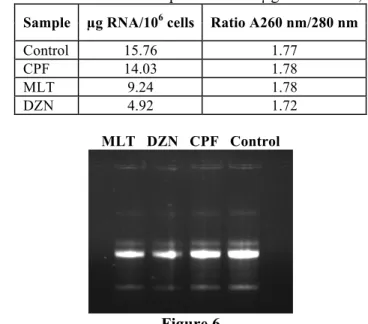
via an alternative method, namely by extracting RNA from cells followed by its quantitative determination. Lymphoblastic K562 cells have been cultivated for 24 hours in the standard culture conditions suitable for the cell proliferation experiments, in the presence of CPF, MLT and DZN at a concentration of 1 µg / mL. At the end of the incubation period, after cell counting and determination of their viability, we isolated RNA from cells and realized its quantitative and electrophoretic characterization. Quantitative determination of isolated RNA was performed by UV spectrophotometry. It was also evaluated the degree of contamination of RNA with genomic DNA by calculating the absorbance ratio at 260 nm and 280 nm. The results (Table II) suggest that CPF moderately inhibits RNA synthesis, while DZN and, at a lesser extent, MLT, have clearly inhibitory effects. These results confirm the weak effects of CPF on the cell proliferation, but not the results regarding the effects of MLT and DZN on K562 cells. It is possible that the increased incorporation of uridine via the via the salvage pathway of nucleotide biosynthesis is not accompanied by active synthesis of RNA. Furthermore, we noticed that, although pesticides tend to inhibit more or less RNA synthesis (Table II), they do not induce its degradation (Figure 6), which in turn would have drastic consequences on the protein synthesis, and consequently on the cell homeostasis.
Table II
The quantity and purity of RNA isolated from the lymphoblastic cells K562 cultivated for 24 hours in the presence of 1 µg/mL of CPF, MLT and DZN
Sample µg RNA/106 cells Ratio A260 nm/280 nm
Control 15.76 1.77 CPF 14.03 1.78 MLT 9.24 1.78 DZN 4.92 1.72 MLT DZN CPF Control Figure 6
Electrophoretic diagram of RNA isolated from K562 cells cultivated for 24 hours in the presence of CPF, MLT, DZN 1 µg/mL
Conclusions
Our in vitro conducted study shows that CPF, MLT and DZN tend to
inhibit proliferation of the resting isolated lymphocytes, but except for DZN, the cellular PHA-induced activation cancels this effect. DZN has clearly immunotoxic effects on polyclonal lymphocyte proliferation. A negative correlation was highlighted between the effects of CPF, MLT and DZN on the lymphoproliferative capacity in experimental model with isolated cells or in whole blood.
Stimulatory effects exerted by OPH compounds were also highlighted, without any correlation with the cell type or its activation status. Accordingly, OPH might induce activation of the immune system with pathological consequences of hypersensitivity or autoimmune reactions.
References
1. Battaglia CL, Gogal RM Jr, Zimmerman K, Misra HP - Malathion, lindane, and piperonyl butoxide, individually or in combined mixtures, induce immunotoxicity via apoptosis in murine splenocytes in vitro. Int J Toxicol. 2010;29(2):209-20
2. Boyum A. – Isolation of mononuclear cells and granulocytes from human blood – Scand. J. Clin. Lab. Invest., , 21:77-89, 1968
3. Ciobanu AM, Neagoe I, Baconi D, Bârcă M, Bălălău D, Bălănescu AR, Manda G - Particular inhibitory action of low concentrations of methadone on peripheral T lymphocytes. Farmacia, 2011, 59 (5): 605-610.
4. Descotes J., Vial Th. – Immunotoxic effects of xenobiotics in humans: a review of current evidence – Toxic. in vitro, 1994, 8(5): 963-966
5. Galloway T., Handy R. –Immunotoxicity of organophosphorus pesticides. Ecotoxicology, 2003, 12: 345 – 363
6. Kooijman R, Devos S, Hooghe-Peters E - Inhibition of in vitro cytokine production by human peripheral blood mononuclear cells treated with xenobiotics: implications for the prediction of general toxicity and immunotoxicity. Toxicol In Vitro. 2010;24(6):1782-9. 7. Li Q., Nagahara N., Takahashi H., Takeda K., Okumura K., Minami M. –
Organophosphorus pesticides markedly inhibit the activities of natural killer, cytotoxic T lymphocyte and lymphokine-activated killer: a proposed inhibiting mechanism via granzyme inhibition. Toxicology, 2002, 172:3:181–190.
8. Mehta G, Singh S P, Pandey S K, Sharma L D - Cytotoxic response of endosulfan and chlorpyrifos pesticides in poultry lymphocyte culture. Toxicol Int 2008;15:97-101
9. Cătălin Tilişcan, Victoria Aramă, Raluca Mihăilescu, Adrian Streinu-Cercel, Oana Andreia
Coman, Daniela Ion, Isabel Ghiță, Ştefan Sorin Aramă, Diagnosis and monitoring
of mitochondrial toxicity induced by nucleoside-analogue reversetranscriptase inhibitors in
HIV infected patients undergoing antiretroviral therapy, Farmacia, 2011, 59(4), 453-461
10. Thrasher J.D., Madison R., Broughton A. – Immunological abnormalities in human chronically exposed to chlorpyrifos. Arch.Environ.Health., 2002, 57: 181 – 187.
11. Voccia I., Blakley B., Brousseau P., Fournier M. – Immunotoxicity of pesticides: a review.
Toxicology and Industrial Health, 1999, 15 (1): 119 – 132
__________________________________