JI. of Educational Multimedia and Hypermedia (2002) 11(2), 141-153
Building a Constructivist Learning Environment Using
a Multimedia Design Project-a Malaysian Experience
MAI NEO AND KEN NEO T.K.
Multimedia University UEP Subang Jaya, Selangor
Malaysia, 47610
Multimedia technology is permeating the educational arena and changing the way teachers teach and students learn. In this article, the focus is on the building of a constructivist learning environment in the classroom by way of the con-struction of a multimedia project. To accomplish this, stu-dents were required to undertake a multimedia development process (MDP), which takes them from the acquisition of media materials to the packaging of the final application. In this constructivist mode, students decided on their own learning goals and determined how to reach the desired learning outcomes themselves. They were responsible for the development of the projects' storyboards, the concept and multimedia authoring, interface design and interactive fea-tures, and deployment and implementation methods. Through this process, studerts developed creativity, critical thinking and collaborative skills and became active partici-pants in their own learning processes. Similarly, the role of the teacher changed, from being the content expert to becom-ing a facilitator. The students were surveyed on their re-sponses to the multimedia project. Results showed that they were very positive toward the project, enjoyed working in groups and became active participants in their learning pro-cess, thus making multimedia a good framework for teaching and learning.
Neo and Neo
Multimedia technology is permeating the educational arena with many colleges and universities,
including
those in Malaysia, moving towards us-ing digital technology to enhance teachus-ing and learnus-ing (Johns, 1999; Ka-chian & Wieser, 1999; Kaimsah, Mokhtar, Ahmad, & Yaacob, 2000; Cheok, 2000; Mat, 2001). With the rapid progress of computer technology, it has become feasible and affordable to integrate multimedia technology into dig-ital teaching and learning. The use of Information and Communication Technology (ICT) and multimedia is garnering tremendous support from the Government of Malaysia. As stated by the Secretary-General of the Ed-ucation Ministry, who believes that:.. technology supports leaning. It will enable teachers to pursue tradi-tional goals with new fervour and success...[and that] ...the use of modem technology in beefing up the delivery of learning rnaterials in our education system must reflect the changing tirnes. Our students must be versatile to these challenges in technology, and our teachers must be proactive to the new requirements ... [There is a need to].. devise curriculum so that the culture of "learning to learn" and lifelong learning can be rapidly inculcated into the students. The learn-ing contents must foster the skill tco seek information, think critically, use the information and communicate effectively and work in a team. (Mat, 2000)
There is already a move to create mu ltimedia couirseware in many edu-cational institutions. By incorporating technology, especially multimedia technology, into the classroon, the teacher can adopt new instructional strategies to create a stimulating teaching and learning environment. The in-fusion of n ultimedia technologies into the classroom has changed the way educators teach and students learm. In this article, the authors seek to build a Constructivist leaming environment through development of a multimedia project. In this project, students will learn to make use of the knowledge presented to them in a more meaningful way using different media ele-mnents. These media elemtents can then be converted into digital form and modified and customised for the project. One important advantage of creat-ing miultimedia projects in the classroom environment is that when students create multimedia projects, they tend to do this in a group environment. By working in a group situation, the stude-nts will have to tap into their group skills and use a variety of activities to accomplish the project's overall ob-jectives. In this way, collaborative learning experience can be gained by the students.
In this multimedia project, students decided on their own learning goals and deternmined how to reach the desired learning outcomes themselves. They were responsible for the development of the projects' storyboards, the 142
Building a Constructivist Learning Environment
concept and multimedia authoring, interface design and interactive features, and deployment and implementation methods. Through this process, stu-dents developed creativity, critical thinking and collaborative skills and be-came active participants in their own learning processes. Similarly, the role of the teacher changed, from being the content expert to becoming a facili-tator and guide.
THE PRINCIPLE TENETS OF CONSTRUCTIVIST LEARNING
What is a constructivist learning environment? One definition is, "a place where learners may work together and support each other as they use a variety of tools and information resources in their pursuit of learning goals and problem-solving activities" (Wilson, 1995). This leaming envi-romnent, based on the constructivist learning philosophy that was evolved during the 1970s and 1980s, has its foundations in cognitive leaming psy-chology (Jonassen, Peck, & Wilson, 1999). It is rooted mainly in the works of Dewey (1896), Piaget (1952), Bruner (1985), Vygotsky (1978), and Pap-ert (1980; Roblyer & Edwards, 2000). The learning model is based on the concept that knowledge is constructed by an individual based on his prior experience rather than processed from infornation received from an exter-nal source. In this process, the student assumes the role of the producer rather than the consumer of information. The teacher becomes the guide and facilitator of learning and a member of a learning community rather than the director of instruction. The students are given significant freedom to set their own learning goals and in how to attain these goals themselves.
Constructivist learning emphasized learning as a social and collabora-tive endeavour as well as problem-solving of realistic and authentic tasks. Thus, instruction focuses on assisting the leamers to develop learning and thinking strategies in the subject domain, that is, learning "how to learn" rather than how much is learned. From a constructivist view, students must be provided with a rich learning environment. The computer with its capa-bility of processing and integrating the various media elements such as text, graphics, sound, animation, and video is ideally suited to present such a rich learning environment.
The success in creating such a learning environment is dependent on three factors: (a) the role that the teacher plays, (b) the role the student plays, and (c) the use of technology in cultivating this learning environ-ment. Traditionally, the teacher assumed the role of the source of knowl-edge or the only content expert in the class and taught using the directed instruction method. In this teacher-centric mode, the teacher is in control of the information and is solely responsible for how much information is to be 143
Neo and Neo
disseminated to the students, thus rendering the learning mode passive. This traditional "chalk-and-talk" mode of teac hing is still widely used in many institutions of higher learning, but, currently, there is a move toward creat-ing a constructivist leamrcreat-ing environment in such institutions. Now, in this perspective, the role of the teacher rnoves away from being the sole expert or dispenser of kniowledge and information in the class to becoming a facilita-tor to the students and a guide to help ther achieve teir learning objectives.
The role of the stdenit also evolves from being a passive learner to be-coming an active participant in the learning process. In this student-centered learn-ing mode, f e students must play an active part in their learning and construct their own knowledge or meaning of what they learn, and leaming builds on wvhat learners hiave already constructed in other contexts. The learners determIine how to reach the desired learning outcomes themselves. In other words, students are involved in learning as a process of knowledge constnretion and not knowledge absorption. This learning process is also kniowledge-dependent, that is, the leamers use current knowledge to con-struct new knowledge.
The third factor in this formula is the use of technology in the teaching and learning environment. Technology can be used by the teacher to repre-sent and support his or her educational materials. And by introducing tech-nology to the students in the form of a multimedia project, it can help stim-ulate their learning process and make them active participants in meeting their learning objectives. By incorporating digital media elements into the project, the students are able to learm better sitice they use multiple sensory modalities, which would make them niore motivated to pay more attention to the information presented and be, er retain the information. Therefore, multimedia application desigr offers new irnsights into the learning process of the designer and forces himr or her to renresent information and knowl-edge in a new and innovative way.
BUILDING THE MULTIMEDIA PROJECT: THE MULTIMEDIA DESIGN PROCESS (MDP)
To build this constructivist learning experiment, third year students in a! interactive multirmedia course in the Faculty of Creative Multimedia were given the task of developing a multimedia project on a topic of their choice. The class was structured such that the students worked in a
collabo-rative and coopecollabo-rative mnanner, and
constructed
their own knowledge of their project, thus takin an active par in their ovwn leaming process. Al-though these studenits have been trained in some multinedia software, they had no prior experience i auithoring an interactive multimedia application, or 144Building a Constructivist Learning Environment
in managing a multimedia project in a group setting, Therefore, to be able to complete this project, they would have had to draw upon their prior knowledge in different disciplines to breakdown the application design into various component parts, synthesize any media element that represented the information, create the digital interactive application, and work as a team. As a group, these students had to tap into their group skills and use a variety of activities to accomplish the project's overall objectives as well as their own learning outcomes. Each group had to create and design an interactive multimedia application on a CD-ROM showcasing a topic of their choice. The students had the option of choosing their own team members and group leader, and were given the entire semester to develop their project.
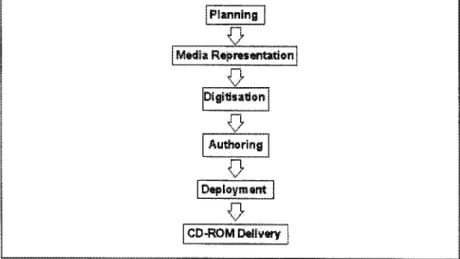
The construction of the projects involved the students having to experi-ence the multimedia design process (Figure 1), which starts from the plan-ning stage and carries them through to the development stage and finally, the deployment stage (Neo & Neo, 2000).
[Media Representa=tion1 IDigilisafJon IAuthoring Deploymeant]
ID
CD-ROM DeliveryFigure 1. The multimedia design process (MPD)
As the figure illustrates, the teams first have to decide on the concept of their application. Once that is done, they develop a storyboard of their pre-sentation, complete with media elements they want to use. After that, the teams assemble the media elements needed for the presentation. If these media are in analogue form, then the students have to convert them into digi-tal formn to be modified and stored in the computer. Whien all the media ele-ments have been digitised, then the students have to author the application us-ing the authiorus-ing tool, Macromedia Director. Here, they have to synchronise the media elements, create the navigational interface, and develop interac-tivit-y in the presentation. Then finally, the students package the interactive multimedia application into an executable file and deploy it over a CD-ROM.
6Neo and Neo
On the part of the lecturer, the role evolved into becoming a facilitator to support the students learning, and to guide them through their proj'ects. As a guide on thle side, the lecturer used teclunology and gave interactive lectures on the fundamental concepts of the multimedia design process to give the students sonme background on the process of creating a multimedia application and the tools and tecliiques involved in such endeavours. By doing so, the lecturer not only demonstrated that multimedia was an impor-tant component in the student's learning but also used interactive multime-dia technology as a means to convey infornation to the students and in-volving them in the teaching environment as well. The lecturer also met with these groups of students every week to discuss any issues that niiay be of concern to them and acted as a consultant to their problems. Table I il-lustrates the roles of the student and the teacher with respect to the multime-dia design process.
Table I
Roles of student and teacher in the mnultin edia design process
Activity Role of students
1. Planning Students organise themselves into teams, select group leader and brainstorm on project topic and create a treatment of project,
including objectives and target audience. Also plans research strategy and division of labour. 2. Media Students create process flow of
Representation application and storyboards of the interfaces complete with media
representation.
3. Digitisation Students convert analogue materiais into digital form and store them in the PC. Have to nake decisions on hardware and software to be used in the process.
4. Authoring Students integrate and synchronlse digital media into final application. Groups decide and design user interface and interactive features using an authoring tool and other helper applications.
5. Deployment Students package final presentation as a self-running application.
6. CD-ROM Students burn application on CD-ROM, Delivery create and design CD jewel case and
jacket design
Role of teacher
Teacher consults groups on concept, feasibility of project and research plans.
Teacher facilitates group discussions and design issues.
Teacher consults on technicai aspects on the authoring tool and any group concerns at
this stage. 146
Building a Constructivist Learning Environment
Figure 2 is a schematic model which summarises the essential features of the multimedia constructivist learning environment.
Figure 2. The multimedia constructivist learning model
SHOWCASE PROJECT
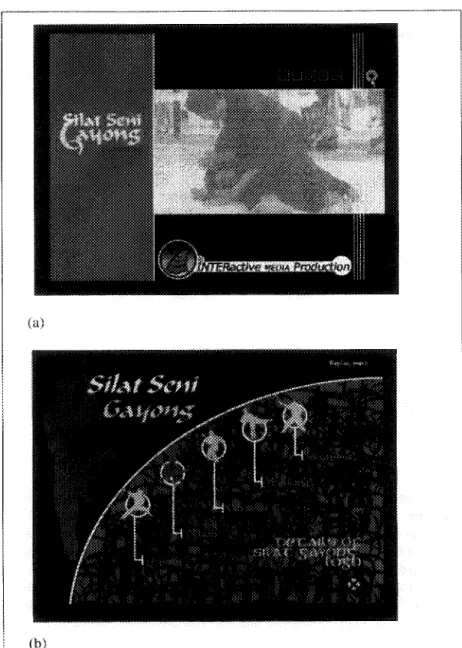
Figure 3 (a) and (b) showcases the interfaces of a project created by one team. This team's project was to highlight the Malaysian martial arts, known as Silat. Figure 3 (a) shows the splash screen, or intro screen, design of the application, and Figure 3 (b) shows the interface for the application's menu screen. Images of various martial arts poses were used as interactive buttons in the presentation to denote different sections in the application, such as "History," "Details," "Customs," "Teaching," and "Weapons." Each image button is interactive and will link the user to the section's indi-vidual pages. The students, working as a team, created all of these designs, from the concept of the presentation's storytelling structure to the media and interactive features used throughout the application.
e c las
learing guiding and supporting the stUdents' projects
Neo and Neo
(a)
(b)
Figure 3 (a) and (b). Interfaces of a project on the Malaysian martial arts, Silat
Building a Constructivist Learning Environment
RESULTS
The projects were assessed on several criteria including originality, technical skills, presentation, design and packaginig, teamwork, and depth of content. On the whole, the students in the class responded very well to the course structure and were able to have a positive attitude toward this constructivist learning environment. A survey using a 5-point Likert scale ranging from 1 (Strongly Disagree) to 5 (Strongly Agree) was administered to the students to assess their responses to the construction of the project and the constructivist dynamics. Table 2 illustrates the means for some of the questions and the corresponding percentage responses.
Table 2
Means and percentage responses of the project construction (N=46)
Results Mean score Response
level
1. Students found the project challenging 4.17 91% 2. Students were able to be creative thinkers 4.15 91%
3. Use of media was more effective in presenting concept 4.11 91%
4. Students were able to think critically about their topic 3.98 83%
5. Students were very motivated doing the project 3.98 76% 6. Students were able to learn more from each other as a team 3.91 78%
7. The group was able to achieve its goals 3.83 76% Creating a constructivist learning environment in this course helped foster several salient student-centric learning traits. Being challenged by the project was the most significant factor in the students' positive attitude to-ward the assignment, with 91% of the respondents scoring 4 and 5 (Agree and Strongly Agree) on the Likert scale, with the ability to be creative thinkers a close second, with a mean of 4.15 and a response level of 91%. The next highest factors surveyed were the ability to use media and being critical thinkers in the project design process, resulting in mean scores of 4.11 and 3.98, and response levels of 91% and 83%, respectively. Motiva-tion was also a key factor for these students, with a mean score of 3.98 and a response level of 78%. In terms of working as a team, many groups con-firmed that they were able to learn more from their tearmnates and able to achieve their group goals, yielding mean scores of 3.91 and 3.83, and re-sponse levels of 78% and 76%, respectively. These results clearly reinforce the notion that creating a constructivist leaming environment through project construction yields positive responses and increased attention to the
assignment from the students.
Neo and Neo
STUDENTS' RESPONSES
Based on interviews and surveys taken, students reported: (a) a deeper understanding of their project's topic, (b) of multimedia development, (c) increased creative and critical thinking skills, (d) higher motivation towards the project and the class, and (e) increased leadership and teamwork skills for resolving problems.
Some of the general comments included:
We learned more about the topic as well as the software. We also de-veloped a positive group attitude;
We leaamed more about multimedia, developing a CD-ROM, software, navigation and interactivity;
We got to know each other better sinEe we spent a lot of time together; We learmed more about our topic. Fun to know everyone on the team and had fun shiooting video, never done it before,
This is very encouraging as it is indicative that multimedia projects and the infusion of constructivism into the classroom has a positive and productive effect on a student's learning process.
Students also commented on the challenges that they faced when tying to collaboratively develop the application. Some of their conments included:
We all had diiferent ideas, and we had to discuss which was better. Eventually we catne to a compromise which everyone agreed on; We argued among ourselves beeause we could not do everything we all wanted;
We had a lot of misunderstandings which we solved by lots of discus-sion and advice. We worked together through discusdiscus-sions;
Most of the team members were not professional, and needed leader-ship from the group leader;
We had problems coordinating team members. 150
Building a Constructivist Learning Environment
Computer and laboratory facilities were also an issue for students, who commented that equipment was difficult to acquire, especially for digitising video, and that the labs should have more multimedia equipment to accom-modate their growing numbers. However, on the whole, these students stat-ed that they would not change the project but would try to enhance it, if they had to do the project again, either through better time management or earlier concept planning.
CHALLENGES AND LIMITATIONS
In designing constructivist learning environments in the classroom to enhance the teaching and learning process is a challenging task for many educators. However, with multimedia technologies perneating the educa-tional arena with such fervour, this challenge must be overcome although there might be some limitations. Hence, to be able to do this seamlessly, three requirements must be fulfilled. The first is to make hardware available to the educators and the students. In other words, multimedia personal com-puters (MPCs) must be made readily available in the laboratories. The sec-ond is that sufficient software must be provided for multimedia application creation 'by the students. The third requirement is to bridge the gap between technology and education, and empower the teachers with the skills to use the technology productively, to manage the classrooms efficiently and to guide students effectively.
In terms of the first two requirements, in Malaysia today, it is being ad-dressed and implemented, with many of the higher learning institutions pur-chasing computers and multimedia authoring software for their computer laboratories and equipping the teachers with computers and software in their offices. However, with regards to the third requirement, therein lies the biggest challenge. As educators, there must be some training provided or acquired for teachers to be able to equip themselves with the proper skills for interactive multimedia creations. With the authoring tools in the market being user-friendly and manufactured specifically for nonprogrammers, ed-ucators need only be trained to be able to use these tools effectively for cre-ating learning environments which are stimulcre-ating and media-rich.
CONCLUSION
From this study, the authors have gained some insights into integrating multimedia technology into the teaching and learning process.
Neo and Neo
1. Multimedia is gaining ground as a way for students to represent the knowledge that they acquire in class and to construct their own
interpre-tation of the information acquired.
2. By using multimedia and a multimedia project in the teaching and leam-ing environment, students are able to develop critical skills that would make them more efficient and productive workers in the 21st century, cognizant of problem-solving skills, and in possession of lifelong learn-ing attitudes.
3. Student-created multimedia projects are beneficial for learning because they often involve substantial work, open-ended assignments, theme-based activities, and knowledge and experiences that the students draw from a wide variety of sources.
4. Multimedia-oriented projects provide a way for students to increase their ability to function as self-directed learners, to leam to think effec-tively, and to practise problem-s olving and decision-making.
5. Students learn to work in groups to solve a realistic and authentic prob-lem, thus gaining collaborative learning experience.
6. Creating a Constructivist learning environment in this course helped fos-ter several salient student-centric learning traits. Many of the students found the projects to be very stimulating and mnotivating, they were able to learn a lot more from their tearnmates and were able to be critical and creative thinkers in the process.
7. This proje t provided ani opportunity for students to learm to reflect on their learning to make sense of the vworld and create understanding. By reflecting on their projects, the students were able to generally assess their strength and weakness as individuals and as a group, and give themselves the experience to manage themsel-ves better next time.
References
Brua'er, J.S. (1985). Models of the learner. Educational Researcher, 14(6), 5-8. Cheok, L.L. l2000). Internet: Creating new learning experience. E-learn ing
2000: Malaysian International C7onference & Ehibition on Electronic
Learning 2000, Kuala Lumpur. Malaysia. Retrieved from the World
Wide Web May 8, 2002, from: http:/iwww.e-learning2000.corn.my Dewey, J. (1896). The reflex arc concept of psychology. Psychology
Re-view, 3. 357-370.
Johns, J.F. (1999). Web-based practice environments to teach mechanical skills. Initeractive Multimedia Electronic Journal of
Computer-En-hanced Learning (DiFMI I1(]). Retrieved from the World Wide Web May 8, 2002, from: http://iniej.wfu.edu/articies/1999/I/0l/index.asp 152
Building a Constructivist Leaming Environment
Jonassen, D.H., Peck, K.L., & Wilson, B.G. (1999). Learning with technol-ogy: A Constructivist Perspective. Upper Saddle River, NJ: Merrill/ Prentice Hall.
Kachian, C., & Wieser, P. (1999). You can almost feel the music: Rede-signing a course for new media delivery. Interactive Multimedia Elec-tronic Journal of Computer-Enhanced Learning (IMEJ), J(I). Re-trieved from the World Wide Web May 8, 2002, from: http:// imej.wfu.edu/articles/l999/1/11/index.asp
Kamsah, M, Mokhtar, S., Ahmad, R, & Yaacob, M. (2000). Developing the concept of e-university for Malaysian public universities. E-learning 2000: Malaysian International Conference & Exhibition on Electronic Learning 2000, Kuala Lumpur, Malaysia. Retrieved from the World Wide Web May 8, 2002, from: http://www.e-learning2000.com.my Mat, J. (2000). Technology in the Malaysian education system. E-learning
2000: Malaysian International Conference & Exhibition on Electronic Learning 2000, Kuala Lumpur, Malaysia. Retrieved from the World Wide Web May 8, 2002, from: http://www.e-learning2000.com.my Mat, J. (2001). Challenges in developing local content e-education.
E-learning 200]: Malaysian International Conference & Exhibition on Electronic Learning 2001, Petaling Jaya, Malaysia. Retrieved from the World Wide Web May 8, 2002, from: http://www.e-learning2000.com .my/working_papers.htm
Neo, M., & Neo, TU.K. (2000). Integrating multimedia technology into edu-cation to enhance digital teaching and learning in the classroom. Pro-ceedings of the International Conference in Education and ICT in the New Millennium, Selangor: tJniversiti Putra Malaysia (pp. 366-376). Roblyer, M.D., & Edwards, J. (2000). Integrating educatiQnal technology
into teaching (2nd ed.). UJpper Saddle River, NJ: Merrill/Prentice-Hall. Papert, S. (1980). Mindstorms: Children, computers, and powerful ideas.
New York: Basic Books.
Piaget, J. (1952). The origins of intelligence in children. New York: Inter-national Universities Press.
Vygotsky, L. (1978). Mind in society: The development of higher psycho-logical processes. Cambridge, MA: Harvard University Press.
Wilson, B.G. (1995). Metaphors for instruction: Why we task about learn-ing environments. Educational 7echnology, 35(5), 25-30.