Approved for Public Release; Distribution is Unlimited
Flight School in the Virtual Environment
Capabilities and Risks of Executing a Simulations-Based Flight
Training Program
A Monograph
by
MAJ Craig A. Blow
United States Army
School of Advanced Military Studies
United States Army Command and General Staff College
Fort Leavenworth, Kansas
REPORT DOCUMENTATION PAGE
OMB No. 074-0188 Form ApprovedPublic reporting burden for this collection of information is estimated to average 1 hour per response, including the time for reviewing instructions, searching existing data sources, gathering and maintaining the data needed, and completing and reviewing this collection of information. Send comments regarding this burden estimate or any other aspect of this collection of information, including suggestions for reducing this burden to Washington Headquarters Services, Directorate for Information Operations and Reports, 1215 Jefferson Davis Highway, Suite 1204, Arlington, VA 22202-4302, and to the Office of Management and Budget, Paperwork Reduction Project (0704-0188), Washington, DC 20503
1. AGENCY USE ONLY (Leave blank)
2. REPORT DATE 3. REPORT TYPE AND DATES COVERED 4. TITLE AND SUBTITLE
Flight School in the Virtual Environment: Capabilities and Risks of Executing a Simulations-Based Flight Training Program
5. FUNDING NUMBERS
6. AUTHOR(S)
MAJ Craig A. Blow
7. PERFORMING ORGANIZATION NAME(S) AND ADDRESS(ES) School of Advanced Military Studies
8. PERFORMING ORGANIZATION REPORT NUMBER
250 Gibbon Ave.
Ft. Leavenworth, KS 66027
9. SPONSORING / MONITORING AGENCY NAME(S) AND ADDRESS(ES) Command and General Staff College
10. SPONSORING / MONITORING AGENCY REPORT NUMBER 1 Reynolds Ave.
Ft. Leavenworth, KS 66027
11. SUPPLEMENTARY NOTES
12a. DISTRIBUTION / AVAILABILITY STATEMENT
APPROVED FOR PUBLIC RELEASE; DISTRIBUTION IS UNLIMITED
12b. DISTRIBUTION CODE
13. ABSTRACT (Maximum 200 Words)
Based on the current unsustainable defense budget and impending reductions, the Aviation Branch must develop a plan now to prevent a deterioration of flight skills among aviators when budget reductions can potentially decrease flight training hours. Simulators’ realism has improved exponentially since the 1970s due to the integration and advancement of
computer technology. Army Aviation currently relies on the use of simulators to augment aircraft flight training in both the operating and generating forces. Analysis on the use of simulators specifically during the first two flying stages of the Initial Entry Rotary Wing (IERW) phase of Flight School XXI (FSXXI), provide leaders insight into how to reduce aviation operating costs while maintaining or improving aviators’ ability to perform in the operating force. Using current doctrine, learning theories, including transfer of training, and experiments relating simulator performance to aircraft performance, analysis determines that the current FSXXI flight simulators can train aviators to execute flight tasks to standard while saving costs. However, researchers must conduct further
experiments to develop empirical evidence relating directly to the capacity for
simulations based primary and instruments to provide the same quality aviators as the current training program to the operating force, and any associated risks incurred.
14. SUBJECT TERMS
Army Aviation Simulation,Simulators,FSXXI,IERW,Primary,Instruments
15. NUMBER OF PAGES 64 16. PRICE CODE 17. SECURITY CLASSIFICATION OF REPORT (U) 18. SECURITY CLASSIFICATION OF THIS PAGE (U) 19. SECURITY CLASSIFICATION OF ABSTRACT (U) 20. LIMITATION OF ABSTRACT
NSN 7540-01-280-5500 Standard Form 298 (Rev. 2-89)
Prescribed by ANSI Std. Z39-18 298-102
i
SCHOOL OF ADVANCED MILITARY STUDIES
MONOGRAPH APPROVAL
Major Craig A. Blow
Title of Monograph:
Flight School in the Virtual Environment
Approved by:
__________________________________
Monograph Director
Mark T. Calhoun, Ph.D.
__________________________________
Seminar Leader
Patrick B. Roberson, COL
__________________________________
Deputy Director
G. Scott Gorman, Ph.D.
School of Advanced
Military Studies
___________________________________
Director,
Thomas C. Graves, COL, IN
School of Advanced
Military Studies
___________________________________
Director,
Robert F. Baumann, Ph.D.
Graduate Degree
Programs
Disclaimer: Opinions, conclusions, and recommendations expressed or implied within are solely those of the author, and do not represent the views of the US Army School of Advanced Military Studies, the US Army Command and General Staff College, the US Army, the Department of Defense, or any other US government agency. Cleared for public release: distribution unlimited.
ii
Abstract
Flight School in the Virtual Environment: Capabilities and Risks of Executing a Simulations-Based Flight Training Program by MAJ Craig A. Blow, U.S. Army, 59 pages.
Based on the current unsustainable defense budget and impending reductions, the Aviation Branch must develop a plan now to prevent a deterioration of flight skills among aviators when budget reductions can potentially decrease flight training hours. Simulators’ realism has improved exponentially since the 1970s due to the integration and advancement of computer technology. Army Aviation currently relies on the use of simulators to augment actual aircraft flight training in both the operating and generating forces. Analysis on the use of simulators specifically during the first two flying stages of the Initial Entry Rotary Wing (IERW) phase of Flight School XXI (FSXXI), provide leaders the insight into how to reduce aviation operating costs while
maintaining or improving aviators’ ability to perform in the operating force. Using current doctrine, learning theories, including transfer of training, and experiments relating simulator performance to aircraft performance, analysis determines that the current flight simulators used at FSXXI can train aviators to execute flight tasks to standard while saving costs. However,
questions remain and researchers must conduct further experiments to develop empirical evidence relating directly to the capacity for simulations based primary and instruments to provide aviators of the same quality as the current training program to the operating force, and any associated risks incurred.
iii
Acknowledgements
I am grateful to the staff at the Combined Arms Research Library, specifically Rusty Rafferty, who conducted research for my monograph, which aided my ability in creating this work. I also thank my monograph syndicate, especially the director, Dr. Mark Calhoun, for providing me exceptional direction and instruction. Further, I thank the following contributors to my project through interviews, conversations, and site visits: COL Scott Thompson, COL Jesse Farrington, COL Donald Galli, CW5 Michael Reece, Mr. Kevin Hottell, Dr. John Stewart, COL Anthony Krogh, CW3 Robert Ness, Ms. Dana Probert, Ms. Maggie Amadei, and Mr. Dan Farley. I must thank my parents for imparting a love of God and country and desire to serve our great nation. I am most appreciative of my beautiful wife Kimchi, my sons Justin and Nathaniel, and daughter Anastasia, for their love, patience, support and acceptance of the trials that come with being a military family. Their love and constant devotion inspires me each day. Finally, I thank my Lord and Savior Jesus Christ, for I can do nothing without His strength and wisdom.
iv
Table of Contents
Introduction ... 1 Problem ... 1 Background... 2 Flight Simulators ... 5Flight School XXI ... 7
Methodology ... 11
Limitations ... 13
Army Training Framework... 14
ARFORGEN... 14
Army Training Strategy ... 16
Army Aviation Training ... 17
Aviation Live, Virtual, Constructive Training Strategy: ... 18
Aviation Doctrine ... 19
Learning Models and Transfer of Training ... 22
Learning Methodology ... 23 Learning Environment ... 28 Transfer of Training ... 30 Tests, Experiments ... 33 Cost-Benefit Analysis ... 37 Risk ... 39 Conclusion ... 43
Implications and Recommended Future Study ... 44
APPENDIX ... 48
1
Introduction
Problem
The former Chairman of the Joint Chiefs of Staff (CJCS), Admiral Michael Mullen, identified the nation’s debt as a significant security risk in America’s 2011 National Military Strategy.1 In September 2011, Admiral Mullen elevated this issue to the nation’s number one security threat while publicly discussing the unsustainable nature of the defense budget.2 The new CJCS, General Martin Dempsey, made a statement during his confirmation hearing that he believes the crisis is problematic, but not the top security risk.3 Regardless, because of the deficit, the Department of Defense (DOD) aims to cut $450 billion over the next ten years.4
Consequently, proactive Army leaders are looking for responsible ways to reduce the Army’s budget. Funding of training becomes one aspect of the budget that leaders target when faced with large budget reductions.5 The DOD warns in the 2009 strategic training plan that “funding for training will face significant budget pressures,” and training resources could go underfunded.6
A greater potential exists for decision makers to cut spending on Aviation flight training operations than any other category, because twenty percent of the Army’s annual budget funds
1 Michael G. Mullen, "The National Military Strategy of the United States of America," http://www.au.af.mil/au/awc/awcgate/nms/nms.pdf (accessed October 12, 2011).
2
Donna Miles, "Mullen: Personnel, Health Costs 'Not Sustainable'," American Forces Press Service, http://www.defense.gov/news/newsarticle.aspx?id=65418 (accessed September 22, 2011).
3 United States Senate, Committee on Armed Services, Nomination of GEN Martin E. Dempsey, USA, For Reappointment to the Grade of General and to be Chairman of the Joint Chiefs of Staff, July 26, 2011, 45.
4 Jim Garamone, "Panetta: Defense Cuts Will Be Made Strategically," American Forces Press Service, http://www.defense.gov/news/newsarticle.aspx?id=65423 (accessed September 22, 2011).
5Nomination of GEN Martin E. Dempsey, USA, For Reappointment to the Grade of General and to be Chairman of the Joint Chiefs of Staff, 14-15.
6 William J. Lynn, "Strategic Plan for the Next Generation of Training for the Department of Defense," (Washington, D.C.: Office of the Under Secretary of Defense, 2010), 4.
2
aviation operations and programs, which is the most expensive category.7 Based on the new fiscally restrained environment and the recent history of consuming a significant amount of dollars in failed programs, the commanding general of the Aviation Branch, MG Anthony Crutchfield, determined that the branch must establish a proactive “cost-culture” framework for operating within fiscally responsible budgets.8 However, the following historical background demonstrates how budgetary cuts can reduce aviators’ capability to execute operations to the highest standards safely.
Background
The Army allocated $6.9 billion over a period of twenty-two years towards the unsuccessful RAH-66 Comanche project and finally discontinued the program in 2004. The Government Accounting Office (GAO) began to question the rationale and effects of continuing the program in 1994. They concluded that allocating a disproportionate amount of the budget towards the Comanche year after year came at the expense of modernizing the remainder of the Army’s aviation fleet.9 This created a reduction in the operational readiness of aviation units.10
Nonetheless, in 1993, the Aviation Branch approved an aircraft acquisition for flight school, which saved the Army $29 million annually.11 It acquired the civilian Bell 206B
helicopter, which the Army calls the TH-67 Creek. This airframe is more economical and reliable
7 Randy Rotte, "Army Aviation Division Chief, G8 Update" (Presentation at the Army Aviation Center of Excellence Senior Leaders Conference, Fort Rucker, AL, February 1, 2011), 18.
8Anthony Crutchfield, "A Vision for the Future of Army Aviation" (Presentation at the Army Aviation Center of Excellence Senior Leaders Conference, Fort Rucker, AL, February 1, 2011), 9.
9 U.S. General Accounting Office, "Army Aviation: Modernization Strategy Needs to Be Reassessed," (Washington, D.C.: U.S. General Accounting Office, 1994), 33.
10 Ibid., 29-30, 33. 11
Marti Gatlin, "TH-67 Soars to Historic Aviation Milestone," TRADOC News Service, http://www.army.mil/article/1930/TH_67_Soars_to_Historic_Aviation_Milestone/ (accessed October 18, 2011).
3
to operate than the UH-1H Iroquois (Huey) it replaced, and it remains the training aircraft for Flight School XXI’s (FSXXI’s) first phase, Initial Entry Rotary Wing (IERW), today.12
By terminating the Comanche program in 2004, the Aviation Branch saved another forty percent of its budget.13 With the savings, they made considerable strides to integrate a light utility aircraft and begin research of other new aircraft. Additionally, the Aviation Branch allocated funds to prolong the life expectancy of its current fleet and modernize systems, such as counter-missile warning systems, while improving its operational readiness through associated training.14
In addition to the significant percentage of the Army budget devoted to the Comanche, the 1990s marked a period in history when defense budgets declined in a post-war era. This foreshadows potential issues today’s Army could face due to the impending budget reduction. Upon the conclusion of Operation DESERT STORM in 1991, the Army entered a period of personnel, equipment, and training reductions, resulting in decreased operational readiness.15 The Association of the United States Army (AUSA) provides analysis each year on the Army’s annual budget. Throughout the 1990s, these analyses only superficially mentioned the financial cutbacks affecting training and readiness. However, in the FY 1999 AUSA budget analysis, strong
language appeared regarding the state of the Army:
Years of insufficient resources have left the Army in an unacceptable and
precarious condition. The FY 1999 budget makes no attempt to remedy years of
reduced funding. In fact,…the next seven years…[will] result in an underfunded
modernization program…[that] strains soldiers [and] equipment…. The Army is
fragile. We may not have a readiness crisis today, but at the current funding level,
that crisis looms as a near-term reality despite the quality of our Army leaders and
soldiers.
1612
Ibid.
13 James W. Williams, A History of Army Aviation: From Its Beginnings to the War on Terror (New York: iUniverse, Inc., 2005), 349.
14 Ibid., 351. 15
Jack Spencer, "The Facts About Military Readiness," The Heritage Foundation Backgrounder, no. 1394 (2000): 12.
16 Richard L. West and Charles F. Feldmayer, "Army Budget Fiscal Year 1999: An Analysis," (Arlington, VA: Association of the United States Army, Institute of Land Warfare, 1998), 75.
4
Military leaders sense the upcoming reductions in training, maintenance, and operations that could potentially lead to a similar crisis due to the national debt, but will try to balance cuts across the force structure to include personnel benefits.17 Because of ongoing combat operations, however, the current CJCS, General Dempsey, understands the difficulty in making any reforms to personnel benefits at this time, potentially placing the majority of cuts on training and
operations until overseas combat operations draw down significantly.18
A contemporary example illustrates the potential risk resulting from decreased budgets and readiness. Task Force Hawk deployed to Albania in 1999 to provide aviation support for North Atlantic Treaty Organization (NATO) operations in Kosovo. After losing an AH-64 Apache helicopter and its crew of two pilots in a fatal crash, General Richard Cody (at the time, a Brigadier General), the Task Force Commander, wrote lessons learned comments in a 1999 memorandum to General Shinseki, the Chairman of the Joint Chiefs of Staff. His statements, later discussed in a Congressional Hearing on the readiness of the AH-64 helicopter fleet, questioned the ability of pilots to fight in a high-risk environment based on the consequences of years of financial constraint.19 Understandably, contraction in the funding of aviation training can increase risk in aviation operations.
The Aviation Branch must develop a plan now to prevent a deterioration of flight skills among aviators given the likelihood that impending budget reductions will affect funding for aviator flight training. Individual proficiency correlates directly to collective proficiency and operational effectiveness in aviation units. Leaders must protect mission readiness by developing effective and affordable training programs. The Army made a considerable advancement in flight
17Nomination of GEN Martin E. Dempsey, USA, For Reappointment to the Grade of General and to be Chairman of the Joint Chiefs of Staff, 14-15.
18
Ibid., 15-16.
19 Committee on Armed Services, Military Readiness Subcommittee, Readiness of the Army AH-64 Apache Helicopter Fleet, First Session, July 1, 1999, 13.
5
simulators in 1935 with the Link trainers, but they lagged behind other services in simulator utilization until the 1960s.20 For decades, the Army used much cheaper aircraft to operate than the other services did, so pressure to adopt the large-scale use of simulators did not emerge until the Army began purchasing more advanced aircraft like the UH-1H Iroquois. This led to procurement of the UH-1H Synthetic Flight Training System (SFTS) – one of the Army’s first large scale procurements of flight simulators for enhancing aviator training while significantly reducing costs.21 The Army continues to use flight simulators to enhance training in a safe, cost efficient environment today. This leads to the research question: Can FSXXI transition the primary flight training and instrument flight training sections of IERW to rely purely on simulations-based training without adversely affecting the operational readiness of aviation units in the operating force?
Flight Simulators
Engineers have continuously upgraded the fidelity of the simulator training experience. The simulators’ realism has improved exponentially since the 1970s due to the integration of computer technology. Army Aviation currently relies on the use of simulators to augment actual aircraft flight training and conduct evaluations, and to train and evaluate responses to emergency procedures – particularly those unsafe to replicate in the actual aircraft. In the future, simulation will play an increasingly important role in accident investigations, understanding the physical and cognitive interactions between pilots and the operational environment, and other aircraft
research.22 Accordingly, as simulator technologies continue to improve and offer greater cost
20 "Synthetic Flight Training," U.S. Army Aviation Digest, July 1967.
21 Frederic H. Stubbs, "Synthetic Flight Training System," U.S. Army Aviation Digest, September 1972.
22 Alfred T. Lee, Flight Simulation: Virtual Environments in Aviation (Aldershot, England: Ashgate Publishing Limited, 2005), ix.
6
benefit, instructor pilots (IPs) can increase the number of tasks they train and evaluations they conduct in the virtual environment.
With the improvement of flight simulation technology, Army Aviation has programmed an increasing amount of simulator training for pilots with two primary purposes: reducing
expenses and increasing aviator proficiency. Considering future budgetary constraints, the branch chief instructed the United States Army Aviation Center of Excellence (USAACE) Directorate of Simulations (DOS) to “find more efficient and effective ways to conduct both individual and collective training using aviation simulators."23 One option to establish the desired “cost-culture” mindset at Fort Rucker involves continuing the trend of increasing flight simulator usage, with the aim of decreasing the more expensive aircraft flight hours.
Flight school serves as a prime venue for researchers to examine the potential of transitioning to more simulator hours not only to save money, but also to increase training
effectiveness, practice emergency procedures at reduced risk, and prepare the Aviation Branch for the future of flight training. Although the TH-67 airframe serves as the Army’s most economical aircraft to fly, it has never undergone a reset—an overhaul on each aircraft to renew its life cycle—like the Army’s other aircraft following combat operations.24 Leaders lack specific data on how many more years the TH-67 can provide service without a reset. However, some estimate the aircraft would provide service until 2031 with a reset program.25 Regardless, the TH-67 requires legacy repair parts that become more difficult and expensive to obtain every year.26 If
23 Anthony Crutchfield, "Professionally Developing the Aviation Force," Army Aviation, July 31, 2011, 9-10.
24 Michael L. Reece, interview by author, Fort Rucker, AL, December 12, 2011.
25 John Lynch, "Future of Flight School Courses of Action," (Fort Rucker, AL: United States Army Aviation Center of Excellence, 2011), 58.
26
Michael L. Reece, "Increasing Role of Simulation in FS XXI," Army Aviation 2011, 12. Even though the Aviation Branch acquired the TH-67 in 1993 for economic and performance benefits,
commercial aviation is becoming increasingly digital. Consequently, the analog repair components on the TH-67 are more expensive and scarce; long-term fleet sustainment plans are becoming more expensive as well.
7
simulation will play an increased role, now is the time to gain greater understanding for how to accomplish it successfully.
Flight School XXI
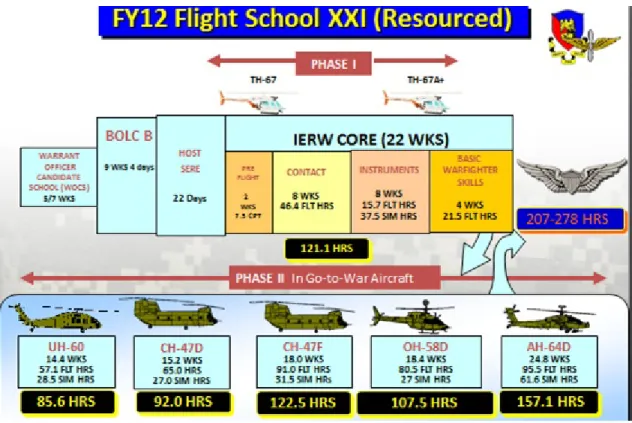
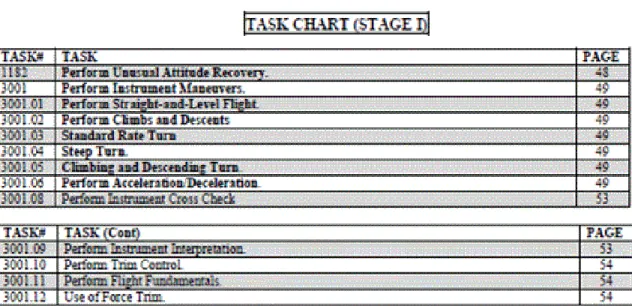
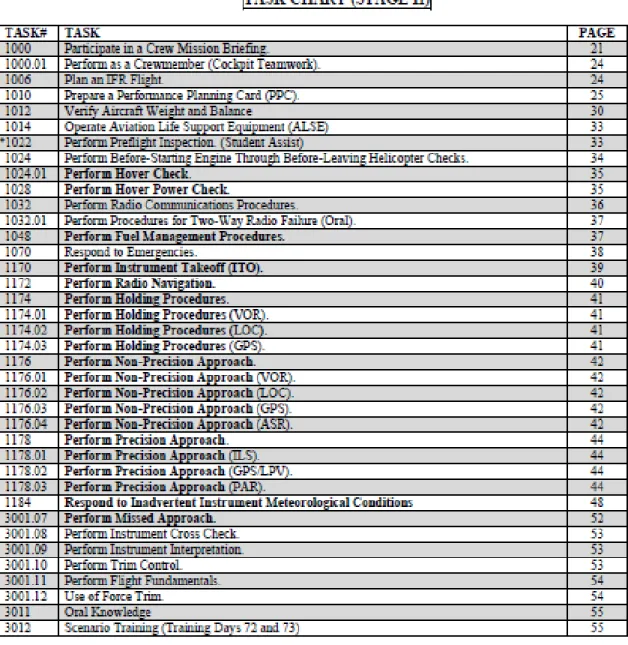
Senior aviation leaders fully implemented FSXXI in 2007. Legacy flight school is the term used for the program prior to this time, even though an interim FSXXI program bridged the two for several years.27 The course consists of two phases. The first phase, IERW, includes pre-flight training, primary (sometimes referred to as contact), instruments, and the basic warfighter skills sections. Although official charts depict the TH-67 supporting all IERW training, the obsolete OH-58C Kiowa serves as the training platform for the basic warfighter skills section (see Figure 1 in appendix).28 The primary and instrument sections comprise the majority of IERW. This involves learning the fundamentals of flying and takes place over a ten-week period. Student pilots learn how to hover, react appropriately to emergencies, gain airspace awareness, and fly a traffic pattern, among other basic tasks (see Figures 2a and 2b in appendix).29 The eight-week instrument section involves learning how to pilot the aircraft using radio navigation and relying completely on the aircraft instruments to control the aircraft (see Figures 3a and 3b in
appendix).30 The second phase consists of advanced aircraft training in one of four advanced aircraft: the AH-64D Apache, OH-58D Kiowa Warrior, CH-47D Chinook, or UH-60L/M
27 Kathy L. Nau, Sara K. Krondak, and Norma L Lewis, "Flight School XXI (FSXXI) Training Effectiveness Analysis (TEA)," (White Sands Missile Range, NM: TRADOC Analysis Center, 2009), chap. 1, 3.
28
Dana Probert, email to author, January 19, 2012; United States Army Aviation Center of Excellence, "FY12 FSXXI Resourced Slide," (Fort Rucker, AL: United States Army Aviation Center of Excellence, 2011), 1.
29 ———, "Flight Training Guide: Initial Entry Rotary Wing (IERW) Aviator (Common Core) (FSXXI) Primary," (Fort Rucker, AL: United States Army Aviation Center of Excellence, 2011), 24-75. 30 ———, "Flight Training Guide: Initial Entry Rotary Wing (IERW) Aviator (Common Core) (FSXXI) Instrument," (Fort Rucker, AL: United States Army Aviation Center of Excellence, 2011), 20-71.
8
Blackhawk.31 Once Aviation Branch assigns aviators to an advanced aircraft and trains them to fly it, they rarely train them to fly another advanced aircraft.
Aviation Branch sees the overarching purpose of FSXXI as increasing the individual operational readiness of new aviators prior to their arrival at their gaining units, where they will begin collective training. Aviation Branch makes sending quality aviators from flight school to operational units a top priority.32 The reorganized version of flight school sends aviators to their first duty station with more hours in their advanced aircraft than the legacy version.33 Although they still arrive at their units at Readiness Level (RL) 3, the goal of FSXXI is to train them to the proficiency level of an RL 2 aviator, a level previously achieved only after a significant amount of unit training.34 This saves operational units money and time, allowing them to focus on
training new aviators to RL 1.35 Even though operational units now spend less money and time on new aviators, this comes at a cost, since Aviation Branch could put a student through the legacy flight school for less money than FSXXI. Part of the additional expense stems from the fact that FSXXI significantly increased the number of hours students fly in their advanced aircraft, but only moderately increased simulator hours.36
31 U.S. Army Audit Agency, "The Army's Flight School XXI Training Program," (Fort Rucker, AL 2010), 3.
32 Lynch, "Future of Flight School Courses of Action," 6.
33 Nau, Krondak, and Lewis, "Flight School XXI (FSXXI) Training Effectiveness Analysis (TEA)," A-1.
34
Michael L. Wesolek, "Evaluation of the Effectiveness of Flight School XXI," (Fort Rucker, AL: U.S. Army Research Institute for the Behavioral and Social Sciences, 2007), 3; Nau, Krondak, and Lewis, "Flight School XXI (FSXXI) Training Effectiveness Analysis (TEA)," chap. 1, 4-5. RL 3 is the
qualification level of aviators undergoing qualification or refresher training. They reach RL 2 once they demonstrate proficiency in all base tasks. To progress to RL 1, they must demonstrate proficiency in all the commander’s specified tasks, which support the unit’s mission essential task list (METL). The Aviation Branch considers RL 1 aviators fully qualified to perform their operational missions and conduct collective tasks.
35
U.S. Army, TC 3-04.11: Commander's Aircrew Training Program for Individual, Crew, and Collective Training (Washington, D.C.: Department of the Army, 2009), chap. 3, 7-11.
9
Post-implementation studies provide cost and time comparisons between the legacy flight school and FSXXI. It costs an average of $202,398 to send a UH-60 aviator to legacy flight school, which includes both IERW and the advanced aircraft training. In comparison, it costs an average of $265,236 to send a UH-60 aviator to FSXXI – a thirty-one percent increase. When looking at the most expensive aircraft, the CH-47, the cost of flight school jumped from $342,708 (legacy) to $508, 891 (FSXXI) – a forty-eight percent increase.37 Examining the cost for the operational unit to conduct less progression training in the advanced airframes shows FSXXI provides only minimal savings. The FSXXI UH-60 aviator saves the operational unit $20,562 as compared to the legacy flight school, for a net loss of $41,821, while the FSXXI CH-47 aviator saves the operational unit $76,218 as compared to the legacy flight school, for a net loss of $89,965.38
Despite the increase in financial costs, FSXXI saved operational units approximately several weeks of training time. An average UH-60 FSXXI graduate required nearly eight fewer flight hours to progress from RL 3 to RL 1–a twenty-four percent flight hour savings over legacy-trained pilots. CH-47 pilots required just four hours less, on average, to progress to RL 1–a thirteen percent decrease in required flight hours for the operational unit.39 Despite the statistics that show the greater financial expense of FSXXI outweighs the operational units’ cost savings to train an aviator to RL 1 after graduation, the operational units favor the change due to the reduced training burden placed on them when receiving FSXXI-trained aviators.40
The advent of FSXXI also meant the introduction of TH-67 simulators to match the training aircraft used in IERW – a significantly more advanced simulator than the previous one.
37 Ibid., 22.
38 Ibid., 23. 39
Nau, Krondak, and Lewis, "Flight School XXI (FSXXI) Training Effectiveness Analysis (TEA)," chap. 3, 1-3.
10
The eight full-motion TH-67 simulators, called Operational Flight Trainers (OFTs), provide the capability for training on all individual and crew/collective required tasks at all levels.41 The sixteen Instrument Flight Trainers (IFTs) provide a realistic cockpit and instrument flight realism, but limits visuals to airfield approaches and takeoffs. Its capability allows for the training of all selected instrument flight tasks.42
The amount of programed simulator training in the initial FSXXI curriculum increased slightly from the amount received in the legacy flight school. In the primary section, the amount of simulator training rose from zero to four and a half hours, while maintaining approximately fifty hours in the aircraft; the instrument section increased from thirty simulator hours to thirty-three, with almost sixteen hours in the aircraft.43 However, the current FY 2012 curriculum allocates just over forty-six flight hours in primary, all in the aircraft, while instruments utilizes just over fifteen aircraft hours with nearly thirty-eight hours in the simulator.44 Thus, Aviation Branch leaders recently eliminated all simulator training for primary, the initial flying stage of IERW, while slightly increasing the percentage of simulator hours in the instrument section (see Figures 1, 4, and 5 in appendix).
By comparison, commercial fixed wing pilots have trained basic tasks in simulators for decades, along with their advanced flight training.45 Granted, these pilots do not receive purely simulation-based initial flight training, and they already possess aeronautical ratings earned through private pilot certification in actual aircraft before learning basic tasks in commercial
41 Dan Farley, "FSXXI Simulator Services Contract," (Daleville, AL: CSC, FSXXI Simulation Services, 2011), 6.
42Ibid.
43 U.S. Army Audit Agency, "The Army's Flight School XXI Training Program," 31. 44 United States Army Aviation Center of Excellence, "FY12 FSXXI Resourced Slide," 1. 45
W.A. James, "Zero Time Flight Training-American Airlines' Experience" (Presentation at the Royal Aeronautical Society Flight Simulation Group: Training Transfer--Can We Trust Flight Simulation, London, England, November, 1991), 9.5.
11
aircraft.46 Other tests and experiments describe the utilization of simulators to train basic flight tasks. The current fiscal environment, the degree of technological advancement of flight
simulators, and the precedent of their use within the aviation community all indicate the potential benefit of transitioning, in part or entirely, to the use of simulator training in Army Aviation FSXXI Phase I—primary and instrument sections.
Methodology
Despite its potential cost savings benefit, insufficient evidence exists to support the conclusion that FSXXI can convert to the full use of simulator training during the primary and instrument sections of IERW and still produce graduates of adequate proficiency at acceptable levels of risk to both the generating and the operating force. Qualitative data emphasizes the criticality of learning basic tasks in the real aircraft, based primarily on the professional experience of aviation leaders. Quantitative analysis demonstrates that aviators can learn individual tasks in a virtual environment and successfully transfer that learning to flight in the actual aircraft, demonstrating potential exists for increased use of simulators in FSXXI. However, a holistic analysis of all the factors that contribute to effective flight training, particularly in the specific context of FSXXI, reveals that insufficient empirical data currently exists to support the complete transformation to simulator training in the primary and instrument sections. The following analysis of the Army’s doctrinal training framework, its training methodology (which includes learning theory and transfer of training (TOT) experiments), cost-benefit data, and risk, identifies the current potential for increased use of simulators, and identifies gaps which
additional research must fill to enable an informed decision regarding this significant change in Army Aviation training methods.
Simulators have long played a critical role in the U.S Army’s training strategy. Training and Doctrine Command (TRADOC) develops and integrates capabilities and doctrine to prepare
46 Ibid.
12
the Army for success. It provides the intent and framework for how the force will conduct training and prepare for the wartime mission. The Army publishes various references that both limit and direct how Aviation Branch should utilize simulators.
The following analysis considers current training doctrine, including official training strategies, TRADOC pamphlets, field manuals, army regulations, and training circulars. These references describe the framework within which aviation simulations must operate. Army
Aviation conducts the majority of simulation-based training in the Army. Aviation Branch, as the Army’s simulation proponent, maintains a training strategy for the integration of live, virtual, and constructive training. This section assesses both the potential for and limitations on increased simulator use in the Army, based on the regulatory and doctrinal framework provided by TRADOC.
A review of learning models used to train pilots assists in understanding the cognitive and practical approach to translating training in a virtual environment to flying in the real
environment. Studies on learning and aeronautical decision making from both military and non-military sources enable assessment of the impact of replacing all real aircraft training in the initial phases of flight school with simulation training. Both civilian and military IP schools use the Federal Aviation Administration (FAA) Aviation Instructor’s Handbook, which describes the different ways student pilots learn. Assessing the learning models presented enables analysis of the effectiveness of simulators at different stages in an aviators’ progression. Further, pilots can perform operational tasks based on different training methods and platforms.
A large body of work exists that assesses the translation of flight simulator training to satisfactory performance in the aircraft. Studies and reports on this topic increased in the past twenty-five years, due to the rapid improvement in simulator technology. Reports of experiments conducted to analyze the efficacy of simulation training shows that the use of flight simulators improved the translated abilities of aviators from the virtual environment to the real aircraft. They reveal that most tasks are transferable between virtual and real environments. Current research
13
demonstrates the relationship between the use of simulators in the virtual training environment and the ability for aviators to manipulate flight controls to standard in executing specific flight maneuvers. However, most of the studies do not focus on students flying for the first time, sometimes referred to as “ab initio” pilots in reports.47 Studies focusing on non-ab initio pilots provide correlative data rather than direct application to the specific research question.
A cost benefit analysis augments the assessment of the viability of making a full
transition to simulation. Data shows that simulators cost less to operate than real aircraft. Due to the large number of students and hours flown in FSXXI each year, potential exists to save money with increased reliability on simulators.
With regard to risk, reports compare the relationship between accidental risk and the amount and type of training received on flight simulators and flight training in general. Although few studies specifically connect accidents with simulator training, many studies demonstrate the dramatic cost of loss of life and equipment due to training shortfalls. Current research does not demonstrate adequately whether simulator training effectiveness requires a foundation of previous experience in the actual aircraft, as asserted by experienced aviators, based on their instincts and knowledge of training principles.
Limitations
Certain limitations imposed in this monograph serve the purpose of focusing the study and analysis. Although one could assess other phases of flight school for transitioning completely to simulators, this study only analyzes the feasibility of transition for the primary & instrument sections. This paper only analyzes training of active duty aviators in FSXXI; it does not address training and operational readiness of National Guard or Army Reserve aviators. However, the
47
Nickolas D. Macchiarella, Tim Brady, and Pamela K. Arban, "High Fidelity Flight Training Devices in the Training of Ab Initio Flight Students" (Presentation at the Digital Avionics Systems Conference, Washington, D.C., October 30-November 3, 2004).
14
study seeks to support generalized findings that serve as a solid foundation for studies of the feasibility of employing simulators on a broader scale in IERW training.
Army Training Framework
The Army must train soldiers, to include aviators, to execute full spectrum operations (FSO), which consists of offense, defense, and stability or civil support operations.48 The Army focuses on balanced training to prepare its personnel for a full range of operational requirements. Understanding the basis for Army training as a whole provides the foundation for understanding aviation training. Army training conforms to the Army Force Generation (ARFORGEN) concept as the framework for all training and operations, and the Army Training Strategy outlines the goals for that training.
ARFORGEN
ARFORGEN serves as the process within which the Army trains its forces and prepares them for combat, and subdivides Army forces into three cycles based on their readiness.49 The Army separates its forces into two categories—generating force and operating force.50 The generating force provides initial training to forces and feeds them into the operating force—the units who conduct the wartime missions. The model arranges the progression of Army forces through three phases, which encompass the “Reset,” “Train/Ready,” and “Available” force pools (see Figure 6 in appendix).51 Army training must nest within the new ARFORGEN cycle, which
48 U.S. Army, FM 7-0: Training Units and Developing Leaders for Full Spectrum Operations (Washington, D.C.: Department of the Army, 2011), chap. 1, 1. The new ADP 3-0 changes the term FSO to “Decisive Action,” but the Army’s other doctrinal manuals still use the term “FSO” pending update in the upcoming months.
49 Daniel P. Bolger, "Army Training Strategy," ed. G-3/5/7 Office of the Deputy Chief of Staff (Washington D.C.: Department of the Army, 2011), 1.
50
U.S. Army, AR 525-29: Army Force Generation (Washington, D.C.: Department of the Army, 2011), 3.
15
exists primarily to increase the number of available Brigade Combat Teams (BCTs) and supporting forces available for operational tours, while maintaining a high level of combat effectiveness.52 Active component Combat Aviation Brigades (CABs) use the ARFORGEN model in accordance with the United States Army Forces Command (FORSCOM) doctrinal training template for training and operations.53 The Army adopted ARFORGEN in an attempt to close the gap between the generating force and operating force by producing trained and ready forces more efficiently while supporting a sustained deployment cycle.54
FSXXI, part of the generating force, contributes to this goal by training aviators to RL 2, one level of proficiency higher than students that graduated from the legacy flight school.55 A basic assumption of the ARFORGEN model contends that the generating force pool will provide capable forces to the operating force pool when required.56 To maximize the value of the
ARFORGEN model, Aviation Branch should assign recently graduated FSXXI students to units entering their Reset period, enabling them to integrate and begin progress to RL 1 as the unit prepares to enter its Train/Ready phase. This would provide newly arrived aviators time to reach RL 1 so they can participate in the small and large unit training events that take place during this Train/Ready phase.57
Since the viability of the ARFORGEN model relies in part on FSXXI producing highly trained aviators ready to report to their units at a logical and predictable time in their
ARFORGEN cycle, Aviation Branch should avoid changes in FSXXI that jeopardize this new force management process. Therefore, IERW should not transition the primary and instrument
52
Ibid., 2.
53 James. D. Thurman, "FORSCOM ARFORGEN Update" (Fort Rucker, AL, February 2, 2011), 31.
54 Ibid., 16. 55
Wesolek, "Evaluation of the Effectiveness of Flight School XXI," 3. 56AR 525-29: Army Force Generation, 1.
16
sections to purely simulation based training if this will lead to lower quality graduates or extended unpredictable graduation timelines. Thus, within the ARFORGEN cycle, the Army employs a training strategy that FSXXI must support. Any plan to increase the use of simulations must account for this requirement.
Army Training Strategy
The Army Training Strategy (ATS) describes the methodology for units to follow in preparing for their wartime mission. The “U.S. Army Training Concept: 2012-2020”
complements the ATS with the future vision of training the generating force pool.58 The ATS vision involves making Army training “realistic, tough, demanding, fast-paced, and adapted for FSO against hybrid threats within the ARFORGEN model.”59 However, the DOD “Strategic Plan for the Next Generation of Training” says the military must solve the future training problem by preparing effective and efficient training scenarios “with limited fiscal, time, material, and personnel resources.”60 Thus, the ATS identifies several objectives that guide aviation training and the use of simulators. Simulators should provide units the ability to replicate FSO training while following the tenets of an integrated training environment (ITE).61
The ATS directs units to execute a FSO training strategy using an “appropriate mix of Live, Virtual, Constructive and Gaming (LVCG) training enablers and an integrated
architecture.”62 Although simulation for IERW does not fall squarely within the parameters of FSO training, IERW contributes to the overall training strategy by serving as the foundation for individual training within the ARFORGEN training cycle. Units should “identify innovative
58 Bolger, "Army Training Strategy," 6-7; U.S. Army, TRADOC PAM 525-8-3: The U.S. Army Training Concept, 2012-2020 (Fort Monroe, VA: U.S. Army Training and Doctrine Command, 2011), 6.
59 Bolger, "Army Training Strategy," 2. 60
Lynn, "Strategic Plan," 3.
61 Bolger, "Army Training Strategy," 7-8. 62 Ibid., 11.
17
training methods to reduce overhead without sacrificing training quality, standards, or outcomes, [and also] adapt virtual, constructive, and gaming training capabilities wherever possible….”63 Virtual apparatuses include training aids, devices, simulators and simulations (TADDS), which provide realistic training conditions to units.64 Furthermore, training realism increases with the level of fidelity in the simulator. Doctrine directs units to use simulation as long as it maintains or improves soldier readiness, but it does not specify how to determine simulator effectiveness or measure the fidelity of flight simulators.
The ATS describes the ITE as an integral component of FSO training. This concept drives the Army to train and educate with more efficiency and effectiveness in support of the ARFORGEN model.65 The Army’s strategic plan identifies this integration as a necessary
component of future unit training.66 Therefore, the Army should upgrade isolated simulators to an ITE. This links TADSS together on a network to enable collective training in the virtual
environment (non-network simulators can only support individual training). However, upgrading and networking simulators increases their cost.67 Therefore, the Army must leverage simulators to achieve realistic, demanding, and efficient training, but in a cost-effective manner.68 The potential exists for Aviation Branch to do this in both the generating force and the operating force.
Army Aviation Training
The Aviation Branch’s doctrine nests with the ATS. In conducting training, the Army uses live, virtual, and constructive methods.69 IERW provides the foundational training for
63 Ibid., 12.
64 Ibid., 17. 65
Ibid., 7.
66 Lynn, "Strategic Plan," 23.
67 U.S. Army Aviation Center of Excellence, "Aviation Live, Virtual, Constructive Training Strategy," (Fort Rucker, AL: United States Army Aviation Center of Excellence, 2008), 6-7.
68 Bolger, "Army Training Strategy," 19.
18
aviators, which enables them to perform their wartime missions in operational units. The use of realistic simulations serves as a training aid to assist in the Army principle, “train as you will fight.”70 Therefore, the primary and instrument sections of IERW nest within the Aviation Live, Virtual, Constructive Training Strategy, and aviator training regulations.
Aviation Live, Virtual, Constructive Training Strategy:
Army Aviation conducts the majority of simulation-based training in the Army and consequently the Army selected Aviation Branch to act as the Army proponent for simulation.71 Therefore, Aviation Branch developed its “Aviation Live, Virtual and Constructive Training Strategy,” (ALVCTS) which augments the ATS with more directed focus on the Aviation Branch.72 Although the ALVCTS includes many of the topics covered by the ATS with regard to simulations, several points create divergence. This allows for further analysis of flight simulators’ usage in primary and instruments within IERW.
The ALVCTS diverges from the ATS in its specificity regarding the use of simulations to augment live training. It states the following:
Simulators and simulations will never fully replace live training events. Aviation
officers require a core baseline of live, hands-on experiences that can only be
gained through realistic training on actual equipment in tough demanding
conditions. The live situational experience is the basis for our success. Only when
this solid foundation of live situational experience is established will we begin to
fully exploit the tremendous potential of simulators and simulation.
73Arguably, live training events provide an important component of aviator readiness. At some point in their training cycle, they must train on the real aircraft. However, as simulation
technology and methods of instruction continue to improve, simulators can replace an increasing
70 Ibid., chap. 2, 3.
71 U.S. Army Aviation Center of Excellence, "Aviation Live, Virtual, Constructive Training Strategy," 1.
72 Ibid. 73 Ibid., 13.
19
number and variety of live training events. By arguing that simulators “will never fully replace live training events,” the authors of the ALVCTS assume technologies and training
methodologies will never advance to the necessary level of realism, and the operating environment will always remain permissive for live training events.
The quotation above, by identifying live foundational training as mandatory for effective aviator training, helps explain the lack of simulator hours in the primary section of FSXXI. By contrast, student pilots conduct the majority of their instrument section training in the simulator, and this serves as the student’s first exposure to flying in instrument conditions.74 Regardless, the ALVCTS plainly states that the Aviation Branch relies on live aircraft training to teach beginner students the fundamentals of flying. It relies on the logic that simulations prove effective only by building on a real experience established in the aviator’s mind with live training, which supports the conclusion that IERW can never transition completely to simulator training.
Aviation Doctrine
Several aviation doctrine publications provide the structure governing flight in both the aircraft and simulator. AR 95-1, “Flight Regulations,” provides the foundational basis for aviation policies and procedures for training and standardization.75 The TC 3-04.11, Commander’s
Aircrew Training Program (ATP), provides the basis for units’ aircrew training program, and it serves as the “keystone publication” for the aircrew training manuals (ATMs).76 A different ATM exists for each advanced airframe in the Army, and it provides detailed guidance for simulator training. In fact, the AR 95-1 relegates authority for simulator training to these ATMs.77 Specific to this study, two FSXXI Flight Training Guides, for primary and instruments, serve as the
74 United States Army Aviation Center of Excellence, "Flight Training Guide: Instrument," 6. 75 U.S. Army, AR 95-1: Flight Regulations (Washington, D.C.: Department of the Army, 2008), 1. 76
TC 3-04.11: Commander's Aircrew Training Program for Individual, Crew, and Collective Training, vii.
20
training manuals for students flying the TH-67. Two forward-looking TRADOC pamphlets influence simulator training also.78 Examining how these governing publications regulate the use of simulator training provides insight into the feasibility of full simulation training in this portion of IERW.
The ATP provides guidance for unit training in the operating force. It includes the Combined Arms Training Strategy, which directs commanders to “maximize the use of
simulators for individual, crew, and collective training tasks.”79 Commanders must also make the training realistic and conform to requirements based on the ARFORGEN model.80 Because ARFORGEN significantly reduces the availability of aircraft during the Reset phase due to scheduled maintenance requirements, units must rely on simulation to sustain individual training, such as RL progression and preparing aviators for collective training events.81 The ATP states, “[v]irtual and constructive simulation training cannot replace live training. However, they can supplement, enhance, and complement live training to sustain unit proficiency….”82 This provides another example in which Aviation doctrine both limits simulator use within the operating force, and encourages units to maximize simulator usage.
ATMs provide the governing regulations that describe different tasks and provide the minimum training time aviators should dedicate to certain aspects of training, to include the required simulator time. ATMs explain how to accomplish all flight tasks whether in the aircraft
78 ———, TRADOC PAM 525-7-15: The United States Army Concept Capability Plan for Army Aviation Operations, 2015-2024 (Fort Monroe, VA: U.S. Army Training and Doctrine Command, 2008); ———, TRADOC PAM 525-8-2 C1: The U.S. Army Learning Concept for 2015 (Fort Monroe, VA: U.S. Army Training and Doctrine Command, 2011).
79TC 3-04.11: Commander's Aircrew Training Program for Individual, Crew, and Collective Training, chap. 1, 19.
80
Ibid., chap. 1, 7. 81 Ibid., chap. 1, 19. 82 Ibid., chap. 8, 4.
21
or in the simulator, along with the training and evaluation requirements to ensure standardization of pilots across the Army.83
FSXXI’s Flight Training Guides for the TH-67 provides details on the conduct of simulator training in the primary and instrument sections. One manual covers primary,
exclusively, and a second manual covers the instrument section. Aviation leaders dictate through these documents that students will only fly simulator hours in the instrument section of IERW (see Figures 4 and 5 in appendix).84 Although the OFTs possess the capability for pilots to execute all primary and instrument mandated tasks, regulation prevents this from happening.85 Despite the neglect of simulation training in primary, the Aviation Branch does accept increased reliance on simulator training within operational units. The Aviation Branch’s acceptance of simulator training not just for instrument proficiency, but also for visual flight, emergency procedures, and aircrew coordination training would all seem to justify increased reliance on simulator utilization by the generating force in IERW.
FSXXI could potentially adapt some future training concepts to increase relevancy. Flight simulators could network together and integrate air traffic controllers (ATC) into the simulation to add training realism and effectiveness.86 This design would meet the intent of the ITE by allowing students to conduct individual training in a collective environment. In the simulation network, they would see and interact with other student pilots in the class, just as they would in the live aircraft and training areas. When flying in the simulated training environment, pilots would need to make the same physical coordination within the airspace as they would in actual
83
———, TC 1-237, Aircrew Training Manual Utility Helicopter H-60 Series (Washington, D.C.: Department of the Army, 2007), viii.
84 United States Army Aviation Center of Excellence, "Flight Training Guide: Instrument," 6; — ——, "Flight Training Guide: Primary," 6.
85
Farley, "FSXXI Simulator Services Contract," 6.
86TRADOC PAM 525-7-15: The United States Army Concept Capability Plan for Army Aviation Operations, 2015-2024, 124-25.
22
flight, by relying on air traffic controllers to sequence aircraft into traffic patterns, instrument approaches, and collision avoidance. This level of fidelity does not currently exist with the TH-67 flight simulators.87
Regardless, doctrine provides a generic framework for the utilization of flight simulators to improve the operational effectiveness of individual aviators and organizational units. Doctrine provides loose boundaries in simulation use within the operating force, and it alludes to more restriction for the generating force with regard to initial pilot training. Consequently, aviation training doctrine fails to provide a clear message in the use of simulators for aviators in both the generating and operating forces. Currently, simulations cannot replace all live training, but they allow for an increased amount of training in less time and simulate situations that live scenarios cannot replicate.88 Furthermore, analysis of various learning models (those currently used in FSXXI and other aviation learning environments) enables assessment of the cognitive and physical ability of students to learn the fundamentals of flying solely in the virtual environment.
Learning Models and Transfer of Training
The Army uses the FAA Instructor Handbook to train its IPs several learning theories for improving training in FSXXI and in operational units.89 Both FSXXI civilian-contracted IPs and IPs from operational units attend these lessons.90 Generally, several variables affect the ability of flight schools to produce well-trained aviators and possess relevance regarding the use of simulators in flight training. Flight schools apply a particular learning methodology that dictates how instructors use the program of instruction to teach students the required skills and tasks to graduate. The learning environment, whether virtual or real, also influences training
87 Maggie Amadei, interview by author, Daleville, AL, December 12, 2011. 88TRADOC PAM 525-8-2 C1: The U.S. Army Learning Concept for 2015, 24. 89
United States Army Aviation Center of Excellence, "Aviation Instructor's Handbook: Instructing Fundamentals for Instructor Pilots," (Fort Rucker, AL: USAACE, 2009).
23
effectiveness. Finally, the tools used for primary and instrument training must allow for the TOT into desired results (in the case of FSXXI, this variable deals with the transfer of skills learned in the TH-67 training aircraft and flight simulators so that the student can achieve advanced aircraft proficiency in a timely manner). Various tests and experiments have helped the aviation
community understand these three variables and improve its training programs; however,
Aviation Branch has made the least progress applying insights regarding the final variable—TOT from simulators to real aircraft—in the program of instruction for the primary and instrument phases of FSXXI. Thus, the use of learning methodology within the construct of the dictated learning environments contribute to the TOT from the simulator to the aircraft; various tests and experiments validate a positive or negative TOT.
Learning Methodology
The FAA recognizes multiple definitions of learning, which involves physical action, cognitive action, and experience to develop behavior.91 Flight instruction should tailor the learning experience to the related activities in aviation, which are procedural, decisional, and psychomotor. Procedural activities include managing the aircraft systems and executing
previously agreed upon tasks, whether dictated by SOP, regulation, or ATC direction. Decisional activities comprise the cognitive requirements of flying, such as assessing hazards,
troubleshooting situations, prioritizing tasks, and assessing and responding to emergencies. Finally, psychomotor skills include manipulation of the flight controls to execute a course of action.92 Further, researchers believe true expertise takes ten years of experience to obtain.93
91 "FAA Aviation Instructor's Handbook," ed. Federal Aviation Administration U.S. Department of Transportation, Flight Standards Service (Washington, D.C.: United States Government Printing Office, 2008), chap. 2, 2.
92
Stanley N. Roscoe, Aviation Psychology (Ames, IA: The Iowa State University Press, 1980), 7, 175; Richard S. Jenson, "Pilot Judgment: Training and Evaluation," Human Factors 24, no. 1 (1982): 62.
24
Regardless of the training methodology, whether using simulation or real aircraft, Aviation Branch does not intend the student to leave IERW an expert pilot. Rather, IERW provides a foundation in aviation knowledge and proficiency sufficient to prepare the student for the advanced phase of flight school and subsequently, the operational unit.
The cognitive aspect of learning is the central component in aviation training.94 In primary and instruments, many of the basic tasks appear to focus predominately on developing psychomotor skills. Regardless, pilots rely heavily on cognitive skills such as problem solving, workload management, prioritization of tasks, communication, planning, and decision-making.95 While cognitive learning occurs by developing “mental models,” aviators learn psychomotor skills by repetition when physically manipulating the flight controls, switches, and other aircraft systems.96
Learning theories incorporate the concepts of learning to explain how students achieve learning outcomes. Although hundreds of learning theories exist for a multitude of applications, the focus here rests on its use within the aviation industry, as described in the FAA Instructor Handbook. From learning theory originates a problem solving methodology used to improve piloting skills. Some call this higher-level skills or higher-order thinking skills (HOTS), which students learn only in a high-quality training program. TOT occurs at multiple levels throughout the process of learning. Tests have demonstrated that flight simulators provide a means to stimulate TOT in student pilots.97
94 John E. Stewart, David M. Johnson, and William R. Howse, "Fidelity Requirements for Army Aviation Training Devices: Issues and Answers," (Fort Rucker, AL: U.S. Army Research Institute, 2008), 9-10.
95 Lee, Flight Simulation: 62.
96 Stewart, David M. Johnson, and Howse, "Fidelity Requirements," 10. 97
Advanced Distributed Learning Research and Evaluation Team, "Designing Simulation Training to Foster Transfer: The Role of Deep Imprinting, Digital Skill Adaptability, Constructivism, and Fidelity," (Advanced Distributed Learning, 2010), 3.
25
The FAA and Army Aviation subscribe to several learning theories that affect pilot training. Learning theories support both civilian and military aviation training, to include FSXXI. Five foundational theories work together to explain learning in aviation—behavioral learning theory, cognitive learning theory, constructivism, experiential learning theory, and the theory of transfer. While all theories could individually provide the impetus for training specific segments of a program, instructors integrate different theories with the goal of accelerating the learning process as a whole.98
Behavioral learning theory posits that for a person to learn, they need an external influence to provide positive reinforcement. It relies on external conditioning to motivate and shape the person’s behavior.99 Waning in relative importance to learning, this theory still contributes to aviation training. Depending if the student executed a particular task to standard, the instructor provides either negative or positive reinforcement, which acts as the stimulus for learning.100 The next theory contributes more to aviation learning.
Cognitive learning theory offers a rational basis for learning and recalling information. Behavioral learning differs from cognitive learning in that the former depends on the environment for learning to occur, while the latter depends on the student.101 Cognitive theory assumes that the human memory actively organizes and processes information, and that learning builds upon prior knowledge.102 A person acquires information, analyzes it, stores it in memory, and then recalls it when needed later.103 Thus, the linkages between events during training are an important factor
98 "FAA Aviation Instructor's Handbook," chap. 2, 2. 99
Simon Priest and Michael A. Gass, Effective Leadership in Adventure Programming, 2nd ed. (Champaign, IL: Human Kinetics, 2005), 14.
100 "FAA Aviation Instructor's Handbook," chap 2, 3.
101 Sharan B. Merriam, Rosemary S. Caffarella, and Lisa M. Baumgartner, Learning in Adulthood: A Comprehensive Guide, 3rd ed. (San Francisco: Pfeiffer, 2007), 285.
102 Ibid., 284-85.
26
when the aviator must recollect that data. Cognitive theory delves into how aviators think, understand situations within the operating environment, solve problems, and make decisions.
Experiential learning theory incorporates both behavioral and cognitive theories.104 This theory harnesses the essence of the FSXXI training program.105 David Kolb, the leading pioneer in this field, posits that people learn from actively experiencing different situations and
scenarios.106 The learning model links a four-step process together, where a person has a concrete experience, reflects upon it, and formulates an alternative course of action to improve upon the previous action. Finally, the person tests the new course of action and continues the process again.107
Shenan Hahn applied these learning theories to develop a model that shows student pilots can learn from experiences in simulation training. His organization, Advanced Distributed Learning, summarized his model this way:
The trainee
experiences
the simulation…then
induces
a cognitive template
of…the actual experience…with the simulator. He/she next
generalizes
the
cognitive template into a schema that is imprinted into the long-term memory….
Post-training, he/she
deduces
from that schema what specific action is needed for
the situation (and thus adapts the training to the current environment),
applies
that
action, and
evaluates
the outcome.
108Simulators provide an ideal means to facilitate experiential learning by allowing aviators to gain causal understanding of the required training tasks, particularly in emergencies or
instrument flight where students can learn safely in an otherwise high-risk environment.
104
Ibid., 15.
105 Wesolek, "Evaluation of the Effectiveness of Flight School XXI," 7.
106 David A. Kolb, Experiential Learning: Experience as the Source of Learning and Development (Englewood Cliffs, New Jersey: Prentice Hall, 1984), 6.
107
Ibid., 21-22.
108 Advanced Distributed Learning Research and Evaluation Team, "Designing Simulation Training to Foster Transfer," 2.
27
Simulator training can therefore help develop a deeply rooted cognitive understanding that aviators can apply to various situations.109
Constructivism, derived from the experiential learning theory, deals with students actively building knowledge and skills based on experiences and materials presented to them.110 If given well-designed instruction in an environment that allows the student to interact effectively with the given task, the student can gain greater understanding.111 Like cognitivists,
constructivists believe that simulations and other virtual reality platforms provide more benefit to learners than training programs excluding them, because they allow students to explore tasks extensively.112
Higher Order Thinking Skills (HOTS) methodology enables learners to reach effective decisions and judgments. HOTS, sometimes called aeronautical decision-making (ADM), require a pilot to analyze, synthesize, and evaluate a problem to develop a solution.113 Although primary flight training has a history of neglecting the teaching in this realm, this skill separates the effective pilot in command from the ineffective one.114 Flight schools need to train HOTS in primary, instruments, and every subsequent training program.115 Charles Robertson limits the scope of his FITS study to civilian aviation, but the concepts are still applicable to FSXXI. Military aviators face a multitude of complex, ill-defined problems from events that occur in
109 Ibid., 3.
110
"FAA Aviation Instructor's Handbook," chap. 2, 4.
111 Richard E. Mayer, "Designing Instruction for Constructivist Learning," in Instructional-Design Theories and Models, ed. Charles M. Reigeluth (Mahwah, NJ: Lawrence Erlbaum Associates, 1999), 143-44.
112
Stephen M. Alessi and Stanley R. Trollip, Multimedia for Learning: Methods and Development, 3rd ed. (Boston: Allyn and Bacon, 2001), 35-37.
113 Cynthia B. Leshin, Joellyn Pollock, and Charles M. Reigeluth, Instructional Design Strategies and Tactics (Englewood Cliffs, New Jersey: Educational Technology Publications, 1992), 230.
114
Roscoe, Aviation Psychology: 176.
115 Charles L. Robertson et al., "Evaluating the Effectiveness of FITS Training," (Grand Forks, ND: University of North Dakota, 2006), 3.
28
training to combat missions. The simulator can maximize this training to reduce risk. FSXXI teaches the basics of aircrew coordination training in IERW, which trains aeronautical decision-making.116 Additionally, scenario-based training resides at the heart of HOTS.117 FSXXI utilizes a number of scenarios during instrument simulator training that challenge student pilots and aid in expanding their learning.118 More focus on this aspect of training throughout IERW with simulator use could provide valuable results.
Learning Environment
The learning environment represents the next critical variable associated with training aviators. Fidelity refers to the accuracy with which a simulator replicates flight in the real aircraft, or, put simply, the quality of the learning environment. Much debate persists with regard to the required fidelity for optimizing training. Moreover, how the pilot perceives the fidelity matters mostin the simulation, not how accurately the cockpit environment portrays the real aircraft.119 Flight simulators do not have to provide a replica of all human sensory stimuli to provide a quality training experience. They must only provide an accurate replication of the environment specifically required to learn the applicable tasks.120
The simulator’s fidelity consists of physical, cognitive, and emotional characteristics.121 This supports the different ways student pilots learn. Physical realism in the simulator equates to
116 United States Army Aviation Center of Excellence, "Flight Training Guide: Primary," 77-78. ———, "Flight Training Guide: Instrument," 62-64.
117 Robertson et al., "Evaluating the Effectiveness of FITS Training," 4. 118
Amadei, interview. 119 Lee, Flight Simulation: 65. 120 Ibid., 62.
121 Ibid., 65.
Albert Rizzo et al., "Human Emotional State and its Relevance for Military VR Training" (Presentation at the 11th International Conference on Human Computer Interaction, Las Vegas, NV, July, 2005), 1.
29
physical aspects of the cockpit, to include controls, switches, instruments, and displays.122 Simulator effectiveness also relies heavily on the cognitive fidelity achieved, which results from the creation of a realistic information environment that challenges the pilot’s cognitive domain.123 The information environment includes all the systems that provide the aircrew with data it must process and react to, including aircraft instruments, fellow crewmembers, ATC, and other aircraft operating in close (virtual) proximity. Emotional fidelity often results in more realistic training in the simulator than in the aircraft due to the simulator’s unique capability to facilitate emergency procedures training. Instructor pilots simply cannot safely replicate many emergencies in the aircraft, but they can replicate any emergency in the simulator, where a crash is a learning event – rather than a tragedy – that often elicits a highly emotional response from the aviator.124
A high-fidelity simulator acts, looks, and feels like the real aircraft. The Army considers all its advanced aircraft simulators, including the TH-67 OFT, high-fidelity simulators, although they actually contain varying levels of the fidelity described above. The IFT simulators used in the instrument section possess a realistic cockpit, but have limited visuals to show only the airport runway when breaking out of the clouds on an approach to the ground.125 Thus, the IFT provides less fidelity than the