Design of a Prototype Web-Based Students’ Record Management
System – WEBSTREMS
Samson A. Arekete
Department of Mathematical Sciences, Redeemer’s University, Ogun State, Nigeria P.O. Box 12257, Ikeja, Lagos, Nigeria.
Tel: +2348037429795, E-mail: [email protected]
Adekunbi A. Adewojo
Department of Mathematical Sciences, Redeemer’s University, Ogun State, Nigeria Tel: +23480360300581, E-mail: [email protected]
Abstract
Information, a principal resource in any business entity has become an important driver of any system. In the academic community, information is especially very important. Students within the system must register for courses approved for the semester, take examinations and check the outcome of such examinations once approved by the authorities. Years after graduating from the system, students come back for the transcripts or to get some references. It is therefore imperative to handle students’ information in a way that is easily accessible, maintainable and preserved. This paper focuses on managing students’ information in very efficient and flexible manner. We present in this paper a prototype design of WEBSTREMS and discuss implementation issues. Keywords: web-based system, database system, client-server, information system
1. Introduction
Students’ academic and personal records form a vital part of the education system. Progress throughout life continues to be hinged on availability of accurate data on graduates of various institutions. From time to time, individual records are sought during processing of admissions for further studies, engagement in voluntary or military service and entry into the world of works and the job market. However, students’ records in most institutions have been held in low esteem, especially in the third world. Most archival records on students are held in manual systems, giving rise to difficulties in retrieving vital information and poor access time. Where such information is available in electronic form, they are not available in friendly format. Some cumbersome transformation processes are therefore needed to generate the necessary reports (Desai, 1990; Arekete and Osinowo, 2009). Since time is of essence in the digital age, we need to develop systems that are flexible, reliable and accurate for the purpose of delivering accurate information anytime such is needed. Moreover, availability of such information must not necessitate physical presence except in rare cases when physical authentication is required.
In today’s digital age, online registration, issuance of electronic notification of results and transcripts, and application into the university via the web have become the norm. It is therefore awkward to keep students’ records and transcripts in paper form where they can only be accessed manually and sent through postal service. Web-based students’ records management system has therefore been introduced to improve the efficiency, reliability, cost-effective exchange and management of students’ academic transactions.
In this paper, we present a prototype design for web-based students’ records management (WEBSTREMS). The design is deliberately focused on flexibility and accurate delivery of information. It is a role-based system as various users are authorized to perform different roles. For example, students can feed in their biodata and register authorized courses for a particular semester. They can also check their approved results. Administrators can authorize students and lecturers and process students’ transcripts. Lecturers on the other hand can authorize courses to be registered in a semester, authorize students to register for particular courses based on fulfillment of certain conditions such as payment of necessary fees and possession of prerequisite conditions, and so on. The rest of the paper is organized as follows: section 2 presents the basic concepts of web-based system. In section 3, we present the design and implementation of the WEBSTREMS. Section 3.1 describes the design considerations of the system while in section 3.2 we describe the database design. Section 3.3 discusses the implementation of the system; typical interface pages were presented. Conclusions are drawn in Section 4.
2. Web-based Systems
technologies to deliver information and services, to users or other information systems/applications. It is a software system whose main purpose is to publish and maintain data by using hypertext-based principles. Such an application is accessed via web browser over a network such as the internet or an intranet. It is also a computer software application that is coded in browser-supported language (such as HTML, JavaScript, Java, ASP, etc.) and reliant on a common web browser to render the application executable that provides diverse capabilities that operates through the internet or LAN.
A web information system usually consists of one or more web applications, specific functionality-oriented components, together with information components and other non-web components. Web browser is typically used as frontend while a database is a backend. These systems vary in size, scope and capability, from packages that are implemented in relatively small organizations to cover student records alone, to enterprise–wide solutions that aim to cover most aspects of running large multi-campus organizations with significant local responsibility. The hallmark of a web-based application is the ease of access and flexibility of use. The user is not tied to a local environment. You can log unto the application software anywhere, perform your role and get your reports printed out. Web applications therefore are convenient and stress-free and devoid of bottlenecks that are characteristics of human-controlled systems. Web applications have enabled online booking and airline reservation, e-commerce/e-business and e-learning. Bal-Ilan (2007) remarked that the vastness and dynamic nature of the web makes it both challenging and interesting. Qin et al. (2003) in fact extended web-based systems to making 2D and 3D designs for rapid production and remote evaluation and verification by clients. Liu and Xu (2001) described the application of web-based IT in product data management based on its globalized information sharing utilities. This software technology is being leveraged upon in this research.
3. Design and Implementation
The design objectives of the software system is to enable student, staff and the University authorities manage basic student information easily and effective. The system was designed with the following capabilities at the back of our mind: (1) It should be a secured system with each category of users restricted to their own specific roles, (2) Each user is fully authenticated at login time, (3) Students who have been authorized to use the system can enter their bio-data and modify them when there are changes; and register for authorized course in each semester, (4) Health records are to be captured to enable proper monitoring and management of students’ health issues, (5) Lecturers can authorize and authenticate any course they are teaching for a semester and they can also update student records with their exam grades, (6) Administrators can print notification of results, academic transcripts and they can deliver such via regular posts or they can e-mail such reports in electronic format, (7) Students can view their results online and request for certified copies when necessary.
3.1 System Design
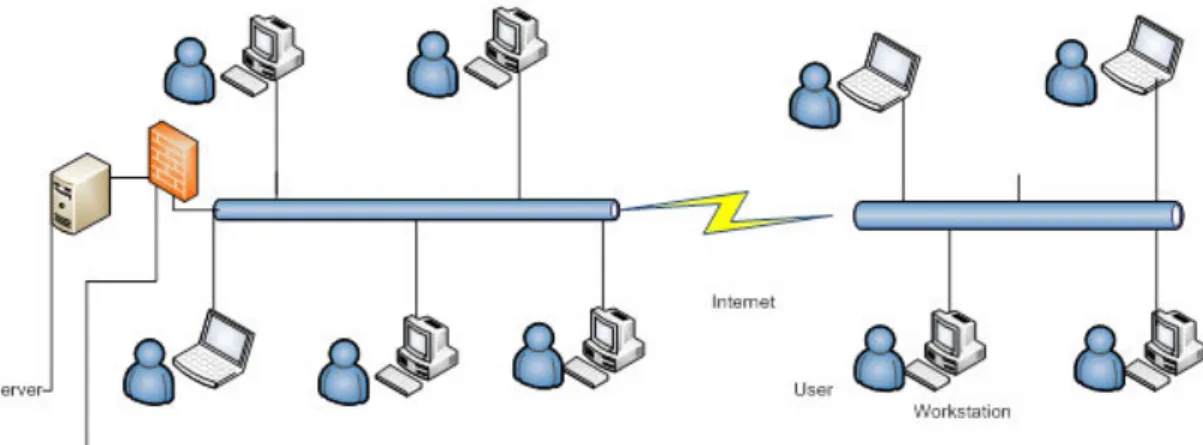
The architecture of WEBSTREMS is shown in Figure 3.1. Client-server architecture is employed in the design. The application is installed in the server. A firewall is installed on server to enhance the security of the application. A user can log-on to the system and request for service through a web browser. The client system can be connected to the server through a local area network or via the Internet. Any computer system can be used as a client, whether a P.C or a laptop. It is therefore possible that students can do their registration from any location and lecturers and administrators can work in the office or from home. This architecture enhances efficiency.
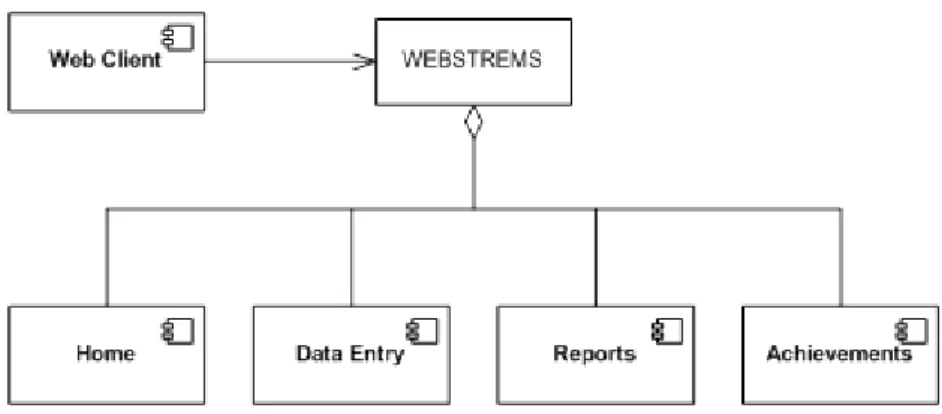
We analyzed the system using the UML – Unified Modeling Language (Aredo, 2002; Perdita and Pooley, 2000; Schmidt, 2001; Rumbaugh et al. 1999; UML, 2011; Kantorowitz and Lyakas, 2004; Williams, 2007). WEBSTREMS is composed of four main components as shown in the conceptual framework (Figure 3.2). These are the home page, the data entry page, the result page and the achievement page.
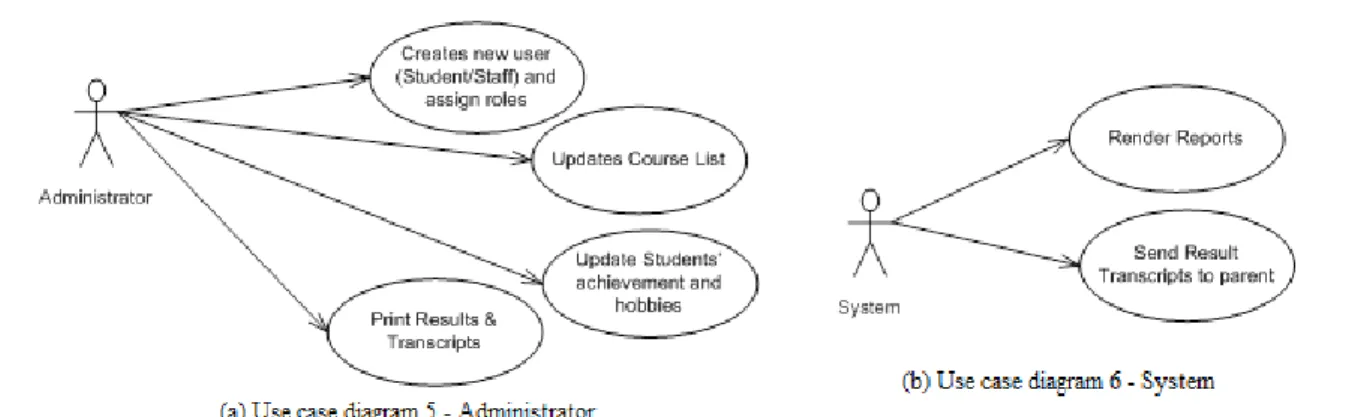
Use case diagrams are used to describe how external entities relate with the system (Figure 3.3 to 3.6. The refinements of the use cases are shown in tables 3.1 and 3.2. Table 3.1 covers the use cases in Figure 3.3. through 3.4 while Table 3.2 refines Figure 3.6. In Figure 3.3a, the Head of Bursary department having confirmed that the student has paid the correct fees uploads his user details so that he can access the WEBSTREMS and update his record. The Students can then update his personal information and register for outstanding or current semester’s courses (Figure 3.3b). Fig. 3.4a depicts the role of the Lecturer who can authorize and authenticate students’ registration, upload examination scores and process results. Senate can examine and approve results when an examination has been taken (Figure 3.4b). In Figure 3.5a, the Administrator can create new users, staff or students; update course list, update student achievement and print results and transcripts. Figure 3.5b depicts the role of the System while the use case in Figure 3.6a describes the roles of the Lecturer in processing results. Finally, Fig. 3.6b shows the role of Student in relation to their results.
3.2 Database Design
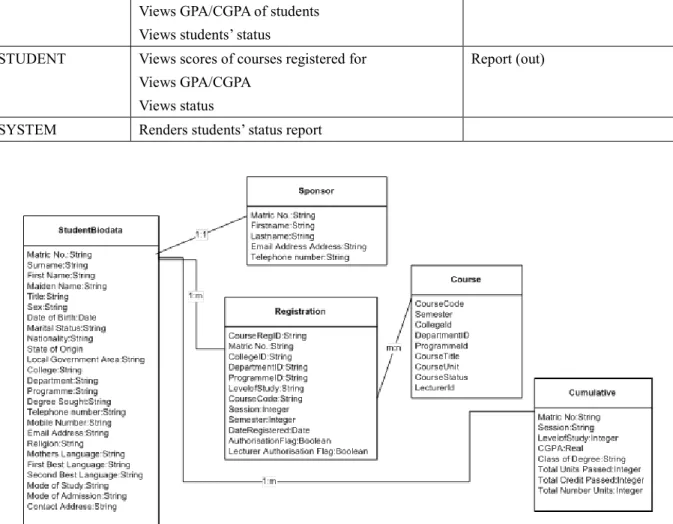
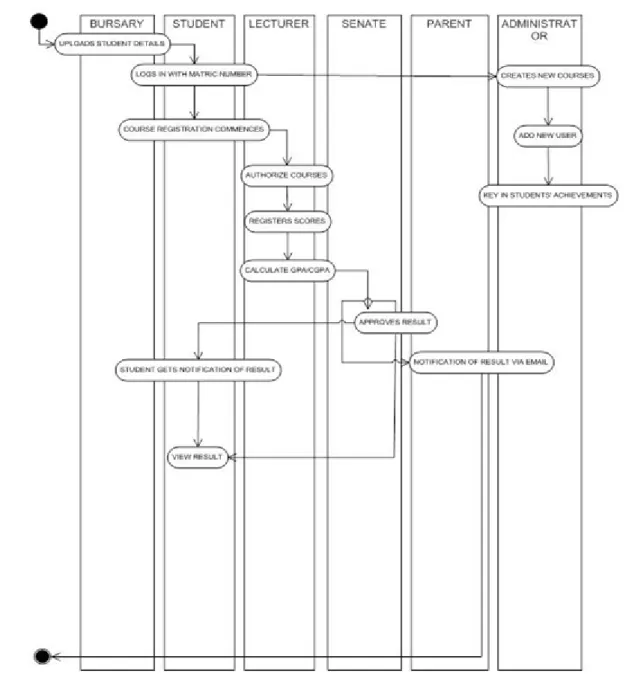
Figure 3.7 depicts the class diagrams of the system, taking only a part of the entire database. The database backend employed the Microsoft SQL Server 2005. The tables are related variously. We have 1:1 relationships (for example, StudentBiodata vs Sponsor), 1:m (one-many) relationships (for example StudentBiodata vs Registration) and m:n (many to many) relationships (for example, Registration vs Course). Each table has a primary key which could be a single field or a combination of fields and one or more foreign keys that can be used to link them. Fig. 3.8 depicts the process model of the WEBSTREMS architecture. Bursary, after verification of student’s payments for the semester uploads student’s basic information into the system. Without this, a student would not be able access the system. Login in with their matric number and with necessary verification, a student can update his personal details and complete registration of courses for the semester. Lecturers can verify and authorize student course registration. Later in the semester when examinations have been conducted, the lecturers can update the system with exam scores of student and generate their reports. Subject to approval of university senate, students and parents can be notified of the students’ results.
3.3 Implementation
WEBSTREMS’ implementation is characterized by an Intel Pentium-M hardware configuration based on the Windows XP and the Windows Server 2003 platforms. We have taken advantage of the popularity of the MicrosoftTM Windows operating system. The minimum requirements are 512MB RAM and 40GB of hard disk storage. The client computer can also run on Window Vista Operating System, Windows 2000, Windows 2005 and Windows 7. The backend employs the Microsoft SQL Server 2005, a frontline relational database management system. The server side technology was programmed using ASP.NET based on the Microsoft.Net Framework. Macromedia Dreamweaver was used to design aspects of the user interfaces. Either Mozilla Firefox, Internet Explorer 6+, Opera or Chrome web browser is required. Internet Information service (IIS) or Cassini is needed at the server computer.
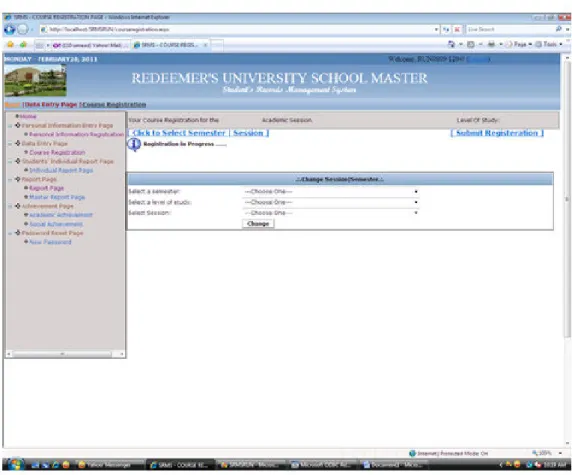
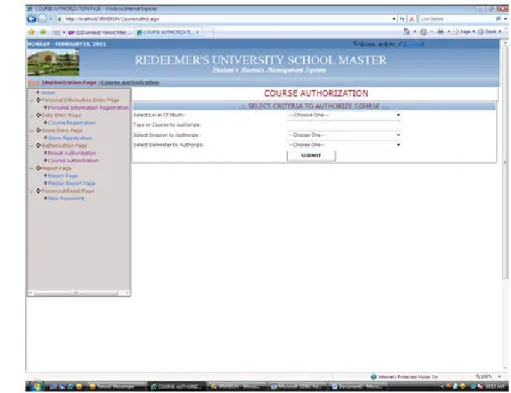
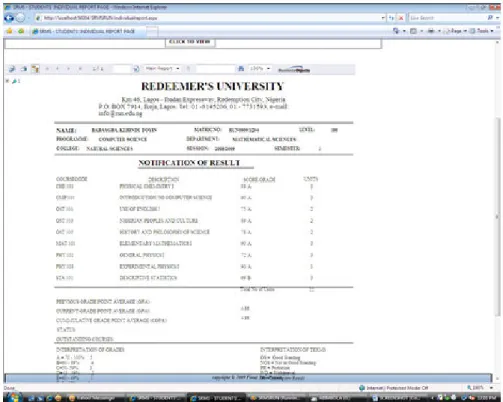
A typical session of WEBSTREMS starts with a login session (Figure 3.9); after login the user can then perform various operations based on the role that is already assigned to him. Only three trials of the login procedure are allowed per session. This is to ensure that any unauthorized user would not be allowed to make indefinite number of guesses. We note that the user category dictates the menu that would be presented to the user. A student will not see the same menu as a lecturer. In the same vein, the administrator has his own unique menu which enables him to perform his functions. Figure 3.10 through Figure 3.14 depict aspects of the implementation sessions. Fig. 3.10 presents the course registration interface while the course authorization interface is shown in Fig. 2.11. Lecturers can update examination scores with the interface shown in Fig. 3.12 and student’s biodata can be captured using the form shown in Fig. 3.13. A typical notification of result is shown in Fig. 3.14. This can be printed or e-mailed to the parent. Delivery using SMS will contain basically the same information but without the fanciful formatting.
4. Conclusion
In this paper, we describe the design and development of a Web-based Students Records Management System. It is a full-featured information system that enables accurate record keeping of students’ personal, academic, health and related data. As students’ data would continue to grow with the addition of more students and their increasing data year after year, we have implemented the backend using a robust and scalable database management system – Microsoft SQL Server 2005. The frontend implementation has taken advantage of the Microsoft Visual Basic.net to enable online access from anywhere there is a compatible web browser. The role of each user has been clearly defined and users cannot go beyond their defined operational domain. The system stores and preserves accurate data and guarantees timely delivery of information to users. Manual processing of academic transcripts which may take several weeks before can now be realized within few minutes. Students’ notification of results can also be issued immediately their results are approved by the senate.
The hallmarks of WEBSTREMS are timeliness, accuracy and efficiency. Parents are often deceived by their wards, claiming they are in good academic standing when actually they are not. One of the objectives of this study is to deliver timely and accurate information to parents on their wards. This work can be improved upon applying formal specification methods. This can form another step in carrying the research further.
References
Aredo, D.B. (2002). “A framework for Semantics of UML Sequence Diagrams in PVS.” Journal of Universal Computer Science (JUCS), 8 (7), 674-697.
Arekete, S.A., Osinowo, M.O. (2009). “Modeling Rule-Based Information Systems with MS-Excel.”
International Journal of Computer Science, 1 (1), 71-78.
(2008), 1–52.
Desai, B.C. (1990). An Introduction to Database Systems, West Publishing Company, New York
Kantorowitz, E., Lyakas, A. (2005). “Use-case components for interactive information”, Science of Computer Programming 56 (2005), 5–21
Liu D.T., Xu, X.W., (2001), “A review of web-based data management systems”, Computer in Industries, 24 (2001), 251-262.
Perdita, S., Pooley, S. (2000). Using UML Software Engineering with Objects and Components, Object Technology, Addison-Wesley, NY.
Qin, S.F., Harrison, R., West, A.A., Jordanovc, I.N., Wright, D.K. (2003) “A framework of web-based conceptual design”, Computers in Industry 50 (2003), 153–164.
Rumbaugh J., Jacobson, I., Booch, G. (1999). The Unified Modeling Language Reference Manual, Addison-Wesley, NY.
Schmidt, D.A. (2001). “Should UML Be used for Declarative Programming?”, Proc. ACM Conf. on Principles and Practice of Declarative Programming (PPDP01), 2001.
UML, (2011). OMG Unified Modeling Language Specification – Version 2.0, May 2011, OMG, http//www.omg.uml.org
Willard, B. (2007), “UML for systems engineering”, Computer Standards & Interfaces, 29 (2007), 69–81.
Samson A. Arekete is a Lecturer at the Mathematical Sciences Department (Computer Science programme) of the Redeemer’s University, Ogun State, Nigeria. He obtained B.Tech in Engineering Physics (Electronics) in 1987, M.Tech in Computer Science in 1995 and Ph.D. in Computer Science in 2013 from the Federal University of Technology, Akure, Nigeria. His current interests are in Distributed Database Systems and Mobile Agents Technology.
Adekunbi A. Adewojo is a Graduate Assistant at the Mathematical Sciences Department (Computer Science programme) of the Redeemer’s University, Ogun State ,Nigeria. She obtained a B.Sc. in Computer Science from the Redeemer’s University, Ogun State, Nigeria in 2009. She currently pursues a M.Sc in Computer Science in Robert Gordon University, Aberdeen, Scotland. She is interested in Information Modeling.
Figure 3.2 Conceptual Framework of WEBSTREMS
Figure 3.3 Use case diagrams - Head of Bursary and Student
Figure 3.5 Use case diagrams - Administrator and System
Table 3.1: Activity 1 – Provide Registration Services
Actor Goal Input&Output
STUDENT Registers personal information Registers courses to be taken Registers carry-over courses if any
Personal information entry form (in)
Course entry form (in) LECTURER Verifies/Authorizes courses registered by students
Keys in course score per student Calculates GPA/CGPA per student
Calculates GPA/CGPA based on departments Calculates GPA/CGPA based on programme
Course score entry form (in) Calculated GPA/CGPA (out)
ADMINISTRATOR Creates new user (Staff and Students) Add new courses to existing ones
Keys in social and academic achievement records of students.
Prints out Result/Transcript
Creation of user form (in) Creation of records form (in)
HEAD BURSARY/ ACCOUNTS DEPARTMENT
Uploads matriculation numbers of students who have paid for a particular semester
Upload form (in)
SYSTEM Sends mail of students’ result to parents email address
Render reports
Figure 3.6 Use case diagrams - Lecturer and Student
Table 3.2: Activity 2 – View Results of Student
ACTOR GOAL INPUT & OUTPUT
LECTURER Views scores of students for clarification purposes Views GPA/CGPA of students
Views students’ status
Report (out)
STUDENT Views scores of courses registered for Views GPA/CGPA
Views status
Report (out)
SYSTEM Renders students’ status report
Figure 3.9 Login Page
Figure 3.11 Course authorisation interface
Figure 3.13 Students biodata interface