Transience of Peers & Streaming Media
Mayank Bawa, Hrishikesh Deshpande, Hector Garcia-MolinaComputer Science Department, Stanford University Stanford, CA 94305
fbawa,hrishi,[email protected]
ABSTRACT
Applicationlevel multicastschemeshave traditionallybeen evalu-ated with respect to thee ciency penaltiesincurred in migrating the multicast functionality from the network layer to the applica-tion layer. We argue that the current performance measures, and therefore design strategies, areincomplete as they do not con-sider transience of peers. The routers in application level multi-cast systems are participant clients, and not infrastructure units. As such, the assumptions on the behavior of these application routers are signicantly dierent from the infrastructure routing units that traditionalresearch has dealt with, especiallyin a peer-to-peer setting where peers are multi-use and the management is decentralized. We argue that the transience in peer behavior has
implications on end-performance enabled. We outline a design philosophythat seeks toseparatepolicy decisionsin handlingpeer behavior from the end-application at a basic infrastructural peer-ing layer. As a proof of concept, we have implemented a peering layer prototype, which is available for download.
1. INTRODUCTION
Live streaming media will form a signicant fraction of inter-net trac in the near future. Recent trade reports indicate that if the current acceptance rate among end-users per-sists, streaming media could overtake television with respect to the size of the client base 1]. We expect the adoption trends for streaming media to be particularly remarkable in the context of peer-to-peer (P2P) systems.
Since video streams are high bandwidth applications, even a small number of clients receiving the stream by unicast are often sucient to saturate bandwidth at the source. IP-Multicast 2] was proposed as an extension to Internet architecture to support multiple clients at network level. The deployment of IP Multicast has been slowed by di-cult issues related to scalability, and support for higher layer This research was supported in part by NSF (Grant No. IIS-9817799). Mayank Bawa is supported by a Sequoia Cap-ital Stanford Graduate Fellowship.
functionality like congestion control and reliability. Several recent research projects 3, 4, 5, 6] have argued for a mul-ticast service at the application layer (end-host multicast). The service is to be simulated over unicast-links between hosts, forming an overlay network over end-hosts.
The end-hosts in P2P systems form ad-hoc networks to con-tribute resources to the community, and in turn use resources provided by other members for a personal goal. Thus, mem-bers of a P2P system can be expected to share their band-width to spread a media stream to other clients. In principle then, an end-host multicast solution seems to be an ideal t. Indeed, several such schemes 7, 8, 9] have been developed over the last year.
In practice, we believe however, that the migration of the multicast functionality from the network layer to the appli-cation layer leads to a subtle mismatch that has impliappli-cations on end-application performance. The mismatch arises from a change in the characteristics of the routing infrastructure assumed by the end-application | the behavior of routing elements (clients) in end-host multicast is very dierent from those (routers) in IP-Multicast.
For example, consider the following scenario in streaming-media delivery via multicast. During an end-hosts multi-cast session, a large fraction of clients (that were acting as routers) mightunsubscribe togetherin the middle of the stream, partitioning the overlay network. The time taken to repair the partitions will result in loss of packets transmitted during the transience period. Such an event, while probable in end-host multicast, is in contrast to network-level mul-ticast where clients only occur as leaves in the multicast tree built on routers. Router failures are not as frequent, and the chances of simultaneous failures of a large num-ber of routers, occurring frequently over the stream dura-tion, is extremely small. Hence, while packet lossesdue to router failures is not a probable eventuality in IP-Multicast, it must be accounted for in an evaluation of an end-host mul-ticast proposal. Unfortunately, conventional evaluations of such proposals have glossed over such implications on end-application performance.
It is our thesis that the primary challenge in any P2P archi-tecture will be themaskingof such peer transience. We will argue that end-applications are not easily insulated from the behavior of the new infrastructure units of a P2P net-work. A P2P network can be large with hundreds of nodes at
any given instant. More signicantly, peers are autonomous, unpredictable, and may have short (of the order of minutes) lifetimes. Thus, it is critical for widespread adoption of any P2P application that the service be capable of good perfor-mance over a large and dynamic system, and the underlying architecture handle such transience gracefully.
Correspondingly, in this position paper, we will argue the following two points:
We revisit the issue of evaluating an end-host multicast
scheme and urge the use of end-application metrics to account for the loss in performance due to the transience of routing units (Section 3).
We introduce the design philosophy of a peering layer
that insulates peer transience from end-applications. As a proof of concept, we present an architecture for stream-ing media over a P2P network that uses thepeering layer
to eciently enable a connected topology (Sections 4 and 5).
The rest of this position paper outlines the end-host multi-cast problem and presents conventional evaluation metrics (Section 2), summarizes current implementation status of the peering layer1(Section 6), and relates this work to other
projects (Section 7). We conclude in Section 8.
2. PROBLEM AND PRELIMINARIES
In this section, we give an overview of a simple end-host multicast architecture to establish the vocabulary, and then point out conventional schemes used to evaluate end-host multicast proposals.
A media stream is a time ordered sequence of packets that is logically composed of two channels: data(served using unre-liable RTP/UDP) andcontrol(sent using reliable RTSP/TCP) channels. Alivestream has the important property of being
history-agnostic: a group-member is only interested in the stream from the instant of its subscription onwards.
S S
Unicast edges on physical network topology
Application-level multicast tree
P1 P2 P3 P3 P 2 P4 P1 : Router,S:Source,P i : Peeri P4
Figure 1: An application level multicast tree built
on the peers
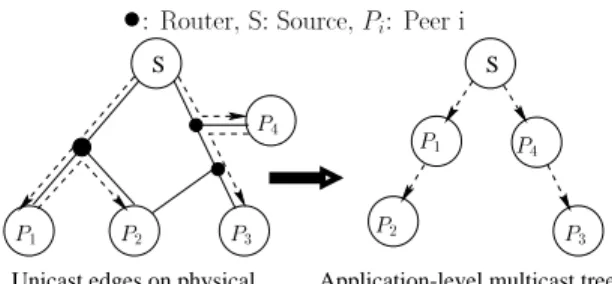
A simple architecture for an end-host multicast service orga-nizes the group members into a source-specic spanning tree as shown in Figure 1. The gure uses dotted lines to show the ow of data packets, while the solid lines represent the underlying physical wires. Each nodeP
i (including the
sourceS) forwards the stream to all its immediate children 1A skeletal implementation of the peering layer is available
for download from 11].
(if any). Eectively, each host acts as a multicast router, replicating and forwarding packets, and assuming responsi-bility for group management. The multicast tree is main-tained incrementally as nodes join and leave. The scheme species protocols to enable an incoming client P
i to
iden-tify an existing node in the tree that can act asPi's parent
(join policy), and to enable a repair of partitions in the tree when a client opts out of its multicast session (leave policy). The bandwidth requirements of S are now shared by the
network of clients, providing a potentially scalable solution for media broadcast. However, there is a loss in eciency entailed by moving the multicast functionality up the stack. For example, observe that the multicast tree is an overlay network | the actual forwarding paths in the physical net-work might visit the same netnet-work router multiple times. Thus, in Figure 1, the router on the path from S to P
1
will see each packet twice: once when S sends the packet
toP1, and next whenP1 forwards the packet toP2.
More-over, routing packets along the overlay network results in increased delay from the sourceS to a client P
i.
Stemming from the inuential work of 3] that identied such eciency concerns, subsequent proposals have been evaluated with respect to the metrics ofstress, relative delay penalty,andnormalized resource usage. Thestressof a phys-ical link is dened as the number of identphys-ical copies of a packet carried by the link. The ratio of the delay between the source and a recipient along the overlay to the unicast delay between them is dened as therelative delay penalty. Finally, resource usagecharacterizes the network resources consumed in the process of data delivery to all recipients. Correspondingly, it is dened asP L i=1 d i s i, where Lis the
number of links active in multicast, d
i is the delay of link i, andsi is the stress of link i. Observe that these metrics
succinctly capture concerns on the loss in eciency. How-ever, note also that it isnotpossible to predict the eects of transience on end-application performance using the above eciency metrics.
3. PERFORMANCE ANALYSIS FOR
END-SYSTEM MULTICAST
In this section, we dene a new set ofend-system metrics
to characterize performance of an end-host multicast solu-tion. We then present a performance analysis scheme to enable the study of eects of router-transience on such met-rics under a candidate solution.
An end-performance evaluation must, fundamentally, be inu-enced by the application semantics. A streaming media application exhibits the following characteristics that can stress the candidate architecture:
Sensitivity to data lossthat requires minimal packet loss
while accommodating changes in membership, and
Timeliness constraintsthat require changes in
member-ship to be accommodated quickly.
Correspondingly, ourend-system metricsto characterize per-formance for streaming media arepacket-losses,median lost-block widths,relative delay-penalty, andtime to rst packet (response time)dened as follows:
Let Ni be the total number of packets streamed by S
during a client Pi's lifetime. Let Nli be the number of
packets that were streamed bySduringPi's lifetime, but
not received byP
i. Then, packet losses observed at P iis dened asN li =N i.
The disruptions in the stream become visible to the
end-user when packet losses atP
iare consecutive, occurring
as blocks of lost packets. Hence, it is important to record the sizes of lost packet-blocks at each client Pi. The
median lost-block width at a client Pi, dened as the
median of all lost packet-blocks observed over the lifetime ofPi, accounts for such disruptions.
The response-time for a clientPi is dened as the time
taken to receive the rst stream packet at P
i after a
subscribe request was sent byP i.
The relative delay-penalty at a client is dened as before
(Section 2).
Given the above set of performance metrics, we next outline an analysis scheme. We propose that an evaluation of a mul-ticast proposal must answer the following questions:
What are the eects of the join policies on the
end-system metrics? What are the parameter ranges over which the join policies can scale?
What are the eects of the leave policies on the shape of
the multicast topology? Are the leave policies successful in keeping the topology connected, compact, and stable?
Which combinations of join and leave policies perform
optimally with respect to the packet loss metrics?
How do the policies compare against a centralized
uni-cast scheme on the response time metric of time to rst packet? Does the architecture scale gracefully with increase in the size of the client-base?
Live streaming media often gives rise to ash crowds at
the source, as the clients attempt to subscribe within a short interval of the start of the event. How does the architecture respond to such ash crowds?
The clients receiving a stream have unpredictable
life-times. How does the architecture behave under a range of expected lifetimes of the clients? Does the topology remain stable and connected for small lifetimes of clients?
The clients may have a range of bandwidth capacities,
from T3 to symmetric DSL. What is the eect of avail-able uplink bandwidth capacity at a node on the end-system metrics?
A third and nal piece remains to be specied | the behav-ior model of peers in a P2P network. We believe such mod-eling will be the source of interesting future work. Sev-eral P2P systems enjoy considerable deployment and can be used to collect behavioral traces. With these three pieces in hand, an end-host multicast proposal can be evaluated either through analysis or simulations.
To summarize, we believe that the eciency metrics dis-cussed in Section 2, while essential, were designed to char-acterize the eects of a functionality migration on the lower (network) layer alone. Unfortunately, it is not only the lower layers that have to bear a penalty for such a migration. Current end-applications are not designed to handle such unpredictability in the behavior of the infrastructure units, resulting in degradation of end-performance returned. We
believe that an evaluation of a candidate multicast scheme under the analysis scheme proposed above will enable a more realistic and accurate test of feasibility.
4. THE PEERING LAYER
As we argued in Section 1, maskingpeer transience is the primary challenge in any P2P architecture that supports an end application. In this section, we describe thepeering layerdesign philosophy that serves to hide topology changes from the above layers.
The peering layer is envisaged as a basic P2P infrastructure layer that exists below the end application. The peering layer is a placeholder for policies that govern topology main-tainance | insertion and deletion of peers. By layering the end service on top of a core transience management service in the peering layer, we believe P2P systems will gain in ease of development.
As a proof of concept that the peering layer functionality is useful in the development of P2P services, we have designed a simple tree-based multicast architecture layered on the peering layer. The solution, calledPeerCast, uses the peer-ing layers at dierent nodes to establish and maintain a mul-ticast tree. The PeerCast solution can work with short-lived nodes. Importantly, as we show elsewhere10], by separat-ing transience management from end applications, we were able toenable existing implementationsof media players at a peer to use the peering layer. Thus peers were conveniently enabled for stream distributionwithoutchanging their exist-ing code bases.
4.1 The Design Philosophy
We start by motivating the existence of a peering layer as a practical utility. Notice that a media stream is logically composed of two channels: data and control. An instance of the data and control channels taken together, between a server and a client constitutes a data-transfer session. Such a session is distinguished from an application session
which begins when a client subscribes to a stream from a source, and ends when the client unsubscribes. An appli-cation session can subsume several data-transfer sessions as the client changes servers from which it receives feed for a given stream.
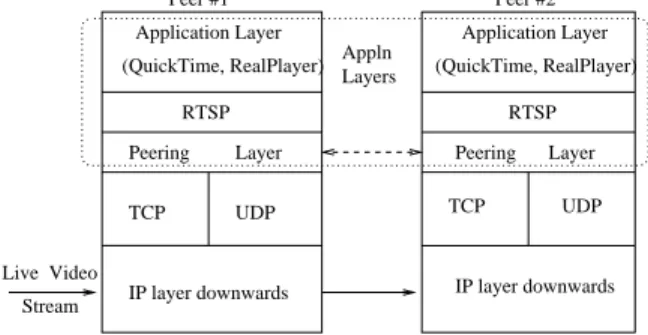
However, current implementations of most applications assume a unicast service, and bind the two sessions irrevocably together. We introduce a basic P2P infrastructure layer between the application and the transport layers for streaming that breaks the coupling between the two sessions. All communication between application and transport layers passes through the peering layer, as shown in Figure 2.
Data transfer sessionsare established between the peering layers at the two nodes. The end-points are identied by the tuple h Server IP-address, Server port, Client IP-address,
Client port, Stream URLi. The rst four components
iden-tify the transport end-points involved in the session. The last component serves to identify the specic stream data is intended for.
Applicationsessionsare established between the peering layer and the end application. The peering layer allows the
appli-Peer #2 Application Layer (QuickTime, RealPlayer) UDP RTSP Peering Layer Live Video Stream Application Layer (QuickTime, RealPlayer) TCP UDP TCP
IP layer downwards IP layer downwards RTSP
Peering Layer
Appln Layers Peer #1
Figure 2: A layered architecture of a peer
cation layer above to specify the stream to obtain, through a \get-stream" interface. Given a stream URL, the peer-ing layer locates a server which can provide the stream, and establishes a data-transfer session with the server. In the event of a data-transfer session termination, it locates a new server for data feed, and restarts the ow of data. If an alternate server cannot be found, an error is agged to the application above. The application session survives these changes, leaving the end application unawareand, indeed,
unconcerned, of shifts in the underlying multicast topology, as it should be.
The guarantees provided by the peering layer reect those of the transport layer protocol used in the data-transfer session (for which it has to maintain state). In addition, it guar-antees that the data feed to the application above will be maintained as long as an unsaturated server can be found.
4.2 The Redirect Primitive
The peering layer supports a simple, lightweight redirect primitive used to eect changes in the topology. The peer-ing layer uses redirects as hints, to enable discovery of an unsaturated node in the network.
A redirect message is sent by a peer p to another peer c
which is either opening a data-transfer session withp, or has
a session already open. The message species a target peert.
On receipt of the redirect message,ccloses its data-transfer
session withp, and tries to establish a data-transfer session
witht, for the same stream URL. Note that such redirect
messages are produced and used at the peering layer, and the application above is unaware of such messages. Thus, the application session persists despite changes in the data-transfer sessions.
4.3 Discovering an Unsaturated Server
A new noden seeking the live stream needs to be able to
discover an unsaturated node in the multicast group. The node n contacts the source s of the stream at the known
URL. Ifsis unsaturated, it acceptsnas its child and
estab-lishes a data-transfer session withn. Otherwise,sredirects nto one of its immediate children c. Then,n attempts to
setup a data-transfer session withc. The process continues
iteratively, until n gets accommodated. If n is unable to
nd an unsaturated node within some specied number of tries, the peering layer ags a resource unavailable error to the upper application-layer.
4.4 Managing Unsubscribe of Nodes
If a nodenwishes to unsubscribe from the stream, it sends a
leave message to its parentp. The parentpfrees up resources
dedicated to n at its side. However, the descendants ofn
are now disconnected froms, and experience a break in the
stream. To enable a recovery following its unsubscribe, n
sends redirects all its immediate children C to some target t (e.g., the source s, or the parent of n). The nodes in C
then start the process of nding an unsaturated server by contacting t, as discussed above.
4.5 Handling Failures of Nodes
Intermediate nodes might fail, without being either able to inform their parent, or send redirect messages to their chil-dren. The overlay network needs to rst detect such a fail-ure, and then recover from it. The peering layer at a node uses a heart-beat mechanism to detect failures, and recov-ers by following the unsaturated-server discovery process as mentioned in Section 4.3.
5. POLICIES FOR TOPOLOGY
MAINTE-NANCE
The peering layer discussed in Section 4 was said to serve as a placeholder for join and leave policies. Clearly, the nature of policies depend on the unique end application supported. In this section, we discuss simple candidate policies to show that the twin goals of performance and eciency can be attained simultaneously by decisionsconnedat the peering layer.
5.1 Improving End-Application Performance
As we observed in Section 3, the end-system performance is characterized by packet losses, packet delays, and response times. It can be shown that the shape of the multicast tree has implications on the end-system metrics. In fact, it is easy to derive the following result.
Theorem 1. Under homogeneous unicast edge and node characteristics, an almost-complete spanning tree is the opti-mal overlay tree for packet loss, packet delay, and time to rst packet metrics.
The shape of the multicast tree is determined by the topol-ogy maintaining policy. Thus, an optimal policy is one that maintains an almost-complete spanning tree. Such a policy can then be implemented using the mechanisms we discussed in Section 4.
5.2 Improving Overlay Efficiency (or
Adapt-ing to Network Dynamics)
The multicast tree that has been formed using the policies discussed in Section 4 does not consider network attributes like link latencies, congestion, or peer bandwidths. More-over, these quantities are dynamic, and it is important that the topology is rearranged in keeping with dynamic mea-surements of these quantities. Indeed, a lot of the previous work 3, 4, 5, 6, 12] in end-hosts multicast has focussed on these aspects, and suggested useful heuristics that can be included in the protocol to enable low penalties in eciency
metrics. We indicate below how such heuristics can be used with our tree management policies of Section 4.
Nodesxandythat seek to establish a data-transfer session
from x to y can compute a cost function F(xy) to
char-acterize network proximity, unicast latency, and bandwidth capacity between them 4]. Given such a cost value, new members can join the multicast tree as suggested below.
Knock-Downs : Each node n periodically recomputes F(nc) for each of its childrenc. For each incoming peer xthat contacts a nodenin the tree,F(nx) is computed.
Ifn is unsaturated, it accepts xas a child. If nis
sat-urated, it comparesF(nx) with the maximumF(nc)
among all of its children c. If F(nx) is cheaper, then nacceptsxas its child, and redirects the child with the
most cost. Otherwise, x contacts each of n's children,
and tries to connect to the least cost candidate node.
Join-Flip: Each internal node n periodically computes F(pn) for its parentp. A new incoming clientxsends a F(px) along with its request ton. IfF(px) +F(xn)
is less thanF(pn) +F(nx),n closes its data transfer
session withp, redirectsxtop, and then itself tox. Such
a policy is used in 6] to form ecient trees.
We can also dene incremental optimization heuristics that rearrange anexistingoverlay to improve eciency.
Maintain-Flip: This policy is similar to the Join-Flip
discussed above. Instead of working with a new incoming client, existing nodes in the overlay tree are swapped. Each node n computes F(pn), F(nc) for its parent p and each of its children c periodically. If F(pn) + F(nc) is more than F(pc) +F(cn) for some child c,
the positions ofn and care swapped. The work in 6]
provides similar policies to build near-optimal trees. The work in 3, 5] uses such measures as part of their routing protocols to build a spanning tree with low eciency penalties.
Leaf-Sink: The authors in 13] propose a centralized
algo-rithm to sink unstable or low-bandwidth nodes to the bottom of the tree. They also propose Redundant Vir-tual Links in the tree, which allow nodes to receive the same packet from multiple dierent sources, leading to decreased packet losses.
6. STATUS
The PeerCast system as described is under development. A few simple join and leave policies have been designed, imple-mented, and eld tested. A discrete event based simulator has been implemented to evaluate PeerCast as outlined in Section 3. The initial results from eld tests and simula-tions are encouraging. We are in the process of designing and conducting more detailed simulations.
7. RELATED WORK
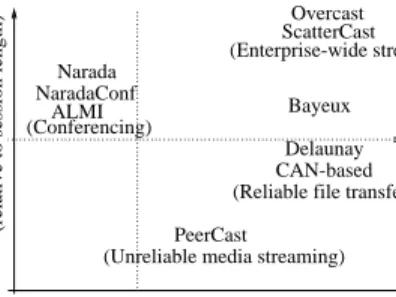
To place our work in the context of proposed end-host multi-cast solutions, we cartooned existing proposals as in Figure 3 that illustrates the domain characteristics catered to. The horizontal axis plots the size of multicast group that can be supported. The vertical axis plots the assumed lifetime of hosts over which the overlay network is formed. The solu-tions indicated in Figure 3 are a representative set of wider
work done in the eld.
ALMI Narada NaradaConf ScatterCast Overcast Delaunay Bayeux CAN-based Hundreds (Conferencing) Longetivity of nodes
(relative to session length)
Size of multicast group
Tens Thousands
(Enterprise-wide streaming)
PeerCast
(Reliable file transfers)
(Unreliable media streaming)
Figure 3: Classifying dierent end-host multicast
proposals.
Solutions in the left portion of the grid 3, 4, 12] have been proposed for multicast over a group of tens of nodes, most of which live through the duration of the session. An example application domain is video conferencing, wherein partici-pants are few (tens of members), and members live through most of the session. The top-right portion of the grid lists proposals 5, 6] that can scale to thousands of nodes, but assume existence of reliable, long-lived infrastructure hosts over which overlays are constructed. As such, these solutions are not adaptable to P2P systems. The middle-right portion lists proposals 7, 8, 9] that rely on primitives proposed in a P2P context to accommodate thousands of clients. These solutions have been proposed and tested in domains in which most of the members are expected to persist through the session. To the best of our knowledge, these proposals have not been proven to scale for hundreds of short-lived nodes forming adynamicgroup.
The solution we propose, PeerCast, by being aware of the need to manage and mask peer transience from the end-application is able to push down on the longetivity axis in the grid. PeerCast is designed to scale to hundreds of short lifetime nodes that participate in long-durationed multicast session transmitted over unreliable unicast UDP/RTP.
8. CONCLUSIONS
In this paper, we argued that the migration of the multicast functionality from the network layer to the application layer results in a fundamental shift in the underlying infrastruc-ture. The infrastructure units are now participating clients, that are known to be more whimsical and transient that network routers. The observation is especially true for P2P networks, where the participating peers are the providers of an end-service. We urge that the end-host multicast schemes be evaluated on end-system performance metrics of relative delay-penalty, response time, packet losses, and lost-block widths. We indicated that masking peer transience is a pri-mary challenge in such a domain. We introduced the design philosophy of a peering layer at each peer that isolates poli-cies for maintaining the topology from end-application func-tionality. The applications at a peer now need not be aware of a change in the server providing its data feed.
9. REFERENCES
1] Shannon Dorey, \Streaming media - will it overtake television?,"
http://www.the-surfs-up.com/news/news4p1.html, 2001.
2] S. Deering, \Multicast routing in a datagram internetwork," PhD Thesis, Stanford University, California, 1991.
3] Y. Chu, S. Rao, and H. Zhang, \A case for end system multicast," inMeasurement and Modeling of
Computer Systems, 2000, pp. 1{12.
4] Y. Chu, S. G. Rao, S. Seshan, and H. Zhang, \Enabling conferencing applications on the internet using an overlay multicast architecture," inProc. of the ACM SIGCOMM, 2001.
5] Y. Chawathe, \Scattercast: An architecture for internet broadcast distribution as an infrastructure service,"PhD Thesis, University of California, Berkeley, 2000.
6] J. Jannotti, D. Giord, K. Johnson, M. Kaashoek, and J. O'Toole, \Overcast: Reliable multicasting with an overlay network," inProceedings of the Fourth Symposium on Operating Systems Design and Implementation, 2000, pp. 197{212.
7] S. Ratnasamy, M. Handley, R. Karp, and S. Shenker, \Application-level multicast using content-addressable networks," inNetworked Group Communication, 2001, pp. 14{29.
8] S. Zhuang, B. Zhao, A. Joseph, R. Katz, and
J. Kubiatowicz, \Bayeux: An architecture for scalable and fault-tolerant wide-area data dissemination," in
Proceedings of the Eleventh International Workshop on Network and Operating System Support for Digital Audio and Video (NOSSDAV 2001), 2001.
9] J. Liebeherr, M. Nahas, and W. Si, \Application-level multicast with delaunay triangulations," Tech. Rep. CS-2001-26, University of Virginia, CS Dept., 2001. 10] H. Deshpande, M. Bawa, and H. Garcia-Molina,
\Streaming live media over peers," Tech. Rep. 2001-31, CS Dept., Stanford University, 2001. 11] \http://www-db.stanford.edu/peers/," .
12] D. Pendarakis, S. Shi, D. Verma, and M. Waldvogel, \ALMI: An application level multicast infrastructure," inProceedings of the 3rd USENIX Symposium on Internet Technologies and Systems (USITS), 2001, pp. 49{60.
13] V. Roca and A. El-Sayed, \A host-based multicast (hbm) solution for group communications," in1st IEEE International Conference on Networking, 2001.