Robust Botnet Detection Techniques for
Mobile and Network Environments
Author:
Basil Alothman
First Supervisor:
Dr.Suleiman Yerima
Second Supervisor:
Professor Helge Janicke
A thesis submitted in partial fulfilment of the requirement for the degree of Doctor of Philosophy PhD.
in the
Faculty of Technology
De montfort University
Leicester, United Kingdom
I, BasilAlothman, declare that this thesis titled, ’Robust Botnet Detection Techniques
for Mobile and Network Environments’ and the work presented in it is my own. I confirm that this work submitted for assessment is my own and is expressed in my own words. Any uses made within it of the works of other authors in any form (e.g. ideas, equations, figures, text, tables, programs) are properly acknowledged at any point of their use. A list of the references employed is included. This thesis is written by me and produced using LATEX.
Professional Conference/Journal Papers (Published):
1. B. Alothman and P. Rattadilok, “Android botnet detection: An integrated source code mining approach,” 2017 12th International Conference for Internet Technology and Secured Transactions (ICITST), Cambridge, 2017, pp. 111-115. 2. B. Alothman and P. Rattadilok, “Towards using transfer learning for Botnet
Detection,” 2017 12th International Conference for Internet Technology and Secured Transactions (ICITST), Cambridge, 2017, pp. 281-282.
3. B. Alothman, “Similarity-based instance transfer learning for botnet detection.”, International Journal of Intelligent Computing Research (IJICR) 9, 880-889 (Mar2018).
4. B. Alothman, “Raw Network Traffic Data Preprocessing and Preparation for Automatic Analysis,” International Conference On Cyber Incident Response, Coordination, Containment and Control (Cyber Incident), Glasgow, 2018.
5. B.Alothman, H. Janicke, and S. Yerima,(2018) “Class Balanced Similarity-Based Instance Transfer Learning for Botnet Family Classication,” The 21st International Conference on Discovery Science (DS2018), Limassol, Cyprus, 2018 Lecture Notes in Computer Science, Springer International Publishing, Cham. pp. 99-113.
Signed:
Cybercrime costs large amounts of money and resources every year. This is because it is usually carried out using different methods and at different scales. The use of botnets is one of the most common successful cybercrime methods. A botnet is a group of devices that are used together to carry out malicious attacks (they are connected via a network). With the widespread usage of handheld devices such as smartphones and tablets, networked devices are no longer limited to personal computers and laptops. Therefore, the size of networks (and therefore botnets) can be large. This means it is not surprising for malicious users to target different types of devices and platforms as cyber-attack victims or use them to launch cyber-attacks. Thus, robust automatic methods of botnet detection on different platforms are required.
This thesis addresses this problem by introducing robust methods for botnet family detection on Android devices as well as by generally analysing network traffic. As for botnet detection on Android,this thesis proposes an approach to identify botnet Android botnet apps by means of source code mining. The approach analyses the source code via reverse engineering and data mining techniques for several examples of malicious and non-malicious apps. Two methods are used to build datasets. In the first, text mining is performed on the source code and several datasets are constructed, and in the second, one dataset is created by extracting source code metrics using an open-source tool. Additionally, this thesis introducesa novel transfer learning approach for the detection of botnet families by means of network traffic analysis. This approach is a key contribution to knowledge because it adds insight into how similar instances can exist in datasets that belong to different botnet families and that these instances can be leveraged to enhance model quality (especially for botnet families with small datasets). This novel approach is denoted Similarity Based Instance Transfer, or SBIT. Furthermore, the thesis presents a proposed extended version designed to overcome a weakness in the original algorithm. The extended version is called CB-SBIT (Class Balanced Similarity Based Instance Transfer).
Firstly, I would like to thank Allah (God) for giving me this opportunity to complete my PhD thesis.
It is not easy to give enough thanks to people who supported me during my time at De Montfort University. But I would like to express my thanks to several people (in no particular order). I would like to extend my thanks and appreciation to my supervisors Dr Suleiman Yerima and Professor Helge Janicke for their support and guidance during my research.
Also, special thanks always go to all my family members and friends who were patient while I was abroad away from my home country and wished me the best success and encouraged me to work hard and submit my thesis as soon as possible. They have always been with me during the good and difficult times.
Finally, I would like to thank my sponsor (Ministry of Education, Kuwait) and Embassy of Kuwait, Kuwait Cultural Office Supervisors who followed the progress of my work and were always available to support me and answer my questions and concerns.
To my late paternal grandfather Mr. Nasser Alothman who taught me the importance and power of relationships, tolerance and giving.
To my late maternal grandfather Mr. Homoud Almogahwi who instilled in me the endurance and passion required for hard work. He supported me financially, morally and provided me with books at a young age (he owned a large press company that generously printed and distributed books around GCC
countries).
To my parents Yousef Alothman and Nadia Almogahwi who were always proud of me and influenced me to be a computer scientist. They never
stopped showering me with their kindness, generosity and love.
To my beloved wife Mariam Aldalali for her help, empathy and endless love. She is my real constant source of encouragement, strength and support. To my children Yousef, Nadia, Loulwah and Bader in whose eyes I always saw the motivation and hope and for being quiet, obedient, respectful and
Declaration and List of Publication ii
Acknowledgements v
Contents ix
List of Figures xiii
List of Tables xiv
Abbreviations xv
Symbols xviii
1 Introduction to the thesis 1
1.1 Introduction . . . 1
1.2 Motivation . . . 4
1.3 Methodology . . . 7
1.3.1 Android Botnet Detection . . . 8
1.3.2 Network Traffic Analysis . . . 9
1.4 Aims and Objectives . . . 9
1.4.1 Aims: . . . 9 1.4.2 Objectives: . . . 10 1.5 Hypotheses . . . 11 1.6 Key Contributions . . . 12 1.7 Thesis Overview . . . 13 1.8 Summary . . . 15
2 Background and Literature Review 16 2.1 Background . . . 17
2.1.1 Botnet Introduction . . . 17
2.1.1.1 Botnet Definition . . . 17
2.1.1.2 Key Concepts . . . 18
2.1.1.3 Anatomy of a Bot Attack . . . 20
2.1.1.4 Botnet Topologies . . . 20
2.1.2.1 SDBot . . . 24
2.1.2.2 RBot . . . 25
2.1.2.3 Zeus . . . 25
2.1.2.4 WannaCry . . . 26
2.2 What is Reverse Engineering? . . . 26
2.3 An Overview of Machine Learning and Transfer Learning . . . 27
2.3.1 What is Machine Learning . . . 27
2.3.2 What is Transfer Learning . . . 28
2.3.2.1 Formal Definition of Transfer Learning . . . 30
2.3.2.2 Inductive transfer learning . . . 32
2.4 Existing Work on Android Botnet Detection . . . 34
2.5 Recent Work on Network Traffic based Botnet Detection . . . 38
2.6 Summary . . . 45
3 An Integrated Source Code Mining Approach for Android Botnet Detection 46 3.1 Overview . . . 47
3.2 Dataset Formation and Feature Extraction . . . 50
3.2.1 Text-Mining Approach . . . 52
3.2.2 Source Code Metrics Approach . . . 53
3.2.3 Feature Selection . . . 55
3.3 Algorithms used in this Work . . . 58
3.3.1 NaiveBayes . . . 58
3.3.2 KNN . . . 58
3.3.3 Decision Trees . . . 59
3.3.4 RandomForest . . . 59
3.3.5 Sequential Minimal Optimization (SMO) . . . 60
3.4 Experimental Results . . . 60
3.5 Summary . . . 68
4 A Novel Similarity-Based Instance Transfer Learning Approach for Botnet Family Classification 69 4.1 Introduction . . . 70
4.2 Methods . . . 71
4.2.1 The TransferBoost Algorithm . . . 72
4.2.2 The Similarity-Based Instance Transfer (SBIT) Algorithm . . . 75
4.3 Instance Similarity . . . 79
4.3.1 What is Similarity . . . 79
4.3.2 How to Measure the Similarity of Instances . . . 80
4.3.3 The Similarity Types used in this Work . . . 81
4.3.4 Example Similarity Values . . . 84
4.4 SBIT Limitations and Extension . . . 86
4.4.1 The Class Imbalance Problem . . . 86
4.4.2 What is Overfitting? . . . 87
4.4.3 The Synthetic Minority Over-sampling Technique (SMOTE) Algorithm . . . 87
4.5 Summary . . . 91
5 Preprocessing of Raw Network Traffic Data and Performance Evaluation of the Proposed Methods 92 5.1 Introduction . . . 93
5.2 Preprocessing Raw Network Traffic Data . . . 94
5.2.1 Obtaining the PCAP Data . . . 95
5.2.2 From PCAP to Plain Text . . . 96
5.2.3 Labelling the Data: . . . 96
5.2.4 Missing Value Replacement (Imputation): . . . 97
5.2.5 One Hot Encoding: . . . 97
5.2.6 Removal of Highly Correlated Features . . . 98
5.2.7 Outlier Detection and Removal: . . . 99
5.2.8 Splitting and Sampling: . . . 99
5.2.9 Data Exploration: . . . 100
5.3 Applying Steps to Real Data . . . 101
5.4 Experimental Evaluation and Discussion . . . 104
5.4.1 The Network Traffic Data . . . 105
5.4.2 Evaluation of Classical Classifiers on Network Traffic Data . . . . 106
5.4.3 Evaluation of SBIT against RandomForest and TransferBoost . . . 108
5.4.4 CB-SBIT vs SBIT . . . 110
5.4.5 CB-SBIT vs SMOTE (using Network Traffic Data) . . . 112
5.4.6 CB-SBIT vs TransferBoost (using Text Data) . . . 117
5.5 Summary . . . 121
6 Conclusions and Future Directions 123 6.1 Lessons learned from this project . . . 123
6.2 How and Why this work is useful . . . 124
6.3 Conclusions . . . 125
6.3.1 Android Botnet Detection . . . 125
6.3.2 Raw Network Traffic Data Preprocessing . . . 126
6.3.3 Similarity Based Instance Transfer (SBIT) . . . 126
6.3.4 Class-Balance Similarity Based Instance Transfer (CB-SBIT) . . . 127
6.4 Limitations and Future Work . . . 128
6.4.1 Android Botnet Detection . . . 128
6.4.2 SBIT and CB-SBIT . . . 129
A Code for transforming Java Source Code into Dataset for Machine
Learning 131
B Code for evaluating Performance of Classifiers 133
C SBIT Implementation 135
1.1 Example Transfer Learning Scenario . . . 7
1.2 Thesis Structure . . . 8
2.1 Anatomy of a Botnet Attack . . . 20
2.2 Centralised Topology . . . 22
2.3 Decentralised Topology (P2P) . . . 22
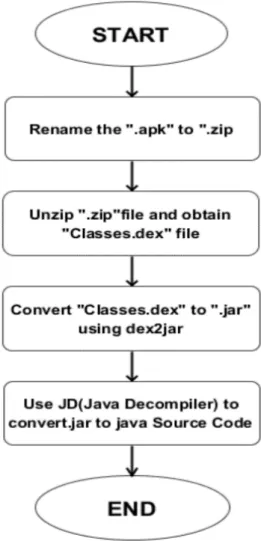
3.1 APK File Reverse Engineering . . . 50
4.1 A Flowchart of the TransferBoost Algorithm . . . 74
4.2 A Flowchart of the SBIT Algorithm . . . 76
4.3 Histogram of Similarity Values . . . 85
4.4 How SMOTE Works . . . 88
5.1 PreProcessingPipeline . . . 95
5.2 Contents of PCAP File . . . 95
5.3 PLS Components 1 vs 2 for TBot, Zero access and Zeus data . . . 104
5.4 Performance of Classical Classifiers on Network Traffic Data . . . 107
5.5 Run Times of the Two Algorithms . . . 110
5.6 Accuracy Values for CB-SBIT and SBIT . . . 111
3.1 A List of the Apps used in the Experiments . . . 51
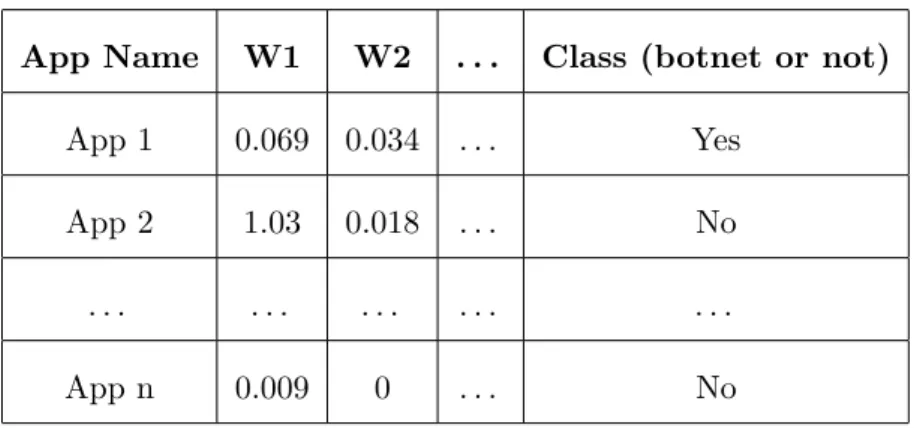
3.2 Dataset resulting after applying TextToWordVector and then TF-IDF filter 53 3.3 Source Code Metrics extracted by CodeAnalyzer . . . 54
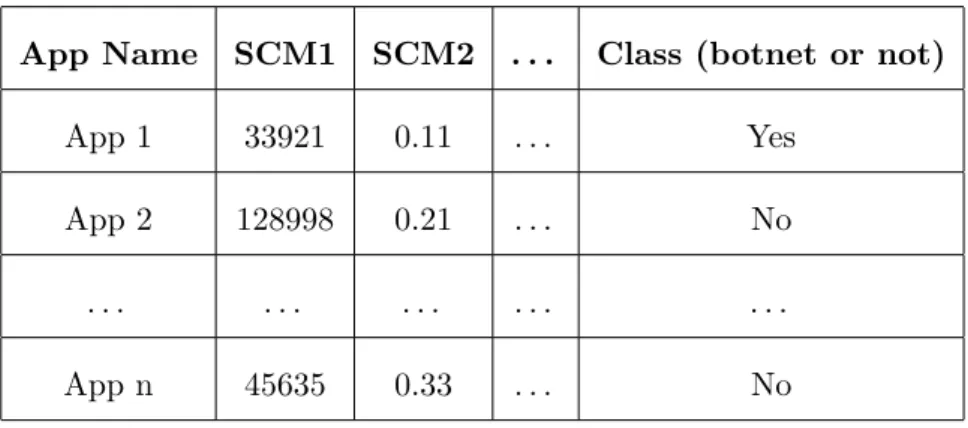
3.4 Dataset resulting after extracting Source Code Metrics . . . 55
3.5 A Summary of the Created Datasets . . . 57
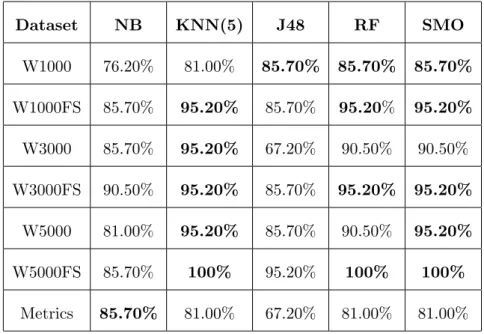
3.6 A Summary of Performance Results (Average Accuracy of Classifiers on Various Datasets) . . . 61
3.7 A Summary of NaiveBayes Results . . . 64
3.8 A Summary of kNN Results . . . 65
3.9 A Summary of J48 Results . . . 65
3.10 A Summary of RandomForest Results . . . 66
3.11 A Summary of SMO Results . . . 66
4.1 Different Similarity Measure Types and their Formulae . . . 82
5.1 Number of Instances in each Class . . . 103
5.2 Dataset Details . . . 106
5.3 The accuracy of each Method using Different Target Datasets . . . 109
5.4 Datasets Resulting after CB-SBIT and SMOTE . . . 114
5.5 Text Dataset Details . . . 119
5.6 Results using Text Dataset . . . 120
5.7 Percentage of Similarity Values that are > 0.5 using Text and Network Traffic Data . . . 121
6.1 An Example Dataset Resulting After Merging Text Mining and Metrics Datasets . . . 129
ITU International TelecommunicationUnion iOS iPhone/iPad/iPodOperating System SMTP SimpleMail TransferProtocol P2P PeerTo Peer
PCAP PacketCAPCAPture
Bot RoBot
Net Network
Botnet RoBot Network C&C Commandand Control DoS Denial of Service
DDoS Distributed DenialofService IRC Internet Relay Chat
HTTP HyperText TransferProtocol SQL StructuredQuery Language IP Internet Protocol
MIL Multiple InstanceLearning ANNs Articial NeuralNetworks MLFF Multi-LayerFeed-Forward SSL SecureSocketLayer MLP Multi-LayerPerceptron BBNN Block-BasedNeuralNetwork FPGA Field ProgrammableGateArray SVM SupportVector Machine
OC-SVM One-Class-SVM KNN K-NearestNeighbours
NB NaiveBayes
RF RandomForest
OPFC Optimum-Path ForestClustering SOM Self-OrganisingMaps
DTs Decision Trees
REPTree Reduced Error Pruning Tree TL TransferLearning
NoTL NO Transfer Learning APK Android Package Kit
ISCX InformationSecurity Center of eXcellence SMS ShortMessageService
LAH List Abbreviations Here JAR JavaARchive
NLP NaturalLanguage Processing API Application Programming Interface JD JavaDecompiler
GUI Graphical User Interface
TF-IDF Term Frequencyand Inverse Document Frequency SCM SourceCodeMetric
SMO SequentialMinimalOptimisation
Acc Accuracy
ERR ERrorRate
FPR False PositiveRate FNR False NegativeRate TPR TruePositiveRate TNR Tue NegativeRate AUC Area Under theCurve
SBIT SimilarityBasedIinstanceTransfer Learning CB-SBIT ClassBalancedSBIT
Sim Similarity
SMOTE SyntheticMinority Over-sampling TEchnique
UK UnitedKingdom
FTP File TransferProtocol
PCA PrincipalComponentAnalysis PLS Partial Least Squares
X Feature Space
X Data
P(X) The marginal probability distribution (for XinX) x(i) The ith instance in X
D A Domain DS A Source Domain DT A Target Domain T A Task TS A Source Task TT A Target Task Y Label Space
y(i) The label of theith instance in X f(•) A Predictive Function ∈ is in 6 = is not equal to P(x) Probability of x P(x|c) Probability of x givenc P Summation n P i=1
Summation of all elements from 1 to n xi The ith element inx
Introduction to the thesis
1.1
Introduction
The Internet is a very busy network that sees huge amounts of data being transferred every day. Users and machines, communicate by sending and receiving various types and amounts of data. This means that despite the usefulness of such communication platform, there are several ways to cause harm. One of these ways is to communicate with someone while pretending to be someone else. Another way is by installing tools onto other people’s devices in order to spy on them or to steal some sensitive information. Also, it is possible to use such installed tools to attack others who might be thousand of miles away. These electronic attacks can be launched against personal or corporate computers and networks. One of the existing methods for executing such harmful attacks is via botnets. Botnets are groups of networked devices that can be exploited to carry out malicious attacks.
The dangers of botnets are becoming more widespread; an example of this is the WannaCry attack that caused many major institutions in several countries to struggle to perform their services (Kalita, 2017). The research community has recently been actively trying to develop automatic techniques to identify botnets in order to stop their harmful activities.
Large amounts of money is lost every year due to botnet activities. For example, reports from reliable sources suggest that more than 65 Billion US Dollars were lost in 2005 and the entire damages caused by spam bots were estimated to have a cost of around 100 Billion US Dollars in 2007 alone (International Telecommunication Union, 2017). It is not a secret that organised cyber crimes are becoming widespread as they can be a profitable venture within short periods of time. It is estimated that cyber crime can cost the global economy up to 600 billion US Dollars a year (Healey and Knake, 2018). This is emphasised in a report published by the WhiteHouse where it is estimated that the US economy suffered a loss of more than 108 Billion US Dollars in 2016 (The Council of Economic Advisers, 2018). Hence, researchers have been working actively to develop effective techniques to detect, and protect from, such malicious attacks.
Normally, machines like these are known as bots and such networks are known asbotnets. More on the definition and architecture of botnets is provided throughout this thesis (especially in Chapters 2 and 3). It is believed that hundreds of millions of computers that are connected to the Internet are infected each year, which results into more than 15 victims each second (Demarest, 2014). These networks represent a serious threat because they can be exploited to carry out malicious and illegal actions which can have high level damages. In fact, existing research indicates that a large number of attacks was because of the Internet of Things (IoT) and its poor security model (Crosbie, 2016). It is estimated that the number of units installed in the IoT will surpass 25 billion by
2020 (Middleton et al., 2013). Hence, the potential number and magnitude of attacks via the IoT is likely to increase.
It is indeed a source of concern to find out that the number of distributed denial of service (DDoS) attacks is on the rise (Wang et al., 2018) and the ways attacks are carried out (in terms of diversity, intensity and duration) is increasing every year (Verisign DDoS Report, 2018).
Android is one of the most popular smartphone operating systems which keeps growing among smart-device users. This operating system is open source, user-friendly and it is relatively easy to write Java applications that run smoothly on it. Its popularity makes it one of the default targets for malicious cyber-attacks. It can be used to launch attacks or it can also be the victim of malicious attacks. Android’s play-store is not very restrictive which makes installing malicious apps easy.
It is common for botnet developers to target smartphone users in order to install their malicious tools on a large number of devices. This is often done to gain access to sensitive data such as credit card details, or to cause damage to individual hosts or organisation resources by executing denial of service attacks. With the large number of Android apps being released everyday it is difficult to know whether or not an app is safe to install. To overcome this issue, among other challenges, it would be useful to automate the process of checking how safe a new app is (i.e. to use the smartphone itself to predict whether or not an app is safe).
Because botnets run on networked devices, they normally communicate with each other, and more fundamentally, with a central point known as the Command and Control (C&C for short). The communication takes place to send/receive commands and
responses/results. Botnets use various network protocol to communicate safely and evade any protection and detection systems. For example, many botnets use the Internet Relay Chat (IRC) as well as Simple Mail Transfer Protocol (SMTP) protocols.
Also, botnets can be formed with different architectures. For example, botnets can have the traditional client/server network architecture where several clients connect to the same server (or group of servers). This model is known as the centralised C & C. While this architecture can be easy to develop, it is also easy to combat against. If the communication between the infected machines and the server(s) is terminated, then the botnet is effectively stopped. Another network model that is adapted by some botnets is the Peer-to-Peer configuration (P2P for short). This architecture is more difficult to combat than the centralised approach because of the large number of connections that can involve thousands or millions of devices.
1.2
Motivation
The work presented in this thesis primarily focuses on two problems. The first problem is botnet detection on the Android operating system by means of source code mining and analysis. The approach developed in this thesis analyses the source code of a given android app and attempts to identify whether it is botnet or normal. The second problem is more generic as it focuses on botnet detection and identification via analysis of network traffic. The network based detection is tackled by developing a novel transfer learning algorithm as will be explained in this thesis.
As for botnet detection on Android, the main motivation for the approach presented in this thesis is to develop a proactive method that attempts to identify the danger before it occurs. Android users can easily install apps from both official Google play store and
third party app markets. The problem here is that the only way users can trust an app is via reading comments and reviews written by other users (who may also be malicious actors). The approach presented in this thesis protects users against this by introducing a method for analysing the source code of Android apps before installing them. The method reverse engineers the Android apps and obtains their source code. Then, from the obtained source code, it uses two different approaches to create datasets suitable for machine learning and data mining. This is all done after only downloading the Android app and without installing and running it. It is worth mentioning here that although this thesis focuses on Android apps, the proposed approach can be used in other mobile operating systems. For example, applications running on the iPhone operating system (iOS) can also be reverse engineered (Joorabchi and Mesbah, 2012) and their source code can be analysed using the same method.
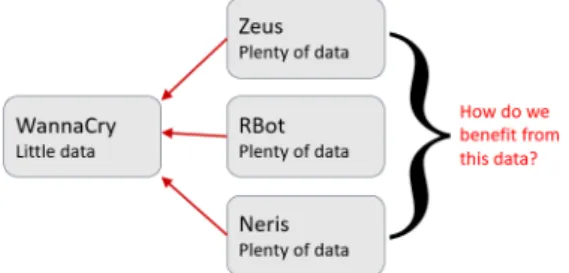
Regarding the second problem addressed in this thesis, the main motivation for developing a transfer learning approach for the precise detection of botnet traffic can be summarised by providing an example (an example is provided in Figure 1.1 later in this section). From reviewing existing approaches, it can be noticed that many of them target specific botnets. On the other hand, many approaches try to identify any botnet activity by analysing network traffic. They achieve this by concatenating existing botnet datasets to obtain larger datasets, building predictive models using these datasets and then employing these models to predict whether network traffic is safe or harmful.
The problem with the first approach is that data is usually scarce and costly to obtain. By using small amounts of data, the quality of predictive models will not be optimum. On the other hand, the problem with the second approaches is that it is not always correct to concatenate different datasets (i.e. datasets containing network traffic from
different botnets). Datasets can have different distributions which means they can downgrade the quality and predictive performance of machine learning models.
The proposed ideas in this thesis are based on using transfer learning. In more detail, instead of immediately concatenating datasets that belong to different botnets, this thesis suggests using transfer learning to carefully decide what data to use in concatenating such datasets. The main hypothesis is: Performance can be improved by using transfer learning techniques across datasets containing network traffic from different botnets. This should be done instead of blindly concatenating datasets.
So, before providing any further details, one can ask: what is transfer learning?. We as human beings have the ability to utilise past learning experiences when we are faced with new tasks. For example, when someones knows how to ride a bike, can he/she benefit from this experience when they learn how to drive a car?. Our level of mastering the new task depends on how much it is related to our past task. In machine learning, the sub-field that attempts to apply this experience, or knowledge, transfer is known as Transfer Learning. It is typically employed when there is little, or limited, amounts of labelled data in one task (usually called the target task), and plenty of data in another related task (usually called the source task). The idea here is that using the target data only can lead to obtaining models with poor performance since there is not sufficient data. By transferring knowledge from the source task(s) the model quality can be improved.
The problem of labeled data scarcity is common in machine learning. In many fields it can be too costly to obtain labeled data. Examples of fields where labeled data can be highly costly to obtain are: data for cancer patients, data for new botnets or viruses and data for undersea studies. One can evaluate existing traditional machine learning
algorithms. Because of the small size of data, the performance of these algorithms can be poor. In order to enhance performance, one idea is to collect more data (which can cost significant amounts of money, time and effort). Fortunately, in many cases, there exists plenty of data in domains that are close (or related) to the domain under study. This is where transfer learning comes into play.
Figure 1.1: Example Transfer Learning Scenario
The example diagram in Figure 1.1 illustrates the idea. For WannaCry, the available data is limited and insufficient to create a highly accurate model. On the other hand, there is plenty of data for each of the other three botnets. The idea is to use transfer learning to augment the WannayCry dataset so that more accurate predictive models can be created for WannaCry botnet detection.
1.3
Methodology
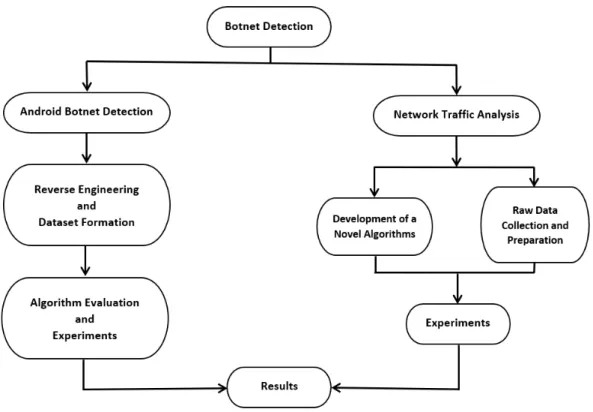
The work in this thesis focuses on two main problems as shown in Figure 1.2. The first challenge was to develop a source code mining approach for the analysis of Android apps. The second challenge was to develop a novel approach for the detection of botnets via analysis of network traffic. For both parts, existing literature was reviewed and limitations were identified. Although there is existing work that attempts to address these problems, techniques developed in this thesis add new contributions to the field as will explained throughout the remaining chapters.
Figure 1.2: Thesis Structure
1.3.1 Android Botnet Detection
The Android apps used in this work were collected from existing repositories. Two types of of apps were collected: normal and botnet. As the main focus is on botnet apps, it was ensured that the normal apps were network apps (i.e. apps that work as part of a network such as messaging and photo sharing apps). This is to make sure the comparison is done using apps that are similar in their underlying architecture. An open source tool was used to reverse engineer these apps and generate their source code. Afterwords, existing text mining approaches were used to form a dataset using the source code. At the same time, a freely available source code analysis tool was used to extract several metrics and for a separate dataset. These datasets were then used to evaluate the performance of several classical machine learning algorithms.
1.3.2 Network Traffic Analysis
The network traffic data used in the network based approach was obtained from an open source repository. The data was in raw format which means it was not immediately suitable for machine learning tools. Therefore, several steps were taken to transform it into a usable format. Subsequently, a novel transfer learning algorithm was developed and implemented. This novel algorithm was then evaluated extensively (using this dataset) and extended to enhance its performance and reduce its limitations.
1.4
Aims and Objectives
Although the previous sections have introduced several key points about the work carried out in this thesis, this section lists the aims and objectives of this thesis:
1.4.1 Aims:
The aims of this thesis are:
1. Develop a robust proactive approach for botnet app detection on android systems
2. Evaluate the proposed approach for botnet app detection on android systems
3. Develop a novel approach for botnet family classification with improved accuracy
4. Evaluate the proposed botnet family classification approach through extensive experiments and comparison with other classification approaches
1.4.2 Objectives:
In order to achieve the aims, the following steps are going to be performed to develop the source code mining approach:
1. Collect various botnet and normal android apps and use reverse engineering techniques to obtain their Java source code
2. Use text preprocessing techniques to transform the Java source code into format suitable for machine learning tools
3. Design and implement source code analysis techniques to distinguish between source code of botnet apps from source code of normal apps
4. Run experiments using several classifiers and find out which classifier works best on which dataset
In addition, the following steps are going to be performed to develop the novel transfer learning approach:
1. Collect network traffic data that contains traffic from various botnets as well as normal network traffic
2. Preprocess the data to transform it into format suitable for machine learning tools
3. Design and implement the novel transfer learning algorithm
4. Conduct several experiments to evaluate the performance of this novel algorithm and identify its strong and weak points
6. Conduct several experiments to compare the performance of this novel algorithm against the performance of existing commonly-used freely available algorithms
1.5
Hypotheses
The following hypotheses will be tested in the course of this thesis.
Hypothesis 1: Analysis of source code of Android apps can be an effective proactive method for the detection and identification of botnet apps. This thesis proposes an approach to reverse engineer Android apps, obtain their source code and mine this source code to predict whether an app is a bot or not. In other words, this hypothesis states that:
Android normal and botnet apps can be distinguished by using machine learning methods to analyse and gain insight into their source code
Chapter 3 of this thesis presents the development and evaluation of a source code mining approach. The findings of this work show that this simple yet powerful method can indeed produce accurate and reliable results.
Hypothesis 2: Where limited data is available for a target task, data available aplenty for one or more related but different task(s) (known as the source task(s)) can be exploited to enhance learning in the target task. This can be achieved by developing a transfer learning approach that carefully selects data from the source task(s) and transfers it to the target task. In other words, this hypothesis states that:
Performance can be improved by using transfer learning techniques across datasets containing network traffic from different botnets.
A novel approach is developed, extended and compared to other existing approaches in Chapter 4. An extensive evaluation of this approach using different types and sizes of real-world datasets is presented in Chapter 5. The novel approach is shown to outperform existing classical and commonly used approaches.
1.6
Key Contributions
The following points provide a summary of the contributions of this thesis to the field of using Machine Learning for botnet detection:
1. A Robust Integrated Source Code Mining Approach for Android Botnet Detection: this approach provides a method that can used to detect botnet android apps by reverse engineering their source code and then analysing it. This method is useful because it helps in detecting botnet apps before users run them. This means that the proposed method attempts to stop any harm before it happens by being proactive. The idea of this methods is based on using text mining techniques to gain insight into the source code of Android apps and classifying them accordingly.
2. A Novel Similarity Based Instance Transfer Learning approach for Botnet Family Classification: a novel instance transfer learning approach is developed and evaluated in this work. The main idea of this novel approach is to measure the similarity between instances in different datasets and to transfer highly similar instances to the smaller dataset. The instances are transferred from the Source dataset(s) to the Target dataset. Although this approach is simple and easy to implement, it is powerful and effective (in its accuracy and speed) as will be shown throughout the thesis.
3. Class Balanced Similarity-Based Instance Transfer Learning for Botnet Family Classification: this approach extends the Similarity Based Instance Transfer approach mentioned in the previous point. It works in exactly the same way but adds an extra step to ensure class balance in the resulting target dataset. In short, it only keeps instances transferred from source datasets so that the classes in the target dataset have a similar percentage (i.e. a similar proportion in the target dataset). This methods helps in avoiding overfitting and make interpreting models easier.
4. A Systematic Method for Transforming Raw Network Traffic Data into a format suitable for Machine Learning and Data Mining: a major part of this thesis is focused on botnet detection via network traffic analysis. However, open source network traffic data usually exists in raw format (known as PCAP format). Therefore, the thesis provides a systematic method that can be applied to not only transform this raw format into a format suitable for machine learning and data mining, but also to gain insight into the data, inspect and visualise it.
1.7
Thesis Overview
Here a summary of the structure of the thesis is provided.
• Chapter 1: This chapter presents an introduction to the main research idea, motivation, research scope and limitation, research hypothesis and thesis contributions. The proposed approaches are introduced at a high level; detailed explanations will be provided throughout the remaining chapters of this thesis. In addition, the chapter ended with an overview of the structure of this thesis.
• Chapter 2: Chapter two contains the background and literature review. It contains sections on what botnets are, some key concepts that must be understood in order to understand botnets, the anatomy of a botnet attack, botnet topologies and architectures, and several botnet examples. In addition, this chapter provides a summarised introduction to machine learning in general, and transfer learning in particular. It mainly focuses on inductive transfer learning because it is the branch under which this thesis falls. Additionally this chapter has a review of several existing botnet detection techniques that are related to the work in this thesis.
• Chapter 3: The third chapter contains a detailed explanation of the integrated source code mining approach that is developed for botnet detection on Android. The chapter starts by providing a summary of existing approaches and then explains in detail how Android apps were reverse engineered to obtain their source code. Next, an explanation of how the source code was used to create two different types of datasets is given. This is followed by an overview of the machine learning methods that were used and a detailed experimental evaluation of their performance.
• Chapter 4: Chapter four has the work carried out on network traffic analysis. It explains the novel transfer learning approach that was developed as part of this thesis. Additionally, this chapter defines similarity, how it can be calculated and how it was used as part of the novel approach.The chapter also contains an explanation of two existing well known algorithms as they are used in the experimental evaluation. In addition, a major part of this chapter is a section of some of the limitations of the novel approach and an extension to this approach.
• Chapter 5: The fifth chapter contains two main sections. One of them is on how to preprocess raw network traffic data, extract useful information from it and transfer it into a format suitable for machine learning tools and platforms. This section provides several steps that can be applied on such data and provides several examples and visualisations. It is then followed by an example use case where these steps were applied to an existing freely available raw data. The second main section of this chapter contains a detailed experimental evaluation using the resulting network traffic dataset as well as some text data. This chapter also includes several performance comparisons such as comparing the novel algorithm (and its extended version) against two common existing algorithms.
• Chapter 6: This chapter concludes the thesis and presents limitations and future work. It is written so that each approach contains a separate section for conclusions, limitations and future work. This is done to keep the explanation focused and to make easier for the reader to understand.
1.8
Summary
In this chapter an introduction to the main research idea was provided to the reader and the hypothesis was stated. The proposed approach was also introduced at a high level; a detailed explanation will be provided throughout the remaining chapters of this thesis. In addition, we have also listed our main contributions and publications. The chapter ended with an overview of the structure of this thesis.
Background and Literature
Review
Before delving into details of the techniques developed in this thesis, it is logical to provide an overview of some essential concepts. It comes as no surprise that there is a large number of techniques for botnet detection and prevention; some of which date back to the 1980s. The contributions of this chapter include an introduction to botnets in order to familiarise the reader with what they are, how they work and the anatomy of their attacks. In addition, the chapter also provides an overview of reverse and re-engineering as the former technique is employed in the work carried out in this thesis. This is followed by a brief overview of the field of machine learning and the sub-field of transfer learning. After that the chapter presents an overview of the most recent botnet detection approaches. A summary of Android botnet detection methods is provided. Also, the overview includes existing botnet detection work that uses transfer learning. As for botnet detection techniques that use traditional machine learning, only the most recent approaches are considered.
2.1
Background
2.1.1 Botnet Introduction
This chapter begins by providing a definition of botnet and then continues with explaining other important concepts and aspects.
2.1.1.1 Botnet Definition
There are several definitions of botnets in the literature. A general definition is: A botnet is a group of networked devices that are used to carry out malicious attacks. Examples of such devices are desktop computers, laptops, smartphones and tablets. These devices, known as hosts, are normally under the remote control of another device known as the botmaster (Haddadi et al., 2014).
For malicious users, this configuration is advantageous because the device carrying out attacks, or malicious activities in general, is not theirs. This is because the communication between the botmaster and hosts, or botclients, can be done via Internet Relay Chat (IRC) channels. Using such channels makes it difficult to trace back because attackers can use an obfuscating proxy to send the commands through. Furthermore, attackers can also use tools to send commands via multiple hops to add more complexity (Schiller and Binkley, 2007).
It can be observed that the word botnet consists of two words; bot and net. A bot is a computer program, a script or an application, that executes tasks automatically. This means that a bot can be useful in cases when automation is required. An example is placing online bids such as on ebay. However, the type this thesis focuses on is the one that is programmed to receive remote commands to perform dangerous actions.
The word net means that several bots (thousands or even millions) are run on networked machines to performs tasks on a large scale. These machines are considered as botclients.
Botnets are considered by many as the core of cyber-crime as they are used to gain control of, and use, a large number of connected devices to send commands to perform harmful tasks such as information theft and industrial espionage (Kirubavathi and Anitha, 2016). In general, they are among the most famous threats that are difficult to mitigate and protect against (Acarali et al., 2016).
One of the most well-known attacks over the internet is the distributed denial of service, or DDoS, attacks. Although botnets are used to carry out such attacks, they are mostly used for spam attacks, or to steal sensitive information such as login credentials and credit card details. Additionally, they are also used to commit fraudulent attacks on banks, bank details and organisations (Kirubavathi and Anitha, 2016).
The ways botnets spread vary. According to (Borgaonkar, 2010) they can be injected into remote machines via using social engineering tricks on chatting applications and hyper-text transfer protocol (HTTP) based communication tools in general. Another way is the use of advanced double fast-flux service networks and structured query language (SQL) injection attacks (Sood et al., 2016).
2.1.1.2 Key Concepts
In order to understand how botnets work, it is important to be familiar with the following concepts which are key in the configuration and functioning of botnets (the following overview was summarised by (Tiirmaa-Klaar et al., 2013)).
• Network: the first concept to be familiar with is computer networking. Botnets are spread over a large number of devices that communicate with each other and with their botmaster. This communication facilitates the ability to send/receive commands and updates.
• Machines are Compromised: Normally the botclients are compromised devices. What this means is that these clients can be used to perform attacks unwillingly and unknowingly. In other words, these devices are exploited and used to participate in botnets without the knowledge and permission of their real users or owners.
• Remote Control: the compromised devices mentioned in the previous point are normally controlled remotely by a botmaster. They receive commands and communicate in a Command and Control configuration (known as the C&C). This allows the exploiter to use some or all of the bots in the botnet as the attack they are trying to perform requires. This control can be in one of several structures (See section 2.1.1.3 for more detail).
• Remote Controller: The previous point talked about the compromised devices being remotely controlled. This process is performed by a malicious person (the exploiter). The remote controller is usually the botmaster mentioned in Section 2.1.1.1. This person usually wishes to execute some illegal activities and harmful attacks. An example attack was the DDoS attack that was launched against Estonia (Robinson and Martin, 2017).
2.1.1.3 Anatomy of a Bot Attack
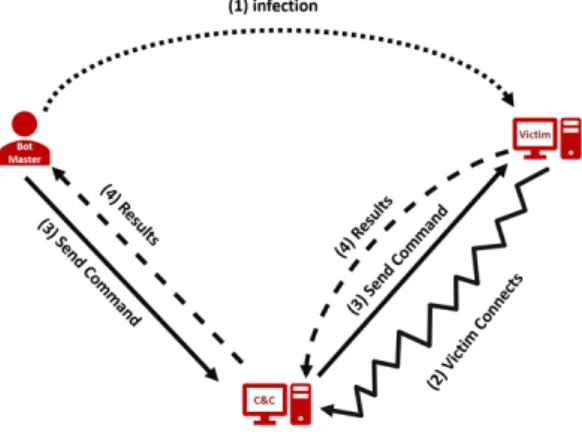
Botnets follow a systematic way to launch attacks. As shown in Figure 2.1, the first step is for the botmaster to infect a victim with a bot. As mentioned previously, there are several ways to infect a victim. Note that the number of infected victims can be large and, therefore, the attacker can have an army of bots under his/her control. After the victims are infected, they connect to the C&C server and wait for instructions. This connection can be established using one of the known protocols such as HTTP or IRC. Then, the C&C server sends its commands to the victims which in turn execute the commands and report back the results to the C&C.
Figure 2.1: Anatomy of a Botnet Attack
2.1.1.4 Botnet Topologies
Botnets have their own characteristics and components. They can normally be divided into smaller entities such as botmasters, bot clients, bot servers, bot victims and nodes. The botmaster is the attacker (i.e. controller of the botnet). This is usually the developer of the botnet (i.e. malware management or bot controller). The bot client/host is the target device which the botmaster wants to control and use. The bot Server Command & Control (C&C) is the Command and Control server of the bots which receives commands
from the botmaster through some command and control (C&C) infrastructure to control and give orders to the bot client. In general, there are three types of bot servers C&C: Centralised (one host), Peer2Peer (one to one) and distributed client (random). Nodes are the bots which will be used to attack the victims. Botnet victims, or the botnet customers, receive the planned attack from the attacker. An example bot attack is through sending or flooding the target system with a huge amount of any kind of data to disrupt the system.
Centralised Topology (Star & Distributed cluster)
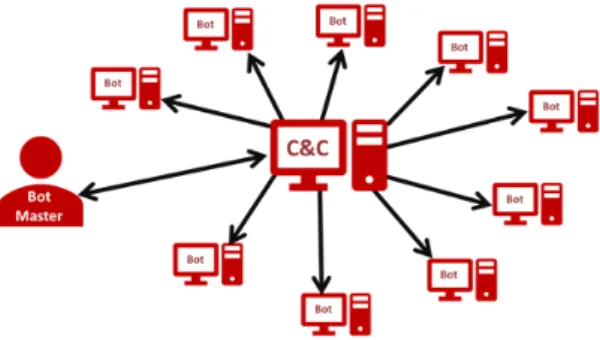
This configuration is like the usual client-server model where a client connects to a server, and the server sends commands and receives reports/results from the client. In such C&C architecture, all bots connect to the botmaster (see Figure 2.2). It is worth mentioning here that the botmaster itself can consist of more than one device (i.e. it can be a group of machines instead of a single machine as in Figure 2.2). These machines are usually responsible for transmitting commands to bots. This topology offers the advantage of reliable coordination between the bots and their botmaster. Also, it speeds up reaction time and it makes status monitoring easy for the botmaster. On the other hand, the C&C server(s) in this architecture is always a single point of failure. This means that once a botnet is identified, eliminating the communication between bots and their botmasters effectively means turning off the botnet. This led to the development of the decentralised configuration discussed next.
Figure 2.2: Centralised Topology
Decentralised Topology (Peer2Peer/Random/No C&C)
The Peer-to-Peer topology, or P2P for short, is another botnet configuration that exists (see Figure 2.3). In this architecture, as its name suggests, bots can have a control role in addition to their usual role. In more detail, the bots can communicate directly with each other so that if the botmaster is removed (or some of the bots are removed), the botnet continues to function. This means that it is no longer necessary to communicate with the botmaster which gives the advantage of being resilient to failure. Therefore, identifying bots does not necessarily mean turning off the entire botnet as is the case with the centralised topology.
Figure 2.3: Decentralised Topology (P2P)
In addition, the P2P architecture offers more flexibility and robustness especially when the number of bots is large. The flexibility stems from their ability to exist on machines and communicate with other bots directly without the need to communicate with a
central point. There are a few techniques that are used to construct a P2P botnet. The process usually has two steps. In the first step, peer candidates need to be selected. And in the second, actions need to be implemented so the selected candidates become members of the botnet. Examples of bots that adopt the P2P configuration for communication areNugache (Stover et al., 2007) and Sinit (Wang et al., 2007).
The Hybrid C&C model
In this architecture, functionalities from both centralised and decentralised botnets are used. In general, bots that are part of a hybrid P2P botnet can be either server bots or client bots. The server bots exhibit the behaviour of both clients and servers whereas the client bots are configured to act as clients only.
Random C&C model
In this architecture, the bot does not continuously communicate with the botmaster or other bots, rather it actually waits for the botmaster to make connection attempts. For an attack to be performed, the botmaster tries to connect to idle bots, if it finds any, it sends them commands to perform attacks. This model is not too difficult to implement and it is not easy to identify and interrupt because the communication between the bot and botmaster is not initiated by the bot. On the other hand, coordination issues can arise if the number of bots is large as the botmaster has to go through a large list of bots. There are no real botnets that use this model, it is only theoretical as it was suggested by (Cooke et al., 2005).
2.1.2 Botnet Examples
Many different botnets have appeared over the years. They differ in several aspects such as the topology, the main task to perform, the botnet size and so on. Some of these botnets are evolved and changed over time to become harder to detect and interrupt. It is important to point out that malicious internet applications are sometimes categorised according to their function. In other words, many malicious applications such as ransomware have a botnet architecture (or an architecture similar to that of botnets). They have client tools that reside on victim hosts and respond to commands coming from a central point. Therefore, the work in this thesis can be applied to detect any of these malicious applications with botnet architecture via network traffic analysis. The following subsections provide a high-level overview of some botnets and malware (i.e. malicious software with botnet architecture) examples:
2.1.2.1 SDBot
This family of bots is common, as its original developer has made it publicly available (i.e. open-source). This has led to it being developed into several flavours and variants. This botnet spreads itself through network shares that use empty or easy to guess passwords (Kharouni, 2009). It is noteworthy that this botnet, or one of its variants, can appear under several names such as backdoor.Sdbot, Troj/Sdbot, BKDR SDBOT or Backdoor.IRC.Sdbot. When infecting devices, this botnet connects to a vulnerable device and executes a script to download itself into that device to infect its underlying system. After that, it opens a backdoor to enable the attacker to take control of that system.
2.1.2.2 RBot
This family of bots is known to be complex and hard to interrupt (Dietrich et al., 2011). It has hundreds of variants and these variants can have different names and techniques. This family of bots had a significant impact on how botnets avoid identification as it was the first family to use encryption or compression algorithms in its communication. Systems infected by RBot can be controlled and use to participate in DDoS attacks, key logging, spamming and so on. Like SDBot, RBot can have several names such as
W32.Spybot.worm, Worm RBot or Backdoor.RBot.gen. RBot easily infects systems with blank or weak passwords (much like SDBot). In addition, it targets some well-known flaws in the Windows Operating System. It is also interesting that some variants of this botnet can exploit backdoors or open ports created by other botnets.
2.1.2.3 Zeus
Zeus (or Zbot) is one of the peer-to-peer botnets that first emerged in 2007 (Binsalleeh et al., 2010). This family of botnets is mainly used for stealing money (or cyber fraud in general), phishing, banking information stealth and other attacks. The Zeus botnet was designed to steal information through man-in-the-browser attack via key-logging techniques and forms grabbing. Its method for spreading is through drive-by-download (e.g.email, network, websites, torrent . . . etc.) and phishing (e.g.emails, webchat). Usually, Zeus’s malicious code is hosted on a site and when a user visits that site, their device is infected. The same can happen when the site displays an advertisement instead of actually hosting the code. When a device is infected, it joins the Zeus botnet and it can be under the attacker’s control.
2.1.2.4 WannaCry
WannaCry is one of the most recent botnets at the time of writing this thesis. It is reported to have affected organisations in 150 countries (Kalita, 2017). Although it is usually classified as ransomware, because it demands payment after launching the cyber attack, it is effectively a botnet. According to many computer security experts, WannyCry uses a flaw in software that was developed by Microsoft. When a device is infected, WannaCry locks, or encrypts, the files and demands a quick payment (which increases with time). In more detail, it makes all the data on the infected computer system inaccessible (by locking it) and only allows the user to access two files; one of which contains instructions on what to do next and the other is the WannaCry tool itself. When the tool is launched it informs the computer users of the encryption of their files, and tells them that they only have a few days to make a payment. It also warns users that they will lose their files if they fail to make the payment. One interesting aspect of WannaCry is that it demands payment in bitcoin. It provides info on how to buy bitcoins and where to send them to.
2.2
What is Reverse Engineering?
Before delving into the details of the work carried out as part of this thesis (this is going to be explained in Chapter 3), it is better to define what is meant by reverse engineering. Reverse engineering can be defined as the practice of dismantling an object to examine, analyse or investigate its internal structure in order to improve it (M¨uller et al., 2000). This is not to be confused with re-engineering (Koschke, 2005) which is concerned with redesigning an object so that it becomes better in one or more aspects (i.e. to overcome the object’s weaknesses or faults).
2.3
An Overview of Machine Learning and Transfer
Learning
One of the main contributions of this thesis is automatic botnet detection via transfer learning (which is a machine learning technique). The data used to train machine learning models for machine is usually processed into a matrix structure with features (sometimes called attributes, descriptors or variables) as columns and instances (sometimes called examples or data points) as rows. Normally the class feature (sometimes called the target feature) is the last feature (i.e. the last column in the matrix). This Section provides a brief overview of what machine learning is, how it works and why it is useful. It also explains what transfer learning is, how it works and when transfer learning can be more useful than traditional machine learning techniques.
2.3.1 What is Machine Learning
Machine learning is mainly about developing and applying algorithms that can learn from data (Bishop, 2006). Primarily, the objective is to automatically explain the past and predict the future through data analysis. This field combines several other fields that include statistics, data science, artificial intelligence and database technologies. Hence, it is a multi-disciplinary field. It is worth mentioning here that data is a key component. Without data nothing practical can be done and only theoretical concepts and ideas can be developed at most (see Chapter 5 for more details).
Explaining the past is done via data analysis and exploration. Here statistical and visualisation techniques are usually used to describe the data. This is performed to highlight important relationships, patterns, trends or aspects that exist in the data so
further analysis can be performed. Furthermore, predicting the future is performed via modelling. In predictive modelling (Kuhn and Johnson, 2013), a model is created from the data in order to make a prediction. The prediction can be made for one or more outcomes. Here it will be simple and work will be done with a single outcome. If such an outcome is categorical, then the process is called classification. If the outcome is numerical, then the process is called regression. If the predictive process is about grouping similar instances of the data into groups of similar instances then it is called
clustering. There are more processes in machine learning and data mining but this brief overview should be sufficient as an introduction. Note that the work presented in this thesis is focused on classification. Making automatic predictions is highly regarded nowadays. The historical data that is already stored, and the large amounts of data that is generated everyday, can help businesses (via machine learning and data mining) derive valuable insights and knowledge (Wu et al., 2014). This extracted knowledge can help in decision making and future planning to improve efficiency and maximize gains and profits.
2.3.2 What is Transfer Learning
Human beings in general have the ability to utilise past learning experiences when they are faced with new tasks. The level of mastering the new task depends on how much it is related to the past task. In machine learning, the sub-field that attempts to apply this experience, or knowledge transfer is known as Transfer Learning.
As explained in (Torrey and Shavlik, 2009), in traditional machine learning algorithms one deals with tasks individually, meaning if one has several tasks he/she learns each one separately. By contrast, transfer learning attempts to learn one or more tasks (known as
source tasks) and use the knowledge learned to enhance learning in another task (known as the target task). The target and source tasks must be related in one way or another.
Transfer learning is typically employed when there is little, or limited, amounts of labelled data in one task (known as the target task), and plenty of data in another related task (known as the source task). The assumption here is that using only the target data will result in less accurate models since there is insufficient data. Whereas, by transferring knowledge from the source task to the target task the model quality can be improved.
There are three key research issues in transfer learning (Pan and Yang, 2010). The first issue is what to transfer, which is concerned with the parts of knowledge that can be transferred between tasks because not all knowledge is common between different tasks (i.e. some knowledge can be specific for specific tasks). It is worth mentioning here that the work in this thesis is focused on this issue. The second issue is how to transfer. This is related to whether to transfer the knowledge as is or to apply some form of modification such as using weights. The third issue is when to transfer. This is an important aspect of transfer learning as in may cases the knowledge transfer ends in a negative transfer. That is, instead of improving learning in the target task, the knowledge transferred deteriorates the process.
Transfer learning techniques can be categorised into three sub-settings. Inductive
transfer learning,transductive transfer learning andunsupervised transfer learning. The focus here will be on Inductive transfer learning, the reader is referred to the survey in (Pan and Yang, 2010) for more details on the other two categories. The work in this thesis is focused on inductive transfer learning because the data comes from a similar domain (network traffic) and all the datasets used have the same feature space (i.e. they
have the same feature sets). This similarity in domain and features (notice features and not necessarily feature values) makes the research problem automatically falls under the umbrella of induction because one needs to find where the differences are and how to exploit them.
2.3.2.1 Formal Definition of Transfer Learning
After providing a textual definition of transfer learning, this section formalises the problem and presents it in an intuitive way. This formalisation is based on the survey in (Pan and Yang, 2010). The definition breaks down the problem into its basic components such as Domain, Task and so on.
Domain and Task:
Let us assume that there exists a feature spaceX and a marginal probability distribution (for data in that space)P(X), whereX={x(1),x(2), . . .x(n)} ∈ X.
A Domain D can be defined as the combination of the feature space X and marginal probability distribution P(X) as follows:
D={X, P(X)}
In addition to that, let us assume that there is a label spaceY (that contains all possible labels for all instances in dataX) and a predictive functionf(•) which is unknown. The purpose of this function is to predict a label that is inY given input data.
A Task T can be defined as the combination of the label space Y and the predictive functionf(•) as follows:
T ={Y, f(•)}
The predictive functionf(•) can be learned from the training data of the form{x(i), y(i)}, wherex(i)∈Xand y(i) ∈ Y, and used to predict labely(i) for data pointx(i) (f(x(i)) =
y(i)).
Source and Target Domain and Task:
It was mentioned previously that transfer learning is focused on learning from one or more source tasks to augment learning in a target task. To represent this using the above notation, the following two domains can be defined:
1. Source domain: DS={XS, PS(X)}where X={x(1),x(2), . . .x(n)} ∈ XS
2. Target domain: DT ={XT, PT(X)}where X={x(1),x(2), . . .x(n)} ∈ XT
And Similarly, two corresponding tasks:
1. Source task: TS ={YS, fS(•)} wherefS(•)→y(i) ∈ YS
2. Target task: TT ={YT, fT(•)} wherefT(•)→y(i)∈ YT
Observe that the predictive functions connect the source and target domains to the source and target tasks respectively as follows:
fS(x(i)) =y(i) wherex(i)∈ XS and y(i)∈ YS fT(x(i)) =y(i) where x(i)∈ XT andy(i) ∈ YT
Transfer Learning:
Given a source domain DS and learning taskTS, a target domainDT and learning task
TT, the purpose of transfer learning is to enhance the learning of the target predictive function fT(•) in TT using the knowledge DS and TS, where the source and target
domains are different (i.e. DS 6=DT), or the source and target tasks are different (i.e.
TS 6=TT). Given this definition, there are multiple scenarios and cases:
• Scenarios 1: When the source and target domains are different (i.e. whenDS 6=
DT) at least one of the following conditions is satisfied:
1. XS6=XT (feature spaces are different)
2. PS(X)6=PT(X) (probability distributions are different)
• Scenarios 2: On the other hand, when the source and target tasks are different (i.e. TS 6=TT) at least one of the following conditions is satisfied:
1. YS 6=YT (label spaces are different)
2. fS(•) 6= fT(•) ⇔ PS(yS|XS) 6= PT(yT|XT) (predictive functions are different)
It is important to notice that work in this thesis falls under the second case in the first scenario.
2.3.2.2 Inductive transfer learning
In transfer learning in general, there are two different tasks (i.e. the source and target tasks are not the same) coming either from the same domain or from two different domains. In inductive transfer learning, the most important thing is to have different source and target tasks, it does not matter if the source and target domains are different or the same. For example, under the domain of textual article classification, one task can be identifying sports articles and another task can be identifying politics articles. Here, although the domain is the same and the tasks are different, transfer learning between
them is still possible. Inductive transfer learning can be performed in more than one way:
• The instance-transfer approach: This approach says, let us not borrow all data from the source task directly, but rather, let us try to use relevant instances from the source task, along with data in the target task, in building a model for the target task. An example approach is TrAdaBoost that can be found in (Dai et al., 2007). TrAdaBoost is based on the classical AdaBoost algorithm. It works when the source and target tasks have the same set of features, but different data distributions. In addition, TrAdaBoost assumes that some of the data in the source task can be useful (i.e. leads to positive transfer) and some can be harmful (i.e. leads to negative transfer). The idea is to assign weights to data from the source task in such a way that useful data can have more effect than harmful data. The author has made the java implementation of this approach publicly available.
• Feature representation transfer: In this approach, attempts are made to find feature representations that reduce classification error. This task is also known as common feature learning (Argyriou et al., 2008). Methods for feature representation transfer can be supervised (Argyriou et al., 2007, Lee et al., 2007) or unsupervised (Raina et al., 2007).
• Parameter-transfer: In this approach it is assumed that models created for individual related tasks should have some parameters in common. Some of the existing approaches transfer parameters of Support Vector Machines (Evgeniou and Pontil, 2004) and priors of Gaussian Processes (Lawrence and Platt, 2004).
• Relational-knowledge transfer: Methods falling under this approach focus on transfer learning in relational domains. Approaches employ techniques from
statistical relational learning to transfer relationships from the source to target domains. An example method is reported in (Mihalkova et al., 2007) where relational knowledge is transferred across relational domains by using Markov Logic Networks (Richardson and Domingos, 2006).
2.4
Existing Work on Android Botnet Detection
Many approaches for botnet detection have been reported in the literature. The work in (Feng et al., 2014) introduced an approach that is based on the analysis of network traffic. They extract a set of features (i.e. attributes) from traffic chunks and then use machine learning algorithms to identify whether the traffic is malicious or not. Other works include BotMiner (Gu et al., 2008), BotHunter (Gu et al., 2007) and more recently BotDet (Ghafir et al., 2018). As the work presented in this chapter is focused on botnet detection on the Android operating system, the key existing approaches will be summarised in the remainder of this section. An interesting approach is Dendroid (Suarez-Tangil et al., 2014) where malware Android apps were grouped into families by analysing their source code. A similarity measure was used to taxonomise apps and create a phylogenetic-tree like structure. One approach to detect malicious Android apps was the work in (Sheen et al., 2015). In this work, features such as the API calls and permission requests that an APK file makes are used in separate datasets and an ensemble of classifiers (collaborative decision fusion) was used to perform predictions. Another approach that is related to permissions can be found in (Wei et al., 2015). In their work, they use techniques from the text mining domain to analyse the relationship between permission requests that an Android app makes and its textual description.
Although it focuses on malware detection, the approach in (Yerima et al., 2013) reverse engineers Android apps and analyses their source code. It focuses on detecting API calls made by the apps as well as the permissions that apps require and the commands that apps execute. The idea here is that by examining whether known APIs are being called from within an app’s source code, it is possible to determine the app’s intended behaviour during runtime. This is the same with permissions requested by apps and commands that apps attempt to run. In general, the approach builds a profile for each app by extracting these features and then uses a Bayesian classifier (e.g. NaiveBayes) to predict the probability of whether a new unseen Android app is suspicious or benign.
Another malware detection and classification technique is the method in (Kang et al., 2016) which disassembles malware Android apps to obtain and use their opcodes for malware detection. It uses n-opcode information to generate two different types of representation. One representation was the binary n-opcodes which describes the
n-opcodes that have been used in an application, whereas the other representation was frequency n-opcodes which contains the counts of n-opcode in an application. This approach evaluates the performance of several classical machine learning classifiers such as Support Vector Machine (SVM) and RandomForest (RF). An interesting finding of this approach was that a high accuracy was obtained when using a small value fornin frequencyn-opcodes.
In addition to the previous work, another method that disassembles malware Android apps to obtain and use their opcodes for malware detection is reported in (McLaughlin et al., 2017). One hot encoding is then used to create feature vectors based on the obtained opcodes. These vectors are then fed into a convolutional neural network (CNN) which learns the intrinsic characteristics of the data and yields a high classification accuracy.
Several approaches use static or dynamic analysis techniques. In static analysis, attempts are made to detect malicious activities without the need to execute the Android apps. The main idea is to model how the Android apps work by constructing and analysing some graphical models. An example of this type is the recent work in (Junaid et al., 2016) where an approach is presented to detect malicious behaviour in Android apps using models of their life cycles. Reverse engineering was used in this approach to construct a life cycle model for each Android app. After that, possible event sequences are derived from these models and used in attack detection. They developed a system called Dexteroid to identify SMS (Short Message Service) when they are sent to costly numbers as well as whether sensitive data is being leaked. Other examples include the work carried out in (Gordon et al., 2015) who built a tool called DroidSafe, the work in (Arzt et al., 2014) who built a tool called FlowDroid and the work in (Yang and Yang, 2012) who developed a tool called LeakMiner. On the other hand, approaches that employ dynamic analysis try to execute the Android apps to perform specific tasks and use the resulting data to detect malicious attacks. Some recent examples are the works in (Bai et al., 2016, Yan and Yin, 2012, Yang et al., 2013). Additionally, the authors of (Yang et al., 2015) proposed an approach to build data flow models from the reverse engineered source code of Android apps. Their method tries to build data flow models by detecting where data enters an application and how this data moves through it. In other words, they build trees of classes, methods and variables and use these trees to identify malicious code.
An approach, denoted DynaLog, is presented in (Alzaylaee et al., 2016, 2017) to generate dynamic features for malware detection. This approach attempts to overcome obfuscation techniques (used in malware families to avoid detection) by extracting features that describe the behavior of malware rather than its source code or contents.