1 The objectives of financial reporting: the case for coherence the Conceptual Framework, and standards
The objectives of financial reporting: the case for coherence the Conceptual Framework, and standards
This paper proposes a basis for progress in the development of the conceptual framework (CF) as a foundation for developing accounting standards. This topic has gained increased prominence following the IASB’s (2013) release of its Review of the Conceptual Framework for Financial Reporting (RCFFR) proposing changes to the CF. In this paper the broad socio-economic environment is seen as determining the primary purpose of General Purpose Financial Reporting (GPFR) which, in turn, establishes the high-level properties of a CF suitable to meet that primary purpose. GPFR’s primary purpose is to support market stability and efficiency through the provision of an account of the financial position and performance of an entity that accords with economic reality.
The case is made that the primary purpose of a CF is to provide the principles for the development of accounting standards that will ‘produce’ GPFR that is useful. This requires theoretical coherence. The CF should drive the standards and if standards depart from the CF principles, such departures should be justified. This proposal is consistent with the position adopted in the RCFFR. However, in contrast to the RCFFR, this paper accents the purposive approach and links the formation of standards directly to the CF. This implies that standards, as sets of rules, are subordinate to CF principles; therefore compliance with standards should not provide a basis for compromising the faithful representation of economic reality. From the purpose identified for GPFR, the paper argues for a default presumption in favour of Fair Value Accounting, a retreat from asset/liability approach, and a re-casting of the income statement to focus on operational flows.
3 The objectives of financial reporting: the case for coherence the Conceptual Framework, and standards
Introduction
The development of conceptual frameworks (CFs) since the early twentieth century has occurred in the context of a discipline self-conscious of its history as an applied technology (Hendriksen, 1982). This has led to cautious steps made to distinguish General Purpose Financial Reporting (GPFR) standards’ development from prevailing accounting practice (Staubus, 1999; Higson, 2003). Evidence of this caution and of the challenging and highly political nature of the standards setting process is reflected in the limited changes proposed in the IASB’s (2013) Review of the Conceptual Framework for Financial Reporting (hereafter RCFFR), as well as in the contentiousness of certain changes. Consistent with the motivation for the normative accounting theories of the 1950s and 1960s, this paper argues for theoretical coherence as a basis to formalise and thus improve twenty-first century GPFR. Theoretical coherence requires the development of a complete, consistent set of hypothetical, conceptual, and pragmatic principles (Hendriksen, 1982). This paper therefore briefly reviews twentieth century developments in CFs and GPFR and assesses the progress made in this field. A case is made that GPFR currently lacks a coherent basis with ‘lip service’ only paid to the CF in many cases. If a coherent CF drives the development of GPFR standards, then specific standards would not require tight codification through extensive lists of rules. However, standards for GPFR would benefit from extensive examples to demonstrate the appropriate application of the principles. The aim of a coherent CF is to provide GPFR that is comparable, understandable and representationally faithful.
This paper adds to the current CF debate in a number of respects. An explicit link is drawn between the CF and standards. This link derives from the primary purpose of GPFR. We assume this purpose to be support for market stability and efficiency through the provision of an account of the financial position and performance of an entity that reflects economic reality. We provide examples of prescriptions of current standards which fail to reflect their conceptual underpinnings. Proposals to address these failings are raised and a proposal to simplify asset classification is advanced.
Section one defines and discusses theoretical coherence in relation to CFs and GPFR. Factors inhibiting the achievement of theoretical coherence in the past are described. Section two outlines the value of parsimony to CF development, which rests on the primary purpose of GPFR. Section three addresses the extent of standard setter progress towards the goal of coherence, focusing the discussion on income, its subordination to the asset/liability view in current standards, and conceptually undeveloped classifications of net income (NI) and other comprehensive income (OCI). Section four identifies how Fair Value Accounting (FVA) may be modified in line with the purposive approach and qualifies the use of FVA as a default measurement basis, rather than as a ubiquitous foundation for accounting measurement. Section five identifies factors currently confounding productive debate towards the goal of coherence. Section six concludes the paper, noting that many of the proposals in the RCFFR are too equivocal or vague to address the issues raised in this paper.
1.0 The essential elements of a coherent CF and the implications of this for GPFR
Why is a CF important?
CFs establish the principles guiding accounting standards. They identify the users; explicitly define the objectives of financial reporting, its qualities, elements, and high-level concepts behind the rules for recognition and measurement. In this regard CFs play an important role in determining the nature and evolution of the rules for GPFR. They also constrain political influences on accounting standards (Most, 1982). Contrary to the view that the social and business environment provides all the guidance necessary for the development of GPFR and its regulation, the inductive empirical period to the mid-1950s showed this was not the case.
1.1 The importance of theoretical coherence for CFs, GPFR, and accounting
Mattesich (1995) describes the greater degree of logical precision that comes with theoretical formalisation. At the broadest level, the standards for GPFR form a system of rules that needs to have an identified purpose. Theoretical coherence would provide the basis for accounting to formalise its structure around that purpose (Inanga and Schneider, 2005; Loftus, 2003; Zeff, 1971). Without coherence, debate about the purpose and qualities
5 required to achieve that purpose becomes intractable, degenerating into squabbles between different camps without an umpire to direct progress
Coherence is consistent with the aim of the International Accounting Standards Committee Foundation’s constitution (IASCF, 2009), para. 2(a): “to develop, in the public interest, a single set of high quality, understandable and enforceable accounting standards”. This necessarily entails a parsimonious approach to setting the scope of accounting standards and their coverage. It is central to this approach that dissimilar sectors such as the public and for-profit sectors cannot be grouped. Thus, investor primacy explicitly excludes public benefit accounting from the development of a coherent CF suitable for GPFR for for-profit entities. Moreover, GPFR qualities and objectives beyond the qualities most important to the primary users should be narrow and require conclusive independent argument for reflection in standards. Without this terseness, debate surrounding CF development becomes intractable and regulation becomes little more than an inventory of placations of vested interests. These placations, influenced by “tribal tendencies” (Demski, cited in Dean and Clarke, 2003, p. 286), have been responsible for much of the complexity of current accounting. They are also responsible for the retreat from FVA measurement during the Global Financial Crisis and current resistance to the removal of the concept of prudence (see, for example: Cascino, Clatworthy, Osma, Gassen, Imam, and Jeanjean, 2013; ICAS, 2013; ACCA, 2013, and EFRAG, 2013b).
1.2 Why has the development of a coherent CF been elusive?
Vexed questions about what the purpose of financial reporting is, and which qualities are important, suggest that CF development remains a challenge. These concerns involve dichotomies between relevance and reliability (now representational faithfulness), as well as between stewardship and decision-usefulness. Entrenched positions have been held irreconcilable by advocates of each purpose or quality implying mutual exclusivity between them (Field, Lys, and Vincent, 2001; Power, 2010). One purpose or quality cannot exist independent of the other, and this presumed mutual exclusivity is obstructive to the development of a consistent, purposeful CF. For example, accounting information about a company cannot be irrelevant but reliable because there is nothing that such information can be relied on for. Equally, wholly unreliable information cannot form a basis for user
decision-making and is, therefore, not relevant. In each case the question that must be asked is, which information is reliable or relevant and for what purpose? This issue was not resolved in the past by prioritising one quality over the other. These qualities are interdependent and must be viewed as such. The emergence of representational faithfulness as a core attribute of GPFR reflects this fact. If financial statement information would be relevant but for concerns about its reliability, then reliability concerns must be addressed by the provision of disclosures sufficient for users to assess the content and quality of that information.
Another area in which intractable debate has occurred is in the competition assumed or asserted between stewardship and decision-usefulness (for example, Gassen, 2008). This debate implies a choice between these objectives. There is no logical reason to suppose that these objectives are not interdependent or at least mutually consistent. A company’s track-record (stewardship) links to its prospects (and therefore decision-usefulness). Prospective information is likely to be assessed in light of past performance relative to previous forecasts (Barth, 2013). Arguably, current values and the provision of prospective information merely extend accountability to future information as well as to past performance (Crowther, 2002). The accountability implications of forecasts simply add to the relevance of such information as an independent argument for the inclusion of such information. A key feature of current arguments for the primacy of stewardship presupposes the account function must be fully discharged “during a given period’” (Kothari, Ramana, and Skinner, 2010, p. 261). This view is supported by Gebhardt, Mora, and Wagenhofer (2014) and Cascino, et al, (2014). Arguably, the succession of company financial reports, along with external information sources, forms a single text and should be viewed as such when determining the discharge of the stewardship function of GPFR. In this sense the IASB’s reluctance to revisit the place of accountability is justified as it has been addressed.
1.3 Specifying a coherent theoretical basis for CFs and GPFR
Walker (2003) identified the important features of a CF, including clarity of expression, internal consistency and the provision of a comprehensive guide to financial reporting practice. A CF must provide a clear statement of the objective of financial reporting from which logical, coherent standards can be developed. Walker argues that ideally a CF would cover all sectors, but the diversity of users this would entail provides support for public
7 benefit entity financial reporting to be separated from for-profit entity financial reporting (consistent with the views expressed by Sprouse and Moonitz, 1962). The descriptive characteristics of the framework should be of a general nature (avoiding tight specification, clearly expressed, internally consistent and enable prediction of standards) (Walker, 2003; Miller and Redding, 1988; Mattesich, 1995).
Coherence involves the consistency of a specified set of propositions. These propositions must also be interdependent or, in the case of generative propositions, be dependent on empirical phenomena. This approach draws on Hendriksen (1982) that a false distinction is drawn between deductive and inductive or a priori and ex posteriori theories. This view forms an explicit part of the basis for the approach developed in this paper. The objectives of GPFR are a deductive and an empirical matter. This approach contrasts with CFs of the past by identifying the origins of GPFR and determining its objective. This approach also follows that identified by Wells (2003) as the basis for the physical sciences, and thus bypasses a problem alluded to by Hendriksen (1982) that CFs of the past have tended to be inventories of existing practice.
Consistency and interdependence of a set of propositions is necessary but not sufficient in relation to accounting standards and their guiding CF (Young, 2008). In addition, it must be considered and what it is that GPFR is intended to achieve. Accounting standards evolved to serve a purpose or solve a problem. The identification of the purpose or problem is central to the development of a coherent basis for structuring financial reporting.
The primary purpose of GPFR, as identified in this paper, is derived from the environment of financial reporting and the causes and function of its regulation. These include:
1. The environment for accounting includes market-listed companies in which management is separate from ownership (Sprouse and Moonitz, 1962).
2. Society’s interest in GPFR is to ensure company-specific information to: Support efficient capital allocation (Miller and Redding, 1988).
Minimise information asymmetry between management and investors as an independent source of financial market (and economic) instability (Hendriksen, 1982).
Improve investment decisions, thereby increasing total welfare, and ameliorating the risks of adverse spill-over effects from the operation of financial markets (Hendriksen, 1982).
3. Minimise of the information asymmetry between managers and investors requires provision of information about a company’s stocks (resources) and flows (in the use of those resources) that is current and timely, and that reflects economic reality. This requires a balance sheet and an income statement, to report separately stocks and flows.
4. Company-specific information provides the primary basis for contemporaneous comparison across companies (Hendriksen, 1982). Past performance and performance relative to prior forecasts is determinable through successive financial reports of an entity and information on its external operating environment.
The implications of these considerations include that:
1. Economic reality in the context of relevance, faithful representation and comparability, converge on current value accounting measurement. That is, relevance is enhanced by faithful representation of the company, and comparability is enhanced by the temporal homogeneity of current values. Further, the consistent use of current values allows inferences about the discharge of the stewardship function by comparison between successive financial reports and forecasts.
2. The demands of relevance, faithful representation and comparability indicate current value and the flexibility of FVA supports it as the means by which to operationalise current value in most cases. This is qualified to the extent that FVA delivers a view of a company that is inconsistent with the economic substance of the events and position of that entity. This echoes Barth’s (2013) call for a measurement objective. However, theoretical and practical consistency should therefore always be with core principles rather than particular methods.
3. Society expresses its interest in financial reporting through financial reporting standards. This interest reflects the objective of market stability efficiency (Hendriksen, 1982; Dean, 2008; IASCF, 2009, para. 2(a)).
9 CFs define the domain of financial reporting. This introduces the idea that ideally the elements of CFs should be reflected in individual standards. As identified in the preceding propositions, this paper characterises the primary purpose of financial reporting in terms of the provision of a picture of a company’s position and performance that reflects economic reality. Simply, under this view financial reporting must address two questions: What does a company have in terms of resources and what use has it made of those resources? Cash flow statements as useful information carriers are not specifically addressed here, as they are a derivative of the balance sheet and an income statement. Coherence is determined by consistency with the primary purpose and not with preferred methods, such as FVA or historical cost accounting (HCA), or subordinate principles, such as the realisation basis for income recognition. This approach follows that proposed by Benston, Bromwich and Wagenhofer, (2006) in which guidance (rules) do not relieve the reporting entity of responsibility to represent economic reality. Implicitly, the case for standards populated much with examples of applications and much less with rules is supported. As long as the standard setter guards against examples being treated as rules, such an approach elevates principles while subordinating rules. Where emerging issues are not covered by existing rules, theoretical coherence should provide a deductive basis to determine appropriate accounting treatments (Hendriksen, 1982; Higson, 2003; Mattesich, 1995).
2.0 The essential features of coherent theoretical development: role of parsimony
Following Beaver and Demski (1974) and Jensen (2001), theoretical coherence is most likely to be advanced by establishing the narrowest credible parameters to accounting’s objectives and methods. Beaver and Demski (1974), and Benston, et al (2006) suggest suppressing user heterogeneity to assist the formulation of a coherent theory underpinning the CF. The FASB (2002, pp. 2-3) comment that: “Much of the detail and complexity in accounting standards is demand-driven”, implies the same view. Mattesich (1995) identifies the conceptual advantages of a theory having a parsimonious and structured set of principles. These accounting researchers have thus identified conceptual economy as a key virtue of any theory. This paper therefore argues for the most parsimonious plausible view of the determinative elements of a CF and its derivative, GPFR.
The central element of the case presented here is that the primary purpose of financial reports is society’s purpose and that society in toto is primarily interested in the service GPFR can provide in terms of wider financial market stability and efficiency. Moreover, the focus is on financial reporting belonging in the GPFR domain, effectively rejecting non-financial reporting, such as social or environmental reporting, being central to GPFR. This approach prioritises parsimony as an aid to consistency.
In contrast to Mozes (1992), this paper contends that the process of developing a CF and standards does not entail explication of the social welfare function as the basis for choice between accounting alternatives. Mozes (1992) argues that an explicit welfare function is required to address the redistributional implications of a normative theory of accounting. Demski (1973) raises similar concerns. Such issues are a matter of interest to broader societal processes; through, for example, taxation, other fiscal policies, regulations and social activism. It is not clear that GPFR standards should or could play an important role in this sphere. Accounting rules focus on company-specific financial information and must prioritise societal welfare (their general purpose) through the fullest possible contribution to market stability and efficiency. This position is based on the idea that wealth distribution should be addressed explicitly through government, economic and regulatory policy, rather than implicitly through GPFR standards.
2.2 Catalysts for past developments in CF and GPFR developments
Watershed developments in GPFR have been responses to the prevailing socio-economic environment (Salvary, 1979; Dean and Clarke, 2003; Dean, 2008). Subsequent to its nineteenth century origins in the UK, key developments in GPFR have tended to occur in the US, as that nation came to assume dominant economic status. In the 1930s, early attempts were made to develop a coherent basis for GPFR in response to the 1929 stock market collapse and subsequent Great Depression (May and Sundem, 1976; Gaffikin, 2008). The Great Depression led to increasing demands to augment the required Balance Sheet with an Income Statement (Hendriksen, 1982). The Great Depression also lent impetus to the development of a CF as the fundamental basis for the regulation of GPFR. The global social dislocation of this period established a key foundation for society’s interest in financial reporting. The widespread economic and social harm caused by the market breakdown
11 demonstrated the ability of financial market turmoil to spread across society as a whole, causing significant losses of wealth, high levels of unemployment, and related social costs (May and Sundem, 1976).
The central theme underpinning the development of GPFR is that it has been reactive to economic and financial market upheavals (Salvary, 1979; Wells, 2003; Dean and Clarke, 2003). As noted, such breakdowns have had widespread spill-over effects on society. Deductively, this suggests the purpose of a CF is to ensure the production of company-specific financial information of a type and quality sufficient to ensure that accounting information deficiencies are not an independent cause of market instability. Amplifying this aim of GPFR is that the specification of GPFR should support the efficient allocation of capital. This, inter alia, indicates constraining financial reporting choices through standards guided by a CF that prioritises correspondence with economic reality. It also advances the priority of investors and creditors over other potential GPFR users. This does not presuppose that GPFR developed to be consistent with such principles is sufficient to ensure the efficient allocation of capital, as was asserted by Trueblood (1973), but it is assumed as a necessary condition. As noted by Ronen and Yaari (2008), shareholders may have the necessary information to optimise their decision-making but lack the power to do so.
The description of the socio-economic environment identified by Sprouse and Moonitz (1962) includes substantially private control of productive assets, free labour, and the market as the primary mechanism for the distribution of goods and services. This descriptive approach may be extended to the relationship of the publicly listed corporation to society. This is because the impact of the specification of GPFR is greatest in relation to publicly listed limited liability companies, allowing us to isolate the determinative features of GPFR as those unique to such entities, and therefore to make those features the central motivating imperative underlying GPFR. This, in turn, prioritises investors (who are isolated from the management of their capital) as the priority of GPFR regulation. This implication is reinforced by the typical causes of shifts in GPFR development; financial market dysfunction and its potential flow through to economic crises. The focus on investors derives from the residual nature of equity which leaves them in greatest jeopardy. Implicit in this argument is the idea that accounting as a financial information system should seek to minimise
information asymmetry between managers and investors to reduce this as a source of aggravation to any drivers of market instability.
The objective of eliminating GPFR as a source of financial market instability or inefficiency supports the conceptual superiority of current values (establishing a default status for FVA) over historical cost, given the temporal homogeneity of current values. The high inflation of the 1970s and early 1980s challenged established financial reporting practice with the perception of progressively declining relevance of HCA causing growing support for competing accounting measurement bases (Mattessich, 1995). However, when inflation receded in the early 1980s the immediate threat to HCA measurement reduced. Nevertheless, variants of current cost accounting had established themselves as alternative measurement bases and when the Savings and Loan crisis of the 1980s renewed the threat to HCA, the progression towards fair value accounting measurement gained momentum.
2.3 Fair value as a result of the evolving CF project
Recent history has seen a concerted effort on the part of major standard setters to converge on increasingly FVA-based standards. This development has involved a progressive narrowing of the objectives and qualities prioritised by CFs and GPFR. This narrowing, consistent with the call of this paper for coherence based on parsimony, has largely subsumed the income statement within the balance sheet. Arguably, from a purposive perspective the primacy of assets and liabilities over revenue and expenses reduces the informativeness of financial reporting. Section three addresses this issue, calling for a more informative account of revenues and expenses (than is implied by the asset-liability priority).
From the late 1980s the FASB pushed for greater use of FVA standards. The US CF was mirrored in the international accounting standards issued by the IASC. The 1989 IASC Framework for the Preparation and Presentation of Financial Statements affirmed that decision-useful, investor-focused information was necessary. This found further support in the Jenkins (1994) Committee Report which made the case for FVA from evidence of market efficiency. To the current period a progressive narrowing of GPFR user definitions has been observed, reflected in 2008 in the FASB characterisation of primary users as investors and creditors and, in the IASB pronouncements, as current and prospective investors (Whittington, 2008). In the 2010 IASB/FASB release of the developing joint CF, relevance and
13 faithful representation have become the fundamental qualitative characteristic of financial information (and has remained so in the RCFFR). As previously noted, the term faithful representation has replaced reliability in a move to reconcile relevance and reliability with each other (Power, 2010). Verifiability, the other common meaning of reliability, has been included in the CF as an enhancing qualitative characteristic. It is reasonable to infer that the relegation of verifiability and the elimination of reliability was an element of standards setters’ attempts to undercut historical cost accounting (HCA) (Whittington, 2008).
The trend towards representational faithfulness as a primary quality of financial reporting began as early as the late 1980s (Hendriksen and Van Breda, 1992). The significance of the CF substitution of representational faithfulness for reliability as a primary qualitative characteristic was that it muted the mutual exclusivity of relevance and reliability (IASB, 2005; FASB, 2008; FASB, 2010). Faithful representation includes the elements: completeness, neutrality and freedom from error (FASB Framework, 2010). Verifiability helps users to assure that information faithfully represents the economic phenomena it purports to represent.
HCA values are unlikely to constitute the best, most topical measurement base for informing market participants. FVA use is qualified in this paper only to the extent that current market values are not available, creating the need to substitute estimates of current values for observable current values (that is, levels two and three). In contrast HCA is at best a ‘proven’ but temporally heterogeneous and remote value. The on-going debate surrounding accounting measurement has focused on fair value (beyond level one) as a proxy for current value. Independent of the argument for current value accounting measurement, fair value has sufficient flexibility to enable on-going development. Arguably, many of the concerns raised about FVA relate to its stringent assumption of market efficiency, even under conditions where that efficiency does not, or is unlikely to, exist. This feature is evident in the requirement for the use of exit values. Other objections to FVA typically relate to the excessive subjectivity introduced by levels two and three fair value. This is substantially a question of implementation and, thus, not systemic. Thus, arguments against FVA generally tend to be arguments against its dogmatic application rather than its general proposition. This supports FVA as central to a coherent basis for specification of GPFR as a default rather than as an inevitable basis for measurement. This, in turn, supports the extension of FVA on the
basis of its greater relevance to investors (as argued for by Barth (1994) and Barth, Beaver, and Landsman (1996; 2001)).
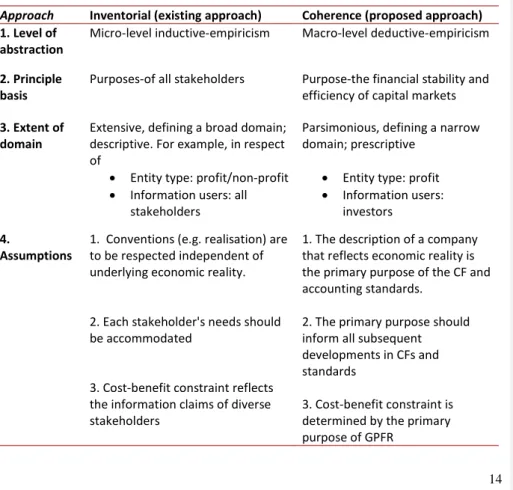
A coherent CF has a number of important attributes. These are identified in table 1 below as implications of the purposive approach to CF development. The development of CF is best pursued by reducing internal conflict among the objectives adopted for accounting information and the qualities specified for that information. This undertaking can be advanced by setting coherence as a primary feature of CF development. This process involves the reconciliation of different conceptual elements. Certain limits to the success of major standard setters’ achievement of consistency have arisen. These are discussed in the following section.
Table 1: A summary comparison of the current and proposed approaches to CF theoretical development
Approach Inventorial (existing approach) Coherence (proposed approach) 1. Level of
abstraction
Micro-level inductive-empiricism Macro-level deductive-empiricism
2. Principle basis
Purposes-of all stakeholders Purpose-the financial stability and efficiency of capital markets 3. Extent of
domain
Extensive, defining a broad domain; descriptive. For example, in respect of
Entity type: profit/non-profit Information users: all
stakeholders
Parsimonious, defining a narrow domain; prescriptive
Entity type: profit Information users:
investors 4.
Assumptions
1. Conventions (e.g. realisation) are to be respected independent of underlying economic reality.
2. Each stakeholder's needs should be accommodated
3. Cost-benefit constraint reflects the information claims of diverse stakeholders
1. The description of a company that reflects economic reality is the primary purpose of the CF and accounting standards.
2. The primary purpose should inform all subsequent developments in CFs and standards
3. Cost-benefit constraint is determined by the primary purpose of GPFR
15 5.
Implications
1. Market stability and efficiency is subordinated to the partial satisfaction of all stakeholder needs.
Subordination of the general purpose to many specific purposes 2. Exhaustive range of financial and non-financial information is required for diverse users
3. A diverse range of principles and methods influence contemporary accounting.
4. Historically and currently realisation has determined Net Income (NI). “Recycling’ of capital items into NI occurs through the realisation principle.
1. Aims for high quality standards that support society's demand for stable financial markets, through efficient capital allocation
2. Investor primacy narrows the set of users and their needs to a limited set of information 3. The primary purpose defines a narrowing of the range of measurement methods and principles.
4. Revenue and capital items are determined by their use in the business, not by realisation.
3.0 Steps towards a coherent theory to guide CF development: What is income?
As noted, throughout the nineteenth century and until the Great Depression of the 1930s GPFR was focused on the balance sheet. Although anachronistic to describe the accounting of this period as FVA it did entail the primacy of assets and liabilities over revenues and expenses (Hendriksen, 1982). The requirement to report revenues and expenses arose in response to financial reporting deficiencies exposed through the Great Depression. More recently standard setters have retreated from this development, reinstating the primacy of assets and liabilities (or stocks of an entity).
The FASB’s and the IASB’s (admittedly inconsistent) enthusiasm for the primacy of assets and liabilities is based on “a definition of income grounded on a theory prevalent in economics” involving changes in wealth between points in time and consumption in the interceding period (Bullen and Crook, 2005). Bromwich, Macve, and Sunder (2008) contend that this theory of economic income (Income concept No. 1), attributed to Hicks, has been taken out of context and is only useful when related to assets and liabilities in complete and
perfect markets. Bromwich, et al (2008) and Jameson (2008) observe that Hicks made an important distinction between sustainable earnings and windfall gains, reflected in Hicks’ concept of maintainable earnings, income concept number 2. Bromwich, et al (2008) further observe that Hicks argued that changes in the value of a company’s assets and liabilities should be identified as far as possible by the user of that information and not the reporting entity. Thus it appears that the primacy of assets and liabilities is based on the misapplication of a theory prevalent in economics.
The misapplication of Hicks’ views on income represents a fundamental weakness in the case for full FVA and asset/liability primacy. As the theoretical provenance of modern CF development is the reason cited in support of, in particular, asset/liability primacy and this provenance is mistaken, then there is no basis to the current approach. We make the case that the specious provenance of the standard setter preference for the asset/liability priority undermines the conceptual foundation of current GPFR. Without another argument for subordinating revenues and expenses there is no basis for asserting that Hicks’ Income concept No. 1 is a sound basis for GPFR development. The lack of such a basis implies an information role for the income statement as a report on sustainable income but it does not undermine FVA. This is not presented as a challenge to Sprouse’s (1966) proposition of the case for an asset liability focus but, rather, an acknowledgement that such an approach may be usefully complemented by a companion focus on revenues and expenses. Where Basu and Waymire (2010) juxtapose the revenue and expenses deemed important by Paton with Sprouse’s (1966) case for the importance of the Balance Sheet, Paton (1922) refers explicitly to “this supplementary account [to the Balance Sheet]”. Clearly, then, Paton did not see the matter as a case of ‘either or’. Again, here as in many issues surrounding financial reporting, an artificially circumscribed suite of options with hasty recourse to unsupported assertions of mutual exclusivity emerges.
The source of the current standard setter preference for the asset and liability priority over revenues and expenses is less important than the causes of the twentieth century introduction of a requirement for an income statement. The explicit identification of the importance of revenues and expenses in response to the Great Depression provides reasons to infer the continuing relevance of the income statement. The need to identify the quality of earnings, that is, their sustainability, is no less today than historically. Income statements add
17 to the informativeness of financial reporting as they provide a measure of the operating efficiency achieved in the use of a company’s stocks. Optimally income statements should distinguish streams (flows) from windfall gains (changes in the capital position of an entity) and, thereby, inform users about the quality of earnings (Hendriksen, 1982). Distinguishing income is important as a basis for determining the likelihood of income recurrence over subsequent periods. Income statements impart information useful in determining stewardship and information that is relevant to the decision-making process; that is, how well assets are being used.
There is little dispute that the income statement is important (Paton, 1922; Hendriksen, 1982; Wustemann and Kierzek, 2005; IASB, 2012), yet there is less clarity about what it is about income reporting that carries information to decision-makers. The importance of the income statement was noted by Paton (1922) with his acknowledgement that this “supplementary” (to the balance sheet) account is vital. Logically and definitionally this information relates to the performance of the entity over a given period or “enjoyment of services in a period” (Irving Fisher, quoted in Hendriksen, 1982, p. 142). As noted, income relates information to users about the efficiency with which a company uses its resources. This, in turn, provides evidence for inferences about the likely recurrence of income or its quality (Hendriksen, 1982). Such earnings quality is most instructive when it is the result of purposeful activity. These propositions support the case for income without reliance on realisation, and the concept of flows as those events, transactions and value changes that are a planned consequence of a company in the pursuit of its business. On the basis of the case presented that realisation should not determine income recognition an examination is made of the categories NI and OCI.
3.1 Net income and other comprehensive income
The IASB (2013, p.1) acknowledges that revenue is “crucial to a number of users” and principles should be used to eliminate inconsistencies in revenue measurement and recognition. The IASB further acknowledge that the category OCI has no conceptual basis (IASB, 2010). No principle excludes certain items from NI, nor is there a conceptual basis to ‘recycling’ or the recognition of certain items of OCI in NI upon realisation (PWC, 2009). The exclusion from NI, then later inclusion in NI on realisation of such items as available for sale
financial assets, property, plant and equipment revaluations, and cash flow hedges follows no identifiable principle in current standards (PWC, 2009). Broadly, current standards draw on a variety of principle bases, including the realisation principle and the asset/liability view. These diverse bases create inconsistencies.
Extending the argument in the prior section to its logical outcome requires that the income statement excludes windfall gains. The characterisation of windfall gains is logically determinable by the character of an asset in relation to the owner. This point is one that has been identified by EFRAG (2013a) in their research into the business model approach to conceptual framework development and acknowledges the potential differential value/income in different business models holding identical assets. A simple ‘stock’ versus ‘flow’ distinction, or capital versus revenue item, provides a plausible basis for determining how changing values, realised or unrealised, are to be recorded, whereby trading gains and losses flow through to the income statement as NI. The relegation of the (income) realisation principle in this proposal is consistent with Paton’s (1922) aversion to it, while maintaining the reflection of the broader suite of FV changes in the balance sheet. Any increase in the gap between NI and cash flows identified as problematic by Gwilliam and Jackson (2007) can be addressed by the indirect method of determining operating cash flows.
A separate concern raised by standard setters is that recognition and measurement should be consistent between different entities for transactions or events that are economically similar (IASB, 2011). Wustemann and Kierzek (2005) sharpen this point by describing the potential for different recognition treatments by different entities of identical transactions or events. One product of the proposals in this paper is that, for example, it may be conceptually legitimate to recognise the gain or loss on the sale of real estate (similar or identical) differently by an entity whose normal business involves trading in such property from one for whom the trade in such property is incidental to their normal business. From an income perspective the efficiency of the conversion of inputs into outputs as a basis for determining expectations of future outputs is crucial. Fortuitous or incidental gains or losses tell the decision-maker little about income sustainability. Although the economic benefit of the individual transaction is identical for each of the two entities, and should be recognised as such in the balance sheet, they have dissimilar implications for the maintainable income of
19 these entities. Thus, the nature of the transaction in relation to the normal business of the entities determines the inclusion of the item in, or exclusion from, NI.
The realisation priority maintains a significant residual influence on contemporary financial reporting standards, reflected in realisation as a basis for recycling certain items of OCI into NI. Under the capital/revenue basis proposed in this paper, realisation does not alter the recognition of an event. For coherence, capital items (stocks) should always be excluded from income, and revenue items should feature in NI at the outset. Part of this drive towards coherence arises in the elimination of extraneous categories, used as a basis for differential recognition. In terms of a financial instrument available for sale, for example, this appears to be a ‘revenue item’, yet its current treatment allows changes in its value to move between recognition in OCI and NI. A held-to-maturity financial instrument seems to equate to a ‘capital item’, yet inconsistent criteria are imposed on the classification of different assets. An illustration of this is holding equities as opposed to holding debt assets. The former cannot be held-to-maturity because equities have no fixed future value and no maturity date (IFRS 39). The question that arises is, what is the asset used for in the business? If either debt or equity assets are used to generate revenue from their sale, they are revenue items. If they are used to produce goods or services for the generation of revenue through sale then they should be capital items. If assets are available for sale then they should be current assets and changes in the value of such assets are NI items.
In terms of external parties’ debt held as an asset by an entity, FV changes play no role preceding maturity or realisation (IFRS 39). The held-to-maturity debt asset category presupposes that increased risk has no value relevance; that debt held-to-maturity will invariably converge on its price at origination. Such a presumption omits information from GPFR. Risk importantly qualifies and alters the value of an asset. As was made clear by the sub-prime crisis, mortgage defaults do occur, ratings agencies’ assessments of credit quality are not consistently reliable, and Insurance against such events can fail. Given these considerations it is uncertain how the held-to-maturity classification can reasonably be used to exempt the assets so classified from the recognition of changes in their fair value. The alternative scenario is that the reporting entity is allowed to rely on its belief that, notwithstanding contrary market assessments, the debt-asset obligee will fully satisfy their obligations.
Consistency is another concern with the held-to-maturity category. Consistency would entail an identical accounting treatment of equity assets held as capital. Such a proposition need only be supported by the company’s belief that they will recoup their original investment within a specified time frame (equivalent to maturity in terms of a debt asset where the term is specified). This category then, is a very broad derivation from HCA measurement as a principle in its own right, although one which is applied inconsistently.
Table two compares the current approach to accounting measurement with the approach consistent with the principles outlined above. As with the proposed approach for accounting CFs, the intention is to create a simple structure. The proposal involves examining the purpose of financial reporting and developing standards that support that purpose. Table 2: The existing and proposed approach to financial reporting
Current approach Proposed approach
1 Balance sheet: Incorporates some changes in the FVs of entity’s assets and liabilities. FVA changes in held-to-maturity assets and liabilities are excluded.
1. Balance sheet: Incorporates all changes in the fair value of all assets and liabilities. This is qualified by the explicit exclusion of gains from company credit downgrade-induced ‘own’ debt. 2 Categories of assets and liabilities: There
are multiple asset and liability categories that determine the use of FV or amortized cost, whether an asset is reported in the balance sheet or income statement, and whether it is reported in NI or OCI (Laux and Leuz, 2010, p. 99; Laux, 2010).
2. Categories of assets/liabilities: There are just two categories-capital and revenue. Capital item gains and losses are reported in the balance sheet, revenue item gains and losses are reported in the income statement
3 Reports OCI as an income statement category, combining revenue and capital item gains and losses in reported OCI. Reports net income as realised income.
3. Reports net income as that income arising from operations. OCI includes gains and losses from capital sources. Realisation does not determine the inclusion of items in NI.
4 Inconsistencies arise as multiple competing principles drive different aspects of standards.
4. Relates the development of accounting standards to its purpose. Consistency is with that purpose and not to a method, methods, or subordinate principles. Thus FVA is employed and interpreted with reference to the primary purpose of financial reporting. Deviations from
21 FVA are indicated when alternative measurement better reflects economic reality.
5 Constrained by methodological consistency rather than by functional consistency. Avoids reductio ad absurdum implications through technical qualifications to its market-based priority.
5. Constrains choices according to general principles. Reduces the suite of accounting choices and links those choices to economic substance rather than technical classification bases.
In contrast to the approach proposed in this paper, RCFFR is observably vaguer, providing more of an inventory of alternatives rather than the prescriptive accounting measurement and recognition principles outlined here. Rather than tight prescription RCFFR intersperses options with indications of IASB preferences. These are loosely specified as in section 8.50 (and elsewhere) where it is proposed that changes in the value of assets and liabilities are to be recognised in OCI, with the caveat that, “not all such re-measurements would be eligible for recognition in OCI” (IASB, 2013, pp. 161-162). It is not stated when such recognition is or is not appropriate. The general lack of specification in the RCFFR is also reflected in IASB ambivalence seen in section 8.55 where it is stated that, “reflecting the effects of asset or liability re-measurement entirely in profit of loss will normally provide [users] with the most relevant information” (IASB, 2013, p. 162) and in section 8.7, qualifying the use of two competing measurements of the same asset or liability in a single report where the two measures provide users with more relevant information. This exemplifies the distinction between this paper’s proposals and those of the RCFFR. The IASB discussion paper frequently resorts to flexibility and loose specification which may assist in achieving an apparent consensus, but does not resolve underlying disagreements.
4.0 Developing the proposal to modify financial reporting
The proposed development of financial reporting in this paper reflects a realistic simplification of current financial reporting in a number of respects. Limiting assets and liabilities to two recognition categories, related to stocks (capital) and flows (income) aims to
capture Hicks’ view of maintainable income. The balance sheet should reflect the capital of a company at a fixed point in time. The income statement provides a view of returns achieved from the balance sheet asset base. In combination, we can determine what a company has (Balance Sheet) and how effectively it has used what it has (Income Statement).
The proposed features add value for users of GPFR as they simplify financial reporting, increase transparency and reduce choices. Asset categories are determinable objectively, rather than by an arbitrary classification system. The classification is determined by the manner in which an entity uses its resources. In conjunction with a proposal to modify FVA measurements with expanded disclosures of valuation inputs and models (along lines proposed by Ryan, 2008a; 2008b; and 2009), the proposed changes provide information useful in making decisions about the efficient allocation of capital and, to the extent that financial reporting can do so, improve the stability of markets through confidence in the substance of financial reports. In terms of the deviation from market values with respect (for example) to accounting for the company’s own credit-impaired liabilities this is driven by faithful representation and the identified need to pull back from full FVA. Also, the primacy of assets and liabilities is restricted to the Balance Sheet and revenues and expenses are preserved in the income statement.
The proposed approach outlined in table two aims to inform investors in financial markets as primary financial reporting users in a manner that enables them to make capital allocation decisions. This purpose is advanced by employing parsimony to define CF objectives. Parsimony is also applied to interpreting the role of financial statements; specifically the Balance sheet and the Income Statement. By distinguishing elements reported in each by whether they constitute capital or revenue items, the proposal seeks to develop consistency, simplicity, and transparency. A specific implication of this approach includes the selection of valuation methods on the basis of their ability to describe economic reality. This entails a default presumption only in favour of FVA. It also indicates how FVA may be modified to meet the purpose of financial reporting.
Current value is indicated on the grounds of decision-usefulness or relevance, and in the provision of timely information. FVA provides greater specification of current value, incorporating estimated values and forecasts. This implicitly supports the accountability of
23 financial reporting, extending the ‘account’ function to those estimated valuations and to forecasts of future cash flows (Barth, 2013). The temporally near and homogenous nature of these values supports their relevance and informativeness to decision makers over that of HCA. Furthermore, FVA is sufficiently flexible that it is able to accommodate real-world complexity. This view is supported by a large body of empirical evidence (for example, Barth, 2004; Barth, Beaver, and Landsman, 1996; Barth, Beaver, and Landsman, 2001). A number of operational issues have been identified and addressed in the preceding discussion. A remaining concern is that of FVA representational faithfulness.
4.1 FVA implementation issues related to income recognition
Revenue recognition under FVA, in terms of the theory advanced in this paper, is less problematic than is implied by Horton and Macve’s (2000) objections to the FVA of current standards. Horton and Macve’s preference for deprival value is driven by concerns that FVA suppresses firm-specific value. This involves issues such as control premiums or blockage discounts for large holdings in a company and the timing of ‘abnormal’ profit recognition. The argument holds deprival value as the optimal current value variant but it implicitly reduces the objectivity of measurement where there is direct commercial evidence to support fair values by elevating the role of firm-specific valuations of its assets and liabilities. Further, as noted by van Zijl and Whittington (2006), the possibility of reconciling deprival value and fair value exists with fairly modest modifications to both, based on correspondence with objective referents. Specifically, van Zijl and Whittington argue for the addition (deduction) of ‘transaction’ costs to acquire (respectively, dispose of) assets and an assumption of entity profit-maximisation, entailing the ‘best and highest use’ valuation of capital. With the qualification of FVA by these changes there is little substance to Horton and Macve’s (2000) preference for deprival value.
Where market referents are not available the value of assets or costs associated with liabilities under FVA as proposed requires extensive disclosures. These allow financial statement users to assess the substance of firm-specific value attributed by the company to lower level fair value assets and liabilities.
Problems with current FVA raised by Horton and Macve (2000) and Macve and Serafeim (2006) include the timing of the recognition of abnormal profits. ‘Abnormal profits’
reflect the need to recognise intangible assets and also suggest the basis for doing so. This approach is based on the assumption that ‘abnormal profits’ are evidence of intangible value. This may simply be the portfolio of assets available to a company as:
“…different combinations may offer different patterns of cost saving or revenue generation” (Horton and Macve, 2000, p. 7).
The historical aversion to the recognition of certain intangibles is linked strongly with a narrowly defined interpretation of reliability as equivalent to an historical transaction cost. This is addressed by a fuller understanding of representational faithfulness (described below) as correspondence with economic reality. By defining abnormal (super-normal) profits as a return on firm-specific intangible capital, revenue recognition proceeds on the basis of contractual fulfilment, and liabilities are recognised as entry or exit values as applicable. Where the liability to contractual fulfilment remains with the entity, entry value best reflects the entity’s liability.
An element of the approach to FVA is that economic substance determines the selection of entry or exit values. In the case of firm-specific gains from a contract there is no intuitively compelling case for the entity to exit an ‘abnormally’ profitable contract unless by doing so it creates capacity for a yet more super-profitable undertaking (and current capacity constraints preclude undertaking both contracts concurrently). In general terms this suggests that the entity’s liability regarding such contracts will usually be its entry value. In many cases the conceptual distinction belies the substantial (economic) equivalence of exit and entry values. Where these values are different the choice should not, as currently, be determined by a rule (that is, the required use of exit values) but by the basis which best describes the economic implications of an asset or liability. In the event that a contract liability is transferred for less than entry value involving abnormal profits then the gain on the contract transfer should be recognised as income (OCI, as a term liability discharge) upon transfer. The key issue in this treatment is that in the normal course of business the entity initially holding an ‘abnormally’ profitable contract would not seek to transfer the liability under that contract so, where they do, evidence of abnormal economic returns requires realisation. This is not an
25 argument for realisation as a general criterion of revenue recognition but as a special case with more elusive concepts such as abnormal profit.
4.2 FVA and representational faithfulness
FVA has typically been subject to challenge on the basis of its reliability. Reliability, now superseded by representational faithfulness, has historically combined freedom from error or bias and verifiability. The FASB defined reliability in the previous CF as:
“…the quality of information that assures that information is reasonably free from error or bias and faithfully represents what it purports to represent. With respect to measures, it states that “[t]he reliability of a measure rests on the faithfulness with which it represents what it purports to represent, coupled with an assurance for the user, which comes through verification, that it has that representational quality” (paragraph 59). Thus, the principal components of reliability are representational faithfulness and verifiability.”
Reliability as a key quality of CFs has frequently been interpreted narrowly by HCA proponents as values verifiable from a past transaction. The missing element of this narrow historical view is representational faithfulness or an answer to the question of what GPFR users could and would rely on that information for. This issue independently supports standard setters’ replacement of reliability with representational faithfulness as a core quality of the CF. It further recommends current value, and fair value in particular, as it has the momentum and flexibility to advance it as the best prospect for relevant and representationally faithful financial reporting. To justify this assertion FVA must be formulated to address concerns about its faithful representation of company-specific economic events.
Opposition to FVA in terms of its representational faithfulness concerns a number of issues. These include that:
1. FVA introduces excessive volatility into financial reports (Enria, et al, 2004). 2. FVA values are difficult or impossible to locate in poorly functioning markets
or, alternatively, that such markets do not provide representationally faithful measures as these might include a discount (in declining markets) for illiquidity, in addition to a discount for deteriorating credit risk.
Commented [c2]: Fix reference from Johnson (and check if he is quoted elsewhere)
3. FVA based on unobserved inputs is unreliable, containing high levels of subjective judgment (Bies, 2004).
4. Market values may misrepresent the firm-specific value of an asset or cost of a liability (Nissim and Penman, 2008).
5. The problem of matching under FVA (Nissim and Penman, 2008): When a company’s credit quality deteriorates its quoted liabilities are marked down without a matching write-down in intangible assets.
Responses to concerns about the representational faithfulness of FVA identified above are that:
1. Volatility is real: Allowing that large and systematically biased measurement errors are avoided, volatility should be reflected in financial statements as an indication of risk as well as returns.
2. Where markets are incapable of providing values for assets and liabilities, either due to dysfunction or because of the nature of the asset, estimates of value should be made. Notably, existing guidance does not impose an obligation to mark-to-market without any regard to the functional state of that market. IFRS 39 (2010, p.8) specifically refers to an “orderly transaction…not a forced transaction”. This supports the view that FV losses are not an independent source of the ‘downward spiral’ in disorderly markets. A market in such a dysfunctional state is explicitly excluded as a source of Fair values. 3. Where non-market, unobservable values are used, a company’s methods and
inputs should be disclosed (Ryan, 2008; 2009; Bies, 2004; SEC, 2008). This allows the analysis of less certain FVs and might be expected to constrain managerial discretion. To some extent this relaxes the representational faithfulness constraint on financial reporting by providing information sufficient to assess that representational faithfulness independently. This should reduce investors’ reliance (or their inability to rely on) financial statement ‘bottom lines’. Instead investors can scrutinise the reasonableness of methods and inputs used to derive bottom lines. Ryan (2008) argues that the provision of auditable information is the comparative advantage of accounting and that increased disclosures would achieve this. Notwithstanding
27 extensive present disclosure requirements (SFAS-157, para. 29B-29F; para. 32, Examples A32A, and A34, SFAS No. 157), expanding the range and specification of lower level FVA disclosures is a plausible response to reliability concerns. Where there is significant uncertainty in determining FV, it may be necessary to require that an independent valuation be obtained. The relevance of such additional evidence is reflected in market assessments as indicated by the research of Cotter and Zimmer (2003).
4. The income statement as proposed should provide confirmatory evidence of previous FV estimates of assets and liabilities that were marked to model. Amongst useful disclosures are those of the past performance of modelled values. The income statement as proposed reflects firm-specific returns from assets or costs from liabilities for which there were market inputs available, where marking-to-market may have provided a value that did not reflect the firm-specific value of that resource. This is distinct from saying that market values were incorrect. Market values describe the value of the asset or cost of the liability generically (to the market). This is an objective value. The value-in-use becomes an objective value through achievement and the entity is rewarded by the reflection of this value generation in superior returns on investment.
5. Financial reporting standards should prohibit the recognition of unrealised ‘gains’ on credit-impaired company-issued debt. This is not a matching problem because Nissim and Penman’s (2008) suggestion that such a gain should be matched with a write-down in (intangible) assets would report a company’s situation as neutral. That is, asset impairment would offset a decreased liability, without necessarily changing equity. Deterioration in a company’s credit situation is not likely to be equity-neutral. However, we do see this as an argument for the balance sheet inclusion of intangible assets.
Barth and Landsman (1995) and Barth, Hodder, and Stubben (2006) argue that there is nothing counter-intuitive in recording gains from declines in the market value of a company’s liabilities due to credit-impairment. They
contend that recording such ‘gains’ reflects a wealth transfer from debt to equity holders. As faithful representation requires that financial reporting reflects reality any recognised gain or loss must be realisable. To fully realise a gain of this type the company must default, driving its equity to zero. Credit deterioration that reduces the value of a company’s listed securities must entail an even greater decline in equity, as a residual ownership interest in the company (Horton and Macve, 2000). The intent and the ability to realise the gain by re-acquiring issued debt (although unlikely where the discount is a) large and b) due to credit risk) implies gain recognition only as realised. Such gains would be recognised through the balance sheet. To recognise all gains related to such outstanding debts pushes FVA away from economic reality. Instead, accounting treatments should be driven by consistency with the provision of useful, reliable, and relevant information.
The argument of this paper is that with sufficient disclosures faithful representation can be achieved and if information is also relevant it will provide investors with information sets sufficient to make well-informed investment decisions. The dichotomy or mutual exclusivity of relevance and representational faithfulness has been overstated and relies on a very narrow definition of verifiability. Minimising strict rules is a key part of faithful representation. Rules should only be used to direct action where the implications of those rules do not include perverse outcomes. Compliance with rules should not provide a basis for a defence against a charge of misrepresentation.
5.0 The current state of the debate about CFs, GPFR, and accounting measurement
This section addresses a number of developments in the debate surrounding CF development that have and continue to confound progress. Key accounting concepts have been appropriated to their users’ agendas. These gambits have and continue to reduce clarity in the debate and, if progress is to be achieved, must be abandoned.
In terms of the current debate we note a number of trends confounding progress in the development of a coherent CF. There appears to be confusion in the use of key terms. These include conservatism and prudence. In general, stakeholder responses to the RCFFR
Commented [c3]: Put these into a discussion style rather than numbered paragraphs
29 proposal to abandon the concept of prudence (affirming the 2010 Exposure Draft (IASB, 2010)) have been negative (see, for example: EFRAG, 2013a; ICAS/IFAC, 2013; ACCA, 2013). Yet if there is no common view of prudence or of conservatism the statements of users’ preference for these properties of accounting information, such as those made by Penman (2011) and Shivakumar (2013), cannot sensibly be made. As Macve (2013) notes of certain circular arguments, these authors do no more than assert the core competency of accounting information to be in providing conservative, objective, and HC-based accounting numbers rather than establishing this. Further, objectivity, an uncontroversially desirable property of accounting information, that any user seeks to rely on to make decisions, is ‘lumped in’ with conservatism and HCA. This is done without justifying the relationship between the respective properties and without establishing the mutual exclusivity of FVA and objectivity. Kothari, et al, (2010) use a similarly rhetorical argument to advance the case for conservatism and HCA, relying on the assertion of the synonymous relationship between conservatism, HCA and objectivity (as a function of verifiability).
Further, as identified earlier, the implied mutual exclusivity of key accounting properties implies a “zero or one” condition identified by Lambert (2010) in his analysis of Kothari, et al’s (2010) inferences from positive accounting theory to its implications for the accounting standards setting process. This leads to a number of false dichotomies. Conservatism, once synonymous with prudence, seems to be more typically used by its proponents as equivalent to HCA, its transactions’ basis, and prudence as the heightened relative propensity to recognise expenses versus revenues. This reduces statements asserting investor demands for conservatism (such as those of Kothari, et al (2010) to the assertion that investors demand HCA, where investor demands may equally be met by FVA along the lines of enhanced valuation input disclosure advanced by Ryan (2008a; 2009). Prudence, as noted by Lambert (2010) and Macve (2013), exists on a spectrum rather than as a property that a particular accounting measurement base either possesses or lacks.
As observed by Lambert (2010) there are inherent problems with prudence as it may potentially trigger a false positive covenant breach and its proponents presuppose that good news will reach the market by some other mechanism. So it may be that excessive conservatism may confound faithful representation. Beyond these limitations of a systematically asymmetric approach to revenue and expense recognition (as a means of
serving asymmetrically information-disadvantaged company outsiders?), prudence and conservatism are not inseparable from HCA or transactions. Lambert’s (2010) description of the demand for conservatism in terms of trade receivables is consistent with FVA model valuation in which past recovery rates and costs of recovery are likely to form the basis for model valuation. Similarly, HCA is not a systemically reliable mechanism for conservative reporting (except as an entailment of a circular definition). All we might say about HCA is that it is unlikely to reflect current values. If HCA is generally a more reliable transmission mechanism of conservatism (in the general sense of caution) then there are also periods where HCA overstates many asset values, such as in the period of the Global Financial Crisis through 2008 and 2009. At such points in business and market cycles investor demand for an accurate view of companies’ positions and prospects is likely to be at its greatest.
As noted earlier, ideologically motivated arguments have also been advanced for FVA. There is merit to the position of Barth (2013) for the confirmatory/accountability potential of FVA to reflect the gap between forecasts and actual outcomes. Yet, elsewhere, Barth, Hodder, and Stubben (2006) provide a less compelling defence of FVA in respect of a decline in the value of liabilities resulting from high own credit risk. Barth, et al (2006) argue that the decline in the value of liabilities is likely to be matched by a fall in the value of the company’s assets. However, while the fall in the value of the assets can occur while the company is a going concern, the reduction in the value of the liabilities can be realised only in the event of financial distress.
What has emerged is a largely rhetorical debate around the CF, accounting standards, NI, OCI, and related issues. Terms and their meanings have been appropriated for their users’ preferred agendas. This has complicated an already challenging undertaking and further impeded advancement in the CF and GPFR. On this basis clear indications for the ongoing debate include the need for coherence, that is, greater clarity and integrity. Part of this process requires that definitions of key terms, whether used conventionally or idiosyncratically, are made explicit when relying on them to advance a position.
Further, research identifying how accounting information users currently use that information, including that of Cascino, et al, (2013) and Shivakumar (2013), does not necessarily support a conclusion of optimisation. Unless GPFR as it stands represents, in one