Developing Efficient and Effective Intrusion Detection
System using Evolutionary Computation
Hasanen Alyasiri
PhD
University of York
Computer Science
Abstract
The internet and computer networks have become an essential tool in distributed com-puting organisations especially because they enable the collaboration between compo-nents of heterogeneous systems. The efficiency and flexibility of online services have attracted many applications, but as they have grown in popularity so have the num-bers of attacks on them. Thus, security teams must deal with numerous threats where the threat landscape is continuously evolving. The traditional security solutions are by no means enough to create a secure environment, intrusion detection systems (IDSs), which observe system works and detect intrusions, are usually utilised to complement other defence techniques. However, threats are becoming more sophisticated, with at-tackers using new attack methods or modifying existing ones. Furthermore, building an effective and efficient IDS is a challenging research problem due to the environment resource restrictions and its constant evolution. To mitigate these problems, we propose to use machine learning techniques to assist with the IDS building effort.
In this thesis, Evolutionary Computation (EC) algorithms are empirically investigated for synthesising intrusion detection programs. EC can construct programs for raising intrusion alerts automatically. One novel proposed approach, i.e. Cartesian Genetic Programming, has proved particularly effective. We also used an ensemble-learning paradigm, in which EC algorithms were used as a meta-learning method to produce de-tectors. The latter is more fully worked out than the former and has proved a significant success. An efficient IDS should always take into account the resource restrictions of the deployed systems. Memory usage and processing speed are critical requirements. We apply a multi-objective approach to find trade-offs among intrusion detection capability and resource consumption of programs and optimise these objectives simultaneously. High complexity and the large size of detectors are identified as general issues with the current approaches. The multi-objective approach is used to evolve Pareto fronts for detectors that aim to maintain the simplicity of the generated patterns. We also investigate the potential application of these algorithms to detect unknown attacks.
Contents
Abstract 3 List of Tables 9 List of Figures 10 Acknowledgements 13 Declaration 15 1 Introduction 17 1.1 Internet Environment . . . 171.2 The Security Problem . . . 19
1.3 Thesis Hypotheses . . . 21
1.4 Thesis Overview . . . 23
2 Intrusion Detection: Concepts and Related Work 25 2.1 Intrusion Detection System (IDS) . . . 25
2.2 Taxonomy of Intrusion Detection Systems . . . 26
2.2.1 Deployment . . . 27
2.2.2 Detection Methods . . . 27
2.2.3 Machine Learning Techniques . . . 28
2.3 Intrusion Detection System Performance Metrics . . . 30
2.4 Related Work . . . 31
2.5 Discussion . . . 40
2.6 Conclusions . . . 41
3 Learning Techniques 43 3.1 Introduction to Evolutionary Computation . . . 43
3.1.1 Genetic Programming (GP) . . . 45
3.1.2 Grammatical Evolution (GE) . . . 49
3.1.4 Multi-objective Evolutionary Algorithms . . . 54
3.1.4.1 Advantages of Pareto Front Based Approaches . . . 56
3.1.4.2 Strength Pareto Evolutionary Algorithm (SPEA2) . . 57
3.2 Ensemble Learning . . . 58
3.3 Previous Work . . . 60
3.4 Evolutionary Computation: Why? . . . 66
3.5 Conclusions . . . 67
4 Datasets Acquisition for Building Intrusion Detection 69 4.1 Intrusion Detection Datasets . . . 69
4.2 Dataset Feature Extraction . . . 70
4.3 Feature Type used in our Experiments . . . 71
4.4 Dataset Splitting for Learning Techniques . . . 72
4.5 Datasets Description . . . 72
4.5.1 Kyoto 2006+ . . . 72
4.5.2 Phishing Websites Dataset . . . 73
4.5.3 UNSW-NB15 Dataset . . . 76
4.5.4 Modern DDoS Dataset . . . 80
4.5.5 CICIDS2017 Dataset . . . 82
4.6 Conclusions . . . 85
5 Performance Evaluation of Evolutionary Computation on Intrusion Detection 87 5.1 Methodology Framework . . . 87
5.2 Application of Genetic Programming to Intrusion Detection . . . 89
5.3 Application of Grammatical Evolution to Intrusion Detection . . . 92
5.4 Application of Cartesian Genetic Programming to Intrusion Detection . 94 5.5 The Performance of Evolutionary Computation Techniques . . . 97
5.6 Evolutionary Computation Techniques for Detecting Unknown Attacks 100 5.7 Conclusions . . . 105
6 Evolving Ensemble Model using Evolutionary Computation for Intru-sion Detection 107 6.1 Stacking . . . 107
6.2 Generating Base Learners . . . 109
6.2.1 Distributed Random Forest (DRF) . . . 109
6.2.2 Extremely Randomized Tree (XRT) . . . 110
6.2.3 Gradient Boosting Machines (GBMs) . . . 110
6.2.4 Generalized Linear Model (GLM) . . . 110 6
6.2.5 Deep Neural Nets (DNNs) . . . 111
6.3 Evolutionary Computation as a Meta-learner . . . 111
6.4 The Performance of Evolutionary Computation Ensemble Techniques . 112 6.5 Evolutionary Computation Ensemble for Detecting Unknown Attacks . 115 6.6 Conclusions . . . 118
7 Trade-offs in Intrusion Detection 121 7.1 Multi-objective Evolutionary Genetic Programming for Learning . . . . 121
7.2 Discovering Trade-offs in Intrusion Detection Programs . . . 127
7.2.1 Experiment 1: Feature Selection . . . 127
7.2.2 Experiment 2: Memory Consumption . . . 130
7.2.3 Experiment 3: Processing Time . . . 131
7.2.4 Experiment 4: Ensemble Diversity . . . 133
7.2.5 Experiment 5: Detecting Unknown Attacks . . . 135
7.3 Conclusions . . . 139
8 Summary and Conclusions 141 8.1 Summary of Experimentation . . . 141
8.2 Thesis Contributions . . . 143
8.3 Future Research . . . 144
List of Tables
2.1 Previous Works Used Adopted Datasets . . . 39
3.1 BNF Grammar Example . . . 49
3.2 GE Decoding Process . . . 50
3.3 Previous Works Summary . . . 68
4.1 Kyoto 2006+ Dataset Features [101] . . . 73
4.2 UNSW-NB15 Dataset Distribution [38] . . . 78
4.3 UNSW-NB15 Dataset Features Description [38] . . . 79
4.4 Distribution of Modern DDoS Dataset Classes . . . 81
4.5 Modern DDoS Dataset Features Description . . . 81
4.6 CICIDS2017 Dataset Scenarios Distribution . . . 83
4.7 CICIDS2017 Dataset Features Description [109] . . . 84
5.1 GP Settings . . . 90
5.2 The BNF Grammar Used for the Problem . . . 93
5.3 CGP Settings . . . 95
5.4 The Performance of GP, GE and CGP on Testing Datasets (%). Average from 20 Runs, ± Value Indicates the SE. Bold Text Indicates a Better Results. . . 98
5.5 Average Number of Terminal and Nonterminal Nodes in Best-Evolved Rules Learned with Proposed Approaches . . . 99
5.6 The New Attack Distribution of The Modern DDoS Dataset . . . 101
5.7 Overall Performance of Best-Evolved Program (%) . . . 101
5.8 Detection Results by Proposed Approaches (Testing Dataset) . . . 102
5.9 Intrusion Detection Programs- Best Run . . . 102
5.10 Comparison of DR on Attack Categories of UNSW-NB15 Dataset . . . 105
6.1 The Performance of EC Algorithms as a Meta-classifier (%) . . . 113
6.2 Overall Performance of The Best Stacked Programs (%) . . . 115
6.4 Intrusion Detection Programs (Meta-classifier) - Best Run . . . 116 7.1 The Performance of Some Programs Evolved by MOGP (Depth = 17) . 124 7.2 Example Programs Output Evolved by MOGP (Depth = 17) . . . 125 7.3 Feature Selection Experimental Results using the Testing Dataset . . . 129 7.4 Feature Selection Experimental Programs Output . . . 129 7.5 The Performance of Standard GE and CGP with Selection Features (%) 129 7.6 Memory Consumption Experimental Results using the Testing Dataset 131 7.7 Memory Consumption Experimental Programs Output . . . 131 7.8 Processing Time Experimental Results using the Testing Dataset . . . 133 7.9 Processing Time Experimental Programs Output . . . 133 7.10 Stacking Experimental Results using the Testing Dataset . . . 135 7.11 Ensemble Diversity Experimental Evolved Programs Output . . . 135 7.12 The Performance of Some Programs (Unknown Variations of Known
Attack Experiment) . . . 136 7.13 Detection Results of MOGP Evolved Programs . . . 136 7.14 No. of Attack Traffic Detected (DR) by MOGP Evolved Programs . . . 138
List of Figures
1.1 Number of Internet Users in the World over the Last Years [3] . . . 19
1.2 Number of New Software Vulnerabilities Reported per Year [8] . . . 20
2.1 Architecture of an IDS [12] . . . 26
2.2 Ambusaidi et al. Framework of the LS-SVM-based IDS [29] . . . 33
2.3 Rathore et al. IDS Architecture [9] . . . 34
2.4 Ensemble and Hybrid Models developed by Chebrolu et al. [31] . . . . 35
2.5 Ensemble Architecture Proposed by Abraham and Thomas [33] . . . . 36
2.6 Zainal et al. Ensemble Experimental workflow [34] . . . 37
2.7 Kamarudin et al. Ensemble Anomaly Detection Model [36] . . . 38
3.1 The Evolutionary Cycle . . . 44
3.2 GP Syntax Tree of Depth 4 . . . 46
3.3 Crossover Operator for Genetic Programming . . . 47
3.4 Mutation Operator for Genetic Programming . . . 47
3.5 Flowchart for The Genetic Programming Algorithm [46] . . . 48
3.6 Crossover Operator on Grammatical Evolution . . . 51
3.7 CGP Genotype and Corresponding Phenotype . . . 53
3.8 CGP Genotype and Corresponding Phenotype after Mutation . . . 54
3.9 An Example of a Pareto Front [58] . . . 55
3.10 Ensemble Methods Workflow . . . 59
5.1 Methodology Framework . . . 88
5.2 Fitness Functions Comparison . . . 89
5.3 GP: Relationship between Accuracy and Number of Generations . . . . 92
5.4 GE: Relationship between Accuracy and Number of Generations . . . . 94
5.5 CGP: Relationship between Accuracy and Number of Generations . . . 96
5.6 Barplot for CGP Algorithm Decision Making Functions with SE Error Bars . . . 97
5.7 Frequent Features Selection (Modern DDoS) . . . 100
5.9 Boxplots Illustrating The Distribution of Each Attack That was De-tected by Each Algorithm (Each Boxplot Represents an Experiment of
20 Independent Runs) . . . 104
6.1 Generating an Ensemble of Classifiers using Stacking [63] . . . 108
6.2 General Scheme used for Building our Ensemble Model . . . 112
6.3 Average Frequency of Base Models Selection in Stacked Programs (Kyoto 2006+ dataset, 20 runs) . . . 114
6.4 Proposed Approaches Performance . . . 117
6.5 Boxplots Illustrating The Distribution of Each Attack That was De-tected by Each Algorithm (Each Boxplot Represent an Experiments of 20 Independent Runs) . . . 118
7.1 Trade-offs Between DR vs. FAR (Phishing Websites) . . . 122
7.2 Global Pareto Front Trade-offs between DR vs. FAR . . . 123
7.3 Global Pareto Front Trade-offs with Different Depths . . . 124
7.4 Caption . . . 126
7.5 Feature Selection Pareto Fronts and Global Pareto Front Trade-off . . . 128
7.6 Memory Consumption Pareto Fronts and Global Pareto Front Trade-off 130 7.7 Processing Time Pareto Fronts and Global Pareto Front Trade-off . . . 132
7.8 Ensemble Diversity Pareto Fronts and Global Pareto Front Trade-off . . 134
7.9 The Visualisation of Program 2 . . . 136 7.10 Pareto Fronts and Global Pareto Front Trade-off (Analysis Experiment) 137 7.11 Pareto Fronts and Global Pareto Front Trade-off (Fuzzers Experiment) 137
Acknowledgements
I would first like to express uttermost gratitude to my supervisor, John A. Clark for all his support and advice throughout his supervision period and after it officially ended. I am extremely grateful to Daniel Kudenko for his support and guidance whenever it was necessary.
I would like to acknowledge my other thesis-committee members, Howard Chivers, Siamak Fayyaz Shahandashti and Julio Hernandez-Castro, for their invaluable and in-sightful comments, which improved this thesis in many ways.
I would like to thank the Iraqi Ministry of Higher Education and Scientific Research, as represented by the Iraqi Cultural Attaché in London, and the University of Kufa for supporting my PhD studies.
Also, I am very thankful to my friends for their moral support and the open source software community.
Finally, I would like to thank my family for their unconditional love, constant sup-port, encouragement and motivation, which enabled me to overcome any difficulties that I encountered during my research.
Declaration
I declare that this thesis is a presentation of original work and I am the sole au-thor. This work has not previously been presented for an award at this, or any other, University. All sources are acknowledged as References.
Contributions from this thesis have been published elsewhere as follows:
• Hasanen Alyasiri, John A Clark, and Daniel Kudenko, “Applying cartesian genetic programming to evolve rules for intrusion detection system,” in 10th International Joint Conference on Computational Intelligence, SciTePress, 2018, pp. 176–183.
• Hasanen Alyasiri, John A Clark, and Daniel Kudenko, “Evolutionary computation algorithms for detecting known and unknown attacks,” in 11th International Con-ference on Security for Information Technology and Communications, Springer, 2018, pp. 170–184.
Chapter
1
|
Introduction
1.1
Internet Environment
The internet is currently a popular subject with application developers, information technology architects, and researchers. It is fast becoming a key instrument in present-day societies and economies by providing fast and flexible information sharing among people and businesses. Its underpinning technologies provide a number of attractive features: ease of use, platform and language independence, interoperability and so on. This is particularly important for enabling the collaboration between components of heterogeneous systems. It is rapidly evolving and expanding to adopt new computing and communication prototypes, for instance cloud computing, Internet of Things (IoT) devices and smart portable platforms. Cloud computing services enable customers to access shared system components (i.e. hardware and software ) from a remotely lo-cated site and utilise them on-demand [1]. IoT comprises physical objects equipped with hardware and software capabilities that will allow them to interact with one an-other and with an-other devices and services over the internet to achieve some purpose [2]. Portable devices have facilitated access from almost everywhere. In addition to personal usage, corporations and governments have come to be increasingly reliant on cyberspace for their everyday tasks. Various activities like communications, business and financial transactions, and even the management of vital infrastructure are now performed over the internet. Until very recently, in most cases, carefully restricted and secured media were used to execute most of these tasks. There were some concerns re-lated to spying and data loss. However, this was limited since systems’ infrastructures were usually inaccessible from the outside. Nowadays, most organisations are connected to the internet permanently, and the majority of them are migrating their computing infrastructures to the cloud.
The complexity of the internet landscape grows continually, introducing new func-tionalities and mixing technologies with great speed. For instance, web applications gave millions of users the opportunity to access vast amounts of data and services in a wide range of areas:
Banking and Financial Services:Web applications have changed the economic sec-tor in various aspects. For instance, a great deal of day-to-day banking is now done online. Cheques are going out of fashion (and the banks would largely like to see their demise). Furthermore, financial exchanges, such as currency exchanges or trading por-tals, have been transformed.
E-commerce: The internet retail is the activity of buying or selling of products over the internet; it has changed how consumers shop. Typically, e-commerce transactions include the purchase of physical or digital products online, such as Amazon.
Education and Science:The E-learning paradigm had a huge impact on the learning process where it has helped to achieve a more effective delivery of knowledge. It eases the access to online courses and digital libraries offering scientific contents at any time. Entertainment: Web applications have helped in the evolution of the entertainment field with the introduction of blogs, multimedia streaming and news feeds. The gaming industry has a major commitment to the internet, where it has created communities dedicated to playing specific online games over it.
Communications: Webinars are an example of how web applications have changed communications. Another example is email, and how individuals’ interactions are con-ceived differently since social media emerged.
Other areas: These include established areas such as file downloading and sharing and, more recently, the Internet of Things applications.
As reported by the Internet World Stats [3], internet users constitute more than 55.1% of the world population. Figure 1.1 shows the growth in the number of internet users over the last years. This incessant growth implies an increase in the amount of data generated online, and the services that run over the internet have become major targets for cyberattack.
Figure 1.1: Number of Internet Users in the World over the Last Years [3]
1.2
The Security Problem
In the modern threat landscape, the internet and computer networks have been a very significant security focus over the last two decades. Cyberspace security is a group of tools and procedures intended to defend computers, networks, software and data files from attack, illegal access, alteration or damage. Intrusions are known as attempts to undermine the confidentiality, integrity, or availability of a system [4]. How to identify intrusions effectively and efficiently in distributed, resource restricted and constantly evolving environments is a difficult task. In the presence of such complexity, humans are not usually able to produce adequate design decisions. Furthermore, intruders’ pro-file, aims and skills have also changed considerably.
In the recent past, cyber-intruders were considered to usually be young socially iso-lated individuals [5] driven by a small number of motivations including curiosity, the thrill of the illicit and/or (for more advanced hackers) peer recognition. Although most were very talented, these intruders did not possess sufficient financial means to produce innovative attacks. However, these days sophisticated attacks and motivations have de-veloped. For example, we now see the use of Advanced Persistent Threats [6] utilising multiple advanced techniques such as zero-day exploits with social engineering. This would help them bypass security tools and maintain a presence on the attacked system for long-term control and data collection. Furthermore, instead of separated obsessed individuals, intruders have evolved into well-resourced groups with economic or
politi-cal motives, attacking high-profile infrastructure from governments to big corporations. Symantec’s “Internet Security Thread Report” [7] for 2018 revealed that 97% of attacks analysed have one motive or more. These known motives were 90% intelligence gath-ering, 11% disruption and 9% financial. Risks have recently become more diverse and it is difficult for security teams to keep up with the daily appearance of vulnerabilities, threats, attacks and responses using appropriate countermeasures. For instance, Fig-ure 1.2 shows the number of publicly identified cybersecurity vulnerabilities per year since 1999 as reported by the Common Vulnerabilities and Exposures database [8]. In comparison to 2008, the number of discovered vulnerabilities has increased by a factor of 3 resulting in an average of 45 new vulnerabilities per day.
Figure 1.2: Number of New Software Vulnerabilities Reported per Year [8] Security threats against network infrastructure can be categorised as active and passive [9][10]. Concerning active threats, attackers try to disturb or terminate the targeted host or network operations using, for example, worms, ransomware and denial of ser-vice. Whereas, for passive threats, intruders stay hidden and focus on obtaining the information exchanged, for instance, traffic analysis and eavesdropping. In some cases, malware, e.g. a keylogger, may be installed to passively monitor and leak information but carry out no immediately disruptive action.
For example, a recent advanced attack occurred in October 2016. An IoT botnet was used to attack Dyn, a pioneer internet infrastructure firm. In this attack, a multi-vector malware called Mirai was developed to take advantage of the vulnerabilities of IoT devices (mainly IP cameras) and infect them. These devices were turned into an IoT zombie army that was utilised to carry out massive distributed denial of services attacks against Dyn making its services unreachable for hours for many clients such as CNN, Netflix, Twitter and other sites, despite it being up and running normally [11]. Another attack called WannaCry hit many major infrastructures worldwide including many of England’s National Health Trusts in May 2017. WannaCry had a huge impact
and the potential to be hugely profitable. Thousands of computers at hospitals were infected by this global ransomware attack within hours of its release. The main reason for this was that it exploits two previously known vulnerabilities in Windows operating systems. Furthermore, the ransomware turns into a worm, capable of spreading itself to any vulnerable systems on the victim’s network as well as to other unpatched systems connected to the internet [7].
To provide a comprehensive threat analysis, security experts should not address only network and server layer issues but also threats to the application layer. Traditional protection tools, such as firewalls, security policies, access control and encryption have failed to protect networks and systems adequately from increasingly sophisticated at-tacks and malware [12]. For instance, Cisco threat researchers [13] analysed more than 400,000 malicious binaries and found that about 70% had used at least some encryption as of October 2017. In addition, security teams have major difficulties handling large volumes of data. The main aim is reducing the risk of losses as far as is practical. The circumstances require more intelligent countermeasures to maintain the security of net-works and important systems. Machine Learning (ML) has had success in many areas of computer science, where it was adopted in real world applications such as products recommendation, optical character recognition, and the like [14]. Thus, recently secu-rity teams considered adopting ML to rise above the chaos of the war with attackers. The automatic classification of malicious behaviours on the internet holds enormous potential for improving protection. In addition, the extracted knowledge allows discov-ery of new attack methods, intrusion scenarios and attacker’s objectives and strategies, and can enhance the ability to distinguish between attacks and legitimate requests.
1.3
Thesis Hypotheses
The internet is a global network that comprises many properties that are complicated and ill-understood. Humans may possibly benefit from enhanced support to cope with such complexity. Therefore, we intend to research the usage of ML algorithms to explore the IDS building process more efficiently than a human could. In particular, we aim to investigate the use of a branch of ML, namely Evolutionary Computation (EC). The research community has confidence that the potential is good, for example: "Computa-tional intelligence will play important roles for cyber intelligence - tracking, analysing, identifying digital security threats to combat viruses, hackers and terrorists that exist on the Internet for different purposes, including IoT cyber threats, cyberstalking and harassment, extortion, blackmail, stock market manipulation, complex corporate espi-onage, and planning or carrying out terrorist activities" [15]. EC approaches have a
number of attractive features, such as producing readable outputs, evolving lightweight solutions and supplying a collection of solutions with a variety of trade-offs among of-ten conflicting objectives. We believe that EC can act as a framework for automatic discovery of insights and intrusion detectors. Our first formal hypothesis is therefore:
Hypothesis 1: evolutionary computation will be able to produce intrusion detection programs for the internet and computer networks based environments. Programs evolved using Genetic Programming, Grammatical Evolution and Cartesian Genetic Program-ming techniques will be able to detect various known and unknown attacks targeting such environments effectively.
As the number and sophistication of attacks grow, it is far from clear whether any current approach will lead to effective attack detection. However, based on experience in many other domains a collection of detectors, of similar or different types, might well provide a means of achieving practical detection goals. In ML, such collections of prim-itive elements (e.g. detectors or classifiers) are termed ensembles. We will investigate their use in this thesis. In particular, we will investigate whether specific combinations can be found via EC approaches. Our second hypothesis is therefore:
Hypothesis 2: evolutionary computation can act as a meta-learner to evolve a function for generating stacking models (intrusion detection programs) that are more effective than previously demonstrated.
Efficiency and effectiveness are equally important aspects of intrusion detection pro-grams. There have been few resource-aware applications in the intrusion detection domain that have been implemented in operational real-world settings. Humans are not experienced enough at making good decisions if complicated trade-offs need to be considered. A multi-objective evolutionary algorithm, which enables us to optimise one or more objectives at the same time, is used to discover detectors that are both effective (i.e. perform well against the standard detection and alarm rates) and efficient (i.e. are fast and generally consume minimal resources). Therefore, our final hypothesis is:
Hypothesis 3: multi-objective evolutionary computation will be able to explore the trade-offs between functional (intrusion detection ability) and non-functional (complex-ity, memory usage and processing time) properties of evolved programs.
1.4
Thesis Overview
The remainder of the thesis is structured as follows:
Chapter 2: outlines IDS architecture and provides an IDS taxonomy. Then it gives a review of the related intrusion detection systems in the literature. Finally, a sum-mary of the chapter is given together with a discussion of the major problems in the field.
Chapter 3: describes the learning techniques utilised in this thesis. It starts with a brief introduction to evolutionary computation as well as details three implementations namely genetic programming, grammatical evolution and cartesian genetic program-ming. It subsequently explains how EC can be extended to solve multiple objectives optimisation issues. The next section presents the ensemble learning paradigm showing how other learning algorithms can be utilised together with EC to increase the learn-ing performance. In addition, an overview of the previous implementations of EC to address IDS problems is given. Lastly, the reasons for adopting ECs are summarised and conclusions are reached.
Chapter 4: examines the characteristics of datasets utilised for training and testing in-trusion systems. Details about the features used and the attacks found in each dataset are explained. Conclusions are summarised in the last section.
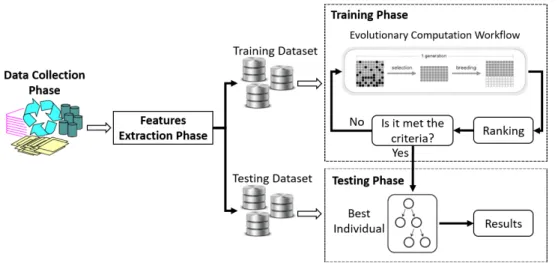
Chapter 5: This chapter details how to apply evolutionary computation to obtain intrusion detection programs. Firstly, an overview of the utilised frameworks is in-troduced. Next the application of each algorithm to intrusion detection is outlined. The performance of evolved programs are demonstrated and explained. The results are reported and compared. Furthermore, the use of proposed frameworks to evolve IDS rules for classifying unknown attacks is also introduced. Finally, conclusions are drawn. Chapter 6: aims to evolve a classifier design scheme that incorporates multiple learners to provide superior predictive performance over a single algorithm. This implemen-tation converts the input vector space (i.e. base learners’ prediction) into a decision space to predict the class type. The proposed techniques will combine multiple learn-ing algorithms into a slearn-ingle and powerful prediction function. The evolved programs are demonstrated and explained. The results are reported and the performance of evolved programs are compared. In addition, we demonstrate the adoption of ensemble paradigms to evolve intrusion detection programs for detecting unknown attacks. The
conclusions are presented.
Chapter 7: explores the efficiency of intrusion detection systems in resource constrained environments. Multi-objective evolutionary computation is used to explore the trade-offs among intrusion detection program security performance and non-security con-straints such as complexity, memory consumption and processing time. The traditional concept of Pareto fronts produces a principled way to examine the trade-offs imple-mented. In addition, we examine the capability of the evolved programs for detecting unseen attacks during the training stage. The obtained results are illustrated and anal-ysed. Finally, the conclusions are summarised.
Chapter 8: concludes the thesis. This chapter firstly shows a summary of the thesis. The contributions of the thesis are highlighted and future work is discussed.
Chapter
2
|
Intrusion Detection: Concepts and
Related Work
This chapter introduces the intrusion detection system. It also presents IDS architecture and taxonomy, with an explanation of each characteristic in the taxonomy. Then it gives a review of the related works in this area. Finally, it provides a summary and discusses the main problems in the field.
2.1
Intrusion Detection System (IDS)
“Intrusion detection is the process of monitoring the events occurring in a computer sys-tem or network and analysing them for signs of possible incidents, which are violations or imminent threats of violation of computer security policies, acceptable use policies, or standard security practices” [16]. In recent years, security threats have had a major effect on the confidentiality, privacy and integrity of services being performed on the internet. IDS technologies tackle security problems through event gathering, logging, detection and prevention [4]. Many research studies have been focused on building IDSs with high detection rates and low false alarms. However, recent investigation [17] has concluded that IDS should be faster, flexible (instead of having strict thresholds), dy-namic towards recognising novel patterns and combining logically related false alarms in order to locate the root cause of alarms. An effective IDS has the potential to tackle these issues.
The earliest work that put forward the concept of automated threat detection reaches back to Anderson in 1980 [18]. In his report, Anderson introduced the idea of detecting unauthorised and malicious activities according to an audit record of the operating system activities. In 1985, Denning and Neumann proposed a real-time intrusion de-tection model which is called Intrusion Dede-tection Expert System (IDES). This proposal considered IDES as system-independent as it observes logins, program executions, file, device accesses, etc for any signs of anomalies in usage. In 1988, Teresa L et al. [19] im-proved the model and implemented a real time IDS developed at the SRI International
[20]. This system monitors the activities of different types of subjects, such as users and remote hosts, of a target system to detect security violations by both insiders and outsiders as they occur.
An IDS contains various modules to monitor and decide whether activities are ma-licious or non-mama-licious in an efficient manner. The modules are a system to monitor, data collection and pre-processing, intrusion recognition engine and a reporting/re-sponse unit. The monitoring unit(s) collect samples of raw audit data (such as system logs, network packets, etc.) and pass them to the pre-processing stage. This unit analy-ses data and extracts features in such a way that the detection engine can later examine them. The intrusion recognition system searches the treated data for any sign of ma-licious conduct. Finally, based on detection engine outcomes, the alarm/response unit takes action. Figure 2.1 shows an IDS organisation and the relations between these components. The solid lines refer to data/control flow while dashed lines refer to the response to intrusive activities.
Figure 2.1: Architecture of an IDS [12]
2.2
Taxonomy of Intrusion Detection Systems
It is important for IDS designers and users to understand and study IDS categories in order to select the best IDS characteristics. There are many ways to classify IDSs. IDS categories depend on system deployment, detection strategy, utilised machine-learning techniques, etc. On the other hand, to achieve greater security some IDSs are hybrid systems and belong to more than one category.
2.2.1
Deployment
IDS placements are an important means of giving protection to a system or its moni-tored environment. The placement of the IDS can be categorised into one of four groups according to its location.
(a) Host-Based IDS: Applies to systems that are located on and monitor a single host machine where it gives them the extra privilege of discovering changes re-lated to file systems [4]. Host-based IDS can also be implemented by observing the system’s kernel where system calls show the behaviour of the program. In addition, because the IDS is located at the end of the communication line, they can also identify some network related attacks. A distributed attack is one of the most obvious weaknesses of such systems.
(b) Network-Based IDS: monitors packets passing through a network and able to examine any number of hosts. Network-Based IDS is categorised according to its architecture into three kinds: stand-alone, distributed or hierarchical [21]. The level of detection may vary from one to another. However, most of them have modules in charge of investigating traffic from the network, transport, and application layers in the Open Systems Interconnection (OSI) model. The main problem occurs when network bandwidth is high. In this case, the IDS might have some difficulties examining all the packets.
(c) Hybrid IDS: Combines the workloads of both network-based and host-based IDS systems. Host-based IDSs will be deployed into the critical parts of the protected environment including servers, databases and the like. These types of IDS pri-marily depend on the host-based parts and employ the network-based system to complement the protection [22].
(d) Application-Based IDS: Examines events located at the application level on a host machine. They can detect intrusion attempts towards a specific application. It often detects many types of attacks by analysing the application log files. However, application-based IDSs are known to consume significant application (and host) resources [22]. An example of an application-based IDS is the web-application firewall.
2.2.2
Detection Methods
Many techniques have been used to identify intrusions. They can be classified into two main groups: misuse or anomaly. Recently, both misuse and anomaly based approaches have been used together in IDSs to improve effectiveness due to their strengths and
weaknesses being complementary [21]. Each of these detection methods is presented below:
(a) Misuse-Based Detection: matches features of current activates against stored pro-files of characteristic properties of known attacks. Commercial IDSs mostly adopt misuse-based approaches due to their effectiveness with known attacks and low false alarm rates. They are also fairly easy to implement. Anytime a new attack is discovered the system updates the database by adding attack signatures. The drawback of this approach is that it cannot identify novel attacks, even if they are slightly modified from a known pattern. The system primarily relies on the strength of its signature database which requires constant updating [12].
(b) Anomaly-Based Detection: Anomaly-based intrusion detection seeks to detect “unusual” behaviour of network connections, hosts or users over a period of time [4]. In this approach, firstly it computes the normal model by profiling the regular behaviour of user activities. While in detection mode, the system compares the current monitored activities with these profiles, and any deviation is reported as being anomalous (i.e. an attack attempt). Due to the constantly changing normal behaviour by the addition of new features or technologies, IDS requires frequent updates. The false positives rate (the rate at which regular activities are classified as anomalies) is often high in this type. However, anomaly-based IDS can detect emerging attacks which are unrelated to any known attacks. This is particularly significant in an environment in which novel attacks and new vulnerabilities of systems are discovered now and then.
(c) Hybrid Detection: An IDS that is a combination of both previous systems. It is used to increase detection rates of known attacks and lower the false positive rate for unknown attacks. It requires two processing factors. Triggering an alarm is based on performing a decision from multiple methodologies. For example, a method identifies anomalous behaviours while decoding the events, and another detection engine performs the signature matching [22].
2.2.3
Machine Learning Techniques
Another division of IDSs is based on what machine learning techniques have been utilised to construct intrusion detection engines. These techniques are often used as a means of synthesising event classifiers, indicators of whether an event is normal or malicious. Various studies implement single learning techniques whereas some systems combine more than one learning technique, for instance, hybrid or ensemble approaches.
(a) Single Classifiers: the intrusion detection dilemma can be addressed by utilising a single machine learning algorithm only [23]. In the previous works, both super-vised and unsupersuper-vised approaches have been applied to solve these issues. Nor-mally, the IDS building process goes through two main operations. The learning (training) responsibility is to measure the estimated distance between the input-output instances to build a classifier (model). Following the model construction, it can categorise unseen instances (testing). There is not much flexibility in this type and IDS performance depends on the learning paradigm used.
(b) Hybrid Classifiers: During the building of an IDS, the usual primary objective is to gain the best potential accuracy for the targeted task. This purpose normally requires the concept of hybrid techniques for the problem to be resolved [23]. The main idea of the hybrid classifier is to integrate multiple ML algorithms which allows the system efficacy to be considerably enhanced. Additionally, either su-pervised and/or unsusu-pervised learning techniques, or both types together, can be used to build the hybrid system. Each technique in hybrid classifiers will perform a specific task. Different methods have been proposed to hybrid classifiers. For instance, an algorithm uses raw data as input and produces intermediate out-puts. The second algorithm will then use the intermediate outputs as the input and generate the final outcomes. Another example is when an algorithm is used to tune the parameters of the second algorithm in order to optimise the predic-tion performance of the second model. The main disadvantage of this kind is that the constructed paradigms are engineered in a way that usually has non-interchangeable positions.
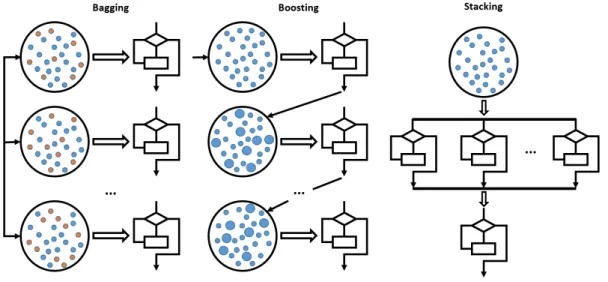
(c) Ensemble Classifiers: these combine various machine learning models which al-lows the overall performance to be effectively enhanced [24]. The idea behind an ensemble classifier is to boost a weak learning paradigm performance. These models could be from the same or from different learning paradigms. Combin-ing strategies are usually of two types: non-trainable such as majority votCombin-ing or trainable approaches such as stacking. The difficulty of ensemble approaches come from the selection of the algorithms creating the ensemble. One of the ad-vantages of ensemble approaches is their modular structure, where the designer of an ensemble can easily replace one or more algorithms with a more accurate one. It is necessary to consider the computational cost that is attached to each new algorithm. Ensembles help to meet the following challenges of IDSs [17] [25]:
• An Ensemble classifier capable of modelling the problem is based on different subsets of a dataset or its features. This is particularly important when there is an insufficient amount of quality training data.
• A reduction of false positives and false negatives. This is supported by the idea that different learning algorithms explore different characteristics of the problem.
• Ensemble-based algorithms perform just as well when data are not available in necessary amounts and when we have a large amount of data.
• An ensemble can model with ease various application or parts of a network (i.e. some models can be developed for some parts or for some levels of the network) and eventually aggregate together, to secure more effective performance.
There are many other possible classifications. For example, [22] gives a taxonomy based on the technology where IDSs may be wired or wireless. Wireless IDSs can be further classified as fixed or mobile. Regarding the data processing method and the arrange-ment of its components, IDSs can be centralised or distributed. Furthermore, IDSs have different types of action depending on the way they are responding. If an IDS responds to the detection of an attack then it is “active” otherwise it is deemed “passive”, which means it only generates alarms. An active response could seek either to take actions on the attacked, or the attacking system.
2.3
Intrusion Detection System Performance Metrics
The effectiveness of a proposed intrusion detection system can be measured according to how malicious and normal behaviours are classified correctly. For this purpose, the most widely adopted statistical measure for the binary classification problem is the confusion matrix. A confusion matrix contains four values: True Positive (TP), True Negative (TN), False Positive (FP) and False Negative (FN). TP refers to malicious behaviour being categorised as a threat, and TN indicates normal behaviour being classed as normal. FN refers to malicious behaviour being categorised as normal and FP indicates normal behaviour being classed as malicious, both of these are problematic. False positives waste a great deal of time and can lead to loss of confidence. False negatives are examples of the detector system not performing its primary task, i.e. to detect attacks. There are some derived measurements that are also used in this thesis:
Detection Rate(DR) = T P
(T P +F N) (2.1)
Accuracy (Acc) = (T P +T N)
(T N +T P +F N+F P) (2.2)
F alse P ositive Rate (F P R) = F P
(F P +T N) (2.3)
F alse N egative Rate (F N R) = F N
(F N +T P) (2.4)
Equation 2.1 indicates the fraction of real attacks that are detected; this is sometimes referred to as Recall. Equation 2.2 defines the fraction of all instances (attacks or non-attacks) that are correctly classified. Equation 2.3 describes the fraction of normal behaviours that are erroneously flagged as malicious, whereas equation 2.4 shows the rate of anomaly behaviours that are being examined which yield normal test outcomes. IDS experts consider the effect of false rates as just as critical as the detection accuracy. Equation 2.5 shows how to calculate the rate of the misclassified instances.
F alse Alarm Rate(F AR) = (F P R+F N R)
2 (2.5)
2.4
Related Work
To keep pace, knowledge extraction using machine learning techniques can help defend-ers complement threat prevention, detection and remediation [13]. These techniques are used to perform various roles from data pre-processing to a deeper understanding of data which helps automate the detection process. Despite their success in other areas, machine learning techniques have not seen much in the way of real-world IDS appli-cation [14]. However, the characteristics of learning methods, for example, adaptation, fault tolerance, high computational speed and error resilience in the face of noisy in-formation match the prerequisites of developing a security tool and could potentially fill the gaps [12]. In this overview, the first part encompasses various machine learn-ing techniques that have been implemented in order to identify threats. The second part lists some results obtained from various techniques deployed against used datasets. Bouzida and Cuppens [26] adopted two supervised algorithms: multilayer neural net-work and decision trees (C4.5) for anomaly-based intrusion techniques. Neural netnet-works showed promise for generalisation accuracy, but were very poor at detecting new at-tacks. Decision trees showed a high efficiency in both generalisation accuracy and new attacks discovery. The KDD dataset was used, it extracted from the DARPA dataset. This dataset comprises 24 attack kinds that could be grouped into four main types namely Denial of Service (DOS), Remote to User (R2L), User to Root (U2R) and probing. In addition, they applied their technique to real network traffic from their laboratory, which contains new attacks not present when DARPA was created. Even though the achieved results are interesting when compared with earlier works, nonethe-less the detection rate of a number of attack kinds continues to be poor. There were two contributions made by this study: adopting the idea of anomaly intrusion detection
through considering both normal and known intrusions while in the training stage and adding a new class for the novel intrusion instances (since these are unrepresented in the training dataset).
Bankovic et al. [27] implemented a technique that creates a set of rules to classify network connections as either normal or intrusive and provides an identification of the attack type. A dimension reduction technique, Principal Component Analysis (PCA), also known as Karhunen-Loève transform, was used to identify a subset of features that maintain the most relevant information. For evolving rules, the KDD dataset was used. The 41 features in the KDD dataset were cut down to only 3 at the first step by PCA. The second step uses a genetic algorithm to create a set of rules to classify behaviour as normal or abnormal. Each rule for intrusion detection is an if-then clause form. The conditional part of the rule is composed of the features connected by the AND function. The result of each rule is a verification of an intrusion taxonomy. This approach has the ability to pre-process network data in real-time and offers a high de-tection rate and low false positive rate. Nevertheless, they considered only three kinds of attacks which are not sufficient to assess the technique.
Stevanovic et al. [28] studied the utilisation of two unsupervised learning algorithms: the Self-Organising Map (SOM) and Modified Adaptive Resonance Theory 2 (Modified ART2) to analyse web logs and detect malicious and non-malicious visitors. Three mil-lion log records were obtained from web-based accesses into their domain over a period of four weeks. Before characterising web visitors, they applied data pre-processing in order to point out unique visitor sessions and generate 10 features for each session. The SOM clustering method uses multiple rounds of a competitive learning process to make the underlying algorithm respond in the same way to similar input patterns. The ART2 algorithm also uses the idea of competitive learning, however, combined with the winner-takes-all rule, eventually generating different clustering results. In their case study of web log analysis, they identify four main kinds of website visitors: human vis-itor, well-behaved crawler, malicious crawler, and unknown.
In [29], Ambusaidi et al. build an IDS using the Least Square SVM algorithm inte-grated with the feature selection algorithm: Flexible Mutual Information Based Fea-ture Selection (LS-SVM-IDS+FMIFS). The main idea is to remove feaFea-tures that are redundant and irrelevant from the data, as these features slow down the classifica-tion process but likewise affect the IDS classificaclassifica-tion accuracy. The evaluaclassifica-tion showed that the feature selection algorithm contributes features that are more critical for LS-SVM-IDS to accomplish better performance and reduce computational cost. Figure 2.2
shows the detection framework main stages: (1) data collection in which flows of net-work packets are obtained, (2) data pre-processing in which training and testing data are pre-processed, and the significant features that can effectively distinguish various classes are chosen, (3) classifier training in which the model for classification is formed using the LS-SVM algorithm, and (4) attack recognition in which the developed model is employed to detect attacks in the test data. The model was examined utilising 3 datasets that are KDD, NSL-KDD and Kyoto 2006+. The NSL-KDD dataset was in-troduced to solve some issues in the original KDD dataset. The developed IDS has accomplished promising achievements in detecting intrusions over computer networks. In general, LSSVM-IDS + FMIFS has the best efficacy in comparison to the other state-of-the art algorithms.
Figure 2.2: Ambusaidi et al. Framework of the LS-SVM-based IDS [29]
Najafabadi et al. [30] used machine learning algorithms to build predictive models to discriminate normal network traffic from malicious network traffic. The proposed archi-tecture includes a data reduction method (i.e. feature selection) to remove irrelevant and redundant features which leads to a decrease in the process time. They tested three classification models (5-nearest neighbor, C4.5 decision tree and Naïve Bayes) alongside four different feature selection methods. The Kyoto 2006+ dataset is utilised for training and testing the models. The classification results showed that while feature selection reduces the number of features, it maintains the same or does not decrease outcomes significantly. They conclude that the feature selection in the IDS application domain is an important pre-processing step and it should not be taken lightly.
Rathore et al. [9] proposed an IDS to tackle the issue of dealing with a large amount of data and a high-speed environment (i.e. Internet and network services). This proposed system comprises a 4 layered IDS structure, which contains a capturing layer, filtra-tion and load balancing layer, parallel processing layer (i.e. Hadoop) and the decision-making layer (see Figure 2.3). DARPA, KDD and NSL-KDD were used for evaluation. Furthermore, two feature selection approaches and DARPA traffic analysis are used
to cut down the number of input features from 41 to 9. In the beginning, the flow of network packets is collected using a high-speed capturing device. The second layer uses the In-Memory intruders’ database to carry out efficient searching and comparisons of the incoming flow’s traffic in order to classify it as an intrusion or normal flow. Then, it sends the traffic of the unidentified flow with packet header data to the third layer (i.e. Hadoop) master servers. It also balances the burden by determining which packets are forwarded to which master server based on the IP addresses. Hadoop has a MapReduce code that utilises the Map and Reduce function provided with some parameters calcu-lations code to calculate the 9 features values. Since MapReduce runs simultaneously the overall performance is boosted. In the end, the feature values are transmitted to the decision-making layer that categorises the flows as benign, or threats, depending on their features values. This layer was tested using five ML algorithms namely J48, REP-Tree, random forest tree, conjunctive rule, SVM and Naïve Bayes. Both REPTree and J48 achieved the highest performance when it comes to processing time and accuracy.
Figure 2.3: Rathore et al. IDS Architecture [9]
Chebrolu et al. [31] researched the use of Bayesian Networks (BN) and Classification and Regression Trees (CART) algorithms for IDS. They used these two paradigms as a hybrid classifier and as an ensemble classifier. The dataset utilised in this study was the DARPA, from which a subset was randomly chosen. Feature selection was also implemented to speed up the computation. First, BN and CART were evaluated separately with full and with subsets of features. The performance on the set of 41
features was compared to a set of 17 selected by BN and 12 selected by CART. BN performed worse with a smaller set of features except on the normal class. CART using a reduced dataset achieved 100% normal class classification accuracy and a increased U2R and R2L classification accuracy as well. The ensemble model was tested using a reduced features set (i.e. 12 and 17) and 41 from the dataset and its workflow is illustrated in Figure 2.4a. In the ensemble method, the final decisions were reached as follows: each paradigm’s output is assigned a weight based on the generalisation accuracy. If both paradigms agree then the final result is chosen accordingly. In case there is a conflict in the decision given by the paradigm then the one with the highest weight is favoured. Based on the results, they concluded that the ensemble model provides more effective performance than the two paradigms working individually. After summarising the models performance with both ensemble and individual classifiers, they formed a hybrid IDS architecture shown in Figure 2.4b. Finally, by utilising the hybrid model; normal, probe and DOS instances were detected more accurately.
(a) Ensemble Model
(b) Hybrid Model
Figure 2.4: Ensemble and Hybrid Models developed by Chebrolu et al. [31]
Xiang et al. [32] proposed a multiple-level hybrid classifier for the IDS. This approach combined both an unsupervised learner (i.e. Bayesian clustering) and a supervised learner (i.e. Decision tree C4.5). The KDD dataset was utilised in this work. At the first stage of classification, the C4.5 model grouped instances into 3 categories DoS, Probe and Other. Both U2R and R2L attacks and Benign instances are categorised as Others at this stage. Stage 2 uses Bayesian clustering to separate out Others into (U2R and R2L) as attacks and Benign instances using only 4 features out of 41. These fea-tures were chosen after weighing the significance of each feature by applying a collection of criteria, for instance, information gain. The C4.5 model was utilised to differentiate U2R and R2L at stage 3 using 14 features only. This step is executed much more easier given that the Benign instances have been separated out at stage 2. Finally, C4.5 is used to further categorise each class of attack into its variations. The experimental results showed a very efficient detection rate with a very low false negative rate, and at the
same time it maintained a reasonable false alarm rate level compared with other pop-ular approaches. However, unknown attacks that are missing from the training dataset are very low.
Abraham and Thomas [33] proposed an ensemble approach consisting of three base classifiers (Decision Trees (DT), Support Vector Machines (SVM), and a hybrid sys-tem composed of DT and SVM). The structure of the ensemble model is illustrated in Figure 2.5. The IDS model is generated by using KDD as the training dataset. In this experiment, each model afforded complementary information about the observed behaviours (i.e. 5 different classes) in order to be categorised. The final outcome of the ensemble classifier is determined by the highest score of the base models. The score of each model is measured via assigned weights which represent the individual prediction performance on the training dataset. Therefore, for a certain example to be categorised and in case all models provide diverse opinions, then the ensemble classifier uses a mod-els score. The model possessing the highest score is considered to be the winner and utilised to decide the final outcome. Evidently, the ensemble method makes use of the differences in misclassification and enhances the overall performance.
Figure 2.5: Ensemble Architecture Proposed by Abraham and Thomas [33] Zainal et al. [34] proposed a heterogeneous ensemble by fusing three different classifiers designed for detecting a single class. They adopted learning algorithms such as the following: Linear Genetic Programming (LGP), Random Forest (RF), and Adaptive Neuro-Fuzzy Inference System (ANFIS) to construct a network-based IDS. Each of the algorithms (i.e. LGP, ANFIS and RF) used the same dataset during the train-ing. This study used the KDD dataset. Rough Set Technique and Discrete Particle Swarm Optimisation (RST-BPSO) was employed to extract the important features. The original 41 features were cut down to 15 for all classes and selected features for each class are vary. After building base classifiers, the system then used the weighted voting method to determine the final classification. Overall, the performance of LGP is better in comparison with the other two algorithms, while both ANFIS and RF are nearly at the same level. It is shown that the ensemble system performs better than the best-performing classifier alone. Figure 2.6 depicts the proposed ensemble workflow.
Figure 2.6: Zainal et al. Ensemble Experimental workflow [34]
Syarif et al. [35] investigated the implementation of three ensemble paradigms to im-prove network-based IDSs performance. They used bagging, boosting and stacking systems to address intrusion detection problems in order to enhance the accuracy and decrease its false positive rates. The four data mining algorithms utilised as base learn-ers for those ensemble classifilearn-ers were naïve Bayes, J48 (decision tree), JRip (rule induction) and iBK (nearest neighbor). The NSL-KDD dataset was used. Regarding the 4 base classifiers utilised, J48 achieved better performance compared with the other 3 methods in terms of the highest accuracy rates, lowest false positive rate and faster execution time. They reported that proposed approaches achieved a high accuracy in detecting known attacks, however, it failed to recognise novel attacks effectively. The utilisation of bagging, boosting and stacking displayed no significant gain in accuracy. Although stacking was the only paradigm that resulted in a notable decrease in false positive rates, its execution time was the longest. Therefore, they concluded that it is unqualified to become an effective solution for the intrusion detection problem. How-ever, with recent improvements in computing capabilities, this issue could be overcome easily. In addition, even a small reduction in misclassification error is very important for the IDS field.
Kamarudin et al. [36] proposed an anomaly-based intrusion detection system utilis-ing an ensemble concept to detect novel attacks targetutilis-ing web servers. The logitboost algorithm is employed as a stacking approach along with the RF algorithm as a base learner because of its power in coping with noise and outliers data. The system was tested utilising 2 datasets (NSL-KDD and UNSW-NB15) focusing only on HTTP traf-fic. A hybrid feature selection technique was used as a pre-processing step to select significant features only, which helped reduce the overall detection time. For NSL-KDD, the number of features was reduced from 41 to 10, while for UNSW-NB15 the number of features was reduced from 43 to 5. Figure 2.7 presents the workflow of the proposed anomaly detection ensemble model. The authors made sure that the attack traffic in each of the training and testing portions was completely varied. The logit-boost classifier algorithm achieved excellent overall accuracy and also maintained a low false alarm rate. However, the results showed that the detection rate of some of the unknown attacks was very low from both datasets.
Figure 2.7: Kamarudin et al. Ensemble Anomaly Detection Model [36]
Finally, Table 2.1 shows various techniques experimentally deployed on the utilised datasets in this thesis. In the performance metrics column beside DR, FPR, Acc and FAR, there is the precision ((T PT P+F P)) which describes the fraction of raised attacks that were predicted correctly. In addition, F1-score (2∗ ((RecallRecall+∗P recisionP recision))), is a measure that includes precision as well as recall and shows approximately the average of the two when they are close.
Author(s) T ec hnique(s) Pre-pro cessing Stage(s) Dataset Used Split P ercen tage P erformance Metric(s) Am busaidi et al. [29 ] In trusion Detection System: Least Square Supp ort V ector Mac hine F eature T ransformation Normalization Feature Selection Ky oto 2006+ T raining = 70% T esting = 30% DR = 99.64 % FPR = 0.13% A cc = 99.77% Thabtah et al. [37 ] An ti-phishing Mo del: Impro v ed Self-Structuring Neural Net w o rk ep o ch (500) F eature Selection Phishing W ebsites T raining = 80% T esting = 20% A cc = 93.06% F1-score = 92.3 0% Recall = 91.12% Precision = 93.71% Moustafa and Sla y [38 ] Net w o rk Anomaly Detection System: Decision T ree N/A UNSW-NB15 T raining = 60% T esting = 40% A cc = 85.56% F AR = 1 5.78% Moustafa et al. [39 ] Anomaly Detection System: Geometric Area Analysis F eature Con v e rs ion F eature Reduction F eature Normalisation UNSW-NB15 T raining = 60% T esting = 40% DR = 91.3% A cc = 92.8% FPR = 5.1% Alk asas sb eh et al. [40 ] In trusion Detection System: Multila y er P erceptron N/A Mo dern DDoS T raining = 66% T esting = 34% A cc = 98.63% Sharafaldin et al. [41 ] In trusion Detection System: Random F orest N/A CICIDS2017 N/A Precision = 0.98 Recall = 0.97 F1-score = 0.97 T able 2.1: Previous W orks Used A dopted Datasets
2.5
Discussion
An intrusion detection system is considered to be a key aspect of present-day security management tools. In IDS research, ML techniques have been applied towards building IDS solutions, however, they are still facing problems and further research is needed. After analysing the aforementioned papers in the literature, we identified major chal-lenges that have been largely ignored or otherwise need further investigation. These challenges, which are also confirmed to be vital by recent surveys, are listed below:
1. Techniques used to address cybersecurity issues should produce understandable solutions (i.e. readable and in an easy to comprehend format) [12] [42].
2. IDSs need to be able to deal with new and undocumented attacks from which signatures are not available [25] [4].
3. "Current IDSs pose challenges on not only capricious intrusion categories, but also huge computational power" [4].
4. IDS should be able to handle the ever increasing number of network connections and process the sheer volume of data generated in real-time [25] [42].
A recent survey [42] concluded that data mining and ML methods are a prevalent and growing research area for cyber security. For instance, ensemble methods have emerged as a promising way of providing reliable and intelligent IDSs [17], [24]. These meth-ods can improve the performance of IDSs (i.e. effectiveness) over a single classifier in terms of both detection rate and false alarms. This is due to the fact that the learning algorithms operate in a different way upon various classes of attacks (e.g. DoS, Probe, U2R and R2L) [43]. However, a recent survey indicates that the application of the heterogeneous ensemble in solving IDS problems is still quite modest [24].
A major limitation of the misuse-based approach is its failure to detect new threats which are previously unknown to the IDS. However, ML holds real value to security teams by overcoming skills and resources gaps, this especially stems from its ability to detect both known and emerging threats [13]. Unknown attacks, which are classified into two types: unseen variations of known attacks or unseen attacks, are emerging as one of the most serious threats to any system [13]. An effective IDS must have the capability to identify attacks that it has never before encountered.
The production of readable output is more and more important as it provides se-curity analysts with some degree of manual analysis so it is easy to understand and
deploy solutions. Finally, due to the highly complex and ill-understood properties of the examined search space (i.e. environment) the ML methods are the best solution to explore these properties [44].
2.6
Conclusions
The internet is a medium that provides services to customers using machine-to-machine interaction on various digital devices. It has become an important factor for many do-mains, e.g. e-government, e-finance, and e-health. Unfortunately, these services are vulnerable and under constant risk of attack. The security issues related to these ser-vices are a major concern to their providers and are directly relevant to the everyday lives of system users. Furthermore, new attacks emerge every day and current mecha-nisms are not sufficient in themselves. Therefore, researchers have adopted various ML techniques to fill these security gaps after the successes achieved by ML in many other domains.
In this chapter, we have reviewed relevant applications related to developing ML-based IDSs. The contribution/novelty of the proposed systems is discussed and argued. There are still issues that have been largely ignored or otherwise need further research. Fur-thermore, the research often investigates a very limited number of attacks and makes assumptions about the architectures of solutions. We highlighted the main issues that need to be considered when designing an IDS. We have argued that ML, perhaps to-day’s highest profile set of tools and techniques, offers the potential to help address these issues.
In this thesis, we study the use of ML methods to investigate IDS design space for this deeply complex environment. Evolutionary computation, which is a group of op-timisation algorithms based on biological evolution, provides a framework to build computer programs for IDS that are both effective and efficient. In this rich trade-off space, the evolved programs suitability for the explored environment is also taken into account during the IDS design. The following criteria are considered: solution complex-ity, limited resources and the detection of unseen attacks. The framework used for each proposed paradigm and the evaluation results are given in the subsequent chapters.
Chapter
3
|
Learning Techniques
This chapter describes the learning techniques utilised in this thesis. In the begin-ning, a general introduction to Evolutionary Computation (EC) and a description of its three implementations: Genetic Programming, Grammatical Evolution and Carte-sian Genetic Programming. In addition, it explains the concept of the multi-objective optimisation search paradigm. It goes on to describe the ensemble learning paradigm to show how multiple learning techniques can be combined to improve the classifica-tion performance. Finally, this chapter looks at previous applicaclassifica-tions of EC algorithms related to the work given in this thesis, reasons for deploying EC and it draws conclu-sions.
3.1
Introduction to Evolutionary Computation
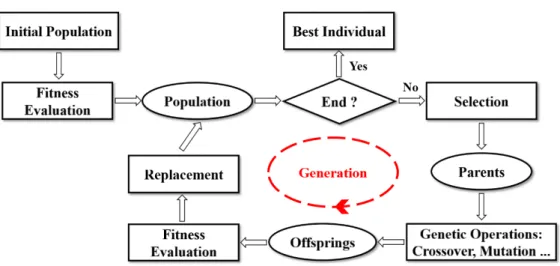
The term evolutionary computation is defined as a creative process inspired by evolu-tion in nature, a Darwinian evoluevolu-tionary system. It is highly suited to addressing real-world issues having a great complexity. EC techniques have been used by researchers to tackle numerous tasks, and it performs different roles, for example, searching for an optimal solution, automatic model design, and the learning of classifiers [12]. The EC approach has a number of attractive features, for instance producing readable outputs, evolving lightweight solutions and supplying a collection of solutions with different trade-offs amongst conflicting objectives [21]. Evolutionary computation has been ex-tensively studied. Variants of it were shown to offer an effective means to generate programs automatically. In general, an EC paradigm begins at producing an initial population including individuals that describe potential solutions to solve a particular problem. Then these individuals are evaluated to show how well each solves or comes near to solving the problem. The evolutionary cycle will continue until some termina-tion criterion is met. Figure 3.1 illustrates the scheme of an evolutermina-tionary process with its primary evolutionary operators.
Figure 3.1: The Evolutionary Cycle
Initialisation refers to the creation of the first population. The initial population cre-ated will have a significant impact on the result. It is often genercre-ated randomly, but techniques that use seeding have also been used (where the initial population members are generated by another suboptimal technique). Next the estimate of how effective the individual is at resolving the problem is captured by means of a fitness function. The main aim here is to optimise the fitness function which correlates with the adopted objectives.
The simulated evolutionary process seeks to evolve ever-fitter populations of candi-date solutions, using various operators inspired by biological metaphors for reproduc-tion and evolureproduc-tion, such as crossover, mutareproduc-tion, and selecreproduc-tion. Crossover is a binary operator that causes solutions to be ‘mated’: two individuals exchange solution com-ponents to form new ones, often referred to as ‘offspring’. This allows the possibility of offspring that combine the most effective features of each parent, with fitter offspring subsequently thriving under the survival of the fittest regime of Darwinian natural se-lection. (Equally, offspring combining poor traits of parents will be unlikely to survive). Mutationis a unary operator that causes some solution component to spontaneously mutate, allowing it to take on values that are potentially not possessed currently by any candidate solution in the population. Generally, each element of each individual may be mutated with some small probability. Finally, selection determines which so-lutions go forward to form the next generation of the population. This implements some form of the ‘survival of the fittest’ regime (fitter solutions have greater chances of going forward). By repeating the indicated cycle it is anticipated that later generations will have fitter individuals and hopefully the process will generate at least one that ‘solves’ the problem, or is otherwise acceptable (i.e. the solution is highly fit, but it is
![Figure 1.1: Number of Internet Users in the World over the Last Years [3]](https://thumb-us.123doks.com/thumbv2/123dok_us/9896579.2483213/19.892.227.718.146.481/figure-number-internet-users-world-years.webp)
![Figure 1.2: Number of New Software Vulnerabilities Reported per Year [8]](https://thumb-us.123doks.com/thumbv2/123dok_us/9896579.2483213/20.892.201.647.426.642/figure-number-new-software-vulnerabilities-reported-per-year.webp)
![Figure 2.2: Ambusaidi et al. Framework of the LS-SVM-based IDS [29]](https://thumb-us.123doks.com/thumbv2/123dok_us/9896579.2483213/33.892.160.793.453.637/figure-ambusaidi-et-framework-ls-svm-based-ids.webp)
![Figure 2.3: Rathore et al. IDS Architecture [9]](https://thumb-us.123doks.com/thumbv2/123dok_us/9896579.2483213/34.892.174.666.536.918/figure-rathore-et-al-ids-architecture.webp)
![Figure 2.4: Ensemble and Hybrid Models developed by Chebrolu et al. [31]](https://thumb-us.123doks.com/thumbv2/123dok_us/9896579.2483213/35.892.177.766.540.740/figure-ensemble-hybrid-models-developed-chebrolu-et-al.webp)
![Figure 2.6: Zainal et al. Ensemble Experimental workflow [34]](https://thumb-us.123doks.com/thumbv2/123dok_us/9896579.2483213/37.892.319.630.148.586/figure-zainal-al-ensemble-experimental-workflow.webp)
![Figure 2.7: Kamarudin et al. Ensemble Anomaly Detection Model [36]](https://thumb-us.123doks.com/thumbv2/123dok_us/9896579.2483213/38.892.209.629.556.921/figure-kamarudin-et-al-ensemble-anomaly-detection-model.webp)