Wright State University
Wright State University
CORE Scholar
CORE Scholar
Browse all Theses and Dissertations
Theses and Dissertations
2017
Semantics-based Summarization of Entities in Knowledge Graphs
Semantics-based Summarization of Entities in Knowledge Graphs
Kalpa Gunaratna
Wright State University
Follow this and additional works at: https://corescholar.libraries.wright.edu/etd_all Part of the Computer Engineering Commons, and the Computer Sciences Commons
Repository Citation
Repository Citation
Gunaratna, Kalpa, "Semantics-based Summarization of Entities in Knowledge Graphs" (2017). Browse all Theses and Dissertations. 1748.
https://corescholar.libraries.wright.edu/etd_all/1748
This Dissertation is brought to you for free and open access by the Theses and Dissertations at CORE Scholar. It has been accepted for inclusion in Browse all Theses and Dissertations by an authorized administrator of CORE Scholar. For more information, please contact [email protected].
Semantics-based Summarization of
Entities in Knowledge Graphs
A dissertation submitted in partial fulfillment of the requirements for the degree of
Doctor of Philosophy
By
Kalpa Gunaratna
B.Sc., University of Colombo, 2008
2017
WRIGHT STATE UNIVERSITY GRADUATE SCHOOL
April 19, 2017 I HEREBY RECOMMEND THAT THE DISSERTATION PREPARED UNDER MY
SUPER-VISION BYKalpa GunaratnaENTITLEDSemantics-based Summarization of Entities in
Knowledge GraphsBE ACCEPTED IN PARTIAL FULFILLMENT OF THE REQUIREMENTS
FOR THE DEGREE OFDoctor of Philosophy.
Amit Sheth, Ph.D. Dissertation Co-Director
Krishnaprasad Thirunarayan, Ph.D. Dissertation Co-Director
Michael Raymer, Ph.D.
Director, Computer Science and Engineering Ph.D. Program
Robert E.W. Fyffe, Ph.D.
Vice President for Research and Dean of the Graduate School
Committee on Final Examination
Amit Sheth, Ph.D.
Krishnaprasad Thirunarayan, Ph.D.
Keke Chen, Ph.D.
Gong Cheng, Ph.D.
Edward Curry, Ph.D.
ABSTRACT
Gunaratna, Kalpa. PhD, Department of Computer Science and Engineering, Wright State Univer-sity, 2017. Semantics-based Summarization of Entities in Knowledge Graphs.
The processing of structured and semi-structured content on the Web has been gaining attention with the rapid progress in the Linking Open Data project and the development of commercial knowl-edge graphs. Knowlknowl-edge graphs capture domain-specific or encyclopedic knowlknowl-edge in the form of a data layer and add rich and explicit semantics on top of the data layer to infer additional knowledge. The data layer of a knowledge graph represents entities and their descriptions. The semantic layer on top of the data layer is called the schema (ontology), where relationships of the entity descriptions, their classes, and the hierarchy of the relationships and classes are defined. Today, there exist large knowledge graphs in the research community (e.g., encyclopedic datasets like DBpedia and Yago) and corporate world (e.g., Google knowledge graph) that encapsulate a large amount of knowledge for human and machine consumption. Typically, they consist of millions of entities and billions of facts describing these entities. While it is good to have this much knowledge available on the Web for consumption, it leads to information overload, and hence proper summarization (and presentation) techniques need to be explored.
In this dissertation, we focus on creating both comprehensive andconcise entity summaries at: (i) the single entity level and (ii) the multiple entity level. To summarize a single entity, we propose a novel approach called FACeted Entity Summarization (FACES) that considers importance, which is computed by combining popularity and uniqueness, and diversity of facts getting selected for the summary. We first conceptually group facts using semantic expansion and hierarchical incremental clustering techniques and form facets (i.e., groupings) that go beyond syntactic similarity. Then we rank both the facts and facets using Information Retrieval (IR) ranking techniques to pick the
highest ranked facts from these facets for the summary. The important and unique contribution of this approach is that because of its generation of facets, it adds diversity into entity summaries, making them comprehensive. For creating multiple entity summaries, we propose RElatedness-based Multi-Entity Summarization (REMES) approach that simultaneously processes facts belonging to the given entities using combinatorial optimization techniques. In this process, we maximize diversity and importance of facts within each entity summary and relatedness of facts between the entity summaries. The proposed approach uniquely combines semantic expansion, graph-based relatedness, and combinatorial optimization techniques to generate relatedness-based multi-entity summaries.
Complementing the entity summarization approaches, we introduce a novel approach using light Natural Language Processing (NLP) techniques to enrich knowledge graphs by adding type se-mantics to literals. This makes datatype properties semantically rich compared to having only implementation types. As a result of the enrichment process, we could use both object and datatype properties in the entity summaries, which improves coverage. Moreover, the added type semantics can be useful in other applications like dataset profiling and data integration. We evaluate the proposed approaches against the state-of-the-art methods and highlight their capabilities for single and multiple entity summarization.
Contents
1 Introduction 1
1.1 Concepts of Entities, Knowledge Graphs, and Entity Summaries . . . 3
1.1.1 Entities and Knowledge Graphs . . . 4
1.1.2 Entity Summaries . . . 6
1.2 Challenges in Automatic Entity Summarization . . . 7
1.3 Why? and What? . . . 8
1.4 Thesis Statement . . . 9
1.5 Entity Summarization Framework (How?) and Dissertation Focus . . . 9
1.5.1 Single Entity Summarization . . . 10
1.5.1.1 Semantic Expansion . . . 11
1.5.1.2 Semantic Enrichment . . . 12
1.5.1.3 Conceptual Grouping . . . 12
1.5.1.4 Ranking and Faceted Entity Summary Creation . . . 13
1.5.2 Multi-Entity Summarization . . . 14
1.5.2.1 Relatedness and Ranking . . . 14
1.5.2.2 Optimization and Multi-Entity Summary Creation . . . 15
1.5.3 Dissertation Focus . . . 15
1.6 Dissertation Organization . . . 17
2 Background and Related Work 19
2.1 WWW, Semantic Web, and Knowledge Representation . . . 19
2.2 Entity Summarization . . . 24
2.2.1 Single Entity Summarization . . . 24
2.2.2 Multi-Entity Summarization . . . 27
3 Diversity-Aware Single Entity Summarization 29 3.1 Preliminaries . . . 31
3.2 Faceted Entity Summarization . . . 32
3.2.1 Partitioning Algorithm - Cobweb . . . 34
3.2.1.1 Cobweb . . . 34
3.2.2 Faceted Entity Summary Approach . . . 38
3.2.2.1 Partitioning the Feature Set - Creating Facets . . . 38
3.2.2.2 Ranking Features . . . 43
3.2.2.3 Faceted Entity Summary Creation . . . 44
3.3 Evaluation . . . 45
3.3.1 Evaluating with the Gold Standard . . . 47
3.3.2 Evaluating with User Preference . . . 49
3.4 Discussion . . . 49
3.5 Conclusion . . . 51
4 Typing Literals in RDF Triples for Improving Coverage of Features in Entity Summarization 52 4.1 Typing Literals in RDF Triples . . . 54
4.1.1 Object Property and Datatype Property . . . 54
4.1.2 Problem Analysis . . . 55
4.1.2.1 Problem Statement . . . 56
4.1.3 Type Generation for Literals . . . 57
4.1.4 Evaluating Type Generation for Datatype Property Values . . . 60
4.2 Incorporating Datatype Properties into Faceted Entity Summaries . . . 62
4.2.1 Problem Statement . . . 62
4.2.2 Grouping Datatype Property Features . . . 63
4.2.3 Ranking Datatype Property Features . . . 63
4.2.4 Faceted Entity Summaries using Object and Datatype Properties . . . 65
4.2.5 Evaluating Faceted Entity Summaries with Both Types of Properties . . . 66
4.3 Discussion . . . 68
4.4 Conclusion . . . 70
5 Relatedness-based Multi-Entity Summarization 71 5.1 Multi-Entity Summarization . . . 73
5.1.1 Problem Statement and Description . . . 73
5.1.2 Approach . . . 74
5.1.2.1 Selecting Features for an Entity . . . 74
5.1.2.2 Selecting Features for Multiple Entities . . . 75
5.1.2.3 Importance, Relatedness and Diversity . . . 77
5.2 Evaluation . . . 80
5.2.1 Implementation Details and Algorithm Settings . . . 80
5.2.2 Datasets and Evaluation Setting . . . 82
5.2.2.1 Qualitative Evaluation . . . 82
5.2.2.2 Quantitative Evaluation . . . 83
5.2.3 Discussion . . . 84
5.3 Conclusion . . . 85
6 Enrichment and Usage of Structured Knowledge - two use-cases 86
6.1 Identifying Equivalent Properties between Linked Datasets . . . 87
6.1.1 Related Work . . . 87
6.1.2 Approach . . . 89
6.1.2.1 Property Alignment between Datasets . . . 89
6.1.2.2 Resource Matching and Generating Property Alignments . . . 92
6.1.3 Evaluation . . . 98
6.1.4 Discussion . . . 103
6.1.5 Future Work and Conclusion . . . 105
6.2 Using Structured Knowledge for Document Similarity . . . 106
6.2.1 Related Work . . . 108
6.2.2 Approach . . . 108
6.2.3 Evaluation . . . 112
6.2.4 Discussion . . . 113
6.2.5 Future Work and Conclusion . . . 115
7 Conclusion and Future Work 117 7.1 Single Entity Summarization . . . 117
7.1.1 Future Work . . . 119
7.2 Multi-Entity Summarization . . . 119
7.2.1 Future Work . . . 120
Bibliography 121
List of Figures
1.1 Sample entity description of the entity Marie Curie. . . 4
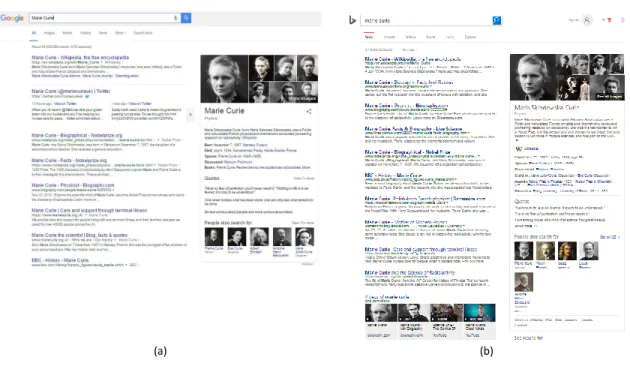
1.2 Entity summaries shown in (a) Google Search and (b) Bing Search, at the top right-hand corner of the search page. . . 6
1.3 Diversity-aware entity summarization framework for individual and multiple entities. 10 2.1 Rich Media Reference system in early 2000s for different domains. . . 21
2.2 Example triple and its RDF/Turtle representation. . . 21
2.3 LOD cloud diagram in 2017 (as of April). See http://lod-cloud.net/ for details. . . . 23
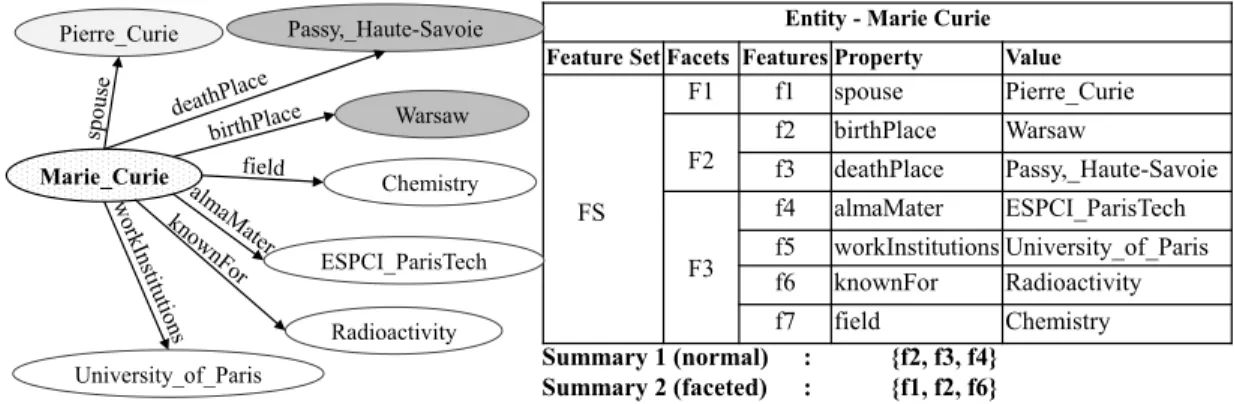
3.1 Facets of entity - Marie Curie. Values for conceptually similar features are in the same color pattern. . . 33
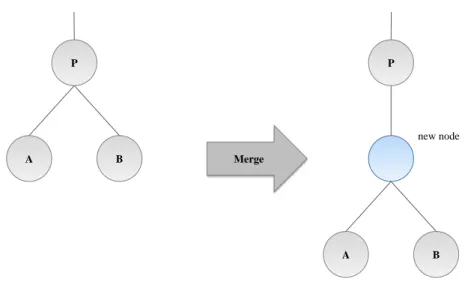
3.2 Merging in Cobweb. . . 37
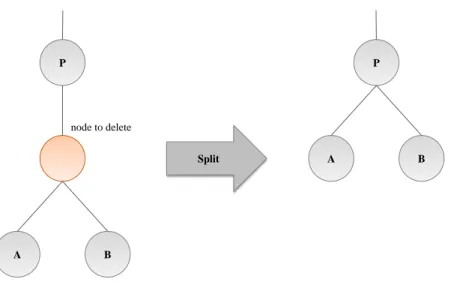
3.3 Splitting in Cobweb. . . 38
3.4 Feature expansion using WordNet and type information. . . 42
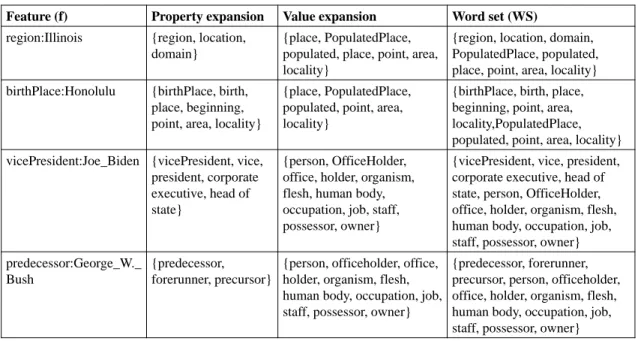
3.5 Flow of steps in creating faceted entity summaries. . . 44
3.6 Entity summaries for the entity Marie Curie by each system. k = 5 and the size of feature set is 39. . . 50
4.1 An object and datatype property instances for the entity Barack Obama in DBpedia. dbo, dbp, and dbr represent http://dbpedia.org/ontology, http://dbpedia.org/property, and http://dbpedia.org/resource namespaces, respectively. . . 55
4.2 Two triples corresponding to datatype properties and one triple corresponding to an object property taken from DBpedia. Computed types are shown in dashed boxes. dbo, dbp, and dbr represent http://dbpedia.org/ontology, http://dbpedia.org/property,
and http://dbpedia.org/resource namespaces, respectively. . . 56
4.3 Grouping both property features. dbo:birthPlace and dbp:vicePresident are object properties anddbp:shortDescriptionis a datatype property. dbo, dbp, and dbr repre-sent http://dbpedia.org/ontology, http://dbpedia.org/property, and http://dbpedia.org/resource namespaces, respectively. . . 64
5.1 Entity summaries maximizing relatedness between them for a news item from Wikinews corpus. . . 72
5.2 Example entity summaries for two entities . . . 84
6.1 Process of Candidate Matching. Matching resources are in the same color/pattern. . 92
6.2 Property matching with overlapping sets of resources . . . 93
6.3 CalculatingMatchCount andCo-appearanceCount values . . . 95
6.4 Precision, Recall and F measures for varyingαvalues . . . 100
6.5 Overview of the approach. . . 109
6.6 Jaccard similarity computation example for two concepts. . . 110
6.7 predication - predication similarity computation example for two predicates. . . 111
6.8 Results against the PubMed related citation gold standard using top n documents. . 113
List of Tables
1.1 Statistics of some known knowledge graphs . . . 5
3.1 Cobweb operations . . . 39
3.2 Evaluation of the summary quality and FACES %↑ = 100 * (FACES avg. quality - Other system’s avg. quality) / (Other system’s avg. quality) fork=5 and k=10, respectively, and average time taken per entity fork=5 for Evaluation 1. Evaluation 2 measures user preference % for each system. (NA stands for Not Applicable) . . . 48
4.1 Types generated for a sample of values. . . 60
4.2 Type generation evaluation. DBpedia Spotlight is used as the baseline system. . . . 61
4.3 Evaluation of the summary quality (average for 80 entities) and %↑= 100 * (FACES-E avg. quality - Other system avg. quality) / (Other system avg. quality) for k=5 andk=10, wherekis the summary length. . . 67
5.1 Evaluating system summaries using questionnaire. . . 81
5.2 Average coherency of different models . . . 82
6.1 Alignment results of object properties. Experiments are numbered 1 to 5. . . 99
6.2 Sample of matching properties under different categories. namespaces: db for DBpe-dia and fb for Freebase. . . 102
ACKNOWLEDGEMENTS
I would like to acknowledge and thank my advisers Prof. Amit Sheth and Prof. Krishnaprasad Thirunarayan. I remember the day I first contacted Prof. Sheth with my ambition to join the Ohio Center of Excellence in Knowledge-enabled Computing (Kno.e.sis) at Wright State University. From the very first day, Prof. Sheth demanded high quality outcomes which led to the successful completion of my PhD. He often reminded me the importance of taking the initiative and par-ticipating in activities and professional services that go beyond my focused research (to overcome the unfair advantage of the others) to compete with the best in the world. Organizing SumPre workshop series at ESWC conference, doing high quality internships, participating in hackathons, and serving in program committees are some of them. In fact, I decided to join Kno.e.sis for my graduate studies mainly because of Prof. Sheth’s experience and excellence in the field and world class achievements of Kno.e.sis students. Prof. Sheth was patient with me during the early days of my PhD and supported me by providing the necessary resources, a nurturing ecosystem, and with his vast knowledge, experience, and time. With Prof. Sheth’s initiation, I started working closely with Prof. Krishnaprasad Thirunarayan (a.k.a Prof. T.K. Prasad) after joining Kno.e.sis who later became my co-adviser. I must say that I thoroughly enjoyed exchanging ideas with Prof. Prasad and am thankful for all the hard work he put into improving my technical and soft skills. Prof. Prasad was always there to discuss research ideas and technical details related to my research problems. I have fond memories of spending hours with him discussing last minute edits when we submitted manuscripts for publication. His guidance in technical writing and algorithmic analysis greatly helped me to develop myself over the years.
I would like to thank Prof. Gong Cheng, Dr. Edward Curry, Dr. Hamid Motahari, and Dr. Olivier Bodenreider for their sincere support. Prof. Gong Cheng is an expert in the area of Semantic
Web and summarization and I learned a lot collaborating with him. He possesses excellent technical and theoretical knowledge and guided me in getting high quality research publications. Dr. Edward Curry was my mentor during my first internship. I enjoyed working with him and I believe he influenced and motivated me in my early days in the PhD program to work hard and to never give up. Dr. Hamid Motahari was my mentor during my last internship and I am thankful to him for giving me the opportunity to work on a real-world enterprise research problem. He helped me to improve my self-confidence in doing research. Dr. Olivier Bodenreider was my mentor during my second internship and I am glad that I had the opportunity to work with him. He taught me how to think about a research problem and gave me the freedom to do research in line with my interests, which helped me to start growing as an independent researcher.
I am grateful for all the love and encouragement from my wife Ronali Gunaratna and daughter Katelyn Gunaratna, my parents Susil Gunaratna and Shirani Gunaratna, my sister Nishadi Fernando and her family, my wife’s parents Ravi Perera, Belinda Perera, and brother in-law Ryan Perera, and all the cousins. They helped me overcome many tough situations over the years.
I would also like to acknowledge several influential people who helped, guided, and advised me along this journey towards achieving a PhD. I thank Dr. Gamini Palihawadana for motivating, encouraging, and supporting me in many ways over the years. Special thanks to Prasantha War-nakula, Palitha Perera, Anil Jayawardena, Kithsiri Perera, Rose Gunaratna, Gamini Ratnayake, Rohan Wijesinghe, Amaradasa Kodikara, and Leslie Silva.
I enjoyed exchanging research ideas, life experiences, and jokes with my colleagues at Kno.e.sis over the years. The list is too long to mention each and every one of them. I want to thank Tonya Davis, administrative assistant at Kno.e.sis for the support over the years. My special thanks to Dr. Ajith Ranabahu for helping me out when I first joined Kno.e.sis in many ways, from providing lodging to being a close friend and looking after me. He was also my first mentor in my PhD program. I would also like to mention Dr. Thilina Gunarathne who helped me in finding a good graduate program. I also thank the Sri Lankan community in Dayton Ohio for providing me a home
away from home and Dr. Shiral Fernando, Dr. Anil Fernando, and their families for always being there for us.
This dissertation is based upon work supported by the National Science Foundation (NSF) and National Institute of Health (NIH). NSF provided support through Grant No. 1143717 III:
EAGER Expressive Scalable Querying over Linked Open Data, and Grant No. EAR 1520870:
Hazard-SEES:Social and Physical Sensing Enabled Decision Support for Disaster Management and Response. NIMH of the NIH provided support under award number R01MH105384-01A1. Any opinions, findings, and conclusions or recommendations expressed in this material are those of the author(s) and do not necessarily reflect the views of the NSF or NIH.
Dedicated to
my parents, Susil and Shirani Gunaratna for their love and sacrifices
my lovely wife Ronali Gunaratna for her endless support and our little daughter Katelyn Gunaratna for bringing us endless joy in life!
1
Introduction
Publishing structured machine readable data on the Web for wide-scale use has been gaining at-tention in the recent past mainly due to the introduction of the Linking Open Data initiative and set of principles called Linked Data Principles [Berners-Lee 2006] that encouraged data publication and re-use. Following these guidelines, people and communities have created the Linked Open Data (LOD) cloud1. The LOD cloud consists of datasets that are inter-linked and have Uniform Resource Identifiers (URIs) to represent resources that can be dereferenced. It has grown from 295 datasets in 2011 to 1146 datasets in 2017 (as of January), which is also accessible online. Some of these datasets are encyclopedic knowledge graphs, like DBpedia [Lehmann et al. 2015], and domain specific, like LinkedMDB [Hassanzadeh and Consens 2009] for movies and LinkedGeoData [Auer et al. 2009] for geographic locations. We refer to a dataset as a knowledge graph in this dissertation when its rep-resentation is rich with semantics and additional knowledge. Semantics are introduced by adding a rich schema on top of the data level of the dataset. Further, a good schema is important in modeling concepts (classes) and relationships between them, which in turn facilitates making inferences from the data level of the knowledge graphs. Therefore, knowledge graphs can help machines understand and process data intelligently. In addition to the growth in the number of datasets in LOD, the content in some of the datasets has also evolved significantly over time. For example, in 2007
DB-1http://lod-cloud.net/, accessed 04/10/2017
2 pedia English version 2.0 describes 1.95 million entities, whereas in 2016 DBpedia English version 2016-04 describes 6 million entities2. Further, the number of facts describing each resource has also increased, providing more information to data consumers.
In the enterprise environment, knowledge graphs are becoming increasingly popular in modeling and representing world knowledge that in turn can make commercial applications more intelligent. The earliest efforts in this direction came with the rise of the Semantic Web technologies. The concept of creating a rich dataset (what we refer to as knowledge graph now) was proposed in the implementation efforts of Taalee system [Sheth et al. 2001]. They built a knowledge graph combining “WorldModel” (definitional component as the ontology) and knowledge base (assertional component as the data layer) to capture knowledge on the Web to support semantic search and faceted information presentation to the users. This was termed as “Rich Media Reference” [Sheth et al. 2002]3. Since the early inception of these ideas, Google Knowledge Graph [Singhal 2012] and
Bing Satori [Qian 2013] have emerged as two of the prominent commercial knowledge graphs to facilitate Google search4and Bing search5respectively on a massive scale. When Google Knowledge
Graph was in the initial stages, it had around 570 million entities and 18 billion facts6. Knowledge
graph creation is supervised by human experts and involves much manual effort to ensure high quality but recently there have been efforts like Google Knowledge Vault [Dong et al. 2014] that automate this process at commercial scale but its success is doubtful as of today. There are also different kinds of knowledge graphs that serve specific purposes. For example, Amazon’s product graph facilitates product search on Amazon, and Facebook’s social graph captures social network details to improve interactions among its users. In this dissertation, we focus on processing data on the knowledge graphs (like DBpedia and Google knowledge graphs) that contain facts describing
2http://wiki.dbpedia.org/dbpedia-version-2016-04, accessed 04/10/2017 3This idea is similar to Google search summary box information presentation. 4https://www.google.com/, accessed 04/10/2017
5http://www.bing.com/, accessed 04/10/2017
6http://insidesearch.blogspot.com/2012/12/get-smarter-answers-from-knowledge_4.html, accessed
1.1. CONCEPTS OF ENTITIES, KNOWLEDGE GRAPHS, AND ENTITY SUMMARIES 3 entities for general purpose consumption. Note that the techniques we discuss here are not restricted to general purpose or encyclopedic knowledge graphs.
Human consumption of structured data published on the Web (e.g., DBpedia) or stored in pro-prietary storage facilities (e.g., Bing Satori) as knowledge graphs is hard due to their large volume (i.e., information overload). For example, on average, DBpedia 2016-04 version has over 200 facts describing each entity. Processing this much information for quick understanding of a entity for a human user is very inefficient and impractical. Therefore, a better representation mechanism is required. Generating summaries is a method that has been used for many years by the linguists to address this issue. Merriam-Webster dictionary7 defines a summary as“using few words to give the most important information about something”. Summarization is the process of producing sum-maries. Text summarization8has been widely used in the digital context (Web documents) as well as printed formats to provide quick insights of the documents by retrieving popular and important topics [Jones 2007; Gambhir and Gupta 2017]. Similarly, summaries for entities in knowledge graphs can facilitate quick understanding of them without the need to look at their complete descriptions. Summaries are short (i.e., concise) but they may not always be comprehensive. When facts selected in a summary are diverse, comprehensiveness of length-limited summaries is improved. We introduce two diversity-aware summarization approaches in two different settings. The first applies to the processing of individual entities and the second to the processing of collections of entities.
1.1
Concepts of Entities, Knowledge Graphs, and Entity
Sum-maries
We introduce the terms entity, knowledge graph, and entity summary in the following sections. 7http://www.merriam-webster.com/dictionary/summary, accessed 04/10/2017
1.1. CONCEPTS OF ENTITIES, KNOWLEDGE GRAPHS, AND ENTITY SUMMARIES 4 Pierre_Curie Warsaw Passy,_Haute-Savoie ESPCI_ParisTech University_of_Paris Radioactivity Chemistry Birt h Plac e KnownFor Marie_Curie property value
Figure 1.1: Sample entity description of the entity Marie Curie.
1.1.1
Entities and Knowledge Graphs
Entities refer to real-world things and they can be described using facts. Hence, capturing entity descriptions in a machine readable format enables machines to process and understand the world. See Figure 1.1 for an example that shows a subset of facts of the entity description for the entity Marie Curie taken from DBpedia. An entity description comprises facts (referred to asfeatures) describing the entity, and each fact is made up of a property-value pair. A property is the relationship that describes the connection of the entity to the value. For simplicity, all the values shown in Figure 1.1 are entities, whereas they can also be literals. Entities are useful in many applications of today’s data-rich world like answering search queries and understanding documents by analyzing entities and their relationships. Specifically, complex questions can be answered by analyzing the graph structure of the entities in the knowledge graph and inferring new knowledge. Google expressed this capability by stating “Things but not Strings” [Singhal 2012]. By mapping strings (literals) into entities when appropriate, machines can better understand and relate to the content in an application since each entity has its own description to compare against others9. Along this line,
Schema.org project was initiated by major search engine companies (including Google, Microsoft, 9http://searchengineland.com/future-seo-understanding-entity-search-172997, accessed 04/10/2017
1.1. CONCEPTS OF ENTITIES, KNOWLEDGE GRAPHS, AND ENTITY SUMMARIES 5 Knowledge Graph # Entity Types # Entity Instances # Relation Types # Facts
Google Knowledge Graph 1,500 570M 35,000 18,000M
Freebase 1,500 40M 35,000 637M
YAGO2 350,000 9.8M 100 4M
NELL 271 5.19M 306 0.435M
DBpedia (2016-04-English) 754 6M 2,711 1,300M
Table 1.1: Statistics of some known knowledge graphs taken from [Dong et al. 2014] and DBpedia statistics10.
and Yahoo) to improve visibility of Web document content by annotating entities with their types using Schema.org taxonomy.
Knowledge graphs consist of large number of entities, their descriptions, and the relationships among them at the data level. There is a schema level on top of the data level to add semantics for the knowledge graphs where concepts (classes that the entities belong) and relationships (to connect entities with information) are defined. The number of entities and facts in a knowledge graph can be in the millions and billions, respectively, and Table 1.1 presents statistics of some of the popular knowledge graphs on the Web. The statistics, except for DBpedia, are taken from [Dong et al. 2014]. In today’s digital and knowledge-empowered world, knowledge graphs play a significant role in making computers smart and intelligent. For example, the search engines Google and Bing use their respective knowledge graphs to answer entity-related user queries and interact with the users. Moreover, comprehensive knowledge graphs act as connecting hubs for online data publishing. For example, DBpedia is an encyclopedic dataset and a knowledge graph created by extracting facts from Wikipedia11that acts as a central hub in the LOD cloud. Many datasets have links going into and coming out of DBpedia that make it a search entry point for many datasets on LOD.
1.1. CONCEPTS OF ENTITIES, KNOWLEDGE GRAPHS, AND ENTITY SUMMARIES 6
(a) (b)
Figure 1.2: Entity summaries shown in (a) Google Search and (b) Bing Search, at the top right-hand corner of the search page.
1.1.2
Entity Summaries
[Cheng et al. 2011] defined an entity summary as a selected subset of features of the original entity description. Creating entity summaries out of their descriptions in the knowledge graphs is a well motivated task. For example, Google identified the importance and significance of entity summaries and considers it high priority in their knowledge graph building effort [Singhal 2012].
Entity summaries are important for quick understanding and analysis of content. The modern Web search task is one such obvious example use case. For example, consider Figure 1.2 which shows screenshots taken from Google Search and Bing Search when searching for the entity Marie Curie. We can see the summary generated for Marie Curie by Google in Figure 1.2 (a) and Bing in Figure 1.2 (b), where the purpose is to help the user understand and verify the information need, without going through a lengthy entity description. Further, entity summaries can be helpful in facilitating certain technical tasks like entity linking, where summaries assist human users in
1.2. CHALLENGES IN AUTOMATIC ENTITY SUMMARIZATION 7 selecting the correct entity from a knowledge graph to link to an entity label in document content by analyzing only the summary [Cheng et al. 2015b].
1.2
Challenges in Automatic Entity Summarization
Automatically generating entity summaries from the entity descriptions has its own challenges. The most challenging problem is the selection of important features for a given summary length constraint. This can also be positioned as a personalization problem, but in this dissertation our main focus is on general purpose entity summary creation. That is, how to create entity summaries for the entire population of users. In fact, personalization can be applied as an add-on to the summarization approach by modifying the ranking algorithms.
The problem of selecting a subset of features as the entity summary can be positioned as a ranking problem where top-k features can be selected as the summary. But, in practice, a pure ranking algorithm can be less effective because ranking alone cannot determine what kinds of features are selected for the summary. For example, consider a two feature summary for an entity listing
birthplace anddeathplacesimply because the ranking algorithm ranked them higher than the others (e.g., they are more popular). In this case, we refer to this entity summary as less diverse. We could argue that diversity introduces comprehensiveness to the summary as it tries to provide a complete overview of the entity given the length constraint of the summary.
Adding diversity to entity summarization is challenging as we are referring to something that goes beyond analyzing syntactic dissimilarities. To achieve this kind of intelligence, we can look for semantics present in the knowledge graphs (schema level) and external knowledge sources. For example, entities are normally associated with type semantics. That is, an entity can be assigned a concept (an ontology class) as its type (e.g., the entity Barack Obama is typed as a Politician in DBpedia). But sometimes, a value in the entity description can be a literal (e.g., string). In this case, there is no explicit semantics associated with the value, and hence it is difficult to process them
1.3. WHY? AND WHAT? 8 intelligently. To bridge this gap, knowledge enrichment can be performed by computing semantic types (ontology classes) of the literals where applicable.
On the other hand, processing multiple entities to create entity summaries is non-trivial because: (i) there is more than one entity to consider in selecting features for the summaries and (ii) the objectives we want to achieve (diversity, relatedness, uniqueness, etc.) need to be satisfied for more than one entity at the same time (multiple constraints). For example, we would like to have diversity within an entity summary but relatedness among the summaries for the entire collection of entities. To satisfy these somewhat competing objectives, we need to employ techniques that can handle more than one entity at a time at different granularity (intra-entity vs. inter-entity).
In this dissertation, we present an intelligent framework to generate diversified entity summaries that have the qualities of conciseness and comprehensiveness considering individual entities and collections of entities.
1.3
Why? and What?
We discuss the importance of entity summarization and what we propose in this context briefly.
Why?
• Creating summaries has been the go-to method in conveying important information in less time and has practical value. For example, document summaries provide a quick glance of the content before a user can explore them. Entity descriptions, similar to web documents or text, are lengthy and hence require concise presentation.
• Entity summarization problem cannot be fulfilled by just “reusing” techniques proposed in In-formation Retrieval (IR) or Artificial Intelligence (AI) to handle related problems like document summarization and ranking. Entities are similar and also different in many ways to Web docu-ments or text. Hence, challenges in (i) processing, (ii) analyzing, and (iii) computing them need
1.4. THESIS STATEMENT 9 to be addressed in new or complementary ways.
• Entities and their descriptions (can) capture world knowledge and are important for modeling world and human knowledge. Summarizing them to help specific tasks (e.g., resource linking) or general purpose content understanding (e.g., web search assistance) is necessary in the modern world.
What?
• We propose methods to create entity summaries that preserve “conciseness” and “comprehen-siveness” (through diversity). Being concise provides quick processing of features and compre-hensiveness provides better coverage of features.
• We generate entity summaries for single and multiple (collection of) entities.
1.4
Thesis Statement
Entity related structured data on the Web can be concisely and comprehensively summarized for efficient and convenient information presentation. This can be achieved through synergistic use of: (i) Unsupervised knowledge-based methods to conceptually group, (ii) Information Retrieval-based techniques to intuitively rank, (iii) Natural Language Processing techniques to semantically enrich structured data, and (iv) Combinatorial optimization techniques to handle relatedness of multiple entities.
1.5
Entity Summarization Framework (How?) and
Disserta-tion Focus
We propose a diversity-aware entity summarization framework for individual entities and a collection of entities. In the individual entity summarization process, entities are processed in isolation to create
1.5. ENTITY SUMMARIZATION FRAMEWORK (HOW?) AND DISSERTATION FOCUS 10 Semantic Expansion Semantic Enrichment Ranking Semantic Relatedness Conceptual Grouping
Ranking and Summary Creation Single Entity Description FACES Approach
User applications and engagements Schema
Knowledge Lexical Database
Multiple Entity Descriptions
Combinatorial Optimization &
Multi-entity Summary Creation REMES Approach
Figure 1.3: Diversity-aware entity summarization framework for individual and multiple entities.
summaries by picking diverse and important features. In contrast, the multiple entity summarization process considers a collection of entities as a whole to create entity summaries that prefers diversity within each entity summary and related features between the entity summaries. Figure 1.3 shows an overview of the two process flows. These two approaches are briefly described below.
1.5.1
Single Entity Summarization
We propose FACeted Entity Summarization (FACES) approach to create single entity summaries (entities are processed in isolation). First, we apply semantic expansion and enrichment processing steps to property-value pairs, and then partition them into conceptually similar groups. Finally, a faceted entity summary is created using the groups. Semantic expansion is the process that adds additional data semantics, and semantic enrichment process adds missing semantics to the data to make them usable. For semantic expansion and semantic enrichment, we make use of machine readable knowledge.
1.5. ENTITY SUMMARIZATION FRAMEWORK (HOW?) AND DISSERTATION FOCUS 11
Machine Readable Knowledge
Knowledge is modeled in various ways that is processable by machines. Ontologies and lexical databases are two such resources that we use in our framework. An ontology captures general or domain-specific knowledge and represents them in a machine readable and community agreed form. Gruber et al. defined an ontology as “an explicit specification of a conceptualization” [Gruber et al. 1993] and later evolved with the term “ontological commitment” to refer to community agreement. Modeling ontologies and knowledge need special attention and there exist formal languages for this purpose. Resource Description Framework (RDF) [Manola et al. 2004], RDF-Schema (RDFS) [Brick-ley and Guha 2004], and Web Ontology Language (OWL) [Dean et al. 2004] are such knowledge representation languages listed in increasing order of their expressiveness.
Apart from ontologies, Natural Language Processing (NLP) communities have created lexical databases that capture the semantics of words such as, synonyms, antonyms, hypenyms, and hy-ponyms. These resources are helpful in enabling machines to understand document content by analyzing word semantics. For example, machines can identify two words that have the same mean-ing by determinmean-ing whether they are synonyms or have similar hypernyms. WordNet [Miller et al. 1990] is a widely used lexical database that captures the semantics of words. We use WordNet to get abstract terms (hypernyms) for words in our framework.
1.5.1.1 Semantic Expansion
We employ a partitioning algorithm to understand conceptually similar groups in our framework, and for the algorithm to achieve good results, features need to be semantically expanded for improved agreement among them. The expansion can be performed in many different ways, and for our problem space, we need the features in each part (group) of the partition to agree at an abstract level. For example, entities related to cities, countries, and regions should be grouped together because they all are spatially related. To achieve this kind of similarity among items within a particular part in the partition, we follow the following two steps: (1) extract the type information
1.5. ENTITY SUMMARIZATION FRAMEWORK (HOW?) AND DISSERTATION FOCUS 12 of the entities from schema knowledge in the knowledge graph and (2) expand tokens for each feature using hypernyms extracted from the WordNet lexical database.
Type information provide some level of semantic agreement between features (from entities men-tioned in the features), but are not sufficient to achieve our objective. Type information are the ontology classes assigned to entities as their semantic type. For example, Marie Curie can be typed as a “Scientist” where Scientist is a class (concept) in the ontology (schema knowledge). Expanding these terms further, by extracting super classes from the ontology and using hypernyms retrieved from a lexical database like WordNet, we can improve the quality of the partition. In addition to taking types of the entities (value of the feature), we take tokens of the property of the feature and expand them using WordNet to get input from the relationship part of the feature. Recall that a feature is comprised of a property and a value (see Figure 1.1).
1.5.1.2 Semantic Enrichment
The values of entity descriptions can be entities or literals. When they are entities, their semantics can be represented using type information and machines can process this knowledge and get to know what ontology class they belong to. This leads to machine understanding of the data. But for literals, there is no such knowledge, except the primary implementation types assigned to them like “string”. “Incomplete” semantics lead to more syntactic treatment. Therefore, we propose a method to compute types for literals in knowledge graphs where possible, to enable richer semantic processing capabilities. To achieve this goal, we utilize NLP techniques and knowledge available at the schema level (ontology).
1.5.1.3 Conceptual Grouping
After features are semantically expanded and enriched, this step tries to create groups that go beyond syntactic similarity. One challenge in this process is that the number of groups that features belong to an entity cannot be determined a priori. Therefore, unsupervised techniques in finding
1.5. ENTITY SUMMARIZATION FRAMEWORK (HOW?) AND DISSERTATION FOCUS 13 these groups have been explored and hierarchical clustering algorithms work best in these scenarios. Further, in grouping features, we would like the features in a group to be more semantically similar. Cobweb [Fisher 1987] is an incremental and hierarchical clustering algorithm that works with probability distributions. That is, if more similar things are grouped together, other similar items to come tend to be grouped into the same group. This behavior is explained as “conceptual clustering” and Gennari et al. [Gennari et al. 1989] argue that this is similar to human judgment in grouping items. Further, Cobweb provides the additional benefit of being incremental. The hierarchical clustering approaches generate dendrograms (tree structures) that we can get the partitions from by pruning at desired levels. Since the Cobweb algorithm works on a probability function, having a good distribution of attribute-value pairs for each item to be partitioned helps it to have good quality partitions. In our problem, we make use of the semantic expansion process to compensate for this. We adapt the Cobweb algorithm to conceptually group features for each entity with the use of semantic expansion and enrichment.
1.5.1.4 Ranking and Faceted Entity Summary Creation
The conceptual grouping component creates a partition for all the features for a given entity. Each part in this partition represents semantically different features. Finally, creating faceted (i.e., di-versified) entity summaries consist of two steps: (1) ranking features and groups and (2) picking features from different groups to create the entity summary.
Instead of employing just a ranking mechanism, our approach creates a partition for the features of an entity and then applies a ranking mechanism to select features from the partition. We rank fea-tures within each group and based on the ranking of the feafea-tures, we also rank groups. The primary building block of the ranking process is the ranking measure for each feature. For this purpose, we combine informativeness and popularity measures inspired by tf-idf measure12. Informativeness is similar to idf (inverse document frequency) and popularity is similar to tf (term frequency).
1.5. ENTITY SUMMARIZATION FRAMEWORK (HOW?) AND DISSERTATION FOCUS 14 ically, we would like each feature (property and value together) to be informative and the value to be popular.
Features are ranked within each group based on this tf-idf based score and groups are ranked accordingly based on scores of the features. Finally, faceted entity summary creation is the process of picking top ranked features from each group.
1.5.2
Multi-Entity Summarization
The main focus of the FACES approach is to generate “concise” and “comprehensive” entity sum-maries and it processes one entity at a time (in isolation). While FACES shows superior entity summary quality compared to the state-of-the-art systems, it cannot process a collection of entities maximizing relatedness of inter-entity features in entity summaries. An entity summary created by analyzing the other entities of interest is important to capture commonality among the entities. This can help the user to get a better understanding of the entire collection of entities. We proposed RElatedness-based Multi-Entity Summarization (REMES) approach to address this problem. A brief overview of REMES process is discussed below.
1.5.2.1 Relatedness and Ranking
In REMES, we try to maximize intra-entity diversity and inter-entity relatedness, in addition to trying to find important features for the summaries. To achieve these objectives, we measure pairwise feature relatedness and individual importance of the features.
For relatedness measures between feature pairs, we utilize a combination of graph-based re-latedness measure called RDF2Vec [Ristoski and Paulheim 2016] applied on values and a Jaccard co-efficient computed on properties after applying the semantic expansion described in the earlier section. Further, the importance of a feature is measured using the tf-idf ranking score described earlier.
1.5. ENTITY SUMMARIZATION FRAMEWORK (HOW?) AND DISSERTATION FOCUS 15
1.5.2.2 Optimization and Multi-Entity Summary Creation
Compared to single entity summary creation, multi-entity summary creation is computationally expensive because the algorithm has to process multiple entities at the same time to pick related features between entities. We map the Quadratic Knapsack Problem (QKP) [Gallo et al. 1980] with multiple constraints (one knapsack per entity) to generate these summaries. To compute a solution for this problem, we utilize a greedy optimization algorithm called the Greedy Randomized Adaptive Search Procedure (GRASP) [Yang et al. 2013]. More details on this optimization process are discussed later in the dissertation. Then, the computation of entity summaries for the entity collection is achieved by satisfying the knapsacks allocated to each entity in the algorithm. The size of each knapsack is the desired summary length for the entity.
1.5.3
Dissertation Focus
In this dissertation, our primary focus is on how to create concise and comprehensive entity sum-maries for single and multiple entities. Comprehensiveness is achieved by having diversity in the features that get selected for the summaries. In the multi-entity summarization approach, in addi-tion to selecting diverse and important features for each summary, the relatedness among different summaries is also valued.
Main Contributions
Our main technical contributions with regards to entity summarization are as follows.
1. We present an algorithm to conceptually group features in individual entity descriptions in order to introduce diversity in selecting features for the summary. Each group in the entity description represents a unique latent dimension.
2. We enhance the grouping capabilities of features by semantically expanding them using a lexical database and schema knowledge. This makes the features in each group not only syntactically
1.5. ENTITY SUMMARIZATION FRAMEWORK (HOW?) AND DISSERTATION FOCUS 16 similar but also semantically related.
3. We introduce a method to enrich knowledge graphs by adding type semantics to literals and demonstrate that such enrichment is useful in practice by offering entity summarization as a use case.
4. We propose a simple and effective ranking mechanism similar to tf-idf to rank features in entity descriptions.
5. We propose a diversity-aware entity summarization approach for individual entities that com-bines semantic expansion and enrichment, grouping, and ranking mechanisms.
6. We measure the relatedness of two features by computing their property similarity using semantic expansion and value relatedness using graph-based co-appearance measures.
7. We propose a relatedness-based multi-entity summarizataion approach that maximizes the re-latedness of features between different entity summaries and diversity of features within each entity summary. To efficiently solve this, we adapt a greedy solution for the Quadratic Multidi-mensional Knapsack Problem (QMKP).
Other Contributions
In this dissertation, we explore two additional applications related to entities, entity summarization and knowledge graphs. The first is on how to align equivalent relationships between linked datasets, which is helpful in integrating and summarizing heterogeneous entities across datasets. The second is demonstrating the value of using extracted entities and their descriptions (knowledge from text) in performing a computing task of measuring similarity between the original sources where the entities are extracted.
• Grouping equivalence relations: We propose a statistics-based method to identify equivalence relationships between linked datasets. Equivalence membership is a strict grouping criteria that we explore in this use case.
1.6. DISSERTATION ORGANIZATION 17
• Ranking documents based on similarity: We propose a method to use knowledge (entities and their descriptions) extracted from documents (in the form of knowledge graphs) to measure inter-document similarity to rank documents for a given document.
1.6
Dissertation Organization
The rest of the dissertation is organized into chapters.
Chapter 2, presents background on World Wide Web (WWW), knowledge representation and Semantic Web, and discuss related literature for entity summarization.
Chapter 3, discusses the FACES approach for generating bothconcise andcomprehensive entity summaries. It introduces the concepts of semantic expansion, conceptual grouping, ranking, and faceted entity summary creation. Entity descriptions can contain both object and datatype proper-ties and, in this chapter, we focus on object property-based entity summarization. We present an evaluation of the system against the state-of-the-art approaches, and discuss the results, focusing on diversity-aware entity summarization (FACES system).
Chapter 4, introduces our semantic enrichment approach that can assign an ontology class as the type (referred to as typing) to a literal in an RDF triple. This process is directly related to the semantic enrichment component in the FACES framework. We device an approach that analyzes the focus of the entire literal and entities present in picking the correct type for the literal. We show the usefulness of such an enrichment process by taking up the entity summarization use case.
Chapter 5, presents the REMES approach for computing intra-entity diversity and inter-entity relatedness-based multi-entity summarization. We present methods for combing graph-based and se-mantic expansion-based relatedness measures. We adapt the Quadratic Multidimensional Knapsack Problem to solve the problem and present an evaluation of the approach against the state-of-the-art standalone entity summarization techniques.
struc-1.6. DISSERTATION ORGANIZATION 18 tured knowledge. We propose an approach to find equivalent relationships between datasets and an approach to compute (and rank) document similarity utilizing structured knowledge.
Chapter 7, summarizes the key insights of the contributions presented in the dissertation and discusses future directions.
2
Background and Related Work
2.1
WWW, Semantic Web, and Knowledge Representation
The World Wide Web (WWW or Web for short) was initiated more than twenty five years ago in 1989 by Sir Tim Berners-Lee with his innovative idea to connect remote computers over the Internet to access documents scattered over different machines [Berners-Lee 1989]. Over the years, the Web has made tremendous progress in serving that need and currently has around 50 billion documents (Web pages) indexed by popular Web search engines [Web-Statistics 2017]. Tim Berners-Lee’s original idea to combine hypertext with the Internet used three component technologies:
• Uniform Document Identifier (UDI) to uniquely identify a document which later became as Uniform Resource Identifier (URI).
– Subsequent extension to this is called Internationalized Resource Identifier (IRI) which can include unicode characters whereas URI can only contain ASCII characters1.
• Web publishing markup language called Hypertext Markup Language (HTML).
• Hypertext Transfer Protocol (HTTP) for communication between machines. 1https://www.w3.org/2004/11/uri-iri-pressrelease, Accessed 04/10/2017
2.1. WWW, SEMANTIC WEB, AND KNOWLEDGE REPRESENTATION 20 While WWW has been a real success, it lacked the ability to represent semantics of the content explicitly to enable the machines to understand the content.
The Semantic Web and Knowledge Representation
The Semantic Web [Berners-Lee et al. 1999; Sheth 2000; Berners-Lee et al. 2001; Antoniou and Van Harmelen 2004; Hitzler et al. 2009; Sheth and Thirunarayan 2012] is an extension of the WWW to allow more meaningful sharing and exchange of data using knowledge representation languages like RDF. The World Wide Web Consortium (W3C), the organization that defines the standards for the Web, envisions Semantic Web [Semantic-Web 2017] as “the Web of linked data and Semantic Web technologies as enabling people to create data stores on the Web, build vocabularies, and write rules for handling data.” In 2001, Berners-Lee et al. [Berners-Lee et al. 2001] expressed the idea of evolving Web into Semantic Web by highlighting the term “ontology” 2. Even before the term
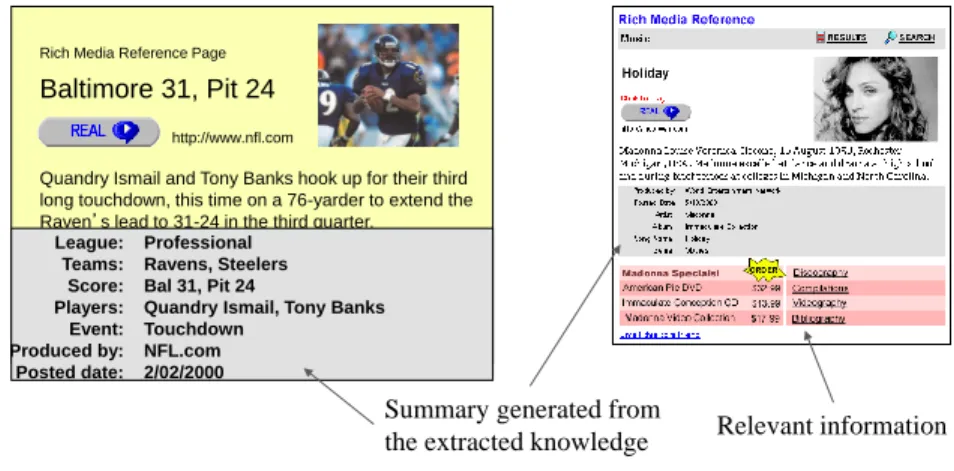
“Semantic Web” became popular with Tim Berners-Lee’s 2001 publication, there are early efforts that made use of ontology-based Web data integration, search, and querying in the mid-to-late 1990s such as Observer [Mena et al. 1996], InfoHarness [Shah and Sheth 1999], VideoAnywhere [Sheth et al. 1999], and MediaAnywhere search [Sheth et al. 2001]. Before the wide-scale use of entity summaries in regular Web search engines as in Google and Bing (showed in Figure 1.2), the “Rich Media Reference” system [Sheth et al. 2002] in early 2000s demonstrated the idea of providing a snapshot (i.e., summary) of the entity being searched. This system used an underlying ontology (also called WorldModelTM) and extracted data from Web documents (termed as creating a knowledgebase at
that time) and these two components collectively formed a knowledge graph. Figure 2.1 shows an output of the system at that time.
Capturing and representing knowledge in terms of ontologies, taxonomies, vocabularies, and datasets can be achieved using formal knowledge representation languages such as first order logic, logic programming languages, and more tractable fragments such as RDF [Manola et al. 2004],
2.1. WWW, SEMANTIC WEB, AND KNOWLEDGE REPRESENTATION 21 Rich Media Reference Page
Baltimore 31, Pit 24
http://www.nfl.com
Quandry Ismail and Tony Banks hook up for their third long touchdown, this time on a 76-yarder to extend the Raven’s lead to 31-24 in the third quarter.
Professional Ravens, Steelers Bal 31, Pit 24
Quandry Ismail, Tony Banks Touchdown NFL.com 2/02/2000 League: Teams: Score: Players: Event: Produced by: Posted date:
Summary generated from
the extracted knowledge Relevant information
Figure 2.1: Rich Media Reference system in early 2000s for different domains.
dbr:Marie_Curie rdf:type dbo:Person
RDF/Turtle syntax of the triple
@prefix rdf: <http://www.w3.org/1999/02/22-rdf-syntax-ns#> . @prefix dbr: <http://dbpedia.org/resource/> .
@prefix dbo: <http://dbpedia.org/ontology/> .
dbr:Marie_Curie rdf:type dbo:Person .
Subject Predicate Object
Figure 2.2: Example triple and its RDF/Turtle representation.
RDFS [Brickley and Guha 2004], and OWL [Dean et al. 2004]. The formal knowledge representation languages such as RDF and RDFS represent sentences in the form of “triples”. A triple consists of a “Subject”, a “Predicate”, and an “Object”. Figure 2.2 shows an example triple and its RDF/Turtle representation. Turtle is the simplest syntax for RDF (and easier to understand) and RDF/XML is the XML embodiment (that is more suitable for machine processing).
Linked Data
The focus of Semantic Web now is to create a Web of Linked Data where anybody can publish data on the Web linked to other data sources [Semantic-Web 2017]. The inter-linking of datasets helps
2.1. WWW, SEMANTIC WEB, AND KNOWLEDGE REPRESENTATION 22 discover new knowledge/information and complement datasets. Tim Berners-Lee introduced the concept of Linked Data in 2006 to realize this vision [Berners-Lee 2006] highlighting a set of best practice rules. The rules are as follows.
1. Use URIs as names for things.
2. Use HTTP URIs so that people can look up those names.
3. When someone looks up a URI, provide useful information, using the standards (RDF, SPARQL).
4. Include links to other URIs. so that they can discover more things.
Following these best practice rules, people started publishing datasets on the Web linking to other datasets mainly using rdf:sameAs at the data level (i.e., connecting entities). This resulted in the LOD cloud shown in Figure 2.3. The LOD cloud consists of interconnected domain specific and domain independent as well as encyclopedic datasets creating a huge knowledge repository, which is impossible to create by a single governing authority. These huge number of interconnected datasets on the Web are used to query [Joshi et al. 2012; Freitas et al. 2012; Freitas and Curry 2014; Freitas et al. 2015] and align [Gunaratna et al. 2014] to support user applications. Data compression techniques have also been explored to handle volume of the data [Joshi et al. 2013] and graph summarization approaches have been explored to provide a quick snapshot of the entire graph [Cheng et al. 2016].
The datasets on LOD are open to changes and continue to grow in size [Auer et al. 2013]. The number of entities and also features per entity have increased over time and become lengthy for human processing (and also for machine in some tasks). For example, DBpedia 2016-04 English version has about 6 million entities described in 1.3 billion triples. On average, it lists around 200 features per entity and there arises the necessity to summarize these features depending on the application. For example, a selected subset of the features of an entity can be shown to a user in answering a Web search query (see Figure 1.2).
2.1. WWW, SEMANTIC WEB, AND KNOWLEDGE REPRESENTATION 23
2.2. ENTITY SUMMARIZATION 24
2.2
Entity Summarization
Entity summarization is the task of selecting/formulating a subset of features from an entity descrip-tion to describe the entity. Summarizadescrip-tion task can be categorized as extractive or non-extractive. Extractive summaries choose a subset of the features for the summary whereas non-extractive sum-maries include reformulation of the extracted facts. In this dissertation, we focus on extractive methods for entity summarization. A different categorization to this is summarizing entity descrip-tions for a specific task or for general consumption. For example, entity summaries can help perform a specific task like Entity Linking (EL) and Entity Resolution (ER). Entity Linking [Hachey et al. 2013] is the task of assigning an entity taken from a knowledge graph to an entity mention in the text whereas entity resolution is to determine whether two or more entity descriptions refer to the same real world entity. [Cheng et al. 2015b] and [Cheng et al. 2015a] handles the tasks of entity linking and entity resolution using entity summaries, respectively. We present methods in creating entity summaries for general purpose consumption as we encounter entity summaries in search (e.g., Google search and Bing search). We further breakdown our methods in two different granularity levels: (i) single entity summary generation and (ii) multiple entity summary generation. Chap-ter 3 and ChapChap-ter 4 focus on single entity summarization and ChapChap-ter 5 presents an approach for multi-entity summarization.
2.2.1
Single Entity Summarization
In this section, we focus on systems and approaches that generate single entity summaries.
Entity Summarization Methods and Ranking Algorithms
[Cheng et al. 2011] introduced and defined the problem of entity summarization in RDF graphs and showed its usefulness in quick identification of an entity. Their system, called RELIN, generalizes the PageRank algorithm to select both related and informative features. The problem with RELIN’s
2.2. ENTITY SUMMARIZATION 25 random surfer, which selects both related and informative features, is that it tends to emphasize central themes and similar and correlated features of an entity because of the centrality based ranking mechanism of the PageRank algorithm. SUMMARUM [Thalhammer and Rettinger 2014] is an entity summarization system for DBpedia that is also based on PageRank and utilizes the global popularity of resources gleaned with the help of information from the corresponding Wikipedia pages. LinkSum [Thalhammer et al. 2016] is an approach that makes use of PageRank for ranking and also link structure of entities in Wikipedia to select facts for entity summaries. [Thalhammer et al. 2012] proposed an approach that utilizes usage data for creating entity summaries and evaluated it in the movie domain using user ratings for movies. Such an approach is hard to generalize because usage data may not be readily available for entities. [Yan et al. 2016] pursued an effort to incorporate context in generating entity summaries by mining query logs. In the recent past, workshops (SumPre at ESWC) 3 and challenges [Gunaratna et al. 2016] have been organized to support the efforts in
the area.
Ranking in the Semantic Web is closely related to entity summarization as the latter task can be perceived as selecting the topk features from an RDF graph. Various ranking algorithms exist in the literature for RDF graphs including TripleRank [Franz et al. 2009] that ranks triples, SemRank [Anyanwu et al. 2005] that ranks associations or paths, [Ding et al. 2005] rank documents, and TRank [Tonon et al. 2013] that ranks concepts. These approaches incorporate ranking algorithms for different reasons. For example, TripleRank [Franz et al. 2009] groups triples using tensors and link analysis. TripleRank’s goal is to rank and identify authoritative sources for a given entity.
Proposed Approach
We propose FACES [Gunaratna et al. 2015], which conceptually groups features of an entity (to add diversity in the summary) and then ranks features based on tf-idf based ranking scheme to pick features for the entity summary. The facet or latent grouping concept that we introduce in
2.2. ENTITY SUMMARIZATION 26 FACES is different from facets in TripleRank as TripleRank’s grouping is based on authority whereas FACES’s is based on semantic overlap of the expanded terms of the features. Also, [Cheng et al. 2011] pointed out that it is hard to align the TripleRank approach to the entity summarization problem but its authoritative ranking is similar to RELIN where centrality dominates. Grouping in RDF datasets has been investigated in upper level ontology creation [Zhao and Ichise 2012] and property alignment [Gunaratna et al. 2013], but these groupings are different from what we explore in FACES. We findconceptually similargroups (explained later) that are not just related (i.e., object value overlap of RDF triples) [Zhao and Ichise 2012] or equivalent [Gunaratna et al. 2013] groups.
Instead, diversity has been shown to be useful in creating graphical entity summarization [Sydow et al. 2013], which is different from entity summarization as it produces a graph (includes neighboring entities) rather than a set of features. They pick ‘lexicographically different’ property names to achieve diversity in the summary using syntactic measures (e.g., birthPlace and deathPlace are different in their context) whereas FACES groups them together (i.e., going beyond string similarity). Further, FACES differs from the existing entity summarization and ranking systems in that it creates both concise and comprehensive summaries. We hypothesize that diversity provides a more complete picture of the entity (i.e., comprehensiveness) when subjected to length constraint (i.e., conciseness).
Improving Type Semantics and Entity Summarization
Type assignment to text fragments is known as Named Entity Recognition (NER) [Nadeau and Sekine 2007]. NER consists of two subtasks: (i) segmenting and (ii) classifying segmented text blocks into pre-defined categories (types). NER produces types for segments of the input text whereas EL identifies entities from which types can be inferred. Finding missing types for entities [Paulheim and Bizer 2013; Sleeman and Finin 2013] is important for the reliability of datasets and reasoning. [Paulheim and Bizer 2013] infer types for entities in DBpedia and [Sleeman and Finin 2013] predict types of entities for efficient co-reference resolution. TRank [Tonon et al. 2013] ranks entity types based on the context in which they appear (disambiguation). [Fang et al. 2010] use type
2.2. ENTITY SUMMARIZATION 27 information for search, and [Tylenda et al. 2011] generate summaries by analyzing type graphs. The diversity-aware FACES approach proposed for single entity summarization requires type semantics for the values of the features to conceptually group them. Hence, it is applicable only to object property-based features.
Proposed Approach
We propose FACES-E [Gunaratna et al. 2016], which includes a typing module to compute semantic types for literals in datatype-based property values. The type computation tries to carefully select the proper type for the literal based on special processing that identifies the focus of the term. Then FACES-E utilizes both object and datatype property-based features to create comprehensive and concise entity summaries. Further, FACES-E extends FACES approach by ranking facets in selecting the entity summaries. NER and EL, however, differ from our problem in that they do not try to suggest a type based on the focus of the text but rather try to determine the types of all the entities present, causing ambiguity from the perspective of our problem (e.g., as illustrated using our evaluation with DBpedia Spotlight [Mendes et al. 2011]). Also, the approaches mentioned above work on entities and/or object properties or infer types for entities, whereas we focus on typing datatype properties where no semantic types are readily available.
2.2.2
Multi-Entity Summarization
Entity summaries have been shown to be effective in performing specific tasks (supporting human effort) like Entity Linking [Cheng et al. 2015b] and Entity Resolution [Cheng et al. 2015a; Xu et al. 2014]. Unlike previously mentioned entity summarization approaches above, these consider more than one entity simultaneously in creating summaries. Multi-entity summarization is a fairly new topic in this area and hence it is at the early stage of making progress. These approaches generate multi-entity summaries for specific tasks and we propose an approach to generate general purpose multi-entity summarization approach based on relatedness.
2.2. ENTITY SUMMARIZATION 28
Proposed Approach
We propose REMES [Gunaratna et al. 2017] to generate muti-entity summaries by capturing intra-entity diversity and importance like some of the single intra-entity summarization methods (e.g., FACES and FACES-E) and inter-entity relatedness of features. We enforce selecting diverse features for each entity and related features among entities.
3
Diversity-Aware Single Entity
Summarization
The entity descriptions in the datasets published online as LOD evolve over time [Auer et al. 2013] and grow in size. For example, DBpedia [Lehmann et al. 2015] is a very large and central dataset in the LOD cloud extracted from Wikipedia. The DBpedia English version 3.9 has 4 million entities described in 470 million RDF triples (facts) and current English version 2016-04 has 6 million entities described in 1.3 billion RDF triples, averaging over 100 and 200 triples per entity, respectively. This amount of information is too much for the quick assimilation of essential information about an entity for a user. Therefore, selecting a small subset of the original triples associated with an entity as a summary is necessary for quick/convenient identification/access of entity-related information. This problem has been calledEntity Summarization [Cheng et al. 2011] in the literature.
Entity summarization is a challenging task, like the well-established field of document summa-rization. Document summarization [Nenkova and McKeown 2012; Mani 2001] has been a topic of interest for data mining and information retrieval communities. Though entity summarization and document summarization are conceptually similar tasks, they differ in the nature of features, the techniques to use, and the structure of the content. Documents are unstructured with significant
30 textual content, so word frequency can be used to glean the essence and used in summarizing their content. For example, frequent words are good candidates for inclusion in a summary of a document. In contrast, entities are structured and do not have frequent word appearances (no duplicates most of the time). Therefore, techniques adopted for document summarization do not always carry over to entity summarization.
Many entity summarization approaches focus more or solely on centrality measures (including popularity) and ranking measures to generate entity summaries. For example, [Cheng et al. 2011; Thalhammer and Rettinger 2014] use a variation of PageRank algorithm to rank features and then pick the topkfeatures for the summary. But we hypothesize that centrality measures and ranking mechanisms alone are not sufficient to improve the quality of entity summaries. Rather, the added use of orthogonal semantic groups of features to diversify the summaries can be effective. To investi-gate our hypothesis, we propose theFACetedEntitySummarization (FACES) approach [Gunaratna et al. 2015]. Our contributions in FACES are two fold:
1. We identify conceptually similar groups of features of an RDF entity by adapting and modifying an incremental hierarchical conceptual clustering algorithm called Cobweb [Fisher 1987] and introduce an algorithm to rank features within a group.
2. We combine three dimensions: diversity, popularity, and uniqueness, to create human friendly entity summaries in a time efficient manner.
Moreover, FACES has other distinct characteristics compared to the existing state-of-the-art entity summarization tools. They are as follows.
• It selects features considering diversity which eliminates redundancy (by filtering similar fea-tures).
• It is dynamic as it is less sensitive to the order of input features and is robust with regards to evolving features (thus applicable in streaming contexts).

![Table 1.1: Statistics of some known knowledge graphs taken from [Dong et al. 2014] and DBpedia statistics 10 .](https://thumb-us.123doks.com/thumbv2/123dok_us/9902586.2483623/21.918.230.745.150.410/table-statistics-known-knowledge-graphs-taken-dbpedia-statistics.webp)