04 August 2020
POLITECNICO DI TORINO
Repository ISTITUZIONALE
Text-based Sentiment Analysis and Music Emotion Recognition / Cano, Erion. - (2018 Jun 06). Original
Text-based Sentiment Analysis and Music Emotion Recognition
Publisher: Published DOI:10.6092/polito/porto/2709436 Terms of use: openAccess Publisher copyright
(Article begins on next page)
This article is made available under terms and conditions as specified in the corresponding bibliographic description in the repository
Availability:
This version is available at: 11583/2709436 since: 2018-06-09T08:41:59Z Politecnico di Torino
Doctoral Dissertation
Doctoral Program in Computer and Control Engineering (30thcycle)
Text-based Sentiment Analysis and
Music Emotion Recognition
By
Erion Çano
******
Supervisor(s):
Prof. Maurizio Morisio
Doctoral Examination Committee:
Prof. Bart Dhoedt,Referee, Ghent University, Belgium Prof. Loïc Barrault,Referee, Le Mans University, France Prof. Rosa Meo,External Member, University of Turin, Italy Prof. Fulvio Corno,Internal Member, Politecnico di Torino, Italy Prof. Marco Torchiano,Internal Member, Politecnico di Torino, Italy
Politecnico di Torino 2018
Declaration
I hereby declare that the contents and organization of this dissertation constitute my own original work and does not compromise in any way the rights of third parties, including those relating to the security of personal data.
Erion Çano 2018
* This dissertation is presented in partial fulfillment of the requirements forPh.D. degreein the Graduate School of Politecnico di Torino (ScuDo). It is licensed under the Creative Commons Attribution-NonCommercial-NoDerivatives 4.0 International License. Please visithttps://creativecommons.org/licenses/by-nc-nd/4.0/to view a copy of this license.
Acknowledgements
This thesis ends a very important journey of my life and is a result of hard work, profound commitment as well as support from many people I wish to thank. My deepest gratitude goes to my parents who have loved and supported me uncondi-tionally during all these years of my long education. I am thankful to Politecnico di Torino for believing in me, for their generous support and comfortable working environment. Special thanks go to my supervisor, Prof. Maurizio Morisio for his continuous guidance throughout my research work. I had the opportunity to learn a lot from his long experience. Furthermore, the freedom he gave me in conducting research strengthened my self-confidence and motivation.
I could not forget to express my gratitude to my SoftEng group colleagues, Prof. Marco Torchiano, Luca Ardito, Oscar Rodriguez, Cristhian Figueroa, Iacopo Vagliano, Mohammad Rashid, Riccardo Coppola, and Diego Monti, for their valuable suggestions and collaboration. I am also highly thankful to Ihtesham Ul Islam, Andrea Martina, Amirhosein Toosi, Francesco Strada, Alysson Dos Santos as well as the other LAB 1 colleagues and friends for the multicultural and pleasant atmosphere they created and shared during these years.
Sincere thanks go to TIM (formerly Telecom Italia) for the financial support of my research. I highly appreciate the collaborative and creative work I conducted within their JOL MobiLab, in cooperation with wonderful people like Marco Marengo, Lucia Longo, Eleonora Gargiulo, Mirko Rinaldini, Luisa Rocca, Lucia Laferla and Martina Francesconi. I finally thank the HPC@POLITO team for providing their high-performance computing infrastructure which fulfilled the heavy computational requirements of my experimental activity.
Abstract
Nowadays, with the expansion of social media, large amounts of user-generated texts like tweets, blog posts or product reviews are shared online. Sentiment polarity analysis of such texts has become highly attractive and is utilized in recommender systems, market predictions, business intelligence and more. We also witness deep learning techniques becoming top performers on those types of tasks. There are however several problems that need to be solved for efficient use of deep neural networks on text mining and text polarity analysis.
First of all, deep neural networks are data hungry. They need to be fed with datasets that are big in size, cleaned and preprocessed as well as properly labeled. Second, the modern natural language processing concept of word embeddings as a dense and distributed text feature representation solves sparsity and dimensionality problems of the traditional bag-of-words model. Still, there are various uncertainties regarding the use of word vectors: should they be generated from the same dataset that is used to train the model or it is better to source them from big and popular collections that work as generic text feature representations? Third, it is not easy for practitioners to find a simple and highly effective deep learning setup for various document lengths and types. Recurrent neural networks are weak with longer texts and optimal convolution-pooling combinations are not easily conceived. It is thus convenient to have generic neural network architectures that are effective and can adapt to various texts, encapsulating much of design complexity.
This thesis addresses the above problems to provide methodological and practical insights for utilizing neural networks on sentiment analysis of texts and achieving state of the art results. Regarding the first problem, the effectiveness of various crowdsourcing alternatives is explored and two medium-sized and emotion-labeled song datasets are created utilizing social tags. One of the research interests of Tele-com Italia was the exploration of relations between music emotional stimulation and
vi
driving style. Consequently, a context-aware music recommender system that aims to enhance driving comfort and safety was also designed. To address the second problem, a series of experiments with large text collections of various contents and domains were conducted. Word embeddings of different parameters were exercised and results revealed that their quality is influenced (mostly but not only) by the size of texts they were created from. When working with small text datasets, it is thus important to source word features from popular and generic word embedding collections. Regarding the third problem, a series of experiments involving convo-lutional and max-pooling neural layers were conducted. Various patterns relating text properties and network parameters with optimal classification accuracy were observed. Combining convolutions of words, bigrams, and trigrams with regional max-pooling layers in a couple of stacks produced the best results. The derived architecture achieves competitive performance on sentiment polarity analysis of movie, business and product reviews.
Given that labeled data are becoming the bottleneck of the current deep learning systems, a future research direction could be the exploration of various data pro-gramming possibilities for constructing even bigger labeled datasets. Investigation of feature-level or decision-level ensemble techniques in the context of deep neural networks could also be fruitful. Different feature types do usually represent com-plementary characteristics of data. Combining word embedding and traditional text features or utilizing recurrent networks on document splits and then aggregating the predictions could further increase prediction accuracy of such models.
Contents
List of Figures xi
List of Tables xiii
1 Introduction 1
2 Background 5
2.1 Sentiment Analysis Concepts and Definitions . . . 6
2.2 Exponential Online Data Explosion . . . 7
2.3 Sentiment Analysis Techniques and Applications . . . 10
2.4 Machine and Deep Learning Expansion . . . 12
2.4.1 Early Mileston Developments . . . 12
2.4.2 From Logic to Data . . . 13
2.4.3 Current Hype of Deep Learning . . . 14
2.4.4 From n-grams to Neural Language Models . . . 15
2.4.5 Word Embeddings for Text Representation . . . 17
2.4.6 Deep Learning Applications and Achievements . . . 18
2.5 Hunger for Labeled Data . . . 19
3 Emotions in Music 22 3.1 Music and Emotions . . . 23
viii Contents
3.1.1 Music Emotions: Concepts and Definitions . . . 23
3.1.2 Models of Music Emotions . . . 25
3.1.3 Sentiment Analysis of Songs . . . 27
3.2 Crowdsourcing Song Emotions . . . 29
3.3 Creating Song Datasets from Social Tags . . . 32
3.3.1 Existing Song Emotion Datasets . . . 32
3.3.2 Folksonomy of Emotion Tags . . . 33
3.3.3 Data Processing and Annotation . . . 36
3.4 Music Data Programming via Lexicons . . . 39
4 Mood-Aware Music Recommenders 43 4.1 Recommender Systems . . . 44
4.1.1 Introduction and Early History . . . 44
4.1.2 Basic Recommendation Techniques . . . 45
4.1.3 Experimentation Datasets . . . 47
4.2 Hybrid and Context-Aware Recommender Systems . . . 48
4.2.1 Hybrid Recommenders: Review Methodology . . . 48
4.2.2 Hybrid Recommenders: Review Results . . . 51
4.2.3 Context-Aware Recommenders . . . 52
4.3 Mood-based On-Car Music Recommendations . . . 54
4.3.1 System Prerequisites . . . 54
4.3.2 System Architecture . . . 55
4.3.3 Recommender and Mobile Application . . . 57
5 Distributed Word Representations 59 5.1 Word Representation Models . . . 60
Contents ix
5.2.1 Continuous Bag of Words . . . 61
5.2.2 Skip-Gram . . . 62
5.2.3 Glove . . . 63
5.2.4 Paragraph Vectors . . . 63
5.3 Performance of Word Embeddings on Sentiment Analysis Tasks . . 64
5.3.1 Word embedding models and corpora . . . 64
5.3.2 Sentiment Analysis Tasks . . . 66
5.3.3 Results and Conclusions . . . 67
6 Sentiment Analysis via Convolution Neural Networks 72 6.1 Neural Network Types for Text Analysis . . . 73
6.2 Data Processing and Statistics . . . 76
6.2.1 Experimental Datasets . . . 76
6.2.2 Preprocessing and Statistics . . . 77
6.3 Experimental Setup . . . 78
6.3.1 Representation of Words . . . 78
6.3.2 Data-driven Experimentation Networks . . . 79
6.4 Results and Discussion . . . 81
7 A Neural Network Architecture for Sentiment Analysis Prototyping 84 7.1 Popular Neural Network Architectures . . . 85
7.2 Neural Architecture Design Alternatives . . . 87
7.2.1 NgramCNN Basic Architecture . . . 87
7.2.2 NgramCNN Pyramid Architecture . . . 87
7.2.3 NgramCNN Fluctuating Architecture . . . 89
7.3 Experimental Settings and Baselines . . . 90
x Contents
7.3.2 Baseline Models . . . 91
7.4 Results and Discussion . . . 92
7.4.1 Sentiment Polarity Classification Results . . . 92
7.4.2 Further Observations . . . 93
7.4.3 Concluding Remarks . . . 94
8 Conclusions and Prospects 96
References 100
List of Figures
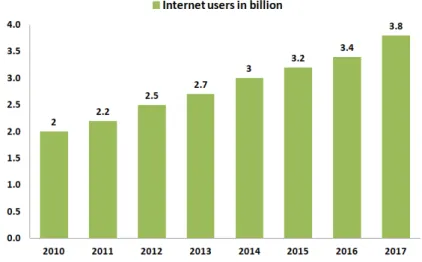
2.1 Tendency of Internet users in the last years . . . 8
2.2 Tendency of Internet websites in the last years . . . 9
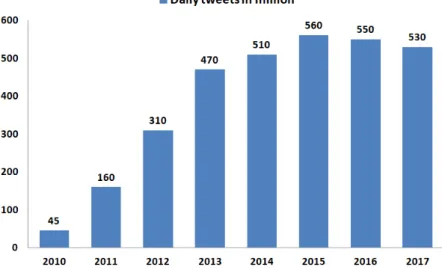
2.3 Tendency of daily tweets in the last years . . . 9
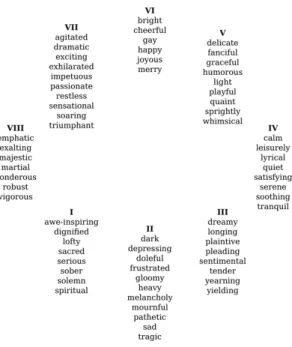
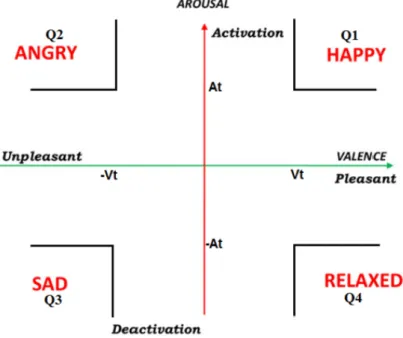
3.1 Model of Russell . . . 25
3.2 Model of Hevner . . . 26
3.3 Adopted model of tag emotion categories . . . 34
3.4 Intra-cluster similarity of tags . . . 35
3.5 Inter-cluster similarity of tags . . . 36
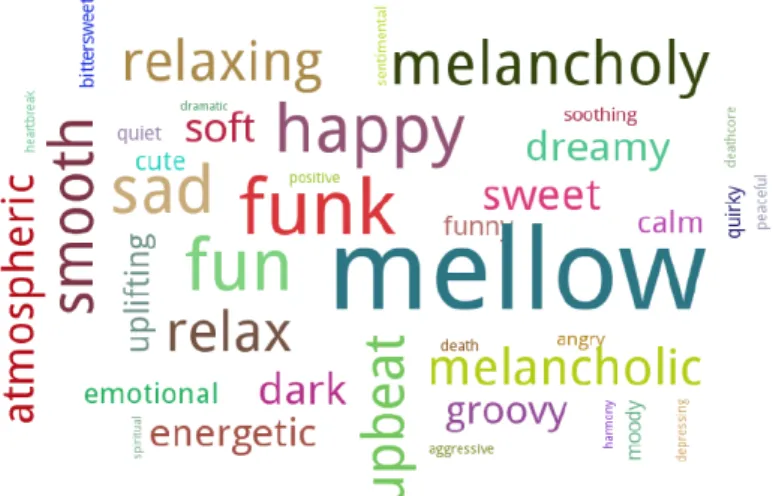
3.6 Word frequency cloud of mood tags . . . 37
3.7 Planar model for emotion categories of texts . . . 40
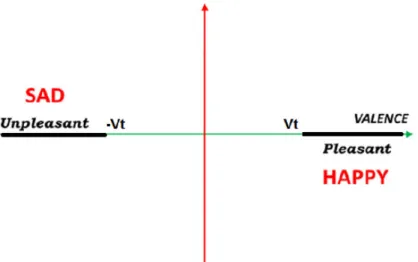
3.8 Planar model for emotion polarity of texts . . . 41
4.1 Holistic view of the system . . . 56
4.2 Iterface of song recommendations . . . 57
4.3 Interface of mobile application . . . 58
5.1 CBOW and Skip-Gram neural architectures . . . 62
5.2 Lyric accuracies on A628 . . . 68
5.3 Lyric accuracies on ML3K . . . 68
xii List of Figures
5.5 Review accuracies on MR50K . . . 68
6.1 Simple convolution-pooling network for image recognition . . . 73
6.2 Illustration of a 2x2 max-pooling operation . . . 74
6.3 Matrix representation of a short sentence . . . 79
6.4 Basic neural network structure . . . 80
6.5 Size-length distribution of training datasets . . . 81
7.1 NgramCNN architecture scheme . . . 88
7.2 NgramCNN with downsampling convolutions . . . 89
List of Tables
3.1 Mirex emotion clusters . . . 25
3.2 Four clusters of tag terms . . . 35
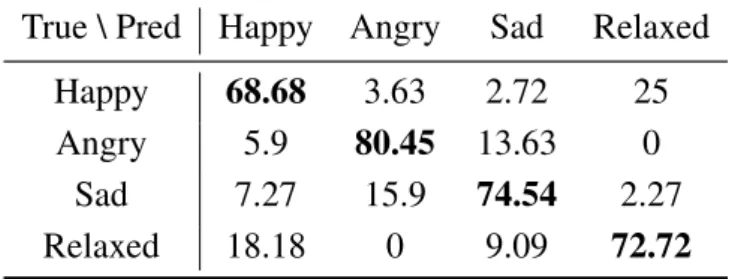
3.3 Confusion matrix between A771 and ML4Q datasets . . . 38
3.4 Confusion matrix of lexicon-generated song labels . . . 42
5.1 List of word embedding corpora . . . 65
5.2 Google News compared with Common Crawl . . . 69
5.3 Properties of self_w2v models . . . 70
5.4 crawl_42 compared with crawl_840 . . . 70
6.1 Document length statistics for each dataset . . . 77
6.2 Accuracies of top five network structures . . . 82
7.1 Accuracy scores of NgramCNN variants and baselines . . . 93
A.1 Digital libraries inquired for primary studies . . . 113
A.2 Inclusion and exclusion criteria for filtering papers . . . 113
A.3 Final list of selected papers . . . 114
A.4 Questions for quality assessment . . . 117
Chapter 1
Introduction
Social networks and the Internet have increased our communication capabilities to the point that everyone with a connected device can be read or heard worldwide. Sharing opinions about politics, sport, brands or products in social networks is now a cultural trend. Consumers are especially inclined to share or consult online opinions about products they have bought or are willing to buy. On the other hand, companies are motivated to find innovative ways for getting benefit using opinion data that are daily posted online. In fact, marketing statistics suggest that 81% of shoppers conduct online research before making big purchases and 92% of marketers consider social media to be important for their business.1
Sentiment Analysis (SA) is considered as the process of computationally iden-tifying and categorizing opinions expressed in a piece of text, especially in order to determine whether the writer’s attitude towards a particular topic or product is
positive,negative, orneutral.2 In other words, it is a set of techniques and prac-tices for automatic identification of sentiment polarity in texts. From the business perspective, analyzing opinions of clients is essential for several reasons, such as improve product or service quality, measure and improve the success of marketing campaigns, determine or adjust marketing strategy, etc. Sentiment analysis results are in fact widely used as a component of recommendation engines that generate advertisements for online users in many websites.
1https://www.hubspot.com/marketing-statistics
2 Introduction
Back in the early 2000s, text polarity was mostly analyzed starting from words or phrases and going up to entire document. Creating lexicons of affect terms and using them to infer word polarity was a common practice [1, 2]. Later on, the popularization of the web, social networks, and cloud services lured users to give more and more feedback on a daily basis. User opinions about different types of items come in various ways. Besides text posts or comments, social tags have become very popular as well, especially as an instrument for performing sentiment analysis of songs. They are basically single word descriptors like “rock”, “sweet” or “awsome” that express users’ opinion for a certain song or another object type. Tags ofLast.fm
(an online radio station and web platform for music listening with open API) were frequently used in various Music Emotion Recognition (MER) research papers [3, 4]. At the same time, the rising popularity of microblogs that are rich in user opinions, motivated many researchers to create datasets of emotionally labeled texts. As a result, focus gradually shifted from unsupervised to supervised learning methods for performing SA. This trend was also propelled by the development of highly effective machine or deep learning techniques and the popularization of high-level libraries or frameworks for using them.
Neural networks offer wide applicability and are able to automate feature ex-traction and selection in many domains and tasks. The release of powerful graphics processing units for scientific computing enhanced quick training and usability of deep neural networks for heavy tasks such as language modeling for predicting word combinations. One of the first neural language models was proposed by Bengio et
al.in 2003 [5]. Simpler and easier to train models were proposed in the following years. Huge and increasing amounts of text started to be used for training them and generating word feature representations also known as word vectors or embeddings. These word features offer significant advantages over the traditional bag-of-words text representation such as density, reduced dimensionality, preserved semantic rela-tions between words, etc. Word embeddings and neural networks started to be used as classification features on several text mining tasks.
This thesis addresses current problems in sentiment analysis of music and differ-ent types of texts, such as movie reviews, product reviews, etc. A particular interest of Telecom Italia was the exploration of social tags and other crowdsourcing alter-natives for creating emotionally labeled song datasets of considerable size. Those datasets form the basis for music emotion recognition, music recommender systems, and other relevant applications. Quality assessment and effectiveness of word
em-3
beddings on sentiment analysis tasks was another concern. Utilizing different types of neural network layers for text feature generation, feature selection, and sentiment prediction is not straightforward. To reach the desired performance, a high number and type of hyperparameters need to be tuned. The last part of the thesis addresses the possibility of encapsulating such complexity in a network architecture that can be used to quickly prototype accurate models for sentiment analysis. In brief, the research questions we pose are the following:
RQ1 Are affect tags of songs and other crowdsourcing alternatives applicable to music emotion recognition or music emotion dataset creation?
RQ2 What effect do training method, corpus size, corpus topic, and other charac-teristics have in the performance of generated word vectors used in sentiment analysis tasks?
RQ3 How could design and hyperparameter tuning complexity of the neural network models for sentiment analysis be reduced?
Regarding RQ1,Last.fmuser tags of about one million recent songs are crawled and analyzed. Our observations, same as those of previous related works such as [6] show that indeed, social tag emotional spaces are in consonance with those of psychologists (e.g., the popular model of Russell [7]). Tags are thus a viable means for exploring emotions in music. We also create two relatively big datasets of song emotions which are publicly released for research use. Other crowdsourcing mechanisms such as online games or services and Mechanical Turk are explored and found useful for gathering labels about songs or similar types of items.
Considering RQ2, several experiments with song lyrics and movie reviews were conducted, using Glove and Skip-Gram methods for generating word vectors of texts. We noticed that corpus size and its vocabulary richness have a significant impact on the quality of word vectors that are generated. Word vectors trained on big text bundles tend to perform better on sentiment analysis of song lyrics and movie reviews. Thematic relevance between training corpus and task seems to have a lower importance on performance and should be further assessed in a more comprehensive experimental framework. We also observed that Glove and Skip-Gram training methods have slightly different performance patterns. The former is a slightly better player on big text bundles when used to analyze song lyrics whereas the latter gives best results on small or average text sources used on movie reviews.
4 Introduction
Responding to RQ3, various experiments with convolution and pooling layers were conducted. Convolutions of different kernels seem to be highly capable of capturingn-gram word vector combinations of texts. Furthermore, pooling layers (e.g., max-pooling) are very effective for selecting the most salient word feature maps for sentiment classification. Combining generic word vectors trained on billion-sized text bundles with convolution and pooling stacks produced state-of-the-art results in sentiment analysis of song lyrics, movie reviews or other types of texts. This thesis proposes a neural network architecture of convolutional and max-pooling neural layers that can be used as a template for rapid prototyping of highly efficient sentiment analysis models. It adapts to various text lengths and dataset sizes with little need for hyper-parameter adaptions.
The thesis is structured as follows. Chapter 2 introduces different concepts about sentiment analysis, summarizes milestone achievements in artificial intelligence and presents important facts which highlight the current shift towards data-driven super-vised learning techniques. In Chapter 3 psychological viewpoints about emotions in music and their representation using simplification models are first summarized. Later on, crowdsourcing possibilities for harvesting emotional labels of songs are discussed. Finally,Last.fmuser tags are utilized for constructing two public and big datasets of song emotions. Chapter 4 introduces recommender systems as important information filtering tools, explores hybrid and context-based recommenders and presents the design of a recommender system of songs in the context of car driving. Influence of various text characteristics on the quality of generated word vectors is explored and presented in Chapter 5 in details. Chapter 6 presents the results of various experiments with convolution and max-pooling neural layers on sentiment analysis of song lyrics, movie reviews and other types of texts. NgramCNN neural network architecture variants and their performance scores are discussed in Chapter 7. Finally, Chapter 8 presents the main contributions, derived conclusions, and possible future research directions.
Chapter 2
Background
“In god we trust, all others must bring data.”
– W. Edwards Deming, statisticianIn the last fifteen years, enormous amounts of user opinion texts have been posted on the Web, especially on social media websites. All these data that keep growing exponentially have created incentives for developing automatic methods and tools that are able to analyze user opinions about different brands, products, services or other entities.Sentiment Analysisthat is also known asOpinion Mining
is a collection of methods, techniques, and practices used for automatic analysis of opinions, sentiments or attitudes about those entities. Business intelligence, market predictions, customer care and online marketing are some of its most popular and common application realms. Sentiment analysis is also highly interrelated with other fields such as Natural Language Processing or Artificial Intelligence that are recently enjoying rapid progress as well, strongly driven by the online data revolution that is happening. In particular, statistical language models, lexicons, and text representation methods, together with machine learning and neural networks are highly important for the correct and intelligent interpretation of opinions.
In this chapter, we first present some basic concepts and definitions related to sentiment analysis. Later in Section 2.2, we discuss the current proliferation of data in the Web as a result of the advancing digitalization process. Section 2.3 provides an overview on some of the most common techniques and successful applications of
6 Background
sentiment analysis. In Section 2.4, important milestone and transformational devel-opments in artificial intelligence, machine learning, and natural language processing are outlined. Finally, Section 2.5 briefly presents various strategies that can be used to generate large quantities of labeled data which are essential for training effective prediction models.
2.1
Sentiment Analysis Concepts and Definitions
Sentiment Analysis (SA) can be considered as the computational examination of sentiments, opinions, emotions, and attitude expressed in text units towards an entity [8]. It is about identifying, extracting and classifying opinions and attitudes about various issues. SA represents a really wide and flourishing research realm today. A good indicator of this fact is obviously the vast collection of terms it is referenced by. Various designations like Sentiment Analysis, Opinion Extraction, Opinion Mining, Affect Analysis, Emotion Analysis or Subjectivity Analysis are interchangeably used in research publications to denote similar tasks. According to [9],Subjectivity Analysis is the earliest term that was first used in late 90s. It insinuates the recognition of opinion-oriented language in texts and its separation from the objective language. Later in 2001, we had the first research papers using the termSentiment Analysiswhen referring to the automatic sentiment polarity analysis of subjective texts. Shortly after in 2003, the termOpinion Miningfirst appeared in a WWW conference publication.
Opinion is obviously the central concept in SA. Liu in [10] provides a formalized definition about it. According to him, an opinion is a quintuple(ei, aij, sijkl, hk, tl). Hereeiis the name of an entity andaij is an aspect (or component) ofei. Togetherei andaij represent the target (g) of the opinion. Furthermore,sijklis the sentiment on aspectaij,hkis the opinion holder andtlis the time when the opinion was expressed. Opinion sentimentsijklispositive,negative, orneutral. It might also be a numeric rating that expresses the intensity of the sentiment (e.g., 1 – 5 stars rating).Sentiment classificationtask is about determining what polarity does opinion sentimentsijkl
have on aspect aij (or on target g). Another important concept in SA is that of
opinion wordsthat are terms commonly used to expresspositive(e.g., “excellent”, “wonderful”, “great”) ornegative(e.g., “poor”, “terrible”, “awful”) opinions. Lists
2.2 Exponential Online Data Explosion 7
of opinion words are usually created as a means for solving sentiment classification tasks and form asentiment lexicon.
In the case when a text document contains opinions of only one opinion holder about a single entity and the different aspects of that entity are irrelevant, the docu-ment is analyzed entirely. In this case the task is known asdocument-level sentiment classification[11]. This task represents the main focus of this thesis. Analysis of user reviews about online products typically falls into this category. When senti-ment classification is applied to single subjective sentences the task is usually called
sentence-level sentiment classification. Here we assume that the sentence holds only one opinion from a single opinion holder. In other words, the sentence must be simple like “Battery life of this camera is great”. This task is also highly interrelated withsubjectivity classificationwhich determines if a sentence is subjective or ob-jective. Document-level and sentence-level sentiment classifications do not exactly reveal what one likes or not about an entity (e.g., battery life). In complex sentences like “This camera is great and I like the picture quality”, the user provides opinions about different entity aspects. Analyzing such sentences by first identifying each aspect or target is calledaspect-level sentiment classification. Finally, it is important to mention that SA is an NLP problem that is restricted only to some aspects of word, sentence or document semantics. Nevertheless, a holistic understanding of the application domain and problems is usually an essential prerequisite. As we will see in the following chapters, text preprocessing and cleaning part is an important step in every SA solution.
2.2
Exponential Online Data Explosion
Technological progress keeps making computing gadgets faster, lighter and cheaper at the point that more and more people can afford them. One of the biggest conse-quences of this is the digitalization of our lives; today we use digital mail, books, photos, music, documents, maps, etc. Everyone of us relies on online learning, news or advertisements. We also order products, tickets or food and pays bills using digital devices connected to the Internet. It is interesting to note that most of the free content we daily consume online is also freely created and made available by us. The paradigm of today is “put it online, get it online.” The consequences of this trend have been pointed out paradoxically in the appealing quote of Tom Goodwin:
8 Background
Fig. 2.1 Tendency of Internet users in the last years
“Uber, the world’s largest taxi company owns no vehicles, Facebook the world’s most popular media owner creates no content, Alibaba, the most valuable retailer has no inventory and Airbnb the world’s largest accommodation provider owns no real estate. Something interesting is happening”.1
In fact, Internet statistics reveal us that user-generated content in sites like Wikipedia, Twitter, Facebook, Youtube or Instagram has indeed been growing expo-nentially in the last years.2 According to those statistics, as of December 2017, there are roughly 3.8 billion Internet users (the trend in Figure 2.1), almost 1.8 billion websites (the trend in Figure 2.2) and 43 million Wikipedia pages. Furthermore, every hour we have 182,000 TB of Internet traffic, 9.5 billion emails sent and 232 million Google searches served. There are also 28 million tweets sent (the trend in Figure 2.3), three million photos uploaded on Instagram, 200 million posts shared on Facebook and 30 thousand hours of video playback uploaded on Youtube.
Users also contribute with valuable content in the form of reviews on sites like Amazon, TripAdvisor, and Yelp. That content has become highly important in the decision making of consumers. People rely on informal reviews to decide where to eat, what gadgets to buy, where to sleep etc. According to statistics,3 92% of consumers today read online reviews and only 12% are prepared to read more than ten of them. Regarding persuasion effect of reviews, 40% of the subjects form an
1Tom Goodwin inhttp://www.techcrunch.com, March 2015 2http://www.internetlivestats.com
2.2 Exponential Online Data Explosion 9
Fig. 2.2 Tendency of Internet websites in the last years
10 Background
opinion by reading just one to three reviews and 73% of them form an opinion by reading up to six reviews. Also, one up to three bad online reviews would be enough to deter most of (67%) shoppers from buying a product or service. There are of course credibility problems created by fake reviews (e.g., from AI trained bots) that come out once in a while. In fact, statistics reveal that 95% of consumers doubt faked reviews when they do not see bad scores, or that 30% of them assume online reviews are tricked if there is no negative feedback at all. Despite the credibility issues, all that free online content that is growing exponentially has greatly motivated the invention and utilization of novel SA solutions. In the following section, basic methods for solving the sentiment classification problem are discussed.
2.3
Sentiment Analysis Techniques and Applications
As mentioned above, sentiment classification problem is central to SA. This problem has been addressed using a high variety of techniques. Survey works like [8] or [12] categorize those techniques asmachine learning,lexicon-basedorhybrid. The first to consider sentiment polarity analysis as a type of document classification were Pang and Lee in [13]. They exercised naïve Bayes, Maximum Entropy and Support Vector Machine algorithms on movie reviews they had collected and prepared. Since that time, researchers have extensively explored all kinds of supervised learning algorithms like Bayesian networks or k-nearest neighbors, linear classifiers like logistic regression, decision trees, random forests, rule-based classifiers or even the most recent deep neural networks. In the early 2000s, there was a tendency of trying unsupervised or hybrid approaches to overcome the need for labeled data. For example, authors of [14] implemented a hybrid approach by first dividing each document into sentences which are classified aspositiveornegativeusing keyword lists of each category. Labeled sentences are then used as data for training traditional supervised algorithms and making the overall prediction.
A popular unsupervised method for review polarity classification was proposed by Turney in [15]. First, a POS tag is assigned to each word of the reviews to recognize adverb or adjective phrases. Then semantic orientation of words or phrases is computed using PMI-IR algorithm. Pointwise Mutual Information (PMI) between
2.3 Sentiment Analysis Techniques and Applications 11
two wordsw1andw2is given by Equation 2.1:
PMI(w1,w2) =log2(p(w1and w2)/p(w1)p(w2)) (2.1)
Here p(w1and w2)is the probability of the two words appearing near each other. The Semantic Orientation (SO) of each word or phrase is thus computed using Equation 2.2 below:
SO(phrase) =PMI(phrase,“excellent”)−PMI(phrase,“poor”) (2.2) This way average semantic orientation is computed for every review. Values greater than zero are associated topositivereviews whereas negative semantic orientation values are associated tonegativereviews. Experimental results of Turney revealed accuracy scores ranging from 65% to 84%, depending on the types of items analyzed. In the following years, unsupervised sentiment analysis has been little explored, in contrast with supervised techniques that gained exceptional popularity motivated by the rapid growth of online user reviews and posts. Lexicon-based approaches extensively utilize opinion words or phrases found in texts that expresspositiveor
negativepolarity. The first step here is filling the list of words of each polarity with a couple of seed words. Next, the lists are extended by searching for synonyms or antonyms in dictionaries. Another common practice is to search on large text corpora for co-occurrence of seed words with other opinion words. Similar approaches analyze texts based on word statistics or formal ontologies that capture semantic associations between concepts.
Regarding applications of SA, there seems to be a well-established tradition in macroeconomic predictions about markets, businesses, brands or products [12]. There are many studies that search for correlations between positivity of texts in social media and financial data records, using the former to model and predict the latter. Companies are also highly motivated to investigate the reasons why customers accept or reject a new product. In this context, understanding customer needs and preferences through opinion mining is highly important and most big companies incorporate it as part of their mission. Online product reviews are becoming important to the point that various websites are soliciting user feedback about restaurants, hotels or other commodities. A common but less obvious application of SA is its use as a subcomponent in other quickly growing technologies like recommender systems. One can easily imagine utilizing positivity of user reviews about certain items to
12 Background
create clusters of users that might become potential clients. The same information can be utilized to augment and improve item profiling as well. Other potential applications of SA include question answering systems, stock market forecasting, political surveys, criminology etc.
2.4
Machine and Deep Learning Expansion
2.4.1
Early Mileston Developments
The recent success of machine learning and especially deep neural networks in various industries is producing fascinating results. Andrew Ng who is considered as one of the pioneers in the field has predicted a revolutionary effect of deep learning in today’s society, similar to that of electricity about 100 years ago.4 The first milestone was probably the neuron prototype designed back in 1943 by McCulloch and Pitts [16]. They combined a weighted linear function with what they called “threshold logic” to model the working of the human brain. Inside the philosophical debate of whether a machine can think or not, Alan Turing evaded the question by proposing “The Imitation Game” (known as Turing Test), a series of criteria for assessing if a machine could be enough intelligent to fool a person into thinking it is actually a human [17]. While the debate still goes on, the pragmatic need to sort out humans from computers in the Web brought out automatic and public versions of Turing Test commonly known as CAPTCHA.5
The progress in AI would not become visible to the general public until Frank Rosenblatt invented the first artificial neural network called “Perceptron” back in 1957 [18]. Inspired by the human visual system and designed for image recognition, this newborn machine created a lot of enthusiasm and resurrected the old debate about the limits of AI. Technically a “Perceptron” is a linear function of input values, limited in representing linear decision boundaries for learning operations like AND, OR and NOT, but not XOR. The first to make this observation were Minski and Papert in 1969 who also proved that is was theoretically impossible for the “Perceptron” to learn XOR function [19]. Consequently, the so-called first AI winter came on and progress was sluggish until the beginning of the 1980s. The most important 4http://fortune.com/2016/10/05/ai-artificial-intelligence-deep-learning-employers/ 5Completely Automated Public Turing test to tell Computers and Humans Apart
2.4 Machine and Deep Learning Expansion 13
development that followed was a paper from David Rumelhart, Geoff Hinton and Ronald Williams, entitled “Learning representations by back-propagation errors” [20]. In that paper, they showed the simple procedure (Backprop algorithm) that could be used to train neural networks with many hidden layers which unlike the “Perceptron” could learn nonlinear functions. Almost at the same time, Yann LeCun made the first practical demonstration of a convolutional neural network trained with back-propagation for recognizing handwritten digits. Unfortunately, neural networks could still not scale to larger problems and the broken expectations together with the collapse of Lisp machine market6resulted in a second winter (during the 1990s).
2.4.2
From Logic to Data
While neural networks were left untouched, there was still time for other develop-ments. Ensemble learning came out as a novel branch of machine learning techniques that utilize multiple learners to solve the same problem with higher predictive accu-racy. The various techniques usually differ in how they select the training data and the way they aggregate the decisions of each classifier. Bootstrap aggregating known asBaggingtrains ensemble models on randomly picked subsets of the training set and makes them vote with equal weight. Random forest, for example, is a combina-tion of decision trees with bagging that provides a robust classificacombina-tion on problems with huge numbers of features. Boostingon the other hand, incrementally learns various classifiers adding them to a final model. When each classifier is added, the data are reweighted giving importance to training instances that previous learners misclassified. In works like [21], Adaboost which is the most common boosting implementation is reported to yield better improvements than bagging.
Roughly at the same time, Support Vector Machine (SVM) classifier was in-vented and proven to be highly effective [22]. It maps the input vectors into a high dimensional feature space and constructs a linear decision surface to ensure high generalization ability and global optimality. Furthermore, the notion of soft margins extends its applicability to non-separable training data. A few years later, the kernel trick generalized usability of SVMs beyond linear functions by transforming the input space into a feature space [23]. All these advances in machine learning helped to shift the focus from logic-driven, deductive solutions to data-driven, statistical
14 Background
ones. The power of computers started to be used for analyzing big quantities of data and inferring conclusions from the obtained results. Moreover, popularization of the Web helped to create bigger experimental datasets and boosted research in disciplines like information retrieval, text analysis, text mining, etc. Bag-Of-Words (BOW) representation was commonly used for representing texts in many studies. It was typ-ically combined with various classification algorithms likek-nearest neighbors, naïve Bayes, decision trees or SVM. In [24] we find one of the first empirical comparisons of such algorithms in text categorization tasks. According to its experimental results, SVM appears the dominant classification algorithm in text categorization tasks. That finding emphasizes the fact that strong points of SVM match text document charac-teristics such as high dimensionality of input space (big vocabulary size), the few irrelevant features (words) and the sparsity of document-term matrix.
2.4.3
Current Hype of Deep Learning
The exponential increase of user-generated content in the emerging Web 2.0 social media of the early 2000s contributed to the proliferation of even bigger datasets of labeled images or texts. ImageNet,7 a huge dataset of millions of labeled im-ages from different categories was created and made available to support research in computer vision and image recognition. At the same time, faster and cheaper hardware (especially GPUs for generic computations) became available and could be quickly and economically deployed in the form of cloud services. This extra supply in computing infrastructure stimulated proliferation of startups that created intelligent and innovative services. Interest in neural network research resurrected and was rebranded as Deep Learning (DL). Groundbreaking network designs like Long Short-Term Memory (LSTM) which was proposed in 1997 and improved in 2000 came out. Generative neural networks that can work in both supervised and unsupervised contexts likedeep belief networksordeep Boltzmann machines
followed in 2006 and 2009. More recent designs likegenerative adversarial net-workspresented in 2014, significantly reduced computational costs. Furthermore, novel regularization techniques like Dropout or Batch Normalization helped for the mitigation of problems like overfitting and accelerated training by reducing covariate shift. That kind of problems had hindered usability of deep neural architectures for many years. Consequently, improved and deeper architectures of convolutional
2.4 Machine and Deep Learning Expansion 15
neural networks likeVGG-19,8AlexNet,9orInception10 were developed and made available for public use. Those big models have won many international image recog-nition competitions like ILSVRC.11Together with open source software platforms likeTorch(2002),Theano(2008) orTensorflow(2015), they have democratized AI creating the hype of today.
2.4.4
From n-grams to Neural Language Models
An important contribution of neural networks in NLP has to do with the transition from the traditional statistical language models to the more advanced neural ones. A language model is a probability function that is able to describe important statistical characteristics of word sequence distributions in a natural language. It typically enables us to make predictions about the next (or previous) word appearing in a sequence of given words. This capability is successfully implemented in various applications of natural language processing like speech recognition, automatic lan-guage translation, spell checking, etc. In an-gram model for example, the probability
P(w1, . . . ,wm)of word sequencew1, . . . ,wmis computed as:
P(w1, . . . ,wm) = m
∏
i=1 P(wi|w1, . . . ,wi−1)≈ m∏
i=1 P(wi|wi−(n−1), . . . ,wi−1) (2.3) As we can see, the above approximation assumes that the probability of observing the ith word wi in context of the proceedingi−1 words can be calculated as the probability of observing it in the shorter context history of the proceeding n−1 words. This property (known asMarkovormemorylessproperty) is a characteristic of those stochastic processes in which the conditional probability distribution of future states depends upon the present state only. The most commonn-gram models areunigram(n=1),bigram(n=2) andtrigram(n=3). The conditional probability of those models is obtained from the frequency ofn-gram counts12as:P(wi|wi−(n−1), . . . ,wi−1) = count(wi−(n−1), . . . ,wi−1,wi) count(wi−(n−1), . . . ,wi−1) (2.4) 8http://www.robots.ox.ac.uk/~vgg/research/very_deep/ 9https://en.wikipedia.org/wiki/AlexNet 10https://github.com/google/inception 11http://www.image-net.org/challenges/LSVRC
16 Background
In contrast, neural language models utilize continuous space word embeddings (also known as distributed word feature vectors) to make language predictions. One of the motivations for developing such models was the need to fight thecourse of dimensionalityproblem that results when models are trained on large text collections with a big vocabulary (number of unique words) sizeV. The total number of possible word sequences increases exponentially withV causing severe data sparsity. Neural language models avoid thecourse of dimensionalityproblem by representing text words in a distributed way. They are conceived as probabilistic classifiers that learn a probability distribution over vocabularyV given some linguistic context that is typically a fixed-size window of previouskwords. Neural language models are thus trained to predict:
P(wm|wm−k, . . . ,wm−1) ∀m ∈ V
Bengio et al. in [5] presented one of the first attempts to train and evaluate a distributed representation of words. Authors proposed to learn the probability functionP(wm|w1, . . . ,wm−1)by decomposing it in the following two parts:
1. A mappingCfrom any elementiofV to a real vectorC(i)∈Rd. This basically represents the distributed feature vectors (word embeddings) ofddimensions associated with each word of the vocabulary.
2. A functiongthat maps an input sequence of distributed context word vectors
C(wt−k+1, . . . ,C(wm−1)) to a probability over words inV for next world
wm. Functiongcreates as output a vector whosei-th element estimates the probabilityP(wm=i|w1, . . . ,wm−1).
This way, according to their approach:
P(wm=i|w1, . . . , wm−1) =g(i,C(wm−1), . . . ,C(wm−n+1)) (2.5) As a result, the number of free parameters scales only linearly (not exponentially as inn-gram models) with vocabulary sizeV. Authors implement their solution by means of a Multi-Layer Perceptron (MLP) network and compare against a state-of-the-art trigram model. They report 10 – 24 percent higher performance at the cost of a significantly longer training time. Yet computation requirements scale linearly with the number of conditioning variables. Their work paved a path of significant improvements in language models, transiting from discrete and sparse
2.4 Machine and Deep Learning Expansion 17
representations (n-grams) to continuous and dense feature vectors that are highly compliant with the emerging neural network technologies. In the epoch of faster GPUs and continuously improving neural architectures, many other researchers followed the same path, proposing neural models with better generalization abilities or improved computational efficiency.
2.4.5
Word Embeddings for Text Representation
One of the first popular methods for generating word embeddings, known as C&W (for Collobert and Weston) was presented in [25]. Authors make use of a CNN architecture to generate word embeddings from a Wikipedia text corpus. They re-port significant improvements in various NLP tasks such as part-of-speech tagging, named entity recognition, semantic role-labeling etc. A few years later, Continuous Bag-of-Words (CBOW), and Skip-Gram were presented in [26]. Authors utilize shallow networks for easier training of models that predict a word based on the context (CBOW) or predict the context words of a given word (Skip-Gram). Both methods are considerably improved (in terms of training time) in [27] where negative sampling and subsampling of frequent words are also presented. At this point, inter-esting properties of word embeddings like the exhibition of syntactic and semantic regularities between words became more evident. For example, word analogies (in this case regarding gender) appear in algebraic regularities of the form:
v(king)−v(male)≈v(queen)−v(f emale)
wherevrepresents the learnedd-dimensional feature vector of the corresponding word. Datasets with word analogy questions were created and started to be used for evaluating the quality of word embeddings.
Glove introduced in [28] represents another recent and popular method for generating word embeddings. Authors train texts using word-word co-occurrence counts and global corpus statistics. At the same time, they preserve the linear structure of CBOW and Skip-Gram. According to authors’ results, Glove scales very well on huge text collections and outruns similar methods on many tasks, including word analogies. In Section 5.3 we present and discuss our own experiments, comparing Glove and Skip-Gram on different SA tasks. Regarding applicability in NLP or SA, BOW representation remains popular despite the data sparsity problem
18 Background
it suffers from. This popularity is mainly because of its simplicity and performance, especially when used in combination with SVM classifiers on texts of relatively small vocabularies. Word embeddings on the other hand, while still being more computation intensive have better generalization abilities and are immune to high dimensionality problem even on texts of large vocabularies. The tendency towards bigger training datasets and continuous speed-ups of neural networks is expected to favor distributed text representations via word embeddings.
2.4.6
Deep Learning Applications and Achievements
The growing applicability of deep neural networks, besides shadowing earlier ma-chine learning techniques in traditional tasks, also opened up new perspectives in more difficult scenarios. Speech recognition and automatic machine translation are two application domains where LSTMs are excelling. Healthcare is probably the most important domain for humanity. Deep learning image recognition systems are already analyzing X-rays better than radiologists do. Drug discovery, melanoma screening or brain cancer detection are appealing applications as well. Genomics or gene editing is also a highly complex task that is getting advantage from deep neural networks. In the realm of cybersecurity, pattern recognition of newer viruses or network threats is being trusted to neural network models. Other applications include optimizing space mission efforts where an Italian team of scientists is currently applying neural networks [29].
At the same time, we have witnessed spectacular achievements involving humans competing against machines. In 2011 for example, Watson,13 the supercomputer of IBM defeated the two most reputable champions of Jeopardy, a quiz show where players are introduced with knowledge indications and are expected to respond with a question. That game involves complex skills like memorization, intuition, agility, etc. Furthermore, AlphaGo program of Google beat in 2016 a professional human Go player. The program renamed AlphaZero was later generalized to play chess and other mind games as well.
The natural question that comes to our minds is what makes deep neural net-works better players than traditional machine learning approaches (e.g., SVM) in so many tasks. In fact, an obvious advantage of today’s neural network
2.5 Hunger for Labeled Data 19
tures is their ability to automatically extract and select features. This eliminates the need for hand-crafting features out of data, speeding up model creation and deployment. Convolution layers, for example, are famous for their ability to find the most representative features in images (e.g., ears, noses or eyes in face recognition). When different convolution layers are stacked one after the other, they transform features received from previous the layers into more complex and detailed features that are eventually passed to the classifier (usually the last few layers). This very successful paradigm of using deep feature extraction and selection layers combined with a simple classifier has been the basis of the image award-winning architectures mentioned in Section 2.4.3.
2.5
Hunger for Labeled Data
“Data is the new oil.” We have been reading or hearing this intriguing phrase by so many information technology leaders, public speakers or even politicians in the last decade. Clive Humbly, a mathematician and data scientist is usually credited as the first one to have coined it.14 The basic idea is to emphasize the essential role that data and information have in society. Actually, data has been around for hundreds of years. The difference today is in the quantity of data that users provide daily by utilizing free online services like Google searches, Twitter or Facebook posts and comments, etc. The other important difference is our ability to process it and extract great value from it using advanced AI techniques and technologies. This ability is giving such an immense advantage to technology giants, making economy experts discuss antitrust regulations, similar to those imposed to oil companies at the beginning of 20thcentury.15
Same as internal combustion engines invented about 150 years ago, AI techniques can be considered as “prediction engines” of today. AI is “fueled” from labeled training data in the same way as combustion engines are fueled by refined oil. However, there is one point where this interesting analogy breaks. It is usually harder to find crude oil than to refine it into gas. The same thing is not true about data. It is so easy today to find it in immense quantities. Yet it is harder and expensive to label or “refine” it, producing the necessary fuel for our prediction engines. Deep
14http://ana.blogs.com/maestros/2006/11/data_is_the_new.html 15http://www.cbc.ca/news/technology/data-is-the-new-oil-1.4259677
20 Background
neural networks of today are incredibly complex and utilize millions of parameters to generate their “magical” predictions. They are thus data hungry, requiring in many cases hundred thousands or millions of labeled training samples. Asking Subject Matter Experts (SME) to hand-label the required data is not feasible anymore as it would take many months and a lot of money. Labeled data have consequently become the development bottleneck for real-world AI applications. There are still some indirect or partial solutions to this problem:
Crowdsourcing servicesPlatforms like Amazon Mechanical Turk16enable hiring of non-expert workers that can fulfill massive tasks. They also provide high-quality tools for a precise and efficient labeling process. Although crowd workers will certainly not perform same as SMEs, labeling quality might be acceptable for many applications.
Online applicationsFancy and entertaining games or other applications usually lure many users in short online interactions. One possibility would be to obtain classification or labeling of the data by users that randomly interact with such applications.
Public datasetsObtaining labeled data from existing free datasets could be the fastest and most economical way for solving the problem. Crawling tools or abilities can also help for harvesting large quantities of data from websites. However, copyright issues may need to be carefully considered as many public data are distributed with non-commercial licenses.
Model tunningIf there are enough labeled data from public datasets but their qual-ity is suspicious, one possibilqual-ity could be to tune the model on progressively better data. This way the model is first trained on the bigger quantity of public data. Next, it is retrained (and thus tuned) on smaller, professionally labeled data.
Transfer learningSometimes there might be tons of professionally labeled data for a similar but not identical task that can be utilized. There are also tools that could be used to automatically determine which elements of the source data can be repurposed for the new task.
2.5 Hunger for Labeled Data 21
Data programmingproposed in [30] is a novel and more systematic paradigm for obtaining large quantities of labeled data efficiently. It is based on higher-level supervision over unlabeled data from SMEs (e.g., in form of heuristic rules) for generating noisy training samples programmatically via labeling functions. Authors propose learning the accuracies of the labeling functions and their correlation struc-ture in the form of a generative model for automatically denoising the generated data. They test their solution onrelation mention extractiontask applied in texts of news, genomics, pharmacogenomics and diseases, reporting very promising results. Data programming might thus become an important specialization of data science in the near future.
Chapter 3
Emotions in Music
“Some sort of emotional experience is probably the main reason behind most people’s engagement with music.”
– P. Juslin and J. Sloboda,Handbook of Music and Emotion, 2001
Music listening is a universal experience that has been highly influenced by technology. The transition from personal music player devices to online streaming platforms changed music industry significantly in the last fifteen years. These plat-forms boosted personalization of music listening experience by recommending music to users based on their listening history and profile. Retrieval and recommendations of music are based on title, genre, artist or other metadata, as well as on mood, an important attribute of music. These advances promoted research in areas like
Music Information Retrieval or Music Emotion Recognition. The later is a form of sentiment analysis in music domain where the text is only a partial source of attributes (features). It uses analogous supervised or unsupervised methods and same constructs like lexicons.
We start this chapter by presenting some fundamental concepts that concern music and emotions. In Section 3.1.2 we introduce some popular music emotion models proposed by psychologist. Then in Section 3.1.3, various feature types used for emotion identification in songs are described. Section 3.2 presents some crowdsourcing methods for massive collection of song emotion labels and discusses their applicability. In Section 3.3 we describe the steps and methodology we followed
3.1 Music and Emotions 23
for creating MoodyLyrics4Q and MoodyLyricsPN, two relatively big datasets of song emotions. In the end, Section 3.4 explores the possibility of using a lexicon-based sentiment analysis method as a generative function of song emotion labels.
3.1
Music and Emotions
3.1.1
Music Emotions: Concepts and Definitions
In the epoch of online networking and forums, music listening and appreciation has become social and collective. Personal CD players and collections of album disks kept in drawers are part of history. Subscriptions in streaming Web and mobile platforms likeSoundCloud,Pandora Radio,AllMusic,Last.fmorSpotifytook their place. The first big shift came in when Apple introduced iTunes and iPod in 2001. They enabled users to purchase, download and store digital music files in the fancy and easy to use iPod, instead of going to the store for buying the preferred album CDs. The eminent transition from local to cloud storage and the proliferation of smart mobile devices created the right conditions for transiting to the above-mentioned subscription platforms that offer listeners streaming of the favorite tracks instead of buying whole albums. The immediate consequence was a steady decrease in album sales. Data (songs) are now stored in the cloud and users can create playlists or music preference profiles, find songs, like and share them or even suggest them to other peers. They also receive music recommendations based on their profiles or previous preferences. Search and retrieval of songs is based on typical metadata like title, artist or genre, as well as on emotions they convey.
All these developments were made possible by (and also promoted) significant advances in Music Information Retrieval (MIR) and Music Emotion Classification (MEC) research. Wheres MIR is the application of information retrieval to find music or songs, MEC can be seen as sentiment analysis applied in music domain. Both are based on data mining and AI (machine learning and/or deep learning) techniques, utilizing various types of music metadata and features. The problem here is that we are dealing withmusicandemotions, two abstract and complex concepts that are study subjects of other disciplines like psychology, philosophy or sociology. There are certainly many definitions of music and emotions from the perspective of such disciplines. In general, music can be described asan art of sound in time that
24 Emotions in Music
expresses ideas and emotions in significant forms through the elements of rhythm, melody, harmony, and color.1 From our perspective, music or emotion definitions are not that important. A more intriguing question is “Why do people listen to music?”. Authors in [31] find (by means of statistical evidence) and report that the most important motivations for daily listening to music are:
• Self-awareness–Music listening is highly associated with self-related think-ing, emotions and sentiments, absorption and escapism, etc.
• Social relatedness–Music involves people in socializing and affiliation, help-ing certain individuals to reveal that they belong to particular social groups, connect to their peers, etc.
• Mood regulation–Music can help to get in a positive mood, to stimulate the physiological arousal, to amuse or entertain, etc.
Their findings show a strong correlation between music listening and self-regulation of mood. People tend to listen to specific kinds of music when they are in a particular emotional state. Music expresses and inducesemotionsand influencesmood, two concepts that are even more abstract and difficult to stipulate. In psychological studies like [32] we find the following definitions:
• Affect–A neurophysiology state consciously accessible as a primitive, non-reflective feeling, most evident in mood and emotion but always available to consciousness.
• Emotional episode–A complex set of interrelated sub-events related with a specific object.
• Mood–The appropriate designation for affective states that are about nothing specific or about everything, about the world in general.
Something we can spot from these confusing definitions is the fact that moods usually last longer in time than emotions. This has also been stressed in the literature. Nevertheless, from our perspective, the two terms are quite similar. As a result, throughout this thesis, they are used interchangeably.
3.1 Music and Emotions 25
Fig. 3.1 Model of Russell Table 3.1 Mirex emotion clusters
Cluster Emotion Adjectives
Cluster 1 passionate, rousing, confident, boisterous, rowdy Cluster 2 rollicking, cheerful, fun, sweet, amiable/good natured Cluster 3 literate, poignant, wistful, bittersweet, autumnal, brooding Cluster 4 humorous, silly, campy, quirky, whimsical, witty, wry Cluster 5 aggressive, fiery, tense/anxious, intense, volatile, visceral
3.1.2
Models of Music Emotions
It is not easy to elaborate or describe music emotions. Actually, there are big variations in taxonomies and the terminology that is used. For example, when searching for music by mood in AllMusic website, the user is confronted with about 570 descriptors.2 Reducing this excessive complexity in a manageable set of categories is an essential prerequisite. Psychologists have developed models or taxonomies of music emotions that are very important for alleviating the problem. Two types of music emotion models can be found in the literature: categorical and dimensional. Categorical taxonomies describe music emotions using short text labels or descriptors. Those labels that are enough close semantically (synonyms) are clustered together to form a music emotion category. Contrary, labels representing contrasting emotions should appear in different and distant categories. Dimensional
26 Emotions in Music
Fig. 3.2 Model of Hevner
models, on the other hand, represent emotions using numeric values of certain parameters (dimensions) in a continuous space. Valence and arousal are two typical dimensions that are commonly used in different dimensional models. No common agreement exists about what type of models are best in various situations. There are however some of them that have gained wide popularity in the research literature.
One of the earliest studies in this field was conducted by Hevner in 1936 [33]. She presented a categorical model of 66 emotion labels clustered in eight categories as shown in Figure 3.2. Obviously, there is high synonymy between labels of same class and dissimilarity (sometimes antonymy) between labels of different classes. The model of Hevner has not been used widely in its original form. Nevertheless, it is considered as an important starting point for constructing other music emotion representation models. A more recent categorical model proposed in [34] organizes music emotion labels in five classes as shown in Table 3.1. Despite the semantic overlapping between clusters 2 and 4 reported in [35], that model has been widely used in several MEC tasks. One of the most popular dimensional models was proposed by Russell in 1980 [7]. It represents music emotions as points in a two-dimensional plane of valence and arousal dimensions as shown in Figure 3.1.Valence
(pleasant - unpleasant) represents how much an emotion is perceived aspositiveor
3.1 Music and Emotions 27
felt. Russell’s model is simple, intuitive and highly used in research literature. There are also other models that add more dimensions to represent music emotions.
3.1.3
Sentiment Analysis of Songs
Sentiment analysis of songs is about utilizing data mining or AI techniques in combination with different features to correctly classify songs in mood categories based on the most typical emotion types they express. Identifying emotions in songs is however complex and difficult. The main trouble is the subjective nature of music perception. Songs are perceived in various ways from different subjects. Another difficulty comes from the heterogeneous form of features that are found in songs. Besides audio which is the most important component, there is also text (lyrics) and other types of attributes like instrumentation, genre, epoch, etc. The different approaches are usually identified by these features they mostly process. In the literature, the most popular feature types are:
• Tags– Social tags such as “mellow”, “bittersweet”, “cool”, “90s” and many more, may be useful for mood, genre or instrument recognition tasks.
• Lyrics– Sentiment analysis of song lyrics can also be highly convenient for emotion identification in musical tracks.
• Audio– Techniques that work with sound were the earliest explored and are based on acoustic features like cepstral coefficients, energy distribution, etc. • Hybrid– For higher accuracy some researchers mix various features in certain
ways and construct multimodal solutions.
In the context of music listening, a tag is just a free text descriptor provided by any user for describing a musical object such as a song, album or artist. Some typical examples are “rock”, “melodic”, “bass”, etc. Today’s music portals collect many of them for free on a daily basis. The power of these tags lies in the detailed and descriptive information they carry. Tags are semantically rich and easy to work with. In the literature, social tags are frequently analyzed to build and test folksonomies of music emotions. Authors of [36] for example, propose a method they call Affective Circumplex Transformation (ACT) for transforming the planar model of Russell into a space of valence, arousal and tension. This new space
28 Emotions in Music
enables a better representation for emotionality of music tags and tracks. Also in [37], authors exploitLast.fmtags of emotions for creating a simple representation space of three clusters only. Their emotion space seems oversimplified and has not gained popularity. Nevertheless, their approach can be considered as a valuable guideline for similar works. Despite their advantages, social tags have drawbacks as well. The absence of a common vocabulary of tags creates ambiguity and problems such as polysemy. Furthermore, user tags do frequently contain irrelevant feedback (noise) and thus require careful preprocessing.
Same as tags, song lyrics represent another source of high-level features. They are easily processed and usually found for free (contrary to audio that is mostly copyrighted). Studies utilizing song lyrics usually fall into two categories: lexicon-based and corpus-lexicon-based. The former try to predict emotionality by mapping lyrics words with their synonyms in affect lexicons. ANEW (Affective Norms for English Words) presented in [38] is one of such affect lexicons that has been widely used. It provides a set of normalized emotional scores for the 1040 English words it contains. Those words were rated in terms of valence, arousaland dominance from many human subjects who participated in the psycholinguistic experiments. Dominance is an emotion dimension that represents the scale of ascendancy (vs. submissiveness) a word induces. Authors in [39] make use of ANEW terms to find the emotional category of the intro and refrain parts of song lyrics. They assume that intro and refrain are the most emotionally significant parts of song lyrics. Furthermore, in [40] authors create and use ANCW, the Chinese version of ANEW. They compute valence and arousal of each word appearing in song lyrics and afterwards the aggregate values of each sentence. For integrating values of all sentences and deriving the emotion category of entire song, fuzzy clustering is utilized.
Corpus-based approaches utilize collections of mood-annotated lyrics to train models. In this respect they represent pure supervised learning solutions. One such study is [41] where authors show that word oriented metrics like term frequency or tf-idf provide important insights for automatic mood classification of lyrics. Feeding such features in traditional classifiers they train a model that is able to predict emotionality of unlabeled songs. Despite being free and easy to work with, lyrics are not available for some types of music like instrumental, classical etc. In contrast with that, audio is the universal component in all types of music. It is also very rich in various feature types. Authors in [42] experiment with loudness, pitch, tempo, tonality, harmonics, key, and rhythm. Support vector regression is used