Dissertation
zur Erlangung des Grades eines
D o k t o r s d e r I n g e n i e u r w i s s e n s c h a f t e n der Technischen Universität Dortmund
an der Fakultät für Informatik
von
Helena Victoria Kotthaus
Dortmund 2018
Gutachter / Gutachterinnen: Prof. Dr. Peter Marwedel Prof. Dr. Jörg Rahnenführer
First and foremost, I would like to thank my advisor Prof. Peter Marwedel for his support, motivation and guidance over the past seven years. Thank you for pointing my research to a rewarding direction and providing me with the opportunity to work on this beautiful interdisciplinary field of research. I would also like to thank Prof. Jörg Rahnenführer, for his commitment to participate as a second reviewer of my thesis.
Special thanks go out to Prof. Jan Vitek for many fruitful and stimulating discussions about speeding up statistical algorithms and to Prof. Floréal Morandat for giving me the opportunity to work on the traceR profiling tool.
I would furthermore like to thank Prof. Uwe Ligges for introducing me to the members of the Core R Team, which enabled me to gain detailed insights of the development process of the R language.
My PhD studies would have been less exciting without the summer internship at Oracle Labs, which had a great impact on my further development. I owe special thanks to Prof. Pinar Tözün and to Prof. Michael Engel – thank you for this unforgettable experience.
The development of the resource-aware model-based optimization framework presented in this thesis would not have been possible without the previous work of numerous colleagues at the statistics department of TU Dortmund University. In this context, I owe special thanks to Jakob Richter, Michel Lang and Prof. Bernd Bischl. On the implementation side, my work was further supported by Ingo Korb, Andreas Lang, Felix Gonsior and Markus Künne.
The research leading to this thesis has received funding from the Deutsche Forschungsgemeinschaft (DFG) within the Collaborative Research Center SFB 876 -Providing Information by Resource-Constrained Data Analysis - project A3.
I would furthermore like to thank all my colleagues, in particular those from Dortmund, for many technical and fun conversations that brightened up my day-to-day life. Special thanks go out to Malte Isberner, thank you for the time where you offered me your beautiful working desk at your home in Silicon Valley for starting the writing process of my thesis as well as for your encouragement and feedback. I would also like to thank Christian Bockerman, thank you for tirelessly supporting me during the writing process of my thesis.
Many thanks go to Prof. Helmut Dohmann who pushed me to move to TU Dortmund University for my Master studies, and to my sister Catherine Kotthaus for motivating me to pick up computer science as a profession.
Last but not least, I want to thank my family, my friends and my boyfriend for their unconditional support and patience during the course of this thesis.
In recent years, statistical machine learning has emerged as a key technique for tackling problems that elude a classic algorithmic approach. One such problem, with a major impact on human life, is the analysis of complex biomedical data. Solving this problem in a fast and efficient manner is of major importance, as it enables, e.g., the prediction of the efficacy of different drugs for therapy selection. While achieving the highest possible prediction quality appears desirable, doing so is often simply infeasible due to resource constraints. Statistical learning algorithms for predicting the health status of a patient or for finding the best algorithm configuration for the prediction require an excessively high amount of resources. Furthermore, these algorithms are often implemented with no awareness of the underlying system architecture, which leads to sub-optimal resource utilization.
This thesis presents methods for efficient resource utilization of statistical learning applications. The goal is to reduce the resource demands of these algorithms to meet a given time budget while simultaneously preserving the prediction quality. As a first step, the resource consumption characteristics of learning algorithms are analyzed, as well as their scheduling on underlying parallel architectures, in order to develop optimizations that enable these algorithms to scale to larger problem sizes. For this purpose, new profiling mechanisms are incorporated into a holistic profiling framework. The results show that one major contributor to the resource issues is memory consumption. To overcome this obstacle, a new optimization based on dynamic sharing of memory is developed that speeds up computation by several orders of magnitude in situations when available main memory is the bottleneck, leading to swapping out memory.
One important application that can be applied for automated parameter tuning of learning algorithms is model-based optimization. Within a huge search space, algorithm configurations are evaluated to find the configuration with the best prediction quality. An important step towards better managing this search space is to parallelize the search process itself. However, a high runtime variance within the configuration space can cause inefficient resource utilization. For this purpose, new resource-aware scheduling strategies are developed that efficiently map evaluations of configurations to the parallel architecture, depending on their resource demands. In contrast to classical scheduling problems, the new scheduling interacts with the configuration proposal mechanism to select configurations with suitable resource demands. With these strategies, it becomes possible to make use of the full potential of parallel architectures. Compared to established parallel execution models, the results show that the new approach enables model-based optimization to converge faster to the optimum within a given time budget.
1 Introduction 1
1.1 Challenges in Statistical Learning Applications . . . 1
1.2 Selected Contributions to Statistical Learning . . . 2
1.2.1 The Domain Specific Language R . . . 2
1.2.2 Model-Based Optimization. . . 4
1.3 Contribution of this Thesis . . . 5
1.4 Outline of this Thesis . . . 6
1.5 Author’s Contribution of this Thesis . . . 8
1.6 Publications Covered by this Thesis . . . 9
2 Fundamentals: Model-Based Optimization and the R Language 13 2.1 Model-Based Optimization . . . 14
2.1.1 Hyperparameter Optimization . . . 15
2.1.2 Model-Based Optimization Algorithm . . . 16
2.2 The R Language Environment . . . 19
2.2.1 Language Characteristics. . . 21
2.2.2 Execution Model. . . 22
2.3 Summary . . . 23
3 Profiling of Machine Learning Algorithms 25 3.1 Optimizations for R - Existing Approaches . . . 26
3.2 Profiling Tool for R - traceR . . . 28
3.3 Profiling of Machine Learning Algorithms Written in R . . . 29
3.3.1 Experimental Setup . . . 29
3.3.2 Runtime Behavior Analysis . . . 32
3.3.3 Memory Consumption Analysis. . . 38
3.4 Summary . . . 43
4 Efficient Memory Utilization for Machine Learning Algorithms 45 4.1 R Optimizations and Memory Footprint Reduction - Existing Approaches . . . 46
4.2 Memory Allocation in the R Runtime Environment - Fundamentals 48 4.3 Memory Footprint Reduction via Dynamic Page Sharing Strategies 50 4.3.1 Page Duplication Avoidance . . . 50
4.3.2 Static Refinement via Annotations . . . 53
4.3.3 Dynamic Refinement via Page Contents. . . 54
4.3.4 Dynamic Page Sharing Optimization . . . 55
4.3.5 Evaluation . . . 59
4.4 Summary . . . 71 v
5 Profiling of Parallel Machine Learning Algorithms 73 5.1 Parallel Execution Mechanisms in R
- Fundamentals . . . 74
5.2 Parallel Profiling Mechanisms - traceR . . . 75
5.2.1 Single Machine Profile . . . 76
5.2.2 Multiple Machine Profile . . . 77
5.3 Profiling of Parallel Machine Learning Algorithms . . . 79
5.3.1 Experimental Setup . . . 79
5.3.2 Runtime Behavior Analysis . . . 79
5.3.3 Memory Consumption and CPU Utilization Analysis. . . 82
5.4 Summary . . . 83
6 Resource-Aware Scheduling Strategies for Parallel Machine Learning Algorithms 85 6.1 Parallel Execution of Model Based Optimization - Existing Approaches . . . 87
6.1.1 Parallel Synchronous Execution. . . 88
6.1.2 Parallel Asynchronous Execution . . . 90
6.2 Resource-Aware Model-Based Optimization . . . 92
6.3 Resource-Aware Scheduling Strategies . . . 94
6.3.1 First Fit Scheduling Strategy . . . 95
6.3.2 Knapsack based Scheduling Strategy. . . 99
6.3.3 Refinement of Job Priorities . . . 100
6.3.4 Evaluation . . . 101
6.4 Resource-Aware Scheduling Strategies for Heterogeneous Embedded Architectures . . . 112
6.4.1 Knapsack based Scheduling Strategy for Heterogeneous Architectures. . . 113
6.4.2 Evaluation . . . 115
6.5 Summary . . . 119
7 Conclusion and Outlook 121 7.1 Summary of Research Contributions . . . 121
7.2 Future Research . . . 124
Bibliography 127
List of Figures 142
Introduction
1.1
Challenges in Statistical Learning Applications
In recent years, statistical machine learning has emerged as a key technique for tackling problems that elude a classic algorithmic approach. One such problem, with a major impact on human life, is the analysis of complex biomedical data. Here, the complexity and the dimensionality of the data that has to be analyzed is increasing due to new high-throughput technologies such as micro-arrays. Most datasets are high-dimensional, consisting of a large number of features. For example, when performing statistical analysis of medical records, the number of monitored gene expressions for each patient is so large that the resulting data set is huge even if the number of patients is fairly small [BG11].Finding a model that describes the interaction between the high-dimensional variables to identify important features and their interplay is a complex problem. Solving this problem in a fast and efficient manner is of major importance, as it enables, e.g., the prediction of the influence of different drugs for therapy selection or the prediction of the survival time of a patient under a given medication. While achieving the highest possible prediction quality appears desirable, it is often simply infeasible due to time and budget constraints. This applies especially in the field of personalized medicine, where the patient needs a treatment as soon as possible. Typically, the trade-off between prediction quality and resource utilization can be tuned by changing parameters of these algorithms. However, the correlation between parameter values and both prediction quality and resource utilization is often highly non-linear, such that finding a suitable parameter configuration is a challenging problem in itself.
Statistical learning algorithms like classification for predicting the health status of a patient or model-based optimization for finding the best algorithm configuration for the prediction require an excessively high amount of resources. For the optimization of such algorithms, the overall goal is to reduce resource demands to meet a given time budget while simultaneously preserving the prediction quality. There exist several different approaches that try to accomplish this goal.
Many existing approaches that tackle the problem of learning under resource constraints seek to optimize the algorithm itself, thereby reducing its resource demands. This naturally requires a thorough understanding of the theoretical underpinnings of the algorithm that range far beyond the mere application [TS13; NS17]. Another approach is to view the algorithm as a black-box and optimize the
resource utilization by enhancing the runtime and memory consumption behavior of the software environment, and the language the algorithm was implemented in. In contrast to the first approach, the second approach – on which we focus in this thesis – can be applied to a broad range of learning algorithms without the need of detailed knowledge of the algorithm itself. However, it naturally only yields benefits for algorithms that are implemented in the chosen language or rely on the chosen runtime.
1.2
Selected Contributions to Statistical Learning
The most widely used programming language for statistical data analysis - and biostatistics in particular - is the GNU R language [IG96]. While apparently not affecting its popularity, its lavish use of resources makes it unsuitable in an environment where high performance is required, or where computation and memory resources are scarce. Here, performance and memory consumption are critical aspects, that can lead to unacceptably long execution times. To solve this problem it is important to find out where the bottlenecks are and thus where the biggest room for improvement lies to develop new methods with a high optimization potential.One important statistical learning application that requires a huge amount of resources is Model-Based Optimization (MBO), which can be used for parameter optimization of machine learning algorithms [HHL11]. Within a huge search space, algorithm configurations with different resource demands are evaluated and compared to find the configuration (model) with the best prediction quality. An important step towards better managing the huge search space is to parallelize the search process itself. However, doing this in a naive fashion that disregards the specifics of the underlying parallel architecture or uses inefficient scheduling strategies may lead to wasting resources.
This dissertation addresses methods for efficient resource utilization of statistical machine learning applications. Regardless of whether we are looking at making a single, specific machine learning algorithm faster or looking at an efficient paralleliza-tion strategy for MBO, the motivaparalleliza-tion remains the same: being able to tackle larger problem sizes without increasing the resource utilization or end-to-end runtime, or, alternatively, reducing the resource utilization and runtime while the problem size remains constant.
1.2.1 The Domain Specific Language R
R is an open source programming language, used as the de facto standard software environment for the development of statistical applications. Its main characteristic is a large set of dynamic features which allow the rapid development of new algorithms. The Comprehensive R Archive Network (CRAN)1 includes over 11,000 software
1
packages for statistical computing and the Bioconductor2 repository contains over 1,300 packages for the analysis of genomic data.
However, the flexibility comes at a price: R is considered to be a rather slow language consuming a huge amount of memory during execution [MHO+12], which is a critical aspect for computation intensive applications like machine learning algorithms. One of the reasons for this is the fact that R is an interpreted language, stemming from the fact that classical ahead-of-time compilation of R code is chal-lenging due to its dynamic nature. To overcome this, some developers make use of the fact that R can interface with other languages such as C, C++ or Fortran [R C18b], to improve the performance of computation-intensive parts of the algorithm. This in turn places a higher burden on the developers who are forced to forgo the convenience offered by the R language that made it so popular in the first place. It also means they cannot rely on functions from other R packages for these parts.
While alternative languages for statistical computation have been proposed [Tie18; RIn18], the statistics community has shown no interest in these in spite of R’s performance issues. The main reason for this is the vast amount of open-source software packages available in R. In recent years, multiple approaches have been developed to optimize the runtime of R applications. There are projects with the goal to create alternative, more efficient R implementations [Ber18;TDH12;KMM+14; KE18]. However, most of these are experimental, and the user base remains fairly small due to compatibility problems with the available R software packages. Other projects [WWP14;Nea18] attempt to provide a faster R by modifying the original GNU R instead of re-implementing it, in order to stay compatible with the available R packages. For all of these projects, their authors have shown improvements for simple R programs. However, whether these speed-ups translate to complex real-world applications like learning algorithms is a different matter.
Optimizations for a faster execution and also for an efficient resource utilization
of statistical learning algorithms based on R can only be profitable if they cover two aspects: They need to preserve compatibility with the available software packages many R programs are based on and simultaneouslycover the real resource bottlenecks
of those algorithms. As a first step, for guiding optimization efforts in the appro-priate direction, it therefore is indispensable to analyze the runtime and memory consumption characteristics of learning algorithms. With the analysis of bottlenecks arising during execution, the optimization potential for resource utilization can be estimated and new efficient optimizations can be developed. The R execution environment already includes profiling tools such as Rprof [R C18d] for analyzing bottlenecks, but the analysis is restricted to high-level characteristics only. Internal functions like memory management of the R Interpreter itself are outside of the scope of what can be profiled.
For a more precise analysis, new profiling mechanismsneed to be developed to analyze runtime and memory behavior of statistical machine learning algorithms.
2
To fully benefit fromnow-ubiquitous multi-core architectures, it is essential that the analysis is not restricted to single-threaded algorithms but also includes parallel (typically “embarrassingly parallel”) learning algorithms and their mapping and
scheduling on underlying parallel architectures.
1.2.2 Model-Based Optimization
One important parallel learning application with huge resource demands is MBO, also known as Bayesian optimization. MBO is, for example, applied for automated
hyperparameter optimizationof machine learning algorithms [HHL11]. It is a state-of-the-art technique for efficient black-box optimization [JSW98]. A black-box function is an unknown function f mapping elements from ad-dimensional space to some (typically real-valued) quality metric. The goal is to find the global minimum (or maximum) of the function in a limited time. For hyperparameter optimization, the goal is to find the algorithm configuration with the best performance like prediction quality for classification algorithms. Different algorithms with different parameters are evaluated to find a well-performing configuration for the given data. Due to the huge model space, a large amount of resources is needed to evaluate the configurations [CVB+02]. In fact, the evaluation of a single configuration can take
several hours[VH04].
MBO is a global optimization method that is not only applied in statistics for the optimization of machine learning hyperparameters but also for many other research fields where expensive models have to be optimized to find a well-performing configuration. To reduce the number of necessary evaluations of the black-box function, MBO uses a regression model to approximate the objective function. The processing cycle of MBO is shown in Figure 1.1.
Figure 1.1: Simplified Visualization of the Model-Based Optimization Procedure. Starting on an initial design of already evaluated configurations, the regression model guides the search to new configurations by predicting the outcome of the black-box on yet unseen configurations (response surface). Based on this prediction, aninfill criterion (also called acquisition function) proposes a new promising configuration for evaluation. In each iteration, the regression model is updated on evaluated configurations of all previous iterations until the budget is exhausted.
Originally, the MBO algorithm sequentially proposes one configuration to be evaluated after another. To allow for parallelization, several modifications to the general technique or to the infill criteria have been suggested [HVC16] (such as constant liar, Kriging believer, qEI [GLC10], qLCB [HHL12], MOI-MBO [BWB+14]), that result in multiple points being proposed in each iteration. The number of
proposed configurations is typically chosen to equal the number of available CPUs. However, due to the heterogeneous resource requirements (CPU, memory etc.) for evaluating the different configurations, this can lead to inefficient resource utilization: Before new configurations can be proposed, the results of all evaluations within one iteration need to be gathered to update the model. The slowest evaluation thus becomes the bottleneck, and all other parallel worker processes idle after finishing their evaluation before a new iteration can start. One approach to avoid idling is to desynchronize the model update. Such asynchronous techniques have been suggested and discussed by [GJL11; JLG11; JLG+12]. Here, the main problem is to avoid evaluations of very similar configurations. Since the evaluation of a configuration can take several hours, the evaluation of similar configurations with little or no impact on the overall optimization is a waste of resources.
The overarching goal is to execute model-based optimization in a resource efficient way to enable the processing of larger problem sizes within a given time budget or, in other words, reduce the end-to-end wall-clock time for a constant problem size. This calls for the development of new resource-aware scheduling strategies to efficiently map configurations to the underlying parallel architecture, depending on their resource demands. In contrast to classical scheduling problems, the scheduling for MBO needs to interact with the configuration proposal mechanism to select configurations with suitable resource demands for parallel evaluation, which is a complex problem, since the resource demands need to be known (at least estimated) before execution.
1.3
Contribution of this Thesis
This thesis presents multiple methods for achieving efficient resource utilization for statistical machine learning applications.
One objective is to analyze the resource utilization of statistical learning applica-tions implemented in the R programming language and develop optimizaapplica-tions that enable these algorithms to scale to larger problem sizes. As a first step towards this goal, the most common classification algorithms are analyzed with respect to their resource requirements, to determine where the highest optimization potential lies. This is enabled by enhancing and redesigning theR profiling framework traceR. Even if the analysis is focusing on learning algorithms, the results also support the development of new optimizations for the R programming language in general and also optimizations for alternative R implementations. The results show that one of the major contributors to the runtime issues is the memory consumption behavior.
To reduce the memory overhead of machine learning applications, a new op-timization based on dynamic sharing of memory is developed. This opop-timization avoids duplication of page contents for large data structures and optimizes the copy-on-write mechanism of the R language. Its evaluation is based on different benchmark sets also including classification algorithms. Especially when the OS
starts to swap out memory the new optimization is able to speed up computation by several orders of magnitude.
In addition to the above-described new memory optimization, parallelization of the execution is used to speed up computation, which poses new resource uti-lization challenges. To analyze the bottlenecks arising in embarrassingly parallel machine learning applications like hyperparameter optimization, the traceR profiling framework is extended for the analysis of parallel programs. For hyperparameter optimization, the analysis with traceR shows that a high runtime variance in the configuration space can cause inefficient resource utilization due to different comple-tion times of evaluacomple-tions running in parallel. The results produced by traceR are used to develop new mapping and scheduling methods with respect to the resource utilization.
To enable a resource-efficient parallel variant of model-based optimization, a
Resource-Aware Model-Based Optimization framework called RAMBO is developed and evaluated. Here, different resource-aware scheduling strategies are included. With RAMBO, it becomes possible to make use of the full potential of parallel architectures in an efficient manner. Therefore, a runtime estimation model that estimates the runtime for each evaluation of a configuration is developed to guide the mapping of evaluations to available resources. In addition to the runtime estimates, the scheduling strategies use an execution priority reflecting the estimated profit of an evaluation for finding the best configuration.
Different experimental setups are used to evaluate the performance of the RAMBO framework on heterogeneous and homogeneous parallel architectures. The results show that RAMBO manages to balance long execution times more evenly and thus executes more evaluations in the same time budget, leading to a higher confidence in the optimization space compared to the default parallel execution model. Compared to other parallel execution models for model-based optimization that aim at reducing the idle time by asynchronously updating the model, RAMBO converges faster to the optimum under the assumption that the resource estimates are accurate. In addition, the results for the scheduling strategy designed for hetero-geneous architectures show that RAMBO converges faster to the optimum while consuming the same amount of energy compared to the competing approach.
1.4
Outline of this Thesis
The organization of the remaining parts of this thesis including the main contributions is visualized in Figure 1.2.
• Chapter 2provides an overview of the fundamentals of model-based optimiza-tion that will be optimized within Chapter 6. Furthermore, the fundamentals of the R language environment are presented, which builds the basis for the optimization of the resource utilization of learning algorithms in Chapter 4.
Figure 1.2: Organization and Contributions of the Thesis.
• Chapter 3starts with the related work on performance optimizations for R. It covers one of the main contributions of this thesis by presenting the analysis of the resource utilization of statistical learning algorithms implemented in the R programming language to support the development of new optimizations that enable these algorithms to scale to larger problem sizes. To accomplish this, a profiling framework was redesigned and enhanced.
• Chapter 4 picks up the main results of the analysis presented in Chapter 3, leading to the second main contribution of this thesis: an optimization approach for efficient memory utilization of machine learning algorithms. Be-sides an extensive evaluation of this optimization, this chapter also contains a survey of related optimization approaches as well as the fundamentals of R’s memory management system.
• In addition to the memory optimization in Chapter 4, the second major avenue for optimizing learning algorithms that is explored in this thesis is paralleliza-tion. Chapter 5, therefore, presents the analysis of parallel machine learning algorithms with the goal to develop new resource-aware scheduling methods. It furthermore includes the fundamentals of parallel execution models supported by the R programming language and presents the parallel profiling mechanisms of the profiling framework that was developed for the analysis.
• Chapter 6 picks up the results presented in Chapter 5. It contains one of the main contributions of this thesis, a new resource-aware model-based optimization framework (RAMBO) including scheduling strategies for paral-lel MBO. The chapter starts by introducing the related approaches for the parallel execution of MBO and continues with presenting RAMBO and the
resource-aware scheduling strategies that can be applied on heterogeneous and homogeneous system architectures. The strategies are evaluated extensively and compared against existing approaches.
• Chapter 7 summarizes this thesis and provides an outlook on future work.
1.5
Author’s Contribution of this Thesis
According to §10(2) of “Promotionsordnung der Fakultät für Informatik der Technis-chen Universität Dortmund vom 29.August 2011”, a dissertation within the context of doctoral studies has to contain a separate list that highlights the author’s contri-butions to research and results obtained in cooperation with other researchers. For this purpose, the author’s contribution to publications which lead to the contents of chapters 3,4,5 and6 are described in the following:
• Chapter 3: In this chapter, an analysis of the resource utilization of statistical learning algorithms implemented in the R programming language is presented based on publications [KKL+14] and [KKK+14]. Those publications were mainly written by the author of this thesis. The evaluation results were performed in cooperation with Ingo Korb. The ideas and concepts of the analysis were mainly developed by the author of this thesis and partly evolved in discussions among co-authors.
The benchmarks [KL18] were designed in collaboration with Michel Lang, who also carried out their implementation. The traceR tool [tra18] used for the analysis, was originally developed by Morandat et al. [MHO+12]. An initial redesigned and enhanced version was developed by the author of this thesis. An improved version was later implemented by Ingo Korb.
Furthermore, the publication [KPM12] was referenced as a related approach. It was mainly written by the author of this thesis, while the concepts evolved in discussions among the co-authors.
• Chapter 4: This chapter is mainly based on publication [KKE+14] present-ing an optimization approach for efficient memory utilization for learnpresent-ing algorithms. Most sections of the publication were written by the author of this thesis. The original idea for the optimization came from the author of this thesis based on the results from [KKL+14] and was refined in discussions among all co-authors. The implementation was carried out by Ingo Korb. Furthermore, the publication [KKM16] was referenced as related approach. Ingo Korb was the main author while the author of this thesis contributed with the idea and concept of the evaluation part.
• Chapter 5: In this chapter an analysis of parallel learning algorithms based on publications [KKM15a] and [KKM15b] is presented. The author of this
thesis was the lead author of these publications. The evaluation results were generated in cooperation with the co-author Ingo Korb, who implemented the parallel extension of the traceR tool [tra18]. The other co-authors contributed through technical discussions.
• Chapter 6: This chapter presents resource-aware scheduling strategies for par-allel MBO and is based on publications [RKB+16], [KRL+16], [KRL+17] and [KLN+17]. The general idea of optimizing MBO via resource-aware scheduling came from Peter Marwedel. The main idea of the RAMBO framework and its first evaluation including the first fit scheduling strategy were carried out in [RKB+16]. Here, Jakob Richter and the author of this thesis contributed equally. The concept of the RAMBO framework was entirely designed by the author of this thesis, while Jakob Richter was responsible for the evaluation part. The RAMBO framework is based on the mlrMBO library [BBH+14] that was implemented by a multitude of people, among others Jakob Richter, Michel Lang, Bernd Bischl and Janek Thomas.
In [KRL+17] and [KRL+16], an enhanced knapsack based scheduling strategy and a comparison study with several other parallel MBO approaches was pre-sented. The idea and concept of the scheduling algorithm and the comparison study were mainly designed by the author. The scheduling algorithm was later implemented in cooperation with the author’s bachelor student Andreas Lang. The parallel MBO approaches that RAMBO was compared to were described and implemented by Jakob Richter, Janek Thomas, Michel Lang and Bernd Bischl. They and the other co-authors also contributed through technical discussions. The first generation of evaluation results was done in cooperation with Jakob Richter and later largely re-worked and analyzed by the author of this thesis.
The RAMBO approach for heterogeneous systems [KLN+17] was written and developed by the author of this thesis and later implemented in cooperation with Andreas Lang, based on technical discussion among all co-authors. The energy measurements were performed with a tool provided by Olaf Neuge-bauer [Neu17], who also advised the author on carrying them out.
1.6
Publications Covered by this Thesis
Parts of this thesis have been published as a technical report as well as in journals and proceedings of the following conferences.
• Helena Kotthaus, Ingo Korb, Michel Lang, Bernd Bischl, Jörg Rahnenführer, Peter Marwedel: Runtime and Memory Consumption Analyses for Machine Learning R Programs. Journal of Statistical Computation and Simulation, vol. 85.1, pp. 14-29, 2014
• Helena Kotthaus, Ingo Korb, Michael Engel and Peter Marwedel: Dynamic Page Sharing Optimization for the R Language. In Proceedings of the 10th Symposium on Dynamic Languages, pp. 79-90, Portland, USA, 2014
• Helena Kotthaus, Ingo Korb and Peter Marwedel: Performance Analysis for Parallel R Programs: Towards Efficient Resource Utilization. Technical Re-port 01/2015, Department of Computer Science 12, TU Dortmund University, SFB876 Project A3, 2015
• Ingo Korb, Helena Kotthaus and Peter Marwedel: mmapcopy: Efficient Mem-ory Footprint Reduction using Application Knowledge. In Proceedings of the 31st Annual ACM Symposium on Applied Computing, pp. 1832-1837, Pisa, Italy, 2016
• Jakob Richter, Helena Kotthaus, Bernd Bischl, Peter Marwedel, Jörg Rahnen-führer and Michel Lang: Faster Model-Based Optimization through Resource-Aware Scheduling Strategies. In Proceedings of the 10th International Con-ference on Learning and Intelligent Optimization (LION 10), vol. 10079 of Lecture Notes in Computer Science, pp. 267-273, 2016
• Helena Kotthaus, Jakob Richter, Andreas Lang, Janek Thomas, Bernd Bischl, Peter Marwedel, Jörg Rahnenführer and Michel Lang: RAMBO: Resource-Aware Model-Based Optimization with Scheduling for Heterogeneous Runtimes and a Comparison with Asynchronous Model-Based Optimization. In Pro-ceedings of the 11th International Conference on Learning and Intelligent Optimization (LION 11), vol. 10556 of Lecture Notes in Computer Science, pp. 180-195, 2017
Parts of this thesis have been published as short abstracts in the following conferences:
• Helena Kotthaus, Sascha Plazar and Peter Marwedel: A JVM-based Compiler Strategy for the R Language. In Abstract Booklet at the International R User Conference (UseR!) WiP, page 68, Nashville, Tennessee, USA, 2012
• Helena Kotthaus, Ingo Korb, Markus Künne and Peter Marwedel: Perfor-mance Analysis for R: Towards a Faster R Interpreter. In Abstract Booklet of the International R User Conference (UseR!), page 104, USA, Los Angeles, 2014 • Helena Kotthaus, Ingo Korb and Peter Marwedel: Performance Analysis for Parallel R Programs: Towards Efficient Resource Utilization. In Abstract Booklet of the International R User Conference (UseR!), page 66, Aalborg, Denmark, 2015
• Helena Kotthaus, Jakob Richter, Andreas Lang, Michel Lang and Peter Mar-wedel: Resource-Aware Scheduling Strategies for Parallel Machine Learning R Programs through RAMBO. In Abstract Booklet of the International R User Conference (UseR!), page 195, USA, Stanford, 2016
• Helena Kotthaus, Andreas Lang, Olaf Neugebauer and Peter Marwedel: R goes Mobile: Efficient Scheduling for Parallel R Programs on Heterogeneous Embedded Systems. In Abstract Booklet of the International R User Conference (UseR!), page 74, Brussels, Belgium, 2017
Fundamentals:
Model-Based Optimization
and the R Language
This thesis addresses methods for efficient resource utilization of statistical machine learning applications. For this purpose, this chapter provides an overview of the fundamentals of model-based optimization, as a machine learning algorithm with huge resource demands, and the GNU R programming language as the de facto standard software environment for the development of statistical learning applications.
R is an open source programming language. Its main characteristic is a large set of dynamic features which allow for the rapid development of new algorithms. The Comprehensive R Archive Network (CRAN) supports the R ecosystem with over 12,000 R software packages for statistical computing, and the Bioconductor
repository with over 1,300 R packages for the analysis of genomic data. Due to the high amount of available software packages R is not only used as a programming language in statistics, it is also a popular graphics tool and data analysis platform in various areas like finance, biology or physics. As reported by Rexer Analytics, which is the largest survey of data science in industry, R has gained high popularity in recent years. While in 2007 only 23% of the respondents used R, in 2015 already 76% of them were using R and more than a third use it as their primary data analysis platform1. R is therefore also popular in the domain of machine learning.
R offers a wide variety of machine learning algorithms via packages2. Addition-ally, frameworks that offer interfaces to several machine learning algorithms are available likecaret[Kuh08],mlr[BLK+16],Rweka[HBZ09] orh2O[Kt17]. Most of the machine learning algorithms allow the adjustment of their parameters. The pa-rameter configuration of an algorithm can highly influence its prediction performance and also its resource utilization. Thus, it is important to adjust those parameters, which require deep knowledge of the algorithms or, alternatively, an automatic hyperparameter optimization approach [THH+13; LKM+15]. The hyperparameters
are the parameters of an algorithm that are configured before the learning algorithm starts.
1
Rexer Analytics:http://www.rexeranalytics.com/data-science-survey.html, 2018
2CRAN Task View: Machine Learning & Statistical Learning:
https://cran.r-project.org/ web/views/MachineLearning.html, 2018
For automated hyperparameter optimization, different approaches can be ap-plied. One popular global optimization method is Model-Based Optimization
(MBO) [HHL11]. R also offers a toolbox for MBO calledmlrMBO[BBH+14;BRB+17]. MBO is a state-of-the-art technique for efficient optimization of expensive black-box functions [JSW98], it is also known as Bayesian optimization. A black-box function is an abstraction of a system for which the internal working is unknown. For hyper-parameter optimization the machine learning algorithm represents the black-box function. To reduce the number of necessary evaluations of algorithm configurations, MBO uses a regression model to approximate the outcome of the black-box. The goal is to find the configuration with the highest quality of the output measured by a given performance criterion within a limited time budget. Due to huge model spaces (many different parameter configurations), a large amount of resources is needed to evaluate these configurations [CVB+02;VH04]. MBO, as an important machine learning algorithm with huge resource demands, is therefore addressed within this thesis.
The remainder of this chapter is structured as follows: Section 2.1presents the fundamentals of MBO including hyperparameter optimization. An overview of the R language environment including the R language characteristics and execution model is given in Section 2.2. Section 2.3summarizes this chapter.
2.1
Model-Based Optimization
In recent years, statistical machine learning has emerged as a key technique for tackling problems that elude a classic algorithmic approach. One such problem, with a major impact on human life, is the analysis of complex biomedical data. Different machine learning algorithms are utilized like classification for predicting the health status of a patient or MBO for finding the best algorithm configuration for the prediction. While achieving the highest possible prediction quality appears desirable, it is often simply infeasible due to time and budget constraints. This applies especially in the field of personalized medicine, where the patient needs a treatment as soon as possible.
The hyperparameters of an algorithm can heavily affect both its prediction accuracy as well as its resource utilization. Therefore it is important to tune these parameters. Different approaches can be applied. MBO is one popular method used for hyperparameter optimization, that tries to minimize the number of necessary configuration evaluations to find the best algorithm configuration as soon as possible.
In this section, first the concept of hyperparameter optimization is presented in Subsection 2.1.1 and then the MBO algorithm as one method for automated hyperparameter optimization is introduced in Subsection 2.1.2.
2.1.1 Hyperparameter Optimization
The hyperparameter configuration of a machine learning algorithm highly affects its prediction performance and also its resource utilization like its runtime. Dependent on the algorithm and its parameters a single evaluation of a configuration can take up to several hours [VH04].
A manual optimization of these parameters would require expert knowledge of the implementation and is often infeasible due to the huge model space that spans over all possible parameter configurations. Furthermore, the performance of an algorithm and thus its optimal configuration can vary dependent on the input data set.
Figure 2.1: Visualization of the mean missclassification error (mmce) as a perfor-mance measurement for different configurations of a SVM classification task with radial basis function kernel (SVM-RBF).
Figure 2.1visualizes the heterogeneity of the performance of different configu-rations of a Support Vector Machine (SVM) with a Radial Basis Function kernel (RBF) used for classification. Dependent on how the parameter for the kernel γ on the x-axis and the cost parameterC of constraint violations on the y-axis are chosen, different mean misclassification errors (mmce) are generated [KBF+12]. Here, the goal of hyperparameter optimization is to find the configuration with the lowest mmce (light yellow) within a limited time budget.
In general, the hyperparameter optimization problem can be formulated as follows: Given an algorithmA that is parameterized and problem instancesI and a cost metric c, find the parameter configurationθ∗ that minimizes (or maximizes) c onI [HHL11]. For machine learning algorithms, the cost metricc quantifies the quality of the configuration like, e.g., the classification performance that can be evaluated via different resampling methods like, e.g., cross-validation [GWH+13].
The space of possible configurations Θ forms the search space for the optimization problem:
θ∗∶=argminθ∈Θf(θ). (2.1) Here, f(θ)denotes the evaluation of the algorithm with θ as parameter configu-ration and can be interpreted as the evaluation of a black-box function f∶ X →R,
were the parameter configurations form the input and the quality (e.g., prediction quality) forms the output (see Subsection2.1.2).
For automated hyperparameter optimization, several methods were developed, e.g., the random search methods [BB12], evolutionary algorithms [LSS12;AST09], meta-learning approaches [BGS+08], bandit-based methods [LJD+17], racing algo-rithms [BBS07;LKM+15] or Bayesian optimization approaches like MBO [SLA12; KFB+17]. Additionally, combinations of these methods can be applied, e.g., Hutter et al. [FKH17] proposed a combination of bandit-based methods that are based on the random search with MBO for hyperparameter optimization.
This thesis will solely focus on MBO approaches for hyperparameter optimization, since MBO is one of the most efficient methods for reducing the number of necessary evaluations of configurations [BRB+17;Jon01].
2.1.2 Model-Based Optimization Algorithm
The MBO algorithm is not only applied in statistics for the optimization of hyper-parameters, but also in many other research fields where expensive models have to be optimized to find a well-performing configuration. MBO is a state-of-the-art algorithm for expensive black-box functions in the field of Design and Analysis of Computer Experiments (DACE) [SWM+89].
The challenge of this global optimization method is to find the best configuration possible or so-called global optimum of a given black-box function f ∶ X → R,
f(x) =y,x= (x1, . . . , xd)T with a d-dimensional input domainX ⊂Rdand an output
y. Here, f is usually expensive to evaluate and thus the number of configuration evaluations is limited by a time budget. It is furthermore assumed that X ⊂Rd is expressed by simple box constraints. The values ofX can not only be numeric but also categorical. The goal is to find the inputx∗ (formerθ∗ see Equation(2.1)) and thus the best configuration of the black-box with:
x∗∶=argminx∈Xf(x). (2.2) Sequential Mode-Based Optimization (SMBO) Algorithm: The general Sequential MBO (SMBO) algorithm is visualized in Figure2.2. Starting on aninitial model with already evaluated configurations off, a regression model ˆf is fitted. The initial set can be generated with different sampling methods described in [MBC00]. Theregression model tries to describe the dependencies between the configuration of the algorithm (input) and the quality of its output (response) measured by a given
performance criterion. The evaluated configurations of the initial set are usually chosen in a space-filling manner to uniformly cover the input space.
Setup Initial Model
Propose New Candidate based on Infill Criterion
Update Regression Model Evaluate
Configuration
Figure 2.2: Visualization of the Sequential MBO (SMBO) Algorithm. The regression model guides the optimization by estimating its response surface. The response surface represents the estimated outcome of the black-box function on yet unseen configurations. Asurrogate model is often used as a regression model, as it is comparably inexpensive to evaluate and therefore often used when function evaluations are very expensive [FSK08]. It iteratively proposes a new promising configuration x that is determined by optimizing a so-called infill criterion (also called acquisition function).
The infill criterion quantifies the improvement of a configuration based on a compromise between good predicted outputs and uncertainty about the search space region (a high potential to optimize the quality of the regression model). To obtain the objective value y, f(x) is evaluated and the surrogate is refitted and a new configuration is proposed for the next iteration. This process is repeated until a target objective value is reached or a predefined budget is exhausted.
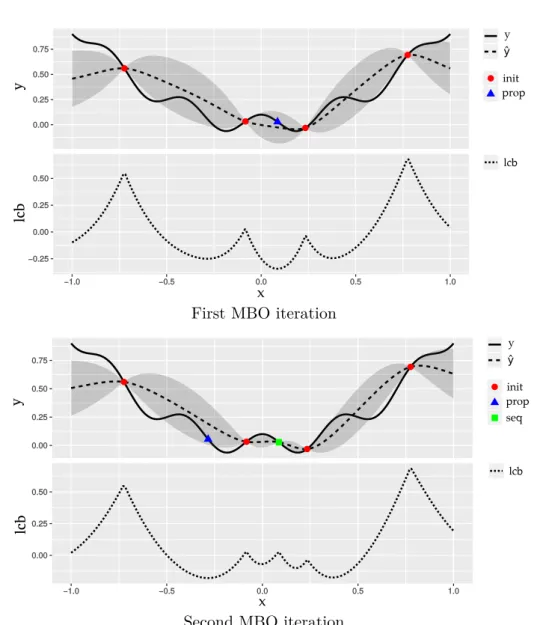
SMBO Example: Figure 2.3 visualizes two exemplary MBO iterations steps. Here, y (solid line) in the upper parts of both MBO iteration steps denotes the output of the unknown black-box function f while yˆ (dotted line) denotes the outputs of the surrogate regression model ˆf that tries to approximate the black-box function. The gray area aroundyˆrepresents the uncertainty of the surrogate model. In the first MBO iteration (see Figure 2.3, upper part) the initial set of configu-rations (red dots) are already evaluated. Based on the corresponding minimum of the infill criterion in the lower part of the MBO iteration figures (dotted line, lcb) a new configuration (blue triangle upper part) is proposed for evaluation.
In thesecond MBO iteration (see Figure2.3, lower part) ˆf is refitted with the evaluated configuration (green rectangle) and a new configuration is proposed (blue triangle) based on the infill criterion (lcb). This process continues until the budget is exhausted. This popular Efficient Global Optimization (EGO) algorithm was proposed by Jones et al.[JSW98].
Surrogate Model: EGO sequentially proposes one point to be evaluated after another using Kriging as a surrogate and theExpected Improvement (EI) as an infill criterion(2.3). Kriging (also called Gaussian process regression) is one of the most popular and flexible variants of a surrogate model [RW05;JSW98]. It is recommended
y lc b x init prop y ŷ lcb
First MBO iteration
lc b y x init prop y ŷ lcb seq
Second MBO iteration
Figure 2.3: Visualization of two exemplary SMBO iterations with the Lower-Confidence Bound (LCB) as infill criterion.
when the input domain is numeric X ⊂Rd. If X contains, e.g., categorical variables, the Random Forest algorithm is commonly used as surrogate [HHL11].
Infill Criterion: The infill criterion guides the optimization by quantifying the improvement of a configuration xbased on a compromise between good predicted outputs ˆµ(x) (exploitation) and uncertainty about the search space region ˆs(x)
(exploration). The former described surrogate model based on Kriging is often combined with the popular EI criterion or with the Lower-Confidence Bound (LCB) criterion.
The EI criterion is defined as follows: EI(x) =E(max(ymin−µˆ(x),0)) = (ymin−µˆ(x))Φ( ymin−µˆ(x)) ˆ s(x) ) +sˆ(x)ϕ( ymin−µˆ(x) ˆ s(x) ). (2.3)
Here, Φ is the distribution,ϕis the density function of the standard normal distri-bution and ymin is the best observed objective value so far.
Alternatively, the comparably simpler LCB infill criterion can be utilized:
LCB(x, λ) =µˆ(x) −λsˆ(x), λ∈R, (2.4)
where ˆµ(x)denotes the posterior mean and ˆs(x)the posterior standard deviation of the surrogate model for configuration x. Exploitation and exploration are balanced, a good (low) expected value of the solution ˆµ(x) is rewarded, and high estimated uncertainty ˆs(x) is penalized. The λvariable guides the exploration-exploitation trade-off.
In addition to the presented infill criteria, several other infill criteria [Jon01], spe-cializations, e.g., for categorical search spaces like in the SMAC Framework [HHL11] and noisy optimization [RGD12] have been introduced. In this thesis, we will focus on the EI and LCB criterion.
Both EI and LCB are very popular and can be used for SMBO, where only one point is proposed per MBO iteration. To allow for parallelization within one MBO iteration, multiple points need to be proposed per iteration. To accomplish this, infill criteria based on the defined EI and LCB were suggested in [GLC10;HHL12] and will be explained in more detail in Section6.1.
In the next section, the R language environment, which is used for the develop-ment of efficient model-based optimization within this thesis, will be presented.
2.2
The R Language Environment
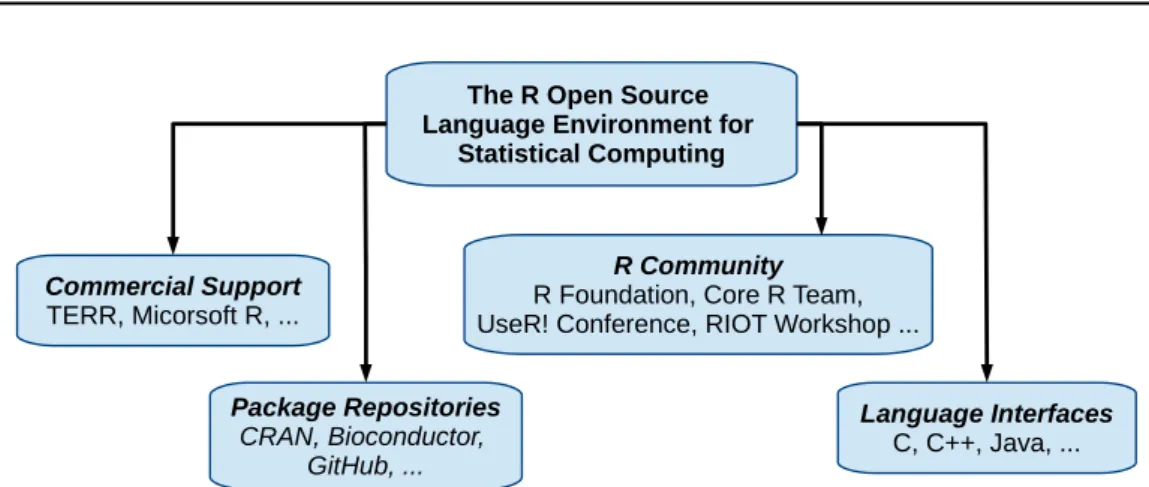
The R language was designed by Ihaka and Gentleman and first released in 1993 [IG96]. It is influenced by two languages, the statistical programming language S [BC84] that was developed at Bell Laboratories in 1980 and the Scheme program-ming language [Dyb09]. Figure2.4 visualizes the most important parts that the R language environment is built on and influenced by.
R is maintained by the R Core Team and the R Foundation of statistical computing and is available under the GPL license [R C18b]. R has also commercial support like the TERR environment, developed by TIBCO [F18] orMicrosoft R, former Revolution R, provided by Revolution Analytics and is used and supported by many other global companies like Google, Oracle, Microsoft and IBM.
Figure 2.4: Categories that influence and build up the R language environment.
The R implementation includes about 700 built-in packages. Packages are libraries including R functions that can be dynamically loaded into an R program. Besides the built-in packages that contain the basic functions of R, R can be extended with over 13,000 packages, available on different repositories like CRAN3, Bioconductor4, and GitHub. The CRAN repository offers several task views where those packages are sorted by topics.
Once a year the R community meets at the UseR! conference to present and discuss their new packages and optimizations for R. Furthermore, since 2015 a group of researchers, including members of the Core R Team that concentrates on alternative R implementations and performance optimizations for R meet once a year at the R Implementation, Optimization and Tooling Workshop(RIOT).
Since R is highly extensible, it caninterface with other languages, thus packages contain not only R code but also code from other languages like C, C++, or Fortran [R C18d]. The R language has so far no formal language specification. There exists only a first draft that was published at the end of 2017 [R C17b], the specification is only given by R’s source code that is frequently changed.
The R Language is processed by an Interpreter that is mostly written in C code. In 2011 a bytecode compiler was added to the R language by Tierney [Tie01]. It provides the option to compile R code into a bytecode representation for faster evaluation. This enables optimizations which are generally beneficial for explicit loops in R code. R is commonly used interactively via a command-line interface, called
Read-Eval-Print-Loop (REPL) that supports the rapid prototyping of statistical applications [R C18a]. The next section presents the language characteristics of R.
3
CRAN:http://cran.r-project.org, 2018
4
2.2.1 Language Characteristics
R is a vector-based language with functional paradigms but also has object-oriented characteristic and is dynamically typed. This section is based on the draft of the R language specification [R C17b] and the analysis of the R languages characteristics by Morandat et al. [MHO+12].
Vector-based: In R everything is an object that is represented by a so-called S-Expression (symbolic expression) in the underlying C code representation [R C18c]. The S-Expression type describes how the contents of the object are treated, which is important for the execution by the interpreter. The basic data structure in R is a vector object. Vectors contain elements of the same type, e.g., primitive data types like, logical, integer, real, complex, character or raw.
The values of a vector can be accessed via indexing operations, e.g., x[3] -returning the third element of vectorx. Missing observations, which are commonly needed in statistics are represented by the value NA. Vectors that contain values of any type of an R object are called lists or generic vectors. R objects can contain attributes. Attributes are name-value pairs. For example, if a vector contains an attribute called “dim” (dimension) this vector represents a matrix.
Furthermore, R offers special compound objects called factors and data frames.
Factors are used to categorize data and are stored as a vector of integers with a corresponding set of characters. Data frames are used for storing data tables. They consist of a generic vector of vectors, factors or matrices. R has also several other data types used for internal processing like environments, function objects, built-in objects, pairlists or promises (for further details see Chapter3).
Functional paradigms: In R functions are treated as first class objects. They can be manipulated as any other R object, returned by other functions, and passed as arguments to other functions. Function objects consist of an argument list, a function body, and an environment and are thus closures. An environment is created when a function is called and contains references to variables that can be accessed and manipulated by the function. Thus functions arelexically scoped like in imperative programming languages. R also provides a global environment and environments for packages.
Each argument of a function is stored in a promise for lazy evaluation. A promise contains the reference to the lexical environment of the argument. R provides referential transparency by passing arguments by deep copy (pass-by-value semantics) except for environments that are passed by reference. However, side effects are possible, since the environment of a function that holds the variables, can be manipulated after its creation.
Dynamic characteristics and computing on the language: The R program-ming language has a dynamic type system, arguments that are passed to a function
are frequently type checked or converted inside the function. Furthermore, R allows for computing on the language. The user can create new language objects at runtime to store code that can then be passed around and executed via the so-called “eval” function. Environments can directly be created by the user. They can be attached to the search path or to a function. The concept of reflection allows the manipulation of variables inside environments including the call stack.
Object-oriented: R supports several object-oriented systems that are influenced by the functional characteristics of the language and thus different from languages like Java or C++. The two most popular ones are called S3 and S4 [Cha16].
The S3 system is based on so-called generic functions with single dispatch and has no formal definition of classes. Instead of the object, the generic function decides which method is called. An S3 object has an attribute attached called “class” attribute. This attribute is a vector of strings that is used to decide in which order methods are resolved. The generic functions take the S3 object as a parameter and look up the class attribute to dispatch the matching function from most to least specific. This system is commonly used in R and also applied for the internal parts of the interpreter to dispatch on built-in functions.
TheS4 system also uses generic functions like S3, but introduces formal classes that define the inheritance structure instead of just using an attribute. Furthermore, it allows for multi-methods, meaning that the method dispatch supports multiple arguments to decide which method to call. The S4 system is complex and not that often used compared to the S3 system.
2.2.2 Execution Model
The R language is evaluated by an interpreter [R C17b]. This evaluation process is visualized in Figure 2.5.
The R Parser converts the textual R code expressions into an internal repre-sentation that represents an Abstract-Syntax-Tree (AST). The AST consists of R language objects like language expressions (Exp) and constant values (C) or symbols (S). It is traversed and executed by the R Evaluator. The evaluator returns the
value (V) of the parsed expression.
Most language objects in this AST are stored as function calls that contain the function name and a list of arguments. Function objects are dispatched to the evaluation of their bodies together with their argument lists that are stored as promises for lazy evaluation. Each time a function is invoked a context is created and placed on a stack that is needed for error handling or control flow operations like the return operation. When the evaluation of the context has finished, it is removed from the stack [R C17b].
Figure 2.5: Execution Model of the R Language.
2.3
Summary
This chapter provided an overview on the fundamentals of this thesis including MBO -a m-achine le-arning -algorithm with huge resource dem-ands - -and the R progr-amming language - the de facto standard software environment for the development of statistical learning applications.
In the following chapters, different methods for efficient resource utilization in statistical machine learning algorithms based on the R programming language will be presented. While Chapter3and Chapter4focus on single-threaded machine learning applications and their resource bottlenecks induced by the R programming language, Chapter5 and Chapter 6will focus on parallel machine learning applications and the optimization of the parallel variant of the described MBO approach.
Profiling of Machine Learning
Algorithms
This chapter presents an analysis of the resource utilization of statistical learning algorithms implemented in the R programming language and is based on the papers by Kotthaus et. al. [KKL+14;KKK+14]. GNU R is the most widely used programming language for statistical data analysis in general, and biostatistics in particular. While apparently not affecting its popularity, its lavish use of resources makes it unsuitable in an environment where high performance is required, or where computation and memory resources are scarce. Here, runtime performance and memory consumption are critical aspects, that can lead to unacceptably long execution times. To solve this problem it is important to find out where the bottlenecks are and thus where the biggest room for improvement lies.
One major hurdle for efficient R programs is that classical ahead-of-time compi-lation of R code is hindered by R’s highly dynamic nature. This leads some users to re-implementing performance critical parts of their algorithms in C or C++ to achieve a higher execution speed. However, translating bigger parts of an R program to another language is a complex task, since R programs rely on functions from R libraries or basic functions included in the R interpreter execution environment that might not be readily available in other environments.
In fact, one of the main drivers behind R’s popularity is the vast amount of available open source software packages, a fact that has also proven to be a near-insurmountable obstacle for alternative statistical computation languages that have since been proposed [Tie18;RIn18]. In spite of R’s well-known performance issues, these languages have never gained any significant traction within the statistics community. In recent years, multiple approaches have been developed to improve the execution speed of R applications. There are projects with the goal to create alternative, more efficient R implementations [Ber18; TDH12;KMM+14;KE18]. However, most of these are experimental, with only a few users due to compati-bility problems with the available R software libraries. Other projects [WWP14; Nea18] attempt to provide a faster R by modifying the original GNU R to stay compatible with the available R libraries without the need of reimplementation. All of these projects have usually shown improvements for simple R programs and micro-benchmarks, but they exhibit fairly mixed results when it comes to speeding up complex real-world applications like machine learning algorithms.
Optimizations for a faster execution and also for an efficient resource utilization of statistical learning algorithms based on R can only be profitable if they cover two aspects: Staying compatible with the available software packages most R programs are based on, and simultaneously covering the real resource bottlenecks of those algorithms. It is therefore indispensable to analyze the runtime and memory consumption characteristics of learning algorithms. With the analysis of bottlenecks arising during execution, the optimization potential for resource utilization can be estimated and new efficient optimizations can be developed. The R execution environment already includes profiling tools such as Rprof for analyzing bottlenecks, but the analysis is restricted to high-level characteristics only. In particular, internal functions like memory management of the R Interpreter itself are outside of the scope of what can be profiled. For a precise analysis, new profiling mechanisms need to be developed to analyze runtime and memory behavior of real-world R programs. The objective of this chapter is to analyze the resource utilization of statistical learning algorithms to support the development of new optimizations that enable these algorithms to scale to larger problem sizes. As a first step towards this goal, the most common classification algorithms are analyzed with respect to their resource requirements, to determine where the highest optimization potential lies. To accomplish this, an R profiling framework, called traceR [tra18], is redesigned and enhanced. Even if the analysis is focusing on learning algorithms, the results also support the development of new optimizations for the R programming language in general.
This chapter is structured as follows: First, Section2.2gives an overview of the R language environment including the R language characteristics and execution model of R. First, the related approaches of optimizations for the R language are presented in Section 3.1. Section3.2 then describes the profiling framework that serves as a basis for the performance analysis. An overview of the machine learning benchmarks and their input data sets used in the analyses is given in Section 3.3, followed by a detailed analysis of their runtime and memory behavior. This analysis serves as a starting point for developing approaches to overcome the identified bottlenecks. Finally, the results are summarized in Section 3.4.
3.1
Optimizations for R - Existing Approaches
A major hurdle for general speedups of R programs is that R is executed by interpretation as opposed to it being compiled to machine code. Classic ahead-of-time compilation of R code is hindered by the fact that R is highly dynamic. Thus information like data types which is needed for optimizations in the compiler is only available at runtime. For example, when a function is declared in an R program, no data types need to be specified for the parameter list. When such a function is called, there are multiple ways to pass the same set of arguments. These features make R very convenient for the user, but very inconvenient for ahead-of-time compilation.
Other languages with a similarly dynamic nature like Matlab or Python have overcome such runtime issues by using Just-In-Time (JIT) based compilation ap-proaches [AP01;BCF+09]. These approaches use knowledge gained at runtime to specifically compile fragments for the time-intensive parts instead of either compiling the entire program at once or interpreting the program statement-by-statement.
One popular runtime environment that provides a just-in-time compilation is theJava Virtual Machine (JVM) [LYB+14]. Kotthaus et al. [KPM12] presented a concept for implementing an optimized version of R by targeting the JVM. Exist-ing alternative R execution environments that also target the JVM are the fastR project [KMM+14;SWH+16] and Renjin [Ber18]. But also other VM implemen-tations were utilized to speed up R, e.g., the NQR project that targets the Parrot VM [KE18]. Furthermore, approaches that propose experimental specialized JIT compilers for R exist [TDH12; TDH14]. These approaches reimplement the original R interpreter that is written in C, in another language such as Java or C++ and benefit from optimizations available to their runtime environments. However, the reimplementations cannot yet guarantee full compatibility with existing R programs and libraries due to the complex and evolutionary development of the R language and its missing formal specification.
Other projects like pqR [Nea18] or Orbit VM [WWP14;WPW15] attempt to provide a faster R interpretation by modifying the original R interpreter instead of reimplementing GNU R to stay compatible. The original GNU R execution environment also contains the option to compile R functions into byte code for faster evaluation which provides some improvement in runtime especially for programs that use loops [Tie01]. Furthermore, additional libraries were developed to speed up arithmetic operations by taking advantage of specific processor architecture features like the Intel MKL [Int18] library or OpenBLAS [ZWW18]. Such libraries are opti-mized implementations of the reference BLAS (Basic Linear Algebra Subprograms) library that is included in the R execution environment.
All of the described optimization approaches have usually shown improvements for simple R programs or specific R functions, but they exhibit fairly mixed results when it comes to speeding up complex real-world applications like machine learning algorithms. One of the objectives of this thesis is to provide insights into the runtime and memory behavior of these algorithms on the original R execution environment. The hope is that both alternative R implementations as well as the original GNU R can use these results to develop optimizations that improve the runtime performance and resource utilization of real-world code.
Morandat et al. [MHO+12] already analyzed bottlenecks for R programs from different fields of statistics. Here, mostly artificial input data sets where used. However, as the characteristics of the input datasets vastly influence the runtime behavior of a program, only realistic data can yield results which are beneficial in practice. In this thesis, we focus specifically on machine learning algorithms combined with real-world input data sets from the UC Irvine machine learning repository (UCI) [BL18] in order to ensure a realistic scenario when analyzing